A
Species Profile

Albatross

Diomedeidae

Born to ride the wind
wildestanimal/Shutterstock.com

Albatross Ocean Range

Marine Species

Albatrosses (Diomedeidae) are mainly pelagic birds of the Southern Hemisphere, found around the Southern Ocean and adjacent South Atlantic, South Pacific and Indian Oceans. Major lineages occur in the North Pacific (including the Bering Sea and Sea of Japan). Individuals travel thousands of kilometers, staying offshore and breeding on remote islands or few coastal sites.

Loading ocean map...

Ocean Regions 12

southern_ocean indian_ocean south_atlantic north_atlantic south_pacific north_pacific atlantic_ocean pacific_ocean tasman_sea coral_sea bering_sea sea_of_japan
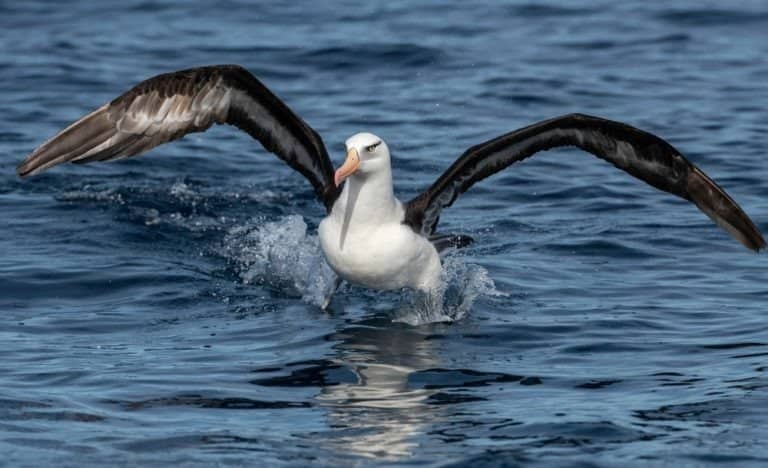
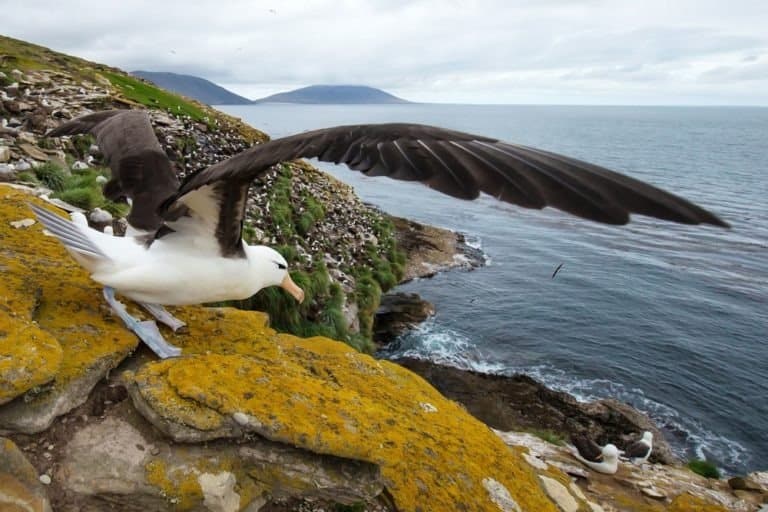
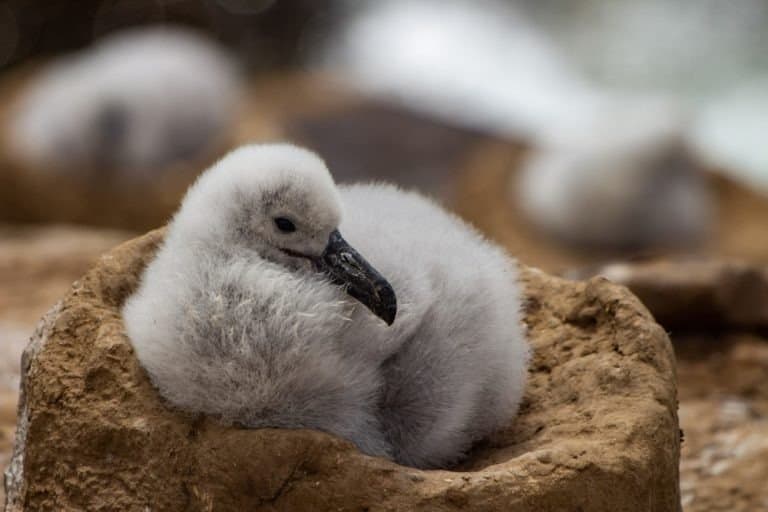
Black browed albatross, North Island, New Zealand.

At a Glance

Family Overview This page covers the Albatross family as a group. Stats below are general traits shared across the family.
Also Known As Gooney, Gooney bird, Goony, Mollymawk, Tubenose, Tubenosed seabird
Diet Carnivore
Activity Diurnal+
Lifespan 35 years
Weight 12 lbs
Status Not Evaluated
Did You Know?

The largest albatrosses have the greatest wingspans of any living bird-up to about 3.7 m in the family's biggest species.

Scientific Classification

Family Overview "Albatross" is not a single species but represents an entire family containing multiple species.

Albatrosses are large, ocean-going seabirds specialized for dynamic soaring and long-distance flight, spending most of their lives at sea and returning to land mainly to breed in colonies on remote islands.

Kingdom
Animalia
Phylum
Chordata
Class
Aves
Order
Procellariiformes
Family
Diomedeidae

Distinguishing Features

  • Very long, narrow wings adapted for soaring (some species with the largest wingspans among birds)
  • Tubular nostrils on the bill (a hallmark of Procellariiformes) aiding salt excretion and olfaction
  • Strong association with open-ocean habitats; come to land mostly for nesting
  • Long-lived, slow breeding life history (often one egg per breeding attempt)

Physical Measurements

Males and females differ in size

Length
2 ft 11 in (2 ft 4 in – 4 ft 5 in)
Weight
15 lbs (6 lbs – 26 lbs)
11 lbs (5 lbs – 19 lbs)
Tail Length
7 in (5 in – 9 in)
6 in (4 in – 8 in)
Top Speed
75 mph
Usually 50–80 km/h

Appearance

Primary Colors
Secondary Colors
Skin Type Feathered body with dense waterproof contour feathers; bare skin on legs, feet, and around the bill base; large bill with keratin plates and tubenose nostrils; fully webbed feet and supraorbital salt gland.
Distinctive Features
  • Measurements (range across the family, smallest to largest members): body length ~70-135 cm; wingspan ~1.9-3.7 m (among the largest of any flying birds); mass ~2-12+ kg (varies by species, sex, season, and condition).
  • Lifespan (range across species): commonly several decades; many species frequently reach ~20-50+ years, with some individuals documented around ~60+ years. Maturity is delayed (often ~5-15 years depending on species).
  • Albatrosses soar across the open ocean using dynamic and slope soaring. They have very long, narrow wings with a wing-lock to save energy, so they live mostly at sea and land to breed or roost.
  • Foraging: primarily surface-seizing and shallow plunging; diet typically includes squid, fish, and crustaceans, plus scavenging (including fishery offal). Foraging strategies vary by genus/species (some more squid-focused, some more fish/scavenging) and by ocean basin.
  • Breed in colonies on remote islands and coasts. They often return to the same site and keep long pair bonds. Usually one egg, long nesting and chick care; some, especially larger Diomedea, skip years.
  • Habitat breadth within the family: largely Southern Ocean/subantarctic and temperate waters, with some North Pacific taxa; species differ in latitudinal range, preferred wind regimes, and association with productive oceanographic features (fronts, shelf edges, upwellings).
  • Tubenose adaptations: external nasal tubes and enhanced olfaction aid locating patchy prey and carrion; production of energy-rich stomach oil used for chick provisioning and defense.
  • Conservation threats (family-level): many species are threatened primarily by fishery bycatch (longlines, trawls), plus invasive predators at colonies, habitat degradation, and climate-driven shifts in wind/food availability.
  • Mitigation (general): bird-scaring/tori lines, night setting, weighted lines and faster sink rates, hook shielding/underwater setting devices, offal management, spatial/temporal closures, and strict invasive predator control and biosecurity at breeding islands.

Sexual Dimorphism

Generally subtle: most species show limited plumage dimorphism, but males are often slightly larger/heavier with proportionally larger bills (degree varies by species). Some taxa show small differences in head/neck coloration intensity or extent, and juveniles/subadults can differ markedly from adults, which can be mistaken for sex differences.

  • On average slightly larger body size and wingspan; heavier mass in many species.
  • Often larger/longer/deeper bill; sometimes more robust head/neck profile.
  • In a few species, head/neck coloration may appear a bit brighter or more extensive (variation is species- and age-dependent).
  • On average slightly smaller and lighter; differences can be minor and require measurements to confirm.
  • Typically slightly smaller bill dimensions (species-dependent).
  • Plumage usually similar to males; age-related plumage changes can be more pronounced than sex-based differences.

Did You Know?

The largest albatrosses have the greatest wingspans of any living bird-up to about 3.7 m in the family's biggest species.

They can travel thousands of kilometers on a foraging trip, often circling entire ocean basins using wind patterns.

Most albatrosses form long-term pair bonds and invest heavily in a single chick per breeding attempt.

Their "tubenose" nostrils and strong sense of smell help them locate patchy prey and productive ocean fronts.

Special salt glands let them drink seawater and excrete concentrated brine through the nasal tubes.

Some species breed annually, while others commonly skip years-especially after raising a chick-depending on food conditions and species.

Many populations are harmed by longline and trawl fisheries, but proven fixes (bird-scaring lines, weighted hooks, night setting) can sharply cut bycatch.

Unique Adaptations

  • Extreme wing design for gliding: long, narrow wings (high aspect ratio) reduce energy cost over open ocean; size and wing loading vary across genera (e.g., Diomedea vs Thalassarche).
  • Shoulder "lock" mechanism: tendons can help hold wings outstretched with minimal muscular effort during long glides.
  • Procellariiform "tubenose" anatomy: external nasal tubes support keen olfaction and help manage salt excretion; shape and placement vary among genera.
  • Salt glands: supraorbital glands remove excess salt, allowing routine drinking of seawater.
  • Olfaction-driven foraging: strong smell sensitivity aids detection of prey-related odors and productive oceanographic features-unusual among birds but characteristic in tubenoses.
  • Downy, well-insulated chicks: adapted to windy, cold, exposed breeding sites in many Southern Ocean species; other species breed in milder North Pacific climates, showing ecological spread across the family.
  • Long life history: delayed maturity, low reproductive rate, and high adult survival-an adaptation to variable ocean food webs, but one that makes populations sensitive to added adult mortality (e.g., bycatch).

Interesting Behaviors

  • Dynamic soaring and slope soaring: family-wide reliance on wind gradients over waves; strongest in the great albatrosses, but used by all to varying degrees.
  • Pelagic lifestyle: most of life is spent at sea; land is mainly for breeding, courtship, and chick rearing on remote islands or isolated coasts.
  • Colonial breeding: dense to scattered colonies; habitat ranges from low sandy atolls (some North Pacific species) to subantarctic tussock and cliffs (many Southern Ocean species).
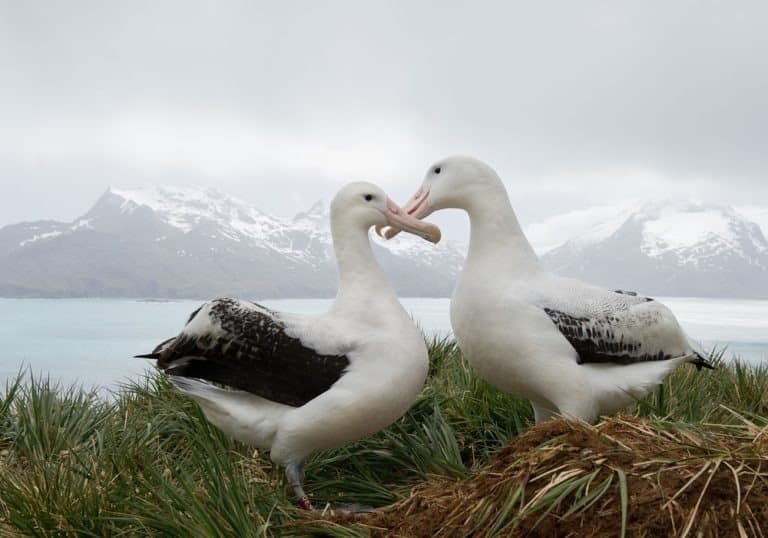
  • Elaborate courtship "dances": ritualized bill-clacking, sky-pointing, and synchronized displays; display repertoires vary by species and genus.
  • One-egg strategy: typically a single egg, long incubation and chick-rearing periods; breeding intervals vary from annual to biennial (or longer after poor seasons).
  • Wide-ranging foraging: diets commonly include squid, fish, and crustaceans; some species scavenge more, others target live prey, and foraging zones differ (subtropical vs subantarctic vs temperate).
  • Strong site fidelity: many return to the same colony (and often the same nesting area) across decades, though dispersal rates vary among species.
  • Interactions with fisheries: attraction to bait and discards can increase risk; mitigation uptake differs regionally, driving variation in threat levels across the family.

Cultural Significance

Albatrosses (Diomedeidae) are symbols of the open ocean, endurance, and omens. Coleridge's poem The Rime of the Ancient Mariner made "an albatross around one's neck" mean a heavy guilt. Pacific peoples know Laysan Albatross nesting sites. Today they are flagship species for cutting seabird bycatch and saving remote island ecosystems.

Myths & Legends

Maritime folklore long held that albatrosses were lucky birds to sailors-sometimes said to carry the souls of drowned seamen-so harming one could bring misfortune at sea.

In Samuel Taylor Coleridge's 1798 poem The Rime of the Ancient Mariner, an albatross first brings good luck; after sailors kill it, disaster follows, and the dead bird is hung around the Mariner's neck.

Sailors long believed an albatross could mean weather or wind was changing. This omen comes from ship stories and shows the bird's close link to wind and open-ocean travel.

Historical naming lore: early European sailors' use of "albatross" (linked through earlier forms to Portuguese/Spanish seabird names) helped cement the bird as an icon of the far seas in travel narratives and maritime storytelling.

Conservation Status

NE Not Evaluated (family-level taxon not assessed by IUCN; individual Diomedeidae species span a wide range of categories from Least Concern to Critically Endangered, with a substantial proportion globally threatened)

Has not yet been evaluated against the criteria.

Population Decreasing

Protected Under

  • Agreement on the Conservation of Albatrosses and Petrels (ACAP) (applies to many species)
  • Convention on Migratory Species (CMS) (many species listed)
  • CITES listings for several albatross species (commonly Appendix II)
  • National protected-species laws and breeding-island protections in multiple range states/territories
  • Site-based protection via protected areas/MPAs at a number of key breeding islands and surrounding waters (coverage variable)

You might be looking for:

Wandering Albatross

22%

Diomedea exulans

Largest wingspan of any living bird; iconic Southern Ocean albatross.

View Profile

Laysan Albatross

18%

Phoebastria immutabilis

Common North Pacific species; major colonies in the Northwestern Hawaiian Islands.

Black-browed Albatross

16%

Thalassarche melanophris

Abundant subantarctic species; bold dark eyebrow and orange bill.

Royal Albatross (Southern/Northern complex)

12%

Diomedea epomophora

Very large albatrosses breeding mainly in New Zealand; often discussed together as “royal albatrosses.”

Short-tailed Albatross

10%

Phoebastria albatrus

Rare North Pacific albatross recovering from historical feather hunting.

Life Cycle

Birth 1 chick
Lifespan 35 years

Lifespan

In the Wild
15–70 years
In Captivity
10–60 years

Reproduction

Mating System Monogamy
Social Structure Socially Monogamous
Breeding Pattern Lifelong
Fertilization Internal Fertilization
Birth Type Internal_fertilization

Albatrosses (Diomedeidae) are mainly socially monogamous, forming long-term, often lifelong pairs after showy courtship dances. Divorce or extra-pair mating is rare. Pairs mate internally, lay one egg, and both parents incubate and feed the chick.

Behavior & Ecology

Social Colony Group: 1000
Activity Diurnal, Crepuscular, Cathemeral, Nocturnal
Diet Carnivore Squid/other cephalopods (common across many species, but importance varies by ocean basin and species)
Seasonal Migratory 6,214 mi

Temperament

Generally non-territorial at sea; interactions are usually tolerant with occasional competitive aggression around concentrated food sources (e.g., carcasses, bait, or dense prey patches).
Strong mate and site fidelity are widespread; breeding adults are often highly attached to specific nest areas, though the degree of nest spacing and local defense varies from tightly packed colonies to more dispersed nesting.
Courtship is highly ritualized and socially important across the family; display intensity and repertoire vary by species and can include extended pair-bond reinforcement even outside peak mating.
Albatrosses mature late, breed slowly, and have high adult survival. Many live for decades—about 20–30+ years in shorter-lived species to 50–60+ in the longest, with rare older birds.
Size and habits vary within Diomedeidae, from smaller mollymawks to great albatrosses. Most make long trips, soar on winds, use rich ocean areas, and grab surface food, leftovers, or squid.
Albatrosses (Diomedeidae) colonies range from low-density nesting with few neighbor conflicts to high-density sites with more interactions, displays, and some fighting; predators and people's actions also change behavior.

Communication

Brays, groans, croaks, and moaning calls used most prominently in colony contexts Mate recognition, spacing, and social interactions
Rhythmic bill clattering/snapping sounds incorporated into courtship sequences.
Chick and adult contact calls at the nest; intensity and structure vary by species and colony noise levels.
Elaborate visual courtship displays (e.g., sky-pointing, head and neck postures, wing-spreading, synchronized movements) that function in pair formation and maintenance across the family.
Tactile behaviors such as billing, allopreening, and body contact used in bonding and reassurance, especially between mates.
Olfactory cue use is important in Procellariiformes; albatrosses can use smell for locating food patches and potentially for individual/colony cues, with reliance varying by species and environmental conditions.
Spatial signaling and spacing behavior (postures, orientation, and threat displays) used to manage neighbor distance in colonies, with more frequent signaling in denser colonies.

Habitat

Open Ocean Deep Sea Coastal Rocky Shore Cliff/Rocky Outcrop Beach Grassland Tundra Shrubland +3
Biomes:
Marine Tundra Temperate Grassland
Terrain:
Island Coastal Rocky Sandy Volcanic
Elevation: Up to 4921 ft 3 in

Ecological Role

Upper-level marine predator and opportunistic scavenger across open-ocean food webs; links midwater and surface ecosystems by consuming nekton and zooplankton and transporting marine-derived nutrients to breeding islands.

Regulation of prey populations (fish, squid, crustaceans) Scavenging and recycling of marine carrion and fishery waste (where present) Nutrient transport and enrichment of remote island soils via guano and nesting activity Indicator value for ocean productivity and ecosystem change (diet shifts reflect prey availability)

Diet Details

Main Prey:
Cephalopods Pelagic and mesopelagic fish Krill and other small crustaceans Larger crustaceans Marine carrion Fishery discards and offal

Human Interaction

Domestication Status

Wild

Albatrosses (Diomedeidae) are not domesticated and have no farmed lines. Human contact includes past hunting and egg taking on breeding islands, fisheries bycatch, conservation (island predator control, protected areas, bycatch fixes), and scientific work (tagging, tracking). They live mostly at sea and often live 20–60+ years and face plastics, contaminants, and invasive predators.

Danger Level

Low
  • Bites or pecks when handled or when defending nests/territories (mainly a concern for researchers/wardens)
  • Minor injuries from wing strikes or large hooked bills during capture/rehabilitation
  • Zoonotic and sanitation risks typical of wild seabirds (e.g., exposure to ectoparasites or pathogens via feces/handling)
  • At-sea interactions: birds attracted to fishing gear can create hazardous situations for crew during mitigation efforts, though direct attacks on humans are rare

As a Pet

Not Suitable as Pet

Legality: Albatrosses (Diomedeidae) are illegal or tightly controlled as pets in most places under national and international laws. Only special permits for rescue care, research, or approved zoos may allow handling; private ownership is usually banned.

Care Level: Expert Only

Purchase Cost:
Lifetime Cost: $50,000 - $250,000

Economic Value

Uses:
Ecotourism and wildlife viewing (breeding colonies, pelagic birding) Scientific and conservation value (tracking, climate/ocean indicators) Ecosystem services (nutrient transfer to breeding islands via guano; marine food-web roles) Historic subsistence/harvest value (localized: meat/eggs/feathers; now largely restricted) Fisheries-related externalities (costs from bycatch mitigation and regulatory compliance)
Products:
  • Non-consumptive tourism revenue (guided trips, permits, local services)
  • Research outputs and conservation programs (monitoring, tagging, bycatch-reduction technologies)
  • Historical materials: feathers and other parts (largely ceased/illegal today)

Relationships

Related Species 8

Great albatrosses Diomedea Shared Family
North Pacific albatrosses Phoebastria Shared Family
Mollymawks Thalassarche Shared Family
Sooty albatrosses Phoebetria Shared Family
Petrels and shearwaters Procellariidae Shared Order
Storm petrels Shared Order
Southern storm-petrels Oceanitidae Shared Order
Diving petrels Pelecanoididae Shared Order

Ecological Equivalents 5

Animals that fill a similar ecological role in their ecosystem

Shearwaters Ardenna spp., Puffinus spp. Pelagic seabirds that forage far offshore on squid and fish. They share dynamic use of wind and large foraging ranges, though shearwaters more often use flapping and shear-flight and are generally smaller than most albatrosses.
Giant petrels Macronectes spp. Large Southern Ocean tubenoses that overlap in range and scavenge/forage on squid, fish, and carrion. They share a similar reliance on wind and long-distance travel, but giant petrels are more capable of scavenging and predation on land than albatrosses.
Frigatebird
Frigatebird Fregatidae Highly aerial, oceanic foragers that exploit wind and cover vast distances. They occupy a broadly similar open-ocean niche, though they often pirate food and generally cannot sit on the water like albatrosses.
Gannets and Boobies Morus spp.; Sula spp. Marine birds that feed on pelagic fish and overlap in many ocean regions; they share colonial breeding on islands but differ strongly in foraging method (plunge-diving versus surface-seizing and scavenging, the latter common in albatrosses).
Skuas Stercorarius spp. Often breed near seabird colonies and interact with albatrosses as kleptoparasites and predators of eggs and chicks. They occupy a similar 'seabird colony' ecological arena, even though they are not pelagic soarers like albatrosses.

Types of Albatross

22

Explore 22 recognized types of albatross

Wandering albatross
Wandering albatross Diomedea exulans
Antipodean albatross Diomedea antipodensis
Amsterdam albatross Diomedea amsterdamensis
Tristan albatross Diomedea dabbenena
Southern royal albatross Diomedea epomophora
Northern royal albatross Diomedea sanfordi
Laysan albatross Phoebastria immutabilis
Black-footed albatross Phoebastria nigripes
Short-tailed albatross Phoebastria albatrus
Waved albatross Phoebastria irrorata
Black-browed albatross Thalassarche melanophris
Campbell albatross Thalassarche impavida
Shy albatross Thalassarche cauta
White-capped albatross Thalassarche steadi
Salvin's albatross Thalassarche salvini
Chatham albatross Thalassarche eremita
Buller's albatross Thalassarche bulleri
Grey-headed albatross Thalassarche chrysostoma
Atlantic yellow-nosed albatross Thalassarche chlororhynchos
Indian yellow-nosed albatross Thalassarche carteri
Sooty albatross Phoebetria fusca
Light-mantled sooty albatross Phoebetria palpebrata

The albatross soars gracefully above the oceans, its wings stiff and firm against the strong gusts of wind.

The sight of this familiar seabird and its massive wingspan flying high above the waters has seized the human imagination and inspired myths and folklore around the world for many centuries. It’s a true survivor with all kinds of unique adaptations for dealing with the stressful toll of long periods at sea. But competition with humans for food has caused numbers to rapidly decline.

5 Incredible Albatross Facts!

  • According to an old sailing myth, the albatross bird contains the soul of a dead sailor killed at sea. This could represent a good or bad omen, depending on who believes it, but this rather solemn belief did not necessarily stop people from killing or eating them. This was a major plot point in the 1798 poem The Rime of the Ancient Mariner by Samuel Taylor Coleridge. After the main character of the tale kills an albatross, his ship is then visited by a series of misfortunes, and his fellow sailors force him to carry the dead bird around his head as retribution. This is the origin of the term “albatross around the neck.”
  • The word albatross comes to us from an Arabic word al-qadus or al-gaṭṭas that means literally “the diver.” The Portuguese then adapted it into the word alcatraz (as in the modern American prison). This was later absorbed into English as albatross.
  • Except for the breeding season, the albatross bird is in near constant motion. A typical individual can travel thousands of miles every year.
  • An alternate name of the albatross is goony bird for the comical way in which it lands on the ground, tumbling forward.
  • Bird watching is a popular past time around the world. The colonies of the northern royal albatross in New Zealand attracts some 40,000 people a year.

You can check out more incredible facts about the albatross.
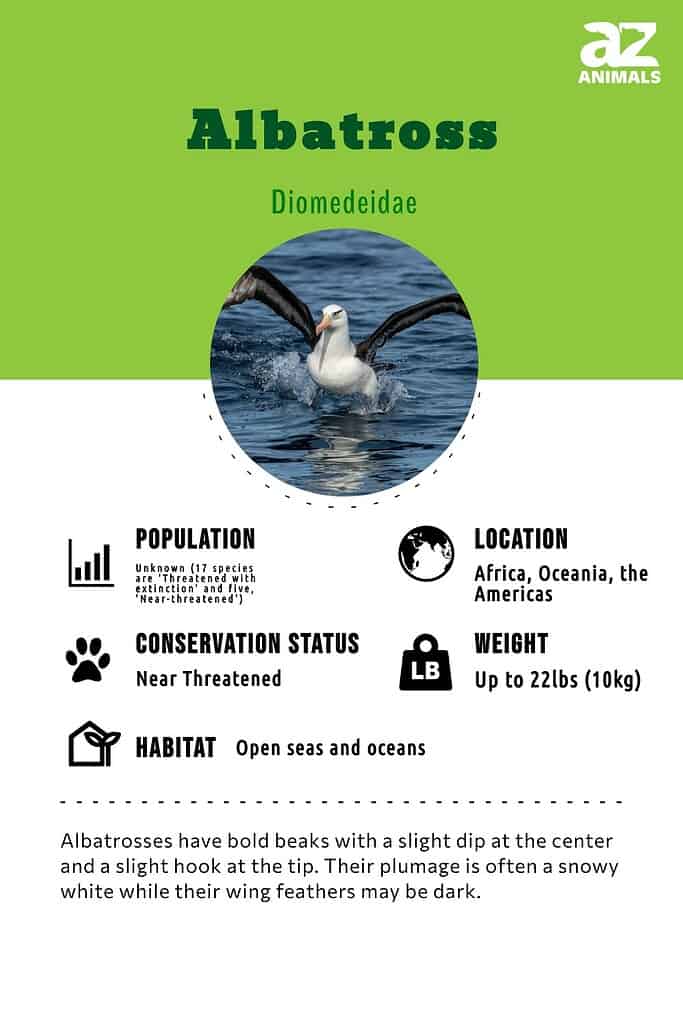
Scientific Name

The scientific name of the albatross is Diomedeidae. This derives from the ancient Greek hero Diomedes, who is said to have participated in the Trojan War. According to one legend, albatrosses sang upon his death. Since the classification of the albatross is controversial, there are anywhere between 13 and 24 species, depending on who’s counting. For instance, taxonomists still debate whether the royal albatross is a single species or two northern and southern species. The albatross belongs to the family of Procellariiformes along with petrels, shearwaters, and other seabirds. The last common ancestor of this family was probably alive more than 30 million years ago.

Appearance
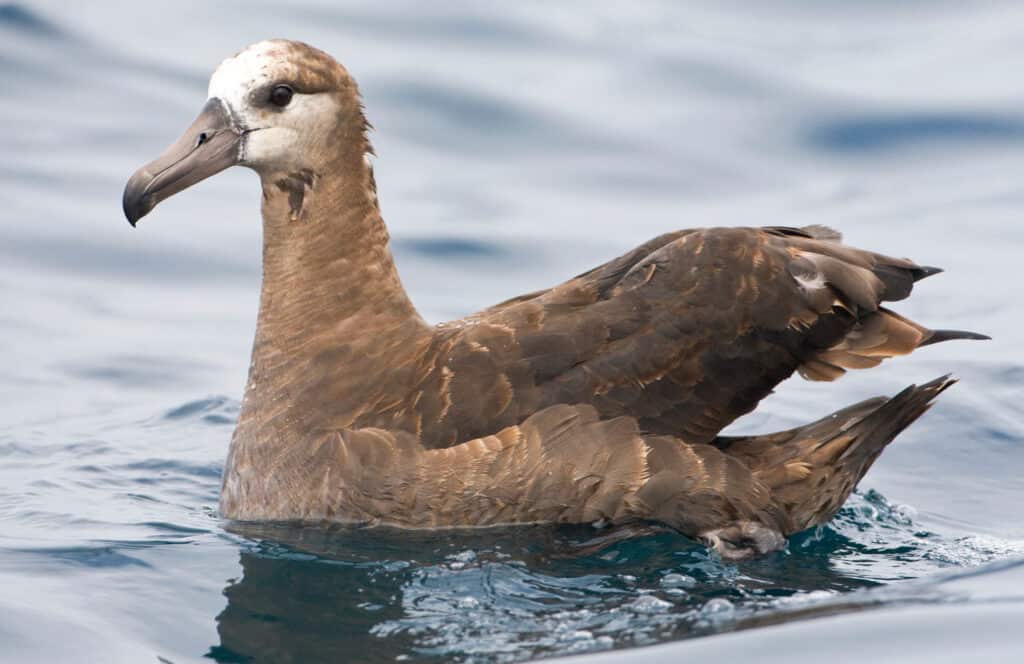
Albatrosses are known for their impressive wingspans

The albatross is a strong big-bodied bird with some variation of white, black, or gray coloration (some species have a single color: the southern royal albatross is almost completely white). The long orange or yellow beak is hooked at the end and contains many horned plates. It also has tubes along the side that enable it to measure airspeed in flight.

The most impressive physical characteristic is the sheer size of the wingspan. Judged by the size of the wings, the great albatross (and the wandering albatross species in particular) is the largest living group of birds in the world, stretching 11 feet from tip to tip. It also weighs up to 22 pounds or about the same size as a swan. Even the smaller species have a wingspan of about 6.5 feet, more than most birds.

The wings are stiff and arched, because the albatross rarely flaps them. Instead, the bird glides on the ocean winds for long periods with minimal body movement. This is a necessary adaptation, because they have a lot of weight to carry around. It also means they cannot fly very well in the absence of wind. But the upside is that the albatross expends almost no energy while in flight.

Evolution
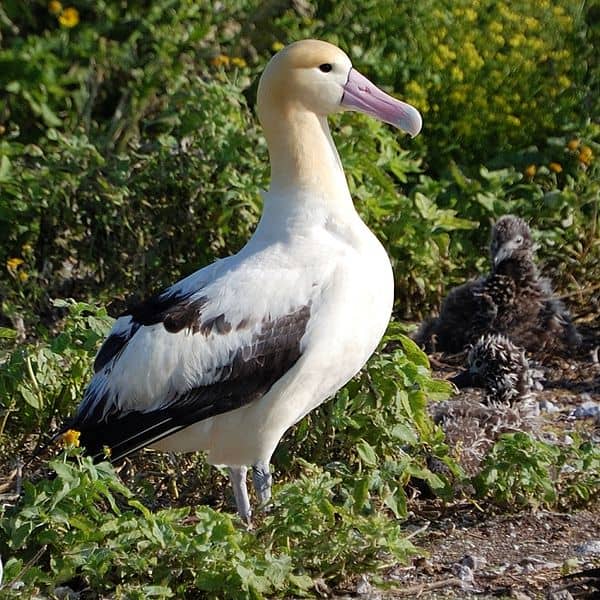
The earliest evidence of albatrosses dates back to the Oligocene era

The earliest fossil evidence of albatrosses, Tydea septentrionalis dates back to the early Oligocene and was discovered in Belgium. Other fossils dating back to the Eocene and the Oligocene have also been found, in Central Asia, New Zealand, and South Carolina.

Experts believe that the great albatrosses and their North Pacific relatives diverged from each other 15 million years ago, while the mollymawks and sooties diverged about 10 million years ago.

Types
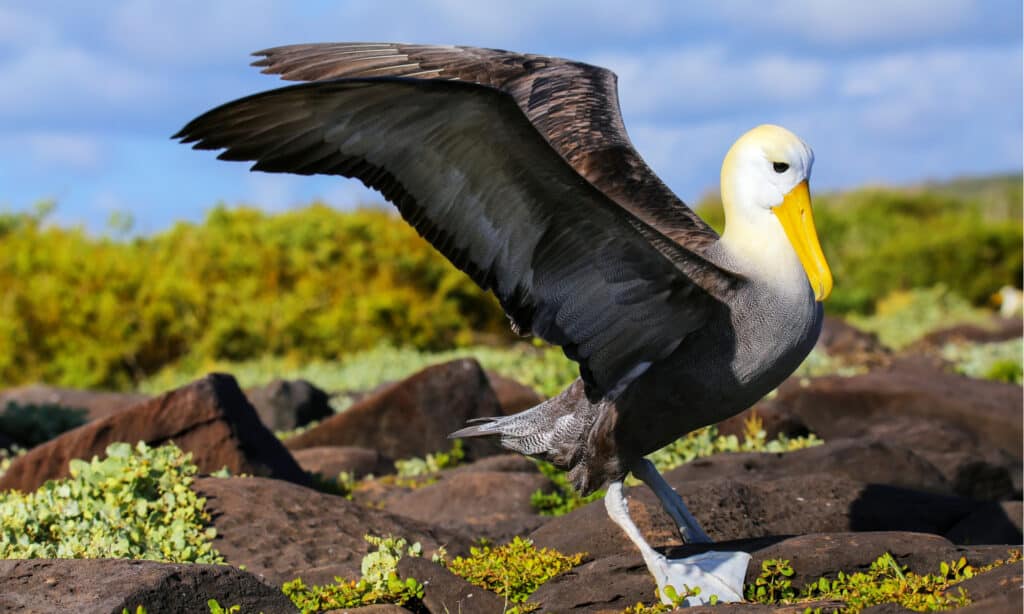
Albatross Vs Seagull- Albatross

There are 22 species of albatross in the world today

There are 22 species of albatross including:

The great albatrosses (Diomedea)

  • Wandering albatross (D. exulans)
  • Antipodean albatross (D. (exulans) antipodensis)
  • Amsterdam albatross (D. (exulans) amsterdamensis)
  • Tristan albatross (D. (exulans) dabbenena)
  • Northern royal albatross (D. (epomophora) sanfordi)
  • Southern royal albatross (D. epomophora)

Behavior
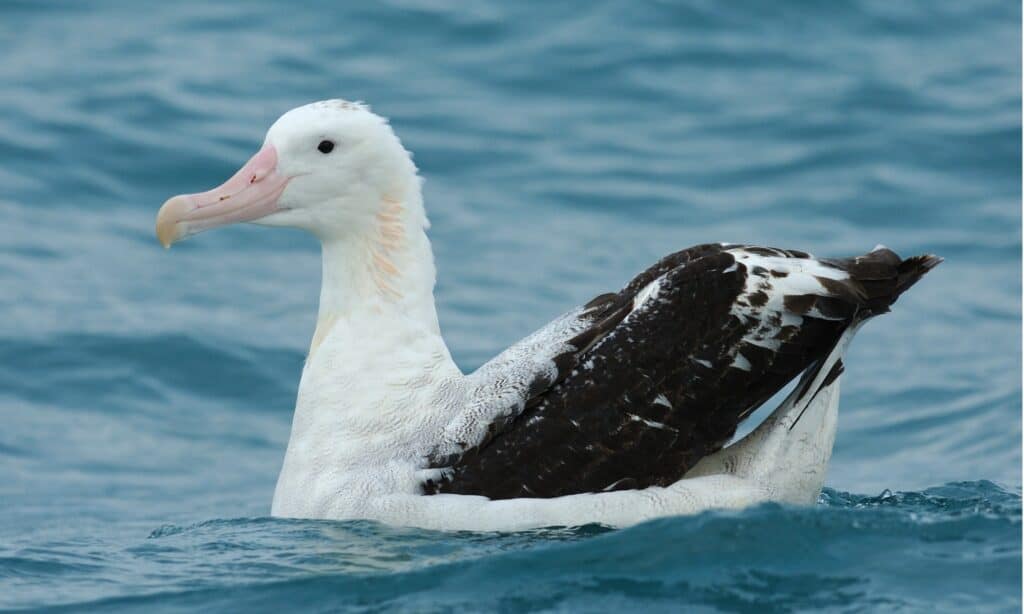
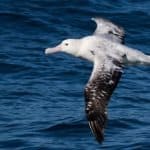
A Wandering Albatross (Diomedea exulans) on the South Pacific Ocean, off Kaikoura, South Island, New Zealand.

Albatrosses are capable of drinking seawater thanks to an organ that gets rid of all that excess salt

The albatross bird is very well-adapted for long periods out at sea. They combine the ability to soar in the air (while expending minimal effort) with the ability to float along the water. Although more vulnerable on the water, the albatross needs to come down occasionally to feed and drink from the ocean. It has a specialized organ that excretes the excess salt it ingests while drinking. Although well-suited for life at sea, the albatross sometimes stops on remote islands for rest. They also return to land in the breeding season and congregate in large colonies which vary in density by species. They seem instinctively to be drawn back to the colony of their birth.

Habitat
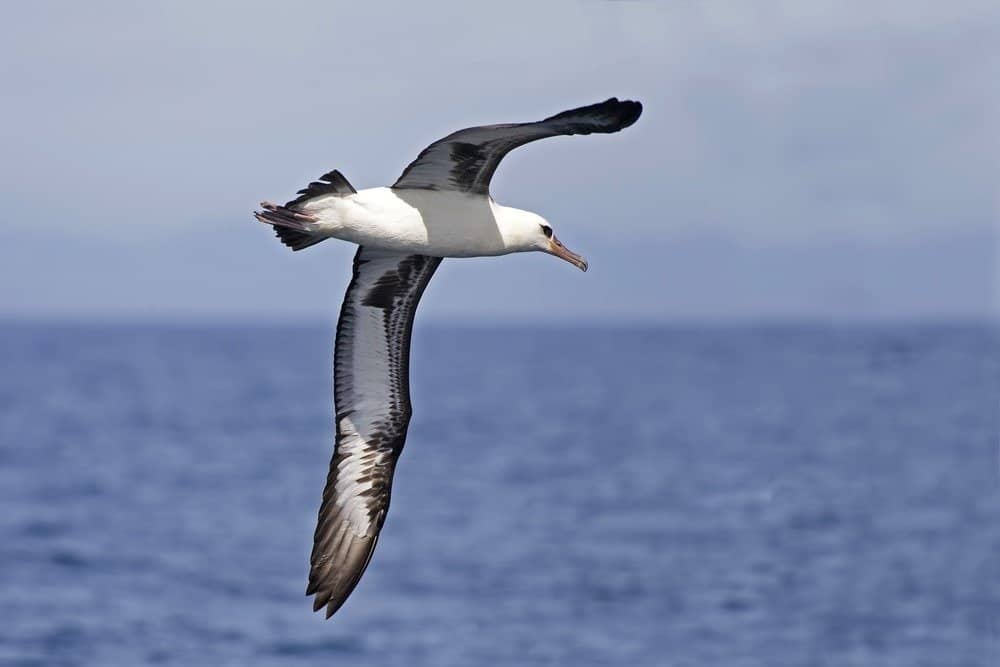
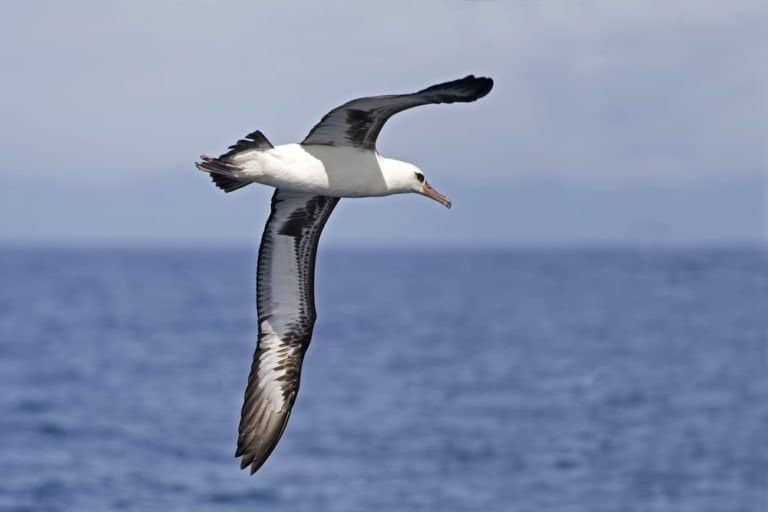
The Laysan Albatross, Phoebastria immutabilis flying over the ocean

Albatrosses are capable of crossing open oceans if a strong wind is present

The albatross is a native resident of the Southern Hemisphere around Antarctica, South America, South Africa, and Australia. In the distance past, it once had a widespread distribution across much of the Northern Hemisphere, but now only a few species inhabit the Northern Pacific region between Alaska, California, Hawaii, and Japan. With the ability to eat seafood and drink saltwater, the albatross has few problems traversing the open oceans. The only thing it really requires is a strong wind for its survival. It has trouble traversing areas where there are gaps in the wind.

Diet
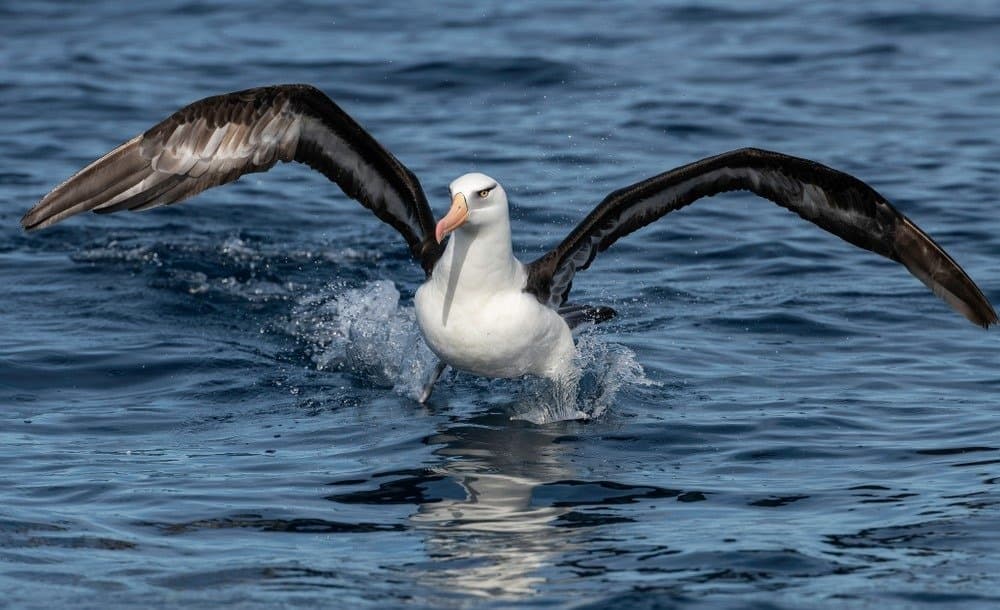
Black browed albatross, North Island, New Zealand.

Albatrosses’ diets depend on their species

The diet of the albatross consists of squid, krill, schools of fish, and, much less commonly, zooplankton (microscopic marine animals). This seabird is also not shy about scavenging. It will trail behind ships to consume their garbage or feast on dead carrion that floats on the surface of the water. The exact nature of its diet varies from species to species. Unlike other predominant sea birds such as penguins, most species (like the wandering albatross) only have the ability to dive a few feet under the water, which makes it difficult to obtain the necessary food to support themselves. If it sees the prey from the air, then some species can plunge rapidly into the water to snatch it.

Predators and Threats
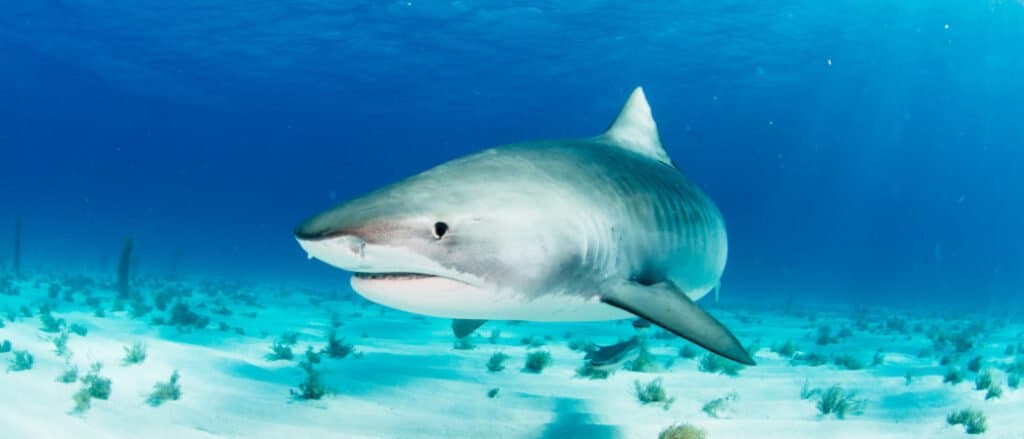
Largest Tiger Shark- Tiger Shark Swimming

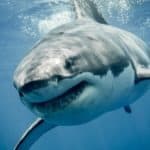
Tiger sharks are known to occasionally prey on juvenile albatrosses

Because it spends so much time floating over the ocean (where no other large carnivores reside), the albatross has few predators, though juveniles are sometimes preyed upon by tiger sharks, and introduced species such as cats and rats will sometimes feast on the albatross eggs.

The only other significant predator is humanity. Some Arctic people might have hunted it as an important source of food in the barren north. Its feathers were also valuable in the creation of luxurious hats. The biggest threat to its survival, though, may be dwindling food supplies as a result of overfishing. The albatross faces constant competition with humans for scarce resources in the open ocean. Another threat is marine pollution that accumulates in the environment and slowly makes its way up the food chain. Slow poisoning can result in abnormal development, reproduction, and eventual death.

Reproduction, Babies, and Lifespan
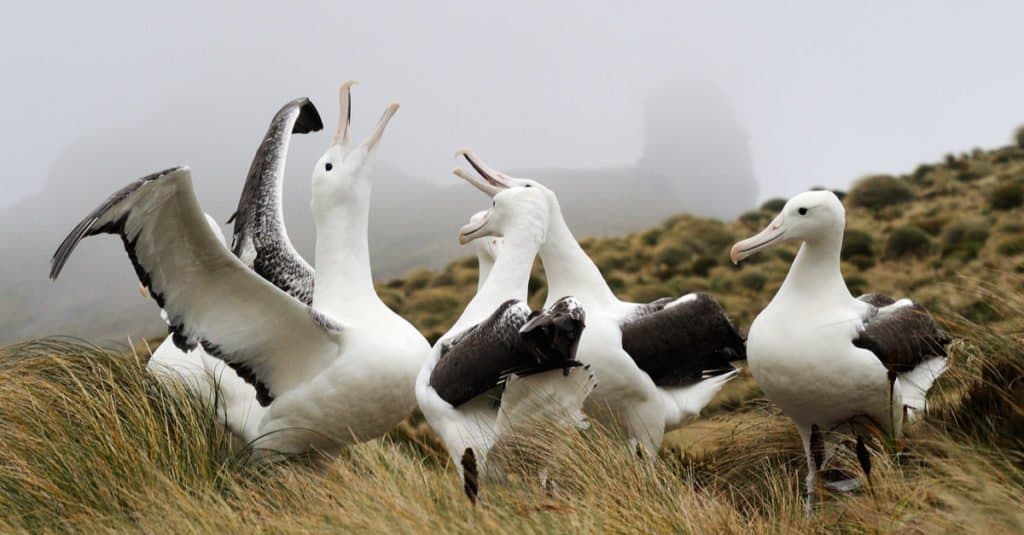
The Southern Royal Albatross only lays one to two eggs each year.

Albatrosses mate for life, and both parents care for the young

After spending long months out at sea, the albatross will migrate to remote islands and coastal areas to breed. The albatross is quite picky about its choice of mate. Because many species mate for life, they cannot afford to choose the wrong partner. They perform (in human terms) an elaborate song and dance routine to communicate their sexual availability. This is accompanied by preening, staring, bill contact, calling, and pointing. In young birds, this ritual must be perfected and honed through years of trial and error. Eventually, it narrows down its potential mates to a single chosen one. This entire intricate process is integral to their survival.

After pairing up with a mate, the albatross is usually set for life. Even if the couple has difficulty conceiving, they will rarely break up. Since the bond is quite strong, they have a large amount of trust in each other. Together they incubate the egg, rear the young, and construct a large nest out of grass, soil, shrubs, and even feathers. They usually choose a place in a high area with multiple angles of approach.

After copulating, they produce only one egg per breeding season and usually skip a year before breeding again. The young chick hatches from its eggs a few months later, undeveloped and highly dependent on its parents for almost everything. In the first stages of its life, the parents alternate between protection duties and food-gathering trips. They feed the chick on a mixture of krill, fish, squid, and an oily substance produced in the stomach from other digested prey.

As a result of the scarce flood supply, development is slow and difficult. A few weeks will pass before the chick is old enough to defend itself. It takes another three to 10 months before it fully fledges (meaning that it gains the ability to fly) and begins hunting for itself. The young albatross then spends the next five to 10 years at sea and returns to breed only upon reaching sexual maturity. The life expectancy of the albatross is up to 50 years, but a few longer-lived specimens have been observed. Many albatross do not survive the juvenile stage. Learn about the oldest living animals on earth here.

Population
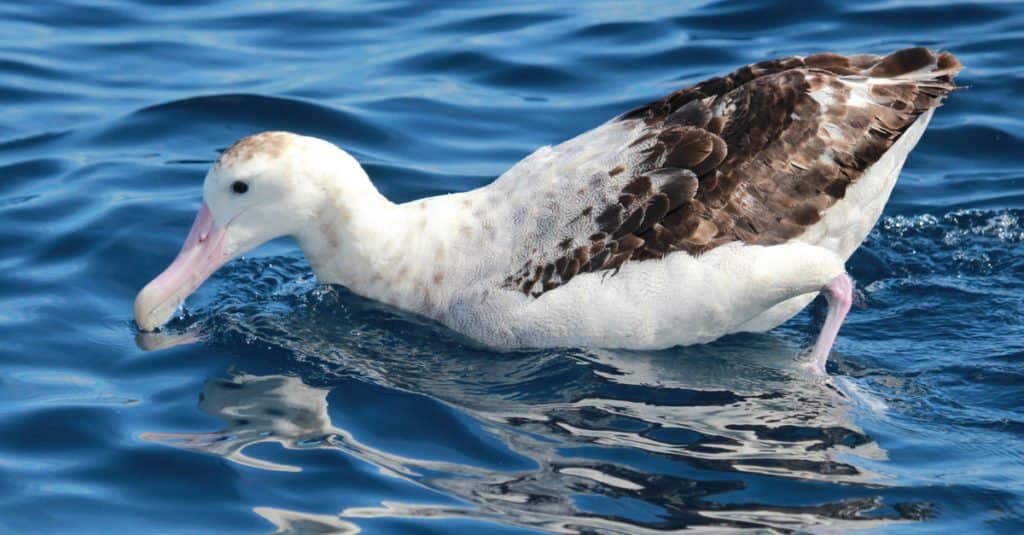
The Antipodean Albatross only lays eggs every two years.

Several albatross species are threatened in some capacity

Decades of human negligence have left the albatross in a bad shape. Of all the species listed by the IUCN Red List, almost every single one is threatened in some capacity. The Laysan albatross, which has a natural range stretching across the entire Pacific, is a near-threatened species with some 1.6 million mature individuals still remaining in the wild. On the other end of the spectrum, the critically endangered waved albatross and the Tristan albatross have only a few thousand members each. Most species exist somewhere between those two extremes, with 10,000 to 100,000 mature individuals left. For instance, the gigantic wandering albatross is vulnerable with 20,000 remaining.

Conservationists believe that better management of existing fishery stocks will be necessary to rehabilitate albatross numbers. Habitat restoration and the banning of chemical pollution will also help in this regard. It is not enough for the United States or any single country to act. Because albatrosses roam over such large territories (and because changes in one part of the ocean can disrupt other parts), it will take an international effort to succeed.

Complete Species List  

The great albatrosses (Diomedea)

  • Wandering albatross (D. exulans)
  • Antipodean albatross (D. (exulans) antipodensis)
  • Amsterdam albatross (D. (exulans) amsterdamensis)
  • Tristan albatross (D. (exulans) dabbenena)
  • Northern royal albatross (D. (epomophora) sanfordi)
  • Southern royal albatross (D. epomophora)

The North Pacific albatrosses (Phoebastria)

  • Waved albatross (P. irrorata)
  • Short-tailed albatross (P. albatrus)
  • Black-footed albatross (P. nigripes)
  • Laysan albatross (P. immutabilis)

The Mollymawks (Thalassarche)

  • Black-browed albatross (T. melanophris )
  • Campbell albatross (T. (melanophris) impavida)
  • Shy albatross (T. cauta)
  • White-capped albatross (T. (cauta) steadi)
  • Chatham albatross (T. (cauta) eremita)
  • Salvin’s albatross (T. (cauta) salvini)
  • Grey-headed albatross (T. chrysostoma)
  • Atlantic yellow-nosed albatross (T. chlororhynchos)
  • Indian yellow-nosed albatross (T. (chlororhynchos) carteri)
  • Buller’s albatross (T. bulleri)

The Sooty albatrosses (Phoebetria)

  • Sooty albatross (P. fusca)
  • Light-mantled albatross (P. palpebrata)
View all 326 animals that start with A

Sources

  1. National Geographic / Accessed November 29, 2020
  2. Britannica / Accessed November 29, 2020
  3. Smithsonian Magazine / Accessed November 29, 2020
  4. Niels C. Rattenborg. Sleeping on the wing. / Published February 6, 2017 / Accessed November 29, 2020
Dana Mayor

About the Author

Dana Mayor

I love good books and the occasional cartoon. I am also endlessly intrigued with the beauty of nature and find hummingbirds, puppies, and marine wildlife to be the most magical creatures of all.
Connect:

Thank you for reading! Have some feedback for us?


Albatross FAQs (Frequently Asked Questions)

The albatross is a family of enormous seabirds that spend most of their time far away from land. It differs from similar seabirds such as petrels and shearwaters by its physical size, skeletal structure, and the location of the tubes on the bill (along the side rather than the top). These tubes assist with the measurement of airspeed.