
A
Species Profile

Asian Elephant

Elephas maximus

One-finger trunk, giant forest heart
Dmytro Gilitukha/Shutterstock.com

Asian Elephant Distribution

Click a location to explore more animals from that region

Loading map...

Size Comparison

Human 5'8"
Asian Elephant 8 ft 6 in

Asian Elephant is 1.5x the height of an average human.

african elephant vs asian elephant

At a Glance

Wild Species
Also Known As Asiatic elephant, Oriental elephant, Haathi, Gajah, Asian pachyderm, Elefante asiático
Diet Herbivore
Activity Cathemeral+
Lifespan 60 years
Weight 5000 lbs
Status Endangered
Did You Know?

Wild population estimate: ~41,410-52,345 individuals (IUCN Red List assessment, 2020).

Scientific Classification

The Asian elephant (Elephas maximus) is one of the three living elephant species and the only extant species in genus Elephas. It is characterized by a relatively smaller body size than African elephants, smaller ears, and a single “finger” at the tip of the trunk. Males may have large tusks, while many females are tuskless (or have small tushes).

Kingdom
Animalia
Phylum
Chordata
Class
Mammalia
Order
Proboscidea
Family
Elephantidae
Genus
Elephas
Species
Elephas maximus

Distinguishing Features

  • Smaller ears than African elephants
  • Single prehensile “finger” on trunk tip (African elephants have two)
  • More convex/level back profile compared with many African elephants
  • Adult males more likely to be tusked; many females lack prominent tusks
  • Five toenails on forefeet and four on hindfeet are typical (variation occurs)

Physical Measurements

Males and females differ in size

Height
9 ft (7 ft 10 in – 9 ft 10 in)
7 ft 5 in (6 ft 7 in – 7 ft 10 in)
Length
19 ft 8 in (18 ft 1 in – 20 ft 12 in)
Weight
4.4 tons (3.3 tons – 6.1 tons)
2.8 tons (2.2 tons – 3.3 tons)
Tail Length
4 ft 1 in (3 ft 3 in – 4 ft 11 in)
4 ft 3 in (3 ft 3 in – 4 ft 11 in)
Top Speed
25 mph
Up to about 40 km/h

Appearance

Primary Colors
Secondary Colors
Skin Type Asian elephant Elephas maximus have thick, wrinkled skin with sparse hair. Folds hold mud and water to cool and block parasites. Body skin is tougher and more folded than small ears, reducing ear heat loss.
Distinctive Features
  • Elephas maximus is native to South and Southeast Asia (India to Malaysia; fragmented on Sumatra and Borneo). It likes forests and edges, uses grass and farm edges, often causing human-elephant conflict. Endangered.
  • Adult male Asian elephants are usually 2.4–3.0 m at the shoulder and about 3,000–5,000 kg; adult females 2.0–2.4 m and 2,000–3,000 kg. Size varies by region and habitat.
  • Head/back profile: Twin-domed forehead (distinct 'double' head bulge) and generally more level/convex back than African elephants (Loxodonta spp.), which tend to have a single-domed head and more pronounced concave back in many individuals.
  • Ears: Relatively smaller, rounded ears compared with African elephants; ear size is a key field distinction and influences thermoregulation behavior (more reliance on shade, bathing, and mud wallows in warm forests and edges).
  • Trunk tip: One prehensile 'finger' at the trunk tip (African elephants have two). Used for fine manipulation of leaves, bark strips, fruit, and grasses in forest-edge feeding.
  • Tusks are enlarged upper incisors. Large tusks are mainly in males. Many females are tuskless or have small tushes. In some areas many males are tuskless because of poaching and selection.
  • Feet/nails: Typically 5 toenails on the forefeet and 4 on the hindfeet (a common diagnostic difference from African elephants, though individual variation occurs).
  • Skin texture/hair: Skin is wrinkled with sparse bristles; hair tends to be more visible in calves/juveniles and on the head/neck and tail tuft in adults.
  • Pregnancy lasts about 18–22 months (often ~22), usually having one calf. Years between births are common. Lifespan is about 60 years; some live 70+ years.
  • Females live in matriarchal family groups (related adult females with calves and juveniles) with changing subgroups. Adult males are often solitary or in loose bachelor groups and may enter musth, affecting movement and mating.
  • IUCN EN: Main threats are habitat loss and fragmentation from roads, plantations, and settlements; broken forest corridors; human-elephant conflict (crop raiding, people fighting back); and poaching for ivory, skin, other products.

Sexual Dimorphism

Asian elephant (Elephas maximus): Males are larger and usually have big tusks; females are often tuskless or have small tusks. Males show musth (gland secretions and urine dribbling) and are more solitary; females live in female-led family groups.

  • Larger average shoulder height and body mass (commonly ~2.4-3.0 m; ~3,000-5,000 kg, with regional variation).
  • Tusks more often present and substantially larger when present; tusk size varies widely among individuals and populations (including some high rates of tusklessness in certain regions).
  • Musth: temporal gland swelling/secretion and urine dribbling; increased roaming and mate-searching; more frequent aggressive posturing during musth periods.
  • More solitary adult social pattern (or loose bachelor associations) outside breeding interactions.
  • Smaller average shoulder height and body mass (commonly ~2.0-2.4 m; ~2,000-3,000 kg).
  • Many females lack visible tusks; may have small tushes (short incisors) rather than large tusks-do not assume tusks are present.
  • Core of stable social units: females form matriarch-led family groups with calves and juveniles; cooperative calf care and group defense behaviors are typical.
  • Mammary glands between the forelegs (as in elephants generally); lactation and calf attendance are major drivers of movement and habitat use in family groups.

Did You Know?

Wild population estimate: ~41,410-52,345 individuals (IUCN Red List assessment, 2020).

Longest mammal gestation: ~18-22 months (commonly ~22 months) before a single calf is born.

Asian elephants have 1 "finger" (prehensile tip) on the trunk; African elephants have 2.

Typical toenail count: 5 on each forefoot and 4 on each hindfoot (a common field ID clue vs African species).

Adult males can enter musth (heightened reproductive state) lasting weeks to months, with temporal-gland secretions and elevated testosterone.

Molars are replaced in a conveyor-belt sequence; individuals typically use 6 sets over a lifetime-wearing the last set can limit lifespan.

Females are often tuskless; many have only small "tushes," while large tusks are mainly a male trait in this species.

Unique Adaptations

  • Highly dexterous trunk with a single prehensile "finger" tip for pinching vegetation; trunk combines breathing, smelling, drinking, and fine manipulation.
  • Thermoregulation via ears: although smaller than African elephants' ears, ear flapping and blood flow through ear vessels help shed heat in humid tropical climates.
  • Serial molar replacement (typically 6 sets): large grinding teeth suited to mixed diets of grasses, leaves, bark, and cultivated crops at forest edges.
  • Massive musculoskeletal support: pillar-like limbs and specialized foot pads distribute weight and dampen impact-important for long-distance walking in rugged terrain.
  • Chemical + acoustic signaling: temporal glands (especially in musth males) and urine dribbling convey reproductive status; vocal repertoire includes infrasonic rumbles.
  • Sexual dimorphism in tusks: selective pressure and human hunting history contribute to high frequencies of tuskless females in many populations.

Interesting Behaviors

  • Matriarchal family groups: related adult females with calves (often ~6-20 individuals), showing fission-fusion dynamics as groups split and reunite with resources.
  • Male life pattern: young males disperse from natal herds around adolescence, then live mostly solitary or in loose bachelor groups; mature bulls visit female groups mainly for breeding.
  • Forest-edge foraging: frequent use of habitat mosaics (forest-grassland-agriculture edges), with daily movements driven by water, shade, and seasonal foods.
  • Infrasound communication: low-frequency calls that can travel kilometers, supporting coordination between groups in dense forest.
  • Dust bathing and mud wallowing: coats skin to reduce insects, protect from sun, and aid thermoregulation; often followed by rubbing on trees.
  • Tool use and problem-solving: documented use of branches to swat flies/scratch, strip bark, and manipulate obstacles; strong spatial memory for water/fruiting areas.
  • Calf care and allomothering: juveniles are guarded and assisted by multiple females; calves nurse for years and learn routes/food handling socially.

Cultural Significance

Elephas maximus is a major religious and state symbol across South and Southeast Asia (Hindu Ganesha, Buddhist white elephant, Thai royal emblem). Domesticated elephants are used in logging, war, ceremonies and temple festivals in Sri Lanka, Myanmar, Thailand, and India, shaping respect and conflict with people.

Myths & Legends

Airavata: in Hindu mythology, Indra's divine white elephant (often described with multiple heads) emerges in cosmic origin stories and symbolizes rain, kingship, and celestial power.

Ganesha's elephant head: widespread Hindu narratives tell how the beloved son of Parvati becomes elephant-headed-making the elephant a sign of wisdom, protection, and auspicious beginnings.

The Buddha's white elephant dream: Buddhist tradition recounts Queen Māyā dreaming of a white elephant entering her side, an omen foretelling Siddhartha Gautama's birth and spiritual destiny.

Gajendra Moksha: the epic tale of the elephant king Gajendra, seized by a crocodile, who calls to Vishnu and is saved-an enduring story of devotion and liberation.

Thailand's "white elephant" (Chang Phueak): royal and folk traditions treat rare pale elephants as sacred; possessing one signified legitimacy and prosperity for a king.

Erawan: in Thai/Lao traditions, Erawan is the mythic elephant associated with Indra (often many-headed), appearing in temple art and stories as a guardian of the heavens.

Temple-festival lore in South Asia: elephants are featured in ceremonial processions (e.g., perahera traditions), where they are treated as living embodiments of prestige and protective blessing.

Conservation Status

EN Endangered

Facing a very high risk of extinction in the wild.

Population Decreasing

Protected Under

  • CITES Appendix I (international commercial trade generally prohibited).
  • India: Wildlife (Protection) Act, 1972 (Schedule I protection).
  • Sri Lanka: Fauna and Flora Protection Ordinance (legal protection; penalties for killing/capture).
  • Thailand: Wild Animal Reservation and Protection Act (national protection framework).
  • Nepal: National Parks and Wildlife Conservation Act, 1973 (protected status).
  • Bangladesh: Wildlife (Conservation and Security) Act, 2012 (protected status).

Life Cycle

Birth 1 calf
Lifespan 60 years

Lifespan

In the Wild
40–70 years
In Captivity
17–86 years

Reproduction

Mating System Polygyny
Social Structure Transient
Breeding Pattern Transient
Fertilization Internal Fertilization
Birth Type Internal_fertilization

Asian elephant (Elephas maximus) mating is male-biased polygynous: solitary males visit female family groups. Musth males win most consortships; females have ~14–16 week cycles with 2–6 day estrus. Gestation 645–660 days, usually one calf; helpers aid calves.

Behavior & Ecology

Social Herd Group: 7
Activity Cathemeral, Crepuscular
Diet Herbivore Grasses (often the dominant diet component where abundant; browse and bark increase seasonally/when grasses are limited)

Temperament

Generally tolerant and socially cohesive within matrilines; strong allomothering and calf-protection behaviors are common across populations (Sukumar 2003).
Risk-averse/cautious toward novel threats; behavior can shift toward heightened wariness and more nocturnal movement in heavily human-influenced landscapes (variation across sites reported in multiple Asian range studies; summarized in Sukumar 2003).
Adult males show pronounced context-dependent temperament: outside breeding they are often avoidant, but during musth they exhibit increased roaming, dominance displays, and a higher propensity for aggression toward rivals/obstacles (Sukumar 2003).
Longevity relevant to social stability: individuals can live for several decades, enabling long-term matriarchal knowledge; reported maximum longevity is on the order of ~60+ years (commonly summarized for the species in Sukumar 2003).

Communication

Low-frequency rumbles Including infrasonic components) used for contact, coordination, and reproductive signaling; fundamental frequencies are commonly reported in the ~14-35 Hz range with higher harmonics extending into the audible band (Langbauer 2000; Stoeger & Baotic 2016
Trumpets (high-intensity, broadband calls) associated with alarm, excitement, play, or social arousal.
Roars/screams and growls associated with high arousal, distress, or agonistic encounters.
Chirps/squeaks and barks Shorter, higher-frequency calls) used in close-range social contexts, including calf-mother interactions (described for Asian elephants in Stoeger & Baotic 2016
Seismic/vibroacoustic signaling: production and detection of ground-borne vibrations Often coupled with low-frequency vocal output), supporting longer-range communication and coordination (reviewed in O'Connell-Rodwell 2007
Chemical: olfactory assessment of urine/dung and scent cues (including temporal gland secretions in males, especially during musth) for reproductive state and individual identification.
Tactile: trunk-to-mouth, trunk-to-genitals, body rubbing, and calf-guiding touches; frequent physical reassurance and bonding within families.
Visual: posture and display (ear spreading, head raising, mock charges), following/leading movements, and coordinated group guarding of calves.

Habitat

Biomes:
Tropical Rainforest Tropical Dry Forest Savanna Temperate Forest Wetland Freshwater
Terrain:
Mountainous Hilly Plateau Plains Valley Riverine Coastal Island +2
Elevation: Up to 9842 ft 6 in

Ecological Role

Megaherbivore and ecosystem engineer

Seed dispersal (endozoochory of many large-fruited tree species; deposition in nutrient-rich dung) Vegetation structuring via browsing/grazing and debarking (can suppress woody encroachment locally and open habitats) Creation/maintenance of trails and gaps that increase habitat heterogeneity and access for other animals Nutrient cycling and soil fertilization via large dung inputs and soil disturbance (digging, trampling) Facilitation of plant regeneration by scarifying/transporting seeds and creating microsites for germination

Diet Details

Other Foods:
Grasses Sedges Bamboo Leaves and twigs from shrubs and trees Tree bark and cambium Roots and tubers Fallen and cultivated fruits Cultivated crops +2

Human Interaction

Domestication Status

Semi domesticated

Elephas maximus is not truly domesticated; most working or captive elephants are tamed wild animals, not the product of long-term selective breeding. For millennia they have been used for transport, hauling, ceremony, and war, and later for logging. Captive herds often come from logging camps and are managed by mahouts.

Danger Level

High
  • fatal trampling or crushing during surprise encounters in the wild (especially near crops, water, or dense cover)
  • aggression by adult males in musth; heightened unpredictability and attack risk
  • captive-handling incidents (keeper/mahout fatalities and serious injuries are well-documented in working and zoo contexts)
  • vehicle and train collisions involving elephants causing human injury/death and major property damage
  • zoonotic risk in captive settings (notably Mycobacterium tuberculosis transmission documented in elephants and handlers)

As a Pet

Not Suitable as Pet

Legality: Not legal or realistic as a pet in most places. Elephas maximus is on CITES Appendix I, so trade and moves need strict permits. Many countries allow them only in licensed zoos or centers; ownership is beyond normal ability.

Care Level: Expert Only

Purchase Cost: $30,000 - $150,000
Lifetime Cost: $3,000,000 - $10,000,000

Economic Value

Uses:
Eco-tourism and wildlife viewing Captive tourism (camps, rides, shows)-often regulated/controversial Historical/declining logging and heavy labor Religious and cultural/ceremonial roles Conservation employment and protected-area economics Human-elephant conflict costs (crop loss, infrastructure damage, mitigation spending)
Products:
  • labor/haulage in managed settings (now limited/declining)
  • tourism services (trekking/attractions, observation-based tourism)
  • ceremonial participation and cultural events
  • educational display in zoos/rescue centers
  • byproducts in some programs (e.g., dung paper/compost)

Relationships

Predators 6

Tiger
Tiger Panthera tigris
Leopard
Leopard Panthera pardus
Saltwater crocodile Crocodylus porosus
Mugger crocodile Crocodylus palustris
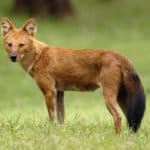
Dhole
Dhole Cuon alpinus
Human
Human Homo sapiens

Related Species 7

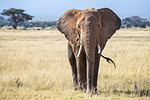
African savanna elephant
African savanna elephant Loxodonta africana Shared Family
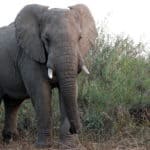
African forest elephant
African forest elephant Loxodonta cyclotis Shared Family
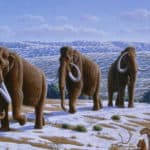
Woolly mammoth
Woolly mammoth Mammuthus primigenius Shared Family
Columbian mammoth Mammuthus columbi Shared Family
Straight-tusked elephant Palaeoloxodon antiquus Shared Family
Hysudric elephant Elephas hysudricus Shared Genus
Narmada elephant Elephas namadicus Shared Genus

Ecological Equivalents 4

Animals that fill a similar ecological role in their ecosystem

African savanna elephant
African savanna elephant Loxodonta africana Closest living analogue as a social, large, herbivorous ecosystem engineer; both have female-led herds and undertake long movements. Asian elephants are usually smaller (adult males ~2.4–3.1 m) and occupy forest-mosaic habitats.
Indian rhinoceros
Indian rhinoceros Rhinoceros unicornis Both are large Asian herbivores that overlap in parts of northern South Asia, alter vegetation by heavy eating and trampling, and require reliable water. Niche overlap is highest in alluvial grassland–riverine mosaics (rhinos graze more; elephants mix grazing and browsing).
Gaur Bos gaurus Large herbivore that co-occurs with Asian elephants in South and Southeast Asian forests, using forest edges, grasslands, and water sources. Both modify vegetation through heavy feeding and seed dispersal; elephants additionally move very large seeds long distances and push down small trees.
Wild water buffalo Bubalus arnee Asian elephant (Elephas maximus) and wild water buffalo share wetland and river habitats in South and Southeast Asia and use water to cool. Both are herbivores whose movements, wallowing, and foot traffic alter wetland edges; buffalo primarily graze, while elephants are mixed feeders.

The Asian Elephant is the largest land animal in Asia.

Elephants are the largest land animals in the world, but the Asian elephant is smaller than its cousin, the African elephant. This species is found throughout southeast Asia, primarily in forested regions in India. They are classified as endangered and are victims of poaching for their tusks and skin.

Incredible Asian Elephant Facts!

  • These elephants have a finger-like appendage on the end of their trunks that allows them to pick objects up.
  • Elephants are considered one of the most intelligent animals, as they are capable of using tools and showing grief and compassion.
  • Asian elephants can have about 60,000 muscles in their trunks.
  • These elephants are sociable animals that form matriarchal groups.
  • These elephants are central to many Hindu beliefs.
Scientific Name
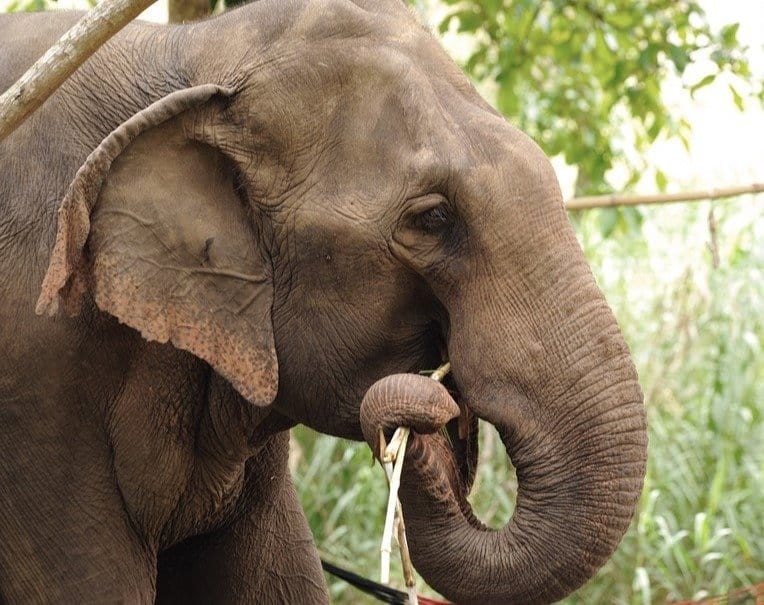
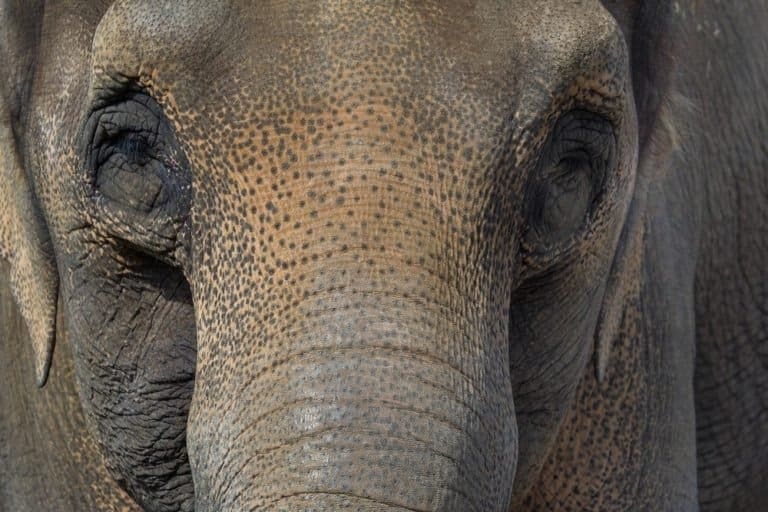
Asian elephant close-up

The three subspecies of the Asian elephant include the Indian, the Sri Lankan, and the Sumatran

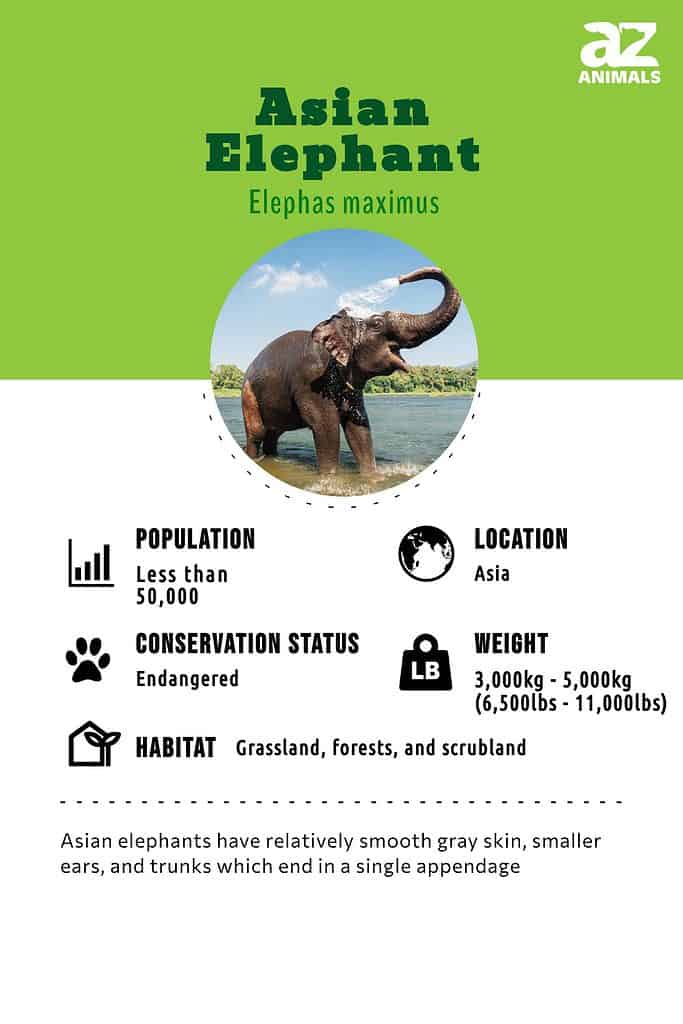
There are three subspecies of Asian elephants with three separate scientific names. The subspecies are grouped by location and size. They all share the scientific name Elephas maximus. In Greek linguistics, “elephant” refers to a horned or antlered beast. In Latin, “ele” means arch, and “phant” means large. Maximus also means large. The Sri Lankan elephant, Elephas maximus maximus, is the largest of the Asian elephants and is native to Sri Lanka. The Sumatran elephant, Elephas maximus sumatranus, is native to the tiny island of Sumatra and is the smallest of the subspecies. Finally, the Indian elephant, Elephas maximus indicus, has the largest range and is native to mainland Asia.

Some scientists suggest that Borneo pygmy elephants may be a subspecies of these elephants. If so, they would be the smallest of all the subspecies. Borneo pygmy elephants have different proportions and rounder faces than Asian elephants, however. They are also more docile.

Appearance
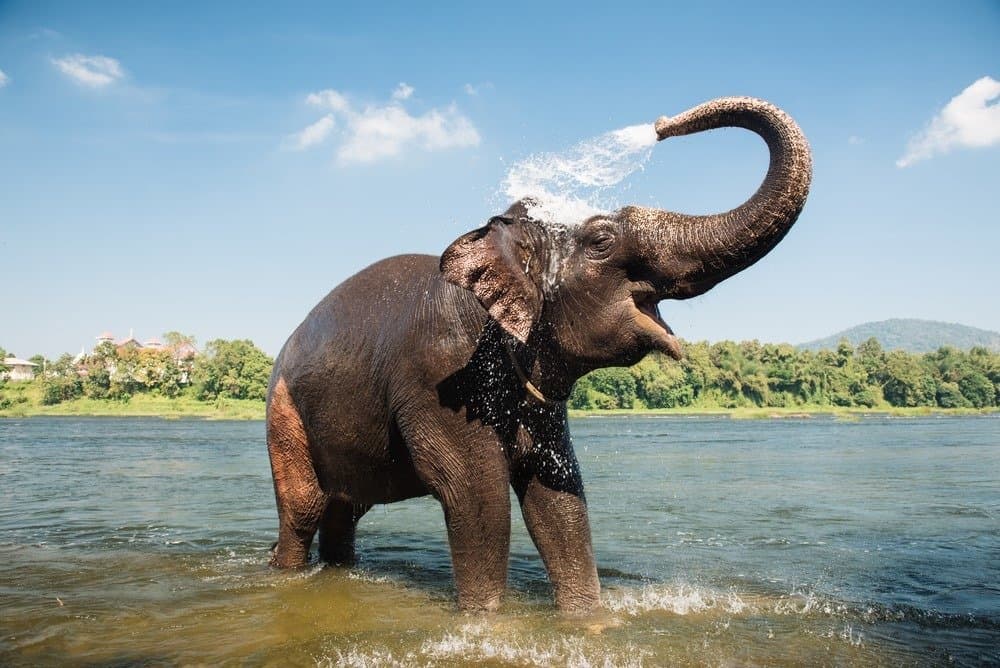
african elephant vs asian elephant

Asian elephants’ pinks spots around their ears and faces are believed to be as a result of diet and genetics

Though they are smaller than their African counterparts, Asian elephants are still enormous mammals. They stand anywhere from 6.6ft to 9.8ft tall, with the largest species being the Sri Lankan variety. These elephants can weigh anywhere from 2.25-2.5 tons, which is slightly larger than a jeep. They are usually gray or brown. These elephants feature light pink spots of de-pigmentation around their ears and faces. These are thought to vary based on diet and genetics. Young Asian elephants are covered in fine red hair, which darkens as they age.

Perhaps their most remarkable feature is their long trunk. The end of elephant trunks features a single finger-like muscle (African elephants have two). Their trunks contain about 60,000 muscles and are perfect for exploring their surroundings through smell and touch. Asian elephants also have small, rounded ears, which help regulate their body temperature.

Not all Asian elephants have tusks. Some males feature prominent tusks, but females have none. Some males have a smaller variety of tusks called “tushes.”

The largest known Asian elephant was a bull elephant named Raja Gaj. He stood at 11ft tall, which is 2ft taller than the average elephant. Raja Gaj was last seen at the Bardia National Park in 2007. He was about 70 years old at the time.

Asian Elephant vs. African Elephant
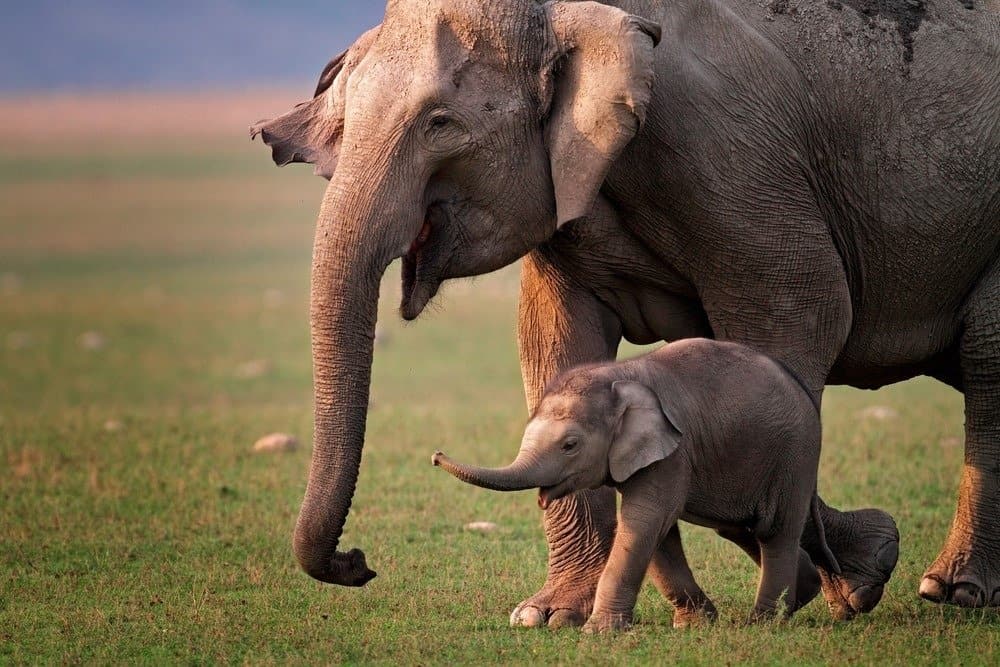
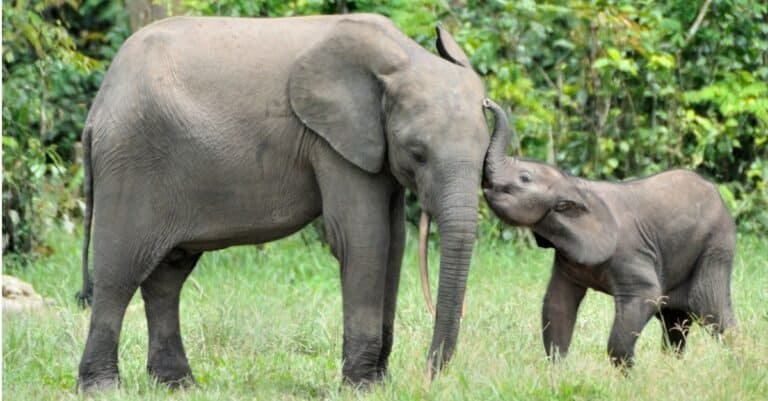
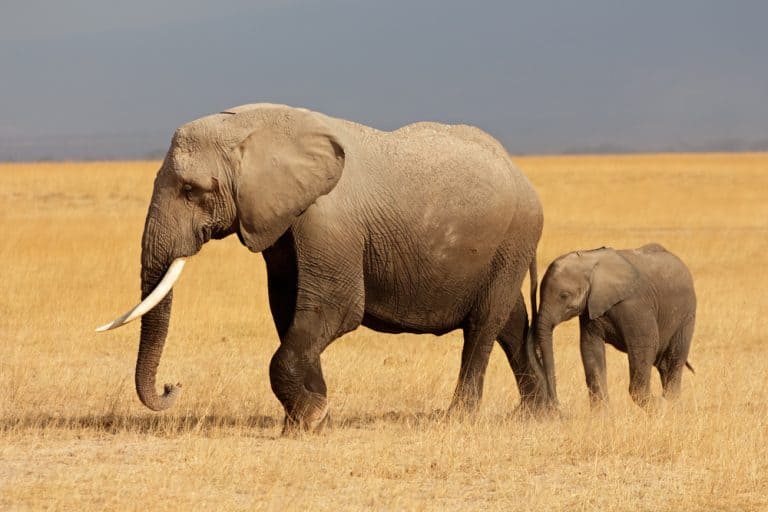
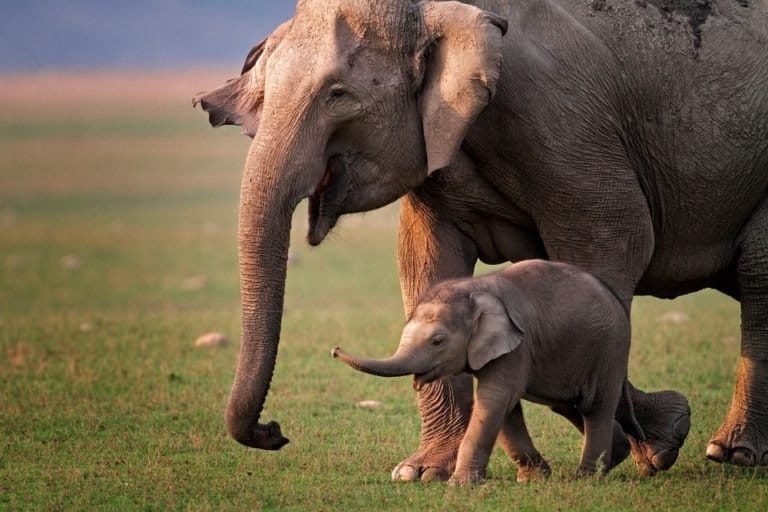
Wild Asian elephant mother and calf, Corbett National Park, India.

Asian elephants are unlikely to ever come across their African counterparts in the wild

There are many differences in appearance between Asian and African elephants. Asian elephants are smaller than their better-known counterparts in Africa. They have two domes on the top of their heads, where the African elephant has one rounded dome. Asian elephants have smoother skin, firmer trunks, and one single “finger” on the end of their trunks. In contrast, African elephants have rough skin, softer trunks, and two “fingers” on the end of their trunks that makes them better able to manipulate objects than Asian elephants.

Asian elephants and African elephants will never meet in the wild, as their ranges do not overlap. African elephants are native to west and central Africa, while Asian elephants live in India, southeast Asia, Sumatra, and Sri Lanka.

Types 

There are three main subspecies of Asian elephant:

  • Indian elephants (Elephas maximus indicus): These elephants’ stomachs are proportionate to their body size and their females may occasionally have small tusks. They are also darker than Sumatran elephants but lighter than their Sri Lankan relatives.

There is also the another subspecies unique to Borneo:

  • Borneo elephants (Elephas maximus borneensis): The smallest of all Asian elephants, this mammal evolved separately from all its relatives on Borneo and is known for having tusks which are straighter than usual and a longer tail on average.

Evolution

During the Pliocene era (between 2.8 – 5.3 million years ago), the species Elephas maximus originated in Africa. Following that period, these mammals moved to Eurasia.

It is worth noting that Elephas hysudricus, the ancestor of the species currently in existence, is believed to have lived in the Middle East. Archaeologists have actually discovered fossils (certain of which are as recent as 3,000 centuries ago) in Jordan.

Behavior
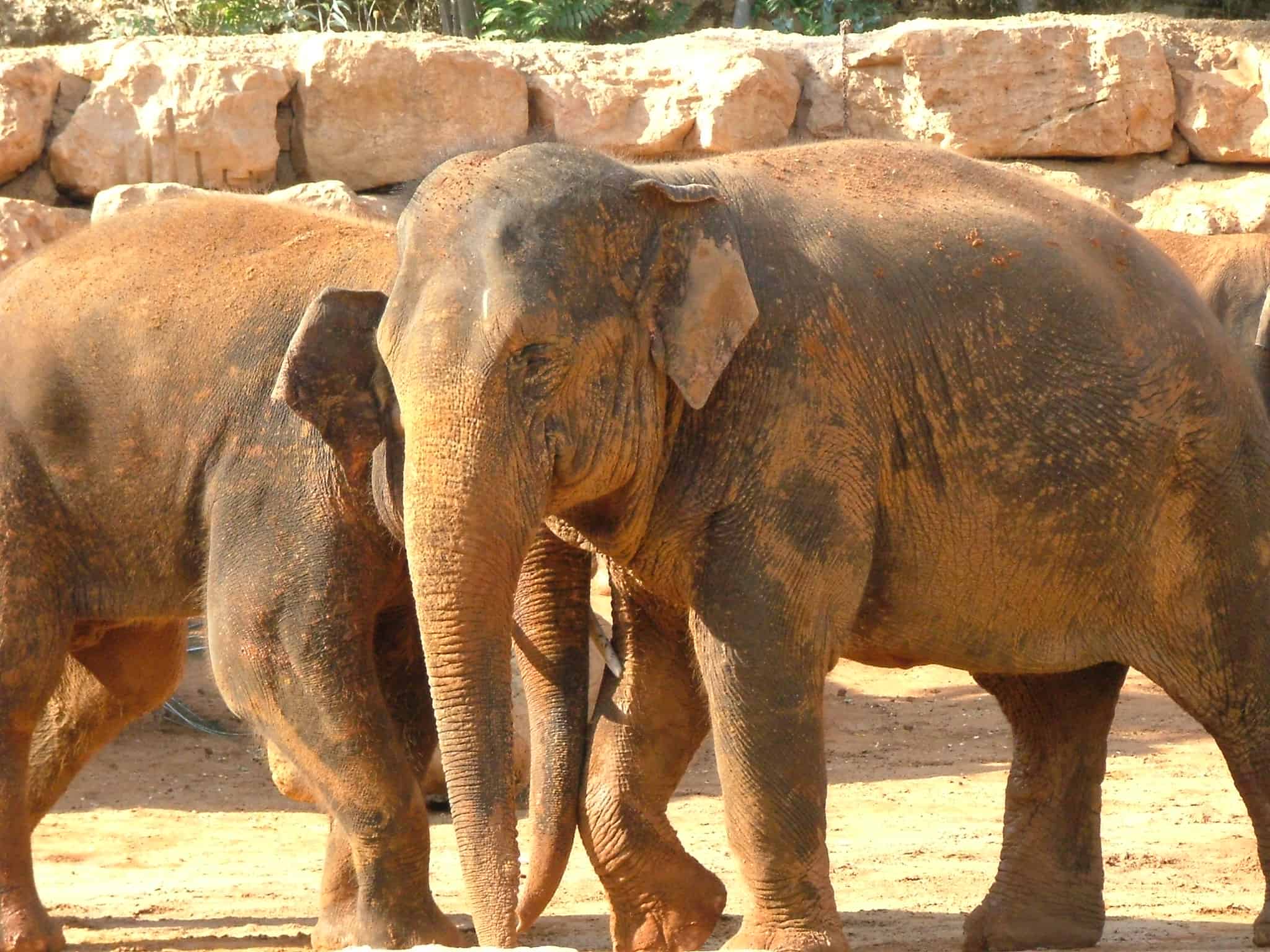
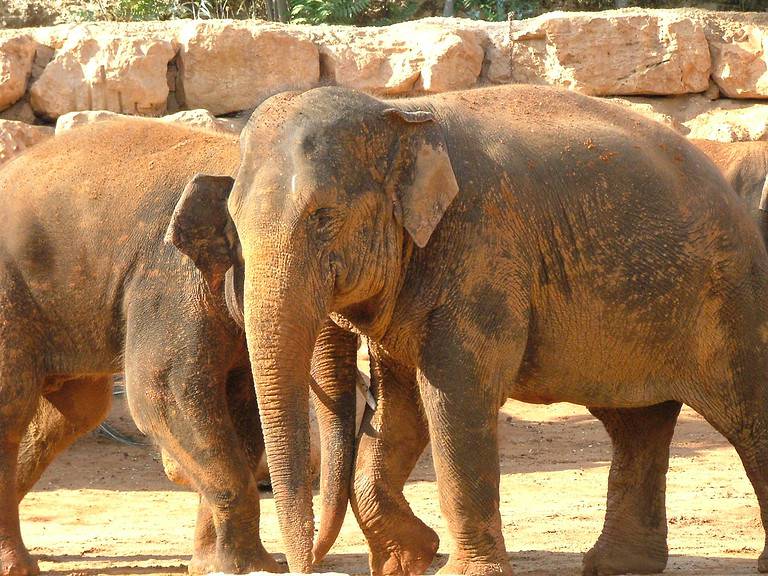
Two Asian Elephants (Elephas maximus) at the Jerusalem Biblical Zoo.

Elephants are capable of communicating with each other using sounds humans are unable to detect

Male elephants are solitary for most of their lives. Females live in matriarchal groups called herds. These herds are led by one female elephant. She is typically the oldest of the group and leads them on familiar tracks in search of food and water. These herds of females can be up to 20 individuals.

These elephants travel at dusk and dawn and lounge around during the heat of the day. They are not territorial. Elephants can communicate with each other using low-pitched sounds that humans cannot hear. These sounds can alert other elephants up to 2 miles away.

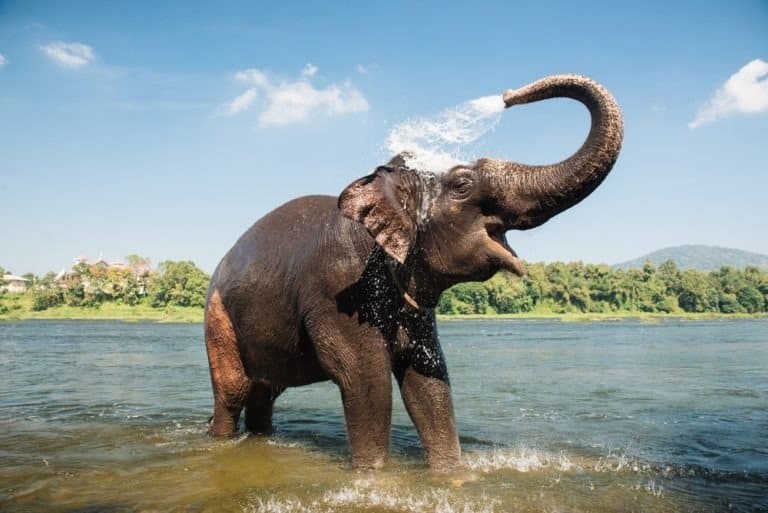
These elephants enjoy the water and use their trunks to spray themselves with water and mud. This practice helps protect their skin from pests. Some areas of their skin are thin and sensitive, while others are up to an inch thick. Due to a large number of nerves in their skin, elephant skin is sensitive, and the mud baths offer much-needed protection.

Habitat
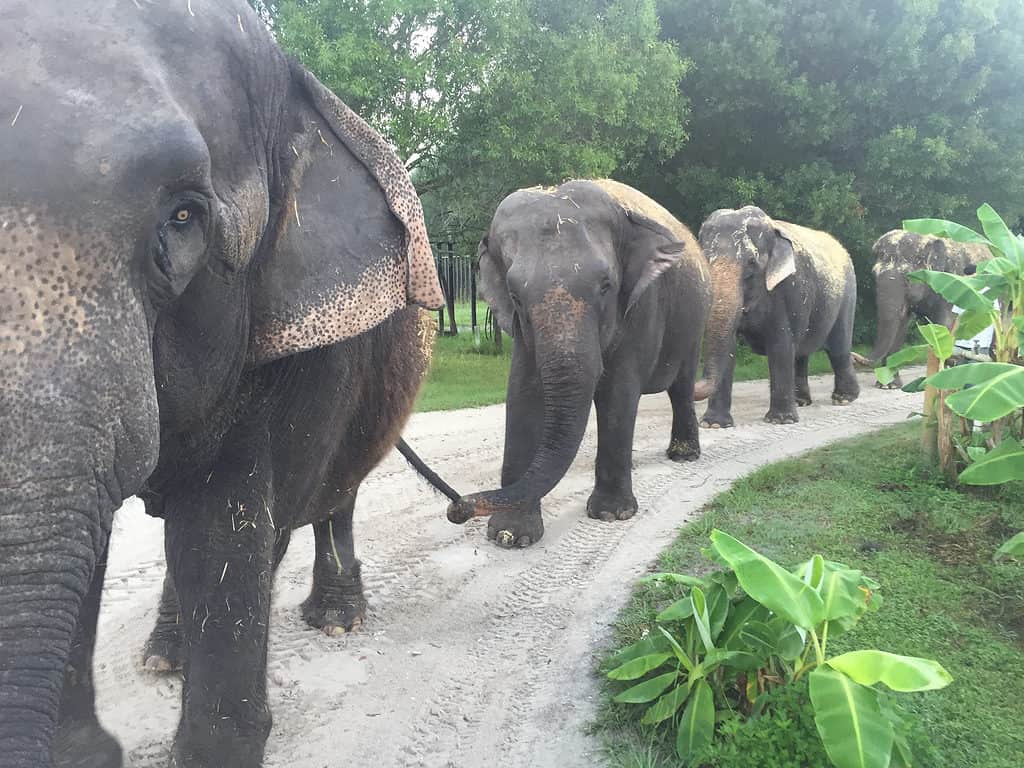
Elephants holding tails

Asian elephants conduct seasonal migrations

These species of elephants are found in India and Southeast Asia. They once stretched as far north as the Yangtze River, but their range has steadily declined. They are considered to be forest animals, but they also enjoy forests with a few areas of grassland in them. These transitional areas where forest and grassland meet provide a rich variety of plants for the elephants to eat.

These elephants are migratory within their spacious home range. They conduct seasonal migrations. Humans often disrupt the migration paths that were long traveled by Asian elephants.

Diet

Like all elephant species, these elephants are herbivores. Their diet consists of roots, grass, and the bark of trees. In a single day, some elephants can eat up to 300lbs of food. Because they need to consume an enormous amount of food, they spend about 3/4 of their day seeking it out. Elephants need to consume such large amounts of food because their bodies can only process about 44% of the food that they eat. They must drink water at least once a day, so they are always close to a source of water.

Herds of these elephants also have a taste for cultivated farm crops, such as bananas and cane sugar. These herds can be a destructive force for farmers if one decides to encroach on their crops.

In captivity, Asian elephants have their diets tailored to their specific needs. They are fed sporadically throughout the day to closely mimic the frequency of feeding they would do in the wild. Elephants in captivity usually eat hay bales, alfalfa pellets, and bran oats. They also eat fresh fruits and veggies like sweet potatoes, carrots, and apples.

Predators and Threats
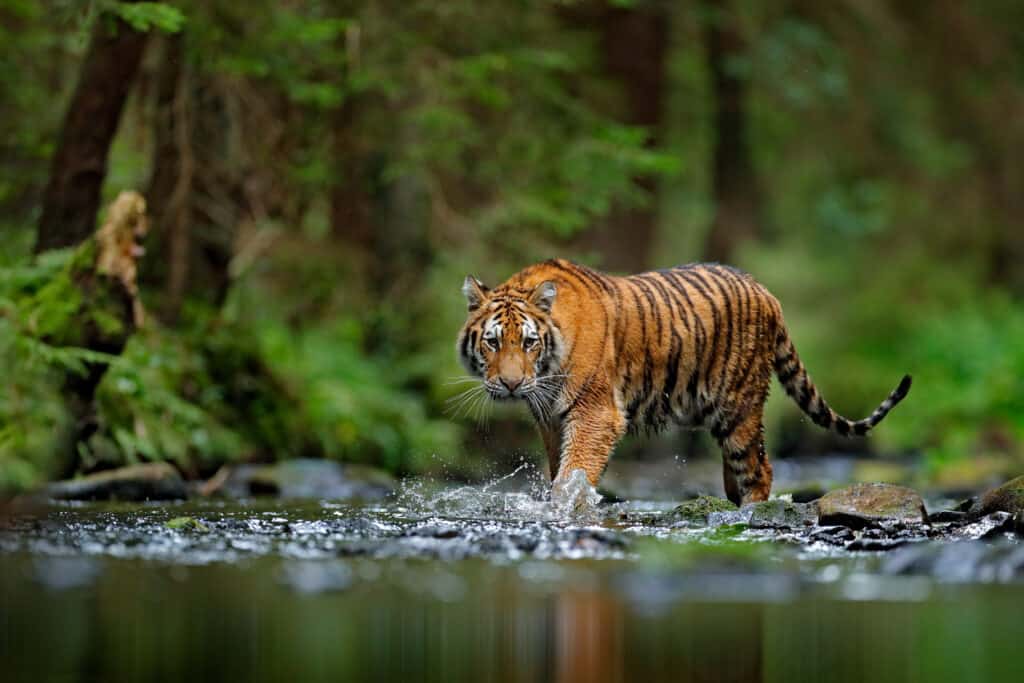
tiger

Tigers may attempt to attack younger elephants

These elephants have few natural predators. Because they are one of the largest land animals, there is little incentive for predators to attempt to take down an adult elephant. Tigers occasionally prey on younger, smaller Asian elephants.

Humans present the biggest threats to Asian elephants. Indirectly, deforestation affects elephant habitats and migratory routes. Forests are cut down in order to create room for new farmland, which brings the elephants into closer contact with humans. Conflicts between elephants and humans arise when elephants roam their territory and find it has been replaced by farmland.

Although it is illegal to poach wild elephants, this activity has nevertheless played a role in the decline of the Asian elephant population. Elephants are hunted for their ivory, which is particularly a threat to male elephants while both genders of elephants are hunted for their skin, which is used for jewelry.

Young elephants are sometimes trafficked out of the wild for the tourism industry. They are trained at a young age to be ridden and to perform for tourists.

Reproduction
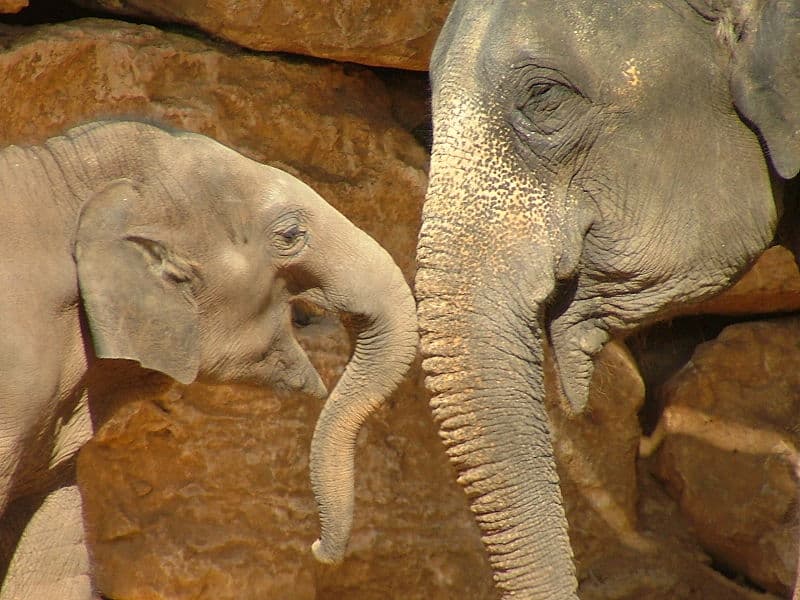
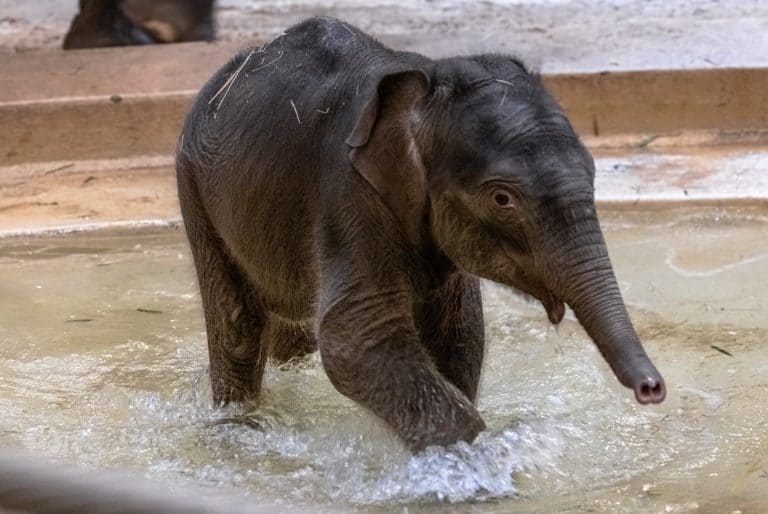
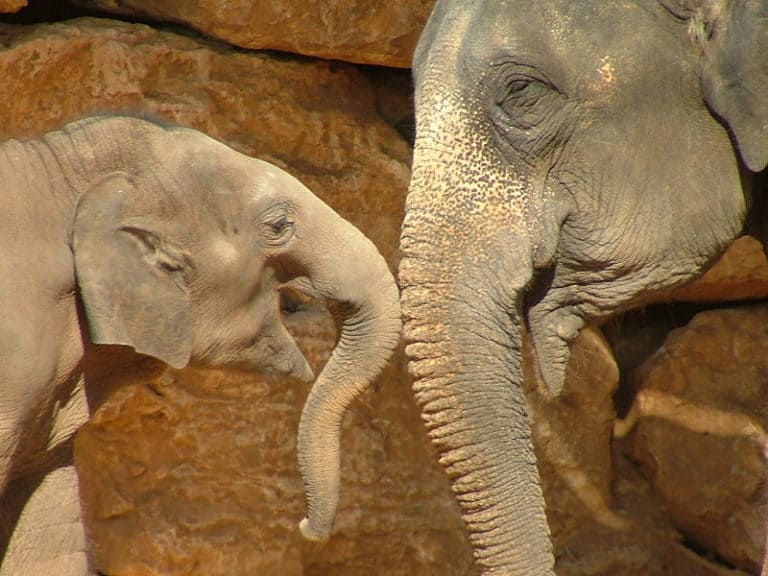
An Asian Elephant and baby at the Jerusalem Biblical Zoo

The bond between mother and calf can last a lifetime

Female elephants give birth every 3 to 8 years. Male elephants, called bulls, typically father their first child after age 30, while females are fertile in their mid-teens. Males take a longer time to grow strong enough to compete with other males for mates, which is why it takes so long for them to be able to mate.

Female elephants, called cows, have the longest gestation period of any animal. Their young are born after 22 months and weigh up to 350 lbs. Occasionally, two calves are born. Soon after they are born, calves can nurse. Fun facts about Asian elephant herd structure are that young are taken care of by all of the female elephants in the herd, referred to as “aunties.” They are weaned off of milk after six months, but they remain attached to the mother for much longer, sometimes until another young is born. Male calves will leave the herd once they reach sexual maturity. Female calves will live with the herd indefinitely.

There is not a lot of data on wild elephant populations, but they are thought to live to be about 50 years old.

Population
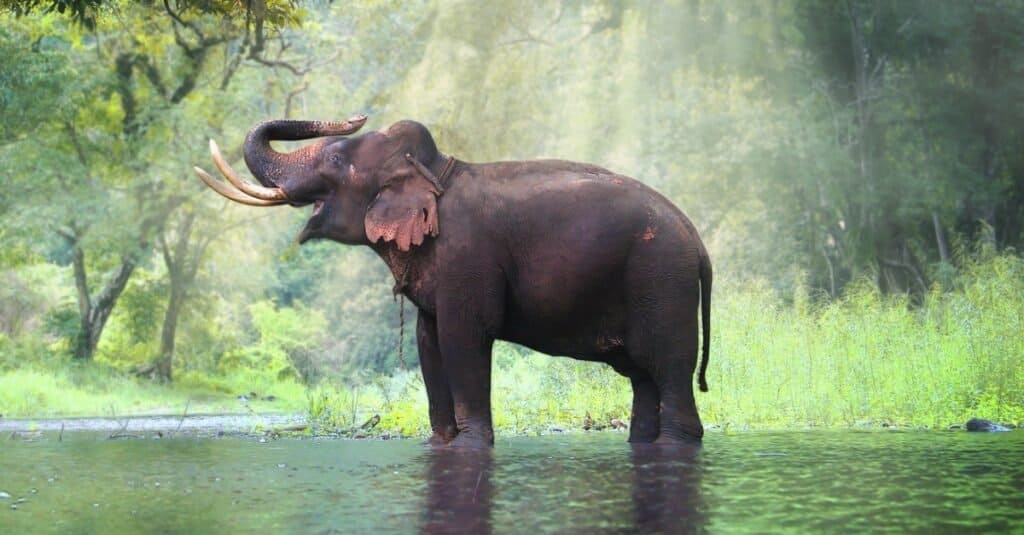
african elephant vs asian elephant

The population of Asian elephants has declined by more than half over the past eight decades

Asian elephants are endangered due to habitat loss, habitat fragmentation, and poaching. Recent population counts have estimated that there are less than 50,000 individuals left in the wild.

Because of these environmental and human pressures, Asian elephants have experienced a significant population decline. They have lost over 50% of their numbers in the last 75 years. Asian elephants are at risk of going extinct, and many conservation efforts have been made to save the various species of Asian elephants. The Indian variety is the most populous and widespread of the subspecies.

In the Zoo
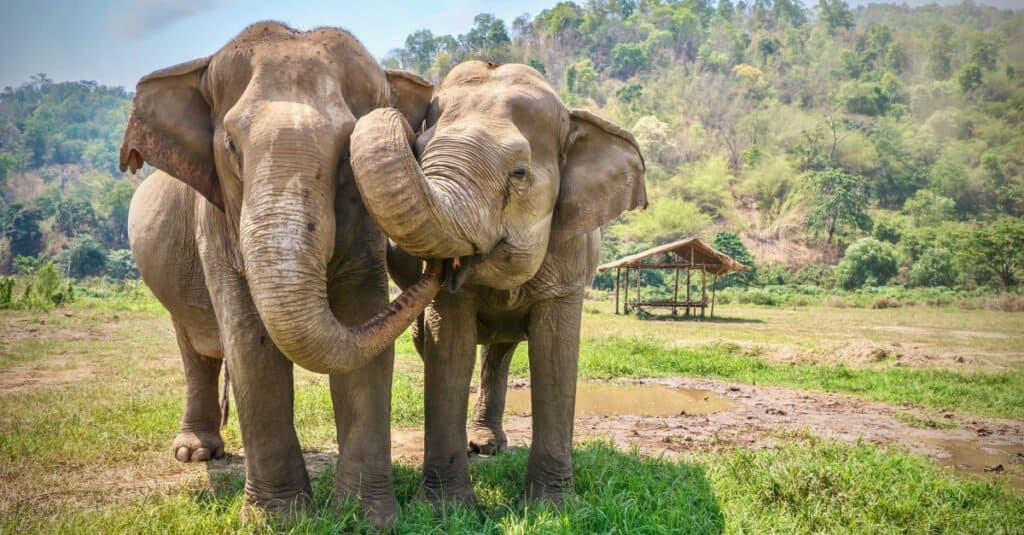
Asian elephants eating together

A significant portion of the Asian elephant population lives in captivity

About a third of the entire Asian elephant population is in captivity. Most of these elephants live in Myanmar, India, and Thailand. These captive elephants are mostly used in the tourism industry in these places.

Many zoos in the US have Asian elephants for patrons to visit and have associated conservation plans to help save the Asian elephant species. Among these zoos are the Smithsonian National Zoo in Washington, DC, and the Buttonwood Zoo in Massachusetts.

Similar Animals

  • African Forest Elephants: They roam the dense thick forest with an ease which would be beyond their larger relatives. But what other differences set them apart from their African cousins? Find out here.
  • African Bush Elephants: Extremely gregarious and social, these giant mammals prefer to roam the open savannah. Find out all there is to know about the largest land mammals on the planet.
  • Elephant vs. Mammoth: How did they evolve? How closely are they related? Where did they live?Discover the answers to these questions and more, here.
View all 326 animals that start with A
How to say Asian Elephant in ...
Catalan
Elefant asiàtic
Czech
Slon indický
Danish
Asiatisk elefant
German
Asiatischer Elefant
English
Asian Elephant
Esperanto
Azia elefanto
Spanish
Elephas maximus
Estonian
India elevant
Finnish
Aasiannorsu
French
Éléphant d'Asie
Galician
Elefante asiático
Hebrew
פיל אסייתי
Croatian
Azijski slon
Hungarian
Ázsiai elefánt
Italian
Elephas maximus
Japanese
アジアゾウ
Latin
Elephas maximus
Malay
Gajah Asia
Dutch
Aziatische olifant
English
Asiatisk elefant
Polish
Słoń indyjski
Portuguese
Elefante-asiático
Slovenian
Azijski slon
Swedish
Asiatisk elefant
Turkish
Asya fili
Vietnamese
Voi châu Á
Chinese
亚洲象

Sources

  1. National Georgraphic / Accessed December 18, 2020
  2. Association of Zoos & Aquariums / Accessed December 18, 2020
  3. WWF / Accessed December 18, 2020
  4. Smithsonian's National Zoo & Conservation Biology Institute / Accessed December 18, 2020
  5. Elephant Country / Accessed December 18, 2020
  6. Safaris Africana / Accessed December 18, 2020
Dana Mayor

About the Author

Dana Mayor

I love good books and the occasional cartoon. I am also endlessly intrigued with the beauty of nature and find hummingbirds, puppies, and marine wildlife to be the most magical creatures of all.
Connect:

Thank you for reading! Have some feedback for us?


Asian Elephant FAQs (Frequently Asked Questions)


The most obvious difference between African and Asian elephants is the location. Asian elephants live in southeast Asia and India, and African elephants are native to the African savannas. African elephants are larger than their Asian counterparts, and they also have larger ears that are shaped like the continent of Africa. They also have two finger-like appendages on the ends of their trunks, where Asian elephants only have one.