
A
Species Profile

Aye-aye

Daubentonia madagascariensis

Tap. Gnaw. Probe. Madagascar's aye-aye.
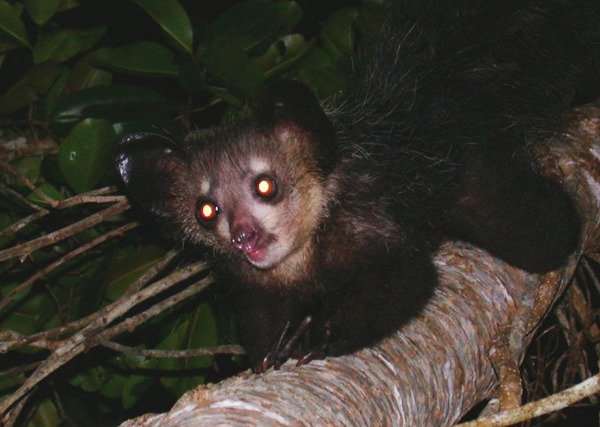
Tom Junek derivative work: WolfmanSF, CC BY-SA 3.0, via Wikimedia Commons

Aye-aye Distribution

Click a location to explore more animals from that region

Endemic Species
Loading map...

Found in 1 country

Aye-aye (Daubentonia madagascariensis)

At a Glance

Wild Species
Also Known As long-fingered lemur, Madagascar long-fingered lemur
Activity Nocturnal
Lifespan 18 years
Weight 2.7 lbs
Status Endangered
Did You Know?

The aye-aye is the only living member of family Daubentoniidae-an entire primate family represented by one species.

Scientific Classification

The aye-aye is a nocturnal strepsirrhine primate (lemur) endemic to Madagascar, famous for its specialized foraging behavior (percussive “tap-foraging”) and an elongated middle finger used to extract insect larvae from wood.

Kingdom
Animalia
Phylum
Chordata
Class
Mammalia
Order
Primates
Family
Daubentoniidae
Genus
Daubentonia
Species
Daubentonia madagascariensis

Distinguishing Features

  • Nocturnal lemur with large ears and continuously growing rodent-like incisors
  • Percussive tap-foraging to locate hollow wood cavities
  • Extremely elongated, thin third (middle) finger for probing and extracting prey
  • Bushy tail often longer than the body
  • Primarily solitary forager

Did You Know?

The aye-aye is the only living member of family Daubentoniidae-an entire primate family represented by one species.

Adult size: head-body length ~30-40 cm; tail length ~44-53 cm; body mass commonly ~2.0-2.8 kg (field summaries incl. IUCN/Primate references).

Its middle (3rd) finger is extremely elongated and thin, used like a probe to hook and extract insect larvae from wood after "tapping" to find hollow spots.

Aye-ayes have continuously growing incisors (rodent-like) that they use to gnaw into wood-rare among primates.

Reproduction is slow: typically a single infant after ~160-170 days gestation, with long parental investment (Primate life-history reports).

Longevity is high for its size: individuals have lived >30 years in captivity (records reported by lemur research centers such as Duke Lemur Center).

It's strictly endemic to Madagascar-found nowhere else on Earth (IUCN Red List).

Unique Adaptations

  • Extreme digit specialization: an elongated, flexible third finger with a ball-and-socket-like joint and reduced soft tissue, optimized for rapid tapping and probing into crevices.
  • Acoustic prey detection: integrates tapping sounds with auditory processing to locate hidden larvae-functionally convergent with woodpecker-like niche use, but in a primate.
  • Ever-growing incisors plus a toothless gap (diastema): allows powerful gnawing into wood to access concealed food; incisors self-sharpen through wear.
  • Large, bat-like ears: enhance detection of faint sounds (movement of larvae, hollow wood resonance) during foraging.
  • Nocturnal vision suite: large eyes adapted for low light (typical strepsirrhine nocturnal traits), supporting nighttime arboreal travel and feeding.
  • Strepsirrhine sensory ecology: reliance on olfaction and scent-marking (glands/urine marking reported in lemur behavioral literature) for communication in the dark.

Interesting Behaviors

  • Percussive "tap-foraging": it rapidly taps along branches, listens for acoustic cues of cavities, then gnaws a hole and probes with the long finger to extract prey (classic behavioral descriptions; e.g., studies by Sterling and others).
  • Nocturnal and arboreal: active mainly at night in trees, traveling and feeding in the canopy.
  • Largely solitary forager: individuals usually feed alone, with overlapping ranges and scent-marked travel routes typical of many nocturnal lemurs.
  • Nest use: sleeps by day in a leafy nest (often a spherical/oval leaf-and-branch structure) in tree crowns and may maintain multiple nests within its range.
  • Generalist omnivory beyond insects: also eats fruit, seeds, nectar, and cambium depending on season and local availability (diet studies across Madagascar).

Cultural Significance

Aye-aye (Daubentonia madagascariensis) is tied to taboos in parts of Madagascar. Seen as a bad omen, it has been killed on sight. Conservation groups work with local leaders to stop killings and teach it is an important, unique lemur.

Myths & Legends

Malagasy omen traditions: in several regions, encountering an aye-aye-especially near a village-is believed to foretell death or grave misfortune for someone in the community.

"Pointing finger" tales: folk stories describe the aye-aye using its long middle finger to point at a person, mark a house, or touch someone-after which illness or death is expected to follow.

Night spirit associations: because it is nocturnal, large-eared, and rarely seen, the aye-aye is sometimes portrayed in local storytelling as a supernatural night-being rather than an ordinary animal.

Taboo-driven responses: traditional accounts in some areas say the only safe response after seeing an aye-aye is to kill it (or ritually remove it), reflecting the strength of taboo and fear in those narratives.

Naming lore: the common name is often said (in popular retellings) to echo a startled exclamation on first sighting-stories that underscore how uncanny its appearance and behavior seemed to observers.

Conservation Status

EN Endangered

Facing a very high risk of extinction in the wild.

Population Decreasing

Protected Under

  • CITES Appendix I (international commercial trade prohibited except under strict permit conditions).
  • Madagascar national wildlife protections: lemurs are legally protected; hunting/capture is generally prohibited under national conservation legislation (enforcement varies).
  • Occurs in multiple protected areas across Madagascar's remaining forests (e.g., Masoala, Ranomafana, Andasibe-Mantadia and other parks/reserves where present).

Life Cycle

Birth 1 infant
Lifespan 18 years

Lifespan

In the Wild
10–23 years
In Captivity
15–23.5 years

Reproduction

Mating System Promiscuity
Social Structure Solitary
Breeding Pattern Transient
Fertilization Internal Fertilization
Birth Type Internal_fertilization

Behavior & Ecology

Social Solitary Group: 1
Activity Nocturnal
Diet Insectivore Wood-boring beetle larvae (grubs) extracted from wood

Temperament

Cryptic, cautious, and generally avoidant of close conspecific contact; most interactions occur at a distance via scent marks rather than sustained proximity (Sterling & Richard 1995).
In aye-ayes, males roam farther and can act more aggressive in encounters (chasing or biting), while females keep tighter, more exclusive areas around core zones and main feeding sites.
Aye-aye (Daubentonia madagascariensis) are very persistent, focused night foragers: they spend long, continuous bouts tap-foraging and gnawing, and often revisit productive patches in their home range.
Life-history context (relevant to social behavior): long-lived for size (maximum recorded longevity ~23.2 years in captivity; AnAge database for Daubentonia madagascariensis), supporting slow reproduction and extended maternal investment rather than large social groups.

Communication

Screeches/squawks used in high-arousal contexts E.g., disturbance, close encounters
Growls/grunts and hisses during aggressive interactions or close-range conflict.
Contact calls described as softer vocal emissions used at short range between mother-infant and during limited affiliative proximity Field descriptions in Sterling & Richard 1995
Olfactory Dominant): frequent scent marking with glandular secretions and urine (including rubbing and urine-washing behaviors) on branches and travel routes; used for advertising presence, reproductive state, and spacing in overlapping home ranges (Sterling & Richard 1995
Acoustic/mechanical foraging signals: percussive tapping on wood Substrate 'drumming' during tap-foraging) produces audible cues that can be detected by nearby conspecifics, though primarily a prey-detection behavior rather than a directed social signal (species-typical behavior described in Sterling & Richard 1995
Visual: limited due to nocturnality; includes posture, approach/avoidance, and threat displays at close range during encounters Sterling & Richard 1995

Habitat

Biomes:
Tropical Rainforest Tropical Dry Forest
Terrain:
Island Coastal Plains Hilly Mountainous
Elevation: Up to 5249 ft 4 in

Ecological Role

Specialized predator of wood-boring insects and an important consumer of large seeds/fruits in Malagasy forests.

Suppresses populations of wood-boring insects by removing larvae from trees and dead wood (biological control) Promotes wood decomposition/microhabitat creation by opening substrates while foraging (facilitating access for microbes and other decomposers) Influences tree reproduction through seed predation (especially on large-seeded species such as Canarium) and potentially occasional seed movement when fruits are carried/handled

Diet Details

Main Prey:
Wood-boring insect larvae Insect larvae in woody substrates Adult insects
Other Foods:
Large hard seeds and nuts Fruit pulp and soft fruits Nectar and flowers Coconut endosperm and cultivated fruits

Human Interaction

Domestication Status

Wild

Aye-aye (Daubentonia madagascariensis) is a wild, non-domesticated lemur from Madagascar with no history of breeding for people. Humans have killed some for superstition, hunted them, and caused habitat loss. Today they are protected (CITES Appendix I, IUCN Endangered) and aided by reserves, relocations, research, and zoo programs. Nocturnal, solitary, tap-forages with a long third finger.

Danger Level

Low
  • Defensive bites/scratches if handled or cornered (wild animal; sharp incisors).
  • Secondary infection risk from any bite/scratch (requires medical evaluation).
  • General zoonotic disease considerations applicable to primates in captivity (risk increases with close contact), though aye-ayes are not known for a specific high-profile zoonosis like macaque herpes B.

As a Pet

Not Suitable as Pet

Legality: Aye-aye (Daubentonia madagascariensis) is not suitable and usually illegal as a pet. CITES Appendix I and Madagascar laws ban trade; only zoos, research, or conservation programs get strict permits.

Care Level: Expert Only

Purchase Cost:
Lifetime Cost: $50,000 - $250,000

Economic Value

Uses:
Ecotourism and wildlife viewing Scientific research value (sensory ecology, foraging specialization, conservation biology) Cultural significance (local beliefs/taboos affecting human-wildlife conflict) Ecosystem services (insect predation; interactions with forest dynamics)
Products:
  • non-consumptive value via guided nocturnal wildlife tourism in Madagascar
  • research outputs (data, publications) supporting conservation planning
  • no legitimate commercial animal-product market (international commercial trade prohibited under CITES Appendix I)

Relationships

Related Species 1

Giant aye-aye Daubentonia robusta Shared Genus

Ecological Equivalents 5

Animals that fill a similar ecological role in their ecosystem

Striped possum Dactylopsila trivirgata Strong niche similarity: a nocturnal, arboreal specialist that locates wood-boring insect larvae by listening, tears into wood to reach them, and has a long, nimble finger like the aye-aye's.
Great spotted woodpecker Dendrocopos major Convergent foraging role in forests: uses percussive probing and excavation of dead or decaying wood to access concealed insect larvae, a similar functional endpoint to the aye-aye's tap-foraging and gnawing into wood to extract grubs, despite distant taxonomy (bird vs primate).
Indri
Indri Indri indri Shared ecosystem and activity constraints as Madagascar arboreal primates (lemurs), though occupying different niches: the indri is primarily folivorous and diurnal, while the aye-aye is nocturnal and heavily extractive-insectivorous. Included as a regional ecological analogue for canopy use and predator exposure in Malagasy forests.
Ring-tailed lemur Lemur catta Co-occurs in the same regional primate community; contrasts highlight niche partitioning: the ring-tailed lemur is largely diurnal, more terrestrial, and omnivorous, whereas the aye-aye is nocturnal, highly arboreal, and specializes in extractive foraging for concealed prey.
Mouse lemurs Microcebus spp. Most similar among Malagasy primates by temporal niche (nocturnal) and partial diet overlap (insects and fruits). Mouse lemurs generally glean insects rather than excavating wood; they provide a close ecological comparator for nocturnal insectivory/omnivory without extreme morphological specialization.

Classification and Evolution

The aye-aye is a species of Lemur that is found inhabiting the rainforests of Madagascar. The aye-aye is not only the largest nocturnal primate in the world but is also one of the most unique.

It is in fact so strange in appearance, that it was thought to be a large species of squirrel when it was first discovered. The incisors of the aye-aye are ever-growing, much like a rodent. This animal evolved these strong teeth, as well as its skull and jaw, to maximize bite force in order to penetrate tree bark and gain access to insects. Even the rodent-like shape of its head helps improve that bite power!

In the mid-1800s the aye-aye was finally recognized as being a species of Lemur but was classified in a group of its own as their closest Lemur relatives remain a mystery even today. However, these incredibly unique animals are severely threatened throughout much of their natural habitat and were thought to be on the brink of extinction by 1980, primarily due to them being killed instantly by local people who believe that seeing an aye-aye is very bad luck. Although today’s population numbers seem to have risen, the aye-aye is one of Madagascar’s most endangered animal species.
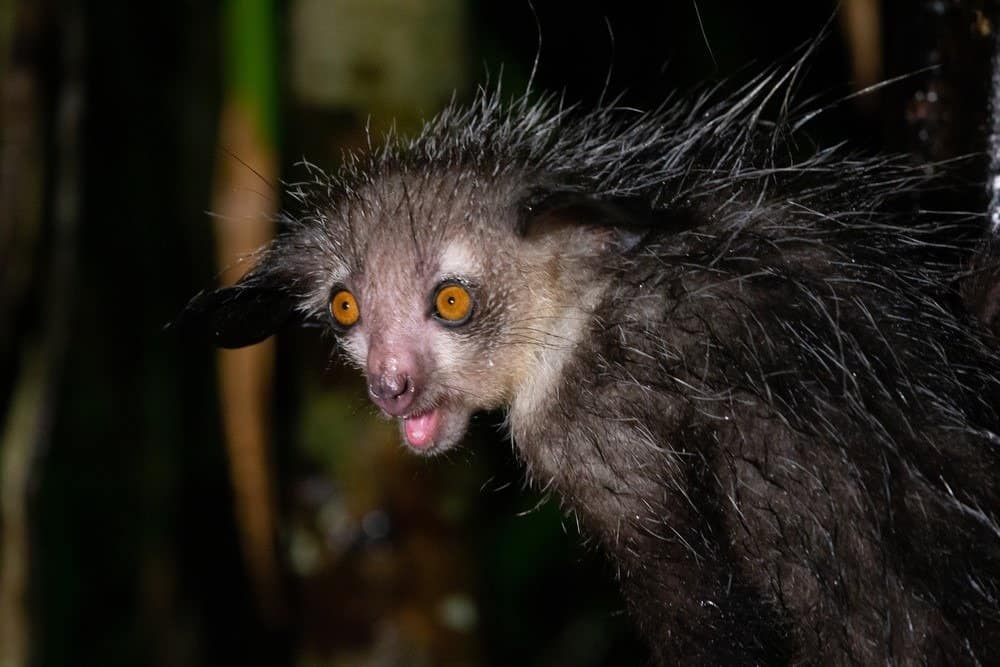
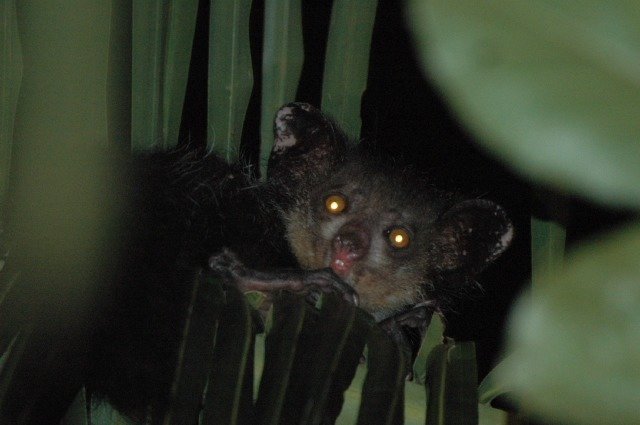
The aye-aye is so strange looking that it was thought to be a large species of squirrel when it was first discovered.

Anatomy and Appearance

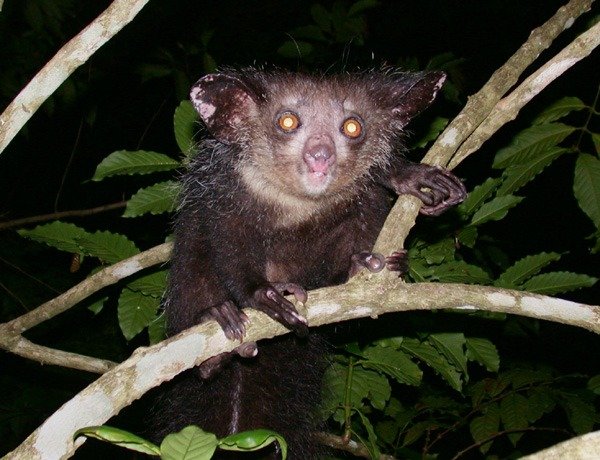
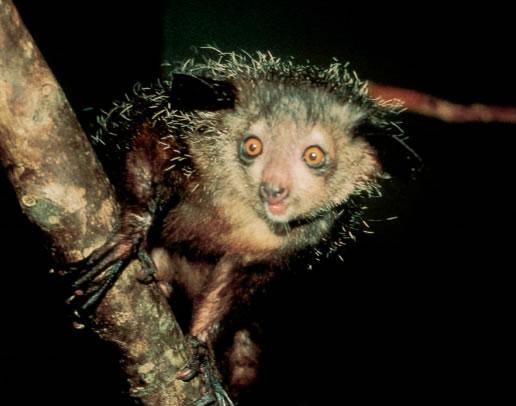
The aye-aye is a primate that is most closely related to Lemurs but is one of the most unique animals on the planet due to the fact that it possesses a number of very distinct adaptations. Their body and long tail are covered in coarse, shaggy black or dark brown fur with a layer of white guard hairs that help them to blend into the surrounding forest in the dark. The aye-aye has very large eyes on its pointed face, a pink nose, and rodent-like teeth with incisors that grow continuously to ensure that they never become blunt. Their large rounded ears are incredibly sensitive giving the aye-aye excellent hearing when listening for grubs beneath the tree bark and are able to be rotated independently. The aye-aye has long and bony fingers with sharp pointed claws on the ends to help when dangling from branches, but it is the middle fingers on their front feet which are their most distinctive feature. Much longer than the others, these fingers are opposable with a double-jointed tip and a hooked claw on the end and are used for both detecting grubs in dead wood and then extracting them.

Learn about the ugliest animals in the world here.
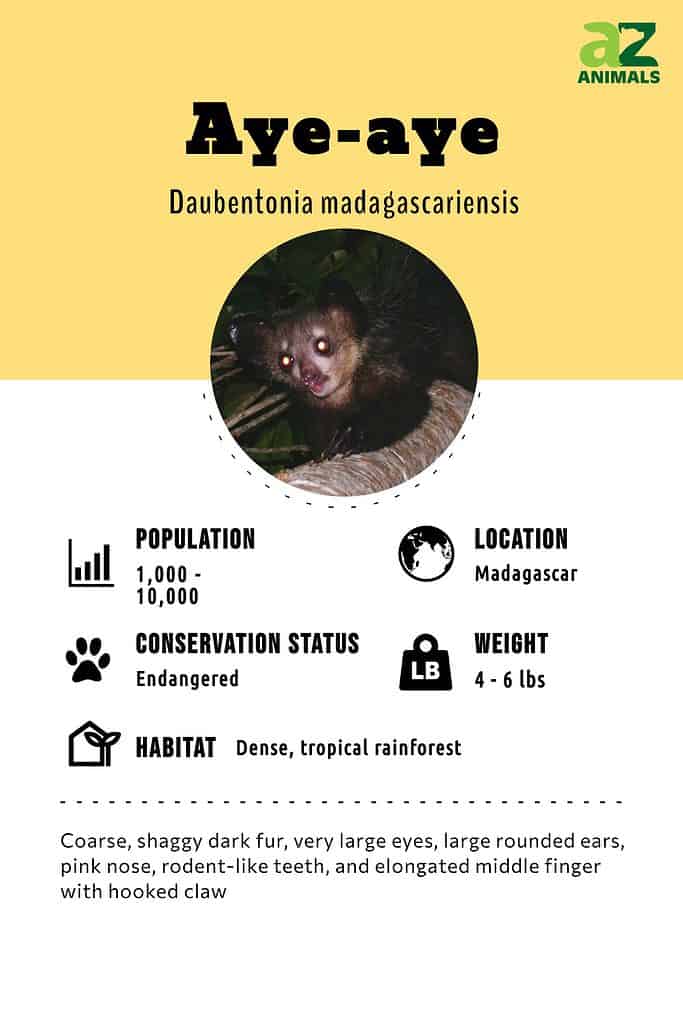
Distribution and Habitat

Historically, the aye-aye was an animal that inhabited the coastal forests of eastern and north-western Madagascar but by 1983 they were thought to be almost extinct with only a few scattered individuals known to still be found there. Since then their population numbers have increased and although these populations aren’t favorably big, they are found in an increasing number of locations and in a variety of different forest habitats. The aye-aye prefers dense, tropical, and coastal rainforest where there is plenty of cover but they are also known to inhabit secondary forests, bamboo thickets, mangroves, and even coconut groves along the eastern coast of Madagascar. However, along with the persecution of the aye-aye by local people they are severely threatened in their natural environment by habitat loss.
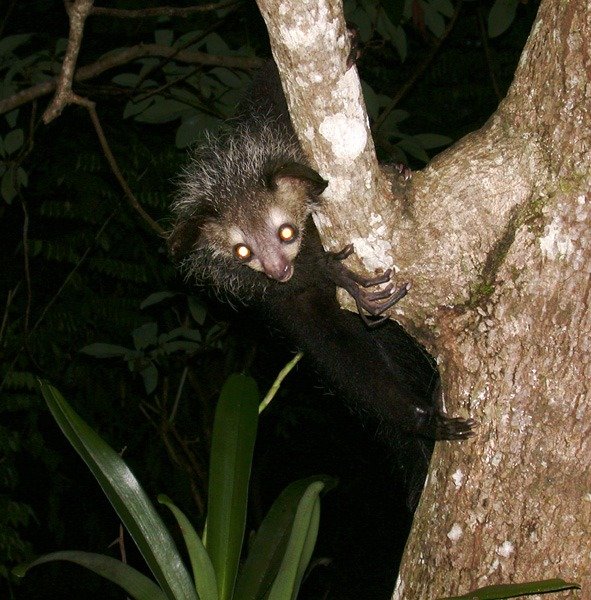
The aye-aye prefers dense, tropical, and coastal rainforests.

Behavior and Lifestyle

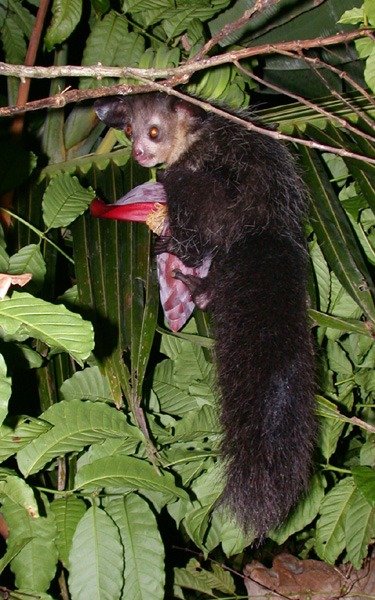
Like many other primates and lemurs, the unique aye-aye spends as much time as possible dwelling high in the tree canopy. Furthermore, the aye-aye keeps its activity in the nighttime and avoids daytime dangers. As arboreal animals, they maintain all daily activities while navigating treetops and living general life. The tree coverage helps camouflage aye-ayes from predators.

In order to sleep, rest, and raise their young, aye-ayes build circular nests in trees. These nests are created with a combination of vines, leaves, bark, and tree branches.

Aye-ayes were originally thought to be solitary animals, but recent research shows that they do sometimes act in groups. They do have large territories that can overlap with other aye-ayes. Males are even known to utilize others’ nests when not occupied.

Reproduction and Life Cycles

It was previously thought that the aye-aye had a very strict breeding season (in the same way as other Lemurs) when they actually seem to breed throughout the year, depending on when the female comes into season. When a female is ready to mate, she calls to male Lemurs who are known to gather around her and will fight aggressively with one another for breeding rights. After a gestation period that lasts for about five months, a single infant is born and spends its first two months in the safety of the nest, not being weaned until it is at least 7 months old. Young aye-ayes will remain with their mother until they are two years old and leave to establish a territory of their own. A female aye-aye is thought to be able to start reproducing when she is between 3 and 3.5 years old, whereas males seem to be able to do so at least 6 months earlier.
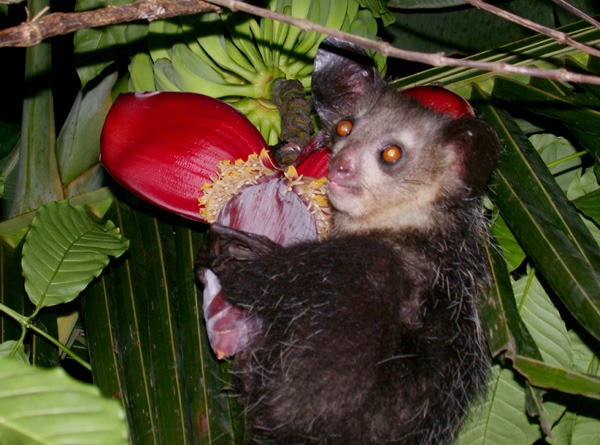
The aye-aye is an omnivorous animal that feeds on both other animals and plant matter, moving about high up in the trees and under the cover of night.

Diet and Prey

The aye-aye is an omnivorous animal that feeds on both other animals and plant matter, moving about high up in the trees and under the cover of night. Males are known to cover distances of up to 4km a night in their search for food, feeding on a variety of fruits, seeds, insects, and nectar. They are however specially adapted to hunt in a very unique way as they use their elongated middle finger to tap dead wood in search of the hollow tunnels created by wood-boring grubs, listening for even the slightest sound with their sensitive bat-like ears. Once the aye-aye has detected its prey it uses its sharp front teeth to gnaw a hole into the wood before inserting the long middle finger, hooking the grub with its claw, and extracting it (filling the same ecological niche as a Woodpecker). The aye-aye is also known to use this long digit to eat eggs and coconut flesh and is thought to be the only primate to use echolocation when searching for food.

Predators and Threats

The secretive and tree-dwelling lifestyle of the aye-aye means that it actually has very few natural predators in its native environment, with the agile and equally nocturnal Fossa being their most ferocious natural predator (along with Birds of Prey and Snakes that hunt the smaller and more vulnerable young). Humans are in fact the biggest threat to the aye-aye as populations have been obliterated in much of their native forests due to superstition from local people who believe that it is a bad omen to see one. In other areas where they are not feared in this way, the aye-aye is hunted as bushmeat. The biggest threat, however, to current populations is habitat loss caused both by deforestation and growing human settlements that encroach on the aye-aye’s natural habitat.
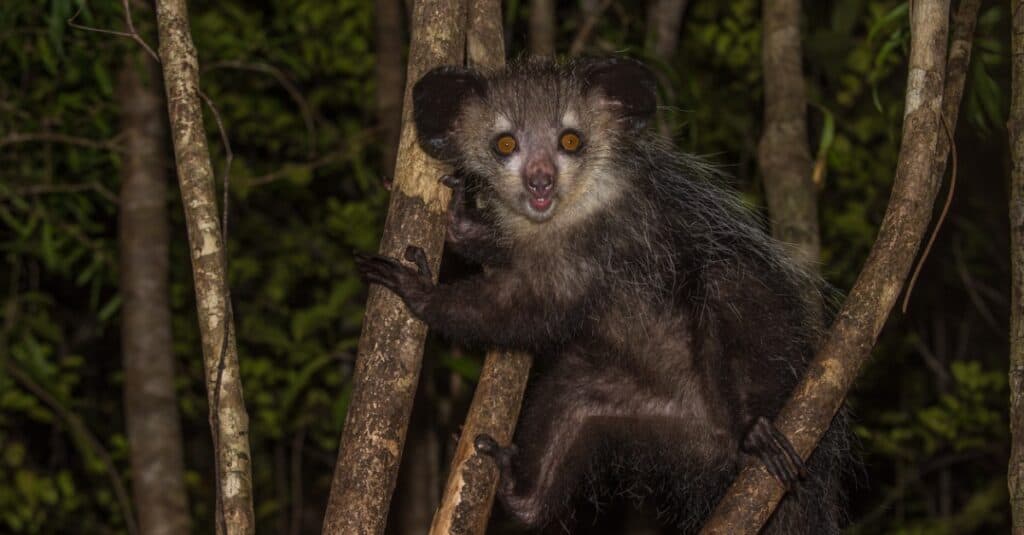
aye-aye holding onto a tree

The secretive and tree-dwelling lifestyle of the aye-aye means that it actually has very few natural predators in its native environment.

Aye-aye Interesting Facts and Features

Although the aye-aye is a solitary animal, males have very loose territories that can overlap those of a number of others. They build their nests high in the trees and will rarely sleep in the same one two nights in a row. This means that one territory for an aye-aye can contain numerous nests, with up to six thought to be found in just one tree.

The aye-aye is thought to be one of the creepiest animals in the world with its name possibly believed to have come from the cry of alarm when a person spotted one. This may be an outdated line of thinking, however. Another suggestion is that the name aye-aye derives from the Malagasy language in such a way as to say that “one doesn’t know”. This would make logical sense if there was a great deal of superstition surrounding the aye-aye, in which locals did not even want to mention the name for fear of a curse or bad luck.

Despite now being found in more areas of its once vast range, aye-aye population numbers were once so low that they were actually thought to be extinct in the wild until 1957 when they were rediscovered.

Read more incredible facts about aye-aye here.

Relationship with Humans

The main reason why aye-aye population numbers have been critically low for years is that local people think that they are just too weird and many believe that seeing one is very bad luck indeed. One story says that if an aye-aye points its long middle finger at you that you will die, and another stresses that seeing one will lead to the death of a villager. The only way of stopping this in both cases is to kill the aye-aye as quickly as possible which has led to the extinction of populations in certain areas. Today though, the aye-aye is also faced with the increasing size of towns and villages that encroach on its native habitats with some individuals forced to invade crops to get food, which often leads to them being shot. They are also severely threatened by deforestation for the logging industry and to clear land for the creation of agricultural plantations.
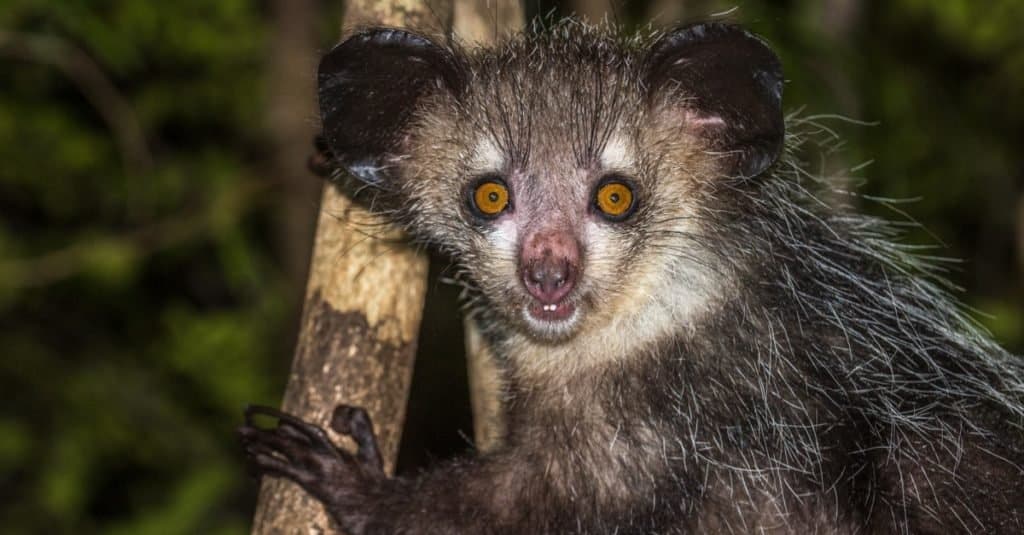
Weirdest Animals: Aye-aye

One of the weirdest animals is the Aye-aye, whose name originated from Malagasy people saying “heh heh” to avoid saying the name of a feared, magical animal.

Conservation Status and Life Today

Today, the aye-aye is listed by the IUCN as an animal that is endangered, meaning that it is severely threatened with possible extinction in the near future. Numbers have increased somewhat since the 1980s and small populations have been sighted in more areas of their natural range; however, they are still greatly threatened by the human activity going on around them. A number of captive populations can be found around the world in breeding programs to try and save the aye-aye from complete extinction. A small population can also be found on the island of Nosy Mangabe, which is a protected reserve just off Madagascar’s northeast coast.

View all 326 animals that start with A
How to say Aye-aye in ...
Bulgarian
Ай ай
Catalan
Ai-ai
Czech
Ksukol ocasatý
Danish
Aye aye
German
Fingertier
English
Aye-aye
Esperanto
Fingrobesto
Spanish
Daubentonia madagascariensis
Estonian
Aie
Finnish
Ai-ai
French
Aye-aye
Galician
Aie aie
Croatian
Madagaskarski prstaš
Hungarian
Véznaujjú maki
Italian
Daubentonia madagascariensis
Japanese
アイアイ
Dutch
Vingerdier
English
Fingerdyr
Polish
Palczak madagaskarski
Portuguese
Aie-aie
Swedish
Fingerdjur
Turkish
Ay-ay
Chinese
指猴

Sources

  1. David Burnie, Dorling Kindersley (2011) Animal, The Definitive Visual Guide To The World's Wildlife / Accessed November 6, 2008
  2. Tom Jackson, Lorenz Books (2007) The World Encyclopedia Of Animals / Accessed November 6, 2008
  3. David Burnie, Kingfisher (2011) The Kingfisher Animal Encyclopedia / Accessed November 6, 2008
  4. Richard Mackay, University of California Press (2009) The Atlas Of Endangered Species / Accessed November 6, 2008
  5. David Burnie, Dorling Kindersley (2008) Illustrated Encyclopedia Of Animals / Accessed November 6, 2008
  6. Dorling Kindersley (2006) Dorling Kindersley Encyclopedia Of Animals / Accessed November 6, 2008
  7. David W. Macdonald, Oxford University Press (2010) The Encyclopedia Of Mammals / Accessed November 6, 2008
  8. Aye Aye Information / Accessed November 6, 2008
  9. Aye Aye Facts / Accessed November 6, 2008
  10. About Aye Ayes / Accessed November 6, 2008
Heather Ross

About the Author

Heather Ross

Heather Ross is a secondary English teacher and mother of 2 humans, 2 tuxedo cats, and a golden doodle. In between taking the kids to soccer practice and grading papers, she enjoys reading and writing about all the animals!

Thank you for reading! Have some feedback for us?


Aye-aye FAQs (Frequently Asked Questions)

Aye Ayes are Omnivores, meaning they eat both plants and other animals.