

B
Species Profile

Baboon

Papio

Big brains, bold troops, wild Africa
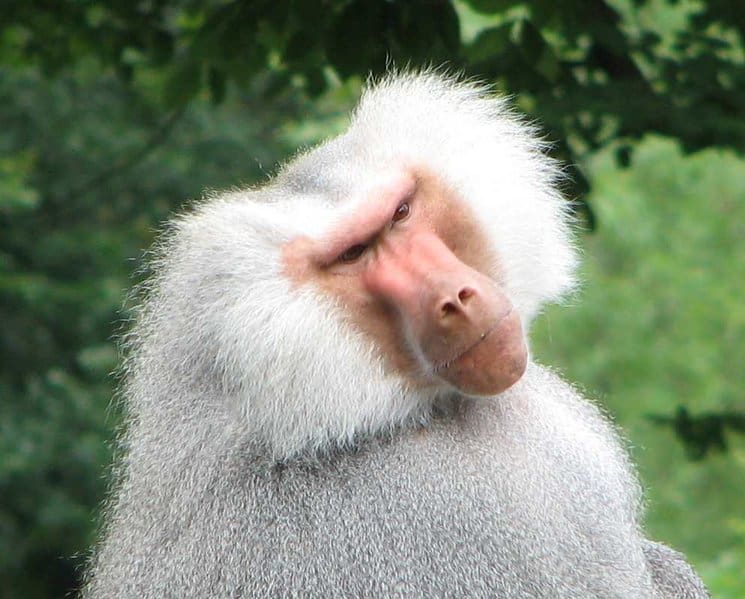
Thomas Netsch / Public Domain

Baboon Distribution

Click a location to explore more animals from that region

Loading map...

Size Comparison

Human 5'8"
Baboon 1 ft 12 in

Baboon stands at 35% of average human height.

At a Glance

Genus Overview This page covers the Baboon genus as a group. Stats below are general traits shared across the genus.
Also Known As Pavian, Monkey, Old World monkey
Diet Omnivore
Activity Diurnal+
Lifespan 25 years
Weight 50 lbs
Status Not Evaluated
Did You Know?

The genus Papio spans much of Africa-from Sahelian scrub to South African mountains-and hamadryas baboons also occur in southwest Arabia.

Scientific Classification

Genus Overview "Baboon" is not a single species but represents an entire genus containing multiple species.

Baboons (genus Papio) are large, terrestrial Old World monkeys native to Africa (and in one case adjacent Arabia). They are highly social omnivores with pronounced sexual dimorphism and complex dominance hierarchies.

Kingdom
Animalia
Phylum
Chordata
Class
Mammalia
Order
Primates
Family
Cercopithecidae
Genus
Papio

Distinguishing Features

  • Dog-like muzzle and powerful jaws
  • Terrestrial lifestyle with long limbs for ground travel
  • Ischial callosities (sitting pads) typical of Old World monkeys
  • Marked sexual dimorphism (males often much larger with large canines)
  • Complex multi-male/multi-female social groups (varies by species)

Physical Measurements

Males and females differ in size

Height
♂ 2 ft 4 in (1 ft 8 in – 2 ft 11 in)
♀ 1 ft 12 in (1 ft 6 in – 2 ft 6 in)
Length
♂ 4 ft 9 in (2 ft 12 in – 6 ft 1 in)
♀ 3 ft 5 in (2 ft 7 in – 4 ft 3 in)
Weight
♂ 62 lbs (31 lbs – 99 lbs)
♀ 33 lbs (18 lbs – 55 lbs)
Tail Length
♂ 1 ft 12 in (1 ft 4 in – 2 ft 8 in)
♀ 1 ft 8 in (12 in – 2 ft 4 in)
Top Speed
34 mph

Appearance

Primary Colors
Secondary Colors
Skin Type Dense mammalian fur over most of the body with extensive bare, thickened skin on the face/muzzle; prominent ischial callosities (hairless sitting pads); bare hands/feet and visible sexual skin (especially in adult females).
Distinctive Features
  • Genus-level size range (adults, across species): head-body length roughly ~40-115 cm; tail length ~40-85 cm; shoulder height commonly ~45-85 cm; adult mass roughly ~10-40 kg (males typically at the upper end, females lower).
  • Long, dog-like muzzle with robust jaws; large, visible canines (especially in adult males).
  • Heavy, muscular, terrestrial build with long limbs adapted for ground travel; capable climbers but commonly forage on the ground.
  • Prominent ischial callosities (sitting pads) and often a conspicuous bare rump region; tail carried in a characteristic arched posture (shape/angle varies among species).
  • Facial skin is usually dark and sparsely haired, with strong brow ridges; expression and coloration used in social signaling.
  • Coat texture often coarse with grizzled guard hairs; some species/populations show more pronounced shoulder/neck hair or cape-like mantling (variable within the genus).
  • Ecology/behavior generalization (with variation): highly social and typically diurnal; most species form multi-male/multi-female troops, while hamadryas baboons show a more multi-level society with one-male units-so social organization is diverse within Papio.
  • Diet generalization (with variation): omnivorous and highly flexible-fruits, seeds, leaves, grasses, roots/tubers, invertebrates, and occasionally small vertebrates; many populations exploit crops and human food sources where available.
  • Habitat breadth across the genus: from savannas and woodlands to semi-desert, escarpments, and montane zones; sleeping sites often trees or cliffs depending on local conditions.
  • Human-baboon interface: frequent adaptation to disturbed habitats (roadsides, farms, peri-urban edges) leads to crop-raiding and conflict; wariness vs. habituation varies strongly by site and human pressure.
  • Lifespan range across Papio: commonly ~20-30+ years in the wild (site- and species-dependent); in captivity often ~30-45 years. (These are genus-level ranges; individual species and populations can fall outside local averages.)

Sexual Dimorphism

Strong sexual dimorphism is typical across Papio: adult males are substantially larger and more robust than females, with more pronounced weaponry (canines) and secondary features; the magnitude varies among species and populations (and with ecology).

♂
  • Larger overall body size and mass; broader shoulders and heavier musculature.
  • Much larger canines and more robust jaw/cranial features used in display and fighting.
  • In some species/populations, more pronounced mane/cape or thicker shoulder/neck hair (variable within the genus).
  • More conspicuous display behaviors and physical intimidation signals associated with dominance rank (expression rather than a single fixed trait).
♀
  • Smaller body size and lighter build relative to males.
  • Prominent sexual swelling of perineal skin during estrus, often accompanied by increased redness/pinkness; degree and coloration vary among individuals and species.
  • Nipples and mammary visibility increase with reproductive history; maternal carriage of infants is a key social/behavioral feature (context-dependent).

Did You Know?

The genus Papio spans much of Africa-from Sahelian scrub to South African mountains-and hamadryas baboons also occur in southwest Arabia.

Across the genus, adults range roughly from ~8 to 40+ kg in body mass (largest males far outweigh smallest females).

Baboons are among the most terrestrial monkeys; many sleep on cliffs or large trees but spend most waking hours on the ground.

Not all baboon societies are organized the same: most live in multi-male/multi-female troops, while hamadryas form "one-male units" within large bands.

They're flexible omnivores: grasses, seeds, fruit, tubers, insects, and small vertebrates can all be on the menu depending on season and place.

In the wild, lifespans commonly range ~20-30 years; in captivity some individuals reach ~35-45 years.

Baboons can thrive in human-altered landscapes, which can lead to intense human-baboon conflict around crops, garbage, and urban edges.

Unique Adaptations

  • Terrestrial build and endurance: long limbs and robust bodies suit long-distance walking and ground foraging in open habitats.
  • Powerful jaws and large canines (especially in males): used in displays and fights; cheek pouches help quickly gather food then eat in safer spots.
  • Highly flexible diet and digestive strategy: able to switch between fruits, grasses, underground storage organs, and animal prey as seasons change.
  • Thick, tough skin on the ischial callosities ("sitting pads"): allows long sitting bouts on rock or ground during rest and social activity.
  • Cliff/rock sleeping traditions: many populations use steep refuges that reduce predation risk from large carnivores.
  • Cognitive and social flexibility: rapid learning, strong memory for individuals/relationships, and ability to exploit disturbed habitats (beneficial for baboons, challenging for people).

Interesting Behaviors

  • Complex dominance hierarchies: rank influences access to food, mates, and allies; rank dynamics vary by species and local conditions.
  • Grooming as social "currency": individuals trade grooming for tolerance, support in conflicts, and relationship maintenance.
  • Coalitions and policing: males (and sometimes females) may team up in fights; some groups show third-party interventions that reduce conflict escalation.
  • Infant handling and "friendships": in many Papio populations, adult males form close associations with particular females/infants, sometimes offering protection.
  • Diverse mating systems: most Papio populations show multi-male mating with mate guarding; hamadryas often show herding and strong male control of a one-male unit.
  • Daily ranging and coordinated travel: troops may move kilometers per day between sleeping sites, water, and seasonal food patches.
  • Communication is multi-channel: barks, grunts, screams, lip-smacks, facial expressions, and threat yawns are used differently across contexts and species.
  • Human-edge foraging: some troops learn schedules and weak points (bins, farms, tourist areas), showing problem-solving and social learning-also a major source of conflict.

Cultural Significance

Baboons (Papio), long part of Africa and nearby Arabia, were sacred in ancient Egypt—hamadryas linked to Thoth and shown in temple art greeting the sun. Today they are popular but sometimes cause trouble, raiding crops and looking for food near towns, and are also valued wildlife and used in research.

Myths & Legends

In Ancient Egypt, baboons (Papio) were linked to the god Thoth, who was the god of wisdom, writing, and the moon. Baboons appear in religious art and were shown adoring the sun, a sacred role.

Ancient Egyptian afterlife imagery: In funerary traditions, baboon figures can appear in scenes tied to judgment and divine order, reflecting their symbolic connection to learnedness and ritual power through Thoth.

Southern African folktales, often in many local versions, like "Baboon and Jackal," show the baboon as strong but often tricked, teaching lessons about cleverness, pride, and social behavior.

Southern and eastern African "why baboon looks like that" tales: Some traditions explain the baboon's bare, brightly colored rump as the result of a punishment, burn, or embarrassing mishap-moral stories about misbehavior and consequences.

Ethiopian and Horn-of-Africa storytelling traditions: Baboons commonly appear as boundary-crossing figures between wild and village life-raiders of crops and trickster-like opportunists-serving as cautionary characters in oral narratives about guarding food and respecting the wild.

Conservation Status

NE Not Evaluated (genus-level). Individual Papio species are assessed separately and currently span mainly Least Concern (LC) to Near Threatened (NT), with conservation outcomes varying strongly by region, habitat fragmentation, and intensity of human conflict/persecution.

Has not yet been evaluated against the criteria.

Population Unknown

Protected Under

  • CITES Appendix II (Papio spp.; international trade regulated)
  • National wildlife legislation varies by range state; many Papio populations occur within protected areas (national parks/reserves), but enforcement and conflict-mitigation capacity differ widely across the genus' range.

You might be looking for:

Olive baboon

28%

Papio anubis

Widespread savanna baboon of East and Central Africa; often the default species in research and media.

View Profile

Chacma baboon

22%

Papio ursinus

Large southern African baboon; common in South Africa/Namibia/Botswana.

Yellow baboon

16%

Papio cynocephalus

East African baboon of more open habitats; relatively slender build.

Guinea baboon

12%

Papio papio

West African baboon with reddish coat; more localized range.

Hamadryas baboon

12%

Papio hamadryas

Horn of Africa/Arabia; males have a distinctive mantle and complex multi-level society.

Gelada (often called a baboon)

10%

Theropithecus gelada

Closely related papionin primate of Ethiopian highlands; frequently referred to as a "gelada baboon" but not in genus Papio.

Life Cycle

Birth 1 infant
Lifespan 25 years

Lifespan

In the Wild
15–35 years
In Captivity
20–45 years

Reproduction

Mating System Polygynandry
Social Structure Aggregation Group
Breeding Pattern Transient
Fertilization Internal Fertilization
Birth Type Internal_fertilization

Most baboons (Papio) are polygynandrous: many males and females mate within groups. Hamadryas often form one-male, harem-like units. Mating occurs in troops, with short mating partnerships when females are fertile. They don’t form lasting pairs or cooperative breeders.

Behavior & Ecology

Social Troop Group: 40
Activity Diurnal, Crepuscular
Diet Omnivore Ripe fruits when abundant; otherwise energy-rich underground storage organs (tubers/corms/bulbs) are commonly favored across habitats (preference varies by species, season, and local availability).

Temperament

Highly social and dominance-structured; individuals negotiate rank through both aggression and ritualized/subtle signals
Temperament spans from relatively tolerant/affiliative populations (more male-male bonding and reduced coercion) to more despotic/coercive ones with higher aggression and strong rank effects
Generally bold, opportunistic, and behaviorally flexible (especially in human-modified landscapes), but risk sensitivity increases with predation pressure and infant presence
Strong kin bias is common where females are philopatric (frequent in many troops), while social cohesion can shift toward male-centered control in one-male-unit systems

Communication

Grunts Often used for benign intent/reassurance, contact, and during approaches
Barks Including contact barks and some alarm-related barking
Alarm calls with context-dependent structure Predators, threats, intergroup encounters
Screams/shrieks Common in intense aggression, distress, and infant-related events
Male loud calls E.g., 'wahoo'-type calls in some taxa/populations; used in spacing, displays, and social context
Facial expressions Threat faces, lip-smacking, teeth displays
Body postures and gestures Stares, presenting, ground slaps, lunges, yawns as display
Grooming and contact sitting as primary affiliative bonding and tension reduction
Infant handling/"social bridging" in some contexts to manage social interactions Varies by species/population
Sexual signals Female anogenital swellings and consortship behavior; strength and timing of signaling vary across the genus
Spatial positioning and coordinated movement Following, herding/leading by high-ranking individuals; varies with social system

Habitat

Biomes:
Savanna Tropical Dry Forest Desert Hot Mediterranean Temperate Grassland Temperate Forest Freshwater Wetland +2
Terrain:
Mountainous Hilly Plateau Plains Valley Coastal Riverine Rocky Sandy +3
Elevation: Up to 10498 ft 8 in

Ecological Role

Flexible omnivore functioning as a high-impact forager: seed disperser and seed predator, ecosystem engineer via digging, and opportunistic mesopredator/scavenger; effects vary by habitat and degree of human contact across Papio species/populations.

Seed dispersal for many fleshy-fruited plants (and long-distance dispersal via daily ranging) Seed predation that can shape plant recruitment and community composition Soil disturbance/turnover and microhabitat creation through digging for roots/tubers/corms Invertebrate population regulation through heavy insect consumption Nutrient redistribution and cycling via feces deposition and occasional scavenging Food-web linkage between plant production and higher trophic levels (prey for large carnivores; predator/scavenger of small animals) Human-wildlife conflict potential (crop-raiding and foraging at refuse sites), which can alter local ecological dynamics

Diet Details

Main Prey:
Insects and other invertebrates Small vertebrates Bird eggs and nestlings Small mammals Carrion
Other Foods:
Fruits and berries Seeds and pods Grasses Leaves and stems Flowers Roots, tubers, bulbs and corms Tree bark, gum or resin, and pith Cultivated crops +2

Human Interaction

Domestication Status

Wild

Baboons (genus Papio) have not been domesticated. People have captured them for show, entertainment, private collections, and biomedical research. They are kept in zoos and sanctuaries. Wild baboons often raid crops, steal livestock feed, forage in towns, or appear in tourist sites (sometimes causing conflict when fed). Human contact varies by region.

Danger Level

High
  • aggression and bites/scratches (especially near food, infants, or during dominance disputes); large canines can cause severe injury
  • zoonotic disease risks from close contact, bites, or exposure to bodily fluids/feces (risk profile depends on setting and hygiene)
  • road/urban hazards when troops forage in settlements (traffic accidents, defensive human responses)
  • conflict escalation from feeding/provisioning, crop protection efforts, or attempted handling/capture
  • property damage and food theft leading to confrontations

As a Pet

Not Suitable as Pet

Legality: Baboons (Papio) are usually illegal or strongly restricted in many places by exotic/primate, dangerous-animal, and welfare laws. International trade is controlled by CITES. If allowed, special permits, secure housing, and strict safety rules are required.

Care Level: Expert Only

Purchase Cost: $5,000 - $20,000
Lifetime Cost: $100,000 - $400,000

Economic Value

Uses:
Tourism and wildlife viewing Ecosystem roles (seed dispersal, predation on invertebrates/small vertebrates) Biomedical and behavioral research (historical and ongoing in some contexts) Human-wildlife conflict costs (crop damage, property damage, management/control) Subsistence use in some regions (bushmeat) Cultural and educational value (zoos, conservation education)
Products:
  • tourism revenue (safaris, park visitation)
  • research value (data/models; regulated specimen use where legal)
  • meat/skins in limited local contexts (often illegal or discouraged depending on region)

Relationships

Related Species 8

Mandrill
Mandrill Mandrillus sphinx Shared Family
Drill Mandrillus leucophaeus Shared Family
Gelada Theropithecus gelada Shared Family
Macaques
Macaques Macaca Shared Family
Vervet monkey
Vervet monkey Chlorocebus pygerythrus Shared Family
Sooty mangabey Cercocebus atys Shared Family
Gray-cheeked mangabey Lophocebus albigena Shared Family
Blue monkey Cercopithecus mitis Shared Family

Ecological Equivalents 5

Animals that fill a similar ecological role in their ecosystem

Gelada Theropithecus gelada Large, ground-foraging Old World monkey with complex multilevel social organization; ecologically similar in being highly social and largely terrestrial, but geladas are far more specialized grazers and are largely endemic to the Ethiopian highlands.
Vervet monkey
Vervet monkey Chlorocebus pygerythrus Widespread African generalist omnivore in savanna/woodland mosaics. Shares a flexible diet and uses both terrestrial and arboreal substrates, though typically smaller-bodied and less terrestrial than many Papio populations.
Patas monkey
Patas monkey Erythrocebus patas Savanna-adapted, highly terrestrial monkey that travels long distances on the ground. Shares open-habitat use and similar predator exposure, but differs in social structure and in feeding emphasis (more insectivory and a different foraging style).
Spotted hyena Crocuta crocuta Not a taxonomic relative but a frequent ecological counterpart. Both are group-living, terrestrial omnivores and scavengers in African savannas, and they often compete around carcasses and water sources.
Humans Homo sapiens Pastoralists and farmers in baboon range create human-modified landscapes (crops, refuse) that baboons commonly exploit. This produces a shared synanthropic omnivore niche in some regions, although the extent varies strongly with local land use and conflict intensity.

Types of Baboon

6

Explore 6 recognized types of baboon

Olive baboon
Olive baboon Papio anubis
Hamadryas baboon Papio hamadryas
Guinea baboon Papio papio
Yellow baboon Papio cynocephalus
Chacma baboon Papio ursinus
Kinda baboon Papio kindae

Classification and Evolution
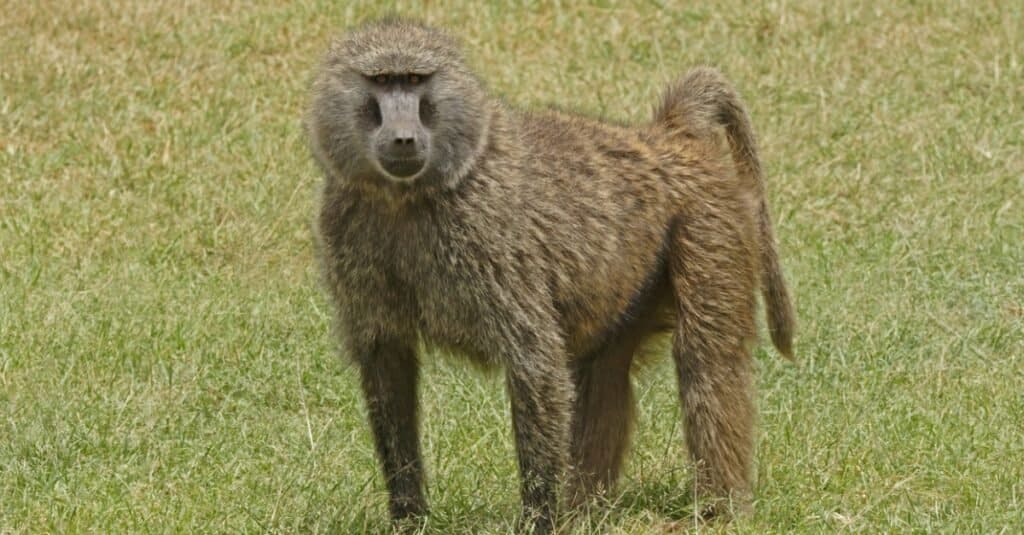
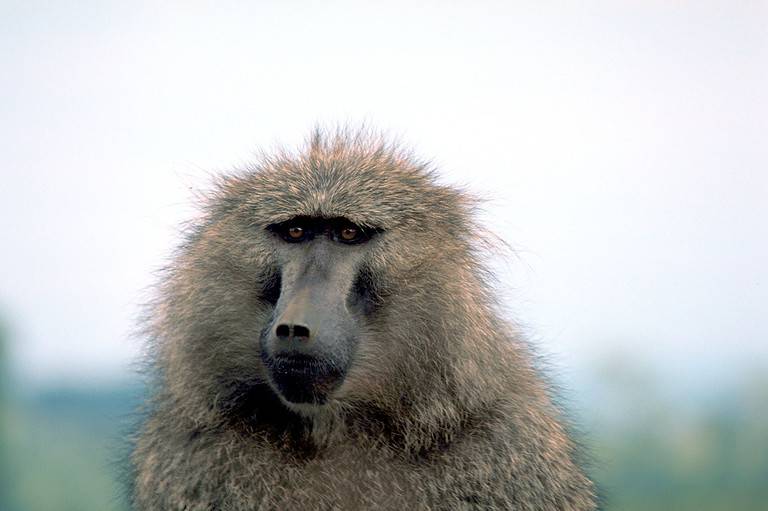
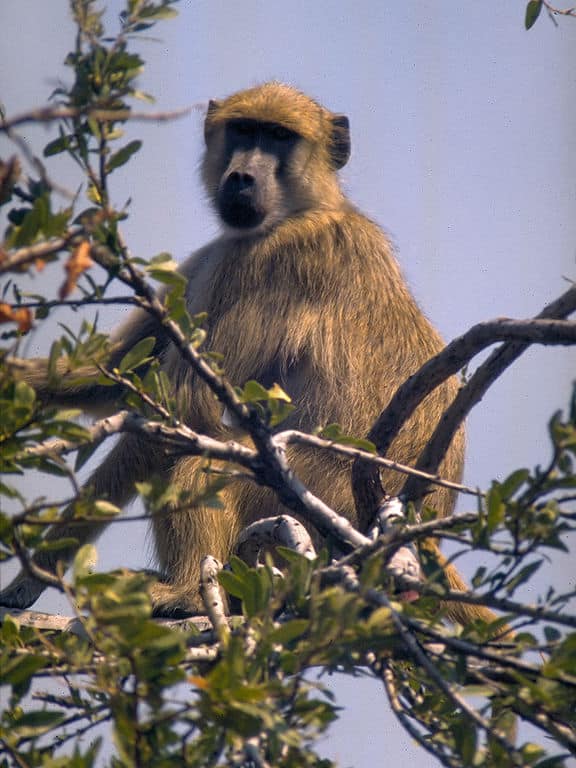
olive baboon standing in field

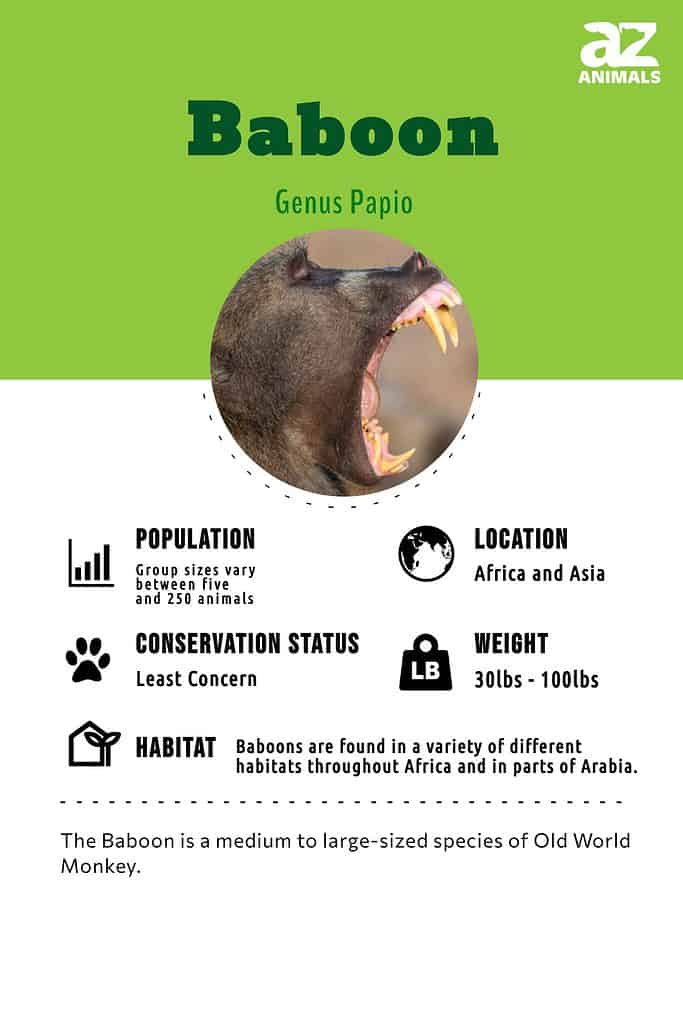
The Baboon is a medium to large-sized species of Old World Monkey that is found in a variety of different habitats.

The Baboon is a medium to large-sized species of Old World Monkey that is found in a variety of different habitats throughout Africa and in parts of Arabia.

There are five different species of Baboon which are the Olive Baboon, the Guinea Baboon, the Chacma Baboon, the Yellow Baboon, and the Hamadryas Baboon which differs most from the others wide its bright red face and cliff-dwelling lifestyle (the other four species are collectively known as Savanna Baboons).

However, there is some debate over the classification of the different species due to the fact that some have been known to interbreed, indicating that they could be sub-species instead. Baboons are incredibly sociable and intelligent animals that are known to form close bonds with other members of the troop that often last for life.

They are also incredibly adaptable animals but their population numbers are declining throughout their natural range primarily due to hunting and habitat loss.

Different Types of Baboons

Here are the five different Baboon species:

  • Olive Baboon
  • Yellow Baboon
  • Chacma Baboon
  • Guinea Baboon
  • Sacred Baboon

Anatomy and Appearance

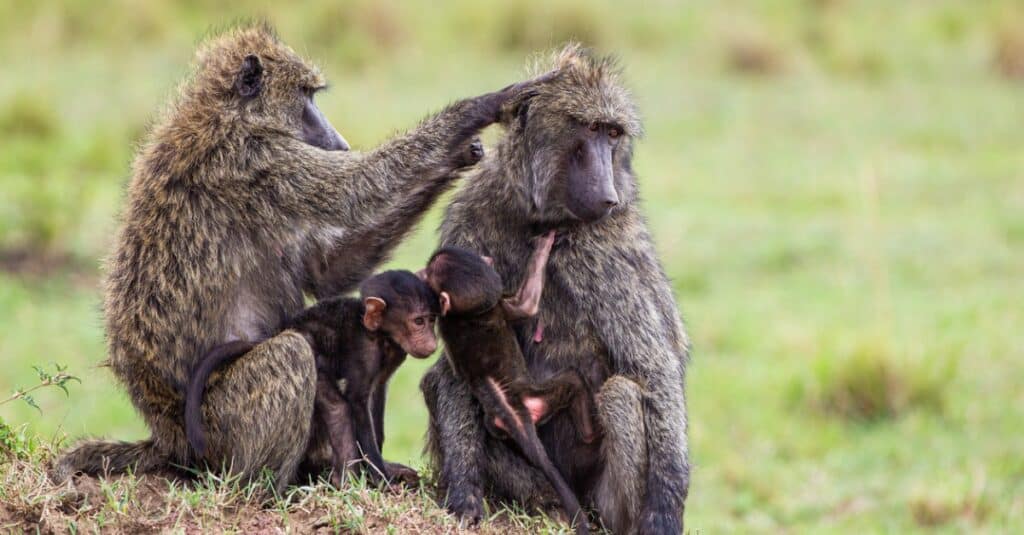
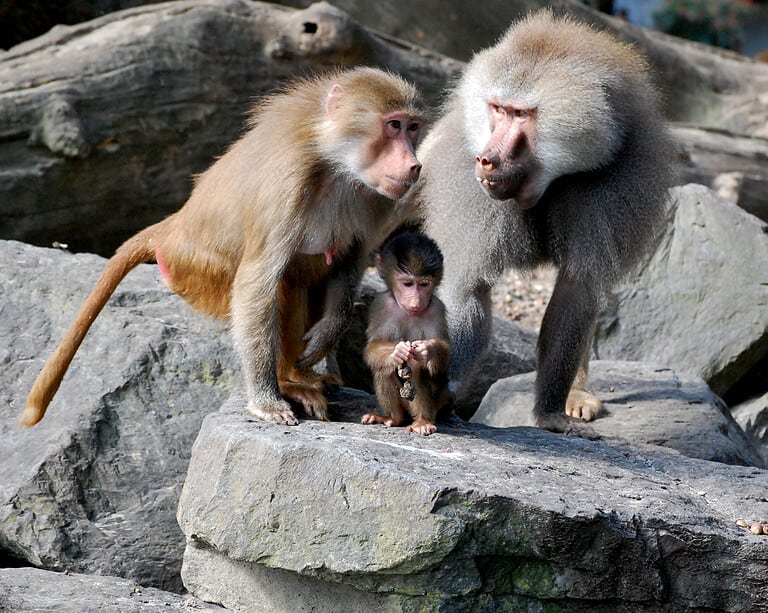
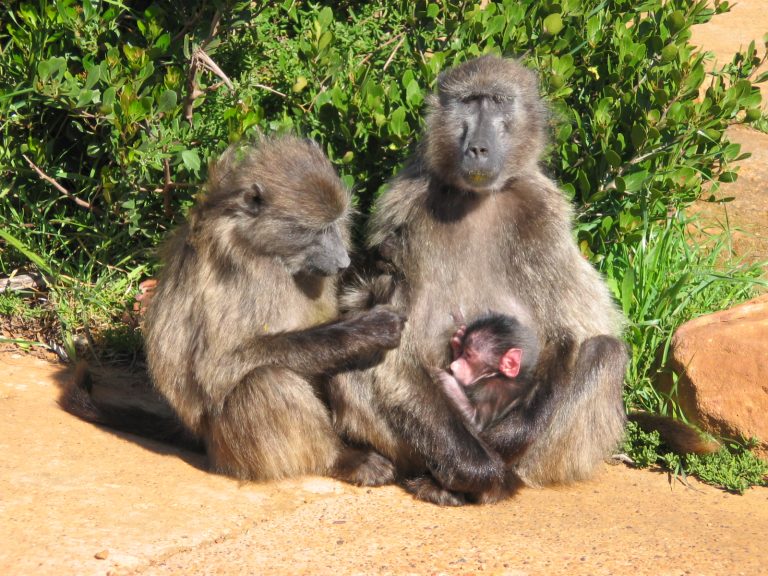
olive baboon family

Baboons are large and powerfully built monkeys that spend most of their time on the ground.

Baboons are large and powerfully built monkeys that spend most of their time on the ground. They have large heads with long, dog-like muzzles and cheek pouches for storing food with a heavy brow ridge protecting their eyes.

Males are often twice the size of females and have fearsomely sharp canines that help them to defend the troop from danger, but their exact size depends on the species with the Chacma Baboon being the largest while the Guinea Baboon being the smallest species.

Baboons have wild-looking fur with a longer mane that extends over the shoulders and hairless patches on their faces and rumps which are padded with hard skin. Their color varies from olive-green to yellow, silver, and brown depending on the species. They also have a distinctive bend towards the base of their long tails.

Distribution and Habitat
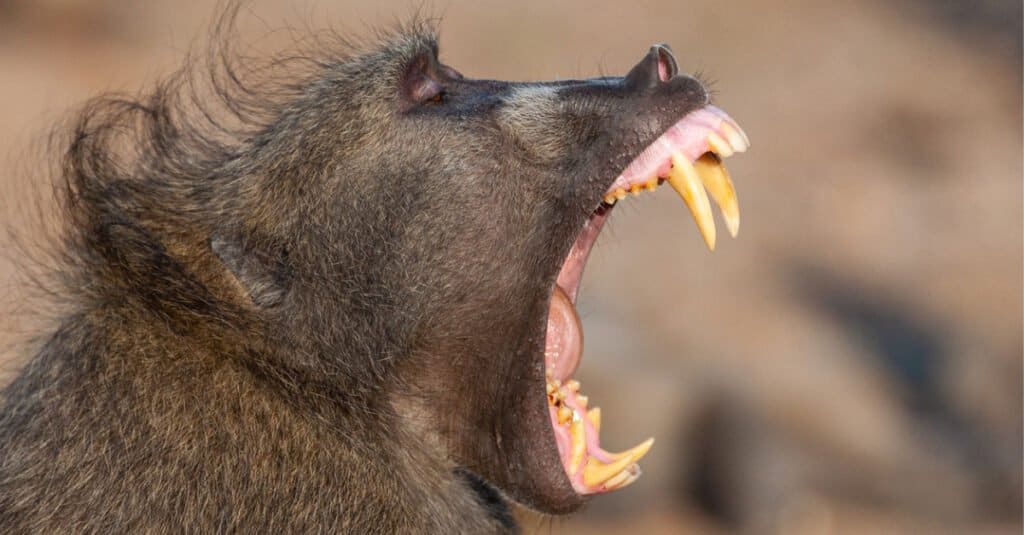
Baboon Teeth- Chacma Baboon

The Hamadryas Baboon is found in the rocky deserts in the hills that line the coast of the Red Sea both in northeast Africa and in parts of the western Arabian peninsula.

Baboons would have once been found throughout the African continent and today, although they are still widespread, their natural range continues to decrease. Baboons are found in a variety of habitats including savanna, scrub, rocky deserts, and rainforests providing there is an ample supply of water.

The Hamadryas Baboon is found in the rocky deserts in the hills that line the coast of the Red Sea both in northeast Africa and in parts of the western Arabian peninsula. The Olive Baboon is the most widespread species with a range that extends from west to east across a wide range of habitats, whereas the Guinea Baboon is confined to a small region in the west.

The Yellow Baboon is found in the east and the largest species, the Chacma Baboon is also found the furthest south, with a range that covers the southern tip of Africa.

Behaviour and Lifestyle
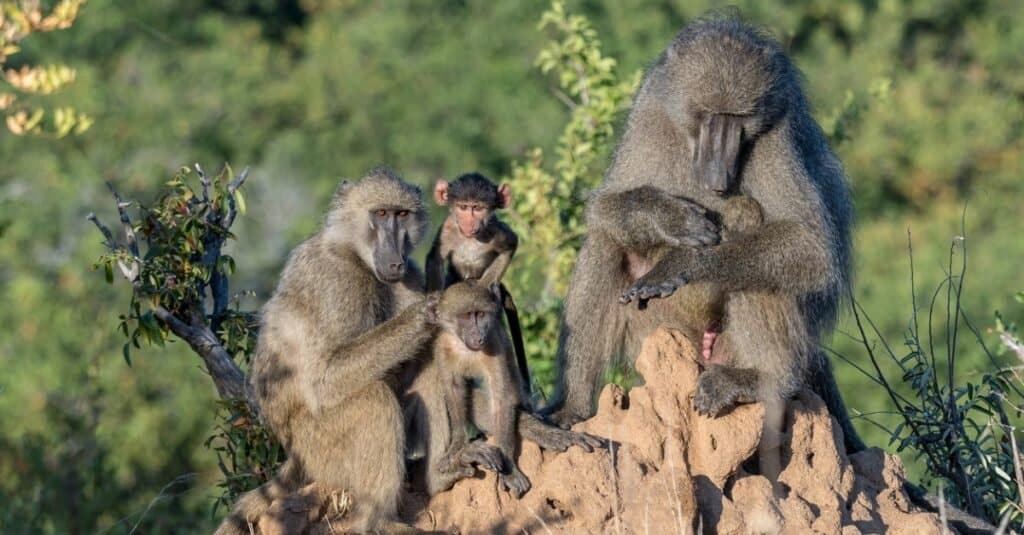
Species Of Mammals

A Chacma baboon family group on an anthill in the Sabi Sabi Nature Reserve, South Africa. Chacma baboons are primates and one of the species of mammals.

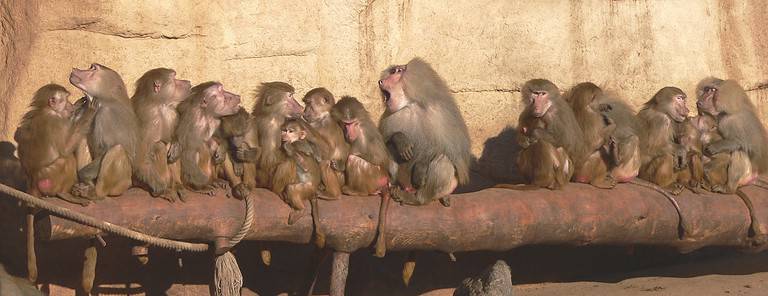
Baboons are incredibly sociable animals that live in large troops that can be very varied in size and can contain a few hundred members.

Baboon troops consist of both males and females with their young and form very close bonds by feeding, sleeping, and grooming together. During the day they break into smaller bands of 4 or 5 females and young, which is led by a dominant male who attempts to keep other males away.

The Hamadryas Baboon, however, lives in much smaller groups of around 12 females and a single alpha male. Baboons live together for protection and are constantly on the lookout for dangerous predators, particularly when they are out in the open.

If a threat is spotted, they make loud barks and while the males run to attack, the females and young disappear up into the safety of the trees. Baboons communicate with one another in a variety of different ways including vocal calls, facial expressions, and even signals with their tails.

Reproduction and Life Cycles
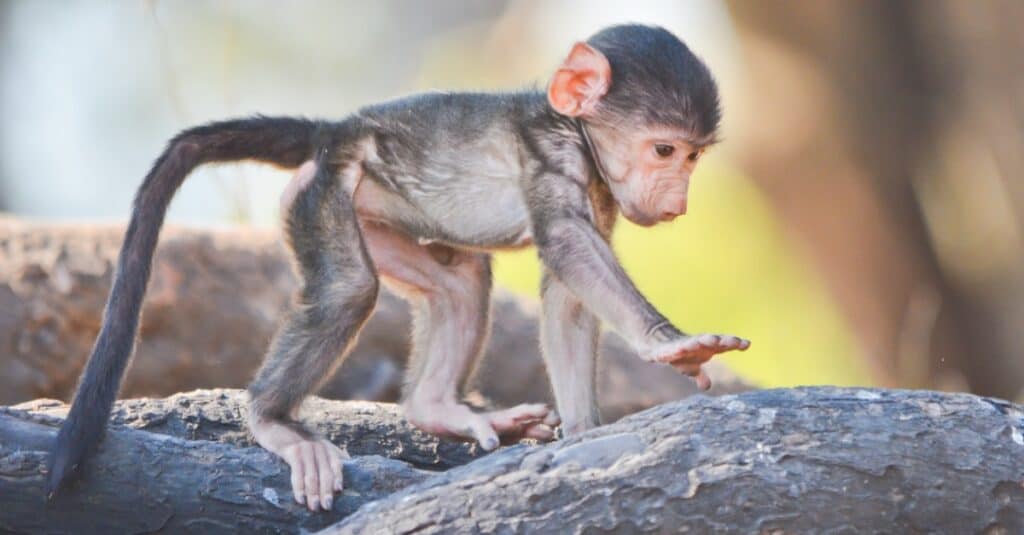
baby-monkey-walking

Baboons breed all year round and while they don’t have a strict breeding season, there are peaks in mating and births at certain times of the year.

Baboons breed all year round and while they don’t have a strict breeding season, there are peaks in mating and births at certain times of year (depending on the location). When a female is ready to mate, the dominant male of their sub-group will defend his right to mate with her fiercely but despite his efforts, female Baboons mate with numerous males in the group during their lives.

After a gestation period that lasts for around 6 months, the female Baboon gives birth to a single infant that grabs onto her fur instantly and clings to her. When they are born, young Baboons are contrasting colors to their parents and are tolerated by the troop until they molt and grow their adult fur after about two months.

Young females remain with their mothers and the two will often form very close bonds throughout their lives, whereas males are chased out of the troop and are forced to try and prove themselves to another group.

Diet and Prey
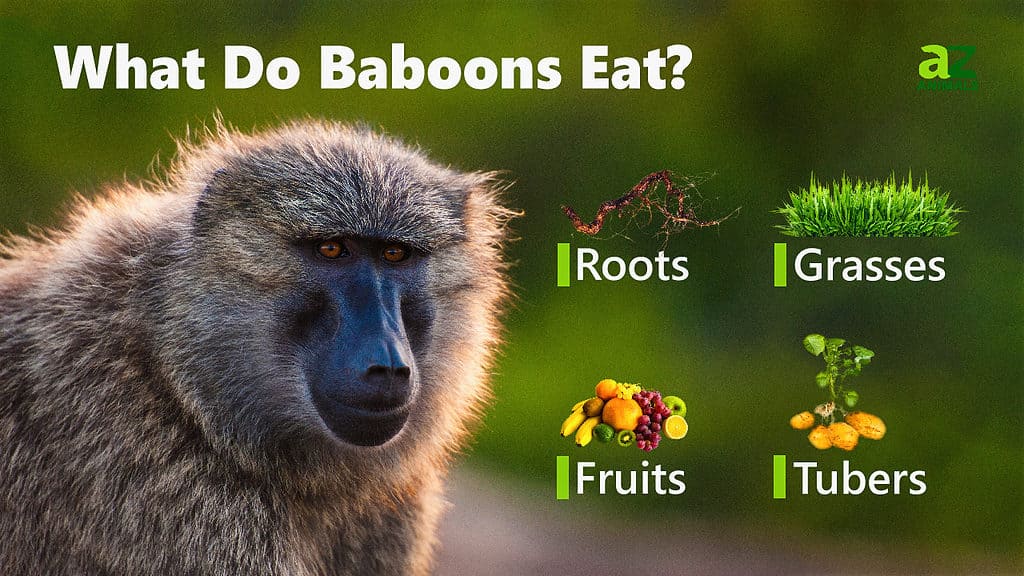
Fruits, seeds, tough roots, and flowers all make up the bulk of their diet, along with insects, eggs, lizards, and rodents.

The Baboon is an omnivorous animal that is known to eat a wide variety of both plant matter and small animals. Fruits, seeds, tough roots, and flowers all make up the bulk of their diet, along with insects, eggs, lizards, and rodents. However, their large size and power also mean that they sometimes hunt and kill larger prey such as young Gazelles.

In areas where human settlements are encroaching on their natural habitats, Baboons are also known to raid crop fields which have led to them often being seen as pests.

Baboons have very similar teeth to people with a series of large, flat molars which are perfect for grinding down vegetation and surplus food can be stored in their flexible cheek pouches to be saved for later.

Predators and Threats
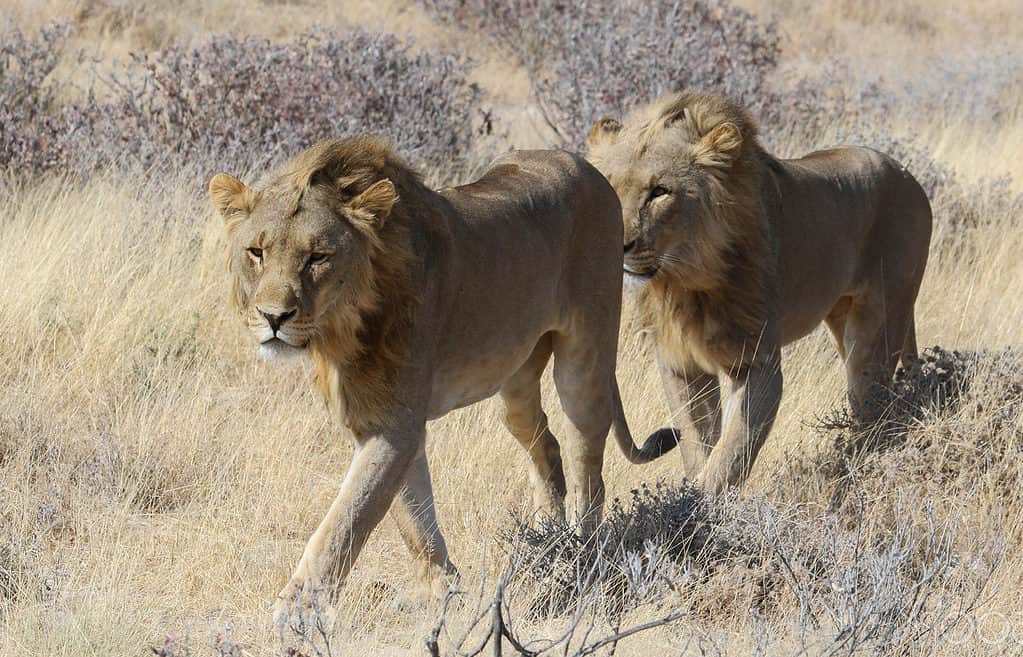
Two lions on grassland

Wildcats such as Lions, Leopards, and Cheetahs are the most common predators of the Baboon.

Due to their size and the fact that Baboons spend the majority of their lives on the ground, they are preyed upon by numerous predators throughout their natural range. Wildcats such as Lions, Leopards, and Cheetahs are the most common predators of the Baboon along with large Pythons, African Wild Dogs, and Birds of Prey that hunt the smaller and more vulnerable young.

People, however, pose the biggest threat to Baboons as they are often hunted and killed for meat and are even shot by farmers who consider them pests, fearing for their crops.

Their numbers though are being most affected by the loss of their once vast natural habitats, which are being subjected to deforestation for agriculture or land clearance for grazing and growing human settlements.

Interesting Facts and Features
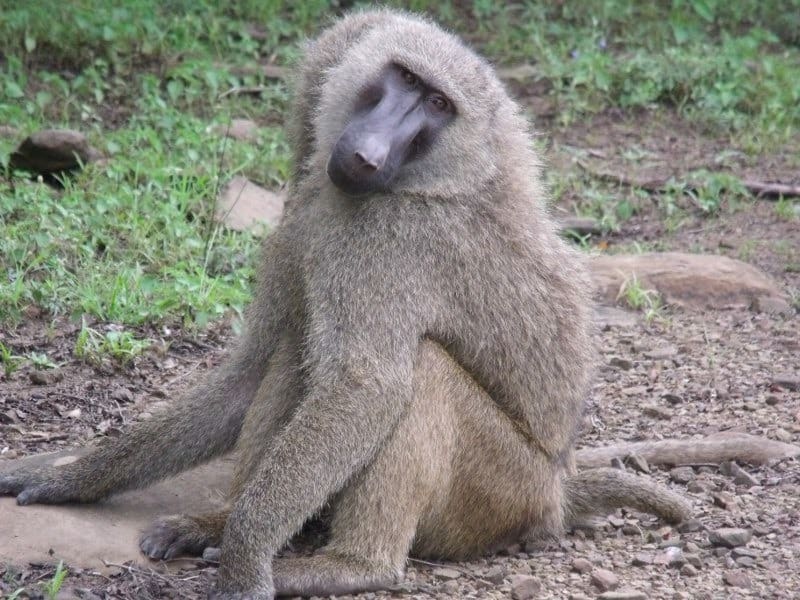
Baboons retire into the safety of the trees to sleep at night, they spend nearly all of the rest of their lives on the ground.

Although Baboons retire into the safety of the trees to sleep at night, they spend nearly all of the rest of their lives on the ground and roam throughout their home ranges in search of food and water. They are known to walk many miles a day and only stop in the shade to get out of the midday sun and are capable of traveling more than four miles between dawn and dusk.

Like many other primates, Baboons take part in social grooming by picking parasites, dead skin, and dirt from each other’s fur. This not only strengthens social bonds within the troop but also highlights the status of the individual, with the Baboon who is being groomed having a higher status in the troop than the one who is grooming them.

In order for male outsiders to be accepted into the troop, they must form a relationship with one of the females until he is then accepted by the others. This process can take months but the pair are usually known to remain close-knit friends for life.

Relationship with Humans

Baboons have adapted remarkably well to the growing human populations throughout their natural range but the fact that they often raid crops has led to them being persecuted by farmers. They are also hunted and eaten as bushmeat in many areas of their native regions but it is their dwindling habitats that are causing the biggest problem for them.

Vast areas of forest are cleared every day to make room for agriculture or to log the tropical timbers which means that Baboons have fewer areas where they can sleep safely in the trees. The grasslands are also dwindling in size as land is turned over to livestock for grazing or used for the expansion of growing settlements.

Conservation Status and Life Today

Today, four species of Baboon are listed by the IUCN as species that are of Least Concern from becoming extinct in the wild in the near future.

The Guinea Baboon is listed as a Near Threatened species. However, despite still being relatively widespread, population numbers are declining in all species due to hunting and habitat loss, with populations in certain areas rapidly becoming more and more isolated from one another.

They are found throughout many of Africa’s national parks and reserves where they play a vital role in the upkeep of the eco-system.

View all 453 animals that start with B
How to say Baboon in ...
English
Baboon
Japanese
ヒヒ属
Turkish
Babun

Sources

  1. David Burnie, Dorling Kindersley (2011) Animal, The Definitive Visual Guide To The World's Wildlife / Accessed November 10, 2008
  2. Tom Jackson, Lorenz Books (2007) The World Encyclopedia Of Animals / Accessed November 10, 2008
  3. David Burnie, Kingfisher (2011) The Kingfisher Animal Encyclopedia / Accessed November 10, 2008
  4. Richard Mackay, University of California Press (2009) The Atlas Of Endangered Species / Accessed November 10, 2008
  5. David Burnie, Dorling Kindersley (2008) Illustrated Encyclopedia Of Animals / Accessed November 10, 2008
  6. Dorling Kindersley (2006) Dorling Kindersley Encyclopedia Of Animals / Accessed November 10, 2008
  7. David W. Macdonald, Oxford University Press (2010) The Encyclopedia Of Mammals / Accessed November 10, 2008
  8. About Olive Baboons / Accessed November 10, 2008
  9. Yellow Baboon Facts / Accessed November 10, 2008
  10. Hamadryas Baboon Information / Accessed November 10, 2008
  11. Guinea Baboon Conservation / Accessed November 10, 2008
  12. About Chacma Baboons / Accessed November 10, 2008
Rebecca Bales

About the Author

Rebecca Bales

Rebecca is an experienced Professional Freelancer with nearly a decade of expertise in writing SEO Content, Digital Illustrations, and Graphic Design. When not engrossed in her creative endeavors, Rebecca dedicates her time to cycling and filming her nature adventures. When not focused on her passion for creating and crafting optimized materials, she harbors a deep fascination and love for cats, jumping spiders, and pet rats.
Connect:

Thank you for reading! Have some feedback for us?


Baboon FAQs (Frequently Asked Questions)

Baboons are Omnivores, meaning they eat both plants and other animals.