




B
Species Profile

Bactrian Camel

Camelus bactrianus

Two humps, built for extremes
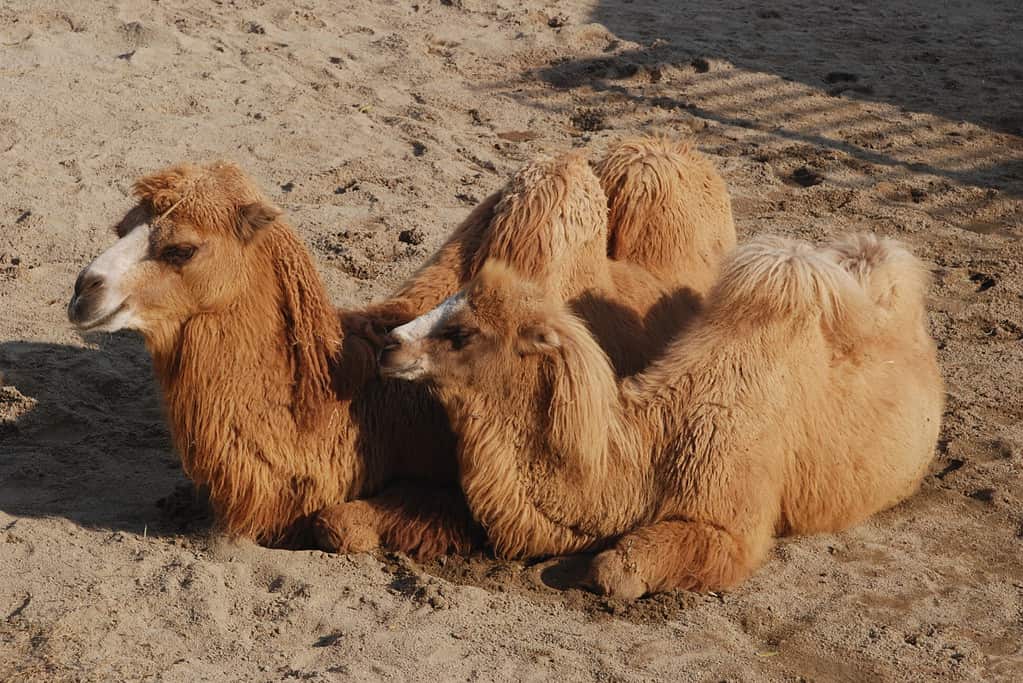
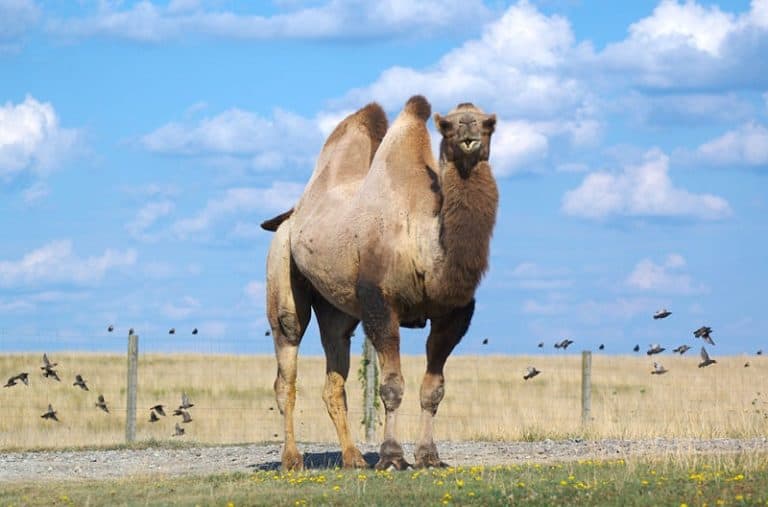
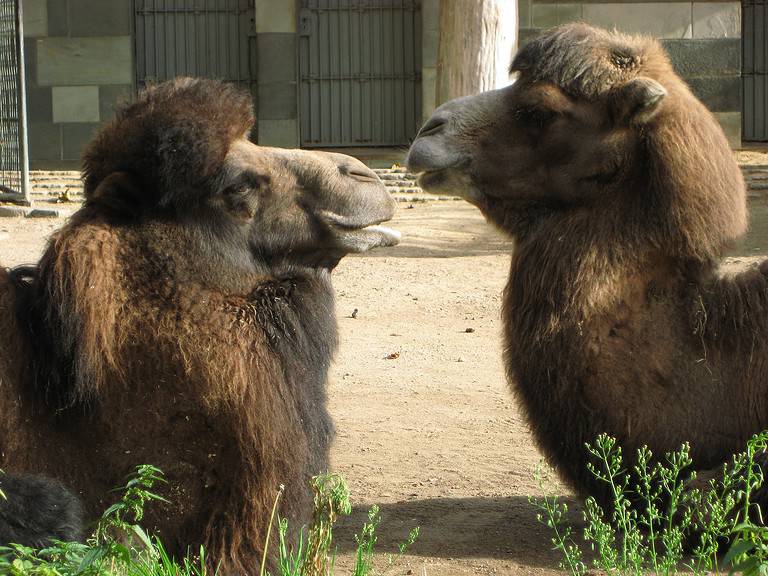
Kuribo, CC BY-SA 3.0, via Wikimedia Commons

Bactrian Camel Distribution

Click a location to explore more animals from that region

Origin Location

This map shows the native origin of the Bactrian Camel. As a domesticated species, they are now found worldwide.

Loading map...

Size Comparison

Human 5'8"
Bactrian Camel 6 ft 7 in

Bactrian Camel is 1.2x the height of an average human.

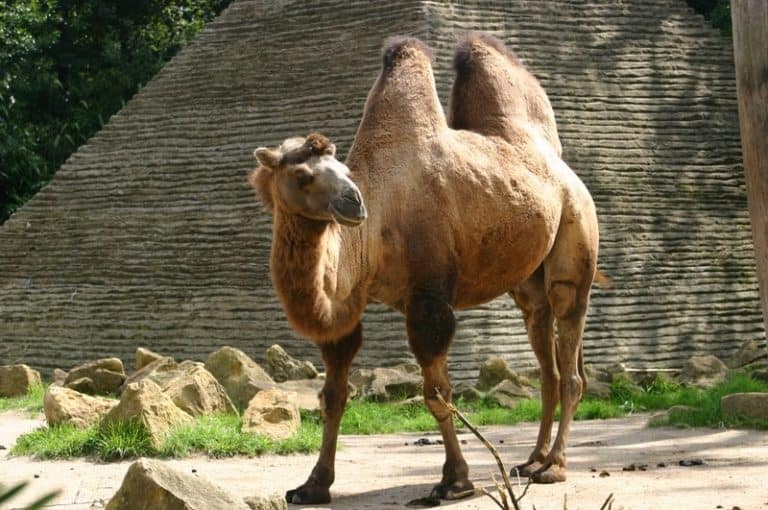
天王寺動物園のフタコブラクダ。

At a Glance

Domesticated
Also Known As two-humped camel, double-humped camel, Asiatic camel, Mongolian camel, ship of the desert
Diet Herbivore
Activity Diurnal+
Lifespan 20 years
Weight 1000 lbs
Status Not Evaluated
Did You Know?

Adults typically stand about 1.8 m at the shoulder (about 2.1 m to the top of the humps) and weigh about 300-690 kg.

Scientific Classification

The Bactrian camel is a large camelid characterized by two humps and adaptation to cold, arid continental climates; it is primarily domestic and widely used as a pack and riding animal across Central Asia.

Kingdom
Animalia
Phylum
Chordata
Class
Mammalia
Order
Artiodactyla
Family
Camelidae
Genus
Camelus
Species
Camelus bactrianus

Distinguishing Features

  • Two humps (fat storage) rather than one
  • Dense winter coat and tolerance of severe cold and heat
  • Broad, padded feet suited for sand and gravel
  • Ability to tolerate dehydration and drink large volumes when water is available
  • Nostrils that can close and long eyelashes to reduce sand intrusion

Physical Measurements

Males and females differ in size

Height
6 ft 7 in (5 ft 11 in – 7 ft 7 in)
5 ft 7 in (5 ft 3 in – 5 ft 11 in)
Length
11 ft 8 in (10 ft – 13 ft 3 in)
9 ft 10 in (8 ft 4 in – 10 ft 12 in)
Weight
1,764 lbs (1,323 lbs – 1.1 tons)
1,157 lbs (992 lbs – 1,433 lbs)
Tail Length
1 ft 6 in (1 ft 2 in – 1 ft 10 in)
Top Speed
40 mph
Short burst speed about 65km/h

Appearance

Primary Colors
Secondary Colors
Skin Type Thick skin with a dense double coat: coarse outer hairs and soft underwool. Hard calluses on chest and knees for kneeling on rough cold desert ground; wide two-toed feet with large leathery pads.
Distinctive Features
  • Two large dorsal fat-storing humps (key distinction from one-humped dromedary); humps shrink/tilt when fat reserves are depleted and become fuller when well-fed.
  • Cold-desert/continental-climate coat: very long, woolly winter pelage with heavy insulation; seasonal molt typically in spring/early summer, often shedding in sheets/patches (frequently documented in husbandry and zoological references).
  • Long hair fringes and mane-like neck/shoulder hair (especially pronounced in adult males) that increase insulation and wind protection.
  • Broad, split upper lip and tough oral papillae enabling browsing on thorny/saline plants typical of Central Asian steppe and desert pastures.
  • Closable nostrils and long double-row eyelashes/bushy eyebrows that protect against dust, sand, and wind.
  • Bactrian Camel (Camelus bactrianus) has a very large body: shoulder height about 1.8–2.0 m, hump height 2.1–2.3 m, length 2.25–3.5 m; males ~600–1,000 kg, females ~450–650 kg (varies by breed and care).
  • Adaptations for traveling on sand/snow: wide, splayed toes with thick pads; legs with robust joints and calloused kneeling pads for rest and loading.
  • Note on taxonomy/context: this is the domestic Bactrian camel (Camelus bactrianus), distinct from the separate wild species Camelus ferus (wild Bactrian camel).

Sexual Dimorphism

Sexual dimorphism is present: adult males are generally larger/heavier with more robust head/neck musculature and more developed mane/neck hair; females are typically smaller and more lightly built. Differences are most obvious in mature animals and during the breeding season (rut).

  • Larger average body mass and overall frame (commonly reported male range ~600-1,000 kg vs female ~450-650 kg, depending on breed and husbandry).
  • More prominent neck/shoulder mane and longer, coarser hair around the throat and forequarters; thicker neck profile.
  • During rut, males often show conspicuous behavioral/appearance signs (e.g., increased neck gland activity/secretions, urine spraying, foaming), though intensity varies by breed and management; these are seasonal and not permanent markings.
  • Smaller average body mass and slimmer neck/forequarter profile compared with males.
  • Typically less pronounced mane/neck hair; humps may appear proportionally smaller/less massive in many domestic lines (strongly influenced by nutrition and reproductive status).

Did You Know?

Adults typically stand about 1.8 m at the shoulder (about 2.1 m to the top of the humps) and weigh about 300-690 kg.

They can tolerate severe dehydration-classic physiology studies report camels may lose ~25% of body mass in water and still recover (Schmidt-Nielsen).

After rehydration, camels can drink roughly ~100 L within minutes (often cited ~10 min) when water becomes available (camel physiology literature, incl. Schmidt-Nielsen).

Bactrian camels grow a heavy winter coat; long guard hairs commonly reach ~20-25 cm, then shed dramatically in spring-an adaptation for cold continental winters.

Gestation is long: about ~12.5-14 months, usually producing a single calf (camelid reproductive references).

Their two humps store fat (not water), providing an energy reserve when forage is sparse across steppe and desert travel routes.

Unique Adaptations

  • Cold-desert insulation: exceptionally dense winter coat and seasonal molt suited to large temperature swings in Central Asia.
  • Efficient water economy: reduced sweating, highly concentrated urine, and very dry feces; classic studies show extreme dehydration tolerance (Schmidt-Nielsen).
  • Oval red blood cells: help maintain blood flow during dehydration/rehydration cycles and tolerate large osmotic shifts better than typical mammalian RBCs (camel physiology literature).
  • Nasal defenses: closable nostrils and complex nasal turbinates that help exclude sand and recover moisture from exhaled air.
  • Foot design for sand and gravel: broad, splayed toes with tough pads reduce sinking and protect on stony desert surfaces.
  • Diet tolerance: can utilize salty and xeric plants; robust lips and oral tissues help handle thorny browse.
  • Two fat humps: an energy reserve that can shrink markedly during prolonged food scarcity, improving survival on long routes.

Interesting Behaviors

  • Seasonal rut (typically winter): males become highly territorial and may display loud vocalizations, neck wrestling, biting, and frequent scent-marking.
  • Kneeling to load/unload: they commonly fold legs under the body ("cush") to accept packs and riders-key to caravan work.
  • Spitting and regurgitation as defense: a common threat behavior when stressed or competing.
  • Group structure: domestic herds often form female-centered groups with young; mature males are more solitary outside the breeding season.
  • Browsing flexibility: they readily switch between grazing and browsing, including thorny, dry, or salty plants that many livestock avoid.
  • Thermoregulatory behavior: seeking windbreaks, facing into wind/sand, and altering activity times to reduce heat or cold stress in open landscapes.

Cultural Significance

The domestic Bactrian camel (Camelus bactrianus) is central to Central Asian life and Silk Road caravans. In cold, dry lands it carries loads, pulls plows, and gives wool (warm undercoat), milk, and meat. Two-humped, distinct from wild camel (Camelus ferus).

Myths & Legends

Mongolian folktales say the Bactrian camel was sure it would get a spot in the 12-year animal cycle, but a quick mouse took it. Tales show the camel watching horizon or resenting the mouse's trick.

Steppe tales explain why the Bactrian camel (Camelus bactrianus) has humps: some say it got them as punishment for refusing help, others as a reward for hard work, teaching pride and sharing.

In Turkic-steppe tales, the Bactrian camel (Camelus bactrianus) lends its horns or antlers to another animal, often a deer, which never returns them, leaving the camel hornless and strong, an origin story for its form.

Silk Road merchants often told that the Bactrian camel (Camelus bactrianus) is a steady guide through blizzards and sandstorms, believed to 'know the road' and protect desert-steppe travelers.

Conservation Status

NE Not Evaluated

Has not yet been evaluated against the criteria.

Population Stable

Life Cycle

Birth 1 calf
Lifespan 20 years

Lifespan

In the Wild
15–30 years
In Captivity
20–40 years

Reproduction

Mating System Polygyny
Social Structure Managed Domestic
Breeding Pattern Seasonal
Fertilization Internal Fertilization
Birth Type Internal_fertilization

Bactrian camel (Camelus bactrianus) is polygynous: one male often manages many females (commonly ~20–50). Rut is seasonal in winter; females have short estrus and are induced ovulators. Gestation ~13 months, usually one calf; females mature at 3–4 years.

Behavior & Ecology

Social Herd Group: 10
Activity Diurnal, Crepuscular, Cathemeral
Diet Herbivore Saxaul (Haloxylon ammodendron) browse (a key winter/late-season forage in Central Asian desert ecosystems; reported as a major component of wild and free-ranging Bactrian camel diets in Gobi/desert-steppe studies)

Temperament

Generally calm and tolerant of conspecific proximity in stable domestic herds, especially when habituated to handling
Can be wary/reactive when poorly habituated or in feral/free-ranging conditions
Adult males become markedly more aggressive during rut (increased biting, kicking, chasing, and dominance displays)
Strongly social tendency: isolation can increase agitation and vocalizing, while familiar herd-mates provide social buffering

Communication

low-frequency grunts/rumbling calls used in close-range social contact
groans/moans during handling, distress, or exertion
loud roars/bellows associated with male rut and agonistic encounters
snorts/exhalation sounds used in alerting or irritation
visual postures and dominance displays Neck/head carriage, approaching/barging, threat stances
tactile interactions (nuzzling, pushing, grooming-like rubbing) common between familiar individuals
spitting/regurgitation as a defensive/aggressive behavior More frequent in conflict/handling
scent marking and chemical signaling via glandular secretions and rubbing Notably in males) and via urine-based signals; rutting males intensify marking behavior (described broadly for Camelus spp.; Gauthier-Pilters & Dagg, 1981

Habitat

Biomes:
Desert Cold Temperate Grassland Alpine
Terrain:
Plains Plateau Valley Rocky Sandy
Elevation: -6063 in – 11482 ft 11 in

Ecological Role

Large arid-land herbivore and disturbance-tolerant mixed-feeding ungulate that links desert-steppe primary production to higher trophic levels and pastoral systems.

Grazing and browsing regulate shrub/grass biomass and influence plant community structure across desert-steppe rangelands (seasonally shifting pressure between grasses and shrubs). Seed dispersal via endozoochory/epizoochory for some desert plants (seeds transported in dung or on fur), aiding patch-to-patch connectivity in fragmented arid habitats. Nutrient cycling: dung and urine concentrate nitrogen and other nutrients, creating localized fertility hotspots that support invertebrates and plant regrowth. Soil disturbance/trampling and trail formation alter microhabitats and can facilitate water infiltration in some contexts while also contributing to erosion/compaction under high stocking pressure in managed systems. Supports scavenger and decomposer communities indirectly through dung resources and (in pastoral contexts) occasional carcass availability.

Diet Details

Other Foods:
Grasses Sedges and rushes Desert shrubs and subshrubs Salt- and drought-tolerant shrubs Thorny browse plants, dry standing forage, twigs and coarse stems Cultivated fodders

Human Interaction

Domestication Status

Domesticated

Camelus bactrianus is the domesticated two-humped camel of Central Asia, used as pack and riding animals since about 4,000-5,000 years ago (Silk Road). Domestic camels did not come from today’s wild Camelus ferus. Adults weigh ~300-1,000 kg, live 20-40 years with people, and can be aggressive in rut.

Danger Level

Moderate
  • Trauma: bites (can cause severe lacerations/crush injury), kicks (including sideways kicks), and trampling/crushing-risk increases with improper handling and during male rut.
  • Behavioral risk: defensive aggression when startled, restrained, or protecting calves; heightened aggression in mature males during breeding season.
  • Zoonotic and occupational exposures (especially in pastoral settings): brucellosis (Brucella spp.), dermatophytosis (ringworm), and other livestock-associated pathogens; risk depends on regional disease prevalence and hygiene/veterinary controls.
  • Handling hazards: falls during riding/working; rope/halter injuries; vehicle incidents during transport.

As a Pet

Not Suitable as Pet

Legality: Bactrian Camel (Camelus bactrianus): Laws differ by country. Often treated as livestock. In many U.S. states it can be kept as agricultural/exotic livestock but needs zoning, secure fencing, welfare rules, and permits; suburban pet keeping is usually impractical.

Care Level: Expert Only

Purchase Cost: $1,500 - $12,000
Lifetime Cost: $60,000 - $200,000

Economic Value

Uses:
Transport/packing and riding Milk production Meat production Fiber (camel hair/wool) Leather/hides Draft/traction (regional) Tourism/trekking and cultural heritage uses Racing/festivals (regional)
Products:
  • pack and riding services (long-distance transport in arid/cold steppe-desert regions)
  • camel milk (fresh, fermented; regionally important pastoral product)
  • meat (carcass meat; offal in some markets)
  • fiber: coarse guard hair and finer underwool for textiles/felt/rope
  • hides/leather goods
  • manure used as fuel/fertilizer in some pastoral systems

Relationships

Related Species 6

Wild Bactrian camel Camelus ferus Shared Genus
Dromedary Camelus dromedarius Shared Genus
Llama
Llama Lama glama Shared Family
Guanaco Lama guanicoe Shared Family
Alpaca
Alpaca Vicugna pacos Shared Family
Vicuna
Vicuna Vicugna vicugna Shared Family

Ecological Equivalents 5

Animals that fill a similar ecological role in their ecosystem

Bactrian Camel Breeds

5

Explore 5 recognized breeds of bactrian camel

Working (pack) (2)

Alashan (Bactrian type) Origin: Alxa/Alashan region (Inner Mongolia, China)
Tuvan Bactrian Origin: Tuva (southern Siberia, Russia)

Working (pack) / Dairy Meat (1)

Kazakh Bactrian Origin: Kazakhstan (Central Asian steppe and semi-desert)

Working (pack/riding) (1)

Kalmyk Bactrian Origin: Lower Volga region / Kalmykia (Russia)

Working (pack/riding) / Fiber (wool) (1)

Mongolian Bactrian Origin: Mongolia (Gobi and steppe regions)

The double-humped, wild Bactrian camel is one of the least-studied animals in the world and in danger of extinction!


Double-humped camels are called Bactrian camels. Two species roam the planet today: domesticated Bactrian camels and wild Bactrian camels. Unfortunately, wild Bactrians are teetering on the verge of extinction and also rank among the least-studied animals on Earth. If drastic measures aren’t implemented soon, they could cease to exist in 20 years. Conversely, domesticated Bactrian camels are thriving and boast population numbers in the millions. The one-humped dromedary camels are also plentiful.

Ten Fascinating Bactrian Camel Facts

  • Recent genetic studies revealed that domesticated Bactrian camels are a different species than the wild ones. They are thought to have diverged 1.1 million years ago.
  • People in what is now Afghanistan and Turkestan began domesticating Bactrian camels in 2500 B.C.
  • Wild Bactrians are the only remaining wild camel species in the world.
  • In ancient Arabian times, riding camels was a status symbol.
  • Bactrian camels can carry 170 to 250 kilograms (370 to 559 pounds) for 47 kilometers (30 miles) a day.
  • In 1856, the United States military initiated the Camel Corps. But, the Civil War broke out, so the government abandoned the project.
  • Mongolians hold a yearly camel race. Participants wear traditional clothing, and colorful commentators give play-by-play updates of the nine-mile race over bullhorns.
  • Camel dung is so dry it can be used to fuel fire without first being dried out.
  • Camels don’t sweat until their body temperature reaches 106 degrees Fahrenheit.
  • The ancient Greek philosopher Aristotle first described camels in his book “History of Animals.”
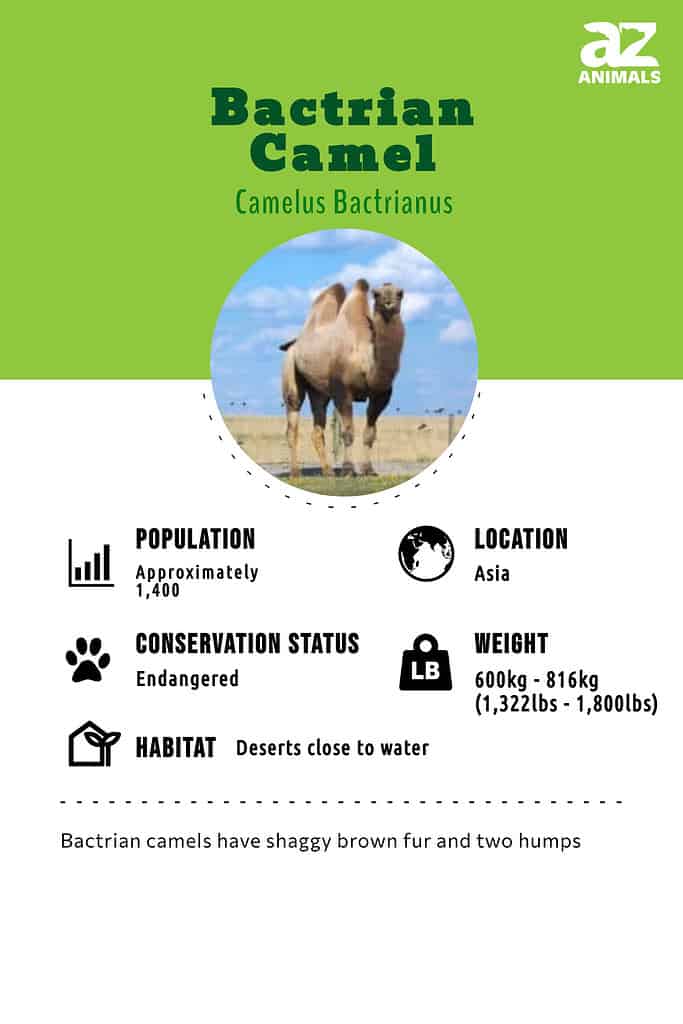
Scientific Name
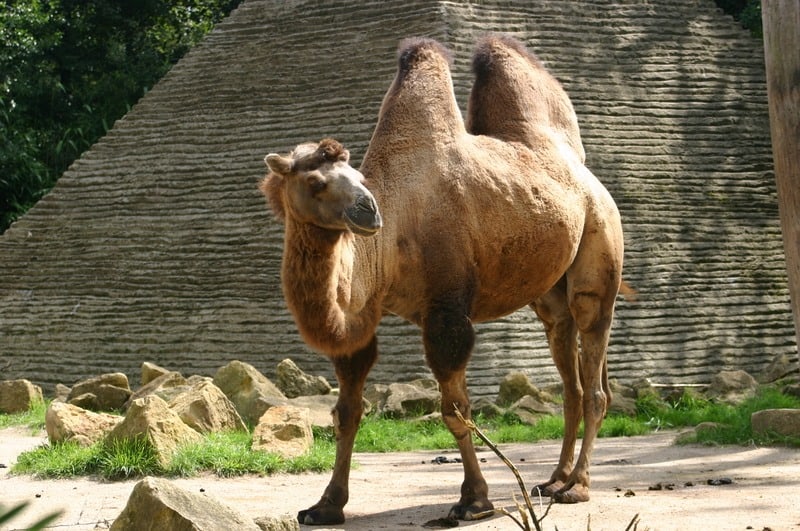
Bactrian Camels may be wild or domesticated


Camelus ferus is the scientific name for wild Bactrian camels, and Camelus Bactrianus is the scientific name for domesticated Bactrian camels.

Camelus comes from Latin. Linguists believe the word evolved from the Arabic phrase jamala, which means “to bear.” Bactrian, and by extension Bactrianus, refer to an ancient region in Asia called Bactria. Ferus references “feral,” which means wild.

The Mongolian word for wild Bactrians is havtagai.

Types

  • The domestic Bactrian camel (Camel bactrianus):  By far more numerous compared to their wild relatives – their population is about 2 million  – these mammals have a woollier coat which occurs in a wide range of colors and bulkier humps. However, they lack the ability to process salty water as efficiently as their wild cousins.
  • The wild Bactrian camel (Camel ferus):  In spite of a similar appearance, these mammals are somewhat different from their domesticated relatives genetically speaking since they actually descended from a different set of forbears. Their coats are generally less luxuriant compared to domestic Bactrian camels’, their heads are also flatter, and their humps smaller. They are also capable of processing water with high levels of salinity efficiently.

Evolution and Classification 
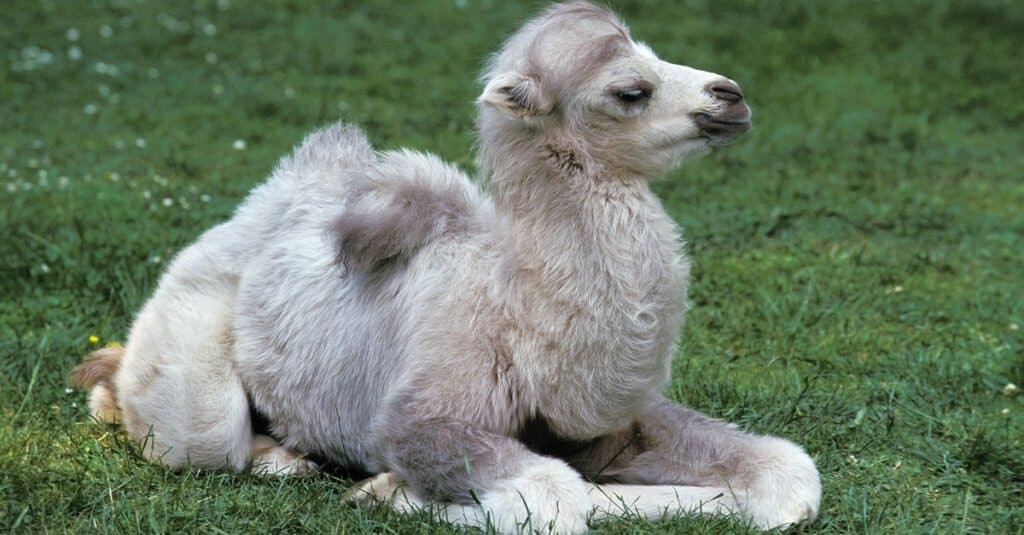
baby camel bactrian

Early camelids were far smaller than their present-day descendants

Both wild and domesticated Bactrian camels belong to the family Camelidae. As a result, they are not only related to Dromedaries, their cousins with single humps, but also alpacas, llamas, guanacos, and vicuñas.

The story of this rather small family dates all the way back to several creatures including one known as Protylopus. Far from having the comparatively large sizes of its present-day descendants,  this four-toed mammal was the size of a rabbit and lived in an area corresponding to present-day North America during the mid-Eocene (between 40 – 50 million years ago).

Leaping 10 – 15 million years forward, during the Late Eocene, the earth was now home to larger goat-sized camelids such as the two-toed Poebrotherium.

The ancestors of present-day camelids only got to leave North America approximately 3 million years ago. A number of them moved southward following the formation of the Isthmus of Panama. Others moved into Asia.

In time only the Bactrian and the Dromedary, and their smaller distant South American relatives remained. 

Appearance and Behavior
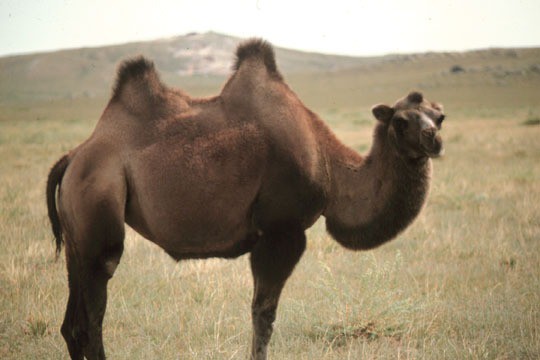
Bactrian Camels have an excellent sense of smell in spite of their small-sized nostrils

Camel bodies are built to withstand extreme conditions, and they can survive in temperatures ranging from 20 degrees Fahrenheit (-29C) to 120 degrees Fahrenheit (49C). Learn about the toughest animals in the world here.

Appearance


Many people think camel humps are water containers, but their signature bumps are actually stuffed with fat that can be accessed in lean times. When the fat is drained, the humps don’t maintain their shape. Instead, they flip-flop from side to side.

Bactrian camel heads are rectangular, but wild Bactrian skulls are flatter. Their noses are muscular narrow slits that can be closed to block dirt and sand. However, despite their tiny nostrils, camels have an excellent sense of smell.

Their small hairy ears and double-row of eyelashes also guard against the elements. A set of hidden eyelids, with two halves that shut like windows, also serve as an extra seal. Plus, their bushy eyebrows act as natural sun visors. Bactrian camels even have hair on their lips to protect against thorny shrubs.

Domesticated Bactrians sport thick, shaggy fur, and they rock large beards on their throats and necks. However, wild coats are thinner. They come in a range of colors, from dark brown to eggshell white. Molting happens naturally, and the fur tends to come off in large clumps, which gives the camels a ragged appearance in spring months.

Camel feet are one of Mother Nature’s technological marvels. They have round hooves with two large toes that carry weight evenly. A tough outer membrane protects against hot and rocky terrain, and built-in shock absorbers ease the pain of long treks.

Bactrian camels are between 225 to 350 centimeters (7.38 to 11.48 feet) long. From the top of their humps to the ground, they’re about 213 centimeters (6.9 feet) tall and usually tip the scales between 300 and 1,000 kilograms (660 to 2,200 pounds). They are the largest camel species, the largest mammal in their native range, and males are typically larger than females.

Humps on wild Bactrian camels are smaller and more cone-shaped than the ones on domesticated Bactrians. Moreover, domesticated individuals have shorter legs and smoother fur. But both species have powerful muscles that help the animals stay upright when strong winds blow through.

Behavior
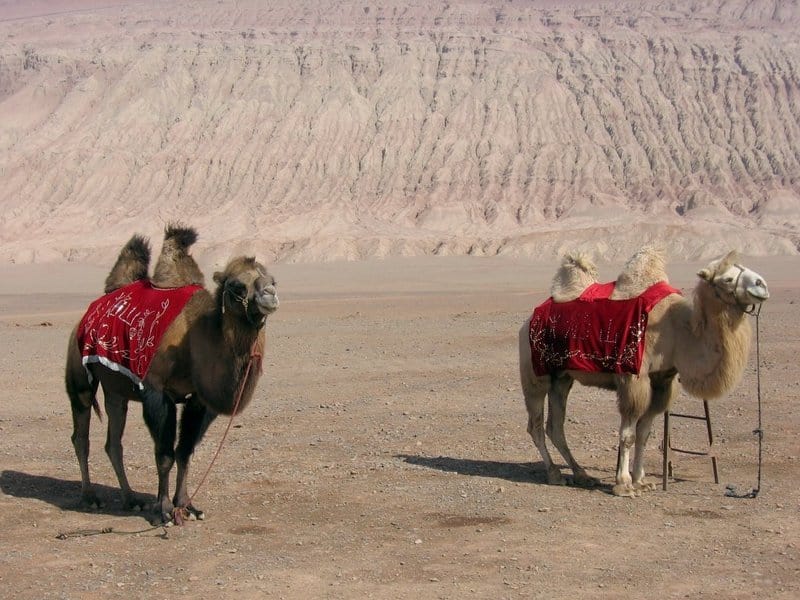
bactrian camel - Camelus ferus - domestic bactrian camels in the desert with saddles
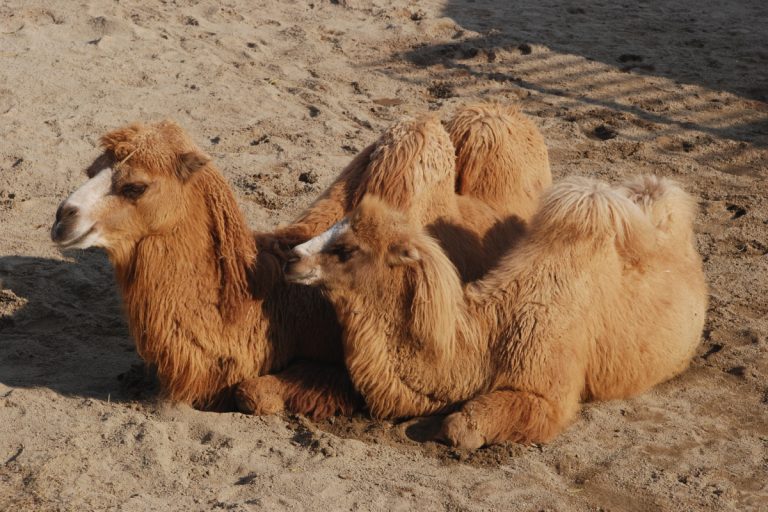
Bactrian camels are warm and affectionate and mothers and calves share a strong bond


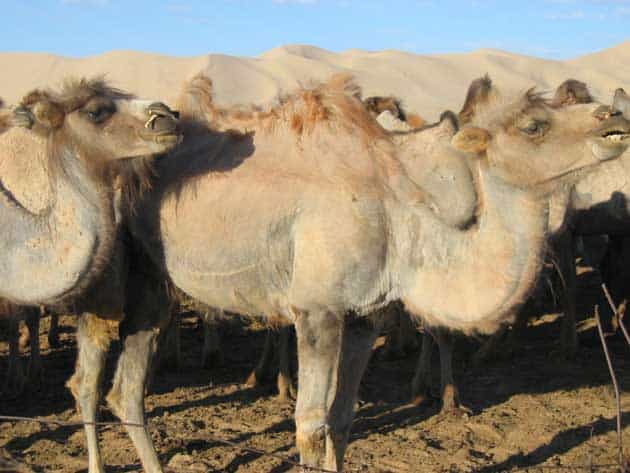
Bactrian camels are diurnal, which means they sleep at night and forage for food during the day. They travel in packs called flocks or caravans. Up to 30 animals may roll together with a single male leading the way, but it’s more common to see packs of 6 to 20. After a rain, the different flocks convene at rivers, springs, and other water sources to load up, and a single animal can drink up to 57 liters of water in one sitting. That’s like drinking an entire beer keg at once!

Domesticated Bactrian camels are warm, friendly animals that form affectionate bonds with humans. Mothers and children are also exceptionally close, and when death strikes, they mourn for up to six months. Wild Bactrians, on the other hand, are shier. They usually run away when people come close and can scatter quickly! Though camels may appear lumbering, the animals can sprint up to 65 kilometers (40 miles) per hour! Watch out, though, if you find yourself close to a camel. Like their alpaca and llama cousins, Bactrian camels spit. But what comes out of their mouth isn’t saliva — it’s vomit!

Not only are camels fine-tuned for harsh ground conditions, but they’re also excellent swimmers.

Habitat
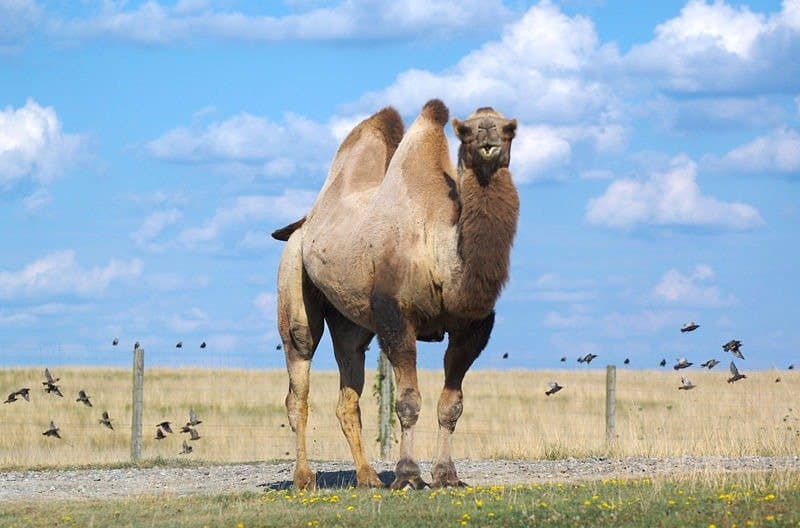
Bactrian Camels can be found in the Gobi desert but mainly live in sanctuaries


Wild Bactrian camels are native to arid regions in central Asia. Specifically, they stick to the Gobi Desert of northern China and southern Mongolia. Currently, the overwhelming majority live on conservation preserves, including:

  • Lop Nur Wild Camel National Nature Reserve
  • Great Gobi: A Strictly Protected Area
  • Altun Shan Wild Camel Nature Preserve
  • Aksai Annanba Nature Reserve
  • Dunhuang Wanya Idun Nature Reserve


The Lop Nur reserve was once a nuclear testing site, but it hasn’t affected the camels. However, recent mining activity in the area is proving deleterious. As such, scientists are working with officials to relocate the camels to Pleistocene Park in Siberia. The Bactrians would be a proxy for another camel species that went extinct in the region. If the plan works, the move could be a boon for the species.

Regarding the move to Siberia, you may be wondering, “can camels live in cold and snowy regions?” The answer is yes! Camels are highly adaptable. They can withstand scorching temperatures, frigid conditions, and everything in between.

Domesticated Bactrians live throughout Asia on farms and with families.

Diet
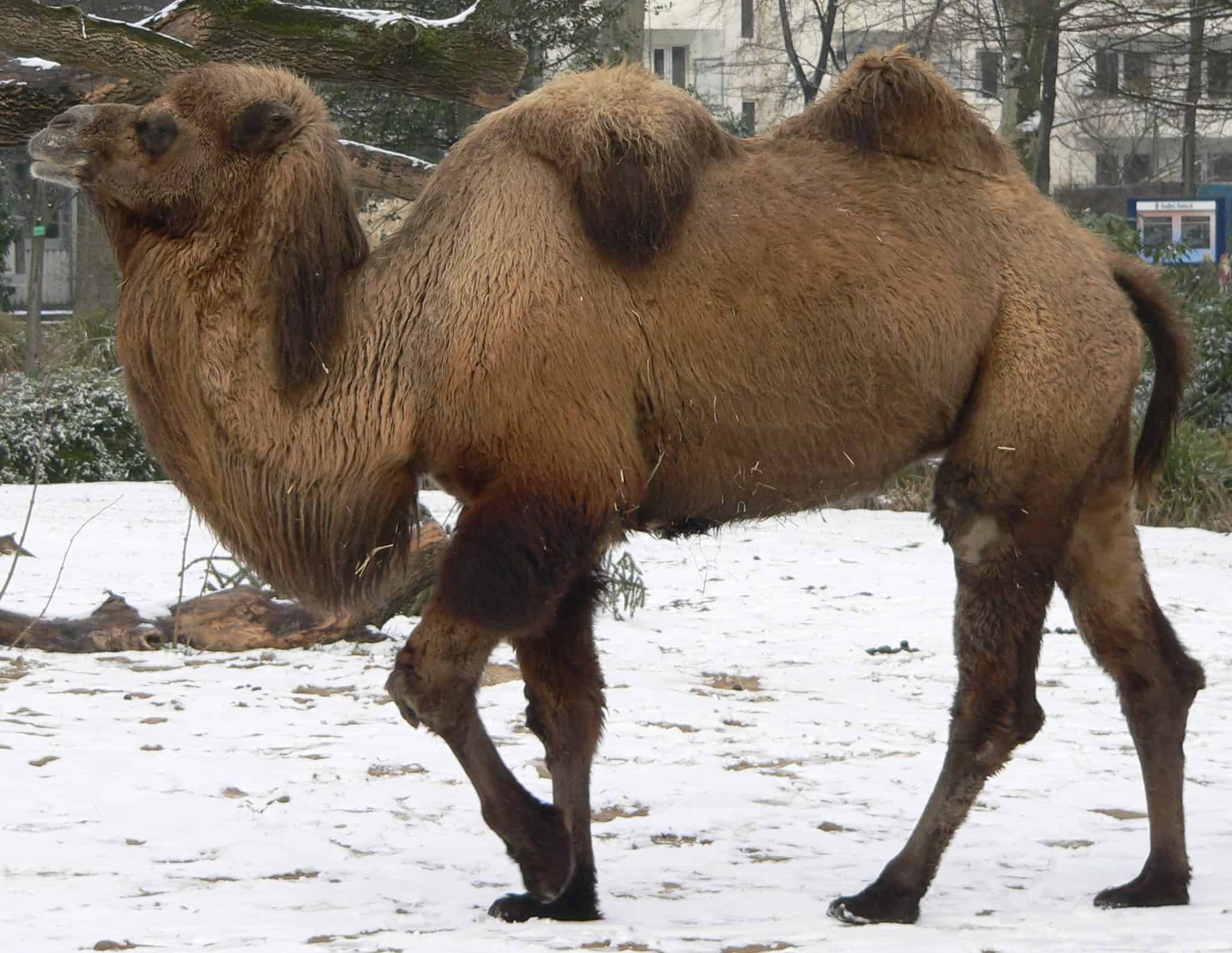
Bactrian Camels are omnivores and are capable of deriving nutrients from tents and footwear if the need arises


Bactrian camels are omnivores in every sense of the word. While they prefer to dine on shrubs — including feather grass, tamarind trees, and saxaul trees — they will down whatever they can find. Camels won’t kill other land animals, but they will eat carcasses and suck the marrow from bones. They’ll also kill fish. If no meat or vegetation is available, camels have special enzymes that can digest tents, clothes, and shoes.

Wild Bactrians can handle saltwater better than any other animal; however, domesticated ones aren’t as hardy. Both can extract nutrients from snow and ice though, which is a natural skill that many animals don’t have. Bactrian camels can also draw water from plants and bark.

Speaking of water, camels can down over 100 liters (22 gallons) in under 10 minutes! That’s the equivalent of drinking 300 glasses of water in 10 minutes! Because of their ability to consume so much at once, camels can go for weeks between feedings.

Predators and Threats
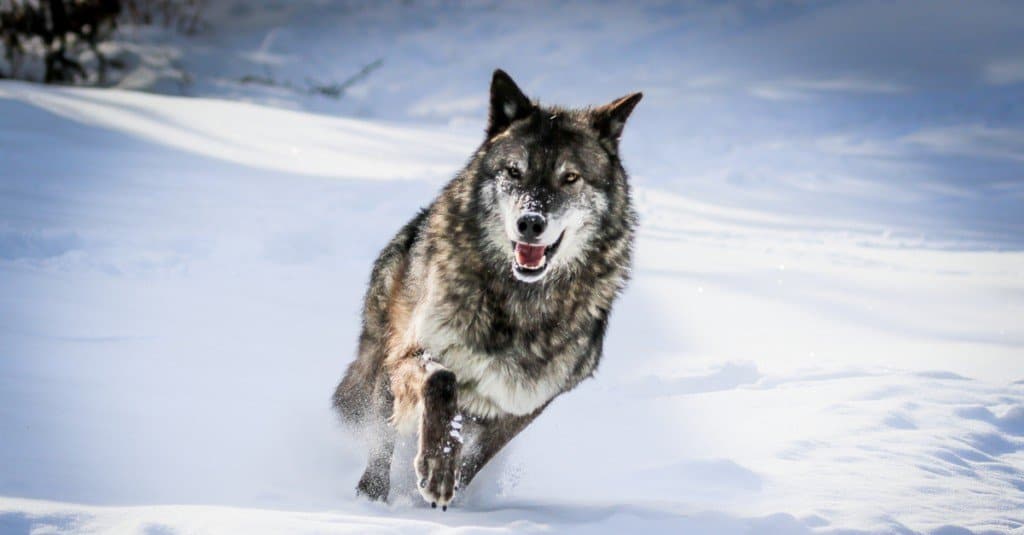
tibetan mastiff vs wolf

Gray wolves are the only wild animals which hunt Bactrian camels


Gray wolves are wild camels’ only natural predators. Caspian tigers once preyed on them, but they’ve since gone extinct regionally. Today, humans are the species’ worst threat.

Humans started hunting Bactrian camels for their meat and hides in the 1800s. By the 1920s, the population had significantly dwindled. Officials established poaching restrictions; however, illegal hunting remains a problem. Moreover, as humans encroach on camel territory, the situation has worsened. Farmers shoot camels that get too close to livestock, and some even use land mines to protect their properties.

Rezoning is also devastating for Bactrian camels in the wild. In China, mining toxicity is proving especially harmful.

Domesticated Bactrian camels aren’t in the same danger as wild ones. However, some scientists worry that elevated rates of hybridization between domestic and wild Bactrians could lead to genetic degradation and further harm the wild population.

Reproduction, Babies, and Lifespan
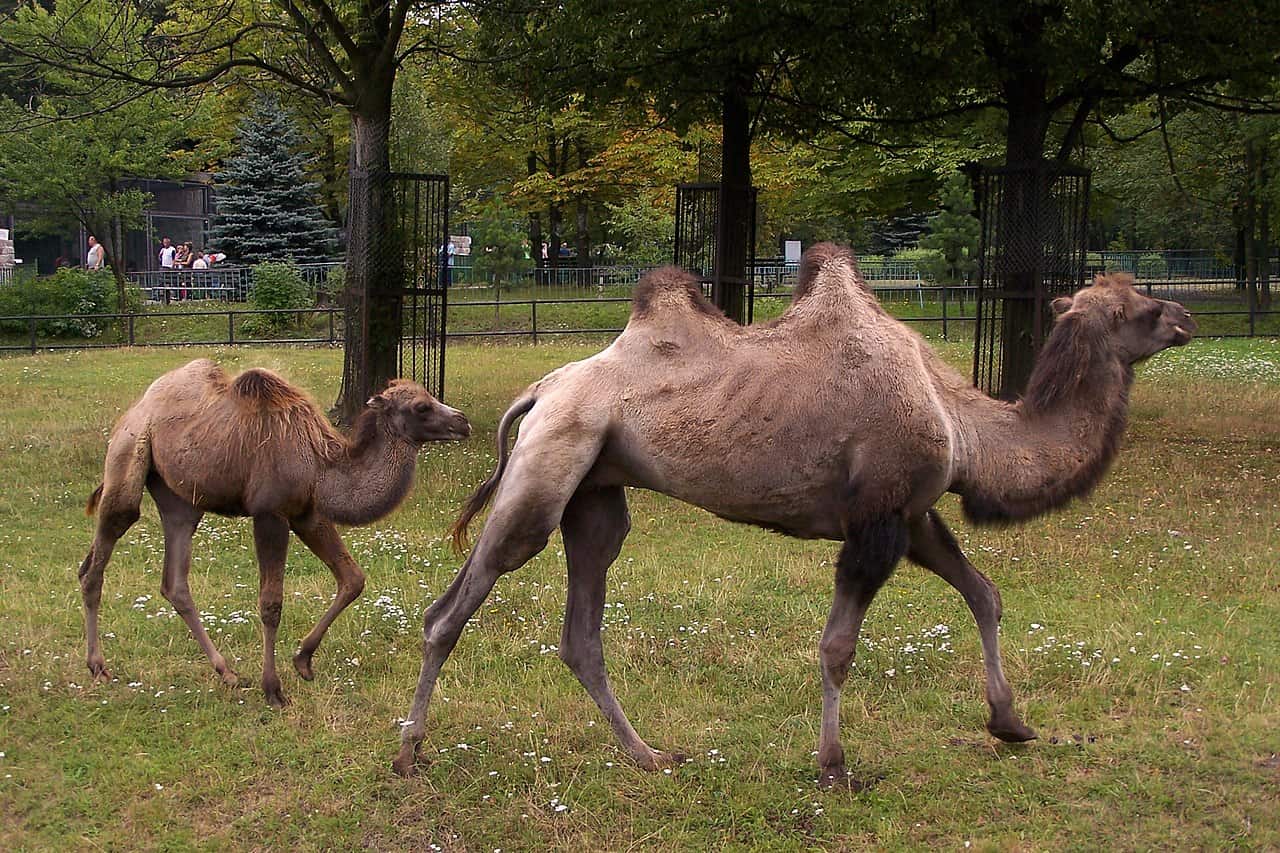
Bactrian camels have a gestation period of 13 months


Since wild Bactrians are endangered, several conservation mating programs are underway.

Reproduction


Winter is mating season for Bactrian camels. To attract females, males vocalize and strike awkward poses.

Lady camels reach sexual maturity at around five years old and are induced ovulators, meaning they don’t release eggs until they’ve been inseminated.

Gestation lasts 13 months, and they typically give birth every other year. Mothers usually give birth to one baby at a time, but twins happen on rare occasions.

If you see a lone camel straggling, it’s likely just reached puberty and searching for a flock to join.

Young
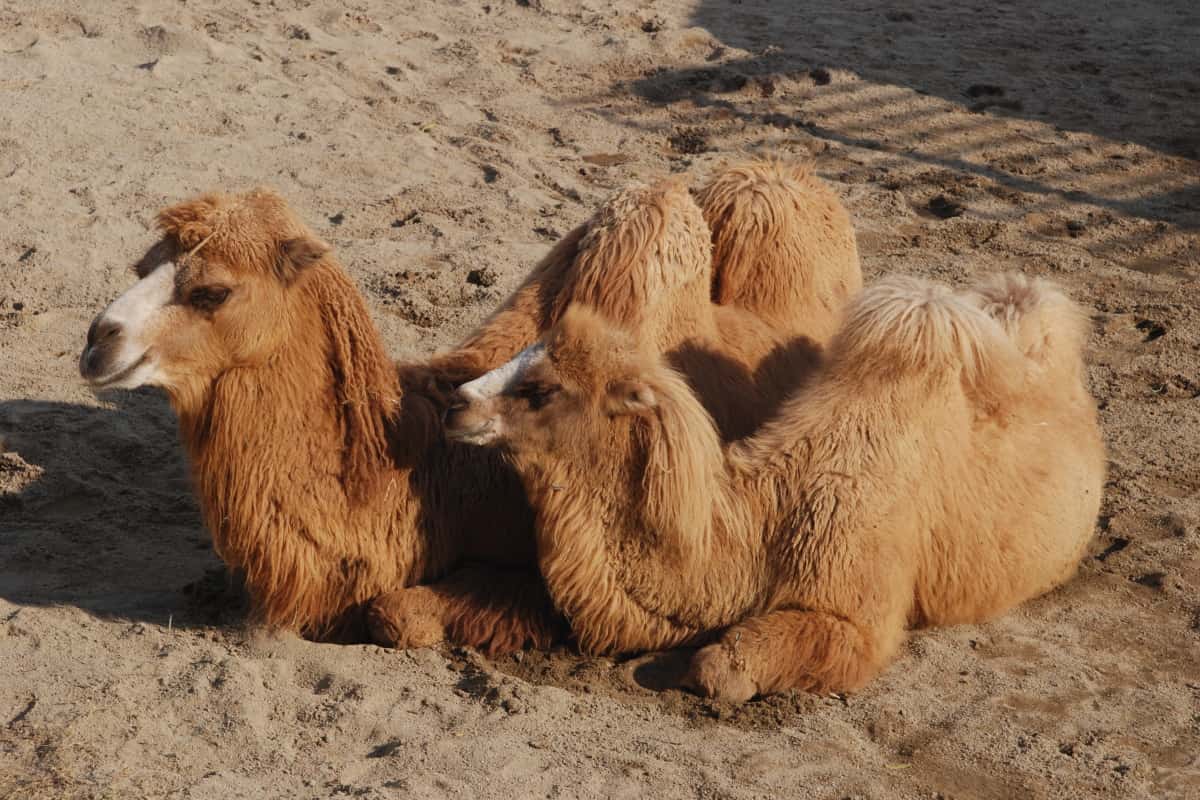
Bactrian Camel


A baby Bactrian camel is called a calf, and males are sometimes referred to as bull calves. They don’t have humps when born and weigh about 36 kilograms (79 pounds) at birth. Lightening fast learners, camels are precocial – meaning they can walk within hours of entering the world.

Calves stay with their mothers for three to four years, and they nurse for about one and a half of those. Helpful and involved siblings, they often help raise new babies that come during that time.

Moms and their offspring form strong bonds, and they mourn each other’s deaths for up to six months.

Lifespan


Camels typically live between 40 and 50 years.

Although it can’t be confirmed, in 2014, Nogeyama Zoo in Japan reported that one of its camels lived to 120, making it the oldest camel ever.

Population


The International Union for the Conservation of Nature Red List ranks wild Bactrian camels as Critically Endangered. Researchers estimate that only 1,400 remain. The Zoological Society of London lists the animals as the eighth most-endangered large mammal in the world.

However, domesticated Bactrian camels are in much better shape. About two million of them live throughout Asia, and hybridization efforts are big business in places like Kazakhstan.

View all 453 animals that start with B
How to say Bactrian Camel in ...
Bulgarian
Двугърба камила
Catalan
Camell
Czech
Velbloud dvouhrbý
Danish
Kamel
German
Trampeltier
English
Bactrian Camel
Spanish
Camello bactriano
Esperanto
sovaĝkamelo
French
Chameau de Bactriane
Hebrew
גמל דו דבשתי
Croatian
Dvogrba deva
Italian
Camelus bactrianus
Japanese
フタコブラクダ
Dutch
Kameel
Polish
Baktrian
Portuguese
camelo bactriano
Swedish
Kamel
Turkish
Çift hörgüçlü deve
Vietnamese
Lạc đà hai bướu
Chinese
雙峰駱駝

Sources

  1. David Burnie, Dorling Kindersley (2011) Animal, The Definitive Visual Guide To The World's Wildlife / Accessed December 1, 2008
  2. Tom Jackson, Lorenz Books (2007) The World Encyclopedia Of Animals / Accessed December 1, 2008
  3. David Burnie, Kingfisher (2011) The Kingfisher Animal Encyclopedia / Accessed December 1, 2008
  4. Richard Mackay, University of California Press (2009) The Atlas Of Endangered Species / Accessed December 1, 2008
  5. David Burnie, Dorling Kindersley (2008) Illustrated Encyclopedia Of Animals / Accessed December 1, 2008
  6. Dorling Kindersley (2006) Dorling Kindersley Encyclopedia Of Animals / Accessed December 1, 2008
  7. David W. Macdonald, Oxford University Press (2010) The Encyclopedia Of Mammals / Accessed December 1, 2008
Dana Mayor

About the Author

Dana Mayor

I love good books and the occasional cartoon. I am also endlessly intrigued with the beauty of nature and find hummingbirds, puppies, and marine wildlife to be the most magical creatures of all.
Connect:

Thank you for reading! Have some feedback for us?


Bactrian Camel FAQs (Frequently Asked Questions)

Bactrian camels are omnivores. They prefer to eat shrubs, but in a pinch will consume whatever is around, including meat, fish, and fabric.