

B
Species Profile

Badger

Mustelidae

Built to dig. Born to endure.
User: Dodo / Public domain

Badger Distribution

Click a location to explore more animals from that region

This map shows coastal regions where Badger are found.

Loading map...

Size Comparison

Human 5'8"
Badger 11 in

Badger stands at 16% of average human height.

Badger (Taxidea taxus)

At a Glance

Family Overview This page covers the Badger family as a group. Stats below are general traits shared across the family.
Also Known As Brock, Ratel
Diet Omnivore
Activity Nocturnal+
Lifespan 7 years
Weight 20 lbs
Status Not Evaluated
Did You Know?

"Badger" spans several mustelid lineages, not one close-knit genus-different groups evolved similar stocky, digging bodies.

Scientific Classification

Family Overview "Badger" is not a single species but represents an entire family containing multiple species.

Badgers are stocky, digging-adapted mustelids (family Mustelidae) found across the Americas, Europe, Africa, and Asia. The term covers multiple distinct mustelid lineages that share a generally robust build, strong forelimbs and claws, and a lifestyle often associated with burrowing (though ecology varies widely).

Kingdom
Animalia
Phylum
Chordata
Class
Mammalia
Order
Carnivora
Family
Mustelidae

Distinguishing Features

  • Stocky body with low-slung profile (common, though not universal)
  • Powerful forelimbs and long claws for digging
  • Strong jaws and generalist dentition typical of many mustelids
  • Often bold facial markings in several lineages (e.g., Meles; Mellivora has contrasting dorsal coloration)
  • Behavior ranges from social (European badger) to largely solitary (American and honey badgers)

Physical Measurements

Males and females differ in size

Height
8 in (5 in – 12 in)
Length
2 ft 7 in (1 ft 5 in – 3 ft 7 in)
1 ft 12 in (12 in – 2 ft 11 in)
Weight
20 lbs (2 lbs – 37 lbs)
15 lbs (2 lbs – 37 lbs)
Tail Length
6 in (4 in – 12 in)
6 in (4 in – 8 in)
Top Speed
22 mph
Badgers: short bursts, speeds vary

Appearance

Primary Colors
Secondary Colors
Skin Type Badgers have dense fur over thick skin. Coats are coarse with long guard hairs and woolly underfur in cold-climate Meles. Some, especially Mellivora, have tough, loose skin for defense. Molting and climate affect coat thickness.
Distinctive Features
  • Badgers (Mustelidae) are a common name for several different groups: Meles (Europe/temperate Asia), Taxidea (North America), Mellivora (Africa/SW–South Asia), Arctonyx (SE Asia), Melogale (South/SE Asia). They are not one species and look and live differently.
  • Body build (generalization): typically low-slung and stocky with short legs, broad shoulders/chest, and a wedge-shaped head; adaptations support digging, but degree varies among genera and habitats.
  • Digging morphology (common): enlarged forequarters, strong forelimbs, and long, robust claws; many species have powerful neck/shoulder musculature for excavation and soil displacement.
  • Head/face (variable): many have bold light-dark facial stripes; others have reduced striping or more uniform faces. Ears are generally small; muzzle often blunt to moderately elongated depending on lineage.
  • Tail (variable): generally short to moderate; length and bushiness vary (some 'true badgers' relatively short-tailed; some hog badgers/ferret-badgers can appear longer-tailed).
  • Scent glands: well-developed anal scent glands are common across mustelids; many 'badgers' use scent for marking territories, burrow entrances, and social signaling (extent varies).
  • Badger sizes vary: body length about 30–90+ cm, tail 10–30 cm, shoulder height 15–35 cm, and weight about 1–17+ kg (small ferret-badgers to large Eurasian or honey badgers).
  • Lifespan range (generalized across badger lineages): often ~4-14 years in the wild (highly variable with predation, persecution, and habitat); up to ~20-24 years reported in captivity for some taxa under managed care.
  • Many badgers dig or live partly underground and use burrows ('setts') for shelter and raising young, but this varies: some Meles have social, multi-entrance setts, while Taxidea and Mellivora often use simple solitary dens.
  • Activity patterns (variable): many are nocturnal/crepuscular, but some show more diurnal activity depending on climate, human pressure, and food availability (notably variable across Mellivora and high-latitude Meles populations).
  • Badgers range from mostly meat-eaters to omnivores, eating earthworms and other invertebrates, small vertebrates, carrion, roots, tubers, fruit, and honey or bee young. Honey badgers hunt more; some true badgers focus on invertebrates seasonally.
  • Sociality (not uniform): ranges from more social group living in some Meles populations to largely solitary habits in many American and honey badgers; group size and tolerance can shift with habitat productivity and local conditions.

Sexual Dimorphism

Generally mild to moderate sexual dimorphism across badger-designated mustelids: males are often larger/heavier with broader heads/neck musculature. The degree varies by lineage and population; some species show only subtle differences outside breeding condition.

  • Often larger body mass and more robust forequarters/neck; broader skull and heavier musculature in many species.
  • May have more prominent scent-marking behavior and larger home ranges in some taxa (ecology varies).
  • Typically smaller/lighter with relatively finer head/neck; differences can be subtle in some lineages.
  • Mammary development during lactation; denning/offspring care strongly shapes seasonal condition and appearance.

Did You Know?

"Badger" spans several mustelid lineages, not one close-knit genus-different groups evolved similar stocky, digging bodies.

Major badger lineages and regions: Meles (Europe & much of Asia), Taxidea (North America), Mellivora/honey badger (Africa to SW Asia & India), Arctonyx/hog badgers (South & Southeast Asia), Melogale/ferret-badgers (South & Southeast Asia).

Across the group, forelimbs are power-built for excavation: strong shoulder girdles, sturdy bones, and long claws for breaking soil and roots.

Burrows can become long-term "real estate," reused by generations and by other animals (from small mammals to reptiles), depending on habitat.

Diets are flexible across the family: some specialize more on earthworms/invertebrates, others are omnivores, and some are famed for raiding bee nests.

Social life varies widely: some badgers form social groups with shared dens, while others are mostly solitary and meet mainly to breed.

Body size varies a lot: from small ferret-badgers to the larger Eurasian-style badgers and the robust honey badger.

Unique Adaptations

  • Digging anatomy (family-level generalization): robust forelimbs, enlarged muscle attachments around the shoulder/upper arm, and strong, curved claws for rapid excavation.
  • Compact, low-slung build: a stockier trunk and short legs help generate pushing power in tight underground spaces.
  • Thick skin and loose hide (notably pronounced in honey badgers): can reduce injury and make it harder for attackers to get a firm grip.
  • Strong cranial/neck musculature in many species: supports biting, pulling, and bracing while digging or handling tough prey.
  • Flexible, generalist dentition and diet across many lineages: enables switching among invertebrates, small vertebrates, fruit, roots, and carrion when conditions change.
  • Behavioral toughness: many badgers are notably bold or persistent when defending dens or pursuing food, though intensity varies among lineages and individuals.

Interesting Behaviors

  • Burrow engineering: many dig extensive setts/dens with multiple entrances, nest chambers, and well-worn paths; complexity varies by species and soil type.
  • Den maintenance: bedding and nesting material may be carried in and replaced; some populations keep latrine areas near setts.
  • Foraging diversity: from nocturnal earthworm and grub hunting to daytime opportunism; activity patterns shift with climate, predation risk, and human disturbance.
  • Seasonal strategy: in colder regions, some species reduce activity and may spend long periods underground (not true hibernation), while tropical species stay active year-round.
  • Territoriality and scent: many use anal gland secretions, dung pits/latrines, and marking to communicate boundaries and reproductive status.
  • Tool-like use of the body: powerful forequarters and wedge-shaped heads are used to pry, loosen, and push soil; in some species, this also helps in defensive confrontations.
  • Opportunistic commensalism: badgers may benefit from human-altered landscapes (field edges, orchards) while also coming into conflict with farming and beekeeping.

Cultural Significance

Badgers (Mustelidae) appear in place names, coats of arms, and symbols across Europe and parts of Asia. In Britain and Ireland they feature in folk and children’s tales and conservation debates. East Asian tales link them to shapeshifting. The honey badger in Africa and South Asia stands for fearlessness.

Myths & Legends

In Japan, the raccoon dog—often wrongly called or mixed up with "badger" in English—acts as a mischievous shapeshifter and trickster, turning into people or objects to fool travelers and monks.

In Japanese folklore, badger-like animals (often mixed with raccoon dogs) are shapeshifters that can take human form; Lafcadio Hearn's retelling, "The Faceless Ghost," made a faceless-ghost tale famous.

China (regional folk traditions): In some regional Chinese folk traditions, badger-like creatures are grouped among "spirit animals" said to gain powers with age, appearing in cautionary village stories about illusions and nighttime encounters.

Korea: In Korean folktales, the badger appears as a woodland character in moral stories, sometimes clever and sometimes gullible, interacting with other animals in lessons about honesty and consequences.

In Europe, medieval bestiaries and folklore linked badgers to secretive burrowing and stubbornness; bestiary stories showed them in vivid tales and later shaped rural stories about setts and the underground world beneath hedgerows.

British Isles (literary folklore): While not ancient myth, classic British storytelling (e.g., the badger as a wise, sett-keeping figure in Victorian/Edwardian-era animal tales) cemented a cultural archetype still widely recognized today.

Conservation Status

NE Not Evaluated (family-level hub; conservation status varies widely among mustelid "badger" lineages and species)

Has not yet been evaluated against the criteria.

Population Unknown

Protected Under

  • Varies by species and jurisdiction; there is no single, universal protected-status legislation that applies to all animals commonly called badgers. Legal protection and trade controls (where they exist) are typically set at the species level in national laws and in international agreements such as CITES, which lists individual species in its Appendices rather than broad common-name groups.
  • Many populations occur within protected areas; legal protection varies by country and species (e.g., national wildlife laws that regulate hunting/trapping and protect dens/sett sites).
  • Examples of regional instruments sometimes relevant to badgers include the Bern Convention (Europe; species listed in its appendices) and country-specific statutes (for example, the UK Protection of Badgers Act 1992 for the European badger).

You might be looking for:

European Badger

22%

Meles meles

The classic Eurasian "badger"; stout, burrowing mustelid with black-and-white facial stripes.

American Badger

20%

Taxidea taxus

North American badger; powerful digger adapted to open habitats and prairie systems.

Honey Badger (Ratel)

18%

Mellivora capensis

African–SW Asian mustelid famous for toughness and opportunistic omnivory; often called a badger despite being quite distinct.

View Profile

Greater Hog Badger

13%

Arctonyx collaris

South and Southeast Asian badger-like mustelid with a pig-like snout used for rooting.

Ferret-badgers

10%

Melogale spp.

Small Asian mustelids with mixed ferret/badger traits; commonly called badgers in parts of their range.

Life Cycle

Birth 3 kits
Lifespan 7 years

Lifespan

In the Wild
1–23 years
In Captivity
4–24 years

Reproduction

Mating System Polygynandry
Social Structure Solitary
Breeding Pattern Seasonal
Fertilization Internal Fertilization
Birth Type Internal_fertilization

Most mustelids, including badgers, breed seasonally and alone, with internal fertilization and often polygynandry—many males and many females mate. Delayed implantation is common. Long-term pairs and cooperative breeding are rare, though exceptions occur.

Behavior & Ecology

Social Clan Group: 5
Activity Nocturnal, Crepuscular, Cathemeral, Diurnal
Diet Omnivore Varies by species and habitat: many badgers eat substantial amounts of earthworms and insects, along with burrowing rodents and other small mammals; fruits, roots, and carrion are also taken seasonally and opportunistically.

Temperament

Diversity note (family-level): "Badgers" within Mustelidae span multiple lineages; sociality ranges from strongly solitary to communal den-sharing, and diets range from insect- and small-vertebrate-focused to broad omnivory (worms, grubs, fruit, tubers, carrion).
General temperament: typically wary and reclusive away from dens, but assertive at close range; many are highly defensive when cornered, using powerful bites, thick skin/loose hide (in some), and strong foreclaws.
Territoriality varies: many species show individual territoriality (especially around dens and core foraging areas), while communal-sett species may defend group territories and tolerate familiar neighbors more than strangers.
Burrow-centric behavior is common: extensive digging, den/sett maintenance, and use of multiple burrows; den sharing is variable (from solitary dens to complex communal setts).
Seasonality varies: in colder regions some populations reduce activity and may enter prolonged inactivity/torpor-like states or spend extended periods underground; in milder climates activity can be year-round.
Badger-type mustelids vary in size from about 1–20+ kg and 35–105 cm, which changes how far they roam, what prey they eat, and how they react to threats.
Lifespan range is variable across species and conditions: often ~4-14 years in the wild, with some individuals reaching ~20+ years in captivity; high juvenile mortality is common in many populations.

Communication

growls
snarls
hisses
grunts
squeals/screams Distress or intense aggression
chattering or yelps Notably in more social populations
Scent marking using anal glands and other scent sources; deposition at latrines and along paths/boundary features
Scratching and digging/sign-posting (soil mounds, claw marks) around den entrances and range edges
Body postures and tactile signals (threat displays, muzzle contact); social grooming/play in the more communal lineages
Chemical recognition supporting kin/neighbor discrimination in social-sett systems Where present

Habitat

Biomes:
Tropical Rainforest Tropical Dry Forest Savanna Desert Hot Desert Cold Mediterranean Temperate Grassland Temperate Forest Temperate Rainforest Boreal Forest (Taiga) Tundra Alpine Freshwater Wetland +8
Terrain:
Mountainous Hilly Plateau Plains Valley Coastal Island Riverine Volcanic Karst Rocky Sandy Muddy +7
Elevation: Up to 14107 ft 7 in

Ecological Role

Omnivorous mesopredators and strong diggers that can affect prey populations and soil processes; their digging and burrowing can increase soil turnover and create refuges or modified habitat used by other species.

Regulation of prey populations (notably rodents and other small vertebrates/invertebrates) Suppression of agricultural/forest pests in some regions Carrion removal via opportunistic scavenging Soil turnover and habitat creation through digging/burrowing in digging-adapted lineages (including 'badgers'), influencing aeration and microhabitats Potential seed dispersal where fruit consumption is common Trophic linking between aquatic and terrestrial food webs in semi-aquatic/aquatic mustelids

Diet Details

Main Prey:
Small mammals Birds and bird eggs Reptiles and amphibians Earthworms Burrowing rodents and other fossorial prey Insects and other terrestrial invertebrates Carrion +1
Other Foods:
Fruits and berries Nuts and seeds Roots, tubers and other underground plant parts Grasses and cereal grains Fungi Honey and other sugary plant-derived foods

Human Interaction

Domestication Status

Wild

Badgers (Mustelidae) are wild animals and have not been domesticated. They are kept only in professional care, like zoos or wildlife rehab centers. People have hunted or trapped them and sometimes clash with badgers when they dig lawns, gardens, or fields. In some areas, badgers can spread disease, such as bovine tuberculosis in European badgers.

Danger Level

Moderate
  • Bites/scratches when handled, cornered, or defending young; strong jaws and tenacity in many mustelids
  • Zoonotic disease risk (e.g., rabies in some regions, distemper-like viruses affecting mustelids, leptospirosis/parasites depending on habitat)
  • Aggression variability: most avoid humans, but some larger or highly defensive species can inflict serious injury
  • Property damage and digging (more typical of fossorial 'badger' lineages) and fishery/pet predation conflicts
  • Handling risks in captivity: high enrichment needs, scent marking, and escape potential increase incident likelihood

As a Pet

Not Suitable as Pet

Legality: Laws differ by place and species. Wild mustelids (family Mustelidae — badgers and otters) are usually illegal without special permits because of welfare, safety, and disease risks. Domestic ferrets may be legal but sometimes banned; check local rules.

Care Level: Expert Only

Purchase Cost: Up to $5,000
Lifetime Cost: $2,000 - $50,000

Economic Value

Uses:
Fur and textile/leather markets (historical to modern) Companion animal industry (ferrets) Hunting/pest control services (ferrets; occasional working use) Ecotourism and wildlife viewing (notably otters) Research and education (zoos, rehab, academic study) Ecosystem services (predation on rodents/invertebrates; trophic roles) Nuisance wildlife management (trapping/exclusion; property damage mitigation)
Products:
  • Fur pelts (e.g., mink/sable/ermine/marten/otter in various regions)
  • Ferrets for companionship and working/hunting use
  • Mink/animal-derived oils and processed byproducts in some markets
  • Zoo/rehabilitation services and educational programming
  • Wildlife tourism revenue (guided viewing, parks)

Relationships

Related Species 7

Cats Felidae Shared Order
Dog
Dog Canis lupus familiaris Shared Order
Bears
Bears Ursidae Shared Order
Raccoons and coatis Procyonidae Shared Order
Skunks and stink badgers
Skunks and stink badgers Mephitidae Shared Order
Mongooses
Mongooses Herpestidae Shared Order
Civets and genets Viverridae Shared Order

Ecological Equivalents 5

Animals that fill a similar ecological role in their ecosystem

Types of Badger

17

Explore 17 recognized types of badger

European badger Meles meles
Asian badger Meles leucurus
Japanese badger Meles anakuma
Caucasian badger Meles canescens
Greater hog badger Arctonyx collaris
Northern hog badger Arctonyx albogularis
Sumatran hog badger Arctonyx hoevenii
Chinese ferret-badger Melogale moschata
Burmese ferret-badger Melogale personata
Javan ferret-badger Melogale orientalis
Bornean ferret-badger Melogale everetti
Vietnam ferret-badger Melogale cucphuongensis
Formosan ferret-badger Melogale subaurantiaca
American badger Taxidea taxus
Honey badger (ratel) Mellivora capensis
Sunda stink badger Mydaus javanensis
Palawan stink badger Mydaus marchei

Badgers are especially clean animals that build communal toilets away from where they live and sleep.

Badgers are medium-sized animals with long, low bodies and wide feet that have elongated claws. The badger animals have bristly hair that ranges in color from black to brown as well as gold and even white. Badgers are related to otters, ferrets, wolverines, minks, and weasels. The mammals are nocturnal, and while many of them are social, some may be loners. The badger is Wisconsin’s state animal.
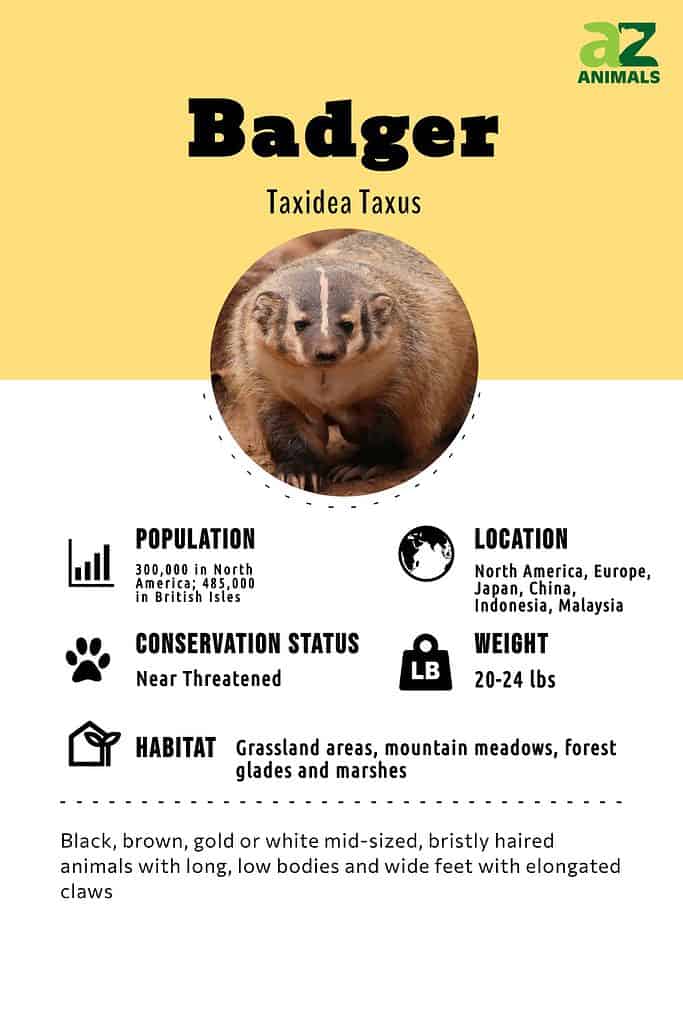
5 Badger Facts

• Badgers are animals that sleep during the day
• There are 11 different badger species
• Young badger animals leave the burrow when they are around 6 months old
• Badgers are a part of the weasel family
• Badgers have few natural predators

You can check out more incredible facts about badgers.

Scientific Name

The scientific name for the badger is Taxidea Taxus, and it is included in the Mustelidae family and is of the Mammalia class. The subfamilies of the badger are Helictidinae, Melinae, Mellivorinae, and Taxideinae. Researchers have classified 11 badger species that are grouped into three types. These are the Melinae, or Eurasian badgers, Mellivorinae, or honey badger, and Taxideinae, or American badgers.

The name “badger” comes from the 16th-century word “bageard.” Originally, the name referred to the European badger, an animal with a white mark on its forehead. Bauson is an outdated name for the badger animal. Brock is another old name for the animal species, but it’s hardly ever used.

Badgers have had several starring roles in British literature throughout the years. For instance, author Kenneth Grahame included a character by the name of “Mr. Badger” in “The Wind in the Willows.” C.S. Lewis added one in the “Chronicles of Narnia” and Beatrix Potter featured a badger by the name of “Tommy Brock” in her book “The Tale of Mr. Tod.”

Types of Badger Species

There are 11 different species of badger found around the world, which include the following:

  • American Badger – American badgers are located in most of the United States, northern Mexico, south-central Canada, and southwestern British Columbia. They have a typical badger appearance with distinctive head markings and huge claws. They prefer prairie regions.
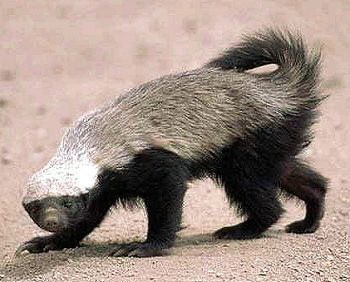
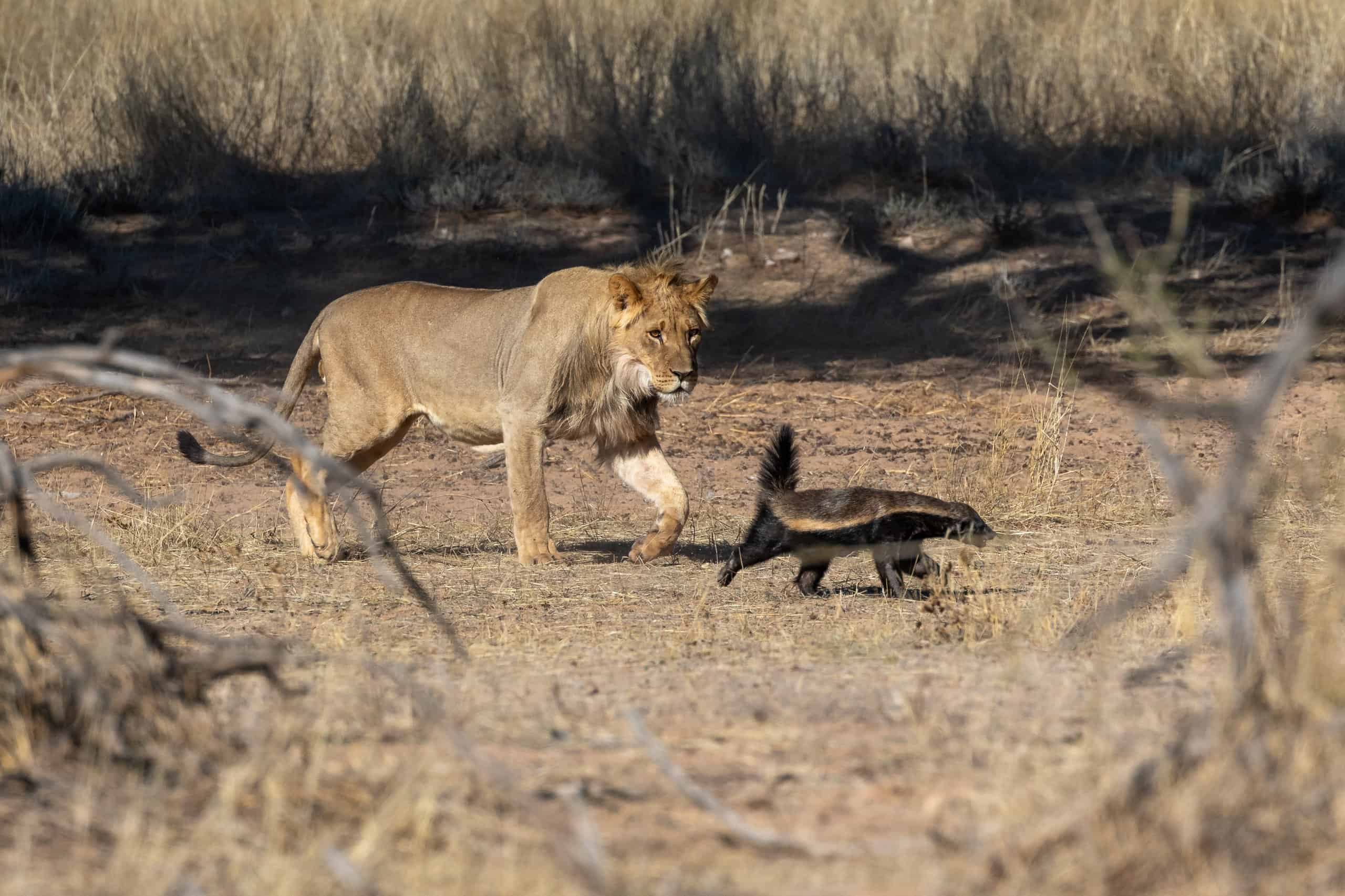
  • Honey BadgerHoney badgers are found in Africa, Asia, and the Indian subcontinent.  They resemble weasels, and are expert at escaping predators with very loose, thick skin. Their preferred habitat is dry areas, grasslands, and forests.
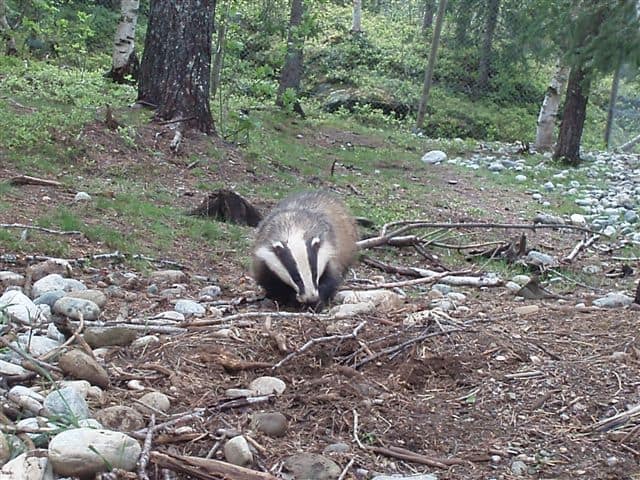
  • European Badger – European badgers are located throughout Europe, commonly found in woodlands and suburban parks. They have black and white fur with a smooth coat, and clear and straight lines on their face and around the eyes.
  • Greater Hog Badger – The greater hog badger is native to Southeast Asia. It’s known as one of the largest terrestrial mustelids, and lives in tropical evergreen forests and grasslands.
  • Japanese Badger – Endemic to Japan, the Japanese badger is smaller than the European badger with long gray-brown hair on the upper coat, and short, black hair underneath. Its face has characteristic black-white stripes. They are found in woodlands and forest habitats.
  • Chinese Ferret Badger – Chinese ferret badgers inhabit Southeast Asia, Northeast India, and Central China. They sport distinctive mask-like facial markings that differ from most other species of badger, and are found in grasslands, open forests, and tropical rainforests.
  • Asian Badger – Asian badgers are native to  native to Mongolia, China, Kazakhstan, Kyrgyzstan, Korea and Russia. Their coloring is lighter than the European badger, with brown facial stripes. Habitats include woodlands, pastures, scrubs, steppes, and high mountain elevations.
  • Bornean Ferret Badger – The Bornean ferret badger is a small nocturnal badger only found on the island of Borneo. It’s listed as threatened due to small area of distribution, habitat destruction, and natural disasters. Its most distinguishing feature is a ferret-like facial mask.
  • Javan Ferret Badger – Javan ferret badgers are native to Java and Bali, Indonesia, in hilly and mountainous areas, and also lower areas in forests and rubber plantations. They have small heads narrow, blunt snouts, large eyes, and brown silky fur with red, grey, or tawny highlights.
  • Burmese Ferret Badger – The Burmese ferret badger resides in Southeast Asia. Its fur can be varied shades of brown, and it sports a white dorsal stripe. The face is marked with black and white patches. Its is nocturnal and lives in grasslands and forests.
  • Vietnam Ferret Badger – In 2006, the Vietnam ferret badger was named as its own species due to two dead ones found over two years time that had dark brown heads and bodies with black and white stripes running from their necks to shoulders. Their skulls were also shaped differently.

Appearance and Behavior
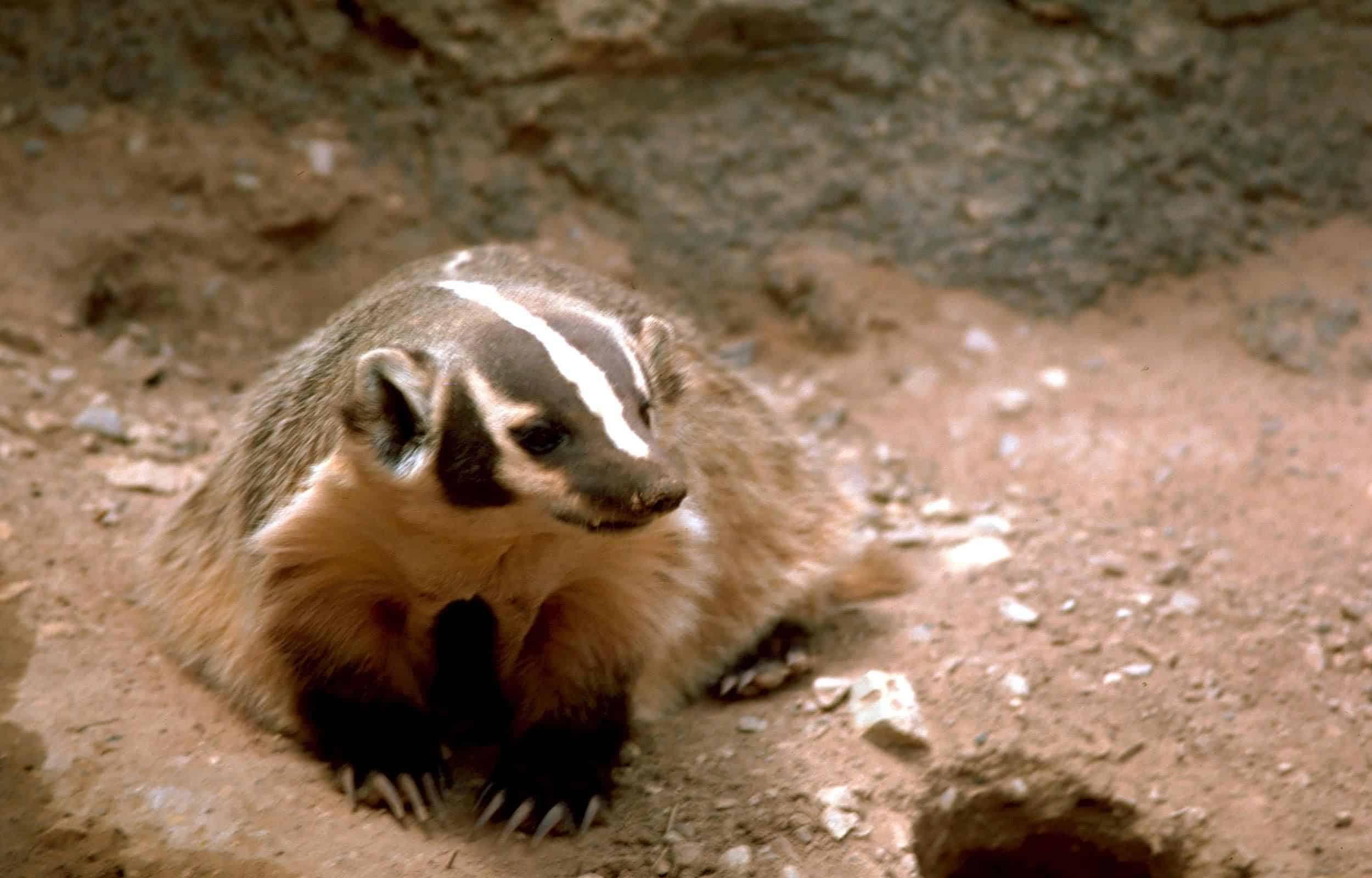
Badger profile view, sitting in the dirt.
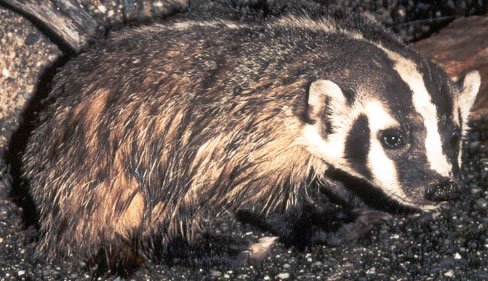
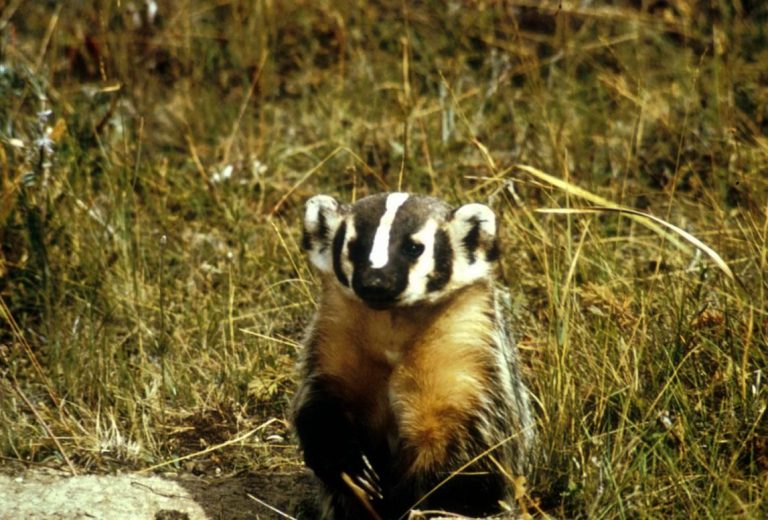
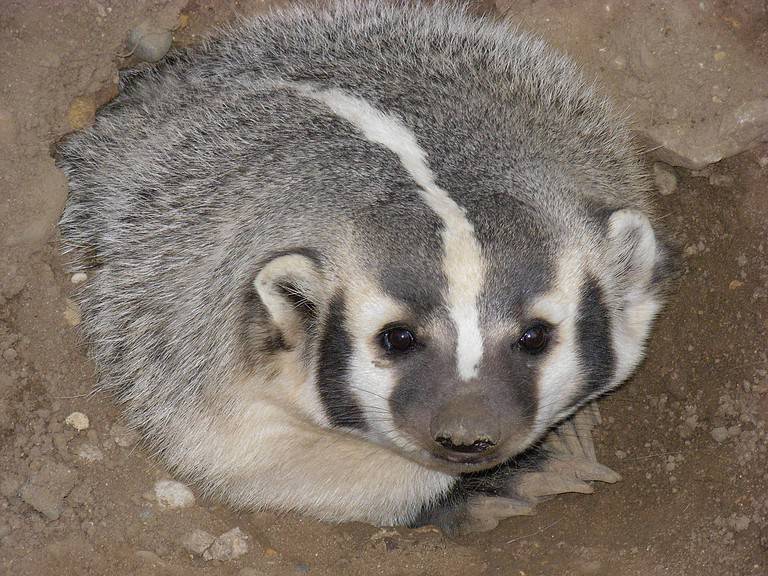
The North American badger features short, stubby legs, a muscular body, a short neck, and a wide, flat head.

The North American badger features short, stubby legs, a muscular body, and a short neck. The animal’s head is wide and flat. Badgers also have a tail. They tend to have gray-colored coats, darker faces, and a white stripe that runs from their backs to their noses. The animal type measures about 9 inches high and is from around 16 inches to 29 inches long. A badger’s tail will vary in size from about 4 inches to 6 inches long or around one-third of the size of the actor Danny DeVito. They weigh from 20 pounds to 24 pounds. The lower jaw of the badger is pronounced from its upper jaw. This means that it’s impossible to dislocate the animal’s jaw, allowing it to maintain a solid hold on its prey. However, the jaw positioning limits movement. A badger can open and shut its mouth or shift it from side to side.

Badger animals are mainly nocturnal, and they spend most of their time underground in the winter. During this time, they fast. To survive long periods without eating, the animal builds up a good deal of fat late in the summer and toward the fall.

Each badger family tends to behave uniquely, but all types of badgers live underground. Some live together in clans known as cete. These vary in size from two animals to as many as 15. Badgers have the capacity to run at speeds of 16 miles per hour to 19 miles per hour for short spurts. The animals are good climbers, and they can swim.

Badgers are animals that are famous for their ferocity. If a female adult badger has babies to protect, then she’ll guard them aggressively. There are accounts of badgers fighting off packs of dogs and attacking much larger animals than themselves like bears and wolves. Badgers may show aggression toward humans if they feel threatened. The animal can deliver a painful bite to protect itself.

The animal species is territorial, and they’ll protect territories that measure around 3 to 4 square miles. The size of a badger’s territory generally depends on how plentiful the food is. Badgers are extremely clean animals that do not defecate in their burrows. In fact, they build shallow pits away from their home for this purpose. Badgers don’t bring food into their burrows either.

Evolution and History

The origins of badgers on the evolutionary chain are a bit sketchy. As they are members of the weasel family, one could trace back the evolution of the weasel and perhaps find more definitive information. For our intents and purposes, there some fossil findings that seem to be ancestors of the honey badger. One fossil, identified as Millivora sivalensis, was an animal similar to the honey badger that is traced to Pakistan at the beginning of the Ice Age 2 million years ago. Another, Benfield’s honey badger, or Mellivora benfieldi has fossils from Italy, Ethiopia, and South Africa. It is thought to have lived 5-6 million years ago during the Late Miocene Period. Definitive honey badger fossils were found in a site near Cape Town, South Africa along with sabretooth tigers and other animals.

Benfield’s honey badger is very similar to the modern honey badger, so is thought to be its ancestor, but this is not certain. Analysis shows this ancestor was smaller, and not as good at digging as the modern badger. Their diets would have been similar, but Benfield’s honey badger may have been more of a meat eater than a root and bulb eater.

The oldest honey badger could be the Howellictis valentini, a 7 million-year-old fossil from Chad. This fossil shows that this badger walked flat-footed like modern badgers, but also was not a good digger. This provides evidence that honey badgers were a distinct group since the Late Miocene.

The genera Eomellivora and Ekorus are thought to be early honey badgers, and are nicknamed “giant honey badgers” for their much larger size. The Eomellivora date back 10 million years and were found in Africa, Eurasia, and even North America.  

Habitat
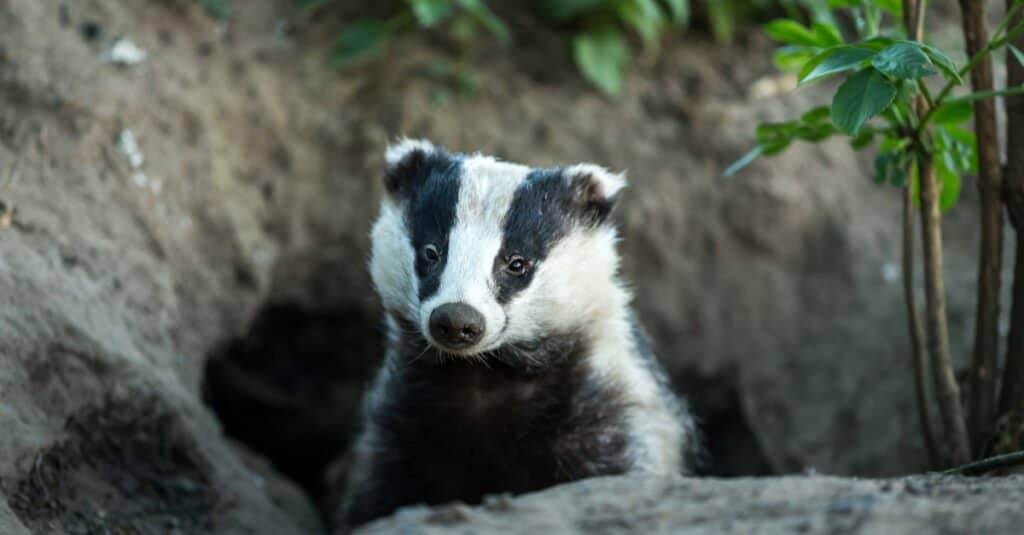
Badger Animal Facts - A Budget Tunnel

Badgers can be found in mountain meadows, grasslands, forest glades and marshes.

American badgers generally live in grassland areas as well as in open fields that feature grassland characteristics. They live in parks, on farms, and in spaces that are free of trees. Badgers make their homes in areas that include a healthy rodent supply. You might come across them in mountain meadows, forest glades, and marshes. They’ve also been found in hot desert environments and brushy areas. People have run into badgers at elevations that are as high as 12,000 feet, but the animal prefers to live at lower elevations.

In California, badgers live in agricultural areas and open spaces. They also make their homes in regional, state, and national parks. Badgers that live in Arizona usually live in the semi-desert grasslands and scrub areas. In Ontario, they live on the province’s far southwestern side.

The badger animal’s use of a home area depends upon the season and whether it’s a male or a female badger. The creatures use some areas of their home range more often based on the different seasons. The areas that they use are also based on the prey that they have available. Male badgers usually have larger home spaces than female badgers.

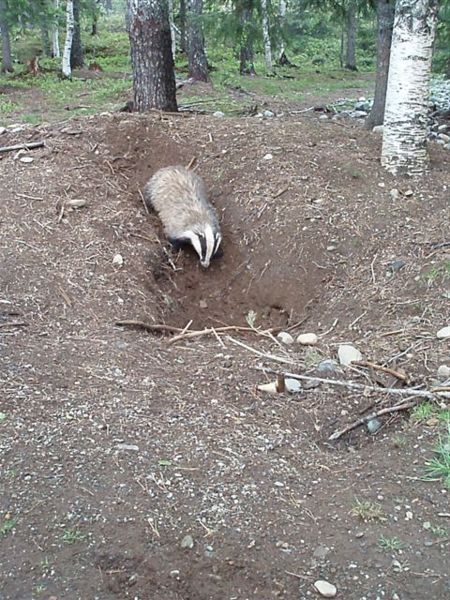
The animal species needs shelter for sleeping, protection from the elements, concealment, and birthing. Badgers frequently increase the size of a gopher hole or a burrow made by another animal for their own use. When a badger builds or appropriates another animal’s burrow, it may be called a sett. The animal’s dens vary in size from around 4 feet to 10 feet deep and 4 feet to 6 feet wide. Female badgers may form two to four burrows close to a connecting tunnel for shelter and protection for their babies. A common sign of a badger den is evacuated soil at the front of the burrow entrance. If you were to look at it from a distance, you would see a mound-like burrow roof with the living space below.

In the summer and fall, badgers range more often. Also, according to burrowing patterns, the animals may dig anywhere from one to three burrows out of prey holes each day. Badgers will use these for a day to a week before abandoning them temporarily and returning to them later. Other wildlife may take advantage of these empty badger burrows. If the prey is abundant, then badgers will reuse burrows, especially during the fall. Sometimes, the animals remain in these dens for several days. When winter arrives, badgers will hole up in a burrow for the majority of the season.

Badgers have different types of sets. However, their main one is the largest. These can be several hundred years old. They can also have a few hundred entrances.
 

Diet
What Do Badgers Eat

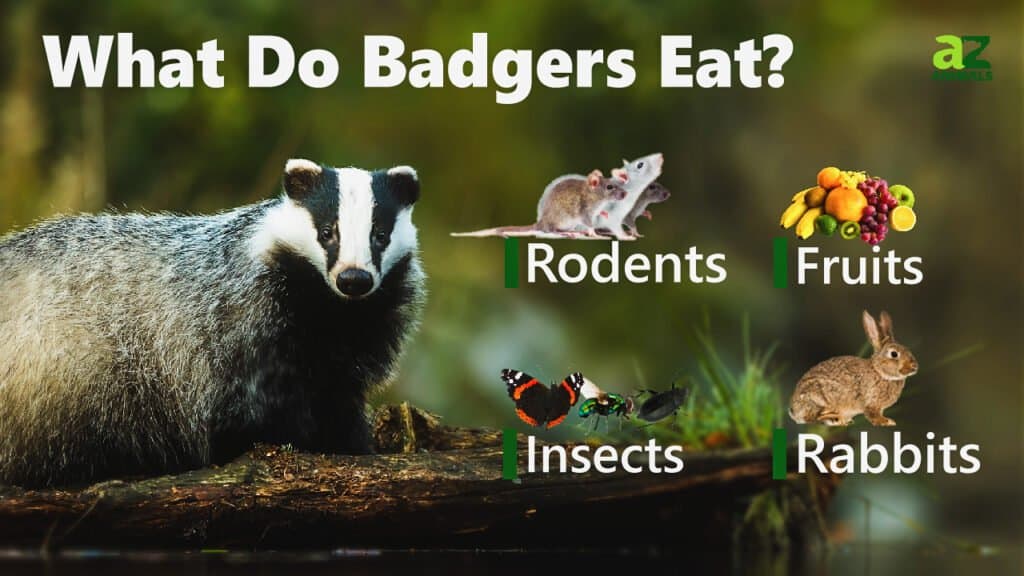
Badgers are omnivores that prey mainly on pocket gophers, prairie dogs, ground squirrels, and moles. They also eat deer mice and voles along with snakes. The American badger is a major predator of snakes and will even go after rattlesnakes. Badgers may also dine on ground-nesting birds like the bank swallow or the sand martin. They’ll eat lizards, fish, and insects. The animal will eat some plant foods like green beans, corn, mushrooms, and sunflower seeds. Badgers have been known to experience alcohol intoxication from eating rotten fruit.

Predators and Threats

Badgers only have a few natural predators because they are highly aggressive animals. While their predators include coyotes, bobcats, golden eagles, and bears, cougars hunt them the most. Humans trap them for their pelts. Badger fur is used for paintbrushes and shaving brushes.

Humans also hunt them in several countries. The Dachshund dog breed exists because people bred them to hunt badgers. In the past, baiting was popular in England. Fortunately, opposition to the sport led to the passing of the Cruelty to Animals Act of 1835 in addition to the Protection of Badgers Act of 1992. For additional protection, the country passed the Hunting Act of 2004.

In Britain, people ate badgers during World War II. Early American settlers and Native Americans ate them too. Today, European badgers die from starvation and tuberculosis, but more of them are killed by vehicles than by any other way.
 

Reproduction, Babies and Lifespan

Mating season is usually in early spring or toward the end of summer. The animals will often mate near the burrows or inside the entrance. Badgers experience delayed implantation. Early embryos implant near the end of December or the first week or two of January. After becoming pregnant, a female badger will dig a natal den, which she’ll use for an extended time. Baby cubs are born after 8 weeks to 10 weeks, and this typically happens in late April or during the first part of May. These cubs feature soft, gray fur, and they are careful and shy. After the babies are born, the female badger may move her litter to look for food in other areas. A natal den will typically be bigger and more intricate than a regular badger den.

Male European badgers are called boars while females are sows. Babies are known as cubs. In North America, baby badgers are called kits. Male and female are the terms used for adult badgers in North America. Female badgers give birth to anywhere from one to five cubs. Female badgers take care of their litter alone, and the babies will stay in the burrow until they are around 8 weeks old. Once baby badgers are around 4 months old, they are able to hunt their own food. At 6 months old, young badgers leave their mother’s burrow.

In the wild, the average lifespan of badgers is from 4 years old to 10 years old. They can live for as long as 14 years. When the animals are in captivity, they can live to be 26 years old.
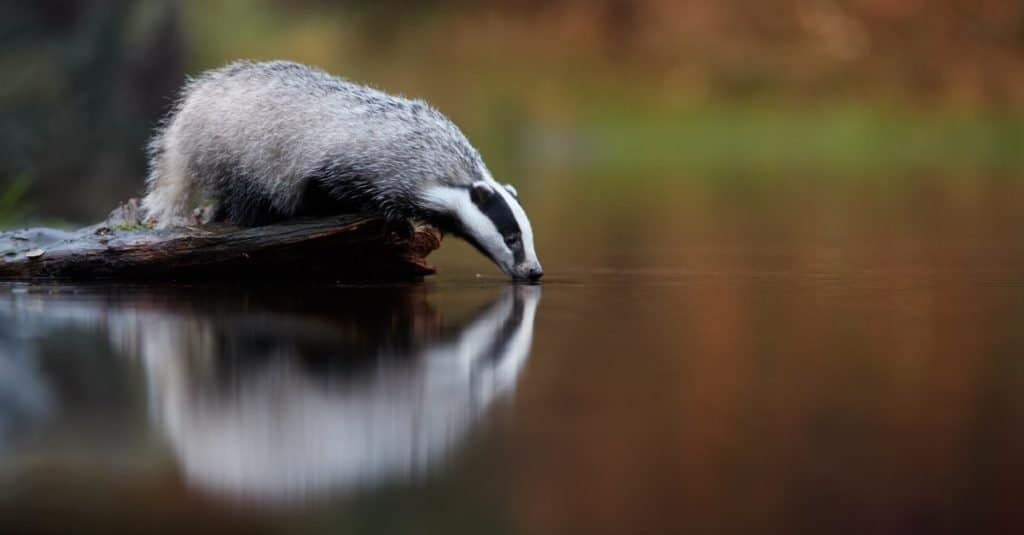
 

Animals That Burrow Underground: Badgers

Most types of badgers are not considered threatened or endangered, but they are highly threatened in China, Vietnam, Laos, and Myanmar.

Population

The International Union for Conservation of Nature reports that most types of badgers are not considered threatened or endangered. The population of the American badger is several hundred thousand. However, the hog badger is close to threatened because the animal’s population has declined by just under 30% within three generations. The species is highly threatened in China, Vietnam, Laos and Myanmar. In England and Wales, the population is around 485,000, which means that the species is not in danger there at this time.

More on Badgers

  • What Do Badgers Eat? Their Diet Explained
  • Badger Teeth: Everything You Need to Know
  • Badger Poop: Everything You’ve Ever Wanted to Know
View all 453 animals that start with B
How to say Badger in ...
Czech
Jezevec americký
German
Silberdachs
English
American Badger
Esperanto
Taksideo
Spanish
Taxidea taxus
Finnish
Amerikanmäyrä
French
Blaireau américain
Croatian
Američki jazavac
Hungarian
Amerikai borz
Italian
Taxidea taxus
Japanese
アメリカアナグマ
Dutch
Zilverdas
Polish
Borsuk amerykański
Portuguese
Texugo-americano
Swedish
Nordamerikansk grävling
Chinese
美洲獾

Sources

  1. David Burnie, Dorling Kindersley (2011) Animal, The Definitive Visual Guide To The World's Wildlife / Accessed November 10, 2008
  2. Tom Jackson, Lorenz Books (2007) The World Encyclopedia Of Animals / Accessed November 10, 2008
  3. David Burnie, Kingfisher (2011) The Kingfisher Animal Encyclopedia / Accessed November 10, 2008
  4. Richard Mackay, University of California Press (2009) The Atlas Of Endangered Species / Accessed November 10, 2008
  5. David Burnie, Dorling Kindersley (2008) Illustrated Encyclopedia Of Animals / Accessed November 10, 2008
  6. Dorling Kindersley (2006) Dorling Kindersley Encyclopedia Of Animals / Accessed November 10, 2008
  7. David W. Macdonald, Oxford University Press (2010) The Encyclopedia Of Mammals / Accessed November 10, 2008
Abby Parks

About the Author

Abby Parks

Abby Parks has authored a fiction novel, theatrical plays, short stories, poems, and song lyrics. She's recorded two albums of her original songs, and is a multi-instrumentalist. She has managed a website for folk music and written articles on singer-songwriters, folk bands, and other things music-oriented. She's also a radio DJ for a folk music show. As well as having been a pet parent to rabbits, birds, dogs, and cats, Abby loves seeking sightings of animals in the wild and has witnessed some more exotic ones such as Puffins in the Farne Islands, Southern Pudu on the island of Chiloe (Chile), Penguins in the wild, and countless wild animals in the Rocky Mountains (Big Horn Sheep, Mountain Goats, Moose, Elk, Marmots, Beavers).
Connect:

Thank you for reading! Have some feedback for us?


Badger FAQs (Frequently Asked Questions)

Badgers are omnivores, so they eat both mammals and plants.