B
Species Profile

Banded Palm Civet

Hemigalus derbyanus

Striped shadow of the rainforest floor
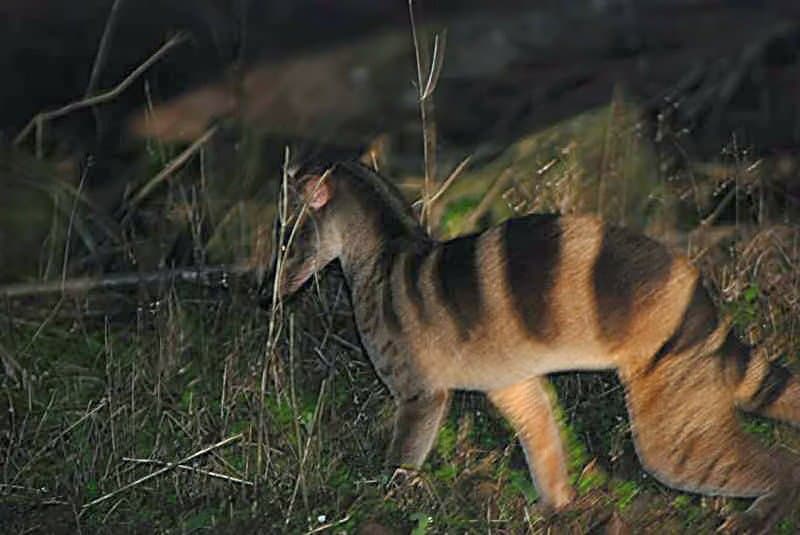
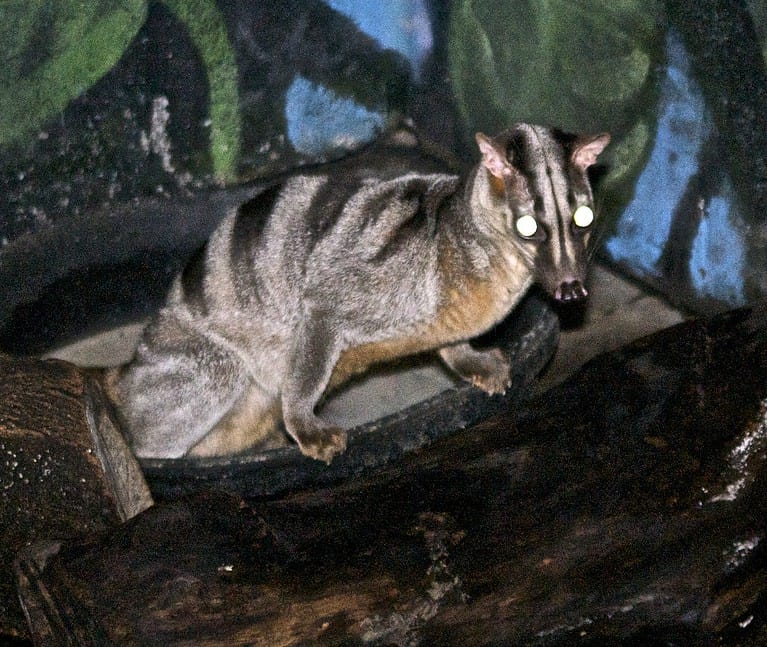
bobinoz, Cleanup: Yamavu / CC BY 3.0, Wikimedia Commons

Banded Palm Civet Distribution

Click a location to explore more animals from that region

Loading map...
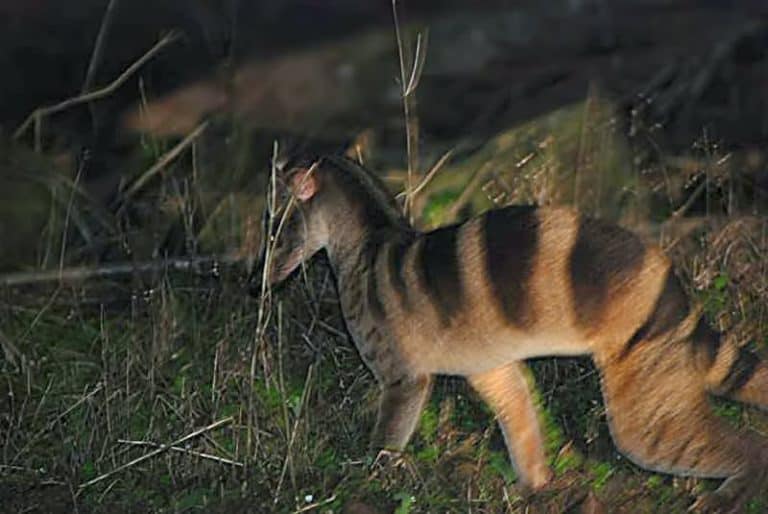
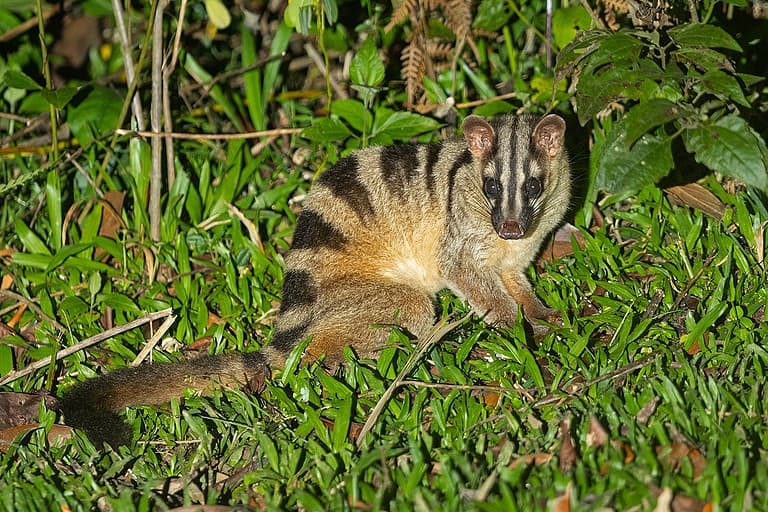
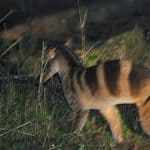
Banded Palm Civet in grass at night

At a Glance

Wild Species
Also Known As Banded civet, Derby's palm civet, Derby's civet
Activity Nocturnal
Weight 3 lbs
Did You Know?

Hemigalus derbyanus is the only living species in its genus (Hemigalus).

Scientific Classification

A small, nocturnal viverrid (civet) of Southeast Asian forests, known for distinct dark body bands and a slender, civet-like build. It is primarily terrestrial to semi-arboreal and is generally solitary.

Kingdom
Animalia
Phylum
Chordata
Class
Mammalia
Order
Carnivora
Family
Viverridae
Genus
Hemigalus
Species
Hemigalus derbyanus

Distinguishing Features

  • Distinct dark banding across the back/flanks (hence “banded”)
  • Elongate body and tail; civet-like profile
  • Nocturnal, secretive forest-dweller
  • Member of Viverridae (not a cat); typically more slender and long-snouted than felids

Physical Measurements

Length
2 ft 8 in (2 ft 4 in – 3 ft 1 in)
Weight
4 lbs (2 lbs – 7 lbs)
Tail Length
1 ft 2 in (11 in – 1 ft 4 in)

Appearance

Primary Colors
Secondary Colors
Skin Type Mammalian skin with dense fur: short-to-medium, soft coat adapted for humid tropical forest conditions; fully furred body including tail (no specialized bare skin patches).
Distinctive Features
  • Slender viverrid (Viverridae) body plan: elongated trunk, relatively short legs, and a small, narrow head with an extended, pointed muzzle (not raccoon-like, not felid-faced).
  • Signature dorsal banding: distinct dark transverse bands across the back that break up the outline in low-light forest understory; overall coloration remains muted/cryptic for nocturnal activity.
  • Tail relatively short and typically marked with 2-3 dark rings and a dark tip (a useful field character alongside the dorsal bands).
  • Nocturnal and cryptic: typically solitary, moving quietly on the ground and low supports in Southeast Asian tropical forests; primarily terrestrial to semi-arboreal rather than highly canopy-specialized.
  • Reported size range (field references): head-body length ~41-51 cm; tail length ~13-17 cm; adult mass commonly ~1-3 kg (values widely reported in standard mammal references for Hemigalus derbyanus).

Did You Know?

Hemigalus derbyanus is the only living species in its genus (Hemigalus).

Adult head-body length is about 41-49 cm, with a tail about 33-44 cm long (reported in major mammal references and IUCN summaries).

Adults typically weigh roughly ~1-3 kg (reported range across field and museum-based sources).

Its bold dark bands help break up its outline in the dim understory of lowland tropical forest.

Like other viverrids, it has well-developed anal scent glands used in communication and territorial marking.

Diet records include small animals (notably invertebrates and small vertebrates) plus fruit-an omnivorous pattern common in forest civets.

It is strongly nocturnal and usually encountered alone, which is why it can be common yet seldom seen.

Unique Adaptations

  • Banded pelage patterning: high-contrast stripes function as camouflage in broken, low-light rainforest understory.
  • Slender viverrid body plan: narrow build and flexible spine aid stealthy movement through dense undergrowth and root tangles.
  • Partly retractile claws (viverrid trait): improves traction for climbing and gripping while still supporting ground travel.
  • Well-developed scent glands (viverrid trait): enables long-lasting chemical communication in visually complex forests.
  • Dentition suited to omnivory: viverrid teeth allow both shearing small prey and processing fruit (diet documented as mixed animal matter + fruit).

Interesting Behaviors

  • Nocturnal, cryptic activity: typically active after dusk, moving quietly along the forest floor and low vegetation.
  • Solitary spacing: individuals are generally recorded alone; social contact is most likely during breeding and between mother and young.
  • Scent-marking: uses glandular secretions (anal/perineal region) to mark routes or sites-typical of Viverridae communication.
  • Opportunistic foraging: searches leaf litter and logs for prey; also takes fallen fruit when available.
  • Terrestrial to semi-arboreal movement: mostly ground-traveling but capable of climbing into low trees and tangles when feeding or avoiding threats.

Cultural Significance

The banded palm civet (Hemigalus derbyanus) is not a major cultural icon. Locally it is called a palm civet, seen as a shy night feeder that is sometimes hunted, but it is not the civet used for coffee.

Myths & Legends

Scientific naming origin: the species epithet derbyanus commemorates the Earl of Derby (a common 19th-century zoological practice of honoring patrons/collectors), tying the animal's "story" to the era of Southeast Asian exploration and museum natural history.

In Maritime Southeast Asia, civets like the Banded Palm Civet (Hemigalus derbyanus) are said to be sneaky night visitors to orchards and forest edges, making local sayings and warning stories about hidden night thieves.

Conservation Status

NT Near Threatened

Likely to qualify for a threatened category in the near future.

Population Decreasing

Protected Under

  • Occurs in numerous protected areas across range (various national parks/reserves in Southeast Asia)
  • Protected under some national wildlife legislation in parts of its range (protections vary by country and jurisdiction)
  • Not currently listed on CITES Appendices (international trade not regulated via CITES for this species)

Life Cycle

Birth 2 cubs

Lifespan

In the Wild
0 years
In Captivity
0–17 years

Reproduction

Mating System Data Deficient
Social Structure Solitary
Breeding Pattern Transient
Fertilization Internal Fertilization
Birth Type Internal_fertilization

Field data on the Banded Palm Civet (Hemigalus derbyanus) mating system are scarce. It is solitary and nocturnal, likely mating during brief encounters when females are fertile. Reproduction is by internal fertilization and live birth; mating_system: data_deficient.

Behavior & Ecology

Social Solitary Group: 1
Activity Nocturnal
Diet Insectivore earthworms

Temperament

Secretive and wary; tends to avoid open areas and human presence (reported in field observations and IUCN/field-guide summaries).
Primarily solitary/low social tolerance outside breeding and maternal care; likely maintains individual space via scent-marked home ranges (common viverrid pattern; direct, quantified spacing data for this species are sparse).
Defensive when threatened (typical small-carnivore response), but not generally described as overtly aggressive toward conspecifics except in mating/territorial contexts (species-specific studies limited).

Communication

Threat/defense vocalizations reported broadly for civets and other viverrids (e.g., hisses, growls, sharp snarls); species-specific vocal repertoire descriptions for Hemigalus derbyanus are not well documented in accessible primary literature.
Scent communication is expected to be primary: anal/perineal gland secretions used for marking, plus urine and fecal deposition; consistent with Viverridae social signaling and commonly noted for civets in field and husbandry references Species-specific chemical ecology data limited
Olfactory investigation Sniffing scent marks) likely mediates spacing, mating readiness, and individual recognition (inferred from viverrid behavior; limited direct study for this species
Body postures and facial expressions used in close encounters (defensive/agonistic displays), typical of small carnivores; detailed ethograms for this species are scarce.

Habitat

Biomes:
Tropical Rainforest Wetland
Terrain:
Hilly Plains Valley Riverine
Elevation: Up to 3937 ft

Ecological Role

Ground-level mesopredator and invertebrate specialist with supplemental frugivory

Regulation of soil/leaf-litter invertebrate populations (notably earthworms and insects) Energy transfer from detrital soil/leaf-litter food webs to higher trophic levels Potential seed dispersal when consuming and defecating intact seeds from soft fruits (e.g., figs)

Diet Details

Main Prey:
Earthworms Beetles Ants Termites Cockroaches Crickets and katydids Ground-dwelling arthropods Small vertebrates +2
Other Foods:
Soft fruits forest berries and fallen fruits

Human Interaction

Domestication Status

Wild

Hemigalus derbyanus (banded palm civet) is a fully wild species with no history of domestication and no bred domestic form. Some individuals are taken from the wild and kept short-term or traded as exotic pets, but this is capture, not domestication. Related civets face hunting, pet trade, musk or civet coffee production, and other human conflicts.

Danger Level

Low
  • Bites/scratches if handled or cornered (sharp carnivore dentition; defensive aggression when stressed).
  • Zoonotic/parasite risk typical of small wild carnivores if handled (e.g., ectoparasites, gastrointestinal parasites; rabies risk where endemic).
  • Stress-related self-injury and escape behavior in captivity can create handling hazards for keepers.

As a Pet

Not Suitable as Pet

Legality: Banded Palm Civet (Hemigalus derbyanus) is usually treated as protected wildlife; export may need permits or CITES permission. Many countries (including many US states and EU members) ban or limit private possession; getting one is often illegal and not recommended.

Care Level: Expert Only

Purchase Cost: $300 - $1,500
Lifetime Cost: $15,000 - $45,000

Economic Value

Uses:
Wildlife trade (live capture) Ecotourism/education (rare, nocturnal species) Ecosystem services (invertebrate predation; seed dispersal likely limited/variable) Research/collection (museum specimens; conservation monitoring)
Products:
  • No established legal commercial product stream specific to Hemigalus derbyanus; value is mainly indirect (biodiversity/ecosystem) or illicit (live-animal trade). In contrast, other civets (family Viverridae, especially Paradoxurus) have been used for civet musk and coffee-related products (HUBS context).

Relationships

Ecological Equivalents 6

Animals that fill a similar ecological role in their ecosystem

Small-toothed Palm Civet Arctogalidia trivirgata Most similar niche among sympatric viverrids: small-bodied, nocturnal, largely solitary, forest-associated omnivore/insectivore. Strong overlap in activity period and general diet (arthropods and fruit), with both using the ground and lower vegetation strata.
Malay Civet
Malay Civet Viverra tangalunga A nocturnal, largely terrestrial viverrid of Southeast Asian forests that hunts invertebrates and small vertebrates and likely overlaps in foraging microhabitats on the forest floor and along trails and edges.
Asian Palm Civet
Asian Palm Civet Paradoxurus hermaphroditus Similar nocturnal omnivorous forager (consuming fruit and animal prey) in lowland forests and disturbed habitats; overlaps in diet breadth and nighttime activity, though Paradoxurus hermaphroditus is typically more arboreal and more generalist than Hemigalus.
Masked Palm Civet
Masked Palm Civet Paguma larvata Comparable forest-edge and forest omnivore with strong nocturnality and a diet of fruit and small prey; can serve as a functional analogue where ranges overlap, although Paguma often uses more arboreal pathways than Hemigalus.
Leopard Cat
Leopard Cat Prionailurus bengalensis Similar-sized nocturnal carnivore in Southeast Asian forests and habitat mosaics; both are solitary and nocturnal and prey on small vertebrates, although the leopard cat is more strictly carnivorous than Hemigalus.
Sunda Stink Badger Mydaus javanensis Ground-focused, nocturnal forager that consumes many invertebrates, especially soil- and leaf-litter prey. Overlaps in use of forest-floor microhabitats, though Mydaus is more specialized for digging and targeting invertebrates.

“Banded palm civets were named for their tan and black striped coats which give the banded palm civet more camouflage in the surrounding jungle.”

The Banded Palm Civet is a rare civet species found in the rainforests and tropical jungles of Southeast Asia. However, the small, Asian animal is vulnerable due to habitat loss from deforestation. These Civets sleep in holes in trees and other dark places during the day. During the night, they are looking for food while avoiding predators. The civets are mainly carnivores, but they’ll also eat plants and fruit.

The scientific name of the Civets is Hemigalus Derbyanus, and while they’re the size of a domestic cat, they are not usually kept as a pet. They are solitary animals that are highly territorial. Their tan and black striped fur help them to blend into their surroundings at night and protect them from predators, which include crocodiles and tigers. They were discovered by John Edward Gray in 1837.

Incredible Banded Palm Civet Facts!

  • With the right person and a lot of patience, a palm civet can make for a great pet. However, there are challenges to owning exotic animals.
  • The Banded Palm Civet will climb trees when they’re looking for food and protect themselves from predators.
  • Banded Palm Civet is a rare species of civet.
  • These palm civets are nocturnal animals that are solitary and extremely territorial
  • These palm civets are closely related to weasels and mongooses.

Banded Palm Civet Scientific Name

The kingdom the Banded Palm Civet belongs to is Animalia with Mammalia as the class. The family these Civets belong to is Viverridae, which includes several other types of civets, the binturong, several types of genets, the Central African Oyan, and the West African Oyan.

The scientific name of the Banded Palm Civet is Hemigalus derbyanus. Hemi, meaning ‘half’ and ‘galus’ from the Greek word galē meaning ‘weasel”. These Civets look very similar to their weasel relatives. In Spanish, the scientific name is “Hemigalo franjeado”, franjeado meaning “fringed”. In this case, the fringe refers to the curved black bands that run along the back of the civet.

Banded Palm Civet Appearance

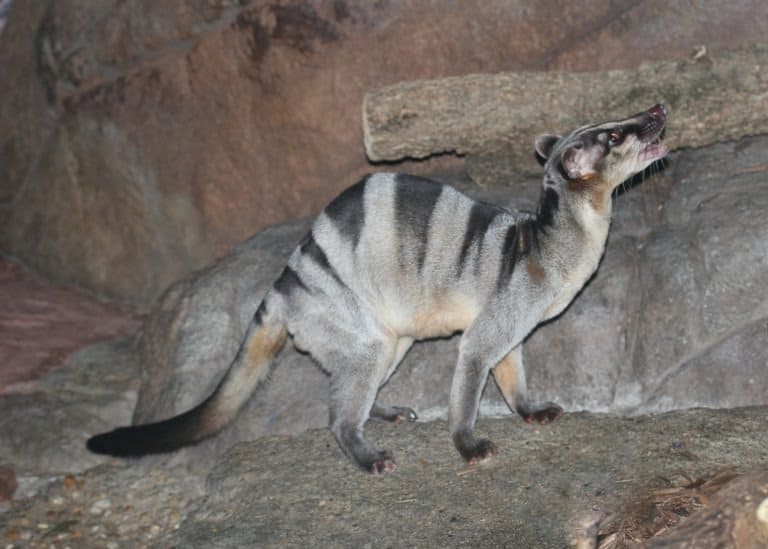
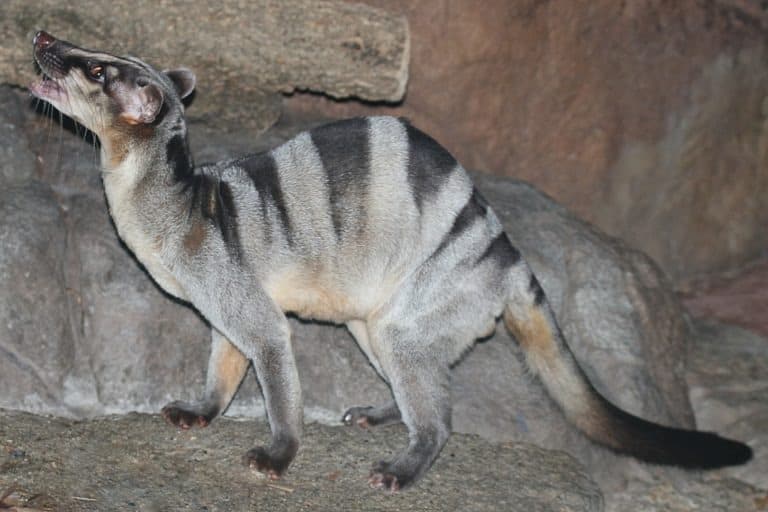
The fur of these animals comes in a wide range of colors, such as black, brown, gray, tan, white, and yellow. They have an elongated body with a mouth full of sharp teeth that make it easy to consume their food. They weigh anywhere from 3 to 10 pounds and are 17 to 28 inches in length. They’re about the size of small domestic cats, and their partially retractable claws help them climb trees. They have seven or eight black curved markings on the dorsal side, and black rings around the tail.
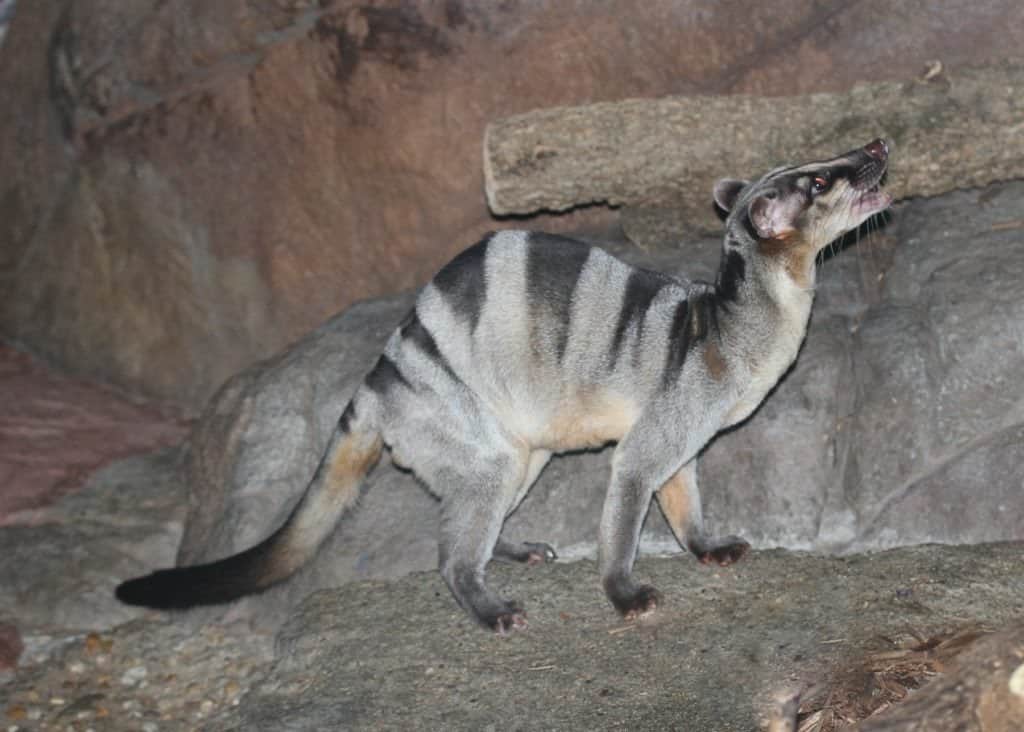
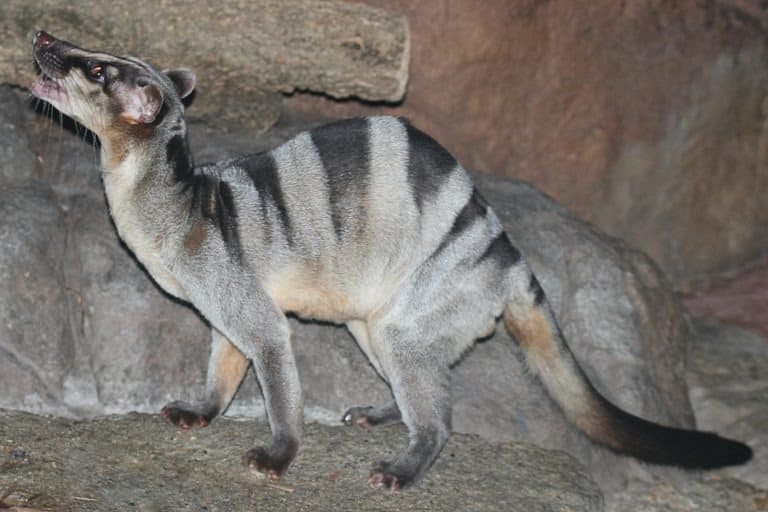
Banded Palm Civet, zoo animal

Banded Palm Civet Behavior

These civets sleep in caves, holes in trees, and other dark places during the day. They are solitary animals who are also highly territorial. Despite sleeping in holes they find in trees, they are a ground-dwelling animal. They are also secretive and relatively ferocious wild animals.

Banded Palm Civet Habitat

The Banded Palm Civet is found in the Asian rainforests and tropical jungles of Thailand, Malaysia, Indonesia, and Burma. However, due to increasing deforestation efforts in these regions, these civets are experiencing habitat loss, making it vulnerable. They’re found in several national parks like Similajau National Park, Mount Kinabalu National Park, and the Temengor Forest Reserve; these areas are protected areas where these Palm Civets are safe.

Banded Palm Civet Diet

The Banded Palm Civet is a carnivore, and therefore, it mainly survives on a diet based on meat, but it does eat plants and fruit on occasion. They will eat rodents, lizards, frogs, insects, earthworms, and small snakes. They will also eat spiders, ants, snails, locusts, and crustaceans found in their territory. They also eat flowers and fruits from mangoes, palm trees, and coffee plants. They also occasionally eat bananas.

Once they catch their prey, they bite the back of the neck and shake it to break its neck. They hold their food in their front paws while tearing into the flesh with their teeth. When they swallow, they tilt their heads upward.

Speaking of civets eating coffee beans, there are a few blends of coffee that use the beans picked out from the droppings of a civet. These beans are part of the rarest and most expensive cups of coffee you’ll ever have. A cup of Kopi Luwak sells for $42 a cup. The civets are used to choose the best berries, but wild civets’ droppings are difficult to harvest.

The digested juices of the civets change the beans’ chemical balance so that they lose the bitterness that coffee normally has and has a softer flavor. This effect they have on coffee beans has led to the trapping of civets, removing them from their natural habitats, and relocating them to coffee plantations.

Banded Palm Civet Predators and Threats

One of the main threats that these Civets face is the deforestation of their native rainforest and tropical jungle habitats. This leads to habitat loss where they can no longer rely on their normal food sources in the area they know, and they no longer have access to trees to keep safe from predators. Their daytime sleeping areas are also destroyed, making them vulnerable to predators when searching for a new place to stay during the day.

Hunting is another threat they face as they’re likely to become caught in traps and snares. Also, civets are taken from the wild to coffee plantations where they are kept for their droppings to grow coffee. Most civet plantations have anywhere from 40 to 150, or more, civets.

The natural predators of the banded civet include crocodiles, large snakes, some Bengal Tigers, and leopards. Bengal Tigers can climb trees, but they hardly ever do so, except when the cubs are young. Leopards love being high up and will even eat their food in trees. Leopards also hunt exclusively at night, which is when the Banded Palm Civet is most active.

Banded Palm Civet Reproduction and Lifespan

The pregnancy of a Banded Palm Civet lasts anywhere from 32 to 64 days. These civets typically give birth to one or two babies that are deaf, blind, and completely helpless at the time of birth. Eighteen days after the babies are born, they have already learned to walk, and by four weeks of age, they already know how to climb trees, a useful survival skill.

The nursing period of these animals lasts 70 days, at the end of which the babies can find food on their own. It takes two years for them to reach sexual maturity. The natural lifespan of the Banded Palm Civet is anywhere from 15 to 20 years. In captivity as a pet, or on coffee plantations, they live longer, up to 25 years of age.

Banded Palm Civet Population

The decline in the population of Banded Palm Civets, over 30% in the last 15 years, is why they are listed as vulnerable. Throughout its native habitat, these civets are protected in Malaysia, Thailand, Brunei, Myanmar, and Indonesia.

Among these, it’s protected in Temengor Forest Reserve and Mount Kinabalu National Park. The exact numbers of these Civets are unknown, nor has there been an exact count, but what is known is that the population of Banded Palm Civets is decreasing.

Banded Palm Civet in the Zoo

There are zoos that house Banded Palm Civets. The Nashville Zoo in Tennessee is one such zoo, and they were the first zoo to experience the first Banded Palm Civet birth in September of 2015. The Nashville Zoo is the only AZA-accredited facility to breed this species.

There are 11 Banded Palm Civets in AZA’s collection, only one of which is at the Cincinnati Zoo and the other ten are at the Nashville Zoo. The Nashville Zoo is using its breeding research project to determine if these civets are seasonal breeders and other factors that lead to their fertility needs. to their fertility needs.

View all 453 animals that start with B
How to say Banded Palm Civet in ...
German
Bänderroller
English
Banded Palm Civet
Spanish
Hemigalus derbyanus
Finnish
Beletti
French
Civette palmiste à bandes
Italian
Hemigalus derbyanus
Swedish
Bandad palmmård
Chinese
縞椰子貓

Sources

  1. David Burnie, Dorling Kindersley (2011) Animal, The Definitive Visual Guide To The World's Wildlife / Accessed August 10, 2010
  2. Tom Jackson, Lorenz Books (2007) The World Encyclopedia Of Animals / Accessed August 10, 2010
  3. David Burnie, Kingfisher (2011) The Kingfisher Animal Encyclopedia / Accessed August 10, 2010
  4. Richard Mackay, University of California Press (2009) The Atlas Of Endangered Species / Accessed August 10, 2010
  5. David Burnie, Dorling Kindersley (2008) Illustrated Encyclopedia Of Animals / Accessed August 10, 2010
  6. Dorling Kindersley (2006) Dorling Kindersley Encyclopedia Of Animals / Accessed August 10, 2010
  7. David W. Macdonald, Oxford University Press (2010) The Encyclopedia Of Mammals / Accessed August 10, 2010
  8. Wildlife Conservation Society / Accessed October 13, 2020
  9. Facts and Details / Accessed October 13, 2020
  10. Wildlife Arkive / Accessed October 13, 2020
  11. IUCN Redlist / Accessed October 13, 2020
  12. EOL / Accessed October 13, 2020
  13. National Parks / Accessed October 13, 2020
A-Z Animals Staff

About the Author

A-Z Animals Staff

AZ Animals is a growing team of animals experts, researchers, farmers, conservationists, writers, editors, and -- of course -- pet owners who have come together to help you better understand the animal kingdom and how we interact.
Connect:

Thank you for reading! Have some feedback for us?


Banded Palm Civet FAQs (Frequently Asked Questions)

All animals in nature play a role in keeping a balance. The Banded Palm Civet’s diet plays a role in controlling the population of what it eats, such as spiders, frogs, and other food it finds. Scientists have not yet fully explored this animal’s role as it’s one of the rarer species of civets.

One of the few reasons the Banded Palm Civet is important to humans is the role it plays with coffee beans. Plus, the oily substance the Banded Palm Civet produces is used in the perfume industry and it’s also used to treat skin disorders and excessive sweating.