B
Species Profile

Barnacle

Cirripedia

Crustaceans that live like living glue
RLS Photo/Shutterstock.com
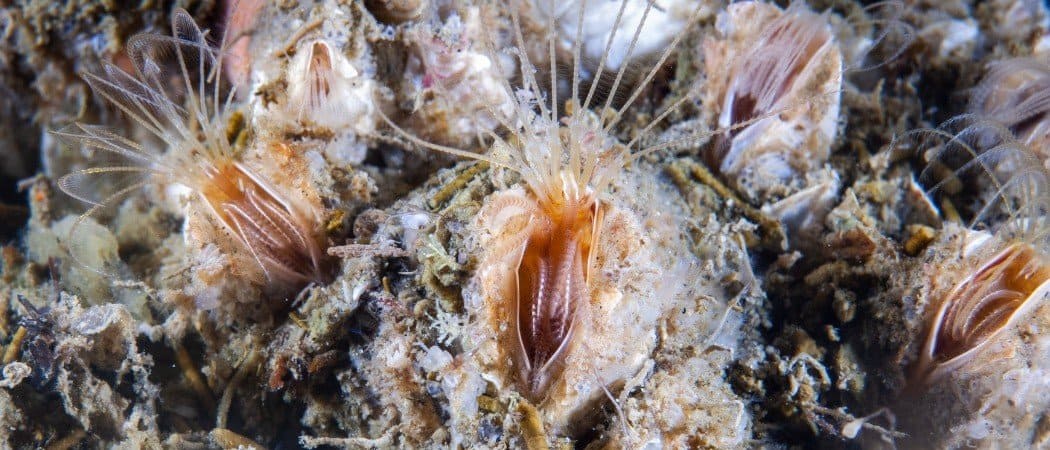
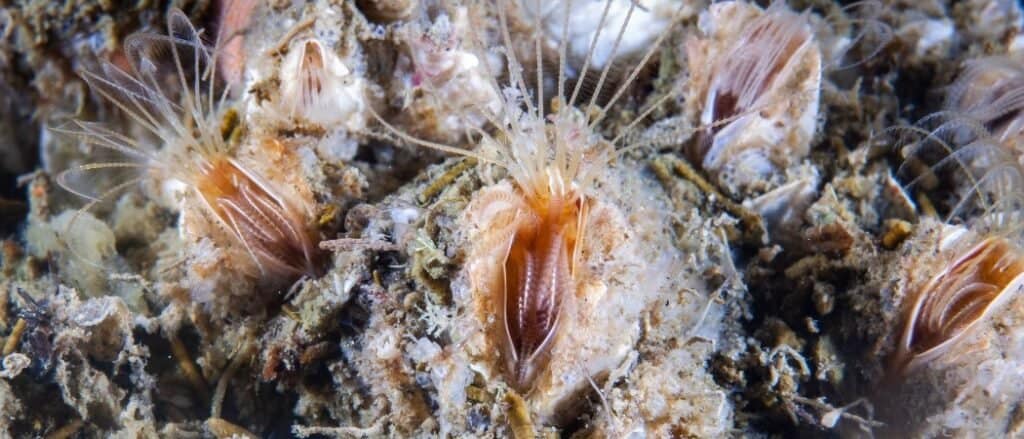
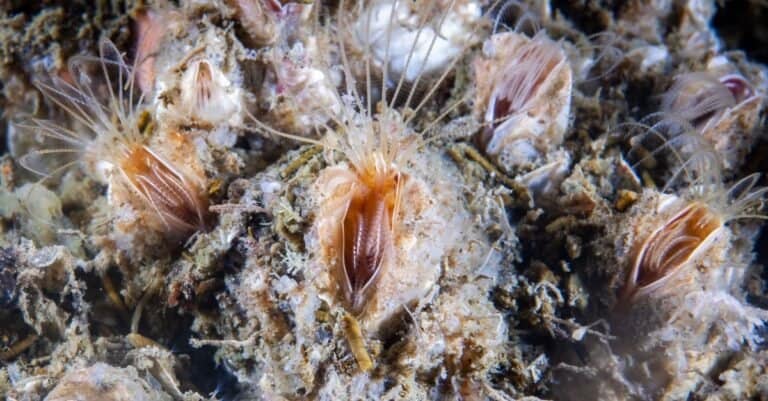
Barnacle feeding underwater.

At a Glance

Class Overview This page covers the Barnacle class as a group. Stats below are general traits shared across the class.
Also Known As Goose barnacle, Gooseneck barnacle, Acorn barnacle, Stalked barnacle, Rock barnacle
Diet Filter Feeder
Activity Cathemeral+
Lifespan 3 years
Weight 1 lbs
Status Not Evaluated
Did You Know?

Barnacles are arthropod crustaceans (not mollusks), despite their shell-like plates.

Size Comparison

Human 5'8"
Barnacle 1 in

Barnacle stands at 2% of average human height.

Scientific Classification

Class Overview "Barnacle" is not a single species but represents an entire class containing multiple species.

Barnacles are marine crustaceans that permanently attach to surfaces (rocks, ship hulls, turtles, whales, driftwood) or, in stalked forms, hang from floating substrates. They are suspension feeders using feathery cirri (modified legs) to capture plankton and detritus. Although they look shell-like, they are arthropods closely related to other crustaceans.

Kingdom
Animalia
Phylum
Arthropoda
Class
Thecostraca

Distinguishing Features

  • Crustaceans with a calcified shell (plates in many forms) enclosing the body
  • Sessile lifestyle: adults cemented to substrate (acorn barnacles) or attached by a stalk (goose barnacles)
  • Feeding with cirri—fan-like appendages swept through the water
  • Larvae are free-swimming (nauplius then cyprid) before settling and metamorphosing
  • Many are hermaphroditic; some have dwarf males or complex reproductive strategies

Physical Measurements

Males and females differ in size

Height
1 in (0 in – 12 in)
1 in (0 in – 12 in)
Length
1 in (0 in – 12 in)
1 in (0 in – 12 in)
Weight
0 lbs (0 lbs – 2 lbs)
Top Speed
0 mph
Larvae swim a few cm/s

Appearance

Primary Colors
Secondary Colors
Skin Type Barnacles' arthropod cuticle forms a protective exoskeleton. Free-living types have calcareous shell plates or a plated capitulum with a leathery stalk. Soft parts are chitin-covered; some parasitic rhizocephalans lose plates and become root-like inside hosts.
Distinctive Features
  • Crustaceans (arthropods), not mollusks: possess jointed-limb ancestry expressed as feathery feeding appendages (cirri) and a chitinous cuticle with calcareous reinforcement.
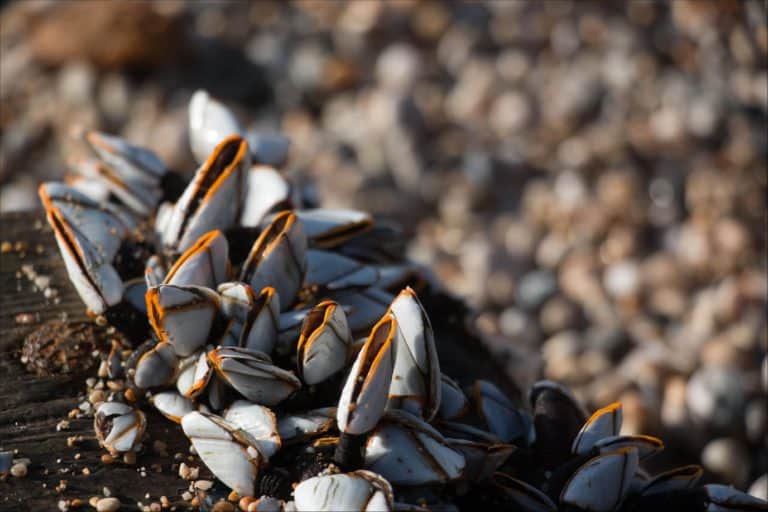
  • Two very common morphs across the group: (1) acorn barnacles-sessile, conical/volcano-like wall plates with an opercular opening; (2) stalked (goose) barnacles-capitulum (plate-bearing 'head') on a flexible peduncle that attaches to floating or fixed substrates.
  • Operculum (paired plates) that opens for feeding and closes to reduce desiccation and predation-especially important in intertidal species; tight closure can create a smooth "sealed" look at low tide.
  • Cement-based permanent attachment: specialized cement glands produce strong biological adhesive; many species show a distinctly basal "footprint" and conform to micro-topography of the substrate.
  • Feeding structures: multiple pairs of cirri extend rhythmically to filter plankton and detritus; in many species, cirral length and thickness vary with wave exposure and flow regime (shorter/robust in high surge; longer/finer in calmer waters).
  • Life cycle generalization (with variation): planktonic nauplius larvae → non-feeding cyprid larva specialized for settlement site choice → metamorphosis into a permanently attached juvenile/adult (or, in parasitic groups, transformation into highly modified internal forms).
  • Size range: some adult acorn or other small barnacles are only a few millimeters across; large acorn types reach about 10–20+ cm across; stalked barnacles reach about 20–30 cm including the peduncle.
  • Lifespan varies: short-lived intertidal and fouling barnacles often live about 1–3 years, while larger deep-water or robust forms can live many years to decades, often around 10–20+ years.
  • Most barnacles are sessile suspension feeders needing strong flow. They settle in groups, form dense crusts, foul ships, live on animals as epibionts, bore into rock, or become parasitic rhizocephalans.
  • Plate architecture varies widely: some have many interlocking wall plates; others have fewer, larger plates; some show pronounced ribs/spines; surface sculpture ranges from smooth to strongly ridged, depending on species and environment.
  • Color and surface appearance often reflect environment as much as taxonomy: clean newly formed plates are pale; older individuals commonly look darker or mottled due to biofilms, algae, sediment, and encrusting organisms.

Sexual Dimorphism

Sexual systems are highly variable across Cirripedia. Many thoracican barnacles are simultaneous hermaphrodites with no obvious external sex differences. Other lineages show separate sexes and/or extreme sexual dimorphism, including dwarf males living on or within females/hermaphrodites. Parasitic groups can show pronounced functional and morphological differences between reproductive roles.

  • In species with separate or dwarf males: males may be minute 'dwarf' individuals attached to the female/hermaphrodite's body or within specialized receptacles; often reduced feeding structures and simplified body form.
  • Where separate sexes occur without dwarfing: males may be smaller and less robust, sometimes with proportionally larger reproductive tissues relative to body size.
  • In species with separate sexes: females are often larger-bodied, providing more brood capacity; may have more prominent brood structures/space within the mantle cavity.
  • In dwarf-male systems: the larger partner is typically female or hermaphrodite, with the main shell/body form and most visible external morphology.

Did You Know?

Barnacles are arthropod crustaceans (not mollusks), despite their shell-like plates.

Size across Cirripedia ranges from very small adults around ~0.1 cm across (about 1 mm) to large stalked barnacles reaching up to ~20 cm total length (including the stalk).

Lifespan varies widely: many intertidal species live ~1-3 years, while larger/cold-water forms can persist roughly a decade or more (reported up to ~10-20+ years in some cases).

They begin life as free-swimming larvae (nauplius → cyprid) before permanently cementing themselves and metamorphosing into adults.

Many are simultaneous hermaphrodites; some groups also have "dwarf males" that live attached to or within females/hermaphrodites.

Barnacle "cement" is among nature's most effective underwater adhesives and is studied for medical and industrial uses.

Charles Darwin spent years painstakingly describing barnacles; his cirripede work became a landmark in zoological classification.

Unique Adaptations

  • Permanent cementation: specialized cement glands produce protein-rich adhesives that cure underwater and bond to rock, metal, plastic, wood, or living tissue; attachment strength and chemistry vary among groups and substrates.
  • Feeding with cirri: the signature "feathery legs" are modified thoracic appendages that form a filtering basket; different species tune cirral shape and beat patterns to local flow regimes.
  • Armor of plates: most familiar barnacles build calcareous wall plates and an operculum (a closable "door"), providing protection from predators and desiccation; plate number and arrangement vary widely across families.
  • Metamorphosis toolkit: the cyprid larva has "temporary" structures for exploration and adhesion, then reorganizes its body plan into a sessile adult-one of the most dramatic life-history shifts among crustaceans.
  • Living on moving hosts: whale and turtle barnacles have shapes and growth patterns that help them resist drag and remain anchored on skin or scutes, effectively turning animals into mobile habitat.
  • Reproductive flexibility: hermaphroditism is common; in several lineages, tiny dwarf males evolve to ensure fertilization when neighbors are scarce-an adaptation to a fixed, patchy lifestyle.
  • Stress tolerance strategies: many intertidal species tolerate big swings in temperature, salinity, and oxygen by tightly sealing, managing water loss, and timing feeding to favorable immersion periods.

Interesting Behaviors

  • Settlement choice with a "cyprid" larva: the final larval stage explores surfaces using specialized antennules, sampling texture/chemistry before committing for life; many species prefer to settle near others (gregarious settlement), but some avoid crowding depending on local conditions.
  • Rhythmic feeding: most typical barnacles extend and retract their cirri to sieve plankton and detritus; activity often tracks waves, currents, and tides, with variation from constant pumping in strong flow to "pause-and-snatch" in calmer water.
  • Intertidal lock-down: acorn barnacles commonly clamp their opercular plates shut during low tide to reduce drying and heat stress; tolerance varies greatly among species and shore heights.
  • Reproduction while immobile: mating usually requires close neighbors; barnacles transfer sperm via an extensible penis (length and flexibility vary across lineages), then brood embryos and release larvae to the plankton.
  • Hitchhiking lifestyles: many species live as epibionts on turtles, whales, crabs, or driftwood, gaining transport to food-rich waters; the relationship ranges from mostly harmless commensalism to more burdensome fouling.
  • Community engineering: dense barnacle "carpets" can dominate wave-swept rocks, creating crevices that shelter small invertebrates and altering who can settle and survive nearby.
  • Extreme ecological diversity within Cirripedia: alongside familiar suspension-feeding acorn and goose barnacles, some relatives are highly modified parasites (e.g., rhizocephalans) that invade crabs and can redirect host reproduction-showing how behavior/ecology can diverge dramatically within the group.

Cultural Significance

Barnacles cover ship hulls and marine structures, driving antifouling technology. Some, like stalked "goose barnacles", are fished in Atlantic Iberia. Darwin’s barnacle studies helped shape how scientists classify animals. Their underwater "cement" inspires new adhesives and coatings.

Myths & Legends

In medieval Europe, writers like Gerald of Wales (12th c.) and John Gerard (16th c.) said barnacle geese grew from goose barnacles on driftwood—a story repeated in chronicles and herbals.

In medieval Europe, people believed barnacle geese came from the sea, so some treated them as fish and allowed eating during fasts, a view argued by church leaders and ordinary people.

Medieval bestiaries and travel tales often presented barnacle-derived geese as wondrous proof of strange natural generation at the edges of the known world, especially in stories set around Ireland and the North Atlantic.

Coastal harvesting lore around goose barnacles in Atlantic Europe often frames them as "sea fruit" or "treasures" wrested from dangerous surf-told in local anecdotes and fisher traditions emphasizing bravery and respect for the ocean.

You might be looking for:

Northern acorn barnacle

26%

Semibalanus balanoides

Common intertidal acorn barnacle of North Atlantic rocky shores; classic cone-shaped shell plates cemented to rock.

Striped/Acorn barnacle (common fouling barnacle)

22%

Amphibalanus amphitrite

Widespread warm-water fouling barnacle on ships and docks; important model in antifouling studies.

Goose barnacle

20%

Lepas anatifera

Stalked barnacle that attaches to floating objects; distinct from acorn barnacles.

View Profile

Common/European goose barnacle

16%

Pollicipes pollicipes

Stalked barnacle harvested as seafood in parts of Europe; lives on wave-swept rocky coasts.

Whale barnacle

12%

Coronula diadema

Specialized barnacle that embeds in whale skin (notably humpbacks).

Life Cycle

Birth 5000 larvas
Lifespan 3 years

Lifespan

In the Wild
0.1–20 years
In Captivity
0.1–10 years

Reproduction

Mating System Hermaphroditism
Social Structure Aggregation Group
Breeding Pattern Transient
Fertilization Simultaneous Hermaphrodite
Birth Type Simultaneous_hermaphrodite

Barnacles (Cirripedia) are sessile crustaceans, often in clusters. Adults are mostly simultaneous hermaphrodites that mate with an extendable penis and hold fertilized eggs. Larvae are planktonic (nauplius→cypris). Some have dwarf males (androdioecy); self-fertilize sometimes.

Behavior & Ecology

Social Colony Group: 100
Activity Cathemeral, Diurnal, Nocturnal, Crepuscular
Diet Filter Feeder Mixed plankton-especially copepod-sized zooplankton and diatom-rich phytoplankton when abundant.
Seasonal Hibernates

Temperament

Sessile and non-territorial in the mobile/behavioral sense; interactions are dominated by space competition (crowding, overgrowth, smothering) rather than direct aggression.
Generally gregarious at settlement (larvae often prefer to settle near conspecifics), but adult spacing and crowding tolerance vary widely among taxa and environments.
Feeding and cirral activity are opportunistic and strongly condition-dependent (water flow, turbulence, submergence, temperature, salinity); many intertidal forms show rhythmic withdrawal/closure linked to emersion and wave shock.
Barnacles often need nearby neighbors to cross-fertilize, so they live in groups. Some kinds need others less, using options like dwarf males or parasitic, very different life cycles.
Barnacles range from tiny millimeter adults to large stalked forms many centimeters long; lifespans range from months or about a year in fast-growing or disturbed places to many years or a decade in stable sites.

Communication

None known No airborne or underwater vocal signaling; communication is primarily chemical/mechanical
Chemical settlement cues released by adults and biofilms that influence cyprid larval choice Gregarious settlement common, strength and specificity vary by species
Chemical mate-location and proximity cues at very short range; reproductive success is influenced by neighbor distance/density in sessile adults.
Tactile/mechanosensory signaling via contact and water-borne vibrations/currents detected by sensory setae; can modulate cirral beating, withdrawal, and closure responses.
Environmental entrainment (non-social but synchronizing): tidal/immersion cycles, light, and flow conditions can synchronize feeding/withdrawal and sometimes spawning within local aggregations, producing apparent group-level rhythms without active coordination.

Habitat

Rocky Shore Coastal Beach Estuary Mangrove Coral Reef Kelp Forest Open Ocean Seabed/Benthic Deep Sea Urban Agricultural/Farmland +6
Biomes:
Terrain:
Coastal Island Rocky Sandy Muddy
Elevation: -433071 in

Ecological Role

Suspension-feeding crustaceans that link plankton/detritus to benthic food webs; also major space-occupying epibionts and biofoulers across marine and estuarine habitats (with some lineages evolving parasitism).

remove suspended particles (water-column filtration) and repackage them as feces/pseudofeces, aiding benthic-pelagic coupling nutrient cycling via excretion and biodeposition create microhabitat/structural complexity on hard substrates (shell matrices that host small invertebrates and algae) serve as prey for many consumers (e.g., whelks, sea stars, fishes, shorebirds) and contribute to coastal food webs influence community structure through competition for space and facilitation (providing settlement surfaces for other organisms) drive biofouling on ships and infrastructure, with economic/ecological impacts

Diet Details

Main Prey:
Zooplankton Planktonic larvae Microcrustaceans and other small pelagic invertebrates Marine snow-associated microfauna
Other Foods:
phytoplankton suspended particulate organic matter Microbial aggregates

Human Interaction

Domestication Status

Wild

Barnacles (Cirripedia) are not domesticated. People mainly interact with wild barnacles by harvesting them for food in some places, moving them accidentally as biofouling on ships and marine structures, studying their development and strong adhesion, and managing them when invasive or protected. There is no selective-breeding tradition; culture is mostly for research and limited aquaculture/depuration.

Danger Level

Low
  • Cuts and punctures from sharp calcareous plates while handling fouled gear, rocks, or hulls
  • Slip/trip hazards on heavily encrusted intertidal rocks and structures
  • Allergic reactions or irritation in some individuals from handling/consuming marine invertebrates (rare; variable by person and local contaminants)
  • Food-safety risks are indirect: as filter feeders, some populations can concentrate local pollutants or biotoxins depending on region and conditions
  • Operational hazards are indirect but important: heavy fouling increases drag on vessels, fuel use, and can contribute to mechanical issues on marine equipment

As a Pet

Not Suitable as Pet

Legality: Generally not regulated as 'pets' per se, but collection/possession can be restricted by local marine-harvest rules, protected-area regulations, and rules for removing organisms from vessels or shorelines. Transport across borders may be restricted due to invasive-species and biosecurity laws.

Care Level: Expert Only

Purchase Cost: Up to $100
Lifetime Cost: $200 - $3,000

Economic Value

Uses:
Seafood (regional delicacy) Biofouling costs (shipping, aquaculture, marinas, coastal infrastructure) Biotechnology/biomimetics (adhesives, antifouling coatings) Environmental monitoring (fouling communities, pollution/biogeography indicators) Ecosystem services (habitat creation, food-web support)
Products:
  • Edible barnacles harvested from the wild (notably stalked/goose barnacles and some large intertidal/subtidal forms)
  • Antifouling paints/coatings and hull-cleaning services driven by barnacle fouling pressure
  • Research tools and knowledge products (larval settlement cues, underwater adhesion proteins, bioinspired glues)
  • Monitoring datasets from settlement plates and fouling surveys used by ports and environmental agencies

Relationships

Related Species 6

Facetotecta Facetotecta Shared Class
Ascothoracids Ascothoracida Shared Class
Acorn barnacles Balanomorpha Shared Order
Stalked barnacles Lepadomorpha Shared Order
Verruca barnacles Verruca Shared Order
Burrowing barnacles Acrothoracica Shared Order

Ecological Equivalents 5

Animals that fill a similar ecological role in their ecosystem

Mussels Mytilidae Sessile marine filter feeders that attach to hard substrates and strongly influence intertidal space competition and water-column particle removal. Similar to many acorn barnacles.
Oyster
Oyster Ostreidae Cemented, hard-shelled suspension feeders that form encrusting communities and reef-like habitat, ecologically parallel to dense barnacle aggregations.
Bryozoans Bryozoa Colonial encrusters that use ciliated feeding structures to capture plankton; they often occupy the same fouling/encrusting niches on rocks, pilings, and ship hulls.
Tube-building polychaete worms Serpulidae Sessile, calcareous-tube–dwelling suspension feeders that occupy hard-substrate microhabitats and compete for space in fouling communities.
Sponges Porifera Sessile filter feeders that can dominate hard-substrate assemblages. Like barnacles, they shape local flow and provide microhabitat, though their feeding mechanism differs.

Types of Barnacle

14

Explore 14 recognized types of barnacle

Common acorn barnacle Semibalanus balanoides
Striped barnacle Amphibalanus amphitrite
Goose barnacle
Goose barnacle Lepas anatifera
Gooseneck barnacle
Gooseneck barnacle Pollicipes pollicipes
Whale barnacle Coronula diadema
Turtle barnacle Chelonibia testudinaria
Pacific acorn barnacle Balanus glandula
Titan acorn barnacle Megabalanus californicus
European little barnacle Chthamalus stellatus
Northern verruca barnacle Verruca stroemia
Stalked barnacle
Stalked barnacle Scalpellum scalpellum
Violet snail-raft barnacle Dosima fascicularis
Burrowing barnacle Trypetesa lampas
Crab-associated barnacle Octolasmis muelleri

If you’ve heard of someone being referred to as a barnacle, it means they’re overly clingy.

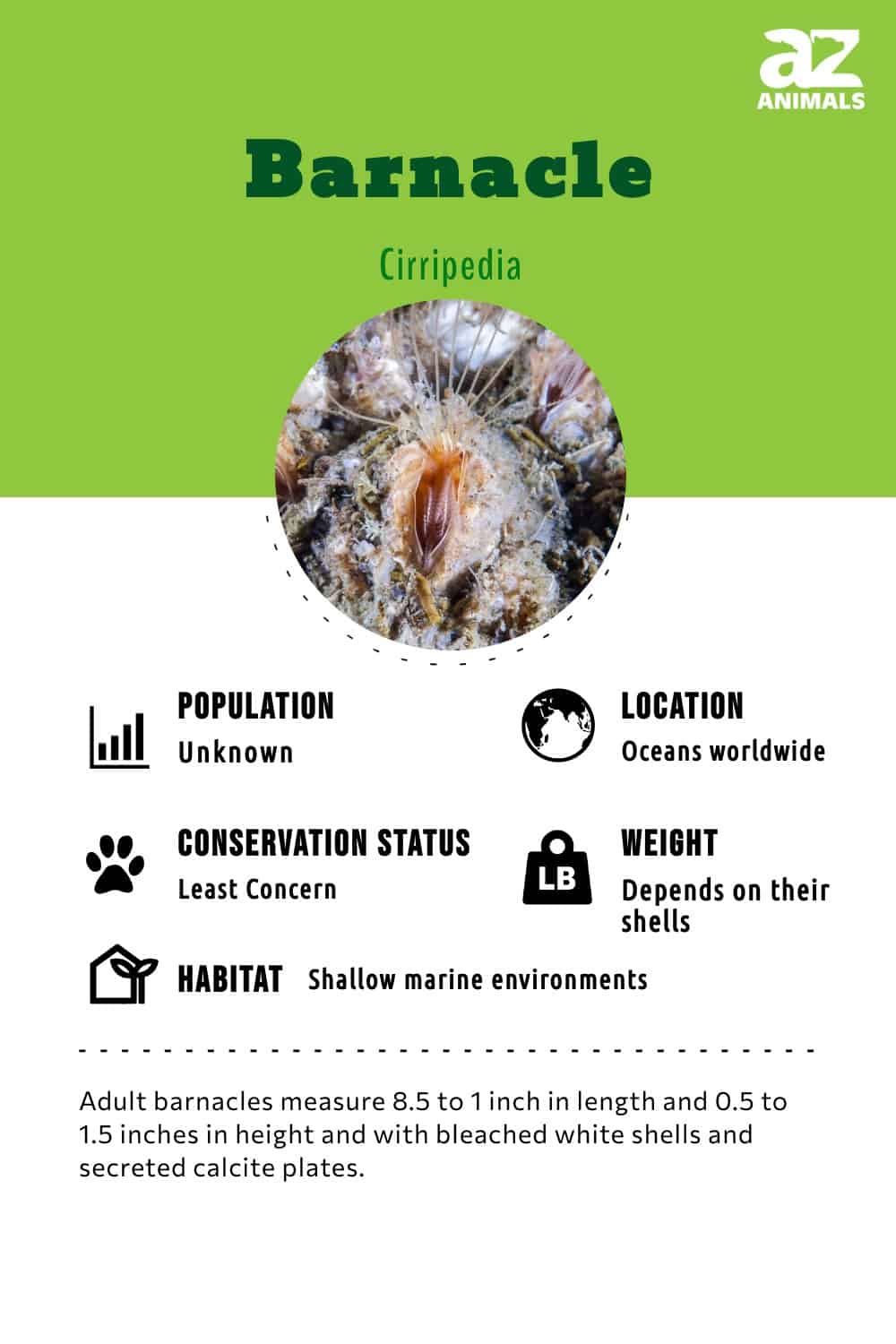
What is a barnacle? The barnacle is one of the oldest surviving creatures on earth and lives in oceans around the world. It is a small crustacean that attaches to the hard surfaces of rocks, sea walls, boats, debris, land structures, and other marine animals, such as sea turtles, sea snakes, lobsters, crabs, and whales. This arthropod is a member of the subphylum Crustacea, which includes crabs, lobsters, shrimps, prawns, crayfish, krill, and woodlice.

It forms a symbiotic relationship with other marine animals by creating a plate of armor in return for being transported to plankton-rich waters in which to use filter feeding. Many humans consume the edible gooseneck species.
6 Incredible Barnacle Facts!

  • It is one of the oldest living animals in the world.
  • It was once believed to be related to snails, which are mollusks, because of the hard shell which many species have.
  • It eats with tiny legs or feet called “cirri” while suspension feeding
  • The rhizocephalan barnacle is a parasite.
  • Commensalism refers to the symbiotic relationship a barnacle has with another marine animal where the barnacle has most of the benefit.
  • It is hermaphroditic.

There are no type species for the barnacle, so there is no one scientific name. Barnacles are members of the marine invertebrate class Maxillopoda. The subclasses are Thecostraca, Tantulocarida, Branchiura, Pentastomida, Mystacocarida, Copepoda, and Cirripedia. From Theocostraca, the infraclass Cirripedia was divided into superorders Thoracica, Acrothoracica, and Rhizocephala, and then into 11 orders.
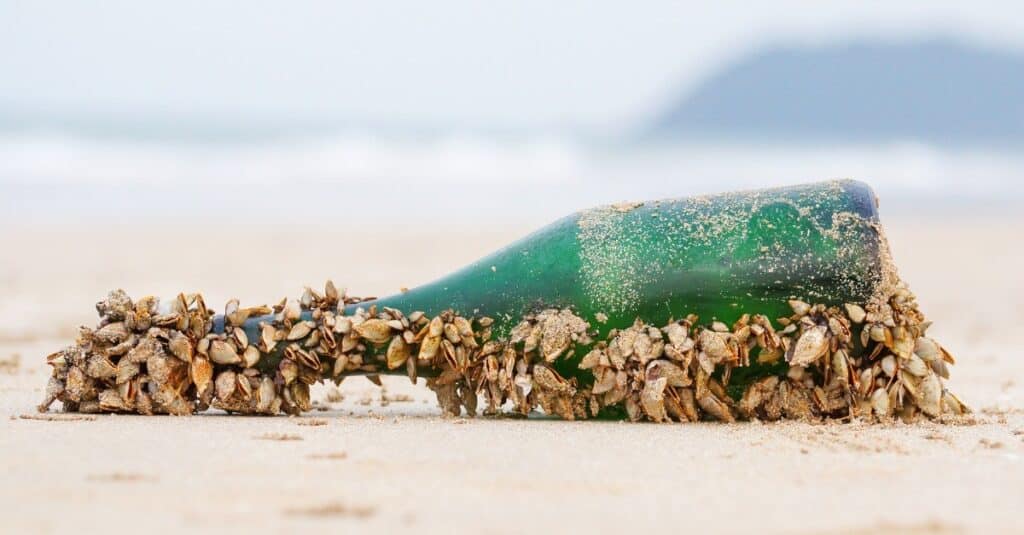
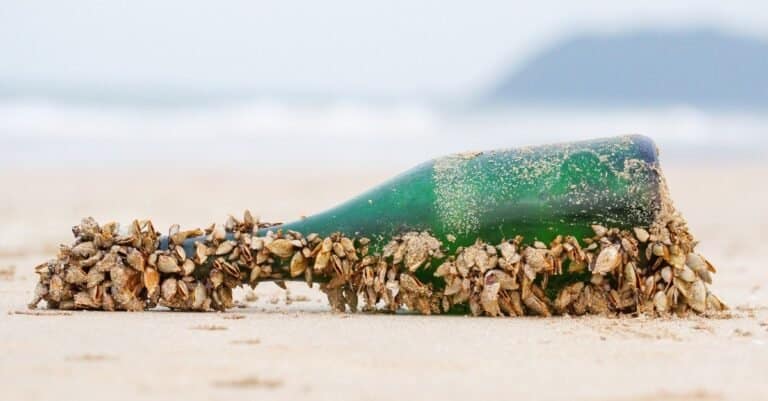
A glass bottle full of barnacles lying on the beach.

Barnacles are members of the marine invertebrate class Maxillopoda.

Scientific Name and Types of Barnacles

There are more than 14,000 species of barnacles, with the most common being the acorn barnacle. However, many species have the common name of acorn barnacle. The scientific name of an acorn barnacle can include the genera Balanus, Chthamalus, Megabalanus, Paraconcavus, or Semibalanus:

  • Common Acorn Barnacle (Balanus glandula) – Very common around North America’s Pacific Coast, these barnacles are able to draw oxygen from both air and water. Overall, they have a conical shape and can live up to 10 years.
  • Giant Acorn Barnacle (Balanus nubilus) – Rightfully named, this is the world’s largest barnacle. They can be found on the Pacific coast of North America, from Baja California to Alaska and at ranges up to 300ft deep.
  • Acorn Barnacle (Chthamalus antennatus) – Also known as the six-plated barnacle – these barnacles are found on the eastern and southern coasts of Australia.
  • Titan Acorn Barnacle (Megabalanus coccopoma) – This type of barnacle was first written about by none other than Charles Darwin. These can be found in South and Central America on their Pacific coasts. They are a large, conical barnacle.
  • Titan Acorn Barnacle (Megabalanus tintinnabulum)
  • Red-striped Acorn Barnacle (Paraconcavus pacificus) – These are a type of balanid barnacles that grow up to just under one and a half inches. They have pink stripes which are striated over their plate growth rings.
  • Northern Acorn Barnacle (Semibalanus balanoides) – These are also known as the Common Barnacle and Northern Rock Barnacle. They are a very commonly-occuring version and can be found in rocky areas of the western European coasts and also on western and eastern coasts of North America.

Gooseneck barnacles also called stalked or goose barnacles, are also common. They are the common name for the members of the infraclass Thoracica and the order Pedunculata. The scientific name of a gooseneck barnacle can include the genera Pollicipes and Lepas.

  • Goose or leaf barnacle (Pollicipes polymerus)
  • Gooseneck Barnacle (Pollicipes pollicipes) – These are stalked versions of the barnacle. They are found on Pacific rocky shores of North America where they directly compete with other animals for limited living space.
  • Smooth Gooseneck Barnacle (Lepas anatifera) – Also known as Pelagic Gooseneck Barnacles, these barnacles use their stalks to attach to all types of driftwood, piers, hulls, and flotsam.
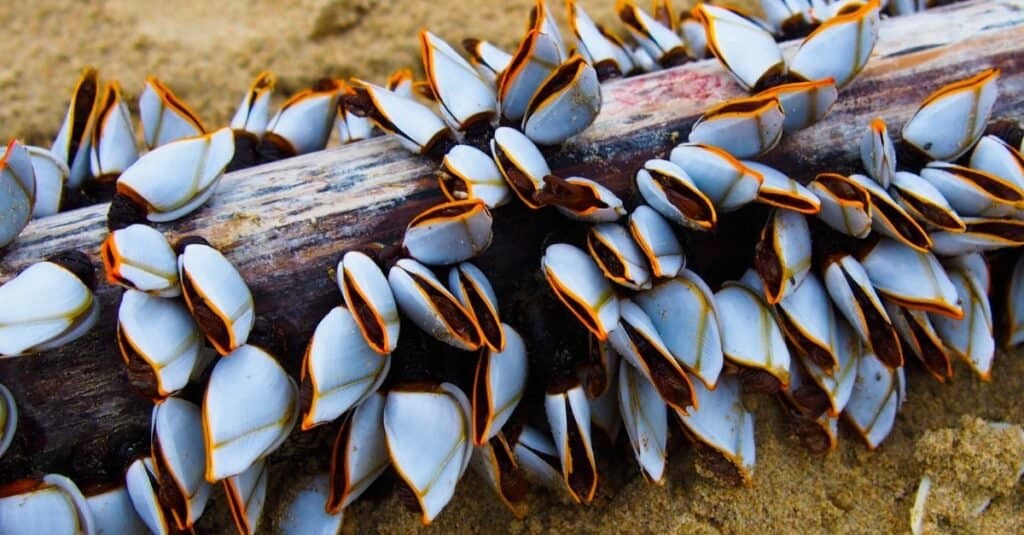
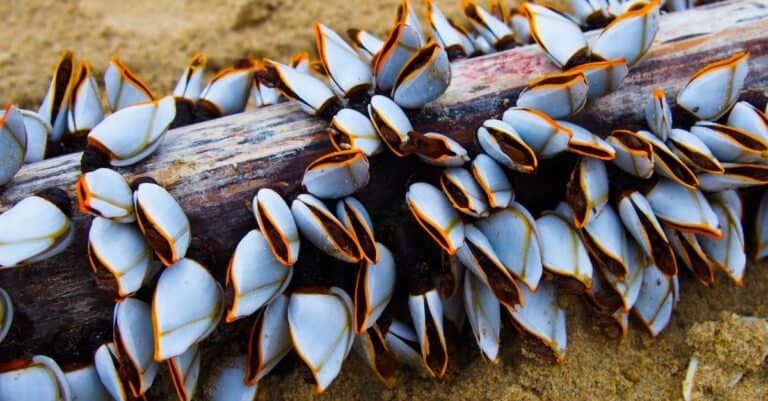
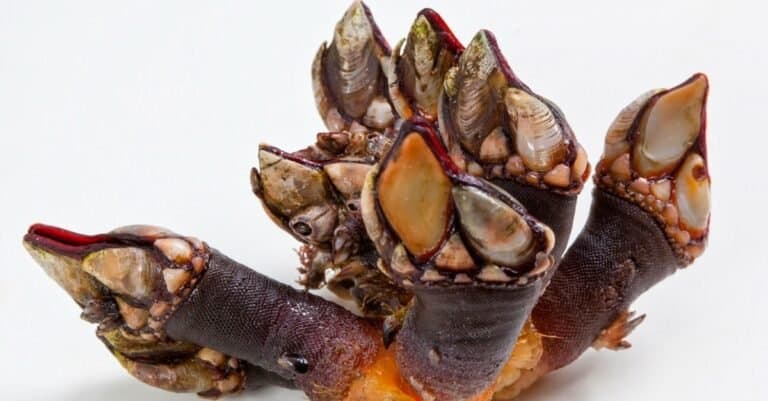
Group of goose barnacles, seashell attached on a wood log on the seashore.

The scientific name of a gooseneck barnacle can include the genera Pollicipes and Lepas.

History and Evolution

The barnacle is one of the oldest types of animals. They have survived for hundreds of millions of years, and the oldest fossil is over 300 million years old! They evolved into something closer to their modern form about 20 million years ago.

Scientists are able to infer information about water depths from prehistoric times based on barnacle fossils and evidence. They are able to do this by the placement of these findings and estimating the distances of them sloping downward and deeper into oceans.

Appearance

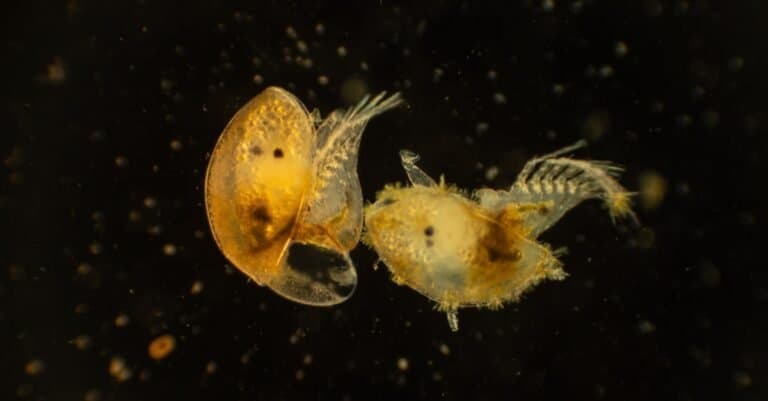
What is a barnacle’s characteristics? A barnacle has specific anatomy depending on its species and whether it is in a larval stage of either the nauplius or cyprid or are mature adults. The nauplius larva hatches from a fertilized egg and has one eye, a head, and a telson, but no thorax or abdomen. It then goes through several moltings to shed its cuticle, during which it looks like shrimp until they become juvenile adults.

Adult barnacles measure 8.5 to 1 inch in length and 0.5 to 1.5 inches in height, depending on the species. Their color is usually white, cream, yellow, or black, and their shells are bleached white. Barnacles secrete 4 to 8 calcite plates with an average of 6 to protect their soft bodies. Adult barnacles have few internal organs and no appendages in their anatomy except for legs or feet, called “cirri,” which they use for feeding and breathing. They have no heart or gills. There’s no information about their weight, and it would mostly be the weight of their shells.

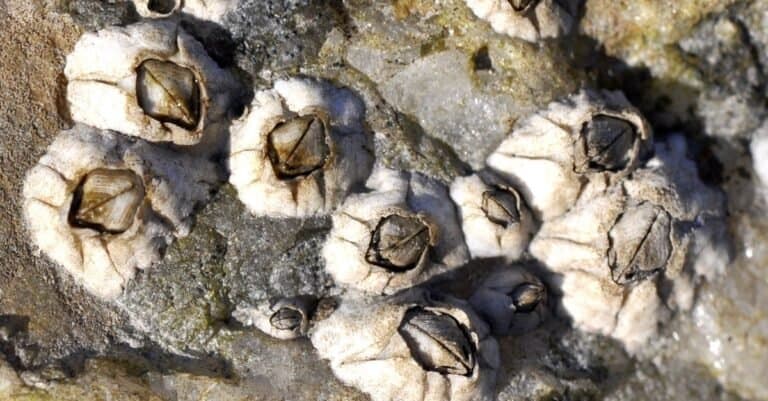
The barnacles that encrust themselves onto boat hulls, buoys, and piers are volcano-shaped, stony, and grey in color. Gooseneck barnacles have a stalk to attach to hard surfaces with, but acorn barnacles do not and are cone-shaped. Acorn barnacles also have an “operculum” or opening at the top which has a “door” of 2 or 4 additional plates, while gooseneck barnacles have chalky-white, heart-shaped shells with black lines. Each type of barnacle has different anatomy.
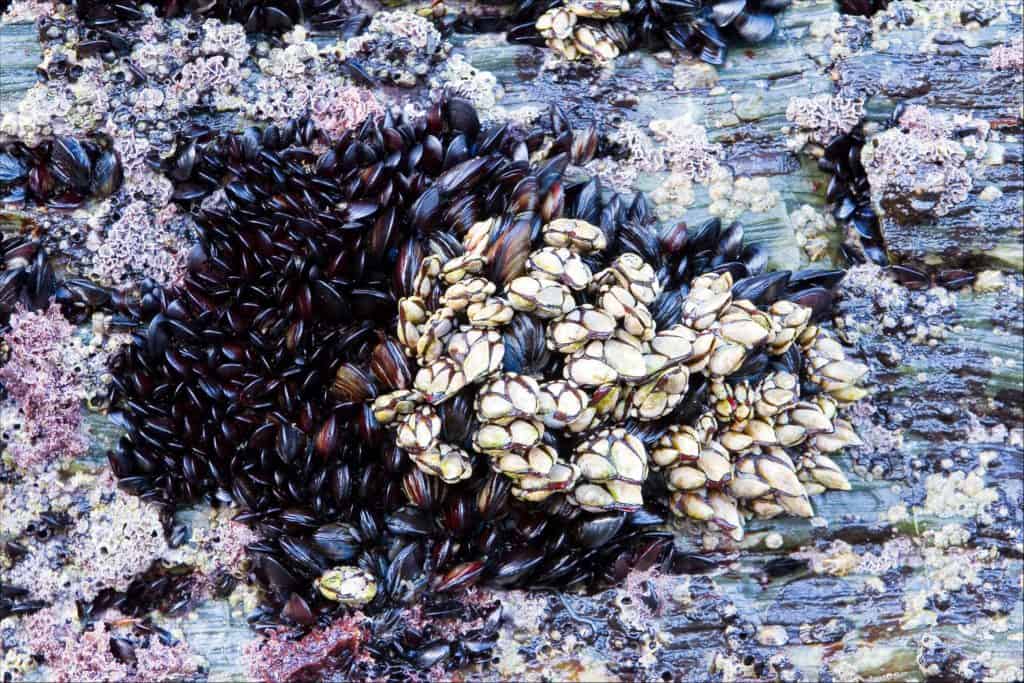
The barnacles that encrust themselves onto boat hulls, buoys, and piers are volcano-shaped, stony, and grey in color.

Behavior

The behavior of the barnacle during its life cycle for free-swimming and feeding is often called inter-tidal, which refers to its acting long with the ocean tides. When the tide comes, it opens its “door” plates and feeds using its cirri, shutting its operculum to save water. Many barnacles hibernate during winter, relying only on their energy reserves.

Habitat

The barnacle larvae free-swim for a short while after hatching from the egg in order to find a surface to attach to. It tends to settle in sites where there are many other barnacles, meaning they are supportive of life. The surface it settles on must first have a film of algae, seaweed, bacteria, or diatoms to allow it to attach. Once it settles, it becomes sessile, and may not move for the rest of its life.

It lives in marine waters around the globe on rocks, boats, and sea creatures such as whales, fish, and crustaceans. Because barnacles tend to encrust large numbers on boats, create drag, and need pressure washing to remove, they are often called “crusty foulers.” When they are piled on, they are said to be biofouling — meaning they are damaging it — and create drag.

Rhizocephala barnacles live inside thoracican barnacles, mantis shrimps, and other crustaceans. Some non-parasitic barnacles attach to sites by growing their shells into the surface, while other species use a strong glue and peduncle (stalk) to attach themselves head-first.
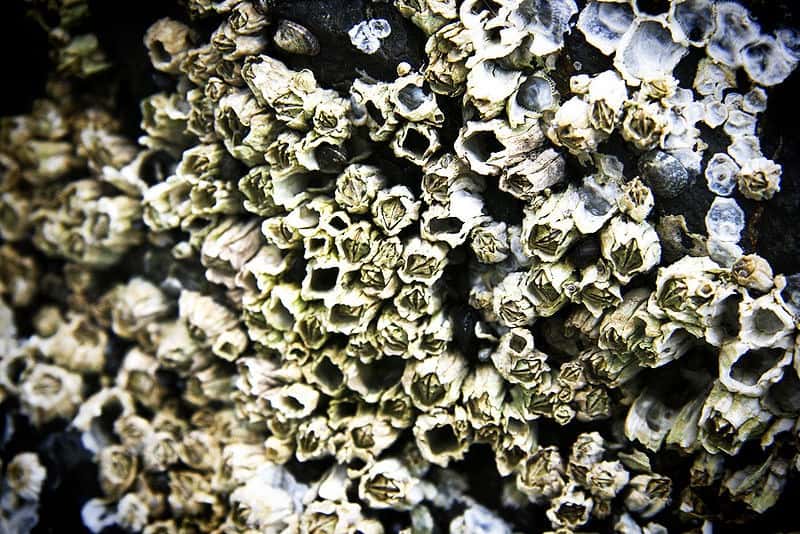
Because barnacles tend to encrust large numbers on boats, create drag, and need pressure washing to remove, they are often called “crusty foulers.”

Diet

The diet of the barnacle is plankton and detritus (dead organic particles), which it consumes through suspension-feeding and filter-feeding. It uses its cirri which it extends and retracts to push the food inside, and opens its operculum to allow water, after which it closes its operculum. A barnacle’s diet is omnivorous because it eats both plant and animal matter.
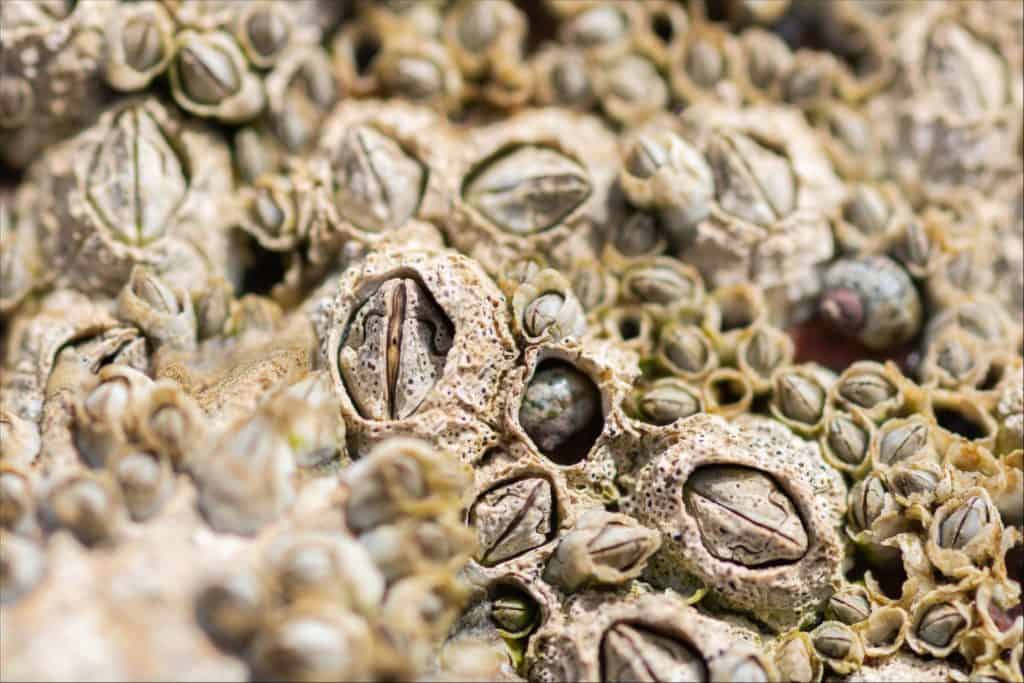
Barnacles are often called “crusty foulers” because of their tendency to encrust in large numbers on boats, creating drag.

Predators and Threats

The barnacle has many threats, including other barnacles, which it competes with for space. Other predators include mussels, starfish, limpets, whelks, and other sea snails. The barnacle is especially vulnerable to predators during the larval stages of its life cycle. If barnacles are kept as pets, other animals in the aquarium are likely to prey on them.

Barnacles are also considered a delicacy for some humans, such as in Spain, Portugal, and other European countries. It is the Pudenculata (gooseneck) order barnacles that are edible and have a fleshy stem. The barnacles are scrubbed clean and steamed in broth with herbs and wine, after which the stem is peeled off and eaten with the soup. Acorn barnacles are not edible because they have less flesh on their stems and have high levels of accumulated toxins.
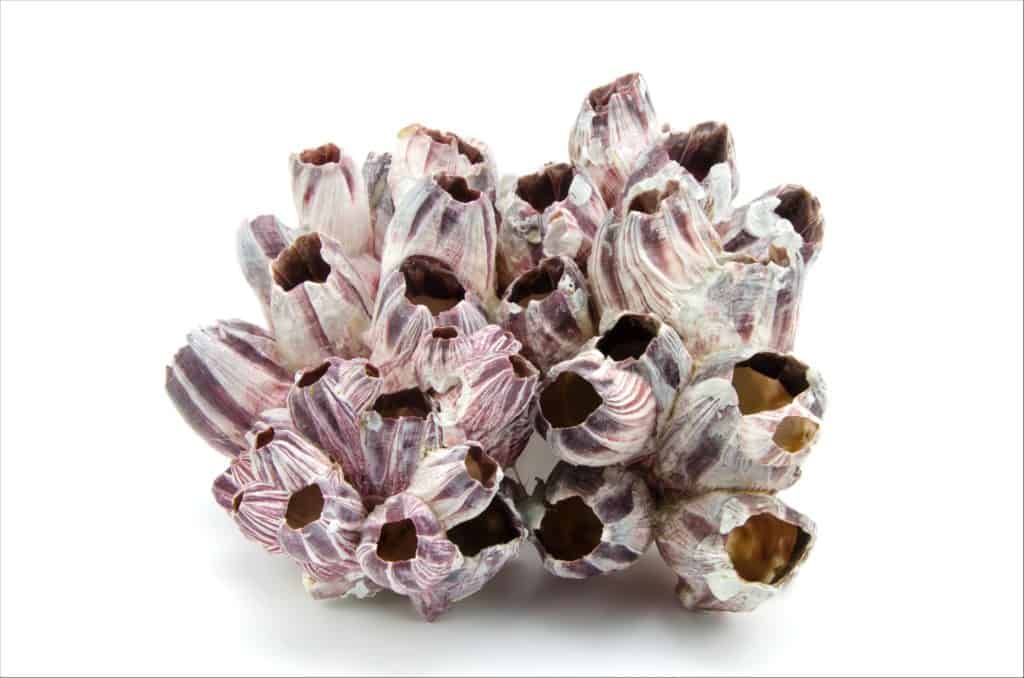
Gooseneck barnacles are edible and have a fleshy stem.

Reproduction, Babies, and Lifespan

Barnacles are hermaphroditic but cannot reproduce by self-fertilization and need to settle with other barnacles to reproduce as well as to be near food sources. When ready to reproduce, one barnacle becomes receptive to the other’s gametes, which has a very long penis it extends 6 to 8 inches.

The life cycle of a new barnacle starts with the egg, two larval stages, and then juvenile onto full adulthood. The barnacle has a mantle cavity into which it gestates hundreds of eggs at a time, and up to 6 broods a year. The eggs spend winter inside the sac and hatch into baby barnacles, called larvae. The first larval stage is called Nauplius and involves free-swimming for 6 months, after which the larva transforms into the second larval stage, Cyprid, which lasts anywhere from a few days to a few weeks. During this time, the cyprid searches for a suitable surface to attach to. It then secretes a sticky glue from the cement gland on the bottom of its antennae, begins producing a hard outer shell, and transforms into a juvenile adult. Barnacles are sexually mature at two years.

The lifespan of a barnacle depends on its species. Its lifespan can be anywhere from 18 months to 10 years or more, but the average is 5 to 10 years.
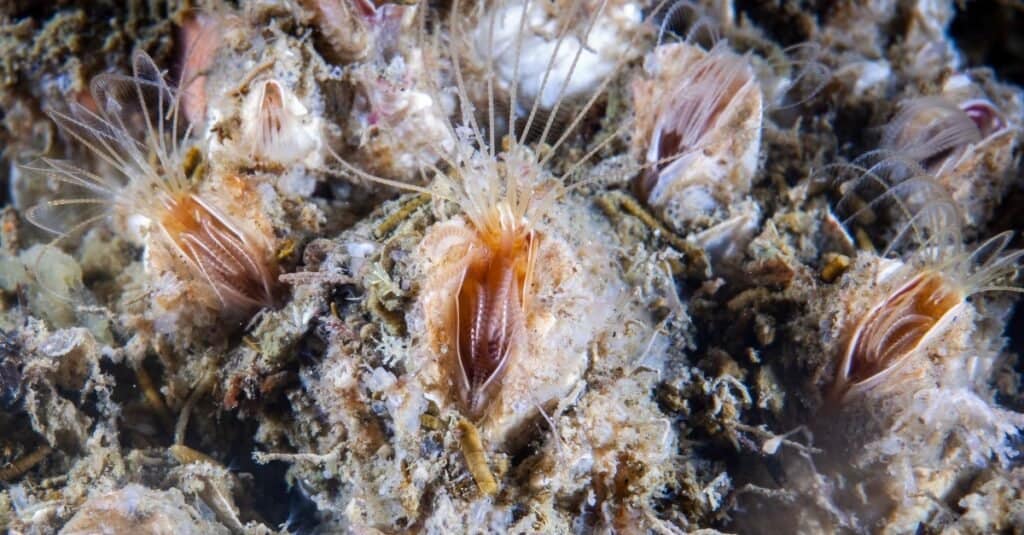
Barnacles feeding underwater in the St. Lawrence River in Canada

The life cycle of a new barnacle starts with the egg, two larval stages, and then the juvenile into full adulthood.

Population

Barnacles do not move once they attach to a surface or a host, so they are especially vulnerable to their environment. Certain barnacle species are threatened, endangered, or nationally endangered. One threat is coastal pollution from the dumping of garbage, plastics, industrial runoff, chemical spills, sewage, and animal agriculture. Other threats are mangrove forest clearing and deep-sea trawling for scraping underwater mountain ranges, which result in habitat loss for them.

View all 453 animals that start with B
How to say Barnacle in ...
Catalan
Cirrípede
German
Rankenfußkrebse
English
Barnacle
Spanish
Cirripedia
Finnish
Siimajalkaiset
French
Cirripedia
Hebrew
זיפרגליים
Italian
Cirripedia
Dutch
Rankpootkreeften
English
Rankeføttinger
Polish
Wąsonogi
Portuguese
Cirripedia
Swedish
Rankfotingar

Sources

  1. Wikipedia / Accessed September 8, 2021
  2. Florida Museum / Accessed September 8, 2021
  3. Reference / Accessed September 8, 2021
  4. National Ocean Service / Accessed September 8, 2021
  5. Jupiter Research Foundation / Accessed September 8, 2021
  6. World Animal Foundation / Accessed September 8, 2021
  7. Outside Type / Accessed September 8, 2021
  8. NOAA / Accessed September 8, 2021
Heather Ross

About the Author

Heather Ross

Heather Ross is a secondary English teacher and mother of 2 humans, 2 tuxedo cats, and a golden doodle. In between taking the kids to soccer practice and grading papers, she enjoys reading and writing about all the animals!

Thank you for reading! Have some feedback for us?


Barnacle FAQs (Frequently Asked Questions)

Barnacles are Omnivores, meaning they eat both plants and other animals.