B
Species Profile

Bird of Paradise

Paradisaeidae

Nature's greatest courtship show
Wisnu Yudowibowo/Shutterstock.com

Bird of Paradise Distribution

Click a location to explore more animals from that region

Endemic Species
Loading map...
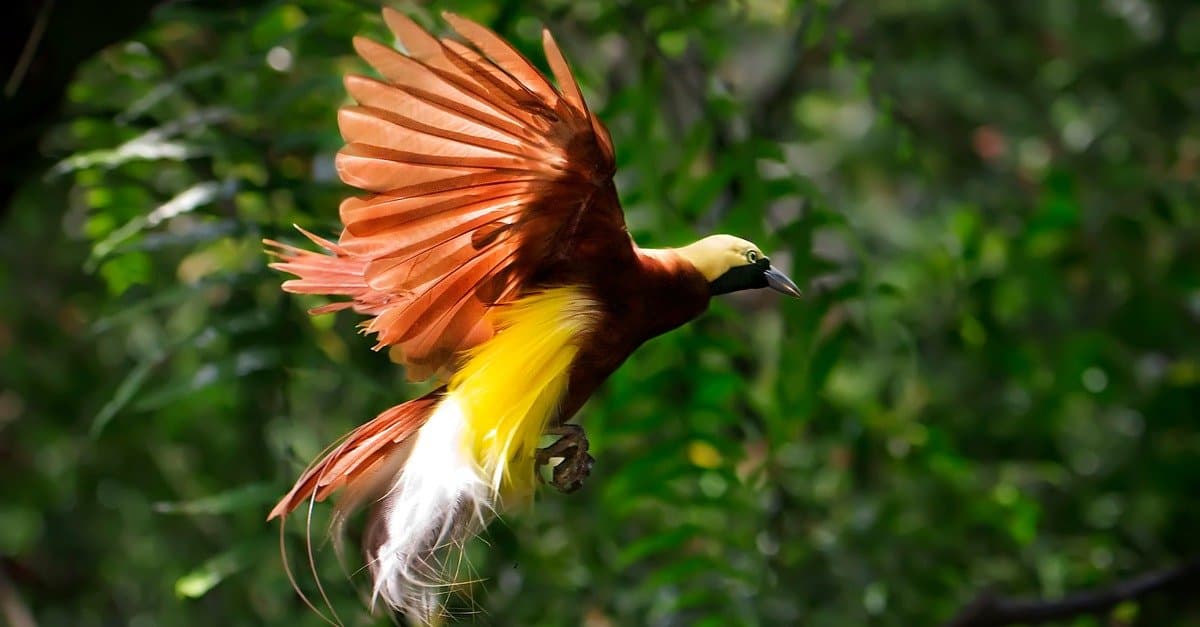
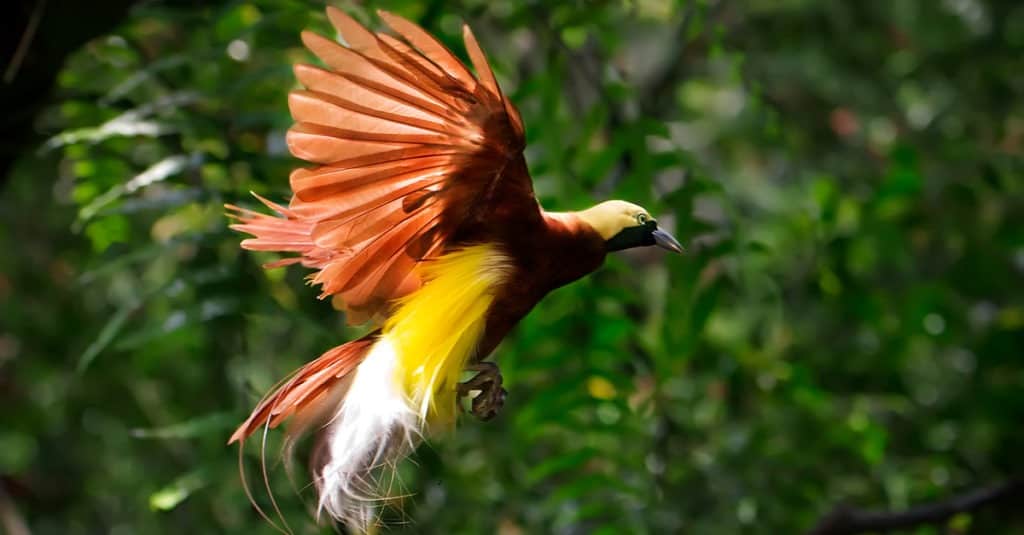
A cendrawasih - the bird of paradise

At a Glance

Family Overview This page covers the Bird of Paradise family as a group. Stats below are general traits shared across the family.
Also Known As Bird of paradise, Paradise bird, Paradise birds, Cenderawasih, Cendrawasih
Diet Omnivore
Activity Diurnal+
Lifespan 8 years
Weight 0.45 lbs
Status Not Evaluated
Did You Know?

The family is centered on New Guinea, with only a few species extending to nearby islands and northeastern Australia.

Scientific Classification

Family Overview "Bird of Paradise" is not a single species but represents an entire family containing multiple species.

Birds-of-paradise (family Paradisaeidae) are passerine birds famed for extreme sexual dimorphism and elaborate male courtship displays, including specialized plumes, iridescent feathers, dance routines, and vocalizations. They are primarily frugivorous/insectivorous forest birds.

Kingdom
Animalia
Phylum
Chordata
Class
Aves
Order
Passeriformes
Family
Paradisaeidae

Distinguishing Features

  • Males often have highly ornamental feathers (plumes, wires, flank fans) and strong iridescence
  • Complex courtship behaviors (dances, poses, acoustic signals), sometimes in leks
  • Sexual dimorphism: females typically more cryptic brown/olive for camouflage
  • Predominantly forest-dwelling passerines with fruit- and insect-based diets

Physical Measurements

Males and females differ in size

Length
12 in (6 in – 3 ft 7 in)
12 in (6 in – 1 ft 5 in)
Weight
0 lbs (0 lbs – 1 lbs)
Tail Length
8 in (1 in – 3 ft 3 in)
5 in (2 in – 12 in)
Top Speed
37 mph

Appearance

Skin Type Birds-of-paradise (Paradisaeidae) are fully feathered passerines with keratin beaks and scaly legs. Many males have fancy feathers and sometimes bare colored facial or throat skin or wattles used in displays.
Distinctive Features
  • Size range (smallest to largest within family): approximately 15-110 cm total length depending on tail/ornamental streamers; body mass roughly ~0.05-0.43 kg (tails and plumes can greatly increase apparent length without proportional mass).
  • Overall silhouette varies markedly: from relatively 'typical' forest passerine shapes to dramatically altered outlines created by elongated tail wires, ribbon-like rectrices, flank plumes, or cape/mantle feathers.
  • Structural/iridescent coloration is common in males: color can shift with viewing angle (blue/green/purple/gold effects), often paired with light-absorbing velvety black that increases contrast in displays.
  • Feather specializations are central: elongated plumes, filamentous 'wires,' breast shields, head crests, and textured feather surfaces adapted for courtship signaling.
  • Many species show conspicuous display postures and choreography (e.g., bowing, wing-snapping, head-down inversions, plume fanning), but the exact display repertoire is highly variable across genera.
  • Range-wide ecology generalization: predominantly New Guinea-centered (including nearby islands) with a minority extending into NE Australia; mostly rainforest and montane forest birds, with some occupying hill forests, edges, or secondary growth.
  • Diet generalization: primarily frugivorous with varying insect/arthropod supplementation; degree of insectivory vs. frugivory differs by species and habitat/season.
  • Birds-of-paradise (Paradisaeidae) usually live about 5–15 years in the wild. Some may reach 20+ years in good conditions or captivity; exact lifespan varies by species.
  • Strong sexual selection: many species are polygynous and lek—males display while females choose—others are more spread out; nesting is often done by females alone, and mating systems vary.
  • Vocal and mechanical sounds are common components of displays (calls, clicks, wing/feather noises), but the prominence and type of sound signals differ substantially among species.

Sexual Dimorphism

Extreme sexual dimorphism is common in Paradisaeidae, driven by mating choice. Males often have much brighter, shiny colors, long showy feathers, and complex courtship dances; females are duller for nesting. Dimorphism and display styles (leks to spread-out) vary.

  • Bright, high-contrast or iridescent plumage is common (often black plus vivid yellow/red/orange or blue/green/purple structural sheen).
  • Specialized ornamental feathers: elongated flank plumes, cape/mantle feathers, breast shields, tail wires/ribbons/streamers, head crests; in some species these create a radically altered display silhouette.
  • Velvety black feathering in some taxa that enhances visual contrast and absorbs light during display.
  • Courtship adaptations: highly stylized dance routines and postures; some species prepare display courts/perches; vocal/mechanical sound production may be emphasized.
  • Occasional bare colored facial/throat skin or wattles used as display signals (presence and form vary).
  • Generally cryptic plumage (brown/tan/cream with spotting, mottling, or fine barring) aiding concealment in rainforest nesting contexts.
  • More conservative feather structure (typically lacking the extreme ornamental plumes/wires seen in males).
  • Subtler coloration and reduced iridescence compared to males, though some species may show limited sheen or mild contrast.
  • Morphology typically optimized for nesting and foraging rather than display (family-level trend; exceptions exist).

Did You Know?

The family is centered on New Guinea, with only a few species extending to nearby islands and northeastern Australia.

Size varies widely: roughly ~15-43 cm body length across species, but total length can exceed ~1 m in species with extremely elongated ornamental tail feathers.

Many species are strongly sexually dimorphic-males may be vividly colored with specialized plumes while females are typically camouflaged brown for nesting safety.

Courtship strategies differ across the family: some males display alone on "courts," others use leks, and some species pair more consistently than the classic "polygynous showman" stereotype.

Most birds-of-paradise are primarily frugivorous but commonly supplement with insects and other arthropods-making many of them important seed dispersers in rainforest ecosystems.

Early European trade skins were often prepared without feet, helping spark the old "birds from Paradise" legend that gave the group its enduring name.

Their diversity includes radically different "performance styles": bouncing dances, hanging upside-down displays, wing-snapping sounds, and optical "shape-shifting" effects from iridescent feathers.

Unique Adaptations

  • Extreme ornamental feathers: specialized plumes (wires, fans, capes, filaments) and elongated tails that function primarily in sexual selection rather than flight efficiency.
  • Structural colors and "optical effects": microstructures in feathers produce intense iridescence and, in some species, unusually dark velvety blacks that heighten contrast during displays.
  • Behavioral choreography: highly stereotyped dances and pose sequences that precisely present ornaments to a female's viewing angle.
  • Sound adaptations: some species use calls plus non-vocal sounds (snaps, rustles) generated by wings or modified feathers as part of the display repertoire.
  • Camouflage and nesting ecology in females: generally subdued female plumage is an adaptation for concealment during nesting in dense forest environments.

Interesting Behaviors

  • Display courts and stage-cleaning: in several species, males maintain and tidy a specific perch or patch of forest floor used as a display arena.
  • Lek and dispersed-lek mating: some species gather in traditional display areas where females visit to choose mates, while others perform at spaced-out calling perches.
  • Multi-sensory courtship: displays often combine dance steps, rapid posture changes, precisely angled iridescence, and distinctive calls or mechanical sounds (e.g., wing or feather-produced noises).
  • Female-led nesting: in many species, females build the nest, incubate, and rear young with little or no male help-though the degree of pair-bonding and male contribution varies among lineages (e.g., manucode-type strategies tend to be less extreme).
  • Flexible foraging: many switch between fruiting trees and insect-rich microhabitats (bark, leaf litter, epiphytes), with variation by elevation and habitat.
  • Altitudinal and habitat variation: across the family, species occupy lowland rainforest, swamp forest, hill forest, and montane cloud forest, sometimes shifting seasonally with food availability.

Cultural Significance

Birds-of-paradise (Paradisaeidae) are central in New Guinea cultures, where their feathers are used in ceremonial dress to show identity, status, or clan. Abroad they became symbols of exotic wonder and influenced ideas about mating; the plume trade helped spur early bird-protection movements.

Myths & Legends

"Bird of the Gods" trade lore: In Malay-Indonesian trade lore, birds-of-paradise were associated with a heavenly origin, often described in English as "bird of the gods."

Story of 'footless birds from Paradise': Early European naturalists got prepared skins missing feet and sometimes wings. This made a Renaissance belief that birds-of-paradise never landed and came from Paradise.

Courtly wonder and rarity tales: In early modern Europe, birds-of-paradise were displayed as marvels in cabinets of curiosity and royal collections, where embellished stories about their otherworldly lives circulated alongside the prized specimens.

In Papua New Guinea, the bird-of-paradise (Paradisaeidae) is a national symbol of identity and pride, seen as the land's spirit and built on older local respect for its showy plumes in ceremony.

Conservation Status

NE Not Evaluated (family-level hub; IUCN primarily assesses species)

Has not yet been evaluated against the criteria.

Population Unknown

Protected Under

  • Many species occur within national parks, wildlife management areas, and other protected areas across Papua New Guinea and Indonesian Papua; effectiveness varies by site and enforcement capacity.
  • Trade is regulated for birds-of-paradise under international and national frameworks (commonly via CITES listings and domestic wildlife laws), though coverage and enforcement can differ among jurisdictions and taxa.
  • Community-based customary land management and locally enforced hunting restrictions are important in parts of New Guinea and can be protective where maintained.

You might be looking for:

Greater bird-of-paradise

20%

Paradisaea apoda

Large Paradisaea species with ornate flank plumes; iconic of the family.

Raggiana bird-of-paradise

18%

Paradisaea raggiana

Bright red/orange plumes; national bird of Papua New Guinea.

Wilson's bird-of-paradise

16%

Cicinnurus respublica

Small, extremely colorful species with elaborate display and a bald blue crown patch.

Superb bird-of-paradise

16%

Lophorina superba

Famous for transforming into a black-and-iridescent "oval" during courtship display.

King bird-of-paradise

15%

Cicinnurus regius

Small species with vivid red plumage and distinctive wire-like tail ornaments.

Twelve-wired bird-of-paradise

15%

Seleucidis melanoleucus

Noted for 12 wire-like flank plumes used in display.

Life Cycle

Birth 1 chick
Lifespan 8 years

Lifespan

In the Wild
4–25 years
In Captivity
8–30 years

Reproduction

Mating System Polygyny
Social Structure Lek Breeding
Breeding Pattern Transient
Fertilization Internal Fertilization
Birth Type Internal_fertilization

Birds of paradise (Paradisaeidae) are mostly polygynous, where one male mates with many females. Males display to attract mates and usually give little or no care. Lek breeding is common; females usually build nests and raise young alone.

Behavior & Ecology

Social Flock Group: 3
Activity Diurnal, Crepuscular
Diet Omnivore Figs and other soft, fleshy rainforest fruits (often a staple across many species, but degree of reliance varies).

Temperament

Often wary, secretive, and forest-interior oriented away from display sites; individuals may remain hard to detect despite bright male plumage.
Strongly display- and competition-driven in breeding males; many species show pronounced territoriality or site fidelity around display perches/courts, especially in lekking systems.
Females are typically more cryptic and risk-averse, prioritizing nest placement and predator avoidance; maternal investment is commonly high where males provide little care.
Social tolerance varies with context: low at display courts (aggression/chases common) but higher at abundant fruiting resources where temporary co-feeding occurs.
Family-level ecological generalization with explicit variation: most are primarily frugivorous with insect/arthropod supplementation; proportions vary by species, season, and elevation. Habitat use spans lowland to montane forests, which can shift daily ranging and encounter rates.
Birds of paradise (Paradisaeidae) range from about 15–110 cm long (some males have long plumes), weigh about 0.05–0.45 kg, and live roughly 5–20+ years in the wild.

Communication

Loud advertising calls used to attract females and/or maintain spacing among males at display sites; often repeated, far-carrying notes in forest habitats.
Complex songs, whistles, and variable call repertoires; some species incorporate harsh squawks, buzzes, or chattering sequences.
Contact calls between mates or between females and dependent young; alarm calls given in response to predators or disturbance.
In some taxa, mimicry or learned elements may occur, with local dialect-like variation at leks reported in certain species Variation across species and populations is substantial
Elaborate visual courtship displays: dances, hopping, pendulum movements, inverted postures, and precise orientation to light to maximize iridescence; display choreography varies widely among genera E.g., ground-court vs perch displays
Plumage and morphological signaling: erectile capes, flank plumes, tail wires, and iridescent breast/shield structures are presented in ritualized sequences; extreme sexual dimorphism is common but not universal.
Postural and spatial signaling: court ownership, perch selection, and threat postures communicate dominance; chases and displacement are frequent at busy leks.
Mechanical/non-vocal sounds in some species (e.g., wing snaps, feather rustles) produced during rapid movements; importance varies by species.
Nest-site and maternal signaling: females use concealment and quiet behavior at nests; subtle cues and soft calls coordinate with fledglings in dense vegetation.

Habitat

Biomes:
Tropical Rainforest Tropical Dry Forest Wetland
Terrain:
Mountainous Hilly Plateau Plains Valley Coastal Island Riverine +2
Elevation: Up to 11811 ft

Ecological Role

Primarily frugivore-insectivore rainforest birds that link plant reproduction and arthropod dynamics across New Guinea and adjacent regions.

Seed dispersal for many fleshy-fruited rainforest plants (including long-distance dispersal in canopy networks) Support of forest regeneration and plant community turnover via dispersal of viable seeds Insect and arthropod population regulation through predation (especially during breeding/provisioning) Occasional minor pollination/flower visitation where nectar or flowers are taken (variable and generally secondary to fruit/insect roles)

Diet Details

Main Prey:
Insects Other arthropods Small invertebrates Small vertebrates
Other Foods:
Fleshy fruits Berries and drupes Arils and fruit pulp Nectar and flowers Seeds

Human Interaction

Domestication Status

Wild

Birds of paradise (Paradisaeidae) are wild birds from New Guinea, nearby islands, and parts of Australia. They were never domesticated. People hunted and traded their plumes, used them in Indigenous ceremonies, and collected them for science. Today work centers on conservation, ecotourism, and limited zoo breeding, while habitat loss is a major threat.

Danger Level

Low
  • Minor injuries from handling (pecking, scratches, wing-flapping)
  • Allergic reactions to feathers/dander in some individuals
  • Zoonotic disease risk typical of wild birds if handled improperly (e.g., salmonellosis/psittacosis-like syndromes are general avian concerns, though birds-of-paradise are not uniquely implicated)
  • Fieldwork hazards indirectly associated with encounters (remote terrain, canopy work, hunting conflicts), rather than direct aggression from the birds

As a Pet

Not Suitable as Pet

Legality: Birds-of-paradise (Paradisaeidae) are usually illegal or not kept as pets. Many species are protected by national laws and CITES, so owning, trading, or importing often needs strict permits or is banned.

Care Level: Expert Only

Purchase Cost:
Lifetime Cost: $20,000 - $250,000

Economic Value

Uses:
Ecotourism and birdwatching (local guiding, lodging, protected-area revenue) Cultural value (traditional ceremonial use of certain plumes in parts of New Guinea) Scientific/research value (evolution, sexual selection, behavior, acoustics) Conservation funding and NGO/program value Historical and illegal wildlife trade pressures (now widely restricted)
Products:
  • Non-consumptive wildlife-viewing experiences (guided tours, park fees)
  • Cultural/ceremonial adornments using naturally molted feathers or traditionally sourced plumes (practice varies by community and legality)
  • Educational media, documentaries, photography
  • (Historical) skins and plumes for fashion; (illegal) occasional trade in feathers/specimens

Relationships

Predators 7

New Guinea eagle Harpyopsis novaeguineae
Variable goshawk Accipiter hiogaster
Papuan hawk-owl Ninox theomacha
Amethystine python
Amethystine python Simalia amethistina
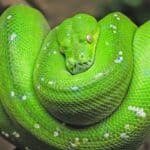
Green tree python
Green tree python Morelia viridis
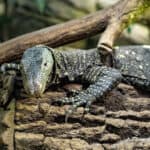
Crocodile monitor
Crocodile monitor Varanus salvadorii
New Guinea quoll Dasyurus albopunctatus

Related Species 4

Bowerbirds Ptilonorhynchidae Shared Order
Crows and ravens
Crows and ravens Corvus Shared Order
Monarch flycatchers
Monarch flycatchers Monarchidae Shared Order
Drongos Dicruridae Shared Order

Ecological Equivalents 4

Animals that fill a similar ecological role in their ecosystem

Satin bowerbird Ptilonorhynchus violaceus Similar courtship ecology: strong sexual selection with elaborate male displays and display sites (bowers vs. leks/courting perches), and females choosing mates based on performance and ornamentation.
Golden-headed manakin Ceratopipra erythrocephala Convergent lek-like mating systems and coordinated, ritualized male displays; although found in the Neotropics, it shows similar sexual-selection-driven behaviors.
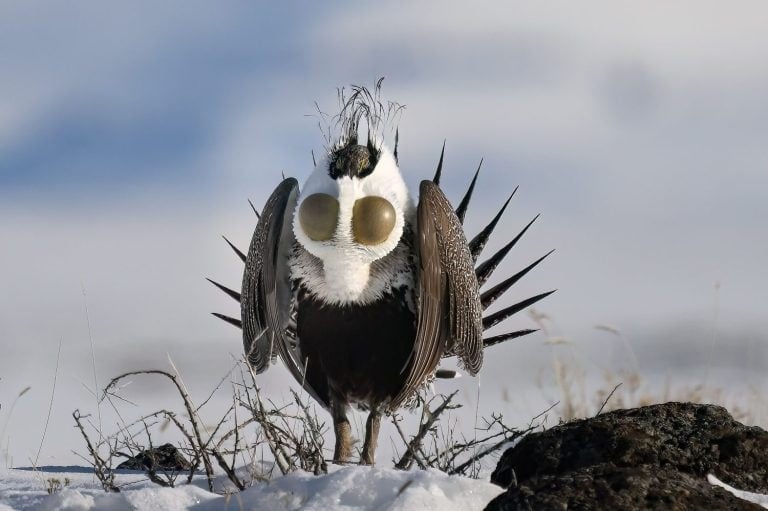
Greater sage-grouse Centrocercus urophasianus Classic lekking bird in which males aggregate and display to choosy females. Occupies an ecologically different habitat but shares a similar mating-system structure and selection pressures.
Sunbirds Nectariniidae Occupy overlapping forest-edge and canopy niches in parts of Australasia, with a strong reliance on plant resources such as fruit and nectar and supplemental insect prey. Not behaviorally identical, but comparable small-to-medium arboreal foragers, with conspicuous male plumage in many species.

Types of Bird of Paradise

44

Explore 44 recognized types of bird of paradise

Glossy manucode Manucodia ater
Crinkle-collared manucode Manucodia chalybatus
Trumpet manucode Manucodia buceroides
Curl-crested manucode Manucodia comrii
Trumpet manucode (trumpet birds-of-paradise) Phonygammus keraudrenii
Paradise-crow Lycocorax pyrrhopterus
Obi paradise-crow Lycocorax obiensis
Long-tailed paradigalla Paradigalla carunculata
Short-tailed paradigalla Paradigalla brevicauda
Splendid astrapia Astrapia splendidissima
Princess Stephanie's astrapia Astrapia stephaniae
Ribbon-tailed astrapia Astrapia mayeri
Huon astrapia Astrapia rothschildi
Arfak astrapia Astrapia nigra
Golden-tailed astrapia Astrapia inaurata
Black sicklebill Epimachus fastosus
Brown sicklebill Epimachus meyeri
Pale-billed sicklebill Drepanornis bruijnii
Black-billed sicklebill Drepanornis albertisi
Magnificent riflebird Ptiloris magnificus
Victoria's riflebird Ptiloris victoriae
King riflebird Ptiloris paradiseus
Growling riflebird Ptiloris intercedens
Western parotia Parotia sefilata
Lawes's parotia Parotia lawesii
Queen Carola's parotia Parotia carolae
Eastern parotia Parotia helenae
Six-plumed bird-of-paradise Parotia sexpennis
Wahnes's parotia Parotia wahnesi
Superb bird-of-paradise Lophorina superba
King bird-of-paradise Cicinnurus regius
Wilson's bird-of-paradise Cicinnurus respublica
Magnificent bird-of-paradise Diphyllodes magnificus
Greater bird-of-paradise Paradisaea apoda
Lesser bird-of-paradise Paradisaea minor
Raggiana bird-of-paradise Paradisaea raggiana
Red bird-of-paradise Paradisaea rubra
Golden bird-of-paradise Paradisaea decora
Emperor bird-of-paradise Paradisaea guilielmi
Blue bird-of-paradise Paradisaea rudolphi
Twelve-wired bird-of-paradise Seleucidis melanoleucus
Wallace's standardwing Semioptera wallacii
King-of-Saxony bird-of-paradise Pteridophora alberti
Lobed bird-of-paradise Loboparadisea sericea

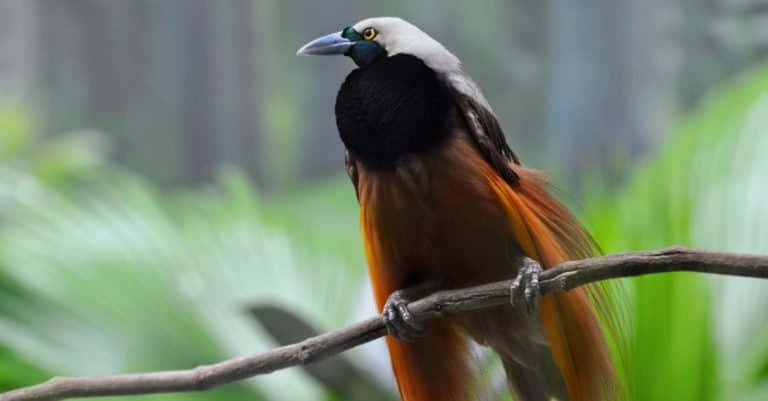
The bird of paradise (also spelled bird-of-paradise) lives in tropical forests in Australia and the surrounding islands. Most types are sexually dimorphic, meaning the males and females differ in appearance. While the females have muted colors and short feathers, the males sport long, brightly colored feathers streaming from their heads, beaks, wings, or tails. They use their elaborate feathers in spectacular mating dances designed to attract the attention of a female.

These birds are not just one species. In fact, around 45 distinct types have been identified.

3 Amazing Facts

  • Males take a long time to mature. It may take up to seven years for them to gain their adult plumage.
  • These birds are important to their habitat as seed distributors. They do not digest the seeds in the fruit they eat.
  • When specimens were first brought to Europe during the 1500s, some people thought the Bird of Paradise was the phoenix of myth. In a native language, they were called “birds of God,” and that is from where the name “bird of paradise” was derived.

Habitat

Birds of paradise are found in the tropical forests of New Guinea, eastern Indonesia, and northern Australia. Their habitats include lowland rainforests and mountain cloud forests ranging from sea level to an elevation of 13,500 feet. These birds prefer dense vegetation where they can find food sources such as fruit and insects. The nests of birds of paradise are usually cup-shaped or pendant structures made out of twigs, leaves, mosses, roots, vines, grasses, and lichens, which are woven together by the bird’s beak. They typically build their nests high up in trees near freshwater sources for easy access to both shelter and food resources.

These birds are elusive and can be hard to spot in the wild. Travelers are also discouraged from visiting parts of their range. However, the Port Moresby Nature Park and Adventure Park PNG in Port Moresby, Papua New Guinea, are easily accessible zoos that have fine collections of various species. Each park has a walk-through aviary where you can view the animals up close as they feed on fruits and fly around their rainforest habitat.
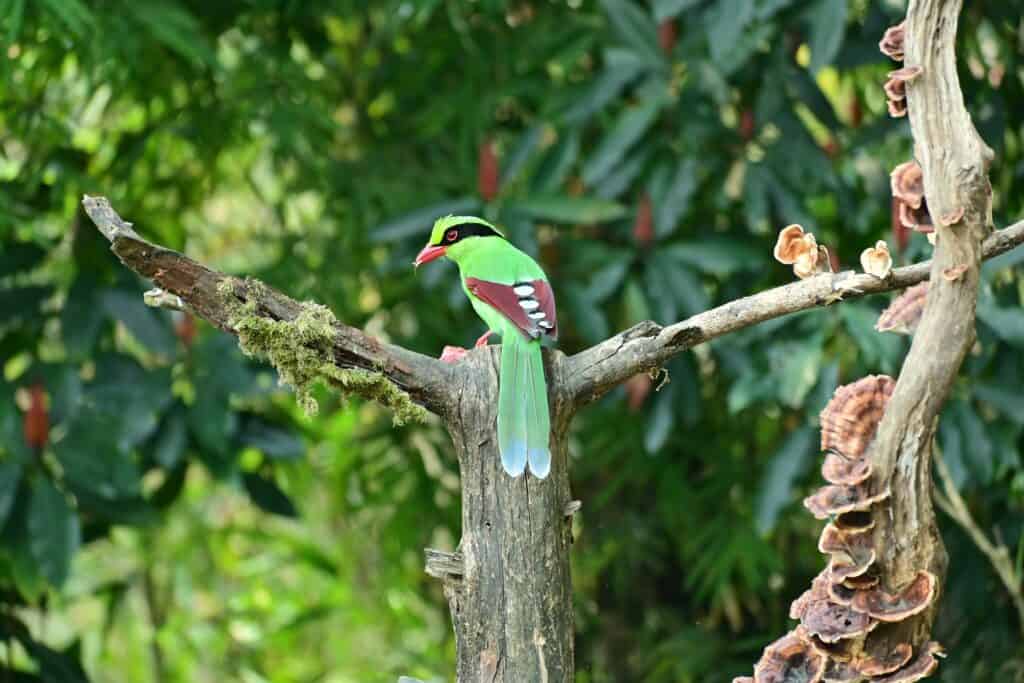
common green magpie

Some species of birds of paradise are in danger of extinction.

Classification and Scientific Name

These birds are in the family Paradisaeidae, Superfamily Corvoidea, and the order Passeriformes. Their class is Aves (birds), their phylum Chordata, and their kingdom Animalia. There are around 45 species divided between 15 genera — Lycocorax, Ptiloris, Manucodia, Epimachus, Phonygamus, Paradigalla, Astrapia, Parotia, Pteriophora, Lophorina, Paradisornis, Paradisaea, Seleucidis, Semioptera, and Drepanornis.

Evolution
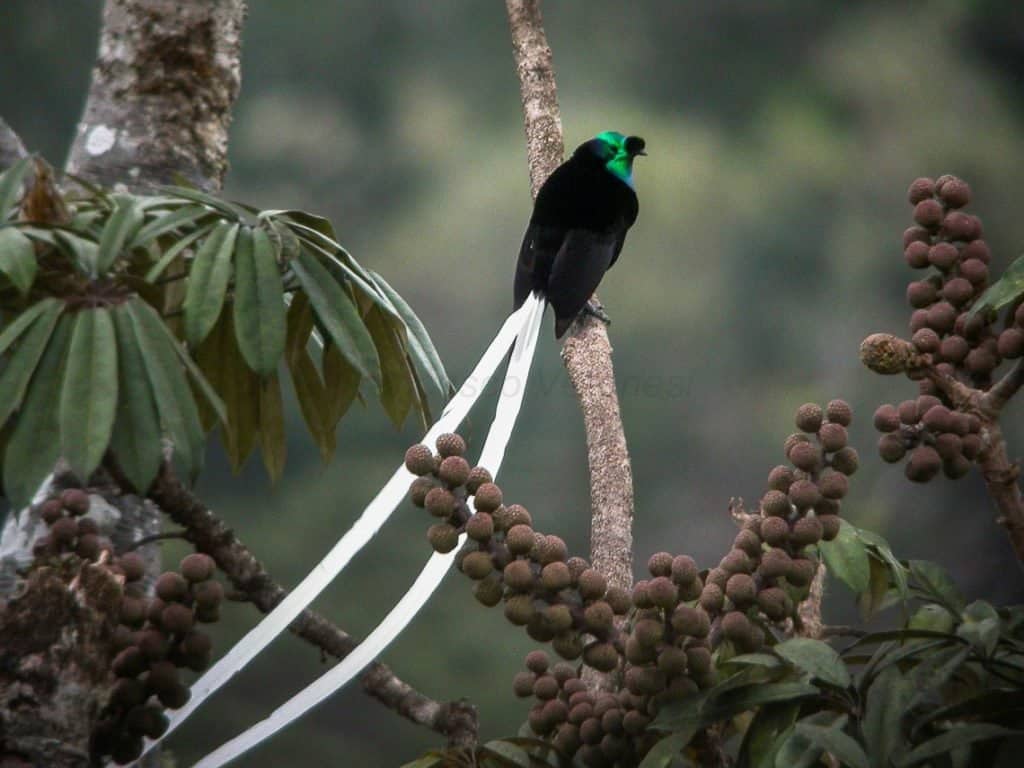
Longest Tail _The Ribbon-Tailed Astrapia

One of the most beautiful birds of paradise is the Ribbon-tailed Astrapia. It is believed they evolved over 25 million years ago.

The evolutionary history of birds of paradise is an intriguing one. It is believed that they evolved in the Australasian region some 20 to 25 million years ago and are closely related to bowerbirds and mannikins. Scientists believe that these birds first developed their extravagant plumage as a result of sexual selection; having more elaborate feathers became linked with better mating success for both males and females. As time went on, this process led to increased diversity in feather coloration and patterning among different species.

The remarkable coloring and courtship displays found among birds of paradise remain one of nature’s most impressive spectacles, making them a favorite subject for study by ornithologists everywhere.

Size, Appearance, & Behavior

The smallest is the king bird-of-paradise, which weighs 1.8 oz (50g) and is less than 6 inches (15 cm) in length. The largest is the curl-crested manucode, which weighs 15 oz (430g) and is 17 inches (44 cm) in length — more than three times the size of its smaller cousin. The black sicklebill has the longest tail — from beak to tip-of-tail, it is 43 inches (110 cm).

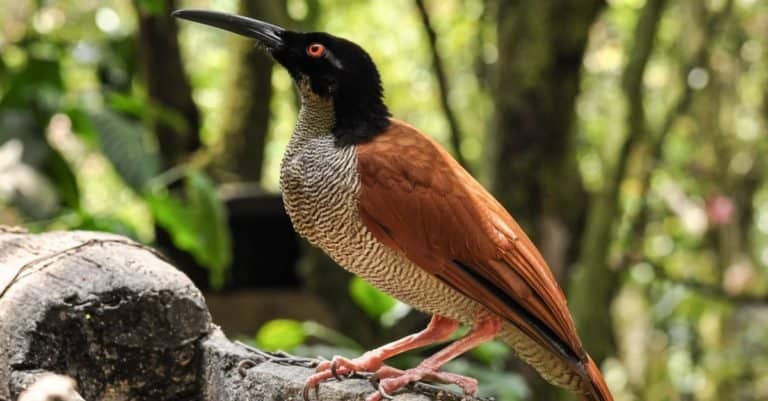
Males have brighter and longer feathers than females. Females bear drab colors, usually green, black, or brown. Some have long, thin, curved beaks. Generally, females of the species have bigger beaks.

These birds exhibit some of the most interesting and entertaining behaviors of any bird. Males go to great lengths to attract the attention of females. They will often clear a “dance floor” — a branch or a patch of ground — by removing all leaves, twigs, and debris. Then, the real show begins. Depending on the species, males may hold their wings and tails at odd angles, puff out their chests, and dance rhythmically.
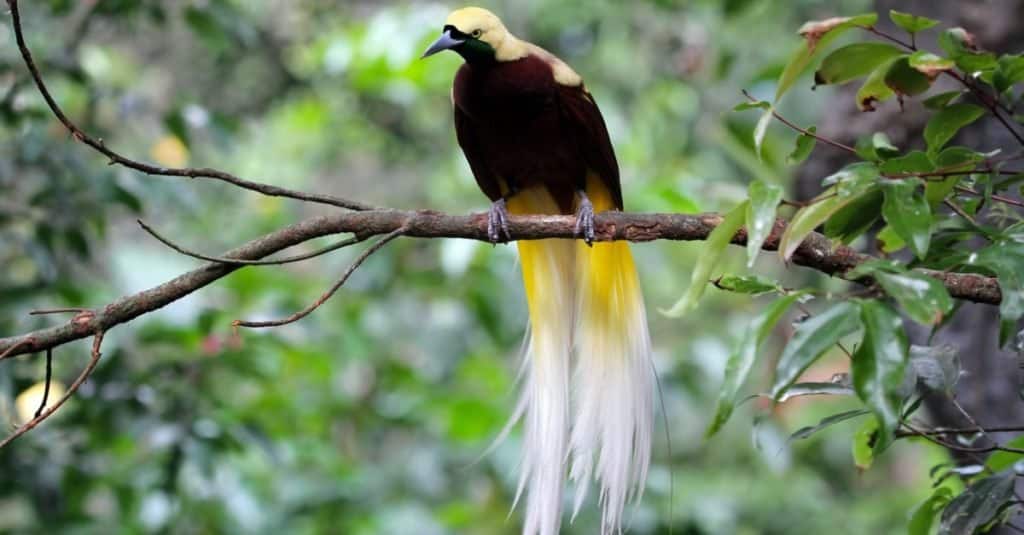
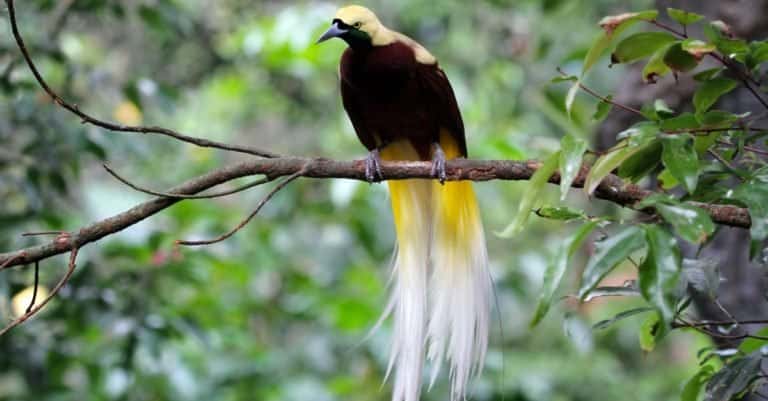
Beautiful bird of paradise sitting on a branch.

The bird of paradise with the largest tail is the black sicklebill with a 43-inch-long tail.

Diet

Birds of paradise, found in the tropical forests of New Guinea and Australia, have a varied diet depending on the species. Generally speaking, they feed mainly on fruit, small insects such as beetles or flies, spiders, and other arthropods. Some species also consume nectar from flowers and are important pollinators for certain plants. During their breeding season, they may switch to proteins like grubs or caterpillars that provide much-needed energy for egg production. They usually search for food in trees or low bushes. Some even hunt at night when nocturnal insects are most active. Although birds of paradise eat both plant and animal matter, their diets tend to be mainly frugivorous, except when there is a lack of available fruits during certain times of the year.

Predators and Threats

The birds of paradise have many predators, including cats, owls, hawks, snakes, rats, and dogs. In addition to these natural predators, the birds of paradise face threats from human activity. One of the main threats is habitat destruction due to deforestation for logging or agricultural purposes. Other threats include pollution and hunting for their feathers and skins. Birds of paradise are also sometimes killed by collisions with buildings or power lines when they migrate to overdeveloped areas. Climate change has been linked to changes in their habitats, which can further threaten their survival as well as decrease food availability.

Reproduction, Babies, and Lifespan
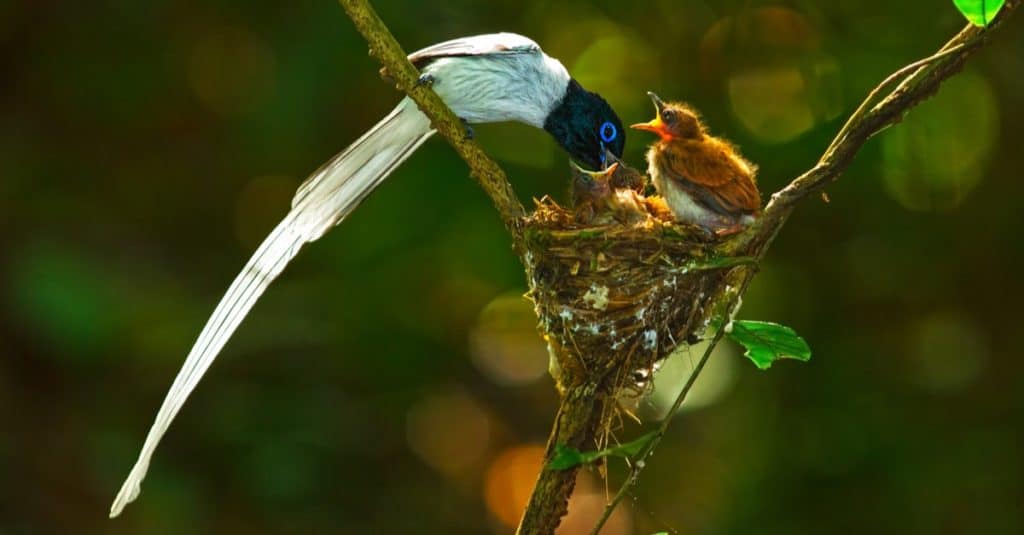
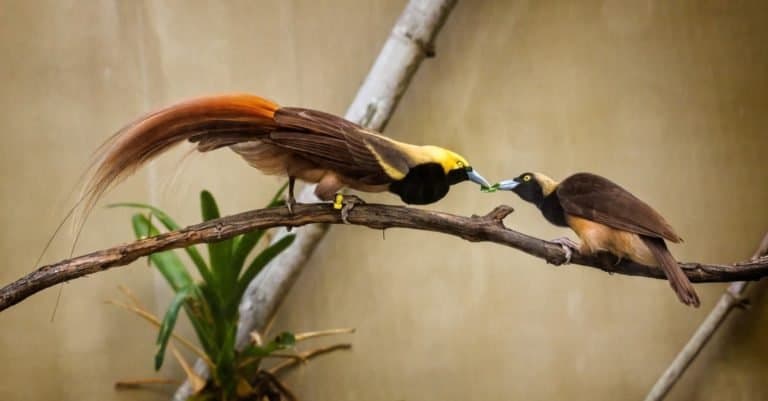
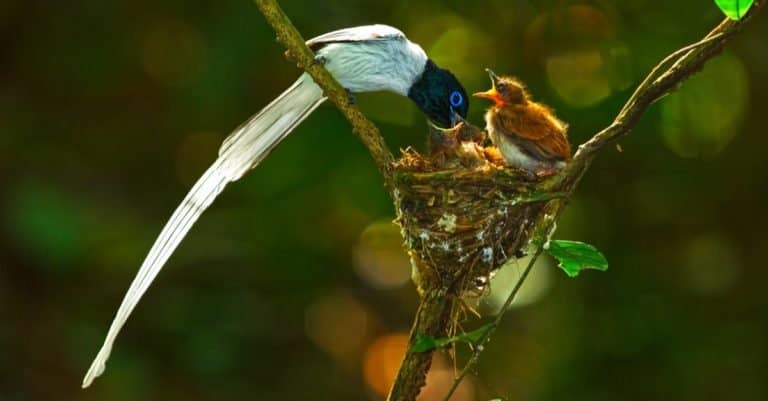
Asian bird of paradise male feeding baby birds.

Asian bird of paradise males help to feed the baby birds.

As already noted, these birds are noted for their elaborate mating dances. Once a female chooses the male with the best dance moves as her mate, she builds a nest and lays one to two eggs. She raises the chicks without assistance from the male.

Some species are monogamous, meaning they mate for life. Others engage in lekking. This means that groups of males display and dance together. The watching female then chooses her favorite from the group. She may mate with a different male each nesting season.

Sometimes, when territories overlap, hybridization occurs as species interbreed. This introduces even more variations in appearance.

The lifespan is five to eight years.

Population and Conservation

The number of these elusive birds is unknown. Some scientists claim there are fewer than 10,000 greater birds of paradise remaining on earth.

The conservation status of birds of paradise varies greatly depending on the species. Some species, such as the Wilson’s Bird-of-Paradise, are listed as Near Threatened and have decreasing population numbers due to deforestation in their habitats. Others, such as the King of Saxony bird-of-paradise, are currently classified as Least Concern, although their populations have been reduced by habitat loss and hunting for feathers. The greater bird-of-paradise is also considered Least Concern. Other species, like the red bird of paradise, are listed as Near Threatened. Conservation efforts must continue to protect these birds so that future generations can enjoy these magnificent creatures.

View all 453 animals that start with B
How to say Bird of Paradise in ...
Bulgarian
Райска птица
Danish
Paradisfugl
German
Paradiesvögel
English
Birds of Paradise
Esperanto
Paradizeedoj
Spanish
Paradisaeidae
Finnish
Paratiisilinnut
French
Paradisaeini
Hebrew
עדניים
Croatian
Rajske ptice
Hungarian
Paradicsommadár-félék
Indonesian
Burung-burung Cendrawasih
Italian
Paradisaeidae
Japanese
フウチョウ族 (Sibley)
Malay
Burung Cenderawasih
Dutch
Paradijsvogels
Polish
Cudowronki
Portuguese
Ave-do-paraíso
Swedish
Paradisfåglar
Vietnamese
Họ Chim thiên đường
Chinese
极乐鸟

Sources

  1. Britannica / Accessed May 31, 2021
  2. Wikipedia / Accessed May 31, 2021
  3. Beehler, Bruce M., Thane K. Pratt, and Dale A. Zimmerman, Princeton University Press Birds of New Guinea / Accessed May 31, 2021
  4. Burnie, David, and Don E. Wilson, eds., DK Publishing Animal: The Definitive Visual Guide to the World's Wildlife. / Accessed May 31, 2021
Heather Hall

About the Author

Heather Hall

Heather Hall is a writer at A-Z Animals, where her primary focus is on plants and animals. Heather has been writing and editing since 2012 and holds a Bachelor of Science in Horticulture. As a resident of the Pacific Northwest, Heather enjoys hiking, gardening, and trail running through the mountains with her dogs.

Thank you for reading! Have some feedback for us?


Bird of Paradise FAQs (Frequently Asked Questions)

Birds Of Paradise eat insects, fruit, seeds, and berries.