







B
Species Profile

Birman

Felis catus

Blue eyes, white gloves, soft heart
Borkin Vadim/Shutterstock.com

Birman Distribution

Click a location to explore more animals from that region

Origin Location

This map shows the native origin of the Birman. As a domesticated species, they are now found worldwide.

Loading map...

Found in 1 country

Size Comparison

Human 5'8"
Birman 10 in

Birman stands at 15% of average human height.

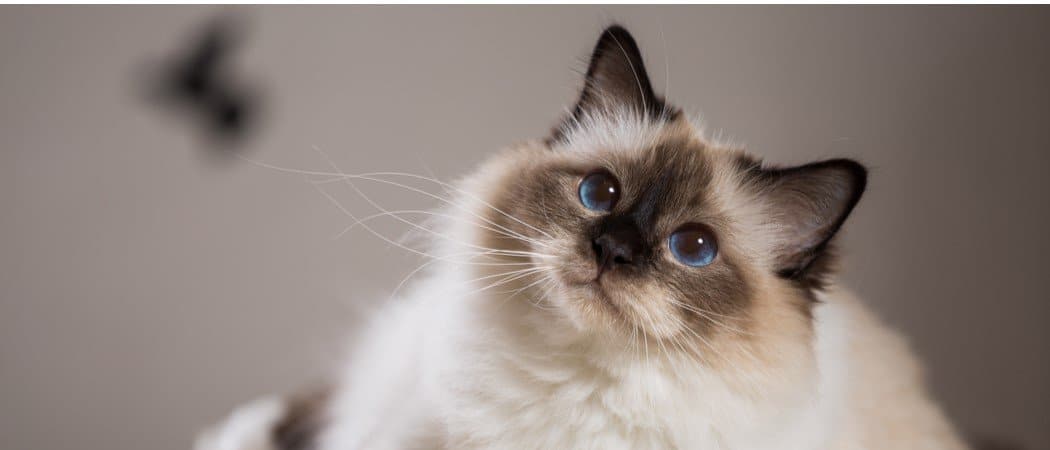
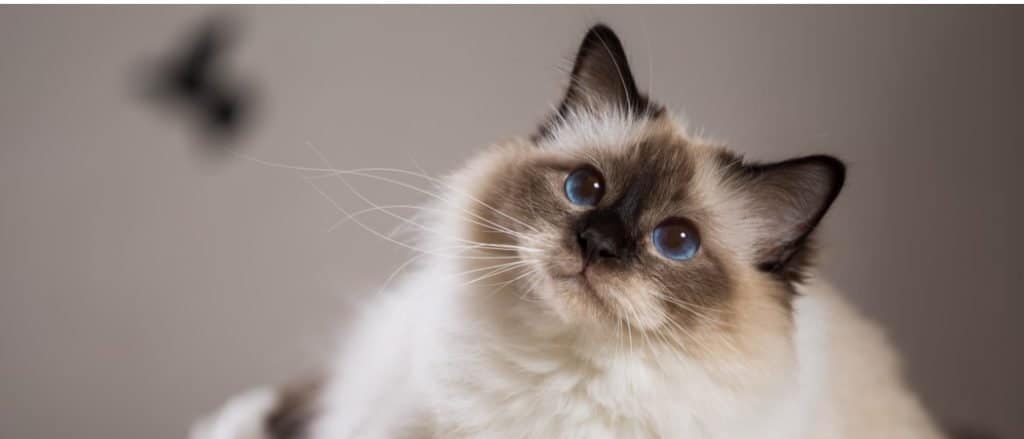
Birman close-up

At a Glance

Domesticated
Also Known As Sacred Cat of Burma, Sacred Temple Cat of Burma, Sacré de Birmanie, Sacred Burmese Cat
Diet Carnivore
Activity Crepuscular+
Lifespan 14 years
Weight 6.5 lbs
Status Not Evaluated
Did You Know?

Birmans are colorpoint cats: cooler body areas (face/ears/legs/tail) develop darker color than the torso.

Scientific Classification

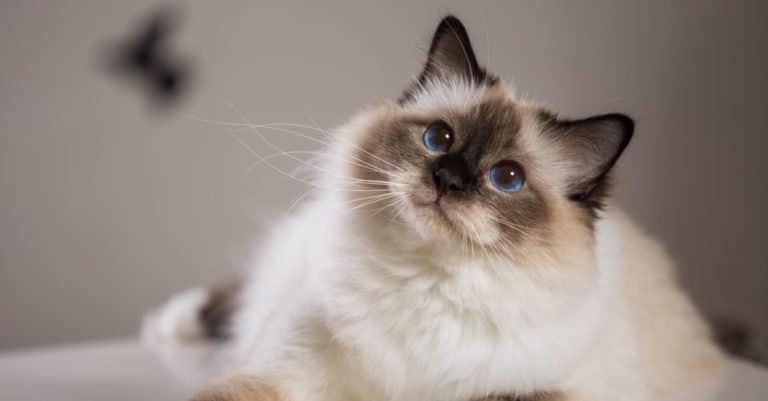
The Birman is a domestic cat breed characterized by a semi-long coat, colorpoint pattern, deep blue eyes, and distinctive white “gloves” on the paws. It is known for a gentle, social temperament.

Kingdom
Animalia
Phylum
Chordata
Class
Mammalia
Order
Carnivora
Family
Felidae
Genus
Felis
Species
Felis catus

Distinguishing Features

  • Colorpoint coat with pale body and darker extremities (face/ears/legs/tail)
  • Distinctive white “gloves” on front paws and white “laces” on hind paws
  • Deep blue eyes
  • Silky semi-long coat with minimal undercoat (typically less matting than some long-haired breeds)
  • Medium-to-large, sturdy build with a rounded head and sweet expression

Physical Measurements

Males and females differ in size

Height
10 in (9 in – 11 in)
Length
2 ft 10 in (2 ft 6 in – 3 ft 2 in)
2 ft 6 in (2 ft 4 in – 2 ft 9 in)
Weight
13 lbs (10 lbs – 15 lbs)
10 lbs (7 lbs – 12 lbs)
Tail Length
1 ft 2 in (12 in – 1 ft 4 in)
11 in (9 in – 1 ft 1 in)
Top Speed
30 mph
Around 45-50 km/h

Appearance

Primary Colors
Secondary Colors
Skin Type Domestic cat coat/skin: semi-long, silky coat with relatively low undercoat (less matting than many longhairs), fuller ruff and plumed tail; skin is typical feline skin beneath the fur.
Distinctive Features
  • Deep, vivid blue eyes (a defining breed trait; contrasts strongly with the coat and points).
  • White 'gloves' on front paws and white rear foot markings ('laces') that should be clean-edged and symmetrical-central to Birman breed identity.
  • Semi-long, silky texture coat with a flowing but not heavily woolly feel; tends to shed seasonally and benefits from routine brushing.
  • Gentle, social, people-oriented companion temperament; typically calmer and less demanding than many high-energy domestic cats (behavioral breed tendency, not a separate species).
  • Breed distinction vs. the base species (Felis catus): consistently expressed colorpoint pattern + mandatory white gloves + characteristic blue eyes and semi-long silky coat; not to be confused with the Burmese (solid-colored, short-haired).
  • Care requirements: brush 1-3× weekly (more during seasonal shedding) to reduce tangles and hairballs; routine nail trims, dental care, and interactive play to prevent weight gain.
  • Health tendencies to watch (breed-associated risks, not guarantees): hypertrophic cardiomyopathy (HCM) screening may be recommended in some lines; monitor for obesity and dental disease, keep regular veterinary checkups, and request documented health testing/history from breeders.

Sexual Dimorphism

Sexual dimorphism is mild to moderate: males are generally larger/heavier with a broader head and more pronounced neck/ruff; females tend to be slightly smaller and finer-boned while retaining the same colorpoint pattern and white gloves.

  • Typically larger overall frame and heavier musculature.
  • Broader head/cheeks and a more pronounced ruff (especially in full coat).
  • Slightly smaller, more refined build.
  • Coat and markings (points, gloves, blue eyes) match breed standard but often appear more delicate due to frame size.

Did You Know?

Birmans are colorpoint cats: cooler body areas (face/ears/legs/tail) develop darker color than the torso.

Their hallmark is four white "gloves" on the front paws; matching rear markings are often called "laces."

All kittens are born white; points and markings appear as they grow (temperature-linked pigment).

The coat is semi-long and silky but usually lacks the dense undercoat that makes many longhairs prone to heavy matting.

Breed standards prize deep sapphire-blue eyes-an eye color strongly associated with colorpoint genetics.

Despite the "Sacred Cat of Burma" name, the modern breed was developed largely in France in the early 20th century.

Unique Adaptations

  • Colorpoint pigmentation (temperature-sensitive tyrosinase): produces darker extremities and consistent contrast between points and body.
  • Silky semi-long coat with relatively low undercoat: offers a "plush" feel and can be easier to maintain than some thick double coats.
  • Distinct white glove pattern: a breed-defining trait selectively maintained by breeders; symmetrical gloves are highly valued.
  • Companion-selected temperament: decades of selection for calm, affectionate, people-friendly behavior distinguishes the breed from the broader domestic cat population.

Interesting Behaviors

  • People-oriented shadowing: many Birmans follow their favorite person from room to room without being overly demanding.
  • "Greeting cat" tendencies: often meet family at the door and seek gentle interaction rather than rough play.
  • Social harmony: typically integrate well with other cats/dogs and may do best with a companion animal if left alone often.
  • Moderate play style: prefers interactive wand play and gentle games over high-intensity acrobatics common in some shorthaired breeds.
  • Soft-voice communication: many are talkative in quiet chirps/trills rather than loud yowls (individual variation).

Cultural Significance

Birmans, called the "Sacred Cat of Burma," are loved as loving pets. They have blue eyes, white gloves, and a colorpoint coat. In cat show culture, their matching white glove markings are famous and help define the breed.

Myths & Legends

A famous legend links Birman cats to temple cats in Burma (Myanmar). A loyal cat is said to have been changed—getting deep blue eyes and white paws—while guarding a temple, making the breed sacred.

Early 1900s European stories say sacred Burmese cats traveled with or were given to Western visitors, later starting the Birman breed in France, an often told tale that boosted the Birman's mystery.

In cat-fancier storytelling, the Birman's white gloves are sometimes treated as a symbolic "sign of purity" or "blessing," a romantic motif used in breed lore and show-culture narratives.

Conservation Status

NE Not Evaluated

Has not yet been evaluated against the criteria.

Population Stable

Life Cycle

Birth 4 kittens
Lifespan 14 years

Lifespan

In the Wild
12–16 years
In Captivity
10–18 years

Reproduction

Mating System Polygynandry
Social Structure Managed Domestic
Breeding Pattern Transient
Fertilization Internal Fertilization
Birth Type Internal_fertilization

Behavior & Ecology

Social Colony Group: 3
Activity Crepuscular, Cathemeral
Diet Carnivore Poultry-based, high-animal-protein foods (e.g., chicken or turkey)

Temperament

Gentle, notably affectionate and socially responsive to humans; often described as more companion-oriented than the base domestic cat average.
Moderate energy and play drive; tends to prefer interactive play and close-by supervision rather than intense, high-arousal activity.
Generally tolerant and adaptable with other cats/dogs when introductions are slow; may show stress if the environment is noisy, crowded, or unpredictable.
Breed-distinguishing traits: strong tendency to follow family members, enjoy lap time, and maintain close proximity; often less aloof than many domestic cats.
HUBS behavioral pattern: domestic cats vary widely from independent to highly social; Birmans skew toward the social/affiliative end, with individual variation by early socialization and household context.
Care requirement (coat): semi-long coat typically needs routine combing/brushing (often 2-3x/week; more during shedding) to reduce tangles and hair ingestion.
Care requirement (social): benefits from daily companionship, gentle handling, and enrichment (puzzle feeders, perch/window access, short interactive play sessions).
Care requirement (environment): commonly thrives as an indoor cat; provide vertical space and quiet resting zones to reduce stress in multi-pet homes.
Health concern (breed-leaning risks): monitor for cardiac disease such as hypertrophic cardiomyopathy (screening exams/echo as advised by a veterinarian), dental disease, and weight gain from a calmer lifestyle.
Health concern (general species context): like many domestic cats, can be prone to obesity, periodontal disease, and stress-related urinary issues-support with hydration, litterbox hygiene, and routine preventive care.

Communication

Meows Often soft/moderate volume; used frequently with humans
Trills/chirps Affiliative greetings; commonly reported in people-oriented cats
Purring Comfort/affiliation; also can occur with stress or pain
Growls/hisses Defensive signals when threatened or overstimulated
Yowls Less typical day-to-day in calm individuals; may appear with distress, estrus if unspayed, or territorial tension
Scent marking via facial rubbing/bunting and cheek glands; Birman often uses head-bumps as friendly solicitation.
Tail posture and slow blinking to signal friendly intent; may maintain close eye contact with relaxed body language around trusted humans.
Allogrooming and mutual resting in bonded pairs/groups; common indicator of social harmony in multi-cat homes.
Kneading and pawing on soft surfaces (comfort/affiliation), often performed near preferred people.
Body blocking/leading behaviors (walking ahead, circling legs) to request attention or guide humans to resources.
Scratching (visual + scent communication); provide multiple scratchers to prevent furniture targeting and support behavioral well-being.

Habitat

Biomes:
Temperate Forest Temperate Grassland Mediterranean Tropical Rainforest Tropical Dry Forest Savanna Desert Hot Desert Cold Boreal Forest (Taiga) Tundra Alpine Freshwater Wetland Marine +8
Terrain:
Plains Coastal Hilly
Elevation: Up to 14763 ft 9 in

Ecological Role

Domestic mesopredator and commensal companion animal; when free-roaming, functions as a small-game predator that can impact local wildlife populations.

Rodent suppression around human dwellings (when hunting occurs) Companion animal role supporting human well-being Can reduce certain pest populations but may also negatively affect native birds and small vertebrates if allowed outdoors (management via indoor housing, leash/catio use)

Diet Details

Main Prey:
Small rodents Small birds small reptiles and amphibians Invertebrates

Human Interaction

Domestication Status

Domesticated

Domestic cats (Felis catus) came from the African wildcat (Felis lybica) with early farming and spread by trade. The Birman was developed mainly in France in the early 1900s. Lore links it to temple cats in Burma/Myanmar, but modern records are European. After big losses in World Wars I and II, breeders bred with other cats to rebuild the breed.

Danger Level

Low
  • Minor scratches or bites (usually from fear, pain, or overstimulation)
  • Allergic reactions in sensitive individuals (dander/saliva proteins)
  • Zoonotic risks common to domestic cats if hygiene is poor (e.g., ringworm; toxoplasmosis primarily via litter handling)
  • Trip/fall hazards in the home (underfoot, especially at night)

As a Pet

Suitable as Pet

Legality: Generally legal to own as a pet in most jurisdictions where domestic cats are permitted. Typical constraints are local animal-control rules (licensing, vaccination, roaming/curfew), landlord/HOA policies, and country-specific import requirements (microchip, rabies vaccination, quarantine or waiting periods).

Care Level: Moderate

Purchase Cost: $800 - $3,500
Lifetime Cost: $18,000 - $40,000

Economic Value

Uses:
Companion animal/pet industry Pedigree breeding and cat shows Veterinary care, pet insurance, and grooming services Pet products (food, litter, enrichment)
Products:
  • Sale/adoption of Birman kittens (pet and show quality)
  • Stud services and breeding rights (where practiced)
  • Cat show participation and related services (handling, grooming)
  • Veterinary services (preventive care, dentistry, diagnostics)
  • Pet insurance and routine consumables (food, litter, grooming tools, toys)

Relationships

The first thing you notice about a Birman cat is its glittering blue eyes. These cats are very popular with families due to their affectionate, playful nature. They have medium to long silky hair and can be found in many unique colors. These adaptable felines are good with children and adults alike.

Breed History

While the Birman cat breed is one of the oldest in the history of domestic cats, it actually dwindled to two lone surviving cats in the early 20th century. Luckily, the female, named Sita, was pregnant, while her mate died en route to France. Sita gave birth to a litter of Birmans, who carried on the breed lineage.

Legend has it that the breed, which originated in Burma (now known as Myanmar), was favored by Kittah priests. A particular high priest, Mun-Ha, was injured to the point of death when thieves sought to steal a treasured statue of the blue-eyed goddess Tsun-Kyan-Kse. This priest’s Birman cat, Sinh, placed its paws on his chest as he lay dying, and when he passed, the cat magically transformed, taking on the features of the goddess. Its fur changed to gold, its eyes to blue, and its paws to pure white.

Birmans were brought to Europe by two English residents of France, August Pavie and Major Gordon Russell, in 1919. The Kittah people gifted two Birmans to the men to thank them for defending their temple from invaders. The cats thrived for a while, but came down to two lone cats during WWII. However, thanks to the litter of Sita, they bounced back with a breeding pair that were crossbred with Persian and Siamese long-haired cats in France. By the 1950s, purebred Birman litters had been restored and multiplied. 

Birman cats made it to the United States in 1959 and were accepted by the CFA in 1967. They are now a well-known and popular breed in North America and are flourishing worldwide.

Traits: What to Know Before You Buy

There are some important things to consider before buying or adopting a Birman:

  • These cats have a coat of medium to long hair that needs combing once or twice a week to keep it looking healthy.
  • These cats can sometimes be wary around strangers, so it may be necessary to put this pet into another room when unfamiliar people visit.
  • They are prone to obesity.

Personality

This breed of cat is known for its friendliness to other pets in a household. They are also known for their intelligence and playfulness. Dangle a piece of yarn in front of a Birman cat and let the games begin!

Some cats are known for their vocal behavior. But these cats are known for being on the quiet side.

These cats are affectionate and love to be around their owners. They are friendly with children, too. While some cats are known to keep to themselves, Birmans love lots of petting and attention.
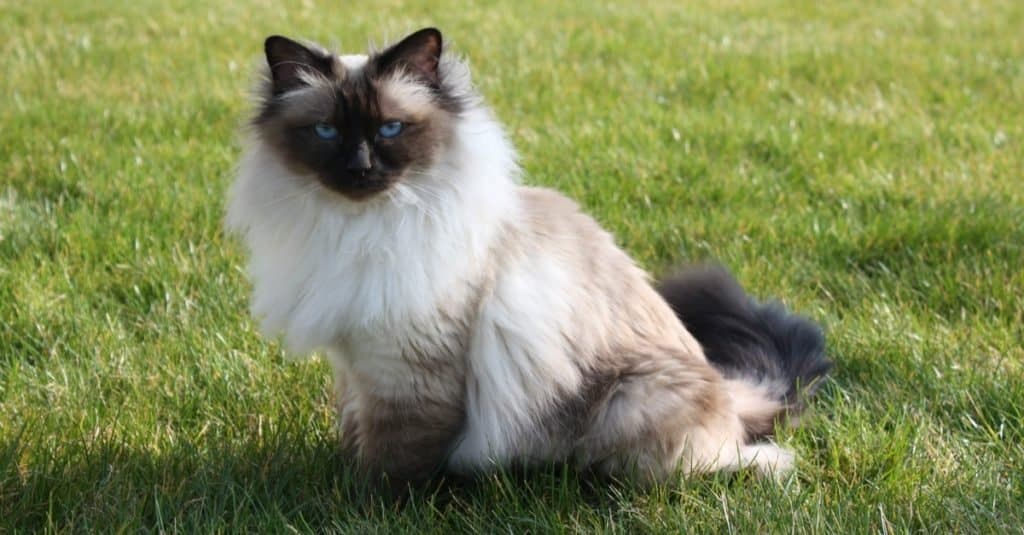
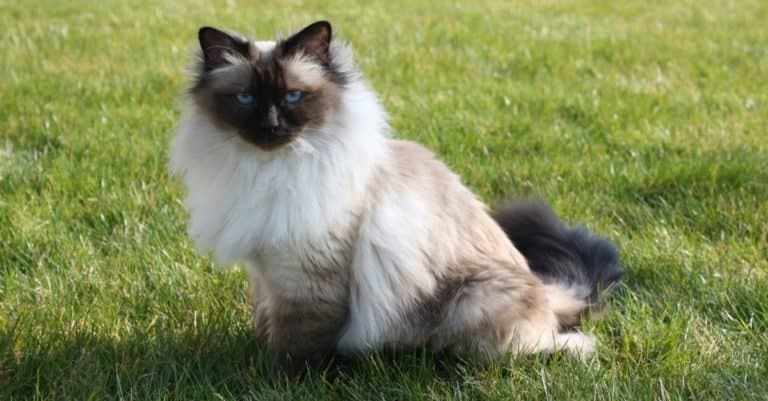
Seal point Birman cat sitting in the grass in the garden.

Though a quieter breed, Birman cats are friendly and blend in well with families with children and other pets.

Birman vs. Ragdoll

Look at a Birman and a Ragdoll sitting side by side; they look a lot alike. But there are both similarities and differences between these two breeds.

A lot of the similarities between these two cats relate to their personality. They can both be described as gentle and playful, especially with other pets. They are intelligent, quiet felines.

It’s hard to miss the glittering blue eyes of both cat breeds. They share many of the same colors.

One difference is found in their history. Birman cats are sometimes called Sacred Cats of Burma. They were raised in the temple of Burma by Kittah priests. Folklore claims this cat’s blue eyes were inherited from a goddess with sapphire blue eyes. Their glowing white paws are a symbol of purity, according to the Kittah priests.

The history of the Ragdoll cat has less folklore attached to it. Ragdolls were bred by a woman named Ann Baker back in the 1960s. Ann had a beloved and very affectionate Persian cat named Josephine. Josephine had a habit of going limp in her owner’s hands when she was picked up. This is how the name Ragdoll came about. Ann filed the paperwork to trademark the name Ragdoll and started breeding more of these gentle, sweet cats with this unique habit.

Though these cats look similar, there are some subtle differences in their colors and physical appearance. For one, Birman cats have rounded eyes of medium size, while Ragdolls have large oval-shaped eyes. Also, a Ragdoll cat’s fur is soft and cushy, while the Birman has just one layer of silky hair without any undercoat. Both Birman and Ragdoll cats have long, plumed tails, and tail length is not a primary distinguishing feature between the two breeds. In addition, adult Birman cats weigh less than adult Ragdolls.

While very similar to a Ragdoll cat in appearance, a Birman has smaller, more rounded eyes, a shorter tail, and weighs less in comparison.

Size and Weight

Adult Birman cats are between 15 and 18 inches long. Adults grow to a height of between 8 and 10 inches. Males are usually bigger than females.

Adults weigh between 6 and 12 pounds. A female Birman usually weighs between 6 and 10 pounds, while a male weighs 10 to 12 pounds.
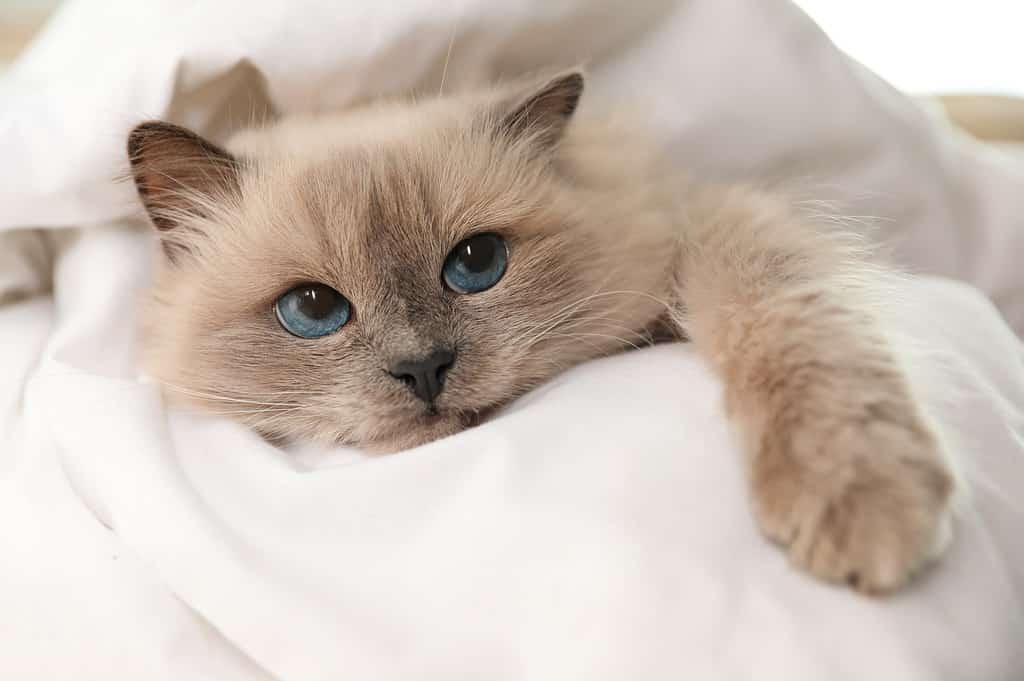
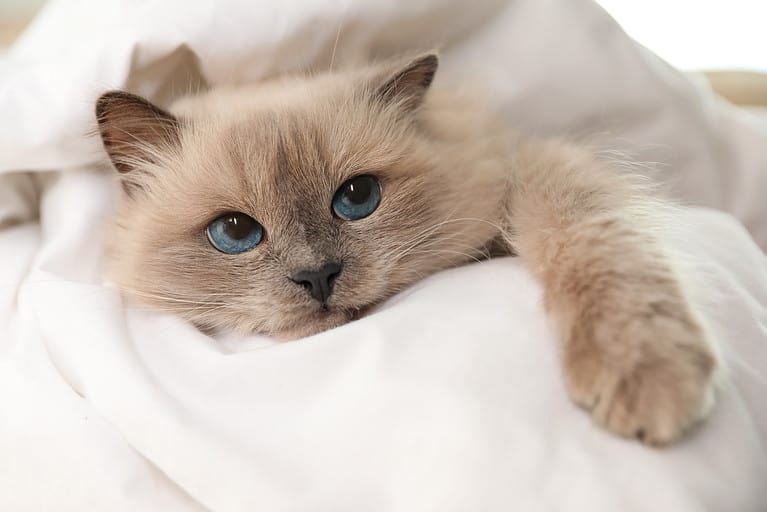
Beautiful Birman cat lying on a bed. ATTRIBUTION NOT FOUND

Adult Birman cats are between 15 and 18 inches long and grow to a height of 8 to 10 inches.

Price

Purebred kittens cost anywhere from $600 to $3000 when purchased from a breeder. But that price varies by breeder.

One alternative to buying a Birman is adopting one from a rescue organization. Some rescue organizations have adults as well as kittens available. A Birman cat rescue organization charges an adoption fee. Adoption fees of Birman rescue organizations range from $60 to $150.

The annual vet costs for Birman cats range from $400 to $600. When it comes to this cat’s food budget, the monthly cost ranges between $20 and $30.

Birman kittens are so popular that many breeders have waiting lists. Of course, the kittens stay with their mother until they can live independently.
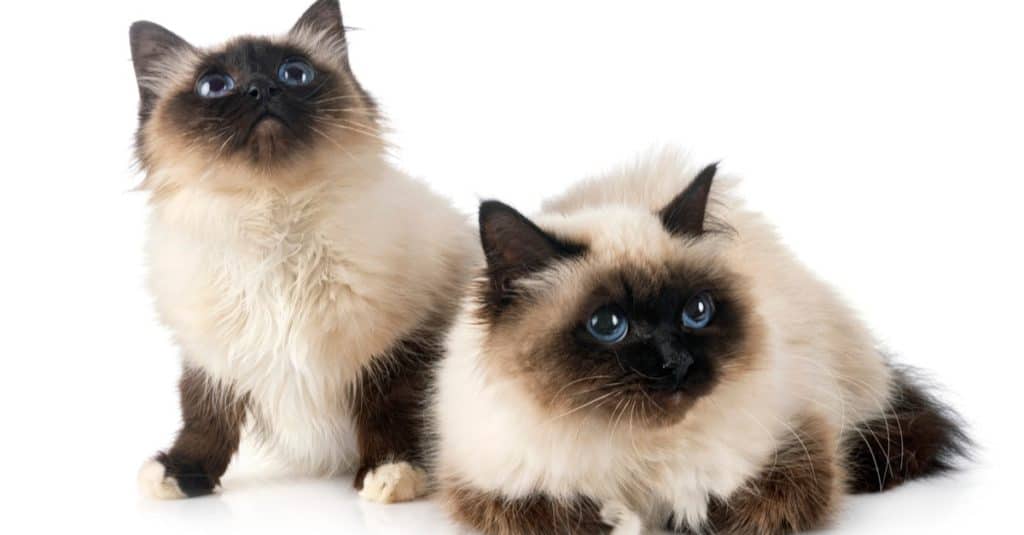
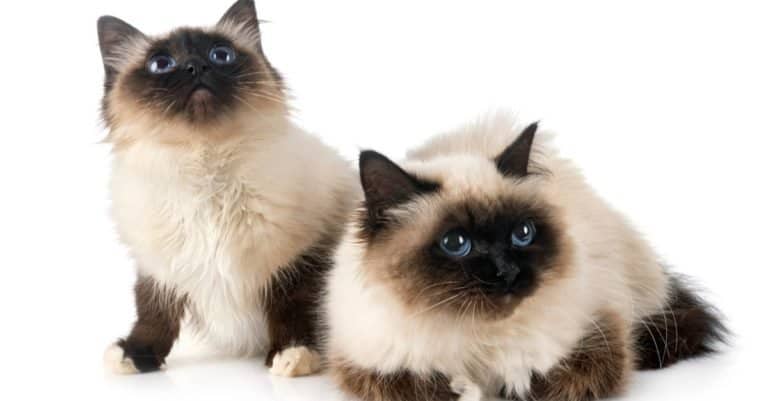
Birman cats isolated in front of white background.

Purebred Birman kittens cost 0 to 00 on average when purchased from a breeder.

Kittens

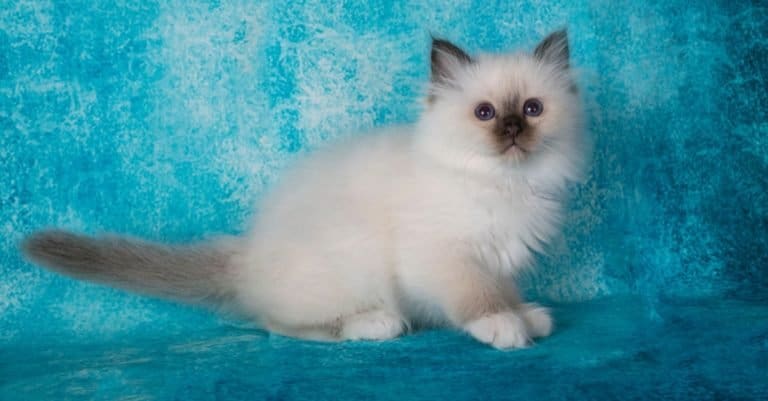
Although these cats have coats in a variety of colors, the kittens are born with all-white fur. As they mature, kittens start to take on their adult colors. Of course, they all have glittering blue eyes from birth and keep white ‘mittens’ on their paws.

Newborn kittens weigh from 3 to 5 ounces and are about 3 inches long. Their eyes and ears don’t open until they are around 9 days old. They reach puberty between 15 and 18 months old. However, they don’t achieve full maturity until they are 3 years old.

Some of the coat colors include lilac, blue, chocolate, cream, red, tortie, and seal.

These kittens are friendly and affectionate with kids.
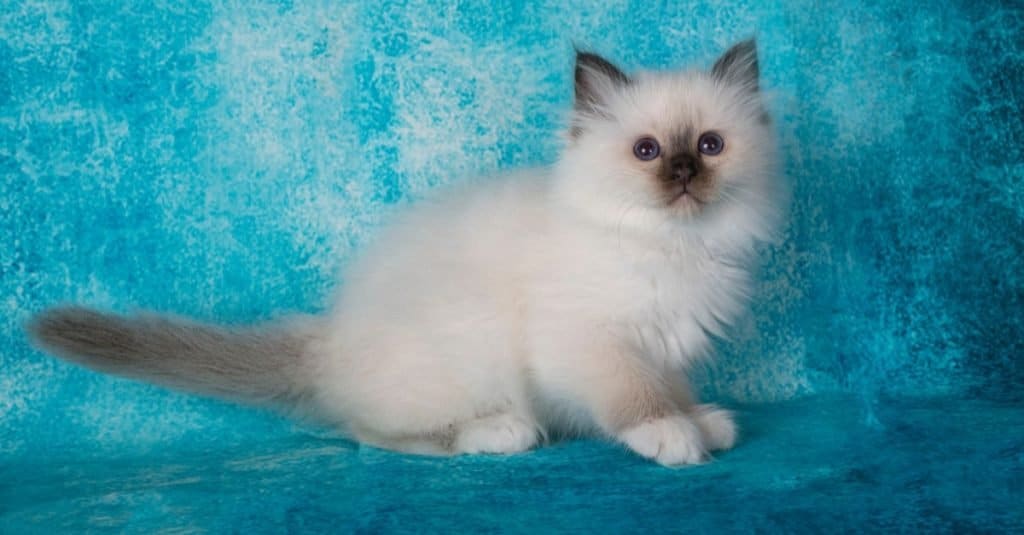
Birman kitten in front of a blue background.

Birman kittens are born with all-white fur, but their coats can take on a variety of colors as they mature in age.

Lifespan

Birman cats reach an average age of 14 years. Of course, how long this cat lives depends on its overall health. The oldest known Birman cat, Minx, reached the age of 23!

Birman cats are hardy and don’t suffer from any unusual health issues. But they do share some general health issues of cats. For one, they are prone to obesity. Obesity in a cat can lead to other issues like heart and kidney problems. An owner who gives their Birman the appropriate amount and type of food can avoid this health issue.
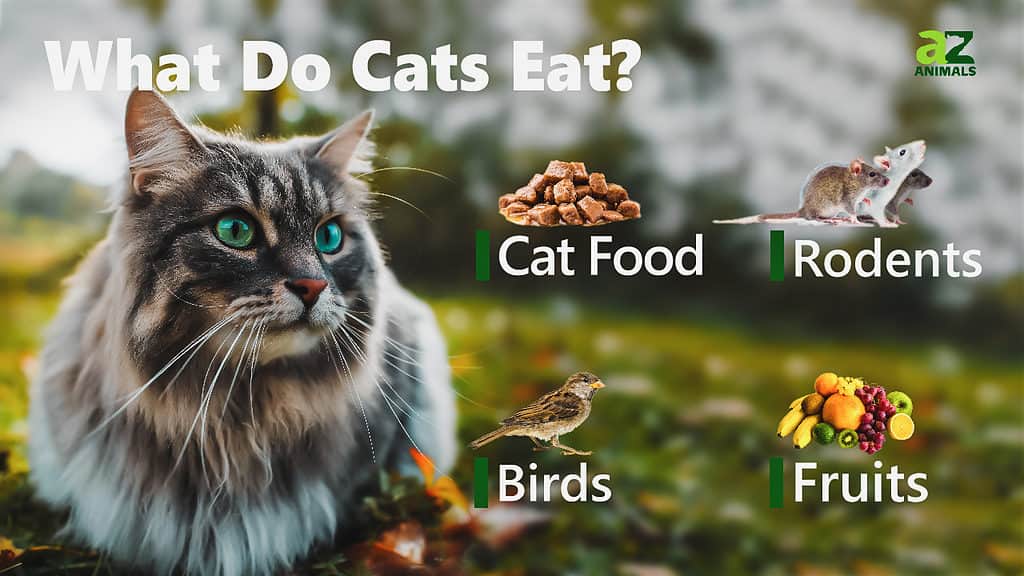
Pet domestic cats generally consume cat food, but also will eat rodents, birds, and fruits.

Breed vs. Mixed

Purebred Birman cats have white paws, silky fur without an undercoat, a playful nature, and an affectionate personality. A kitten with only one Birman parent may not take on all of these features and qualities. The kitten may inherit more of the other parent’s qualities.

The Cat Fanciers Association lists the colors of purebred Birmans as seal, chocolate, blue, lilac, red, cream, and tortie.
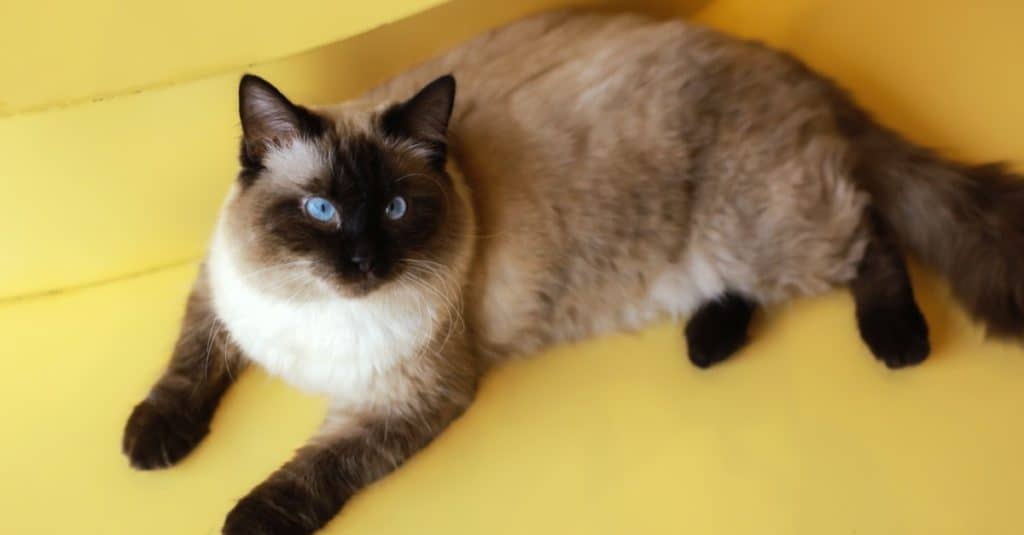
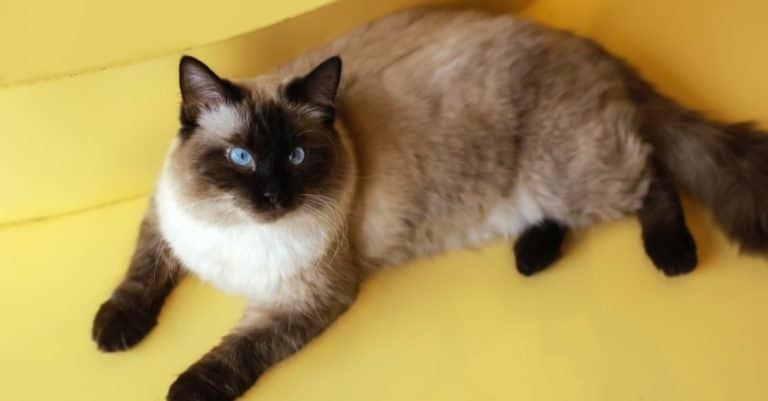
A beautiful Birman cat with blue eyes lying on a yellow table.

Purebred Birman cats have silky fur without an undercoat, gorgeous blue eyes, and a playful, affectionate personality.

Types of Birman Cats and Colors

The coats of Birman cats can vary between solid, tabby, and tortie patterns for accepted purebreds. All of these cats have blue eyes, points, and white gloves and laces. The CFA recognizes 20 color/pattern combinations. For a better understanding of coat coloring, below is a list of various Birman coat colors with descriptions:

  • A Seal Coat: A Birman with a seal coat has cream fur on most of its body with dark fur or seal patterns on its face, tail, ears, and legs. It kind of looks a lot like a fluffy Siamese cat.
  • A Blue Coat: When a cat enthusiast says blue fur, they really mean fur with a grayish tone. A Birman with a blue coat has mostly cream fur with blue (gray) fur on its face, tail, ears, and legs.
  • A Chocolate Coat: A Birman with a chocolate coat has mostly golden/ivory colored fur with chocolate-brown fur on its ears, face, tail, and legs.
  • A Lilac Coat: A Birman cat with a lilac coat has mostly pale ivory fur on its body, along with pink/gray fur on its face, ears, legs, and tail.
  • A Red Coat: This cat has a cream coat with red/gold fur on its ears and face.
  • A Tortie Coat: A tortoiseshell or tortie coat has a swirling pattern of black, blue, chocolate, and gold fur.
View all 453 animals that start with B

Sources

  1. Ragalon Ragdolls / Accessed July 7, 2021
  2. Wikipedia / Accessed July 7, 2021
  3. National Birman Fanciers / Accessed July 7, 2021
  4. VCA Hospitals / Accessed July 7, 2021
Abby Parks

About the Author

Abby Parks

Abby Parks has authored a fiction novel, theatrical plays, short stories, poems, and song lyrics. She's recorded two albums of her original songs, and is a multi-instrumentalist. She has managed a website for folk music and written articles on singer-songwriters, folk bands, and other things music-oriented. She's also a radio DJ for a folk music show. As well as having been a pet parent to rabbits, birds, dogs, and cats, Abby loves seeking sightings of animals in the wild and has witnessed some more exotic ones such as Puffins in the Farne Islands, Southern Pudu on the island of Chiloe (Chile), Penguins in the wild, and countless wild animals in the Rocky Mountains (Big Horn Sheep, Mountain Goats, Moose, Elk, Marmots, Beavers).
Connect:

Thank you for reading! Have some feedback for us?


Birman FAQs (Frequently Asked Questions)

A Birman, also called the Sacred Cat of Burma, is a feline with a gentle, affectionate personality. It’s also well-known for its silky hair, gleaming blue eyes, and ability to get along with other pets.