
B
Species Profile

Bison

Bison

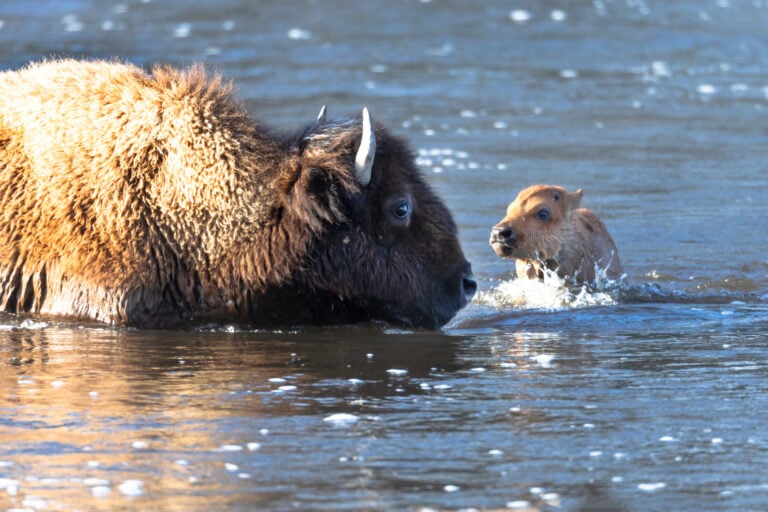
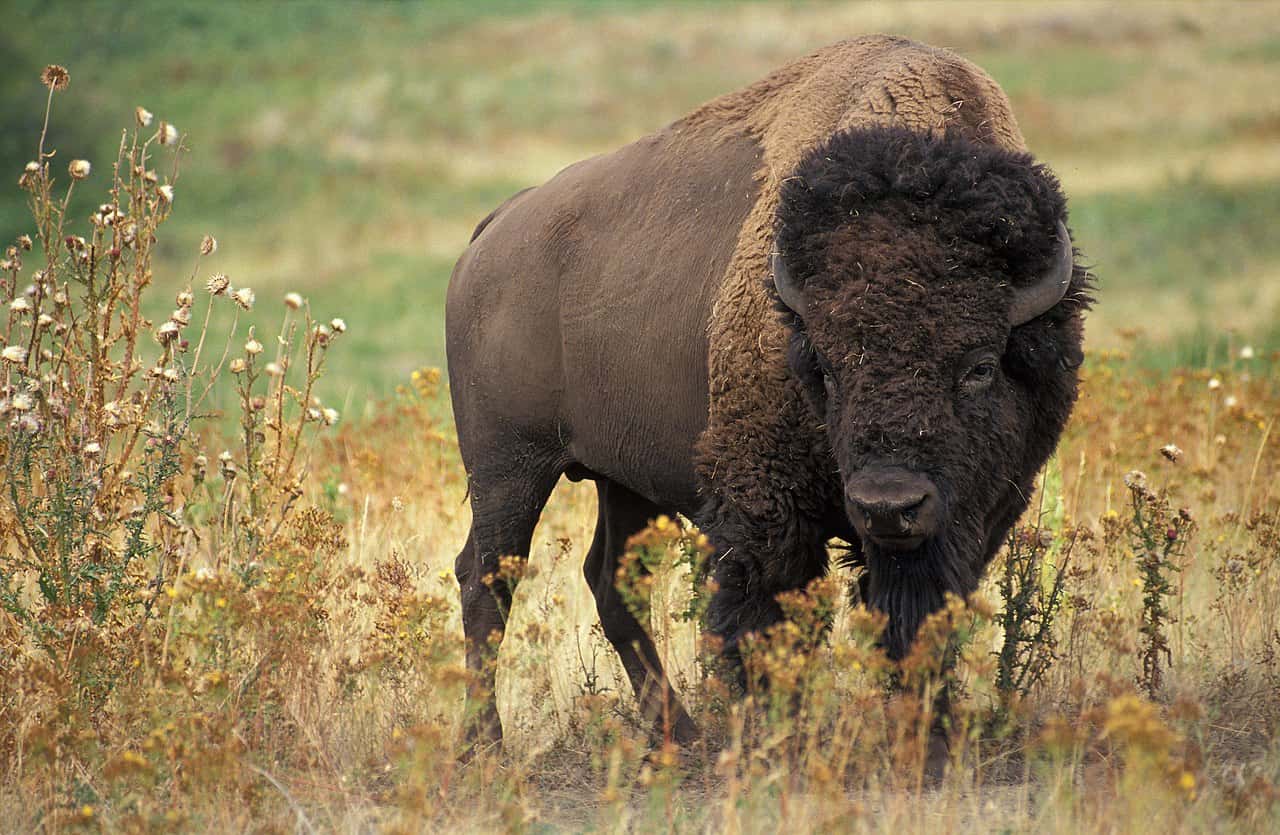
Hump-backed architects of the plains
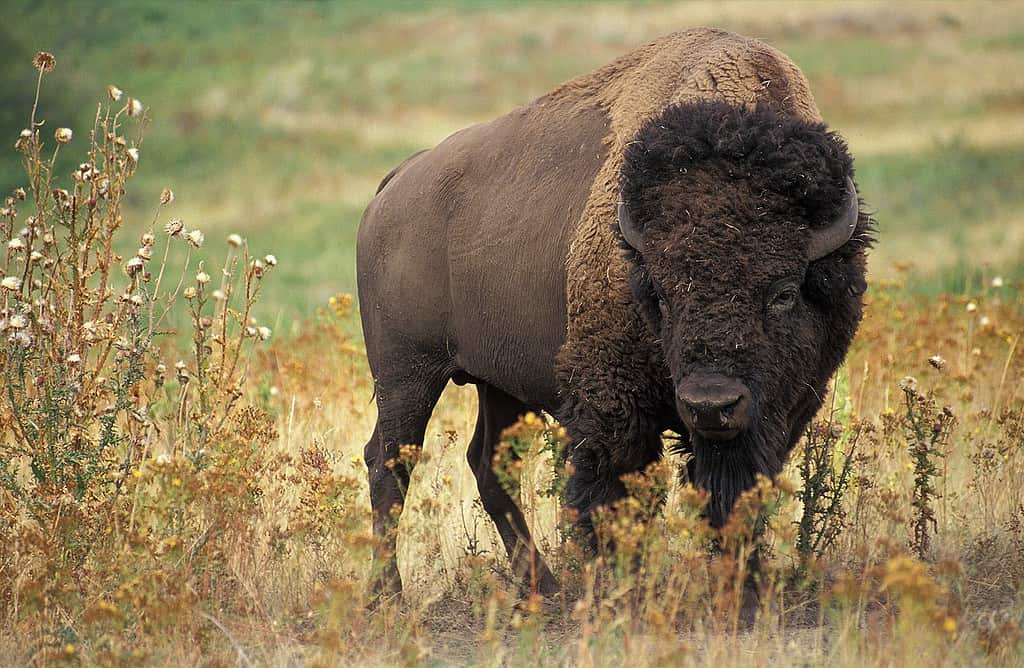
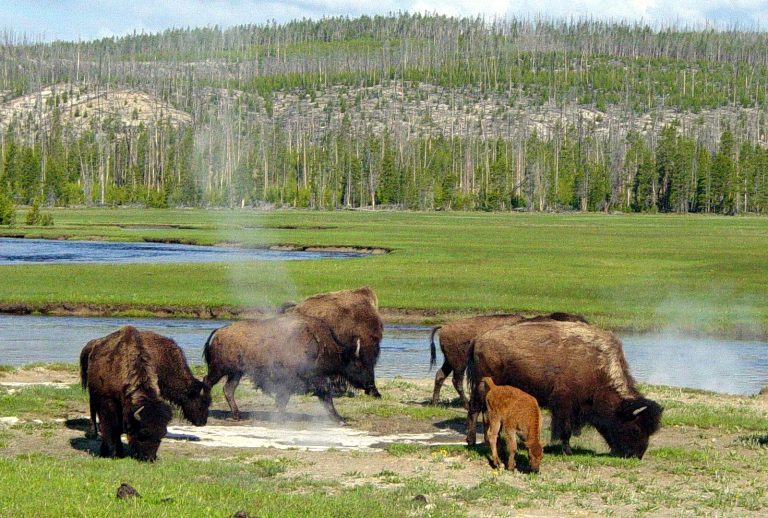
Jack Dykinga, Public domain, via Wikimedia Commons

Bison Distribution

Click a location to explore more animals from that region

Loading map...

Size Comparison

Human 5'8"
Bison 5 ft 11 in

Bison is 1.0x the height of an average human.

Bison bison. Original caption: "scientists are helping users of American rangelands meet the challenge of managing multiple uses sustainably.")

At a Glance

Genus Overview This page covers the Bison genus as a group. Stats below are general traits shared across the genus.
Also Known As buffalo, wisent, zubr
Diet Herbivore
Activity Diurnal+
Lifespan 15 years
Weight 1000 lbs
Status Not Evaluated
Did You Know?

The genus Bison includes two living species (American bison and European bison) plus several extinct Ice Age forms.

Scientific Classification

Genus Overview "Bison" is not a single species but represents an entire genus containing multiple species.

Bison are large, social bovids (cattle relatives) adapted to grazing, characterized by a prominent shoulder hump, massive head and forequarters, and (in many populations) dense, shaggy coats. The genus includes two extant species (American and European bison) and multiple extinct Ice Age forms.

Kingdom
Animalia
Phylum
Chordata
Class
Mammalia
Order
Artiodactyla
Family
Bovidae
Genus
Bison

Distinguishing Features

  • Large shoulder hump formed by elongated vertebral spines and powerful forequarter musculature
  • Broad head with short, curved horns in both sexes
  • Dense forequarter coat (especially in colder climates) and seasonal shedding
  • Herd-forming grazing lifestyle; strong migratory/roaming tendencies where landscapes allow
  • Wallows (depressions) commonly used during rut and for cooling

Physical Measurements

Males and females differ in size

Height
5 ft 9 in (4 ft 11 in – 6 ft 7 in)
4 ft 11 in (4 ft 3 in – 4 ft 11 in)
Length
10 ft 10 in (8 ft 6 in – 12 ft 10 in)
9 ft 8 in (7 ft 10 in – 11 ft 10 in)
Weight
1,653 lbs (882 lbs – 1.2 tons)
992 lbs (705 lbs – 1,199 lbs)
Tail Length
2 ft 4 in (1 ft 6 in – 2 ft 11 in)
1 ft 6 in (12 in – 1 ft 12 in)
Top Speed
37 mph
About 40-60 km/h

Appearance

Primary Colors
Secondary Colors
Skin Type Bison have thick hides with dense underfur and long guard hairs, forming a shaggy cape on head, neck, and shoulders. They shed seasonally; winter coats are much heavier to block wind and cold.
Distinctive Features
  • Bison vary in size: shoulder height about 1.4–2.4 m, body length 2.1–3.8 m, and mass usually 300–1,000+ kg for living species, with some extinct Ice Age forms maybe 1,500–2,000 kg.
  • Bison have a massive head, short neck, very strong front body with a large shoulder hump near the withers, and lighter hindquarters — a front-heavy shape unlike most domestic cattle.
  • Coat traits: dense woolly undercoat + long guard hairs; distinct mane/beard and shaggy forequarter cape, especially in winter; tail ends in a dark tuft.
  • Horns: both sexes have horns; shape and size vary by species and individual. Extinct forms show broader variation (including very large horn spans in some Pleistocene species).
  • Mostly grazers suited to open lands like grasslands, steppe, and meadows. European bison use mixed forest-meadow areas and eat more leaves; diets change with seasons and plants available.
  • Bison are usually social: cow-calf groups and mixed herds form, while mature males are often solitary or in small bachelor groups until breeding. Group size and spacing vary with habitat openness, predation risk, and management.
  • Bison grazing, trampling, wallowing, and movement make patchy short-grazed lawns, disturbed soil, and seedbeds, shaping plant communities and wildlife; effects depend on herd size, landscape fragmentation, and whether herds roam free or are tightly managed.
  • Living bison usually live about 10–20 years in the wild, often less when stressed, and about 20–25+ years in captivity. Extinct species' lifespans are unknown but likely similar to bovids of similar size.
  • Modern Bison populations are a mix of conservation herds and ranched animals, often intensively managed; past hunting and habitat loss shaped their range. Hybridization with cattle has occurred and complicates conservation genetics.
  • Clarification: 'bison' (genus Bison) are distinct from African/Asian buffalo (Syncerus/Bubalus), despite common-name overlap in casual usage.

Sexual Dimorphism

Sexual dimorphism is strong in Bison: males are much larger and sturdier, with heavier front bodies, thicker necks, and bigger horn bases and heads. Size differences vary by species (American vs. European), nutrition, and how they are managed; fossils leave uncertainty.

  • Larger body mass and shoulder height on average; markedly heavier head/neck/forequarters (more imposing hump/withers profile).
  • Often thicker, more muscular neck and chest; during rut, males may appear especially massive in the front half.
  • Typically larger horn bases and broader skull proportions (exact horn size/shape varies by species and individual).
  • More frequent solitary behavior outside the breeding season; conspicuous rut behaviors (bellowing, wallowing, sparring) though intensity varies among populations.
  • Smaller, lighter build with less extreme forequarter mass; hump still present but generally less imposing.
  • Often form the stable core of cow-calf groups; maternal behavior and calf defense are prominent.
  • Horns present but commonly slimmer/less massive at the base (variation occurs).

Did You Know?

The genus Bison includes two living species (American bison and European bison) plus several extinct Ice Age forms.

Their signature shoulder hump is powered by enlarged muscles and long spines that help drive the head through snow and tough vegetation.

Both species are social herd animals, but European bison (wisent) tend to use more forest-edge habitats than the grassland-centered American bison.

Bison are "ecosystem engineers": grazing, trampling, and wallowing create habitat mosaics that benefit many plants, insects, and birds.

A single large bull can weigh about twice (or more) as much as a cow, and both sexes can be surprisingly fast over short distances.

After catastrophic historic declines, bison survived through a mix of private herds, protected areas, and intensive conservation management.

Bison are often mistaken for domestic cattle, but bison typically have a bigger forequarter build, a pronounced hump, a shorter/upturned tail, and (in many populations) a much shaggier mane and forebody coat.

Unique Adaptations

  • Pronounced shoulder hump with powerful neck/shoulder musculature for snow-plowing and efficient head-down grazing.
  • Massive head and reinforced forequarters for pushing through vegetation and intraspecific competition.
  • Insulating pelage: many populations develop dense, shaggy coats (especially on head/neck/forequarters) that are shed seasonally; thickness varies with climate and lineage.
  • Ruminant digestion (four-chambered stomach) enabling efficient extraction of nutrients from coarse grasses and sedges.
  • Broad hooves and strong legs suited for long-distance walking and traversing mud, snow, and uneven ground.
  • High sprint capability for a large ungulate, aiding predator avoidance and rapid herd movement.

Interesting Behaviors

  • Seasonal herd structure: females and young commonly form groups, while adult males are more solitary or in small bachelor groups outside the breeding season (degree of separation varies by species and population).
  • Rut behavior (late summer-autumn in many populations): males compete via displays, pushing, and occasional clashes; vocalizations and scent-marking intensify.
  • Wallowing: bison roll in dust or mud, leaving shallow "wallows" that can become microhabitats; also used for skin care and possibly social signaling.
  • Group movement and vigilance: herds coordinate travel to forage and water; many eyes reduce predator risk, though responses differ by habitat openness.
  • Foraging patterns: both are primarily grazers, but European bison often browse more (shrubs, leaves) where woodland and mixed habitats are common.
  • Snow foraging: in colder ranges, bison use head-and-hump power to sweep aside snow to reach grasses and sedges; intensity varies with snow depth and local forage.
  • Dominance and spacing: body posture, head carriage, and short rushes manage personal space; serious fights are less common than ritualized contests but do occur.

Cultural Significance

Bison (American bison and wisent) symbolize food, strength, and wild places. Plains Indigenous peoples used them for food, clothes, tools, art, and ceremony. Wisent linked to royal hunting, then conservation and reintroductions. Today bison shape land use, grazing, historic cattle–bison mixing, and their role as keystone species.

Myths & Legends

White Buffalo Calf Woman (Lakota): a sacred figure who brought the people the sacred pipe and teachings, with the white buffalo as a revered sign of renewal and blessing in related traditions.

The Buffalo Dance traditions (various Pueblo peoples): ceremonial dances that honor the buffalo and ask for balance, rain, and successful hunts, embedding the animal in ritual life and seasonal cycles.

Nanabozho and the buffalo (Anishinaabe/Chippewa story cycles): trickster-hero tales in which Nanabozho interacts with buffalo, reflecting lessons about respect, cleverness, and the challenges of living from the land.

In medieval and early modern Europe, the Old World wisent was seen as a royal prize. Kings and nobles protected forests and held special hunts, making the wisent part of court legend.

Ice Age "bison" in Upper Paleolithic art: bison figures in European cave paintings (commonly associated with steppe bison and related forms) reflect deep-time cultural fascination with these powerful herd animals.

Conservation Status

NE Not Evaluated

Has not yet been evaluated against the criteria.

Population Unknown

Protected Under

  • Across extant species, global IUCN categories are currently concentrated at Near Threatened (NT): American bison (Bison bison) and European bison (Bison bonasus) are both listed as NT, with broadly increasing overall trends under intensive management-while many individual herds remain small, isolated, and/or genetically constrained.
  • International/national protections vary by jurisdiction and population. European bison is widely protected in range states and is listed under CITES Appendix II (trade controlled). North American conservation relies heavily on protected areas, Indigenous-led conservation, and provincial/state/federal frameworks; notable population-level legal designations include Canada's Species at Risk Act listing for wood bison (a subspecies/population within B. bison) in parts of its range.

You might be looking for:

American bison

60%

Bison bison

The best-known living bison; native to North America; includes plains and wood bison populations.

View Profile

European bison (wisent)

30%

Bison bonasus

The living bison species native to Europe; heavily conserved after near-extinction.

Steppe bison (extinct)

10%

Bison priscus

Widespread Pleistocene bison across Eurasia and North America; known from fossils and cave art.

Life Cycle

Birth 1 calf
Lifespan 15 years

Lifespan

In the Wild
10–25 years
In Captivity
15–30 years

Reproduction

Mating System Polygyny
Social Structure Aggregation Group
Breeding Pattern Seasonal
Fertilization Internal Fertilization
Birth Type Internal_fertilization

Bison (American bison, European wisent): a few males get most mates during a late-summer rut. Females and calves form female-led groups; males are solitary or in bachelor groups and briefly guard females. Mothers alone care for calves; calving mostly happens at the same time.

Behavior & Ecology

Social Herd Group: 20
Activity Diurnal, Crepuscular, Cathemeral
Diet Herbivore Fresh, new-growth grasses and sedges (high-protein spring/summer grazing)
Seasonal Migratory 186 mi

Temperament

Generally cautious and vigilant; flighty in some populations but may habituate to humans where regularly exposed
Can be highly aggressive at close range, especially during the rut (male-male competition) and when females have calves
Strong dominance interactions among males; contest intensity varies with age structure and breeding synchrony
Seasonal shifts in social tolerance: more cohesive female groups during calving; more male aggression and display during rut

Communication

Grunts and low contact calls used within herds
Snorts/snuffles and forceful exhalations associated with alertness or agitation
Roars/bellows (more prominent during the rut) used in sexual display and male competition
Cow-calf calls including bleats/grunts for contact and reunions
Olfactory cues: scent investigation, flehmen-like responses, urine and gland scent cues important in mating context
Visual displays: head tossing, lateral presentation, hump/forequarter emphasis, horn orientation, and directed stares during dominance contests
Acoustic/physical displays: pawing, wallowing, and ground-horning that leave visual/scent marks and function in rut signaling
Tactile interactions: sparring, pushing, and horn-to-horn contact among males; limited affiliative rubbing/licking within close associates More common in calves and female groups
Group movement cues: coordinated departures and following behavior (often led by experienced females), with spacing and alignment signaling comfort vs. alarm

Habitat

Biomes:
Temperate Grassland Temperate Forest Boreal Forest (Taiga) Tundra Alpine Wetland
Terrain:
Plains Plateau Valley Riverine Hilly Mountainous
Elevation: Up to 11482 ft 11 in

Ecological Role

Large-bodied grazing megaherbivores and ecosystem engineers across grassland-steppe and mosaic wood-pasture systems (extant and extinct bison lineages).

Maintain grassland structure by suppressing woody encroachment and favoring grazing-tolerant plants Create habitat heterogeneity via patch grazing and repeated use areas (lawns) that benefit diverse plants and insects Nutrient cycling through dung/urine deposition, boosting soil fertility and supporting dung-dependent food webs Soil disturbance and seedbed creation via trampling and wallowing; can aid seed dispersal on fur and in dung Support predator-scavenger communities indirectly by sustaining large-herbivore biomass and providing carcasses Influence fire regimes by altering fuel loads and vegetation composition (effects vary by ecosystem and grazing intensity)

Diet Details

Other Foods:
Grasses Sedges and rushes Herbaceous forbs Shrubs and woody browse Mosses and lichens

Human Interaction

Domestication Status

Semi domesticated

Bison are not fully domesticated like cattle. Many are kept on ranches or in captivity and some herds are ranched with selective breeding for meat and hides. European bison were saved by conservation breeding. Some managed bison have cattle genes from past hybridization. Many herds stay wild or are only lightly managed—best called semi-domesticated.

Danger Level

High
  • Goring, trampling, or crushing injuries-especially during rut, when bulls are more aggressive, and during calving season, when cows are highly defensive
  • Unpredictable charges when approached too closely (common risk in parks and photo situations)
  • Vehicle collisions in bison range areas
  • Handling/fencing risks for ranchers (crowding, loading chutes, transport)
  • Zoonotic/livestock-interface concerns in some regions (e.g., brucellosis or tuberculosis management contexts), typically a low-probability but high-consequence management issue

As a Pet

Not Suitable as Pet

Legality: Bison are usually not legal or practical as household pets. Many places treat them as wildlife or livestock, needing permits, special fencing, vet care plans, and often banning them in homes.

Care Level: Expert Only

Purchase Cost: $500 - $8,000
Lifetime Cost: $20,000 - $250,000

Economic Value

Uses:
Meat production Hide/leather and fiber Breeding stock and conservation genetics Ecotourism and wildlife viewing Cultural and heritage value Landscape grazing/land management
Products:
  • bison meat (fresh cuts, ground, jerky)
  • hides/leather products
  • skulls/horns (regulated) and taxidermy products (regulated)
  • breeding animals/semen/embryos for ranching or conservation programs
  • tourism services (guided viewing, park entry, educational programs)

Relationships

Types of Bison

5

Explore 5 recognized types of bison

American bison
American bison Bison bison
European bison (wisent) Bison bonasus
Steppe bison (extinct) Bison priscus
Long-horned bison (extinct) Bison latifrons
Ancient bison (extinct) Bison antiquus

The Largest Land Mammal in North America

With their gigantic heads, massive horns, and shaggy fur, bison are the largest mammal in North America and have long dazzled the imaginations of native peoples and American settlers.
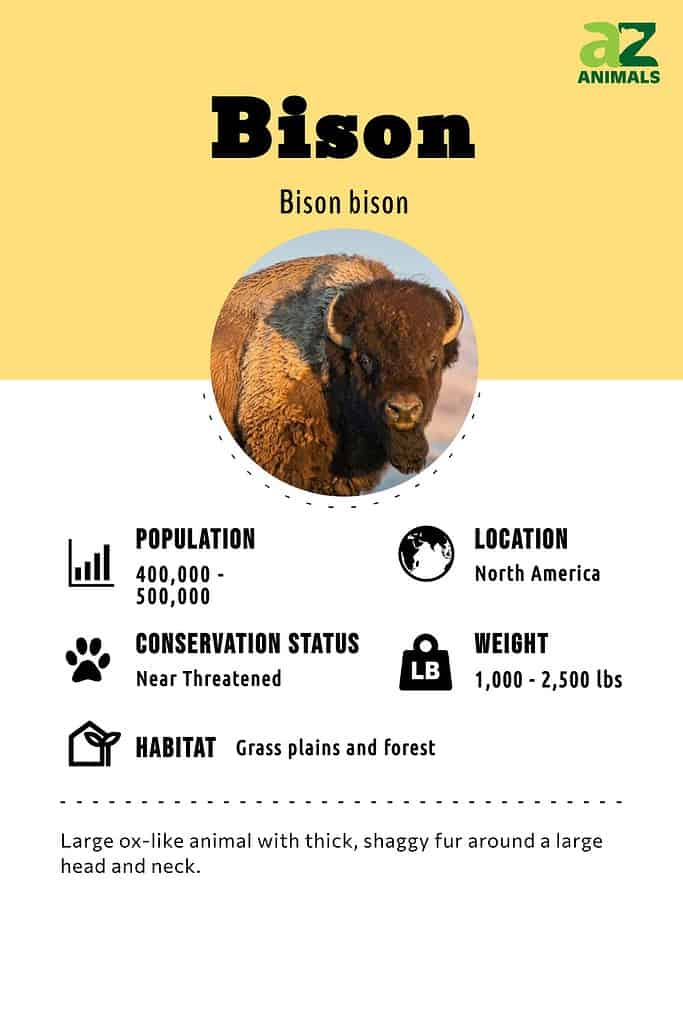


At the start of the 1800s, about 60 million bison roamed the forests, plains, and river valleys from Alaska to Mexico. By 1889, only about 635 remained in the wild leading President Roosevelt’s administration to add them to the protected species list. Today, thanks to educational and re-population efforts, wild bison numbers have swelled to about 20,500. They are considered “one of the greatest conservation success stories of all time.”

Four Interesting Facts About Bison

  • Large and in Charge: Bison, which are technically a type of cow, are the largest terrestrial mammals in North America. But don’t let their lumbering size fool you. Bison can reach running speeds of 40 miles per hour!
  • Official Status: Bison is the official national mammal of the United States, and November 1st is National Bison Day.
  • Cross-Breeding with Cows: Ranchers breed bison with cows, and the resulting animals are known as “beefalo” and “zubron.”
  • Singular and Plural: Bison is one of the few words in the English language where the singular and plural forms of the word are the same.

Scientific and Cultural Names
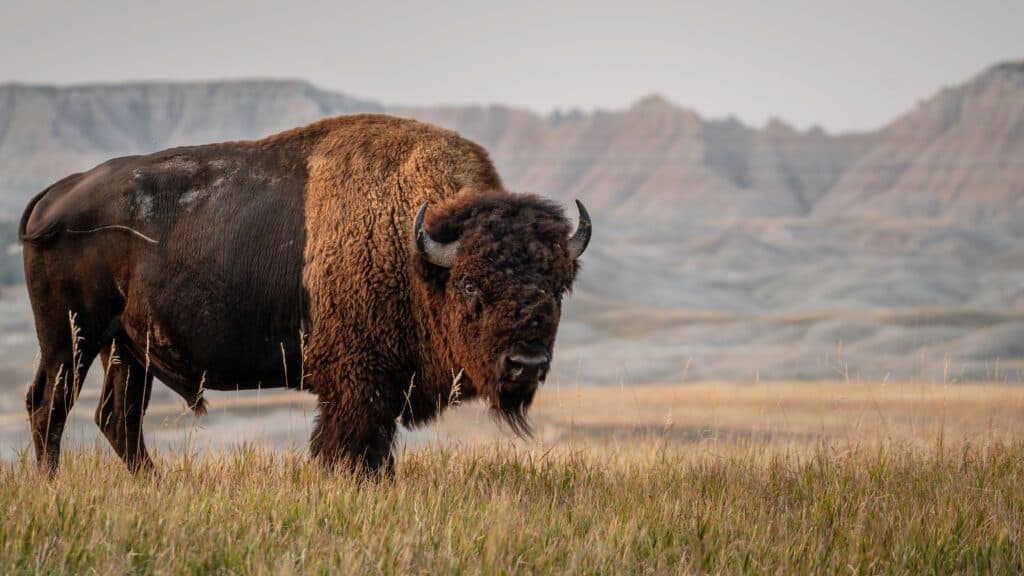
american bison

Tatanka is the Siouan word for bison, which translates to “big beast.”

The word “bison,” which means “wild ox,” has Latin, Proto-Germanic, and Middle English linguistic roots.

You may hear people call bison “buffalo” or “American buffalo.” Though common, it’s a bit of a misnomer because bison are a far-distant relative to actual buffalo and water buffalo that live in Africa and Asia. French Explorer Samuel de Champlain is thought to be the person who mistakenly labeled bison as buffalo when adventuring across North America in the 18th century. 

In Europe, bison are also known as wisent. Though linguists aren’t 100 percent positive about the word’s roots, most agree it stems from a Slavic or Baltic term meaning “the stinking animal.”

In Siouan languages, spoken by Lakota and Sioux peoples, the word for bison is “tatanka,” which translates to “he who owns us” or “big beast.”

Species

American Bison (Bison bison bison)

There are two types of bison. The first carries the scientific name Bison bison bison, and they live primarily in North America – in scrubland and river valleys. They are covered in hair except for a less hairy tail and have large horns that point upwards and sideways. They weigh between 800 – 2,800 pounds and can stand as high as 6 ft 7 in at the shoulder. American bison are easier to tame than their European counterparts and can be bred with cattle. American bison can be divided into two sub-species – the plains bison (B. bison bison) and the wood bison (B. bison athabascae).

European Bison (Bison bison bonasus)

The second type is known scientifically as Bison bison bonasus, and they live mainly in Europe. These bison are less hairy than American bison, although their tails are hairier. Weighing between 935 – 2,030 pounds and standing up to 6 ft 11 in at the shoulder, European bison are a little smaller than American bison. With forward-pointing horns and an ornery disposition, European bison are more difficult to tame.

Evolution
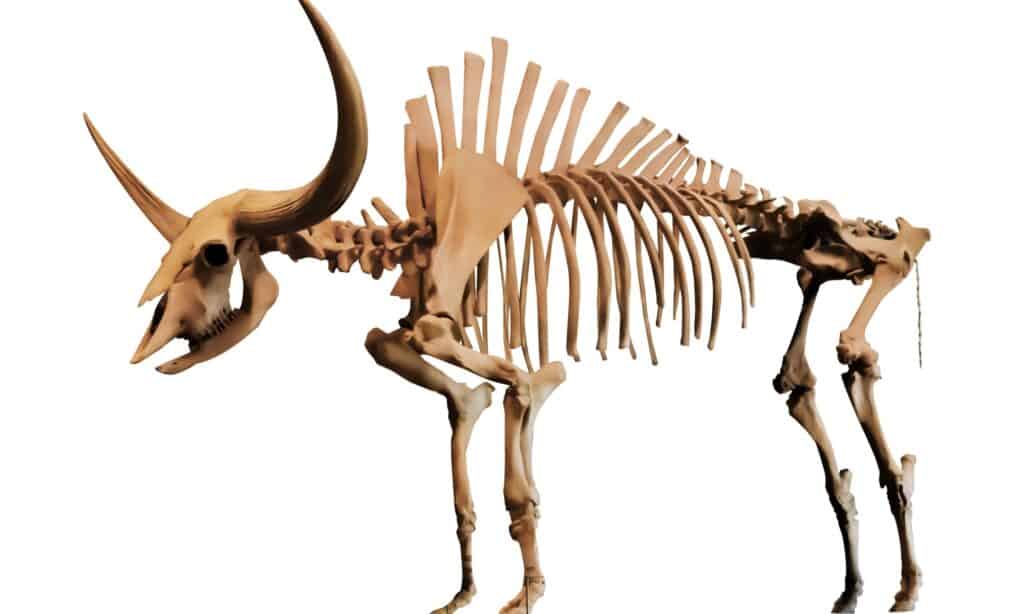
Bison latifrons lived in North America during the Pleistocene epoch and was the largest bovid to ever live in North America.

North American bison are part of the Bovini group which includes cattle, yaks, zebu, wiset (the European bison), and gaur. Although relationships between species are complicated and unresolved, it is agreed that the closest ancient ancestor of the bison is bison antiquus.

The bison genus first appeared in southern Asia around 2 million years ago. Bison priscus lived in northern Eurasia and Alaska and may have been the dominant hoofed mammal during their time. These animals immigrated to North America during the Pleistocene Epoch(240,000 – 220,000 years ago) by way of the Bering land bridge during times of low sea levels.

Bison latifrons evolved from B. priscus with the former leading to bison antiquus. The last appearance of bison antiquus in North America was around 10,000 years ago. These animals led to the modern American Plains Bison.

Bison Appearance
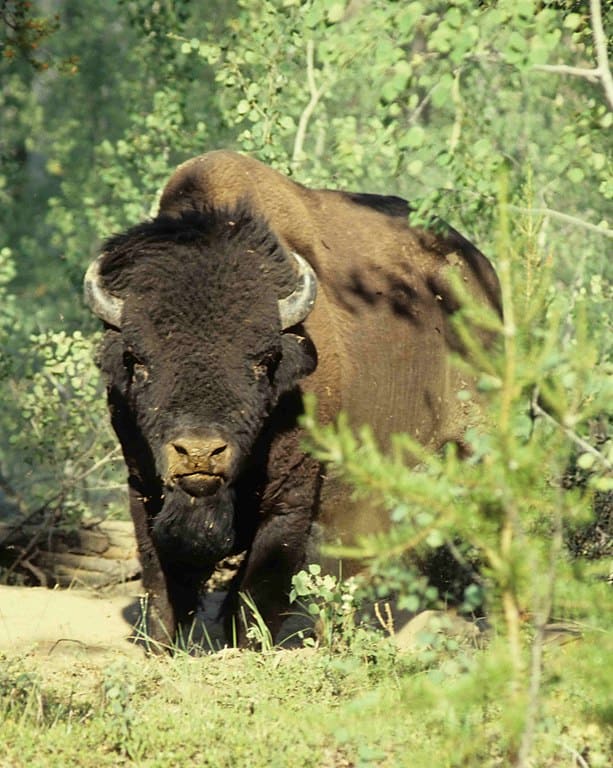
Picture of adult bison

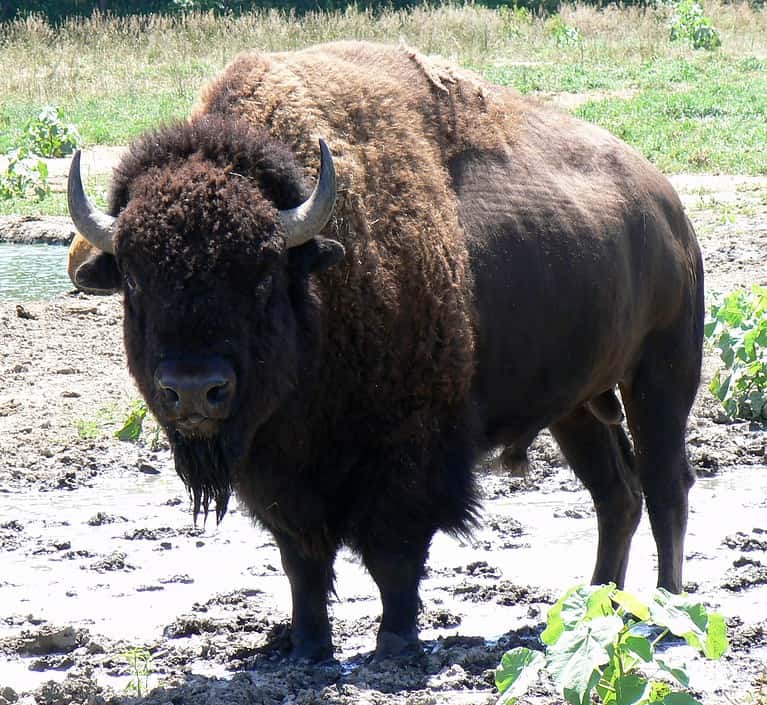
Bison are enormous animals with two large horns.

The average adult found in North America is two meters — or 6 feet 2 inches — tall. That’s taller than basketball legend Michal Jordan! Lengthwise, they can reach 3 meters, which is 11 feet. European bison are slightly taller but squatter, measuring 2.1 meters — or 6 feet 11 inches — tall and 2.9 meters — or 9 feet 6 inches — long.

When it comes to weight, American bison tip the scales between 400 and 1,270 kilograms, which calculates to about 880 and 2,800 pounds. European bison typically fall between 800 and 1,000 kilograms, or 1,800 to 2,200 pounds. To put it another way, bison weigh about as much as a car.

Cold-weather bison sport long and shaggy hair. Ones that live in warmer climates have shorter fur. When born, bison are a red-orange color. At around two months old, the red starts turning into dark brown. In colder months, bison grow thicker fur coats that they shed in the summer months.

Bison fall into the artiodactyl category of animals, meaning they have cloven hooves. And though they are huge animals, they’re also fast and can reach speeds up to 40 miles per hour. As a comparison, the average human runs between 8 and 10 miles per hour. Elite athletes, like marathon superstar Eliud Kipchoge, run at about 13 miles per hour.

American Bison v. European Bison
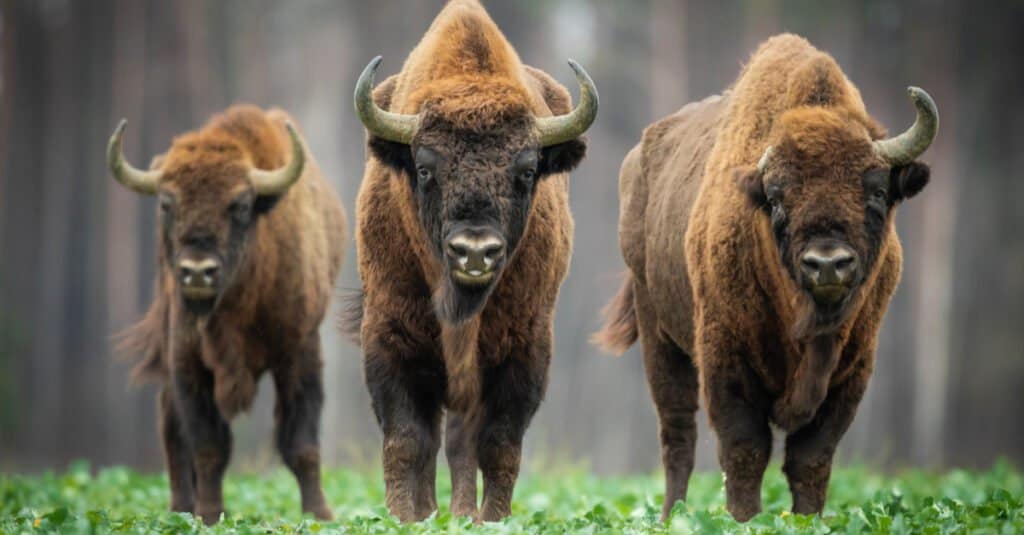
European Bison

European bison lack the shaggy fur around their heads and necks of American bison.

The American and European bison are very similar animals but do have a few small differences.

For starters, American and European bison are animals that live in slightly different habitats. The former tend to roam in open plains and mountain regions while the latter congregate in woody forests. Behaviorally, American plains bison are easier to domesticate than European wood bison.

Additionally, American bison fur is typically longer than its European counterpart. However, European bison’s tails are hairier than American bison’s tails. Additionally, American bison tend to graze and eat low-lying vegetation and grass. European ones, on the other hand, are browsers, which means they feed mostly on leaves, shoots, and hanging fruits.

European and American bison also have small anatomical differences. American ones have 15 ribs and European ones have only 14. American buffalo has four lower spine discs while their European counterparts have five. Lastly, European bison have slightly longer legs and necks than their American cousins.

Largest Bison Ever

In 2007, a hunter in Wyoming’s Bridger-Teton National Forest killed an area bison known as “Old Lonesome,” who was believed to have the largest recorded horns of the species. From tip to tip, Old Lonesome’s horns measured 32 inches. Individually, each horn was about 19 inches. 

Today, cattle farmers raise bison for meat. The largest recorded one weighed in at 3,801 pounds or 1,724 kilograms. The heaviest wild bison ever recorded weighed 2,800 pounds or 1,270 kilograms.

Behavior
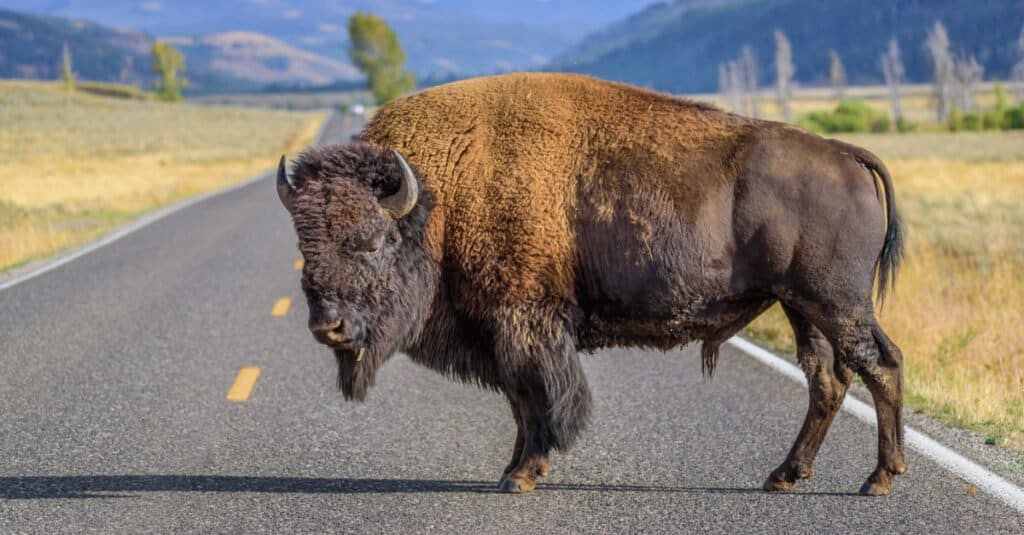
American bison in the middle of the road

American bison are easier to tame than their European counterparts.

At times bison are peaceful and lazy. Other times, they can be bold and dangerous without warning. Mothers grow especially protective if they sense a threat near their calves. Humans should not get closer than 25 feet to bison at a minimum. 

Bison generally live in gender-specific herds for part of the year. When male bison — or bulls — reach two years old, they leave their mothers and join a male pack called a “bachelor herd.” Female herds are usually larger than male ones and have a matriarch that makes the big decisions, like where to graze and when to sleep. Every year, female and male herds join up for the mating season.

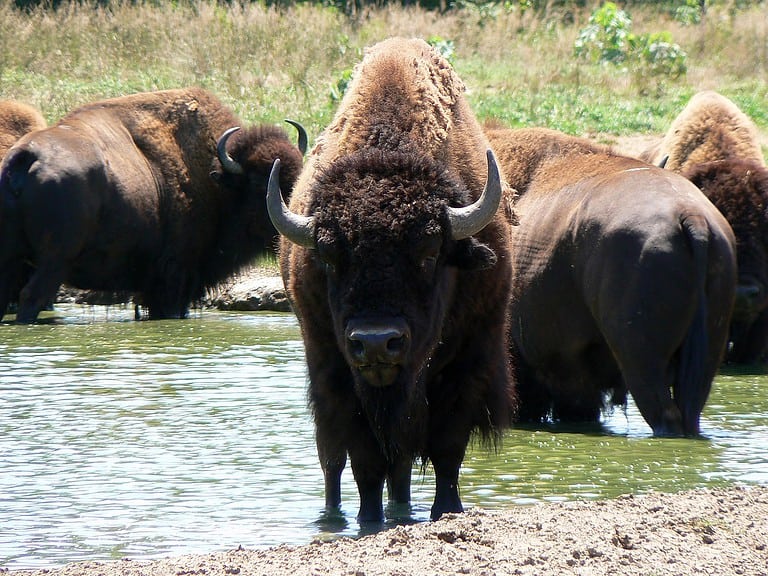
Bison like to wallow. No, that doesn’t mean they sit around feeling sorry for themselves. Wallowing is when animals roll around in mud, water, or dust. They engage in this behavior for several reasons. Sometimes they use wallowing as an astringent to soothe their skin or as a temperature control tool. Other times they do it for fun and to attract partners during mating season. Wallowing, however, can prove fatal to bison if they do it in a spot infected with anthrax spores.

Habitat

Today, wild bison live in North America, and Europe, and a small herd roam in Russia. In North America, herds mostly stick to the Great Plains west of the Mississippi River and tall-grass plains and east of the Rocky Mountains.
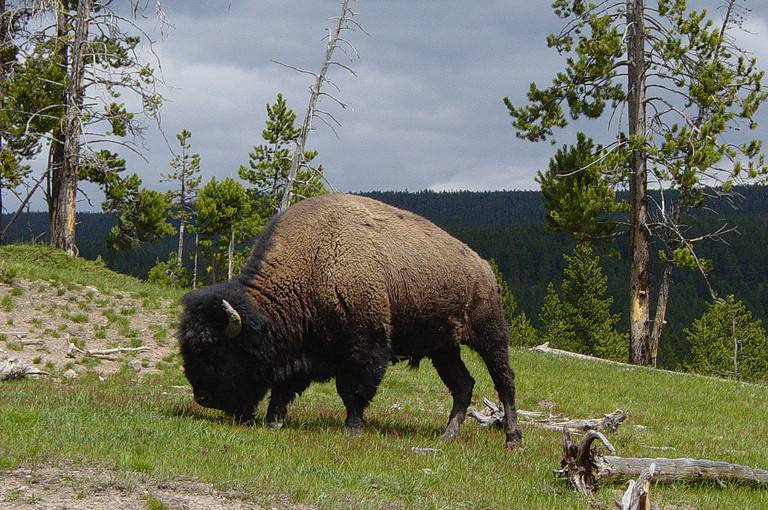
Yellowstone’s bison herd are ancestors of original native animals.


Purebred American buffalo herds live in the following regions:

  1. Yellowstone National Park in Wyoming and small sections of Utah and Idaho
  2. Wind Cave National Park in South Dakota
  3. Blue Mounds State Park in Minnesota
  4. Elk Island National Park in Alberta
  5. Grasslands National Park in Saskatchewan
  6. The Henry Mountains in Utah

European bison mainly live in wooded areas.

Diet: What Do Bison Eat?
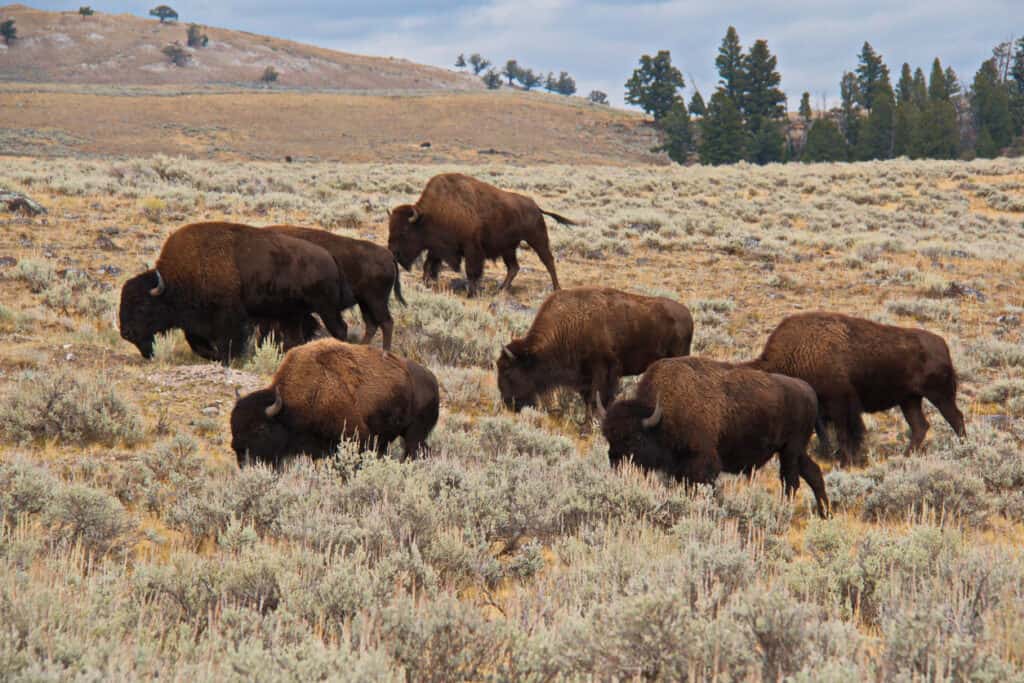
Bison roaming in field

A bison’s diet consists of 93% grass.

American Bison are nomadic vegetarians. Their diet consists of 93 percent grass, 5 percent flowering shrubs, and 2 percent vegetation that hangs from trees. To remain healthy, bison must eat 1.6 percent of their body mass per day, which averages to about 24 pounds of daily vegetation — or two bowling balls worth of grass and plants!

Bison migrate with the vegetation and go where the most nutritious options grow based on the time of year. Like other livestock, they need to avoid toxic plants, like hemlock, arrowgrass, death camas, and milk vetch. 

Bison have a ruminant digestive system, meaning they can ferment and isolate nutrients in a special compartment in their stomachs. 

Predators and Threats
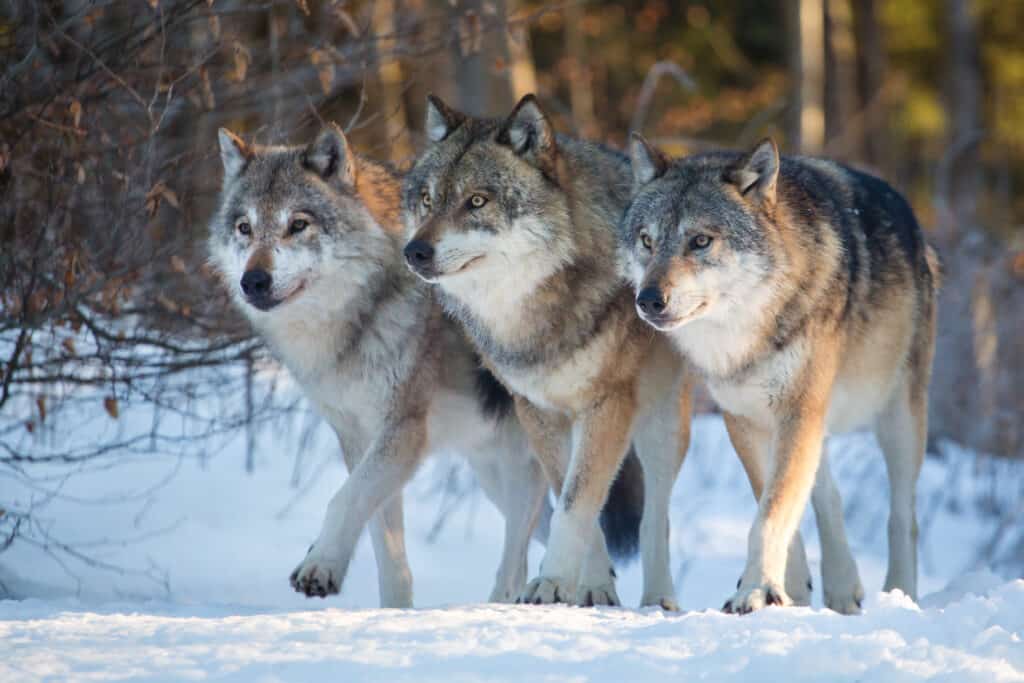
Wolf pack

Wolves prey on bison.

Wolves, cougars, bears, and humans hunt and prey on bison.

In North America, before the 1800s, native tribes responsibly hunted bison for sustenance. They used nearly every part of the animal to support entire communities. When settlers started heading west, several factors decimated the bison population. Technological advances, like railroads, mines, and factories, encroached on bison’s habitats and introduced diseases that proved fatal to the species. Collectively, the events are known as “the great bison slaughter of the 19th century.”

So that raises the question: Are bison endangered? The answer depends on the region.

Though bison were once a protected species in the United States, they are no longer rated that way. However, organizations like the Buffalo Field Campaign maintain lobbying efforts to get them added to the list. Additionally, the World Wildlife Foundation and International Union for Conservation of Nature list bison as “near threatened.” 

Unlike the United States, Canada lists wood bison on its endangered list.

Reproduction, Babies, and Lifespan
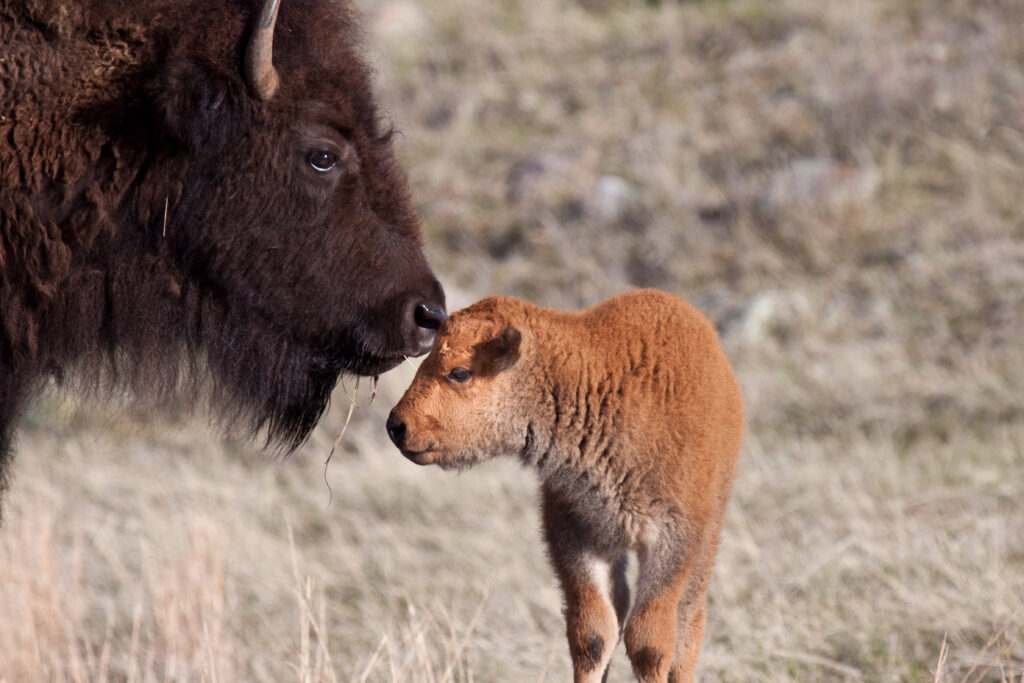
Calf and Mother Bison

Bison calves are born with red coats.

Mating

Bison mating season is called “rutting season” or “the rut.” It kicks off in June and ends in September. As mammals, female bison — called “cows” — have live births and gestate for about 285 days, which is about the same as humans. They’ve got it easier than elephants, though, who remain pregnant for nearly two years. Also, like people, bison typically only have one child at a time, but twins do happen occasionally. Unlike humans, bison babies weigh a whopping 30 to 70 pounds or 14 to 32 kilograms.

To attract mates, bulls bellow and wallow, meaning they let out loud cries and roll around. They also headbutt and charge at each other as a show of strength to protect their ladies. Notice we didn’t say “lady.” That’s because bison are polygamous, meaning one male mate with several females, but females only mate with one male.

Bison can reproduce between the ages of 3 and 19. Cows who get pregnant after 8 years old are considered to have geriatric pregnancies.

Baby Bison Facts
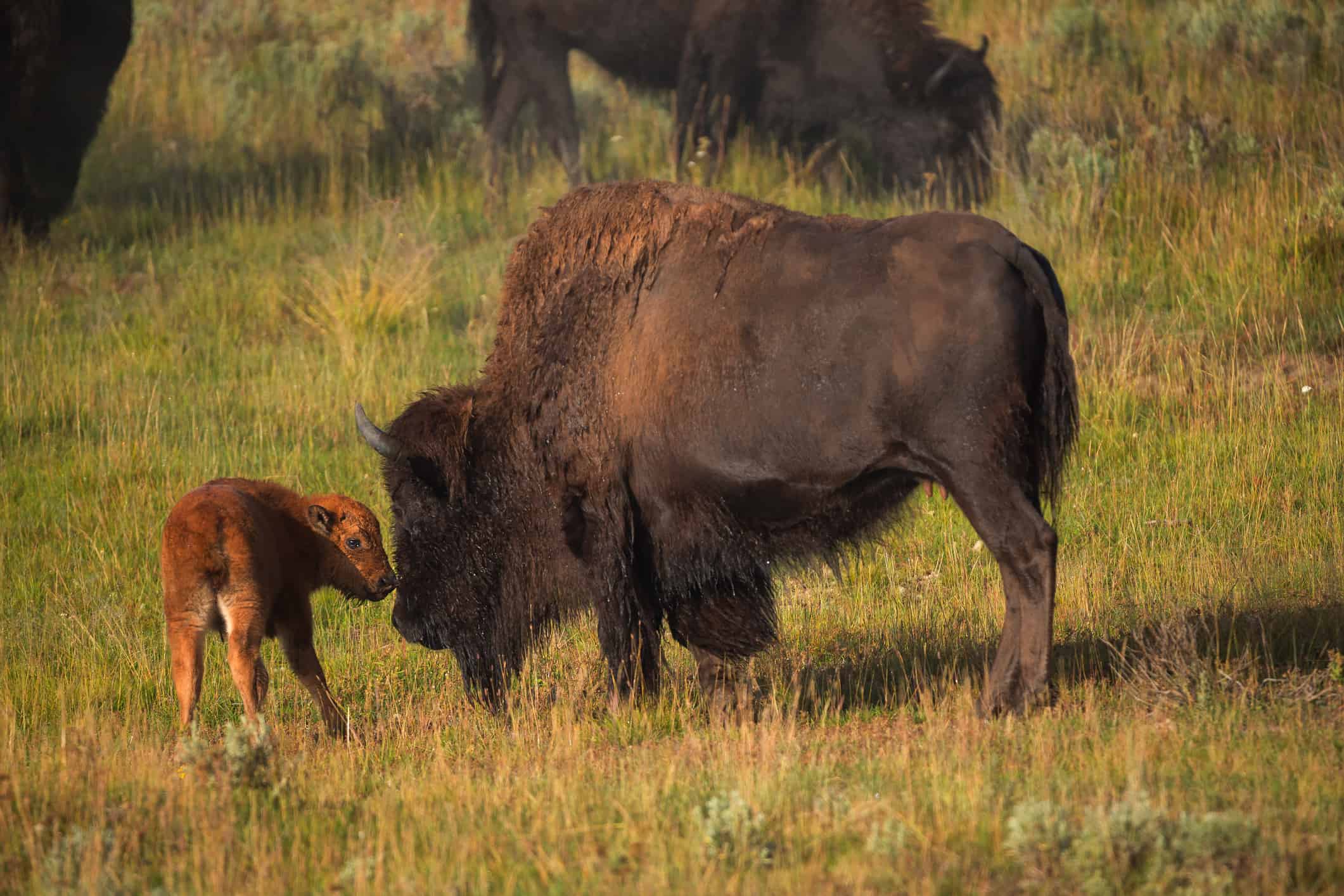
Bison with young calf

Bison calves stay with their mothers for two to three years.

Technically, a baby bison is a calf, but they’re commonly called “red dogs” because of their orange-reddish fur at birth. In their early months, mother cows produce milk for their babies and teach them how to graze for vegetation. Little ones typically stay with their mother’s herd for between two and three years before joining a bachelor herd. 

Lifespan

Wild bison have a lifespan of about 15 years; captive bison can live to about 25.

Population
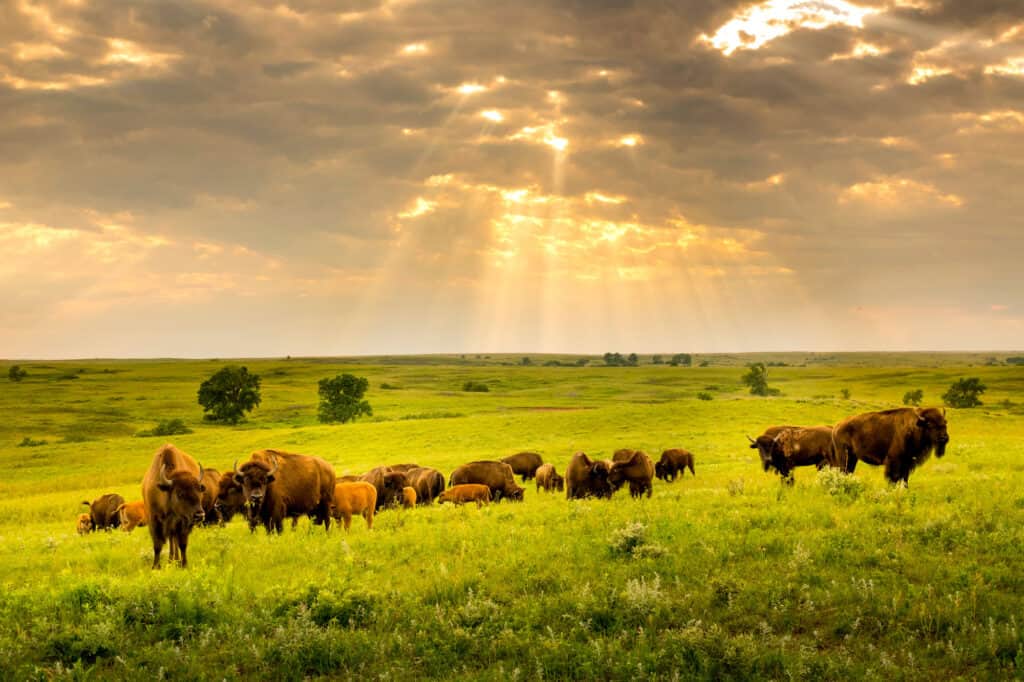
Bison Kansas

Thanks to conservation efforts, bison have gone from near extinction to a population of over 500,000.

During the 1800s, westward expansion and overzealous hunting reduced the bison population close to extinction in North America. As entertainment, some train companies offered hunting-by-rail trips where men would stand atop rail cars and shoot bison. Today, thanks to education and conservation efforts, about 20,500 wild purebred bison and 500,000 bison-cattle hybrids call the United States and Canada home. About 600 bison live in Europe and a small section of Russia.

Interestingly, the 1986 Chornobyl disaster played a role in the recent resurgence of wisents in Europe. After the nuclear disaster in the region, officials created the Chornobyl Exclusion Zone, which has turned into a makeshift wildlife preserve. The vegetation that now grows in the area proved beneficial to large mammals and has supported the regeneration of European bison and brown bears.

In the United States, in 1913, bison re-population efforts were aided by the New York Zoological Park — now known as the Bronx Zoo. As a gift to the federal government, the zoo put 14 bison on a train west to the Black Hills of South Dakota. From there, they were loaded onto another train and let loose in the plains. Those 14 American buffalo are the ancestors of the bison that now roam in Yellowstone National Park.

View all 453 animals that start with B
How to say Bison in ...
Bulgarian
Бизони
Catalan
Bisó
Czech
Bizon
German
Bisons
English
Bison
Esperanto
Bizono
Spanish
Bison
Finnish
Biisonit
French
Bison
Galician
Bisonte
Croatian
Bizon
Hungarian
Bölény
Indonesian
Bison
Italian
Bison
Japanese
バイソン属
Latin
Bison
Dutch
Bison (geslacht)
English
Bison
Polish
Bison (zwierzęta)
Portuguese
Bisonte
English
Bizon
Swedish
Bison (släkte)
Turkish
Bizon
Vietnamese
Bò rừng bizon
Chinese
美洲野牛属

Sources

  1. David Burnie, Dorling Kindersley (2011) Animal, The Definitive Visual Guide To The World's Wildlife / Accessed December 16, 2008
  2. Tom Jackson, Lorenz Books (2007) The World Encyclopedia Of Animals / Accessed December 16, 2008
  3. David Burnie, Kingfisher (2011) The Kingfisher Animal Encyclopedia / Accessed December 16, 2008
  4. Richard Mackay, University of California Press (2009) The Atlas Of Endangered Species / Accessed December 16, 2008
  5. David Burnie, Dorling Kindersley (2008) Illustrated Encyclopedia Of Animals / Accessed December 16, 2008
  6. Dorling Kindersley (2006) Dorling Kindersley Encyclopedia Of Animals / Accessed December 16, 2008
  7. David W. Macdonald, Oxford University Press (2010) The Encyclopedia Of Mammals / Accessed December 16, 2008
Austin S.

About the Author

Austin S.

Growing up in rural New England on a small scale farm gave me a lifelong passion for animals. I love learning about new wild animal species, habitats, animal evolutions, dogs, cats, and more. I've always been surrounded by pets and believe the best dog and best cat products are important to keeping our animals happy and healthy. It's my mission to help you learn more about wild animals, and how to care for your pets better with carefully reviewed products.
Connect:

Thank you for reading! Have some feedback for us?


Bison FAQs (Frequently Asked Questions)

No, the main difference that separates bison vs. ox is that bison are two distinct species that live in North America and Europe while ‘ox’ is a term generally used to refer to castrated male cows.