


B
Species Profile

Bonobo

Pan paniscus

DRC's "make-peace" great ape
GUDKOV ANDREY/Shutterstock.com

Bonobo Distribution

Click a location to explore more animals from that region

Endemic Species
Loading map...

Size Comparison

Human 5'8"
Bonobo 2 ft 7 in

Bonobo stands at 46% of average human height.

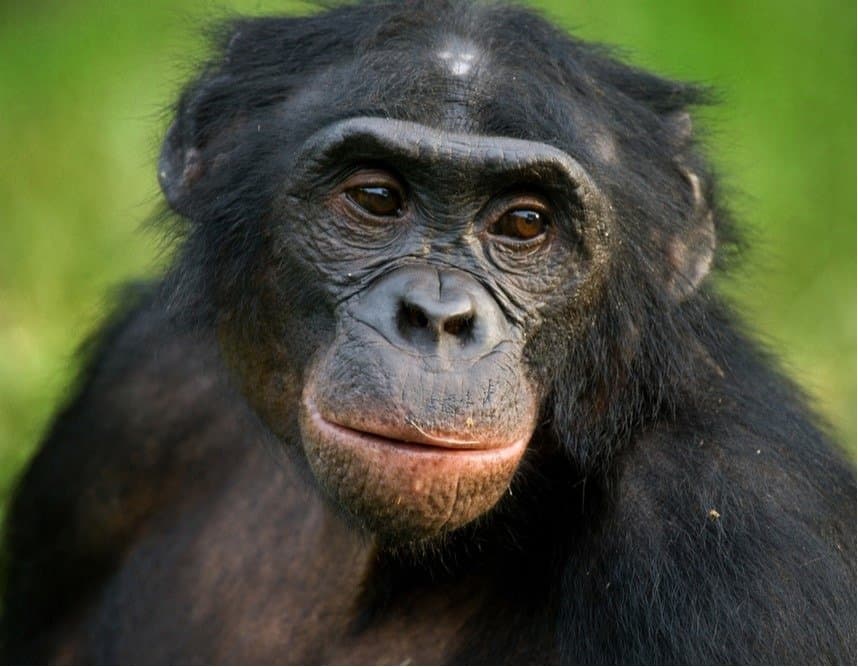
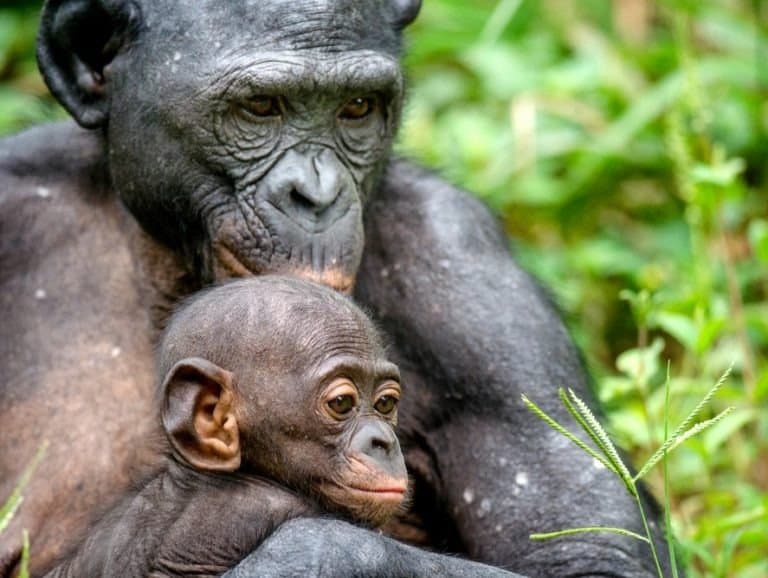
Portrait of bonobos. Democratic Republic of Congo.

At a Glance

Wild Species
Also Known As Pygmy chimpanzee, Pygmy chimp, Dwarf chimpanzee, Dwarf chimp
Diet Omnivore
Activity Diurnal
Lifespan 35 years
Weight 46 lbs
Status Endangered
Did You Know?

Endemic range: bonobos live only in the Democratic Republic of the Congo, primarily south of the Congo River-this river is a major barrier separating them from chimpanzees (Pan troglodytes).

Scientific Classification

The bonobo (Pan paniscus) is a great ape endemic to the Democratic Republic of the Congo, known for high social cohesion, relatively reduced aggression compared to chimpanzees, and frequent socio-sexual behaviors used in bonding and conflict reduction.

Kingdom
Animalia
Phylum
Chordata
Class
Mammalia
Order
Primates
Family
Hominidae
Genus
Pan
Species
paniscus

Distinguishing Features

  • Endemic range restricted to areas south of the Congo River (geographic barrier separating it from chimpanzees)
  • Generally more gracile build than chimpanzees, with relatively longer legs
  • Dark face with pinkish lips; often a central part in head hair forming a “cap” look
  • Highly social, female-bonded societies with frequent affiliative behaviors

Physical Measurements

Males and females differ in size

Height
2 ft 7 in (2 ft 4 in – 2 ft 11 in)
Weight
88 lbs (75 lbs – 99 lbs)
73 lbs (60 lbs – 84 lbs)
Top Speed
16 mph
About 25 km/h, not certain

Appearance

Primary Colors
Secondary Colors
Skin Type Mammalian skin with dense body hair; face, ears, palms/soles, and parts of the anogenital region are sparsely haired to bare and strongly pigmented. Female anogenital 'sexual skin' is elastic and becomes markedly swollen during estrus.
Distinctive Features
  • Overall build is relatively slender compared with common chimpanzees, with proportionally longer legs and a more upright posture during bipedal bouts; long arms and grasping hands and feet typical of great apes.
  • Adult facial morphology: dark, relatively hairless face with less pronounced supraorbital ridging than common chimpanzees; small, rounded ears; prominent, often pinkish lips are frequently noted in field descriptions.
  • Cranial hair commonly parts along the midline in adults, producing a neat, 'center-part' appearance; this is a common visual field cue distinguishing many bonobos from many chimpanzees (though not absolute).
  • Body size (commonly reported ranges): head-body length ~70-83 cm; adult mass often reported around ~27-38 kg (females) and ~39-45 kg (males), indicating comparatively modest sexual size dimorphism for a great ape.
  • Tail absent; nails (not claws); dark, leathery palms and soles adapted for arboreal climbing and terrestrial knuckle-walking (knuckle-walking calluses/skin thickening can be evident on hands).
  • Wild bonobos Pan paniscus live only in the DRC south of the Congo River in humid lowland and swamp forests; their dark coat and strong skin pigment help protect them from sun and scrapes.
  • Bonobos (Pan paniscus) often show lots of friendly touch and frequent socio-sexual behavior for bonding and easing tension. Aggression occurs, but strong female alliances shape group life.
  • Diet/habitat linkage: fruit-heavy omnivory (with leaves, pith, flowers, and invertebrates) in closed-canopy forest; visual appearance is typically of a dark, sleek-coated ape moving both arboreally and terrestrially in forest understory and mid-canopy.
  • IUCN lists bonobo (Pan paniscus) as Endangered. Main threats: habitat loss and fragmentation, hunting for bushmeat, and political unrest that makes protection harder.

Sexual Dimorphism

Sexual dimorphism is present but relatively reduced compared with many other primates: males average somewhat larger and more robust, while females exhibit conspicuous anogenital swellings ('sexual skin') during estrus; both sexes have generally similar dark pelage and overall coloration.

  • On average greater body mass/robustness than females (commonly cited adult male masses ~39-45 kg versus females ~27-38 kg).
  • External genitalia visible: scrotal skin can appear lighter/pinker in some individuals relative to surrounding dark skin; degree varies individually and with lighting.
  • Prominent pink anogenital swelling during estrus (size/intensity cyclically variable), a key visual cue in social/behavioral contexts.
  • Females often appear slightly smaller/slimmer on average; otherwise pelage coloration and general facial features are broadly similar to males.

Did You Know?

Endemic range: bonobos live only in the Democratic Republic of the Congo, primarily south of the Congo River-this river is a major barrier separating them from chimpanzees (Pan troglodytes).

Adult size (typical): head-body length ~70-83 cm; adult mass commonly ~27-38 kg (females) and ~34-46 kg (males), making them more gracile than chimpanzees.

Gestation is about ~240 days (≈8 months), and interbirth intervals are long-often ~4-6 years-reflecting slow great-ape life histories.

Bonobos build a new sleeping nest almost every night in trees, and infants ride clinging to mothers for years.

Diet is strongly fruit-centered when available, but they also eat leaves, pith, flowers, seeds, and invertebrates; hunting occurs but is generally less frequent than in many chimpanzee populations.

Female-female genital rubbing (GG rubbing) is a well-documented bonobo behavior used in social bonding and tension reduction, especially around feeding and reconciliation.

Unique Adaptations

  • Extended sexual swelling and socio-sexual signaling: females can show sexual swellings for long periods (including outside peak fertility), which helps maintain social bonds and reduce male monopolization.
  • Gracile build and locomotion: relatively long legs and a slimmer build support efficient travel through rainforest understory and frequent climbing; they also show relatively common upright postures during displays and foraging.
  • High social tolerance toolkit: strong affiliative tendencies (grooming, contact, reconciliation) function as a behavioral adaptation that stabilizes group living in dense forest where feeding competition can be intense.
  • Cognitive flexibility typical of great apes: problem-solving, social learning, and occasional tool use (e.g., leaf sponges) support opportunistic foraging in complex rainforest habitats.
  • Slow life-history strategy: long juvenile dependence and long interbirth intervals allow extended learning in a socially complex society-key for navigating alliances and relationships.

Interesting Behaviors

  • Female alliances and social leverage: adult females commonly form coalitions that can collectively dominate males, shaping a more female-centered social dynamic than in many chimpanzee communities.
  • Socio-sexual conflict management: sexual behaviors (including GG rubbing, mounting, and genital contact in multiple pairings) are often used to reduce tension, facilitate sharing, and reconcile after disputes.
  • Food-related tolerance: compared with many chimpanzee communities, bonobos often show higher co-feeding tolerance and more frequent peaceful proximity at fruiting trees, where conflict risk is high.
  • Greeting and reassurance rituals: individuals use embraces, grooming, and socio-sexual contact as affiliative "reset" behaviors after excitement or conflict.
  • Vocal and gestural communication: bonobos use a rich mix of calls (including high-pitched peeps) and gestures; rapid exchanges can coordinate movement, reunions, and group decisions.
  • Fission-fusion grouping: like chimpanzees, bonobos split into smaller parties and rejoin; party size shifts with food availability and social context.
  • Male life strategy: males often gain status through their mother's rank and support (maternal assistance can strongly influence male social success).

Cultural Significance

Bonobo (Pan paniscus) is a flagship species for Congo Basin rainforest conservation and a symbol of empathy, cooperation, and human social evolution. Compared to chimpanzees for lower aggression and strong female bonds. Renamed from 'pygmy chimpanzee,' its species status increased its visibility in conservation and primatology.

Myths & Legends

Naming-origin anecdote: "bonobo" is widely linked to the Congo River town of Bolobo-often told as a label-reading or shipping mix-up story from early specimen history-becoming the enduring name for this newly recognized ape.

In Congo Basin stories, bonobos and other great apes are seen as close relatives or as people who moved into the forest long ago; these tales set rules and teach how to treat beings.

People often call bonobos (Pan paniscus) "peaceful apes" or "make-love-not-war." This modern story shapes how people imagine them and why they are used as symbols of cooperation.

Conservation Status

EN Endangered

Facing a very high risk of extinction in the wild.

Population Decreasing

Protected Under

  • IUCN Red List: Pan paniscus (Bonobo) - Endangered (EN), population trend decreasing
  • CITES Appendix I (international commercial trade prohibited, with limited exceptions)
  • National legal protection in the Democratic Republic of the Congo (species protected under national wildlife/hunting regulations)

Life Cycle

Birth 1 infant
Lifespan 35 years

Lifespan

In the Wild
25–45 years
In Captivity
30–49.3 years

Reproduction

Mating System Polygynandry
Social Structure Aggregation Group
Breeding Pattern Transient
Fertilization Internal Fertilization
Birth Type Internal_fertilization

Bonobo (Pan paniscus) mating is polygynandrous: many males and females mate with many partners year-round in fission-fusion groups. Sex is frequent for bonding and easing tension. Females have long anogenital swellings. Gestation ~240 days; births ~every 4–5+ years.

Behavior & Ecology

Social Troop Group: 50
Activity Diurnal
Diet Omnivore Ripe fruit (especially figs, where available)

Temperament

High social tolerance and cohesion relative to Pan troglodytes; feeding co-tolerance is often high and aggression is more commonly moderated via affiliation and socio-sexual contact (de Waal 1995; Furuichi 2011).
Female philopatry is absent; females typically disperse at sexual maturity, yet adult females often form strong alliances in the new community and can dominate or socially constrain male aggression (Kano 1992; Furuichi 2011).
Conflicts are frequently followed by reconciliation/appeasement behaviors (grooming, play, sexual contact), contributing to generally lower rates of severe within-community aggression; however, competitive aggression and intercommunity hostility can occur (Furuichi 2011; Wilson et al. 2014).
Bonobos (Pan paniscus) in the wild often live around 40 years, and in captivity over 50 years, which allows long-term bonds and male social paths shaped by their mothers' lines.

Communication

High-pitched peeps/peep-yelps used in coordination and social contexts Common in Pan
Screams and alarm calls during disturbances and aggression.
Grunts/soft calls during close social interactions Feeding, grooming, approaches
Hoot-like long calls used for spacing/coordination Bonobo long-call repertoire differs in usage and structure from chimpanzee pant-hoots; described across field studies such as Bermejo & Omedes 1999 and subsequent work
Gesture-based communication (manual/arm gestures, reach/hand-extend, directed displays) used in play, solicitation, and coordination; flexibility and intentional use are documented in Pan.
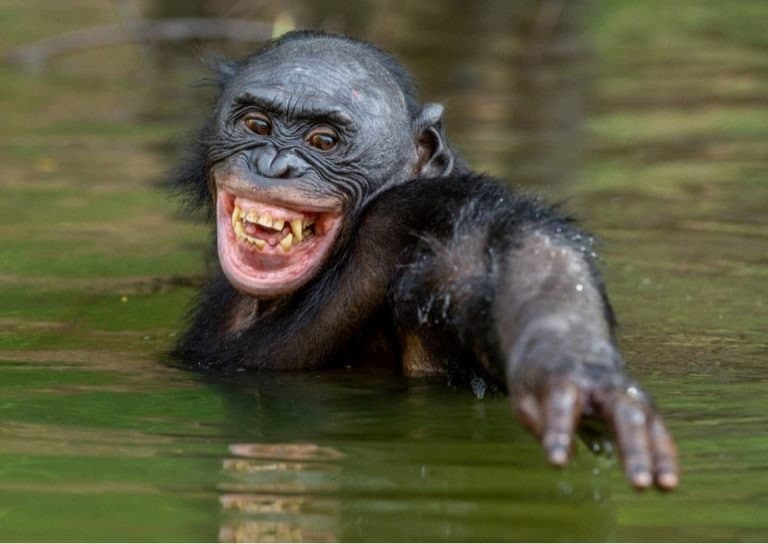
Facial expressions (play face, bared-teeth, pout) and body postures for affect and intent signaling.
Grooming as both hygiene and social signaling Bond maintenance, alliance reinforcement
Socio-sexual contact Including genito-genital rubbing, ventro-ventral copulation) functioning as a communicative/ritualized affiliative signal and conflict mitigation mechanism (de Waal 1995; Hohmann & Fruth 2000
Tactile contact (embracing, holding, play wrestling) common in reassurance and bonding.
Auditory displays such as branch shaking and ground/vegetation slapping to signal arousal, status, or to recruit attention Common in great apes

Habitat

Biomes:
Tropical Rainforest Wetland
Terrain:
Plains Riverine Muddy
Elevation: Up to 4921 ft 3 in

Ecological Role

Forest frugivore-omnivore that functions primarily as a major seed disperser with secondary roles as an invertebrate predator and occasional small-vertebrate predator.

Seed dispersal of many tropical tree and liana species via endozoochory (ingestion and defecation of viable seeds), promoting forest regeneration and plant gene flow Pruning/herbivory effects on vegetation through leaf/shoot/THV consumption, influencing understory dynamics Regulation of some invertebrate populations through predation on termites/ants/caterpillars Nutrient redistribution via movement and deposition of feces (localized fertilization)

Diet Details

Main Prey:
Fruit Ant Caterpillar Earthworm Termites Small vertebrates
Other Foods:
Ripe fruits Young leaves Leaves, petioles and shoots Pith and stems Flowers Seeds Bark Mushrooms +2

Human Interaction

Domestication Status

Wild

Bonobo (Pan paniscus) is not domesticated; all are wild or captive (zoos, sanctuaries, research). Slow having babies and long lives mean captivity doesn't equal domestication. Humans interact through habitat loss and hunting in the DRC, protected areas and trade enforcement, zoo and sanctuary care of social groups, and research and public education with welfare and disease risks.

Danger Level

High
  • Severe bite and crush injuries: bonobos are powerful great apes; even juveniles can inflict serious trauma, and adults can cause life-threatening injuries if threatened, stressed, or improperly managed.
  • Unpredictable aggression under captivity or human-imposed stressors despite species-typical lower reactive aggression relative to common chimpanzees (Pan troglodytes).
  • Zoonotic disease transmission (bidirectional): close contact raises risk for pathogens such as respiratory viruses, tuberculosis, hepatitis viruses, and enteric parasites; human-to-ape transmission is also a major welfare/conservation risk.
  • Handling/management hazards in facilities: escape risk, property damage, and injury during restraint/transport; requires specialized containment and trained teams.

As a Pet

Not Suitable as Pet

Legality: Bonobos (Pan paniscus) are mostly illegal to keep as pets. They are CITES Appendix I and Endangered under the U.S. ESA. Capture, trade, or private keeping usually needs permits and is nearly impossible.

Care Level: Expert Only

Purchase Cost: $20,000 - $100,000
Lifetime Cost: $500,000 - $2,500,000

Economic Value

Uses:
Conservation and biodiversity value Ecotourism and conservation-linked local livelihoods (where stable and permitted) Scientific and educational value (behavior, cognition, comparative psychology, anthropology) Zoo and sanctuary programs (public education, fundraising for conservation) Illegal wildlife trade (negative economic driver) Illegal bushmeat trade (negative economic driver)
Products:
  • non-consumptive tourism/visitor revenue (where feasible and regulated)
  • research outputs (scientific publications, comparative cognition data)
  • education/media content (documentaries, outreach materials)
  • conservation funding streams (grants, NGO programs, protected-area budgets)
  • illegal live-animal trade for private possession/display (prohibited)
  • illegal meat products from poaching (prohibited)

Relationships

Predators 5

African leopard Panthera pardus pardus
Nile crocodile
Nile crocodile Crocodylus niloticus
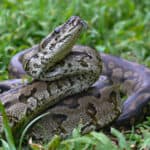
African rock python
African rock python Python sebae
Crowned eagle Stephanoaetus coronatus
Human
Human Homo sapiens

Bonobos, first discovered in the 1920s, were originally referred to as the pygmy Chimpanzee.

In fact, these great apes were not classified as their own species, separate from the common chimpanzee, until 1954. While like the chimpanzee, this species has a flatter and smaller head, longer legs, and a slender body.

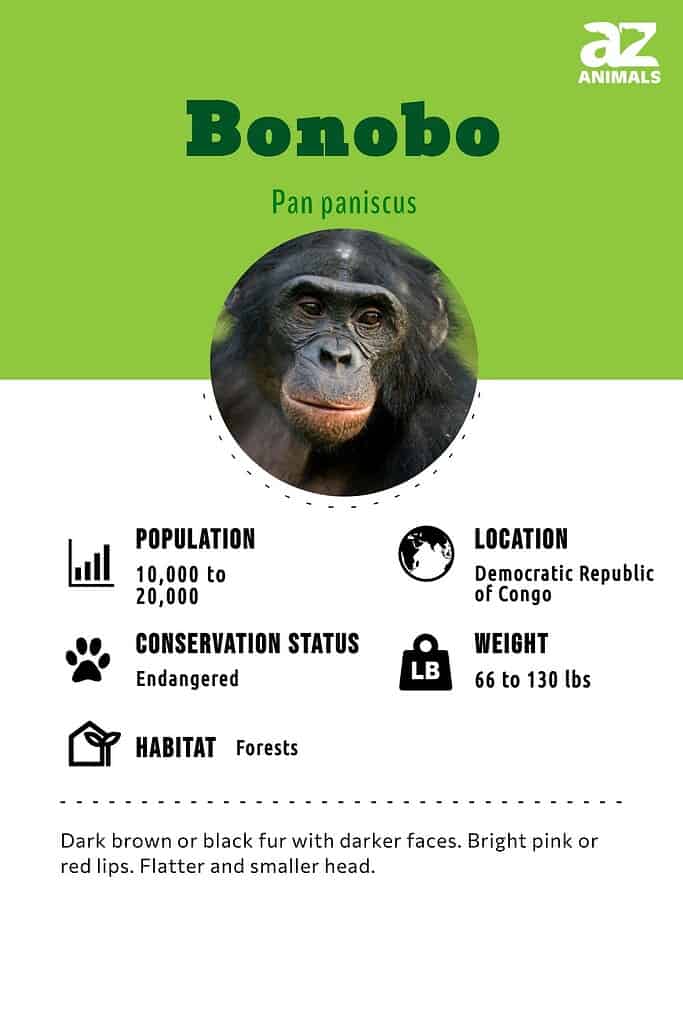
The bonobo is an animal that generally features dark brown or black fur and whiskers that hide its ears. The Bonobo has pink or red lips and 32 teeth. Its fur may turn silvery gray in older members of the colony. One of its most distinctive features is a tail tuft that the Bonobo keeps throughout its adult life.

This species generally lives in a matriarchal society of up to 100 individual apes. Male offspring typically stay with their mothers throughout their lives. Female Bonobos reach sexual maturity around 12 years of age and will then seek out a mate to form their own subgroup within the colony.

Deforestation and poaching have severely impacted the Bonobo population in central Africa. As of 2020, only between 10,000 and 50.000 of these apes are known to exist in the wild. These numbers are expected to dwindle even further as humans destroy more and more of their natural habitat.
5 Incredible Bonobos Facts!

  • Share 98.7% of their genome with humans, which makes them one of our closest living relatives.
  • First discovered in 1929 and did not become a separate species until the 1950s.
  • One of two species in the Pan genus along with the common Chimpanzee.
  • Can jump up to 27.5 inches into the air, while the average human has a 16-to-24-inch vertical jump.
  • Use the same sound or call to mean different things depending upon the context or situation.

Scientific Name

The Bonobo’s scientific name is Pan paniscus. It is one of only two living species in the Pan genus. The other species is the common Chimpanzee or Pan troglodytes.

Evolution And History
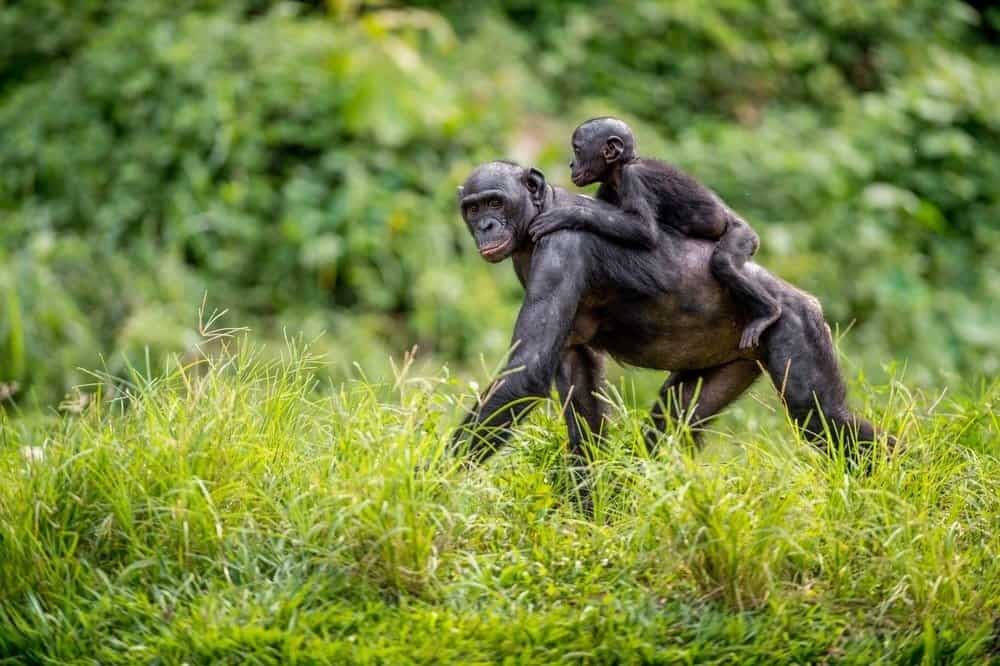
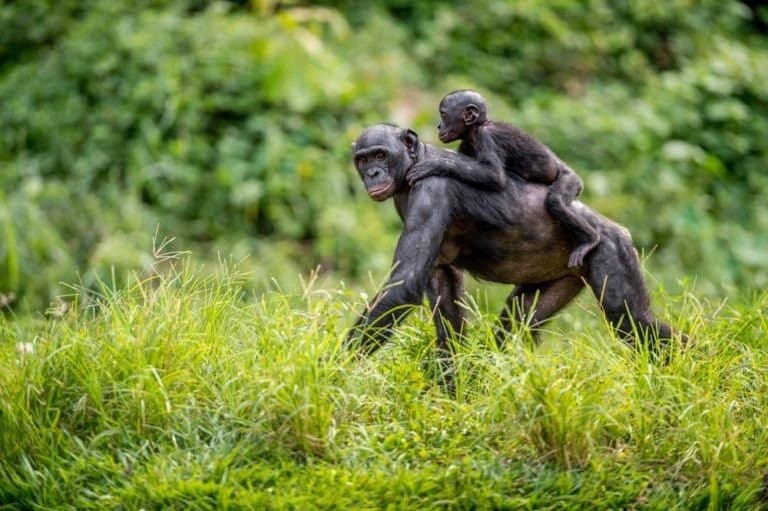
Bonobo Cub on the mother's back in natural habitat

Originally thought to be a chimpanzee, the bonobo is a separate species.

The closest living relative of humans, the bonobo, along with the chimpanzee, both evolved from the same common ancestor of apes around 1 to 2 million years ago. It is speculated that due to the formation of the Congo River, where these great ape relatives reside, both of these primate species were separated, which created the 2 species.

The bonobo was originally thought to be a chimpanzee and was called a pygmy chimpanzee but they are actually very different based on numerous traits, characteristics, and appearances.

Appearance And Behavior
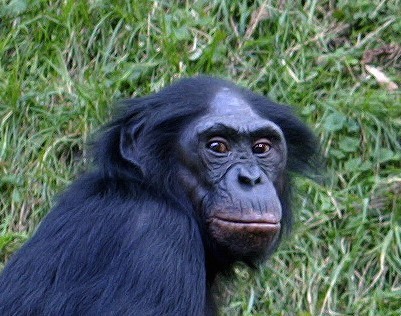
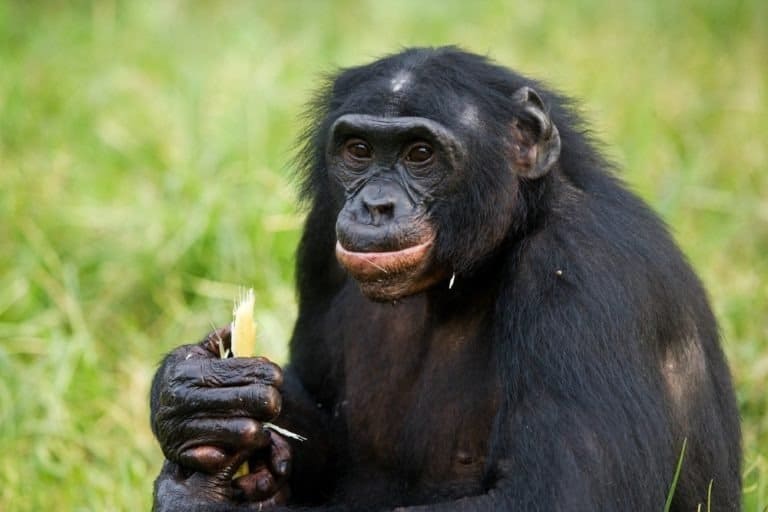
Bonobos, or pygmy chimpanzees, are animals with dark brown or black fur with darker faces. Their lips are bright pink or red, which gives them a distinct look. The Bonobo’s head is generally flatter and smaller than other great apes.

They stand between 28 and 35 inches and can weigh anywhere between 65 and 85 pounds. They are known for their long legs and for the fact that they keep their tail tufts even as adults.

Bonobos overall act peacefully in the wild. They have been recorded as showing altruistic tendencies and a willingness to share food, shelter, and necessities with other Bonobos. They also display compassion and empathy for wounded members of their communities.

Bonobos are also highly intelligent. Their communication includes a series of sounds that other apes must translate based on their current surroundings. Indeed, the same sounds can mean many different things depending on the context. They also use hand gestures to convey meaning and there are examples of Bonobos using these signals to communicate with humans.

Unlike most great ape species, the Bonobos live in a matriarchal society where a select group of elder females has the final say on where the group travels, when they eat, and other important decisions. Despite the maternal-centric nature of their culture, each community does typically have one alpha male that protects the group, leads foraging parties, and helps to determine when, where, and what to eat.

This alpha male can and does eat with the elder females. However, the other males will wait to eat until the matriarchs are finished. Interestingly, a male Bonobo often derives his status based on his mother’s position and standing in the hierarchy. As a result, the son of an elder female could outrank a young female Bonobo.
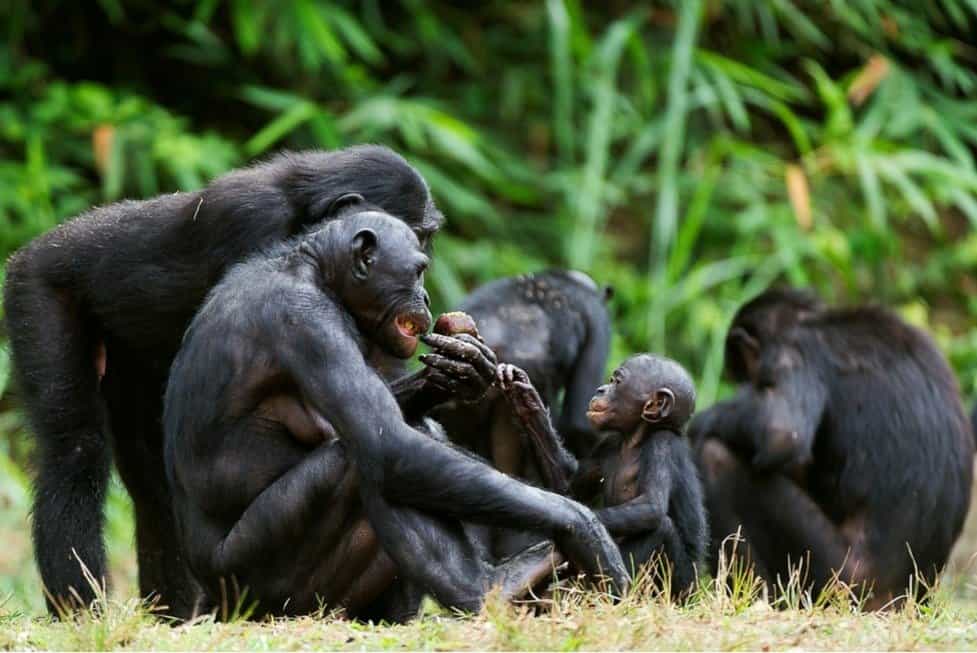
The Bonobo ( Pan paniscus) family, called the pygmy chimpanzee.

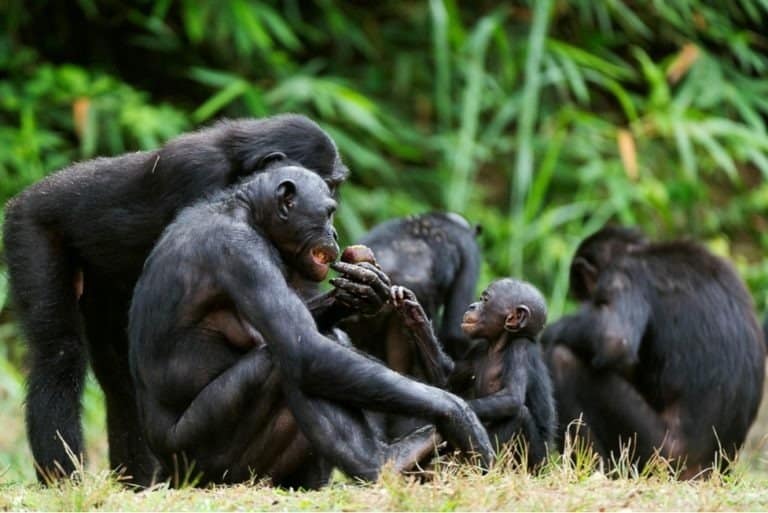
Bonobos live in a matriarchal society.

Bonobo Vs. Chimpanzee

Overall, Bonobos are remarkably like the common Chimpanzee. Both animals share 98.7% of their DNA with humans and they display some of the same social activities. For example, sexual activities are a critical component of the social interactions of both chimpanzees and Bonobos. Both monkeys use these activities to introduce themselves, reduce tension, and resolve conflict.

Despite these similarities, there are several physical and behavioral differences between the two species within the Pan genus. Full-grown male Chimpanzees are generally larger and bulkier than their Bonobo counterparts. Male chimps can grow as large as 154 pounds and stand up to 5.5 feet tall. Bonobos range in height between 28 and 35 inches and weigh between 65 and 85 pounds.

There are also significant behavior differences between the chimp and the Bonobo. Chimpanzees will actively go out in groups to hunt for meat. Bonobos subsist primarily on fruits, seeds, and other vegetation in their environment.

They will only eat meat when a small mammal, such as a rodent, is readily available. Even then, Bonobos do not use hunting parties. Instead, individual males may catch and bring back squirrels, small antelopes, or other vertebrates.

Chimpanzees have a much more rigid communal hierarchy than Bonobos do. In a group of chimps, there is one alpha male that leads everyone else. His offspring outrank other males and females in the group. Overall, the structure is very linear.

In contrast, Bonobos follow a matriarchy where males derive their position primarily from their mother’s status and relationships with the other elder females. Like chimps, they do have one alpha male that is responsible for protecting the group, but the elder females have significant input on where the community travels, what they eat, and when they eat.

The Bonobo alpha male generally tolerates other males well because he often does not know which juveniles are his direct offspring. Due to the promiscuous nature of this species, the mothers primarily raise the young and the males help to provide food for all infants and younger members of the community.

Habitat
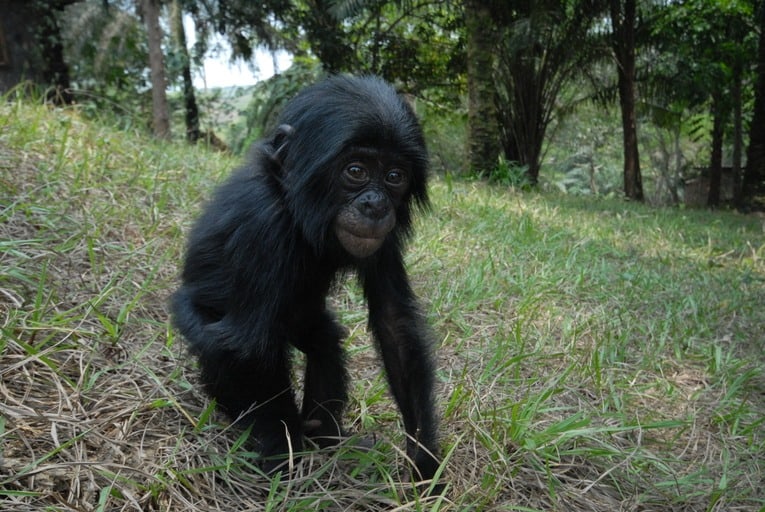
Bonobos are only found in the Democratic Republic of Congo.

Unlike other ape species, Bonobos are mainly found in one area of central Africa. They call the jungle forests between the Congo and Kasai rivers home. As a result, they are native to the region known as the Democratic Republic of Congo.

Diet
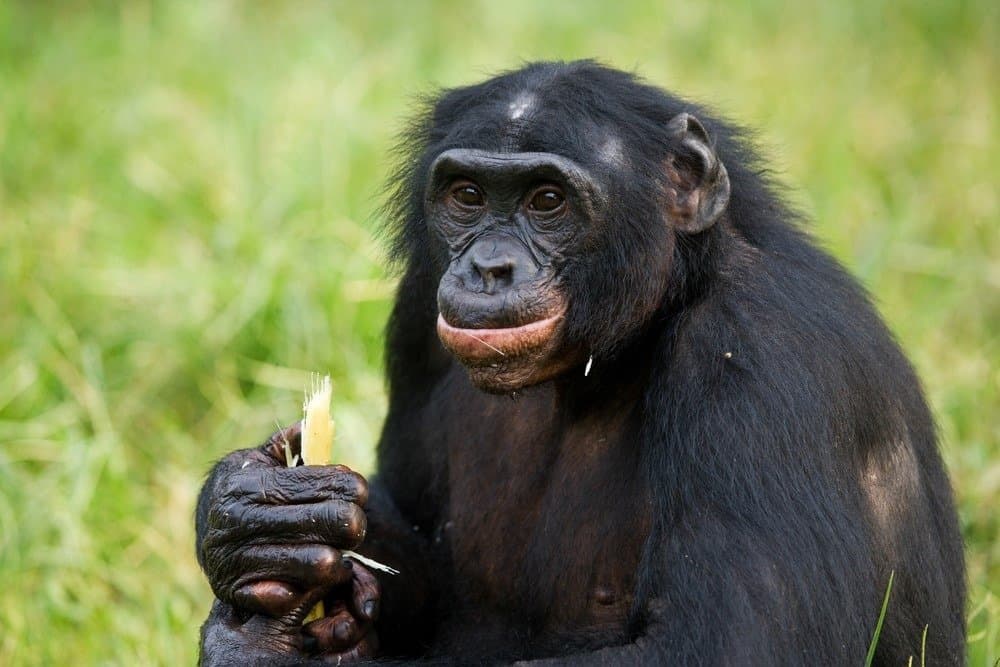
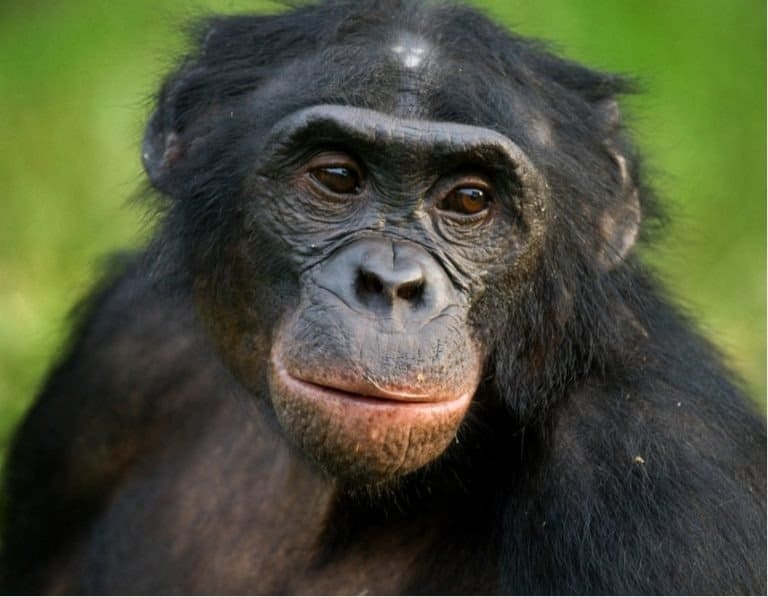
Portrait of bonobos. Close-up

The bonobo has a diet that is primarily made of fruit and vegetation.

Bonobos subsist primarily on fruits. Figs, custard apples, berries, and other local African fruits make up about 60% of this primate’s diet. They have also been known to eat honey, eggs, seeds, and other vegetation found in the surrounding jungle.

Unlike Chimpanzees, Bonobos do not specifically go out hunting for meat. However, they do eat forest antelopes, called duikers, flying squirrels, and other rodents. On some occasions, Bonobos will eat smaller monkeys and there have been instances of cannibalism in captive Bonobo colonies.

Predators And Threats

Human poaching and deforestation activities are the single biggest threats to the Bonobo’s survival. While these monkeys have been known to spend time walking on all fours, they spend most of their time up in trees. Continued loss of its habitat as humans expand further into the jungle between the Congo and Kasai rivers in central Africa is likely to cause further declines in this great ape’s population.

Given that they are found only in one area between two rivers,
crocodiles are also a serious predator of the Bonobo species.

Reproduction, Babies, And Lifespan
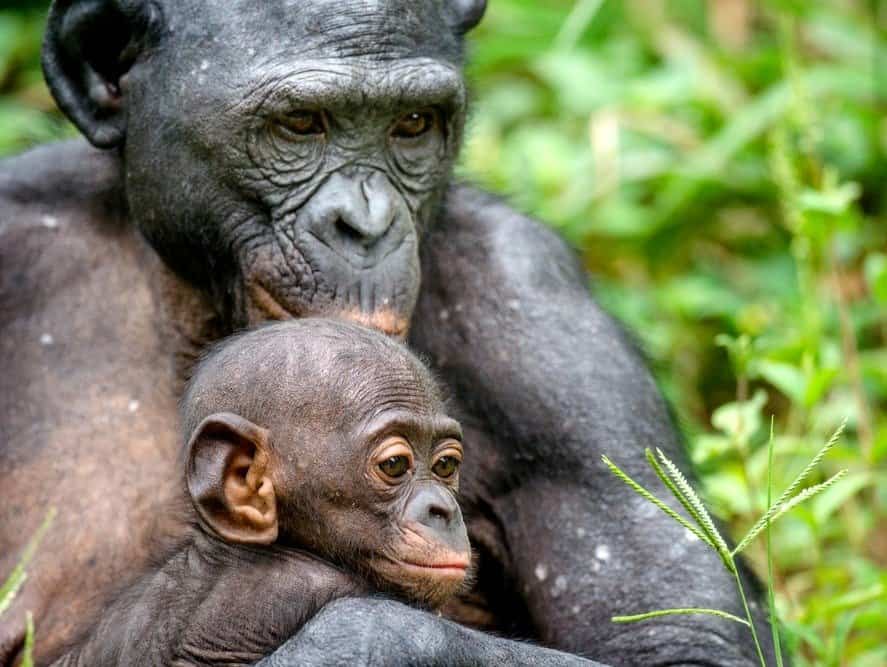
Female Bonobos reach sexual maturity at 12 years of age. At that time, they will leave their mother’s group and seek their own mates. Each female typically has one baby every four to five years. As a result, a single female can have between five and seven offspring during their lifetime.

The Bonobo’s gestation period is normally between 230 and 240 days, or eight months. Weaning typically takes 5 to 6 years for both male and female offspring. A mother’s male progeny will typically stay with them for their entire lives, which can be up to 40 years or more.

Population

The overall number of Bonobos in the wild is hard to estimate given the remote area in which this great ape lives. However, most experts place the total population between 10,000 and 20,000 worldwide. Outside of zoos, bonobos are only found in one forest region in Africa’s Democratic Republic of the Congo

Bonobos In The Zoo
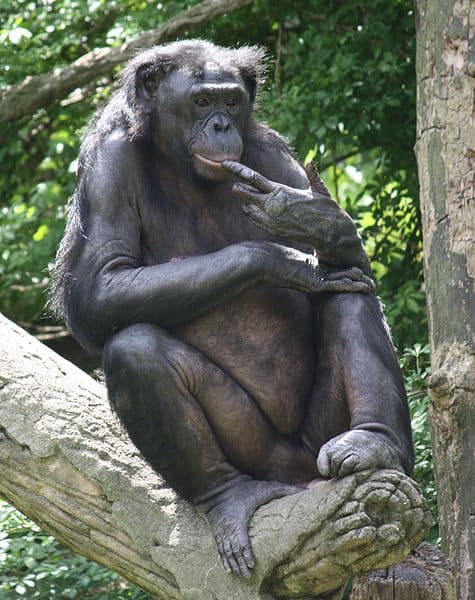
While Bonobos are generally peaceful in the wild, their behavior changes when kept in captivity. Bonobo colonies in zoos are still matriarchal societies, but the female primates become much more food aggressive than they are in the wild.

In the wild, females are known to share their food and generally have no problem with asking male monkeys for food if they get to it before the matriarchs do. However, in a zoo setting, the matriarch will insist on eating first and will not allow male monkeys to take food until the females are finished. In fact, there have been instances of females maiming or otherwise mutilating males over food in captive groups.

View all 453 animals that start with B
How to say Bonobo in ...
Catalan
Bonobo
Danish
Bonobo
German
Zwergschimpanse, Bonobo
English
Bonobo
Spanish
Bonobo
Finnish
Bonobo
French
Bonobo
Hebrew
שימפנזה ננסי
Croatian
Bonobo
Italian
Bonobo
English
Bonobo
Dutch
Bonobo
Japanese
ボノボ
Polish
Szympans karłowaty
Portuguese
Bonobo
Swedish
Bonobo
Turkish
Bonobo

Sources

  1. Wikipedia / Accessed December 23, 2020
  2. WWF / Accessed December 23, 2020
  3. Study / Accessed December 23, 2020
  4. Britannica / Accessed December 23, 2020
Melissa Bauernfeind

About the Author

Melissa Bauernfeind

Melissa Bauernfeind was born in NYC and got her degree in Journalism from Boston University. She lived in San Diego for 10 years and is now back in NYC. She loves adventure and traveling the world with her husband but always misses her favorite little man, "P", half Chihuahua/half Jack Russell, all trouble. She got dive-certified so she could dive with the Great White Sharks someday and is hoping to swim with the Orcas as well.
Connect:

Thank you for reading! Have some feedback for us?


Bonobo FAQs (Frequently Asked Questions)

A bonobo is one of two species of primates in the Pan genus. They are closely related to the Common Chimpanzee and share 98.7% of their DNA with humans. These great apes are known for their long legs, dark faces and fur, and bright lips.