B
Species Profile

Brown Bear

Ursus arctos

Hump-shouldered king of the wild buffet
Hillebrand, Steve - Public Domain by U.S. Fish and Wildlife Service

Brown Bear Distribution

Click a location to explore more animals from that region

Loading map...

Size Comparison

Human 5'8"
Brown Bear 3 ft 7 in

Brown Bear stands at 64% of average human height.

At a Glance

Wild Species
Also Known As Bruin, Bear
Diet Omnivore
Activity Cathemeral+
Lifespan 25 years
Weight 600 lbs
Status Least Concern
Did You Know?

Range spans North America, Europe, and Asia-one of the broadest distributions of any terrestrial carnivore (IUCN).

Scientific Classification

The brown bear (Ursus arctos) is a large omnivorous bear species with a broad Holarctic distribution across parts of North America, Europe, and Asia, showing substantial regional variation in size, coat color, and ecology.

Kingdom
Animalia
Phylum
Chordata
Class
Mammalia
Order
Carnivora
Family
Ursidae
Genus
Ursus
Species
Ursus arctos

Distinguishing Features

  • Large, powerfully built bear with prominent shoulder musculature (often forming a ‘hump’)
  • Coat color ranges from pale blond to dark brown/near black; often grizzled guard hairs in some populations
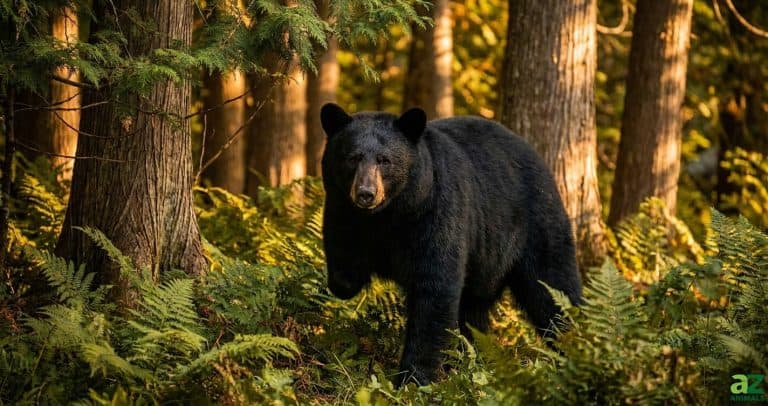
  • Longer foreclaws and straighter facial profile than American black bear (useful field marks in North America)
  • Omnivorous diet with strong seasonal shifts (plants, berries, roots, insects, carrion, and sometimes large prey; salmon important in some coastal populations)

Physical Measurements

Males and females differ in size

Height
3 ft 7 in (2 ft 11 in – 4 ft 11 in)
3 ft 7 in (2 ft 11 in – 4 ft 7 in)
Length
7 ft 7 in (5 ft 11 in – 9 ft 10 in)
5 ft 12 in (4 ft 9 in – 7 ft 11 in)
Weight
595 lbs (176 lbs – 1,323 lbs)
309 lbs (187 lbs – 551 lbs)
Tail Length
5 in (2 in – 9 in)
5 in (2 in – 9 in)
Top Speed
35 mph
Up to 56 km/h

Appearance

Primary Colors
Secondary Colors
Skin Type Dense double-layer fur over thick skin: coarse guard hairs with insulating underfur; seasonally variable coat (heavier winter pelage).
Distinctive Features
  • Large, robust bear with a prominent muscular shoulder hump (key field trait vs. American black bear).
  • Head profile often appears dished/concave in many individuals (vs. straighter facial profile more typical of American black bear), though overlap exists regionally.
  • Foreclaws long and relatively straighter, adapted for digging; commonly ~5-10 cm on the forefoot in many populations (field guides and morphometric summaries; claw length varies by region/sex/age).
  • Massive forequarters and long forelimbs; gait often shows a pronounced shoulder rise due to hump musculature.
  • Large head with small rounded ears relative to head size (often appearing smaller than in American black bear).
  • Brown Bear (Ursus arctos) adult size varies with region and food. Head-body length about 1.4–2.8 m, shoulder height 0.7–1.5 m, mass often 80–600+ kg depending on sex and population; coastal/island bears can be largest.
  • Seasonal ecology/behavior relevant to appearance/condition: marked late-summer-autumn hyperphagia with rapid fat accumulation; winter denning (timing/duration strongly regional-can be minimal in milder climates and several months in colder continental/arctic climates).
  • Apex omnivore and ecosystem engineer traits visible in wear/scars: frequently worn/broken claws, rubbed fur, and scarring from intraspecific conflict; also noted for scavenging and seed dispersal (diet-driven tooth wear and stained muzzle can occur).

Sexual Dimorphism

Brown Bear (Ursus arctos) shows clear sexual dimorphism: adult males are much larger than females. Typical weights range about 135-390 kg for males and 95-205 kg for females, but size varies a lot by region and food.

  • Larger overall body size and more massive forequarters/shoulder hump; thicker neck and head.
  • Broader skull and more pronounced sagittal/nuchal musculature; often more prominent scars from male-male competition.
  • On average, longer foreclaws and larger paws (digging/adult male size effects), though ranges overlap with females.
  • Smaller, more gracile head/neck and generally less bulky shoulder/forequarter profile than males.
  • Body condition fluctuates strongly with reproductive state (pregnancy/lactation) and seasonal hyperphagia; may appear notably slimmer post-den emergence or during food-poor years.

Did You Know?

Range spans North America, Europe, and Asia-one of the broadest distributions of any terrestrial carnivore (IUCN).

Adult size varies dramatically by region and food: inland bears are often much smaller than salmon-fed coastal bears.

Key ID vs. American black bear: brown bears usually show a pronounced shoulder hump, a more concave "dished" face, and much longer foreclaws (~5-10 cm) (Pasitschniak-Arts 1993).

Diet is highly flexible: roots, berries, insects, carrion, ungulates, and (in many coastal systems) salmon-so they function as apex omnivores.

During late-summer/fall hyperphagia, individuals can spend most of the day feeding to build fat reserves for winter denning.

They are major seed dispersers: many berry seeds pass through the gut and are deposited in nutrient-rich scat, aiding plant regeneration.

Longevity: commonly ~20-30 years in the wild; maximum recorded wild longevity is in the mid-30s, and captivity records exceed 40 years (species accounts such as Pasitschniak-Arts 1993; zoo records).

Unique Adaptations

  • Shoulder hump powered by enlarged muscles (not a fat hump): supports powerful forelimb strokes for digging and turning rocks/wood.
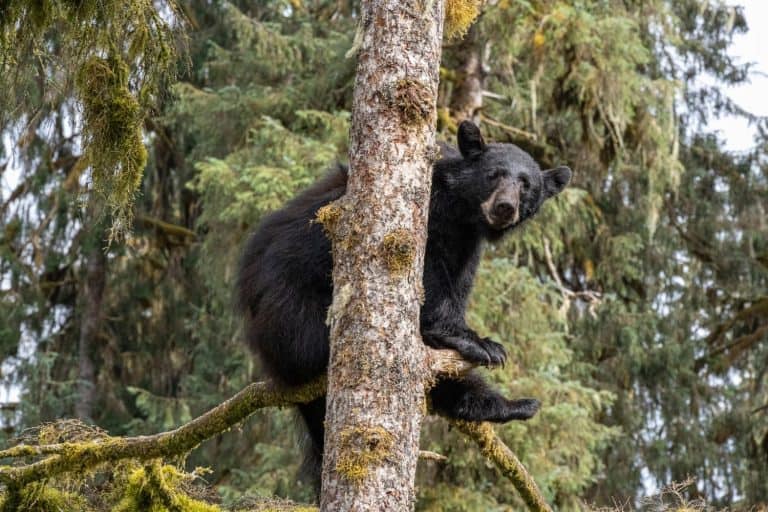
  • Long, relatively straighter foreclaws (commonly ~5-10 cm) adapted for excavation-longer than typical American black bear claws and less suited to tree-climbing (Pasitschniak-Arts 1993).
  • Hibernation/denning physiology: prolonged fasting with reduced metabolic rate, recycling of nitrogen to limit muscle loss, and minimal bone demineralization-key to surviving months without eating or drinking.
  • Highly developed olfaction enabling detection of food/carcasses over long distances; smell is the dominant foraging sense.
  • Omnivore dentition and jaw strength: robust molars for grinding plant matter plus canines for animal prey, supporting extreme dietary breadth.
  • Fat storage and seasonal body-mass swings: large pre-den fat deposition buffers winter fasting and supports lactation in denning females.

Interesting Behaviors

  • Seasonal hyperphagia: a marked late-summer/fall surge in foraging time and intake to accumulate fat for winter survival and reproduction (notably for pregnant females).
  • Winter denning: many populations den for several months; timing and duration vary strongly with latitude, snow conditions, sex, and reproductive status (pregnant females typically den longest).
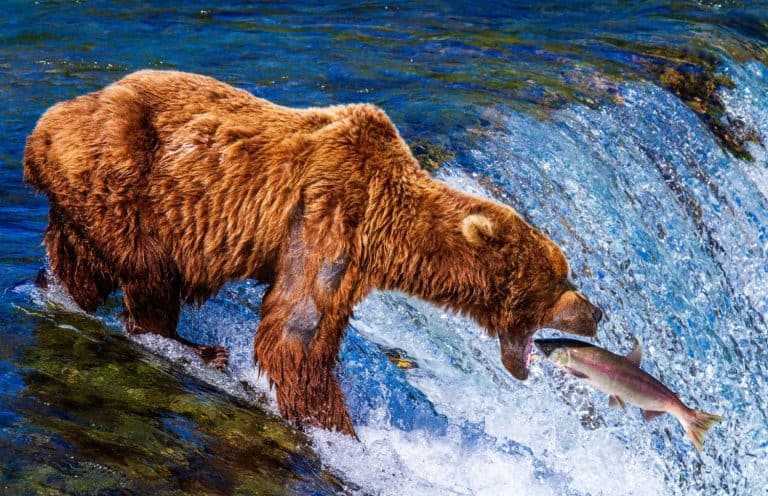
  • Fishing strategies (where salmon occur): standing at falls, chasing in shallows, or ambushing at pool edges; individuals often specialize in particular techniques and sites.
  • Digging and excavation: frequent digging for roots, bulbs, ground squirrels, and insects; this soil disturbance can reshape plant communities and create microsites for germination.
  • Chemical communication: rubbing, tree biting, and claw marking; scent marking helps advertise presence and reproductive status across overlapping home ranges.
  • Scavenging and carcass defense: readily scavenges and may displace other predators; carrion use can increase where ungulate mortality or hunting offal is available.
  • Mother-cub behavior: extended maternal care (often ~2-3 years) with intense cub defense; family groups may avoid dominant males due to infanticide risk documented in the species.

Cultural Significance

Brown bear (Ursus arctos) has long been seen as a powerful, human-like being, a teacher, ancestor, or forest lord. Bears are symbols in flags and place names, and they mark seasons by eating berries, following salmon runs, and going into dens. They appear in northern festivals.

Myths & Legends

Ainu (Japan): the traditional "bear-sending" ceremony honors the bear as a divine visitor; after ritual care, the bear's spirit is returned to the spirit world with offerings and songs.

Nivkh and other peoples of the Lower Amur/Sakhalin: traditional bear festivals treat the bear as a revered guest or kin whose spirit must be respectfully guided back to the mountains/forest realm.

Greek myth: Callisto, a companion of Artemis, is transformed into a bear; she and her son Arcas are later set among the stars as constellations (Ursa Major/Minor traditions).

Haida/Tlingit/Northwest Coast traditions: "Bear Mother" stories tell of a woman who marries a bear and bears children who bridge human and bear worlds, establishing kinship obligations and taboos.

Finno-Karelian tradition (including Kalevala-region folklore): the bear is a revered forest being with euphemistic names; rituals and songs honor it as a noble guest after a hunt.

Norse cultural tradition: berserkers ("bear-shirts") are associated with bear-strength and trance-like battle fury, reflecting the bear as an emblem of formidable power.

Conservation Status

LC Least Concern

Widespread and abundant in the wild.

Population Stable

Protected Under

  • CITES Appendix II (with some national/regional populations subject to stricter controls and/or treated as Appendix I in trade regulations in certain jurisdictions)
  • EU Habitats Directive: strict protection and/or habitat protection applies to certain European brown bear populations (implementation varies by Member State)
  • Bern Convention (Convention on the Conservation of European Wildlife and Natural Habitats): listed for protection in Europe
  • United States Endangered Species Act: the grizzly bear (Ursus arctos horribilis) in the contiguous U.S. has been listed as Threatened (species-level status remains LC globally)
  • Range-state national wildlife laws and protected-area networks (national parks/reserves) provide varying degrees of protection across Europe, Asia, and North America

Life Cycle

Birth 2 cubs
Lifespan 25 years

Lifespan

In the Wild
20–30 years
In Captivity
30–50 years

Reproduction

Mating System Polygynandry
Social Structure Solitary
Breeding Pattern Transient
Fertilization Internal Fertilization
Birth Type Internal_fertilization

Brown bears (Ursus arctos) are mostly solitary but have a polygynandrous mating system in spring-summer (May–July). Mating associations are short; males give no care. Delayed implantation causes winter births (Jan–Feb). Litters 1–4 (usually 2); females breed at 4–8 years.

Behavior & Ecology

Social Sloth (rarely used; brown bears are usually described as solitary/aggregating rather than as stable groups) Group: 1
Activity Cathemeral, Diurnal, Nocturnal
Diet Omnivore Seasonally concentrated, energy-rich foods-especially salmon (Oncorhynchus spp.) in coastal/riverine systems and berry crops (e.g., Vaccinium spp.) during late-summer hyperphagia.
Seasonal Hibernates

Temperament

Generally wary/avoidant of humans where persecution occurs; more tolerant in protected areas with predictable food
Strongly food-motivated; can become bold and persistent near high-calorie resources
Dominance-structured intolerance at concentrated foods (threat displays, displacement, occasional fights), but often maintains spacing to reduce injury risk
Highest risk of defensive aggression from females with cubs; bluff charges and jaw-popping/huffing are common warning behaviors
Seasonally variable behavior: increased foraging intensity during hyperphagia (late summer-fall) and reduced activity during denning in seasonal climates (Pasitschniak-Arts 1993)
Brown Bear (Ursus arctos) in the wild usually lives about 20–30 years; some reach the low-to-mid 30s, and in captivity they can live over 40 years.

Communication

huffs/woofs Short explosive exhalations used in alarm/defensive contexts
jaw-popping/teeth clacking Close-range threat signal, often by defensive females
growls/roars Aggressive or high-arousal encounters, including contests at food
moans/"chuffing"/low grunts Variable; often during social interactions or courtship
cub bawls/squeals Distress and contact calls to the mother
Scent marking via rubbing on trees/poles and ground scenting; chemical signals from urine and glandular secretions Including pedal scent from feet) used for status, sexual condition, and individual identity (Pasitschniak-Arts 1993
Tree scratching and bite-marking Visual + olfactory signal posts along travel routes
Body posture and facial/ear cues: head low, ears back, lateral display, and approach/retreat pacing during conflicts
Bluff charges and rapid advances as distance-increasing signals; physical contact is often avoided unless escalation occurs
Spatial communication through trails, repeated use of marking sites, and avoidance behavior in overlapping home ranges Garshelis et al. 2005

Habitat

Biomes:
Boreal Forest (Taiga) Temperate Forest Temperate Rainforest Tundra Alpine Temperate Grassland Mediterranean Desert Cold Freshwater Wetland Marine +5
Terrain:
Mountainous Hilly Plateau Plains Valley Coastal Island Riverine Rocky +3
Elevation: Up to 16404 ft 3 in

Ecological Role

Omnivorous apex/mesopredator and major nutrient vector with strong bottom-up and top-down effects that vary regionally (notably in salmon-bearing watersheds).

Regulates prey populations via predation on ungulates (especially calves/fawns) and small mammals Scavenging accelerates carrion decomposition and nutrient cycling Seed dispersal via endozoochory of fleshy fruits (berries) and movement across habitats Bioturbation from digging (roots, rodents, insects) alters soil structure, aeration, and plant community dynamics Transfers marine-derived nutrients from salmon into terrestrial/riparian ecosystems through carcass transport and excretion (documented with stable-isotope and ecosystem studies; e.g., Hilderbrand et al. 1999; Gende et al. 2002)

Diet Details

Main Prey:
Pacific salmon Ungulates Ungulate neonates and eggs Small mammals Invertebrates Carrion of large mammals
Other Foods:
Berries and soft mast Hard mast and nuts Graminoids and forbs Roots, bulbs, and rhizomes Fungi Agricultural crops

Human Interaction

Domestication Status

Wild

Ursus arctos (brown bear) is not domesticated and has no history like dogs or livestock. Humans mostly hunted or captured bears, handled conflicts (moving, scaring, or killing them), or kept them for display. Today efforts focus on conservation and ecotourism. Bears shift diet and space use when near people or human food.

Danger Level

High
  • Defensive attacks at close range, especially females with cubs or bears surprised at daybeds/cover
  • Food-conditioning/habituation leading to increased boldness around people, camps, and settlements
  • Injury or death from bites and claw strikes; severe trauma risk is high due to large body mass and forelimb strength
  • Rare predatory attacks (documented but uncommon relative to defensive encounters)
  • Conflict scenarios: at carcasses (hunter kills), dumps/garbage sites, orchards/crops, and during livestock depredation responses
  • Secondary hazards: vehicle collisions and dangerous encounters during capture/handling by humans

As a Pet

Not Suitable as Pet

Legality: Keeping a Brown Bear (Ursus arctos) is usually illegal or tightly regulated. Many places ban private ownership or need permits. Bears are often called dangerous wild animals and kept only in zoos or sanctuaries.

Care Level: Expert Only

Purchase Cost: Up to $10,000
Lifetime Cost: $100,000 - $500,000

Economic Value

Uses:
Ecotourism and wildlife viewing Regulated hunting (where legal) and associated licensing revenue Subsistence use (limited regions): meat and fat Fur/hide/trophy value (historical and regulated contexts) Cultural value (Indigenous cultural significance, symbolism) Ecosystem services (seed dispersal, nutrient redistribution via scavenging) Economic costs (livestock depredation, crop damage, property damage, management and conflict mitigation)
Products:
  • guided bear-viewing tours (photography, lodge-based tourism)
  • hunting permits/tags and outfitting services (jurisdiction-dependent)
  • hides/trophies (legal, regulated markets only)
  • meat/fat in subsistence contexts (where permitted)
  • bear-resistant waste systems and conflict-mitigation services (indirect economic sector)

Relationships

Ecological Equivalents 5

Animals that fill a similar ecological role in their ecosystem

“Brown bears are often called “grizzly bears.”

Brown Bears are animals that are found in many parts of North America and Eurasia, where the bears inhabit wooded and mountainous areas. The brown bear is also the national animal of a number of states in North America, Europe, and Asia.
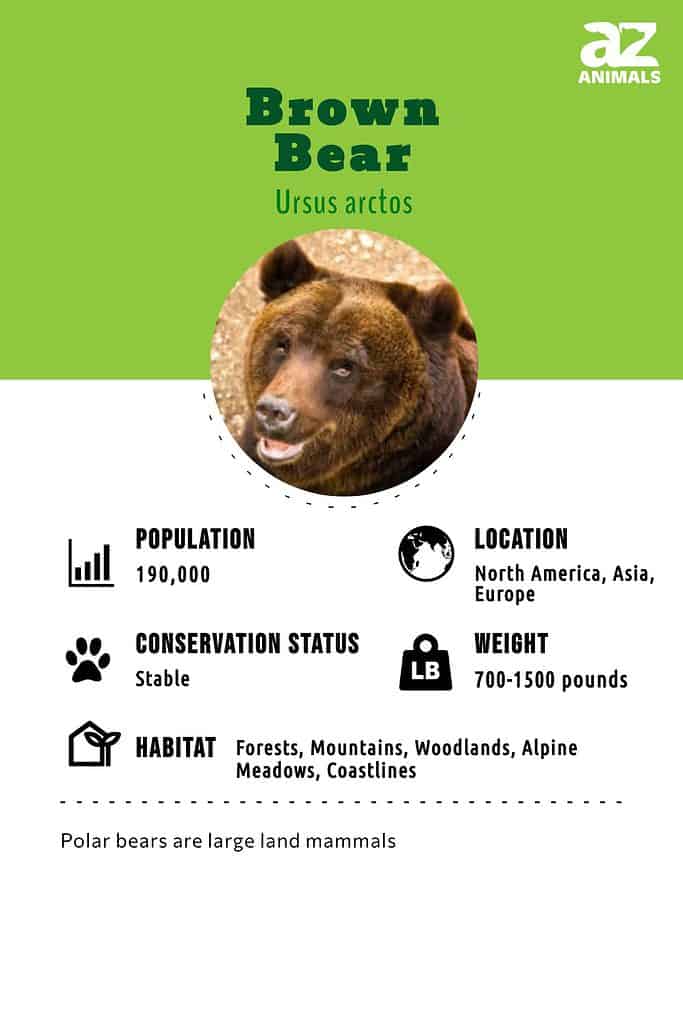
Brown Bear infographic
Brown bears are found on several continents

4 Amazing Brown Bear Facts

  • The brown bear is the most widely distributed bear on the globe
  • A group of brown bears is called a sloth or sleuth
  • Before hibernation, the brown bear can eat up to 90 pounds of food a day
  • It appears that brown bears have individual personalities and are extremely intelligent

You can check out more incredible facts about brown bears.

Scientific Name

The brown bear has the name of Ursus arctos and is a type of mammal. The name Ursus is derived from the Latin, which means “bear.” Both “ursus” and “arctos” mean bear, with “arctos” being the Greek term for this animal.

The term “Grizzly Bear” is called Ursus arctos horribilis. It is a subspecies of the brown bear and was named because the bear was somehow interpreted as “grisly or horrible” instead of the term for the coat being grizzled with streaks of gray.
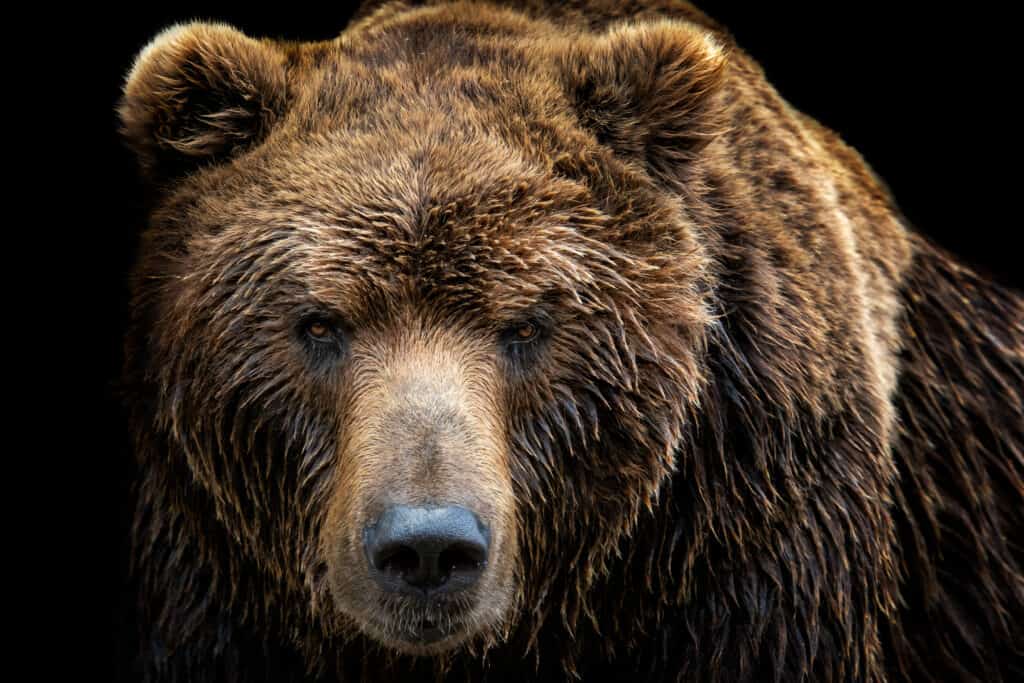
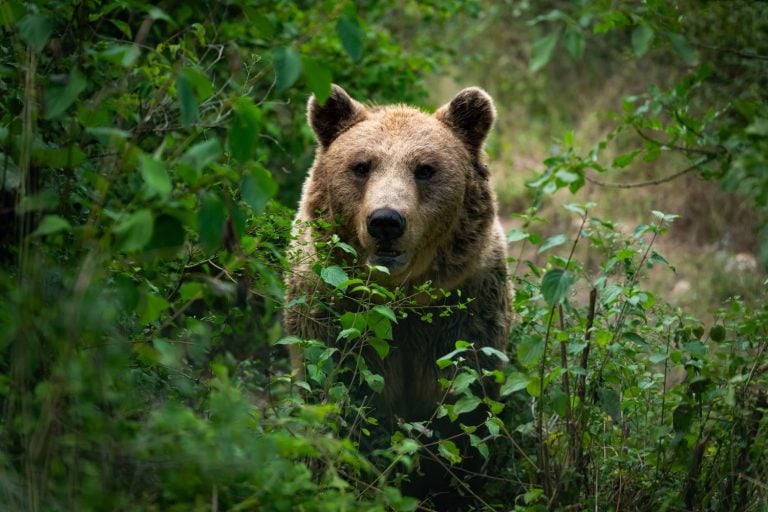
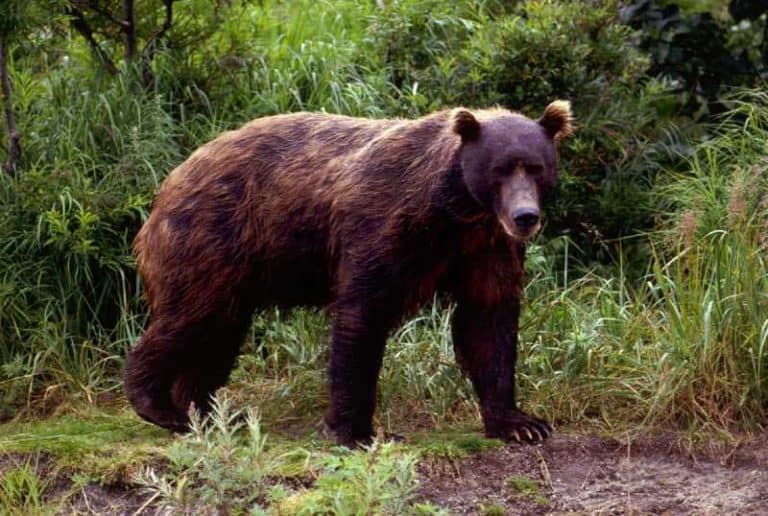
Bear staring into camera

The brown bear has the name Ursus arctos.

Evolution

Brown bears evolved from Ursus etruscus in Asia 800,000 years ago. Genetic analysis indicates they diverged from the cave bear complex 1.2-1.4 million years ago. Fossils of this species are found in China from 0.5 million years ago. It spread to Europe and North Africa 250,000 and Alaska 100,000 years ago before moving south 13,000 years ago when giant short-faced bears (Arctodus simus) went extinct.

Paleontologists suggest two migrations of brown bears: inland grizzlies from northern Siberia to central Alaska and Kodiak bears from Kamchatka to the Alaskan peninsula. Fossils in Labrador, Ohio, Kentucky, and Ontario show they once extended eastward.

Appearance and Behavior

Brown bears are extremely large animals. Brown bears can grow to be five to eight feet tall and weigh approximately 700 pounds. This means that the brown bear weight is about 75 percent as heavy as an Arabian horse, which weighs 930 pounds. Though some can be even larger. An Alaskan brown bear can weigh as much as 1500 pounds.

In the spring, after hibernation, a brown bear may weigh much less. To make up for this, the bear may eat as much as 90 pounds of food per day to gain weight for the coming winter and its hibernation.

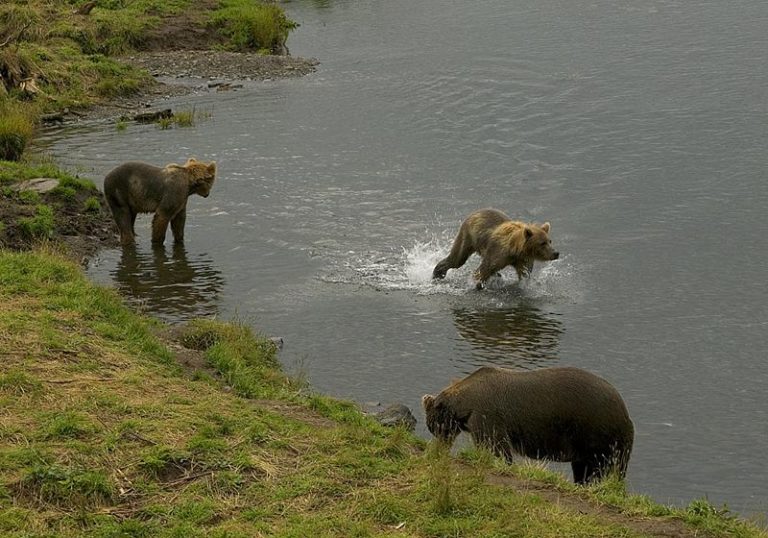
They tend to be solitary animals; females and their brown bear cubs gather together and, at times, are known to congregate, especially at Alaska fishing spots. A group of bears is called a sloth or sleuth, but brown bears mostly live alone.

In winter, brown bears are animals that dig dens for hibernation, which are often found on hillsides.

Brown bears are very fast and are known to reach speeds of 30 to 40 miles per hour, as much as 30% faster than the top speed of the fastest human, Usain Bolt. If they are surprised or if a human gets between a mother and cubs, they can be dangerous. The brown bear is also known to be an exceptional swimmer.
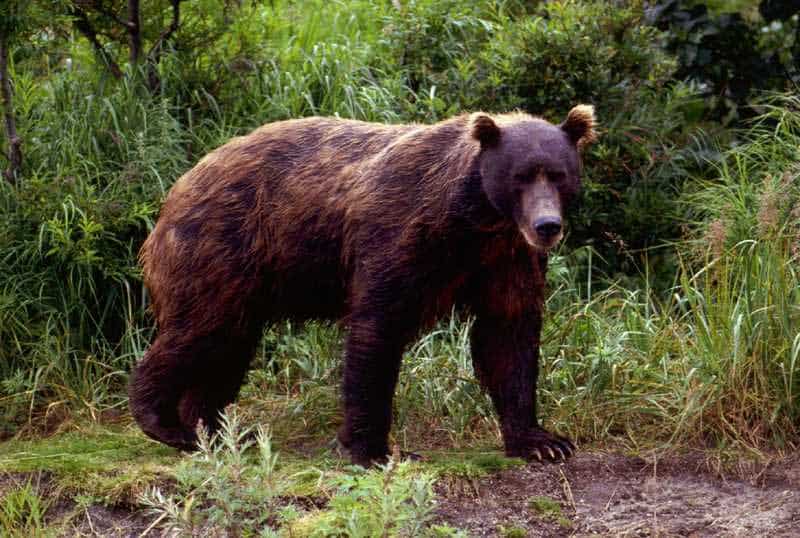
Habitat

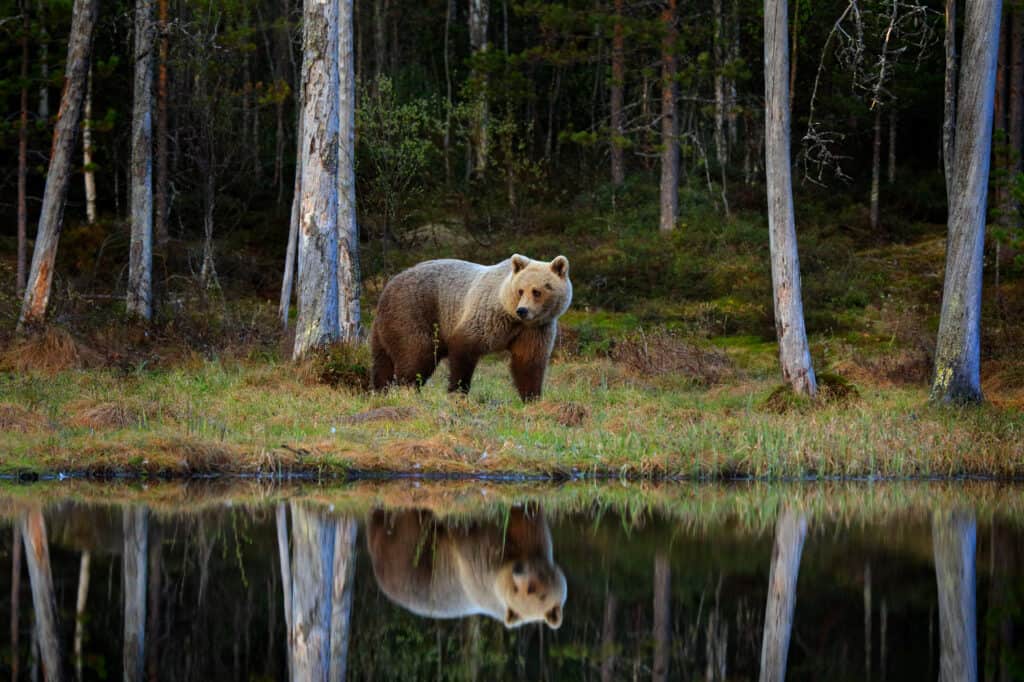
Brown bears live in the forests and mountains of the northern parts of North America, Asia, and Europe. In Europe, they are found mostly in the woodlands of the mountains. Siberian brown bears prefer the forests, while in North America, they call the alpine meadows and coastlines home. Wherever they are, the brown bear prefers a habitat that has dense cover where they can feel safe and secure.
bear

Brown bears live in the forests and mountains of the northern parts of North America, Asia, and Europe.

Diet

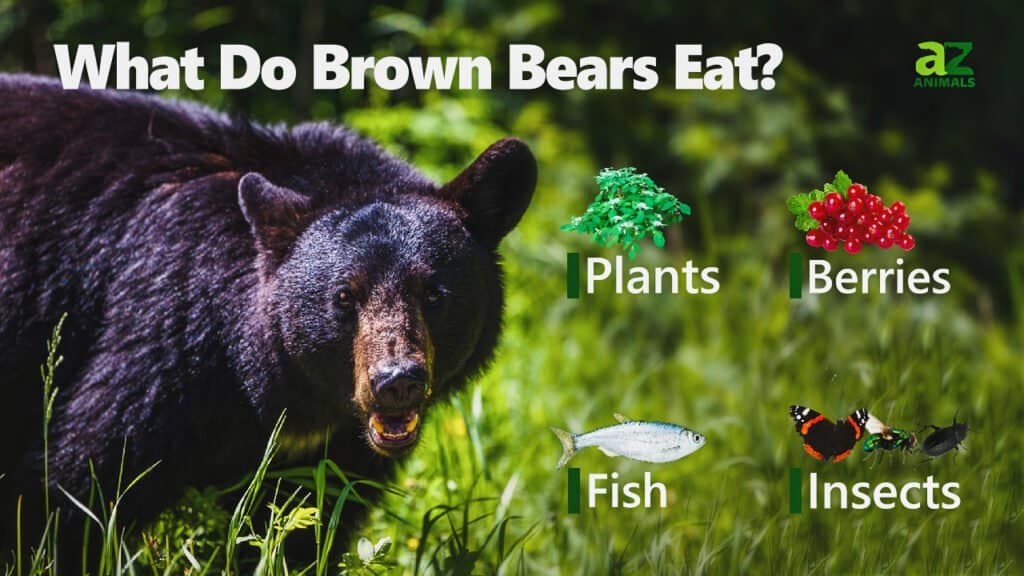
Brown bears are omnivores. They are also top-of-the-food-chain predators. They eat other animals, such as rodents or moose. A large portion of their diet, however, consists of nuts, berries, fruit, leaves, and roots.
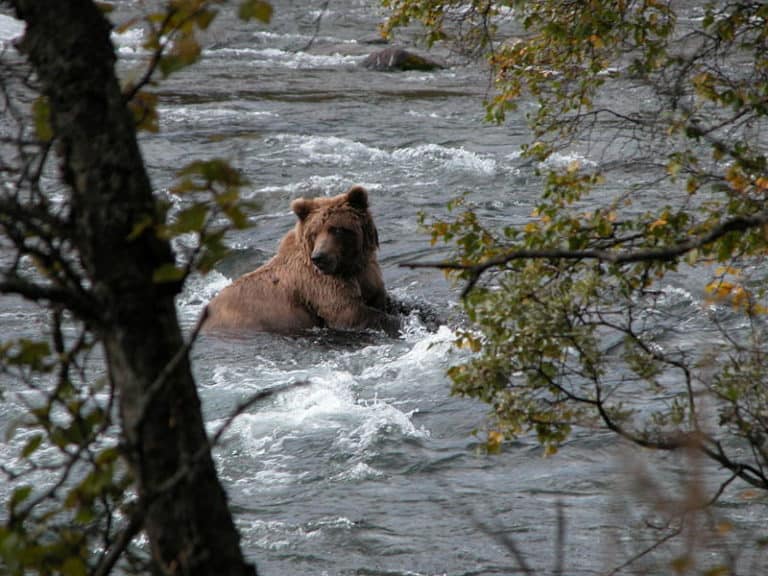
They also enjoy fishing for salmon and crave the fats that can take them through the long winter of hibernation. Before it hibernates, the brown bear has been known to eat as much as 90 pounds of food per day.
What Do Brown Bears Eat
Brown bears are opportunistic feeders and eat a variety of animals, insects, plants, and berries.

Predators and Threats

As one of the largest omnivores, the brown bear today does not have to worry about being eaten. They must worry about other brown bears. However, there are also other threats.

In the past, brown bears were threatened by big game hunters as trophies, and their hides and meats were used.

Poaching can be a problem. In Asia, some think that the bear gall bladder has medical benefits, although there is no evidence that this is true.

Logging, mining, and deforestation, as well as the destruction of habitat, threaten the brown bear population. The human-and-bear conflict has been an issue, as bears can interfere with roaming livestock, water supplies, fruit orchards, and trash bins.
bosnia and herzegovina brown bear

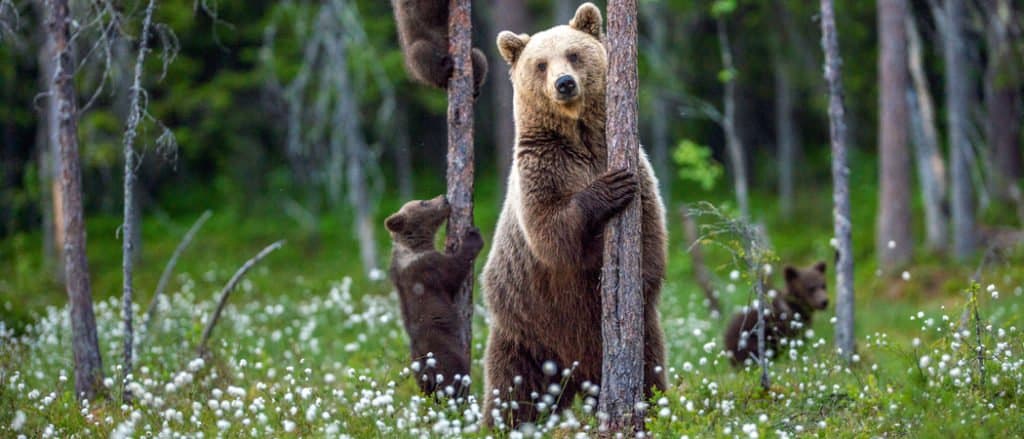
Logging, mining, and deforestation, as well as the destruction of habitat, threaten the brown bear population.

Reproduction, Babies, and Lifespan

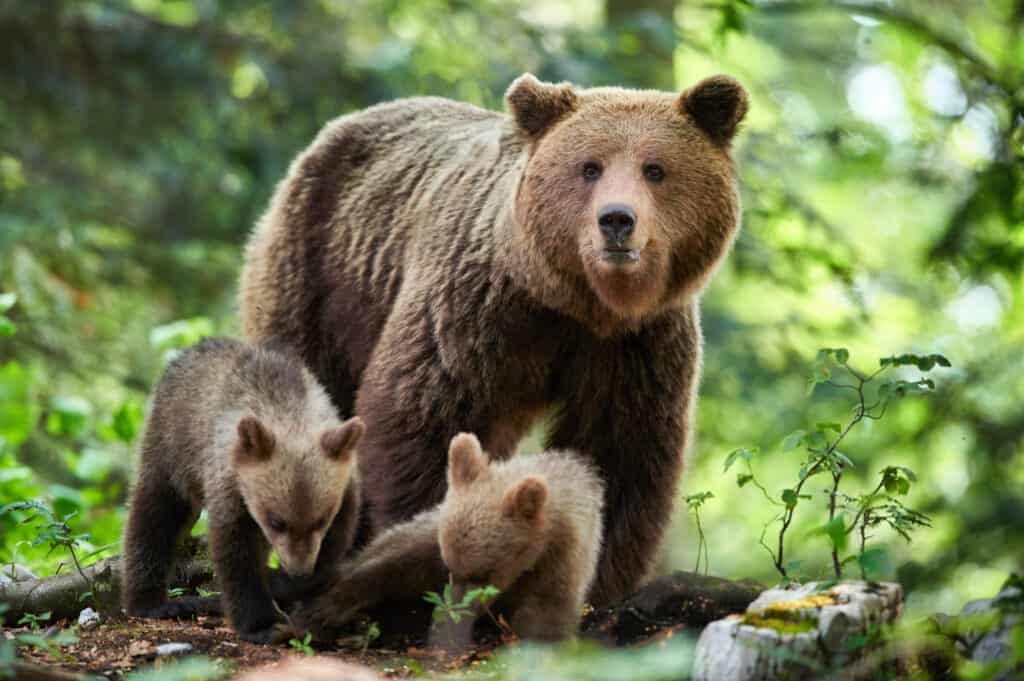
Males may fight over females when mating and will guard the female for one to three weeks. They mate from May to July. Females go into the den while pregnant, then give birth during the winter rest, and usually have a pair of cubs. The brown bear cubs will nurse on their mother’s milk until spring and then stay with her for more than two years.

Female bears only reproduce once in three years, as they are busy with their young cubs until the little cubs are on their own. Cubs are born blind and naked but are soon on their way to growth. By 6 months, the brown bear’s weight can be 55 pounds. In the wild, brown bears can live as long as 20 to 30 years.
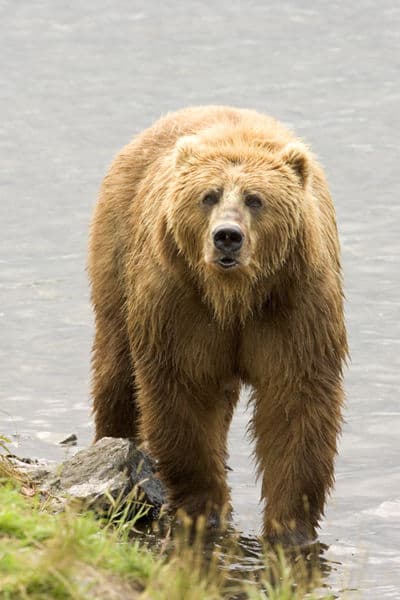
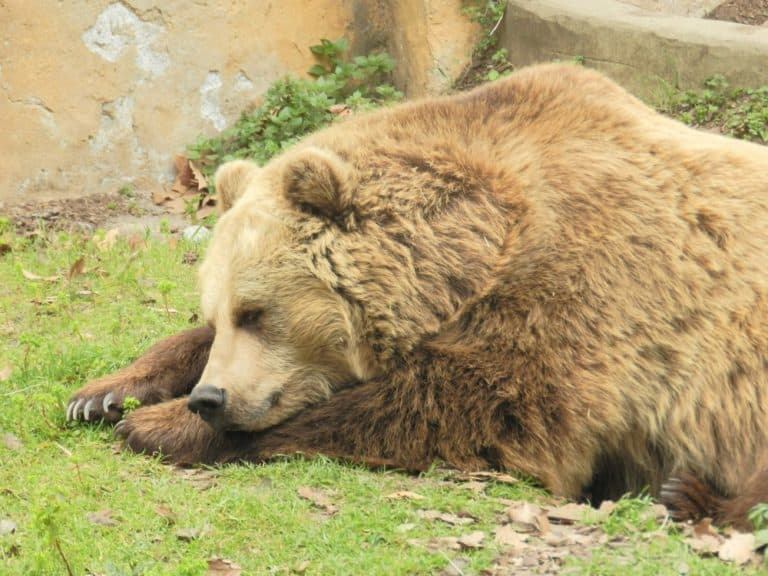
Brown Bear Close Up

Female brown bears only reproduce once ever three years.

Population

It is thought that there are now approximately 190,000 brown bears left in the world. They are the largest living carnivores, although often thought of as omnivores, and have a high priority on the conservation list.

Within the United States, in Glacier and Yellowstone National Parks, you can see brown bears. Those are the only places in the country where they live. However, there is an effort, through brown bear reintroduction programs, to bring this bear back.

Russia has the highest number of brown bears, with a population of 100,000. The Carpathian Mountains have a large population; countries include Slovakia, Poland, Ukraine, and Romania. Other places that have brown bear populations include Palestine, eastern Siberia, and the Himalayan region. They are also in the Atlas Mountains of northwest Africa and on Hokkaido, an island in northern Japan.
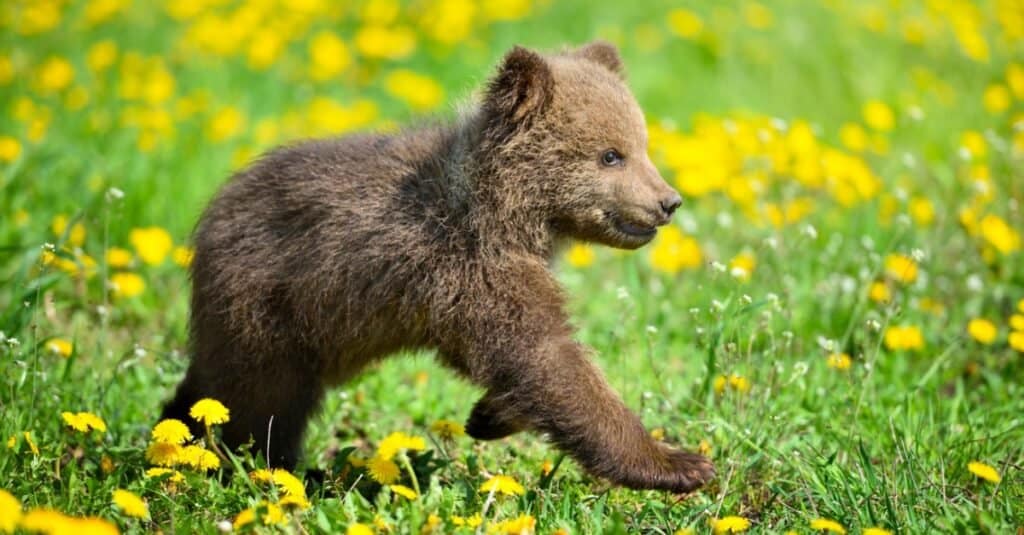
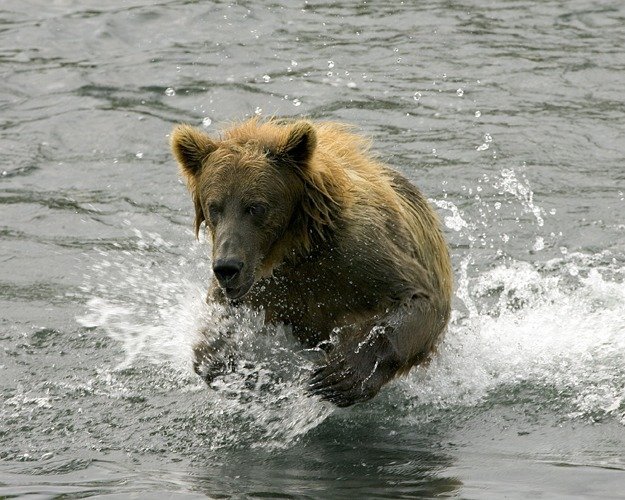
baby bear running

There are approximately 190,000 brown bears left in the world.

5 Brown Bear Paw Facts

  • The brown bear has four large paws, and each of the paws of the brown bear has five toes that result in long claws.
  • The two front paws of the brown bear have toes that have longer claws than the back paws, as the brown bear uses its front paws for digging.
  • The two back paws of the brown bear are larger than the two front paws as the brown bear often stands on its hind legs to either survey its surroundings or to get food out of higher places.
  • The brown bear uses its front paws with their enormous claws to rip open logs that have bugs inside so that it can eat them.
  • The brown bear uses its specially structured paws and legs in order to help it run fast, climb trees and swim well.
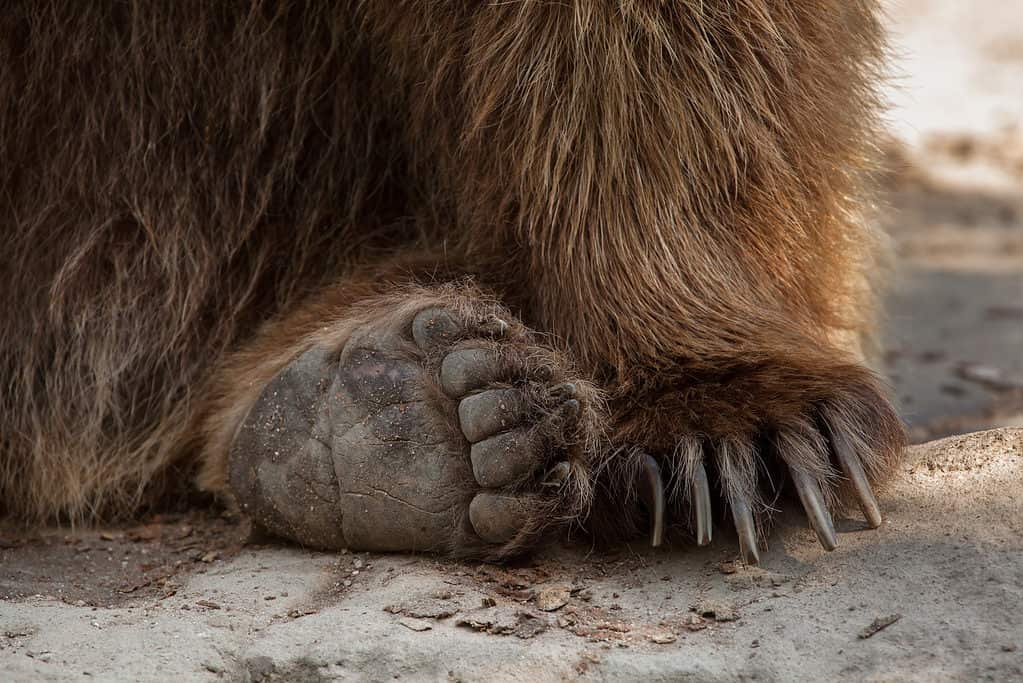
Eurasian brown bear (Ursus arctos arctos), also known as the European brown bear.

The two front paws of the brown bear have toes that have longer claws than the back paws, as the brown bear uses its front paws for digging.

5 Brown Bear Teeth Facts

  • Brown bears do not normally bite their prey but instead grind and crunch with their enormous teeth to get their meal into them.
  • The brown bear has approximately 42 teeth, including large predatory teeth that the brown bear uses to shred meat and skin.
  • The brown bear uses both its large, strong paws and its sharp teeth to catch and kill its prey and will either bite the neck of the animal or swipe it with its immense forearms.
  • The molar teeth of the brown bear increase in size as they go further into the mouth of the brown bear, and the brown bear predominantly uses its largest molar to grind up tough food.
  • The size of the teeth of the brown bear is dependent on the size of the bear itself, so bigger bears will have bigger teeth than smaller bears.
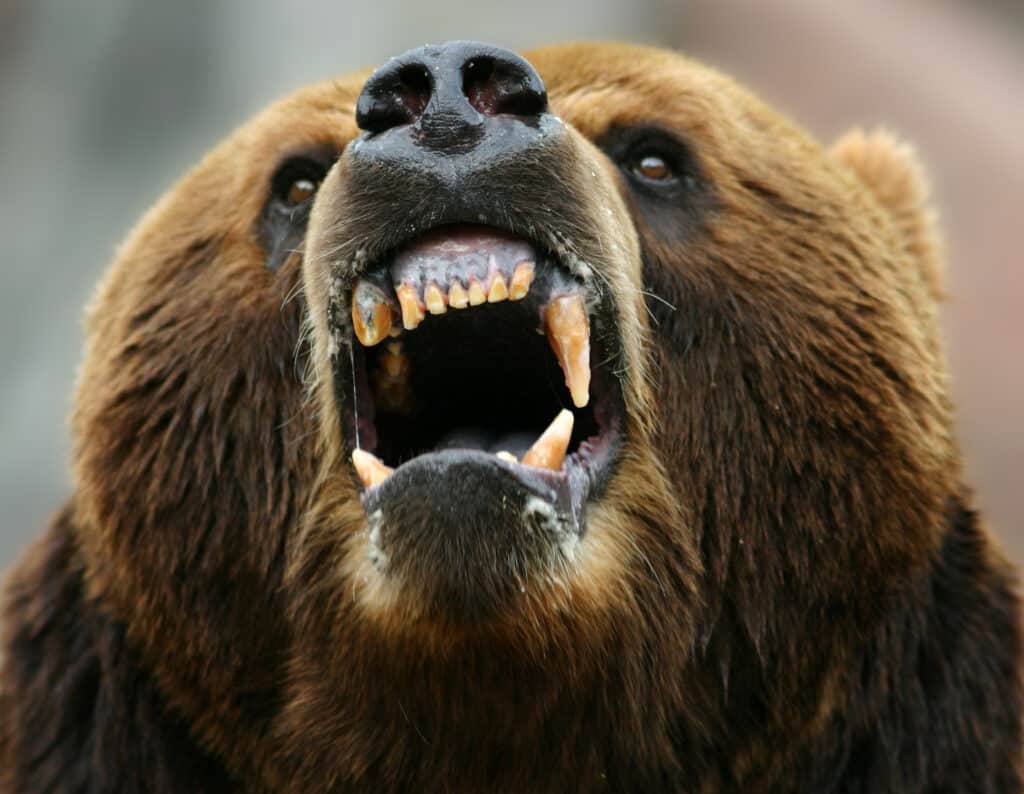
Brown Bear Showing Teeth

Brown bears do not normally bite their prey but instead grind and crunch with their enormous teeth.

16 Types of Brown Bear

  1. Grizzly bear – Ursus arctos horribilis. Also known as the North American brown bear. 290-600 pounds. 3.5 feet tall.
  2. Kodiak bear – Ursus arctos middendorffi. Also known as the Alaskan brown bear. Lives on the Kodiak Archipelago in Alaska. Weigh up to 1,500 pounds.
  3. Eurasian brown bear – Ursus arctos arctos. Also called the European brown bear. Lives throughout Eurasia. Weighs 330-780 pounds.
  4. Marsican brown bear – Ursus arctos marsicanus. Also known as the Apennine brown bear. Critically endangered species. Males are over 6 feet tall.
  5. Ussuri brown bear – Ursus arctos lasiotus. Also known as Ezo brown bear, Russian grizzly, and black grizzly. Weigh 880-1200 pounds.
  6. Alaska Peninsula brown bear – Ursus arctos gyas. Also called peninsular grizzly. Lives on the coast of Alaska. Weighs 800-1200 pounds.
  7. Himalayan brown bear – Ursus arctos isabellinus. Also known as the Himalayan red bear. Weighs 400-880 pounds.
  8. Syrian brown bear – Ursus arctos syriacus. Native to the middle east.
  9. Kamchatka brown bear – Ursus arctos beringianus. Also called the Far Eastern brown bear. Largest brown bear in Eurasia, weighing up to 1430 pounds and up to 9.8 feet long.
  10. Eastern Siberian brown bear – Ursus arctos collaris. Weighs 300-550 pounds.
  11. Gobi bear – Ursus arctos gobiensis. Called Mazaalai in Mongolia. Critically endangered species.
  12. Tibetan bear – Ursus arctos pruinosus. Also called the Tibetan blue bear. Very rare to spot one, as there are only 5,000 left in the wild.
  13. Cantabrian brown bear – Ursus arctos pyrenaicus. The largest animal on the Iberian Peninsula. Weigh 203-397 pounds. Various shades of brown and cream.
  14. Dall Island brown bear – Ursus arctos dalli. Some scientists believe this bear to be a variation of other North American brown bears. DNA analysis is needed.
  15. ABC Islands bear – Ursus arctos sitkensis. Also called the Sitka brown bear. Very dark-colored fur.
  16. Stickeen brown bear – Ursus arctos stikeenensis. Lives in British Columbia near the Stikine River.

5 Extinct Brown Bears

  • California grizzly bear – Ursus arctos californicus. Now extinct.
  • Atlas bear – Ursus arctos crowtheri
  • Steppe brown bear – Ursus arctos priscus
  • Mexican grizzly bear – Ursus arctos nelsoni
  • Ungava brown bear – Ursus arctos ungavaesis.

View all 453 animals that start with B
How to say Brown Bear in ...
Bulgarian
Кафява мечка
English
Mrki medvjed
Catalan
Ós bru
Czech
Medvěd hnědý
Danish
Brun bjørn
German
Braunbär
English
Brown Bear
Esperanto
Bruna urso
Spanish
Ursus arctos
Estonian
Karu
Finnish
Karhu
French
Ours brun
Hebrew
דוב חום
Croatian
Mrki medvjed
Hungarian
Barna medve
Indonesian
Beruang coklat
Italian
Ursus arctos
Japanese
ヒグマ
Latin
Ursus arctos
Dutch
Bruine beer
English
Brunbjørn
Polish
Niedźwiedź brunatny
Portuguese
Urso-pardo
English
Urs brun
Slovenian
Rjavi medved
Swedish
Brunbjörn
Turkish
Boz ayı
Vietnamese
Gấu nâu
Chinese
棕熊

Sources

  1. David Burnie, Dorling Kindersley (2011) Animal, The Definitive Visual Guide To The World's Wildlife / Accessed November 10, 2008
  2. Tom Jackson, Lorenz Books (2007) The World Encyclopedia Of Animals / Accessed November 10, 2008
  3. David Burnie, Kingfisher (2011) The Kingfisher Animal Encyclopedia / Accessed November 10, 2008
  4. Richard Mackay, University of California Press (2009) The Atlas Of Endangered Species / Accessed November 10, 2008
  5. David Burnie, Dorling Kindersley (2008) Illustrated Encyclopedia Of Animals / Accessed November 10, 2008
  6. Dorling Kindersley (2006) Dorling Kindersley Encyclopedia Of Animals / Accessed November 10, 2008
  7. David W. Macdonald, Oxford University Press (2010) The Encyclopedia Of Mammals / Accessed November 10, 2008
Heather Hall

About the Author

Heather Hall

Heather Hall is a writer at A-Z Animals, where her primary focus is on plants and animals. Heather has been writing and editing since 2012 and holds a Bachelor of Science in Horticulture. As a resident of the Pacific Northwest, Heather enjoys hiking, gardening, and trail running through the mountains with her dogs.

Thank you for reading! Have some feedback for us?


Brown Bear FAQs (Frequently Asked Questions)

Brown Bears are Omnivores, meaning they eat both plants and other animals.