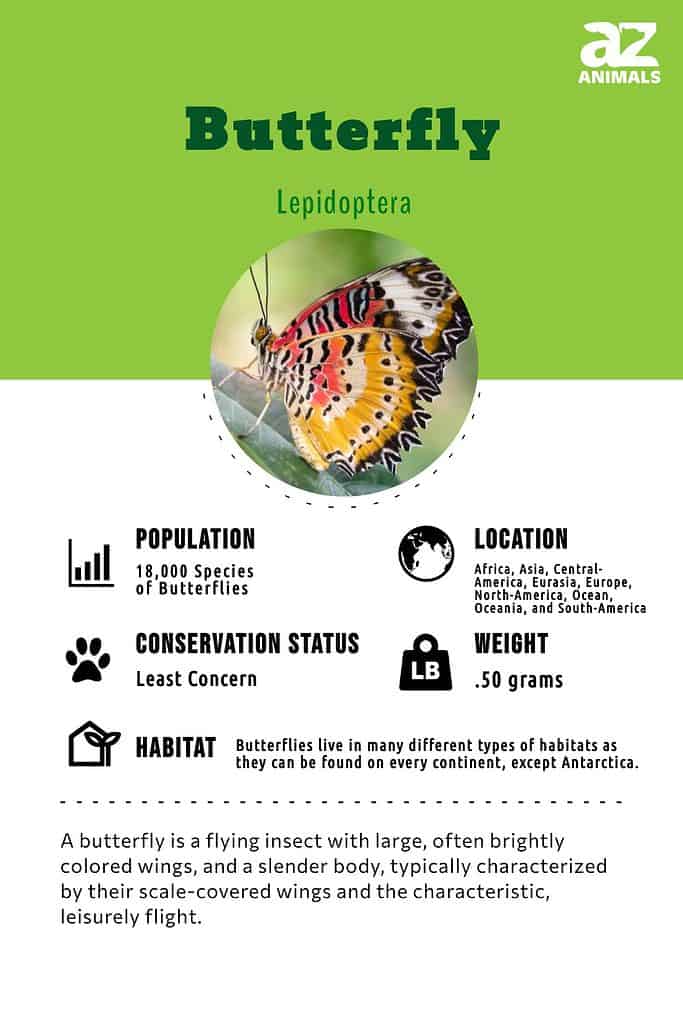
B
Species Profile

Butterfly

Lepidoptera

Scaled wings, big transformations.
outdoorsman/Shutterstock.com

Butterfly Distribution

Click a location to explore more animals from that region

Loading map...
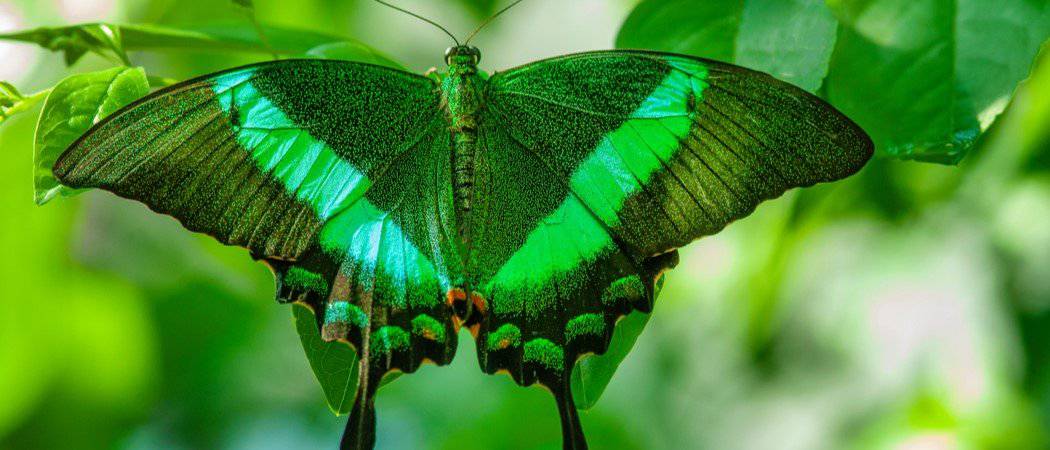
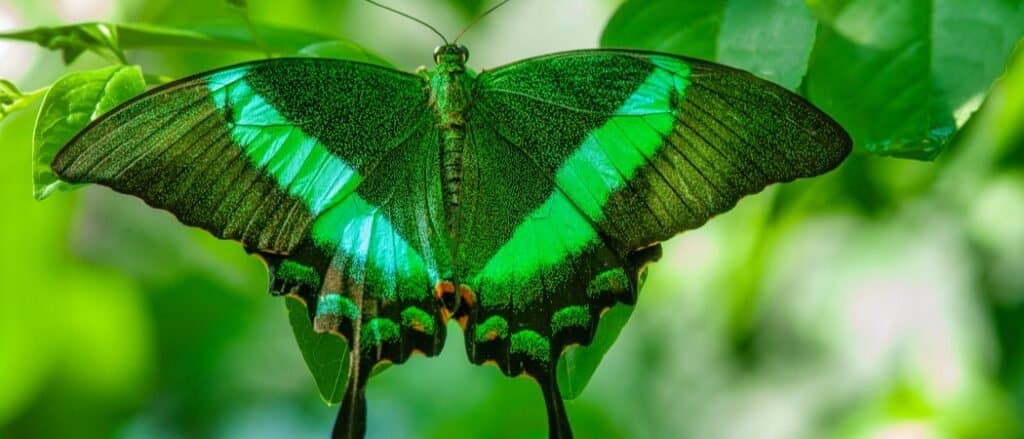
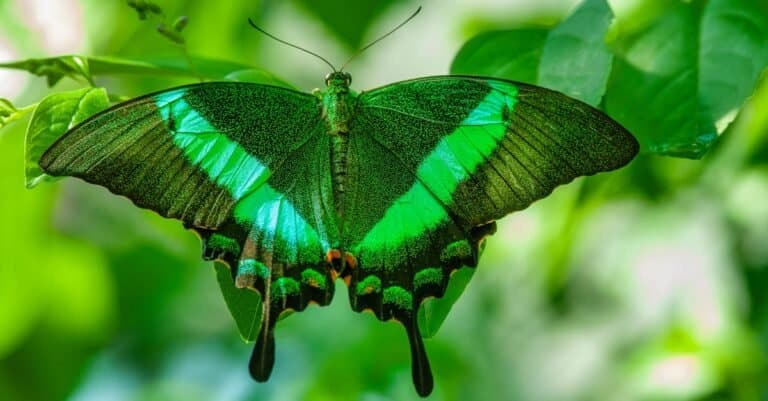
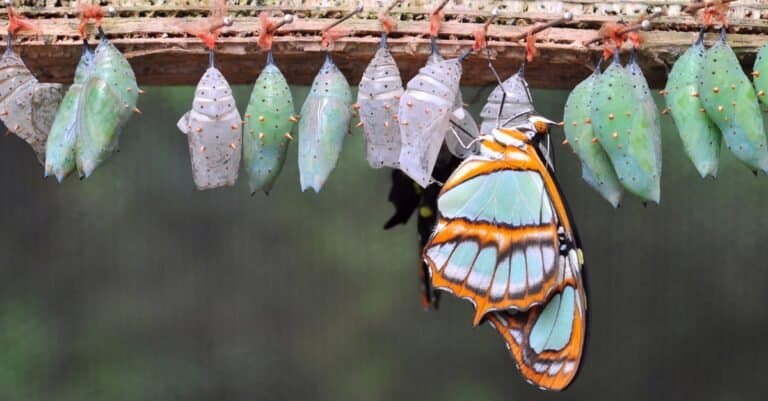
Close-up of green spotted malachite butterfly

At a Glance

Order Overview This page covers the Butterfly order as a group. Stats below are general traits shared across the order.
Also Known As butterflies, moths, butterflies and moths, scale-winged insects, scaly-winged insects, leps
Diet Herbivore
Activity Diurnal+
Lifespan 0.25 years
Weight 0.02 lbs
Status Not Evaluated
Did You Know?

Lepidoptera is one of the most species-rich insect orders, with well over 150,000 described species and many more likely undescribed.

Scientific Classification

Order Overview "Butterfly" is not a single species but represents an entire order containing multiple species.

Butterflies are day-active lepidopteran insects characterized by scaled wings, a coiled proboscis for feeding (often on nectar), and complete metamorphosis (egg–larva/caterpillar–pupa/chrysalis–adult). In many popular usages “butterfly” refers to the primarily diurnal lineages within Lepidoptera (often contrasted with moths).

Kingdom
Animalia
Phylum
Arthropoda
Class
Insecta
Order
Lepidoptera

Distinguishing Features

  • Two pairs of wings covered in microscopic scales (often brightly patterned)
  • Complete metamorphosis with caterpillar larval stage and a pupal stage (chrysalis)
  • Adults typically have clubbed antennae (a common trait distinguishing many butterflies from many moths)
  • Coiled proboscis used for sipping liquids (nectar, sap, minerals from damp ground)

Physical Measurements

Males and females differ in size

Weight
0 lbs (0 lbs – 0 lbs)
Top Speed
37 mph
Poisonous

Appearance

Skin Type Lepidoptera have an exoskeleton; adults have wings covered in overlapping scales. Caterpillars are soft, with true legs and hooked prolegs; they can be smooth, spiny, or hairy. Pupae are hardened, immobile, as chrysalis or cocoon.
Distinctive Features
  • Lepidoptera vary a lot in size: some adults have tiny wingspans of about 3 to 5 mm, while the largest, like silk moths and birdwings, reach about 25 to 30 cm.
  • Lepidoptera adults may live a few days to weeks; some migratory or overwintering adults live months. Whole life cycle is often weeks to months, but larvae can last a year or more.
  • Complete metamorphosis is universal: egg → larva (caterpillar) → pupa (chrysalis or cocoon, depending on lineage) → adult. This life cycle underpins strong ecological separation between larval and adult diets and habitats.
  • Most adults have a coiled proboscis to drink liquids like nectar, but some feed on sap, rotting fruit, animal fluids, or do not feed (some moths have reduced mouthparts).
  • Links between plants and insects are very important: caterpillars mostly eat plants and often only eat one kind of plant or plant part, while adults visit flowers and sometimes help pollinate.
  • Behavior/ecology varies broadly: many moths are nocturnal/crepuscular while many butterfly lineages are diurnal; migration occurs in some species (from local movements to long-distance, multi-generational migrations), while many others are sedentary.
  • Lepidoptera play many roles: key parts of food webs (prey for birds, bats, spiders, parasitoids), important herbivores shaping plants, pollinators, and indicator species for habitat health and climate change.
  • Antennae differ by group and sex: many butterflies have clubbed antennae, while many moths have threadlike or feathery antennae. Males often show sensory scales and pheromone organs.

Sexual Dimorphism

Sexual dimorphism in Lepidoptera varies: some species have nearly identical males and females, others differ in size, color, pattern, antennae, or wings. Differences relate to mate finding (pheromones, display, flight), predator avoidance, and reproduction, and vary by family and habitat.

  • Often more active fliers in many taxa and may show brighter or higher-contrast dorsal wing colors/patterns used in signaling (not universal).
  • May possess specialized scent scales (androconia) or hair-pencils for pheromone dispersal (common in many groups).
  • In many moth lineages, males frequently have more strongly bipectinate (feathery) antennae for detecting female pheromones; in other groups antennae differences are subtle or absent.
  • May be smaller-bodied in some species, with proportionally slimmer abdomen compared to egg-laden females (varies widely).
  • Often larger abdomen for egg production; in many species females are larger overall, though the reverse occurs in some groups.
  • Frequently more cryptically colored/patterned in some taxa (especially where females spend time stationary while ovipositing), but in other taxa females are the more conspicuous sex.
  • In some lineages, females may have reduced flight capability or even reduced wings (not typical of the order overall, but present in certain groups).
  • Ovipositor and associated abdominal morphology are adapted for egg-laying on/into host plants; external visibility varies by species.

Did You Know?

Lepidoptera is one of the most species-rich insect orders, with well over 150,000 described species and many more likely undescribed.

Adult wingspans span an extreme range: roughly 0.3-0.4 cm in the tiniest micro-moths to about 25-28 cm in the largest giant moths and birdwings.

Many adults sip nectar with a coiled proboscis, but across the order some also feed on rotting fruit, tree sap, dung, or even animal tears; others (e.g., many giant silk moths) don't feed at all as adults.

Caterpillars often show strong host-plant specificity-some use just one plant genus or even a single species-shaping coevolution with plant chemical defenses.

Silk is a lepidopteran innovation: caterpillars spin it for shelters and cocoons; humans domesticated the silkworm (Bombyx mori) to build global silk industries.

Lepidoptera include iconic long-distance migrants (e.g., certain butterflies and day-flying moths), while many other species are highly local and seasonal, with diapause to survive winter or drought.

Wing colors can be pigment-based or structural (microscopic scale architecture), creating iridescence, UV patterns, and angle-dependent shimmer used in signaling and camouflage.

Unique Adaptations

  • Wings and bodies covered in "scales" (flattened hairs) that enable color patterns, thermoregulation, water-shedding, and easy escape from spider webs by shedding scales.
  • A coiled proboscis (in most adults) specialized for liquid feeding; its length varies widely, from short to exceptionally long in some nectar-feeders adapted to deep flowers.
  • Silk production by larvae for cocoons, shelters, leaf-rolling, safety lines, or communal tents-supporting both survival strategies and (in domesticated silkworms) human textile production.
  • Diverse defenses in caterpillars: spines and urticating hairs in some, chemical deterrents in others, and unique glands like the osmeterium in swallowtail larvae that everts to emit odors.
  • Hearing and anti-bat tactics in many nocturnal moths: tympanal ears evolved in multiple lineages, enabling evasive flight; some moths even generate ultrasound clicks to interfere with bat echolocation.
  • Optical tricks from scale microstructure: structural colors and UV-reflective patterns used in mate choice and species recognition, often invisible to humans.
  • Extreme size diversity: adults from a few tenths of a centimeter across to nearly 30 cm wingspan; caterpillars from a few tenths of a centimeter to roughly 10-15 cm in the largest species.

Interesting Behaviors

  • Complete metamorphosis across the order: egg to larva (caterpillar) to pupa (chrysalis/cocoon) to adult, with huge variation in timing (weeks to multiple years).
  • Activity patterns vary widely: many "butterflies" are mainly diurnal, while many moth lineages are nocturnal or crepuscular; both patterns occur repeatedly across Lepidoptera.
  • Plant-insect specialization is common: larvae may be leaf-chewers, miners, borers, or case-bearers, and many track host-plant phenology closely; others are generalists.
  • Pollination roles range from incidental to specialized mutualisms: day-active species often visit flowers for nectar, while many nocturnal moths pollinate night-blooming plants; a famous specialized partnership occurs between yucca moths and yucca plants.
  • Chemical ecology is central: adults and larvae use pheromones for mate-finding, and many caterpillars sequester plant toxins to deter predators (with warning coloration in some groups).
  • Migration and dispersal show big variation: some species undertake multi-generational migrations, while many others have short, localized flight seasons and limited dispersal.
  • Predator-prey interactions are intense: camouflage (leaf-like wings, bark patterns), startle displays (eyespots), and mimicry (including resemblance to toxic species) occur across many families.
  • Food-web importance is broad: caterpillars are major herbivores and key prey for birds, bats, reptiles, spiders, and parasitoid wasps/flies; outbreaks can reshape vegetation, while many species are conservation indicators of habitat quality.
  • Lifespan ranges are extreme: some adults live only a few days, others (especially those that overwinter as adults) can persist for months; total life cycles can be a few weeks or, in some high-arctic moths, extend for over a decade due to slow larval development.

Cultural Significance

Across cultures, Lepidoptera (butterflies and moths) stand for change, short life, and the soul. They shaped silk trade, pollinate plants, support food webs, show environmental change, and inspire art, textiles, science, and conservation.

Myths & Legends

Ancient Greece: Psyche-whose name means "soul" and is often depicted with butterfly wings-appears in the tale of Eros and Psyche, linking butterflies with the human soul and transformation.

Japan: butterflies are widely associated with souls; traditional belief holds they can represent the spirits of the dead or a visiting soul, and paired butterflies are a classic motif for marital happiness.

Ireland and parts of Britain: folk belief long held that butterflies could be souls of the departed (or carriers of messages), leading to customs of treating them gently and avoiding harm.

Hopi tradition (Southwestern North America): Butterfly Maiden (and butterfly imagery in katsina ceremonies) is associated with fertility, renewal, and the return of life in spring.

China: the legend of Liang Shanbo and Zhu Yingtai ("The Butterfly Lovers") ends with the lovers transformed into butterflies, a lasting symbol of love and metamorphosis in opera, literature, and art.

Aztec mythology: Itzpapalotl ("Obsidian Butterfly"), a fearsome warrior figure associated with night, sacrifice, and power, reflects the strong symbolic role of moth/butterfly imagery in Mesoamerican belief.

Mexico (often linked to Indigenous and regional traditions): monarch butterflies arriving near the Day of the Dead are widely regarded as returning souls/visitors, blending seasonal natural history with spiritual meaning.

Conservation Status

NE Not Evaluated

Has not yet been evaluated against the criteria.

Population Unknown

You might be looking for:

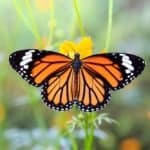
Monarch butterfly

18%

Danaus plexippus

Large migratory milkweed butterfly of North America, famous for long-distance seasonal migrations.

View Profile

Painted lady

14%

Vanessa cardui

Highly widespread, strong-flying butterfly found on multiple continents; notable migrant.

Old World swallowtail

12%

Papilio machaon

Large swallowtail with tail-like hindwing extensions; widespread across Eurasia and North America.

Cabbage white

10%

Pieris rapae

Common white butterfly; larvae are pests of brassica crops.

View Profile

Blue morpho

10%

Morpho menelaus

Neotropical forest butterfly known for brilliant structural blue coloration.

Common buckeye

8%

Junonia coenia

North American butterfly with prominent eyespots; common in open habitats.

Life Cycle

Birth 200 caterpillars
Lifespan 0 years

Lifespan

In the Wild
0.04–5 years
In Captivity
0.04–6 years

Reproduction

Mating System Polygynandry
Social Structure Solitary
Breeding Pattern Transient
Fertilization Internal Fertilization
Birth Type Internal_fertilization

Lepidoptera mating is mostly polygynandry: many males and females mate more than once. Some species are monandrous or polyandrous. Moths often use pheromones; butterflies perch, patrol, or hilltop. Internal fertilization transfers a spermatophore. Parthenogenesis is rare.

Behavior & Ecology

Social Aggregation Group: 10
Activity Diurnal, Nocturnal, Crepuscular, Cathemeral, Matutinal, Vespertine
Diet Herbivore Flower nectar for many adults; fresh host-plant foliage for most larvae (caterpillars).
Seasonal Hibernates 3,107 mi

Temperament

Generally non-aggressive and non-social; interactions are often avoidance-based (startle flight, concealment, dropping) rather than confrontational
Adult males of some species show localized territoriality (patrolling or perching) and can chase conspecifics and other insects; intensity varies widely across families
Larvae range from cryptic and solitary to conspicuously gregarious; defensive tendencies range from passive camouflage to active thrashing, regurgitation, or use of irritating hairs/spines in some taxa
Broad ecological diversity across the order leads to wide behavioral variation (e.g., nectar-feeding vs. non-feeding adults; specialists vs. generalists; migratory vs. resident populations)

Communication

Ultrasonic clicks or pulses in some moth lineages Used in predator deterrence and/or courtship in certain taxa
Audible clicks/creaks produced by wing or body structures in a minority of species Generally close-range and context-dependent
Chemical signaling via pheromones is pervasive (long-range mate attraction, short-range courtship cues, host-plant and oviposition cues); sensitivity and plume-following behaviors vary across taxa
Visual signaling with wing coloration/patterns (including UV patterns) used in species recognition, mate choice, and territorial interactions; also includes deceptive signals such as eyespots and masquerade
Tactile/close-range courtship behaviors (antennal contact, wing-fanning, positioning) that modulate chemical and visual cues
Vibrational communication through substrates (wing or body vibrations on leaves/branches) used in courtship or disturbance contexts in some groups
Silk-based cues in larvae Silk trails that facilitate group cohesion or site fidelity in gregarious species
Inter-specific chemical interactions in myrmecophilous butterflies Some larvae/pupae use chemical mimicry and signals to interact with ants; presence and degree of association vary widely

Habitat

Biomes:
Tropical Rainforest Tropical Dry Forest Savanna Desert Hot Desert Cold Mediterranean Temperate Grassland Temperate Forest Temperate Rainforest Boreal Forest (Taiga) Tundra Alpine Freshwater Wetland Marine +9
Terrain:
Mountainous Hilly Plateau Plains Valley Coastal Island Riverine Volcanic Karst Rocky Sandy Muddy +7
Elevation: Up to 19685 ft 1 in

Ecological Role

Highly diverse herbivore-pollinator-prey guild: caterpillars are major plant consumers and occasional predators; adults range from important pollinators to opportunistic sugar/fruit/sap feeders, forming key links between plants and higher trophic levels.

Pollination of wild plants (and some crops), especially by nectar-feeding adults Regulation of plant communities through herbivory and selective host-plant pressure Core prey base for birds, bats, reptiles, amphibians, small mammals, and predatory invertebrates Nutrient cycling via frass deposition, leaf litter processing (in some detritus/lichen-feeding larvae), and transfer of plant-derived energy through food webs Bioindication: many species respond sensitively to habitat change, climate, and pesticide pressure

Diet Details

Main Prey:
Soft-bodied insects Ant brood and ant-tended resources Insect eggs and larvae Animal-derived foods
Other Foods:
Living plant foliage Flowers and buds Seeds and grains Fruits and fruit juices Plant sap and tree exudates Nectar Honeydew and other sugary secretions Lichens and algae Detritus +3

Human Interaction

Domestication Status

Wild

Lepidoptera (butterflies and moths) are mostly wild, but people manage, breed, and trade many species. True domestication is rare, best known in the silkworm Bombyx mori; others are mass-reared for silk, research, and education. Caterpillars eat plants and often are pests. All undergo full metamorphosis; adults may or may not feed.

Danger Level

Moderate
  • Most species are harmless; however, some caterpillars have urticating hairs/spines that can cause dermatitis, eye irritation, or allergic reactions on contact
  • Rare but serious envenomation/poisoning: a small number of moth larvae (e.g., Lonomia spp.) can cause severe bleeding disorders and may be life-threatening
  • Allergies/asthma triggers from scales/hairs in sensitive individuals (handling mass-reared insects or high-density exhibits)
  • Indirect harm via agriculture/forestry: many species are significant crop/ornamental/forest pests, causing economic loss and sometimes prompting pesticide use with human/environmental health implications
  • Biosecurity risk: accidental transport or release can introduce invasive species or pathogens affecting native Lepidoptera and managed populations

As a Pet

Suitable as Pet

Legality: Laws differ by country, state, and species. Many allow keeping captive-bred native butterflies and moths for education, but ban wild collecting, transport, and release. Protected species and imports need permits and agricultural checks.

Care Level: Moderate

Purchase Cost: $15 - $500
Lifetime Cost: $30 - $1,500

Economic Value

Uses:
Textiles and biomaterials Agriculture (pollination and pest impacts) Biological control and integrated pest management Education and recreation Scientific research and biotechnology Food and livelihoods (in some regions)
Products:
  • silk (notably from domesticated silkworm moths; also some wild silks)
  • live pupae/eggs/larvae for butterfly houses and educational kits
  • pollination services (some adult Lepidoptera contribute, typically secondary to bees but locally important)
  • biocontrol programs targeting pest Lepidoptera (and conversely mass-rearing of pests for sterile insect technique in limited contexts)
  • research organisms (e.g., genetics, development, ecology, mimicry, biomimetic materials/optics from wing scales)
  • edible caterpillars and associated trade in some regions
  • ecotourism and cultural/ornamental value (butterfly watching, exhibits, art/collectibles-sometimes regulated due to conservation concerns)

Relationships

Predators 9

Great tit Parus major
Barn swallow
Barn swallow Hirundo rustica
Little brown bat
Little brown bat Myotis lucifugus
European paper wasp Polistes dominula
Common wasp Vespula vulgaris
Praying mantis
Praying mantis Mantis religiosa
European garden spider Araneus diadematus
Dragonflies
Dragonflies Anisoptera
Robber flies
Robber flies Asilidae

Related Species 9

Swallowtails
Swallowtails Papilionidae Shared Family
Whites and sulfurs Pieridae Shared Order
Brush-footed butterflies
Brush-footed butterflies Nymphalidae Shared Order
Blues, coppers, and hairstreaks Lycaenidae Shared Family
Owlet moths Noctuidae Shared Order
Hawk moths Sphingidae Shared Order
Giant silk moths
Giant silk moths Saturniidae Shared Family
Geometer moths
Geometer moths Geometridae Shared Family
Leaf-miner micro-moths Nepticulidae Shared Family

Ecological Equivalents 4

Animals that fill a similar ecological role in their ecosystem

Bees Anthophila Frequent floral visitors and major pollinators; they strongly overlap with nectar-feeding adult Lepidoptera in resource use and plant–pollinator interactions, although Lepidoptera often rely on a coiled proboscis and include many nocturnal pollinators.
Hoverflies Syrphidae Diurnal flower visitors that can occupy similar pollination niches as butterflies. Adults often take nectar and pollen, while larvae vary widely in diet (aphid predators, detritivores), paralleling Lepidoptera's life-stage niche shifts.
Flower chafers Cetoniinae Many of these beetles are nectar- and pollen-feeders and act as pollinators. They overlap ecologically in flowering habitats, although their mouthparts, activity patterns, and effectiveness as pollinators differ.
Caddisfly Trichoptera Closest living insect order to Lepidoptera (sister group) and often similar in adult morphology, with scaled or haired wings and comparable wing venation patterns. Ecological roles differ—many caddisfly larvae are aquatic—but they are often used as a comparative ecological/functional relative in life-history discussions.

Types of Butterfly

14

Explore 14 recognized types of butterfly

Monarch butterfly
Monarch butterfly Danaus plexippus
Painted lady Vanessa cardui
Old World swallowtail Papilio machaon
Small white (cabbage white) Pieris rapae
Blue morpho Morpho menelaus
Common buckeye Junonia coenia
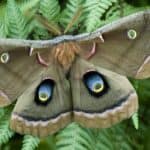
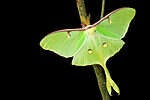
Luna moth
Luna moth Actias luna
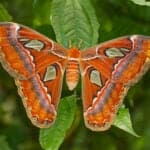
Atlas moth
Atlas moth Attacus atlas
White witch moth Thysania agrippina
Tobacco hornworm moth (Carolina sphinx) Manduca sexta
Silkworm moth Bombyx mori
Codling moth
Codling moth Cydia pomonella
European gypsy moth (spongy moth) Lymantria dispar
Diamondback moth
Diamondback moth Plutella xylostella

There are many different types of butterflies in the world, like swallowtails and monarchs.

They come in all different colors, including blue, white, pink, and brown. The life cycle of each butterfly starts out as a larva before it finally morphs into a beautiful butterfly. Butterflies are found on every continent, except Antarctica.

5 Incredible Butterfly Facts!
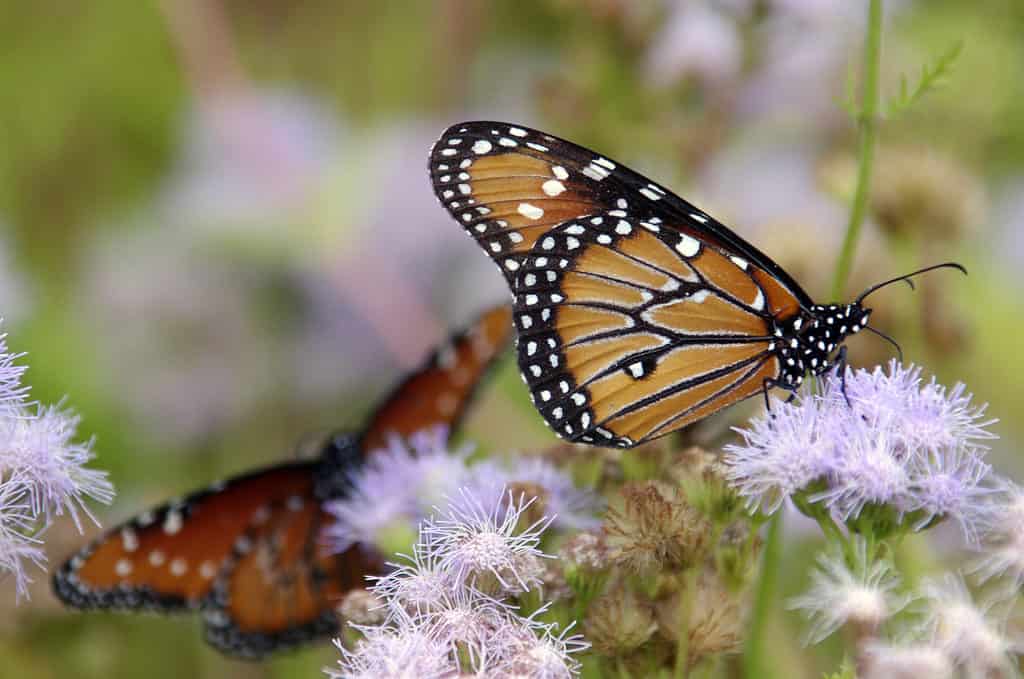
Butterflies on a Gregg's mistflower (Conoclinium gregii)

There are just under 18,000 species of butterflies in the world.

  • There are just under 18,000 species of butterflies in the world.
  • Females of most species of butterflies are able to mate on the day of their emergence, but males have to wait several days.
  • All adult butterflies live less than one year. Some species of butterflies can live up to 30 years before moving into the butterfly part of their life cycle, but the facts show that they may only live a day or two as an adult butterfly.
  • Butterflies can fly up to 37 miles per hour.
  • The facts show that the largest butterfly in the world is the Queen Alexandra’s birdwing. This butterflies wingspan can measure 10.7 inches.

Species, Types, and Scientific Names
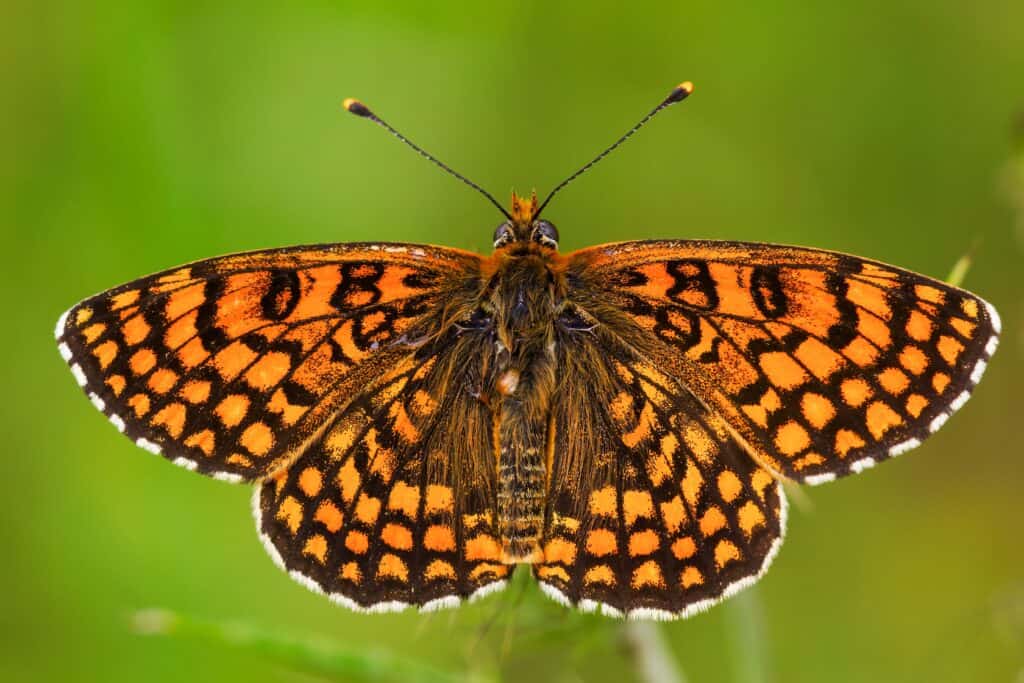
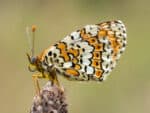
Fritillary Butterfly

All butterflies and moths are members of the Lepidoptera order. In ancient Greek, the word “lepís “ means scale while the word “pterón” means wing.

Butterflies are members of the Rhopalocera suborder. They are also members of the Arthropoda phylum and the Insecta class.

All butterflies and moths are members of the Lepidoptera order. In ancient Greek, the word “lepís “ means scale while the word “pterón” means wing, so the scientific name aptly fits these insects. Butterflies are divided into 46 superfamilies and 126 families, but each completes the same life cycle. About 10% of the known 180,000 species of butterflies and moths are alive today, with the greatest number of types found in Peru.

Butterflies are divided into six families. The Hesperiidae contains about 4,130 species, including:

  • Pyrrhopyginae – These South American and Central American stout-bodied butterflies have about a 2-inch wingspan, and they live in forest canopies.
  • Pyrginae – These temperate and tropical butterflies live near the ground, and they often rest with their wings held flat.
  • Hesperiinae – These brown-and-orange butterflies that look kind of like a Monarch with about a 2-inch wingspan, similar to a swallowtail’s wings, live in temperate and tropical areas, including England.
  • Coeliadinae – Often called policeman and awls, these butterflies live in Africa, Australia, and the Orient.
  • Euschemoniinae -The only member of this subfamily is the Regent Skipper from Australia.

Another family of butterflies is the Papilionidae. These are often called swallowtails because there is often a small extension on their back wings. The caterpillars of these butterflies process an extra organ, called an osmaterium, that emits a foul smell as a defense mechanism. Members of this family that can be all different colors, including pink, include:

  • Papilioninae – Many of these butterflies live in the Orient while others live in New Guinea, but they all flutter extremely quickly.
  • Parnassiinae- These semi-transparent butterflies that can have a pink tint mostly live in Asia, but there are three species in North America and three in Europe. They are poisonous to all vertebrae.
  • Baroniinae –Mexico’s orange-and-brown Baronia brevicornis which looks similar to a Monarch is the only member of this subfamily.

The next family is the Pieridae, and there are about 1,036 species in this family. These are found around the world, and most are brightly colored. They include the:

  • Sulphurs, Yellows, Brimstones – Often called grass yellows and sulphurs, these butterflies migrate a long way, with most of them congregating in the Amazon region.
  • Pierinae – These generalist butterflies that often have a white ground marked with black, orange, or yellow live all around the world from alpine meadows to tropical rainforests.
  • Dismorphiinae – These tropical butterflies are sexually dimorphic and many are mimetic.

The next family is the Lycaenidae classification, and there are about 6,500 species in this subfamily. These small butterflies often have a metallic blue or coppery upper side, and they often live with ants who help to protect them and get a sugary substance needed to live from them. Members of this large subfamily include:

  • Theclinae – These butterflies often live in the neotropics usually have white hairline streaks and usually have tails on their hindwings.
  • Polyommatinae – The males of this subfamily generally have blue uppersides while females have orange ones, but they both have many dark spots on their undersides.
  • Lycaeninae – Males of this subfamily that live in New Zealand and the Holarctic region set up territories where they defend against all insects.
  • Poritiinae- These rainforest and cloud forest butterflies live in Asia, Malaysia, the Philippines, and Sulawesi, and they are some of the most iridescent butterflies in the world.
  • Miletinae – These brown-and-white carnivorous butterflies live in Southeast Asia, Africa, and North America.
  • Lipteninae – There are about 522 species of this butterfly that lives in Africa, where they normally live on or near fig trees.
  • Liphyrinae – These African butterflies do not have a sucking instrument, called a proboscis, so they cannot eat.

Another family of butterflies is the Riodinidae classification, although some classification schemes list them as a subfamily of the Lycaenidae family. There are about 1,500 species of these butterflies. These butterflies are small, and they may have a metallic color. Subfamilies include:

  • Riodinidae – These small butterflies from South and Central America often have bright metallic colors.
  • Euselasiinae- There are at least 172 members of this subfamily that lives under leaves in the neotropical region.

Once considered families with their own scientific names, the Nymphalidae classification of butterflies all have very small forelegs that are useless for walking. There are about 6,000 different species that scientists usually divide into 22 subfamilies, including:

  • Libytheinae- These butterflies that live in diverse locations globally have the ability to camouflage themselves so that they look like dead leaves.
  • Nymphalinae – These are brush-footed butterflies that live around the globe.
  • Heliconiinae – These small butterflies are often called passion-vine butterflies.
  • Acraeinae – These butterflies are often orange and black live in Africa, Brazil, and Venezuela.
  • Danainae – The larvae of the butterflies get toxins from their food and pass it on to the adult butterfly so that birds do not like their taste.
  • Morphinae – Some of the biggest butterflies in the world, they usually have eyespots on their wings, which they can use as decoys to get away from their enemies.

Evolution and Origins
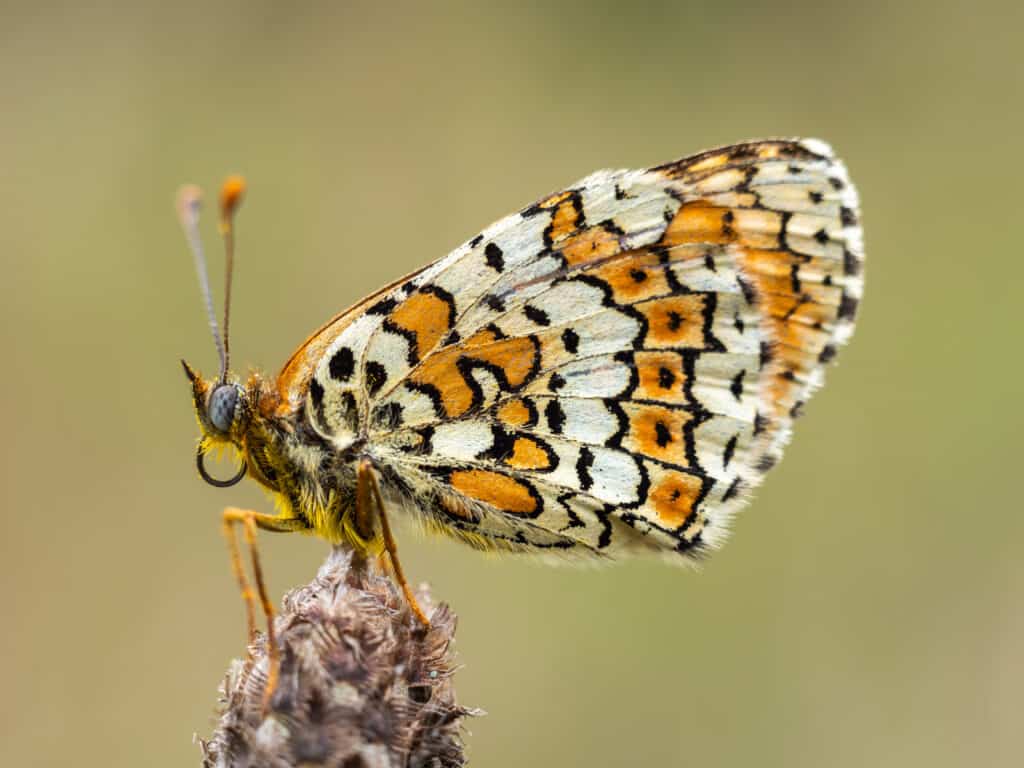
Fritillary Butterfly

Butterflies are insects and are believed to have evolved from moths.

Butterflies are insects and are believed to have evolved from moths, which are their close relatives. The earliest known butterfly fossils date back to the mid-Eocene period, around 40 million years ago. During the early stages of their evolution, butterflies were likely small and dull-colored, similar to many moths today.

Over time, they evolved to become larger and more brightly colored as a result of adaptation to different environments and to better attract mates. The evolution of butterflies is also thought to have been influenced by the development of plants, as many butterflies have evolved to be able to feed on specific types of plants, and plants have also evolved to defend themselves from butterfly predation.

Appearance
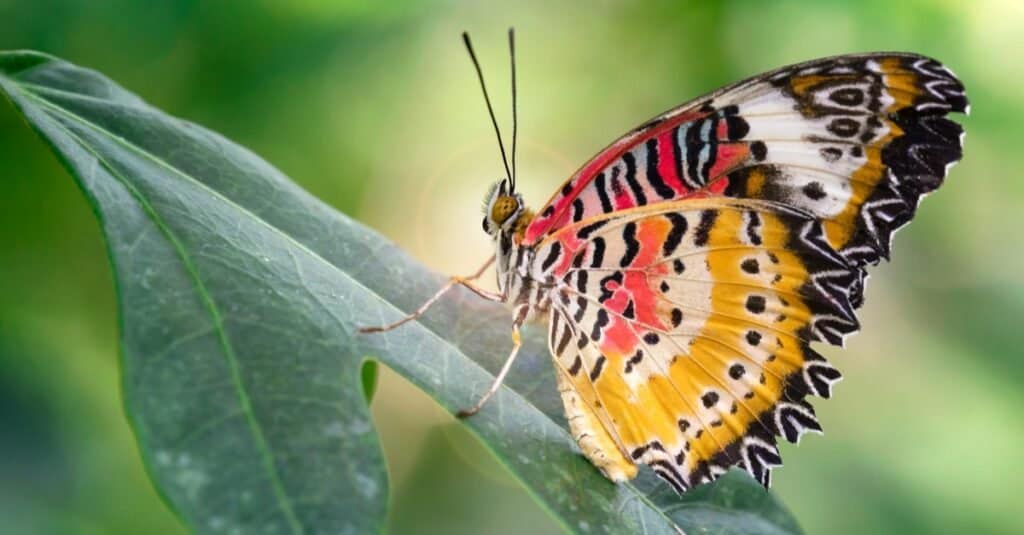
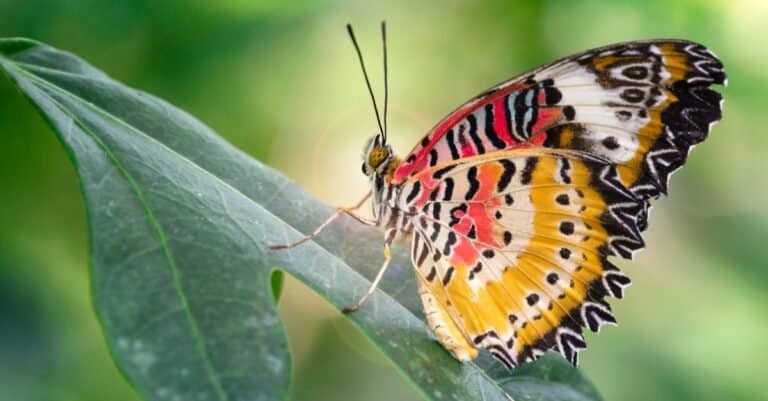
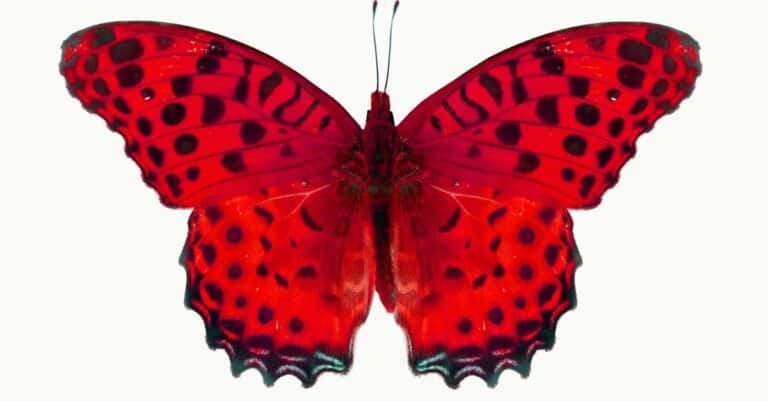
Beautiful butterfly with wide multicolored red and yellow wings on a leaf in a tropical botanical garden near Chiang Mai, Thailand.

Beautiful butterfly with wide multicolored red and yellow wings on a leaf in a tropical botanical garden near Chiang Mai, Thailand.

Butterflies are very diverse insects. They have a three-part body consisting of the head, thorax, and chest. They also have six legs and two antennae. Most have scales on their wings and hair on their legs. They have compound eyes that they can use to see very well.

The biggest butterfly is Queen Alexandra’s birdwing, which is cared for by the staff at the Natural Museum of History in London. Its wingspan is about 10.7 inches. The smallest butterfly is the Western pygmy blue butterfly, which lives in California, Mexico, and Central America. Its wingspan measures about 0.5 inches across.

Habitat

Butterflies live in many different types of habitats as they can be found on every continent, except Antarctica. You can find some butterflies in deserts while others live in rainforests. Some live where it is very hot while others live in more moderate climates.

The highest number of different species of butterflies in the world is found in Peru. Many of them live in the Manu National Park, where over 1,300 species of butterflies have been recorded. Other countries with diverse butterfly populations, include Brazil, Colombia, and Ecuador.

Diet
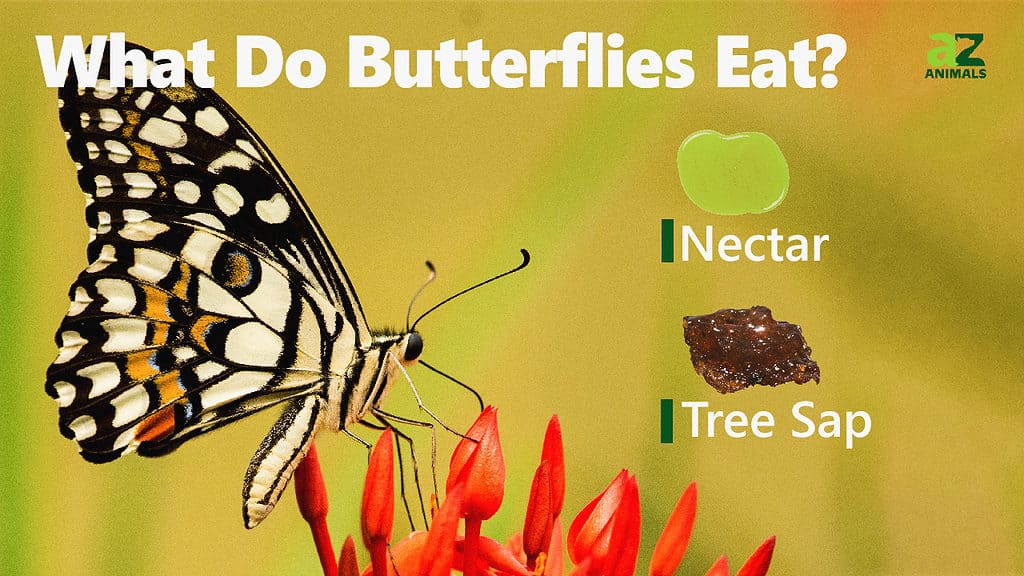
butterfly eats
Most butterflies have one or two host plants that they prefer to dine on.

Most butterflies have one or two host plants that they prefer to dine on. While most prefer to suck the nectar out of plants as adults, some are carnivorous. For example, North America’s harvester butterfly eats only living wooly aphids.

Other species get nutrients from decaying plants. You can often find these species in areas where there are monsoons. The butterflies, like the Gluphisia crenata, drink up the water. Then, they release the fluids through their anal glands. This allows them to get salts and amino acids that their bodies need to thrive.

Even More Exciting Information

If you would like to learn even more intriguing facts about butterflies, including how many legs they possess, how to preserve them, which butterflies are poisonous, and which flowers attract them most, check out the articles below!

  • Top 10 Smallest Butterflies in the World
  • How Long Do Butterflies Live?
  • 8 Most Unique Butterflies in the World
  • How Many Legs Does a Butterfly Have?
  • How to Preserve a Butterfly (in 6 Easy Steps)
  • Where Do Butterflies Live?
  • Fear of Butterflies: What’s It Called and Why Are Some People Scared of Butterflies?
  • 10 Poisonous Butterflies
  • Do Butterflies Bite?
  • How Many Eyes Do Butterflies Have?
  • What’s a Group of Butterflies Called?
  • What Flowers Attract Butterflies?
  • 10 Rarest Butterflies in the World
  • Do Butterflies Lay Eggs?
  • How Do Butterflies Eat?
  • How Do Butterflies Reproduce?
  • Raising Butterflies: How To Get Started Today
View all 453 animals that start with B
How to say Butterfly in ...
English
Papilioninae
Spanish
Papilioninae
French
Papilioninae
Italian
Papilioninae
Japanese
アゲハチョウ亜科
English
Papilioninae

Sources

  1. Smithsonian / Accessed August 1, 2021
  2. The Children's Butterfly Site / Accessed August 1, 2021
  3. Wikipedia / Accessed August 1, 2021
  4. Learn About Butterflies / Accessed August 1, 2021
  5. Enchanted Learning / Accessed August 1, 2021
  6. Research in Estonia / Accessed August 1, 2021
  7. Lepscience / Accessed August 1, 2021
  8. Pets On Mom / Accessed August 1, 2021
  9. Sky Vine Butterflies / Accessed August 1, 2021
Rebecca Bales

About the Author

Rebecca Bales

Rebecca is an experienced Professional Freelancer with nearly a decade of expertise in writing SEO Content, Digital Illustrations, and Graphic Design. When not engrossed in her creative endeavors, Rebecca dedicates her time to cycling and filming her nature adventures. When not focused on her passion for creating and crafting optimized materials, she harbors a deep fascination and love for cats, jumping spiders, and pet rats.
Connect:

Thank you for reading! Have some feedback for us?


Butterfly FAQs (Frequently Asked Questions)

Butterflies are Herbivores, meaning they eat plants.