
C
Species Profile

Caiman Lizard

Dracaena guianensis

The snail-crusher of the Guianas
Philip Bird LRPS CPAGB/Shutterstock.com

Caiman Lizard Distribution

Click a location to explore more animals from that region

Loading map...
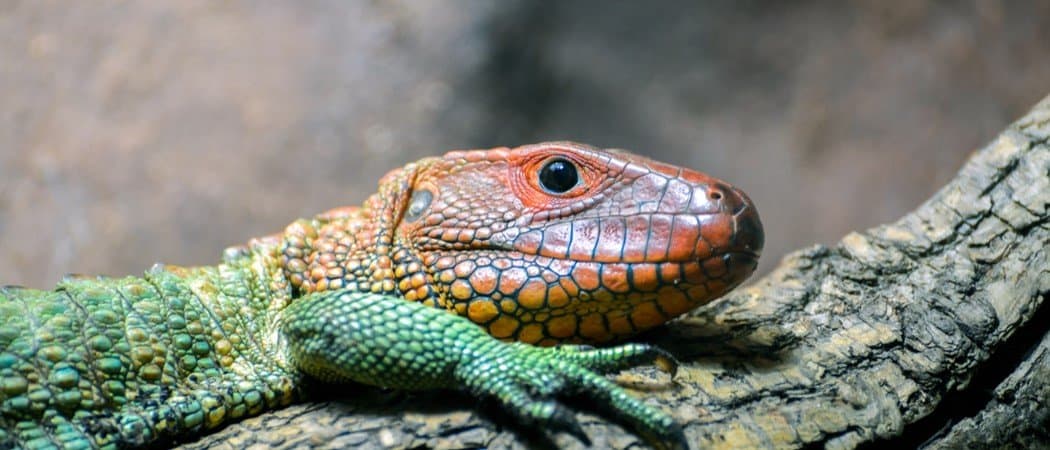
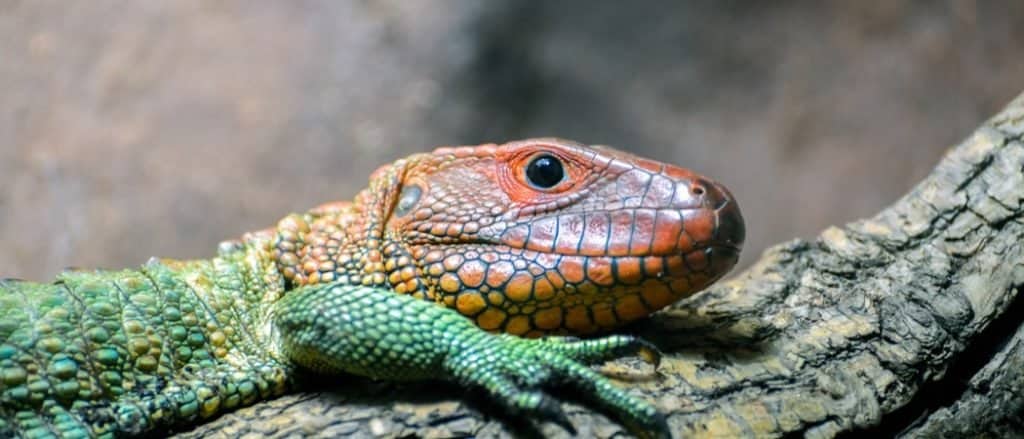
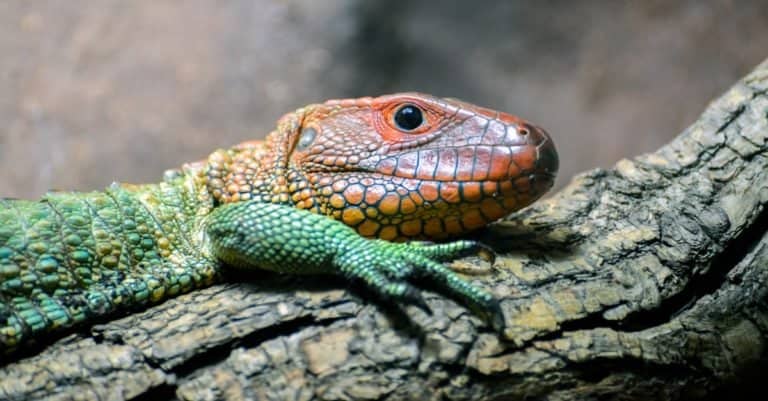
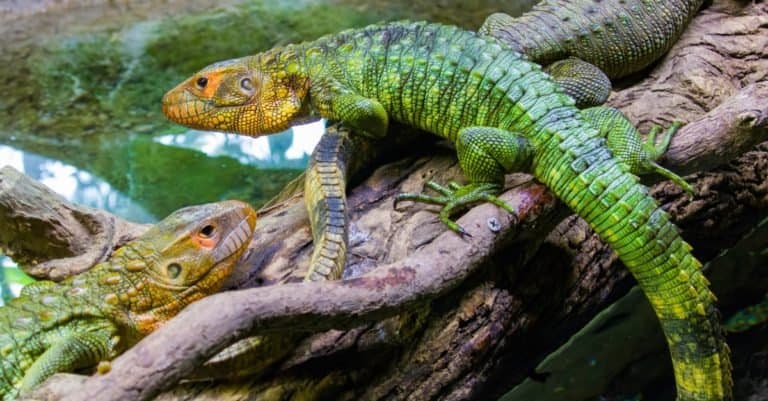
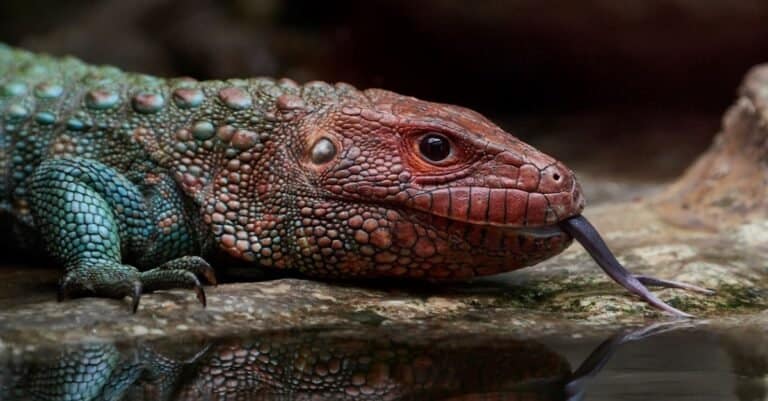
Northern Caiman Lizard (Dracaena guianensis) on a branch.

At a Glance

Wild Species
Also Known As Caiman lizard, Guianan caiman lizard, Guiana caiman lizard
Diet Carnivore
Activity Diurnal
Lifespan 10 years
Weight 4 lbs
Status Least Concern
Did You Know?

Grows to about 1.2 m total length in the largest reported adults (Vitt & Caldwell, 2014).

Scientific Classification

A large, semi-aquatic teiid lizard of northern South America, known for its heavy, crocodile-like head and powerful jaws adapted for crushing hard-shelled prey (especially snails).

Kingdom
Animalia
Phylum
Chordata
Class
Reptilia
Order
Squamata
Family
Teiidae
Genus
Dracaena
Species
Dracaena guianensis

Distinguishing Features

  • Large, robust teiid lizard with a broad, caiman-like head
  • Strong jaws and blunt teeth suited for crushing snails and other hard prey
  • Typically green body with darker patterning and a banded tail
  • Semi-aquatic lifestyle; strong swimmer, often found near water

Physical Measurements

Males and females differ in size

Length
3 ft 5 in (2 ft 11 in – 3 ft 11 in)
2 ft 6 in (1 ft 12 in – 2 ft 11 in)
Weight
5 lbs (3 lbs – 8 lbs)
3 lbs (2 lbs – 4 lbs)
Tail Length
1 ft 12 in (1 ft 8 in – 2 ft 4 in)
1 ft 4 in (1 ft 1 in – 1 ft 8 in)

Appearance

Primary Colors
Secondary Colors
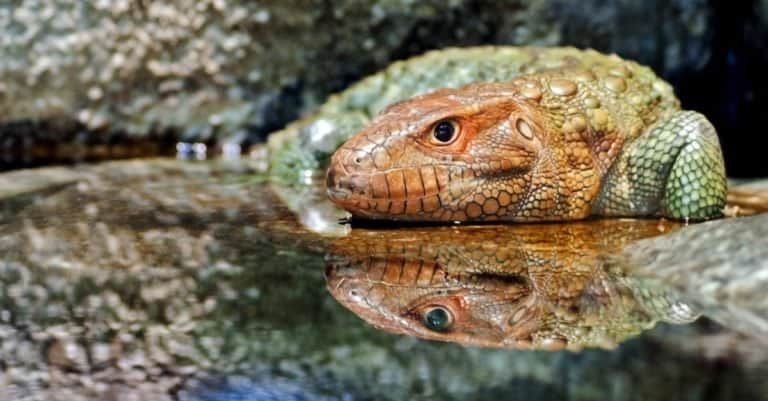
Skin Type Northern Caiman Lizard (Dracaena guianensis) is a heavily scaled teiid with large, keeled, armor-like dorsal scales; tail has ridged scutes for swimming, and belly scales are smoother.
Distinctive Features
  • Powerful jaw musculature and posterior crushing dentition (enlarged, blunt/molariform teeth) adapted for hard-shelled prey, especially freshwater snails such as apple snails in much of its range.
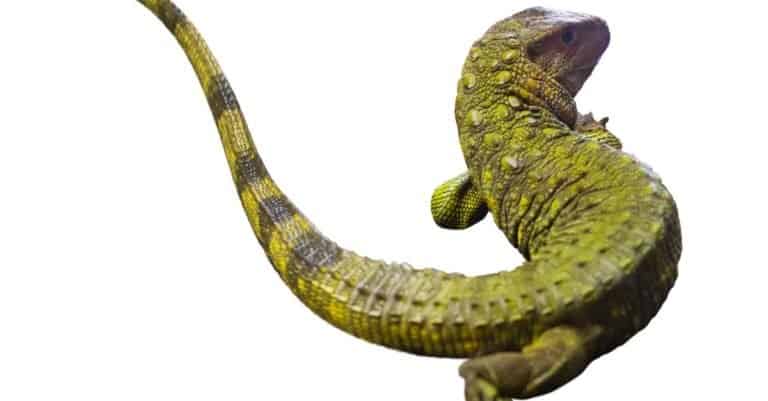
  • Laterally compressed, muscular tail used as the primary swimming propulsor; commonly shows high-contrast banding that remains visible even when the body is uniformly green.
  • Robust body with armored dorsal scaling (thick, strongly textured scales) compared with many other teiids; contributes to the characteristic caiman-lizard look.
  • Semi-aquatic behavior is reflected in appearance and posture: frequently basks near water, dives readily when disturbed, and often forages along banks and in shallow water for mollusks and other aquatic prey.
  • Large, robust lizard with a broad, crocodile-like head and very strongly keeled, armor-like scales; typically green with dark crossbands and a laterally compressed tail adapted for swimming.
  • Adults are typically about 0.8 to 1.2 m (80 to 120 cm) in total length, with the tail making up a large proportion of the overall length.
  • Reported longevity (mostly from captive husbandry records rather than formal demographic studies): often cited around a decade or more; rigorous wild longevity estimates for this species are scarce.
  • The northern caiman lizard (Dracaena guianensis) is usually brighter green with an orange-red head and lives in northern Amazon and Guiana drainages; confirm identity using location and scale patterns.

Sexual Dimorphism

Sexual dimorphism is commonly expressed in head robustness and head/neck coloration intensity: males tend to show a broader, heavier head with stronger orange/red tones, consistent with the species' display and jaw-driven feeding ecology. Precise, population-wide quantified dimorphism values are not consistently standardized across published sources for the northern caiman lizard.

  • Typically larger and more robust overall (commonly reported in husbandry/field accounts).
  • Head proportionally broader/heavier with more pronounced jowls (masseter region), enhancing the species' characteristic 'crocodile-like' head shape.
  • More intense orange-to-red coloration on head/neck is frequently reported, especially in adult males.
  • Typically smaller and less heavily built than males (commonly reported).
  • Head generally narrower/less massive relative to body.
  • Head/neck coloration often less intensely orange/red, tending toward greener/oliver tones compared with males.

Did You Know?

Grows to about 1.2 m total length in the largest reported adults (Vitt & Caldwell, 2014).

Its back teeth are broadened and crushing ("molariform")-a specialization for hard-shelled prey like apple snails (Vitt & Caldwell, 2014).

Often basks on branches overhanging water and drops in to escape-an anti-predator routine typical of semi-aquatic reptiles.

Despite the "caiman" name, it's a true lizard (Family Teiidae), related to tegus and whiptails-not crocodilians.

The tail is laterally compressed, acting like a paddle for strong swimming in slow rivers and flooded forests.

The genus name Dracaena comes from Greek for "dragon/dragoness," reflecting its armored, prehistoric look.

Northern (D. guianensis) and Paraguayan caiman lizards (D. paraguayensis) occupy different basins: the north in Amazon/Guiana drainages, the south in the Paraguay-Paraná system (broadly summarized in regional herpetofaunas).

Unique Adaptations

  • Crushing dentition: enlarged, rounded posterior teeth adapted to break thick shells-key to a snail-dominated diet (Vitt & Caldwell, 2014).
  • Robust "crocodile-like" skull: deep head with strong jaw adductors to generate high bite forces for hard prey (functional interpretation consistent with durophagy described in herpetology texts).
  • Armored scales with osteoderms: large, keeled dorsal scales reinforced by bony plates provide abrasion resistance in aquatic vegetation and added protection from predators.
  • Swimming hardware: laterally compressed tail for propulsion and a streamlined, semi-aquatic body plan suited to creeks, oxbows, and flooded forest edges.
  • Water-edge lifestyle traits: behaviors and body plan support rapid dive-escape and prolonged use of riparian habitats across northern South America (Vitt & Caldwell, 2014).

Interesting Behaviors

  • Snail handling and crushing: forages in shallow water and along margins for large freshwater snails (notably apple snails, Pomacea spp.), then crushes shells with powerful posterior teeth and jaw muscles (Vitt & Caldwell, 2014).
  • Branch-perch vigilance: frequently perches/basks on sunlit branches above water; at disturbance it dives straight in, using the water as immediate cover.
  • Semi-aquatic foraging loops: alternates between shoreline patrols, short swims, and returns to favored basking sites-typical of diurnal, active-foraging teiids.
  • Defensive strategy: relies on rapid retreat to water, vigorous biting, and tail-whipping when cornered; the heavy head and jaws are also effective deterrents.
  • Seasonal activity tied to flooding: activity and hunting opportunities often increase in flooded forest/varzea periods when aquatic prey becomes abundant (general Amazon ecology pattern; species noted as semi-aquatic in Vitt & Caldwell, 2014).

Cultural Significance

Northern Caiman Lizard (Dracaena guianensis) gets its name because its head looks like a small caiman. Known from wildlife documentaries and the pet trade, this Amazon specialist eats apple snails and shows how skull and teeth match a snail diet.

Myths & Legends

European scientists linked the genus Dracaena (including the Northern Caiman Lizard, Dracaena guianensis) to Greek dragon images, making these armored riverbank lizards seem like 'little water-dragons' to early naturalists.

In the Guianas and Amazon edge, the Northern Caiman Lizard (Dracaena guianensis) is called a 'caiman-like lizard.' People say it lives on watery edges and mix crocodiles into local tales, though it's a true lizard.

Collectors from colonial and later times in Guiana and the Amazon often called the Northern caiman lizard 'crocodile-headed' and said it crushes shells, creating a long riverbank story about eating snails.

Conservation Status

LC Least Concern

Widespread and abundant in the wild.

Population Unknown

Protected Under

  • Occurs in protected areas within its range (site-dependent protection varies by country and reserve).

Life Cycle

Birth 5 hatchlings
Lifespan 10 years

Lifespan

In the Wild
8–12 years
In Captivity
12–20 years

Reproduction

Mating System Data Deficient
Social Structure Solitary
Breeding Pattern Transient
Fertilization Internal Fertilization
Birth Type Internal_fertilization

Northern caiman lizard (Dracaena guianensis) has internal fertilization by mating. Wild mating behavior is not well known. Adults are mainly solitary, meet briefly to mate, and no cooperative breeding or paternity studies have been reported.

Behavior & Ecology

Social Solitary Group: 1
Activity Diurnal
Diet Carnivore Apple snails (Pomacea spp.)

Temperament

Wary/avoidant toward disturbance; commonly retreats rapidly to water when approached (semi-aquatic escape response frequently noted in field accounts for D. guianensis; IUCN species narrative summaries).
Northern Caiman Lizard (Dracaena guianensis) defends its area and acts defensive at close range. When cornered it may make a threat, open its mouth, and bite; males get more aggressive during breeding.
HUBS (Dracaena spp.): Temperament is generally 'shy but capable of strong defense' across the genus; individuals vary from highly secretive to tolerant of observers depending on habituation and local hunting pressure.

Communication

Hissing/forced exhalation during defensive displays Commonly reported anuran-free, non-vocal defensive sound in large lizards; noted in natural history/husbandry summaries for Dracaena spp.
Visual displays: head elevation, body inflation, lateral compression, and open-mouth gaping as threat signals; may include tail positioning and rapid movement into water as an escalation Reported broadly for large teiids and described in Dracaena spp. accounts
Chemical assessment: tongue-flicking to sample airborne/substrate cues Conspecifics, prey trails), consistent with squamate chemosensory communication; likely important for mate location in a semi-aquatic, visually occluded habitat (general squamate biology; referenced in standard herpetology texts such as Vitt & Caldwell
Tactile contact during courtship/mating Mounting, cloacal alignment); outside reproduction tactile interaction is rare due to solitary spacing (general squamate reproductive behavior; limited species-specific field quantification for D. guianensis

Habitat

Biomes:
Tropical Rainforest Freshwater Wetland
Terrain:
Plains Riverine Muddy
Elevation: Up to 820 ft 3 in

Ecological Role

Semi-aquatic mesopredator and specialized molluscivore in northern South American lowland wetlands and slow-moving forest waters.

Top-down control on large freshwater snail populations (notably Pomacea/apple snails) and other aquatic invertebrates Transfers aquatic production to riparian zones via feeding and deposition of shell remains (localized nutrient/mineral inputs and microhabitat effects) Potential indirect influence on snail-mediated parasite dynamics by reducing densities of key intermediate-host snails

Diet Details

Main Prey:
Apple snails Freshwater snails Freshwater bivalves Freshwater crabs Freshwater shrimp and prawns Fish Amphibians Aquatic insects and larvae +2

Human Interaction

Domestication Status

Wild

Dracaena guianensis (Northern caiman lizard) is not domesticated. People mainly catch it for the live-animal trade or keep it in zoos and with specialist hobbyists. Captive breeding is uncommon and many were wild-caught. Adults are large, semi-aquatic, active by day snail-eaters (~0.9–1.2 m), need big enclosures, and can live 10–15+ years in care.

Danger Level

Moderate
  • Bite injury: powerful jaws adapted for crushing hard-shelled prey; defensive bites can cause deep punctures/lacerations, especially if forcibly handled.
  • Tail/limb thrashing during restraint can cause scratches/contusions.
  • Zoonoses common to reptiles (e.g., Salmonella) via fecal-oral contamination; risk increases with poor hygiene/household exposure.
  • Aquatic enclosure hazards (drowning risk for small children, electrical/heating equipment risks) are indirect but non-trivial in home settings.

As a Pet

Not Suitable as Pet

Legality: Often legal in many places, but rules differ by country, state, or province. International trade is controlled under CITES Appendix II (Dracaena guianensis) and usually needs permits and proof it came from a legal source. Check local and import laws.

Care Level: Expert Only

Purchase Cost: $400 - $2,500
Lifetime Cost: $12,000 - $35,000

Economic Value

Uses:
International live-animal (pet) trade (specialist market) Zoological/educational display animal (zoos, nature centers) Occasional local capture/consumption reported in parts of range (minor/patchy compared with tegu harvest) Ecotourism/wildlife viewing value in intact wetland/river systems
Products:
  • Live animals (captive-bred or wild-sourced where legal)
  • Zoo/education exhibits and programs

Relationships

Predators 7

Black caiman Melanosuchus niger
Common caiman Caiman crocodilus
Green anaconda
Green anaconda Eunectes murinus
Boa constrictor
Boa constrictor Boa constrictor
Harpy eagle
Harpy eagle Harpia harpyja
Ornate hawk-eagle Spizaetus ornatus
Jaguar
Jaguar Panthera onca

Related Species 5

Paraguayan caiman lizard Dracaena paraguayensis Shared Genus
Argentine black and white tegu
Argentine black and white tegu Salvator merianae Shared Family
Golden tegu Tupinambis teguixin Shared Family
Amazon racerunner Ameiva ameiva Shared Family
Common caiman lizard
Common caiman lizard Dracaena guianensis Shared Family

Ecological Equivalents 5

Animals that fill a similar ecological role in their ecosystem

Common caiman Caiman crocodilus Shares lowland Neotropical river and floodplain habitats and a semi-aquatic, diurnal lifestyle. Both are shoreline ambush/foraging predators and potential competitors or threats to juveniles, with overlapping basking sites and prey communities.
American crocodile Crocodylus acutus Ecological analogue: semi-aquatic predator with robust jaws and shoreline ambush behavior. Included as a functional comparison for head/jaw-based prey handling, even though its core range and habitats (often coastal/brackish) differ from the northern caiman lizard's typical freshwater floodplain systems.
Water opossum Chironectes minimus Another semi-aquatic Neotropical vertebrate that forages along streams and flooded forests; overlaps in shoreline use (nocturnal and diurnal) and consumes aquatic invertebrates, creating niche similarity in riparian foraging despite major taxonomic differences.
Neotropical river otter Lontra longicaudis Riparian, semi-aquatic predator that uses river-edge microhabitats; potential ecological interaction via competition for aquatic prey (fish and crustaceans) in shared waterways.
Matamata turtle Chelus fimbriata Occupies slow-water Amazon and Orinoco floodplain environments; relies on aquatic foraging and camouflage/ambush tactics in structurally complex waters, making it a niche neighbor in similar wetlands.

“The Caiman Lizard is one of the biggest lizard species of the Americas”

Caiman lizards are a large semiaquatic reptile species originating in South America. The Caiman lizard is one of around 5,000 species of lizards. Occasionally referred to as water tegus, these lizards love the water and are fantastic swimmers. Although considerably smaller than the well-known crocodilian caiman, they have some similarities such as the scales along their backs, their characteristic tail, and their comparable habitats.

5 Caiman Lizard Facts

  • As they grow bigger, Caiman lizards shed their skin.
  • Caiman lizards can develop an attachment to their owners.
  • The Caiman lizard is related to the Tegu species.
  • The Caiman lizard is an oviparous animal.
  • Northern Caiman lizards are brightly colored.

Caiman Lizard Scientific name

The lizard’s scientific genus is Dracaena and is sometimes subsequently called the Dracaena lizard. There are currently two subspecies of Caiman lizards: the Northern Caiman lizard and the Paraguay Caiman lizard. The scientific name for the Northern Caiman lizard is Dracaena guianensis, and the scientific name for the Paraguay Caiman lizard is Dracaena paraguayensis. They are both species in the Teiidae family.

“New World Runners” is another name for this family. These lizards belong to the Squamata order and the Reptilia class. The word Dracaena is derived from the Greek drakaina, the female version of drakon meaning “serpent or dragon.” Guianensis means “of or from French Guiana” and in the same sense, Paraguayensis means “of or from Paraguay.”

Caiman Lizard Appearance

These lizards are sizable reptiles. They can grow to be between two and five feet long and weigh eight to twelve pounds when fully grown. As adults, these lizards are about as heavy as a cat. Females ordinarily only get as big as four feet in length and 10 pounds, while full-grown males can reach sizes of five feet long and 12 pounds.

A male lizard’s maximum length is about as tall as actor Danny Devito. These lizards have thick, stocky bodies and elongated, flat tails. Covering the lizard are large scales that are similar in appearance to those on crocodiles. Their limbs are short but strong, allowing them to quickly evade danger.

These lizards have a bifurcated (forked) tongue, powerful jaws, and small rounded teeth. Additionally, they have very sharp claws. They use their tongue to smell and detect food. Possibly the most impressive feature of these lizards is their third, clear eyelid. This unique mechanism acts as goggles to help them see while swimming underwater.

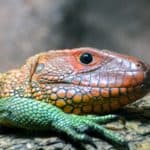
There are some physical traits unique to each subspecies. For instance, the coloring varies between the two. Northern Caiman lizards usually have fairly vibrant hues including a green body, red or orange head, and brown or black tail. Paraguay Caiman lizards, however, have less colorful, muted tones such as gray or tan from head to tail. Males of the Northern variety tend to have a broader and brighter red-colored head than their female counterparts.

These lizards are believed to be present-day relatives of the extinct Dracaena columbiana. They are also related to tegus and whiptails who, likewise, belong to the Teiidae family.
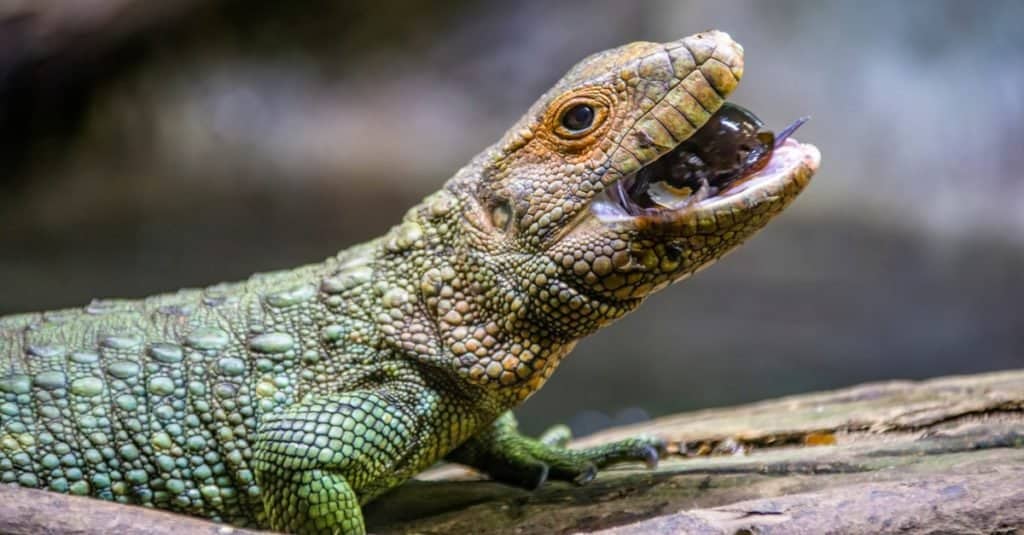
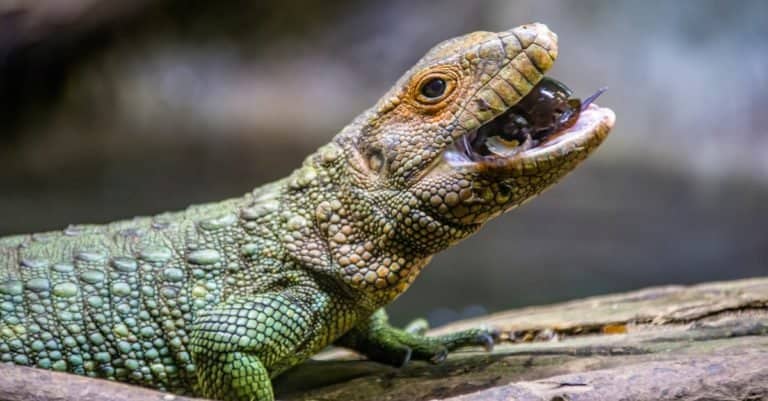
A Northern caiman lizard eating golden apple snails.

A Northern caiman lizard eating golden apple snails.

Caiman Lizard Behavior

A group of lizards is called a lounge. Caiman lizards have been described as neither social nor solitary. Caiman lizards can thrive on their own but they are generally not aggressive and can live in harmony with other lizards as well. This is due to their even-tempered nature.

These lizards are highly active and can run, climb, and swim extremely well. They spend a majority of their time in or close to water. Their tail aids them in swimming and may be used to defend themselves against predators by whipping it at them. These exotic lizards are diurnal. Nearly all of their activity takes place in the daytime and they primarily sleep throughout the night.

During the day, the lizards search for food near riverbanks, hunt underwater, and sunbathe on branches that hang low over the water. They use the water as a quick escape route when needed, simply plunging into the river from the branches they rest on and swimming away. At night, they sleep in bushes or trees, hidden from potential threats. Caiman lizards are tremendously smart animals.

Caiman Lizard Habitat

These lizards are semiaquatic, meaning they must have both terrestrial (on land) and aquatic (in water) habitats. These cold-blooded creatures reside in warm climates. They live mostly in forests, wetlands, flooded woodlands, and savannas. They regularly reside in parts of the Amazon river basin. They need an abundance of freshwater and they frequent rivers, swamps, and marshes. Caiman lizards are native to South America. They can be found in Bolivia, Brazil, Colombia, Ecuador, French Guiana, Paraguay, and Peru.

Caiman Lizard Diet

These lizards are carnivores. They are able to easily crush shells by utilizing their mighty jaws and molar-like teeth. They bite down on the tough material, breaking it. Then they discard the hard shell pieces before eating the meat from their prey. This allows them to effortlessly feed on a variety of hard-shelled invertebrates. Their favorite meal seems to be snails, particularly apple snails.

What does the Caiman Lizard eat?

The lizard’s main diet consists of snails, crawfish, and freshwater clams. In many instances, they prey on Amazon river turtles as well. Furthermore, they will eat insects, crabs, fish, amphibians, and rodents. In captivity, these lizards are fed crickets and worms too.

Caiman Lizard Predators and threats

These lizards face environmental threats from deforestation leading to habitat loss and from human pollution. In the past, these lizards were largely hunted for their skin and sold in the pet trade. They are now protected by the Convention on International Trade in Endangered Species of Wild Fauna and Flora (CITES). This organization aims to regulate trade and decrease animal exploitation. The Caiman lizard has been safeguarded by CITES since the 1970s and is listed in Appendix II.

The International Union for the Conservation of Nature (IUCN) currently categorizes both subspecies of these lizards as least concern on the IUCN red list. They are not in immediate danger of population decline.

What eats the Caiman Lizard?

Known predators of the these lizard include snakes such as the green anaconda, crocodiles, and jaguars.

Caiman Lizard Reproduction and Life Cycle

Unfortunately, the mating rituals of these reptiles are vastly unexplored apart from the fact that they mate through sexual reproduction. It is known, however, that these lizards are oviparous. This means they lay eggs rather than giving live birth. The female lizard lays between five and ten eggs in holes dug along the riverbank. She then covers over the holes to shelter them from predators and potential hazards. The eggs incubate for about 179 days, between five and six months, before hatching.

The baby lizards, called hatchlings, emerge from their shells after the incubation period is over. When they are first born, the hatchlings are only five inches long. Baby lizards will grow roughly two feet in length within the first year. From the moment each baby hatches, they are self-sufficient and will not receive any care from their parents. Hatchlings are capable of roaming around on their own the same day they are born. Just a few hours after departing from their eggs, they can walk and swim.

These lizards typically live over ten years in captivity. Some reach the age of 12 or older. In the wild, their lifespan is unknown for certain but is believed to be around ten years. They are susceptible to commonly occurring ear and eye infections, as well as respiratory infections and parasites. In most cases, these ailments can be treated by a veterinarian.

Caiman Lizard Population

Scientists do not know how many of these lizards there are in the wild. While their exact population number is unidentified, it is stable at this time. They remain in the IUCN’s least concern category. According to IUCN, Paraguay Caiman lizards are currently prevalent in Paraguay. It is unclear at this time if any Northern Caiman lizards still occupy French Guiana.

View all 392 animals that start with C

Sources

  1. EOL / Accessed June 26, 2021
  2. Britannica / Accessed June 26, 2021
  3. Smithsonian's National Zoo & Conservation Biology Institute / Accessed June 26, 2021
  4. The Dallas World Aquarium / Accessed June 26, 2021
  5. Everything Reptiles / Accessed June 26, 2021
  6. Reptiles Magazine / Accessed June 26, 2021
  7. Caiman Lizard / Accessed June 26, 2021
  8. Wildlife Facts / Accessed June 26, 2021
  9. Rosamond Gifford Zoo / Accessed June 26, 2021
A-Z Animals Staff

About the Author

A-Z Animals Staff

AZ Animals is a growing team of animals experts, researchers, farmers, conservationists, writers, editors, and -- of course -- pet owners who have come together to help you better understand the animal kingdom and how we interact.
Connect:

Thank you for reading! Have some feedback for us?


Caiman Lizard FAQs (Frequently Asked Questions)

You can legally own Northern Caiman lizards. As long as you provide the proper care, they can make great pets. Although it takes more to care for them than a decent enclosure, it is important to remember that these semiaquatic lizards do require spacious enclosures with adequate water and land area. The enclosure should be kept at temperatures between 80 and 90 degrees Fahrenheit. It is necessary for humidity levels to be about 60 to 80 percent. The cost of a Caiman lizard, together with supplies and food, makes these pets quite expensive.