



C
Species Profile

Cairn Terrier

Canis lupus familiaris

Scruffy Highland hunter, loyal friend
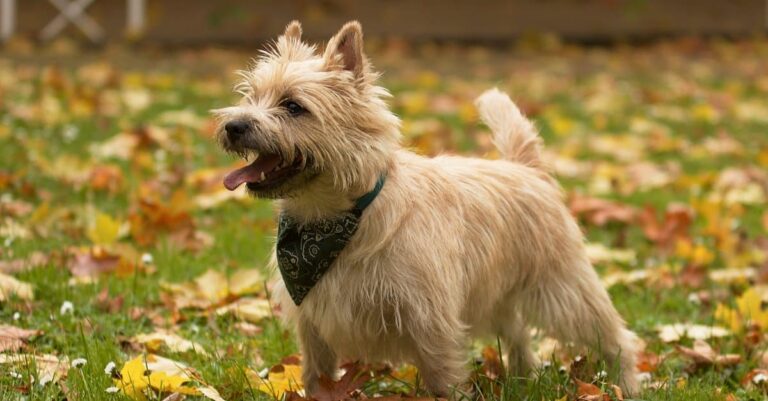
Nick Chase 68/Shutterstock.com

Cairn Terrier Distribution

Click a location to explore more animals from that region

Origin Location

This map shows the native origin of the Cairn Terrier. As a domesticated species, they are now found worldwide.

Loading map...

Found in 1 country

Size Comparison

Human 5'8"
Cairn Terrier 10 in

Cairn Terrier stands at 14% of average human height.

Cairn Terrier lifespan

At a Glance

Domesticated
Also Known As Cairn
Diet Omnivore
Activity Diurnal+
Lifespan 14 years
Weight 8 lbs
Status Not Evaluated
Did You Know?

The name comes from Scottish "cairns"-piles of stones where rodents hid and the dogs worked.

Scientific Classification

The Cairn Terrier is a small, sturdy Scottish terrier breed originally developed for hunting and bolting vermin among rock piles (“cairns”). It is an alert, energetic companion dog with a rough, weather-resistant coat.

Kingdom
Animalia
Phylum
Chordata
Class
Mammalia
Order
Carnivora
Family
Canidae
Genus
Canis
Species
lupus

Distinguishing Features

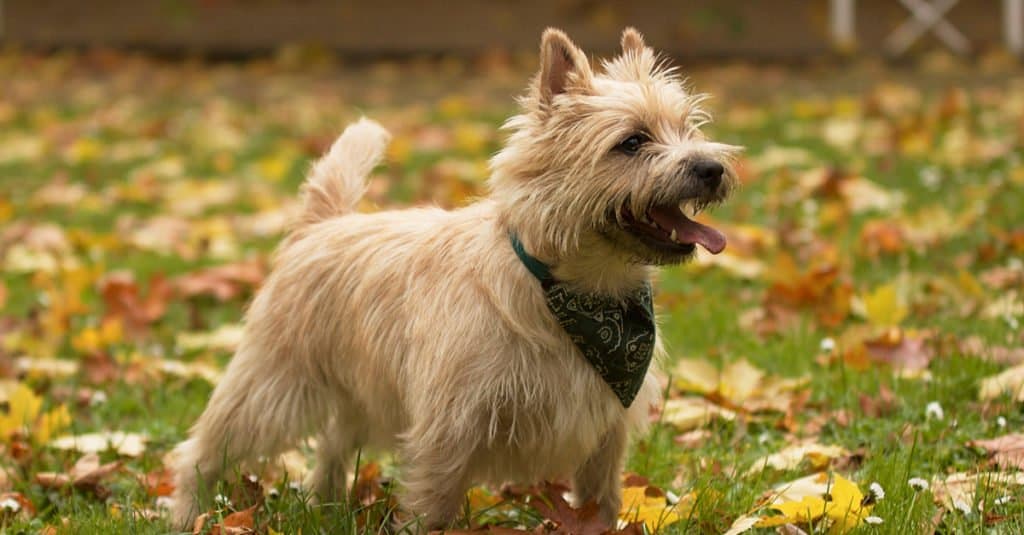
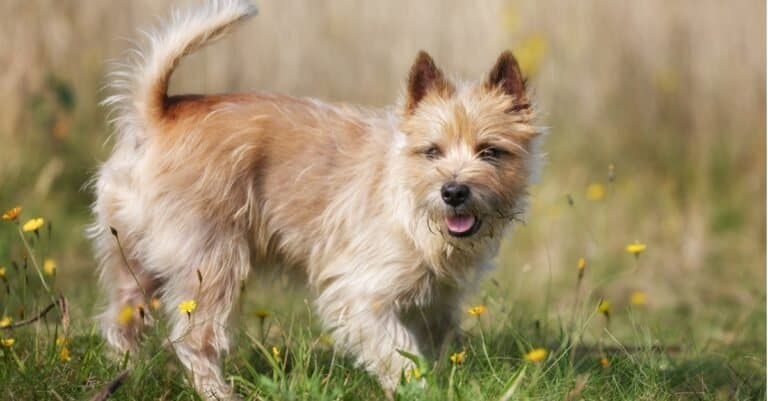
  • Small, compact terrier with strong legs and a fox-like expression
  • Harsh, wiry outer coat with soft undercoat; commonly brindle, wheaten, red, gray, or nearly black (not typically pure white)
  • Erect ears, short tail carried upright, and a shaggy face with furnishings
  • High prey drive and digging tendency typical of working terriers

Physical Measurements

Males and females differ in size

Height
10 in (9 in – 10 in)
9 in (9 in – 10 in)
Length
1 ft 10 in (1 ft 8 in – 1 ft 12 in)
1 ft 9 in (1 ft 7 in – 1 ft 11 in)
Weight
16 lbs (13 lbs – 18 lbs)
14 lbs (12 lbs – 15 lbs)
Tail Length
6 in (5 in – 6 in)
6 in (5 in – 6 in)
Top Speed
19 mph
About 30 km per hour

Appearance

Primary Colors
Secondary Colors
Skin Type Typical domestic dog skin with a weather-resistant double coat: harsh, wiry outer guard hairs over a softer insulating undercoat; shaggy facial furnishings (brows, beard) protect the face in rocky 'cairn' terrain and brush.
Distinctive Features
  • Small, sturdy Scottish working terrier build developed for bolting vermin among rock piles ('cairns'): compact body, strong forequarters, and good digging capability.
  • Rough, wiry double coat with a 'tousled' outline; coat is meant to look natural rather than sculpted.
  • Shaggy facial furnishings: pronounced eyebrows and beard/moustache; expressive, alert 'terrier' face.
  • Small, upright, pointed ears; dark, oval eyes set to give an alert, keen expression.
  • Medium-length tail carried gaily (not curled over the back), historically useful as a 'handle' to locate the dog in rough terrain (never pulled).
  • Breed-specific temperament/behavior traits (species context: compared with the base domestic dog, Cairns are more tenacious, alert, and prey-driven): energetic, confident, independent, quick to investigate movement/sounds, strong vermin-chasing instincts.
  • Care requirements tied to appearance: regular hand-stripping or coat 'rolling' to maintain harsh texture and weather resistance; clipping softens coat. Routine brushing to prevent matting in furnishings; periodic trimming around feet/eyes for hygiene and visibility.
  • Health concerns that can affect appearance/comfort: prone to skin/allergy issues in some lines (itching, recurrent dermatitis); maintain parasite control and skin-friendly grooming.
  • Watch for patellar luxation (may change gait), possible hip problems, and eye issues like cataracts. Keep Cairn Terriers lean to protect joints and keep them quick and in working shape.

Sexual Dimorphism

Subtle sexual dimorphism typical of small domestic dogs: males are often slightly larger/heavier with a broader head and more robust neck/forequarters; females tend to be a bit finer-boned and narrower through the chest. Coat type and color patterns are not sex-linked.

  • Slightly larger overall size and heavier bone; broader skull and muzzle often more pronounced.
  • May present a more robust ruff/neck coat due to body mass, though coat texture remains the same.
  • Slightly lighter, more refined head and body; narrower chest and finer bone.
  • Often appears a bit more 'clean-lined' in outline while retaining the same shaggy furnishings and wiry texture.

Did You Know?

The name comes from Scottish "cairns"-piles of stones where rodents hid and the dogs worked.

Cairns are one of the oldest Scottish terrier types and helped form related breeds such as the West Highland White Terrier and Scottish Terrier.

Unlike many show breeds, the Cairn's classic "scruffy" look reflects practical field function: harsh outer coat over a soft insulating undercoat.

The famous dog "Toto" in the 1939 film The Wizard of Oz was a Cairn Terrier (played by a dog named Terry).

Cairns are typically not all-white; common colors include brindle, wheaten, red, gray, and black, and they can change shade as they mature.

Bred to bolt vermin, many Cairns retain a strong prey drive and a love of digging and "going to ground."

Unique Adaptations

  • Small, sturdy build with strong forequarters-useful for squeezing among rocks and excavating in cairns and dens.
  • Harsh, weather-resistant double coat and shaggy facial furnishings that help shed rain and protect skin in rough terrain.
  • High pain tolerance and determination typical of working terriers, selected for confronting vermin underground or among stones.
  • Compact feet and flexible movement for uneven Scottish ground-rocky slopes, heather, and rubble piles.
  • Efficient, low-to-the-ground gait: conserves energy while ranging and quartering for scent and movement.

Interesting Behaviors

  • Cairn "earthworking": instinctively digging, pawing, and nosing into tight spaces as if flushing prey from rocks or burrows.
  • Alert watchdog vocalizing: quick to announce novel sounds or visitors-part of a terrier's job to signal activity on the croft.
  • "Terrier pounce" and shake: a classic predatory sequence used to dispatch small quarry (best redirected to toys).
  • Scruff-and-scout posture: head up, ears pricked, scanning for movement-often seen on walks as they "patrol."
  • Object play with persistence: repeated pawing and tugging at puzzle toys reflects problem-solving for locating hidden prey.
  • Chase tendency: may dart after squirrels or rabbits; reliable recall usually requires deliberate training and management.

Cultural Significance

Cairn Terrier (Canis lupus familiaris) is a Scottish working terrier from the Highlands and Islands. It guarded farms from rats and vermin. Famous as Toto in The Wizard of Oz, it is brave, loyal, and comes in many colors, unlike the white West Highland Terrier.

Myths & Legends

Naming origin and working lore: Scottish keepers and farmers told of "cairn dogs" that could slip between stones and flush rats and foxes from rock piles, earning their name from the very terrain they mastered.

On Skye and the western Highlands, early terrier men liked small, rough-coated Cairn Terriers (Canis lupus familiaris). Stories called them "wee earth dogs"—tough helpers on crofts and in game coverts.

The Toto legend: popular memory often merges Toto's on-screen bravery with the breed itself-an enduring cultural tale of a small terrier's courage and loyalty during an epic journey (The Wizard of Oz).

Old sporting tradition: in British field lore, terriers were celebrated for "gameness" (unyielding boldness); Cairn-type terriers were frequently singled out in anecdotes for continuing to work in tight spaces where larger dogs could not.

Conservation Status

NE Not Evaluated

Has not yet been evaluated against the criteria.

Population Stable

Life Cycle

Birth 4 pups
Lifespan 14 years

Lifespan

In the Wild
13–15 years
In Captivity
10–17 years

Reproduction

Mating System Polygynandry
Social Structure Managed Domestic
Breeding Pattern Not Applicable
Fertilization Managed Selective
Birth Type Managed_selective

Cairn Terrier (Canis lupus familiaris): Dogs can mate with many partners, but Cairns are usually bred by people. Owners plan matings, track heat cycles, sometimes use vet help. Mating is not for long-term mates; helpers rarely care for pups.

Behavior & Ecology

Social Pack Group: 3
Activity Diurnal, Crepuscular, Cathemeral
Diet Omnivore Meat-forward foods (especially poultry or beef) with strong aroma; many individuals are highly food-motivated by soft training treats.

Temperament

Alert, energetic, bold; quick to investigate movement/sounds (often expressed as watchfulness and frequent alarm barking).
Independent, persistent problem-solver (classic terrier trait): more likely than the base domestic-dog average to self-reward (e.g., digging/chasing) unless training and management are consistent.
High prey drive and "bolt-and-hold" vermin-hunting style; distinguishing breed trait vs the general domestic dog population-strong motivation to chase small animals and to dig into crevices/soil.
Affectionate and playful with family; can be reserved with strangers until warmed up. Early, positive socialization reduces reactivity and over-vigilance.
Dog-to-dog: often confident and may posture; can be pushy in play. Best outcomes with structured introductions, reinforcement of disengagement cues, and prevention of resource guarding.
Trainability: intelligent but can be selective; responds best to short, varied sessions with rewards and games. Harsh corrections can increase resistance or defensive behavior.
Care requirements (behavior-linked): needs daily enrichment (sniffing, puzzle feeders, short training games), consistent exercise, and secure fencing/leash reliability due to chase/dig tendencies; provide appropriate digging outlets to prevent yard damage.
Coat/handling care (breed-specific): rough, weather-resistant double coat benefits from regular brushing and periodic hand-stripping or grooming; handling practice from puppyhood supports cooperative care and reduces grooming-related stress.
Health problems that can change a Cairn Terrier's mood or behavior include patellar luxation and Legg-Calvé-Perthes (pain/lameness), atopy/allergic skin disease (itching), dental disease (mouth pain), and cataracts.
Cairn Terriers are bold, get bored easily, and strongly want toys or food. Well-bred, well-socialized dogs are friendly and calm; under-exercised ones can become noisy, pushy, or reactive.

Communication

Sharp, frequent barking Notably as an alarm/alert signal; more pronounced than many non-terrier breeds
Growling/rumbling during boundary-setting, guarding, or intense play.
Whining for attention, anticipation, or mild frustration.
Yips/squeals during high arousal play or when startled.
Howling is possible but less common; may occur in response to sirens or group vocalizing.
Body posture and facial expressions: stiffening, forward lean, hard stare when aroused; relaxed loose posture and open mouth during friendly engagement.
Tail and ear signaling: tail carriage and ear set shift with arousal/curiosity; rapid orientation to novel sounds is common.
Scent marking: urine marking and intensive sniffing during walks; uses scent investigation to map social environment.
Play signals: play bow, bouncy side-steps; terrier play may include more pouncing and chase initiation.
Touch/solicitation: pawing, nudging, climbing into laps; may use persistent contact to request play or access.
Mouth-oriented exploration: carrying, tugging, and gentle mouthing; appropriate outlets reduce unwanted grabbing/chewing.
Displacement behaviors under stress: scratching, sniffing the ground, shake-offs; useful indicators during introductions or training sessions.

Habitat

Biomes:
Temperate Forest Boreal Forest (Taiga) Tundra Alpine Temperate Grassland Mediterranean Desert Hot Desert Cold Savanna Tropical Dry Forest Tropical Rainforest Wetland Freshwater Marine +8
Terrain:
Rocky Hilly Coastal Island
Elevation: Up to 14763 ft 9 in

Ecological Role

Human-associated omnivore and companion; historically a small-game and vermin-control hunter rather than an apex predator.

Local pest (rodent) suppression in farm/household settings Deterrence/alerting behavior that can reduce wildlife intrusion and human security risks Human companionship and support roles (e.g., therapy/engagement when trained)

Diet Details

Main Prey:
Rat Mouse Vole Shrew Rabbit Ground-nesting birds and eggs Lizards Insects and other small invertebrates +2
Other Foods:
Berries Fallen orchard fruit Grasses Roots and tubers Fungi/mushrooms

Human Interaction

Domestication Status

Domesticated

Canis lupus familiaris (domestic dog) came from gray wolves through long domestication with people. The Cairn Terrier was developed in Scotland to work in cairns, hunting and flushing vermin. Small, sturdy, bold, with a harsh double coat and strong prey drive, it is friendly with people and needs exercise, training, grooming, and secure fencing.

Danger Level

Low
  • nips/bites, especially during handling, resource guarding, or when startled (small-breed bite risk)
  • scratches from jumping/pawing during excited greetings
  • chasing behavior leading to knock-into incidents with small children or frail adults (usually minor)
  • barking-related nuisance complaints; stress for neighbors in dense housing if not managed
  • rare escalation if poorly socialized, in pain, or mishandled-risk increases around unfamiliar dogs and high-arousal situations

As a Pet

Suitable as Pet

Legality: Generally legal to own as a pet in most jurisdictions. Typically not subject to breed-specific legislation; ownership is still subject to standard local rules (licensing, leash laws, vaccination/rabies compliance, noise ordinances, and housing/HOA restrictions).

Care Level: Moderate

Purchase Cost: $800 - $2,500
Lifetime Cost: $18,000 - $35,000

Economic Value

Uses:
Companion/pet ownership Working vermin control (farm/estate) Breeding and stud services Conformation showing and dog sports Pet services economy (veterinary, grooming, training, boarding) Rescue/adoption and animal welfare sector
Products:
  • puppies from reputable breeders
  • adoption placements via breed rescue/shelters
  • stud service and breeding rights (where applicable)
  • grooming services (hand-stripping/clipping, bathing)
  • training classes and behavior services
  • veterinary preventive care (vaccines, parasite control, dental cleanings)
  • pet insurance policies
  • equipment and supplies (crates, fencing, leashes, enrichment toys)

Relationships

The Cairn terrier existed long before 1909. It is that year that breeders brought them to the United Kingdom and named them Short-haired Skye Terriers. Because of opposition from Skye Terrier breeders, the original name for this breed was not acceptable to the Kennel Club. The name “Cairn terrier” was suggested and has stuck ever since.

Cairn terriers are small dogs with a weatherproof outer coat that ranges in color from red, black, cream, or brindled. This breed is hypoallergenic and sheds very little. They have a fearless and assertive temperament and get along well with other dogs if properly trained. Cairn terriers are commonly left-pawed. This unusual characteristic has also been correlated to strong performance in scent-related goals like ratting and tracking.
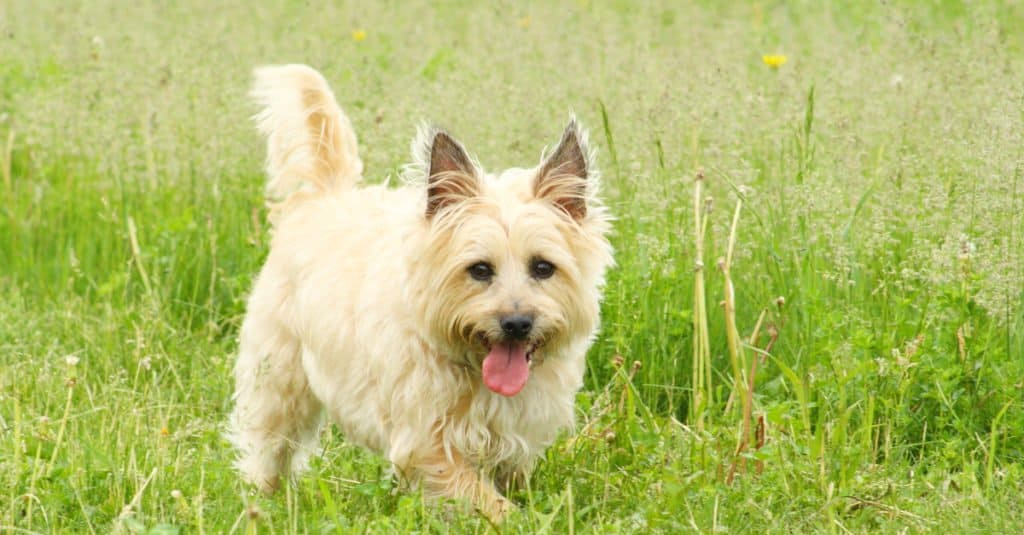
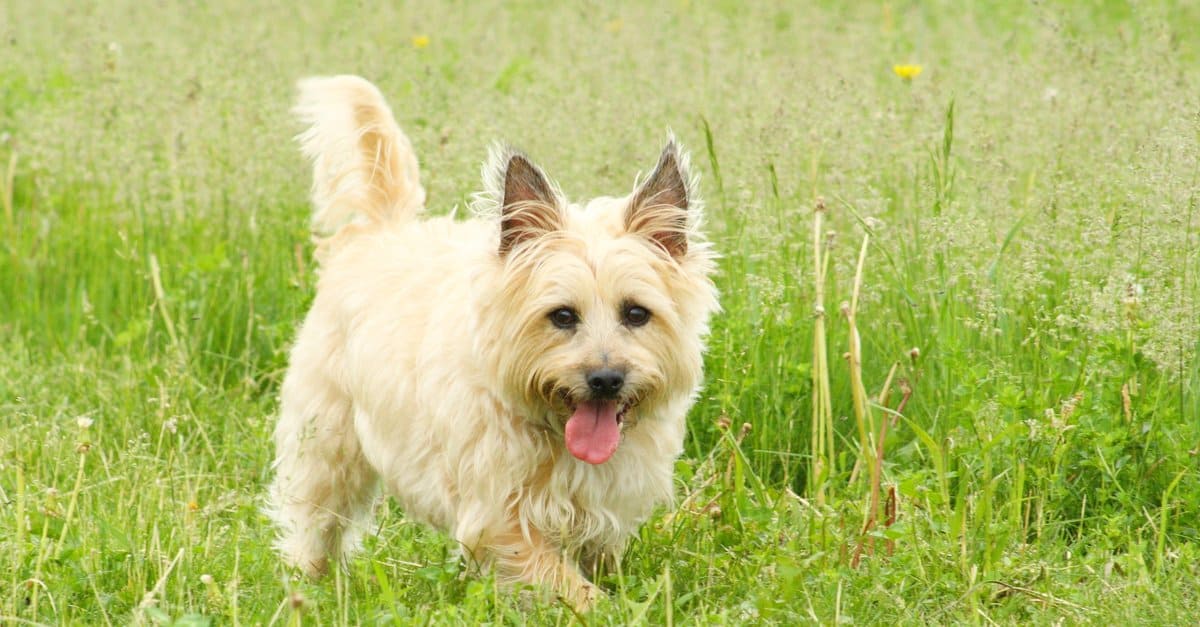
Cairn Terrier standing in the grass

Cairn Terriers were bred to hunt rodents in the Scottish Highlands.

Evolution

Cairn terriers originated within a group of small dogs (Scotch terriers) bred to hunt rodents in the Scottish highlands. They are known to have lived and worked in Scotland since the 1600s. A “cairn” was a mound of rocks used to mark a grave. Scotch terriers were bred to dig under the rocks and root out rodents. The smallest of these dogs came to be known as the Cairn terrier. These spirited little dogs were later trained to work in packs to hunt foxes and other smallish predators. By the 1900s, British terrier fanciers began to separate the Scotch terriers into four distinct breeds — the Cairn, Skye, Scottish, and West Highland white terriers.

Owning A Cairn Terrier: 3 Pros And Cons

ProsCons
Hypoallergenic: These dogs don’t shed much, so you won’t have to worry about pet hair everywhere.Stubbornness: Getting a Cairn Terrier to listen is a job in itself. These are very stubborn dogs.
Pet Friendly: Unlike most terriers, the Cairn Terrier is more friendly with other pets.Barking: This terrier breed is very sassy and scrappy. Be prepared for a lot of barking.
Excellent watchdog: These dogs will alert you when any activity is going on. Not that they’ll rescue you from an intruder, but they will alert you. They bark at everything and nothing at all.Potential Health Problems: Joint problems, epilepsy, and cataracts are a few health problems Cairn Terriers are prone to having.
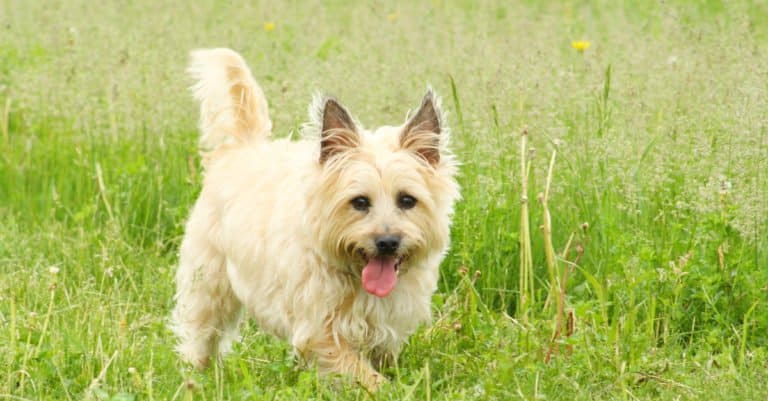
A Cairn Terrier standing in a field.

The Cairn Terrier can make a great family pet. They get along with children and are fantastic guard dogs.

Size And Weight

The Cairn terrier is a small dog. Dictated by breed standards, a male terrier’s adult weight reaches 14 pounds, while females grow to be 13 pounds.

Both males and females from the chest to where the body meets the tail are 15 inches long. Males are 10 inches tall, while females are 9 ½ inches tall.
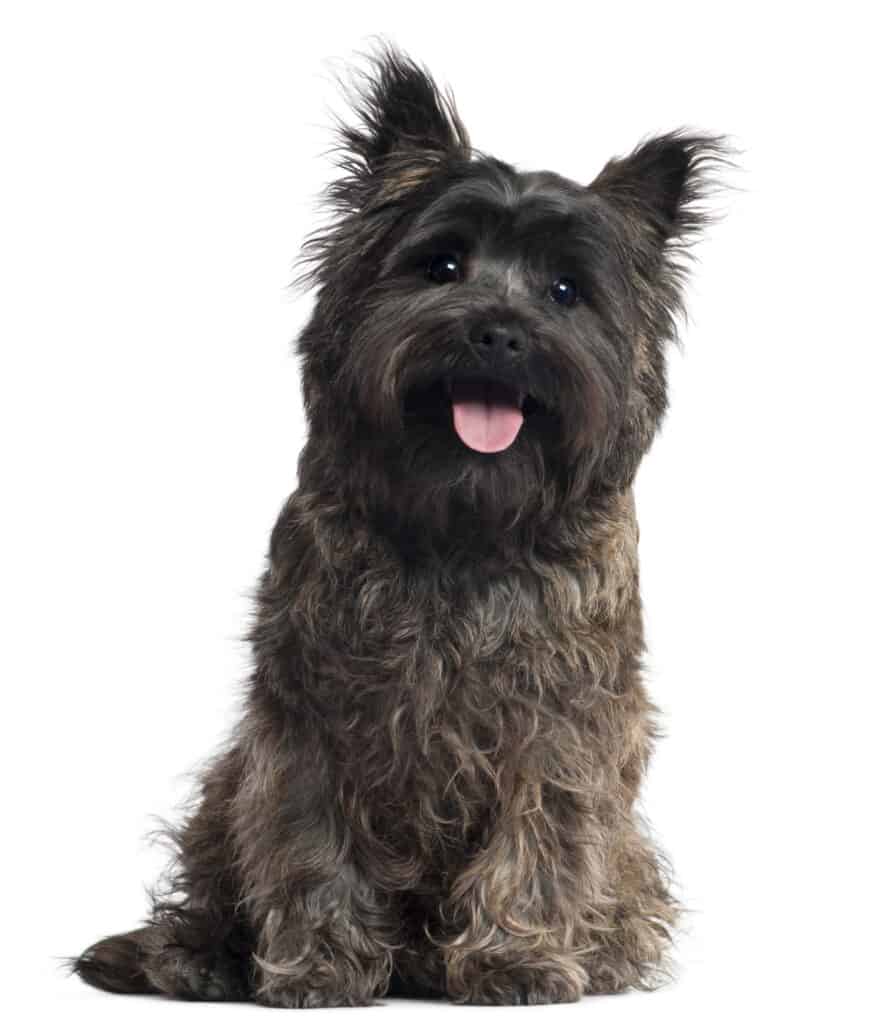
    cairn terrier

    Cairn terriers are generally healthy but are prone to cataracts and skin allergies.

    Common Health Issues

    Before contacting breeders to buy a Cairn terrier puppy, there are some health issues you need to understand. Some of the diseases in this breed are hereditary. Not all illnesses are high-risk. Some are environmental illnesses, and owners can prevent them with proper care and attention.

    Cataracts in Cairn terriers are prevalent. Cataracts mean that your dog’s eye lenses are unhealthy and unable to focus light on the retina. Veterinarians recommend a yearly CAER examination.

    Allergies are second on the list. The three forms of allergies are inhalant, contact, and food. Most of these allergies are either seasonal or chronic. Because of the side effects, Glucocorticoids should be used as a last resort to treat your terrier’s condition.

    Heart defects occur in every purebred breed. Your puppy’s examination at six weeks by a veterinarian helps to detect any congenital heart defects. Although predominant diseases aren’t associated with Cairns, murmurs do occur.
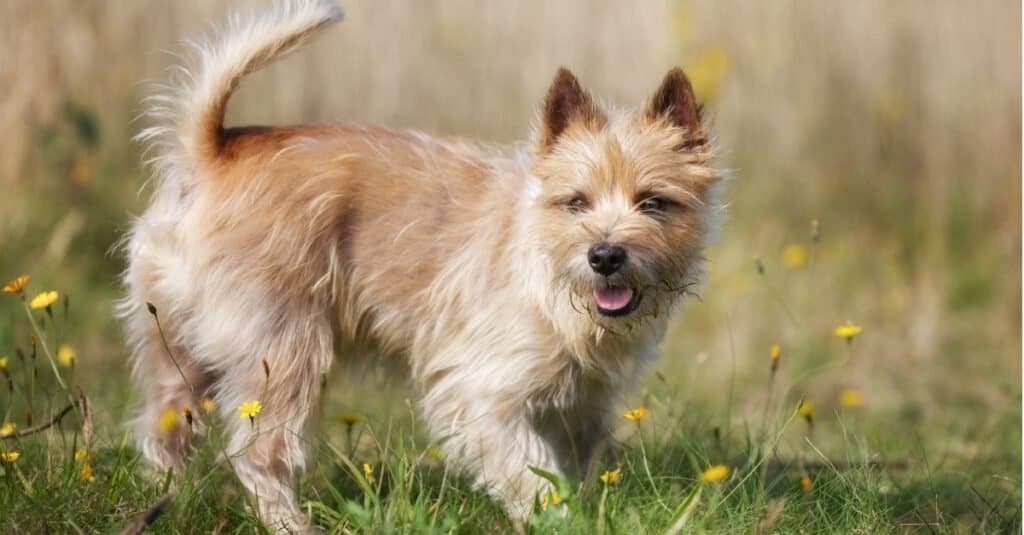
    Types of terrier dogs

    Cairn terriers are outgoing and happy with great personalities.

    Temperament And Behavior

    Cairn terriers are outgoing and happy dogs. They have great personalities and are well-behaved. They are fearless and brilliant. Compared to other breeds, the Cairn is more independent. Taking this dog hiking, camping, or on journeys where they can explore is heaven to them.

    Although they are not aggressive towards their family members, they are very stubborn. To avoid this behavior, training them early in their life is essential.

    How To Take Care Of A Cairn Terrier

    A Cairn terrier is cute as a puppy, but even more adorable fully grown. To ensure your pet is properly cared for, satisfying their basic needs and regular training are all a part of caring for your Cairn.
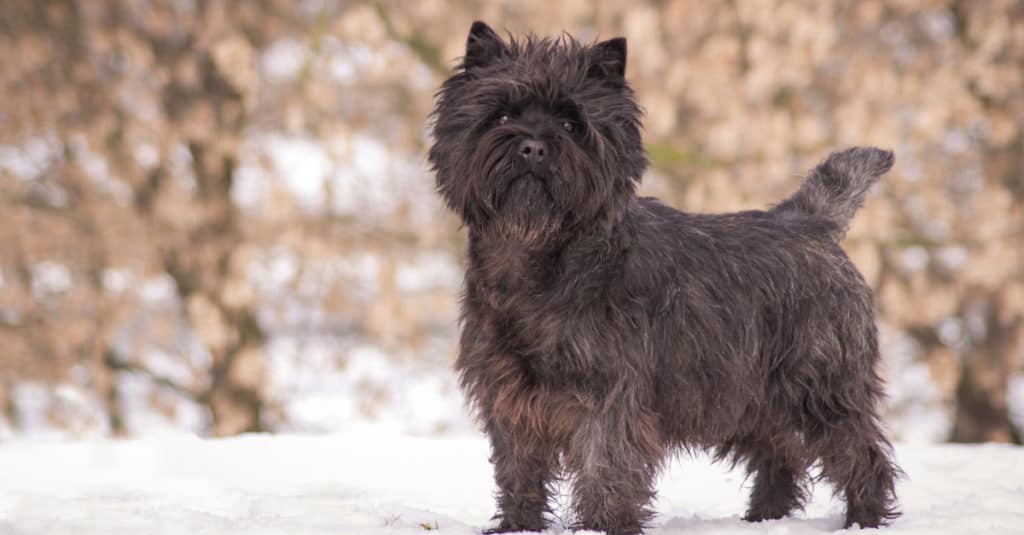
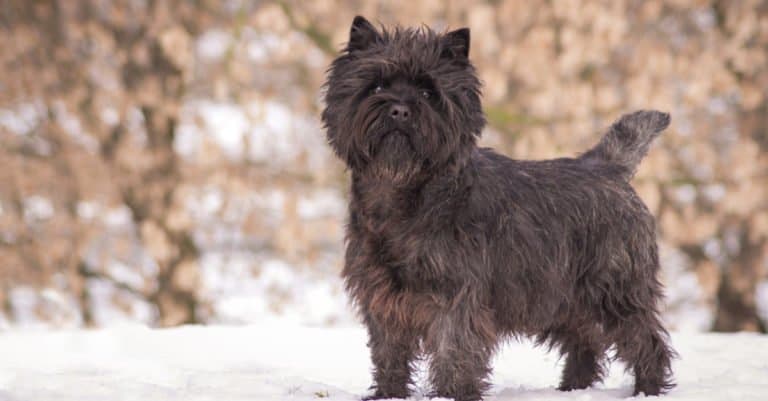
    Cairn Terrier standing in the snow

    Cairn terriers don’t mind the snow. They love to be outside and active.

    The Best Dog Food

    Feeding your terrier is easy. These dogs only need a small portion of quality food to remain happy and healthy. This breed is prone to food allergies, so consider a limited-ingredient diet of dog food optimized for allergy control.

    Once you choose high-quality dog food for your terrier, knowing what food allergies your pup has is next. Additives like corn, wheat, and soy can trigger allergies.

    Choose quality food that has meat as one of the first ingredients. Avoid foods with BHA & BHT. These are synthetic preservatives.

    Feeding your pet between 1/2 and 2/3 cups of food is enough for the whole day. Feed your Cairn twice a day. Also, change the water bowl daily. When Cairns has an empty stomach, they may vomit. Feed your dog too much, and it may become obese.

    Maintenance And Grooming

    Cairn terriers shed very little. Once your pup’s hair dies, it stays in the follicle. If you decide to groom your terrier, rolling the coat will keep it healthy. Rolling the coat can be done by hand or with a grooming tool.

    Opting to have someone else do it may be best. Contacting a professional groomer is a good idea to ensure experts execute the technique correctly.

    Rolling the coat should be done once a month unless your terrier is a show dog.

    Training

    Training Cairn terriers is easy because they’re lively, intelligent, and loyal. The most challenging behavior to train may be getting your pet not to bark. Some say Cairn terriers are unreasonable, but with the right techniques, it’s reasonably easy.

    Exercise

    Cairn terriers need lots of exercise to fit their active lives. Taking them walking twice a day for 20 to 30 minutes keeps them mentally and physically healthy.

    This breed is naturally curious, so keep your pup on a leash. If not, Cairns runs off to explore. Only take the leash off in enclosed areas where they can’t escape.

    Playing catch, going for runs, and long/short walks are all excellent ways to keep your Cairn terrier active. Overall, try to mix up your exercise regimen to give your pup new challenges.

    Because Cairn terriers are so small, they’ll quickly adjust to living in an apartment. The best setting for a Cairn terrier is a home full of love.
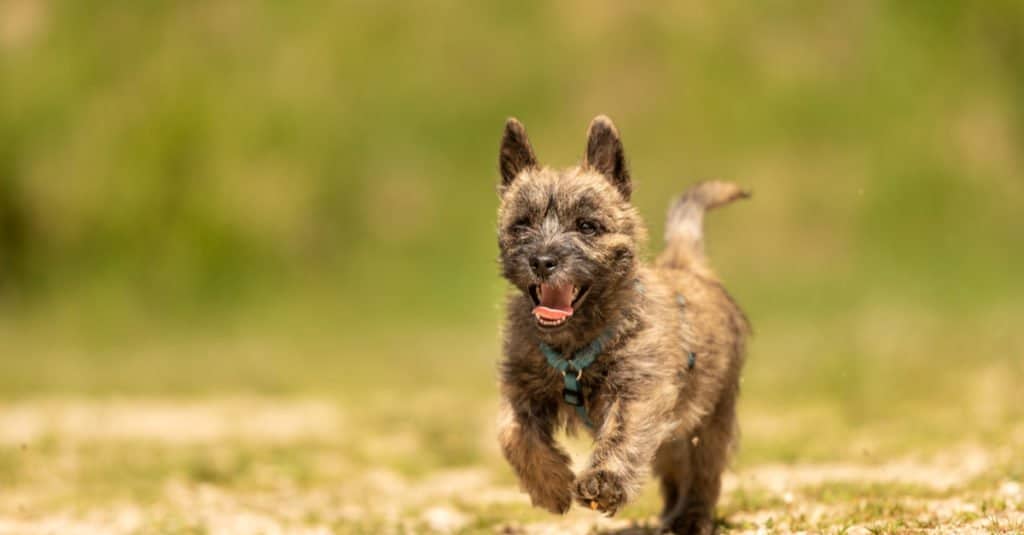
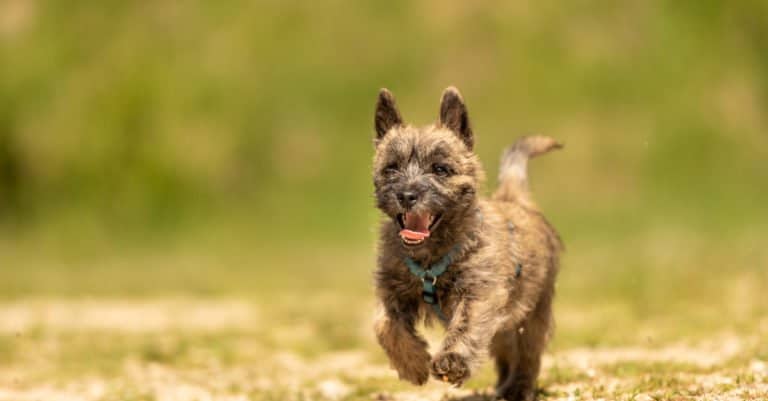
    Cairn Terrier puppy running down the road

    Cairn terrier puppies have a great deal of energy and love to play!

    Puppies

    Cairn Terrier puppy development spans one year and four months from birth to maturity. Don’t exercise your puppy too hard before eight months. The diet needed for your pup should include:

    • Omega fatty acids
    • Animal proteins
    • Minerals
    • Carbohydrates
    • Vitamins

    To maintain long-term health, these are the nutrients your dog needs. At eight months, make a transition to adult food by mixing adult and puppy formula. When you mix the formulas, it gives the Cairn a chance to get used to eating adult food.

    Cairn Terrier And Children

    Some people say that a Cairn terrier shouldn’t be in homes with small children, while some owners say Cairn terriers naturally love little children. If your children are well-behaved, your pets will usually be well-behaved.

    One suggestion for the safety of your children and Cairn terrier is never to leave them alone together. You don’t want to have to rescue your child from your Cairn or your Cairn from your child. Overall, Cairn terriers make excellent family pets.

    Dogs Similar To Cairn Terriers

    • Bedlington Terrier: Like Cairn terriers, Bedlington terriers have a bold and confident temperament. Due to them being hyperactive, train your pet at an early age. These dogs are highly active and intelligent.
    • Bolognese Dog: Like Cairn terriers, Bolognese Dogs are small in size. They’re typically ten to twelve inches tall and weigh between five and a half and nine pounds. They’re hypoallergenic and make great family dogs.
    • Chihuahua: Besides being a small dog, the Chihuahua has similar characteristics to a Cairn terrier. They both share huge personalities, and the Chihuahua loves being around its family and loved ones. They’re very loyal and feisty like Cairns. Despite their small frame, Chihuahuas make excellent guard dogs. Some breeders do a Cairn and Chihuahua mix. A Cairn and Chihuahua mix is called a Toxirn. The Cairn and Chihuahua mix combines the traits of both dogs. A loving lap dog mixed with a working dog.
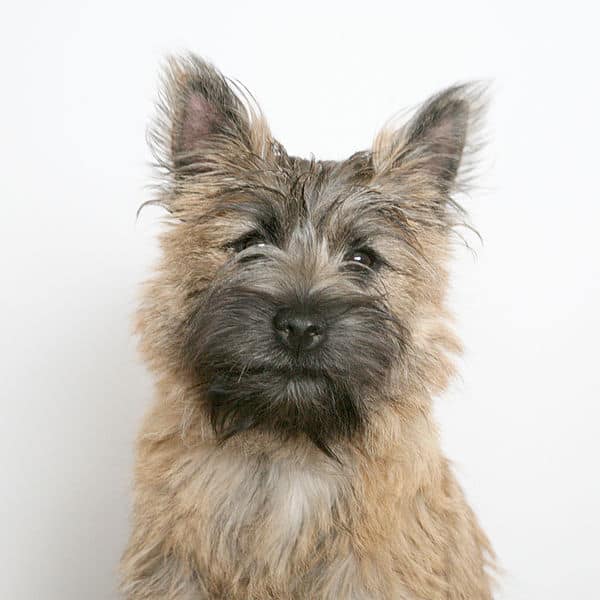
    Toto from the “Wizard of Oz” was played by a Cairn terrier.

    Famous Cairn Terriers

    Throughout history, this breed has had some star power. The most notable Cairn is Terry, who played Toto in The Wizard of Oz. Liza Minnelli may be the most famous person to own a Cairn. Growing up, Liza had a Cairn terrier named Lily. The love she had for her dog came from Judy Garland, her mother, who played Dorothy in The Wizard of Oz and grew to love Terry (Toto).

    View all 392 animals that start with C

    Sources

    1. Wikidepdia / Accessed February 8, 2021
    2. Dogell / Accessed February 8, 2021
    3. Your Purebred Puppy / Accessed February 8, 2021
    4. Trending Breeds / Accessed February 8, 2021
    5. Cairn Terrier Health / Accessed February 8, 2021
    6. Dog Lime / Accessed February 8, 2021
    7. Wikihow / Accessed February 8, 2021
    8. Wikihow / Accessed February 8, 2021
    9. Wag Walking / Accessed February 8, 2021
    10. Canna-pet / Accessed February 8, 2021
    11. Dog-learn / Accessed February 8, 2021
    12. Cairn Terrier Collectibles / Accessed February 8, 2021
    Lisha Pace

    About the Author

    Lisha Pace

    After a career of working to provide opportunities for local communities to experience and create art, I am enjoying having time to write about two of my favorite things - nature and animals. Half of my life is spent outdoors, usually with my husband and sweet little fourteen year old dog. We love to take walks by the lake and take photos of the animals we meet including: otters, ospreys, Canadian geese, ducks and nesting bald eagles. I also enjoy reading, discovering books to add to my library, collecting and playing vinyl, and listening to my son's music.

    Thank you for reading! Have some feedback for us?


    Cairn Terrier FAQs (Frequently Asked Questions)

    The Cairn Terrier does not get shaved. Brush your pet’s coat to remove tangles and dead hair. After brushing, use a technique called Rolling the Coat.