






C
Species Profile

Catfish

Siluriformes

Whiskers, spines, and river smarts
Billy Ogle/Flickr

Catfish Distribution

Click a location to explore more animals from that region

Invasive Species

This map shows coastal regions where Catfish are found.

Loading map...
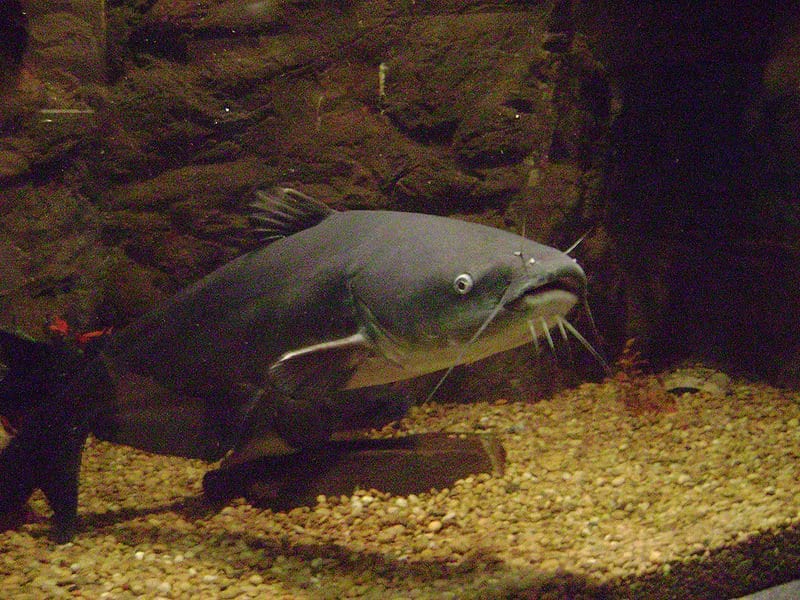
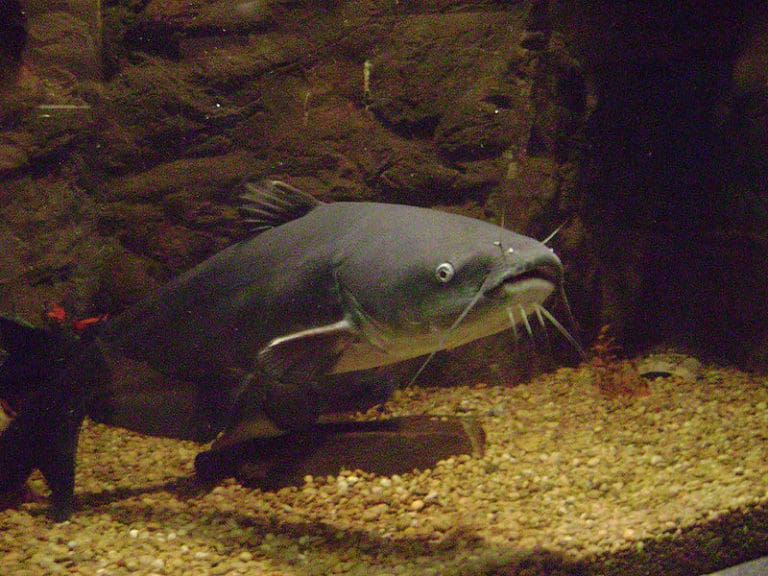
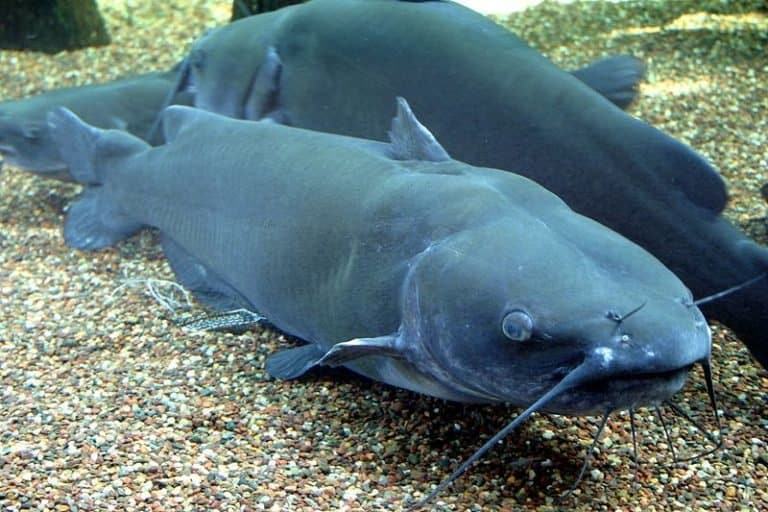
Blue catfish

At a Glance

Order Overview This page covers the Catfish order as a group. Stats below are general traits shared across the order.
Also Known As Mudcat, Whiskerfish, Bullhead, Bagre, Poisson-chat, Pesce gatto
Diet Omnivore
Activity Nocturnal+
Lifespan 10 years
Weight 300 lbs
Status Not Evaluated
Did You Know?

The catfish order includes thousands of species across dozens of families-one of the most diverse fish groups.

Scientific Classification

Order Overview "Catfish" is not a single species but represents an entire order containing multiple species.

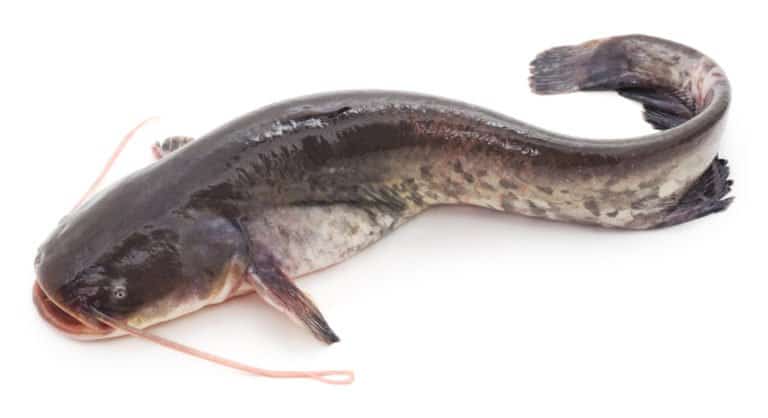
Catfish are ray-finned fishes in the order Siluriformes, typically recognized by whisker-like barbels around the mouth (though not all species have prominent barbels). The group includes a wide diversity of freshwater and some marine forms, ranging from tiny aquarium species to very large predators and scavengers.

Kingdom
Animalia
Phylum
Chordata
Class
Actinopterygii
Order
Siluriformes

Distinguishing Features

  • Barbels (‘whiskers’) with strong chemosensory function (common but variable)
  • Scaleless skin in many groups; some have bony armor plates (e.g., Callichthyidae, Loricariidae—note: Loricariidae are catfish but have distinctive armored bodies)
  • Often possess stout dorsal/pectoral spines in many families
  • Broad ecological diversity: scavengers, predators, detritivores, algae-scrapers (in some armored forms)

Physical Measurements

Males and females differ in size

Length
12 in (1 in – 9 ft 10 in)
12 in (0 in – 10 ft 6 in)
Weight
1 lbs (0 lbs – 661 lbs)
2 lbs (0 lbs – 772 lbs)
Top Speed
19 mph
Burst up to 30 km/h

Appearance

Primary Colors
Secondary Colors
Skin Type Most Siluriformes are scaleless with mucus-covered skin; many have thicker skin and feeling pores. Some groups (Callichthyidae, Loricariidae) have bony plates, and marine/brackish forms may have tough skin and head shields.
Distinctive Features
  • Catfish range from tiny 2–3 cm ones (some trichomycterids or aspredinids) to giants like wels catfish (Silurus glanis) up to 5 m; Mekong giant (Pangasianodon gigas) about 3 m. Weight: grams to over 100 kg.
  • Lifespan across the catfish order: small species often live about 2–5(10) years; many medium to large catfish live about 10–25 years; some big, slow-growing species can live 30–60+ years.
  • Barbels ("whiskers") around the mouth are a hallmark sensory feature, but their number/length varies widely; some species have reduced or less conspicuous barbels.
  • Strong sensory adaptations are common: taste buds on barbels/skin, enhanced chemoreception, mechanosensory lateral line; some lineages have electroreception, and electric discharge occurs in a small subset (e.g., electric catfish family Malapteruridae).
  • Pectoral (and sometimes dorsal) fin spines are frequent and can lock for defense; spines may be serrated and are often key handling hazards.
  • Body plans range from dorsoventrally flattened bottom-dwellers to laterally compressed swimmers; head shapes vary from broad/armored to streamlined; some groups have sucker-like mouths for adhesion/grazing (e.g., Loricariidae).
  • Ecology/behavior generalizations with explicit variation: many species are benthic and nocturnal/crepuscular, sheltering by day; however, numerous taxa are active day foragers, pelagic channel swimmers, cave specialists, or even surface-oriented air-breathers.
  • Habitat range: predominantly freshwater (rivers, floodplains, lakes, swamps), with notable brackish and marine representatives-especially sea catfishes (Ariidae) and some estuarine/nearshore taxa.
  • Feeding roles are highly diverse: detritivores and algal grazers (e.g., many Loricariidae), insectivores and small-crustacean feeders, omnivores, scavengers, specialized parasites/micropredators (some Trichomycteridae), and large apex or mesopredators (e.g., Pimelodidae, Siluridae, some Clariidae).
  • Air-breathing and low-oxygen tolerance are common in multiple lineages (notably Clariidae and others), enabling survival in hypoxic waters and, in a few cases, overland movement between water bodies.
  • Reproduction is diverse: broadcast spawning occurs in some; many exhibit parental care such as nest building/guarding (common in Ictaluridae), egg attachment/guarding, or mouthbrooding in several sea catfishes (Ariidae).
  • Major family examples show the order's diversity: Ictaluridae (North American bullheads and channel catfish), Siluridae (Eurasian wels), Clariidae (air-breathing walking catfish), Ariidae (sea/brackish mouthbrooders), Pimelodidae (long-whiskered), Callichthyidae (armored Corydoras).

Sexual Dimorphism

Sexual dimorphism occurs in many Siluriformes but is highly variable by family/species; numerous species show subtle differences, while others exhibit clear breeding-related changes. Dimorphism often involves fin shape, body depth, breeding tubercles/odontodes, or specialized mouth/heads linked to parental care.

  • In some species, males develop enlarged or more serrated pectoral spines and/or elongate dorsal/pectoral fin rays during breeding seasons.
  • Breeding males in several armored/loricariid and related groups may develop odontodes (tooth-like dermal projections) or roughened fin/head surfaces.
  • Genital papilla or modified anal-fin region can be more prominent in males in certain taxa (species-dependent).
  • In some Ariidae (sea catfishes), males may undertake mouthbrooding, associated with broader buccal cavity and behavioral role differences (not universal across the order).
  • Females are often larger-bodied or deeper-bellied in species where fecundity selection is strong, especially near spawning (gravid abdomen).
  • Ovary development leads to seasonal increases in body mass/abdominal volume; external morphological differences may otherwise be minimal in many species.

Did You Know?

The catfish order includes thousands of species across dozens of families-one of the most diverse fish groups.

Many catfish can "taste" the world with barbels and skin packed with chemoreceptors.

Some catfish groups include marine and brackish-water species, though most catfish are freshwater.

A number of catfish make sounds by rubbing fin spines or vibrating the swim bladder-used in alarm and courtship.

Many armored catfish wear bony plates instead of typical scales.

Air-breathing has evolved multiple times in catfish-some gulp air at the surface to survive low-oxygen waters.

Parental care is widespread: nests, guarding, and even mouthbrooding (notably in some sea catfish).

Unique Adaptations

  • Barbels ("whiskers") around the mouth-often multiple pairs-enhance tactile and chemical sensing; prominence varies among families.
  • Strong dorsal and/or pectoral spines (often lockable) help deter predators; spines can snag in nets and mouths.
  • Extraordinary non-visual sensing: many catfish detect water movement via the lateral line, and some groups have specialized electrosensory abilities for locating prey in murky water.
  • Skin with abundant taste buds and chemoreceptors allows "contact tasting," useful in darkness or turbidity.
  • Bony armor has evolved in multiple catfish lineages (for example, many armored catfish groups), providing protection and enabling a bottom-hugging lifestyle.
  • Air-breathing and hypoxia tolerance in several families (for example, walking catfish) allow survival in oxygen-poor waters; some can endure short periods out of water if kept moist.
  • Adhesive or suction mouths in many armored, algae-grazing catfish enable clinging to rocks in fast currents and grazing biofilms.

Interesting Behaviors

  • Mostly bottom-oriented foraging is common (especially in rivers and lakes), but lifestyles range from open-water hunters to plant-scraping algae grazers and even cave specialists.
  • Many are nocturnal or crepuscular, using barbels, smell/taste, and vibration detection more than vision-yet some species are active daytime shoalers.
  • Feeding strategies vary widely: insect and crustacean picking, scavenging, detritus sifting, algae/wood grazing (in some lineages), and large-fish predation in big-bodied species.
  • Reproduction shows major diversity: nest building in cavities or under cover, egg guarding by one or both parents, and male mouthbrooding in several sea catfish.
  • Some catfish tolerate harsh conditions (warm, stagnant, or muddy water) by air-breathing, surface gulping, or using intestine-assisted respiration (notably in some armored catfish).
  • Defense behaviors often involve locking pectoral/dorsal spines; many species also use camouflage and remaining motionless on the substrate.
  • Social behavior ranges from solitary ambush predators to schooling/shoaling species; aquarium favorites like some small armored catfish commonly shoal and synchronize movements.

Cultural Significance

Catfish (Siluriformes) are food and farmed fish worldwide because they grow fast and tolerate many conditions. They are popular for sport, local dishes, and aquariums (small armored types). In the wild they live on the bottom, eat dead matter, and prey on other animals, linking food webs.

Myths & Legends

Japan's giant earthquake catfish: a huge catfish said to live beneath the earth; when it thrashes, earthquakes occur-an enduring figure in folklore and early modern Japanese art.

In Ojibwe clan tradition, catfish is one of the animal totems within the Fish clan; Fish clan members were traditionally regarded as scholarly advisers and mediators who helped resolve disputes.

Mekong River traditions in Laos, Thailand, and Cambodia often connect great river fish (including giant catfish) with powerful river spirits and serpent beings believed to inhabit and guard the river.

Amazon Basin river tales about the toothpick fish (a tiny parasitic catfish) circulate as cautionary stories about dangerous waters and unseen aquatic threats.

European river lore about exceptionally large European catfish includes anglers' tales of "river monsters," reflecting the awe inspired by very large individuals.

Conservation Status

NE Not Evaluated (IUCN does not assign Red List categories to entire orders; assessments are at species level within Siluriformes)

Has not yet been evaluated against the criteria.

Population Unknown

You might be looking for:

Wels catfish

22%

Silurus glanis

One of the largest freshwater catfish; Europe and western Asia.

View Profile

Channel catfish

20%

Ictalurus punctatus

Common North American species, widely fished and farmed.

Blue catfish

14%

Ictalurus furcatus

Large North American catfish; major sport and commercial species.

View Profile

Walking catfish

12%

Clarias batrachus

Air-breathing catfish known for overland “walking”; invasive in some regions.

View Profile

Striped Raphael catfish

10%

Platydoras armatulus

Armored South American catfish popular in aquaria.

Pictus catfish

8%

Pimelodus pictus

Spotted South American river catfish common in aquaria.

View Profile

Corydoras (armored catfish)

8%

Corydoras

Small armored catfishes (family Callichthyidae) widely kept in aquaria.

View Profile

Life Cycle

Birth 1000 frys
Lifespan 10 years

Lifespan

In the Wild
1–60 years
In Captivity
2–50 years

Reproduction

Mating System Promiscuity
Social Structure Transient
Breeding Pattern Seasonal
Fertilization Substrate Spawning
Birth Type Substrate_spawning

Catfish (Siluriformes) show many mating styles but are mostly promiscuous. Many spawn on substrate (nests, cavities, foam) with brief seasonal breeding tied to floods. Parental care ranges from none to guarding or mouthbrooding.

Behavior & Ecology

Social Shoal Group: 3
Activity Nocturnal, Crepuscular, Cathemeral, Diurnal
Diet Omnivore Benthic invertebrates (especially insect larvae and small crustaceans), reflecting the common bottom-foraging habit across many families
Seasonal Migratory, Hibernates 311 mi

Temperament

Highly variable across the order: ranges from small, cryptic, easily stressed benthic insectivores/detritivores to bold, opportunistic scavengers and large, assertive predators; temperament often shifts with size/age and local predation risk.
Often shelter- and bottom-oriented, with many species favoring ambush or slow, methodical foraging; however, some are active midwater/river-channel foragers and can be highly mobile (including long-distance movements tied to floods or spawning).
Territoriality varies: many species defend a favored crevice/log/cavity (especially when nesting), while others are tolerant in dense aggregations when food/shelter is abundant.
Ecological breadth is extreme within Siluriformes: freshwater dominance with some marine/brackish groups; feeding modes include detritivory, insectivory, mollusc/crustacean feeding, herbivory/aufwuchs grazing, scavenging, and piscivory.
Catfish (Siluriformes) adults range from about 2 cm to 3 m long, and lifespans are about 2–5 years in small species and 20–60+ years in large species.

Communication

Stridulation (rubbing pectoral fin spines against the shoulder girdle) producing clicks/squeaks, often associated with distress, handling, or aggressive encounters
Drumming sounds generated by specialized muscles acting on the swim bladder (in taxa that possess/retain this capability), used in social contexts such as courtship, territorial displays, or agitation
Low-frequency grunts/knocks in some larger species, especially during close-range interactions
Tactile and contact-based cues via barbels and body contact Important in low visibility and at night
Chemical communication (pheromones and other olfactory cues) important for reproductive readiness, species recognition, and locating food in turbid waters
Hydrodynamic sensing via the lateral line to detect prey movement and nearby conspecifics in darkness or turbidity
Visual displays where visibility allows (fin spreading, posture changes, lateral presentation), more prominent in clearer habitats and diurnal species
Defensive signaling using erectable pectoral/dorsal spines (posture-based threat display); in some taxa, venom glands enhance deterrence
Electroreception in some lineages (not universal), aiding navigation and prey detection and potentially contributing to close-range social/environmental sensing

Habitat

Biomes:
Freshwater Wetland Marine Tropical Rainforest Tropical Dry Forest Savanna Desert Hot Desert Cold Mediterranean Temperate Grassland Temperate Forest Temperate Rainforest Boreal Forest (Taiga) Alpine +8
Terrain:
Riverine Coastal Plains Valley Island Muddy Sandy Rocky +2
Elevation: Up to 14763 ft 9 in

Ecological Role

Diverse benthic omnivores, predators, and scavengers that link detrital/benthic production to higher trophic levels in freshwater (and some brackish/marine) food webs

nutrient recycling and energy transfer from sediments/detritus to the broader food web bioturbation and sediment mixing through bottom-feeding and burrowing in many species regulation of invertebrate and small-fish populations via predation scavenging that accelerates decomposition and reduces carrion persistence support for fisheries and aquatic food webs as both predators and prey in floodplain systems, occasional contribution to dispersal/processing of plant material (e.g., fruits/seeds) through omnivory

Diet Details

Main Prey:
Aquatic insect larvae Aquatic invertebrates Crustaceans Mollusks Small fish and fish eggs/larvae Amphibian larvae Zooplankton Carrion +2
Other Foods:
Detritus Algae and periphyton biofilm Aquatic plant material Terrestrial plant inputs

Human Interaction

Domestication Status

Semi domesticated

Catfish (Siluriformes) are mostly wild, but many are partly domesticated by aquaculture and captive breeding for food and aquarium trade. Sizes range from tiny 2–3 cm and a few grams to giants 2.5–3 m and 100–300+ kg. Small species live ~3–10 years; large ones 10–60+ years. They are bottom-dwellers in freshwater and brackish/marine habitats, foraging by touch and smell.

Danger Level

Moderate
  • Pectoral/dorsal fin spines can puncture skin; some groups have venomous glands causing significant pain, swelling, and infection risk
  • Large-bodied species can inflict serious bites or injuries during handling (especially in nets/boats) and can be hazardous to small pets/livestock in rare cases
  • Electric shocks from electric catfish (family Malapteruridae) can cause painful jolts and secondary injury (falls, drowning risk if in water)
  • Food-safety hazards if improperly handled/stored (spoilage, contaminants such as mercury in some large predators, and parasite risks depending on region and preparation)
  • Ecological/human conflict via invasions where introduced: competition with native fishes, impacts to fisheries, and management costs

As a Pet

Suitable as Pet

Legality: Keeping or selling catfish is often legal but rules differ by species and place. Some areas ban or require permits for non-native, invasive, very large, or electric catfish. Check state, provincial, and national rules and invasive species lists.

Care Level: Moderate

Purchase Cost: $2 - $2,000
Lifetime Cost: $200 - $50,000

Economic Value

Uses:
Capture fisheries (subsistence to commercial) Aquaculture (food production) Ornamental/aquarium trade Bait and recreational angling Research/education By-products (leather, animal feed)
Products:
  • fresh and frozen fillets/whole fish
  • smoked/salted/dried products
  • fish meal and feed inputs
  • ornamental live fish for aquaria
  • catfish skin leather (limited but notable)
  • fertilizer/compost inputs from processing waste

Relationships

Related Species 9

Channel catfish Ictalurus punctatus Shared Family
Wels catfish
Wels catfish Silurus glanis Shared Family
Walking catfish
Walking catfish Clarias batrachus Shared Family
Mekong giant catfish
Mekong giant catfish Pangasianodon gigas Shared Family
Striped Raphael catfish Platydoras armatulus Shared Family
Pictus catfish
Pictus catfish Pimelodus pictus Shared Family
Bronze corydoras Corydoras aeneus Shared Family
Bristlenose pleco Ancistrus cirrhosus Shared Family
Glass catfish Kryptopterus vitreolus Shared Family

Ecological Equivalents 5

Animals that fill a similar ecological role in their ecosystem

Weather loach Misgurnus anguillicaudatus Bottom-dwelling freshwater forager. Often nocturnal or crepuscular and uses tactile and chemosensory cues in turbid habitats; overlaps with many catfish feeding niches.
Burbot Lota lota Coldwater benthic predator and scavenger that feeds heavily at night; functionally overlaps with temperate piscivorous and scavenging catfish in rivers and lakes.
European eel Anguilla anguilla Elongate, nocturnal, cover-seeking generalist predator in fresh and estuarine waters; occupies similar refuge-based and nocturnal predation roles as many catfish.
Round goby Neogobius melanostomus Benthic invertebrate feeder and fish-eater with strong site association. In some systems, it competes for shelter and for benthic prey used by smaller catfishes.
Atlantic stingray Hypanus sabinus Benthic hunter in brackish and marine shallows. Overlaps with marine/estuarine catfishes (e.g., Ariidae, Plotosidae) by feeding on invertebrates and small fishes on or near the bottom.

Types of Catfish

16

Explore 16 recognized types of catfish

Channel catfish Ictalurus punctatus
Wels catfish
Wels catfish Silurus glanis
Walking catfish
Walking catfish Clarias batrachus
Mekong giant catfish
Mekong giant catfish Pangasianodon gigas
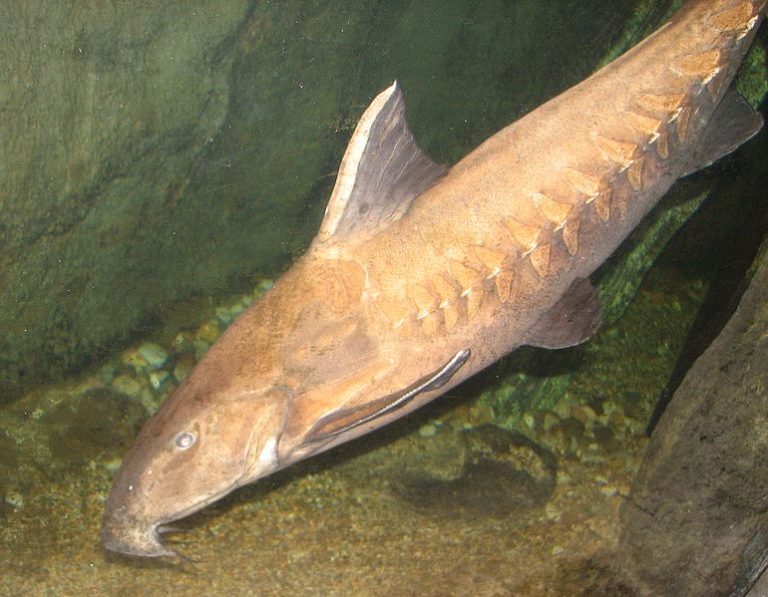
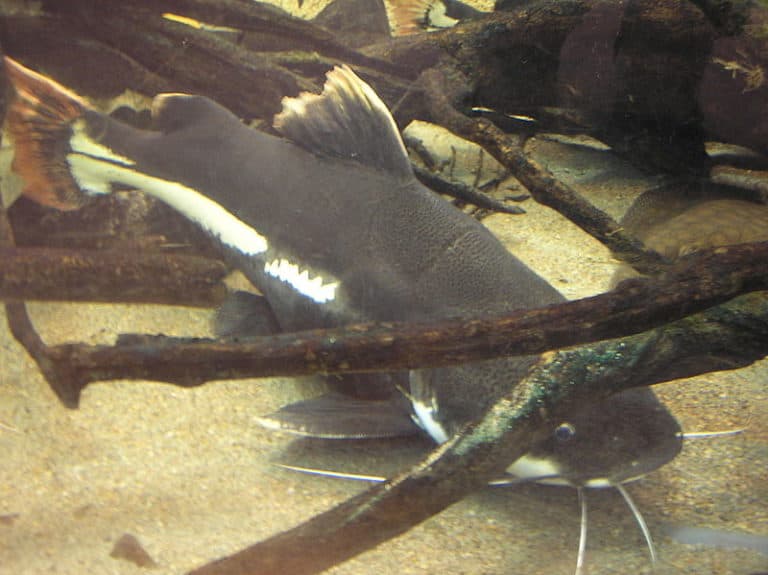
Redtail catfish
Redtail catfish Phractocephalus hemioliopterus
Pictus catfish
Pictus catfish Pimelodus pictus
Striped Raphael catfish Platydoras armatulus
Upside-down catfish Synodontis nigriventris
Glass catfish Kryptopterus vitreolus
Bronze corydoras Corydoras aeneus
Pygmy corydoras Corydoras pygmaeus
Bristlenose pleco Ancistrus cirrhosus
Sailfin pleco Pterygoplichthys gibbiceps
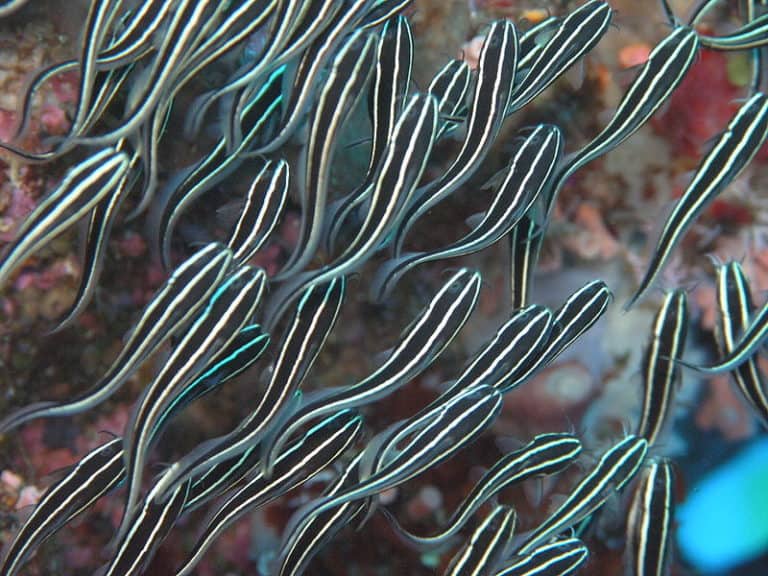
Eeltail catfish Plotosus lineatus
Black bullhead Ameiurus melas
Stonecat Noturus flavus

The amazing sensory apparatus of this species relays important information about the composition of its surrounding environment. The catfish has also served as a common delicacy in many human cultures around the world. This is both a blessing and a curse. Where there is no regulation on fishing, the catfish may be driven to the brink of extinction. But when humans take an interest in its survival, the catfish is allowed to thrive.

An Incredible Fish: Three Catfish Facts

  • The catfish is known by many different local names. In the American South, it is sometimes called a mud cat or chucklehead.
  • Certain catfish species, such as the blue catfish and flathead catfish, have been introduced by humans into non-native environments for farming and are considered among the top invasive species in some regions. These species can cause serious damage to local ecosystems by consuming native plants and animals.
  • Some species produce a venomous compound to deal with threats. This has proven to be dangerous to humans in only a few rare cases. The venom of the striped eel catfish, in particular, can be dangerous and has the potential to be fatal to humans in rare cases, though confirmed deaths are extremely uncommon.

Classification and Scientific Name

All catfish belong to a single order known as Siluriformes. As you may already know, an order is the next major level of taxonomy below a class. In the case of the catfish, it is in a class of ray-finned fish known as the Actinopterygii, which also includes tuna, swordfish, salmon, cod, and many other types of fish. All catfish evolved from a single common ancestor. This means a single group branched out and led to all modern catfish species.

Different Types
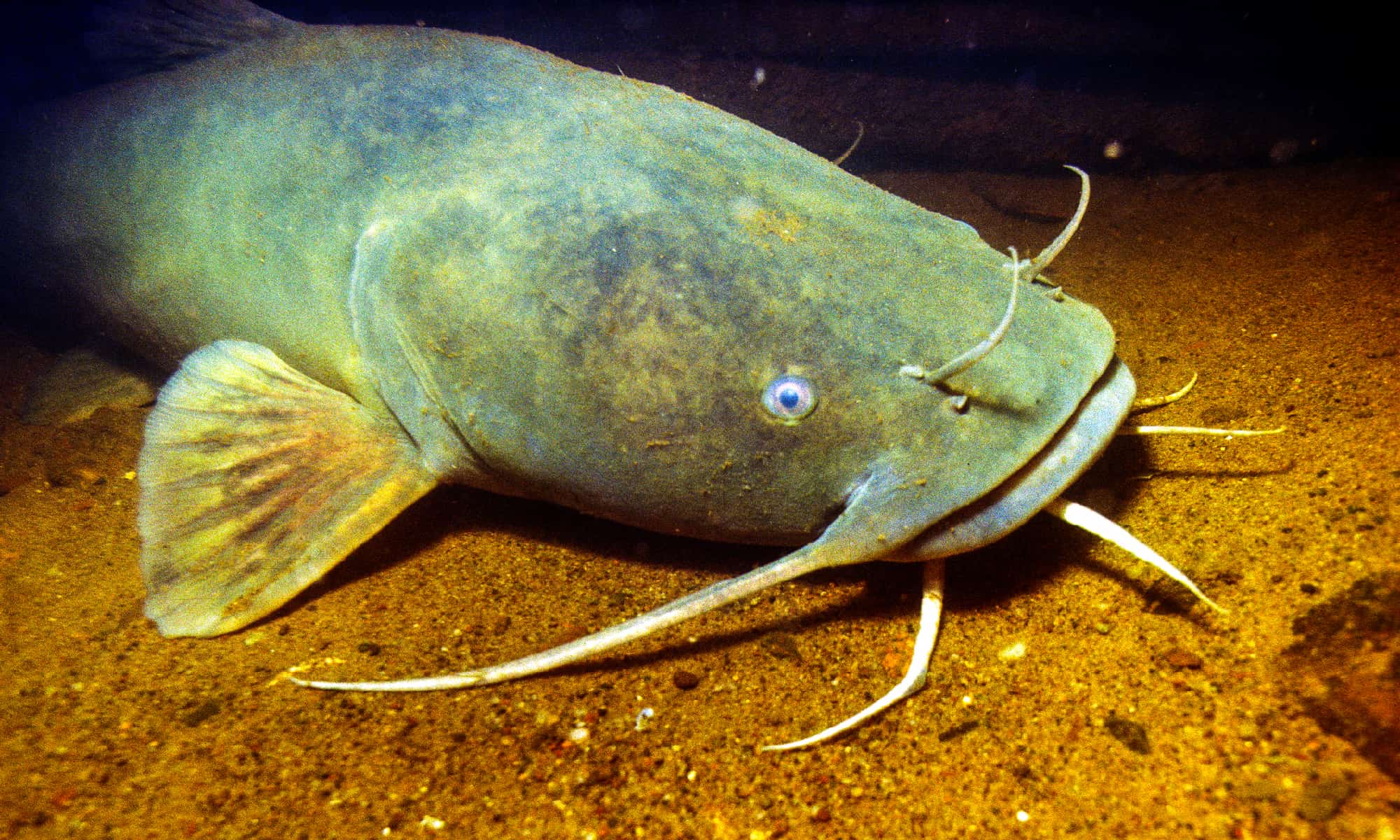
Catfish, Fish, Mississippi River, Underwater, USA

This flathead catfish, Pylodictis olivaris, lying on the bottom of the Mississippi River, is only one example of possibly 3,000 different species of catfish.

The order of Siluriformes possesses a truly staggering amount of diversity. It contains around 3,000 species across 35 different families. By comparison, the primate order, which includes all humans, apes, and monkeys, is composed of only a few hundred species. Here are just a few examples of catfish species:

  • Blue Catfish (Ictalurus furcatus): Endemic to Mexico and the Southeastern United States, this is the largest species of catfish on the entire North American continent. With its blue-gray coloration, this fish is highly tolerant of brackish waters, which has allowed it to thrive in all kinds of rivers and lakes.
  • Channel Catfish (Ictalurus punctatus): This species inhabits much of the United States and Mexico east of the Rocky Mountains. It is probably the most fished catfish species in the world. If you’ve ever eaten catfish, then you’ve likely had this type of fish. Its popularity has led to its introduction in Europe, Asia, and South America, where it’s sometimes considered an invasive species.
  • Cory Catfish: Cory catfish are popular in the aquarium trade. In the wild, the fish buries its snout into the river bottom and vacuums up food. Cory catfish eat an omnivorous diet of fish pellets and other foods like worms when kept in captivity.
  • Micro Catfish: These tropical freshwater fish of South America are some of the smallest catfish species in the world. They grow to a length of no more than one or two inches.
  • Mekong Giant Catfish (Pangasianodon gigas): At the other end of the spectrum, the massive Mekong giant catfish is part of the shark catfish family. It inhabits the Mekong basin of Southeast Asia and China.
  • Goonch (Bagarius yarrelli): Also known as the giant devil catfish, the goonch is a large species weighing over 200 pounds. Residing mostly in India, the goonch has inspired both fascination and terror.

Appearance
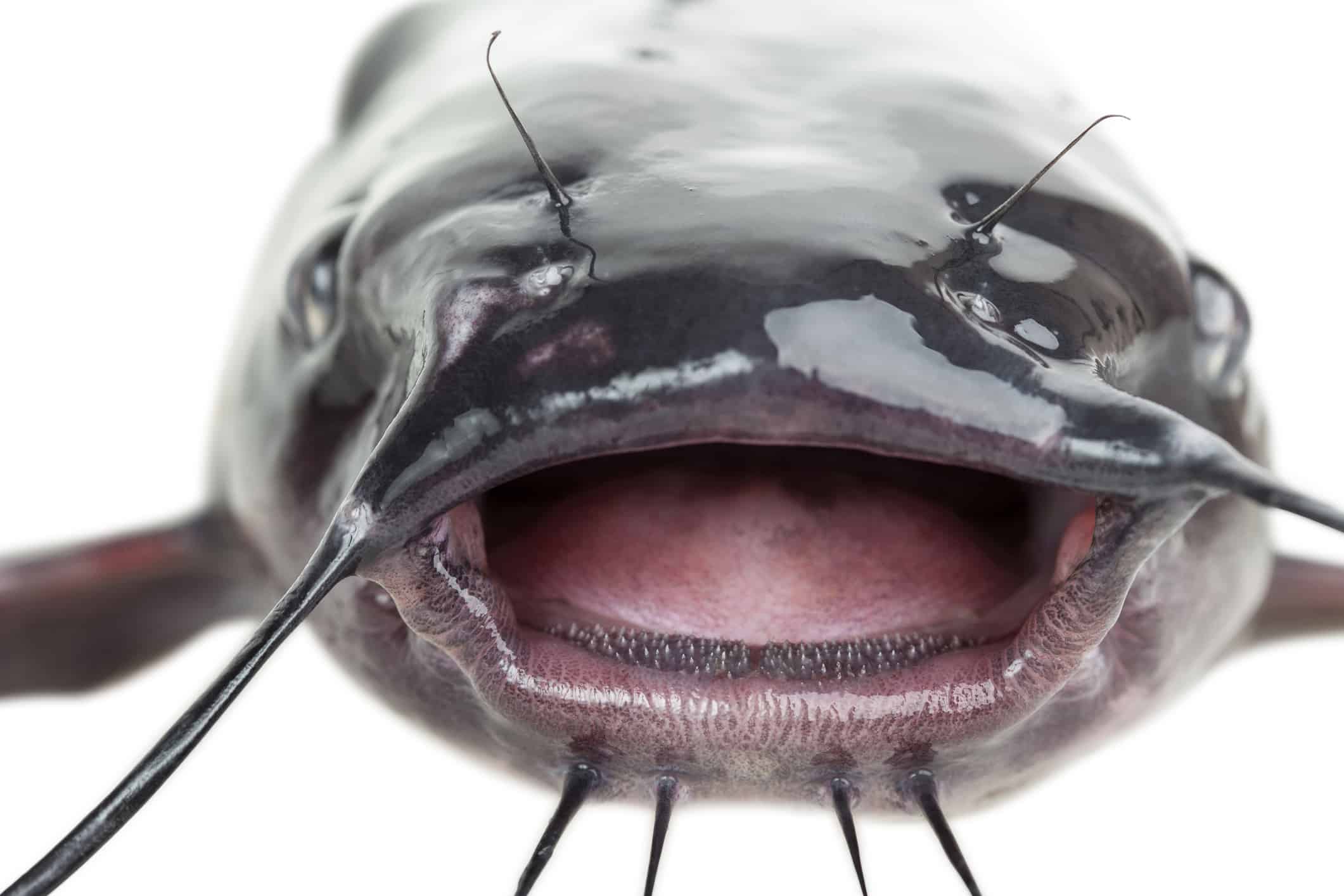
Channel Catfish Mouth

The channel catfish is common in the United States and is a good example of this order of fish, known for its barbels (whiskers or feelers).

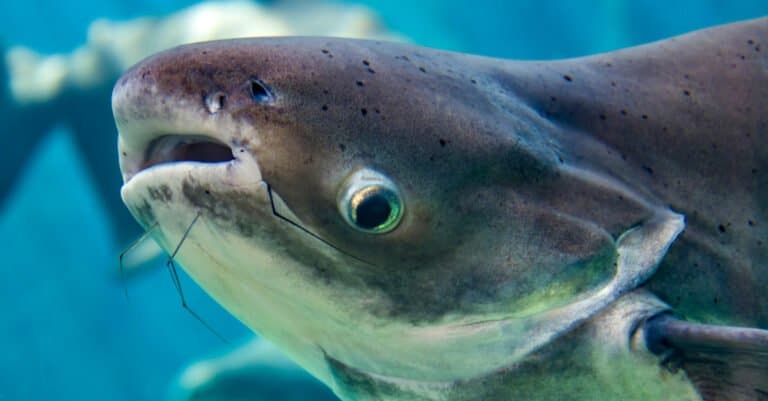
This fish comes in a diverse range of colors, shapes, and characteristics, but there are a few distinct traits that unite all species together. The most prominent physical characteristic is the pair of long barbels (the whiskers or feelers) along the upper jaw that act as sensory organs. Most actually have receptors all over the body that allow them to taste or smell various chemicals in the water, but the barbels are the main instruments through which they sense the surrounding environment. A single pair is standard, but some may have up to four pairs of whiskers arranged along the mouth, snout, and chin.

Another important sensory feature is a bony structure that connects the swim bladder to the fish’s auditory system, called a Weberian apparatus. This enables it to produce and detect sounds in the water.

Most have a long body and flattened head to allow for bottom feeding. With their tendency to sink rather than float, they spend most of their time sifting the floor for food, usually during the night but sometimes during the day as well. Their mouths are widely spaced to take in large quantities of food at a single time. Most species are gray, white, yellow, brown, or green in color. The skin consists of bony plates or a lining of mucus instead of scales. A spine near the fins is present in some species to ward off dangerous predators. It usually delivers either a sharp sting or a very painful and debilitating venom.
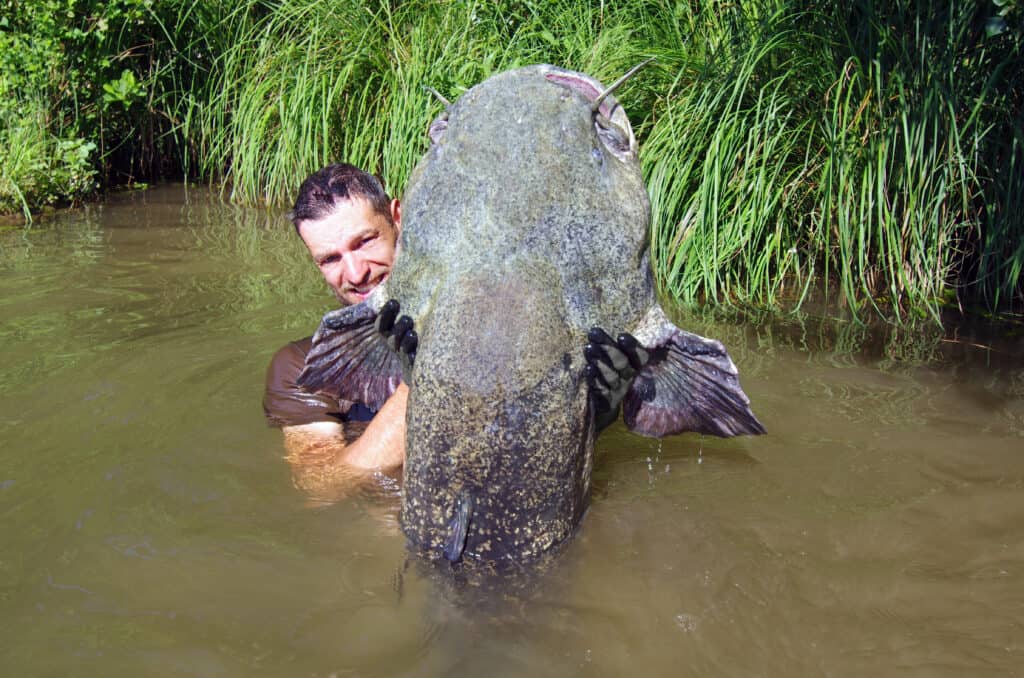
noodling

Some species of catfish are enormous in size — much bigger than the average catfish caught for dinner in the United States.

The size also reflects its immense diversity. The order ranges greatly in size between the banjo catfish, which is less than an inch long, and the truly massive wels catfish, which measures up to 10 feet in length and 440 pounds in weight. Sexual differences between males and females seem to occur in about half of all documented families.

Some species feature truly unusual adaptations. For instance, the upside-down catfish lives up to its name by swimming upside down. The electric catfish in Africa can generate some 450 volts of electricity. The walking catfish can traverse land for short distances in between pools by moving on its front fins and tail; it also has the ability to breathe in oxygen from the air. Each of these adaptations is well-suited for the environment in which it lives.

Distribution, Population, and Habitat

The majority of this type of fish inhabit the shallow freshwater regions of every continent on the planet except for Antarctica. The only exceptions are several species adapted specifically for saltwater environments or even caves. Population numbers are generally quite strong across the world, and most species are not yet at risk of extinction. However, some species are increasingly in peril due to overfishing and marine pollution. The Mekong giant catfish of Southeast Asia and China, the Andean catfish of Ecuador, the blind-whiskered catfish of Mexico, and several other species are all considered to be critically endangered, while many others are trending that way.

Predators and Prey
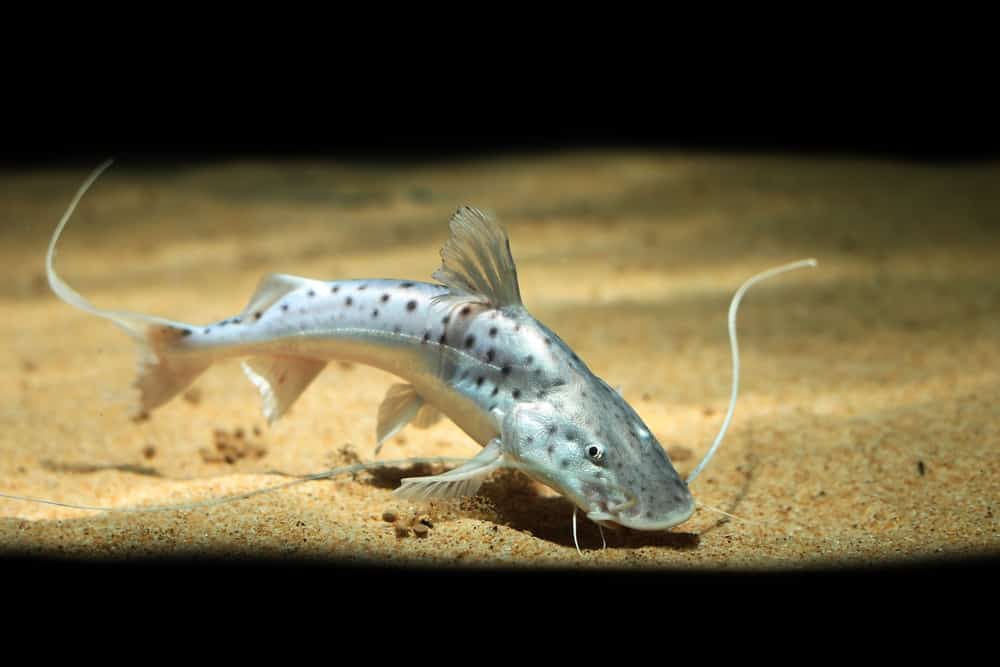
Large,Piraiba,Catfish,(brachyplatystoma,Filamentosum),Seaching,For,Food,In,Aquarium

Large Piraiba catfish (Brachyplatystoma filamentosum) are searching for food such as algae, snails, worms, insects, or whatever is local.

The catfish lives in so many different places that it has a staggering list of predators. Some of the most common predators include birds of prey, snakes, alligators, otters, fish (including other catfish), and, of course, humans. Due to their large physical size and defensive spines, the catfish is hardly the first choice of prey for many predators. But some of the smaller of the species, in particular, are most vulnerable.

This fish’s diet also varies greatly by location. Most species feed on random algae, snails, worms, insects, and other small marine creatures by sucking or gulping them up with their huge mouths. The larger species consume frogs, newts, birds, rodents, and other animals as well.

Reproduction and Lifespan

With approximately 3,000 species to account for, this fish varies quite a bit in terms of its reproduction habits. Breeding season usually occurs during the late spring and early summer. The females can lay thousands of eggs at a time within small hiding places such as rock crevices or dense vegetation. The eggs hatch quickly after a mere 5 to 10 days. The male is tasked with much of the parental duty. The maximum life expectancy of a typical catfish species is anywhere between 8 and 20 years in the wild. Some of them obviously fall victim to predators long before this.

Fishing and Cooking

The catfish is such a popular dish throughout the world that large numbers of catfish are deliberately raised in farms. Each local culture tends to have its own method of cooking the catfish. In the Southeastern United States, it is typically rolled in cornmeal and fried. In Southeast Asia, it is grilled or fried and then eaten with various vegetables and spices. In Hungary, it is cooked with paprika sauce and noodles.

View all 392 animals that start with C
How to say Catfish in ...
Indonesian
Lele
Malay
Ikan Keli
Danish
Malle
German
Welsartige
English
Catfish
French
Poisson-chat
Croatian
Somovke
Italian
Pesce gatto
Latin
Siluriformes
Dutch
Meervalachtigen
English
Maller
Polish
Sumokształtne
Portuguese
Peixe-gato
Finnish
Monnikalat
Swedish
Malartade fiskar
Chinese
鲇形目

Sources

  1. Brittanica / Accessed November 8, 2019
  2. Soft Schools / Accessed November 8, 2019

Thank you for reading! Have some feedback for us?


Catfish FAQs (Frequently Asked Questions)

The catfish is consumed by birds of prey, large reptiles, mammals, and other fish.