

C
Species Profile

Chimpanzee

Pan troglodytes

Tools, talk, and tight-knit tribes
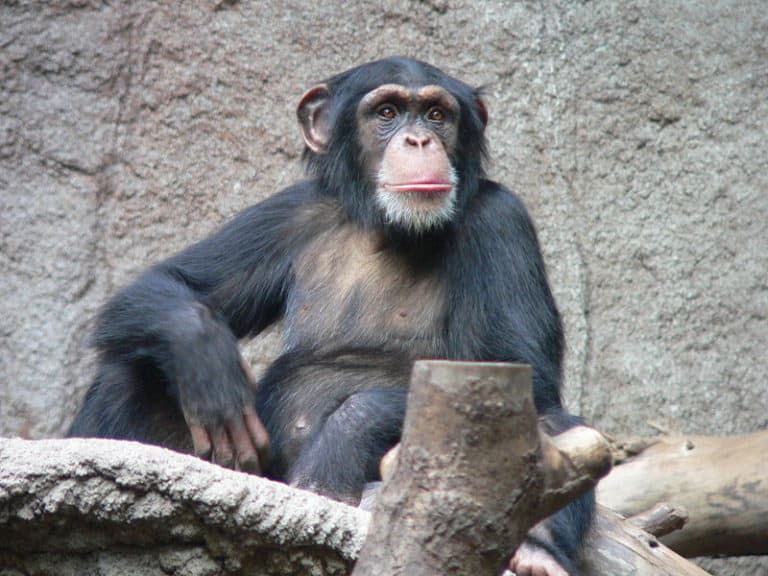
Malene Thyssen / Creative Commons

Chimpanzee Distribution

Click a location to explore more animals from that region

Loading map...

Size Comparison

Human 5'8"
Chimpanzee 4 ft 3 in

Chimpanzee stands at 75% of average human height.

At a Glance

Wild Species
Also Known As Chimpanzee, Chimp, African chimpanzee
Diet Omnivore
Activity Diurnal+
Lifespan 33 years
Weight 70 lbs
Status Endangered
Did You Know?

Genetic similarity: humans and common chimpanzees share ~98.8% DNA sequence identity in commonly cited genome comparisons; lineage split is often estimated ~6-7 million years ago.

Scientific Classification

A large-bodied African great ape and one of humans’ closest living relatives, known for complex social behavior, tool use, and high cognitive abilities.

Kingdom
Animalia
Phylum
Chordata
Class
Mammalia
Order
Primates
Family
Hominidae
Genus
Pan
Species
Pan troglodytes

Distinguishing Features

  • Great ape with no tail; long arms adapted for knuckle-walking and climbing
  • Highly social fission–fusion communities with dominance hierarchies
  • Extensive tool use (e.g., termite fishing, nut cracking in some populations)
  • Mostly dark hair, bare face/ears/hands; facial coloration varies with age and individuals

Physical Measurements

Males and females differ in size

Height
4 ft 11 in (3 ft 11 in – 5 ft 7 in)
3 ft 9 in (3 ft 3 in – 4 ft 3 in)
Weight
110 lbs (88 lbs – 132 lbs)
77 lbs (57 lbs – 110 lbs)
Top Speed
25 mph
About 40 km/h (estimate)

Appearance

Primary Colors
Secondary Colors
Skin Type Chimpanzees have mammal skin with dense, coarse body hair and hairless face, ears, palms, soles, lips, and anogenital area. Facial skin is light in infants, darker in many adults, and may wrinkle.
Distinctive Features
  • Large-bodied African great ape (Genus Pan, Family Hominidae) with knuckle-walking adaptations: elongated forelimbs relative to hindlimbs, robust metacarpals/phalanges, and dorsal finger-walking posture; capable of efficient quadrupedalism and frequent climbing.
  • Adult Common Chimpanzee (Pan troglodytes) males usually weigh about 40–60 kg, females about 27–50 kg, and standing height is roughly 1.0–1.7 m depending on posture.
  • Head with pronounced supraorbital brow ridges; relatively prognathic face compared with Homo; large, sexually dimorphic canine teeth (especially in males).
  • Hands with opposable thumbs and high manual dexterity; feet with grasping hallux (opposable big toe), supporting arboreal locomotion and fine manipulation (key to tool use).
  • Common chimpanzees (Pan troglodytes) use tools for feeding: use sticks to fish for termites and ants, scoop algae, make leaf sponges for water, and some West African groups crack nuts; behaviors vary by population.
  • Complex social organization characterized by fission-fusion dynamics within multi-male/multi-female communities; individuals form temporary parties that change composition frequently (classic field findings: Goodall 1986; Mitani 2009).
  • Common chimpanzees make typical sounds like pant-hoots, drum on buttress roots, show facial expressions, and use many gestures; their signals depend on the situation and group.
  • Geographic range spans equatorial Africa in multiple habitat types (from moist forest to woodland-savanna mosaics); pelage condition and sun-bleaching can reflect habitat openness and exposure (IUCN Pan troglodytes).
  • Conservation-relevant external signs sometimes observed in threatened landscapes: snare injuries causing limb deformities/hand loss; scarring from conflict/trauma-important ethical considerations for research and management (IUCN Pan troglodytes threats: hunting, habitat loss, disease).

Sexual Dimorphism

Sexual dimorphism is moderate: males are larger and more muscular with larger canines; females exhibit conspicuous, cyclical anogenital swellings during estrus (a key visual reproductive signal). Both sexes share overall pelage patterning and lack bright permanent coloration. (Morphology and life-history syntheses: IUCN Pan troglodytes; Goodall 1986; Deschner et al. 2004).

  • Greater average body mass and muscle bulk (typical adult male mass often ~40-60 kg vs. females ~27-50 kg; site-dependent) (IUCN Pan troglodytes).
  • Relatively larger canine teeth and more robust craniofacial features (sexual dimorphism common in Pan) (IUCN Pan troglodytes; Goodall 1986).
  • More prominent genitalia when visible (scrotum/penis), though usually not a signaling structure compared to female swellings.
  • Cyclical anogenital swelling: perineal skin enlarges markedly and can appear pinker at maximal tumescence; swelling size changes across the cycle and is associated with reproductive state (Deschner et al. 2004; Goodall 1986).
  • On average smaller body mass and less overall muscularity than adult males (IUCN Pan troglodytes).
  • Mammary development becomes more evident after first birth and with nursing; otherwise external sex differences can be subtle outside swelling periods.

Did You Know?

Genetic similarity: humans and common chimpanzees share ~98.8% DNA sequence identity in commonly cited genome comparisons; lineage split is often estimated ~6-7 million years ago.

Adult size (typical ranges): males ~40-60 kg; females ~27-50 kg; head-body length ~70-100 cm (no tail).

Life history is slow: gestation ~230 days; infants typically nurse for ~4-5 years; interbirth interval commonly ~5-6 years in long-term field studies.

They have "cultural" tool traditions that vary by population: e.g., termite fishing, ant-dipping, leaf sponges, and (in some West African groups) stone/wood nut-cracking.

Communication is multimodal: the loud "pant-hoot" can carry >1 km in forest, and field research has cataloged dozens of distinct, intentional gestures (e.g., ~60+ in major gesture inventories).

Conservation status: Endangered (IUCN); major threats include habitat loss/fragmentation, hunting (bushmeat), disease (including Ebola and human respiratory viruses), and the illegal pet trade.

Unique Adaptations

  • Knuckle-walking anatomy: reinforced wrist/hand structures allow efficient terrestrial travel while preserving long, curved fingers for climbing.
  • Powerful upper body: high relative forelimb strength and mobile shoulders support vertical climbing, suspensory movement, and rapid arboreal escapes.
  • Precision grip capability: opposable thumbs plus strong tactile control enable fine manipulation of tools (probing, stripping, shaping, and combining materials).
  • Large, flexible brain for an ape: high encephalization supports social memory, coalition management, and flexible problem-solving (key in complex fission-fusion life).
  • Dietary and habitat flexibility: primarily frugivorous but highly omnivorous-can pivot to leaves, pith, insects, and hunted meat, enabling occupancy from dense rainforest to woodland-savanna mosaics.
  • High social cognition: individuals track third-party relationships (who is allied with whom) and adjust behavior strategically-an adaptation to living in large, shifting networks.

Interesting Behaviors

  • Fission-fusion society: individuals belong to a larger "community" (often ~20-150) but split into temporary parties that change hour-to-hour based on food, mating opportunities, and social tension.
  • Male cooperation and politics: males form coalitions for status, patrol territorial borders, and can conduct coordinated intercommunity aggression; dominance rank strongly shapes mating access and feeding priority.
  • Grooming as social currency: grooming reduces stress, repairs relationships after conflict, and builds alliances; some populations show the distinctive "grooming handclasp" posture as a local tradition.
  • Tool-based foraging: classic behaviors include termite fishing with stripped sticks, ant-dipping with wands, cracking hard nuts with hammer-and-anvil (in some subspecies/populations), and making leaf "sponges" to drink from tree holes.
  • Hunting and meat sharing: groups may cooperatively hunt (often red colobus monkeys in some forests) and share meat in ways tied to alliances and mating effort.
  • Long-distance signaling: pant-hoots, drumming on buttress roots, and "chorusing" help coordinate spacing between parties and advertise identity and rank.
  • Learning by observation: juveniles spend years watching skilled adults; tool competence develops gradually, with prolonged practice and social tolerance shaping who learns what.

Cultural Significance

Common chimpanzee (Pan troglodytes) help scientists study what makes humans unique: tool use, alliances, empathy, and cultural differences. Their close relation to humans raises ethical worries about captivity, invasive research, and disease. Media often shows them as 'almost-humans,' which can both gain support and mislead about wildness and welfare.

Myths & Legends

In West and Central African tales, chimpanzees (Pan troglodytes) are said to be former humans who left people for the forest after breaking rules, refusing work, or avoiding duties, serving as moral warnings.

Folktales called “Why the ape has no tail” often tell how an ape — sometimes the Common Chimpanzee (Pan troglodytes) — lost its tail by trick, punishment, or pride, giving a memorable origin for tailless great apes.

Trickster-and-judge narratives: in some regional animal-story cycles, the chimpanzee appears as a clever litigant or deceptive negotiator-using intelligence and social manipulation rather than strength-mirroring real chimpanzee emphasis on alliances and strategy.

Naming origin (historical anecdote): the species name Pan troglodytes (Blumenbach, 1775) combines Pan (the Greek rustic god) with "troglodytes," meaning cave-dweller-an example of European-era mythic/classical naming layered onto an African animal.

Conservation Status

EN Endangered

Facing a very high risk of extinction in the wild.

Population Decreasing

Protected Under

  • CITES Appendix I (international commercial trade prohibited except under strict conditions).
  • Many range states provide legal protection against hunting/capture and occur within national parks and other protected areas across West and Central Africa (effectiveness varies).
  • United States Endangered Species Act: listed as Endangered (applies to wild and captive chimpanzees in the U.S. since the 2015 uplisting).
  • European Union Wildlife Trade Regulations: generally treated as Annex A (implementing CITES Appendix I controls on trade).

Life Cycle

Birth 1 infant
Lifespan 33 years

Lifespan

In the Wild
0–50 years
In Captivity
35–60 years

Reproduction

Mating System Polygynandry
Social Structure Aggregation Group
Breeding Pattern Transient
Fertilization Internal Fertilization
Birth Type Internal_fertilization

Common chimpanzee (Pan troglodytes) are multi-male/multi-female and mate with many partners in fission‑fusion communities. No pair bonds; females show sexual swellings, males guard briefly, high-ranking males father more young but many males reproduce.

Behavior & Ecology

Social Community Group: 55
Activity Diurnal, Crepuscular
Diet Omnivore Ripe fruit-especially figs (Ficus spp.) when available.

Temperament

Highly social, with frequent affiliative contact (grooming, embracing, play) that supports long-term bonds; grooming is a major currency of affiliation and coalition maintenance (Goodall 1986; Dunbar 1991).
Dominance-structured: males typically show clear rank relationships supported by coalitions; rank affects mating access, feeding priority in some contexts, and social leverage (de Waal 1982; Goodall 1986).
Territorial and sometimes lethal intergroup aggression: males commonly patrol boundaries; attacks on neighbors and occasional killings have been documented across multiple long-term sites (Goodall 1986; Mitani et al. 2010).
Working together in chimp groups changes with habitat: some groups (Taï, Ngogo) hunt together and share meat, while others do not; sharing often follows harassment, alliances, or mating chances.
High behavioral flexibility and cultural variation: tool-use and foraging techniques (e.g., termite fishing, nut cracking, leaf sponging) differ among populations and are socially learned (Whiten et al. 1999; Boesch & Boesch 1983).
Reproductive/social life history is slow: interbirth intervals commonly ~5-6 years in the wild, supporting prolonged juvenile dependence and learning (Goodall 1986; Emery Thompson 2013).
Pan troglodytes can live up to 61.7 years in captivity (AnAge). Wild common chimpanzees usually live less due to disease, injury, and baby deaths.

Communication

Pant-hoot Long-distance contact call; can signal identity, location, excitement, and social context) (Goodall 1986; Mitani & Stuht 1998
Pant-grunt Submissive signal directed up the dominance hierarchy) (Goodall 1986; de Waal 1982
Screams Often in aggression, fear, or high arousal; can recruit allies) (Goodall 1986
Grunts Context-dependent; feeding, social approach, reassurance) (Goodall 1986
Barks Alarm/agonistic contexts; also used in some intergroup situations) (Goodall 1986
Soft "hoos"/"huu" calls Often in travel/coordination and some disturbance contexts; acoustically graded variants reported) (Goodall 1986; Crockford et al. 2012
Gestural communication Manual, bodily, and tactile gestures; includes intentional signaling and persistence/response waiting in many contexts) (Tomasello et al. 1994; Hobaiter & Byrne 2014
Facial expressions E.g., play face; bared-teeth displays) paired with posture to modulate meaning and intensity (Goodall 1986
Tactile signals: grooming, reassurance touches, embraces, and socio-sexual contact used to regulate tension and reinforce bonds Goodall 1986; de Waal 1982
Visual/aural displays: charging displays, branch-waving, ground slapping, and object throwing to intimidate or attract attention; drumming on buttress roots can broadcast over distance Goodall 1986
Attention-getting signals with objects E.g., leaf-clipping) used in courtship/sexual solicitation and as a social attention signal in some populations (Goodall 1986; Nishida 2012
Chemical/biological cues: urine/feces and anogenital inspection contribute to individual recognition and reproductive state assessment, though olfaction is less emphasized than in many mammals Goodall 1986

Habitat

Biomes:
Tropical Rainforest Tropical Dry Forest Savanna Wetland Freshwater
Terrain:
Mountainous Hilly Plateau Plains Valley Riverine
Elevation: Up to 9186 ft 4 in

Ecological Role

Omnivorous frugivore-predator acting as a major seed disperser and a mesopredator/top predator of some small vertebrates in forest mosaics.

Long-distance seed dispersal and regeneration of many tropical tree species via endozoochory (swallowed fruits, defecated seeds) Selective pruning/seed predation that can shape plant recruitment patterns Predation pressure on some monkey populations (notably red colobus), influencing primate community structure Nutrient redistribution through dung deposition across home ranges Creation of foraging trails and localized disturbance that can affect understory dynamics

Diet Details

Main Prey:
Red colobus monkey Cercopithecine monkeys Bushbaby Bushbuck fawns Rodents Bird eggs and nestlings Termites Army ants Ants and beetle larvae +3
Other Foods:
Ripe fruit Figs and other drupes/berries Seeds and nuts Young leaves and leaf petioles Pith and stems Flowers and nectar Bark and cambium Honey Fungi Soil/clay +4

Human Interaction

Domestication Status

Wild

Pan troglodytes is a wild great ape with no domesticated form. Humans interact by long-term field research and habituation (Gombe, Tai), capture for shows or pets, medical and thinking studies (now reduced), ecotourism, and illegal trade/bushmeat. Chimpanzees keep wild behaviors (fission-fusion groups, tool use, male aggression) and show no inherited domestication.

Danger Level

High
  • Severe physical trauma: chimpanzees are large, powerful primates with strong canines; documented attacks on humans include deep bite wounds, crushing injuries, and maiming (risk increases with adult males, sexually mature individuals, and in captivity where frustration/territoriality can be triggered).
  • High unpredictability in captive/privately kept individuals: maturation commonly brings increased aggression and dominance testing; even hand-raised chimpanzees can become dangerous as adults.
  • Zoonotic disease transmission in both directions: chimps and humans share susceptibility to many respiratory viruses and enteric pathogens; close contact (tourism, sanctuaries, research, pet situations) elevates risk. There is also risk from blood/body-fluid exposure during bites/scratches.
  • Fieldwork and ecotourism hazards: risk of aggressive displays/charges or intergroup encounters near humans, particularly around provisioning history or poor viewing protocols.

As a Pet

Not Suitable as Pet

Legality: Keeping Common Chimpanzee (Pan troglodytes) as a pet is generally illegal or tightly limited. CITES Appendix I and U.S. ESA Endangered listing limit trade, transport, ownership, and many countries ban private ownership.

Care Level: Expert Only

Purchase Cost: $30,000 - $80,000
Lifetime Cost: $500,000 - $2,000,000

Economic Value

Uses:
Ecotourism (chimpanzee tracking/forest tourism where communities are habituated) Scientific research value (behavioral ecology, cognition; historically biomedical research) Conservation funding and NGO/program employment in range states Illegal trade (live capture for pets/entertainment; body parts) and bushmeat markets (illicit, conservation-negative) Human health relevance (zoonotic-disease surveillance and One Health research)
Products:
  • Tourism services (guided tracking permits, park fees, local lodging/transport tied to chimp tourism)
  • Research outputs (datasets, publications, cognitive/behavioral paradigms; non-consumptive value)
  • Education/outreach programming (sanctuaries, conservation centers)
  • Illicit commodities (live infants sold in illegal pet markets; bushmeat-both illegal in many jurisdictions)

Relationships

Humans share 95%-98% of the same DNA as chimpanzees.

Located in 21 countries across the continent of Africa, the chimpanzee is a fascinating primate. Its intelligence is notable, owning extraordinary capabilities to learn communication techniques such as sign language, and has even been trained to play games on computers! Unfortunately, these amazing animals are shrinking in numbers and are currently listed as endangered. Read on to learn more about the intriguing chimpanzee.
Classification

The Chimpanzee is a species of ape that is natively found in a variety of different habitats in western and central Africa. Closely related to other great apes including Orang-Utans and Gorillas, the Chimpanzee is an animal that is also very closely related to Humans as we share 98% of the same DNA. They are thought to be the most intelligent animals on the planet after people and are not only known to show emotion but are also great problem-solvers and are even known to not just use, but also make tools to help them to survive more successfully in their surroundings.

There are two different species in the genus Pan which are the Common Chimpanzee and the smaller Bonobo (also known as the Pygmy Chimpanzee) which has a limited distribution south of the Congo River. However, despite being highly adaptable and intelligent creatures, Chimpanzees are severely threatened in their natural habitats today, mainly due to hunting for bushmeat and deforestation.
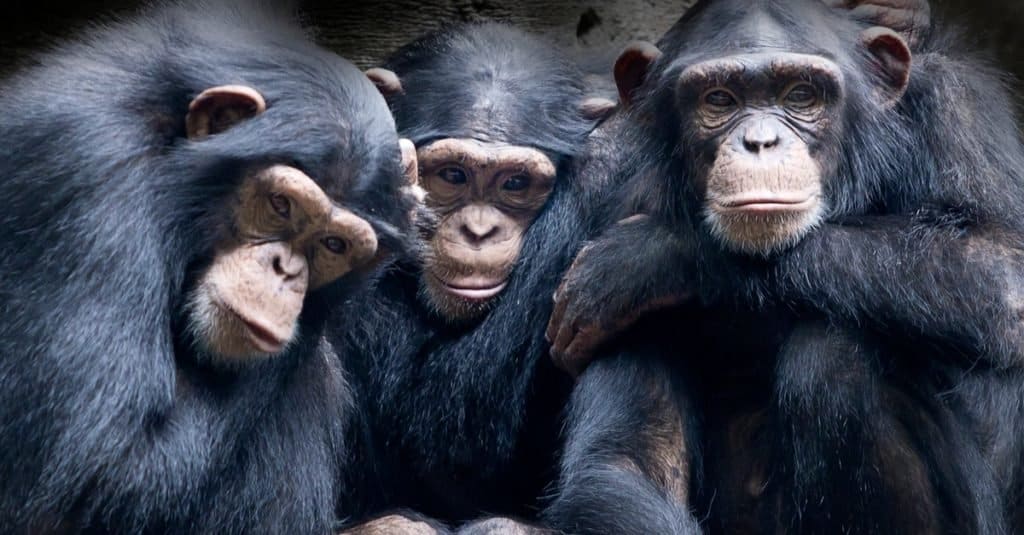
Animal Facts: Chimpanzees

Humans and chimpanzees share 95 to 98 percent of the same DNA.

Evolution

Pan fossils have been found in Kenya dating to the Middle Pleistocene, indicating that both chimpanzees and humans inhabited the East African Rift Valley during that time, ranging from 126,000 to 770,000 years ago.

The bonobo species separated from the chimpanzee less than 1 million years ago. Around six million years ago, researchers believe that the chimpanzee split from the human line, of which only Homo sapiens survived, making chimpanzees the closest relatives of humans. Chimpanzees and humans diverged from gorillas 7 million years ago.

Types of Chimpanzees

There are four subspecies of the common chimpanzee, and a fifth which is a proposed subspecies. These inhabited more areas in the past but have shrunk to smaller populations. The four are:

  • Western chimpanzee (P. t. verus) – Found mostly in Gabon, Cameroon, and Congo. The most widespread subspecies with population around 115,000.
  • Central chimpanzee (P. t. troglodytes) – Found mostly in Côte D’Ivoire, with smaller populations in Guinea, Sierra Leone, Nigeria, Guinea-Bissau, and Liberia.
  • Eastern chimpanzee (P. t. schweinfurthii) – Found mostly from the Ubangi River/Congo River in Central African Republic and DRC, to western Uganda, Rwanda and western Tanzania.
  • Nigeria-Cameroon chimpanzee (P. t. ellioti) – Found in Nigeria and Cameroon, this is the rarest subspecies of chimpanzee with only 6,500 remaining.

The Southeastern chimpanzee, P. troglodytes marungensis, is not recognized as a subspecies by the ICUN, but it inhabits Burundi, Rwanda, Tanzania, and Uganda.
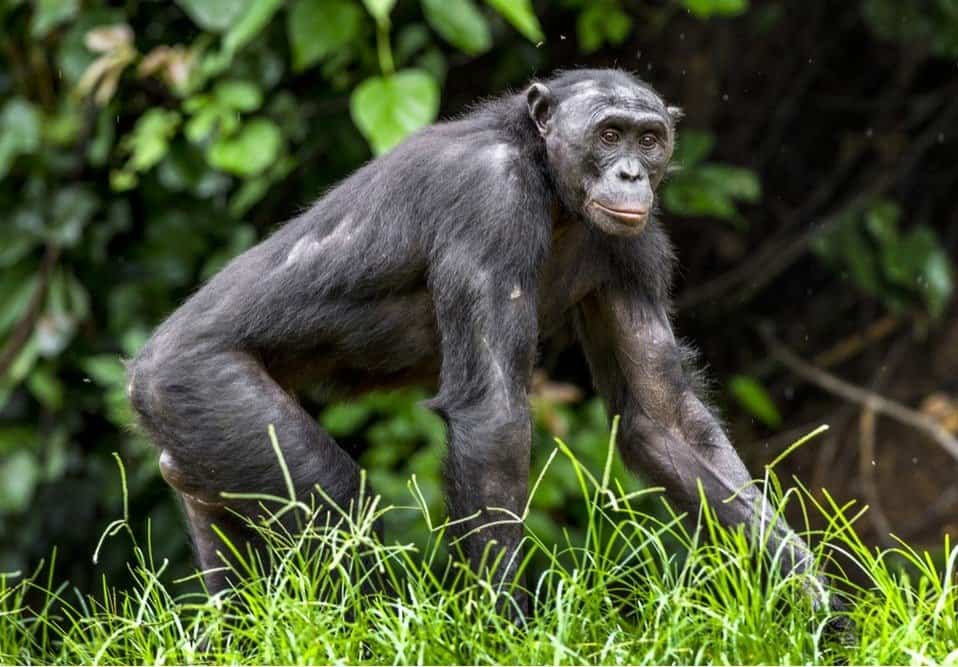
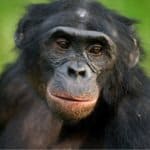
The portrait of male Bonobo walking in the jungle.

The Bonobo (Pan paniscus) is not actually a species of Chimpanzee, rather, under the same genus as the Chimpanzee–Pan.

Anatomy and Appearance

Chimpanzees are large primates that have long yet sparse black hairs covering their bodies except for their face, palms, and the soles of their feet. Their hair not only allows them to remain warm in areas at higher altitudes but also provides their skin with some protection from the sun. The hairless parts of their bodies are light to dark brown depending on the age of the individual (their skin darkens as they mature). They have large ears that give them excellent hearing and a heavy brow ridge over their eyes. Like other great apes, Chimpanzees are animals that have good sight and can see in color, while their forward-facing eyes allow them to focus on a single object. They have long fingers and an opposable big toe that helps them to grip things, with their arms also being longer than their legs which enables them to move around on all fours which are known as knuckle-walking. Chimpanzees have 32 teeth which are very similar to those of Humans to help them not just grind up plant matter but their longer canines also help to bite into flesh.
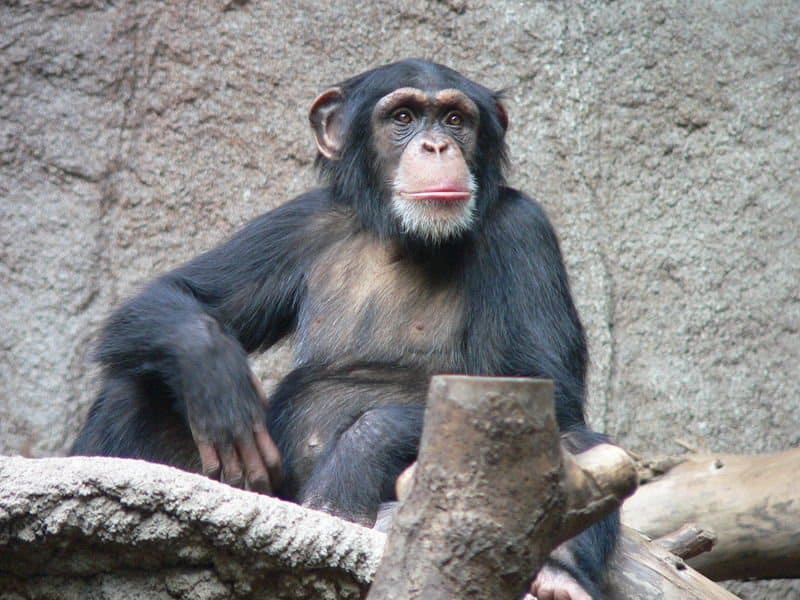
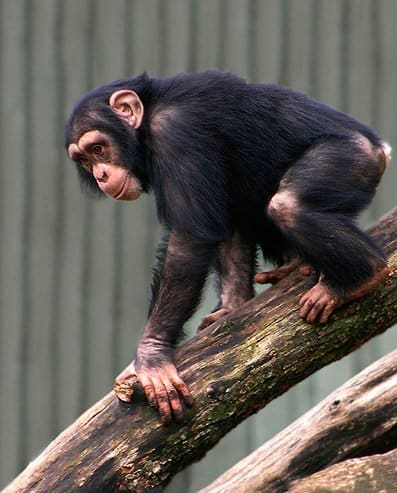
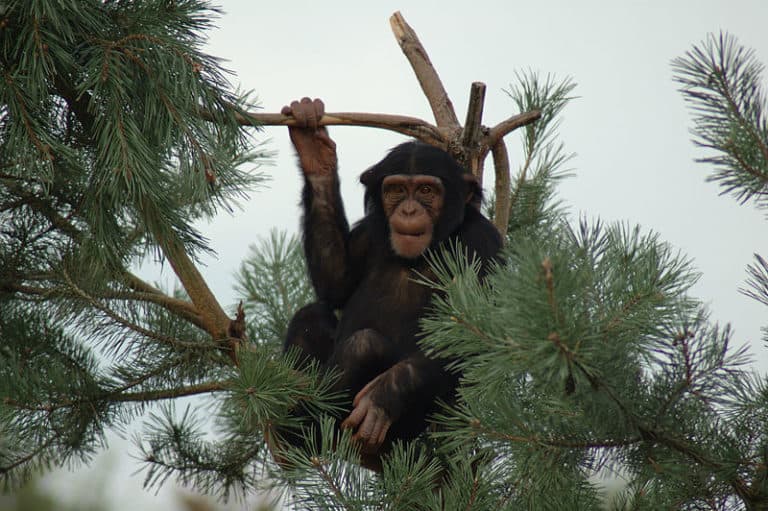
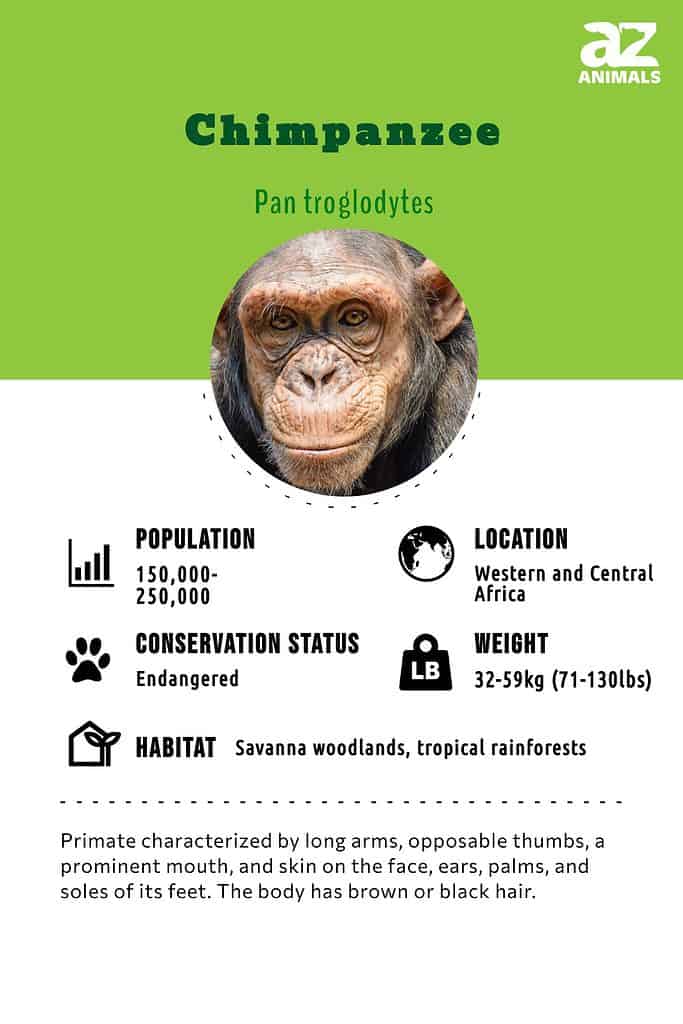
The chimpanzee’s features include long arms, opposable thumbs, a prominent mouth, and a body covered in brown or black hair.

Distribution and Habitat

Chimpanzees are found throughout 21 different countries in western and central Africa where they are known to inhabit a variety of different regions from the tropical, humid rainforests to the dryer and more arid regions of the savanna and open woodlands. They are excellent climbers and rely heavily on the surrounding trees not just for protection from predators but also to find food and places to nest during the night. Chimpanzees have been severely affected by the loss of much of their natural habitat as forests are cleared to make way for agriculture or to cut down the trees as tropical timber. With groups being pushed into smaller and smaller ranges the competition for food and nesting sites increases and conflict can occur both between different groups and amongst individuals who reside in the same community.
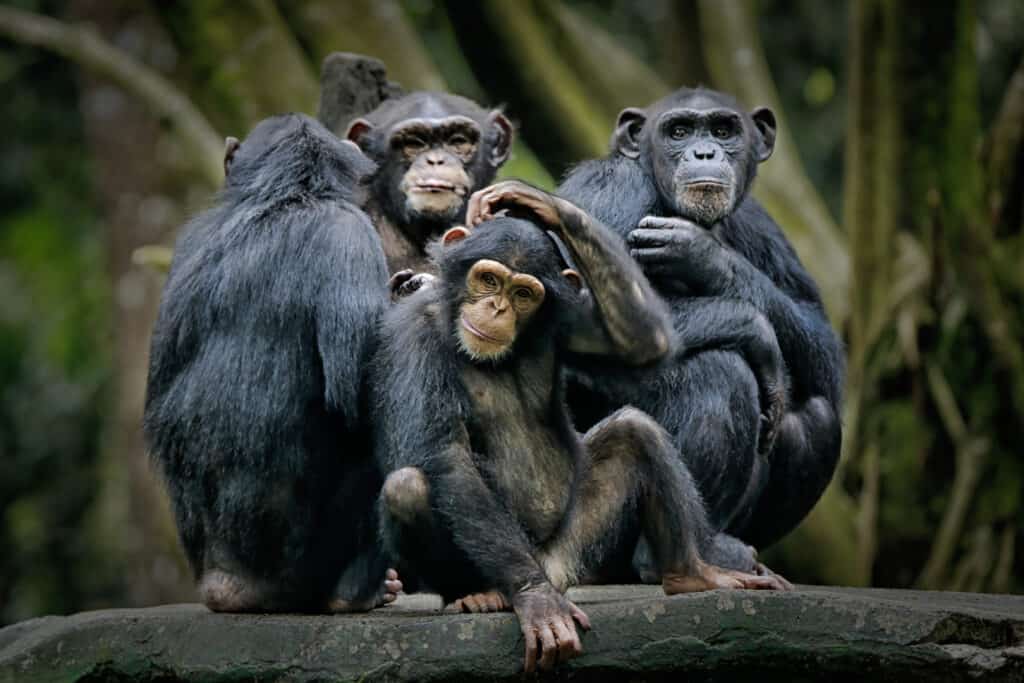
Chimpanzees have suffered severely from habitat loss as forests are cleared for the agricultural or timber industries.

Behavior and Lifestyle

Chimpanzees are highly sociable animals that spend daylight hours feeding, playing, and grooming with other members of the group. Groups (also known as communities) can range in size from 15 to 120 individuals depending on the habitat and the amount of food available. They are highly territorial and do not tolerate outsiders in their midst, often killing an individual that is from another group. Chimpanzee groups have incredibly complex social structures with the dominant males not necessarily being the strongest individuals but more the ones that can rally together the most supporters. Chimpanzees make nests in the trees at night by folding over branches to provide them with a safe platform on which to sleep, with a new nest being constructed every day. Although they spend a lot of time both sleeping and eating in the trees and do move about by swinging from branch to branch, most travel is done using a network of paths on the ground using their knuckles to balance on.

You can check out incredible facts about chimpanzees.
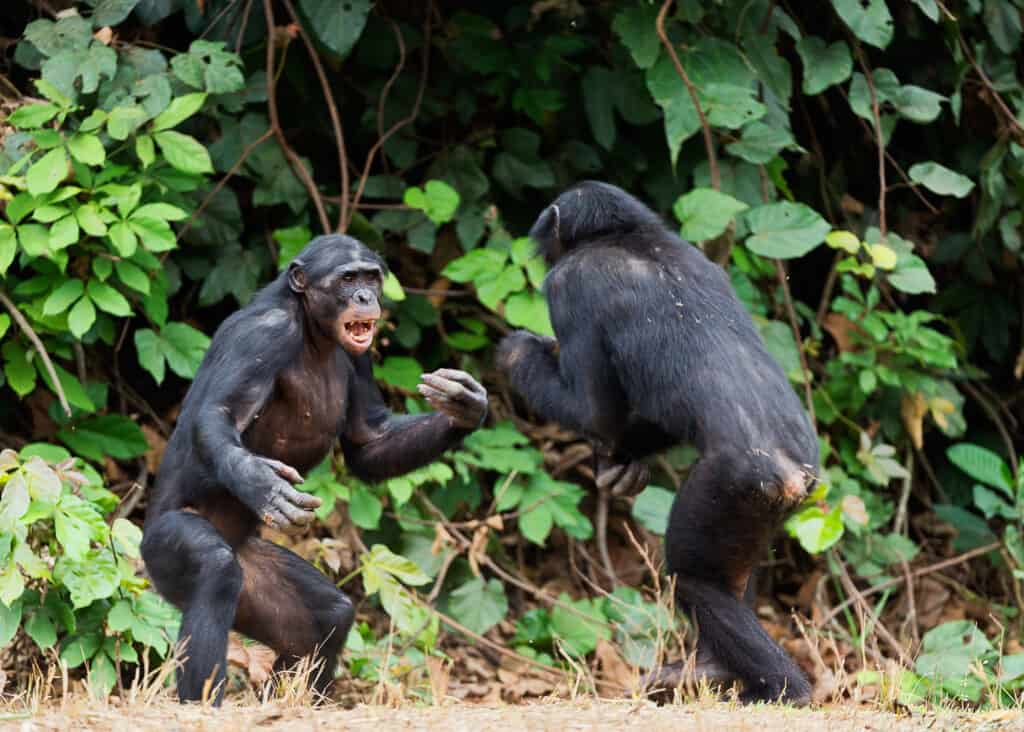
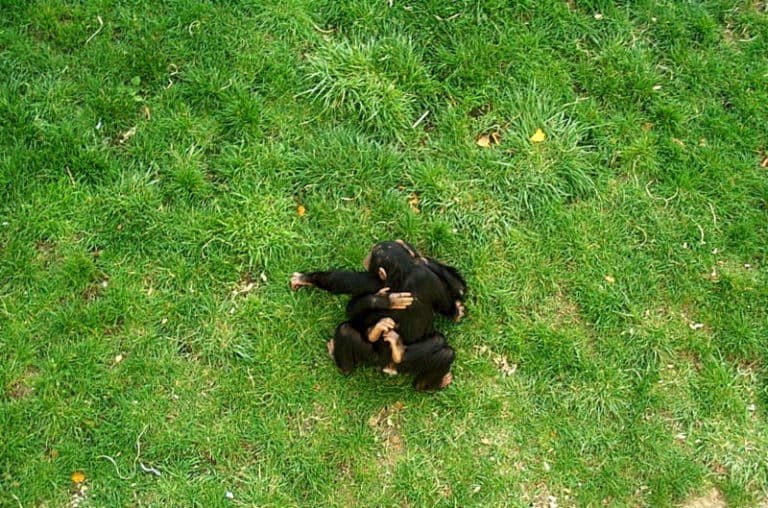
chimpanzees fight

Chimpanzees are highly territorial and don’t tolerate outsiders in their midst, often killing an individual that is from another group.

Reproduction and Life Cycles

Although bonds within the group can last for many years, there are no long-term bonds between males and females as far as reproduction is concerned. Female Chimpanzees can give birth at any time of year to a single infant that is born after a gestation period that lasts for around eight months. After birth, the infant clings onto its mother’s fur and will remain with her solidly for the first few years when the young begin to get more adventurous and starts to explore their surroundings increasingly more on their own. Young Chimpanzees learn the skills they need to survive by watching their mother including what to eat, how to make tools, and nest building, along with playing with other young individuals to practice both their grooming and wrestling skills. Females are thought to be able to reproduce at 13 years of age whereas males seem to develop slightly later and breed when they are about 16 years old.
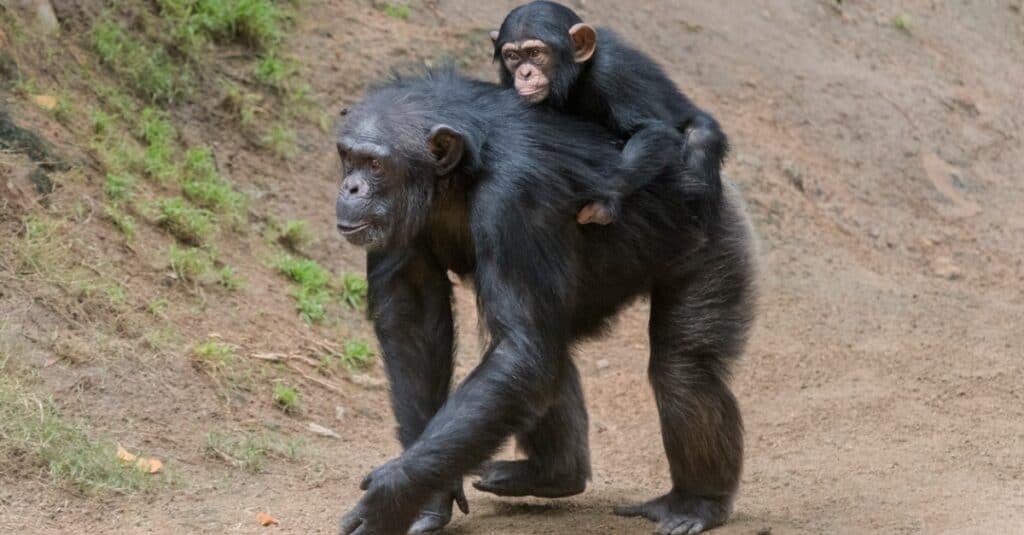
Chimpanzee Lifespan - Chimpanzee baby on mother's back

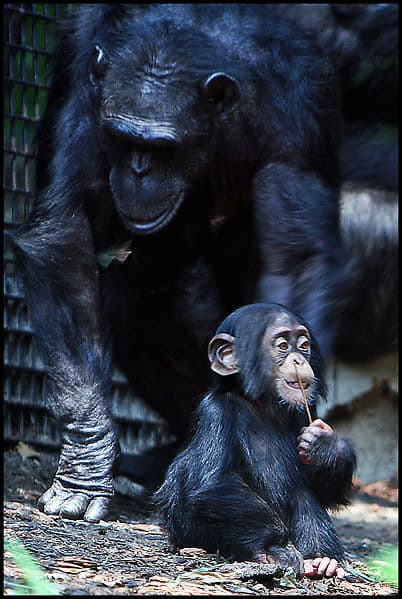
After birth, the infant chimpanzee clings onto its mother’s fur and will remain with her for the first few years.

Diet and Prey

The Chimpanzee is an omnivorous animal that eats hundreds of different types of food. The bulk of their diet is comprised of seasonal fruits, seeds, and flowers that are picked from the trees, along with insects such as ants and termites that are extracted from their nests using a stick. However, they are known to eat larger prey too and when working together, sub-groups can kill monkeys and birds and have even been known to successfully hunt small antelope. Chimpanzees are the only animals (apart from Orang-Utans and Humans) that don’t just use tools but also make them. They are known to strip the leaves and twigs off branches which are then inserted into a termite mound, where the termites crawl onto the branch and the Chimpanzee then licks them off. They are also known to use stones as hammers to open nuts and have even been known to use chewed leaves as a sponge to soak up water, which is then drunk from the leaf.
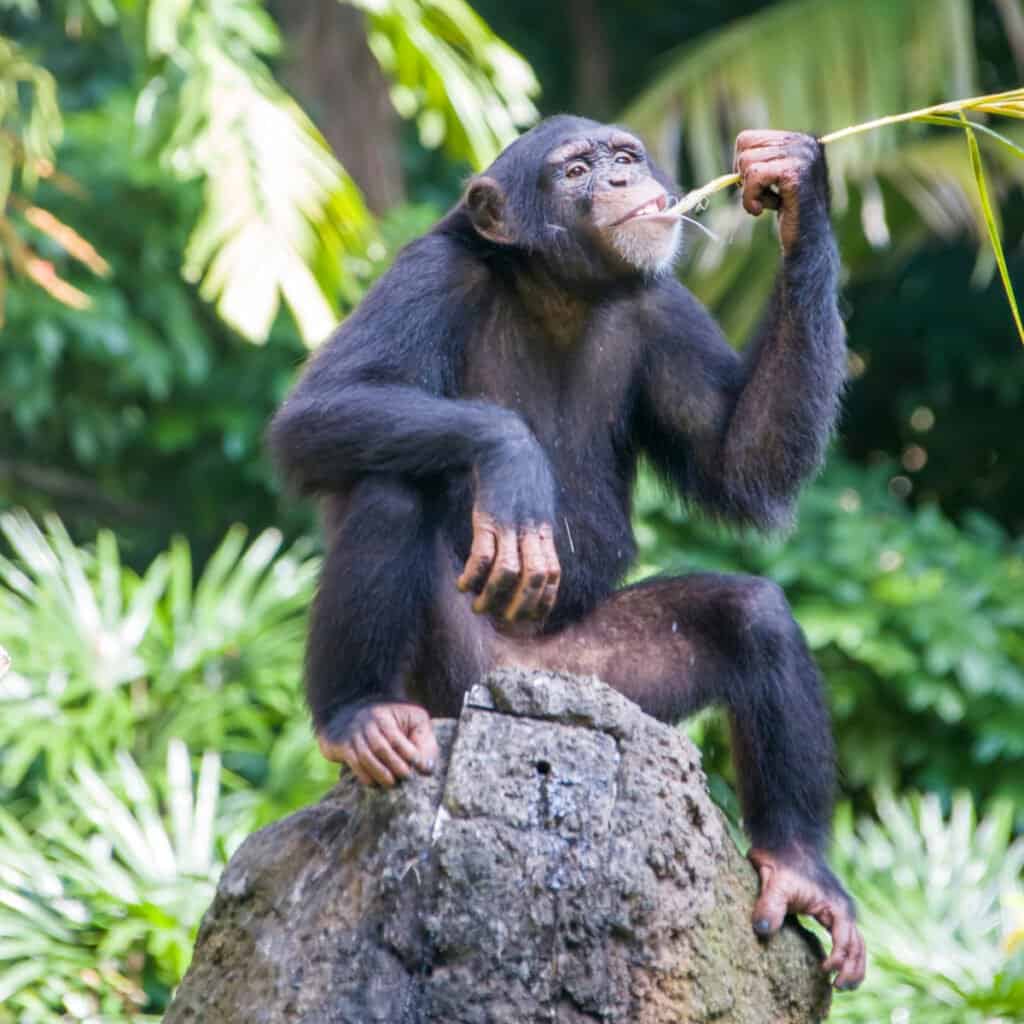
What do chimpanzees eat - chimpanzee using tool

Chimpanzees will use tools to hunt for ants and termites.

Predators and Threats

Because they spend so much time in the trees, Chimpanzees are not at great risk from many of the large predators that are found on the ground. There are however, animals that can live both on the ground and in the trees with Leopards being one of the biggest natural threats to these animals. Chimpanzees are also preyed upon by large species of snakes and can be killed by other primates (including other Chimpanzees). Infants are at greater risk than their parents as they have even been known to be captured and eaten by Baboons that share their ranges. The biggest threat to Chimpanzees though are people that have not only hunted them for their meat but have also wiped out vast areas of their natural habitats, meaning fewer trees to eat and rest in.
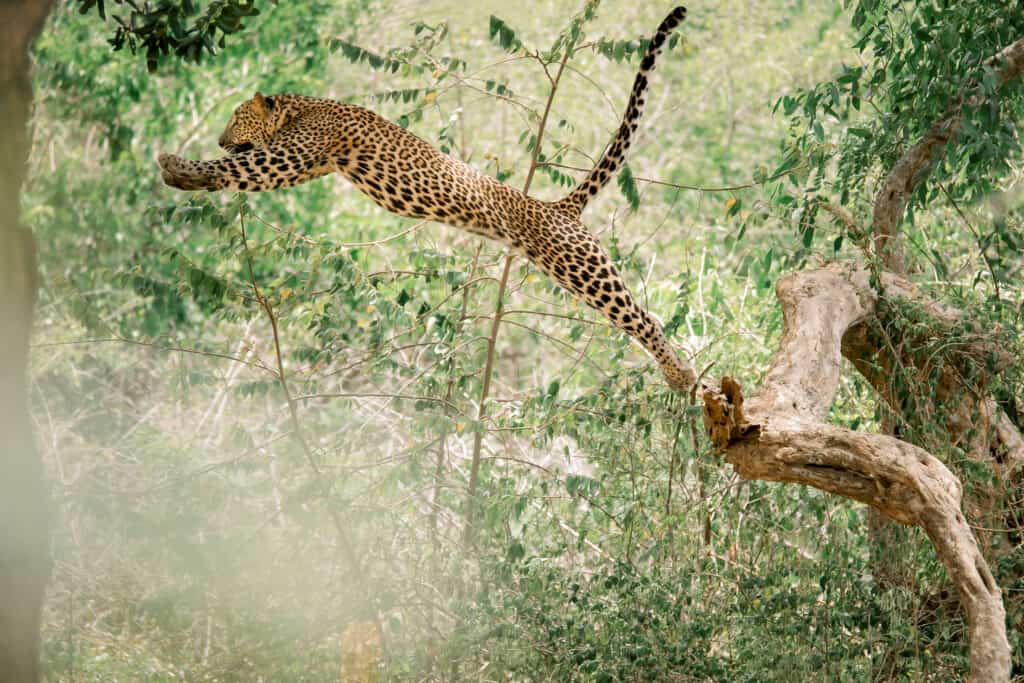
leopard

Leopards, which are agile in trees, are predators of chimpanzees.

Interesting Facts and Features

Chimpanzees are highly sociable and spend much time every day grooming one another. Not only does this keep them clean and free from parasites but it is also thought to be relaxing for them and strengthens social bonds within the group. Chimpanzees are known to make 30 distinct calls with which they communicate with other members of the group, including the pant-hoot. This series of shrieks and roars are the most common noise for an adult Chimpanzee to make and can be heard up to 2km away. Although they do make a variety of different sounds, most communication is through facial expressions. They have very flexible lips which are curled apart to produce a “smile” that signifies fear when they are either angry or feel threatened. Chimpanzees are known to be one of the world’s most intelligent animal species and cannot only remember things but are also able to recognize themselves in a mirror.
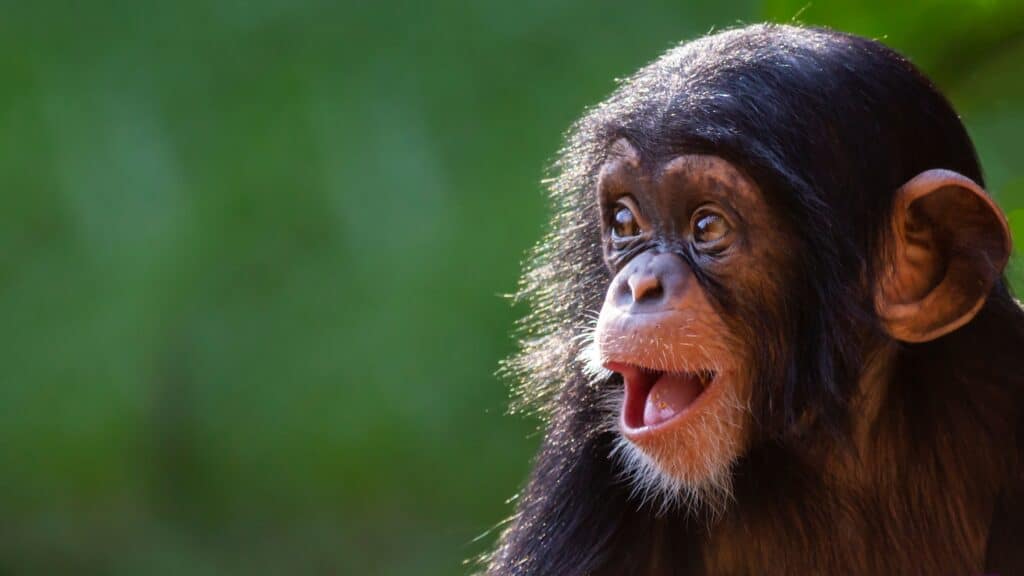
chimpanzee

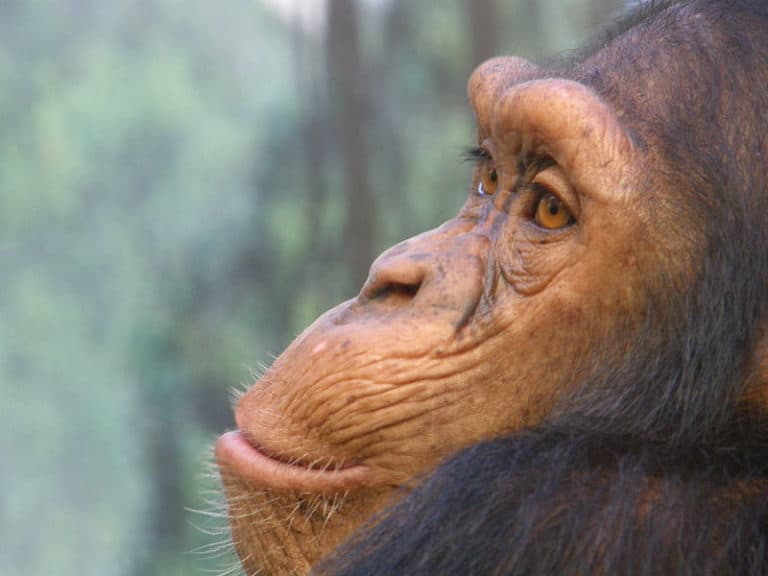
Chimpanzees use facial expressions as their main method of communication.

Relationship with Humans

Chimpanzees and Humans are thought to share a common ancestor that lived around 8 million years ago but Chimpanzees have been severely affected by their closest relatives. People have hunted and killed Chimpanzees for bushmeat which continues today (despite being prohibited), with some populations having also been devastated as they inhabit regions that have been in long periods of civil war. However, it is the loss of their natural habitats which is having the worst effect on Chimpanzees as they need the trees around them to survive. Despite the lack of care for them in the wild, the human-like nature of Chimpanzees has fascinated people for years both in science and in zoos where there are always people crowding around, enjoying watching them interact. A great deal of what we now know about Chimpanzees is thanks to the work of Jane Goodall who spent 30 years studying them in the wild in the Gombe National Park, Tanzania.

Ham, the Chimpanzee that traveled to space.
Due to their high intelligence, chimpanzees have been trained by humans for important tasks like traveling to space.

Conservation Status and Life Today

Today, the Chimpanzee is listed by the IUCN as an animal that is Endangered in its natural environment and therefore faces the threat of extinction in the near future if nothing is done to change the situation. It is estimated that there could be as few as 100,000 individuals remaining in Africa, with the population thought to have declined rapidly over the past 30 years. With the level of deforestation continuing to increase, Chimpanzees are being pushed into smaller and more isolated regions of their once vast natural range leading to further population declines in many areas of Africa.

View all 392 animals that start with C
How to say Chimpanzee in ...
Catalan
Ximpanzé comú
Czech
Šimpanz učenlivý
German
Gemeiner Schimpanse
English
Common Chimpanzee
Finnish
Simpanssi
French
Chimpanzé
Italian
Scimpanzè comune
Japanese
チンパンジー
Swedish
Schimpans
Turkish
Bayağı şempanze

Sources

  1. David Burnie, Dorling Kindersley (2011) Animal, The Definitive Visual Guide To The World's Wildlife / Accessed December 5, 2008
  2. Tom Jackson, Lorenz Books (2007) The World Encyclopedia Of Animals / Accessed December 5, 2008
  3. David Burnie, Kingfisher (2011) The Kingfisher Animal Encyclopedia / Accessed December 5, 2008
  4. Richard Mackay, University of California Press (2009) The Atlas Of Endangered Species / Accessed December 5, 2008
  5. David Burnie, Dorling Kindersley (2008) Illustrated Encyclopedia Of Animals / Accessed December 5, 2008
  6. Dorling Kindersley (2006) Dorling Kindersley Encyclopedia Of Animals / Accessed December 5, 2008
  7. David W. Macdonald, Oxford University Press (2010) The Encyclopedia Of Mammals / Accessed December 5, 2008
  8. Chimpanzee Information / Accessed December 5, 2008
  9. Chimpanzee Conservation / Accessed December 5, 2008
Abby Parks

About the Author

Abby Parks

Abby Parks has authored a fiction novel, theatrical plays, short stories, poems, and song lyrics. She's recorded two albums of her original songs, and is a multi-instrumentalist. She has managed a website for folk music and written articles on singer-songwriters, folk bands, and other things music-oriented. She's also a radio DJ for a folk music show. As well as having been a pet parent to rabbits, birds, dogs, and cats, Abby loves seeking sightings of animals in the wild and has witnessed some more exotic ones such as Puffins in the Farne Islands, Southern Pudu on the island of Chiloe (Chile), Penguins in the wild, and countless wild animals in the Rocky Mountains (Big Horn Sheep, Mountain Goats, Moose, Elk, Marmots, Beavers).
Connect:

Thank you for reading! Have some feedback for us?


Chimpanzee FAQs (Frequently Asked Questions)

Chimpanzees are Omnivores, meaning they eat both plants and other animals.