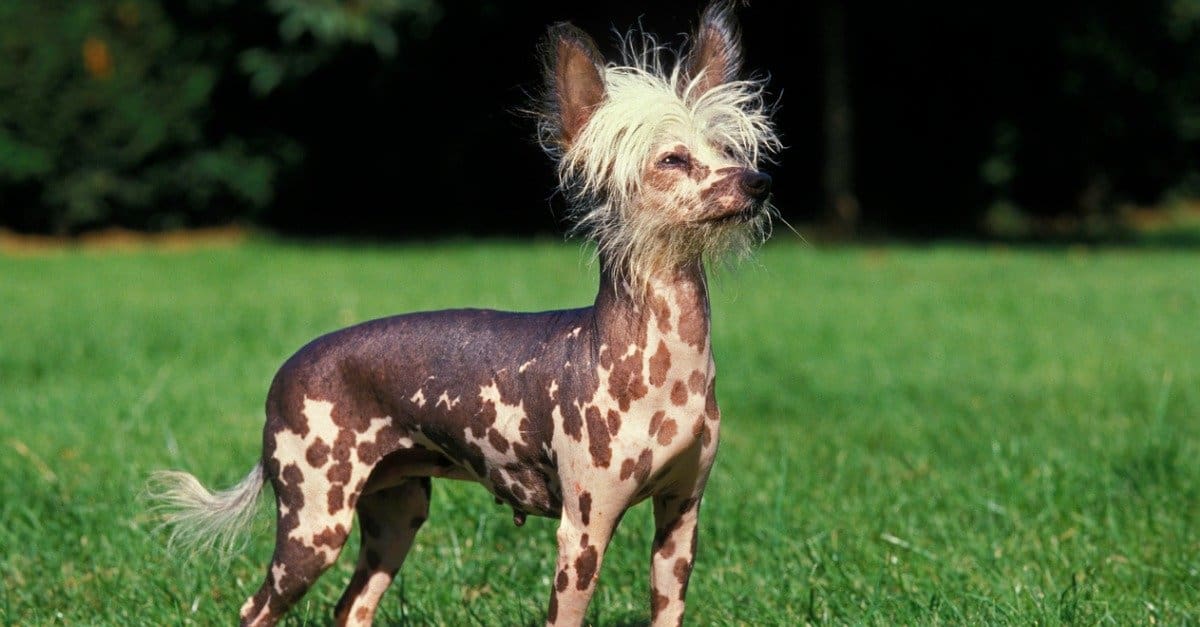
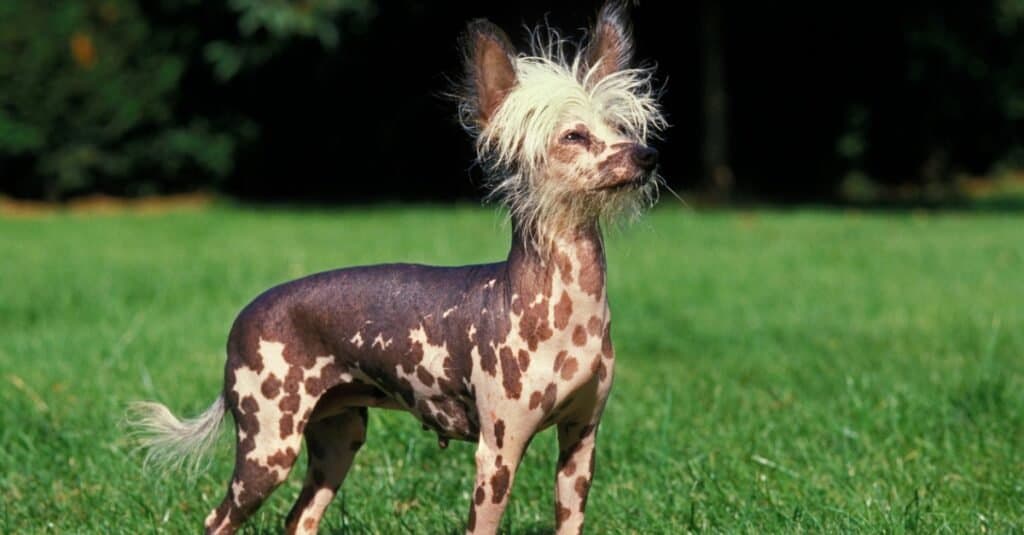
















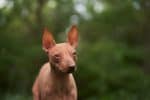


It’s tough to miss the Chinese Crested dog’s flowing mane, reminiscent of an 1980s hair band, and its big, fluffy ears. This hairless breed of dog comes in two varieties: hairless and powderpuff (with hair). The origins of the Chinese Crested are debated, with some theories suggesting that hairless dogs from Africa or other regions may have influenced the breed’s development in China, where they were bred as small companion dogs.
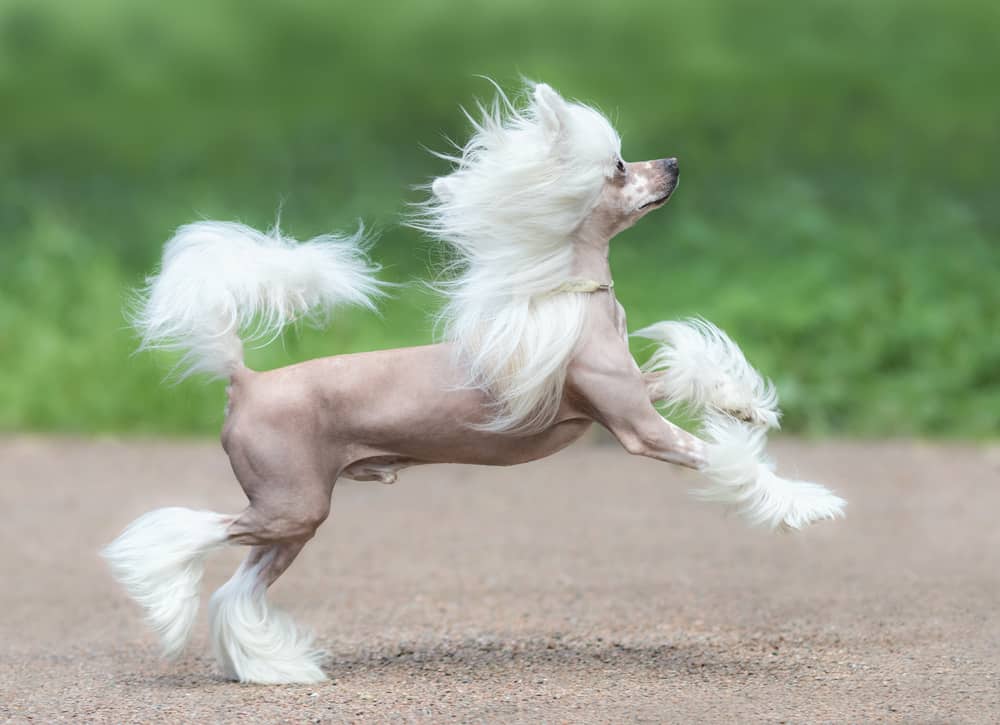
Chinese Crested are small and fragile and can weigh up to 12 pounds.
©Abramova Kseniya/Shutterstock.com
Chinese sailors brought these dogs with them on their voyages, and they served as rat catchers aboard ships and were traded at ports around the world. By the 1900s, the Chinese Crested dog, which had become a favorite among the British, French, and Portuguese, began to appear in European paintings.
In the 1950s, the famous American entertainer, Gypsy Rose Lee, was gifted a Chinese Crested by her sister. She became an ardent breeder; in fact, today some of the most active kennels in the world can trace their dog’s ancestry to those bred by Gypsy Rose Lee.
Although not common or widespread, this breed is a treasured companion for many owners.
Types of Chinese Crested
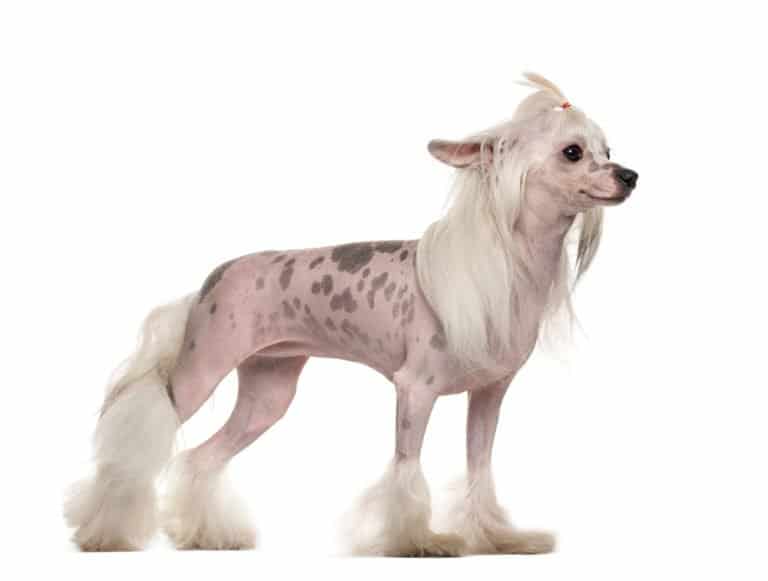
The hairless Chinese Crested features hair only around the face, ears, tail, and feet, while the powderpuff has a long, soft coat of fur around its entire body. Although the Chinese Crested is a hairless breed of dog, the variety with hair (the powderpuff) is not a separate breed.
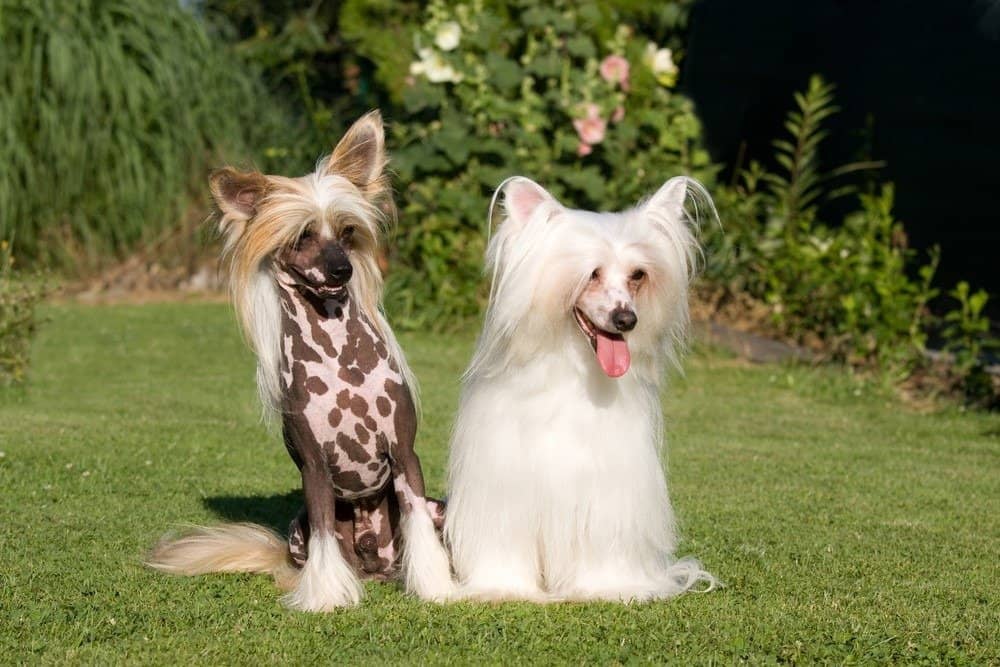
There are two varieties of Chinese crested dog: the hairless and the powderpuff.
©Lenkadan/Shutterstock.com
Moreover, an incomplete dominant gene causes the hairless trait. What this means is that offspring only need to inherit the trait from one parent to express it. The powderpuff trait must be inherited from both parents. Quite amusingly, the same litter can feature both variations.
Both varieties minimally shed, making this breed hypoallergenic.
Size and Weight
This breed is notable for its small size. Males and females vary by very little.
| Height (Male) | 9 to 13 inches |
|---|---|
| Height (Female) | 9 to 11 inches |
| Weight (Male) | 5 to 12 pounds |
| Weight (Female) | 5 to 12 pounds |
Common Health Issues
The Chinese Crested is a fairly healthy breed with only a few significant health problems to note. This breed is prone to several eye diseases, including retinal atrophy (a degenerative condition), lens luxation (in which the lens becomes detached from the rest of the eye), and glaucoma (damaged optical nerves).

The Chinese Crested is a healthy breed overall, but eye diseases are somewhat common.
©DragoNika/Shutterstock.com
Other health issues to watch for are cancer, autoimmune disorders, and patellar luxation, a genetic condition in which the kneecaps can pop out of place, causing lameness and gait difficulties. Allergies to certain fabrics and materials could cause skin rashes or irritation. A responsible breeder will have screened for many of these health or genetic issues.
Temperament and Behavior
Chinese Crested are gentle, good-natured, and affectionate dogs that bond deeply with their owner(s). The breed is intelligent, adaptable, and intuitive to its owner(s) and surroundings. This dog is ideal for training and teaching tricks.
However, due to the dog’s sensitive nature, a tender and patient attitude is more likely to yield positive results than a harsh, overbearing approach. Few behavioral problems should arise if owners are attentive to the dog’s desire for companionship.
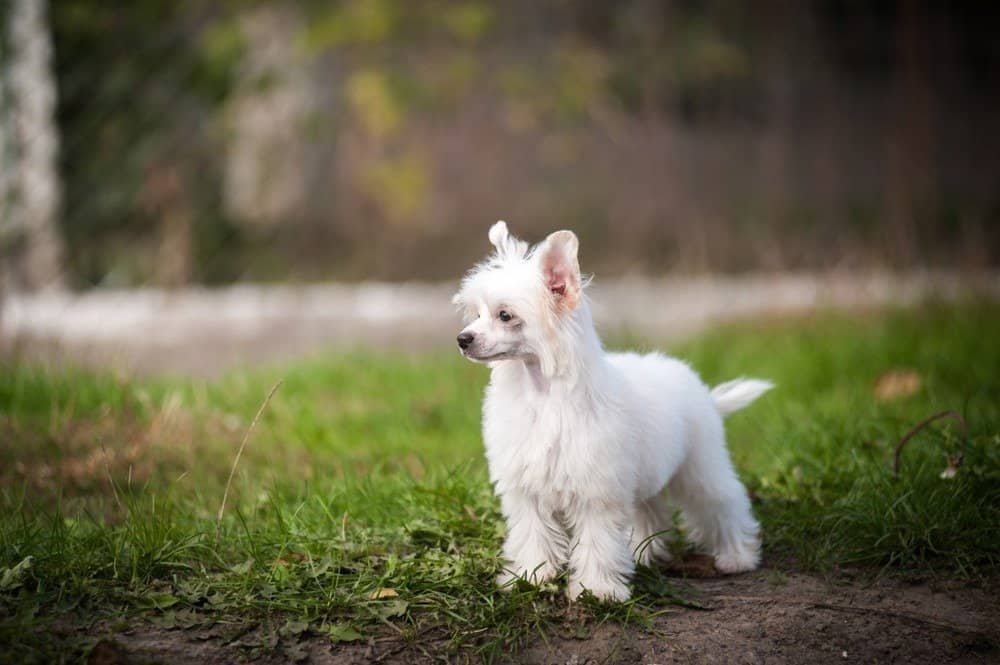
A gentle, affectionate breed, the Chinese Crested bonds easily with its family.
©David Raihelgauz/Shutterstock.com
This breed is moderately active, and short brisk walks and designated play time should suffice to release its energy. Toys and balls are also encouraged. When outside, whether in warm or cold weather, efforts should be made to protect the skin of this breed using sunscreen or sweaters. Chinese Crested dogs are athletic enough to take part in agility and sports competitions for smaller dogs.
The Chinese Crested dog is notably not easily prone to aggression or anger, making it a good choice for an owner with children. Due to its small stature and exposed skin, roughhousing, tugging, or aggressive play is not recommended.
The Best Dog Food for Chinese Crested Dogs
The Chinese Crested should be fed a high-quality diet to support a moderately active lifestyle. It is also a good idea to hand out occasional treats to encourage its training. However, you should carefully monitor its calorie intake because this breed is prone to weight gain.
If it seems like your dog is gaining weight, then you should think about cutting back on calories or purchasing leaner food to compensate. You should avoid cooked bones and high-fat foods altogether. Table scraps and human food should not be given regularly.
Since these dogs can experience allergies, look into some limited-ingredient and allergy-control dog food options.
Maintenance and Grooming
The two Chinese Crested varieties have their own particular grooming challenges. Obviously, the hairless variety doesn’t require brushing, but their exposed skin needs protection and attention. It is recommended that lotion be applied as needed to stop or prevent dry or chafing skin. You should also apply sunscreen whenever you take the dog out in the sun.

Shortly after birth, it will become clear whether your Chinese Crested puppy is a powderpuff or hairless.
©Lenkadan/Shutterstock.com
The powderpuff variation does require regular brushing. It has a longer overcoat and a shorter undercoat, which makes it easier to brush than other dog breeds, but the coat is also prone to matting.
Chinese Crested Dog Pictures
View all of our Chinese Crested Dog pictures in the gallery.

Aneta Jungerova/Shutterstock.com
Sources
- David Burnie, Dorling Kindersley Animal, The Definitive Visual Guide To The World's Wildlife / Accessed January 27, 2025
- Tom Jackson, Lorenz Books The World Encyclopedia Of Animals / Accessed January 27, 2025
- David Burnie, Kingfisher The Kingfisher Animal Encyclopedia / Accessed January 27, 2025
- David Burnie, Dorling Kindersley Illustrated Encyclopedia Of Animals / Accessed January 27, 2025
- Dorling Kindersley Dorling Kindersley Encyclopedia Of Animals / Accessed January 27, 2025
- American Kennel Club / Accessed January 27, 2025