C
Species Profile

Chinstrap Penguin

Pygoscelis antarcticus

Strapped for the ice, built for the surf
Gilad Rom / Creative Commons

Chinstrap Penguin Distribution

Click a location to explore more animals from that region

This map shows coastal regions where Chinstrap Penguin are found.

Loading map...

Size Comparison

Human 5'8"
Chinstrap Penguin 2 ft 4 in

Chinstrap Penguin stands at 42% of average human height.

At a Glance

Wild Species
Also Known As Stonecracker
Diet Carnivore
Activity Diurnal+
Lifespan 15 years
Weight 5 lbs
Status Least Concern
Did You Know?

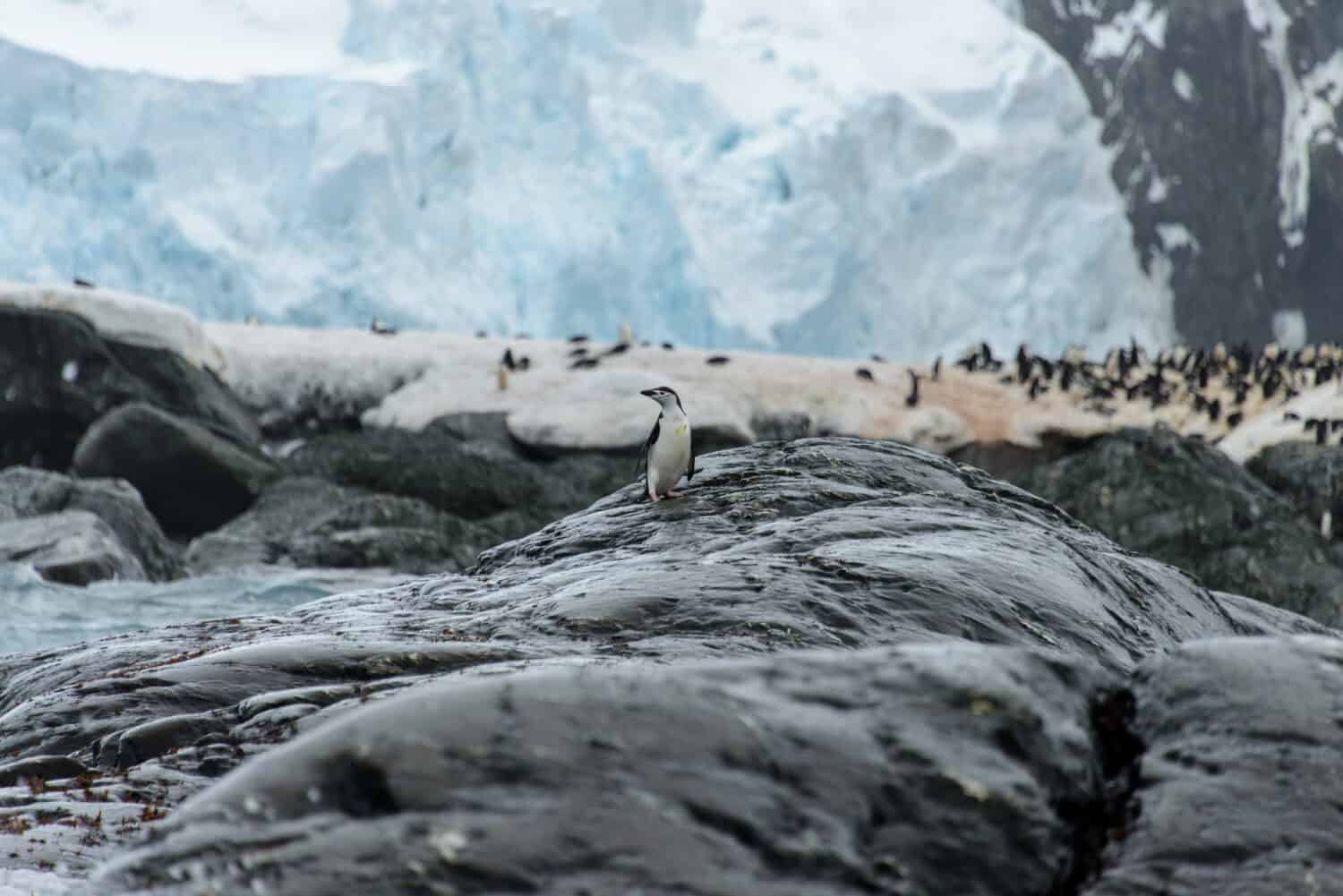
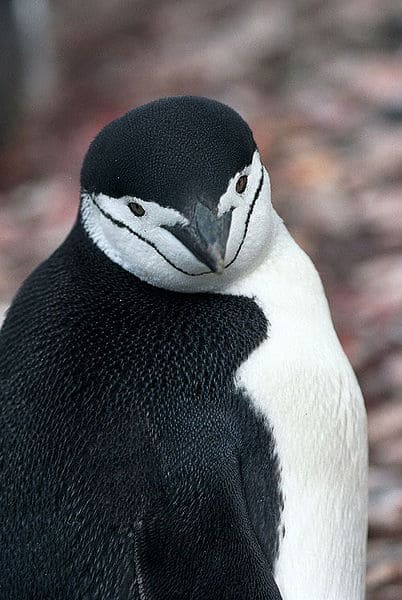
The "chinstrap" is a narrow black line running under the throat and up the cheeks-one of the easiest field marks among Antarctic penguins.

Scientific Classification

The Chinstrap Penguin is a medium-sized Antarctic and subantarctic penguin species in the genus Pygoscelis, named for the narrow black band under the chin.

Kingdom
Animalia
Phylum
Chordata
Class
Aves
Order
Sphenisciformes
Family
Spheniscidae
Genus
Pygoscelis
Species
Pygoscelis antarcticus

Distinguishing Features

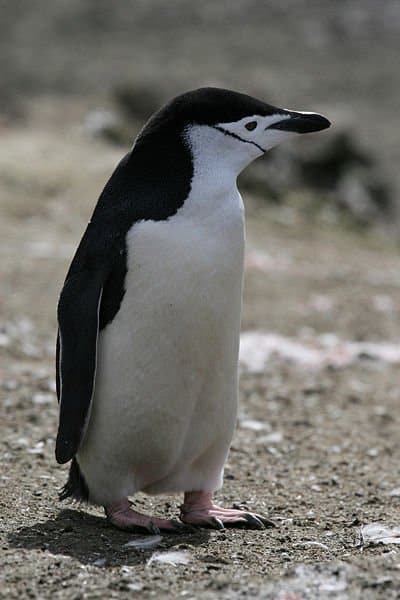
  • Narrow black line running under the chin (‘chinstrap’) on an otherwise white face
  • Black head and upperparts with white underparts
  • Red-brown to blackish bill; pinkish feet
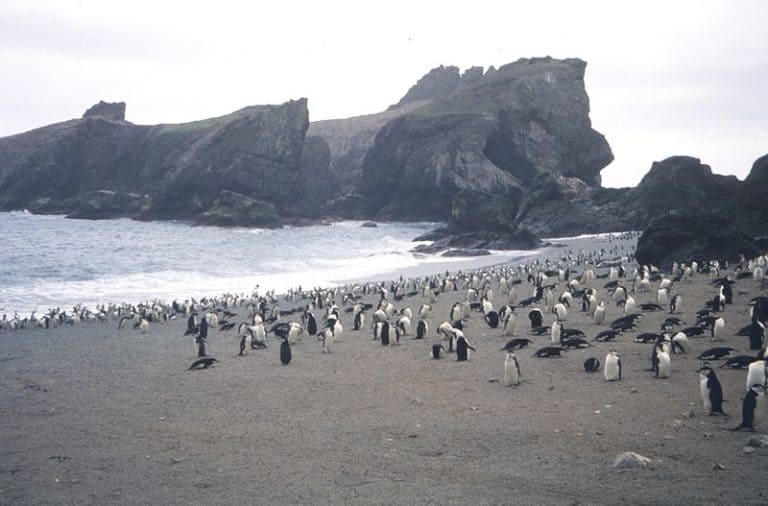
  • Strongly colonial breeder, often in large noisy rookeries
  • Diet dominated by Antarctic krill, with fish and squid as secondary prey

Physical Measurements

Males and females differ in size

Height
2 ft 4 in (2 ft 3 in – 2 ft 6 in)
Length
2 ft 4 in (2 ft 3 in – 2 ft 6 in)
Weight
9 lbs (8 lbs – 11 lbs)
8 lbs (7 lbs – 9 lbs)
Tail Length
5 in (5 in – 6 in)
Top Speed
6 mph
Steady swim ~9 km/h

Appearance

Primary Colors
Secondary Colors
Skin Type Dense, overlapping waterproof feathers over most of the body; limited bare skin on the feet and around the bill base (typical penguin integument adapted for cold-water insulation and streamlining).
Distinctive Features
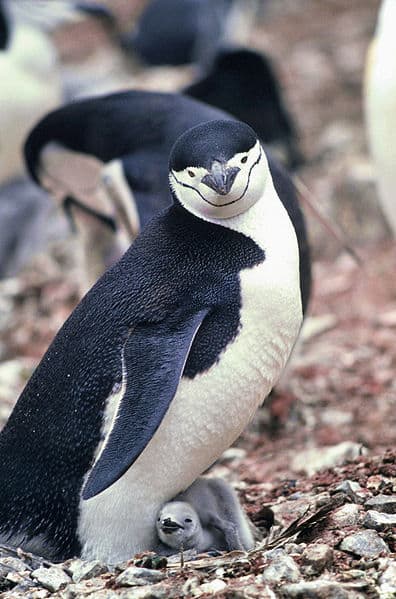
  • Diagnostic narrow black band (chinstrap) under the chin from ear to ear; gives the species its common name (a brush-tailed penguin species).
  • White face and black cap; black, fairly short bill (shorter than Gentoo). Lacks Gentoo’s white head stripe and Adelie’s bold white eye ring, helping tell the three brush‑tailed penguins apart.
  • Medium-sized penguin: adults commonly reported at ~68-76 cm total length; mass typically ~3.0-5.3 kg with strong seasonal/foraging-related variation (values widely reported in standard references such as Williams, 1995; Birds of the World).
  • Stiff, flipper-like wings; compact, torpedo-shaped body optimized for pursuit-diving in the Southern Ocean.
  • Colonial breeder on Antarctic/subantarctic islands and the Antarctic Peninsula region, often nesting on rocky slopes and talus; guano-stained nesting areas and dense colonies are characteristic of breeding appearance context.
  • Thin black band under the chin (the "chinstrap") contrasting with a white face/throat, with a black cap and dark back typical of the species.
  • Typical wild longevity often cited around 15-20 years, with maximum ages reported near ~20 years in long-term studies/compilations; survivorship varies by region and ocean conditions (as summarized in major penguin references and species accounts).

Sexual Dimorphism

Chinstrap Penguin (Pygoscelis antarcticus) males and females look very alike. Size is the main difference: males are a bit larger and have slightly bigger bills and flippers. But sizes overlap, so you can't tell sex by looks alone without measurements or genetic tests.

  • On average slightly greater body mass and linear measurements (e.g., bill and flipper length) than females; differences are subtle and overlapping.
  • May appear marginally more robust in head/bill profile at close range, but not diagnostic without morphometrics.
  • On average slightly smaller/lighter with slightly shorter bill/flipper measurements; otherwise identical plumage and facial markings.
  • No unique plumage markers distinguishing females from males.

Did You Know?

The "chinstrap" is a narrow black line running under the throat and up the cheeks-one of the easiest field marks among Antarctic penguins.

Adults are typically 68-76 cm long (head-body) and commonly ~3.0-5.0 kg depending on season (e.g., Williams, *The Penguins*, 1995; Birds of the World).

They usually lay 2 eggs in a pebble nest; incubation lasts ~35-37 days, with chicks fledging about ~50-60 days after hatching (Birds of the World).

Diet is dominated by Antarctic krill (*Euphausia superba*), with fish and squid taken opportunistically-making them closely tied to Southern Ocean food-web shifts (Birds of the World; CCAMLR ecosystem literature).

Chinstraps often breed on steep, rocky slopes and scree, commuting between high nesting terraces and the sea on well-worn "penguin highways."

Their loud, harsh call earned the nickname "stonecracker" in some Antarctic field traditions and popular accounts.

They are close relatives of Adélie and gentoo penguins (genus *Pygoscelis*), and rare hybridization with Adélies has been reported in the Antarctic Peninsula region (ornithological field reports/records summarized in Birds of the World).

Unique Adaptations

  • Thermal insulation: very dense, overlapping feathers plus a subcutaneous fat layer reduce heat loss in near-freezing water; feathers are tightly waterproofed by preen oil.
  • Salt management: supraorbital salt glands excrete excess salt from seawater ingestion; brine drains via the bill.
  • Countershading for camouflage: dark dorsal surface and pale belly reduce visibility to predators from above and below in the water column.
  • Foot and claw strength for terrain: robust legs/feet and sharp claws aid climbing steep, loose rock slopes typical of chinstrap colonies.
  • Visual species recognition: the contrasting head pattern (including the "chinstrap") likely helps individuals identify species and mates in mixed *Pygoscelis* neighborhoods (notably where Adélie/gentoo ranges overlap).
  • Seasonal body-mass cycling: they fatten before the annual molt, then fast on land while replacing feathers-an energetically costly but crucial waterproofing reset for the next foraging season.

Interesting Behaviors

  • Colonial breeding on rocky slopes: nests are built from small stones; birds actively steal and defend pebbles, and stone "theft" can trigger fast, noisy disputes.
  • Pair-bond displays: mates use synchronized vocal calls and upright "ecstatic" postures; returning adults often perform recognition calling at the nest site (described in *Pygoscelis* behavioral studies; Birds of the World).
  • Two-egg strategy with brood reduction: although 2 eggs are typical, food limitation can lead to only one chick surviving to fledge in some seasons/colonies (documented in long-term Antarctic Peninsula studies).
  • Crèche formation: after early brooding, chicks gather in groups while parents alternate foraging trips, reducing individual predation risk from skuas and sheathbills near colonies.
  • Directed commuting: repeated daily routes between colony and ocean create clear trails; birds time departures/returns to surf conditions and predator risk near shore.
  • Foraging by pursuit-diving: they "fly" underwater using stiff flippers; reported dive depths are commonly in the tens of meters, with maximums around ~70 m and dive durations up to a few minutes in published dive-record studies (summarized in Birds of the World).

Cultural Significance

Chinstrap penguins (Pygoscelis antarcticus) are iconic Antarctic birds shown with Adélie and gentoo in photos and tours. Their breeding and diet depend on krill and sea ice, so they appear in studies and public stories about climate and food web change around the Antarctic Peninsula and Scotia Arc.

Myths & Legends

Chinstrap Penguin (Pygoscelis antarcticus) has little early native folklore because Antarctica had no native people; its cultural story comes mainly from the Heroic Age of polar exploration and modern media.

During maritime and early Antarctic expeditions, penguins (including the chinstrap, Pygoscelis antarcticus) were seen as comic ship mascots by sailors, shown in diaries, sketches, and traditions as symbols of endurance.

Chinstrap Penguin (Pygoscelis antarcticus) got its common name from the clear black line under its chin seen by early explorers. Pygoscelis is Greek for 'rump' and 'leg,' pointing to the penguin's rear leg posture.

Conservation Status

LC Least Concern

Widespread and abundant in the wild.

Population Decreasing

Protected Under

  • Antarctic Treaty System (ATS) - framework governing activities in Antarctica, including environmental management relevant to penguin breeding sites.
  • Protocol on Environmental Protection to the Antarctic Treaty (Madrid Protocol, 1991; in force 1998) - establishes strict environmental safeguards, including protected area tools (ASPAs/ASMAs) that can encompass or buffer breeding colonies.
  • CCAMLR (Convention on the Conservation of Antarctic Marine Living Resources, 1980) - manages Antarctic fisheries (including krill) to reduce ecosystem impacts and maintain ecological relationships affecting penguin prey availability.

Life Cycle

Birth 2 chicks
Lifespan 15 years

Lifespan

In the Wild
10–20 years
In Captivity
15–30 years

Reproduction

Mating System Monogamy
Social Structure Socially Monogamous
Breeding Pattern Seasonal
Fertilization Internal Fertilization
Birth Type Internal_fertilization

Behavior & Ecology

Social Colony Group: 20000
Activity Diurnal, Cathemeral
Diet Carnivore Antarctic krill (Euphausia superba)
Seasonal Migratory 497 mi

Temperament

Strongly social and crowd-tolerant at colony scale but highly territorial/aggressive at the nest (pecking, bill jabbing, flipper slaps, and threat postures), especially during courtship and when defending stones/chicks (Williams 1995).
Bold and persistent foragers; may show risk-sensitive behavior (tighter rafting/grouping) in areas/times of elevated predator presence (e.g., leopard seals near haul-out/landing sites) (Ainley et al., Birds of the World).
Behavioral 'hub' pattern: repeated use of the same colony access routes and shoreline congregation/rafting points; intensity varies with breeding stage and local topography/sea-ice conditions (Ainley et al., Birds of the World).

Communication

Ecstatic display call Prominent during courtship/territorial advertisement; individually distinctive for mate/chick recognition in dense colonies) (Williams 1995
Contact calls between mates and between adults and chicks Used during reunions and at nest) (Ainley et al., Birds of the World
Agonistic/braying-type calls during disputes over nest space and stones Williams 1995
Visual displays: head-swinging, pointing, bowing, and flipper extension; stereotyped threat postures used to manage high-density nesting conflicts Williams 1995
Tactile signals: mutual preening Allopreening) between mates; bill fencing/bill jousting in escalated aggression; body shielding/positioning to protect eggs/chicks (Ainley et al., Birds of the World
Spatial/landmark-based recognition: strong nest-site fidelity and repeated use of colony 'traffic lanes' aids reunions and reduces conflict in high-density breeding hubs Ainley et al., Birds of the World

Habitat

Biomes:
Terrain:
Coastal Island Rocky
Elevation: Up to 984 ft 3 in

Ecological Role

Mid-trophic-level marine predator (krill specialist/opportunist) that transfers energy from zooplankton to higher predators in Antarctic/subantarctic food webs.

Top-down predation pressure on euphausiids (especially Antarctic krill), influencing local krill swarm dynamics Biological indicator of krill availability and regional oceanographic change (diet/foraging shifts track prey fields) Nutrient transport and recycling between ocean and land via guano deposition at colonies, enhancing terrestrial/coastal productivity

Diet Details

Main Prey:
Antarctic krill Ice krill Antarctic silverfish Myctophid lanternfishes Squid Euphausiids and amphipods

Human Interaction

Domestication Status

Wild

Chinstrap Penguin (Pygoscelis antarcticus) is a wild seabird with no history of domestication or human breeding. People see them through science, monitoring, and regulated tourism at breeding colonies around the Antarctic Peninsula and Scotia Arc. They eat Antarctic krill (Euphausia superba), so krill changes or fisheries affect them. Past egg, guano, and hunting happened, but now they are legally protected.

Danger Level

Low
  • Bites and pecking injuries when handled at close range (sharp beak; defensive behavior at nests).
  • Minor blunt injury from flipper strikes during restraint/handling.
  • Zoonotic and biosecurity risks typical of wild seabirds (e.g., Salmonella spp. and other enteric pathogens; ectoparasites), especially for researchers/rehabilitators-managed via PPE and hygiene protocols.
  • Slip/fall hazards and ammonia/respiratory irritation near dense colonies due to guano accumulation (context-dependent).

As a Pet

Not Suitable as Pet

Legality: Chinstrap Penguin (Pygoscelis antarcticus) is not legal as a private pet in most places. Antarctic collection is tightly regulated. International trade is banned under CITES Appendix I, with narrow captive-bred or scientific exceptions; zoos need permits and vet oversight.

Care Level: Expert Only

Purchase Cost:
Lifetime Cost: $250,000 - $1,500,000

Economic Value

Uses:
Ecotourism (wildlife viewing at colonies under regulated visitation) Scientific research value (climate/ecosystem indicators; biologging studies) Education/exhibition value (public aquaria/zoos; conservation messaging) Ecosystem services/indicator species value (tracking Southern Ocean change) Indirect economic interactions/conflicts (links to Antarctic krill fisheries and management)
Products:
  • Primarily non-consumptive value; no lawful commercial 'products' derived from the species in modern practice.
  • Tourism-related services (guided landings/cruises) in regions where colonies are accessible and visitation is regulated (Antarctic Treaty System/IAATO guidelines).
  • Research outputs and monitoring datasets used in environmental management (population trends, foraging ecology, krill-availability indicators).

Relationships

Predators 7

Leopard Seal
Leopard Seal Hydrurga leptonyx
Killer Whale
Killer Whale Orcinus orca
Antarctic Fur Seal Arctocephalus gazella
Brown Skua Stercorarius antarcticus
South Polar Skua Stercorarius maccormicki
Southern Giant Petrel Macronectes giganteus
Northern Giant Petrel Macronectes halli

“The largest chinstrap penguin colony has more penguins than San Francisco has people!”


The chinstrap penguin is the most abundant of all penguin species. In fact, one of their colonies has more than a million breeding pairs of penguins on a remote island!
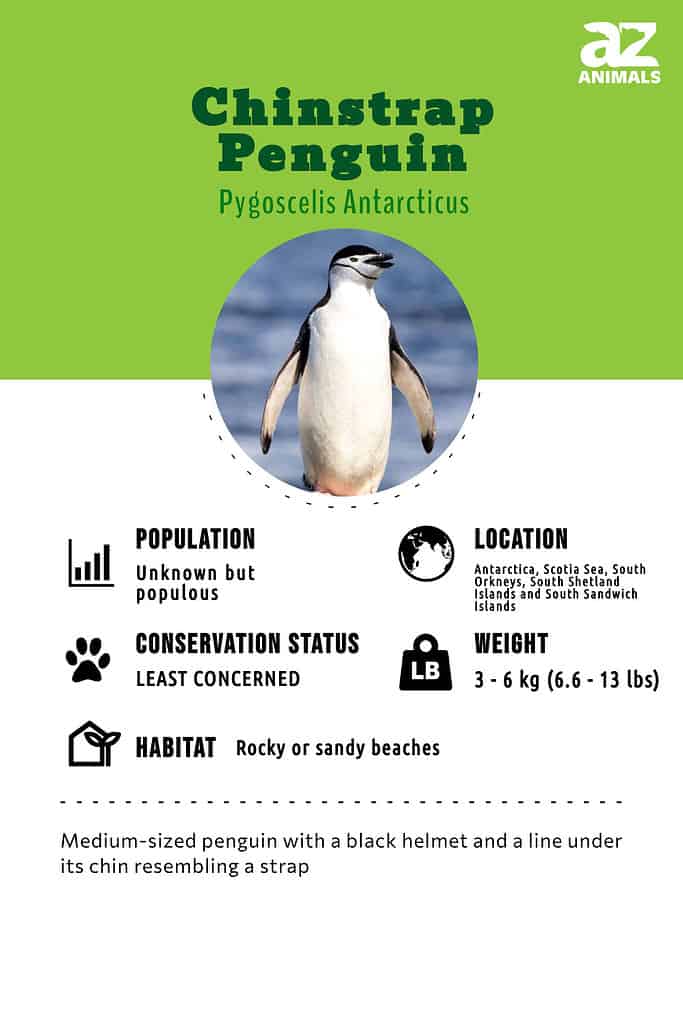
Incredible Chinstrap Penguin Facts!

  • The chinstrap penguin colony on Zavodovski Island in the South Atlantic Ocean is so large (an estimated 1.2 million breeding pairs) that the Guinness Book of World Records declared it the world’s “Largest penguin colony!” (To see what this incredible colony looks like, just scroll down to  our “population section!)
  • Many chinstrap penguins mate for life; mating pairs were found to get together 82 percent of the time.
  • Chinstrap penguins are one of the most aggressive of the penguins.

Scientific Name and Classification
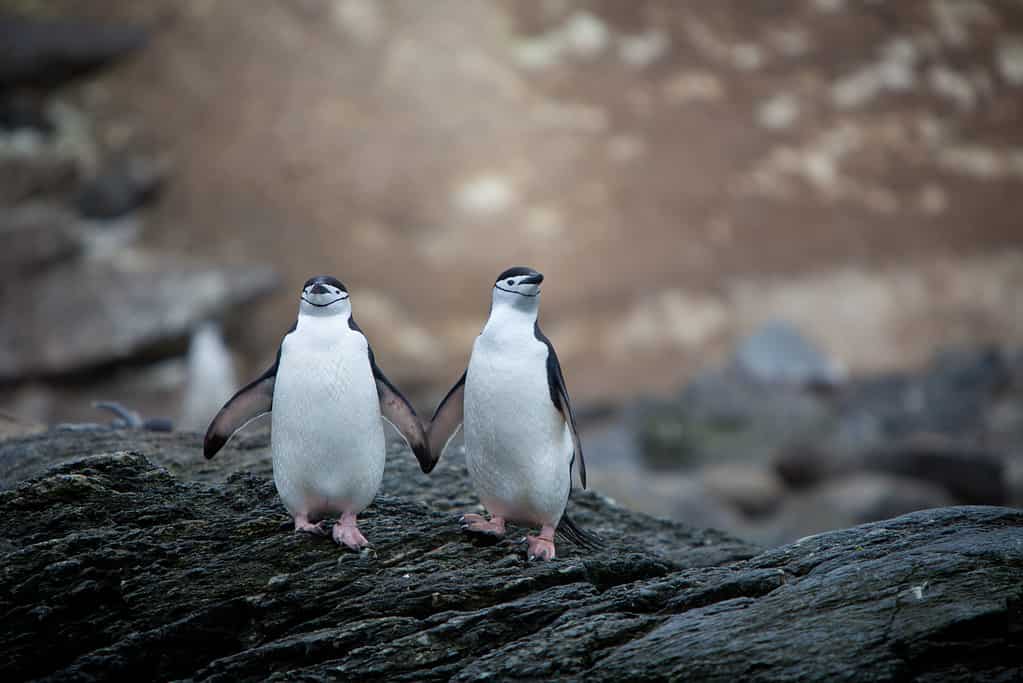
Chinstrap penguins usually mate for life.

The Chinstrap penguin has the scientific name Pygoscelis antarcticus. Chinstrap penguins are sometimes referred to as P. Antarctica, a prior scientific name for the species. Its family name is Spheniscidae, and the class to which it belongs is Aves.

The chinstrap penguin is also called the ringed penguin, bearded penguin, and stone cracker penguin, which is a name given because of its loud noisy call. The origin of the name penguin is not really known. It is possibly from the Welsh word, “pen” for the head, and “Gwyn” meaning white.

Species

The Pygoscelis family comprises three different penguins; together they are known as “brush-tailed” penguins.

  • Chinstrap penguin (Pygoscelis antarcticus) – a medium-sized penguin with a black helmet and chin strap marking that inhabits a variety of islands and beaches in the Antarctic and Southern Pacific oceans.
  • Adelie Penguin (Pygoscelis adeliae) – a medium-sized penguin with a black head and back found only on the coast of the Antarctic continent. It is one of the most widespread and southernly distributed of all penguins.
  • Gentoo penguin (Pygoscelis papua) – is a medium-sized penguin with a black head that features a white marking from eye to eye, an orange bill, and a black back, that mostly inhabits the Falkland Islands and the Antarctic Peninsula.
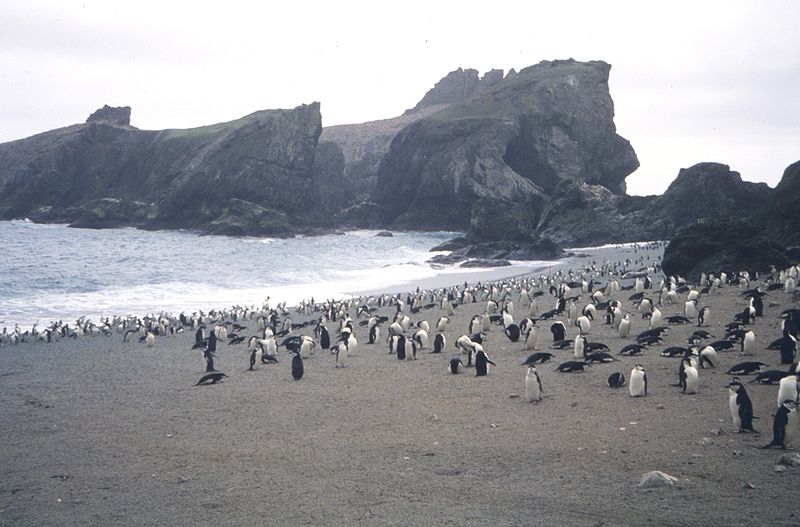
Some penguin species left Antarctica for warmer waters during the ice age.

Evolution

Fossil records indicate that all penguin’s common ancestors lived as long as 40 million years ago and were around five feet tall. They are believed to have originated in Antarctica, which was covered in forests at that time and connected to what would become New Zealand, Australia, South America, and surrounding islands. These ancient ancestors of penguins had diverged from the ancestors of petrels and albatrosses around 71 million years ago.

The arrival of the ice age 35 million years ago brought brutal changes to the ancient ancestors of the penguin. The continents of Australia and South America drifted away from Antarctica while ocean currents encircled it. This cooling climate likely killed the older penguins – leaving them to compete with whales for the same prey.

While most of the ancient penguins became extinct, others, like the macaroni penguin, swam to warmer waters to found new lineages. Species like the emperor penguin stayed in Antarctica and evolved adaptations suited to live in the cold environment. Chinstrap penguins are among the species that branched out to habitats beyond the Antarctic continent.


Appearance and Behavior
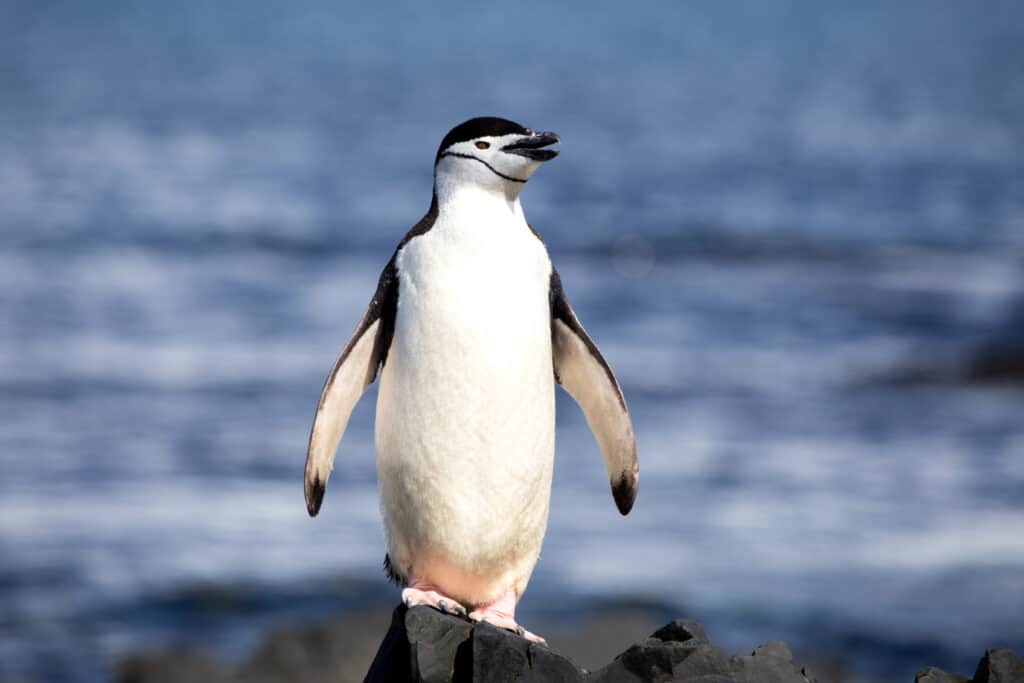
penguin

A chinstrap penguin is easily recognizable by its black helmet and black line under its chin.

The chinstrap penguin actually looks like a bird wearing a black helmet with a black chinstrap – reminiscent of the first aviator helmets. Otherwise white-faced, the bills and eyes are blackish. Their feet are pink with black soles. Young penguins have gray faces and will develop adult markings in 14 months.

They are not the largest of penguins; the chinstrap penguin is of medium size. Their length is 75 cm (29 inches), and they have an average weight of 5.5 kg (12 pounds).

This penguin is known to be vocal and has an extremely loud voice when in its breeding colony. Chinstrap penguin sounds are very noisy; the penguin makes an “ah, kauk, kauk, kauk” as it raises its flippers and sways its head from side to side.

Chinstrap breeding colonies are not boring. They don’t just sit around in the sun – fights break out with much head waving and flipper flipping. Chinstraps call to each other in loud, shrill voices, bow, gesture, and preen their coats. If a territorial dispute occurs, they may stare, point and charge.

The chinstrap penguin is very social and can be found in colonies with the Adélie penguin, cormorants, or other similar penguins. Their nests are simple and in rocky hollows. When it comes to defending against other species and each other, they are the most aggressive of the brush-tailed penguins.

A group of penguins is called a colony. Other names for the same group include Waddle or Rookery. A group of floating penguins on the ocean are called a raft.
 

Habitat
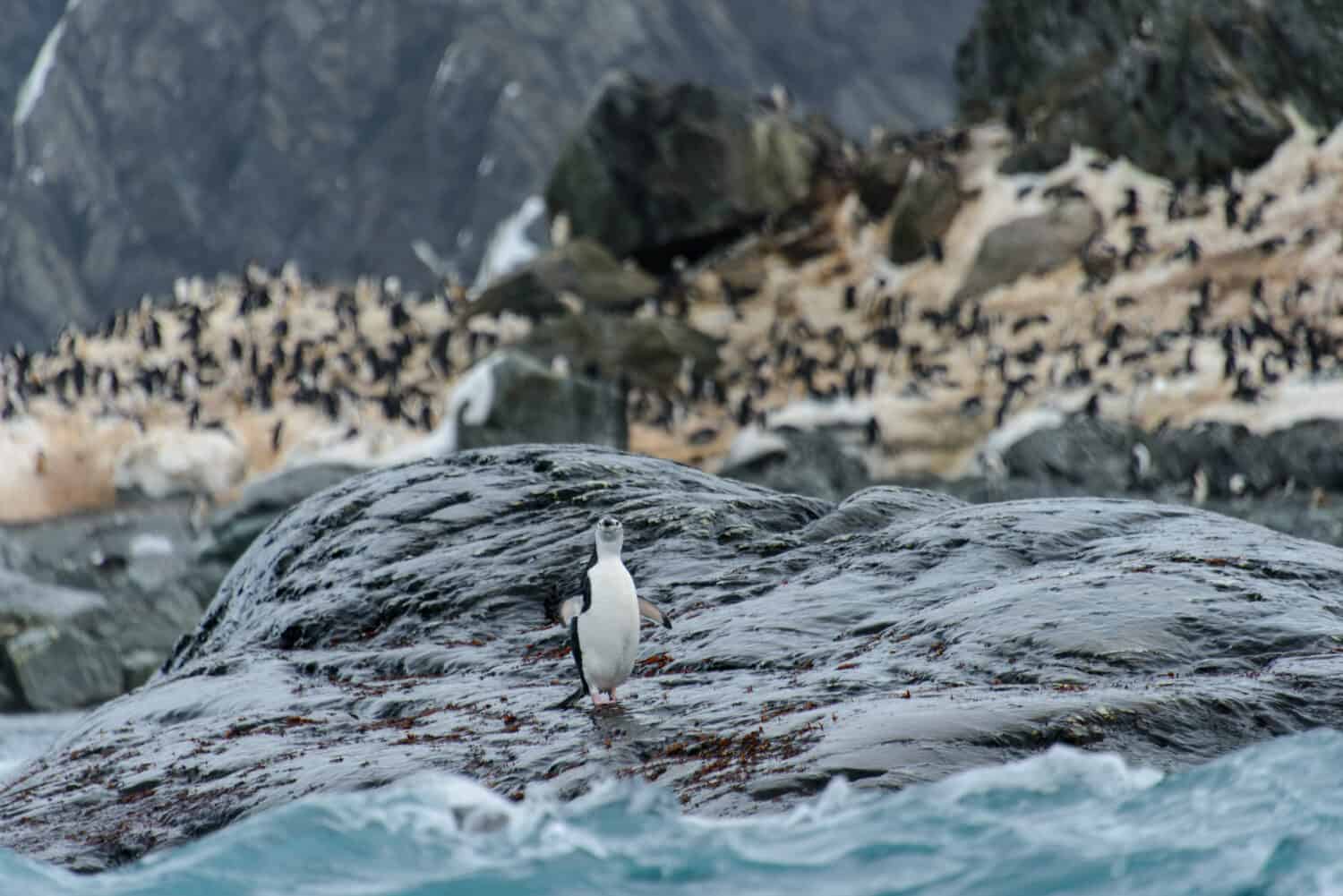
Chinstrap penguin's colony on show

Chinstrap penguins follow schools of krill to warmer seas during the autumn months.
Image: Greens and Blues, Shutterstock

Sometimes chinstraps roost on ice with other penguin breeds, such as the Adélie penguin. Considered the most aggressive of penguins, they spend much of their life out at sea, where they might feed on small fish and krill.

They live in Antarctica and in the Scotia Sea, the South Orkneys, the South Shetland Islands, and the South Sandwich Islands, where the largest of their colonies are found. They dwell on the beachfront of the Southern Ocean and are often in rocky or sandy habitats. A few hundred birds live not far from New Zealand, in the Balleny Islands in the Ross Dependency area.

In early April, which is autumn in the southern hemisphere, the chinstrap penguin follows the schools of krill as they migrate further north to warmer waters with less ice.

Diet
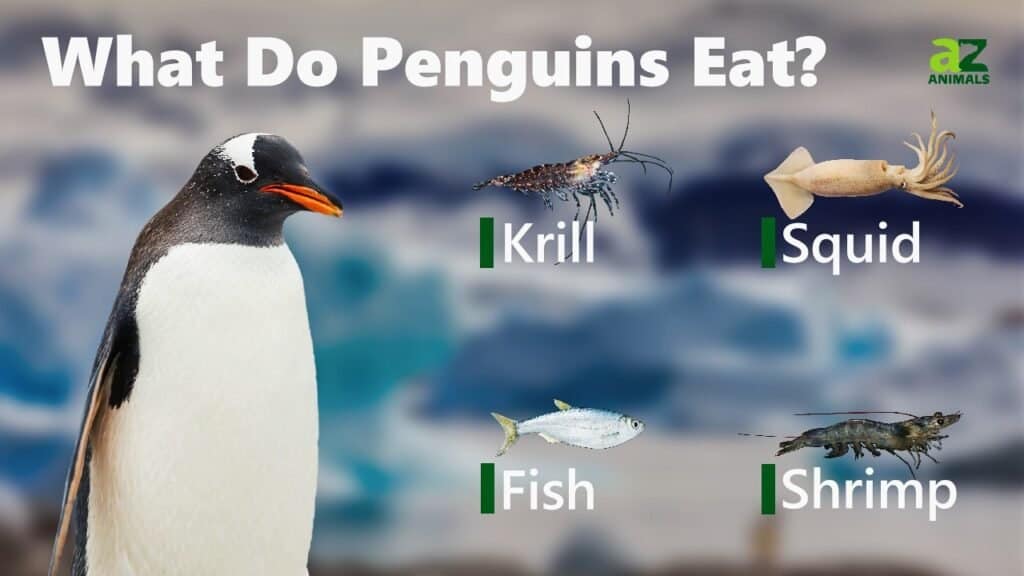
What Do Penguins Eat
Chinstrap penguins primarily eat krill, with other seafood like crustaceans and fish added to the mix.

The chinstrap penguin enjoys diving. It may catch some fish, squid, and shrimp, but the vast majority of its diet comes from eating krill. With an estimated biomass of 379 million tons in the Southern Ocean, krill are abundant in the waters near where chinstrap penguins have their colonies.

However, with the mean air temperature rising dramatically (as much as 5 to 6 degrees Celsius) in many of the areas penguins hunt krill, the rise and fall of krill populations have been hypothesized to be the driving factor in the fluctuations of penguin populations.

Predators and Threats
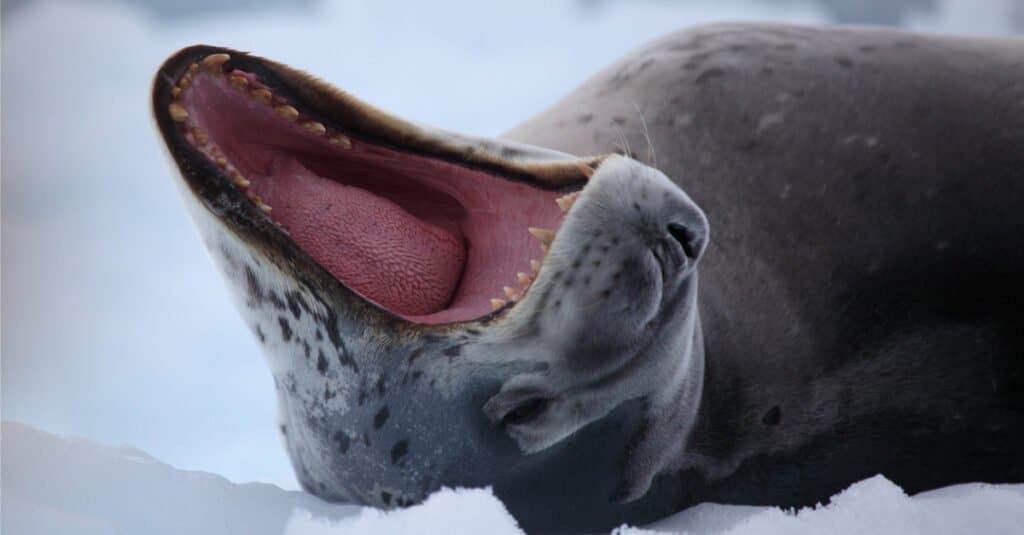
Leopard Seal Teeth - Leopard Seal

Leopard seals can eat up to 5% of a chinstrap penguin colony during a breeding season.

The main predators of the adult chinstrap penguin are leopard seals and killer whales. Studies of leopard seals have shown they can eat 1.4 to 5% of a colony of penguins during a breeding season. Leopard seals rely on stealth to hunt chinstrap penguins. They wait along the edges of ice sheets where penguins have congregated and catch penguins as they enter the water. Generally, once chinstrap penguins have entered open water they face fewer threats.

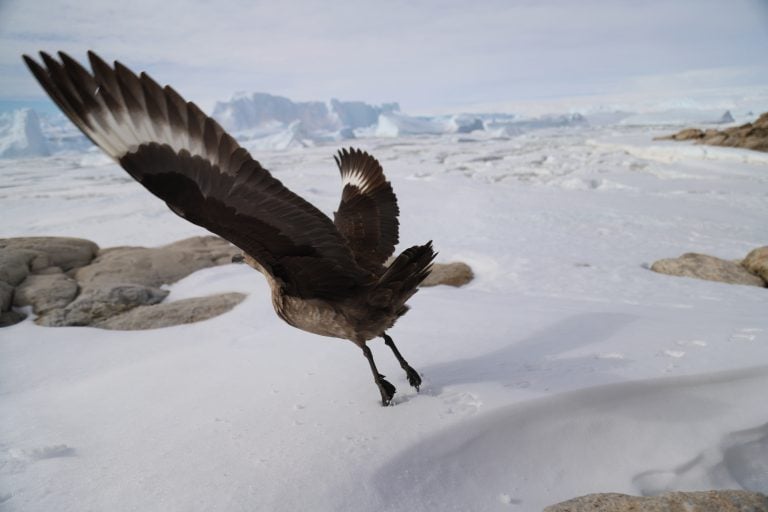
Other predators include sea lions and sharks. The eggs and chicks are in danger from skuas, predatory sea birds. The largest threat to chinstrap penguins – as with other penguins species – is climate change which has affected the abundance of krill.
 

Reproduction, Babies, and Lifespan
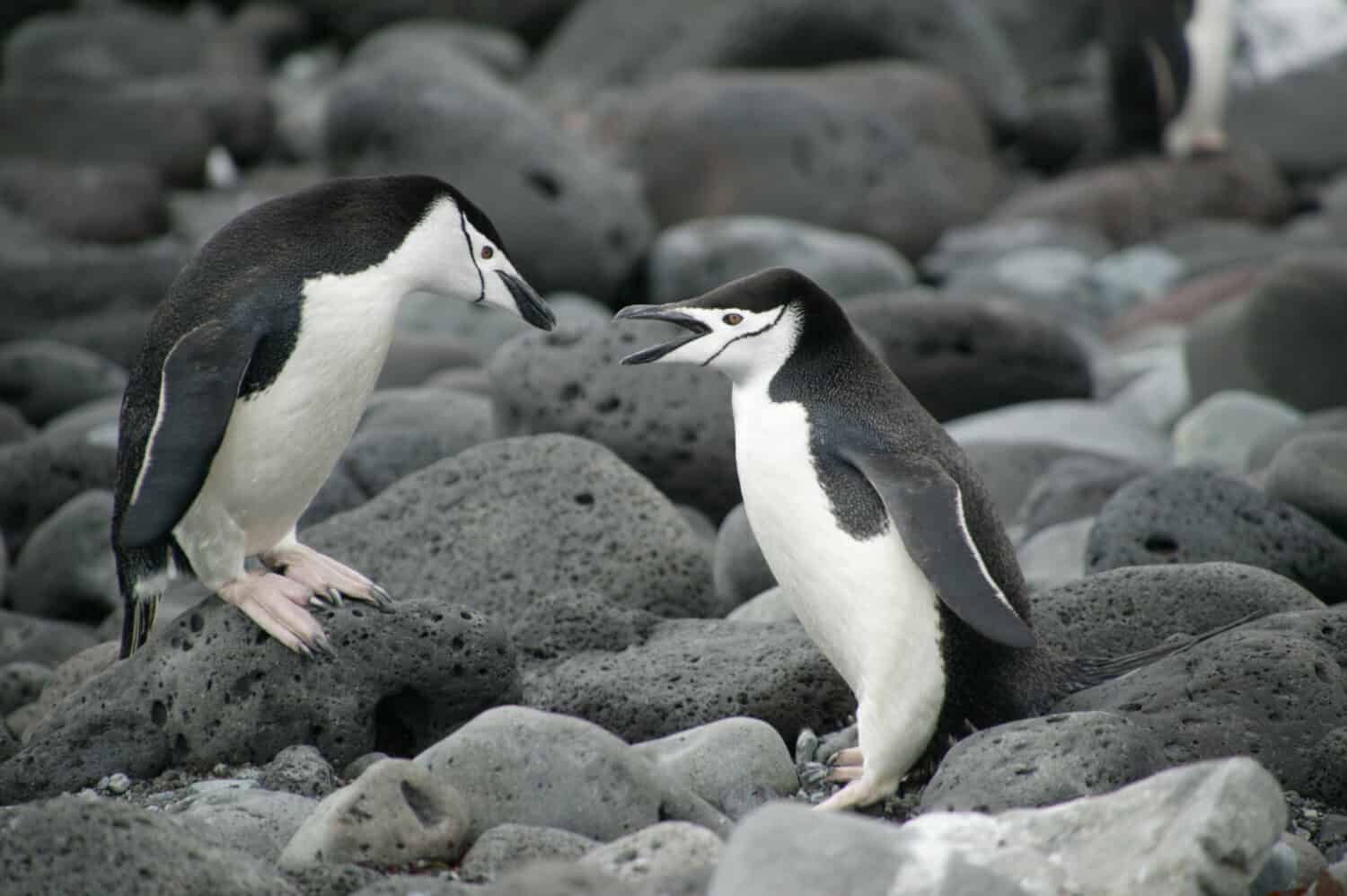
Mating Chinstrap Penguins, Penguin Island, South Shetland Islands, Antarctica

Chinstrap penguins tend to mate for life and share chick-rearing responsibilities.
Image: Air Images, Shutterstock

Returning to the colony when seeking his mate, the male will beat on his chest with his flippers while raising his head to make a screeching sound. Other males often echo the same unique chinstrap penguin sounds when one has started to screech. Once the chinstrap penguin has found a mate, he will return to the same one every year; mating pairs reunite to form a special bond.

The breeding season is November/December through March. The chinstrap penguin lays two eggs; the timing is usually later than other penguin species nearby. Eggs are hatched by both the mother and father, who do shifts of 5 to 10 days. After about 37 days, the eggs hatch. The baby chick stays with its parents for about a month. Then it moves on to be with a group of young chicks.
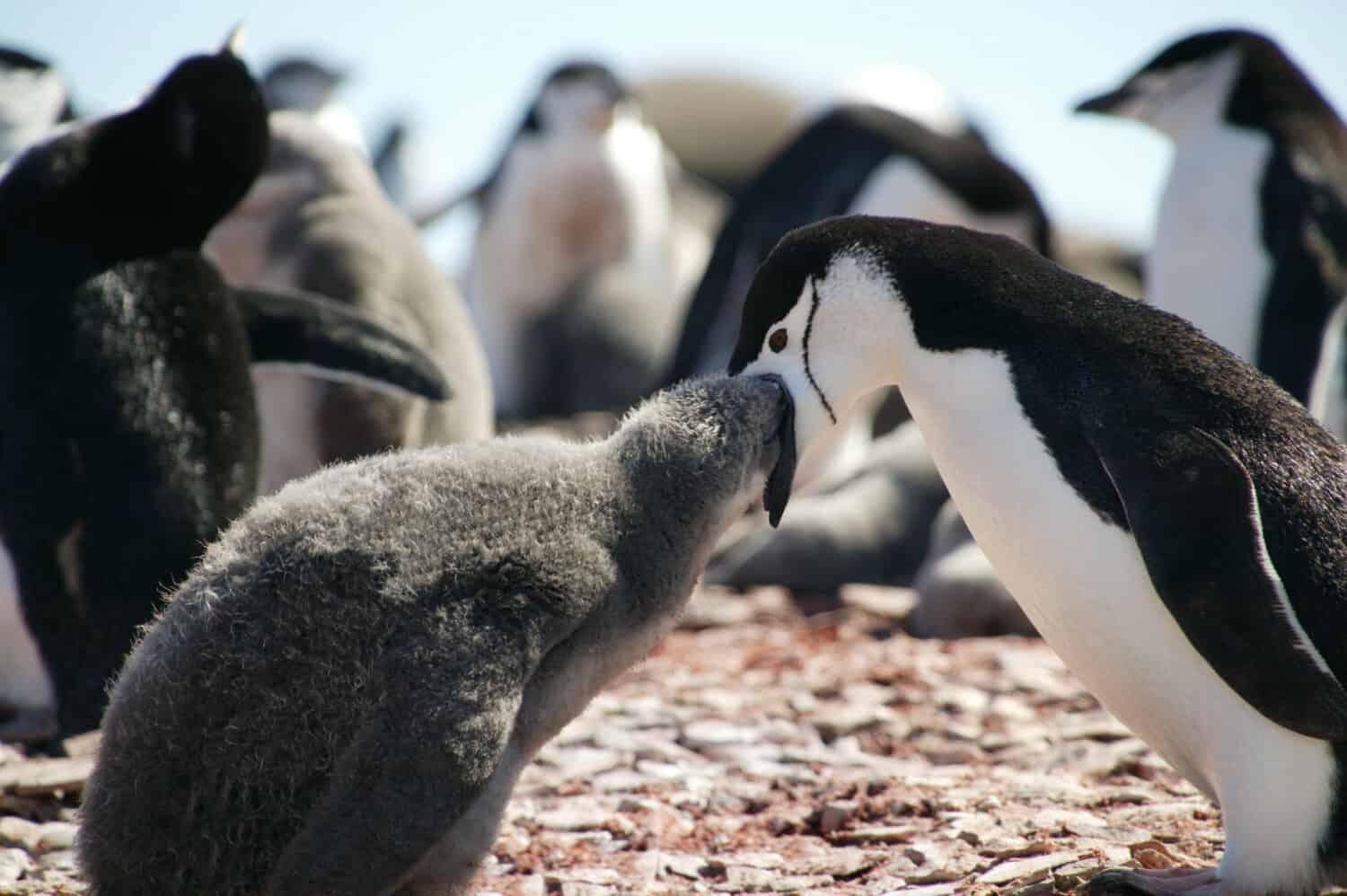
Chinstrap Penguins, Penguin Island, South Shetland Islands, Antarctica

Chinstrap penguin chicks have fluffy gray down until it is replaced with waterproof feathers at around two months.
Image: Air Images, Shutterstock


A baby penguin is called a chick. They also might be referred to as nestlings. A group of baby penguins is called a crèche, where the chicks huddle together for warmth and against predators. This allows the parents to go hunting for food to bring back. After about two months, the fluffy down is replaced by waterproof feathers, and the chick is now ready to make their first trip to sea to hunt on their own.

The chinstrap penguin lives to be about 20 years old. The reported oldest living chinstrap penguin in North America was 32 years old in 2015 and was living in Moody Gardens in Texas.

Population

In August 2018 the IUCN estimated that the population of chinstrap penguins at 8 million individuals. They are the most abundant of all penguin species and are listed as “Least Concern,” although their population is declining overall.

They are found on Circumpolar, Sub Antarctic, and Antarctic islands, and the Antarctic Peninsula. When breeding, they are not on the ice but remain on the rocky coast. The most populous colony of chinstrap penguins is found on Zavodovski Island, which is an island in the South Sandwich Islands.

While Zavodovski Island is just 3 miles (5 km) long and 3 miles wide, it supports more than a million breeding pairs of chinstrap penguins!

Beyond Antarctica, chinstrap penguins have also been seen in the following areas:

  • Argentina
  • Bouvet Island 

  • Chile
  • French Southern Territories
  • South Georgia 

  • South Sandwich Islands
  • Islands of New Zealand
Chinstrap penguin's colony on show

The chinstrap penguins’ numbers remain large because it ranges over diverse habitats.
Image: Greens and Blues, Shutterstock

More Chinstrap Penguin Facts

Their largest colony has been called “the smelliest place on Earth!”

With more than a million breeding pairs of penguins on a tiny island that’s just 3 miles (5 km) wide, you can imagine Zavodovski island is a pretty smelly place. However, beyond penguin droppings, sulfuric air from an active volcano on the island also produces noxious smells. Hailed by the UK’s Telegraph as “the world’s smelliest place,” the island’s features have names like Stench Point, Pungent Point, and Noxious Bluff. 

A volcano also threatens their largest colony

The stratovolcano on the island housing the largest colony of chinstrap penguins is named Mount Curry, and it began erupting in March 2016. The eruption covered much of the island in ash but also came at a time that chinstrap penguins had begun leaving their breeding grounds to forage at sea until the fall, which limited the impacts

Featured in Planet Earth II

The documentary series Planet Earth II filmed the chinstrap penguins on Zavodovski. Getting to the remote island took more than a year of planning and the documentary crew had to cross some of the roughest seas on earth just to capture this remote environment.

View all 392 animals that start with C
How to say Chinstrap Penguin in ...
Czech
Tučňák uzdičkový
German
Zügelpinguin
English
Chinstrap Penguin
Spanish
Pygoscelis antarctica
Finnish
Myssypingviini
French
Manchot à jugulaire
Hebrew
פינגווין רצועת הסנטר
Croatian
Ogrličasti pingvin
Hungarian
Állszíjas pingvin
Italian
Pygoscelis antarctica
Japanese
ヒゲペンギン
Dutch
Stormbandpinguïn
English
Ringpingvin
Portuguese
Pinguim-de-barbicha
Swedish
Ringpingvin
Chinese
南極企鵝

Sources

  1. David Burnie, Dorling Kindersley (2011) Animal, The Definitive Visual Guide To The World's Wildlife / Accessed November 2, 2009
  2. Tom Jackson, Lorenz Books (2007) The World Encyclopedia Of Animals / Accessed November 1, 2019
  3. Richard Mackay, University of California Press (2009) The Atlas Of Endangered Species / Accessed November 2, 2009
  4. David Burnie, Dorling Kindersley (2008) Illustrated Encyclopedia Of Animals / Accessed November 2, 2009
  5. Dorling Kindersley (2006) Dorling Kindersley Encyclopedia Of Animals / Accessed November 2, 2009
  6. A. Atkinson, V. Siegel, E.A. Pakhomov, M.J. Jessopp, V. Loeb / Published January 1, 2009 / Accessed January 2, 2020
  7. DAVID G. AINLEY, GRANT BALLARD, BRIAN J. KARL and KATIE M. DUGGER / Published March 25, 2005 / Accessed January 4, 2020
  8. Guinness Book of World Records / Published January 4, 2001 / Accessed January 4, 2020
  9. IUCN Red List / Published August 26, 2018 / Accessed January 4, 2020
Lisha Pace

About the Author

Lisha Pace

After a career of working to provide opportunities for local communities to experience and create art, I am enjoying having time to write about two of my favorite things - nature and animals. Half of my life is spent outdoors, usually with my husband and sweet little fourteen year old dog. We love to take walks by the lake and take photos of the animals we meet including: otters, ospreys, Canadian geese, ducks and nesting bald eagles. I also enjoy reading, discovering books to add to my library, collecting and playing vinyl, and listening to my son's music.

Thank you for reading! Have some feedback for us?


Chinstrap Penguin FAQs (Frequently Asked Questions)

The chinstrap penguin is considered a carnivore, as it eats squid, small fish, shrimp and krill. A carnivore eats other animals, so in the case of the chinstrap penguin, it eats other sea creatures. It does not eat seaweed or sea plants but relies on fish for its diet.