
C
Species Profile

Chipmunk

Tamias

Pocket-cheeked, stripe-backed foragers
Cindy Larson/Shutterstock.com

Chipmunk Distribution

Click a location to explore more animals from that region

Loading map...

Size Comparison

Human 5'8"
Chipmunk 4 in

Chipmunk stands at 5% of average human height.

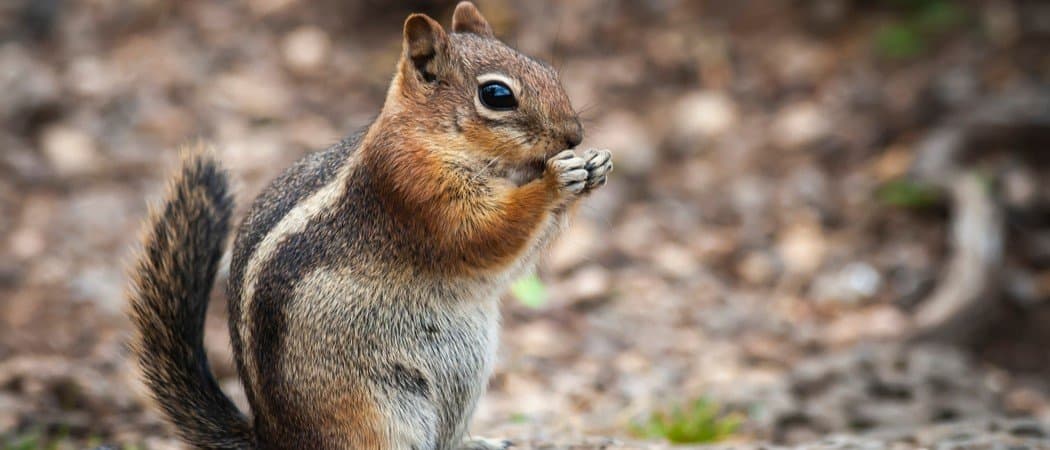
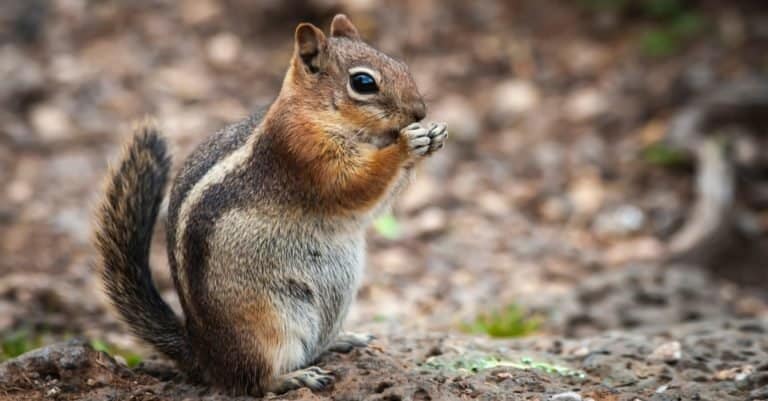
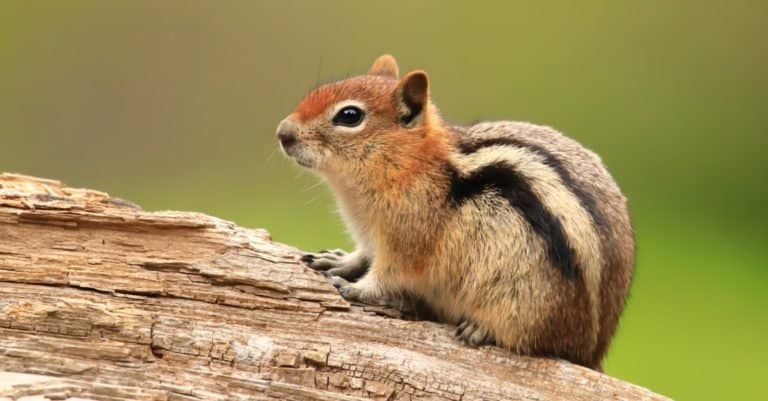
Close-up Mountain Chipmunk Eating Standing on a rock

At a Glance

Genus Overview This page covers the Chipmunk genus as a group. Stats below are general traits shared across the genus.
Also Known As Chippy, Striped squirrel, Striped ground squirrel, Ground squirrel
Diet Omnivore
Activity Diurnal+
Lifespan 3 years
Weight 0.15 lbs
Status Least Concern
Did You Know?

Genus-wide size range: ~18-30 cm total length (incl. tail), ~0.03-0.15 kg-smallest desert/alpine species to the largest woodland forms.

Scientific Classification

Genus Overview "Chipmunk" is not a single species but represents an entire genus containing multiple species.

Chipmunks are small, striped, ground-foraging squirrels in the genus Tamias. They are known for cheek pouches used to carry seeds and nuts, and for caching food in burrows or scatter-hoards.

Kingdom
Animalia
Phylum
Chordata
Class
Mammalia
Order
Rodentia
Family
Sciuridae
Genus
Tamias

Distinguishing Features

  • Small squirrel-like rodents with prominent dorsal stripes
  • Expandable cheek pouches for transporting food
  • Ground-oriented behavior with burrows; agile climbers when needed
  • Food caching (seeds, nuts) and seasonal activity patterns (some enter torpor)

Physical Measurements

Males and females differ in size

Height
4 in (2 in – 5 in)
Length
9 in (7 in – 12 in)
9 in (6 in – 12 in)
Weight
0 lbs (0 lbs – 0 lbs)
Tail Length
4 in (2 in – 5 in)
4 in (2 in – 5 in)
Top Speed
16 mph
15-25 km/h

Appearance

Primary Colors
Secondary Colors
Skin Type Dense mammalian fur with seasonal molt (many species show slightly longer/denser winter coat); tail fur moderately bushy but less plumed than many tree squirrels.
Distinctive Features
  • Measurements (e.g., Eastern chipmunk, Tamias striatus): total length ~20-30 cm; head-body length ~12.5-19 cm; tail length ~7.5-11 cm; mass ~0.05-0.15 kg (mass can vary seasonally).
  • Lifespan (range across Tamias species): commonly ~2-5 years in the wild; maximums reported in favorable conditions can reach ~7-8+ years; in captivity some individuals may reach ~8-10 years.
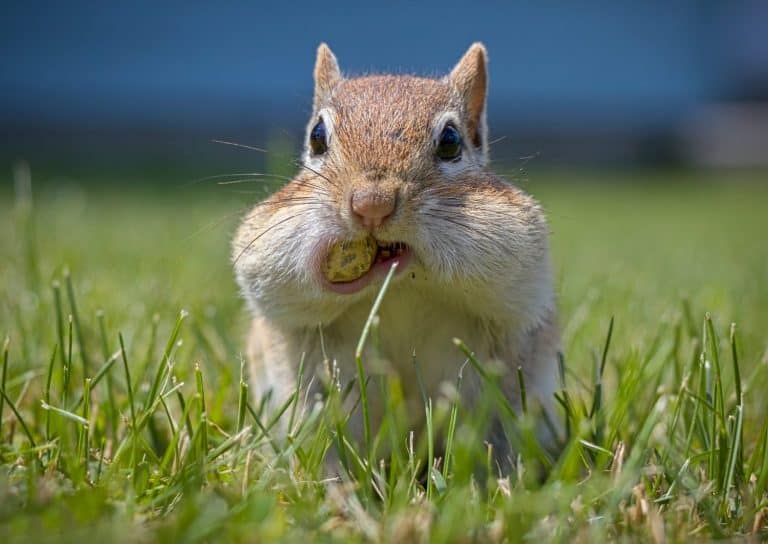
  • Cheek pouches: large, expandable internal cheek pouches used to transport seeds/nuts; often visibly distend when full-strongly characteristic of the genus.
  • Ground-foraging emphasis: typically forage on/near the ground (leaf litter, logs, openings), though many also climb for food; reliance on ground travel is generally greater than in many tree squirrels.
  • Caching and food storage: widespread use of caching-some species emphasize larder-hoarding in burrows, others use more scatter-hoarding or mixed strategies; intensity varies with habitat seasonality and winter conditions.
  • Burrow use: most species maintain burrow systems for nesting and food storage; burrow complexity and use can vary with soil type, climate, and predation pressure.
  • Chipmunk (Tamias) species live across North America (forests, shrublands, mountains) and one in Eurasia. Coat color and stripe contrast match local habitats, paler in dry open areas, darker in wetter forests.
  • Head and facial markings: distinct facial stripes (dark lines with pale bands) are common; ears are relatively small and rounded; eyes are large; tail moderately bushy and often held slightly raised while moving.
  • Seasonal changes: many species show seasonal molt with winter coat appearing slightly fuller and sometimes grayer or duller; overall striping remains visible year-round.

Sexual Dimorphism

Sexual dimorphism is generally subtle across Tamias: males and females are similar in coloration/striping and overall appearance. Differences are most often modest size/weight shifts (males sometimes slightly larger) and seasonal reproductive condition (e.g., testes visibility in breeding season; nipple visibility in lactating females).

  • On average, slightly larger/heavier in some species/populations (not consistently diagnosable by sight alone).
  • Breeding season: testes may be visible/scrotal depending on species and season.
  • Generally similar size and coloration to males; often overlapping measurements.
  • Lactation: nipples more apparent during/after nursing; body condition may change during reproduction.

Did You Know?

Genus-wide size range: ~18-30 cm total length (incl. tail), ~0.03-0.15 kg-smallest desert/alpine species to the largest woodland forms.

All chipmunks have expandable cheek pouches to haul seeds and nuts to caches-pouches open inside the mouth but aren't used for chewing.

Most species are solitary and strongly territorial, using calls and scent to defend feeding and burrow areas.

Caching strategies vary: many pack a central burrow larder; others also scatter-hoard in multiple small sites depending on habitat and predation risk.

They're among the few squirrels that regularly live in elaborate underground burrow systems with nesting chambers and storage rooms.

Winter behavior varies with latitude/elevation: some enter extended torpor/hibernation with periodic wake-ups, while others stay active more often in milder regions.

Tamias is mostly North American, but includes one naturally Eurasian member (the Siberian chipmunk).

Unique Adaptations

  • External cheek pouches: fur-lined, expandable pouches allow transporting large loads efficiently-key to caching-based survival.
  • Distinctive striping: bold dorsal and facial stripes provide disruptive camouflage in dappled ground cover; stripe patterns differ among species.
  • Caching physiology and behavior: strong spatial memory and routine "cache runs" support survival through winter and food-scarce periods.
  • Burrow-based living: underground nests buffer temperature extremes and reduce predation risk, important for species in cold, arid, or high-elevation environments.
  • Flexible winter strategies: across Tamias, energy conservation ranges from frequent torpor bouts to longer hibernation-like periods, reflecting climate differences.
  • Generalist dentition typical of squirrels: effective for seeds, nuts, and plant parts, with many species also taking insects opportunistically.

Interesting Behaviors

  • Ground-focused foraging: most feeding happens on or near the forest floor, with quick dashes to cover rather than long canopy travel.
  • Cheek-pouch loading and unloading: individuals rapidly "shovel" food into pouches, then retreat to a burrow or hiding place to sort and store it.
  • Burrow engineering: many dig multi-entrance tunnels with separate nest and food-storage chambers; excavated soil may be dispersed to hide the entrance.
  • Vigilant communication: sharp chips, trills, and alarm calls are used to signal threats; call patterns and intensity can vary by species and region.
  • Food caching (larder + scatter): some rely heavily on a main larder in the burrow, while others distribute caches more widely-often influenced by local climate and competitors.
  • Seasonal rhythms: breeding and activity peaks typically track spring/summer food availability; timing and number of litters can vary across the genus.
  • Predator-avoidance tactics: freeze-and-sprint behavior, use of logs/rock crevices, and quick burrow retreats are common across habitats from forests to scrub and alpine zones.

Cultural Significance

Chipmunk (Tamias) are lively woodland animals in North America, often in children's books, cartoons, and media for their quick moves and food-stuffing. The name comes from Ojibwe. They teach caching, hibernation (torpor), and seed dispersal.

Myths & Legends

"How the Chipmunk (Tamias) Got Its Stripes" is a Native North American tale where a bragging chipmunk makes a strong animal mad, often a bear, which claws its back and leaves dark stripes forever.

Widespread Indigenous stories show the chipmunk (Tamias) as a clever show-off whose teasing causes the claw-mark stripes. Many tribes tell versions that change the quarrel and the lesson.

In some regional tellings, the chipmunk's stripes are a reminder of humility after it challenges a stronger creature; the story is used as a moral lesson for children about pride and respect for others.

Name-origin tradition (historical/linguistic association): the word "chipmunk" is linked to Ojibwe terminology describing rapid headfirst tree-descending-an anecdotal cultural explanation often shared in natural history contexts.

Conservation Status

LC Least Concern (genus-level summary: most chipmunk species currently assess as LC, but conservation status varies across the genus and includes at least NT and EN taxa in localized/high-elevation or very small-range populations-e.g., Alpine Chipmunk (Tamias alpinus, often NT) and Palmer's Chipmunk (Tamias palmeri, EN) in many recent assessments). Genus-wide ranges/generalizations: Measurements (smallest→largest across species): total length ~18-30+ cm; body mass ~30-150+ g (tails typically ~7-13 cm). Lifespan (wild, across species): commonly ~2-5 years, with maximums sometimes ~7-10+ years in favorable conditions/captivity. Behavior/ecology (shared patterns with variation): diurnal, ground-foraging scatter-hoarders/larder-hoarders using cheek pouches; strong reliance on seeds, nuts, fungi, and seasonal fruits with opportunistic insects; most use burrows/rocky refugia and show seasonal torpor or reduced winter activity in colder/high-elevation settings, but the degree of hibernation/torpor and habitat specialization varies markedly among species (from generalist forest-edge taxa to highly range-restricted montane specialists).

Widespread and abundant in the wild.

Population Unknown

Protected Under

  • No single, blanket legal protection applies to the entire genus; protection is typically species- and jurisdiction-specific.
  • Many populations occur within protected lands (e.g., national/state/provincial parks, wilderness areas), providing habitat-based protection.
  • At-risk chipmunk species with very small ranges may receive additional attention under state/provincial threatened-species frameworks and site-specific management plans (varies by taxon and jurisdiction).

You might be looking for:

Eastern Chipmunk

28%

Tamias striatus

The most familiar chipmunk in eastern North America; common in woodlands and suburban areas.

View Profile

Siberian Chipmunk

18%

Tamias sibiricus

A Eurasian chipmunk; often referenced in Europe/Asia and in the pet trade.

Least Chipmunk

12%

Tamias minimus

A small western North American chipmunk found in a variety of habitats including forests and shrublands.

Yellow-pine Chipmunk

10%

Tamias amoenus

Common in coniferous forests of western North America; associated with pine-dominated habitats.

Townsend’s Chipmunk

8%

Tamias townsendii

A Pacific Northwest species associated with moist forests.

Life Cycle

Birth 4 kits
Lifespan 3 years

Lifespan

In the Wild
1–8 years
In Captivity
3–11 years

Reproduction

Mating System Polygynandry
Social Structure Solitary
Breeding Pattern Seasonal
Fertilization Internal Fertilization
Birth Type Internal_fertilization

Chipmunks (Tamias) usually mate with several partners: both males and females do so during short female heat periods. They are solitary and mate briefly while males roam. Litters can have multiple fathers; mothers raise the young and males do not help.

Behavior & Ecology

Social Colony Group: 1
Activity Diurnal, Crepuscular
Diet Omnivore Energy-rich seeds and nuts (hard mast, when seasonally available)
Seasonal Hibernates

Temperament

Generally alert, wary, and quick to flee; boldness and habituation to humans vary widely among species and populations (notably where food subsidies occur).
Territoriality is usually moderate: strong defense of immediate burrow/food-cache areas and frequent chasing of conspecifics, but broader home-range overlap is common; intensity varies with resource distribution and density.
Foraging and caching behavior is central across the genus (larder-hoarding in burrows and/or scatter-hoarding), with species and population differences in reliance on each strategy depending on climate, winter severity, and food predictability.
Seasonal behavior varies across the genus: many undergo prolonged torpor/hibernation or extended inactivity in winter, while others show shorter bouts or reduced activity depending on latitude/elevation and local conditions.
Genus-level size diversity: adult Tamias typically range from about ~0.03-0.07 kg in smaller species up to ~0.07-0.15 kg in larger species (varies by species and region).
Genus-level lifespan diversity: wild lifespans are commonly ~1-3 years for many individuals, with maxima often ~5-8+ years reported in favorable conditions; captive records can be longer, varying by species.

Communication

High-pitched 'chip' notes used in contact and mild alarm contexts
Rapid 'chuck' or 'chatter' sequences associated with agitation or close-range threats
Trills or longer alarm calls in response to predators Call structure and usage vary among species
Squeaks/whines during close interactions E.g., mating encounters, mother-young contexts
Scent marking via glands/urine/feces along runways, near burrow entrances, and around core areas; chemical cues likely support individual recognition and reproductive signaling Degree of marking varies by species and density
Body postures and tail movements (e.g., tail flicking) as visual signals during vigilance and aggressive encounters.
Chasing, foot stamping, and other short-range threat displays to resolve spacing/territorial disputes.
Spatial signaling through burrow placement, runway use, and repeated visits to caches, creating predictable activity hotspots that neighbors can monitor.

Habitat

Biomes:
Temperate Forest Boreal Forest (Taiga) Alpine Tundra Temperate Grassland Mediterranean Desert Cold Wetland +2
Terrain:
Mountainous Hilly Plateau Plains Valley Coastal Island Riverine Rocky Sandy +4
Elevation: Up to 13779 ft 6 in

Ecological Role

Omnivorous ground-foraging seed-and-invertebrate consumer and major caching rodent in temperate forests and woodland-edge ecosystems (with diet breadth and caching intensity varying by species, habitat, and season).

Seed dispersal and altered plant recruitment via scatter-hoarding and forgotten caches Influences forest regeneration through selective seed predation and caching Invertebrate population control (notably insects and other arthropods) Fungal spore dispersal through consumption/handling of mushrooms and truffles (supporting mycorrhizal networks) Soil mixing/aeration and nutrient redistribution via burrowing and food storage Key prey base for mesocarnivores and raptors, transferring energy up the food web

Diet Details

Main Prey:
Insects Spiders and other arachnids Earthworms and other soft-bodied invertebrates Snails and slugs Bird eggs or nestlings Small vertebrates
Other Foods:
Seeds Nuts and hard mast Berries and other soft fruits Buds, blossoms and tender green vegetation Fungi Agricultural grains and crops

Human Interaction

Domestication Status

Wild

Chipmunk (Tamias) are wild, small ground squirrels seen in parks, gardens, and forest edges. They may eat bulbs, seeds, and bird food, sometimes causing minor pest problems, but help spread seeds. They have no history of true domestication; some are bred in small numbers for pets or research.

Danger Level

Low
  • Bites and scratches if handled, cornered, or habituated/food-conditioned
  • Allergic reactions in some individuals (dander)
  • Potential exposure to ectoparasites (fleas/ticks) and associated pathogens (risk varies by region)
  • Zoonotic disease risk is generally low but not zero; any wild rodent can carry pathogens, so avoid handling and never keep illegally acquired animals

As a Pet

Not Suitable as Pet

Legality: Whether it is legal to keep chipmunks (Tamias) depends on the place. Some areas allow them with permits; others ban them or require a wildlife/exotic license. Import, transport, and local rules may limit ownership.

Care Level: Expert Only

Purchase Cost: $50 - $400
Lifetime Cost: $1,500 - $7,000

Economic Value

Uses:
Wildlife viewing/ecotourism (parks, campgrounds) Ecosystem services (seed and fungal spore dispersal; soil turnover from digging) Research/education (behavior, ecology, disease ecology) Nuisance/pest impacts (gardens, bulbs, bird feeders, occasional structural burrowing) Limited pet/exotic animal trade (jurisdiction-dependent)
Products:
  • No major standardized products at the genus level; value is mostly non-consumptive (recreation/education) and indirect ecosystem services.

Relationships

Predators 12

Red fox
Red fox Vulpes vulpes
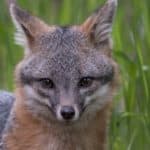
Gray fox
Gray fox Urocyon cinereoargenteus
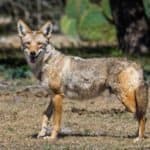
Coyote
Coyote Canis latrans
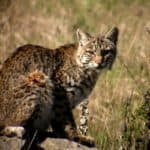
Bobcat
Bobcat Lynx rufus
Long-tailed weasel Neogale frenata
American marten Martes americana
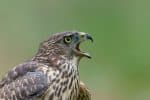
Northern goshawk
Northern goshawk Accipiter gentilis
Red-tailed hawk Buteo jamaicensis
Great horned owl Bubo virginianus
Striped skunk Mephitis mephitis
Raccoon
Raccoon Procyon lotor
Gopher snake
Gopher snake Pituophis catenifer

Related Species 7

Tree squirrels Sciurus Shared Family
Marmots
Marmots Marmota Shared Family
Prairie dogs
Prairie dogs Cynomys Shared Family
Ground squirrels Urocitellus Shared Family
Ground squirrels Otospermophilus Shared Family
Ground squirrels Ictidomys Shared Family
Ground squirrels Spermophilus Shared Family

Ecological Equivalents 5

Animals that fill a similar ecological role in their ecosystem

Ground squirrels Marmotini Overlap strongly as small-to-medium terrestrial squirrels that forage on the ground, use burrows, and rely on seasonal foods. Chipmunks are generally more forest- and edge-associated and more likely to use cheek pouches and larder hoards, but there is broad ecological convergence.
Tree squirrels Sciurus Share many food resources (mast, seeds, fungi) and forest habitats. Chipmunks are typically more ground-foraging and burrow-using, while tree squirrels are more arboreal; yet both can be key seed dispersers and competitors at feeding sites.
Pocket gopher Thomomys Both are burrow-centered small mammals that strongly influence soils and plant communities. They differ because gophers are specialized subterranean herbivores, whereas chipmunks are surface-foraging omnivores that engage in extensive aboveground caching.
Deer mouse
Deer mouse Peromyscus Occupy similar forest and brush understory niches as small omnivores that eat seeds, fruits, and invertebrates. Both are common prey and important in seed predation and dispersal, but chipmunks are more often diurnal and use cheek pouches and structured burrow systems.
Woodrats Neotoma Niche overlap as small-to-medium rodents that collect and cache plant material and use sheltered dens. Woodrats tend to be more nocturnal and den-focused, creating middens, while chipmunks more often use burrows and forage during the day.

Types of Chipmunk

25

Explore 25 recognized types of chipmunk

Eastern chipmunk
Eastern chipmunk Tamias striatus
Siberian chipmunk Tamias sibiricus
Yellow-pine chipmunk Tamias amoenus
Alpine chipmunk Tamias alpinus
Buller's chipmunk Tamias bulleri
Gray-footed chipmunk Tamias canipes
Gray-collared chipmunk Tamias cinereicollis
Cliff chipmunk Tamias dorsalis
Durango chipmunk Tamias durangae
Merriam's chipmunk Tamias merriami
Least chipmunk Tamias minimus
California chipmunk Tamias obscurus
Yellow-cheeked chipmunk Tamias ochrogenys
Panamint chipmunk Tamias panamintinus
Palmer's chipmunk Tamias palmeri
Long-eared chipmunk Tamias quadrimaculatus
Colorado chipmunk Tamias quadrivittatus
Hopi chipmunk Tamias rufus
Red-tailed chipmunk Tamias ruficaudus
Allen's chipmunk Tamias senex
Siskiyou chipmunk Tamias siskiyou
Lodgepole chipmunk Tamias speciosus
Sonoma chipmunk Tamias sonomae
Townsend's chipmunk Tamias townsendii
Uinta chipmunk Tamias umbrinus

“One chipmunk can collect 165 acorns per day.”

Chipmunks are small mammals that live in burrows, fallen logs, or holes under houses. This rodent is the tiniest member of the squirrel family!

They are omnivores eating a variety of plants and small animals. Chipmunks have a collection of chirps and other sounds they use to communicate with one another. They have a lifespan of two to three years.

5 Incredible Chipmunk Facts!
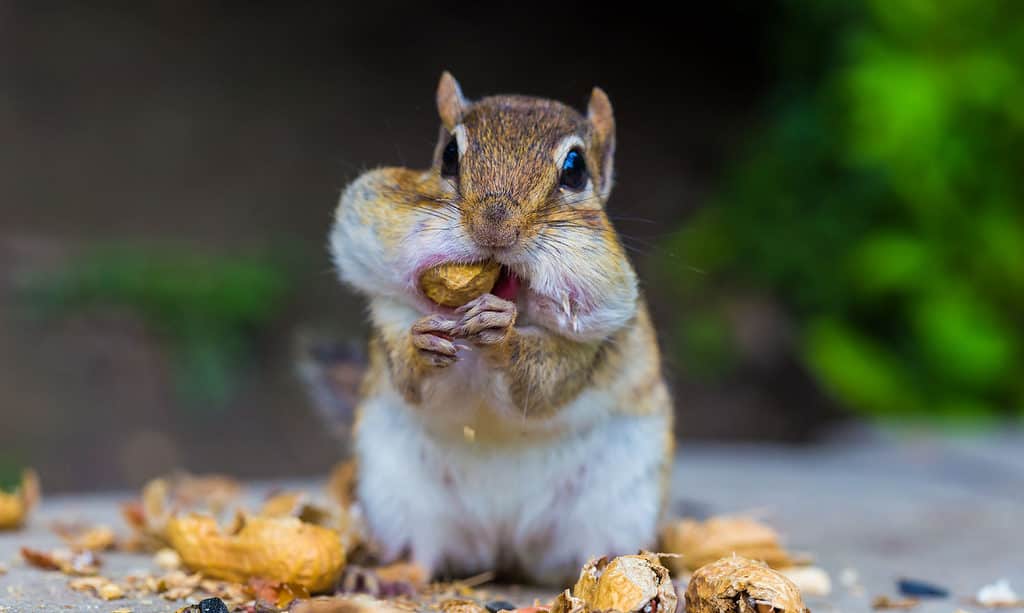
chipmunk having nuts

Chipmunks live in tunnel systems measuring up to 30 feet in length.

  • There are 25 species or types
  • While foraging during the day, this rodent stuffs food into pouches in its cheeks
  • This animal remains in its burrow over the winter
  • A chipmunk baby is the size of a jellybean
  • They live in tunnel systems measuring up to 30 feet in length

Evolution and Origins

Chipmunks are a part of the squirrel family and actually split off from rats and mice close to 70 million years ago. Scientists think they probably evolved their stripes independently from rats and mice. The only species of Chipmunks that isn’t native to North America is the Siberian chipmunk as indicated by its name.

The name Chipmunk is derived from their behavior to wake up to eat stored food. They get their name from the “chip chip” sound they make while eating.

Different Types of Chipmunks

Here is a full list of Chipmunks:

  • Eastern chipmunk
  • Siberian chipmunk
  • Least chipmunk
  • Red-tailed Chipmunk
  • Yellow-pine chipmunk
  • Colorado chipmunk
  • Lodgepole chipmunk
  • Hopi chipmunk
  • Townsend’s Chipmunk
  • California chipmunk
  • Buller’s Chipmunk
  • Panamint chipmunk
  • Long-eared chipmunk
  • Gray-collared chipmunk
  • Alpine chipmunk
  • Cliff chipmunk
  • Uinta chipmunk
  • Merriam’s Chipmunk
  • Allen’s Chipmunk
  • Palmer’s chipmunk
  • Sonoma chipmunk
  • Yellow-cheeked chipmunk
  • Gray-footed chipmunk
  • Durango Chipmunk
  • Siskiyou chipmunk

Scientific Name

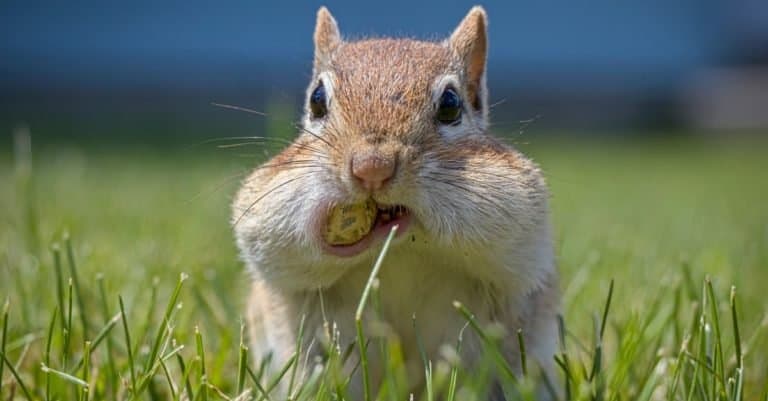
eastern chipmunk with cheeks full

The scientific name for an Eastern chipmunk is Tamias striatus.

The scientific name for an Eastern chipmunk is Tamias striatus. The Latin word striatus means streaks. This refers to the stripes on an Eastern chipmunk’s back. Chipmunks can also be classed into three different genera: the eastern chipmunk, the Siberian chipmunk, and the neotamias. This last genus contains 23 different species that live in the western US. Because all chipmunks are so similar, there is disagreement about whether they should be classified as different genera or just refer to all of them as the same.

Chipmunks are sometimes called striped squirrels or timber tigers. They belong to the Sciuridae family and the Mammalia class.

There are 25 species or types. Some of these include:

  • Eastern chipmunk
  • Siberian chipmunk
  • Townsend’s chipmunk
  • Uinta chipmunk
  • Red-tailed chipmunk
  • Colorado chipmunk

Appearance and Behavior
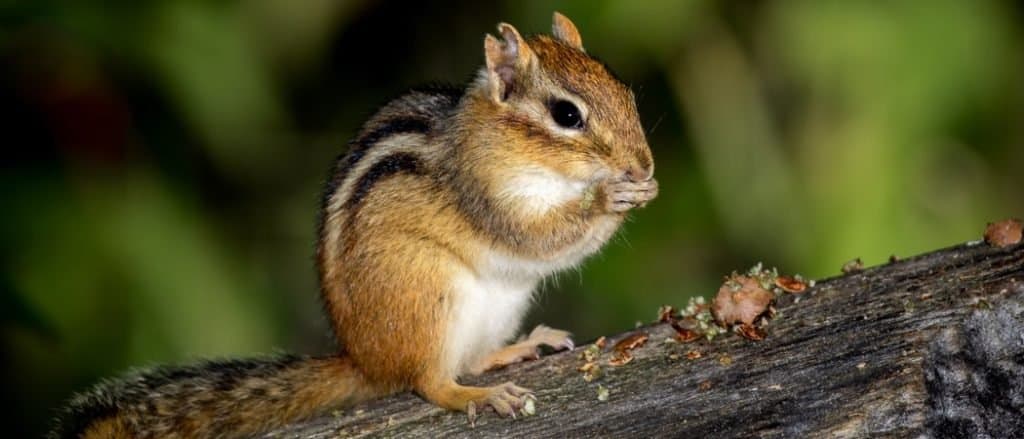
Trapping Chipmunks

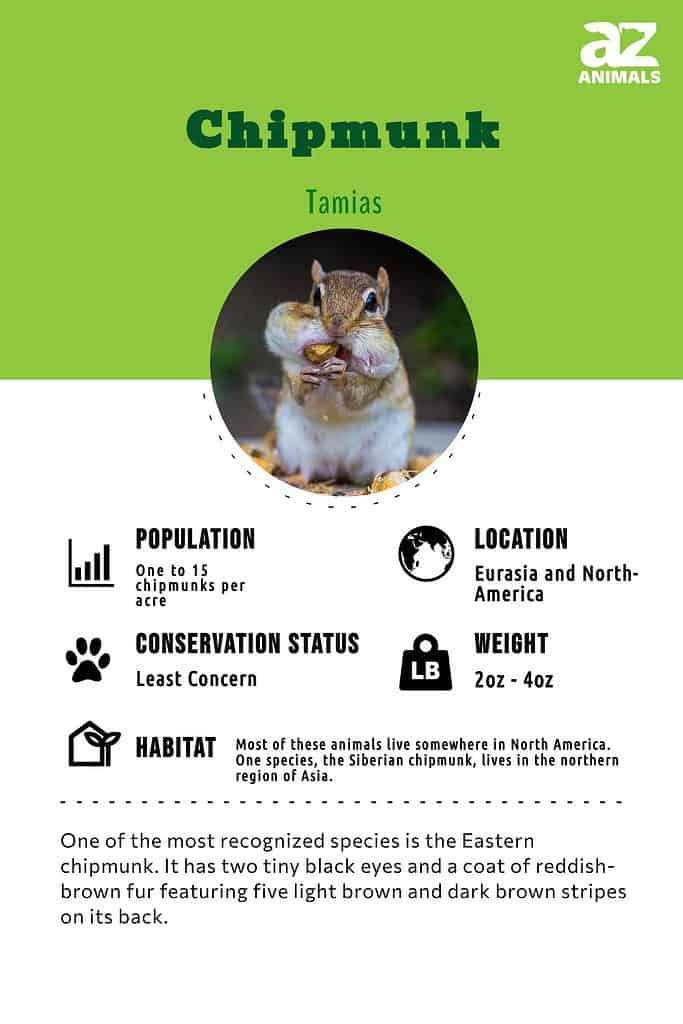
One of the most recognized species is the Eastern chipmunk.

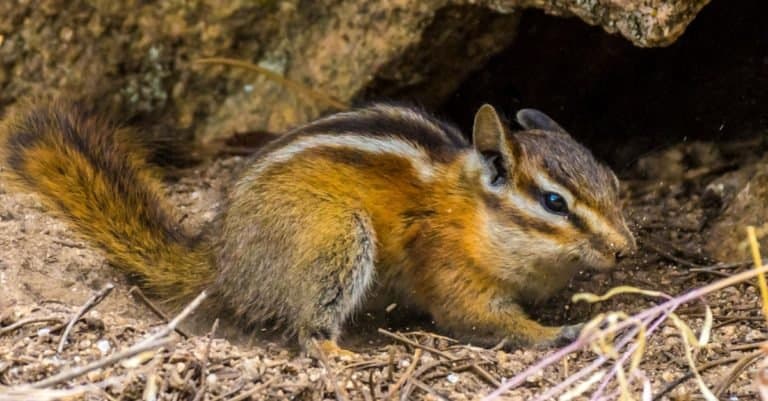
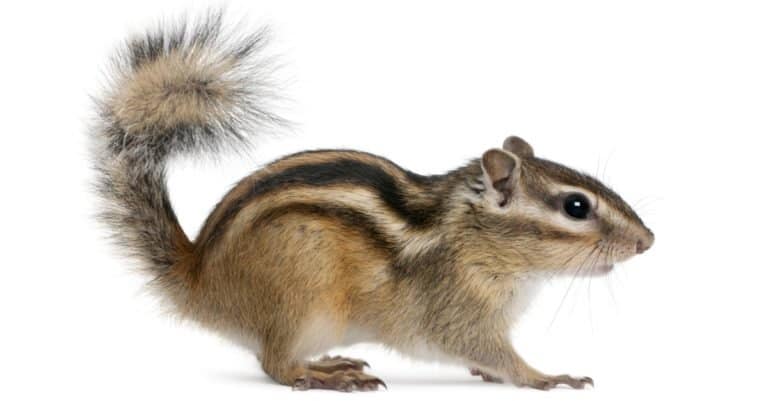
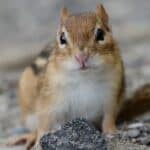
One of the most recognized species is the Eastern chipmunk. It has two tiny black eyes and a coat of reddish-brown fur featuring five light brown and dark brown stripes on its back. Also, this species has a light brown stripe near each ear and a dark tail. This animal’s fur can be brown, reddish-brown, or gray depending on what type it is.

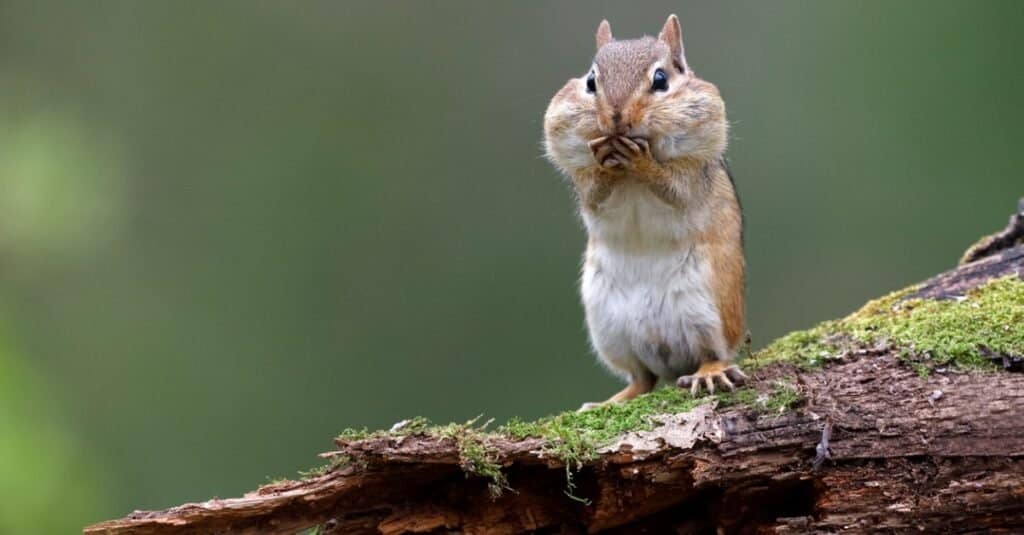
This rodent uses its delicate claws to dig holes and climb trees. In addition, these animals have pouches in their cheeks that they fill up with nuts, fruit, seeds, and more. These pouches allow them to take a large supply of food back to their home after spending time foraging in the open.

Understandably, the less time the animal spends out in the open, the less vulnerable they are to predators. These animals can sometimes become quite a pest in the home and need to be removed then.

A grown chipmunk measures from four to seven inches in length with a tail that adds another three to five inches. They weigh anywhere from one to five ounces. A five-ounce animal weighs the same as a baseball used in the major leagues.

An average-sized chipmunk measuring four inches in length is almost as long as two golf tees lined up end to end. The biggest species is the Eastern chipmunk. An adult Eastern chipmunk measures about 11 inches long, from the tip of its nose to the tip of its bristly tail.

When it comes to defensive features, the dark coat of these animals allows them to blend in with their woodland habitat. Also, its speed can help this rodent to outrun some predators and find a hole to hide in.

Though chipmunks may not live right next to one another, they communicate with others in the same territory. These animals have a variety of calls or sounds that mean different things. Some chirping sounds let other chipmunks know a predator is in the area.

Other chirping sounds are made by males as they compete with each other for a female. In other words, they have their own rodent language!

These rodents are solitary animals. They are only together during the breeding season. They are shy rodents that want to stay out of sight most of the time. When chipmunks do form a group, it is called a scurry.

Learn how to get rid of chipmunks by reading this article. Also, read here to find out if keeping chipmunks as pets is a good idea.

Chipmunk vs. Squirrel
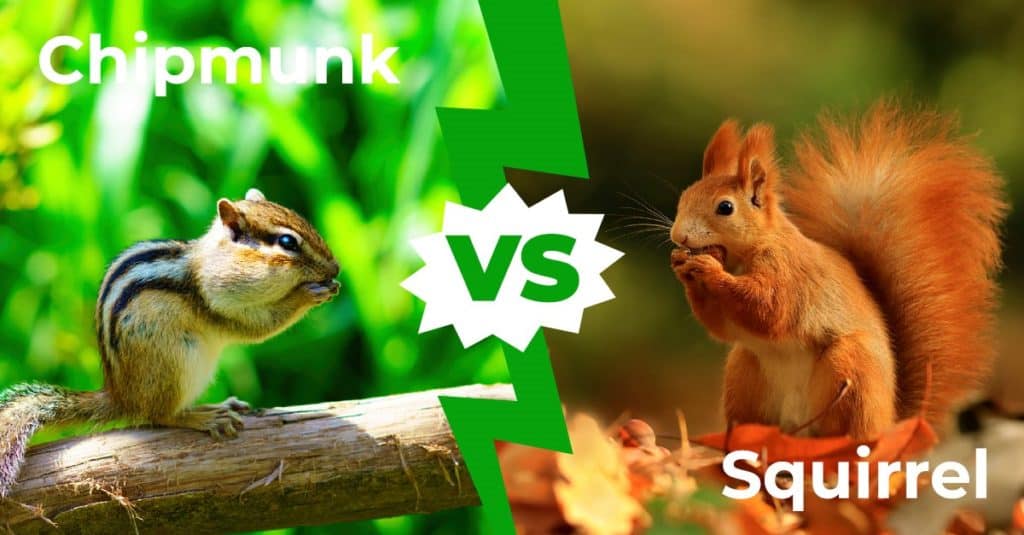
Chipmunk vs Squirrel

A chipmunk is a type of squirrel so there are a lot of similarities between these two rodents. Of course, there are some differences as well.

Both chipmunks and squirrels, aka tree squirrels, are omnivores with a diet that includes seeds, fruit, bird eggs, nuts, and insects. Also, both rodents climb trees and have a forest habitat.

One of the main differences between them is their size. Tree squirrels are larger measuring up to 20 inches long from their nose to the tip of their tail. Another difference is while chipmunks have stripes down their back, tree squirrels have solid gray or brown fur.

As a note, there’s another rodent called a ground squirrel that looks a lot like these animals! But they are not the same animal.

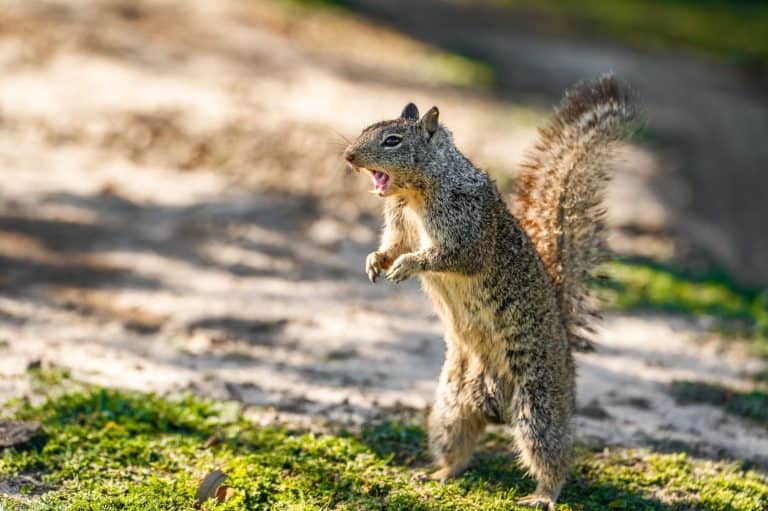
One easy way to tell them apart is a chipmunk’s small ears stand up on its head, while a ground squirrel’s small ears lay flat. Also, ground squirrels live in grassy areas and fields while chipmunks are found in woodland areas.

Habitat
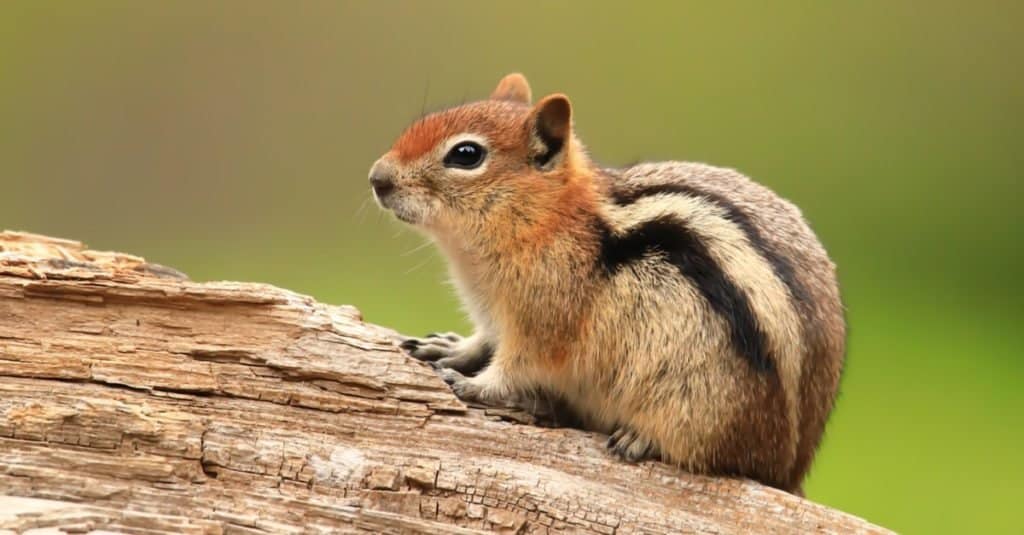
Rocky Mountain Chipmunk found in Afton, Wyoming

Most of these animals live somewhere in North America. One species, the Siberian chipmunk, lives in the northern region of Asia.

Most of these animals live somewhere in North America. One species, the Siberian chipmunk, lives in the northern region of Asia. Specifically, wherever you find trees in North America, you’re likely to find animals! They can also live in fallen logs and in holes under houses. Many species live in tunnels located three feet beneath the ground.

These animals are found in a temperate climate. If they live in an area with really cold winters they will go into hibernation. However, these rodents don’t go to sleep in the wintertime as bears do. Instead, they sleep on and off while surviving on the nuts and seeds they collected throughout the warm weather months.

Seeing the animal out of its shelter in the wintertime is a rare occurrence. They go into hibernation in late October and come out in March or April. Learn more about other animals that hibernate here.

These animals sometimes migrate when they need to find a place with better access to water.

Diet
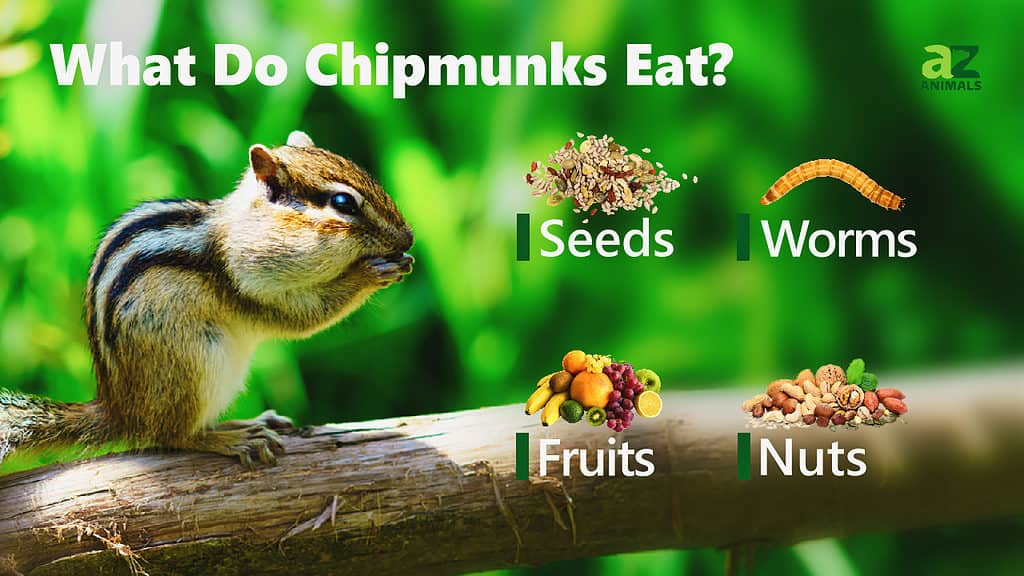
Chipmunks eat seeds, worms, fruits, and nuts.

These animals are omnivores. They eat whatever is most plentiful in their habitat.

What eats chipmunks?

Not surprisingly, These animals have a lot of predators. These include hawks, snakes, raccoons, rats, weasels, coyotes, and owls.

What do chipmunks eat?

They eat fruit, nuts, seeds, insects, snails, birds’ eggs, and frogs. It’s not uncommon to see an Eastern chipmunk and other types of chipmunks in North America chowing down at a backyard birdfeeder.

Items not eaten by the animal are stuffed into its cheek pouches and taken back to the nest to store for winter.

Predators and Threats
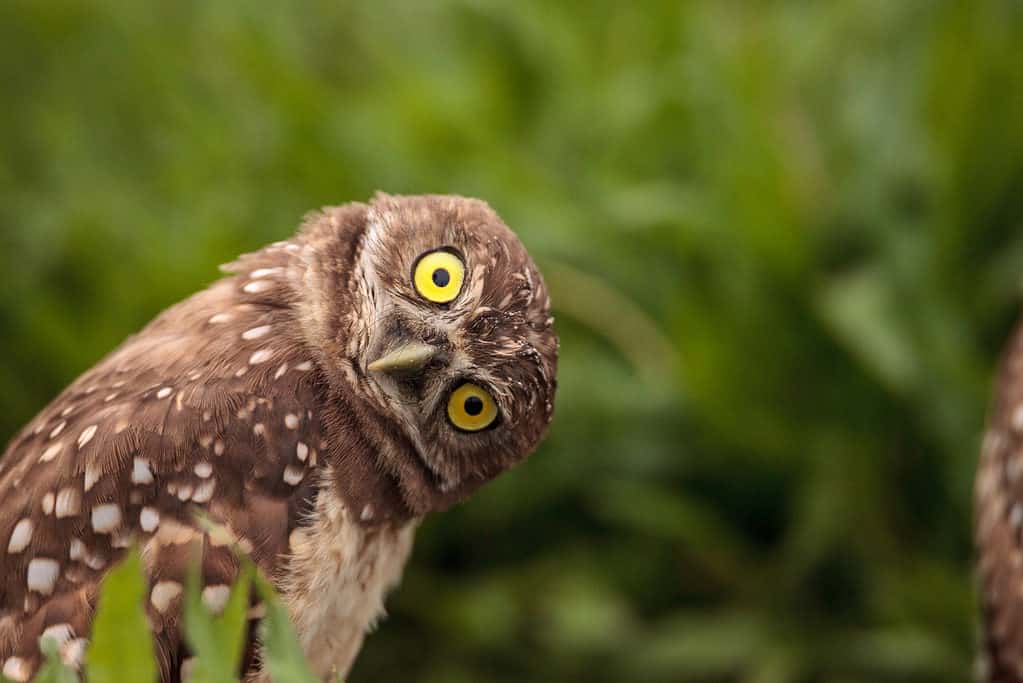
Funny owl

Predators of Chipmunks include: include hawks, snakes, raccoons, rats, weasels, coyotes, and owls.

These animals are an important food source for many animals. So, it has a long list of predators. Some examples include hawks, snakes, raccoons, rats, weasels, coyotes, and owls. Of course, they also fall prey to housecats from time to time.

Many of these rodents’ predators are fast and live in the same type of environment. For example, a coyote may stalk a chipmunk and sneak up on it while it’s foraging in the open.

A hawk can easily see the animal foraging for food on the ground and swoop down to grab it. A snake can pursue the rodent by following it into its tunnel as the rodent tries to escape.

It’s not uncommon to see these animals dead on the road. They live in the same areas as many humans, so they are vulnerable to passing cars.

Some humans think of them as pests. A pest control technician may be called in to set a trap to catch one or more chipmunks that are living in a hole beneath a home or beneath a home’s roof. The presence of chipmunk poop in the area is a sure sign that a chipmunk is occupying the space.

A pest control professional may use a trap that kills the rodent. Alternatively, some pest professionals use humane methods and trap them alive so they can be moved to another location away from the residential area.

The conservation status of the Eastern chipmunk is Least Concern. Its population is stable.

Reproduction, Babies, and Lifespan
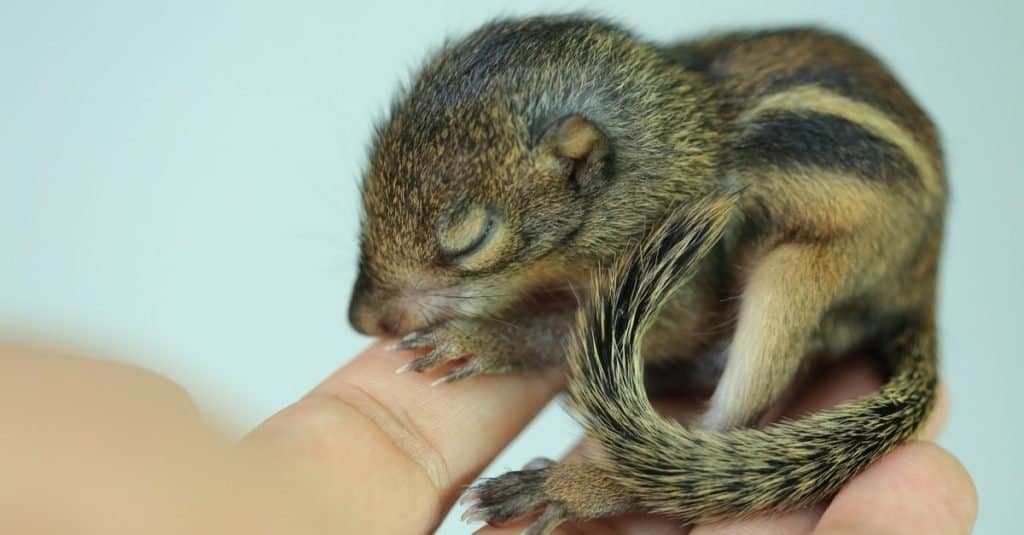
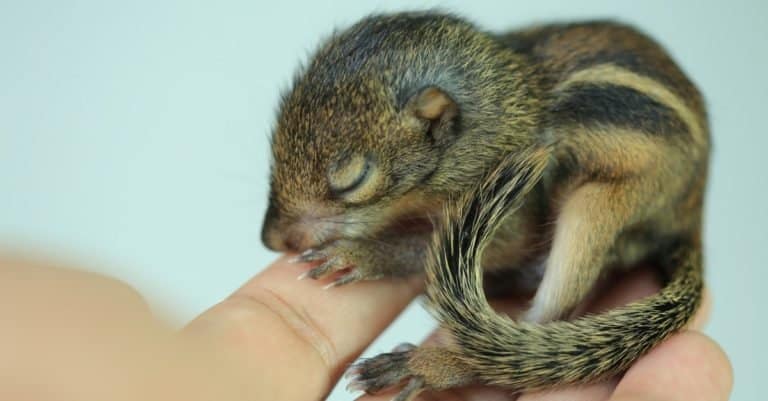
Baby chipmunk when they sleep

A baby chipmunk or pup weighs less than an ounce. The size of a newborn animal is about the same as one jellybean!

The breeding season of an Eastern chipmunk takes place twice a year. They breed from February to April and from June to August. Females release a scent when they are ready to mate.

Sometimes males fight over females during this active season. One male may mate with several females. The gestation period is 31 days. As a comparison, the gestation period of the Eastern gray squirrel is a little longer at 44 days.

Most of these animals give birth to two to six live babies, also called pups. However, it’s possible for them to have up to nine pups in a litter!

A baby chipmunk or pup weighs less than an ounce. The size of a newborn animal is about the same as one jellybean! They are born blind and without any hair. The pups stay out of sight in the burrow for the first six weeks of life. They nurse their mother during that time. The father doesn’t play a part in the care of the pups.

At about six weeks old, the pups venture out of the burrow with their mother to learn how to forage for food. The pups have a full coat of fur and can live independently at around 8 weeks old.

Chipmunks can carry fleas and ticks. These rodents can also carry diseases such as leptospirosis, salmonella, and even rabies. Chipmunks have a lifespan of two to three years.

Population

The IUCN Red List of Threatened Species describes the population of Eastern chipmunks as, ‘abundant.’ Also, it’s estimated that there are from one to 15 chipmunks per acre depending on the area.

The conservation status of the Eastern chipmunk is Least Concern with a stable population.

Similar Articles about These Animals…

  • Chipmunk Sounds: How To Identify A Chipmunk By Sound These feisty little guys make a wide variety of chirps, cheeps, and squeaks. Click here to learn how to identify them.
  • Chipmunk Holes: How To Identify & Fill Chipmunk Burrows Chipmunks dig extensive burrows, learn more about them here.
  • Chipmunk Repellent: The Best Way To Get Rid of Chipmunks Chipmunks are cute and fun to watch, but they are also very destructive if they get in a car or building. Check out this article to find out how to keep them out of your home.
View all 392 animals that start with C
How to say Chipmunk in ...
Estonian
Ida-vöötorav
English
Chipmunk
French
Tamia rayé
Dutch
Oostelijke wangzakeekhoorn
Polish
Pręgowiec amerykański
Finnish
Juovamaaorava

Sources

  1. Wikipedia / Accessed March 14, 2021
  2. Connecticut Department of Energy and Environmental Protection / Accessed March 14, 2021
  3. National Wildlife Federation / Accessed March 14, 2021
Rebecca Bales

About the Author

Rebecca Bales

Rebecca is an experienced Professional Freelancer with nearly a decade of expertise in writing SEO Content, Digital Illustrations, and Graphic Design. When not engrossed in her creative endeavors, Rebecca dedicates her time to cycling and filming her nature adventures. When not focused on her passion for creating and crafting optimized materials, she harbors a deep fascination and love for cats, jumping spiders, and pet rats.
Connect:

Thank you for reading! Have some feedback for us?


Chipmunk FAQs (Frequently Asked Questions)

Chipmunks are Omnivores, meaning they eat both plants and other animals.