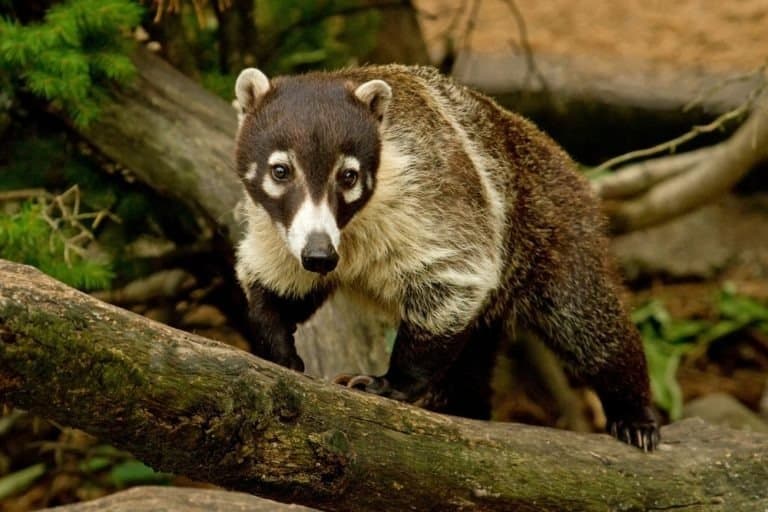
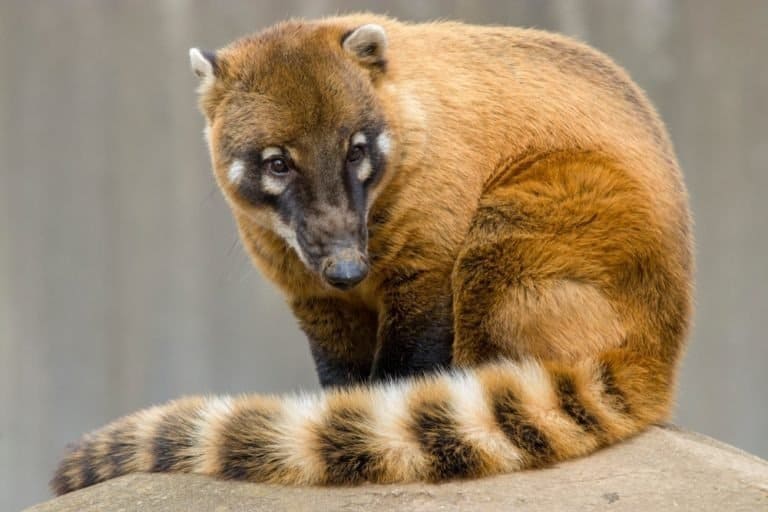
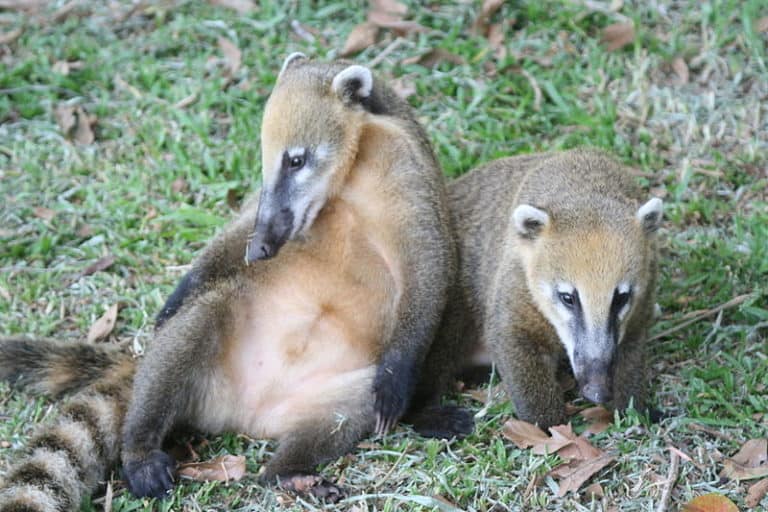




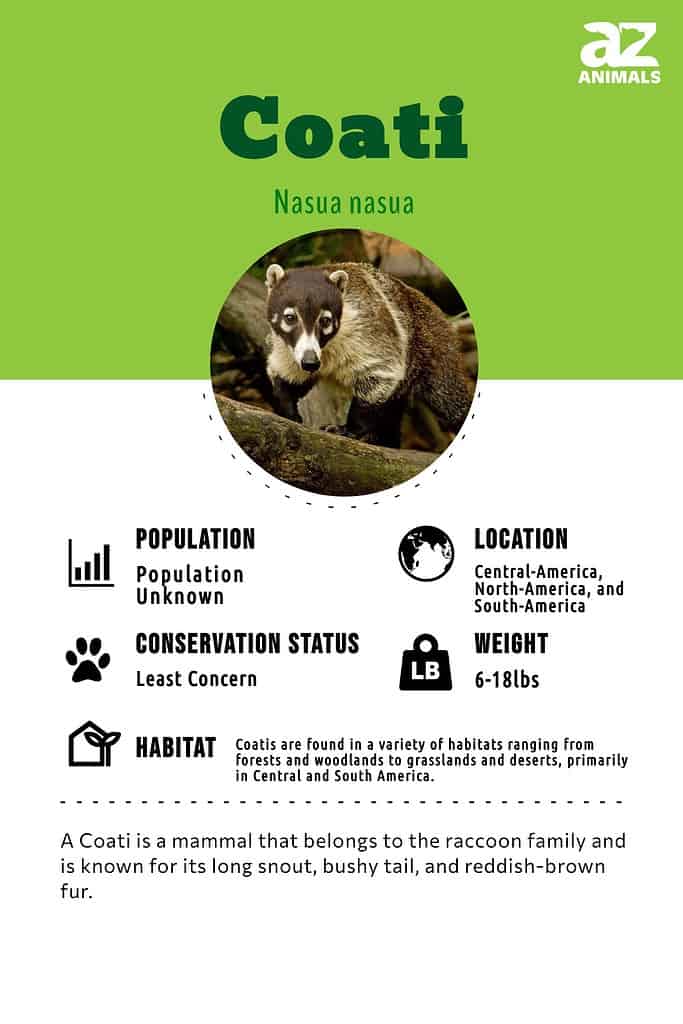
“Coatis are related to raccoons and are also known as coatimundis“
Coatis are furry animals that are native to South America. They usually exist in Mexico, Central America, South America, and the Southwestern United States. Their name coatimundi is known to be derived from the Tupian Brazil language.
The name ‘Coati’ originated from the Spanish word “coatí,” which goes back to Old Tupi. Their word – kua’ti – is a combination of two words: “cua” (meaning “belt”) and “tim” (meaning “nose”).
The visually descriptive name is due to the coati’s habit of sticking their noses into their bellies when they sleep. The creature’s scientific name ‘Nasua’ also comes from the Latin word meaning ‘nose’.
Incredible Coati Facts
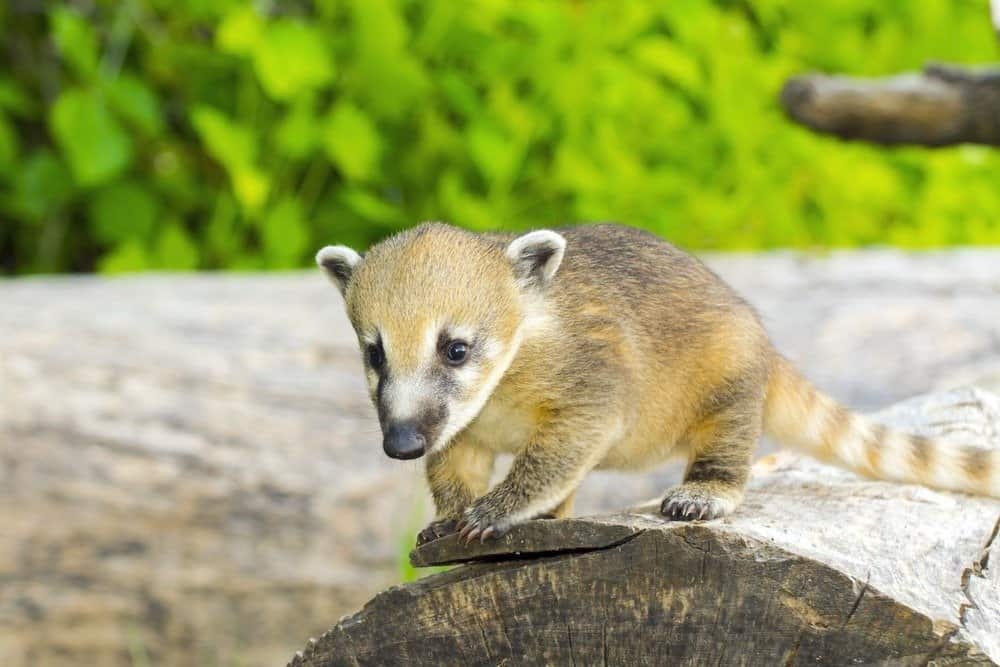
A young South American coati (Nasua nasua) baby on a tree log
©belizar/Shutterstock.com
- Coatis are animals with unusually long noses that help them in feeding themselves by sticking under rocks in search of food.
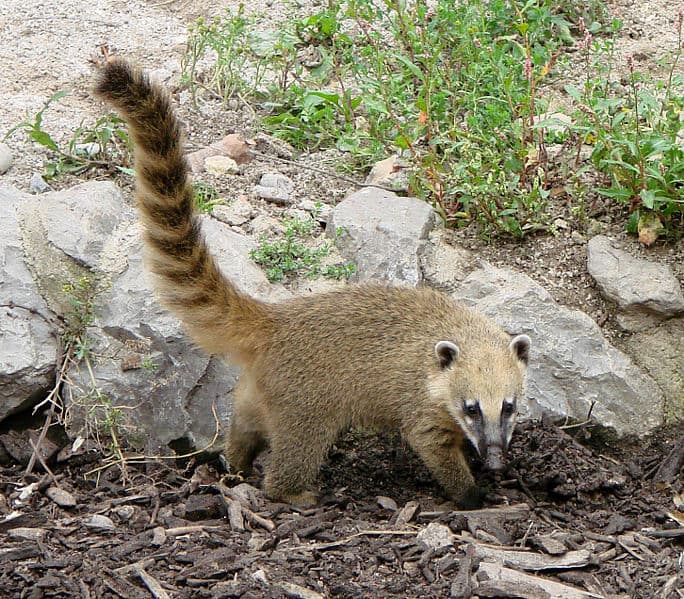
- Coatis usually walk with their tails high up in the air. It is used for balancing purposes while climbing.
- Coatis have double-jointed ankles that make them flexible and help them descend trees at a much higher speed.
- These creatures make a ‘woof’ sound when they are surprised and slowly leap into the bushes in groups after that.
- Their groups can get as big as having about 30 members.
Scientific Name
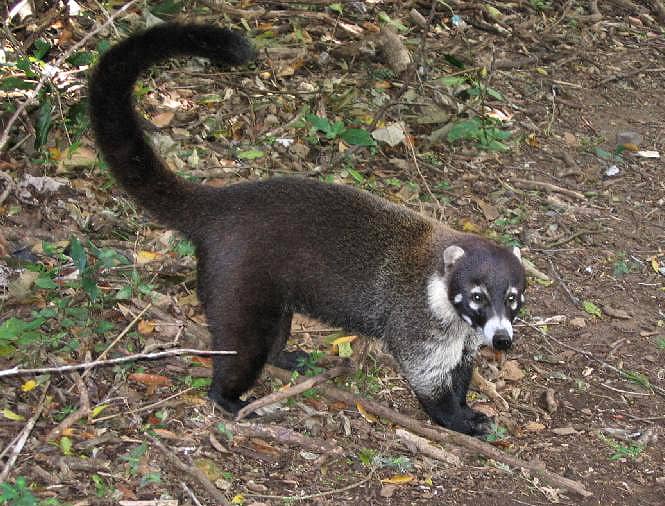
The species of coati, often known as coatimundi or coatimundi, is a member of the Nasua genus.
©Liz Roy / Creative Commons – Original
Coati belongs to the genus Nasua and is also called coatimundi or coatimundi. They are known to come from the family Procyonidae.
There are four subspecies of coati – the mountain coati, the Ring-tailed Coati or banded-tail coati, the Cozumel Island Coati, and the white-nose Coati. The name coatimundi has been derived from the Tupian Brazil language.
There are three different types of coati:
- White-nosed coati
- South American coati
- Nasuella olivacea
Evolution and Origins
Genetic investigations have revealed that the olingos (genus Bassaricyon), who are considered to have separated roughly 10.2 million years ago, are the closest relatives of coatis.
From Arizona to Argentina, North, Central, and South America all contain white-nosed coatis. This species can be found in a range of environments, such as tropical woodlands and dry, open forests. Coatis consume fruit, lizards, small rodents, and insects.
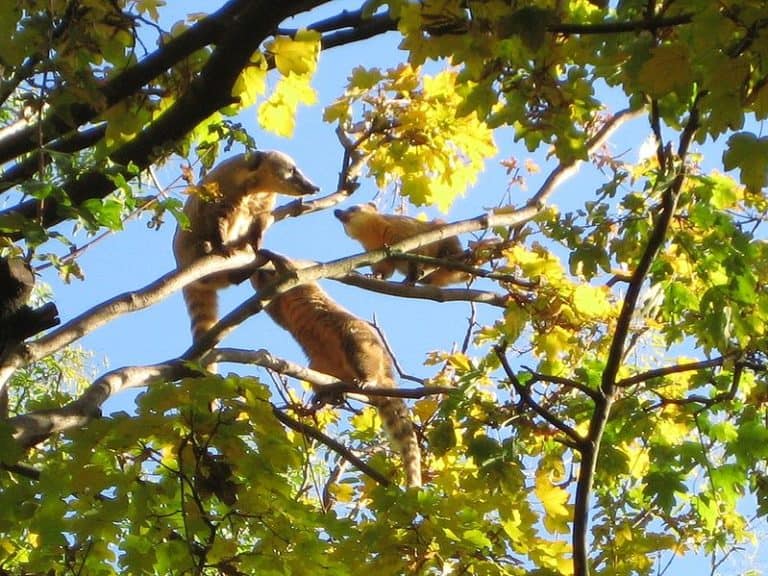
Coatis are good climbers and swimmers. They use their tails to balance on branches and to delay the tree’s fall. or alterations in behavior They have a keen sense of smell, and we often observe them sniffing the ground as they utilize their strong claws and large snout to seek food.
Appearance and Behavior
Coatis have a sleek and slender heads. Their noses are the highlight of their faces and are usually long and flexible. These furry creatures have small ears, long tails, and dark feet.
They often use their tails for balancing their bodies. Their fur coats usually come in black or brown color with a lighter underpart. Coatis are about 12 inches in height and usually weigh between 4 to 18 lbs.
Their front feet are equipped with curved claws that are relatively long. The back feet, however, have shorter claws. Their toes are webbed, and they are known to be powerful swimmers. The male coati is known to be double the size of female ones and has sharp canines.
Different types of coati have slightly different behavioral characteristics. Some of them are active during the daytime. While some others are active during the night. They are known to be very intelligent animals and are also very adaptable.
These creatures sleep at higher, elevated places and live in groups that can be as big as 30 members. These groups are called bands. When surprised, these groups make a ‘woof’ noise and then leap into the bushes.
Adult coati males are especially known to be solitary creatures and join the females only at mating time. Coatis are also known to be excellent climbers and usually take the help of their tails to balance their bodies while climbing. They descend to the ground to hunt for food.
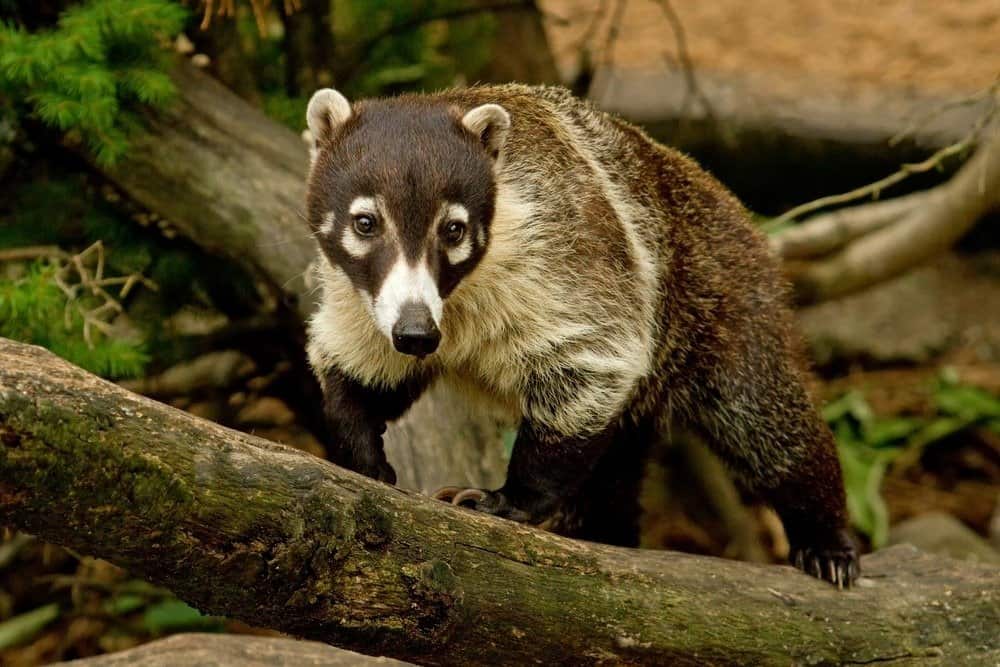
Adult coati males are known to live alone and only associate with females during mating season.
©Cynthia Kidwell/Shutterstock.com
Habitat
Coatis are animals that are found only on the American continent and usually live in moist or tropical rainforests. They live in elevated areas – mostly above 3000 meters – which could include pine and oak trees. Their fur coat helps them survive these conditions.
These are found in Arizona, Mexico, Central, and Southern America, and the Southwestern United States. It is usually unlikely, but some coati can also be found in deserts and savannas. The ring-tailed coati is primarily found in South America, though it is also known as the South American coati or the banded-tail coati.
Diet
Omnivorous in nature, coatis have a diet that includes a variety of things like lizards, eggs, birds, and crocodile eggs. They also eat fruit as well as invertebrates – which they dig out from beneath the ground using their long claws. They are known to travel a lot in search of food.
Predators and Threats
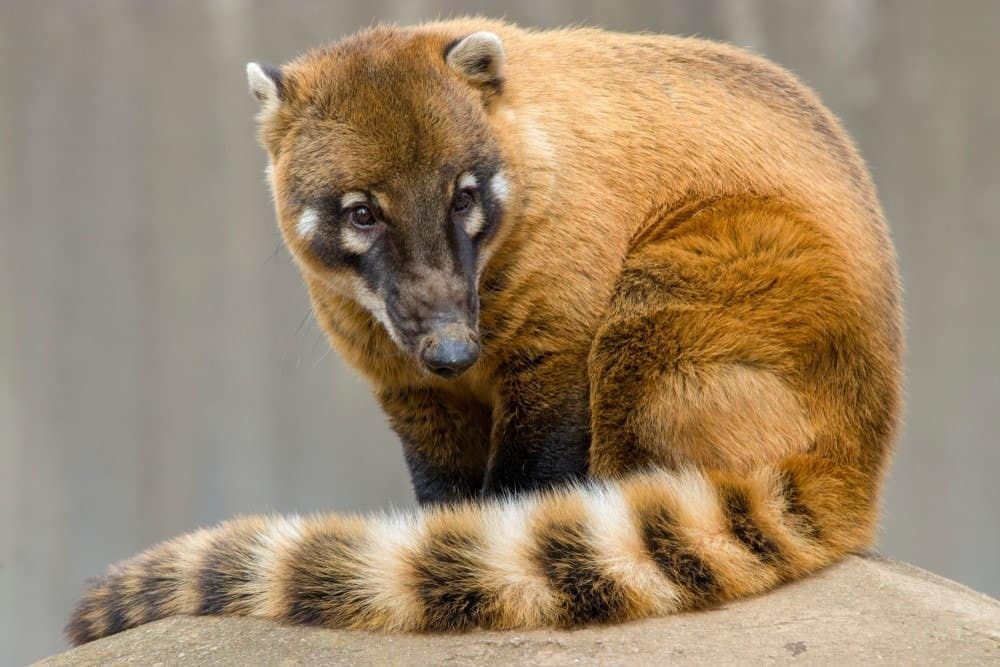
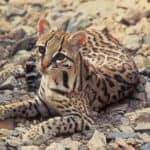
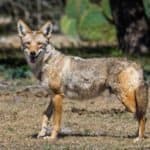
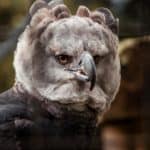
Coati’s are prey for maned wolves, anacondas, tayras, dogs, and foxes.
©Danny Ye/Shutterstock.com
Like all the other animals, coatis are also a part of the environmental food chain and there are a lot of animals that prey on them. These predators include maned wolves, anacondas, tayras, dogs, and foxes. Some other animals that are known to prey on them are ocelots, raptors, eagles, jaguarundis, and boa constrictors. The pups are at particular risk of becoming the dinner of the white-headed capuchin monkey.
These creatures are also under threat due to human activities like hunting and deforestation as their natural habitat has been degenerating. Humans are also known to eat coatis which is also why the coati population is said to be on a decline. However, the species is not threatened, and the IUCN has placed it under the category of ‘least concern’.
Reproduction, Babies, and Lifespan
The start of the rainy season is usually when the coati mate. The process starts when one male coati joins the band and mates with all the females. Once the baby has been conceived, the female leaves the group and builds a nest high up in the tree. The gestation period lasts for about three months after which the female gives birth to 2 to 7 babies that are called kittens.
The kittens have their eyes closed at birth and usually only open them when they are about 10 days old. Around day 19, they start standing up and can walk by day 24. Around 6 to 10 weeks of age, the kittens rejoin the band with their mothers and further care continues inside the band with the help of other female members of the group. The average coati lives for about 14 years.
Population
The coati population is not very clear as the species have not been studied very well.
However, it has been assumed that the numbers have relatively declined because not only do these creatures fall prey to natural predators, but they also face a threat from hunting and degeneration of their natural habitat due to deforestation by human beings. Humans also feed on coatis which are also known to be the reason that the coati population is on a decline in some areas.
The population varies from place to place. The greatest number of members that a band or coati group has been known to have is more than 150 members. However, they are not threatened and have been placed under the least concerned category by the IUCN.
Zoo
Coatis can not survive in very peculiar environments and hence it would usually not be a good idea to keep them in captivity. Moreover, they are energetic animals, and keeping them in small cages wouldn’t be an appropriate thing to do. They usually require a lot of time outside.
Coati Pictures
View all of our Coati pictures in the gallery.

Cynthia Kidwell/Shutterstock.com
How to say Coati in ...
Sources
- David Burnie, Dorling Kindersley (2011) Animal, The Definitive Visual Guide To The World's Wildlife / Accessed October 15, 2009
- Tom Jackson, Lorenz Books (2007) The World Encyclopedia Of Animals / Accessed October 15, 2009
- David Burnie, Kingfisher (2011) The Kingfisher Animal Encyclopedia / Accessed October 15, 2009
- Richard Mackay, University of California Press (2009) The Atlas Of Endangered Species / Accessed October 15, 2009
- David Burnie, Dorling Kindersley (2008) Illustrated Encyclopedia Of Animals / Accessed October 15, 2009
- Dorling Kindersley (2006) Dorling Kindersley Encyclopedia Of Animals / Accessed October 15, 2009
- David W. Macdonald, Oxford University Press (2010) The Encyclopedia Of Mammals / Accessed October 15, 2009
- Wikipedia / Accessed November 5, 2020
- World Land Trust / Accessed November 5, 2020
- Sea World Parks & Entertainment / Accessed November 5, 2020