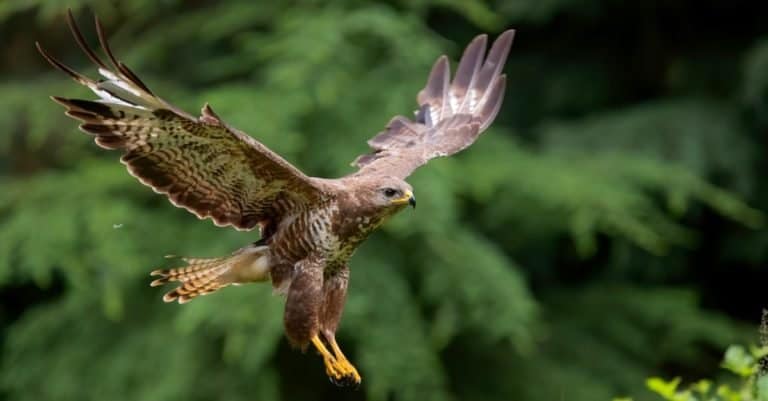
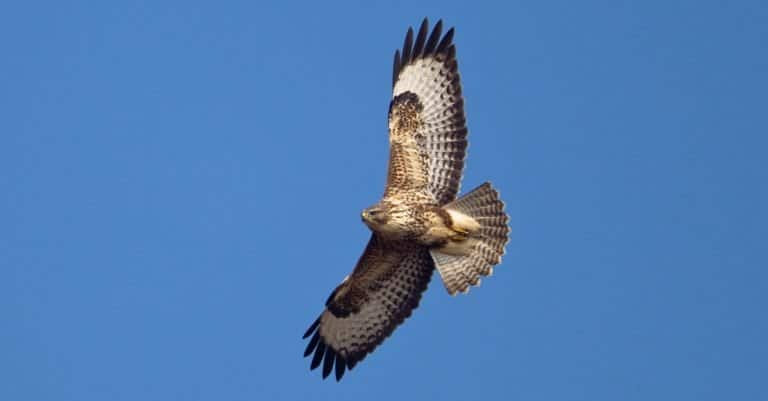
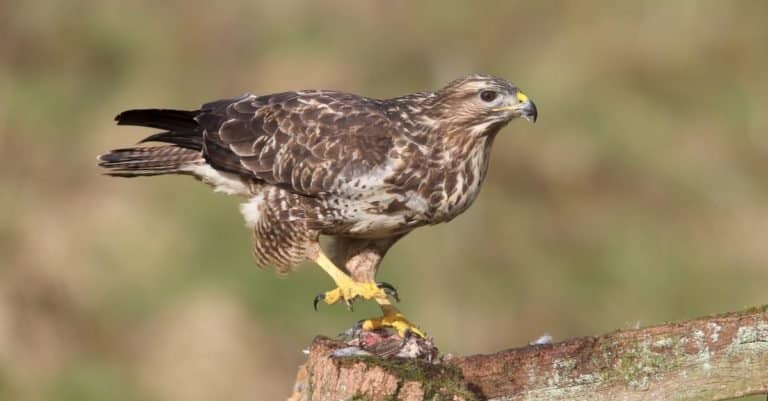
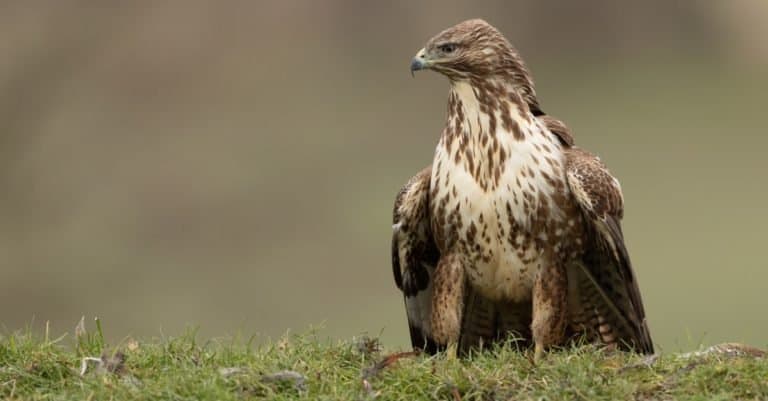
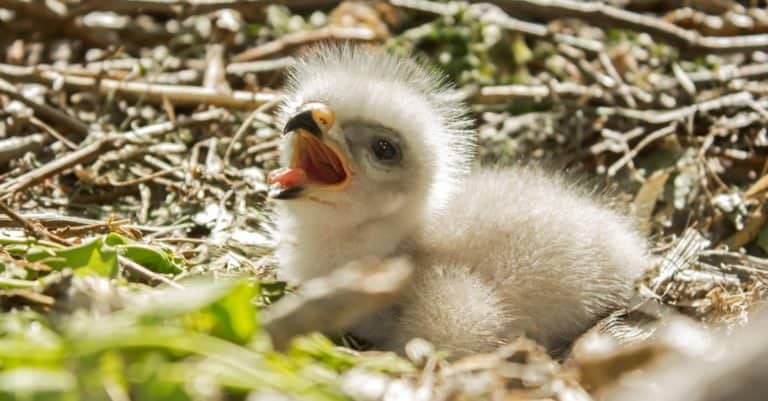
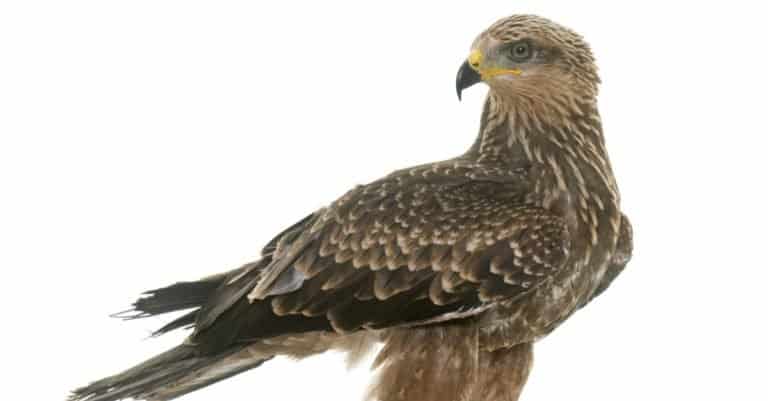



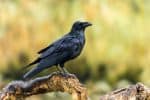

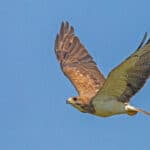

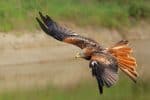
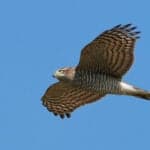
Common buzzards live in Europe, Africa, and Asia. They are carnivorous birds of prey — eating other birds, reptiles, rodents, and occasionally, carrion. Though they are mostly solitary, these birds form monogamous pairs to raise chicks and sometimes form groups or flocks.
An Amazing Bird: 2 Common Buzzard Facts
- These birds stomp their feet on the earth to attract worms to the surface to eat them
- They are sometimes called ‘tourist eagles’ because many tourists think they’ve spotted an eagle when it’s probably a common buzzard.
Where to Find a Common Buzzard
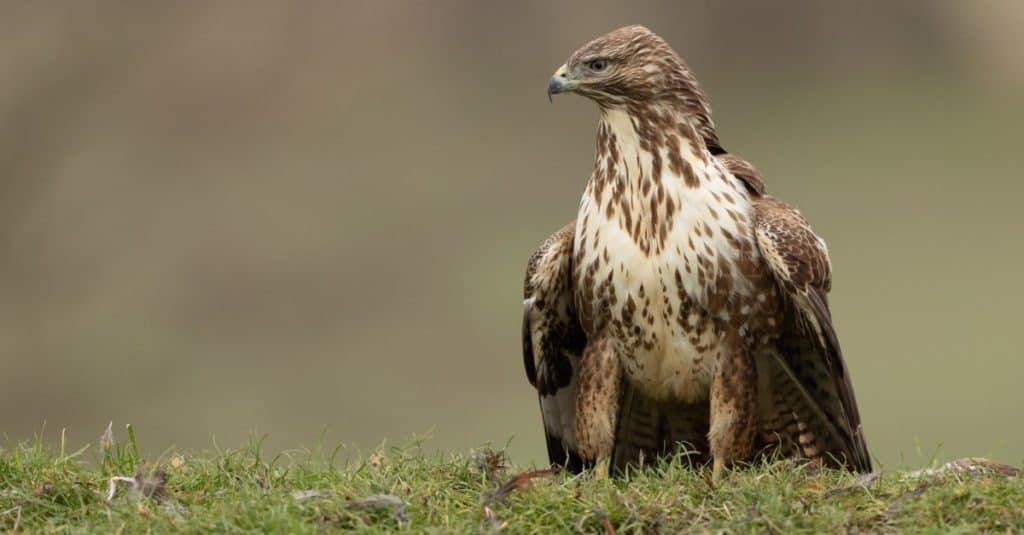
Common buzzards are found throughout Europe, Asia, Russia, India, and Mongolia.
©L Galbraith/Shutterstock.com
This buzzard is found throughout Europe, including Scotland, Ireland, France, Greece, and England, along with many others. Also, they are found in Asia in countries such as Russia, China, India, and Mongolia. Common buzzards that live in colder areas migrate to South Africa for the winter months.
Their habitat includes woodlands, scrublands, marsh bogs, farmlands, and even around cities and towns occupied by lots of people. These birds prefer to live in temperate climates.
Common buzzards can be seen year-round in Scotland, Wales, and throughout England. They are especially active in the springtime. Bird watchers are likely to see them perched on street lights, fence posts, and in trees overlooking open fields or pastures. They can be seen soaring over fields and hillsides in search of prey.
Nests
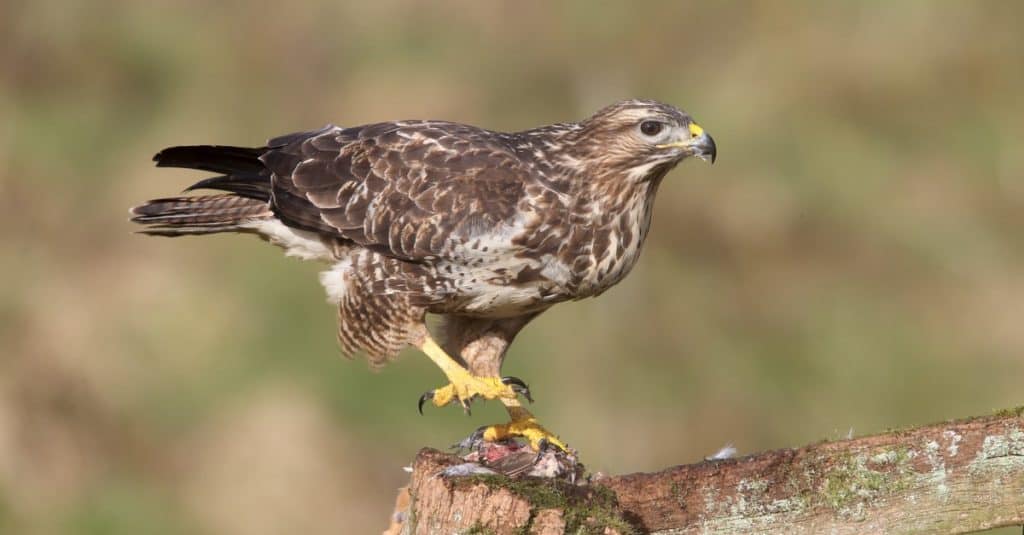
Male common buzzards usually build the nest with sticks, branches, and twigs lined with leaves.
©Erni/Shutterstock.com
Common buzzards build a thick, bulky nest with sticks, branches, and twigs. These birds use heather or leaves to line the inside of the nest. Many nests are built in trees near the trunk or in a strong fork of branches. They can be from 10 to 80 feet off the ground. Other common buzzards build nests on rocky cliffs. Since these birds use the same nest every year, the nest can change in size and shape with repair work over time.
The male buzzard usually builds the nest.
Classification and Scientific Name
Buteo buteo is the scientific name of this buzzard. The word buteo is the Latin word meaning hawk. This bird is sometimes called the tourist eagle because tourists in Europe often mistake it for an eagle.
It belongs to the Accipitridae family and the class Aves.
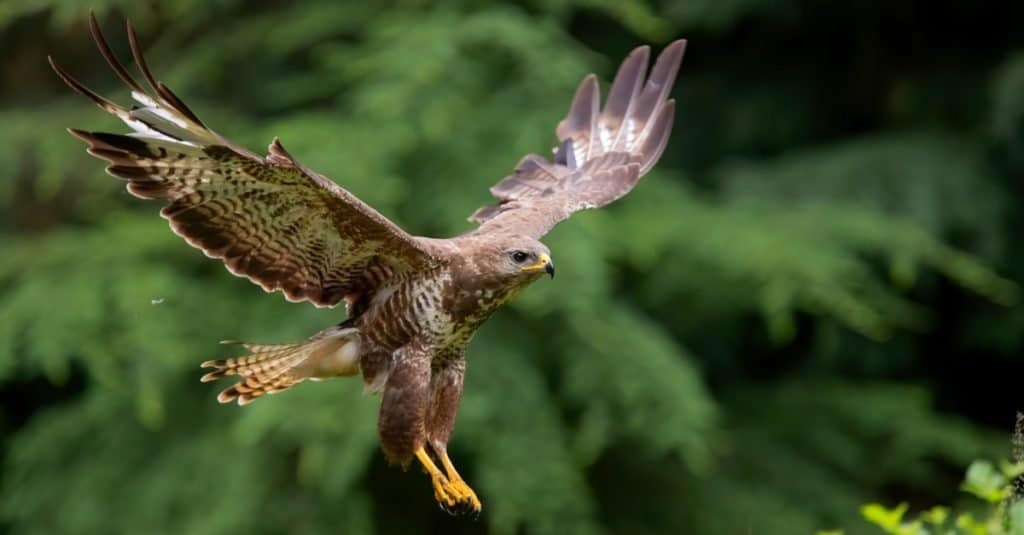
The steppe buzzard migrates to Africa for the winter months.
©Henk Bogaard/Shutterstock.com
Species
There are up to 28 subspecies of the common buzzard. Some of them include:
- Buteo buteo rothschildi, native to the Azores Islands, this bird is darker and smaller than other hawks.
- Buteo buteo insularum, native to the Canary Islands.
- Buteo buteo arrigonii, native to Corsica and Sardinia, this bird has very heavy streaking on its belly.
- Buteo buteo vulpinus, aka the steppe buzzard, can be found in Sweden, Finland, Estonia, Belarus, Ukraine, Kazakhstan, Kyrgyzstan, Russia, Siberia, China, and Mongolia. This bird winters in Africa.
- Buteo buteo menetriesi, can be found in Crimea through the Caucasus to Iran and Turkey.
Evolution
The Buteoninae subfamily originated in the Americas with radiations that led to common buzzards and other Eurasian and African buzzards. The Buteo species of Eurasia and Africa are commonly referred to as “buzzards”, while those same birds are called “hawks” in the Americas. DNA testing shows that the common buzzard is closely related to the red-tailed hawk (Buteo jamaicensis) of North America.
Genetic studies indicate that the common buzzards of Europe and Africa diverged from the American birds around 300,000 years ago, although fossil records show that Buteo species were present in Europe during the late Miocene period.
Size, Appearance, & Behavior
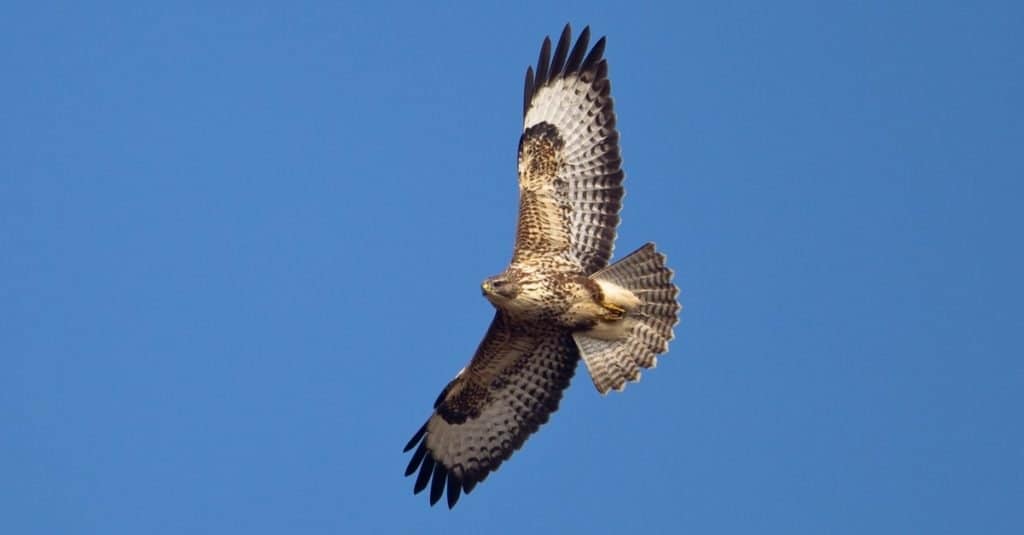
Common buzzards have a wingspan of 42 to 53 inches.
©Andrew M. Allport/Shutterstock.com
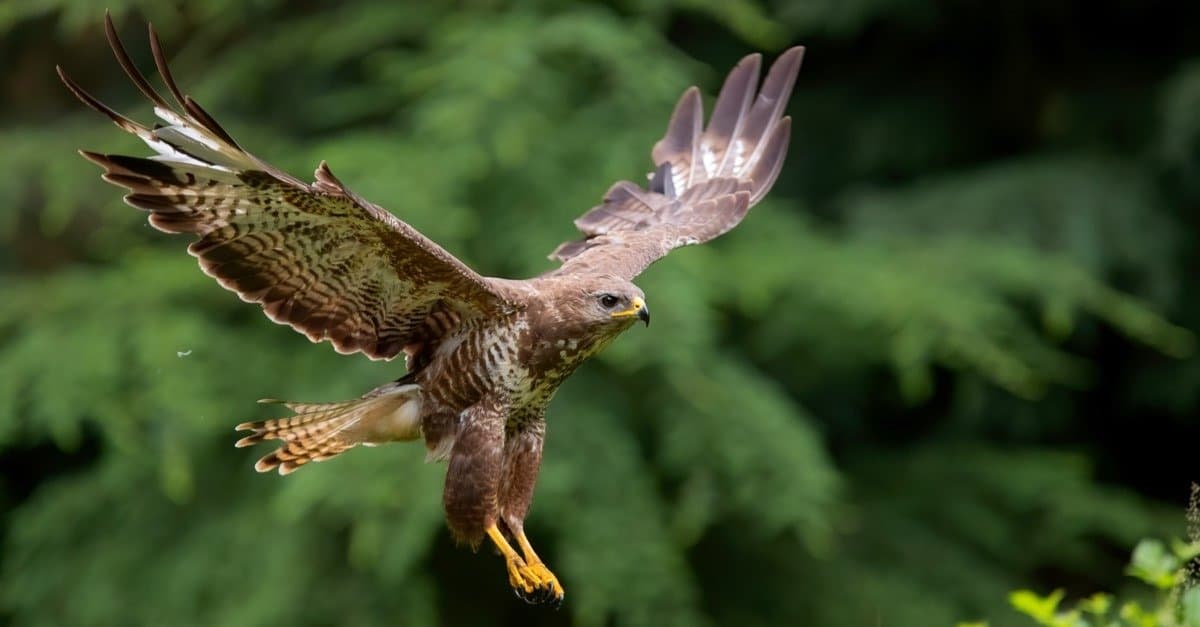
The feathers of the bird are a mixture of dark brown, light brown, and white. They are medium to large in size with dark eyes and a hooked beak. They are 15 to 22 inches long and weigh 1 to 3 pounds. One of the most interesting facts is that males usually weigh less than females. This makes them better fliers. The wingspan of this bird ranges from 42 to 53 inches.
A buzzard’s brown feathers can help it to hide from predators in the woods. Furthermore, its speed can help it to escape danger.
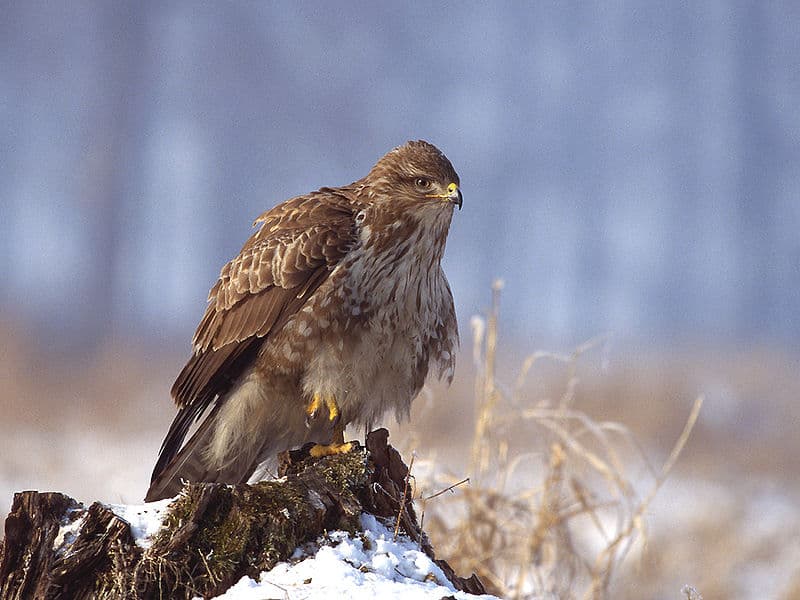
Common buzzards will eat carrion but mostly hunt live prey.
©Lukasz Lukasik / Free Art License – Original
Common Buzzards vs. Vultures
Buzzards and vultures are considered the same thing in North America. Turkey vultures are sometimes called buzzards.
The diet is different for these two birds. A vulture’s main diet is carrion. A common buzzard hunts rodents, reptiles, and other birds and will eat carrion as well.
Common buzzards and vultures have different types of feet. The buzzards have strong talons made for grabbing prey and carrying it. Vultures have feet that are considered weak.
Look at these birds, and you’ll notice a big difference. A vulture has no feathers on its neck, whereas the buzzard has thick feathers.
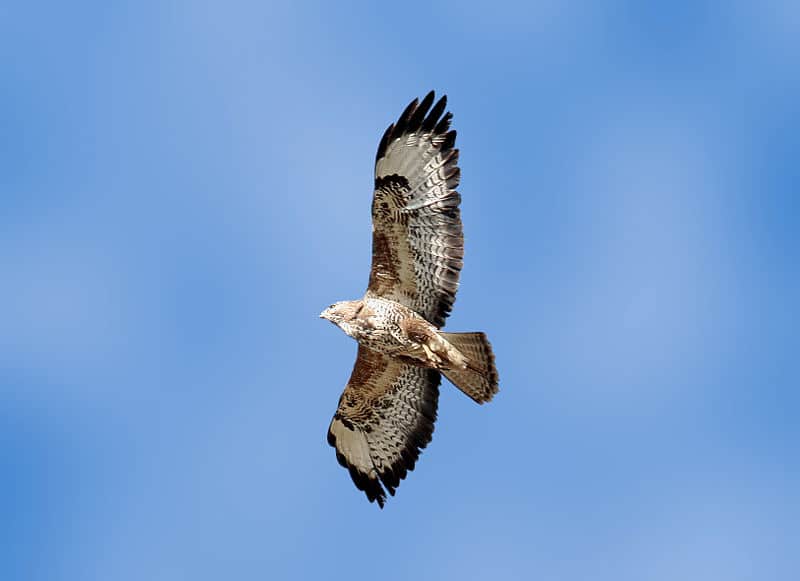
Common buzzards are generally larger than many species of hawks, such as the Eurasian sparrowhawk, but some hawks, like the northern goshawk, can be similar in size or larger.
©Andreas Trepte / Creative Commons – Original
Common Buzzards vs. Hawks
One of the main differences between common buzzards and hawks is their size. Hawks are smaller and lighter than buzzards.
Buzzards and hawks both hunt for rodents, birds, and small reptiles. However, hawks are more likely to capture prey than eat carrion. Carrion is part of a buzzard’s diet.
Migration Pattern and Timing
This bird is known as a partial migrant. This means there are differences in the migratory habits of individual buzzards in different regions. Some migrate further south than others due to the weather conditions where they live. Some buzzards migrate just a short distance until they are in a region that’s warmer with more prey to consume over the winter.
The steppe buzzard is one species that migrates an especially long distance for the winter months. In September and October, steppe buzzards begin making their way from Asia Minor to the Cape of Africa. They migrate again, beginning in March, to return to their breeding grounds.
Diet
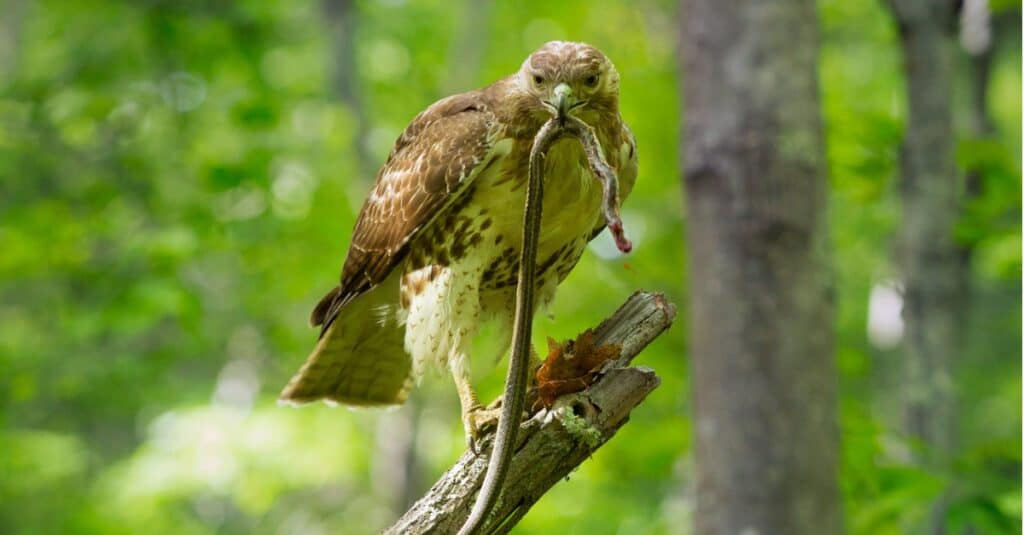
Common buzzards eat snakes, voles, mice, lizards, insects, and the occasional carrion.
©iStock.com/Holcy
These buzzards are carnivores. They spend the bulk of the day by themselves looking for prey.
Common Buzzard: What do the birds eat?
The buzzards eat rodents such as voles and mice, and reptiles, including snakes and lizards, as well as insects, and carrion. These raptors make the most of whatever food source is in the area.
Sometimes, common buzzards eat poisonous bait put out to kill foxes.
Predators and Threats
Though a common buzzard is a bird of prey, it does have some predators.
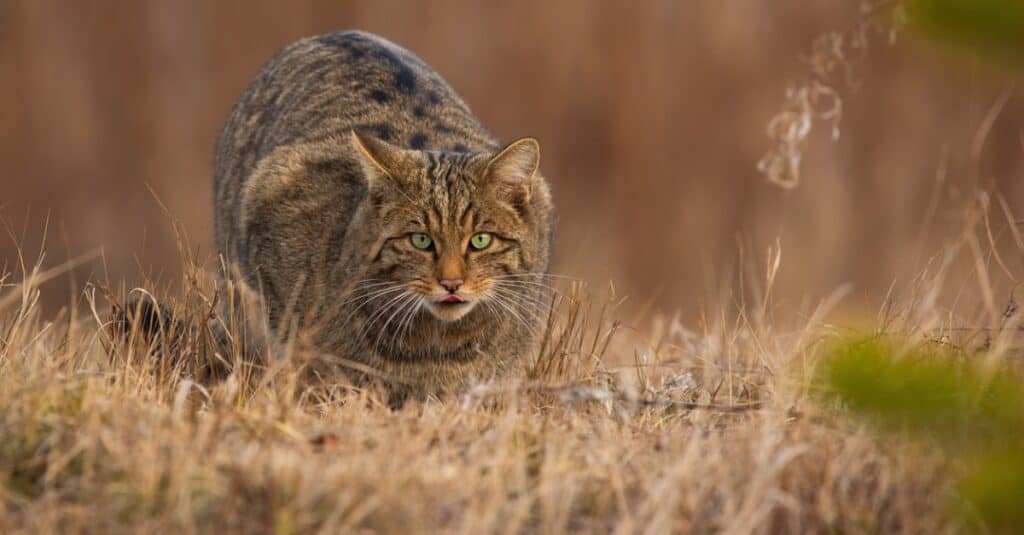
European wildcats prey on common buzzards.
©iStock.com/JMrocek
What eats common buzzards?
Eagles, wildcats, and foxes are all predators of this bird. Foxes and wildcats may capture a bird by sneaking up on it as it eats carrion. Eagles are larger than these birds and can overpower them.
Humans can be a threat to these birds as well. Sometimes, to get rid of a fox in the area, people will set out poisoned traps. The buzzards may consume this poison.
Habitat loss due to deforestation is another threat.
Despite all of these threats, the official conservation status of the common buzzard is Least Concern with a stable population.
Reproduction, Young, and Molting
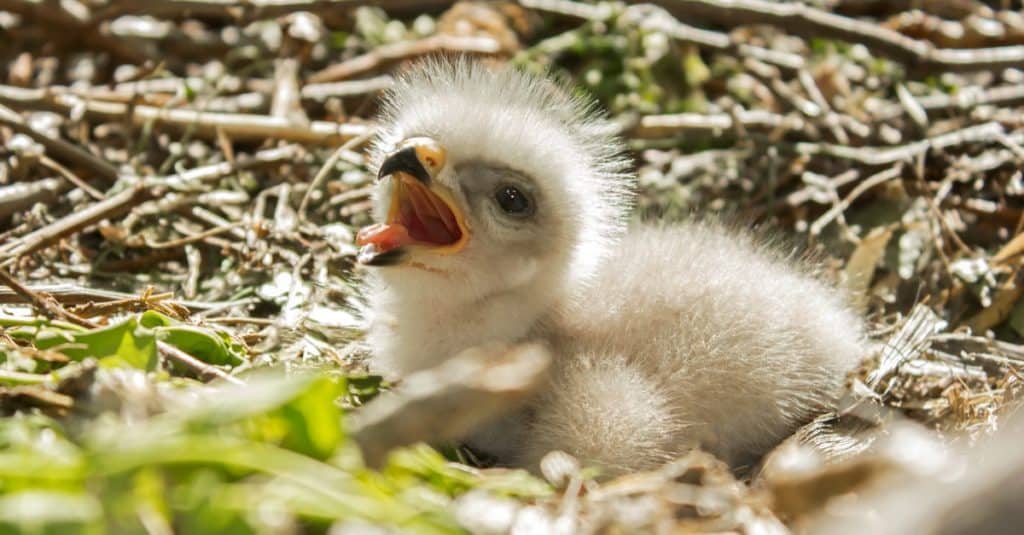
Buzzard chicks leave the nest after 6 to 8 weeks.
©Luka Hercigonja/Shutterstock.com
The breeding season of this bird runs from March to May. A male attracts a female by flying in circles and diving. These birds are monogamous.
The female lays 2 to 4 eggs that hatch in 33 to 38 days. Newborn buzzards are known as chicks. The male hunts for food for both the female and the chicks. The chicks begin to get a full layer of feathers at 50 to 60 days old. After 6 to 8 weeks in the nest, the chicks are strong enough to live on their own.
Common buzzards reach sexual maturity at 3 years old. One of the most incredible facts about this bird is that its lifespan goes up to 25 years.
Population
According to the IUCN Red List of Threatened Species, there are 2,100,000 to 3,500,000 mature common buzzards worldwide.
Europe has the largest population, with 1,630,000 to 2,170,000 mature individuals.
The conservation status of this bird is Least Concern with an increasing population.
Common Buzzard Pictures
View all of our Common Buzzard pictures in the gallery.

Henk Bogaard/Shutterstock.com
How to say Common Buzzard in ...
Sources
- Wikipedia / Accessed December 29, 2020
- Living with Birds / Accessed December 29, 2020
- Sciencing / Accessed December 29, 2020