




Quick Take
- Achieving a 13-foot leg span is a mandatory requirement for the Japanese spider crab to dominate.
- A catastrophic drop of 7 billion individuals forced the sudden cancellation of the Alaskan crab season.
- The horseshoe crab is strangely closer to terrestrial spiders than to any other aquatic crustacean.
- Executing a periodic molt is a critical requirement for Decapoda to achieve their next growth stage.
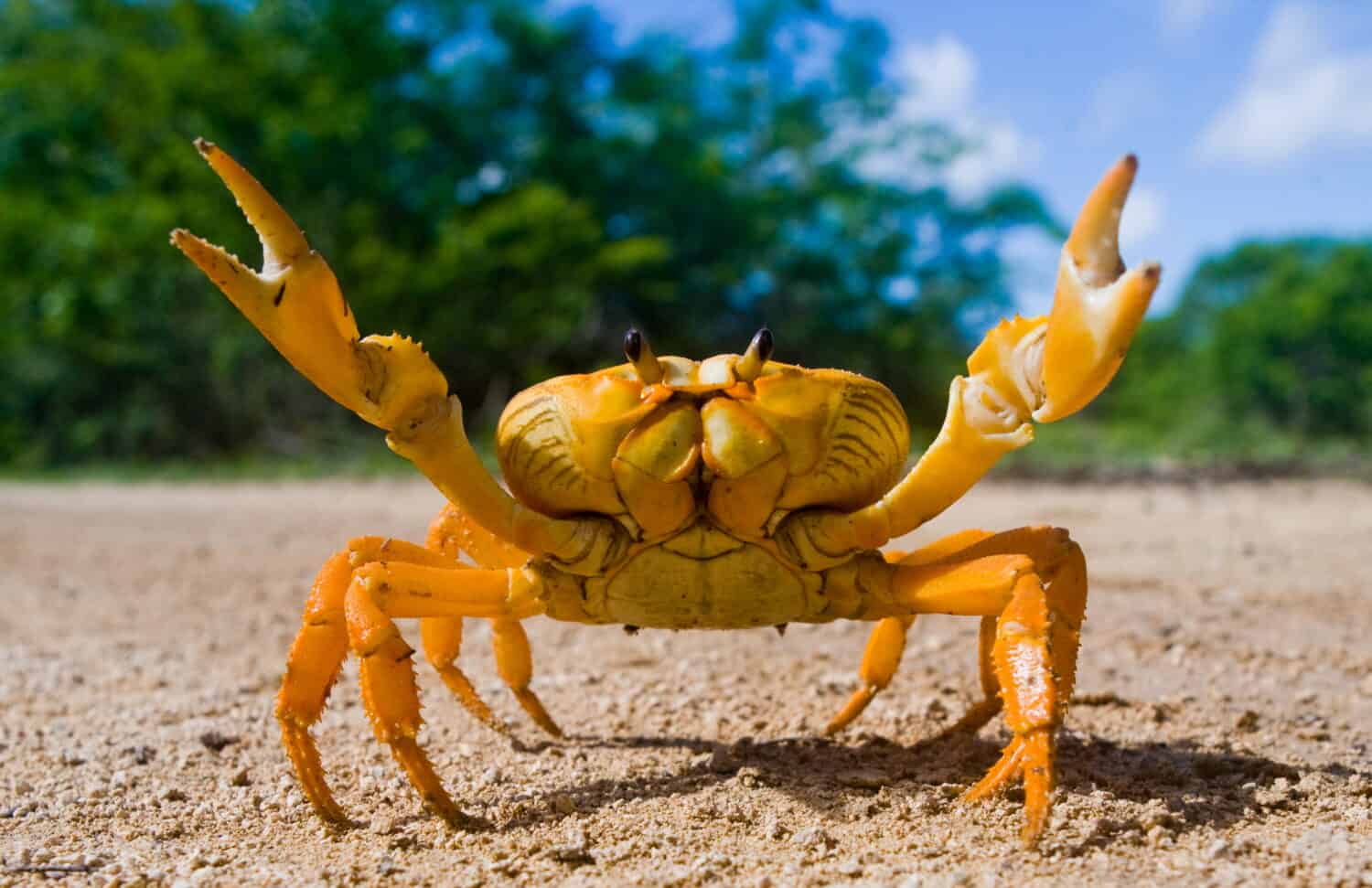
Ever wonder why crabs wave pincers around? They are using them to communicate, and will even use their pincers to make drumming noises!
More than 6,700 species of crabs have been identified. Some crabs live exclusively in the ocean, while others live along the shoreline, and some crabs live in freshwater instead of the saltwater environment of the ocean. Still, others live full-time on land, but always near water of some type.
Crabs are very important animals to the environment because they help to keep things clean. They are also an important source of food for a wide range of other creatures, including humans.

Interesting Crab Facts
- Crabs are animals that help coral reefs to survive by cleaning away the debris that might otherwise kill the reefs.
- Crabs have been around since Jurassic times, more than 200 million years ago.
- Most crabs walk and swim sideways.
- Male crabs of some species fight with one another over mates and hiding places.
- Crabs have 10 legs, but the first two are claws and are not used for walking.
Classification and Scientific Name
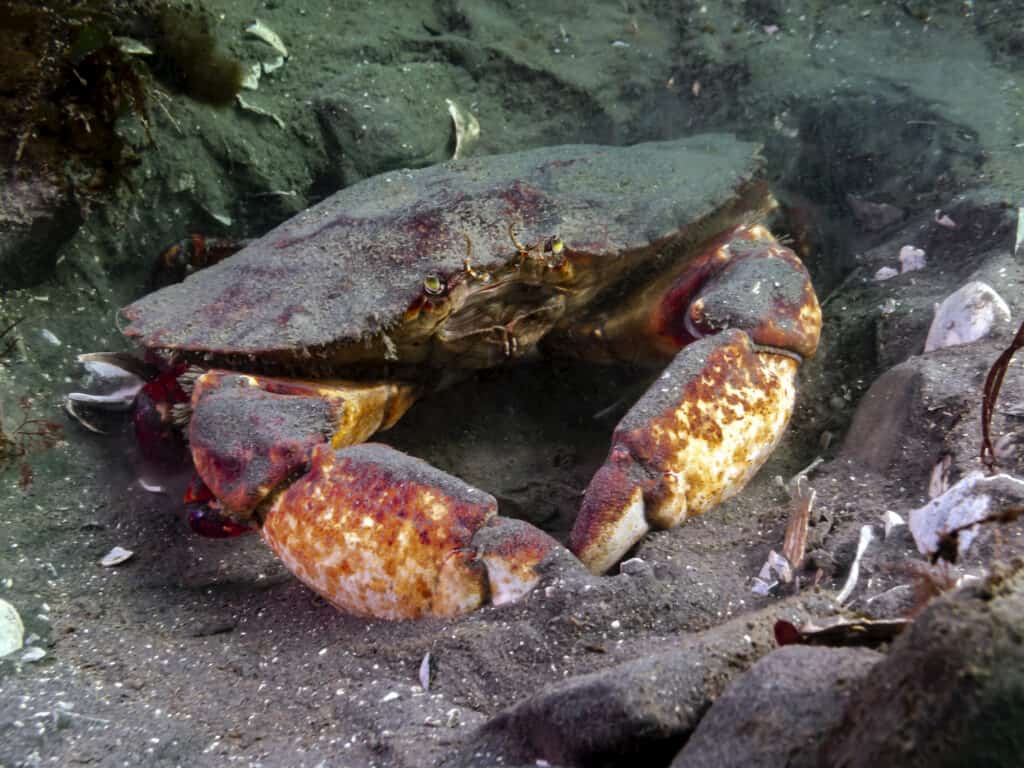
An adult Red Rock Crab burrowing in the mud; photographed in southern British Columbia.
©iStock.com/naturediver
Since there are so many different kinds of crabs, they have thousands of common names, such as king crab, horseshoe crab, blue crab, snow crab, coconut crab, and more. Yet, they all belong to the scientific order Decapoda, which comes from the Greek words “deka” meaning ten, and “pous” (poda), meaning feet.
Most crabs belong to the Brachyura family. This term is based on the characteristic of crabs to have a short, hidden tail. The word Brachyura comes from the ancient Greek terms for short, “brachys”, and tail, “oura.”
However, not all crabs belong to this family, and some of the better-known species, such as the king crab, are in the Lithodidae family. This name comes from the Greek word “lithodes,” which means stone-like, because they have very hard, stone-like shells.
Evolution and Origins
Gecarcinucidae, Potamidae, Potamonautidae, and Pseudothelphusidae are the four most important families of freshwater crabs, and they have ancient origins that date back to the early Cretaceous. During the late Cretaceous to the early Tertiary, the majority of the current families and superfamilies evolved.
Their small, protective bodies are more like those of genuine crabs, and they move more quickly sideways. Hence, “crabs” are not a legitimate biological species. These are a group of identically morphed branches of the decapod tree.
The advantages of having a crab shape are still unknown, but according to researchers, they might have something to do with the ability to colonize new habitats or diversify into new species.
The real crabs, one of the apex forms of crustacean evolution, did not appear until the Cretaceous period (145.5 million to 65.5 million years ago).
Types of Crabs
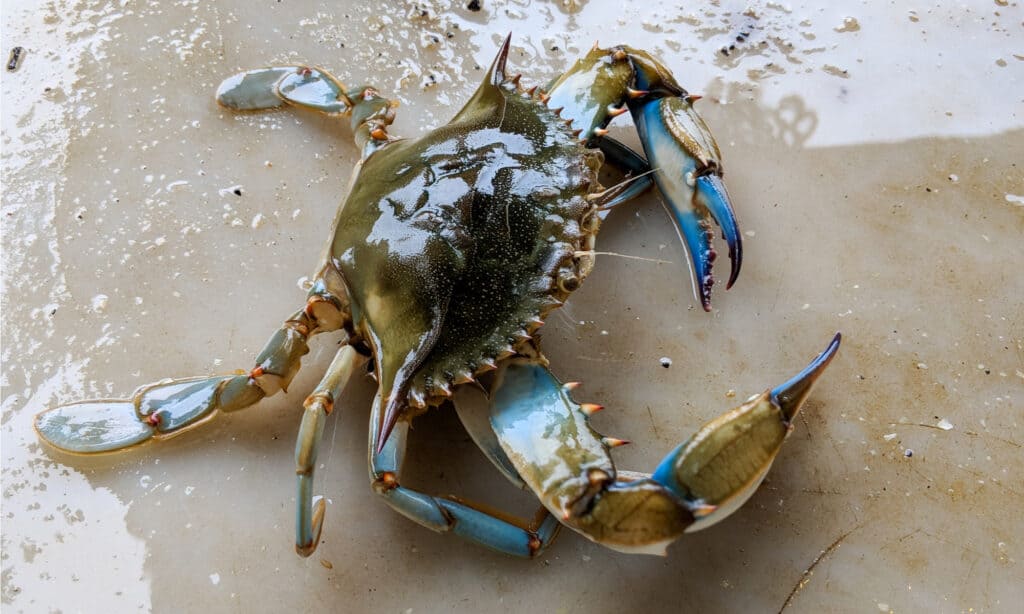
Blue crabs are native to the eastern coast of the USA.
©P. Dorman/Shutterstock.com
- King Crab: King crabs are among the largest species of crabs, with the red king crab weighing almost 30 pounds. These crabs inhabit cold climates and are commonly fished for food production.
- Blue Crab: Blue crabs are another large species of crab native to the eastern coast of the United States and the Gulf of Mexico. Easily identifiable by their blue bodies and legs, these crabs have a fifth pair of paddle-shaped legs that aid in swimming.
- Bairdi Crab: Bairdi crabs, also known as tanner crabs, can weigh up to four pounds and inhabit the Bering Sea. These crabs have short tails, carapace bodies, an abdominal flap, and pincers on their frontmost pair of legs.
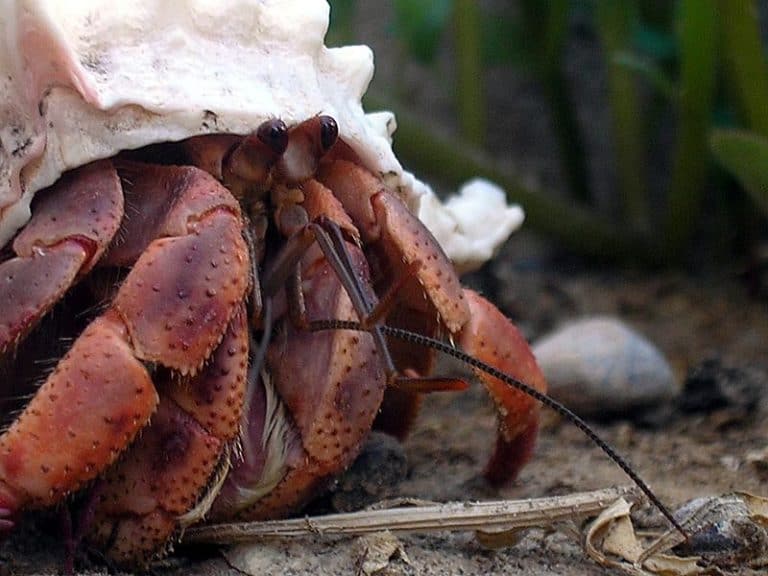
- Hermit Crab: Hermit crabs have adapted to occupying empty mollusk shells to protect their soft exoskeleton. These crab species have become popular pets among children.
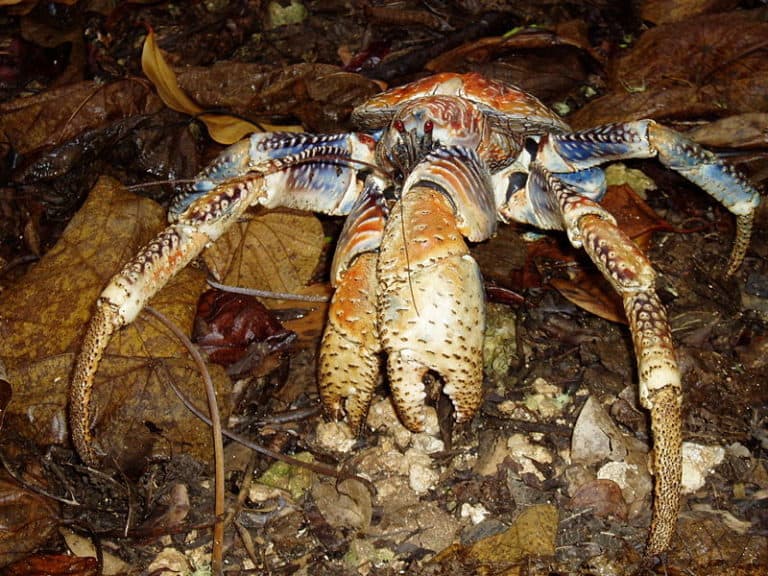
- Coconut Crab: Coconut crabs are the largest terrestrial arthropods, weighing up to 9 pounds. Also known as the robber crab or palm thief, these crabs will eat anything left on the ground and are often seen climbing coconut trees to dislodge the fruit or escape from predators.
Appearance
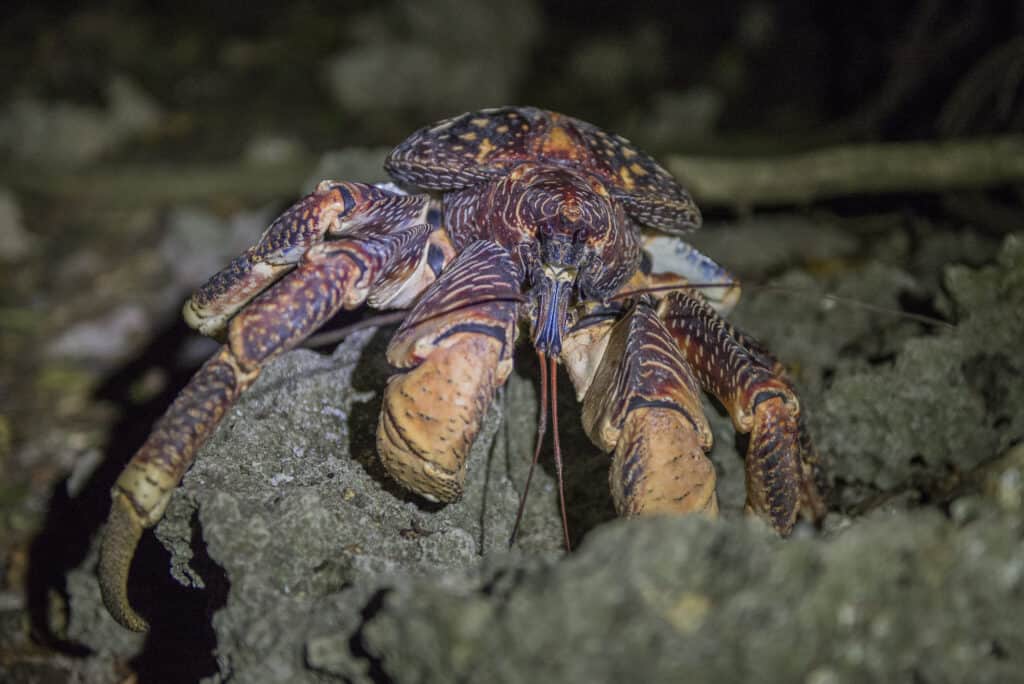
Coconut crabs have a very keen sense of smell that works differently underwater and on land.
©iStock.com/Riccardo Maywald
Each kind of crab has a unique appearance that separates it from all other crabs, though some look enough alike that only an expert can tell them apart. In general, a crab has a rounded or oval-shaped body that is sometimes smooth and sometimes covered with protrusions of varying lengths that offer the crab some protection from predators.
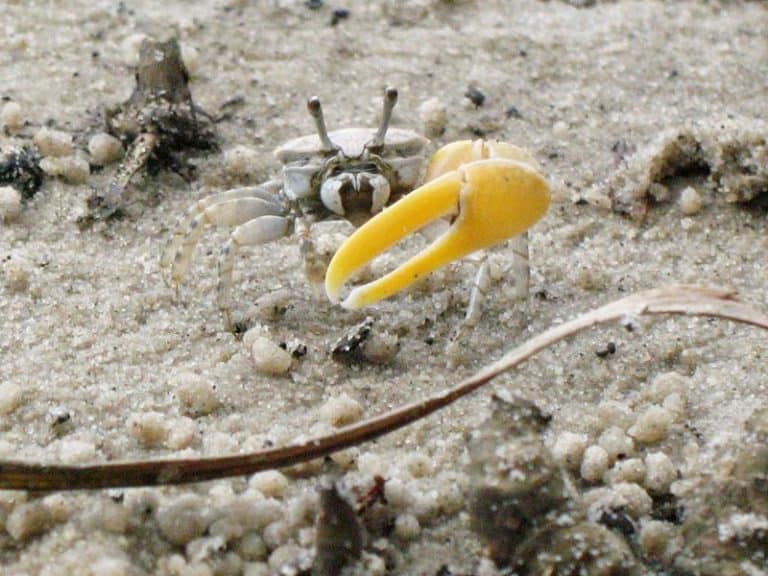
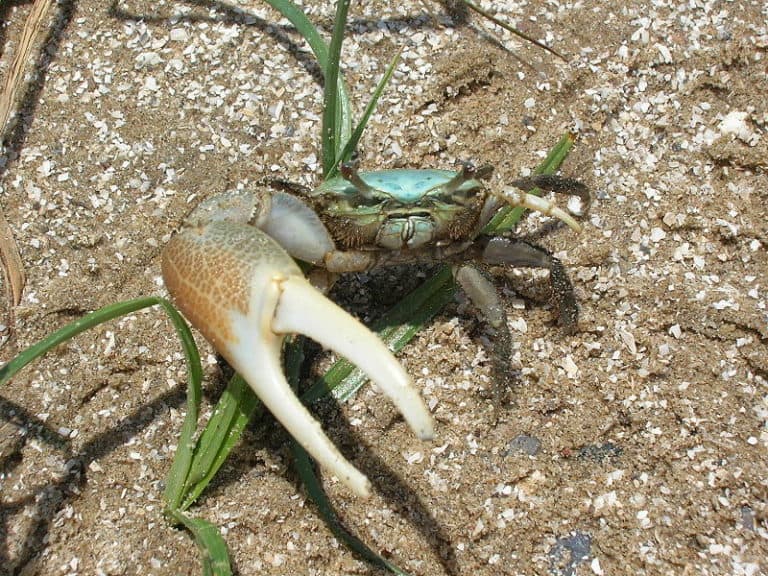
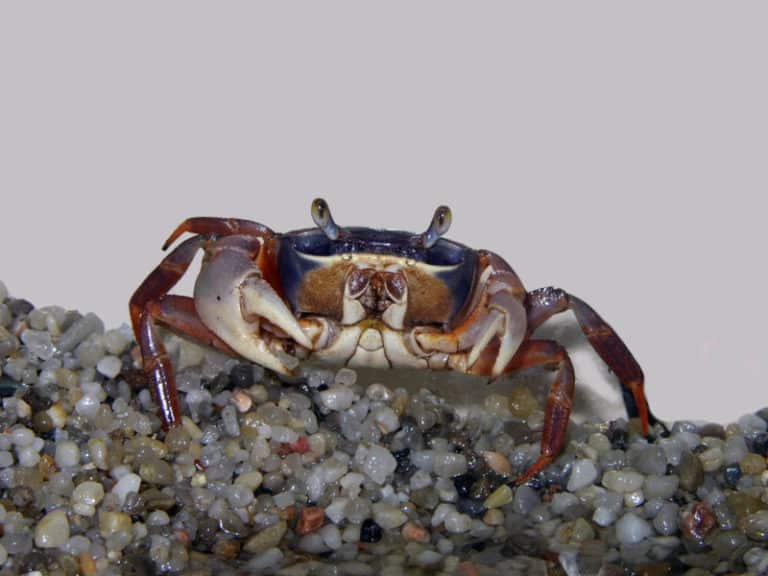
Crabs have ten legs, five along each side of the body. The pair of legs in the front has evolved to become pincers that the crab can use for defense or to feed itself. In some crabs, the pincers are of roughly equal size, but in other species, such as the fiddler crab, one pincer is much larger than the other.
Crabs come in a wide range of sizes. The smallest known crab is the pea crab, Pinnotheres pisum, which measures as little as 0.27 inches (0.68 cm) across. That’s about half the size of an aspirin tablet.
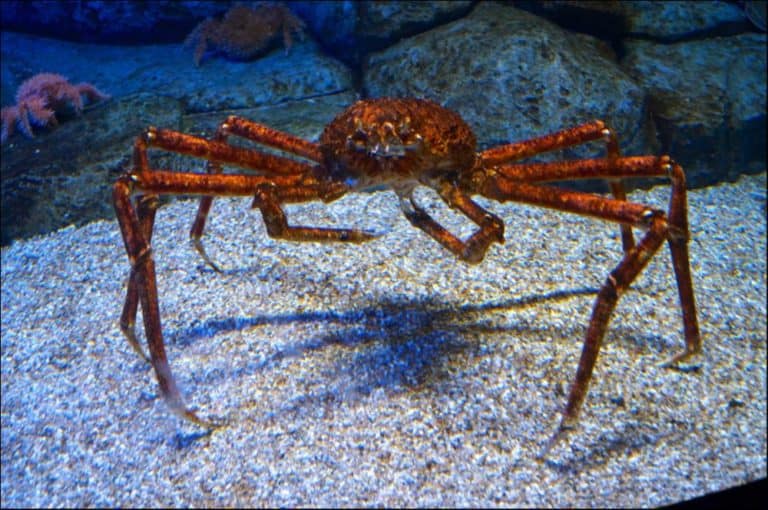
The largest crab is the Japanese spider crab, which can grow as much as 13 feet (4 m) wide when its legs are spread — about the length of a Volkswagen. The heaviest crab ever found was a king crab, which weighed in at an amazing 28 pounds, about the same weight as a corgi or a miniature poodle.
The average crab falls in between these two extremes and is only about 15.74 inches (40 cm) in diameter, or about one-tenth the length of a Volkswagen.
A crab’s body is covered with a hard shell called an exoskeleton. This protects the crab during most of its life, but because the exoskeleton can’t grow with the crab, it must be shed, typically once per year, to allow the crab to grow. This is a very vulnerable time for crabs, and they usually try to hide at this time.
The exoskeleton of a crab is the part that determines what color it is. Crabs come in many different colors, depending on the species and where they live. Many are shades of red or blue, but crabs are also brown, white, yellow, tan, or a combination of colors. A crab’s color can help to protect it by offering it some camouflage.
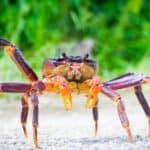
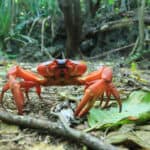
However, sometimes the color is very distinctive, such as with the bright red Christmas crabs from Christmas Island. In these cases, the color helps crabs find one another or warns other creatures to stay away.
Crabs can also have smooth shells, or they can be covered with spiny bumps that deter predators or help them hide in coral reefs or rocky niches.
Sexual Dimorphism
Crabs often express or show marked sexual dimorphism. Sexual dimorphism is simply a distinct difference in size, shape, and appearance between the two different sexes in mammals. Males will often have larger claws and a tendency that is particularly pronounced in the fiddler crabs.
In fiddler crabs, males actually have one claw that is much larger than the other, and its main purpose is for communication and attracting a mate. Another difference is the form of the abdomen in most male crabs. This is narrow and almost triangular in shape, while females have a much more rounded abdomen. This is mostly due to where female crabs keep fertilized eggs.
Behavior
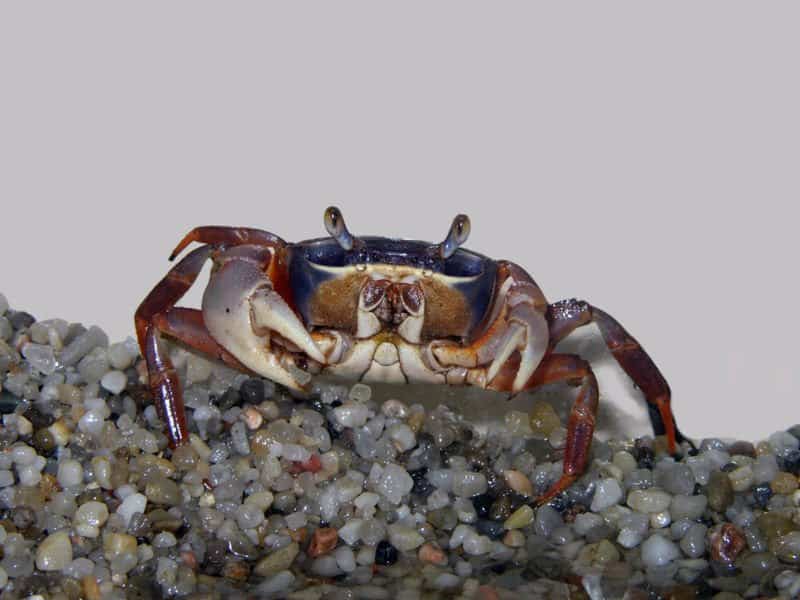
Different kinds of crabs have different lifestyles. Some crabs live alone, only meeting with other crabs when it’s time to mate. Other types of crabs live in large groups called “casts” all the time. These groups can have hundreds or even thousands of crabs in them. Living in a group makes it easier for a crab to find a mate, and it also makes it harder for any one crab to be selected as prey by a predator, so it helps to keep them safe.
Crabs tend to be shy and will usually run from danger. Even though crabs have pincers that they can use to hurt a predator, the injury is usually not serious, and most crabs would rather run than fight. Some crabs, though, such as the coconut crab, have big, strong pincers that are strong enough to break a person’s finger. These animals live on land and can be aggressive. They will even attack small animals such as dogs and cats if they encounter them.
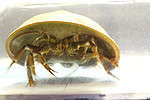
One type of crab, the horseshoe crab, is actually not a crab at all. In fact, it’s not even a crustacean. This is an ancient species that has been mostly unchanged since the time of the dinosaurs. People continue to call them crabs because they live in salt and brackish water and act a lot like crabs, but they aren’t. Surprisingly, their closest living relatives are not other crabs, but spiders.
Habitat
Crabs typically live around water, especially saltwater or brackish water. They are found in every ocean on Earth. Some live in the water all of the time, while others live at the edge of the water, in and among the rocks or the sand along the shores. Some types of crabs live only in freshwater and would die if they were put into the ocean.
Other types of crabs live entirely on land, though most of these live at least some part of their lives in the water. Often, they seek the water to breed, and the babies are born there and live in the water until they are developed enough to come out onto the land. Sometimes land crabs migrate in huge groups to the ocean when it’s time to breed, as with the red Christmas crabs that seem to take over everything where they live until the breeding season is over.
Diet
What crabs eat varies greatly by species, but most crabs are omnivores, meaning that they eat both plants and animals. The tiny pea crab spends its life as a parasite inside of oysters, mussels, sand dollars, sea cucumbers, and other creatures, where it consumes plankton that the host brings in to feed itself. Larger crabs live on their own and often hide in burrows where they dart out to grab shrimp or fish that get too close. Crabs also eat algae, mussels, barnacles, clams, seahorses, and even smaller crabs.
Predators and Threats
Although crabs have a hard outer shell that protects them, they are still a favorite food for many animals. Newborn crabs lack a shell and usually live like free-floating plankton, where they are a target for all kinds of predators, including tiny fish, corals, anemones, sea worms, and the young of most kinds of animals.
As the crabs begin to develop a shell, they become better protected, but they are still vulnerable to predatory fish, otters, larger crabs, octopuses, and humans. Some crab predators use very unique tactics, such as the pistol shrimp, which “shoots” high-powered bubbles that knock crabs unconscious.
Data are lacking for the International Union for the Conservation of Nature (IUCN) to classify the conservation status of all crabs, but some species are listed as near-threatened, meaning that their numbers may decline in the future. Some crabs, such as king crabs, are experiencing population declines and survival challenges due to warming water temperatures and ocean acidification, which could threaten their future survival.
Plenty of crabs still live in the ocean, and humans take advantage of this abundance by catching and consuming them in large numbers. Humans consume several million tons of crab annually, with global consumption estimated to reach around 3.7 million metric tonnes by 2026. The most consumed species can vary by region, with blue crabs and snow crabs among the most popular.
If crab fishing is not controlled, some species could end up extinct. Regulating the number of crabs caught each season helps to control their numbers and make sure that crabs continue to be around in the future.
Reproduction, Babies, and Lifespan
Male crabs will often use their pincers to attract a mate. This is especially common in species that have one very large claw, or pincer, such as the fiddler crab. Males of some species will also fight one another over a female, with the winner getting to mate and the loser going off and looking for another female.
Crabs typically mate when they molt, because there’s no hard shell to get in the way. This is usually when both the water temperature and the outside air are warm. Many aquatic crabs mate belly to belly, and the eggs are fertilized internally.
The female can store the sperm until she needs it, then use it to fertilize her eggs. The fertilized eggs are placed on her underside, near her tail, and carried there until they hatch. The larvae are free-swimming and join the plankton in the water. Even crabs that live on land must migrate to the water where their babies are born. The babies must live in the water for a time and then migrate back onto the land when they become juveniles.
Larval crabs molt several times before they start to look like their parents. As juveniles, they will begin to act like their parents as well and will either join a cast of crabs or find themselves a suitable place to live. While some small crab species live only three to four years, many common crabs, such as Dungeness crabs, can live 8-13 years, and some species like the Japanese spider crab can live for several decades.
Population
With over 6,700 species of crab worldwide, their overall numbers are considered large but unknown for most species. Many crabs are listed by the IUCN as DD, which means data deficient, because there’s not enough information about them to tell whether or not they exist in large numbers. Some types of crabs are threatened because they have limited areas in which to live, and when humans encroach upon their territory, the crab numbers decrease.
Humans do monitor some species closely, as people have an interest in how well the species used for food are doing. King crabs, Opilio crabs, Japanese blue crabs, and other species that are routinely caught for humans to eat are regulated by fisheries in many countries, with strict limits as to how many can be caught, as well as the size and sex of those kept. The timing of the fishing is also controlled. This helps to keep the population healthy so that there will continue to be plenty of crabs.
Human Consumption
Crabs have been a part of the human diet for as long as humans have been living near water bodies. Now they are considered exotic and eaten all across the globe. Crabs are either eaten whole, just the claws and legs, or, in some cultures, hard-shelled crabs are cooked whole. In the Southeast Asian regions, especially the parts that fall under the influence of the Infosphere, crabs are cooked with a whole lot of spices, and even the roe is consumed.
In the west however, crabs are either steamed and the meat is first removed from the shell, and served with garlic and butter, or as crab cakes, a delicious concoction of crab meat mixed with egg whites, mayonnaise, cracker meals, etc.
What kind of nutrition does crab meat have?
Do crabs have health benefits? Let’s find out.
Nutrition value of crabs (100 Grams):
- Calories: Crab meat has around 97 calories per 100 grams, which, compared to a lot of other sources, is low.
- Protein: Crab meat contains around 38% protein, which means 19g of protein per 100g of crab meat.
- Fats: It contains around 2% fat and 0% saturated fat.
- Cholesterol: Crab meat contains around 53 mgs of cholesterol per 100 g.
- Carbs: Crab meat is carbohydrate-free.
- Vitamins: It contains high levels of Vitamin B6 and B12 and Vitamin C.
- Minerals: Crab meat has high amounts of sodium, potassium, iron, calcium, and magnesium.
As you can see, crabs can be considered a good source of protein and micronutrients, and can be used as substitutes for other meats.
‘It is important to note that in recent years, the crab population around Alaska has suffered a drastic decline, with numbers falling from around 8 billion in 2018 to 1 billion in 2021. This decline has led authorities to cancel crab seasons in the region. Recent research points to warming ocean temperatures and ecological shifts as primary causes of this collapse.
Crab Pictures
View all of our Crab pictures in the gallery.

StuVidiot/Shutterstock.com
How to say Crab in ...
Sources
- David Burnie, Dorling Kindersley Animal, The Definitive Visual Guide To The World's Wildlife / Accessed December 14, 2008
- Tom Jackson, Lorenz Books The World Encyclopedia Of Animals / Accessed December 14, 2008
- David Burnie, Kingfisher The Kingfisher Animal Encyclopedia / Accessed December 14, 2008
- Richard Mackay, University of California Press The Atlas Of Endangered Species / Accessed December 14, 2008
- David Burnie, Dorling Kindersley Illustrated Encyclopedia Of Animals / Accessed December 14, 2008
- Dorling Kindersley Dorling Kindersley Encyclopedia Of Animals / Accessed December 14, 2008