D
Species Profile

Darwin’s Frog

Rhinoderma darwinii

Dad's vocal sac, nature's nursery
Mono Andes / Creative Commons

Darwin’s Frog Distribution

Click a location to explore more animals from that region

Loading map...

At a Glance

Wild Species
Also Known As rana de Darwin, ranita de Darwin
Activity Diurnal+
Lifespan 5 years
Status Vulnerable
Did You Know?

Adults are very small: ~2.2-3.2 cm snout-vent length (SVL) (reported in species accounts/field guides for R. darwinii).

Scientific Classification

A small South American frog famous for extreme parental care: males brood developing tadpoles in their vocal sac and later release fully formed froglets.

Kingdom
Animalia
Phylum
Chordata
Class
Amphibia
Order
Anura
Family
Rhinodermatidae
Genus
Rhinoderma
Species
darwinii

Distinguishing Features

  • Pointed, ‘nose-like’ snout
  • Leaf-litter camouflage with mottled brown/green coloration
  • Very small size (typically a few centimeters long)
  • Male vocal-sac brooding of tadpoles (unique reproductive strategy)

Physical Measurements

Length
1 in (1 in – 1 in)

Appearance

Primary Colors
Secondary Colors
Skin Type Moist amphibian skin; generally smooth to finely granular (lightly warty in places rather than strongly tuberculate). Designed for a cool, humid temperate-forest microclimate; sensitive to drying and microhabitat disturbance.
Distinctive Features
  • Very small anuran: adult snout-vent length (SVL) commonly reported around ~2.0-3.2 cm (with females typically averaging slightly larger than males).
  • Distinctive pointed, wedge-like snout (often described as 'beaked'), enhancing a leaf-tip mimic profile when the frog is motionless in litter.
  • Compact body with relatively slender limbs; toes lack large adhesive pads (not a canopy treefrog), consistent with a ground-dwelling/low-vegetation lifestyle.
  • Cryptic dorsal coloration and irregular markings that mimic decomposing leaves and shadows in temperate Nothofagus/Valdivian forest floor habitats in southern Chile and adjacent Argentina.
  • Extreme parental-care trait with a major visible effect in males: the male's vocal sac can become distended during brooding as developing tadpoles are held internally; later, fully formed froglets are released from the mouth.
  • High sensitivity to habitat changes (forest fragmentation, drying of understory, microclimate shifts) and other threats can indirectly affect appearance/condition (e.g., dehydration stress, reduced body condition), as this species relies on cool, consistently humid leaf-litter refuges.

Sexual Dimorphism

Sexual dimorphism is present but subtle in overall shape; females tend to be slightly larger on average, while males are distinguished by an expandable vocal sac used for calling and for brooding developing young internally until froglets are released.

♂
  • Expandable vocal sac/throat region; during reproductive periods the throat can appear noticeably swollen due to vocal-sac brooding of developing young (a unique, highly diagnostic feature in the field).
  • Typically slightly smaller average SVL than females (overlapping ranges; size alone is not fully reliable without observing reproductive condition).
♀
  • Typically slightly larger average SVL than males (overlapping ranges).
  • Lacks the brooding/distension associated with male vocal-sac parental care.

Did You Know?

Adults are very small: ~2.2-3.2 cm snout-vent length (SVL) (reported in species accounts/field guides for R. darwinii).

Reproduction is famous: the male takes hatched larvae into his vocal sac and later "gives birth" to froglets from his mouth.

They live in cool, wet temperate forests (Valdivian/Andean) and often hide in leaf litter and mossy ground cover.

Pointed snout + leaf-like coloration helps them vanish among fallen leaves; individuals can look green, brown, or mottled.

They are extremely sensitive to habitat drying and disturbance; forest fragmentation and microclimate change are major threats.

Conservation status is Endangered (IUCN Red List) and populations have declined sharply in parts of the range.

Named for Charles Darwin, who collected early specimens during the voyage of the HMS Beagle (1830s).

Unique Adaptations

  • Vocal-sac "internal nursery": a rare amphibian strategy where the male's vocal sac functions as a brooding chamber that supports development to froglet stage.
  • Extreme paternal investment: male protects developing young from many external aquatic predators and from stream/pond dependence.
  • Cryptic, leaf-mimicking morphology: small body, pointed snout, and disruptive coloration help it blend into temperate-forest detritus.
  • Reproductive mode adapted to cool forests: reduces reliance on standing water, fitting a leaf-litter ecology in southern temperate climates.

Interesting Behaviors

  • Male vocal-sac brooding: after eggs hatch, the male gathers larvae and houses them inside the vocal sac until metamorphosis, then releases froglets.
  • Leaf-litter sit-and-wait behavior: often remains motionless and relies on camouflage rather than fleeing when approached.
  • Moisture-driven activity: most detectable during cool, humid conditions; retreats into litter/under logs when conditions dry.
  • Acoustic communication: males call during breeding season; the same vocal sac used for calling is later used for brooding.
  • Site fidelity to suitable microhabitats: tends to use stable, humid forest-floor patches (moss, fern bases, rotting wood).

Cultural Significance

Darwin's Frog is an emblematic species of Chile's Valdivian temperate rainforest and a flagship for amphibian conservation in southern South America. Internationally it is tied to the history of natural science through Charles Darwin's collections and later scientific attention to its extraordinary paternal brooding.

Myths & Legends

Naming-and-discovery lore: the species' common name preserves the historical association with Charles Darwin's Beagle-era collecting in southern Chile-often retold as a classic natural-history story of "Darwin's little frog" from the temperate rainforests.

Regional rain-and-frog beliefs (broader Chilean rural tradition): frogs' calls are commonly treated as signs of impending rain or changing weather, a widespread countryside association that situates local frogs as seasonal "announcers" of storms.

Conservation Status

VU Vulnerable

Facing a high risk of extinction in the wild.

Population Decreasing

Protected Under

  • Chile: Hunting Law (Law No. 19,473) and its implementing regulations provide legal protection for native wildlife, including restrictions on capture or harvest of native amphibians.
  • Argentina: National Wildlife Conservation framework (Law No. 22.421) and provincial regulations apply to native fauna protection and control of take/commerce; site-level protections vary by province.
  • Occurs in multiple protected areas across its Chilean-Argentine range (site coverage is incomplete and populations outside reserves remain vulnerable to habitat conversion and disease).
  • HUBS (Rhinodermatidae conservation landscape): The family comprises two species-Rhinoderma darwinii (Vulnerable, decreasing) and Rhinoderma rufum (Critically Endangered, possibly extinct). Across the group, the dominant pressures are native forest loss/fragmentation (logging/plantation conversion), amphibian disease (chytridiomycosis), and climate-linked drying/warming that erodes cool, humid forest-floor microhabitats; R. rufum is the most at-risk species.

Life Cycle

Birth 30 froglets
Lifespan 5 years

Lifespan

In the Wild
2–10 years
In Captivity
4–15 years

Reproduction

Mating System Polygynandry
Social Structure Solitary
Breeding Pattern Transient
Fertilization Substrate Spawning
Birth Type Substrate_spawning

Darwin's frog (Rhinoderma darwinii) breeds on the cool forest floor by amplexus, laying small clutches (3–20) on leaf litter. The male broods tadpoles in his vocal sac until froglets; total development about 2–3 months. No helpers; females not bonded; parentage data limited; likely polygynandry.

Behavior & Ecology

Social Breeding pair Group: 1
Activity Diurnal, Crepuscular
Diet Insectivore No single experimentally confirmed "favorite prey" is published for Darwin's frog; species accounts most consistently describe it taking very small leaf-litter arthropods-especially springtails and mites-as frequent items (for example, AmphibiaWeb species account; IUCN Red List species account).
Seasonal Hibernates

Temperament

Cryptic and wary; relies on camouflage and remaining motionless rather than active defense
Generally non-gregarious and non-cooperative; social tolerance is mostly limited to brief breeding interactions
Males can be locally territorial around calling/breeding micro-sites (expressed primarily through calling/spacing rather than overt fighting), with intensity varying by density and season (general anuran pattern; see Wells, 2007)

Communication

Male advertisement call: a soft, high-pitched tonal 'peep' used to attract females and maintain spacing from rival males; calling is typically from concealed positions in leaf litter/moss Wells, 2007; IUCN account for natural history context
Context-dependent calling associated with territorial spacing Male-male acoustic interactions), with call rate and daily timing varying with temperature and humidity (Wells, 2007
Acoustic localization Phonotaxis): females orient to calling males during breeding season (general anuran mechanism; Wells, 2007
Tactile cues during courtship/amplexus and during egg attendance/collection prior to vocal-sac brooding
Visual signaling is limited; camouflage and stillness function more as anti-predator strategy than intraspecific display
Likely use of chemical cues for close-range recognition and/or habitat assessment is plausible in anurans, but species-specific experimental evidence for Rhinoderma darwinii is not consistently quantified in readily comparable datasets Noted here as a data-gap rather than a confirmed mechanism

Habitat

Forest Rainforest Deciduous Forest Coniferous Forest Woodland Wetland Bog Marsh River/Stream +3
Biomes:
Temperate Forest Temperate Rainforest Wetland Freshwater
Terrain:
Mountainous Hilly Valley Coastal
Elevation: Up to 3608 ft 11 in

Ecological Role

Leaf-litter insectivore (mesopredator) in temperate South American forest-floor food webs.

Regulation of leaf-litter arthropod populations (insect and mite control) Energy transfer from detrital/leaf-litter invertebrate production to higher trophic levels (as prey for birds, reptiles, and mammals) Contributes to forest-floor community balance; sensitive to habitat change and thus useful as a bioindicator of intact, humid native forest conditions (as noted in conservation assessments such as the IUCN Red List).

Diet Details

Main Prey:
Springtails Mites Ants Beetles Flies and other small true flies Small spiders Small leaf-litter arthropods +1

Human Interaction

Domestication Status

Wild

Darwin's frog (Rhinoderma darwinii) is not domesticated. It lives on the forest floor in southern Chile and Argentina in temperate Nothofagus forests and leaf litter. Humans affect it by logging, plantation change, habitat loss, drying, and disease. Adults are tiny (2.2–3.2 cm). Males brood 3–20 land eggs in a vocal sac 6–10 weeks. Conservation, research and ecotourism are key interactions.

As a Pet

Not Suitable as Pet

Legality: Darwin's Frog (Rhinoderma darwinii) is threatened and usually protected in Chile and Argentina. It is not recommended as a pet and is mostly not legal without a conservation or research permit and import/export permission.

Care Level: Expert Only

Purchase Cost:
Lifetime Cost: $2,000 - $15,000

Economic Value

Uses:
Conservation (flagship species for temperate forest protection) Scientific research (parental care, life-history evolution, amphibian decline studies) Environmental education Ecotourism / wildlife photography (local, low-volume)
Products:
  • No sustainable commercial products; value is primarily non-consumptive (research, education, conservation attention).

Relationships

Predators 4

Chilean long-tailed snake Philodryas chamissonis
Chilean slender snake Tachymenis chilensis
American mink
American mink Neogale vison
Black rat
Black rat Rattus rattus

Related Species 1

Northern Darwin's frog Rhinoderma rufum Shared Genus

Ecological Equivalents 3

Animals that fill a similar ecological role in their ecosystem

Patagonian ground frogs Eupsophus spp. Small leaf-litter frogs of southern Nothofagus forests in Chile and Argentina. They occupy moist understory and mossy leaf-litter habitats and feed on small insects. Eupsophus species lack the male brooding behavior exhibited by Rhinoderma darwinii.
Southern chorus frogs Batrachyla spp. Small Batrachyla frogs occur in cool, wet southern-temperate habitats (peatlands, wet meadows, forest edges) that overlap with Rhinoderma darwinii. Both use similar invertebrate prey and require high humidity and ground cover.
Marsupial frogs Gastrotheca spp. Gastrotheca species carry their young in a dorsal (back) brood pouch, whereas males of Rhinoderma darwinii carry tadpoles in their vocal sac and later release froglets. Both strategies reduce the risk to tadpoles in water, but Gastrotheca are Andean and do not co-occur with Rhinoderma darwinii.

The unique carnivorous Darwin’s frog carries tadpoles in its vocal sac for up to 70 days!

Darwin’s frog is native to streams and forests of Chile and Argentina. This tiny frog species gets its name after explorer Charles Darwin. He discovered the frog during his famous “Voyage of the Beagle” from February 1832 to September 1835. Darwin’s frog is able to camouflage itself on the forest floor, thanks to its evolving to look like a dried-up leaf.

5 Darwin’s Frog Facts

  • Male Darwin’s frogs carry hatchling tadpoles in their vocal sac for about 50 to 70 days.
  • Darwin’s Frogs are carnivores, eating small insects, snails, worms, and spiders.
  • Both humans and fungus are to blame for the frogs’ decline toward extinction.
  • These tiny frogs only grow up to 1.4 inches in length.
  • Despite being small, Darwin’s frogs travel at speeds of up to five miles per hour.

Darwin’s Frog Scientific Name

Commonly called Darwin’s frogs, these tiny amphibians of the class Amphibia bear the scientific name of Rhinoderma darwinii. They belong to the family Rhinodermatidae.

Two species of Darwin’s Frogs exist. One originates in northern Chile, while the other lives in southern Chile and Argentina. Sadly, scientists believe the northern Darwin’s frog to be extinct from a deadly fungus outbreak. But hope remains that these northern species still exist somewhere in the forests of northern Chile.

Of their scientific name, “rhinoderma” means rhinoceros-nosed. But they get their common name from the explorer who discovered and documented their existence, Charles R. Darwin.

Darwin’s Frog Appearance and Behavior

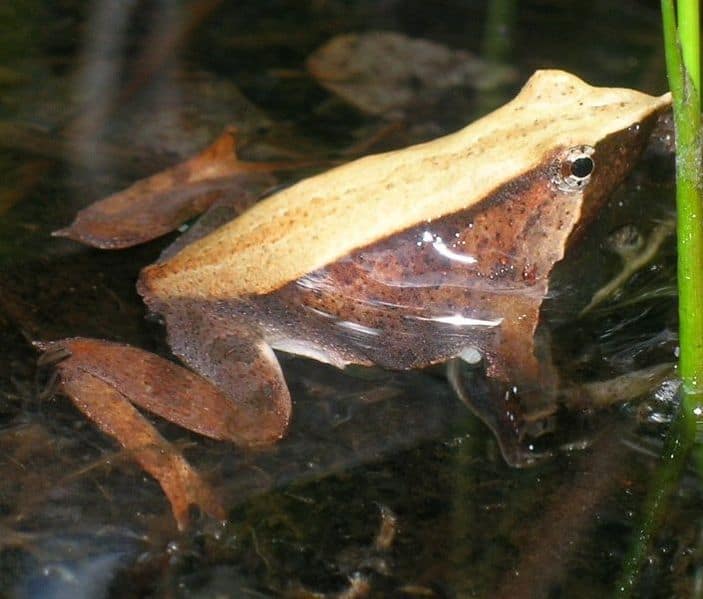
Darwin’s frog’s upper body skin is brown or green in color with large blotches. Its bottom side is usually black or white. Their skin features many warts as well.

The tiny frog relies on its coloration and skin texture to camouflage itself on the forest floor and in streams, looking like a dried leaf. Each individual frog’s body print and colors work much like a fingerprint for humans. No two frogs have the exact same patterned appearance.

The frog’s body is rounded, but its head is shaped like a triangle with a pointed snout. Its thin legs work very well for hopping on the forest floor at speeds of up to five miles per hour. Only its hind feet have webbing between toes, ideal for swimming. This lets the front feet better grip the ground.

This little frog is similar in size to a sewing thimble. It averages from 0.9 to 1.2 inches in length.

Darwin’s Frog is a diurnal creature, meaning it sleeps at night and is mostly active during daytime. When threatened by predators, the frog plays dead. It lays very still on the forest floor or floating in a stream. Its coloration and skin patterns make it look like a dead leaf, blending it in perfectly with forest debris.

Darwin’s Frog Habitat

Darwin’s Frogs live in the glades and forests of Chile and Argentina. The frogs prefer living in forests, bogs, and along the edge of slow-moving streams or swamps. But they live at altitudes of up to 3,600 feet above mean sea level. Overall, their habitat includes grasslands, the woody debris of forest floors, mossy areas, young trees, young bushes, and elsewhere in native forests.

Darwin’s Frogs are best suited for places with short vegetation, which keep the soil moist and at a cooler temperature. Since their coloration matches the habitats in which they live, they also find better places to hide from predators.

During the day and when sleeping, Darwin’s Frogs take shelter under logs or moss. They also enjoy basking in sunlight when no predators are near.

Darwin’s Frog Diet

Like many of its amphibian and frog cousins, Darwin’s Frog is a meat-eater. To capture its prey, the carnivorous frog simply sits quietly and waits for passing insects, spiders, snails, and worms. When prey comes near, the frog ambushes it quickly and silently with its long, sticky tongue.

Darwin’s Frog Predators and Threats

The biggest threats to Darwin’s Frogs are the fungus chytrid, which causes an infectious disease called chytridiomycosis. This fungal infection is capable of killing more frogs, more quickly than its natural predators or humans. Scientists do not know the origin of the bacteria responsible for this fungal infection. But it is believed to have wiped out the entire population of the northern Darwin’s Frog species of northern Chile. This means only the southern population of Darwin’s Frogs remain in southern Chile and Argentina.

Southern Darwin’s Frogs also face the ongoing threats of animal predators. These include rodents, snakes, and birds.

When a predator is near, the Darwin’s Frog uses its coloring to help it hide from the animal. By laying very still on the forest floor, the frog blends in with its surroundings. The predators only see what looks like another dead leaf on the ground. The frogs also drop or jump into a stream and float like a leaf down the river.

Humans threaten the Darwin’s Frog habitat through urbanization. Deforestation and encroaching cities take habitat from the frogs for human use. Other threats are results of climate change: changing temperatures and increased sun UV exposure can kill the frogs.

The northern Darwin’s frog is believed to be extinct. Its southern cousin of southern Chile and Argentina is vulnerable to extinction. Their risk for extinction is primarily due to human deforestation, climate change, and fungal infection threat.

Darwin’s Frog Reproduction, Babies and Lifespan

To reproduce, Darwin’s Frog males call out loudly during the night and throughout each day for females. This call is a quick pattern of “piiip” sounds. When a male finds a female to mate with, he leads her to shelter for breeding. This shelter is usually a mossy log or other partial covering.

The Darwin’s Frog is very unusual in how it takes care of its young. Each mating season ideally results in up to 40 clear eggs to a clutch. The female deposits the clutch of eggs into leafy debris on the forest floor. The male fertilizes the eggs, then stays nearby because his job is not finished. He waits for about three weeks near the clutch until the larvae are able to squirm within their eggs. He then scoops all of the eggs into his throat’s vocal sac. There, they spend about three days before hatching into tadpoles.

The tadpoles remain in the male’s vocal sac for another 50 to 70 days. During this time, the father frog provides nourishment from fluids within the sac. The tadpoles also gain nourishment from the yolk from the eggs.

At the end of their 50 to 70 days in the vocal sac, the tiny froglets move into their father’s mouth. The male frog then appears to spit the little frogs out. This process usually takes place at a stream.

Darwin’s Frogs can live 10 to 15 years in the wild.

Darwin’s Frog Population

The International Union for Conservation of Nature (IUCN) lists Darwin’s Frogs (Rhinoderma darwinii) on their Red List of Threatened Species as endangered due to the population is decreasing.

Listed conservation threats include:

  • Urban development
  • Agriculture and deforestation
  • Fire and fire management
  • Invasive diseases
  • Pollution
  • Volcanoes
  • Droughts


View all 451 animals that start with D
How to say Darwin’s Frog in ...
Catalan
Granota de Darwin
English
Darwins Frog
Spanish
Rhinoderma darwinii
Finnish
Darwininsammakko
French
Rhinoderma darwinii
Hungarian
Darwin hegyesorrú békája
Italian
Rhinoderma darwinii
Dutch
Darwins bekbroeder
Polish
Żaba Darwina
Portuguese
Rhinoderma darwinii
Turkish
Darwin kurbağası

Sources

  1. David Burnie, Dorling Kindersley (2011) Animal, The Definitive Visual Guide To The World's Wildlife / Accessed May 24, 2010
  2. Tom Jackson, Lorenz Books (2007) The World Encyclopedia Of Animals / Accessed May 24, 2010
  3. David Burnie, Kingfisher (2011) The Kingfisher Animal Encyclopedia / Accessed May 24, 2010
  4. Richard Mackay, University of California Press (2009) The Atlas Of Endangered Species / Accessed May 24, 2010
  5. David Burnie, Dorling Kindersley (2008) Illustrated Encyclopedia Of Animals / Accessed May 24, 2010
  6. Dorling Kindersley (2006) Dorling Kindersley Encyclopedia Of Animals / Accessed May 24, 2010
A-Z Animals Staff

About the Author

A-Z Animals Staff

AZ Animals is a growing team of animals experts, researchers, farmers, conservationists, writers, editors, and -- of course -- pet owners who have come together to help you better understand the animal kingdom and how we interact.
Connect:

Thank you for reading! Have some feedback for us?


Darwin’s Frog FAQs (Frequently Asked Questions)

Darwin’s Frogs are carnivores. They eat insects, spiders, snails, and worms. They ambush their prey, sitting still until the prey comes close to the frog. Then the frog sticks out its sticky tongue with lightning speed, capturing the prey and pulling it into its mouth.