


D
Species Profile

Dhole

Cuon alpinus

The Whistling Pack Hunter of Asia
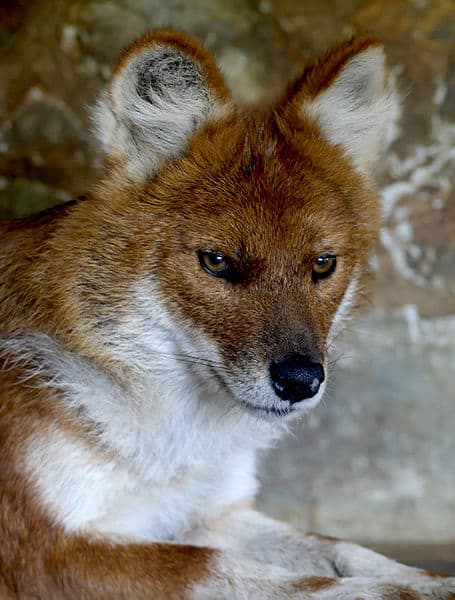
Kalyanvarma / CC BY-SA 3.0

Dhole Distribution

Click a location to explore more animals from that region

Loading map...

Size Comparison

Human 5'8"
Dhole 1 ft 7 in

Dhole stands at 27% of average human height.

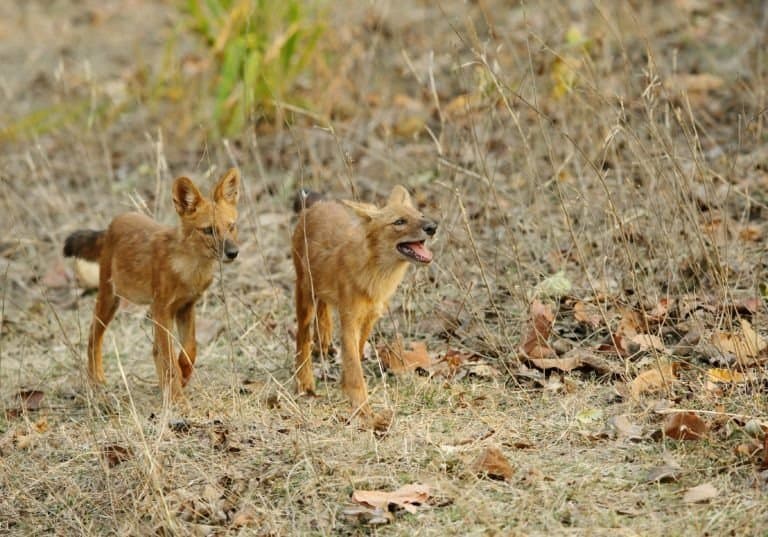
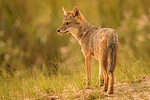
Dhole in grassland

At a Glance

Wild Species
Also Known As Indian wild dog, Whistling dog, Red dog
Diet Carnivore
Activity Diurnal+
Lifespan 7 years
Weight 21 lbs
Status Endangered
Did You Know?

Adults measure ~88-113 cm head-body with a 40-50 cm bushy tail; shoulder height ~42-55 cm; mass commonly ~10-21 kg (species accounts; regional variation).

Scientific Classification

The dhole (Asian wild dog) is a social, pack-living canid native to South and Southeast Asia, known for cooperative hunting and distinctive whistling calls.

Kingdom
Animalia
Phylum
Chordata
Class
Mammalia
Order
Carnivora
Family
Canidae
Genus
Cuon
Species
Cuon alpinus

Distinguishing Features

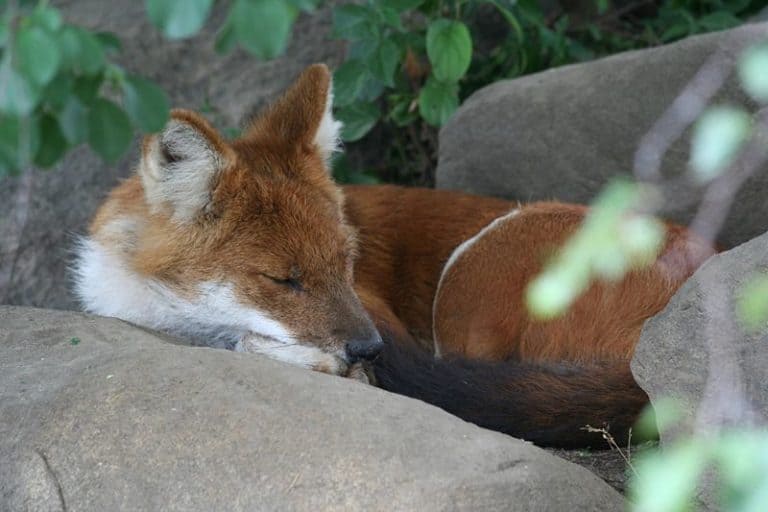
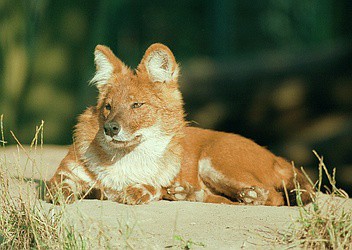
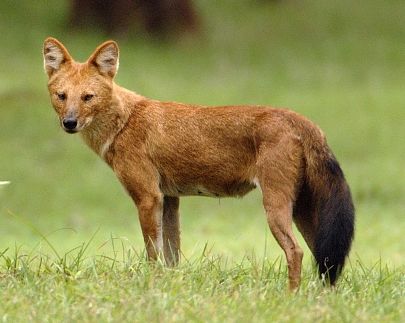
  • Reddish to rusty-brown coat with paler underside
  • Bushy black-tipped tail
  • Rounded ears and relatively short muzzle compared with many Canis species
  • Highly social pack behavior and characteristic whistles/chirps
  • Dentition adapted for shearing meat; fewer molars than many other canids

Physical Measurements

Males and females differ in size

Height
1 ft 6 in (1 ft 4 in – 1 ft 8 in)
1 ft 7 in (1 ft 5 in – 1 ft 10 in)
Length
4 ft 9 in (4 ft 2 in – 5 ft 4 in)
Weight
40 lbs (33 lbs – 46 lbs)
30 lbs (22 lbs – 37 lbs)
Tail Length
1 ft 6 in (1 ft 4 in – 1 ft 8 in)
Top Speed
28 mph
Dhole about 45 km/h

Appearance

Primary Colors
Secondary Colors
Skin Type Mammalian skin with dense double-layer fur (coarse guard hairs over insulating underfur) and seasonal molt; paw pads are hairless, thickened skin adapted for long-distance travel.
Distinctive Features
  • Canid adapted for endurance and cooperative pack hunting; adult head-body length typically 88-113 cm, tail length 40-50 cm, shoulder height about 42-55 cm (Nowak, 1999; IUCN Red List: Kamler et al., 2015).
  • Adult mass commonly ~10-20 kg (reported range often ~10-21 kg depending on region/sex) (Nowak, 1999; IUCN Red List: Kamler et al., 2015).
  • Bushy tail with frequent black terminal tip; tail is carried low when traveling and can be conspicuous when signaling within the pack.
  • Rounded ears relative to many other wild canids; muzzle comparatively short and broad, giving a 'stockier' head profile than foxes/jackals.
  • Distinctive vocalizations include high-pitched whistles used for contact/coordination in dense vegetation-an important field ID trait in South and Southeast Asian forests.
  • Dentition differs from most canids: reduced lower molars (total teeth typically 40 vs. 42 in many other canids), associated with a more specialized carnivorous shearing bite (Nowak, 1999).
  • Social structure: highly gregarious; packs commonly ~5-12 but can be larger (reports up to ~40). Cooperative hunting on medium-to-large ungulates is characteristic (IUCN Red List: Kamler et al., 2015).
  • Lifespan: about up to ~10 years reported in the wild; up to ~16 years in captivity (Nowak, 1999; zoo records summarized in species accounts).
  • Conservation status: Endangered (IUCN). Major threats include habitat loss/fragmentation, depletion of prey base, and disease spillover from domestic dogs (rabies, canine distemper) (IUCN Red List: Kamler et al., 2015).

Sexual Dimorphism

Sexual dimorphism is present but subtle; males average slightly larger/heavier than females, with extensive overlap in measurements (Nowak, 1999; IUCN Red List: Kamler et al., 2015).

  • On average heavier and marginally longer-bodied than females within the same population (overlapping adult mass typically within ~10-20 kg).
  • May show slightly broader head/neck musculature in robust adults, though not a strong field character.
  • On average slightly lighter/smaller than males; external coat coloration/pattern is essentially the same as males.
  • During lactation, nipples may be visible through the belly fur in close observation.

Did You Know?

Adults measure ~88-113 cm head-body with a 40-50 cm bushy tail; shoulder height ~42-55 cm; mass commonly ~10-21 kg (species accounts; regional variation).

Unlike most canids (42 teeth), dholes typically have 40 teeth because the last lower molar is reduced/absent-an adaptation linked to meat-shearing dentition in pack hunters.

They're known as "whistling dogs": packs use high-pitched whistles and yaps to coordinate in dense forest where visual contact is limited.

Dholes can form packs from just a few animals to 20+; cooperative hunting lets them take prey much larger than an individual dhole (e.g., deer-sized ungulates).

Reproduction is high-output for a wild canid: gestation ~60-63 days; litters are typically 1-10 pups (often around 5-6).

Lifespan is typically up to ~10 years in the wild, and can reach ~15-16 years in captivity (zoo longevity records).

Conservation: the dhole is listed as Endangered (IUCN); major threats include habitat loss/fragmentation, prey depletion, and disease spillover (e.g., canine distemper, rabies) from domestic dogs.

Unique Adaptations

  • Dental specialization: typical 40-tooth dentition (reduced/absent last lower molar) and strong shearing teeth suited to quickly processing meat in group-feeding contexts.
  • Bushy tail and reddish coat: the tail is conspicuously full and may aid visual following within a moving pack in understory habitats; coat color can vary from rufous to darker brown by region/season.
  • High reproductive potential: comparatively large litters and intense alloparental care help packs rebound when conditions are good-important for a species facing high mortality risks.
  • Whistling communication: high-frequency calls travel effectively through forest, supporting coordination when visibility is poor.
  • Cursorial build: long limbs and a streamlined body support endurance pursuit and repeated chases during pack hunts.

Interesting Behaviors

  • Cooperative pack hunting: individuals take different roles (pursuit, flanking, interception), increasing capture success on fast, agile prey.
  • Vocal coordination: distinctive whistles plus yaps and squeaks help keep the pack together in thick vegetation and during chases.
  • Communal pup-rearing: multiple adults provision pups; food is often brought back by regurgitation, and babysitting/guarding is shared.
  • Denning behavior: dens are commonly in burrows (often enlarged from other animals' burrows) or sheltered cavities; packs concentrate care around the den during pup-rearing.
  • Flexible activity: largely diurnal/crepuscular in many protected areas, but can shift with human disturbance and prey behavior.
  • Social tolerance at kills: compared with many large canids, dholes often show relatively low-intensity aggression within the pack while feeding, enabling rapid group consumption to reduce kleptoparasitism risk.
  • Scent communication: urine marking and feces placement along travel routes and rendezvous sites help maintain pack cohesion and spacing.

Cultural Significance

Across South and Southeast Asia, the dhole (Cuon alpinus) is known as the "red dog" or "whistling dog." Seen as bold, social hunters, they shape local views and now serve as a symbol for healthy forests with deer and other hoofed animals in India, Nepal, Bhutan, Thailand, and Malaysia.

Myths & Legends

In Rudyard Kipling's Jungle Book story "Red Dog", a feared pack of "red dogs" sweeps the forest as an almost unstoppable force, a literary image inspired by the dhole's real pack-hunting behavior.

In parts of the Indian subcontinent, people tell of 'whistling dogs'—dholes (Cuon alpinus) whose strange whistles often start a hunt and carry far through sal forests and hilly jungle.

In South Asia, people long called the dhole (Cuon alpinus) the 'red dog' for its reddish coat. Old hunting camp tales used that name to mean a pack hunter.

Conservation Status

EN Endangered

Facing a very high risk of extinction in the wild.

Population Decreasing

Protected Under

  • CITES Appendix II
  • Protected under national wildlife legislation in multiple range states (example: India-Wildlife (Protection) Act, 1972; Schedule II)

Life Cycle

Birth 5 pups
Lifespan 7 years

Lifespan

In the Wild
3–10 years
In Captivity
10–16 years

Reproduction

Mating System Monogamy
Social Structure Cooperative Breeder
Breeding Pattern Long Term
Fertilization Internal Fertilization
Birth Type Internal_fertilization

Dhole (Cuon alpinus) packs are socially monogamous with one dominant breeding pair and helpers. Pregnancy lasts ~60–63 days; litter usually 4–6 pups (1–10). One seasonal litter per year. Pups born in dens; helpers feed, guard, and babysit.

Behavior & Ecology

Social Pack Group: 8
Activity Diurnal, Crepuscular, Cathemeral
Diet Carnivore Medium-sized ungulates-especially deer (commonly chital and sambar where they co-occur), which dominate dhole diet in multiple scat-based studies across South Asian reserves (e.g., Andheria et al., 2007, Bandipur; Johnsingh, 1983, Bandipur).

Temperament

Highly social and cooperative; strong in-group tolerance and affiliative behavior (frequent greeting, muzzle-licking, contact) that supports coordinated hunting and communal pup care (Fox 1984).
Bold, persistent coursing hunter; packs often engage in prolonged group chases and repeated attack attempts on large ungulates, with role-switching among individuals (documented in field observations summarized by Fox 1984; Durbin et al., IUCN).
Inside packs they are usually calm, with low aggression; encounters with other packs can be hostile. Packs keep home ranges and use scent marks and loud calls to keep their space.
Dholes can change their activity: near people and roads they become more active at dawn, dusk, or at many times, but in less disturbed protected areas they are mostly active in daytime.

Communication

High-pitched whistle The hallmark 'whistling hunter' call) used for long-range contact and regrouping in dense vegetation; often given during travel or when separated (Fox 1984
Yelps/yaps and chattering vocalizations used at close range during greetings, social excitement, and pre-hunt rallies Fox 1984
Squeals/screams during intense interactions E.g., conflict, capture attempts, high arousal contexts) (Fox 1984
Scent marking with urine/feces and ground-scraping at prominent sites to signal presence and coordinate spatial use within and between packs Summarized in Fox 1984; Durbin et al., IUCN
Body posture and facial signaling Tail carriage, ear position, crouching/standing over) for dominance/appeasement and coordination during group movement and hunting (Fox 1984
Tactile/affiliative behaviors: greeting ceremonies, muzzle-licking, and close-contact resting that reinforce pack cohesion and facilitate pup solicitation/feeding Including regurgitation-based provisioning) (Fox 1984

Habitat

Biomes:
Tropical Rainforest Tropical Dry Forest Savanna Temperate Forest Alpine
Terrain:
Mountainous Hilly Plateau Plains Valley Riverine Rocky +1
Elevation: Up to 17060 ft 5 in

Ecological Role

Cooperative pack-hunting mesopredator/apex predator (depending on presence of tiger/leopard) that structures ungulate communities through predation and risk effects.

Regulates populations of medium-sized ungulates (deer, wild pig), influencing browsing pressure and vegetation dynamics Selective removal of vulnerable individuals (very young, old, or weakened animals), potentially reducing disease transmission and improving prey population health Provides carrion and kill remains that subsidize scavengers (e.g., vultures, jackals, corvids) and decomposer communities Contributes to trophic cascades and spatial/behavioral shifts in prey (landscape-of-fear effects)

Diet Details

Main Prey:
Chital Sambar deer Muntjac Wild boar Gaur Nilgai Serow and Goral Hares Rodents Ground-dwelling birds and their eggs Livestock +5

Human Interaction

Domestication Status

Wild

The dhole (Asian wild dog, Cuon alpinus) is fully wild with no history of domestication. In parts of South and Southeast Asia it was hunted and killed as a threat to hunters and farm animals; bounties and eradication happened in the 19th–20th centuries. Human links include conflict, disease spread, and modern conservation.

Danger Level

Low
  • Direct attacks on humans are considered rare; dholes typically avoid people.
  • Bite risk exists if an animal is cornered, trapped, or habituated/food-conditioned; risk increases around den sites.
  • Zoonotic disease risk is primarily indirect via shared pathogens with domestic dogs (notably rabies and canine distemper virus), especially where free-ranging dogs overlap dhole habitat.
  • Human-dhole conflict is more commonly economic than physical: occasional livestock depredation can trigger retaliatory killing (poisoning/snares), which is a major conservation threat.

As a Pet

Not Suitable as Pet

Legality: Dholes (Cuon alpinus) are not legal or possible as private pets in most places. They are CITES Appendix II; keeping them needs permits and is usually limited to zoos, rescues, or research facilities. U.S. rules vary by state.

Care Level: Expert Only

Purchase Cost:
Lifetime Cost: $50,000 - $200,000

Economic Value

Uses:
Ecosystem services (predator regulating prey populations) Ecotourism/wildlife viewing (where observable) Zoo/education/conservation breeding value Public health interface (sentinel for rabies/distemper spillover risk management)
Products:
  • non-consumptive tourism/park revenue (wildlife sightings, guided safaris/treks)
  • conservation program outputs (education, research data, managed-care breeding where permitted)
  • indirect agricultural value via trophic regulation (context-dependent; can be offset by livestock losses)

Relationships

“The dhole has been described as a mix between the gray wolf and the red fox”

Also known as the ‘Asiatic Wild Dog’, Dholes are once a wide-ranging wild dog species that covered nearly half the globe. Today the dhole is an endangered species with an estimated population of fewer than 2,500 adults. Dholes are animals that inhabit dense jungles, steppes, mountains, scrub forests, and pine forests. These Asiatic wild dogs’ coloring can range from charcoal gray to red or brown with yellow, white, or otherwise light-colored highlights. Despite being members of the dog family, dholes do not bark or howl, but they have unique screams, chattering, clucking, and whistles that they use to communicate and hunt with.

Incredible Dhole Facts!

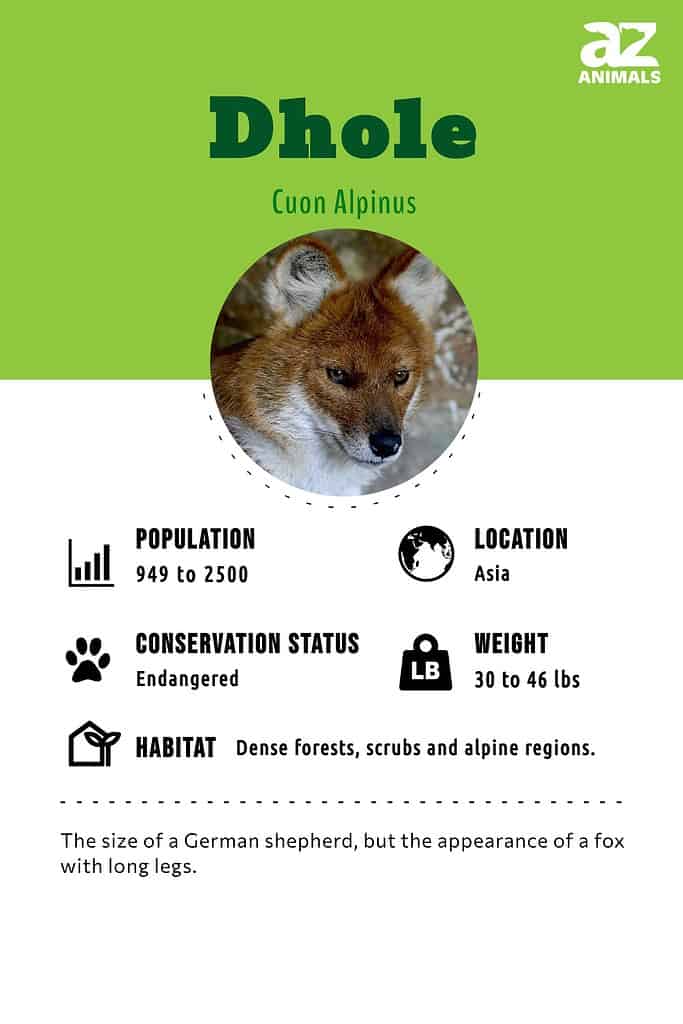
  • While the dhole is closer in stature to a German Shepherd dog, it more closely resembles a fox in appearance.
  • These wild dogs once ranged over all of North America, Europe, and Asia, but 12,000 to 18,000 years ago they were reduced to their current habitat of eastern and southern Asia.
  • An adult can eat 2.2 lbs of meat in four seconds, and it can later regurgitate it to feed other members of its pack.
  • Dhole packs have killed leopards and tigers, and they have even been known to attack Asiatic black bears.
  • Dholes are able to run at speeds of up to 45mph.
Scientific Name

The dhole, also known as the Asiatic red dog, Indian wild dog, or mountain wolf, has the scientific name Cuon alpinus. The dhole is a member of the family Canidae and the class Mammalia.

While it is a close relative of animals within the genus Canis, there are several distinct differences. The dhole’s skull is concave, it is missing a third lower molar, and the upper molars possess only one cusp.

Origin Of The Species
It is believed that the dhole is descended from an ancestor that is jackal-like and was found in the Pleistocene era where it prowled throughout Europe, North America, and Asia. It became confined to its current location around 12,000 to 18,000 years ago. Thought to be the forbearer of the dog, the dhole was formally given the genus name Canis. Although is it still close, genetically, to the Canis species, when it was noted how different the two animals were, it was later changed to the genus Cuon.

Types Of

The dhole, while originally thought to contain two species, is in fact just one species that could possibly be made up of as many as 11 subspecies, although currently there are 7 subspecies recognized. These 7 are:

Burmese dhole (Cuon alpinus adjustus).

Ussuri dhole (Cuon alpinus alpinus)

Tien Shan dhole (Cuon alpinus hesperius)

Sumatran and Javan dhole (Cuon alpinus sumatrensis)

Cuon alpinus fumosus

Cuon alpinus lepturus

Cuon alpinus laniger

Appearance And Behavior

The dog is about 30 to 40 inches long, in addition to an 11 to 19-inch tail, and it can weigh anywhere between 30 to 46 pounds. Depending on the region, they can vary in color from a yellowish hue to a darker red-brown color. They do have lighter coloration along their chest, belly, and paws.

The average dhole, including its tail, is about as long as R2D2, of Star Wars fame, is tall. Males typically weigh more than females and are larger. While they are fox-like in appearance, dholes are more akin to a medium to large-sized dog.

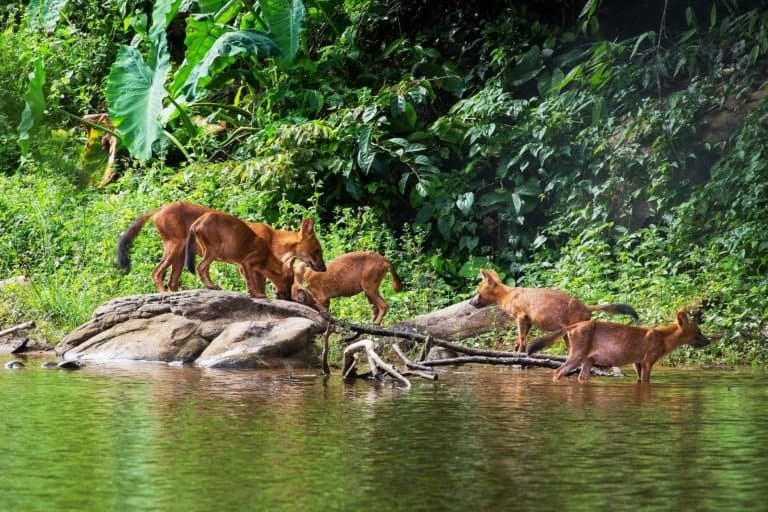
Dholes are highly social animals, and they frequently hunt in packs of 5 to 12. These clans may grow to as many as 30 or 40 members. These wild dogs are carnivores, and they generally hunt deer or sheep. However, there have been recorded instances of dholes attacking animals as large as a tiger or bear.

Dholes are also very vocal animals. As a member of the dog family, they whine and growl much like your family pet. Unique to these animals, though, is a series of clucking noises and screams that are not found anywhere among other canines. They are also known to communicate through whistling and chattering while hunting.

Unlike other canid species, dholes very rarely display in fighting behavior. It may even be difficult to pick out the dominant male-female pair of the pack. They work as a unit to rear the pack’s pups, and the young adult animals are free to join other packs without trouble upon reaching maturity.
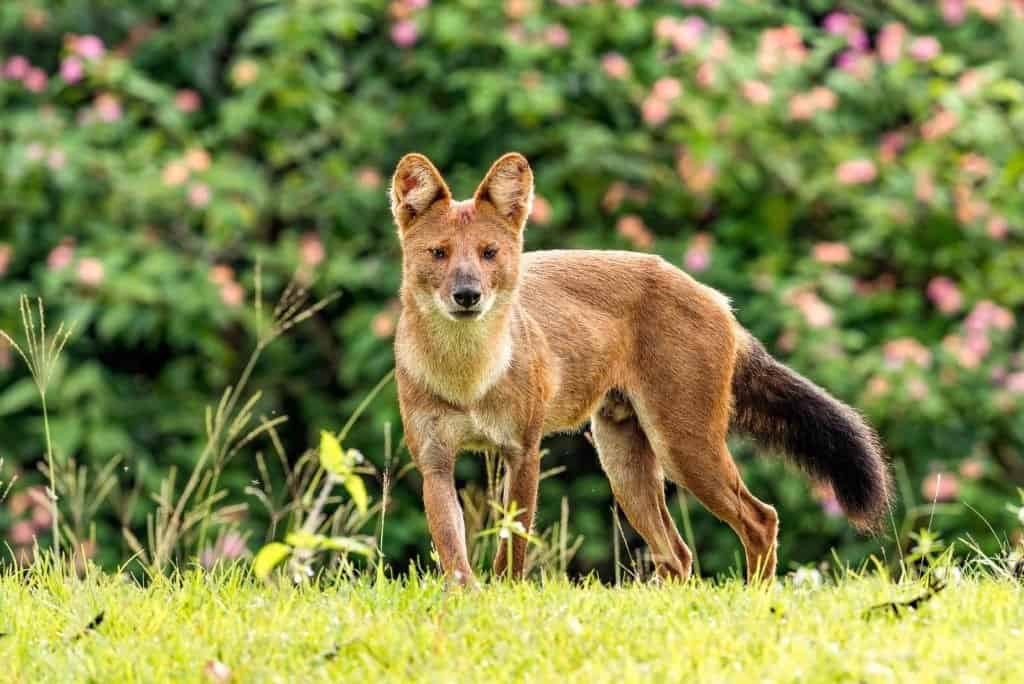
Dholes are highly social and hunt in large packs.

Habitat

Dholes are wide-ranging, and they are found throughout Eastern and Southeastern Asia. Once, these wild dogs could be found across North America, Asia, and Europe. Around 12,000-18,000 years ago, they were reduced to specific areas within the Asian continent. Dholes can now be seen as far north as Siberia, as far south as some Malaysian islands, and as far west as the Indian peninsula. Due to the vast area they can be found in, they survive in an equally wide variety of habitats such as

  • Dense forest
  • Scrub forest
  • Plains
  • Mountains
  • Jungles

Dholes, like other dogs, cover a large area. Their average territory can be 34 square miles. That’s larger than the entire area of Manhattan! As such, they are extremely fast runners, swimmers, and jumpers.

Dhole dens are typically underground and may be simple or very complex with many tunnels. Dholes have even taken over jackal dens. The entire pack will inhabit one den and may utilize multiple entrances.

Diet
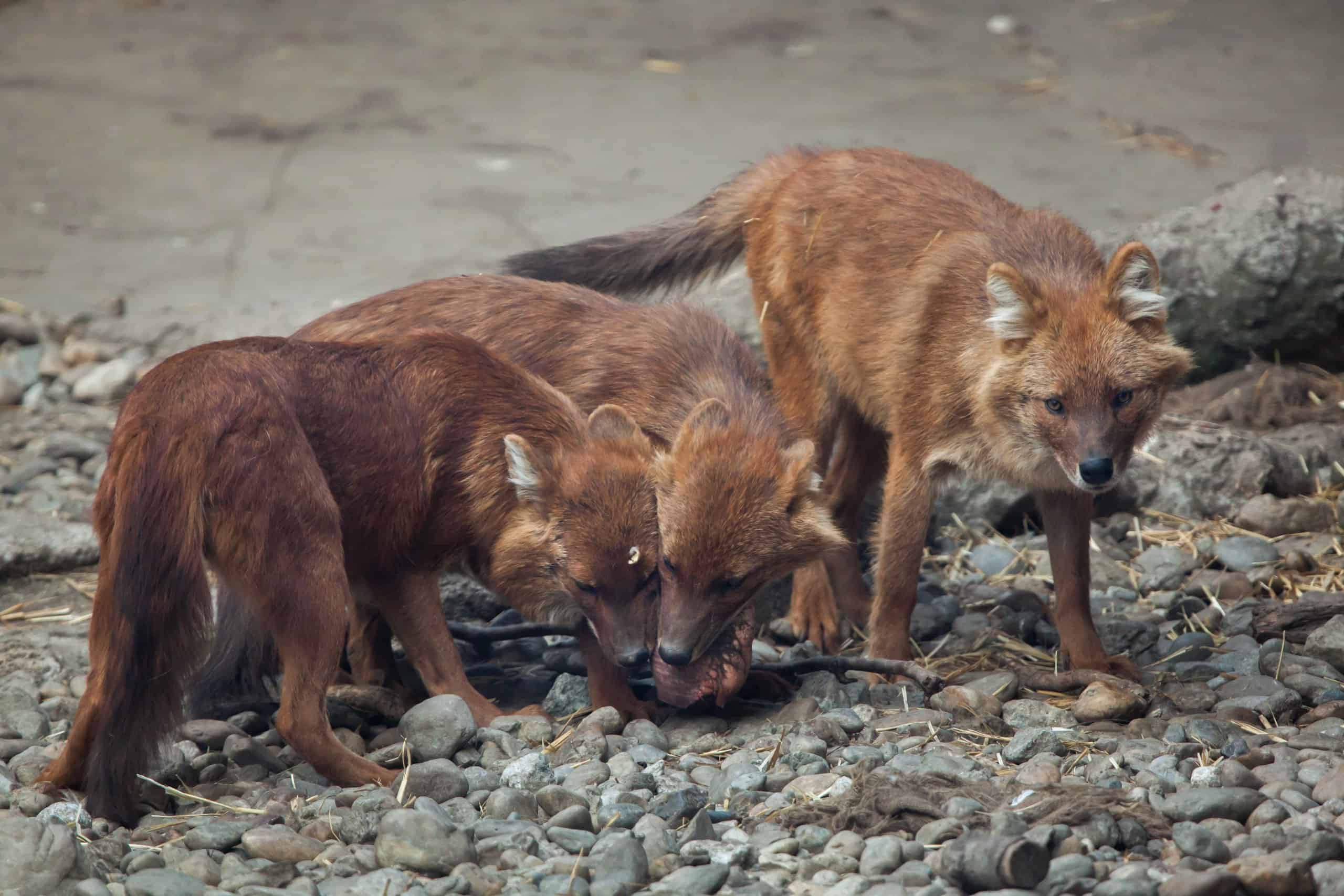
As mentioned earlier, Dholes are carnivorous. Primarily they hunt hoofed mammals in packs; however, due to their vast habitat, they are highly adaptable, and they hunt whatever is available in that specific region.

Their need for enough food is actually the reason for such a large habitat to begin with. The dhole hunting parties take down their prey, swallow large portions of it whole, and then transport it back to the rest of the pack. Dholes have even been known to eat over one kilogram of meat in under four seconds; that’s as heavy as three-quarters of a human brain!

In smaller packs, and alone, they will eat proportionally smaller prey consisting of rabbits, lizards, mice, etc.

Predators And Threats

The dhole is not specifically prey for any other predator. Tigers, leopards, and other predators that share a habitat with the dhole have killed them, but the reverse is also true. The primary source of conflict between these higher-level predators is because of food scarcity.

The major threats faced by the dhole are not from other animals. Dholes are suffering from habitat loss specifically due to deforestation for agricultural, residential, and commercial purposes. This habitat loss leads to a decline in available prey, and it increases the subsequent threat of competition from high-level predators in the area.

Also, related to this loss of habitat is the persecution of the dhole by humans in the area. Failing to find adequate food from their usual prey source, they adapt and occasionally hunt domesticated animals. The resulting retaliation from farmers has been devastating to the dhole population as a whole.

Disease has also proven to be a major threat to them. Their exposure to pathogens has drastically increased with their proximity to, and association with, domesticated dogs as well as their predation of other domestic animals.

Reproduction, Babies, And Lifespan
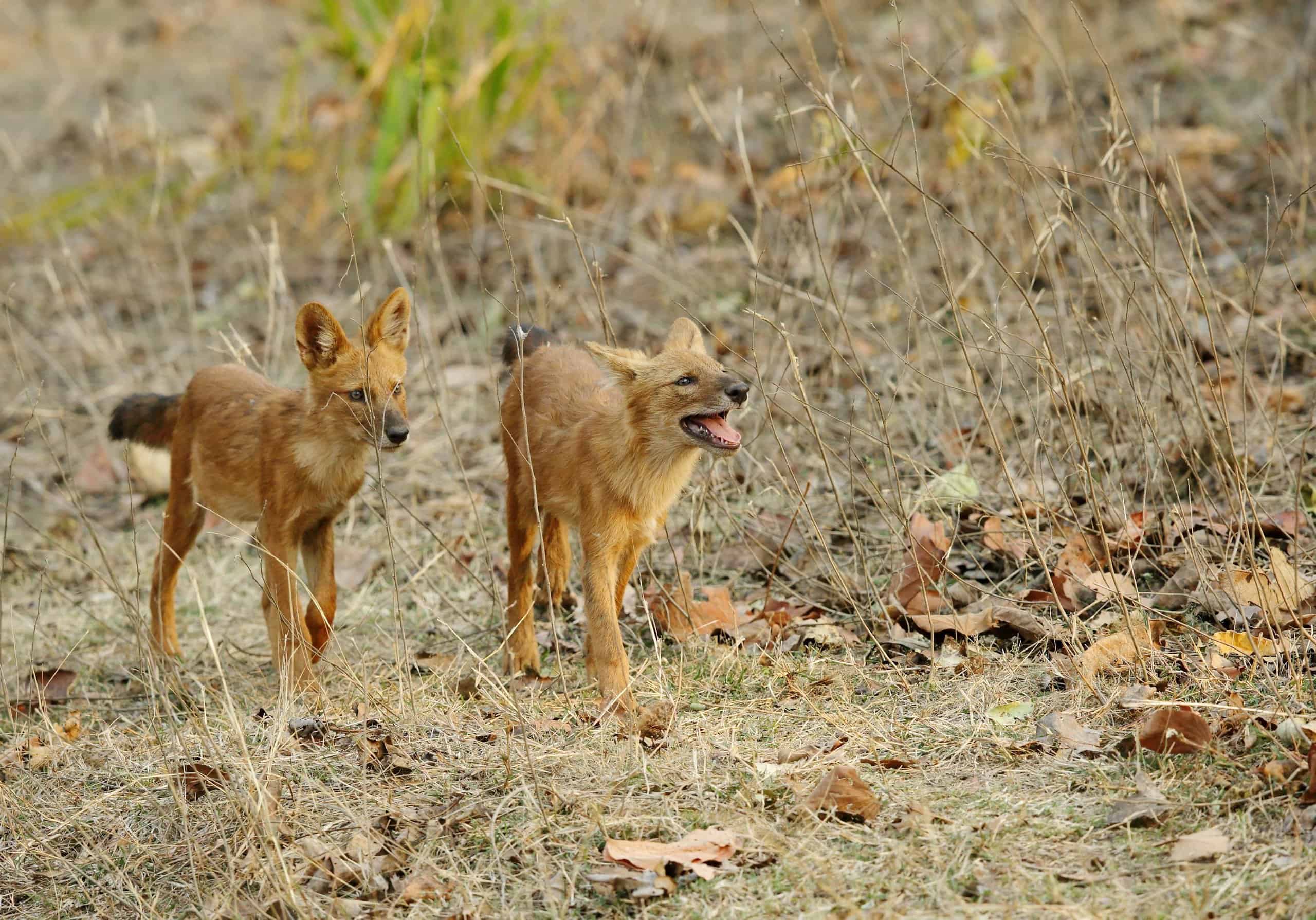
A dhole pack will typically contain more than one breeding female. In the wild, they have been observed to mate from October through January, but this may vary in captivity. A baby dhole is called a pup. They are born in large litters typically consisting of 5-10 pups but sometimes as many as 12 to 16.

The gestational period is approximately 60 days, and the babies are suckled by their mothers for a period of similar length. During this time, any pregnant females share the den and the pups interact freely. While their mothers ween them, the entire pack helps feed the pups by regurgitating their food.

The pups grow much faster than wolf or dog pups. Their growth is more similar in rate to that of a coyote. By six months, the pups are accompanying the pack on hunts, and at eight months old they take on active roles in the hunt.

After maturing, dholes can leave the pack and join another without the challenges or fighting that is common in other wild dog species. Typically, around the age of three, females leave the pack to join another. In the wild, the average lifespan for these animals is around 10 years. Captive dholes average 15 to 16 years of life.

Population
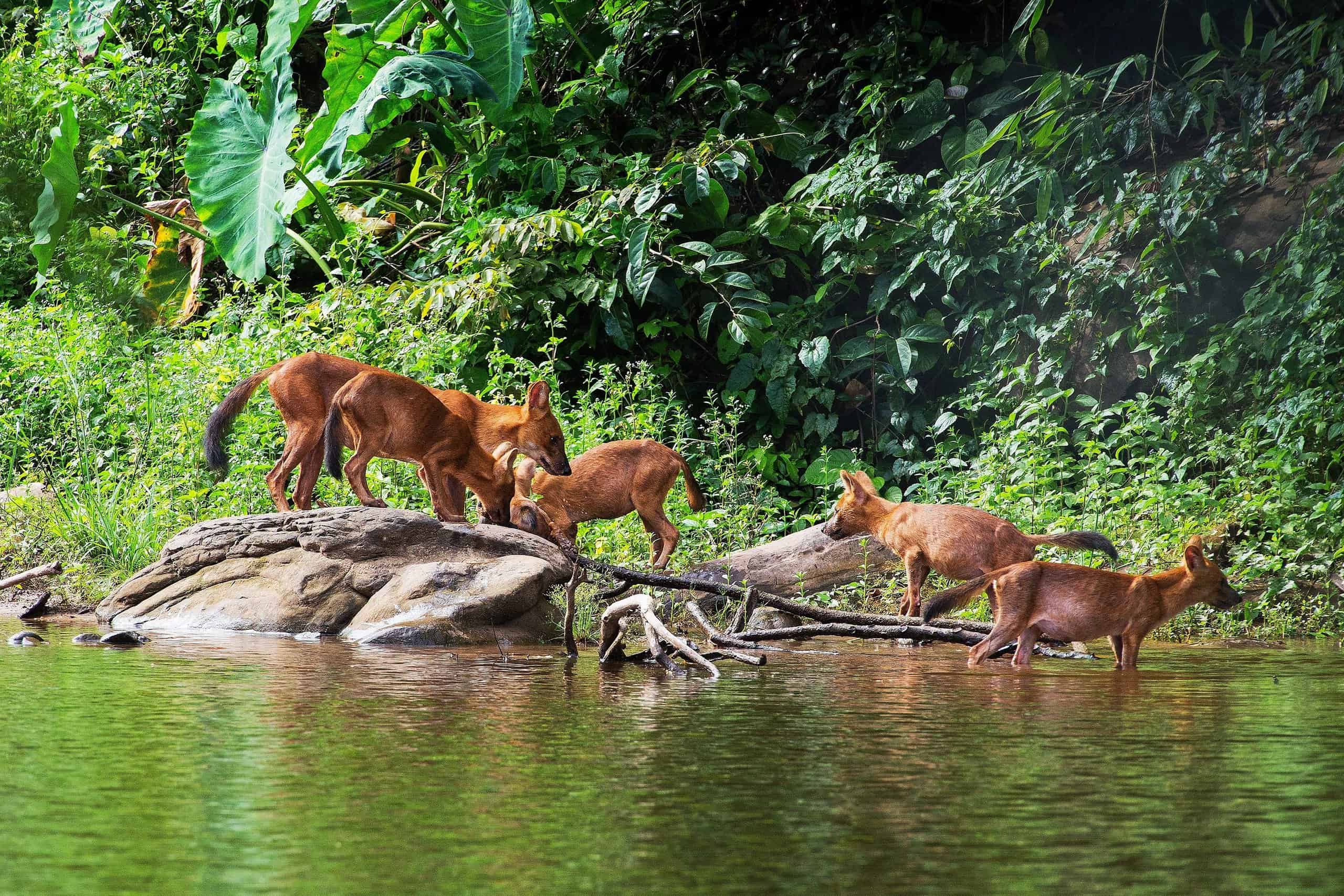
The true population size of the dhole is very difficult to assess. Their tendency to inhabit locales that are sparsely populated, or contain unfavorable terrain, makes it nearly impossible to get a firm figure for their population. In addition, dholes, in areas that have been studied, have frequently experienced wild population swings over short periods of time.

The best estimate is a total population of between 949 and 2,215 adult animals that remain in the wild. For that reason, these wild dogs are listed as endangered, and the population is assumed to be in continued decline.

In The Zoo

There are only three places in North America where you will find these wild dogs. The Minnesota Zoo, the San Diego Zoo, and The Wilds operated by the Columbus Zoo, all have captive dholes. Notably, the staff at The Wilds have recently hand-raised a litter of pups when their mother died shortly after birthing them.

View all 451 animals that start with D
How to say Dhole in ...
Bulgarian
Азиатско диво куче
Czech
Dhoul
Danish
Dhole
German
Rothund
English
Dhole
Spanish
Cuon alpinus
Finnish
Vuorisusi
French
Dhole
Hebrew
דהול
Hungarian
Ázsiai vadkutya
Indonesian
Ajag
Italian
Cuon alpinus
Japanese
ドール
Malay
Anjing Hutan
Dutch
Dhole
English
Asiatisk villhund
Polish
Cyjon
Portuguese
Raposa-asiática-dos-montes
English
Ajag
Swedish
Asiatisk vildhund
Turkish
Asya yaban köpeği
Chinese

Sources

  1. David Burnie, Dorling Kindersley (2011) Animal, The Definitive Visual Guide To The World's Wildlife / Accessed July 12, 2010
  2. Tom Jackson, Lorenz Books (2007) The World Encyclopedia Of Animals / Accessed July 12, 2010
  3. David Burnie, Kingfisher (2011) The Kingfisher Animal Encyclopedia / Accessed July 12, 2010
  4. Richard Mackay, University of California Press (2009) The Atlas Of Endangered Species / Accessed July 12, 2010
  5. David Burnie, Dorling Kindersley (2008) Illustrated Encyclopedia Of Animals / Accessed July 12, 2010
  6. Dorling Kindersley (2006) Dorling Kindersley Encyclopedia Of Animals / Accessed July 12, 2010
  7. David W. Macdonald, Oxford University Press (2010) The Encyclopedia Of Mammals / Accessed July 12, 2010
  8. IUCNRedList / Accessed October 11, 2020
  9. Biodiversity Heritage Lilbrary / Accessed October 11, 2020
  10. San Diego Zoo / Accessed October 11, 2020
A-Z Animals Staff

About the Author

A-Z Animals Staff

AZ Animals is a growing team of animals experts, researchers, farmers, conservationists, writers, editors, and -- of course -- pet owners who have come together to help you better understand the animal kingdom and how we interact.
Connect:

Thank you for reading! Have some feedback for us?


Dhole FAQs (Frequently Asked Questions)

Dholes are primarily carnivores; however, there are reports that they will occasionally eat berries or small amounts of vegetation.