
D
Species Profile

Discus

Symphysodon

Discus: the Amazon's living discus
Andrey Armyagov/Shutterstock.com

Discus Distribution

Click a location to explore more animals from that region

Endemic Species

This map shows coastal regions where Discus are found.

Loading map...

Size Comparison

Human 5'8"
Discus 6 in

Discus stands at 8% of average human height.

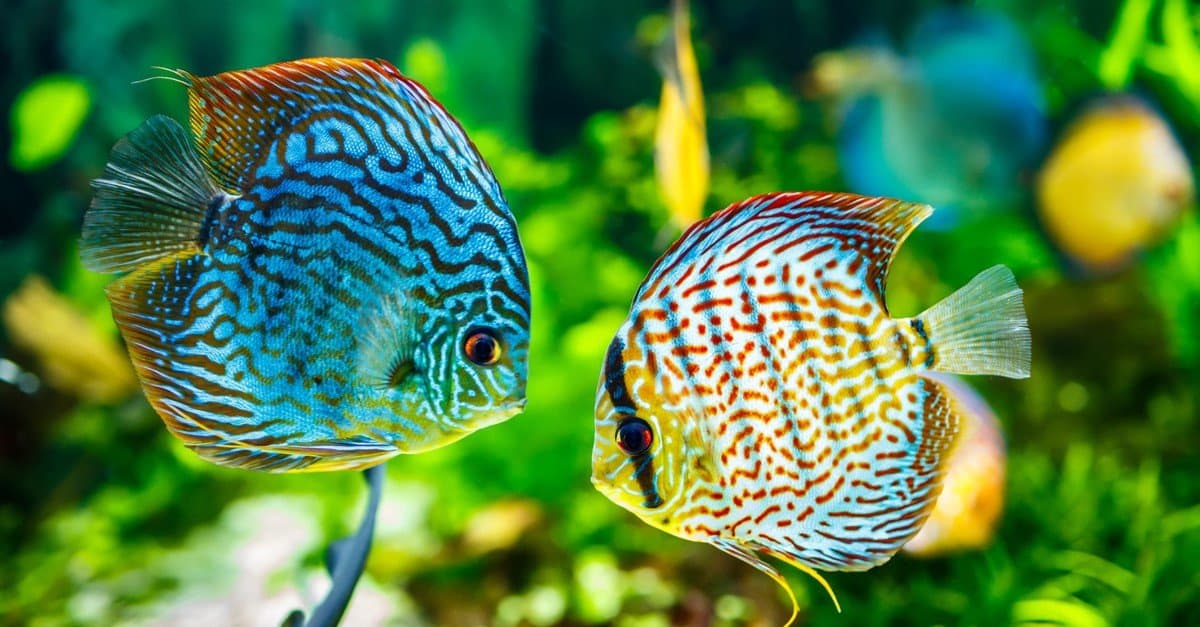
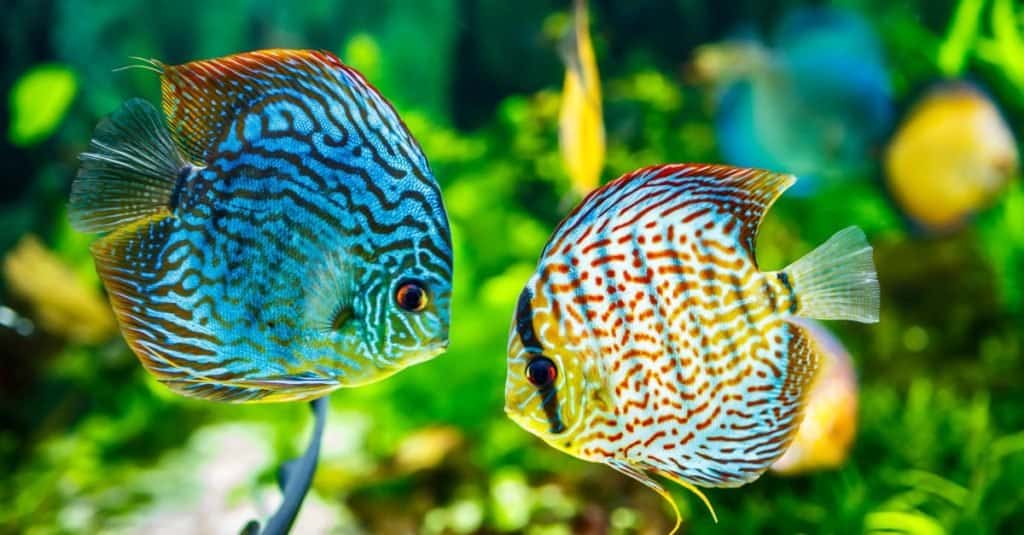
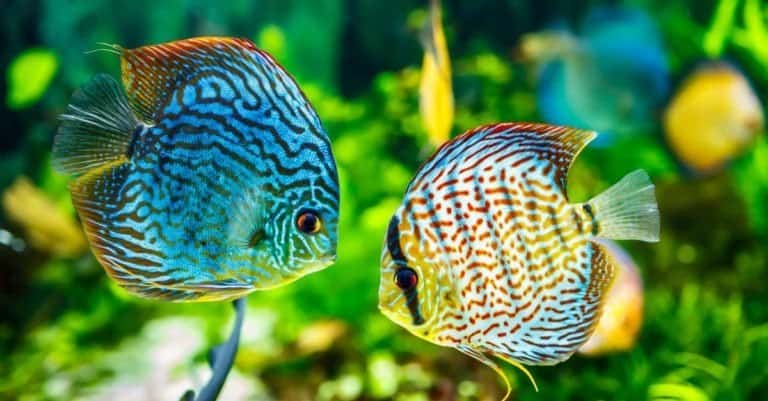
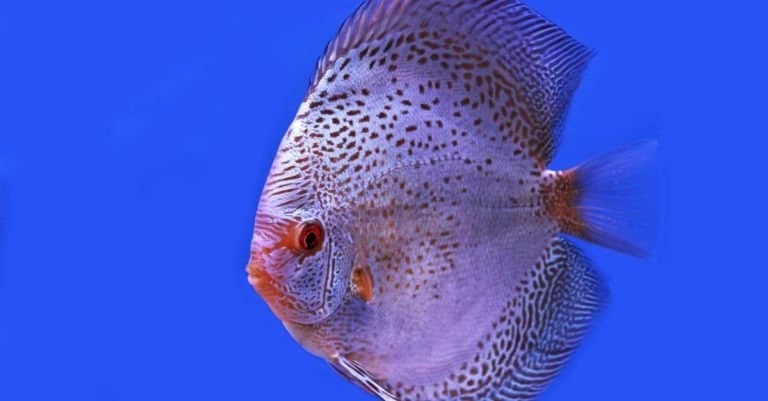
Two discus fish in an aquarium

At a Glance

Genus Overview This page covers the Discus genus as a group. Stats below are general traits shared across the genus.
Diet Omnivore
Activity Diurnal+
Lifespan 8 years
Weight 0.7 lbs
Status Least Concern
Did You Know?

Across Symphysodon, adults typically reach ~12-20 cm standard length (about 15-25 cm total length), with deep, round bodies that inspired the common name "discus."

Scientific Classification

Genus Overview "Discus" is not a single species but represents an entire genus containing multiple species.

Discus are laterally compressed, disk-shaped South American cichlids (genus Symphysodon) famous in the ornamental fish trade. They inhabit calm, warm freshwater systems in the Amazon basin and are known for complex social behavior and biparental care (including mucus-feeding of fry in early development).

Kingdom
Animalia
Phylum
Chordata
Class
Actinopterygii
Order
Cichliformes
Family
Cichlidae
Genus
Symphysodon

Distinguishing Features

  • Strongly laterally compressed, nearly circular body profile
  • Long dorsal and anal fins that extend along much of the body
  • Variable vertical barring and intricate blue/green patterning depending on species/population
  • Cichlid traits: single nostril per side, laterally compressed body, parental care behaviors

Physical Measurements

Males and females differ in size

Height
6 in (4 in – 7 in)
6 in (4 in – 9 in)
Length
7 in (5 in – 9 in)
7 in (5 in – 10 in)
Weight
0 lbs (0 lbs – 1 lbs)
1 lbs (0 lbs – 1 lbs)
Top Speed
4 mph
Short burst escape speed (Amazon)

Appearance

Primary Colors
Secondary Colors
Skin Type Bony fish with small ctenoid scales and a noticeable mucus coat (enhanced during breeding); skin/scale reflectivity can produce strong metallic/iridescent effects depending on light, water color (blackwater vs clearwater), and condition.
Distinctive Features
  • Body shape (genus-level hallmark): strongly laterally compressed, near disk-shaped profile; tall body relative to length.
  • Fin profile: long dorsal and anal fins that mirror each other, creating a rounded/oval outline; pelvic fins often elongated and filamentous; caudal fin relatively short compared to body height.
  • Adult discus in the genus Symphysodon are about 12–22 cm long. Small mature fish are near 12 cm; largest wild and many captive adults reach about 22 cm, varying by species and care.
  • Eye often appears vivid (commonly red/orange tones in many individuals/strains), standing out against the body pattern; intensity varies with lineage and environment.
  • Dynamic coloration: bars and overall darkness can intensify rapidly with stress, social rank, or habitat lighting; calmer fish often display brighter base colors and clearer iridescence.
  • Amazon basin ecology (generalized): warm, slow-moving freshwater (floodplain lakes, backwaters, sluggish channels) with variation between blackwater (acidic, tannin-stained, low mineral content) and clearwater systems; microhabitat use and tolerance ranges vary among Symphysodon species/populations.
  • Social/behavioral generalization: often occur in loose groups; establish dominance hierarchies; form monogamous pairs during breeding-degree of schooling vs pairing can vary with habitat and population density.
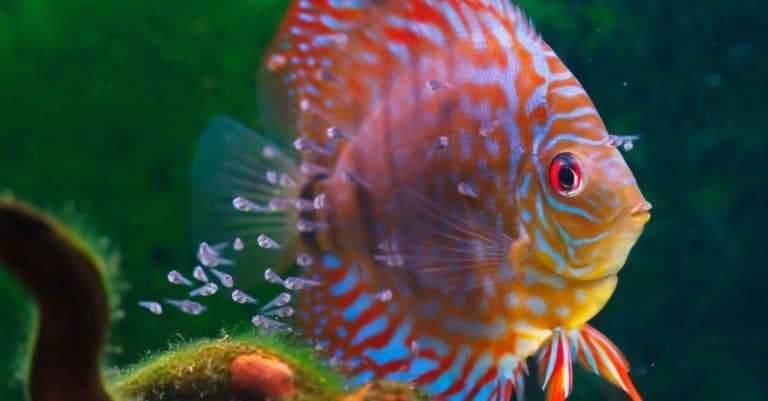
  • Parental care (shared genus trait): biparental guarding of eggs/wrigglers and prolonged care of fry; early fry commonly graze on parental mucus (a notable cichlid specialization in this genus), though intensity/duration can vary.
  • Lifespan range across species and conditions: commonly ~8-15+ years (shorter in the wild under predation/seasonal stress; often longer in well-maintained captivity).

Sexual Dimorphism

Sexual dimorphism is generally subtle and inconsistent across Symphysodon; sexes are often difficult to distinguish outside of breeding condition, and traits vary among individuals and strains.

  • Often slightly larger or heavier-bodied in some pairs/lines (not reliable).
  • May show more pointed extensions on dorsal/anal fin tips and a thicker forehead profile in some individuals.
  • Genital papilla tends to be smaller and more pointed when visible during spawning.
  • Often slightly rounder-bodied when gravid (not reliable outside breeding readiness).
  • Genital papilla/ovipositor tends to be larger and blunter during spawning.
  • In many cases, definitive sexing is most accurate by observing spawning roles/behavior rather than external morphology.

Did You Know?

Across Symphysodon, adults typically reach ~12-20 cm standard length (about 15-25 cm total length), with deep, round bodies that inspired the common name "discus."

They're among the few fishes known for extended fry feeding on parental skin mucus-often compared to "milk" in aquarium literature.

Wild populations occur in different Amazon water types (blackwater, clearwater, and mixed systems), and their coloration can reflect local habitats and lineages.

Discus form pair bonds for spawning, and both parents usually guard eggs, fan them with fins, and shepherd free-swimming young.

Captive-bred strains (selectively bred for color/pattern) greatly outnumber wild-caught fish in the global aquarium trade today.

They're sensitive to water quality and temperature compared with many other aquarium cichlids, which helped drive advances in filtration, quarantine, and breeding practices among hobbyists.

"Discus" has become a benchmark fish for aquarists-often treated as a rite-of-passage species because it rewards stable, well-managed tanks.

Unique Adaptations

  • Laterally compressed, disk-like body: enhances maneuverability among submerged roots, branches, and dense vegetation in slow Amazon waters while presenting a broad surface for display signaling.
  • Extended dorsal and anal fins: help with precise station-holding and fine turns in low-flow habitats; also function in visual displays during courtship and hierarchy interactions.
  • Specialized parental provisioning: elevated mucus production and fry behavior adapted for repeated contact with parents-an uncommon, high-investment strategy among fishes.
  • Physiology for warm, low-mineral waters: many wild discus are associated with warm, soft, acidic conditions (especially blackwater), though tolerance ranges differ among species/populations and captive lines.
  • Color pattern diversity: banding, spotting, and ground colors vary across the genus and among regional populations-useful for camouflage, recognition, and signaling; selective breeding has amplified this diversity in captivity.

Interesting Behaviors

  • Schooling-to-pairing social shift: juveniles commonly associate in groups, while adults may become more territorial and pair-focused when breeding (intensity varies by population and conditions).
  • Biparental care: both sexes typically participate in egg tending (guarding, cleaning, fanning) and in guiding fry as they begin to swim.
  • Mucus-feeding "nursing": fry repeatedly graze on parental skin mucus for days to weeks after becoming free-swimming; parents may take turns as the primary mucus source.
  • Spawning site selection: pairs clean vertical or steep surfaces (e.g., roots, stems, rocks, tank cones) before egg-laying; exact microhabitat choice varies across wild habitats.
  • Fine-scale communication: posture, fin displays, and subtle color shifts are used in dominance and courtship; individual "personalities" and social tolerance can differ notably among groups and captive strains.
  • Habitat-linked behavior: fish from quieter backwaters and flooded forests often show stronger preference for calm cover, while those from more open clearwater margins may use different shelter and foraging patterns.

Cultural Significance

Discus (Symphysodon) are famous aquarium fish, called the "king of the aquarium" for their shape, color, and demanding care. Captive breeders made stable types shown in competitions; wild discus highlight Amazon conservation (water quality, floodplain forests, sustainable collection).

Myths & Legends

Name-origin lore in natural history: early European naturalists and hobbyists likened the fish's perfectly round profile to the ancient Greek discus, cementing "discus" as a common name and symbol of elegant form in aquariums.

"Symphysodon" comes from Greek words meaning "fused" or "paired" and "tooth." Early scientists named the discus for its unusual teeth, showing how body shape became part of taxonomy.

In mid to late 20th century fishkeeping, discus (Symphysodon) were seen as aquarium royalty, a special centerpiece fish shown like living trophies at clubs and exhibitions, a hobby status legend not a folk myth.

Amazon-evocation in popular culture: discus are repeatedly used in books, posters, and aquarium branding as an emblem of the mysterious blackwater Amazon-an enduring cultural association that frames them as ambassadors of rainforest waters.

You might be looking for:

Heckel discus

30%

Symphysodon discus

Iconic wild-type discus from the Amazon/Negro system; noted for a strong central vertical bar and darker overall patterning.

Green discus

28%

Symphysodon tarzoo

Wild discus commonly associated with western Amazon tributaries; often shows greenish/blue patterning.

Blue/Brown discus

27%

Symphysodon aequifasciatus

Widely referenced wild species complex in the aquarium trade; many domestic color strains derive from this lineage.

Domesticated discus strains

15%

Symphysodon spp. (cultivars)

Captive-bred varieties (e.g., pigeon blood, turquoise, snakeskin) not always cleanly attributable to a single wild species due to hybridization/selection.

Life Cycle

Birth 300 frys
Lifespan 8 years

Lifespan

In the Wild
5–12 years
In Captivity
8–18 years

Reproduction

Mating System Monogamy
Social Structure Socially Monogamous
Breeding Pattern Serial
Fertilization Substrate Spawning
Birth Type Substrate_spawning

Symphysodon (discus) form male–female pairs that defend small spawning territories, lay eggs on hard surfaces, and show strong biparental care. Parents clean, fan and guard eggs and fry; young feed on parental mucus (mucus-feeding). Pairs are socially monogamous during broods but may re-pair.

Behavior & Ecology

Social Shoal Group: 12
Activity Diurnal, Crepuscular
Diet Omnivore Aquatic insect larvae (especially midge/chironomid larvae)

Temperament

Generally peaceful to moderately assertive in non-breeding contexts; low fin-nipping compared with many cichlids, but social rank can matter
Territorial and more aggressive during courtship/spawning; pairs defend eggs/larvae and may drive off conspecifics
Strongly social and stress-sensitive: prone to hiding, reduced feeding, and color darkening under crowding, poor water quality, or frequent disturbance
Hierarchy-forming in groups (dominance/subordination expressed via spacing, access to food, and display behavior); intensity varies among individuals and environments

Communication

Limited/variable evidence for audible sound production; if present, likely low-intensity clicks/thumps associated with agonistic or courtship interactions Documentation is less robust than for some other cichlids
Visual signaling is primary: rapid color pattern changes (dark bars, overall darkening/paling), iridescent pattern emphasis, and eye/fin coloration shifts
Postural/fin displays: lateral presenting, fin erection, head-up/head-down postures, and slow, deliberate approaches to establish rank or courtship intent
Agonistic contact behaviors: short charges, chases, mouth-to-mouth pushing/locking in escalated disputes More common around breeding sites
Tactile parent-offspring interactions: fry orienting to and contacting parental flanks during close association/early feeding; parents actively gather/lead fry
Chemical cues likely important for recognition and reproductive state (common in cichlids), though specificity across Symphysodon populations/species can vary

Habitat

Biomes:
Tropical Rainforest Freshwater Wetland
Terrain:
Plains Riverine Valley Muddy Sandy
Elevation: Up to 1968 ft 6 in

Ecological Role

Benthic/periphyton forager and small-invertebrate predator in calm Amazon floodplain and slow-channel habitats

helps regulate populations of small aquatic invertebrates grazes biofilm/periphyton, influencing algal and microbial communities on submerged surfaces contributes to nutrient cycling and detrital processing through consumption and excretion transfers energy from detrital/periphyton pathways to higher trophic levels (as prey for larger fishes and piscivores)

Diet Details

Main Prey:
Aquatic insect larvae Small aquatic insects Microcrustaceans Zooplankton Small worms Small snails and other soft-bodied benthic invertebrates
Other Foods:
Periphyton biofilm Detritus and fine organic matter Biofilm Algal filaments and diatoms Plant fragments

Human Interaction

Domestication Status

Semi domesticated

Symphysodon (discus) are wild Amazon Basin cichlids, not domesticated like farm animals but widely bred in tanks for the pet trade. Since the mid-1900s, selective breeding and crossing produced many color and pattern strains (solid reds/blues, patterned lines), creating semi-domesticated fish for captive food and tank life. Wild-caught discus are still exported in some places, but availability and laws vary.

Danger Level

Low
  • Minor skin abrasions or nips during handling (rare; small teeth, primarily defensive/feeding-related).
  • Allergen exposure from aquarium water/foods for sensitive individuals (uncommon).
  • Potential transmission of aquarium-associated pathogens if poor hygiene is used (e.g., handling tank water with open cuts); risk is generally low and mitigated by basic handwashing and wound care.

As a Pet

Suitable as Pet

Legality: Discus are usually legal to keep in home aquariums in many places. Wild-caught fish may need permits and must meet source-country, health/quarantine, and local import rules, which can vary by region.

Care Level: Expert Only

Purchase Cost: $20 - $500
Lifetime Cost: $1,000 - $8,000

Economic Value

Uses:
Ornamental aquaculture Aquarium retail Wild collection (where permitted) Breeding and genetics/strain development
Products:
  • live ornamental fish (juveniles and adults)
  • captive-bred strains and hybrids marketed as color morphs
  • aquarium supplies demand driven by discus keeping (heating, filtration, foods, water-treatment products)

Relationships

Predators 6

Peacock bass
Peacock bass Cichla spp.
Tiger sorubim Pseudoplatystoma spp.
Red-bellied piranha Pygocentrus nattereri
Silver arowana Osteoglossum bicirrhosum
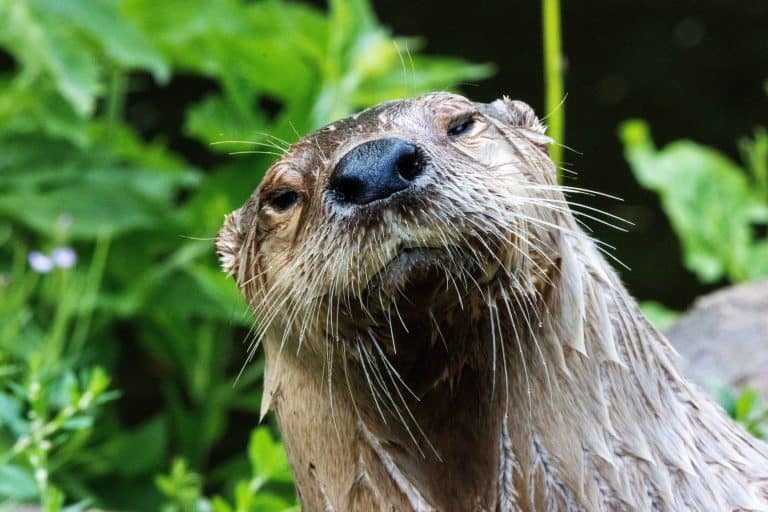
Giant otter
Giant otter Pteronura brasiliensis
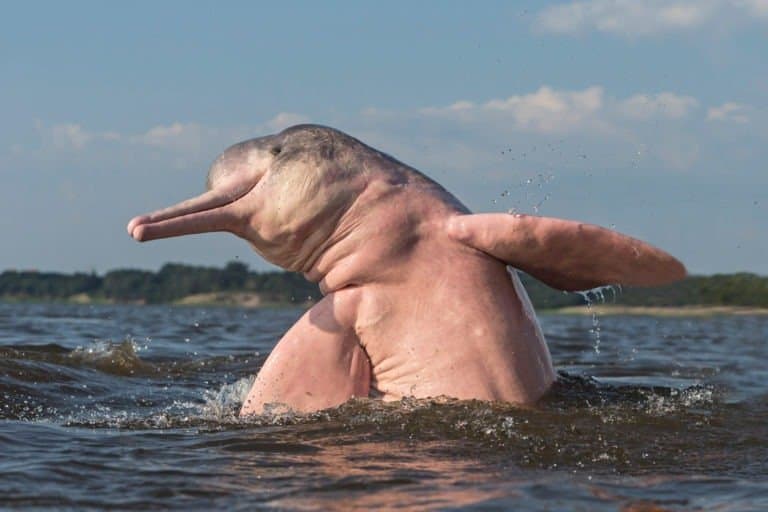
Amazon river dolphin
Amazon river dolphin Inia geoffrensis

Related Species 5

Freshwater angelfishes Pterophyllum Shared Family
Uaru cichlids
Uaru cichlids Uaru Shared Family
Severums Heros spp. Shared Family
Oscars
Oscars Astronotus ocellatus Shared Family
Dwarf cichlids Apistogramma Shared Family

Ecological Equivalents 5

Animals that fill a similar ecological role in their ecosystem

Freshwater angelfish Pterophyllum scalare Overlapping Amazon/Orinoco floodplain habitats; laterally compressed body for maneuvering among roots and vegetation; omnivorous micro-predator; biparental cichlid care, though discus are especially known for prolonged fry care with mucus-feeding.
Uaru cichlid
Uaru cichlid Uaru amphiacanthoides Occurs in warm, slow-flowing Amazonian waters; exhibits schooling/aggregating tendencies; is omnivorous with substantial plant and detritus intake; and displays biparental care—overall ecologically similar as a large-bodied floodplain cichlid.
Severum Heros efasciatus Occupies blackwater and clearwater floodplain and marginal habitats; has an omnivorous diet; and holds a comparable size class and predator-prey role within Amazonian cichlid assemblages.
Cardinal tetra Paracheirodon axelrodi Common co-occurring community fish in the warm, acidic blackwater systems where discus occur; shares environmental tolerances (high temperature, low hardness and low pH) and participates in the same small-prey food web, though at a much smaller size.
Hatchetfishes Gasteropelecidae Co-occur in calm floodplain and seasonally flooded forest (igapó) waters; share reliance on small invertebrate prey subsidies and structurally complex shore habitats, although they occupy a different water-column niche (surface vs. midwater/near-structure).

Types of Discus

3

Explore 3 recognized types of discus

Heckel discus Symphysodon discus
Common/Brown discus Symphysodon aequifasciatus
Green discus Symphysodon tarzoo

Quick Take

  • Reaching a 9-inch diameter is an achievement restricted to specimens within specialized artificial environments.
  • The 1 year reproductive threshold serves as a critical constraint for Amazonian population stability.
  • A discovery regarding skin secretions offers a surprising alternative to traditional larval feeding patterns.

Symphysodon, also known as discus, is a genus of brightly colored tropical fish (and a member of the cichlid family). These fish mainly reside in the long, sinewy waterways of the Amazon Basin. Because of their vivid colors and intricate markings, the discus is one of the most popular tropical aquarium fish in the world. They have undergone selective breeding in captivity for unique types of exotic markings and patterns, many of which don’t exist in the wild.

A comprehensive infographic titled 'Discus Fish: The King of the Aquarium' featuring a central illustration of a blue and brown striped Discus fish and various biological facts.
Beyond its vivid colors, the 'King of the Aquarium' hides a bizarre survival secret: feeding its larvae through skin secretions. See what makes this cichlid the most unique ruler of the Amazon Basin. © A-Z Animals

Incredible Facts

  • Discus fish prefer to congregate in large groups with dozens of members for protection and feeding.
  • They appear to derive their bright colors from combinations of pigments within skin cells.
  • An alternate name for discus is the “pompadour fish.” Named after Madame de Pompadour, a mistress of King Louis XV of France, the pompadour was a popular hairstyle in which a large volume of hair sweeps over the forehead.
  • Because of its bright colors, the discus has also earned the title “King of the Aquarium”.

Classification and Scientific Name

While “Symphysodon” and “discus” are used interchangeably, discus is more commonly used to describe the genus. “Symphysodon” may be a combination of the Greek words “symphysis,” meaning “grown together,” and “odous,” meaning “teeth.” Discus belongs to the family of cichlids, one of the most diverse vertebrate families in the world.

Species

A genetic study of discus confirms that there are three distinct species under the genus. The blue discus and the red discus, mentioned below, appear to be the most closely related and can produce viable hybrids together. However, several other types of discus have been created through selective breeding in captivity.

  • Blue Discus: Living downriver of the Rio Purus in the Eastern Amazon Basin, the blue (or the brown discus) has some combination of blue and brown colors all around its body.
  • Green Discus: Also native to the downriver Purus area in the Western Amazon Basin, the green discus sports a yellow-green body with some blue highlights around the fringes and some black stripes over its body.
  • Red Discus: Native to the Rio Negro and surrounding areas, the red discus has a bright red-orange body, sometimes complemented with blue-green patterns and black stripes. This species is also known as the Heckel discus.

Evolution
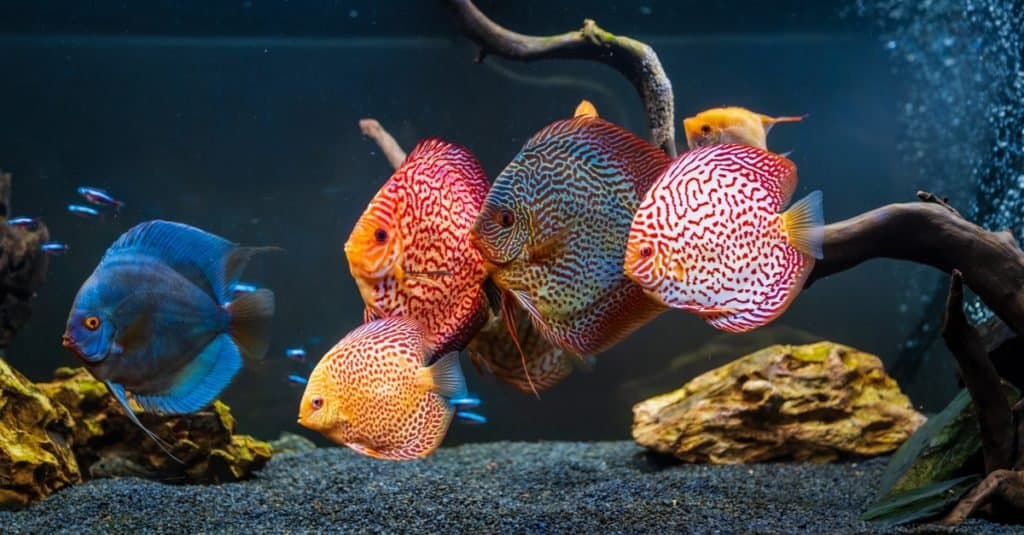
Favorite and Most Popular Animals: Fish

Discus fish have a mysterious evolutionary history.

The discus fish, also known as the Symphysodon, is an ancient genus of cichlid that has remained unchanged for millions of years. It is thought to have originated in the Amazon River basin and was first discovered by Europeans during their exploration of South America in the 16th century. Since then, discus fish have been selectively bred to develop different varieties with unique morphological features such as vibrant colors and longer fins. However, much about its evolutionary history remains unknown. Scientists believe that these fish may be closely related to other types of cichlids from Africa and Asia, but are unsure how they are connected or when they diverged from each other. Further research is needed to understand more about the evolution of this fascinating species.

Appearance
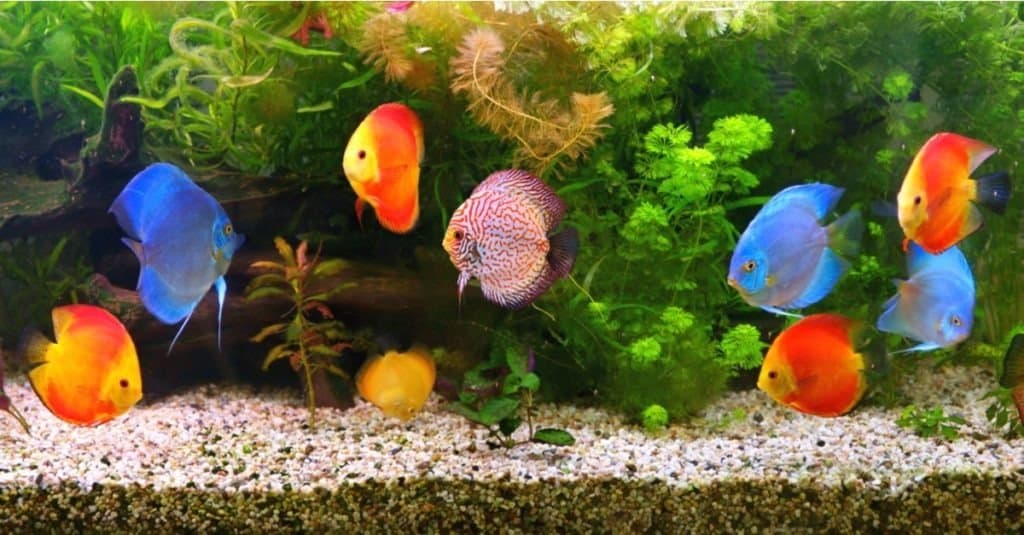
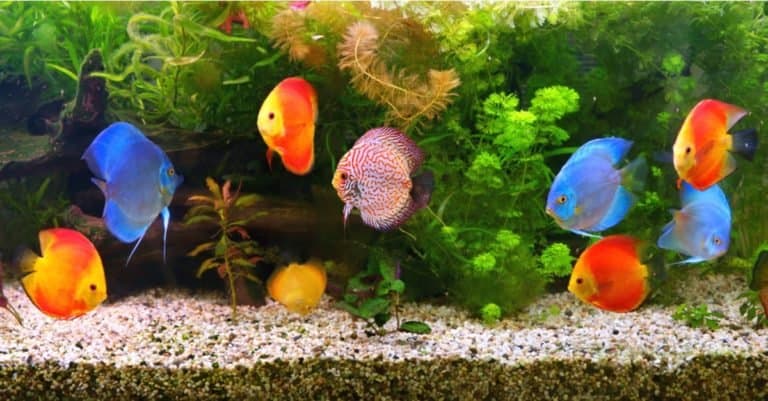
A group of discus in an aquarium

Many color varieties were bred for the aquarium trade.

For good reason, this fish has earned the name of discus with its relatively flat, rounded body. Large, prominent fins protrude dorsally and on the rear of the fish. As mentioned previously, the discus is classified according to coloration: blue, red, or green. However, there are multitudes of unique patterns. The fish also have remarkable color-changing abilities based on age, mood, environmental conditions, and stress levels.

Discus usually grow no larger than 6 inches and about half a pound in the wild. Reports indicate growth of around 8 or 9 inches in captivity. Except for breeding season, when the female’s abdomen is enlarged, it is very difficult to tell the sexes apart.

Behavior
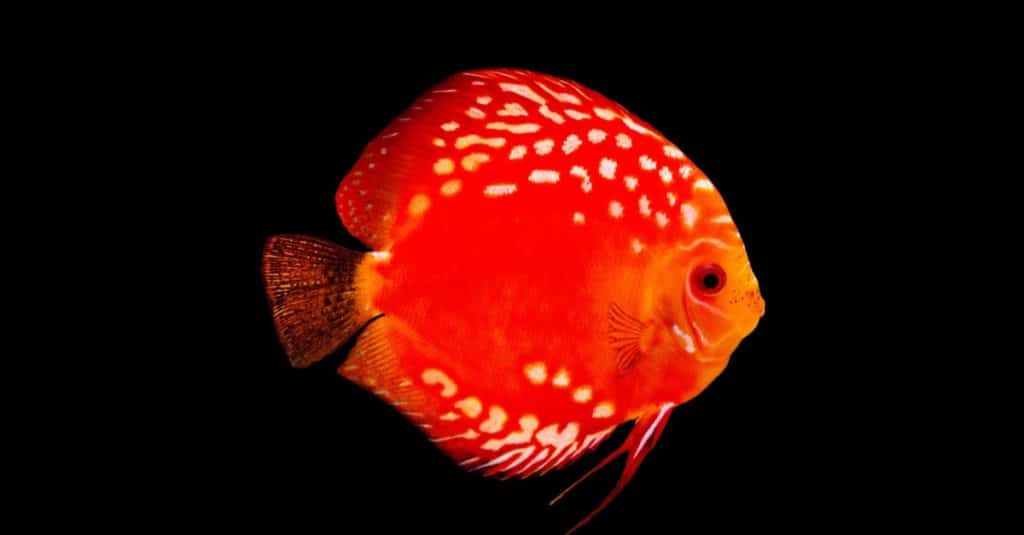
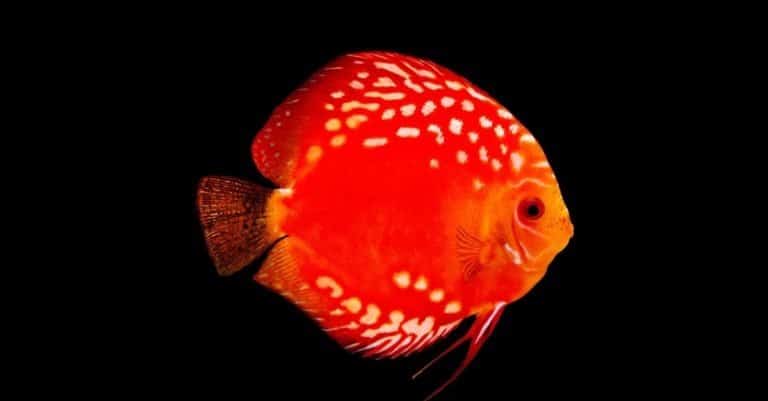
Red discus on black background

Discus fish prefer to hang out in groups and are friendly with other fish.

Discus fish display several unique behaviors, including swimming in circles, displaying “courtship” behavior during mating season, and forming small groups with other discus fish known as “schools.” During the courtship season, male discus will chase female discus around the water until they mate. This is often accompanied by vibrant colors and fin displays. In addition to these behaviors, discus also likes to interact with other fish. Discus are generally peaceful toward other species of water inhabitants, but may become aggressive if they feel threatened or territorial. Discus fish are shy creatures who will often hide among plants or driftwood when startled by predators. Discus fish also communicate using sounds like grunts and clicks, as well as visual cues such as flashing colors or movements of their fins.

Distribution, Population, and Habitat

In the wild, discus fish are exclusively endemic to the tributaries and floodplains of the Amazon River Basin. They are especially prolific in slow-moving blackwater channels. Discus will often congregate around fallen trees near the shore because of the constant flooding occurring annually.

Discus are not currently classified as threatened by the IUCN Red List. They are presumed to have stable and healthy populations. However, the threats to their natural habitat are probably the greatest potential problems discus populations face.

Predators and Prey

Discus are an intermediate part of the food chain, serving as an important link between nutritious plants and animals at the bottom and the predators above them.

What does the discus fish eat?

The majority of discus’ diet consists of algae and other small plant material supplemented with small invertebrates such as worms and crustaceans.

What eats the discus fish?

The main predators of these fish include turtles, birds, and larger species of fish. Discus are also known to act as cannibals to unrelated larvae of their own species.

Reproduction and Lifespan
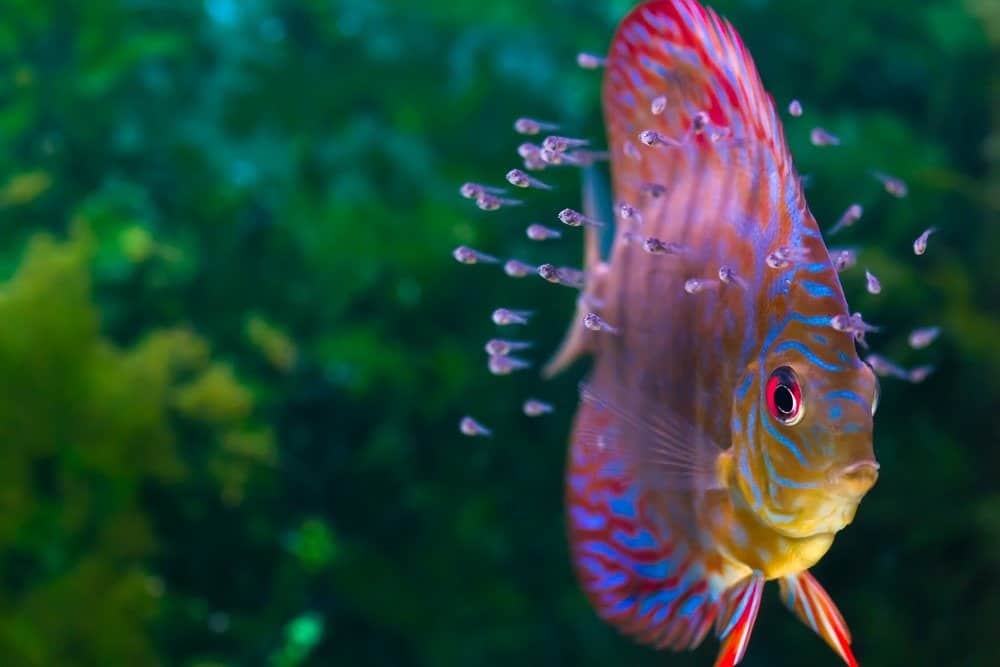
Baby Discus Cichlid fish swimming with parent. Discus fishes are native to the Amazon River.

Baby Discus fish swim with their parents.

Based on scientific observations, it appears that the timing of the discus mating season is highly influenced by changes in the flood levels of their local environment. They tend to spawn right as the water levels begin to rise as a way to take advantage of the abundant food and lower predator density. When ready to mate, a pair moves away from the rest of the group, perhaps to reduce the incidence of cannibalism. After copulating, the eggs usually hatch in about three or four days.

As with many other cichlid species, discus parents invest some time and care into the development of their offspring, guarding and cleaning the eggs. However, unlike many other cichlids, the discus has a unique adaptation: they secrete a mucus-like substance through their skin for the larvae to feed on for the first few weeks of their lives. When one parent begins to tire of this process, the larvae will switch to another parent. At the end of this period, the larvae will have grown large enough to fend for themselves.

The young discus will start to reproduce on their own after a year of age. The typical lifespan is some 10 to 15 years. But life is rough for young fish, and many of them fall prey to other animals before they can reach full size.

Fishing and Cooking

The discus is rarely caught in the wild for its meat. It’s isolated, difficult to reach, and simply undesirable. However, the discus is often raised in artificial environments for the purpose of selling it on the pet market, where it has proven to be incredibly valuable.

Population and Conservation
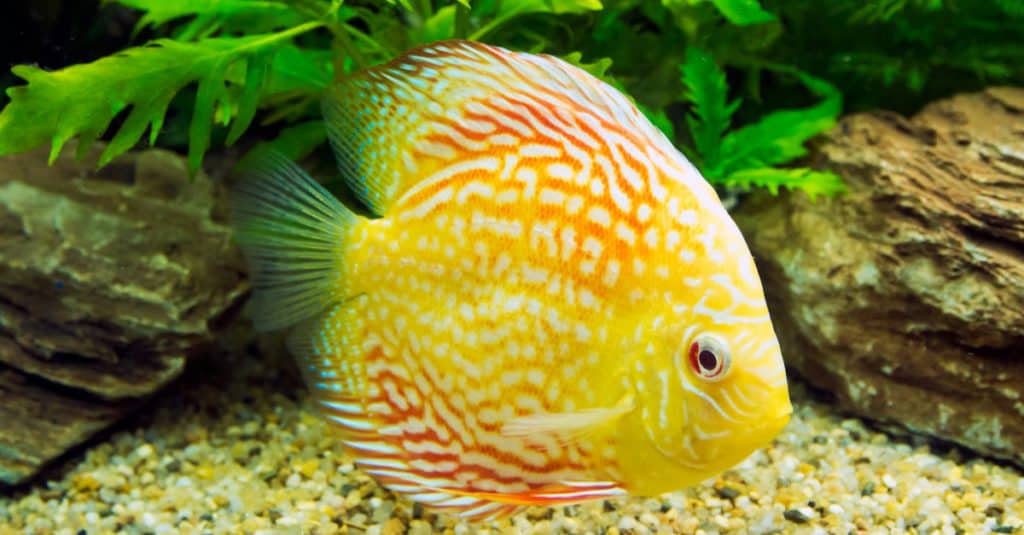
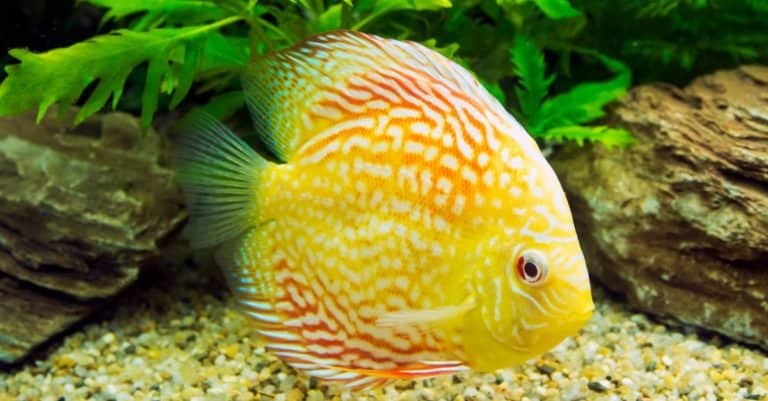
Yellow and red discus

Discus fish are threatened by habitat loss.

Discus fish are native to the Amazon River Basin. Their natural habitats have been greatly reduced due to deforestation and water pollution caused by human activities. As a result, their population has significantly declined over recent years. To help protect this species from extinction, conservation efforts have been taken in some countries, including Brazil and Peru. These include regulations on fishing and hunting as well as habitat protection measures. In addition to these efforts, captive breeding programs are being used to increase the population of discus fish in certain areas where they are threatened with extinction. Captive breeding involves raising wild-caught specimens in controlled environments until they can be reintroduced into their natural habitats. This helps ensure that healthy populations of discus fish will remain for future generations to enjoy.

View all 451 animals that start with D
How to say Discus in ...
Czech
Terčovec
English
Discus

Sources

  1. Britannica / Accessed December 27, 2020
  2. Aqueon / Accessed December 27, 2020
  3. The Spruce Pets / Accessed December 27, 2020
Heather Hall

About the Author

Heather Hall

Heather Hall is a writer at A-Z Animals, where her primary focus is on plants and animals. Heather has been writing and editing since 2012 and holds a Bachelor of Science in Horticulture. As a resident of the Pacific Northwest, Heather enjoys hiking, gardening, and trail running through the mountains with her dogs.

Thank you for reading! Have some feedback for us?


Discus FAQs (Frequently Asked Questions)

Even in an artificial environment, it is a good idea to replicate its natural diet as closely as possible. Tropical flakes, algae rounds, and shrimp pellets are some of the best foods you can give it. Try to make sure that you have a good balance between plant food and meat.