




D
Species Profile

Dusky Dolphin

Lagenorhynchus obscurus

Cape-wearing acrobat of cool seas
James Riden / Creative Commons

Dusky Dolphin Distribution

Click a location to explore more animals from that region

This map shows coastal regions where Dusky Dolphin are found.

Loading map...

At a Glance

Wild Species
Diet Carnivore
Activity Cathemeral+
Lifespan 20 years
Weight 100 lbs
Status Least Concern
Did You Know?

Adults are typically 1.6-2.1 m long and ~70-120 kg (Jefferson, Webber & Pitman, 2015).

Scientific Classification

The dusky dolphin is a small, highly social oceanic dolphin known for energetic leaping and acrobatics, typically found in cool-temperate waters of the Southern Hemisphere and often forming large, fast-moving groups.

Kingdom
Animalia
Phylum
Chordata
Class
Mammalia
Order
Cetacea
Family
Delphinidae
Genus
Lagenorhynchus
Species
Lagenorhynchus obscurus

Distinguishing Features

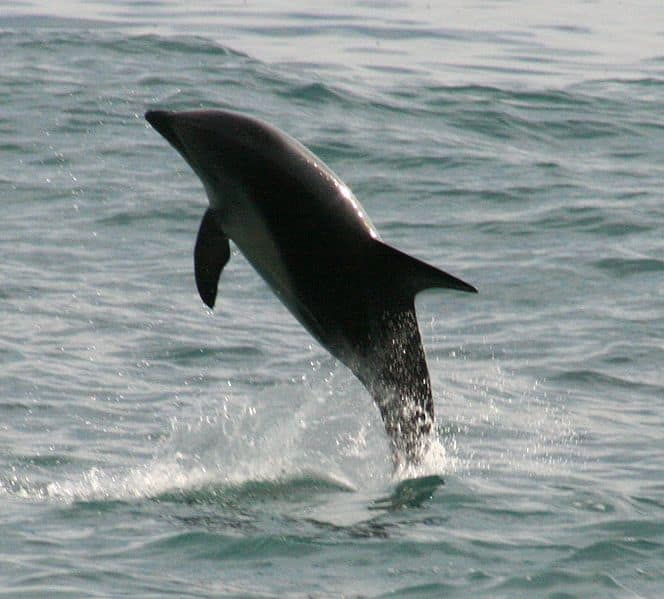
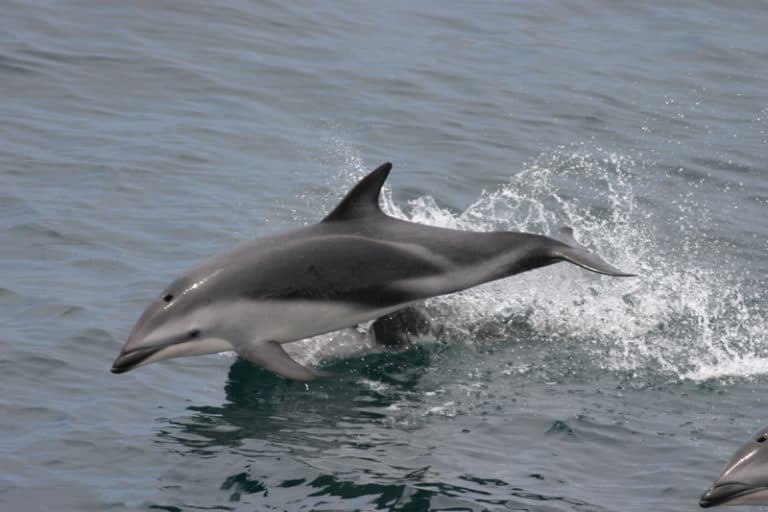
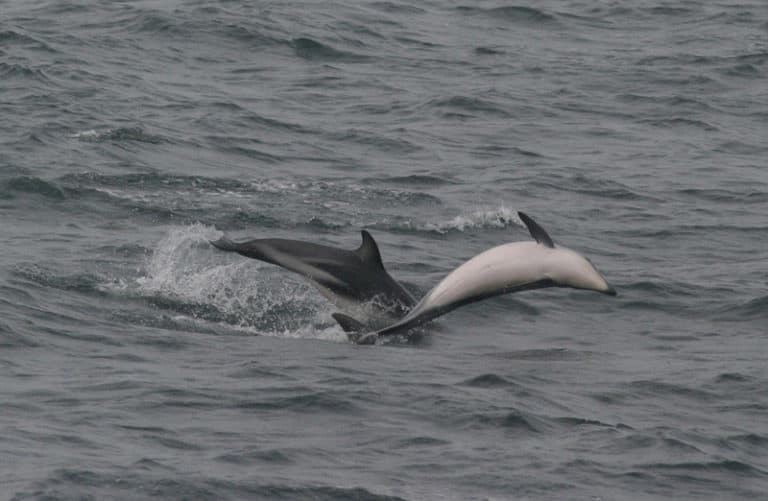
  • Distinct dark (dusky) cape over back with contrasting pale flank patch; overall gray-black and white countershading
  • Slender beak (rostrum) and relatively small body (commonly ~1.6–2.1 m)
  • High, curved dorsal fin and strong, frequent aerial behavior (leaps, spins, bow-riding)
  • Often forms large schools and can associate with other cetaceans in productive waters

Physical Measurements

Males and females differ in size

Length
1 in (1 in – 1 in)
5 ft 11 in (5 ft 4 in – 6 ft 4 in)
Weight
198 lbs (154 lbs – 243 lbs)
154 lbs (121 lbs – 187 lbs)
Top Speed
23 mph
About 20 knots (37 km/h)

Appearance

Primary Colors
Secondary Colors
Skin Type Dusky Dolphin (Lagenorhynchus obscurus) skin is hairless, smooth, and rubbery over thick blubber. It often has linear tooth-rake scars and cuts from social or feeding activity; fresh color edges are sharp.
Distinctive Features
  • Small, compact delphinid with adult total length typically ~1.6-2.1 m (reports commonly cite ~1.7-2.0 m as typical adults; Jefferson, Webber & Pitman 2015; Wursig, Thewissen & Kovacs 2018).
  • Distinctive dark dorsal cape with a pale flank patch (light gray-to-white) and white underside; strong countershading suited to pelagic hunting in cool-temperate, often productive/upwelling-influenced waters (e.g., Peru/Chile/Argentina, New Zealand, southern Africa).
  • Short, only moderately defined beak (rostrum) compared with long-beaked dolphins; head profile tends to look blunt/rounded at speed.
  • Tall, falcate (curved) dorsal fin set near mid-back; flippers moderately long and pointed; tail flukes with a pale underside (often white).
  • Very social, fast-moving dolphins that form large groups (tens to hundreds, sometimes over 1,000). Often do energetic leaps, spins, and bow-riding as a common behavior.
  • Foraging ecology linked to schooling fish and squid in productive waters; appearances often correlate with fronts, upwelling zones, and shelf-edge/slope features.
  • Human contact can cause more scarring or abrasions where dolphins meet fisheries. Bycatch risk varies by region, and repeated boat approaches in dolphin-watching areas can cause changes in behavior, depending on the situation.
  • Often called Lagenorhynchus obscurus, though some recent work suggests a different genus; appearance stays the same, and field identification relies on the dark cape and pale flank patch pattern.

Sexual Dimorphism

Sexual dimorphism is subtle but present: adult males average slightly longer/heavier than females, with broadly overlapping ranges; external coloration/pattern is essentially the same between sexes. Reported longevity is ~20-30+ years (maximums around three decades cited in syntheses; Jefferson et al. 2015; Wursig et al. 2018).

  • Slightly larger average body size and mass than females (overlapping ranges).
  • May show more prominent tooth-rake scarring on flanks/dorsum in some populations, consistent with higher rates of male-male social aggression in delphinids (population-dependent).
  • Slightly smaller average body size; otherwise same cape/flank patch pattern and fin shape.
  • Lactating females may appear more robust through the midsection during nursing periods, but this is not a fixed morphological marker.

Did You Know?

Adults are typically 1.6-2.1 m long and ~70-120 kg (Jefferson, Webber & Pitman, 2015).

They often travel in large, fast-moving groups-commonly 10-500, with aggregations of >1,000 reported in some areas (IUCN/field studies).

Their striking pattern includes a dark dorsal "cape" and a light flank patch-useful for camouflage (countershading) in open water.

In New Zealand, many groups show a day-night rhythm: daytime socializing/traveling nearshore and nighttime feeding offshore on vertically migrating prey (documented Kaikoura studies).

They eat schooling fish and squid (e.g., anchovy and other pelagic fish; squid), strongly linked to productive upwelling systems (Peru-Chile).

They have many small, conical teeth-about 34-48 teeth in each row of each jaw-ideal for gripping slippery fish and squid (species descriptions).

Maximum reported ages reach roughly ~28-30 years, with many individuals living less (ageing from tooth growth-layer studies).

Unique Adaptations

  • Countershading + 'dark cape' pattern: reduces visibility from above (dark back) and below (light belly), while the pale flank patch breaks up body outline in dim, choppy seas.
  • Streamlined, high-agility body: built for rapid acceleration, tight turns, and repeated breaching-useful when corralling schooling fish.
  • Echolocation suited to turbid, productive waters: biosonar helps track fish and squid in low visibility typical of upwelling zones.
  • Dense tooth rows (34-48 per jaw row): effective for grasping small, slippery prey rather than tearing large chunks.
  • Cool-temperate niche specialization: strongly associated with nutrient-rich waters (upwelling fronts, shelf edges, and canyon systems) that concentrate prey.

Interesting Behaviors

  • High-frequency aerial acrobatics: repeated leaps, twists, and splashy landings-often in coordinated bursts across a pod.
  • Bow-riding and wake-riding: frequently surf waves created by boats and sometimes large whales, matching speed and direction in tight formation.
  • Large-pod social life: groups can merge into superpods, then split again, suggesting flexible "fission-fusion" social structure.
  • Cooperative feeding: pods herd schooling fish into tighter balls/lines near the surface, often attracting seabirds; individuals take turns darting through prey.
  • Diel activity patterns (notably New Zealand): daytime milling/social behavior near shore followed by offshore feeding when prey migrate upward at night.
  • Vigorous social contact: chases, synchronous swimming, and body rubbing-common in social bonding and courtship.
  • Mother-calf cohesion: calves draft beside their mothers; groups may form nursery-like subgroups within larger aggregations.

Cultural Significance

Dusky dolphins (Lagenorhynchus obscurus) are a flagship species for dolphin-watching and swim-with-dolphin tourism, especially off Kaikoura, New Zealand, and Patagonia. Conservation must deal with bycatch in gillnets (Peru, Chile) and disturbance from many tour boats.

Myths & Legends

The Dusky Dolphin Lagenorhynchus obscurus gets its name from the Latin obscurus, meaning dark, for its cape-like color; it was first described in the 1800s by John Edward Gray.

Polynesian and Maori coastal traditions see dolphins as protective sea guides or guardians that lead people and canoes through dangerous waters. These beliefs are often linked to dolphins seen close to shore, including dusky dolphins.

A common Greek tale says the musician Arion was saved by a dolphin after pirates attacked him. This story made dolphins symbols of saving people at sea in many maritime cultures.

European maritime lore long viewed dolphins traveling with ships as auspicious companions, their playful bow-riding interpreted as a sign of safe passage-an association echoed today when dusky dolphins surf vessel wakes in Southern Ocean routes.

Conservation Status

LC Least Concern

Widespread and abundant in the wild.

Population Unknown

Protected Under

  • CITES Appendix II (international trade controls apply to most cetaceans, including this species in practice)
  • National protections and regulations for cetaceans in several range states (e.g., marine mammal protection provisions and fisheries/bycatch regulations in countries such as New Zealand, Argentina, Chile, and South Africa; details vary by jurisdiction)
  • CITES Appendix II

Life Cycle

Birth 1 calf
Lifespan 20 years

Lifespan

In the Wild
15–35 years
In Captivity
1–12 years

Reproduction

Mating System Polygynandry
Social Structure Aggregation Group
Breeding Pattern Transient
Fertilization Internal Fertilization
Birth Type Internal_fertilization

Dusky dolphin (Lagenorhynchus obscurus) are highly social, forming fission-fusion groups where mating is polygynandrous (promiscuous): many males and females mate; no long-term pairs. Gestation about 11 months, one calf, 2–3 year interval; mothers care for calves.

Behavior & Ecology

Social Pod Group: 100
Activity Cathemeral, Diurnal, Nocturnal
Diet Carnivore small schooling fish-especially Peruvian anchovy (Engraulis ringens) where available

Temperament

Highly social and gregarious; frequent close-proximity interactions within pods
Energetic and acrobatic (repeated leaping, spinning, somersaults) often during social bouts; these displays can scale up in larger groups
Cooperative/collective foragers; groups may coordinate movement and prey herding, especially in dense prey patches
Curious and boat-associated in some HUBs (notably where tourism is common), including bow-riding; responses vary from approach to avoidance depending on local vessel pressure
Generally tolerant of conspecific contact (rubbing, synchronous surfacing), with occasional brief aggression during competition (e.g., rapid chases, body bumps)

Communication

frequency-modulated whistles used in social cohesion Common across delphinids; described in dusky dolphin acoustic studies
burst-pulsed sounds/calls associated with social excitement and coordinated activity
echolocation clicks during foraging and navigation; click trains intensify during prey pursuit
visual signaling via aerial behaviors (leaps, spins, synchronized breaching) that can function as group-cohesion and arousal signals, especially in large pods
tactile contact (pectoral-fin rubbing, body-to-body contact) within close social groups
percussive surface displays (tail slaps, pectoral slaps) used in high-arousal contexts and apparent coordination
synchronized swimming and coordinated surfacing as non-vocal alignment signals within fast-moving groups

Habitat

Coastal Open Ocean Seabed/Benthic Rocky Shore
Biomes:
Terrain:
Coastal Island
Elevation: Up to 2952 ft 9 in

Ecological Role

Mid-upper trophic-level marine predator that links pelagic forage-fish/cephalopod production to higher trophic levels and helps structure schooling-fish communities through predation.

Regulates populations of small pelagic fish and squid (top-down control) Transfers energy from mesopelagic/diel-vertically migrating prey into epipelagic food webs (trophic coupling) Provides prey resources to scavengers via occasional carcasses and supports biodiversity through predator-driven schooling/fleeing dynamics Serves as an indicator species for changes in cool-temperate pelagic ecosystems (prey availability and oceanographic shifts)

Diet Details

Main Prey:
Small pelagic schooling fish Sardines Jack mackerel Hakes Lanternfishes Squids Small crustaceans +1

Human Interaction

Domestication Status

Wild

Dusky dolphin (Lagenorhynchus obscurus) is a wild small dolphin with no history of domestication or being kept as pets. Humans interact mainly through tourism (boat tours and swim-with activities), accidental capture or entanglement in fisheries, and scientific study. Adults are about 1.6–2.1 m long, 70–100 kg, and may live 18+ years.

Danger Level

Moderate
  • Bites and blunt-force injury can occur if humans attempt to touch/handle wild individuals; dolphins can inflict deep puncture/laceration wounds with conical teeth.
  • High-speed approaches to boats (bow-riding) increase risk of collision-related injury to swimmers/divers and to the animals; vessel strikes are a shared hazard.
  • Zoonotic/dermal infection risk from close contact with marine mammals (e.g., bacterial skin infections) and from exposure to bodily fluids during handling/stranding responses.
  • Open-water interactions (swim-with) carry situational risks: sudden group movements, rough sea state, separation from boat, and accidental contact during acrobatic surfacing.

As a Pet

Not Suitable as Pet

Legality: Dusky Dolphin (Lagenorhynchus obscurus) cannot be kept as a private pet almost anywhere. Marine mammal laws (e.g., U.S. MMPA) and CITES rules stop capture, transport, and possession without permits.

Care Level: Expert Only

Purchase Cost:
Lifetime Cost: $5,000,000 - $20,000,000

Economic Value

Uses:
Ecotourism (whale-watching / dolphin-watching; swim-with operations in some locales) Scientific research & education value (behavioral ecology, acoustics, population monitoring) Fisheries interactions (economic losses/gear damage; bycatch mitigation costs) Historic/limited direct take in parts of range (utilization as meat/bait in some fisheries) HUBS-Delphinidae: non-consumptive tourism, fisheries bycatch/depredation, directed takes in some regions, research/monitoring, limited regulated captivity for select species
Products:
  • Tourism services (boat tours, guiding, local hospitality revenue linked to viewing)
  • Research outputs (datasets, publications, conservation assessments)
  • (Where it has occurred) animal products from directed takes: meat/bait (region- and time-specific; increasingly regulated/controversial)

Relationships

Related Species 7

Peale's dolphin Lagenorhynchus australis Shared Genus
Atlantic white-sided dolphin Lagenorhynchus acutus Shared Genus
White-beaked dolphin Lagenorhynchus albirostris Shared Genus
Hourglass dolphin Lagenorhynchus cruciger Shared Genus
Pacific white-sided dolphin Sagmatias obliquidens Shared Family
Short-beaked common dolphin Delphinus delphis Shared Family
Bottlenose dolphin
Bottlenose dolphin Tursiops truncatus Shared Family

Ecological Equivalents 5

Animals that fill a similar ecological role in their ecosystem

Pacific white-sided dolphin Sagmatias obliquidens Fast, cool-water dolphin that forms large, moving groups and eats small schooling fish and squid, cooperating to herd fish near the surface; often rides bow waves and leaps, similar to dusky dolphins (Lagenorhynchus obscurus).
Short-beaked common dolphin Delphinus delphis Both are small-to-medium pelagic dolphins that consume schooling fish and squid, form large fast-moving groups, and hunt at productive fronts and upwelling zones in parts of the Southern Hemisphere.
Hector's dolphin Cephalorhynchus hectori Shares cool-temperate Southern Hemisphere coastal habitat (notably New Zealand) and feeds on fish and squid; is more coastal and forms smaller groups than dusky dolphins. A small delphinid occupying the same broader feeding guild.
Dall's porpoise Phocoenoides dalli Cold- to cool-temperate, high-speed odontocete that feeds on schooling fishes and squid. Although a porpoise (family Phocoenidae) rather than a delphinid, it occupies a similar small, fast pelagic-predator niche and associates with similar prey concentrations.
Dusky dolphin
Dusky dolphin Lagenorhynchus obscurus Adults 1.6–2.1 m long and 70–100 kg, with a lifespan of about 20 years. Very social, often leaping and bow-riding; feed on small schooling fish and squid in cool-temperate Southern Hemisphere waters.

The Dusky Dolphin is a small species of dolphin that is found inhabiting the cooler waters along continental shelves throughout the southern hemisphere. This distinctive-looking cetacean is closely related to other large marine animals, including other dolphins, porpoises, and whales, but despite their fish-like appearance Dusky Dolphins are true mammals that both breathe air in and out of their lungs and also suckle their young on milk produced by the mother’s mammary glands. Dusky Dolphins are widespread throughout the southern hemisphere, with three species being recognized that have been grouped by their geographical range, with one found off the coast of South America, one near South Africa and in the Indian Ocean, and another inhabits deeper waters close to New Zealand. Sadly, however, despite being locally common in certain areas, Dusky Dolphin populations have declined throughout much of their natural range primarily due to threats caused by increasing levels of human activity.

Evolution and Origins
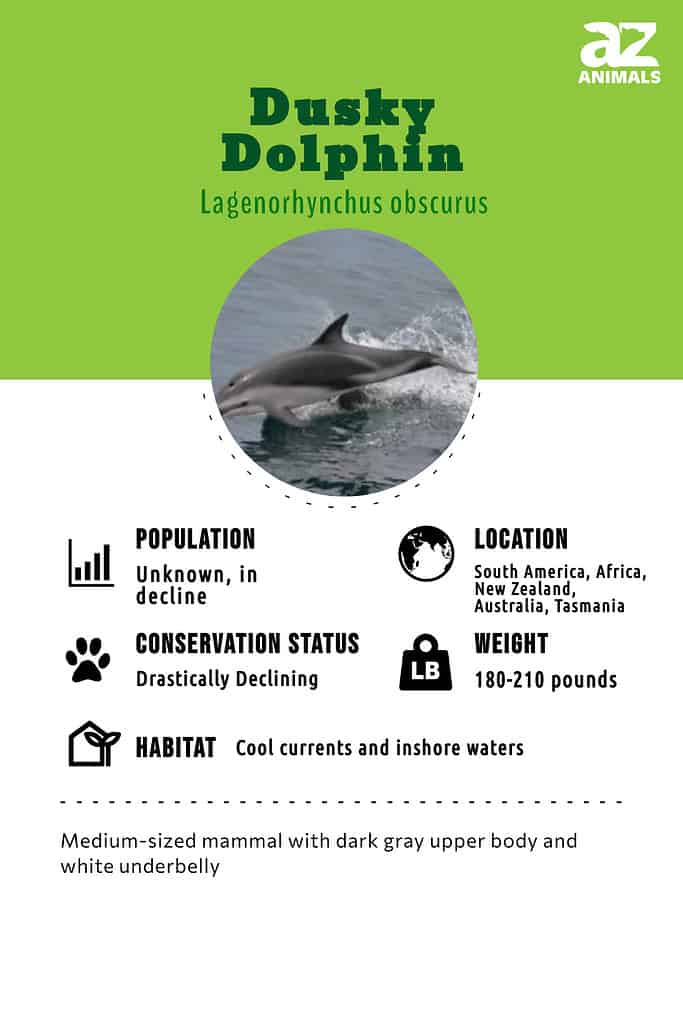
Dusky Dolphin infographic

The evolutionary history of the Dusky Dolphin (Lagenorhynchus obscurus) is a fascinating subject that has been studied extensively by researchers and marine biologists. Despite being one of the most elusive and enigmatic species in the cetacean family, scientists have managed to uncover some interesting facts about its origins over time.

According to genetic studies, Dusky Dolphins are closely related to other members of the Lagenorhynchus genus, such as the Pacific white-sided dolphin and Peale’s dolphin. These dolphins all share similar physical characteristics, including their small size, streamlined bodies, and distinctive black-and-white markings.

Based on fossil records and molecular data analysis, it is believed that the ancestors of modern-day Dusky Dolphins diverged from their common ancestor with other Lagenorhynchus species around 6-7 million years ago. Over time, these early dolphins evolved unique adaptations that allowed them to thrive in their specific habitats along coastal regions throughout South America.

Today, Dusky Dolphins are found primarily in temperate waters off the coastlines of New Zealand, Chilean Patagonia, Peru’s Ballestas Islands, and Argentina’s Atlantic coast. They have adapted well to these environments through specialized hunting techniques like strand feeding where they herd fish into shallow water before attacking them collectively; making them an important part of local ecosystems within those areas.

Anatomy and Appearance
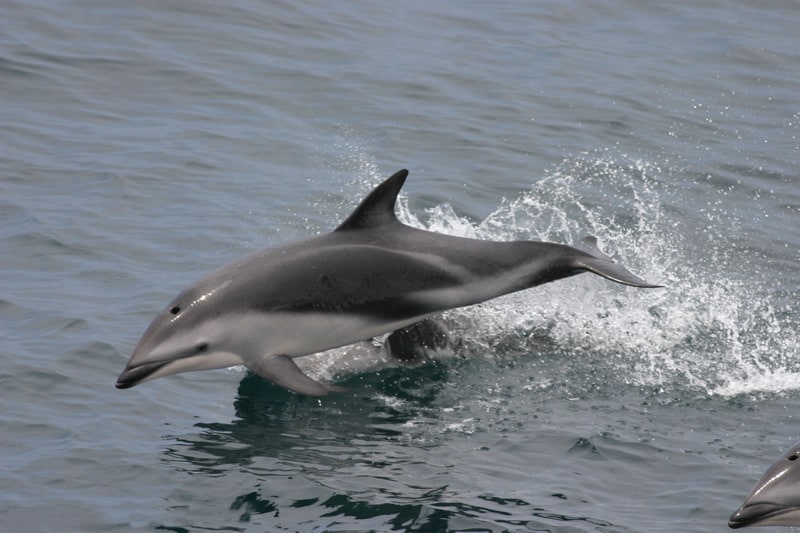
A Dusky Dolphin can weigh up to 210 pounds.

The Dusky Dolphin is the smallest of the world’s 33 different species of dolphin, growing to under two meters in length and generally weighing less than 100kg. Like other species of cetacean, Dusky Dolphins have a smooth and hairless, streamlined body that helps them to glide through the water and is powered by their two tail flukes which lay horizontally rather than vertically like those of fish. The upper side of their bodies is either dark grey or blue-black in color and is separated from their light grey to white underside by a grey line that runs from their beak to the base of their tail. Dusky Dolphins also have two light grey lines which run diagonally from their tail to their dorsal fin, which is tall and curved to help them to change direction quickly in the water. The beak of the Dusky Dolphin is black and more rounded in shape than those of other dolphin species and contains between 24 and 36 pairs of sharp, cone-shaped teeth that are ideal for catching slippery and fast-moving prey.

Distribution and Habitat
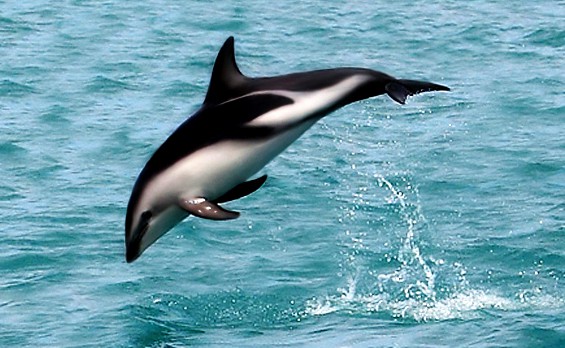
Dusky Dolphins like cool currents

Dusky Dolphins tend to be found in cool to temperate waters (10 – 18 degrees centigrade) close to continental shelves throughout the southern hemisphere and seem to prefer shallower rather than deep water regions (although this can vary depending on the location and time of year). Although they are not generally known to participate in seasonal migrations, Dusky Dolphins can travel vast distances across the ocean and at great speed in search of food. The three Dusky Dolphin species have been classified by the regions in which they live, with the highest populations found off the coast of South America, South-Western Africa, and around New Zealand. There are also populations known to occur in the waters close to Argentina along with around the Falkland Islands further south. Despite their wide range and distribution throughout the southern hemisphere, Dusky Dolphin populations have been decreasing mainly due to interaction with humans, including being hunted for their meat and getting caught in the nets that are used to catch the shoaling fish which the Dusky Dolphins hunt.

Behavior and Lifestyle

Dusky Dolphins are highly social and intelligent animals.

The exact behaviors and habits of Dusky Dolphins depend on the species, and where they live however, they generally spend time close to the shore resting during the day in small groups that consist of between ten and twenty individuals. As night falls, these small groups begin to travel further away from land to feed and form pods consisting of up to 1,000 individuals that include both male and female members in order to work together to corner shoals of fish.

Dusky Dolphins are incredibly sociable animals and can be seen playing, grooming, and leaping together after feeding before breaking up into their smaller groups again to return closer to the coast to rest. Although they are able to dive for up to 90 seconds at a time like other marine mammals, Dusky Dolphins must keep returning to the water’s surface to breathe and expel old air and water from their lungs via the single blow-hole that located on the top of their heads. They are highly intelligent animals and are often seen leaping out of the water before diving back in after gliding through the air for a few seconds. This technique is known as porpoising and enables the Dusky Dolphin to breathe without having to slow down when chasing prey.

Reproduction and Life Cycles
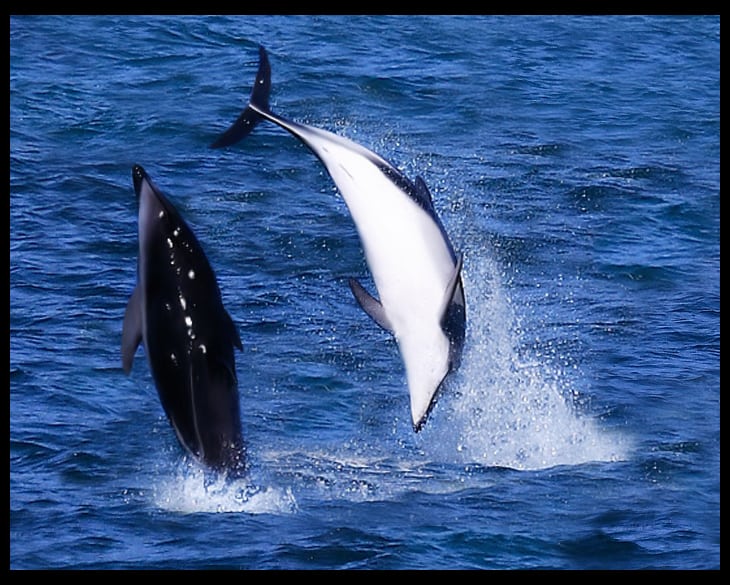
Dusky Dolphins can be seen throughout the southern hemisphere.

Despite being relatively widespread across the southern hemisphere, the fast-moving nature of the Dusky Dolphin has meant that it can often be hard to study these animals in the wild, and quite little is therefore known about their lifespans in general. Most Dusky Dolphin calves tend to be born towards the end of the winter and in the early summer months between October and February, when the female gives birth to a single offspring after a gestation period that lasts for around 11 months.

The Dusky Dolphin calf is fed on the nutritious milk provided by its mother until it is then taught to hunt by her after about a year. Calves tend to remain close to their mother until they are around three years old, when they leave to join a pod of their own (males with often form bachelor groups), and the female is then able to mate again. Dusky Dolphins are thought to be able to breed when they are between the ages of four and five and are thought to live for an average of 20 years.

Diet and Prey
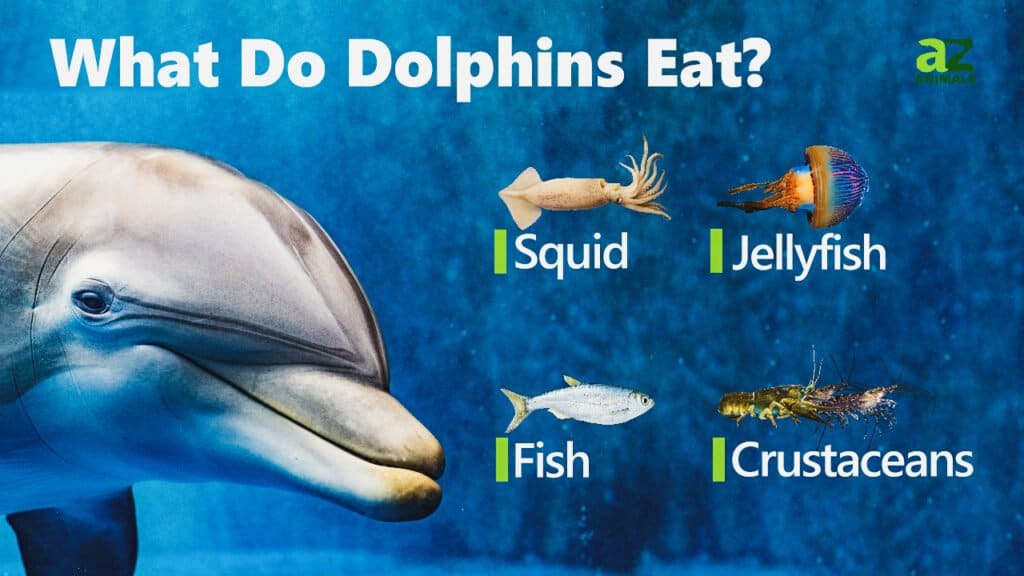
What Do Dolphins Eat
Dolphins eat squid, jellyfish, fish, and crustaceans.

The Dusky Dolphin is a carnivorous animal that only feeds on other animals in order to gain the nutrients that it needs to survive. By congregating in large groups, Dusky Dolphins are able to trap vast schools of fish so that they have the best opportunity to feed by traveling through the waters in a line and pushing the shoal into an area where it is trapped. Prey depends largely on the area in which the Dusky Dolphins are feeding, but they most commonly consume anchovies, sardines, and mackerel in shallower waters, squid at mid-depths, and larger prey, including hake and octopus in the deeper ocean. Although Dusky Dolphins have excellent hearing and are able to see remarkably well through the water, it is actually a specially evolved system that these animals use which both helps them to locate prey and to avoid upcoming obstacles. By producing a rapid series of clicking noises, the Dusky Dolphin’s brain is then able to translate the clicks that bounce off things ahead (such as fish) into a mental sound map of the surrounding area and therefore knows exactly where to find food.

Predators and Threats
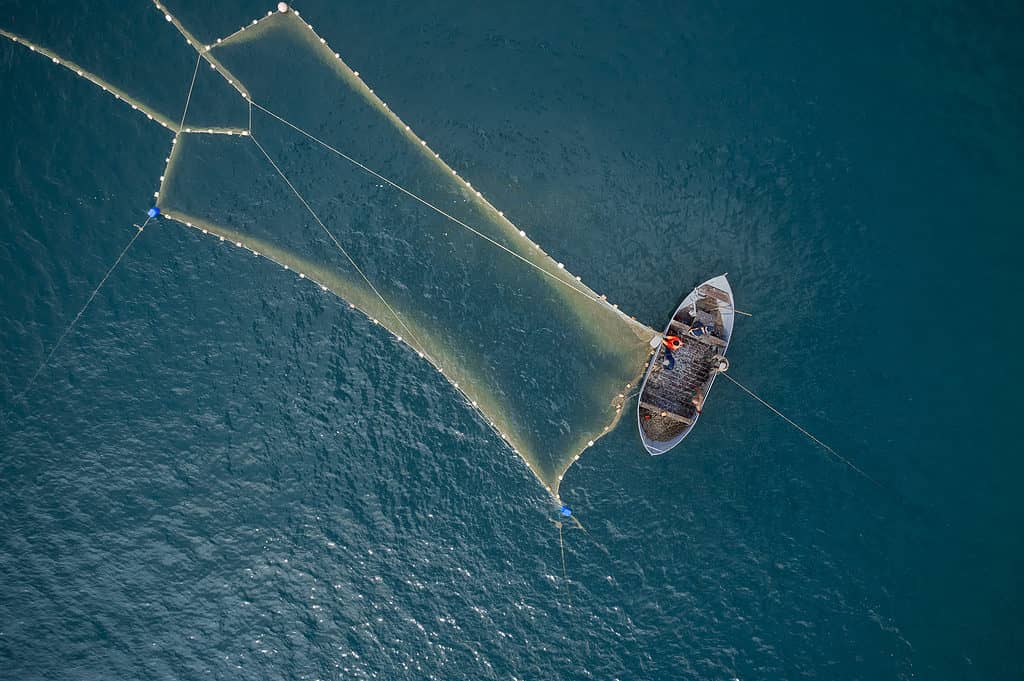
A fisherman on a fishing boat is casting a net for catching fish.

The commercial fishing industry is the biggest threat to dolphins.

The relatively large size, sociable nature, and sheer speed of the Dusky Dolphin mean that it has very few predators that hunt it in its natural environment. Pods of Killer Whales (to which they are related) are the main predators of the Dusky Dolphin, along with some large species of shark that venture into the shallower, coastal waters. The biggest threat to the world’s Dusky Dolphin populations, though, is people encroaching more and more on their natural habitats, usually in the form of commercial fishing. As humans are fishing for the same shoaling fish as the Dusky Dolphins, it often leads to them being caught up in vast nets where they can quickly become trapped. Other reasons for the decline in Dusky Dolphins include the fact that they are also hunted in some areas (particularly Peru) for their meat and are injured by large boats that hit them.

Interesting Facts and Features
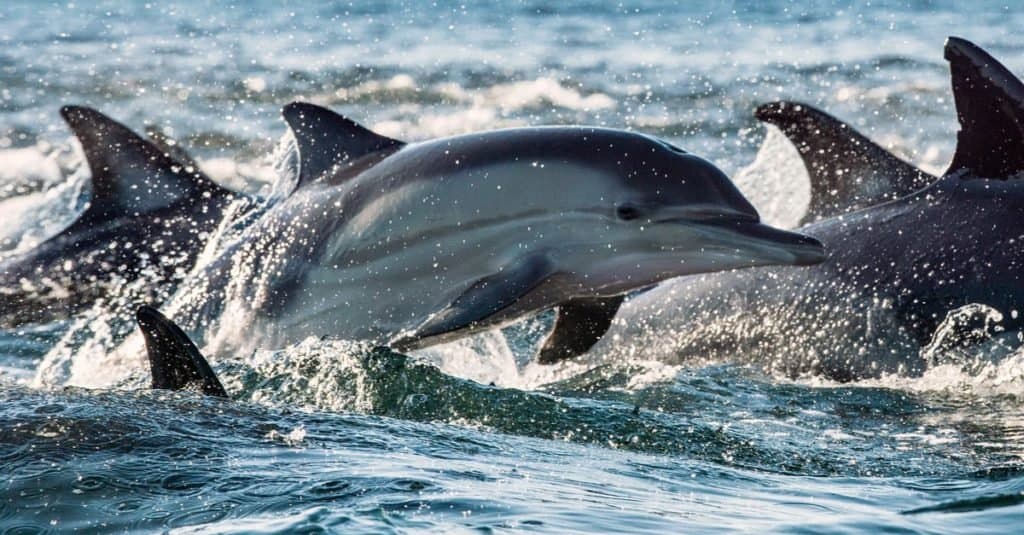
Dolphins, swimming in the ocean and hunting for fish. The Long-beaked common dolphin in Atlantic ocean.

Dusky dolphins and common dolphins are friends.

The Dusky Dolphin is thought to be one of the most intelligent animal species in the world and even communicates with other individuals using their own language, which consists of a series of whistles, clicks, and squeaks. The unique body shape of the Dusky Dolphin means that it is incredibly flexible and, in fact, the most agile species of dolphin in the world. They are often seen leaping out of the water both when swimming and playing, and the noise that is caused by them diving back into the water is able to travel for up to 1km through the water and up to 3km through the air. Dusky Dolphins are known to be incredibly sociable animals with sick or injured individuals helped by others that push them towards the surface so the vulnerable individual is able to breathe. Along with being seen together in their own pods, Dusky Dolphins are also known to interact with other cetaceans, including Common Dolphins, which they feed alongside.

Relationship with Humans
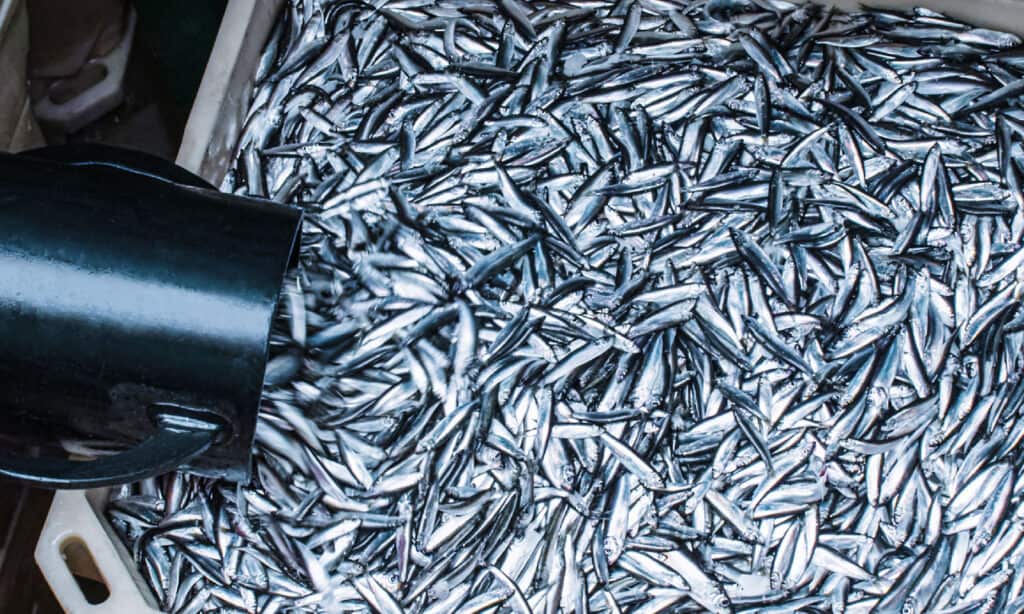
Sprat

Turtles, sharks, and dolphins are caught by the thousands in commercial fishing nets.

Despite being one of the most intelligent animals in the world, the increasing amount of man-made obstacles, such as boats and rigs that litter the sea, has led to a decline in Dusky Dolphin populations as they are often hit by them. Populations around South America have also suffered greatly from hunting by people for their flesh which is used both as bait for fish and for human consumption. A study carried out between 1991 and 1993 revealed that 7,000 Dusky Dolphins were captured each year, and although the hunting of dolphins has been recently banned, they are still commonly hunted as food. The issue, however, that most affects all Dusky Dolphin populations is the fact that they are often caught by accident in large fishing nets that are targeting the same fish that the dolphins are. However, in a growing number of places around the world, watching the acrobatic Dusky Dolphin is becoming increasingly popular with tourists and bringing awareness to the threats that they face.

Conservation Status and Life Today
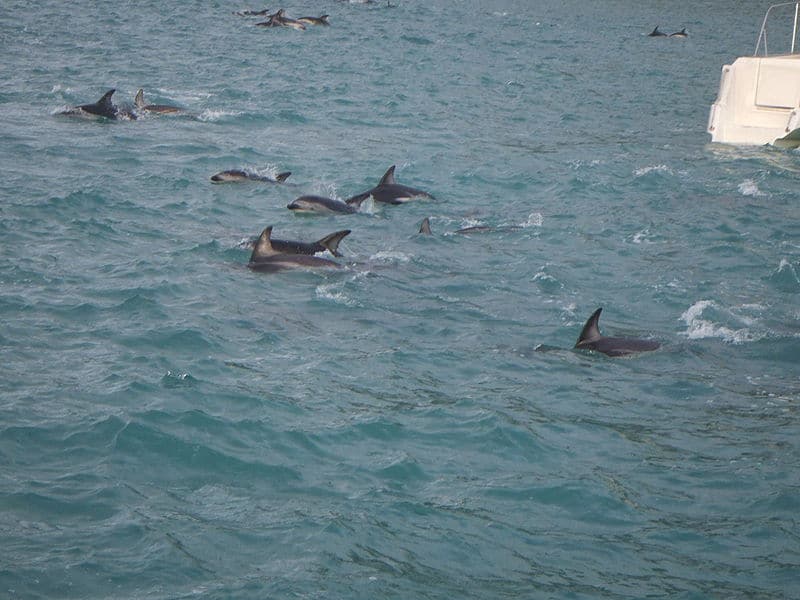
Dusky Dolphin numbers are drastically declining.

Today, the Dusky Dolphin is listed by the IUCN as being Data Deficient which means that although certain populations in certain areas are well reported, little is really known about those individuals that inhabit unpopulated regions. However, their numbers are known to be drastically declining throughout the southern hemisphere, primarily due to the increasing levels of human activity in their native environments. Despite hunting them being banned, they are still caught in nets and trawlers by the thousands on a yearly basis.

View all 451 animals that start with D
How to say Dusky Dolphin in ...
Catalan
Dofí fosc
German
Schwarzdelfin
English
Dusky Dolphin
Spanish
Lagenorhynchus obscurus
French
Lagenorhynchus obscurus
Italian
Lagenorhynchus obscurus
Japanese
ハラジロカマイルカ
Dutch
Donkergestreepte dolfijn
Polish
Delfin ciemny
Portuguese
Golfinho-do-crepúsculo
Swedish
Södra Atlantvitsiding

Sources

  1. David Burnie, Dorling Kindersley (2011) Animal, The Definitive Visual Guide To The World's Wildlife / Accessed December 10, 2008
  2. Tom Jackson, Lorenz Books (2007) The World Encyclopedia Of Animals / Accessed December 10, 2008
  3. David Burnie, Kingfisher (2011) The Kingfisher Animal Encyclopedia / Accessed December 10, 2008
  4. Richard Mackay, University of California Press (2009) The Atlas Of Endangered Species / Accessed December 10, 2008
  5. David Burnie, Dorling Kindersley (2008) Illustrated Encyclopedia Of Animals / Accessed December 10, 2008
  6. Dorling Kindersley (2006) Dorling Kindersley Encyclopedia Of Animals / Accessed December 10, 2008
  7. David W. Macdonald, Oxford University Press (2010) The Encyclopedia Of Mammals / Accessed December 10, 2008
  8. Dusky Dolphin Information / Accessed December 10, 2008
  9. About Dusky Dolphins / Accessed December 10, 2008
  10. Dusky Dolphin Conservation / Accessed December 10, 2008
Heather Hall

About the Author

Heather Hall

Heather Hall is a writer at A-Z Animals, where her primary focus is on plants and animals. Heather has been writing and editing since 2012 and holds a Bachelor of Science in Horticulture. As a resident of the Pacific Northwest, Heather enjoys hiking, gardening, and trail running through the mountains with her dogs.

Thank you for reading! Have some feedback for us?


Dusky Dolphin FAQs (Frequently Asked Questions)

Dusky Dolphins are Carnivores, meaning they eat other animals.