
E
Species Profile

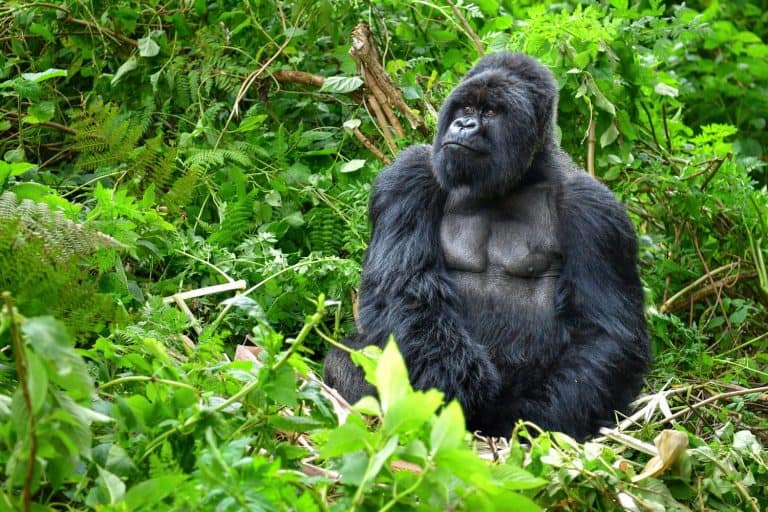
Eastern Lowland Gorilla

Gorilla beringei graueri

Gentle giant of Congo's forests
JoJan / Creative Commons

Eastern Lowland Gorilla Distribution

Click a location to explore more animals from that region

Endemic Species
Loading map...

Size Comparison

Human 5'8"
Eastern Lowland Gorilla 5 ft 3 in

Eastern Lowland Gorilla stands at 93% of average human height.

At a Glance

Wild Species
Diet Folivore
Activity Diurnal
Lifespan 35 years
Weight 220 lbs
Did You Know?

Largest living primate: adult males commonly ~160-210 kg and ~1.6-1.7 m standing (field reports); females often ~70-100 kg and ~1.4-1.5 m.

Scientific Classification

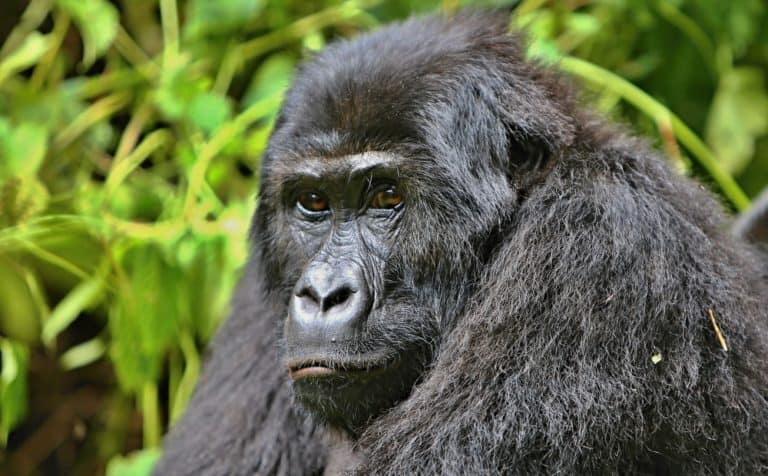
The Eastern lowland gorilla (Grauer’s gorilla) is the largest living primate and a subspecies of the eastern gorilla, endemic to the eastern Democratic Republic of the Congo. It is primarily terrestrial and herbivorous/folivorous, living in cohesive social groups led by a dominant silverback.

Kingdom
Animalia
Phylum
Chordata
Class
Mammalia
Order
Primates
Family
Hominidae
Genus
Gorilla
Species
Gorilla beringei

Distinguishing Features

  • Very large body size (often the largest gorilla subspecies)
  • Stockier build with a broad chest and robust limbs
  • Darker, shorter hair than western lowland gorillas (but not as long/shaggy as mountain gorillas)
  • Social groups centered on a silverback; knuckle-walking locomotion

Physical Measurements

Males and females differ in size

Height
1 in (1 in – 1 in)
4 ft 6 in (4 ft 1 in – 4 ft 11 in)
Weight
375 lbs (309 lbs – 463 lbs)
198 lbs (154 lbs – 216 lbs)
Top Speed
20 mph
Mostly knuckle-walking; reported ~32 km/h

Appearance

Primary Colors
Secondary Colors
Skin Type Coarse hair over most of body; bare, thick, pigmented (dark gray to black) skin on face, ears, palms/soles, and parts of the chest/abdomen. Facial skin forms a distinctive bare 'mask' with individual nose-print (rhinarium) wrinkles.
Distinctive Features
  • Largest living primate; extremely robust build with broad chest/shoulders and long, muscular forelimbs adapted for terrestrial knuckle-walking (locomotion primarily terrestrial but capable climbers).
  • Cranial features: pronounced brow ridge; males often with a sagittal crest for attachment of large jaw muscles (linked to display and chewing).
  • Adult size (reported ranges vary by source and population): adult males commonly ~140-205 kg body mass; adult females commonly ~90-100 kg (e.g., Nowak, 1999; Groves, 2001-values presented as typical ranges rather than fixed 'exact' measures).
  • Stature: large-bodied ape with standing height often reported around ~1.6-1.8 m for adults (varies by posture and measurement method; commonly summarized in museum/field references rather than standardized 'exact' heights).
  • Dentition/jaws: very large canines in adult males (display and competition more than feeding), with powerful molars for fibrous vegetation; diet predominantly herbivorous/folivorous with seasonal fruit when available (field studies across eastern DRC).
  • Nostrils and nose-print: each individual has a unique pattern of nasal wrinkles/creases used for identification in field research and conservation monitoring.
  • Grauer's gorilla (Gorilla beringei graueri) lives only in eastern Democratic Republic of the Congo. It is Critically Endangered due to poaching and habitat loss. Appearance notes help field ID.

Sexual Dimorphism

Marked sexual dimorphism in body mass, cranial crests, canine size, and adult male silverback coloration; males are substantially larger and develop a silver dorsal saddle with maturity.

  • Much larger overall body mass and shoulder breadth; commonly cited adult male mass range ~140-205 kg (sources summarized in mammal reference works such as Nowak, 1999; Groves, 2001).
  • Distinctive silver-gray dorsal 'saddle' (silverback) appearing with maturity, typically spreading across back and rump; combined with darker limbs and chest.
  • More pronounced sagittal crest and brow ridge; larger jaws and canines used in threat displays and male-male competition.
  • Smaller body mass (commonly cited ~90-100 kg in reference summaries such as Nowak, 1999; Groves, 2001).
  • No true silverback saddle; coloration remains more uniformly dark with only minor grizzling possible with age.
  • Less pronounced cranial crests and smaller canines relative to males.

Did You Know?

Largest living primate: adult males commonly ~160-210 kg and ~1.6-1.7 m standing (field reports); females often ~70-100 kg and ~1.4-1.5 m.

Endemic range: only in eastern Democratic Republic of the Congo (not found anywhere else on Earth).

Big decline: estimated ~77% population reduction from 1994 to 2015 (Plumptre et al., 2016), driven largely by hunting and habitat loss linked to conflict/mining.

Flexible diet: mostly leaves, stems, pith and other herbaceous vegetation; fruit can be seasonally important at lower elevations.

Daily architects: each individual typically builds a new night nest every day; younger gorillas also make day nests for rest.

Slow life history: ~257-day gestation; usually a single infant; typical interbirth interval ~4-6 years, making recovery from losses very slow.

Altitude generalist (for a gorilla): recorded roughly from lowland forests up to montane zones (~600-2,900 m), broader than the mountain gorilla's core range.

Unique Adaptations

  • Very robust skull and jaws with large molars and strong chewing muscles-adapted for processing tough, fibrous vegetation (folivory) while still exploiting fruit when available.
  • Enlarged gut/fermentation capacity (typical of gorillas) to extract energy from high-fiber plant diets.
  • Extreme sexual dimorphism (males far larger) supports a social system where a silverback can defend and lead a group.
  • Dense hair and broad elevational tolerance help this subspecies use both lowland and cooler montane forests.
  • Powerful hands/forelimbs support both terrestrial knuckle-walking and occasional climbing/branch pulling during feeding.

Interesting Behaviors

  • Cohesive family groups led by a dominant silverback; Grauer's groups can include multiple adult males more often than some other gorilla populations (especially in higher-quality habitats).
  • Knuckle-walking terrestrial travel, with climbing more common in juveniles and where fruiting trees are used.
  • Chest-beating displays (often paired with vocalizations) to advertise strength, coordinate spacing, and reduce the need for physical fights.
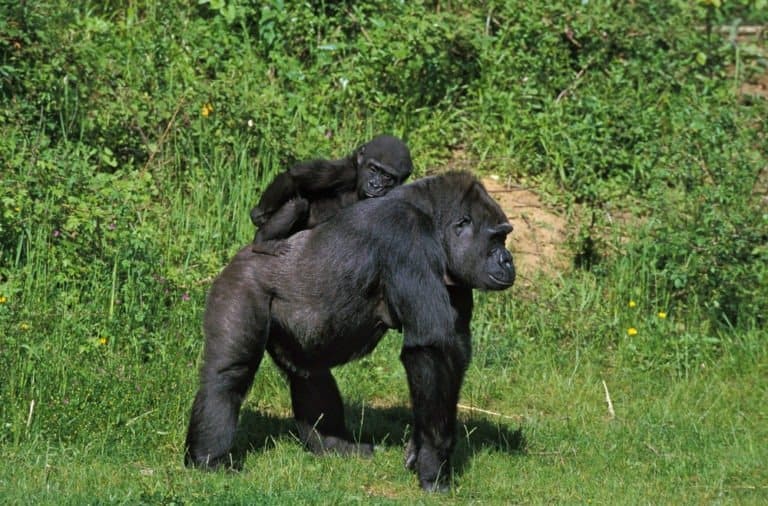
  • Social grooming, play (especially in juveniles), and close mother-infant contact; infants ride ventrally then dorsally as they grow.
  • Foraging style: "selective feeding" on high-quality plant parts (young leaves/pith) and opportunistic fruit feeding when available.
  • Nightly nesting: ground nests are common due to large body size; day nests are built during midday rests.
  • Conflict avoidance: many inter-group encounters are resolved via displays and spacing rather than contact aggression.

Cultural Significance

Grauer's gorilla (Gorilla beringei graueri), named for Rudolf Grauer, lives in eastern DRC. Many local groups see them as almost human and don't kill or eat them; elsewhere hunting rose with war, guns, and the bushmeat trade. They are a symbol for Kahuzi-Biega National Park and ecotourism.

Myths & Legends

Across parts of Central Africa, oral traditions commonly describe great apes as forest beings closely related to humans-sometimes framed as "people of the forest" who share humanlike family life but remain apart in the wild.

In some clan-based totem systems documented in the Congo Basin, powerful animals (including great apes in certain localities) can function as totems tied to identity and taboo, where harming the animal is culturally restricted.

Early 1900s Congo expedition stories made the gorilla seem like a huge, scary jungle giant—an image that spread into tales like King Kong. But local people often told of gorillas' social, humanlike ways.

Conservation Status

CR Critically Endangered

Facing an extremely high risk of extinction in the wild.

Population Decreasing

Protected Under

  • CITES Appendix I (commercial international trade prohibited except under exceptional circumstances).
  • National legal protection in the Democratic Republic of the Congo (gorillas are legally protected; killing/capture is prohibited except under tightly defined circumstances).
  • Occurs in and around protected areas including Kahuzi-Biéga National Park (UNESCO World Heritage Site), Maiko National Park, and Itombwe Nature Reserve; additional protection occurs through some community-managed reserves (e.g., Tayna).

Life Cycle

Birth 1 infant
Lifespan 35 years

Lifespan

In the Wild
30–40 years
In Captivity
35–55 years

Reproduction

Mating System Polygyny
Social Structure Harem Based
Breeding Season Non-seasonal; breeding and births occur year-round (no defined breeding season).
Breeding Pattern Long Term
Fertilization Internal Fertilization
Birth Type Internal_fertilization

Behavior & Ecology

Social Troop Group: 10
Activity Diurnal
Diet Folivore Aframomum spp. (wild ginger) pith/fruits (when locally abundant)

Temperament

Generally calm and non-predatory; day-to-day interactions are typically tolerant and low-conflict within stable groups, with frequent close proximity and affiliative contact (resting in contact, gentle touching, grooming).
Groups have a strong dominance led by the silverback; fights are rare but can become serious during mating fights, challenges to the silverback, or when infants are in danger, matching Grauer's observations.
Grauer's gorillas (Gorilla beringei graueri) are shy around people in low-contact areas. With hunting or heavy disturbance, they become more careful, flee sooner, and are seen less.
Grauer's gorillas (Gorilla beringei graueri) in lowland and mountain forests change group size and travel with food. Where ground plants are common groups stay together; with patchy fruit they split.

Communication

Grunts Common close-range contact calls used during feeding, travel, and coordination
'Belch' vocalizations Often described in gorillas as relaxed contact sounds during feeding/foraging
Hoots Longer-range contact and arousal-related calls
Barks Alarm/alert calls; can occur in disturbance contexts
Screams High-arousal distress/aggression contexts, including conflicts
Roars/growls Threat displays, often associated with charging or dominance assertion by males
Chest beating Acoustic + visual display; used in dominance/threat and sometimes long-range signaling-documented widely in Gorilla, including eastern gorillas; classic descriptions in Schaller 1963 and later syntheses
Visual postures and displays (stiff-legged stance, charging, ground slapping/vegetation tossing) used for intimidation and spacing.
Facial expressions (stare, open-mouth threats) and gaze direction for social signaling at close range.
Tactile communication Embracing, gentle touching, play, and grooming-less frequent than in Pan but present and socially meaningful
Gestural communication Hand/arm gestures for directing movement, initiating play, or mediating infant handling; great-ape gestural repertoires apply to Gorilla and are reported in eastern gorillas
Olfactory cues Individual/sex/condition cues via body odor and close-range sniffing; not a primary long-distance channel but relevant at close distances

Habitat

Biomes:
Tropical Rainforest
Terrain:
Mountainous Hilly Plateau Valley Riverine
Elevation: 1968 ft 6 in – 9514 ft 5 in

Ecological Role

Large-bodied folivore/frugivore-leaning herbivore that functions as a major vegetation consumer and (seasonal) seed disperser in eastern DRC forests.

Seed dispersal for fleshy-fruited plants (via endozoochory during seasonal fruit feeding), aiding forest regeneration Vegetation structuring through heavy use of understory herbs (influencing plant community composition and patch dynamics) Nutrient cycling and soil fertilization via dung deposition across home ranges Creation/maintenance of trails and small clearings that can affect understory light and plant recruitment patterns

Diet Details

Other Foods:
Leaves Young shoots and stems Pith Bark and woody stems Roots and rhizomes Fruits Flowers Seeds Bamboo shoots Mineral-rich soil +4

Human Interaction

Domestication Status

Wild

Grauer's gorilla (Gorilla beringei graueri) has no domestication history; all captive animals were taken for zoos, circuses, or illegal trafficking, not bred as domesticates. Human contacts include forest-edge farms (rare crop raiding), mining in eastern DRC, bushmeat hunting/snaring, illegal infant capture, protected-area research/ranger protection, and limited controlled tourism. Critically Endangered (IUCN).

Danger Level

High
  • Physical injury during defensive encounters (charging, biting, crushing strength), especially if humans approach too closely, attempt capture, or surprise groups at close range
  • Increased risk near habituation or provisioning attempts (rare/illegal), which can erode natural avoidance
  • Zoonotic disease transmission risk in both directions (e.g., human respiratory pathogens affecting gorillas; close contact increases outbreak risk)
  • Indirect danger associated with human-gorilla conflict zones (snare removal, anti-poaching operations, mining areas), including armed conflict risk to people rather than gorilla aggression per se

As a Pet

Not Suitable as Pet

Legality: Keeping an Eastern Lowland Gorilla (Gorilla beringei graueri) as a pet is illegal almost everywhere. CITES Appendix I, DRC law, and the U.S. ESA do not allow capture, trade, or pet ownership except strict science or conservation permits.

Care Level: Expert Only

Purchase Cost:
Lifetime Cost: $700,000 - $2,000,000

Economic Value

Uses:
Ecosystem services (seed dispersal/forest regeneration) Conservation employment (rangers, monitoring teams, local NGOs) Scientific research value (behavior, ecology, disease ecology) Nature-based tourism potential (limited/controlled where feasible) Illegal wildlife economy (bushmeat, live infant trafficking-criminal)
Products:
  • non-consumptive value: research data and biodiversity financing (grants, conservation programs)
  • non-consumptive value: protected-area visitation/tourism (where security and regulations allow)
  • illegal products: bushmeat (criminal trade)
  • illegal products: live infants for display/private possession (criminal trade)

Relationships

Ecological Equivalents 5

Animals that fill a similar ecological role in their ecosystem

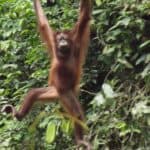
Eastern chimpanzee Pan troglodytes schweinfurthii In parts of eastern and central DRC, Grauer's gorillas and chimpanzees share forests. Both are large, travel long distances, are social, and eat fruit and leaves. Chimpanzees hunt, consume more animal prey, and are more arboreal, while gorillas are mostly terrestrial.
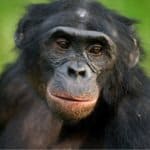
Bonobo
Bonobo Pan paniscus Occurs in lowland Congo Basin forests and consumes large amounts of fruit and terrestrial herbaceous vegetation (THV). Both species disperse seeds and travel in social groups, although bonobos eat more fruit and are less often organized into one-male-led groups.
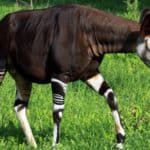
Okapi
Okapi Okapia johnstoni Endemic to DRC forests, it is a browser that relies on understory leaves and shoots. It overlaps with Grauer's gorilla in exploiting understory vegetation and contributing to forest plant dynamics (browsing pressure and seed movement), though the okapi is a solitary ungulate rather than a social primate.
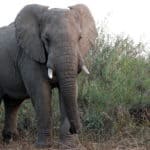
African forest elephant
African forest elephant Loxodonta cyclotis Large-bodied tropical forest herbivore and key seed disperser. Overlaps functionally with Grauer's gorillas in shaping vegetation and dispersing seeds, but elephants operate at much larger spatial scales and can open the canopy and clear paths, indirectly influencing gorilla foraging routes.
Black-and-white colobus Colobus angolensis Forest leaf-eater that, like Grauer's gorillas, consumes many leaves and uses the understory and mid‑canopy, so they may eat the same foliage. Colobus live higher in the trees and ferment leaves in a specialized stomach.

“The largest primates in the world.”

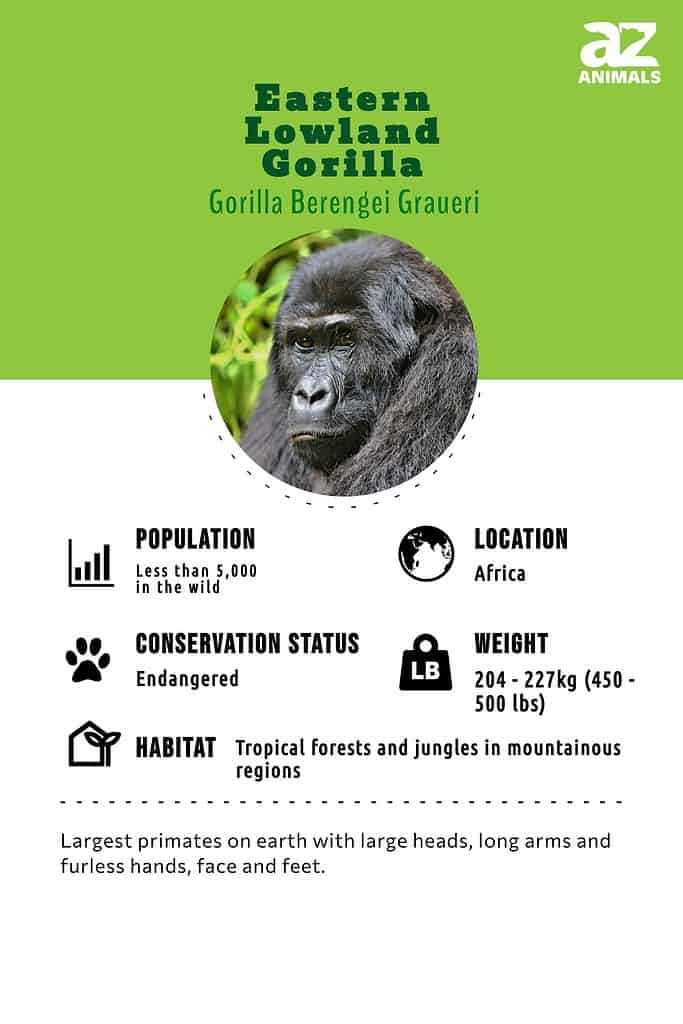
One of the largest subspecies of the Great Apes, the Eastern lowland gorilla is one of two species of a gorilla living in Africa. They are an endangered species, with recent estimates placing the count at about 5,000 individuals left in the wild. These gorillas are vulnerable to poaching, and they fall victim to the results of civil unrest in their territory.
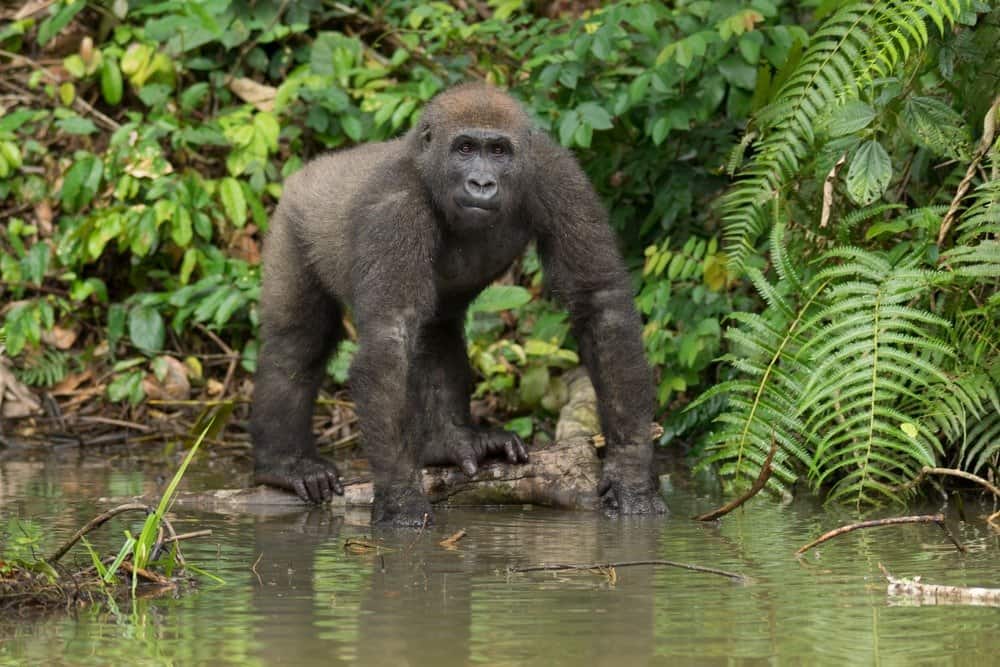
Eastern lowland gorilla walking in water

Eastern lowland gorillas are one of the most intelligent species of primates.

Facts About Eastern Lowland Gorillas

  • Eastern lowland gorillas are the largest primates in the world.
  • They are also known as Grauer’s gorilla after the scientist who discovered them.
  • They are one of the most intelligent species of primates.
  • They are the second most endangered subspecies of gorillas.
  • A group of Eastern lowland gorillas is called a troop, and they are led by a large adult male known as a silverback gorilla.

Scientific Name

Eastern lowland gorillas are also known as Grauer’s gorilla, after the Austrian scientist Rudolph Grauer who discovered them in the early 1900s. Grauer is where the second half of this subspecies’ scientific name, Gorilla Berengei Graueri, comes from. Berengei means Kivu highlands, so their scientific name means “Grauer’s gorilla of the Kivu highlands.” They are in the phylum Chordata and are also considered primates. Members of the Chordata phylum are called chordates, and this Phylum includes all vertebrates.

Evolution
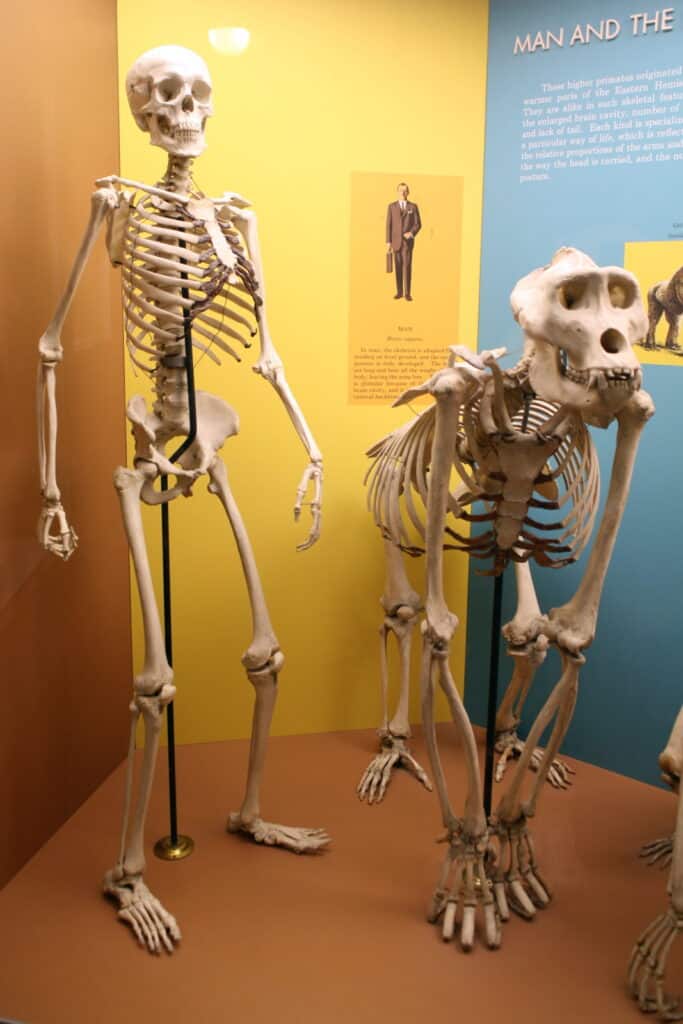
Not the left, a human Skelton, on the right a gorilla Skelton. Three walls (L-r, brown,yellow,blue) are behind the display which appears to be in a museum. On the yellow wall is a poster with a photograph of a male presenting human in a business suit (jacket, trousers,tie) carrying a brief case in his right hand,, with indecipherable verbiage underneath. The blue wall has raised white letters that spell MAN AND THE - rest out of frame. A paragraph of white letters below with information regarding the display.

Human gene sequences differ from gorilla sequences by only 1.6%

Although not much is known about the evolution of gorillas, they are closely related to humans and chimpanzees. They all diverged from a common ancestor about 7 million years ago. Human gene sequences differ from gorilla sequences by only 1.6% on average.

Gorillas were previously thought to be a single species with three subspecies (western lowland, eastern lowland, and mountain gorillas), but it is now agreed that there are two main species, the western gorilla (Gorilla gorilla) and the eastern gorilla (Gorilla beringei), and they each have two subspecies. Western and eastern gorillas split into two groups around 77,700 years ago.

Appearance
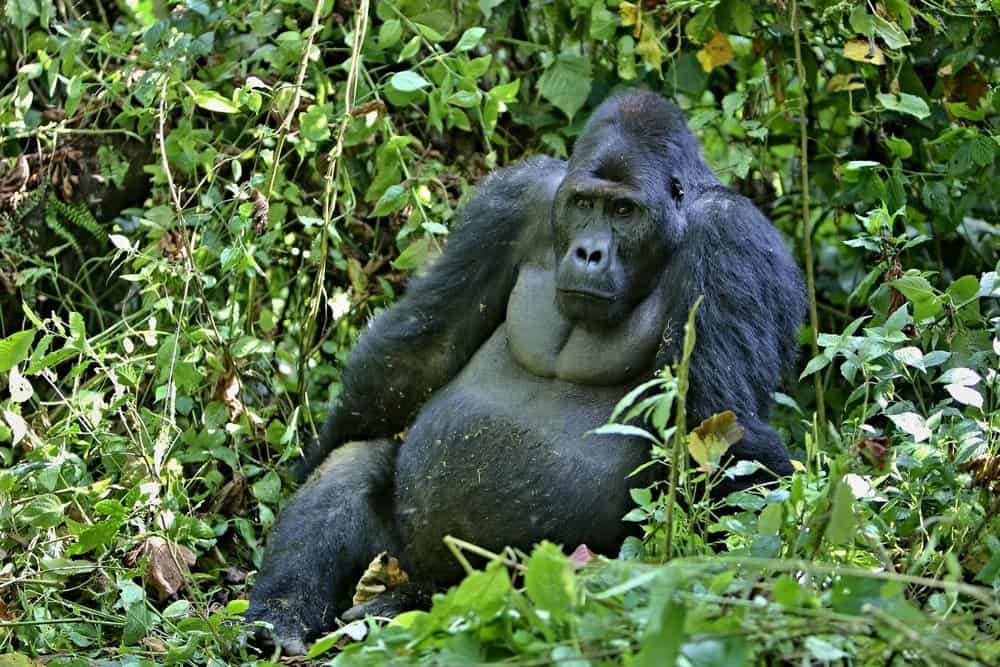
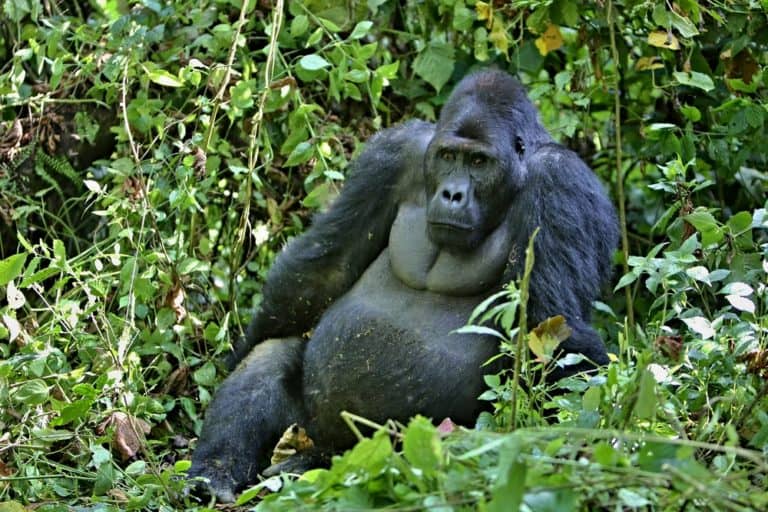
Eastern lowland gorilla laying in lush greenery

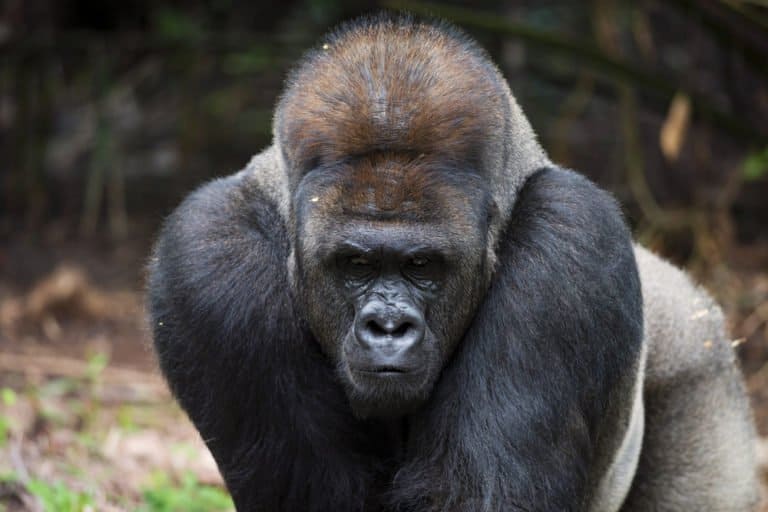
Eastern lowland gorillas are the largest species of primate on earth.

These gorillas are massive, as they are the largest species of primate on earth. Males are typically larger than females, and the species weighs in at about 450-500 lbs. That means that the Eastern lowland gorillas weigh a little less than a vending machine. These gorillas can be 5-6 feet tall. They have large heads in comparison to the rest of their bodies, as well as strong jaws and teeth. Like other gorillas, they have a thick coat of dark fur save for their faces and hands. They prefer to walk around on their knuckles.

For added protection and warmth, gorillas have a thick layer of dermis and epidermis or inner and outer layers of skin. They also have a significant amount of fat on their bodies.

Behavior

Gorillas are social animals, and the Eastern lowland gorilla is no exception. The distribution of gorillas is in tight-knit family groups called troops or bands. These troops travel, feed, and raise their young together. The troops are led by a large male gorilla, called a silverback. They also contain two or three female gorillas and their young, and can also include a few subordinate male gorillas. Though the troops are usually small, researchers have recorded groups as large as 30 individuals. Rarely, there are two silverback leaders in a group.

Gorillas spend most of their days eating and, contrary to popular belief, are not aggressive or territorial creatures. Though the silverbacks do have a dominant leadership position, which includes mating with females and being alert to threats, they are also in charge of practical decisions. These include deciding where the group feeds, travels and sleeps.
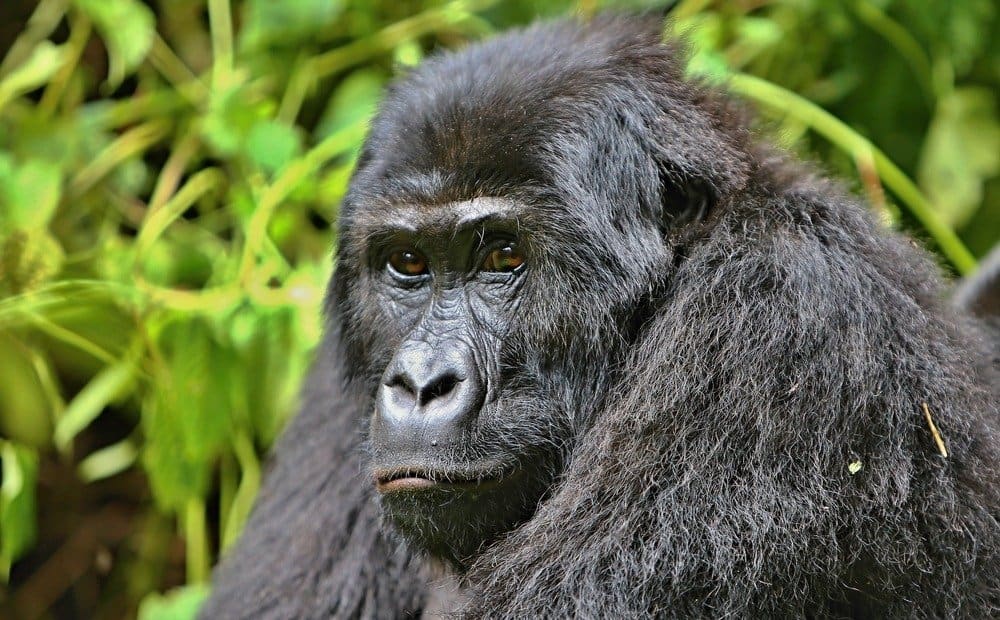
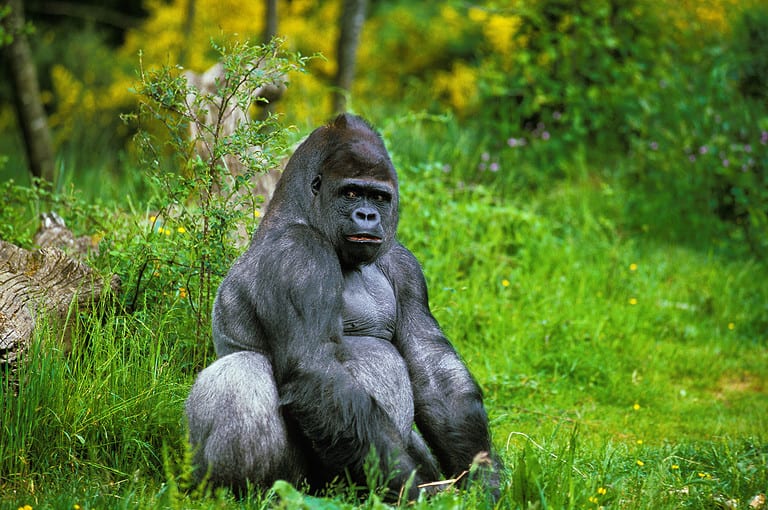
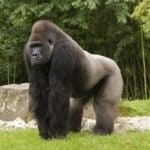
Eastern lowland gorilla — silverback male

Gorillas live in family groups called troops or bands.

These apes are usually quiet, but they are capable of vocalizing in many different ways. Over 25 various vocalizations have been recorded. Eastern lowland gorillas communicate using hoots, growls, barks, screams and laughs. Each of these has a distinct meaning. Gorillas are one of the most intelligent species of primates — they can even be taught sign language and have been known to use tools to better access food.

Habitat
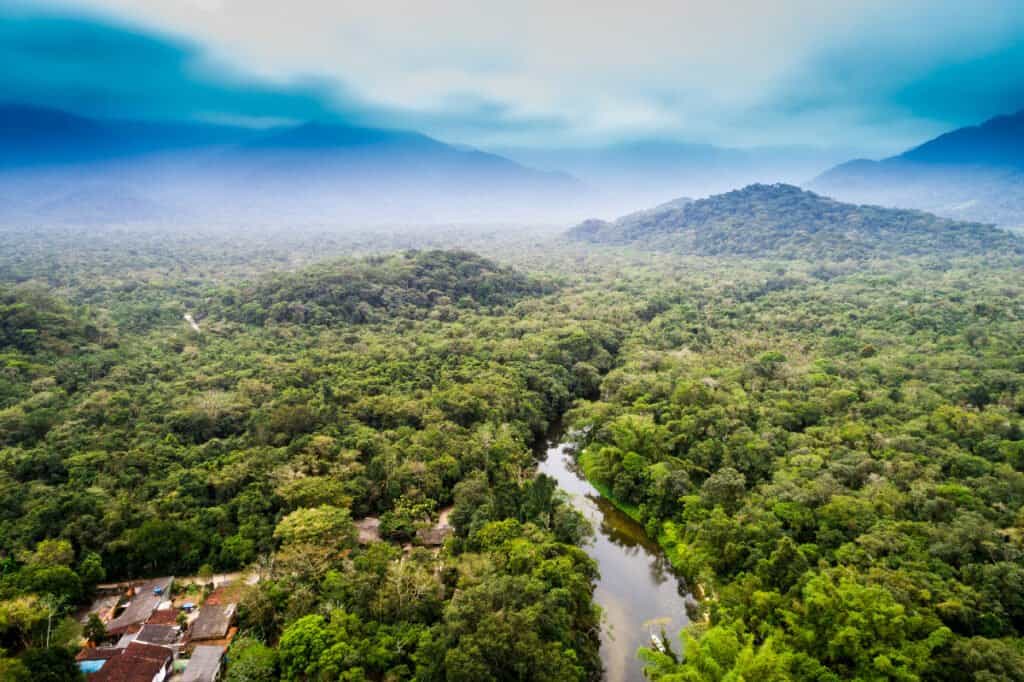
colombia amazon river

Eastern lowland gorillas live in the eastern region of the Democratic Republic of the Congo.

This species of gorilla lives in the eastern region of the Democratic Republic of the Congo (DRC). They thrive in tropical lowlands and rainforests which have decreased drastically in the last few decades. The distribution of gorillas is also much more sparse because of habitat fragmentation. They used to inhabit a range of about 8,100 square miles, the size of the state of Massachusetts. They now inhabit around 4,600 square miles. Many national parks cover Eastern lowland gorilla habitats, such as the Kahuzi-Biega National Park and the Maiko National Park. There are also a few wildlife reserves dedicated to preserving gorilla habitats.

Diet
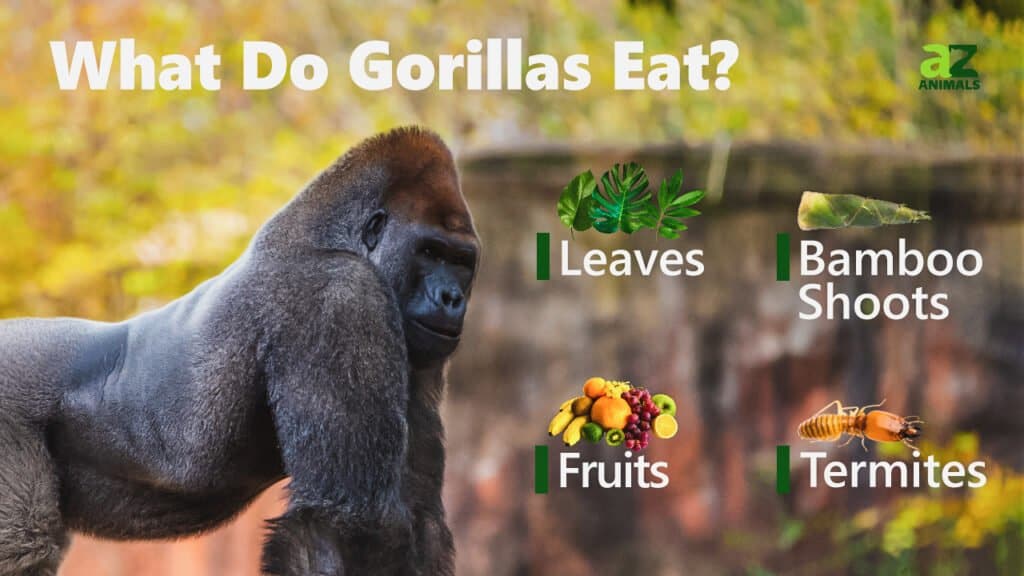
What Do Gorillas Eat
Gorillas eat leaves, bamboo shoots, fruits, and termites.

Eastern lowland gorillas are omnivores, enjoying both a plant-based and an insect-based diet. They mostly eat fruits but also consume berries, leaves, and nuts. As for insects, the Eastern lowland gorilla prefers termites and ants. Occasionally, these gorillas go after small rodents or lizards. They have been known to travel great distances in search of food.

Their powerful jaws allow them to eat fibrous and tough vegetation. They also rarely drink water directly, as most of the water they consume comes from the plants they eat. Adult gorillas need to eat about 18kg, or about 40 lbs, of food per day.

Predators and Threats
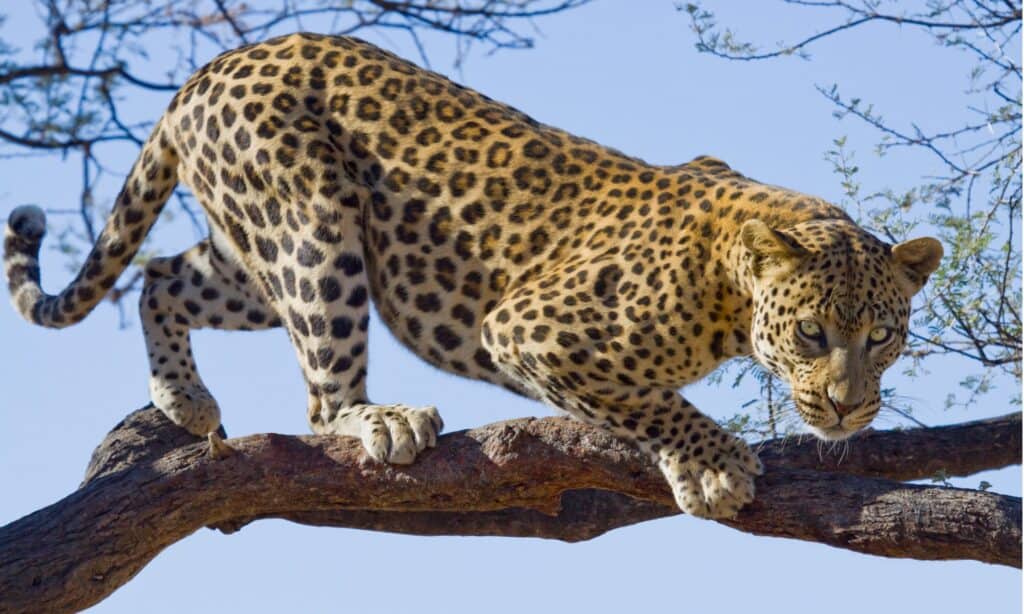
The Big Five

Leopards sometimes prey on gorillas but humans are their biggest threat.

A fully grown adult gorilla faces few threats from predators. Only larger animals, such as leopards and crocodiles, pose a threat to adult Eastern lowland gorillas.

Humans are by far the biggest threat to this animal. Habitat loss due to mining and civil unrest in the DRC has impacted this species. They also fall victim to poaching, even in national parks meant to protect them. Rebels and poachers invade these areas to hunt gorillas. Organizations like the World Wildlife Fund have intervened to help the park regain control of the land, but continued civil unrest in the area makes conservation difficult. The eastern lowland gorilla is considered an endangered species according to the Red List of the International Union for Conservation of Nature.

Reproduction, Babies, and Lifespan
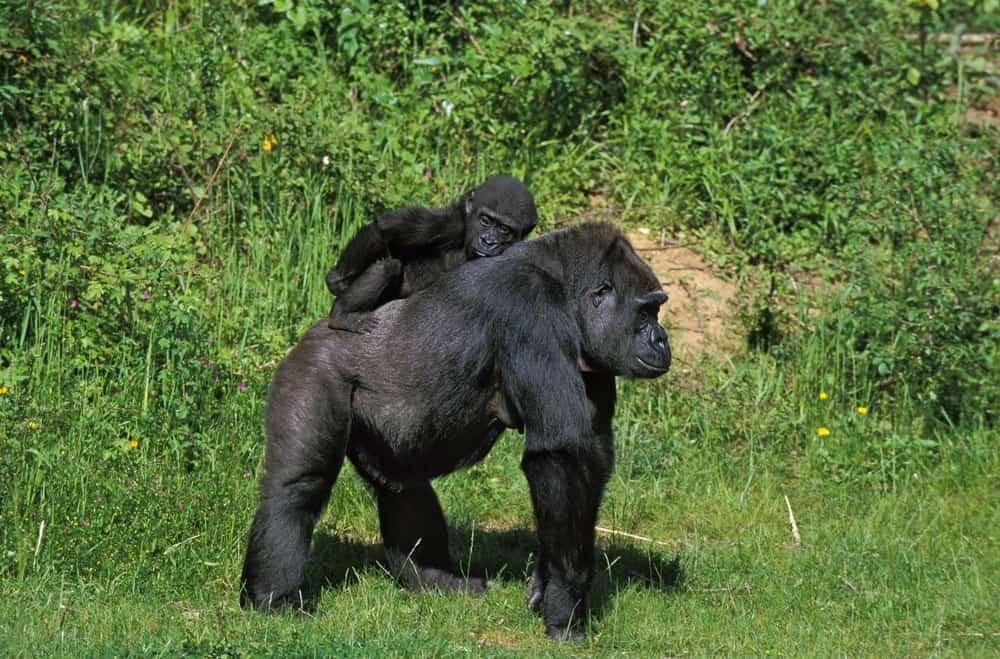
Eastern lowland gorilla adult and baby

Female gorillas usually give birth to one baby at a time.

Once they are old enough, about half of all male gorillas will leave their birth group when they reach sexual maturity, around 15 to 20 years of age. They travel with other male gorillas or sometimes travel alone until they establish a harem of females. Like other gorilla species, the male silverback Eastern lowland gorilla routinely mates with the females in the troop and is the only male allowed to do so. They form strong bonds with the female members so that the females are less likely to leave. Silverback males usually stay with the same group of females for life, unless they are overtaken by a competing male. Fights between male gorillas for rule over the harem are intense and may end in death. Eastern and Western varieties of lowland gorillas cannot mate with one another.

Young gorillas are called babies. Females have a gestation period of around 8.5 months. Babies will sleep in the same nest as their mother for the first three years of their life, and continue to stay with the group until they reach sexual maturity. Sons of the male silverback can sometimes take over the group later in their lives. Females often only give birth to one young at a time, and infant mortality rates among young gorillas are very high. Babies can crawl around on their own when they reach 9 weeks old, and walk when they are 35 weeks old.
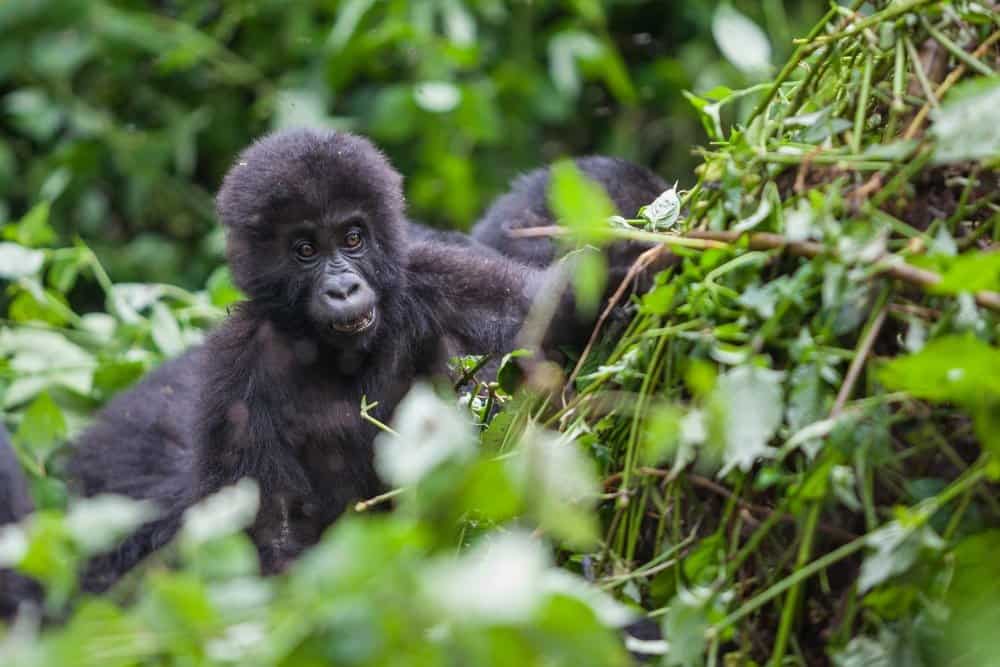
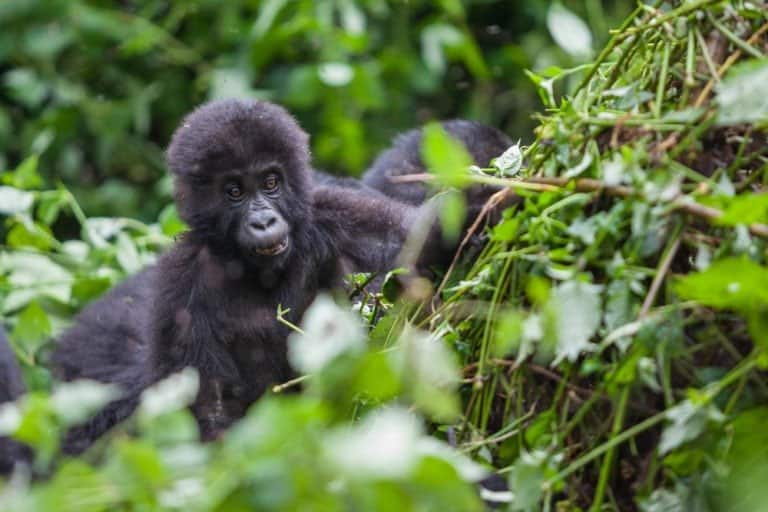
Baby gorillas sleep in the nest with their mothers until they are three years old.

In the wild, eastern lowland gorillas can reach 30-40 years of age. In captivity, gorillas can live to be as old as 60.

Population

Over the last 30 years, the population of Eastern lowland gorillas has gone down by over 50%. It is estimated that only around 5,000 individuals remain in the wild. Accurate population counts are hard to achieve due to the ongoing civil war in the DRC.
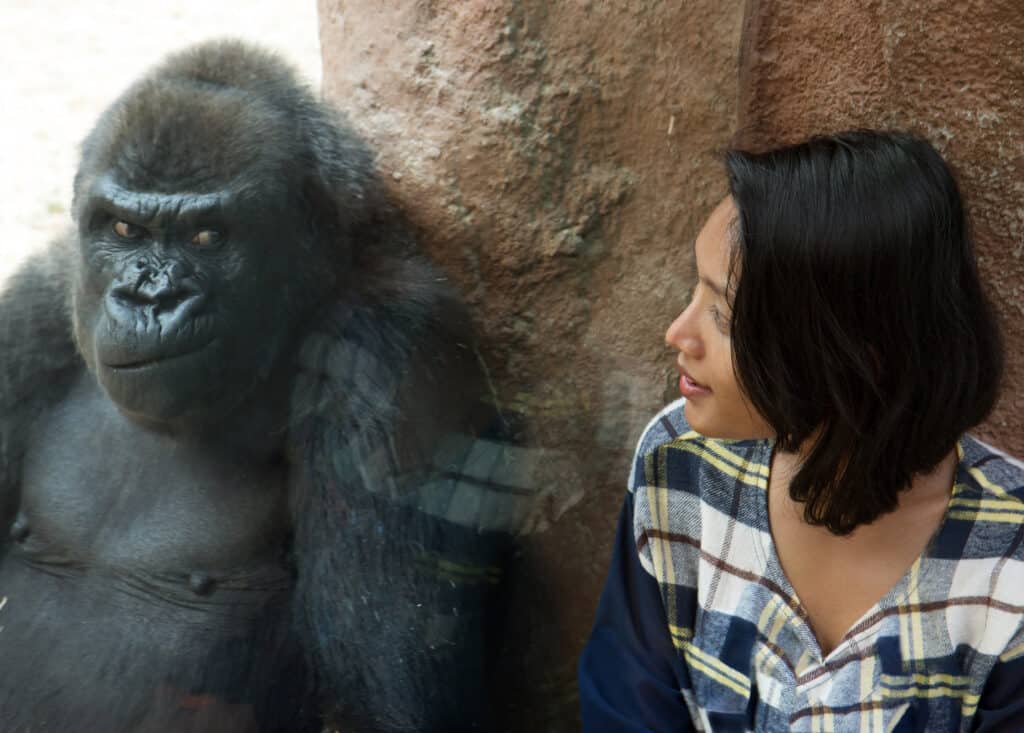
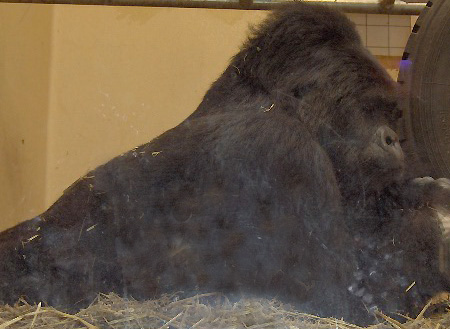
gorilla

Most gorillas in zoos are the less endangered western lowland gorillas.

In the Zoo

Most gorillas found in zoos are western lowland gorillas, which are not as endangered as their eastern cousins. Some zoos, such as the San Diego Zoo, have conservation programs in central Africa that aid in protecting all species of gorillas. The San Diego Zoo also runs a recycling program for cell phones, which contain metals that are mined for in Eastern lowland gorilla territory. This program helps prevent new metals from being mined, which reduces habitat loss and the hunting of the species.

There are only two Eastern lowland gorillas in captivity, both of which are females. They live at the Antwerp Zoo in Belgium and are named Victoria and Amahoro.

View all 185 animals that start with E

Sources

  1. https://www.almaany.com/en/dict/en-en/beringei/
  2. Gorillas-World
  3. World Wildlife Federation
  4. Animal Corner
  5. Bwindi Impenetrable National Park
  6. Flanders Today
  7. Britannica
  8. Storyteller Travel
Lisha Pace

About the Author

Lisha Pace

After a career of working to provide opportunities for local communities to experience and create art, I am enjoying having time to write about two of my favorite things - nature and animals. Half of my life is spent outdoors, usually with my husband and sweet little fourteen year old dog. We love to take walks by the lake and take photos of the animals we meet including: otters, ospreys, Canadian geese, ducks and nesting bald eagles. I also enjoy reading, discovering books to add to my library, collecting and playing vinyl, and listening to my son's music.

Thank you for reading! Have some feedback for us?


Eastern Lowland Gorilla FAQs (Frequently Asked Questions)

Eastern lowland gorillas are threatened by habitat loss due to civil war, as well as the mining of metals to produce cell phones and other electronics. They also fall victim to poaching, as well as illegal animal trafficking. Like most forest animals, deforestation also presents a threat to the eastern lowland gorilla habitat.