







Quick Take
- The Egyptian Mau can outrun most domestic cats, yet its speed is far from the most surprising thing about its physical biology. See the speed facts →
- This cat was worshipped by pharaohs for thousands of years, yet its status in Egypt today couldn't be more different. Explore the full history →
- Before buying one, there's a medical sensitivity owners rarely expect, and overlooking it could be dangerous. Check the health sensitivities →
- Its eyes don't just look unusual. They actually change based on something happening in the moment. See the eye details →
The Egyptian Mau is a rare small-to-medium-sized short-haired breed of domestic cat that is naturally spotted on the tips of its fur. Originating in Egypt, it is considered an ancestor of modern domestic cats as well as one of the fastest. The breed name “mau” means “cat” in Egyptian Arabic.

Egyptian Mau Traits: What to Know Before You Buy
- The Egyptian Mau is a descendant of the African wildcat.
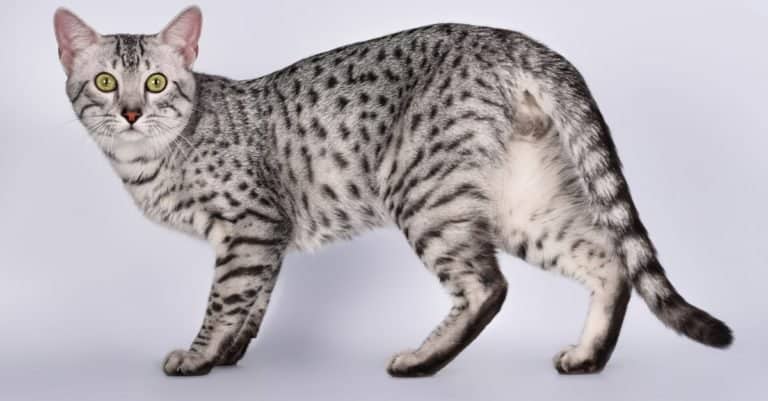
- Physically, this breed is long and very muscled.
- It has a much longer pregnancy than other breeds, an average of about 73 days, compared to the typical 63 to 67 days for most breeds.
- It’s very fast, running more than 30 mph (48 km/h).
- The breed is so rare that it is more common to find a mixed breed than a purebred one outside of Egypt.
Breed History
The Egyptian Mau, the lone naturally spotted breed of domestic cat in the world, has a rich history. Researchers have learned much about this breed from Egyptian art and mummified cats. Studies of cat mummies dated 200-600 B.C. found in Egyptian tombs prove that Egyptian Maus are descendants of Felis lybica ocreata — a subspecies of the African Wildcat, which originated in Ethiopia.
The Egyptian Mau was worshipped by ancient Egyptian pharaohs and kings, dating back to the XIIth Dynasty (2800 B.C.), where the sun god Ra was portrayed as a spotted cat slaying the serpent of darkness in the Egyptian Book of the Dead. Later in 950 B.C., the cult of Bastet worshipped the goddess Bast, who was also depicted as a cat. It was because of this cult that the Egyptian Mau came to represent fertility, strength, and agility.
Besides being treasured members of society in ancient Egypt, these cats (which were abundant in number) served a practical purpose by keeping the rodent population down around Egyptian silos, as pests at that time attracted deadly cobras as well as African wildcats. Paintings on the walls of pharaohs’ tombs also portrayed the cats as family members—draped across the shoulders of their owners, pampered, dressed in jewelry, and taken as companions on outings like fishing in marshes. In death, these beloved creatures were mourned and honored by being preserved as mummies, some even buried alongside mummified mice for them to feast on in the afterlife.
The Egyptian Mau gained popularity in Europe before WWII, and an exiled Russian princess, Natalie Troubetsky, brought the first three Egyptian Maus to the United States when she immigrated in December of 1956. Her cats, Jojo, Liza, and Baba, were used to populate the cattery she founded, dubbed “Fatima.” By 1958, she registered 10 cats with CFF. The cats she bred took off in popularity, and with other catteries breeding Egyptian Maus, this group became known as “traditionals” in cat societies. Another line, begun by a zookeeper in New Delhi, India, and brought to the U.S. by Jean Mill in 1980, is called the “Indian Line.”
Personality
The Egyptian Mau’s personality is friendly, chatty, playful, and active. It has a social, balanced temperament with characteristics of loyalty, alertness, independence, patience, and intelligence. This social cat is physically gorgeous, strong, regal, and graceful, and while it has an affectionate personality, it is a freedom-loving “four on the floor” (all feet on the ground) cat that does not enjoy being held or sitting on a lap. It can be possessive in temperament and cherish one human to be attached to above all others. Strange noises and abrupt movements make it skittish.
This breed is very vocal and musical per its breed name Mau, meaning “cat.” It may chirp, trill, chortle, and make other unusual sounds in response to stimulation. Another common behavior in this breed is the “wiggle-tail,” in which it twitches its tail, shaking it like it’s spraying territory, although it does not release urine.
This breed can be territorial with other pets, but can learn to get along. It does, however, enjoy families, especially those with older children. It is shy around strangers.
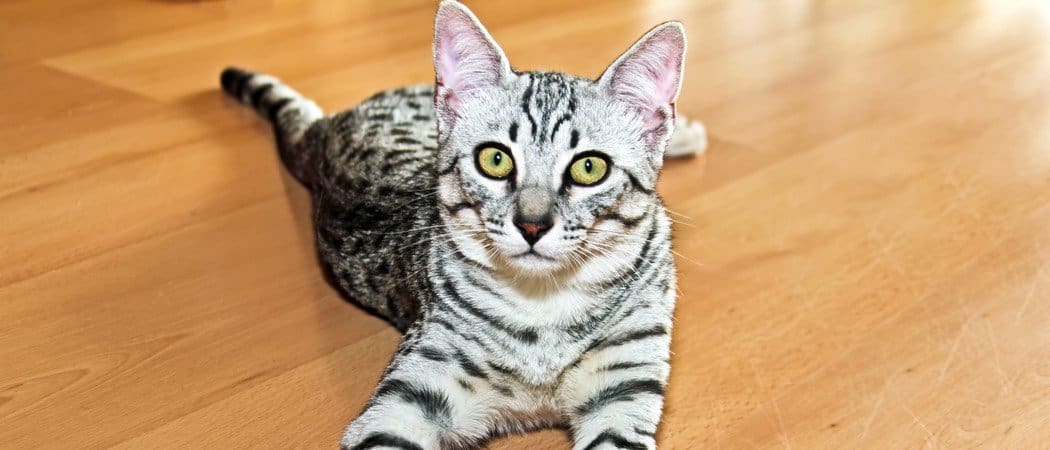
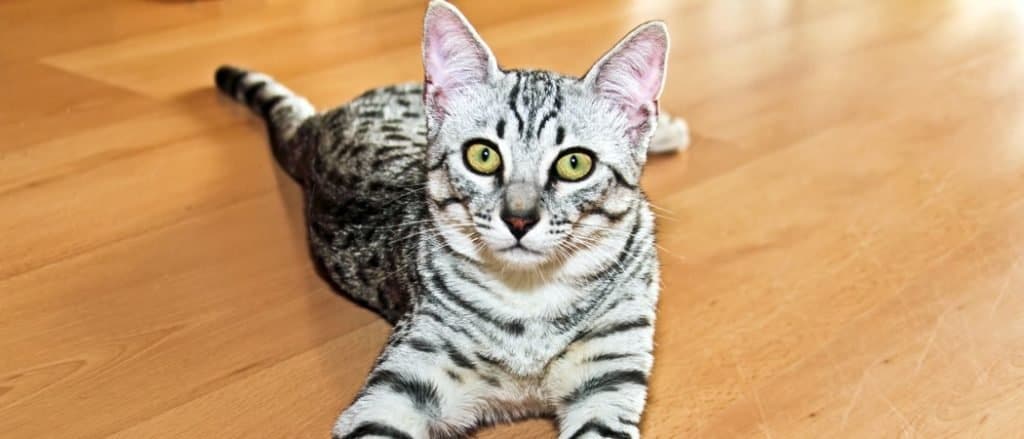
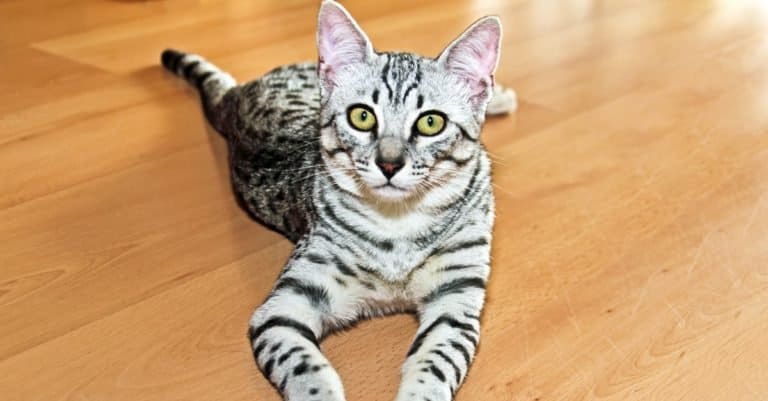
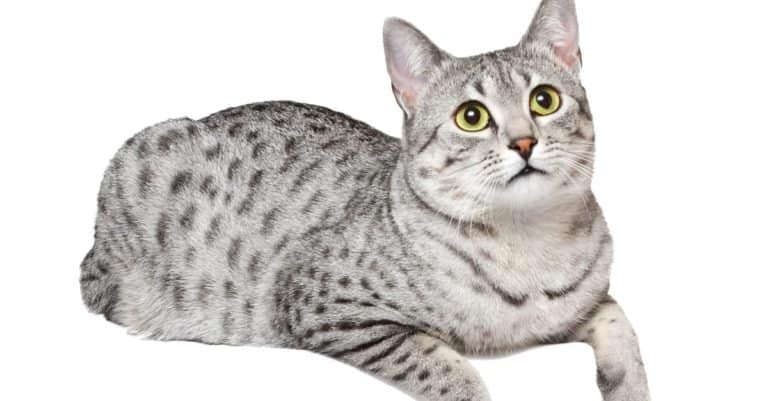
It has gooseberry green eyes, which can change to turquoise depending on its temperament.
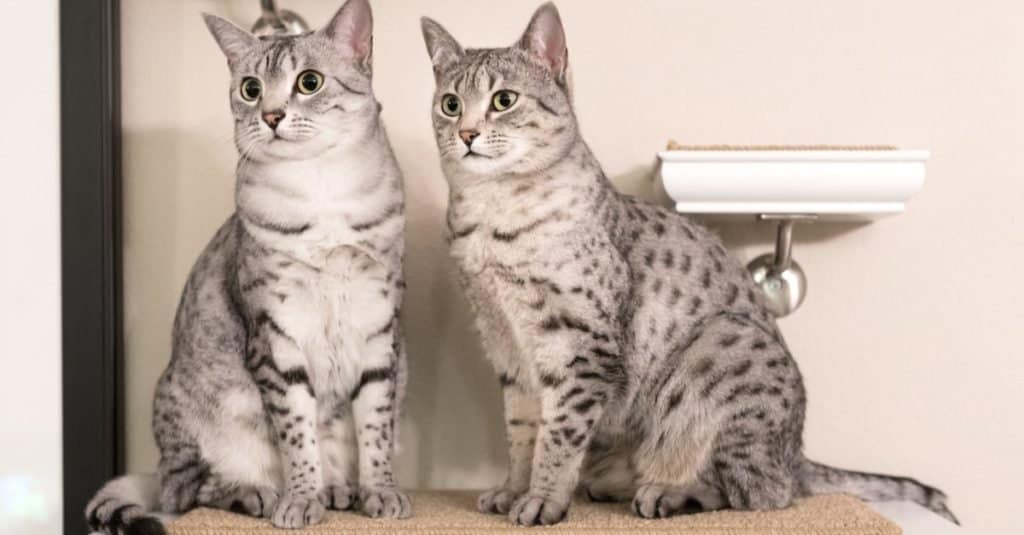
The Egyptian Mau has a social, balanced temperament with characteristics of loyalty, alertness, independence, patience, and intelligence.
©Sarah Fields Photography/Shutterstock.com
Size and Weight
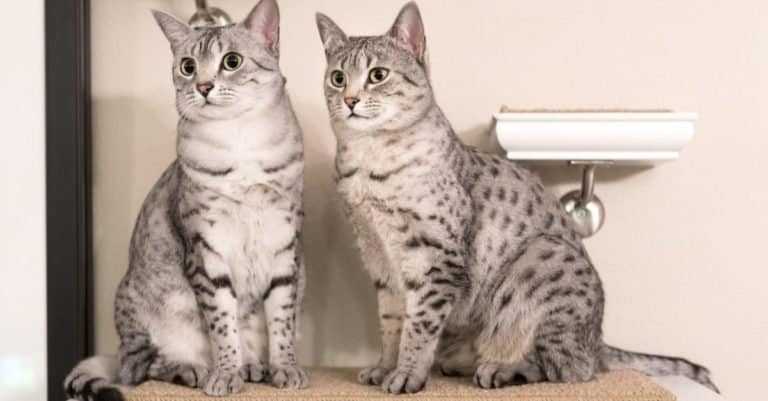
The Egyptian Mau is small to medium in size with short to medium silky fur and a long body. It has the slender elegance of a Siamese with the density of a Burmese, overall resembling the Abyssinian but with more length, muscle, shapeliness, distinct curves, and height. It is often confused with an Ocicat, which was developed from Abyssinian, Siamese, and American Shorthair cats.
Both sexes are 8 to 14 inches in height, with male Egyptian Maus being larger than females. Males weigh 8 to 14 lbs on average, and females weigh 6 to 10 lbs on average. Kittens reach full maturity at about 18 months and weigh about 7 to 9 lbs on average, reaching their full weight later.
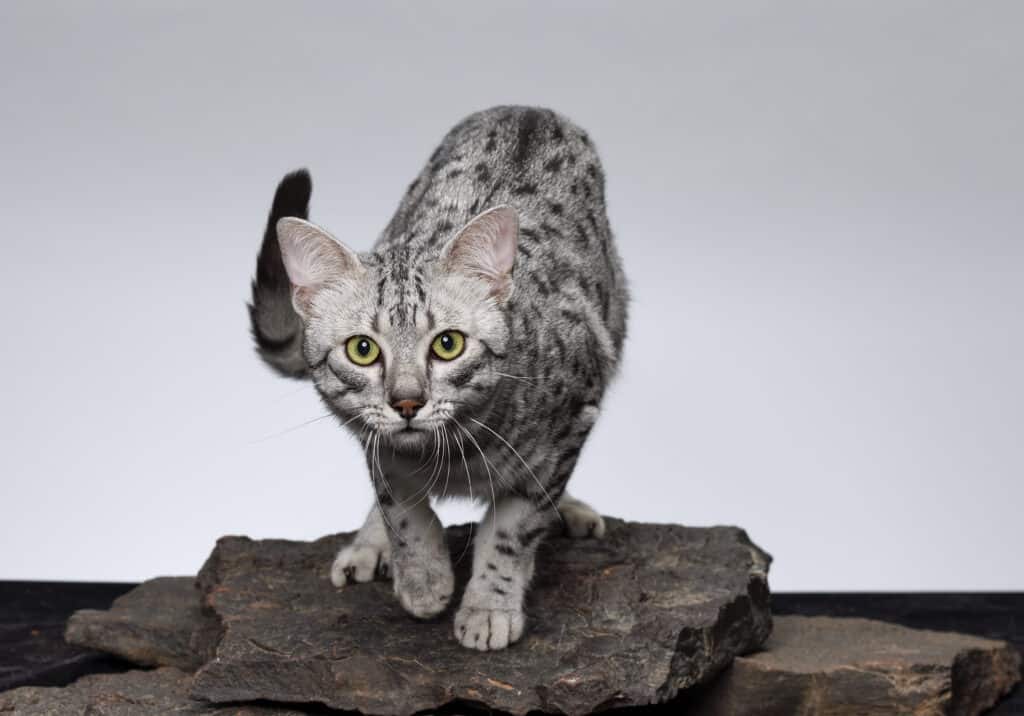
The Egyptian Mau is often confused for an Ocicat, which is a mixture of an Abyssinian and an Egyptian Mau and retains the spotted fur.
©iStock.com/Thomas Leirikh
Price
The price of an Egyptian Mau depends on whether you are getting a purebred or a mixed breed, as well as its age and where you get it from. If you get Egyptian Mau kittens from a breeder, they can each cost anywhere from $1,800 to $2,500 on the high end and $600 to 1,200 on average, depending on color, breed registration, and other characteristics.
However, there are Egyptian Mau rescues in the U.S. where you can find purebred and mixed-breed kittens and adult cats and pay the standard adoption fee.
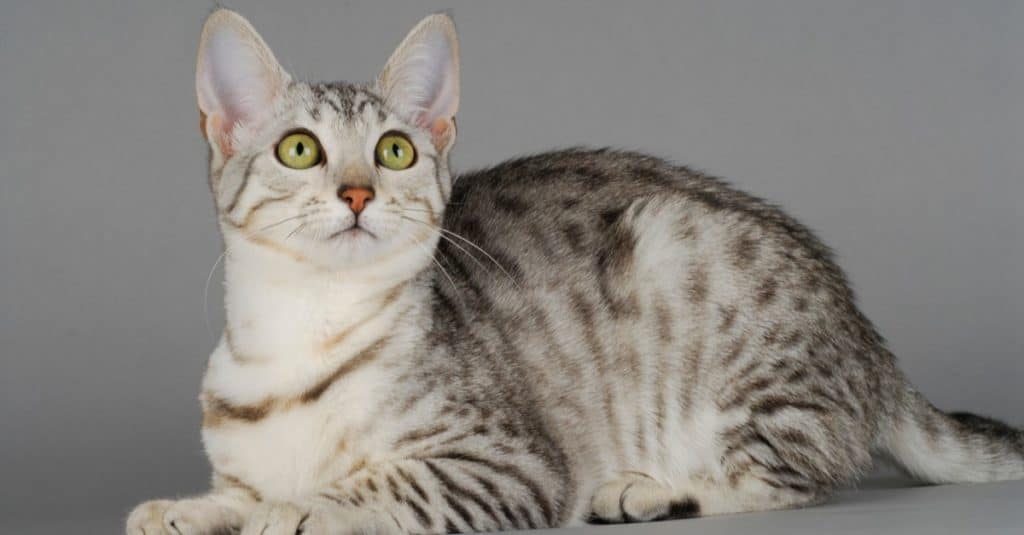
Due to its rarity, a pure-bred Egyptian Mau can cost anywhere from ,800 to 2,500.
©COULANGES/Shutterstock.com
Kittens
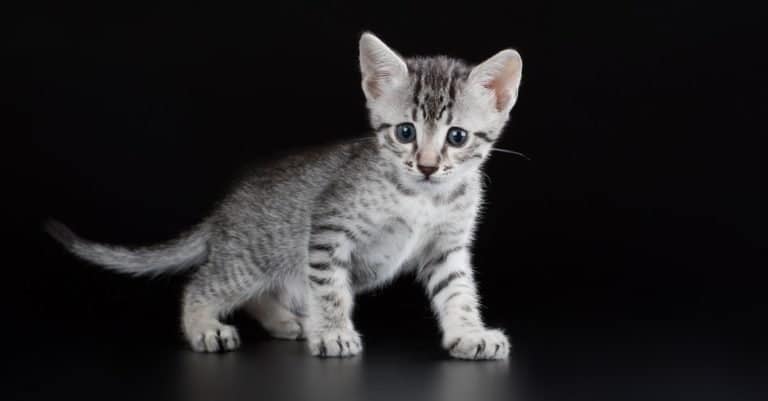
These kittens all have green eyes, but amber is naturally occurring in kittens and young adults up to 18 months of age. They can cost as much as $1,200. If you are looking for a female for breeding, it can cost up to $2,000. Ideally, it would be best if you chose a reputable breeder with a healthy line and a written health guarantee to avoid issues, some of which can appear at a young age.
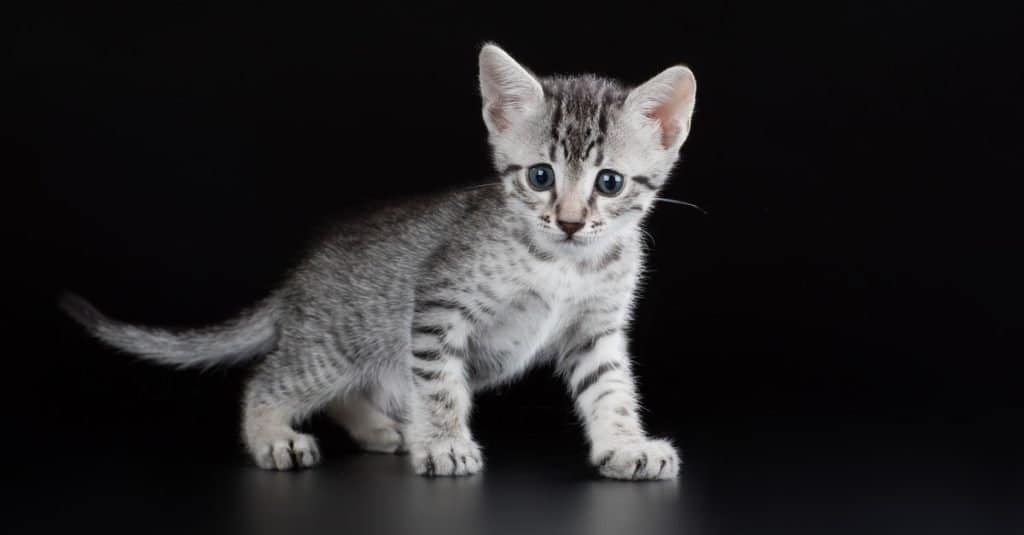
You should choose a reputable breeder with a healthy line and a written health guarantee if seeking to purchase an Egyptian Mau kitten.
©Vivienstock/Shutterstock.com
Lifespan
The lifespan of these cats ranges from 9 to 20 years, but 12 to 16 years on average. Although it’s generally very healthy, it can be prone to heart disease, urate urolithiasis, pyruvate kinase deficiency, and leukodystrophy. It is more sensitive to temperature than other breeds and enjoys very warm temperatures. It is more sensitive to medicines and anesthesia than other breeds as well.
Egyptian Mau Breed vs. Mixed
Some characteristics of a purebred cat are as follows:
- A rounded, triangular-shaped head
- Medium-to-large, softly shaped, black-tipped, tufted ears
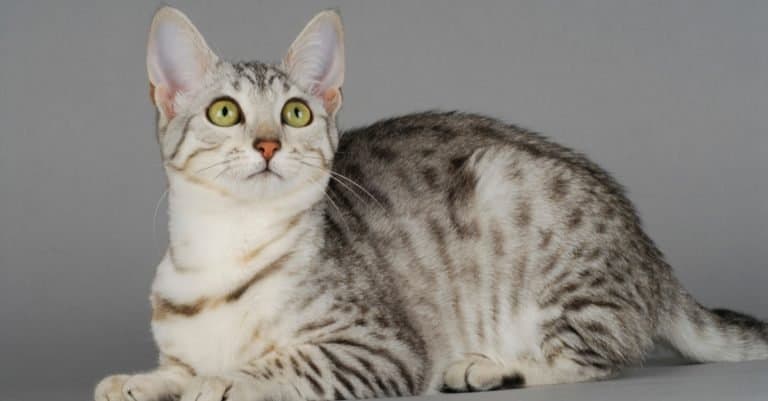
- Large, almond-shaped “gooseberry green” eyes with a somewhat worried expression
- Spotted tabby markings
- A paler underside
- A cheetah-like walk
- A back stripe running from head to tail
- An “m” or scarab beetle marking on its forehead
- Two “mascara lines” on each side of their cheeks
- The hind legs are slightly longer than the front legs
- Thin, long tail with classic black tip
These cats are street cats in Egypt and rare everywhere else. An Egyptian Mau mixed breed is often a cross between an Egyptian Mau and a short-haired domestic cat rather than another purebred. When crossed, it is simply called an Egyptian Mau mix.
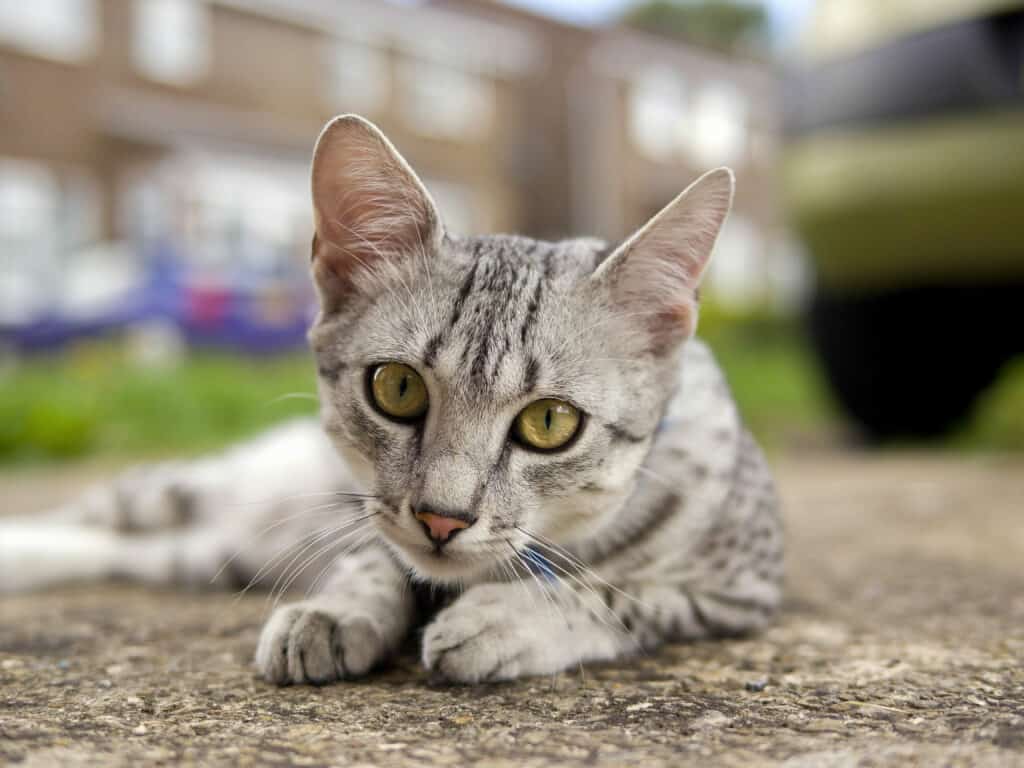
Egyptian Maus are street cats in Egypt, but rare in all other parts of the world.
©iStock.com/Tbowerman
Types of Egyptian Mau Cats and Colors
These cats come in three main colors for show quality:
- Silver with charcoal spotting (most common)
- Bronze with black or dark brown spotting
- Smoke with black spotting
On the other hand, pet-quality cats have other colors which are diluted rather than natural, including blue silver, blue smoke, blue-spotted, solid black, and blue (or pewter). Ordered from the most common to the least, the colors are silver, bronze, smoke, black, caramel, and blue. Black and blue Egyptian Maus cannot be show-quality, but can be used for breeding.
Egyptian Mau Pictures
View all of our Egyptian Mau pictures in the gallery.

Steve Photography/Shutterstock.com
Sources
- Wikipedia / Accessed June 8, 2021
- Kitty Wise / Accessed June 8, 2021
- Catspro / Accessed June 8, 2021
- Pet Coach / Accessed June 8, 2021
- Pet Guide / Accessed June 8, 2021
- All About Cats / Accessed June 8, 2021
- Cat Breeds List / Accessed June 8, 2021
- Vetstreet / Accessed June 8, 2021
- Cat Fanciers Association / Accessed June 8, 2021
- Hills Pet / Accessed June 8, 2021