E
Species Profile

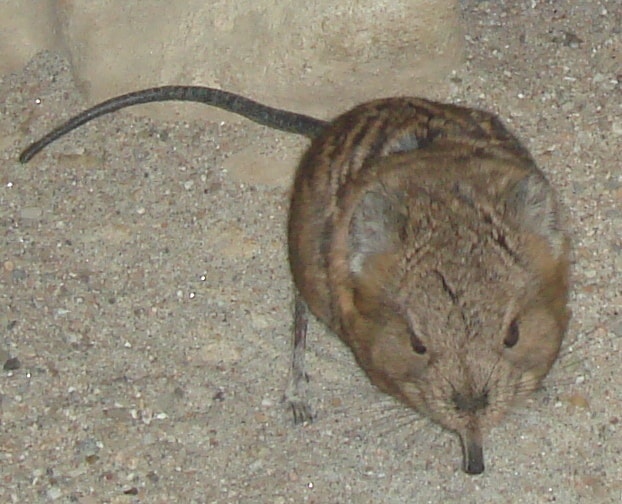
Elephant Shrew

Macroscelidea

Sengis: Africa's lightning snouts
Joey Makalintal / Creative Commons

Elephant Shrew Distribution

Click a location to explore more animals from that region

Endemic Species
Loading map...
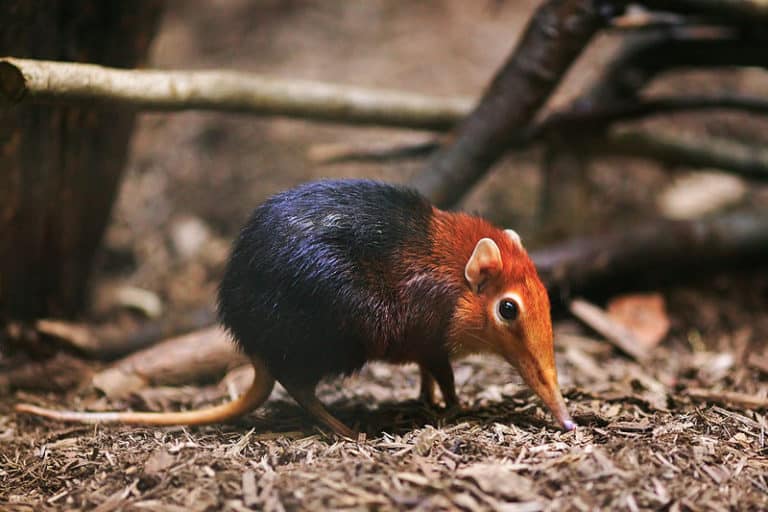
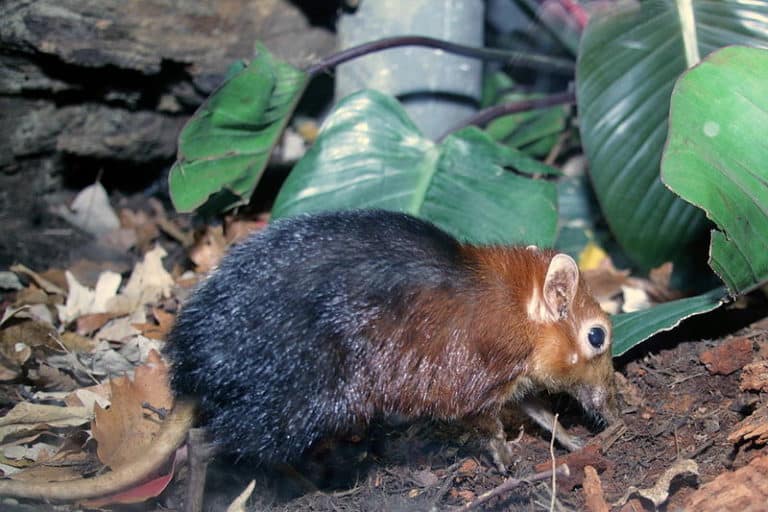
Black and Rufous Elephant Shrew (Rhynchocyon petersi)

At a Glance

Order Overview This page covers the Elephant Shrew order as a group. Stats below are general traits shared across the order.
Activity Diurnal+
Lifespan 2.5 years
Weight 0.75 lbs
Status Not Evaluated
Did You Know?

They're called "sengis" (preferred name) and are not true shrews; they belong to Afrotheria, a group that includes elephants, hyraxes, and aardvarks.

Scientific Classification

Order Overview "Elephant Shrew" is not a single species but represents an entire order containing multiple species.

Elephant shrews—more properly called sengis—are small insectivorous African mammals characterized by long, flexible snouts, long legs, and very rapid, bounding locomotion. Despite the name, they are not true shrews and are part of Afrotheria (more distantly related to elephants, hyraxes, and aardvarks than to rodents or shrews).

Kingdom
Animalia
Phylum
Chordata
Class
Mammalia
Order
Macroscelidea

Distinguishing Features

  • Elongated, mobile snout used to probe for insects and other invertebrates
  • Long hind limbs and fast, bounding gait
  • Often maintain cleared ‘runways’ through vegetation for escape
  • Insectivorous/omnivorous diet (invertebrates predominant)
  • Not true shrews; Afrotherian mammals (order Macroscelidea)

Physical Measurements

Males and females differ in size

Height
5 in (2 in – 8 in)
Length
1 ft 1 in (7 in – 1 ft 10 in)
1 ft 2 in (6 in – 1 ft 10 in)
Weight
0 lbs (0 lbs – 2 lbs)
Tail Length
6 in (3 in – 10 in)
7 in (3 in – 10 in)
Top Speed
19 mph

Appearance

Primary Colors
Secondary Colors
Skin Type Fully furred mammalian skin; short-to-moderate dense coat (often 'soft-furred' in many smaller sengis) with locally variable thickness/texture by habitat and species; tail is furred but can be sparser toward the tip in some taxa.
Distinctive Features
  • Correct common name is 'sengi' (not a true shrew); order Macroscelidea within Afrotheria (distantly related to elephants, hyraxes, aardvarks-not closely, and not rodents).
  • Geographic range (order-level): endemic to Africa; habitats span arid/semi-arid scrub and savanna to montane areas and dense tropical forests-substantial ecological diversity across the order.
  • Across the order, head-body length is about 10–30 cm, tail often 8–25 cm, and mass about 0.02–0.7 kg, from small soft-furred sengis to giant forest sengis (Rhynchocyon).
  • Body plan: long, flexible, trunk-like snout; relatively large eyes; ears vary from moderate to large; long, slender legs (often long hindlimbs) built for rapid, bounding/zig-zag locomotion.
  • Very fast, springy runners that make sudden turns. Many species keep and reuse cleared runways through plants or leaf litter for escape and foraging; runways are clearer in dense ground cover.
  • Diet generalization: primarily insectivorous (ants, termites, beetles, other arthropods), often supplemented with other invertebrates and occasionally some plant material; exact diet breadth varies with locality and season.
  • Foraging ecology: uses the snout to probe/flip leaf litter or inspect soil/crevices; many rely on keen vision and hearing as well as scent while moving rapidly between foraging points.
  • Activity patterns vary across the order: many are diurnal or crepuscular, but some show flexibility with local conditions (temperature, predation, habitat structure).
  • Social system generalization: territoriality is common; several species show pair-living/monogamous tendencies with overlapping male-female territories, but spacing systems and pair cohesion vary among genera and habitats.
  • Communication and marking: scent marking (including glandular secretions and urine/feces) used for territorial boundaries and mate signaling; intensity and specific glands used can vary among taxa.
  • Anatomical cues often visible: relatively elongated face; small, narrow muzzle tip; long tail used in balance during rapid running; feet adapted for speed (digits and claw size vary among species).
  • Giant forest sengis (Rhynchocyon) are larger, longer-bodied, and often boldly patterned, while soft-furred sengis (e.g., Elephantulus) are smaller, grayer, and often live in drier, more open habitats.

Did You Know?

They're called "sengis" (preferred name) and are not true shrews; they belong to Afrotheria, a group that includes elephants, hyraxes, and aardvarks.

Across the order, adults range from ~10-31 cm head-body length (tails often similar) and roughly ~0.03 kg up to ~0.7 kg, depending on species.

Many sengis maintain networks of cleared "runways" through leaf litter or grass, letting them sprint and zig-zag away from predators.

Giant forest sengis (genus Rhynchocyon) are the heavyweight, colorful rainforest/woodland members; smaller soft-furred sengis (e.g., Elephantulus) dominate drier savannas and deserts.

They typically eat invertebrates (ants, termites, beetles, spiders), but some species also take small amounts of fruit/plant material when available.

Young are born relatively well-developed (precocial) compared with many small mammals, and litters are usually small (often 1-2).

Lifespan varies by species and setting: commonly ~2-5+ years in the wild; in captivity some can reach roughly ~8-10 years (records vary).

Unique Adaptations

  • Elongated, flexible "trunk-like" snout: packed with sensory capability for locating small prey; a hallmark trait across the order (degree and shape vary).
  • Cursorial build in a small mammal: long legs and relatively upright posture for high-speed running compared with similarly sized insectivores.
  • Cleared-trail (runway) lifestyle: a behavioral adaptation that functions like a private road system through cluttered habitat.
  • Precocial offspring and small litters: a reproductive strategy seen broadly in sengis, contrasting with many other small mammals that have larger, more altricial litters.
  • Cranial and sensory specializations: strong reliance on smell and hearing for detecting prey and threats; specifics vary among genera and habitats.
  • Ecological breadth within one order: arid-adapted species (common in savanna/desert margins) versus forest-adapted "giant" sengis-shared core body plan, different habitat solutions.

Interesting Behaviors

  • Runway engineering: many species repeatedly clear and patrol narrow paths, improving travel speed and escape routes; the extent of runway use varies by habitat and species.
  • Rapid bounding locomotion: long hind limbs and a springy gait enable quick dashes and abrupt turns-especially obvious in open-country species.
  • Territorial living: many sengis hold and scent-mark home ranges; pair structure ranges from strong pair bonds in some species to more variable arrangements depending on ecology.
  • Diurnality is common: many are active by day (often peaking morning/late afternoon), though activity timing can shift with heat, predation pressure, and local conditions.
  • Insect-focused foraging: they probe leaf litter and soil with the flexible snout, picking prey with quick tongue and jaw movements; diets can shift with season and prey availability.
  • Nest use: they shelter in hidden nests (leaf nests, burrows, or dense cover), with nest type differing between arid-land and forest forms.
  • Predator avoidance: instead of relying on burrow retreat alone, many use speed plus their runway network; forest species may freeze and slip into cover in dense understory.

Cultural Significance

Sengis (Macroscelidea) are African mammals that look like tiny elephants but are not true shrews. The Swahili name "sengi" is used more now. DNA studies put them in Afrotheria and show how looks can trick about relationships.

Myths & Legends

In East Africa the Swahili name sengi is used for the animal instead of the European label "elephant shrew." That local name has been adopted around the world to show its real relations (Macroscelidea).

Natural-history lore from exploration-era writings: early European naturalists and travelers frequently remarked on sengis' "vanishing" speed and the impression of tiny elephant-like snouts-anecdotes that helped cement the memorable (if taxonomically misleading) common name.

Afrotheria is a new story of family links: late 20th–early 21st-century work grouped sengis with elephants and hyraxes. Museums and classrooms tell this modern origin story in the mammal family tree.

Conservation Status

NE Not Evaluated (order-level hub). Conservation status varies widely by species: most sengis are Least Concern, but some are threatened (e.g., Endangered) and a few are Data Deficient; population trends likewise vary by species and region.

Has not yet been evaluated against the criteria.

Population Unknown

Protected Under

  • Varies by country and species; many sengi populations occur within protected areas (national parks, forest reserves) across sub-Saharan Africa, which can be critical for threatened forest specialists with limited ranges.
  • No single, uniform international protection applies to the entire order; legal protection and enforcement are primarily national/subnational (wildlife and forest legislation), with conservation outcomes strongly dependent on habitat protection effectiveness and connectivity.

You might be looking for:

Golden-rumped sengi (Golden-rumped elephant shrew)

22%

Rhynchocyon chrysopygus

A larger, long-legged forest sengi with a distinctive golden rump; among the best-known ‘giant’ sengis.

Rufous sengi (Rufous elephant shrew)

18%

Elephantulus rufescens

A small, arid-adapted sengi in eastern Africa; representative of the smaller ‘soft-furred’ sengis.

Short-eared sengi (Short-eared elephant shrew)

16%

Macroscelides proboscideus

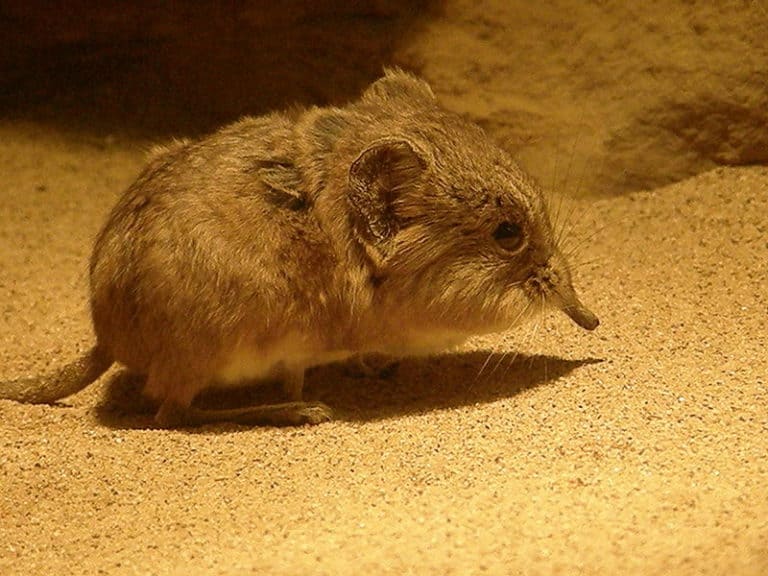
A desert/semidesert sengi of southwestern Africa; notable for relatively short ears and sandy habitats.

Black-and-rufous sengi

14%

Rhynchocyon petersi

A coastal forest ‘giant’ sengi from East Africa; black and chestnut coloration.

Four-toed sengi

12%

Petrodromus tetradactylus

Forest-associated sengi; the name refers to the hind foot having four toes.

Cape sengi (Cape elephant shrew)

10%

Elephantulus edwardii

A small South African sengi often encountered in rocky fynbos and shrub habitats.

Life Cycle

Birth 2 pups
Lifespan 3 years

Lifespan

In the Wild
1–5 years
In Captivity
3–10 years

Reproduction

Mating System Monogamy
Social Structure Socially Monogamous
Breeding Pattern Long Term
Fertilization Internal Fertilization
Birth Type Internal_fertilization

Macroscelidea (sengis, elephant shrews) are mostly monogamous, with male–female pairs defending territories. Internal fertilization is typical. Pairs often stay together across breeding seasons, but extra-pair mating can occur. Care is mainly maternal; cooperative breeding is rare.

Behavior & Ecology

Social Pair Group: 2
Activity Diurnal, Crepuscular, Nocturnal, Cathemeral
Diet Insectivore Small arthropods-especially ants, termites, and beetle larvae (varies by species and local availability)

Temperament

Highly alert and wary; rapid flight responses
Territoriality common (degree varies by species, sex, season, and habitat)
Generally low social tolerance outside pair contexts
Routine-driven space use (runways/trails), with strong site fidelity in many populations
Stress-prone when exposed; prefers cover and quick access to refuges
Foraging-focused and opportunistic insectivory with local dietary flexibility

Communication

short squeaks/chirps used at close range
trills or twittering calls reported in some species
alarm-like squeals or sharp calls during disturbance or chases
low snorts/huffs occasionally noted during close encounters
scent marking with specialized glands and secretions (location varies among taxa), plus urine/feces marking
chemical communication for territory maintenance and pair coordination
visual signaling via posture and rapid movement; tail and body positioning during encounters
tactile contact during brief pair interactions and mating
use and maintenance of runways/trails as a spatial/indirect signaling system Presence and movement cues
foot stamping/drumming-like percussive signals reported in some contexts Variation across species

Habitat

Biomes:
Tropical Rainforest Tropical Dry Forest Savanna Desert Hot Mediterranean Temperate Grassland Temperate Forest Alpine +2
Terrain:
Mountainous Hilly Plateau Plains Valley Coastal Riverine Rocky Sandy +3
Elevation: Up to 10498 ft 8 in

Ecological Role

Small-bodied terrestrial invertebrate predator (mesopredator) and leaf-litter/soil-foraging participant

suppression of insect populations (including social insects like ants/termites in some areas) linking leaf-litter/soil invertebrate production to higher trophic levels (as prey for raptors, snakes, and small carnivores) minor seed dispersal via occasional fruit consumption (likely localized and variable among species) bioturbation/micro-disturbance of litter and topsoil during foraging, potentially influencing decomposition and nutrient cycling

Diet Details

Main Prey:
Ants Termites Beetles Flies and other insect larvae Grasshoppers and crickets Caterpillars Spiders Centipedes and millipedes Worms and small soil invertebrates +3
Other Foods:
Fruit and berries Seeds Tender shoots and leaf material

Human Interaction

Domestication Status

Wild

Elephant shrews (sengis; Order Macroscelidea) are not domesticated. Across the order, they have remained wild African mammals with no history of selective breeding for tameness or utility. Human contact has mainly been through field study, occasional capture for museums/zoos/research, incidental live-trapping, and (locally) opportunistic hunting; there is no established domestic lineage or widespread captive-breeding industry aimed at pet ownership.

Danger Level

Low
  • Bites or scratches if handled or cornered (stress response)
  • Potential zoonotic risk is generally low but, as with most wild mammals, handling can pose some pathogen/parasite exposure risk (e.g., ectoparasites)
  • Roadkill risk to drivers is minimal due to small body size, but animals may be killed on roads

As a Pet

Not Suitable as Pet

Legality: Elephant shrews (sengis) (Macroscelidea): Laws differ by country and state; many places ban or need permits. International trade, wild capture, and health rules often limit ownership; welfare and how they are obtained make private keeping rare.

Care Level: Expert Only

Purchase Cost: Up to $500
Lifetime Cost: $2,000 - $15,000

Economic Value

Uses:
Scientific research and education Conservation/ecotourism value (biodiversity interest) Limited subsistence use (local hunting)
Products:
  • No major commercial products across the order; value is primarily non-consumptive (research, education, biodiversity/ecotourism) with occasional local use as bushmeat in some areas.

Relationships

Predators 6

Serval
Serval Leptailurus serval
African wildcat Felis lybica
Small-spotted genet Genetta genetta
Slender mongoose Galerella sanguinea
Barn owl
Barn owl Tyto alba
Puff adder
Puff adder Bitis arietans

Related Species 6

Elephants
Elephants Loxodonta Shared Class
Hyraxes Hyracoidea Shared Order
Aardvarks Orycteropodidae Shared Class
Tenrecs
Tenrecs Tenrecidae Shared Class
Golden moles Chrysochloridae Shared Class
Manatees and dugongs Sirenia Shared Class

Ecological Equivalents 4

Animals that fill a similar ecological role in their ecosystem

True shrews Soricidae Convergent small-bodied insectivores: use leaf litter and ground cover for foraging in similar ways, but are unrelated (shrews are Laurasiatheria, not Afrotheria).
Hedgehogs
Hedgehogs Erinaceidae Overlap in diet (invertebrates) and ground-foraging in African savannas and woodlands; differ strongly in locomotion and defenses.
Small mongooses Herpestidae Some ecological overlap as terrestrial insectivores in open habitats. Mongooses are larger predators and occupy a higher trophic role.
Jerboas and hopping mice Dipodidae; Notomys spp. In arid zones, some sengis and jerboas both rely on rapid bounding locomotion and use runways or paths to evade predators, though their diets and ancestry differ.

Types of Elephant Shrew

17

Explore 17 recognized types of elephant shrew

Golden-rumped sengi Rhynchocyon chrysopygus
Black-and-rufous sengi Rhynchocyon petersi
Checkered sengi Rhynchocyon cirnei
Grey-faced sengi Rhynchocyon udzungwensis
Four-toed sengi Petrodromus tetradactylus
Round-eared sengi Macroscelides proboscideus
Namib round-eared sengi Macroscelides flavicaudatus
Rufous sengi Elephantulus rufescens
Cape sengi (Cape elephant shrew) Elephantulus edwardii
Short-snouted sengi Elephantulus brachyrhynchus
Bushveld sengi Elephantulus intufi
Eastern rock sengi Elephantulus myurus
Western rock sengi Elephantulus rupestris
Dusky sengi Elephantulus fuscus
Karoo rock sengi Elephantulus pilicaudus
Somali sengi (Revoil's sengi) Galegeeska revoili
North African sengi Petrosaltator rozeti

You would never guess it by looking at them, but elephant shrews are more closely related to elephants than shrews. 

Elephant shrews are small, furry mammals that resemble giant mice or gerbils. In spite of their name, they are not actually shrews, and despite their appearance, they are not rodents either. Elephant shrews are most closely related to moles and tenrecs.

Elephant Shrew Facts

  • Elephant shrews can jump three feet into the air, giving them the nickname ‘jumping shrew.’
  • They are known to thrive in the Namib Desert, which is one of the driest places in the world.
  • Elephant shrews are only found in Africa.
  • Female elephant shrews menstruate similarly to human females.
  • Elephant shrews can live up to four years and are ready to reproduce at six weeks old.
Scientific Name
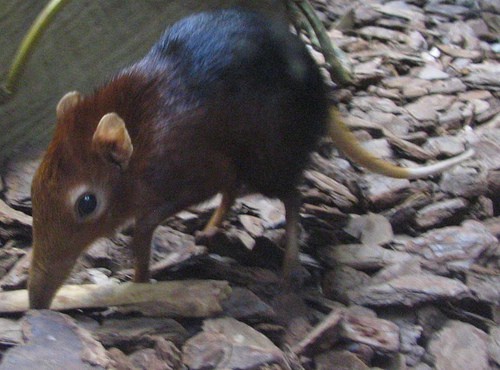
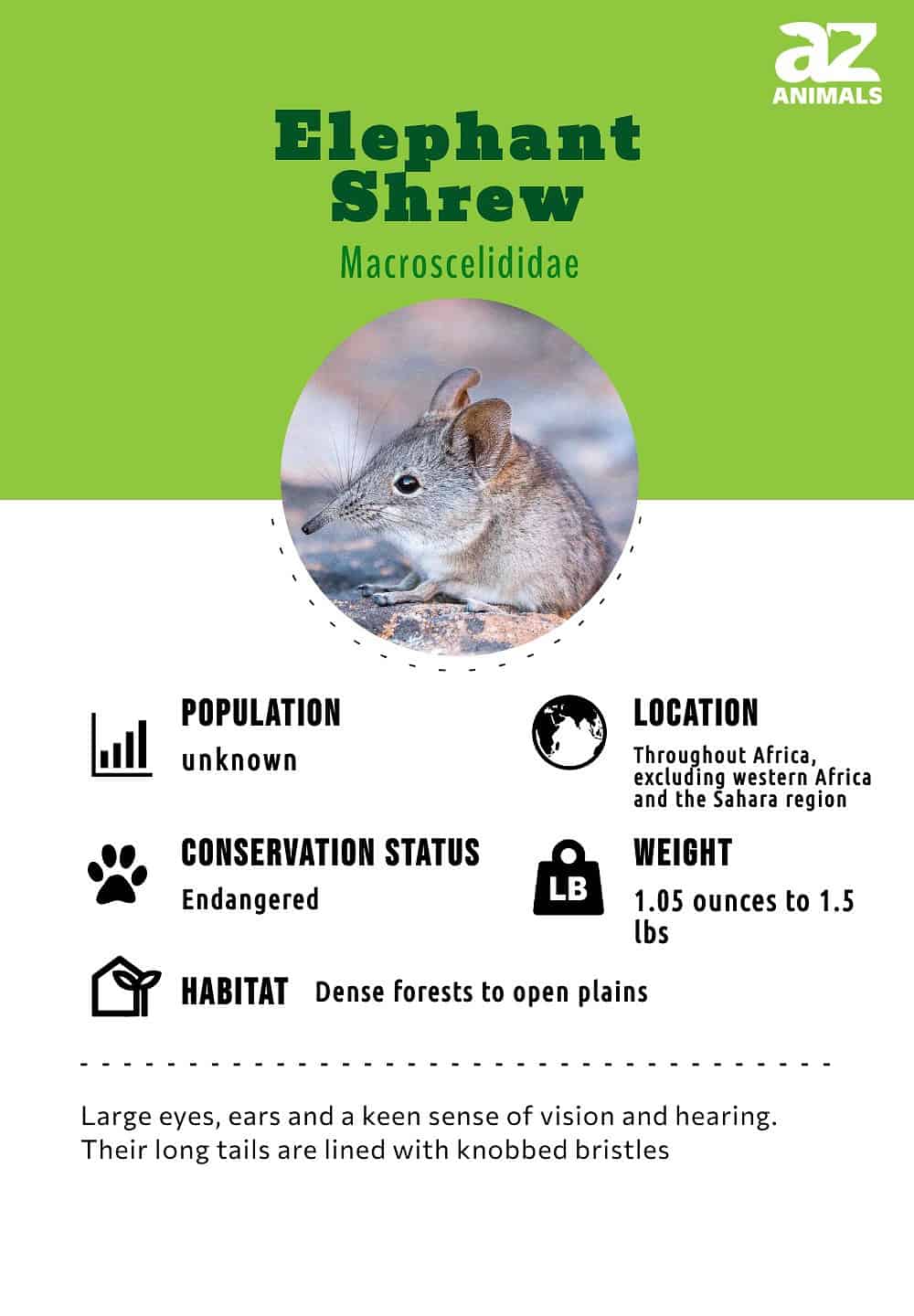
There are approximately 20 different species of these shrews, but they all belong to the family Macroscelididae. The name is derived from the Greek words “macro,” meaning “long,” and “skelidos,” meaning “legs.” All elephant shrews have very long and powerful legs relative to the small size of their bodies, so this is a fitting name.

Elephant shrews can belong to all of the following genera: 

  • Elephantulus, meaning “elephant-like”
  • Macroscelides, meaning “long legs”
  • Petrodromus, meaning “rock runner,” from the Greek words “petra,” meaning “rock,” and “dromas,” meaning “to run”
  • Petrosaltator, meaning “rock hopper,” from the Greek word “petra” and the Latin word “saltare,” meaning “to jump or hop”
  • Rhynchocyon, meaning “dog snout,” is from the Greek words “rhyncho,” meaning “snout,” and “cyon,” meaning “dog”

Other common non-scientific names for this type of animal are “jumping shrew” and “sengi.” They are known as the elephant shrew most commonly due to their long snout.

Evolution And Origin

The elephant shrew has been recognized as a distinct species since the 1950s, although they were originally thought to be related to insectivores and tree shrews it is now believed that they are more closely related to an ancient group that gave way to elephants and aardvarks. While their history may be confined to Africa, it dates back 41.3 million to 33.9 million years ago, during the late Eocene era.
Types Of

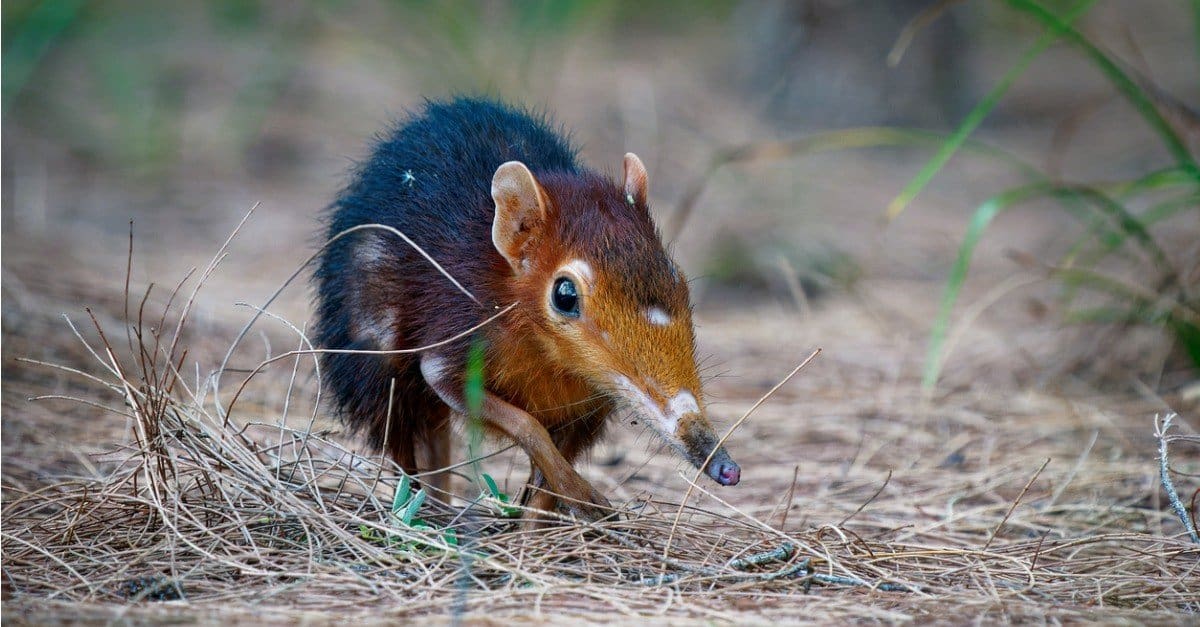
There are approximately 20 species of elephant shrews, all endemic to Africa, that belong to 6 different genera. Each species is located in a different region. The 6 genera are:

  • Genus Elephantulus – this includes 8 species, of which one is the short-snouted elephant shrew.
  • Genus Galegeeska – 2 species are in this genus, the Somali and the rufous elephant shrews.
  • Genus Macroscelides – 3 species are here, including the Round-eared elephant shrew.
  • Genus Petrodromus – the four-toed elephant shrew is in this genus
  • Genus Petrosaltator – the North African elephant shrew is found in this genus
  • Genus Rhynchocyon – 5 species are found in this genus, including the golden-rumped elephant shrew.

Appearance And Behavior
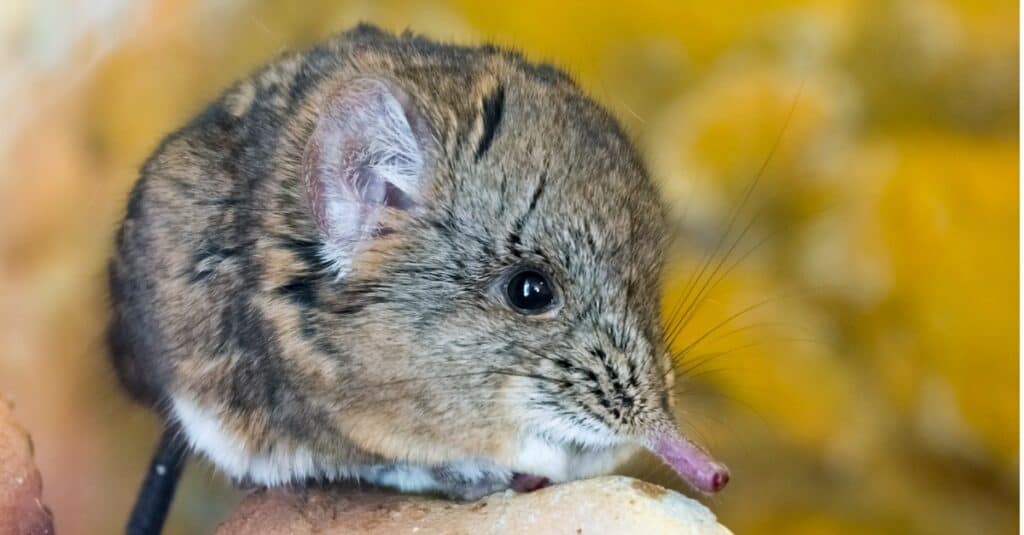
animals with big noses: elephant shrew

Elephant shrews are diurnal, which means they sleep at night and are active during the day.

These shrews are quite small and typically only grow to be four to twelve inches in length, not counting their tails. An elephant shrew’s tail can grow up to nine inches in length. The largest species of this shrew can weigh up to one and a half pounds, but most species weigh less than a pound. To put this in perspective, this means that the average elephant shrew weighs about as much as a large can of soup.

In general, these shrews have short, stiff, and glossy fur similar to rodents like mice, and their coloring often depends on the species. They can sport black, grey, brown, white, tan, or golden fur, and certain species have checkered coats with multiple colors.

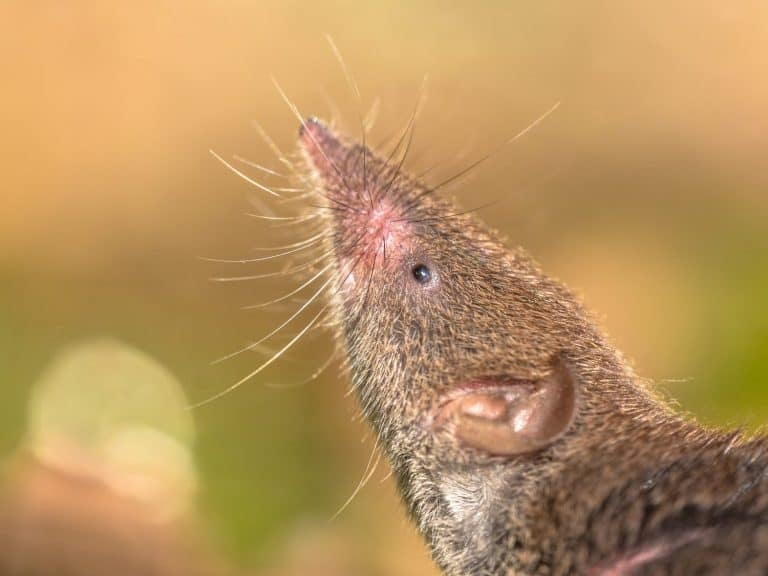
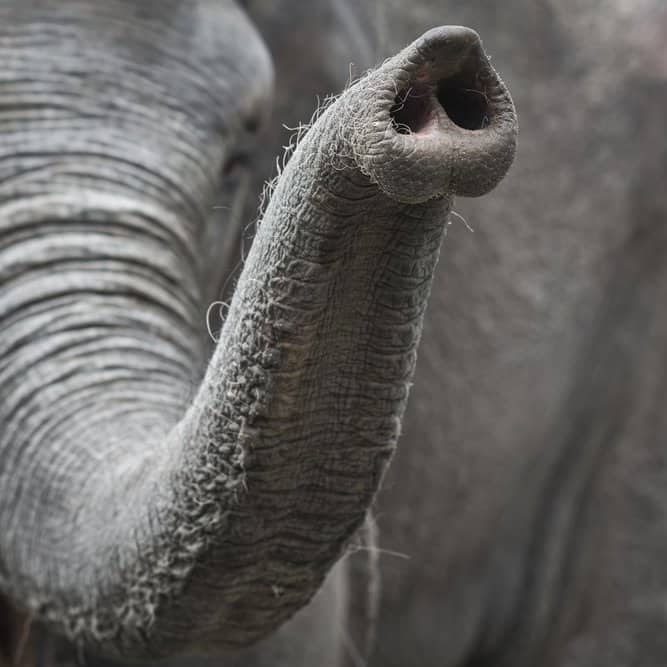
They have scaly tails, powerful hind legs, long feet, and long, thin snouts that are similar enough to an elephant’s trunk to give them their colloquial name. Their long, flexible snouts, along with their large eyes and ears, allow them to hunt for insects and escape predators.

Their long hind legs allow them to jump up to three feet in the air, similar to rabbits, and this is where the nickname “jumping shrew” comes from.

These shrews are extremely active and considered diurnal, which means they sleep at night and are awake during the day.

Habitat

These shrews belong to a special group of mammals known as Afrotheria, which means that they are of African origin. They can be seen in zoos, but they only live in the wilds of Africa.

In particular, they can be found in savannahs, stone deserts, and arid steppes of the continent. The Namib Desert, which is famous for being one of the driest places in the world, is one of the locations where they are known to flourish although shrews can also be found in the tropical forests of East Africa.

Diet

These animals are mainly insectivores, but they may also eat leaves, fruits, and seeds. Spiders, termites, ants, worms, centipedes, and millipedes are their diet of choice.

They use their proboscis-like noses together with their paws to clear small paths on the ground so that they can lure insects close. They have exceptional senses of sight, hearing, and smell, and this helps them to both search for food and escape predators.

These shrews have long, skinny tongues like an anteater, and this helps them to hunt and eat insects more easily.
Predators And Threats

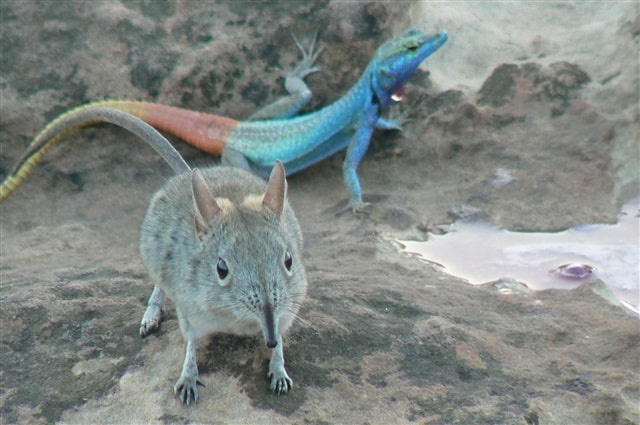
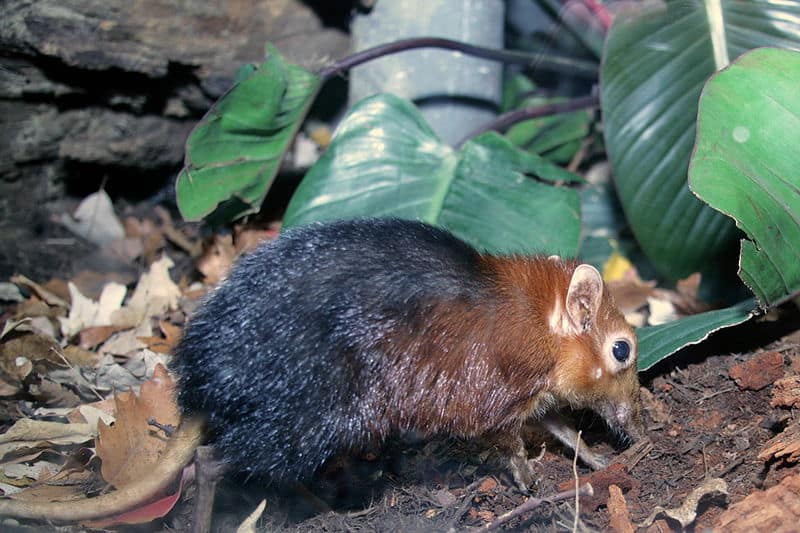
Because they are so small, these shrews face numerous predators, including lizards, snakes, and various birds of prey. While it’s also true that any carnivorous or omnivorous type of animal would prey upon the little elephant shrew, the truth is that they are difficult to catch.

These shrews are well-adapted to their habitats. Not only are they masterfully camouflaged by their coloring, but they are also very speedy and nimble. Most elephant shrews can run up to 18 miles per hour and leap three feet into the air.

More than predators, the biggest threat to the shrew comes from the loss of habitat. Deforestation and the habitat fragmentation that comes with agriculture and logging both have had a devastating impact on the elephant shrew population.

They are listed as “not extinct,” but their conservation status is generally considered endangered. The two species of these shrews that are considered the most threatened are the gray-faced sengi, which was only discovered in 2005, and the golden-rumped elephant shrew, which is officially listed as endangered. 

Reproduction, Babies, And Lifespan
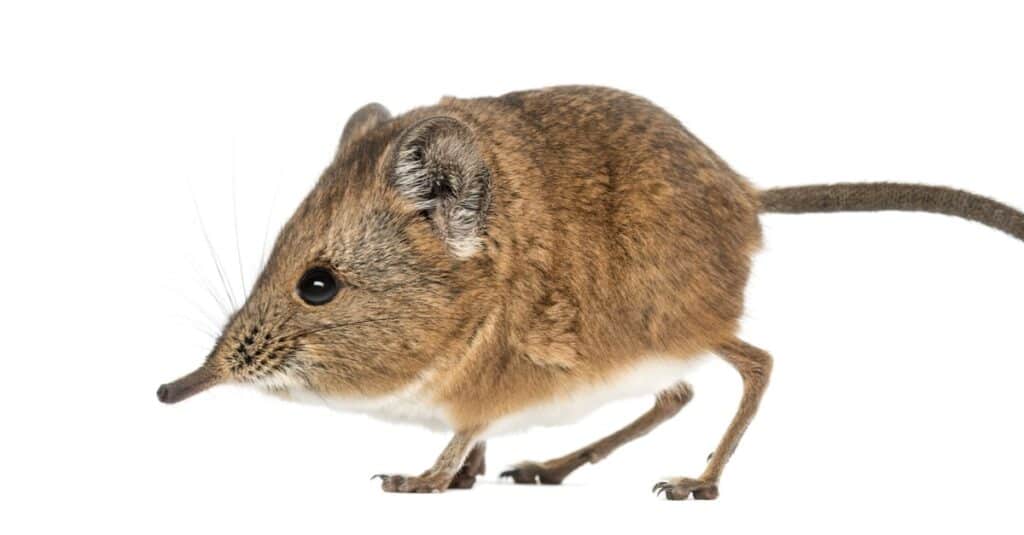
Elephant shrew - Macroscelides proboscideus - isolated on white

Elephant shrew – Macroscelides proboscideus – has a relatively short lifespan, only living about 2 years in the wild.

These animals have relatively short lifespans, so they reach sexual maturity at an early age. Most elephant shrews live only two years in the wild and up to four years in captivity.

One unusual trait of these shrews is that the females have menstrual cycles that are very similar to those of human females. Most mammals are only sexually viable during certain times of the year, so frequent menstruation means that they are able to birth multiple litters annually. Another uncommon trait is that elephant shrews mate for life, and these couples fiercely defend their territory.

Gestation ranges from 45 to 60 days, and a typical healthy litter contains no more than three babies. It is common for female shrews to give birth to only one or two babies at a time.

Within a week of giving birth, babies are weaned from their mothers and are ready to explore their surroundings. By day 15 they are ready to migrate away from the nest. The young elephant shrews will become sexually active after about 45 days and establish their own nests far away from their parents.

View all 185 animals that start with E

Sources

  1. David Burnie, Dorling Kindersley (2011) Animal, The Definitive Visual Guide To The World's Wildlife / Accessed November 4, 2009
  2. Tom Jackson, Lorenz Books (2007) The World Encyclopedia Of Animals / Accessed November 4, 2009
  3. David Burnie, Kingfisher (2011) The Kingfisher Animal Encyclopedia / Accessed November 4, 2009
  4. Richard Mackay, University of California Press (2009) The Atlas Of Endangered Species / Accessed November 4, 2009
  5. David Burnie, Dorling Kindersley (2008) Illustrated Encyclopedia Of Animals / Accessed November 4, 2009
  6. Dorling Kindersley (2006) Dorling Kindersley Encyclopedia Of Animals / Accessed November 4, 2009
  7. David W. Macdonald, Oxford University Press (2010) The Encyclopedia Of Mammals / Accessed November 4, 2009
Melissa Bauernfeind

About the Author

Melissa Bauernfeind

Melissa Bauernfeind was born in NYC and got her degree in Journalism from Boston University. She lived in San Diego for 10 years and is now back in NYC. She loves adventure and traveling the world with her husband but always misses her favorite little man, "P", half Chihuahua/half Jack Russell, all trouble. She got dive-certified so she could dive with the Great White Sharks someday and is hoping to swim with the Orcas as well.
Connect:

Thank you for reading! Have some feedback for us?


Elephant Shrew FAQs (Frequently Asked Questions)

An elephant shrew, also commonly known as a jumping shrew or a sengi, is a small, rat-sized mammal that is native to Africa.

The name “elephant shrew” is derived from the animal’s long, thin and flexible snout, which is said to resemble an elephant’s trunk.

Elephant shrews are a part of what is known as Africa’s “Little 5,” a phrase used to call attention to some of the smaller, lesser-known African wildlife. This name is meant to contrast the so-called “Big 5,” which includes lions, elephantsrhinos, leopards, and buffaloes.