


F
Species Profile

Flamingo

Phoenicopteridae

Pink by diet, united by colonies
Yulia Lakeienko/Shutterstock.com

Flamingo Distribution

Click a location to explore more animals from that region

Loading map...

Size Comparison

Human 5'8"
Flamingo 3 ft 9 in

Flamingo stands at 67% of average human height.

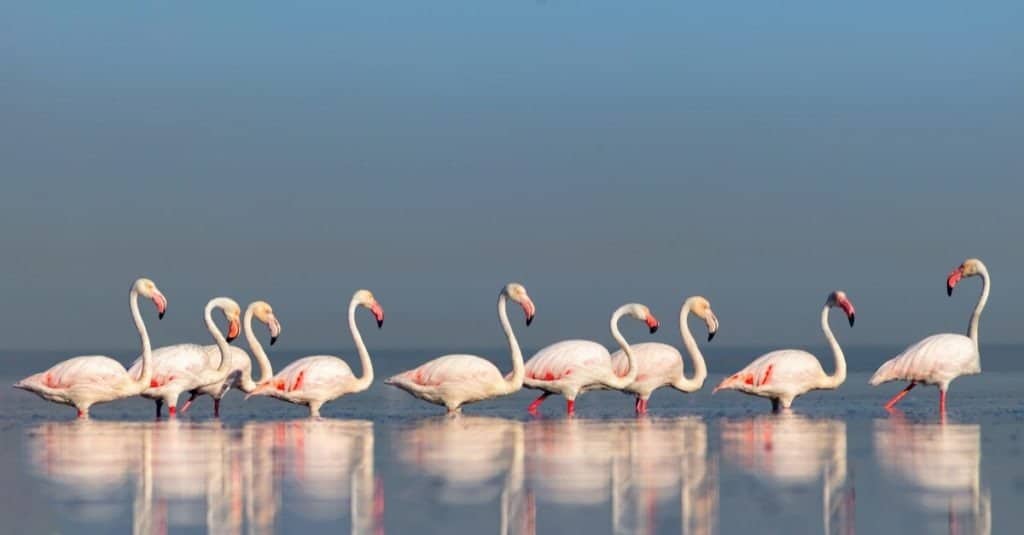
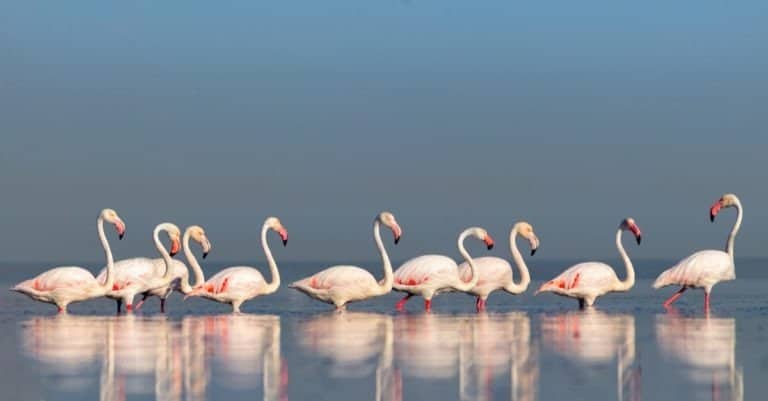
Group birds of pink African Flamingos walking around the blue lagoon on a sunny day, Namibia

At a Glance

Family Overview This page covers the Flamingo family as a group. Stats below are general traits shared across the family.
Diet Filter Feeder
Activity Diurnal+
Lifespan 30 years
Weight 4.5 lbs
Status Not Evaluated
Did You Know?

Family-wide size range spans roughly 0.8-1.5 m tall, with wingspans about 0.95-1.65 m from the smallest to largest flamingos.

Scientific Classification

Family Overview "Flamingo" is not a single species but represents an entire family containing multiple species.

Flamingos are colonial, long-legged wading birds adapted for filter-feeding with a strongly downcurved bill. Their pink coloration comes from dietary carotenoids (e.g., from algae and crustaceans).

Kingdom
Animalia
Phylum
Chordata
Class
Aves
Order
Phoenicopteriformes
Family
Phoenicopteridae

Distinguishing Features

  • Very long legs and neck; wading posture
  • Downcurved bill used upside-down for filter-feeding
  • Pink to red plumage intensity linked to diet
  • Highly social; large, noisy flocks and synchronized breeding displays

Physical Measurements

Males and females differ in size

Height
♂ 0 in (0 in – 1 in)
♀ 3 ft 7 in (2 ft 7 in – 4 ft 9 in)
Length
♂ 4 ft 1 in (2 ft 7 in – 5 ft 1 in)
♀ 3 ft 7 in (2 ft 7 in – 4 ft 9 in)
Weight
♂ 7 lbs (4 lbs – 10 lbs)
♀ 7 lbs (4 lbs – 9 lbs)
Tail Length
♂ 6 in (5 in – 8 in)
Top Speed
37 mph
Fly about 50–60 km/h

Appearance

Primary Colors
Secondary Colors
Skin Type Feathered body with specialized contour feathers; long legs with scaly skin; partially webbed feet; bare facial skin around the bill/eye region; robust keratin bill with serrated lamellae and a strongly downcurved shape adapted for filter-feeding.
Distinctive Features
  • Family-wide body plan: tall, long-legged, long-necked wading birds; smallest-to-largest adults typically ~80-150 cm in body length, with wingspans roughly ~95-165 cm and body masses commonly ~2-4+ kg (ranges vary by species, sex, and condition).
  • Lifespan varies widely: often ~20-40+ years in the wild for many populations, and commonly ~40-60+ years in captivity (exceptional individuals can reach higher ages).
  • Flamingos have a strongly downcurved bill they use upside-down to filter food. Dense lamellae and the tongue pump water or mud to catch algae, diatoms, brine shrimp, and invertebrates. Diet varies by species and habitat.
  • Habitat generalization: strongly associated with shallow wetlands, especially saline/alkaline lakes, lagoons, estuaries, and salt pans; tolerance for high salinity/alkalinity is common, but the degree of specialization varies across the family and by region.
  • Diet-linked coloration: pink intensity is primarily carotenoid-based and can fluctuate with diet availability; juveniles are typically duller/gray-brown before acquiring adult pink tones as diet and age change.
  • Colonial ecology: typically highly gregarious, forming large flocks and dense breeding colonies; colony size and stability vary from modest groups to massive aggregations depending on species and local conditions.
  • Flamingos build mud mounds or raised nests near shallow water, usually lay one egg (sometimes two); both parents sit on eggs and care for chicks, often forming creches; breeding depends on rain, water, and food.
  • Movement patterns: some populations are migratory or nomadic/irruptive in response to water levels and food (especially in variable inland basins), while others are more resident in stable coastal systems.
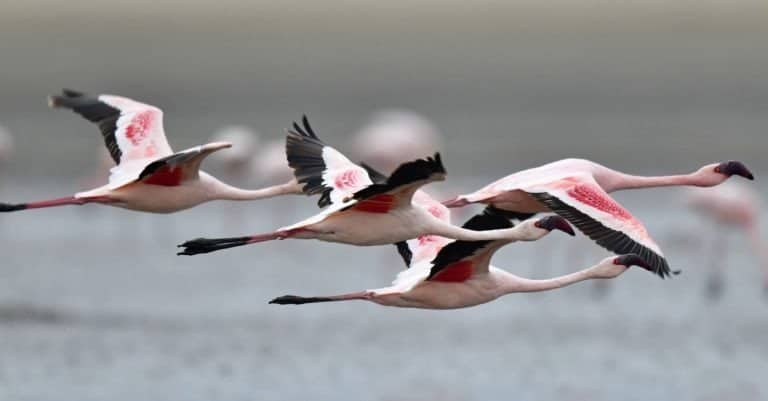
  • Locomotion/foraging posture: frequent long periods standing or wading; feeding often involves synchronized group movements and head-sweeping in shallow water; flight reveals contrasting dark wing feathers in most species.

Sexual Dimorphism

Sexual dimorphism is generally subtle across the family. In many species, males average slightly larger with a heavier bill/neck, but plumage coloration is broadly similar between sexes; degree of size difference varies among species and populations.

♂
  • Often slightly greater overall size/mass within a species (family-level trend; not universal).
  • On average, bill may be marginally longer/deeper and head/neck slightly more robust in some species/populations.
♀
  • Often slightly smaller and lighter on average within a species (family-level trend; not universal).
  • Bill may be slightly shorter/finer on average in some species/populations.

Did You Know?

Family-wide size range spans roughly 0.8-1.5 m tall, with wingspans about 0.95-1.65 m from the smallest to largest flamingos.

Flamingos feed with their heads upside down: the tongue pumps water while comb-like plates in the bill strain out tiny prey and algae.

Their pink/orange/red color comes from dietary carotenoids (commonly from algae and small crustaceans); paler birds often reflect lower pigment intake.

Most flamingos lay a single egg on a cone-shaped mud nest; many colonies synchronize breeding, sometimes in the hundreds of thousands.

Chicks hatch gray and often gather into large nursery groups, where many young are tended in groups while parents forage.

Across the family, many populations can drink or feed in briny/alkaline waters thanks to salt-handling adaptations that exclude many competitors.

Flamingos occur across the Americas, Africa, southern Europe, and Asia-showing a shared body plan but notable differences in diet specialization and habitat use among species.

Unique Adaptations

  • Downcurved bill with internal lamellae (filter plates) and a large, piston-like tongue that pumps water-together forming an efficient biological "sieve."
  • Feeding posture adaptation: neck and bill geometry allow prolonged upside-down feeding at the water's surface or along the bottom.
  • Salt-management system: specialized nasal salt glands help excrete excess salt, enabling life in brackish to hypersaline wetlands.
  • Long legs and partially webbed feet suited for wading and for stirring sediments to free food particles; leg length varies across species with typical foraging depth.
  • Diet-linked pigmentation: carotenoids from algae and crustaceans are metabolized and deposited into feathers and skin; intensity varies by diet, health, molt stage, and species.
  • Dense, insulating plumage and behavioral thermoregulation (e.g., tucking legs, facing into wind) help cope with exposed, open-water roosts and high-elevation or desert-adjacent wetlands used by some species.
  • Conical mud nests elevate eggs above shallow water and help buffer temperature; construction and placement vary with substrate and water level.

Interesting Behaviors

  • Highly colonial living: flamingos typically feed, roost, and breed in dense groups; colony size varies widely by species and site-from small colonies to enormous aggregations.
  • Synchronized courtship "parades": groups perform coordinated head-flagging, wing-salutes, and marching displays that can help align breeding readiness (expression and intensity vary among species and conditions).
  • Filter-feeding styles differ across the family: some species target very small particles (e.g., microscopic algae/diatoms), while others more often strain larger invertebrates like brine shrimp and insect larvae-yet all rely on the same basic filtration mechanism.
  • Habitat flexibility within a shared niche: many flamingos specialize in saline/alkaline lakes and lagoons, but some also use estuaries, coastal flats, and inland marshes; movements range from local wandering to longer-distance dispersal depending on water levels and food.
  • Group foraging dynamics: individuals often feed shoulder-to-shoulder, stirring the bottom with feet to resuspend food; flock spacing and tactics shift with depth, substrate, and prey type.
  • Biparental care is typical: both parents generally incubate and feed the chick (via nutrient-rich crop "milk"), though timing of care and colony attendance vary with species and environment.
  • Nursery group formation: after leaving the nest, chicks commonly form large groups; adults locate their own young by vocal cues, with group size and duration varying by colony density and predation risk.

Cultural Significance

Flamingos (Phoenicopteridae) are symbols of grace, balance, and bright color. They appear in art across the Mediterranean, North Africa, and the Americas, became a popular symbol through 1957 plastic lawn flamingos, and were served at Roman feasts.

Myths & Legends

Southern Cone (Argentina and Uruguay): A folktale made popular by Horacio Quiroga, called "The Flamingos' Stockings," tells how flamingos (Phoenicopteridae) want fancy stockings for a dance, are tricked into snake-skin, then bitten, explaining red legs.

In Ancient Egypt, flamingos (Phoenicopteridae) appear in art and decoration; their bright color and living in marshes linked them to the sun, Nile life, and the idea of coming back each year.

The genus name Phoenicopterus comes from Greek words for 'crimson' or 'purple' and 'wing' or 'feather.' It shows a long interest in the birds' fiery color and 'flame-colored' poems.

Ancient Roman writers told that flamingos (Phoenicopteridae) were fancy foods at feasts, especially their tongues, making the birds seem rare and a sign of wealth in later European memory.

The plastic lawn flamingo, a tacky yard ornament, became a joking symbol of life in the suburbs and camp style, sparking "flocking" pranks and fundraisers that keep flamingos (Phoenicopteridae) in legend far from wetlands.

Conservation Status

NE Not Evaluated at the family (hub) level. Across Phoenicopteridae, individual species currently range from Least Concern (e.g., Greater and American/Caribbean flamingos) through Near Threatened (e.g., Lesser, Chilean, and James's flamingos) to Vulnerable (notably the Andean flamingo). Family-level biological ranges/generalizations: adult size spans ~80-150 cm in length (approx. ~1.5-4.5 kg; wingspan roughly ~95-165 cm depending on species/sex); longevity commonly ~20-40+ years in the wild and can reach ~50-60 years in captivity. Ecology/behavior is broadly shared (highly gregarious, colonial breeding, synchronized nesting, strong site fidelity to key wetlands, filter-feeding on algae/diatoms and small invertebrates in saline/alkaline or coastal lagoons) but varies by species and region in migratory/nomadic tendency, salinity tolerance, and breeding frequency (often highly dependent on rainfall/water levels).

Has not yet been evaluated against the criteria.

Population Unknown

Protected Under

  • Protected through a patchwork of national wildlife laws across range states; enforcement and coverage vary by country and site.
  • Many key breeding and staging wetlands are within protected areas and/or designated as Ramsar Wetlands of International Importance.
  • Regional instruments may apply in parts of the range (e.g., EU Birds Directive protections for European breeding/foraging sites of Greater flamingos).
  • Conservation actions commonly emphasize wetland protection, water management/allocation, regulation of mining and pollution, and disturbance control at colonies-especially for Vulnerable/near-threatened high-Andean and East African saline-lake populations.

You might be looking for:

Greater Flamingo

28%

Phoenicopterus roseus

Largest and most widespread flamingo; pale pink with black flight feathers.

American Flamingo

22%

Phoenicopterus ruber

Caribbean and northern South America; often bright pink to reddish.

Chilean Flamingo

18%

Phoenicopterus chilensis

South American species; grayish legs with pink joints, paler body.

Lesser Flamingo

18%

Phoeniconaias minor

Smaller, deep pink; major populations at African soda lakes; specialized algae feeder.

Andean Flamingo

9%

Phoenicoparrus andinus

High Andes saline lakes; more restricted range; pale with distinctive bill pattern.

James's (Puna) Flamingo

5%

Phoenicoparrus jamesi

High-altitude Andean lakes; smaller, delicate bill; limited distribution.

Life Cycle

Birth 1 chick
Lifespan 30 years

Lifespan

In the Wild
10–50 years
In Captivity
15–80 years

Reproduction

Mating System Monogamy
Social Structure Socially Monogamous
Breeding Pattern Serial
Fertilization Internal Fertilization
Birth Type Internal_fertilization

Flamingos (Phoenicopteridae, ~6 species) breed mostly as socially monogamous pairs in large colonies. Pairs usually form per season (serial monogamy), mate internally, lay one egg, and both parents care; chicks may join crèches (groups of chicks).

Behavior & Ecology

Social Colony Group: 1000
Activity Diurnal, Crepuscular, Cathemeral, Nocturnal
Diet Filter Feeder Carotenoid-rich algae and small crustaceans (notably brine shrimp)
Seasonal Migratory 1,243 mi

Temperament

Highly gregarious and socially tolerant at close spacing (dense roosts/colonies)
Synchronized and socially coordinated (group courtship/marching displays; collective movements)
Can be aggressive at short range during breeding (pecking, threat postures), especially around nest mounds and mates
Generally risk-averse with strong disturbance sensitivity; may shift feeding times (more crepuscular/nocturnal) under heat, hunting pressure, or human activity
Dominance interactions occur at feeding sites (displacements), with intensity varying by crowding and resource limitation
Site-faithful at traditional wetlands in many populations, but also capable of nomadic/irruptive movements when water and food conditions change

Communication

loud honking/goose-like contact calls Individual and group cohesion
flight calls during takeoff/landing and coordinated movements
grunts/growls and lower-intensity calls in close social contexts
courtship-associated calls Often in chorus during group displays
chick begging calls; parent-chick recognition calls used to reunite and feed chicks within creches
visual displays: head-flagging, wing-salute, marching/synchronized group displays that facilitate pair formation and breeding readiness
postural signaling and threat displays (neck extension, gape/bill-directed threats, pecking) used in spacing and mate/territory defense at nest sites
bill movements and ritualized gestures during pair bonding and nest interactions
group-level synchronization (standing, preening, turning, and takeoffs) that functions as coordination and possibly predator/danger response
spatial/olfactory cues are not primary; communication is dominated by visual and vocal signals adapted to dense colonies and open habitats

Habitat

Biomes:
Wetland Freshwater Marine Desert Hot Desert Cold Mediterranean Savanna Tropical Dry Forest Temperate Grassland Temperate Forest +4
Terrain:
Coastal Island Muddy Plains Plateau Rocky Sandy Valley Volcanic +3
Elevation: Up to 15748 ft

Ecological Role

Colonial wetland filter-feeders that transfer energy from planktonic/microbial production and small invertebrates to higher trophic levels, while strongly influencing shallow-water food webs.

Regulate plankton and benthic microalgae through high-volume filter-feeding and grazing Bioturbate sediments (stirring/mixing) and recycle nutrients, affecting water clarity and productivity Serve as prey (eggs/chicks/adults) for raptors and large carnivores, linking wetland productivity to terrestrial predators Act as bioindicators of wetland salinity/food-web changes via diet-dependent condition and coloration Transport nutrients among wetlands via movement and guano deposition

Diet Details

Main Prey:
Brine shrimp and other small crustaceans Aquatic insect larvae and small aquatic invertebrates Small mollusks Annelid worm Zooplankton
Other Foods:
Phytoplankton Cyanobacteria and other microalgae Biofilm Soft aquatic plant material and seeds

Human Interaction

Domestication Status

Wild

Flamingos (family Phoenicopteridae) are tall, social waterbirds that live in shallow saline or alkaline lakes, lagoons, estuaries, and salt pans. They are not domesticated but have been kept in old collections and zoos for centuries and are managed in captivity and conservation programs; people also view them in the wild.

Danger Level

Low
  • Physical injury during close handling: biting/pinching with the bill, wing strikes, or scratches (risk increases for keepers/vets).
  • Zoonotic/occupational exposure typical of birds (e.g., Salmonella/Campylobacter risk from fecal contamination; low but relevant for handlers).
  • Indirect hazards around colonies (slippery mud/salt crusts, strong sun exposure, remote terrain) affecting visitors more than the birds themselves.
  • Disease-control context: wild birds can be involved in avian influenza surveillance; risk to the general public is usually low when not handling birds.

As a Pet

Not Suitable as Pet

Legality: Flamingos (Phoenicopteridae) are usually illegal or impractical as pets. Many species and eggs are protected, trade is regulated, and keeping them needs special permits and zoo-like care standards.

Care Level: Expert Only

Purchase Cost: $5,000 - $30,000
Lifetime Cost: $150,000 - $500,000

Economic Value

Uses:
Ecotourism and wildlife viewing Zoo/aquarium exhibition and education Conservation and research value (indicator species for wetland health) Cultural/aesthetic value (iconic wildlife) Limited historical/illegal exploitation (eggs, meat, feathers)
Products:
  • Guided tours and park revenue at flamingo wetlands/colonies
  • Zoo admissions and educational programming featuring managed flamingo flocks
  • Scientific data/services (monitoring wetlands, population surveys, contaminant studies)
  • Photography/film/media value tied to colony spectacles
  • Historically: eggs/feathers/meat in some regions (now widely restricted/illegal)

Relationships

Predators 11

Fox
Fox Vulpes
Jackals Canis spp.
Coyote
Coyote Canis latrans
Feral dog
Feral dog Canis lupus familiaris
Hyena
Hyena Hyaenidae
Large gulls Larus spp.
Skuas and jaegers Stercorarius spp.
Ravens and crows
Ravens and crows Corvus
Eagles
Eagles Aquila spp. and Haliaeetus spp.
Large falcons and caracaras Falco spp. and Caracara spp.
Crocodiles and Alligators Crocodylidae and Alligatoridae

Related Species 4

True flamingos Phoenicopterus Shared Family
Lesser Flamingo Phoeniconaias minor Shared Family
Andean and James's flamingos Phoenicoparrus Shared Genus
Grebes
Grebes Podicipedidae Shared Class

Ecological Equivalents 5

Animals that fill a similar ecological role in their ecosystem

Avocet
Avocet Recurvirostra spp. Shallow-water waders that sweep or filter small aquatic invertebrates from saline or brackish flats; they often use similar wetlands (though flamingos are more specialized filter-feeders).
Stilts Himantopus spp. Long-legged waders that occupy shallow wetlands and salt pans; they overlap in foraging habitats and face similar predator pressures, often forming colonies near open water.
Spoonbills Platalea spp. Colonial wetland birds that forage by tactile sweeping in shallow water. They use lagoons and estuaries and roost communally, but they target larger prey than most flamingos.
Shoveler Spatula spp. Filter-feeding waterfowl with lamellate bills that strain plankton and invertebrates. They can occur in eutrophic lakes and brackish wetlands where flamingos concentrate food.
Brine shrimp-specialist shorebirds Phalaropus spp. Exploit hypersaline systems and feed on planktonic crustaceans (including Artemia) using surface-feeding and spinning behavior; overlap in saline-lake food webs.

Types of Flamingo

6

Explore 6 recognized types of flamingo

Greater Flamingo Phoenicopterus roseus
American Flamingo Phoenicopterus ruber
Chilean Flamingo Phoenicopterus chilensis
Lesser Flamingo Phoeniconaias minor
Andean Flamingo Phoenicoparrus andinus
James's Flamingo (Puna Flamingo) Phoenicoparrus jamesi

“A flamingo’s feathers don’t turn pink until it reaches 2 or 3 years old”

Flamingos are omnivorous birds that eat brine shrimp, algae, and snails. They live in large groups called colonies. These birds reside in tropical climates in regions of Africa, Asia, and around South America. This bird can have a wingspan as wide as 60 inches.

An Incredible Bird: 5 Flamingo Facts!

  • Flamingos lay just one egg in a clutch.
  • They have pink feathers due to the beta-carotene in the foods they eat.
  • These birds can live from 20 to 30 years in the wild.
  • They sometimes live in flocks containing thousands of birds.
  • Their webbed feet help them to move across the surface of a lake.
Scientific Name and Different Types

The scientific name of the American Flamingo is Phoenicopterus ruber. The word flamingo comes from the Spanish word flamenco. Flamenco is a rhythmic dance. This may refer to the behavior of a flock of flamingos as they change direction in unison and move in a synchronized way.

The other five species of flamingo include:

  • Lesser Flamingo (Phoeniconaias minor) – Appropriately named, these are the smallest of the flamingos. Besides their size, they can be identified by their dark red beaks, light pink plumage, and hind toes. They live near high mountain lakes and lagoons in Peru, Chile, Bolivia, and Argentina.
  • Chilean Flamingo (Phoenicopterus chilensis) – These flamingos stand out from their cousins because of their legs. They are grey with ping coloration of their leg joints. They have typical pink plumage, and their beaks are over 50% black. These birds are located in South American mudflats and shallow lakes from Peru, Bolivia, Ecuador, Brazil, Argentina, and Chile.
  • Greater Flamingo (Phoenicopterus roseus) – The biggest of the flamingos, the Greater Flamingo has a white hue to its feathers. They can be spotted because of the black tip on their beaks and the pink coloration from the beak to the eye. They can be found in around the parameters of Africa, the Middle East, India, Pakistan, and southern Europe. And they will migrate if the weather is too harsh.
  • Andean Flamingo (Phoenicoparrus andius) – This flamingo is pale pink, although it does have some darker upperparts and wing covers, and black flight feathers. They have brownish and reddish eyes. This particular type of flamingo can be found in lakes of the Andes mountains of South America.
  • Puna Flamingo (Phoenicoparrus jamesi) – Also known as James’s Flamingo, these flamingos’ plumage is very pale and has bright streaks around their necks. Their beaks are yellow and have black tips to them. Instead of pink, the Puna Flamingo has red legs. These birds can be found in the high mountains of Chile, Argentina, Bolivia, and Peru.
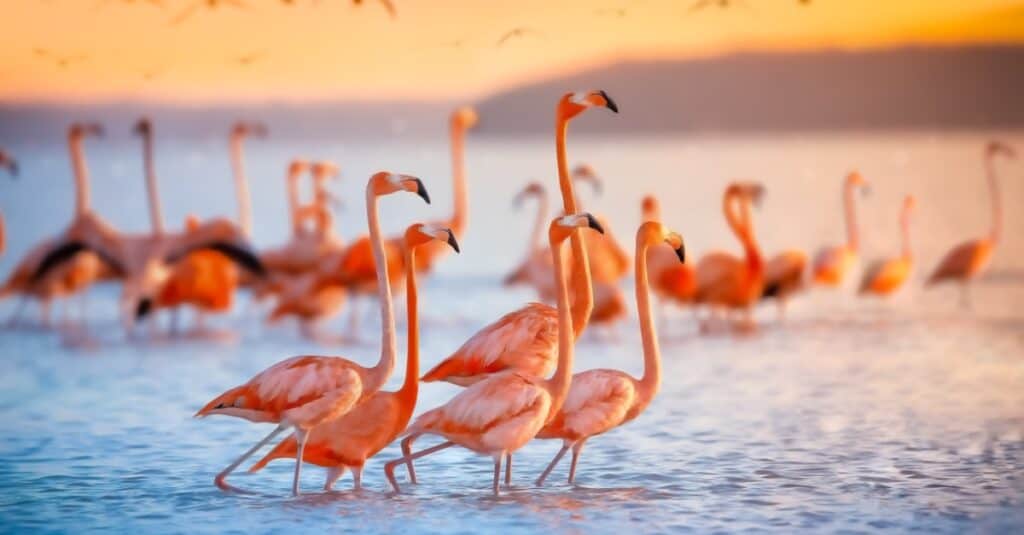
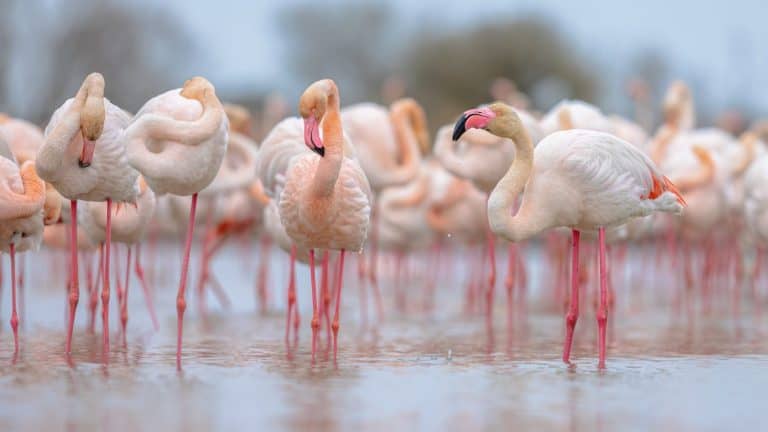
flamingos standing in the water

The word flamingo comes from the Spanish word flamenco, a rhythmic dance.

History and Evolution

Scientists and researchers believe that flamingos most likely evolved from Junciatarus. There was a divergence that produced the grebes and flamingos in the late Eocene period. The Junciatarus was a generalist feeder that found its food by wading through freshwater in North America and Europe. Some of their extinct cousins are thought to have had shorter legs and were more diver hunters than flyers.

It is not known exactly when the ancestors of the flamingo evolved to have their specialized filter-feeding capability because of the lack of fossil records. There is a gap of time in fossils from their predecessors and in fossils from early flamingos that would indicate a gradual adaptation of filter-feeding.

Appearance & Behavior

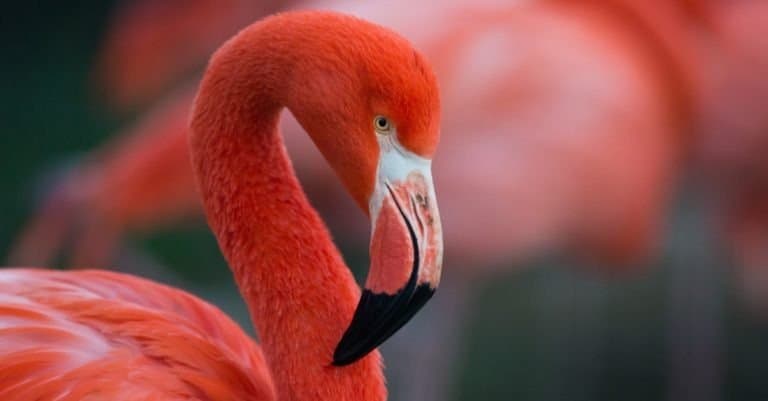
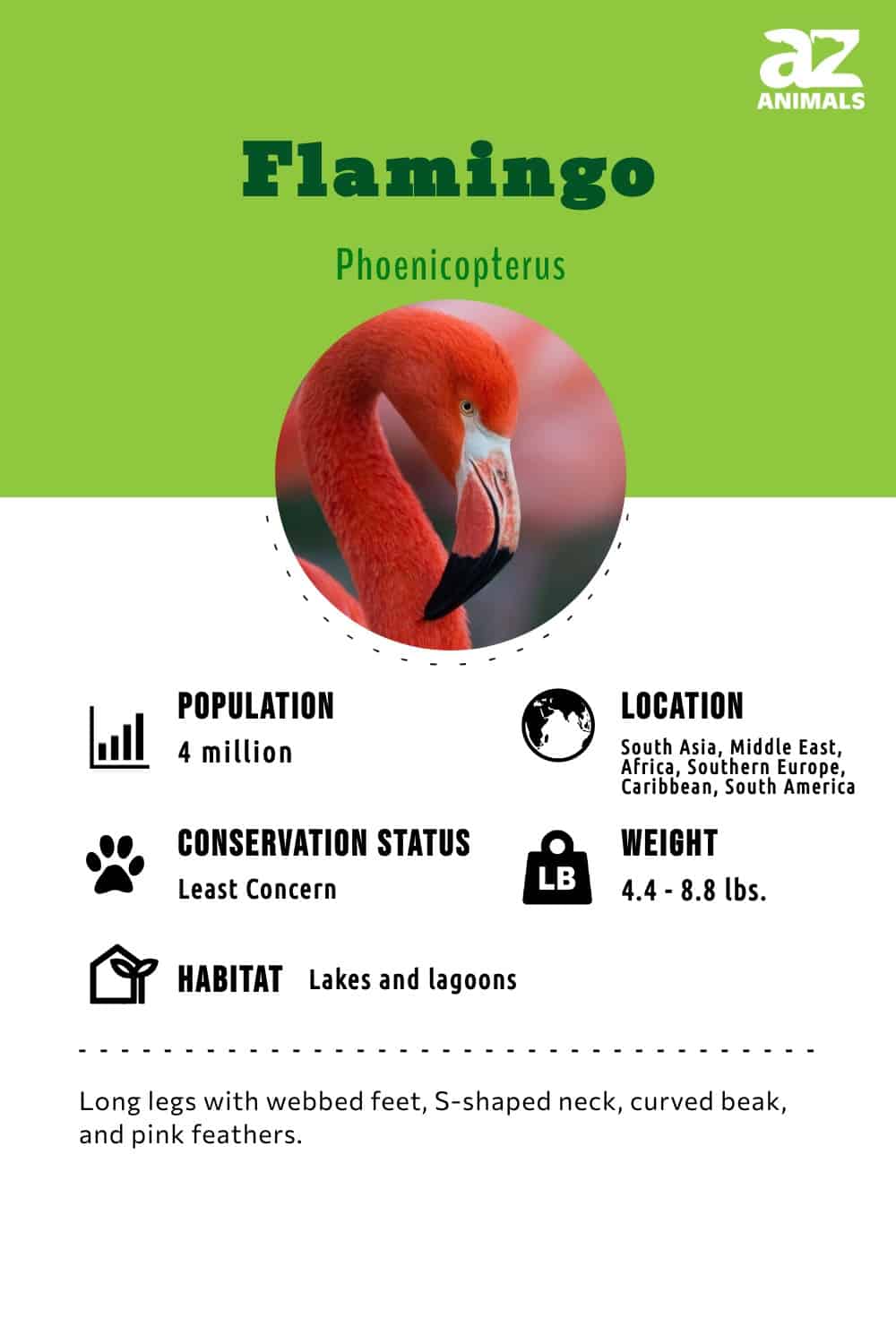
Flamingos are birds that are known for their long legs (with webbed feet), S-shaped neck, curved beak, and pink feathers. Their diet of algae and brine shrimp contains beta carotene which is a red/orange pigment. The large supply of beta carotene taken in via the bird’s diet is what turns their feathers bright pink. This bird uses its curved beak to shovel algae into its mouth when its head is underwater.

These birds range from 3 to 4 feet tall and can weigh up to 9 pounds, depending on the species. The tallest species is the greater flamingo at 4.7 feet as well as the heaviest at 9 pounds. Line up three bowling pins end to end, and they are equal in length to a 4-foot-tall bird. A 9-pound bird is almost as heavy as the average housecat.

The largest wingspan of the flamingo bird is 60 inches. That length is almost equal to the length of a home’s refrigerator! A Roseate spoonbill is similar to a flamingo and has a wingspan of 51 inches.

When it comes to survival, the flamingo’s greatest asset is its colony lifestyle. They live in colonies containing 100 or even thousands of birds. The sheer size of a colony can discourage predators. If one bird spots a predator, it begins honking to alert other birds of the danger.

These social birds can be aggressive to one another when looking for food or competing for a mate during the breeding season. Otherwise, they’re even-tempered animals.
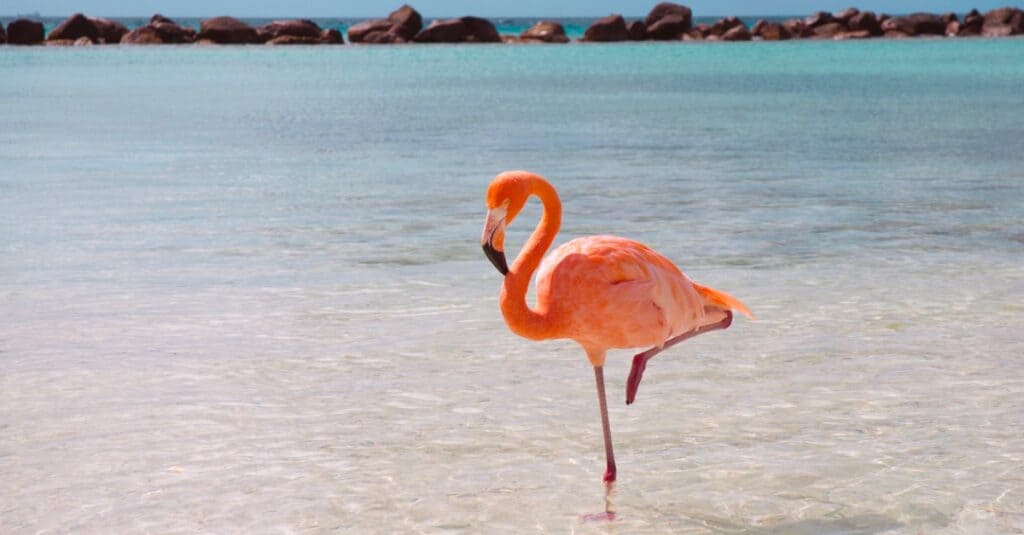
flamingo standing on the shore of the ocean

The color of a flamingo is a result of what they eat— algae and brine shrimp.

Habitat

These birds live in tropical climates. Some live in east, west, and southwestern Africa. Other species live in the southern region of coastal South America. They are also found in the Galapagos Islands, Turks and Caicos Islands, and the Bahamas as well as in India. The region of the world where a flamingo lives depends on its species.

Specifically, their habitats include lagoons, shallow lakes, mangrove swamps, and tidal flats.

Though this bird is not known to migrate, a colony may relocate if there is a drought in the area or if there is a shortage of one of its food sources. Birds living in a lake that is at a high elevation may move to a body of water at a lower elevation for the winter months.
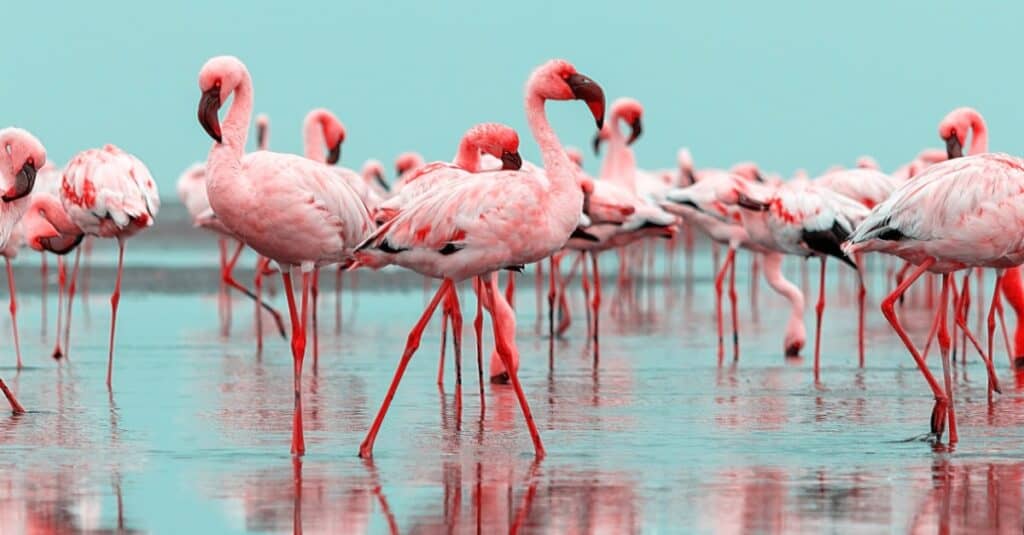
flamingos standing in the water

Birds living in a lake that is at a high elevation may move to a body of water at a lower elevation for the winter months.

Legs

The bird’s legs help it to survive in its lagoon, lake, or swamp habitat. The long legs of this animal allow it to access deeper areas of a body of water. This means it has a chance to find fish that aren’t accessible to birds with shorter legs.

One of the most interesting facts about these birds is they have webbed feet. These specially designed feet prevent them from sinking in the mud as they wade out in a lake or lagoon in search of a meal. Their webbed feet also come in handy when they want to swim in the water instead of wade.

Observe a colony of these birds about to take off into flight and it may appear like they are running on the surface of the water. In a way, their webbed feet allow them to skim the surface of the water as they begin to lift off.

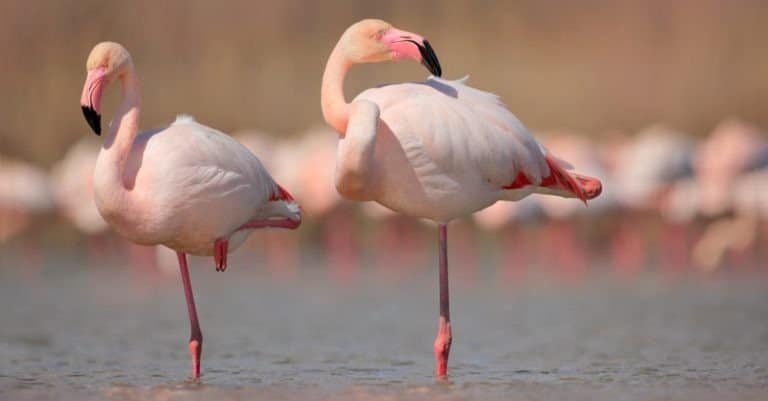
You may have seen a picture of the bird standing on just one leg. Why do they do that? Answer: Scientists don’t know. Some scientists say that tucking one leg up under their body is a way to retain heat. But these birds have been seen standing this way in really hot climates. Other scientists believe this is a comfortable resting position for the bird. No one but a flamingo knows for sure.
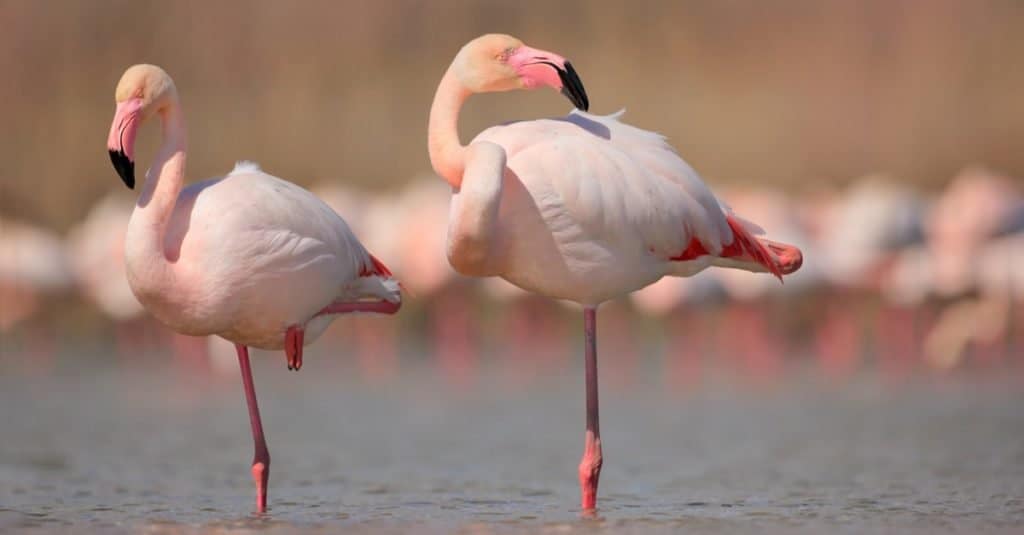
Dumbest Animals in the World: Flamingo

The bird’s legs help it to survive in its lagoon, lake, or swamp habitat.

Diet

These birds are omnivores. One of the simplest facts to remember is they eat the food source that’s most plentiful in their habitat.

What eats them?

Some of the predators of these birds include eagles, vultures, kites, storks, raccoons, Geoffrey’s cats, feral pigs, and foxes. While adult birds are fairly safe in their colony, their eggs and hatchlings are targeted by these predators.

What do they eat?

This bird eats shrimp, snails, and algae. It dips its head into the water, turns it upside down, and eats small items of food by shoveling them into its upper beak.

Though most flamingos eat just 9 ounces of food per day, they drink around 4 gallons of water. Picture four, 1-gallon milk jugs in your refrigerator filled with water!

Check out this article about flamingo poop, and how the flamingo digestive system works.
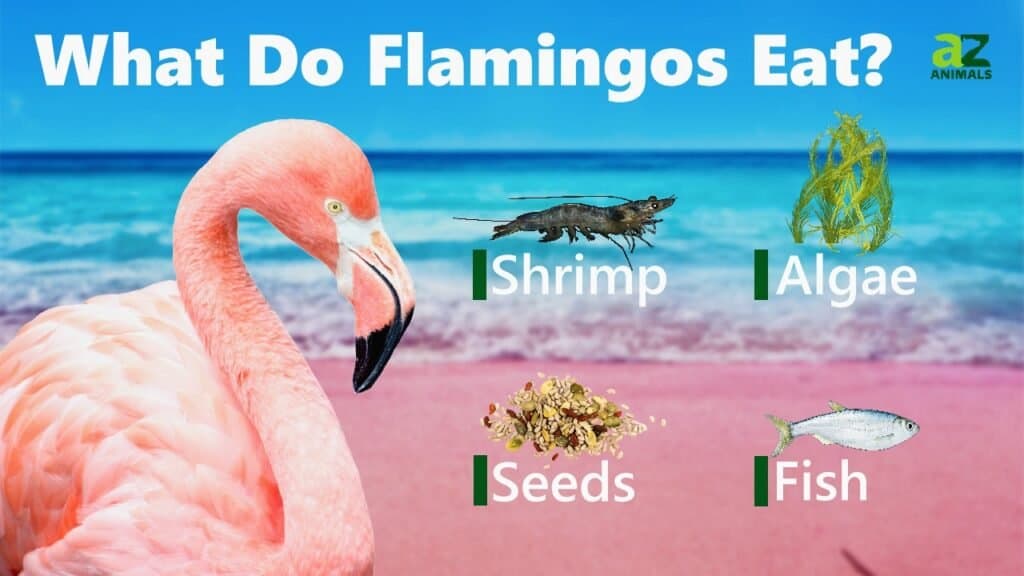
What Do Flamingos Eat
Flamingos are omnivores and typically eat shrimp, seeds, algae, and fish.

Predators and Threats

Some predators of these birds include vultures, eagles, storks, and kites. Foxes, Geoffrey’s cats, raccoons, and feral pigs are other predators of this bird and can steal eggs or hatchlings.

The birds in a colony watch over and defend one another’s eggs and hatchlings. Sometimes a predator will be discouraged from entering the area because there are so many birds in one colony.

Many of these birds live in lagoons and other bodies of water, so they’re vulnerable to water pollution created by nearby factories. Habitat loss due to construction is another threat.

The conservation status of this bird is Least Concern with an increasing population.
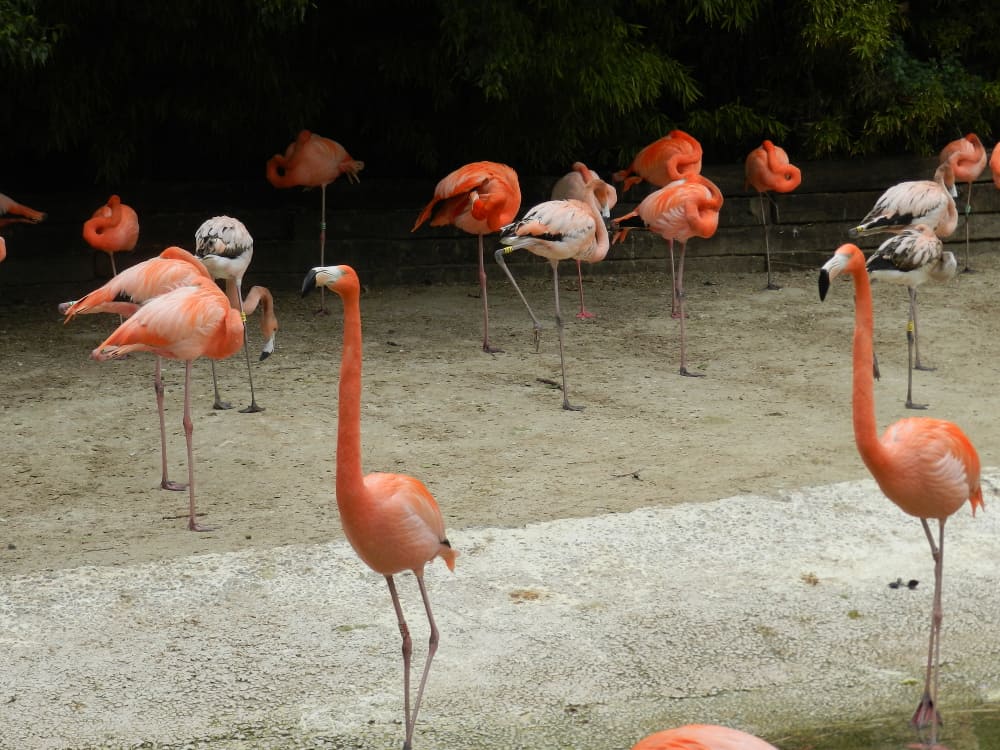
The birds in a colony watch over and defend one another’s eggs and hatchlings.

Reproduction, Babies, and Lifespan

There’s no specific time of year that these birds breed. However, the breeding time is the same throughout a flock or colony. That way, the chicks are born at the same time and can be raised together. Conditions such as the level of rainfall and the amount of food available to these birds can both influence when the breeding season takes place.

When breeding season arrives for a colony, the male flamingo struts around in front of females showing off and preening his feathers. Though these birds are thought to be monogamous, there are some males that mate with multiple females.

Flamingos build a nest that’s essentially a mound of mud with a shallow hole at its top. The female lays just one 5-ounce egg in the hole and both parents take turns keeping the egg warm until it hatches. The incubation period falls between 27 to 31 days. The White ibis bird which is similar to a flamingo has an incubation period of 21 days.

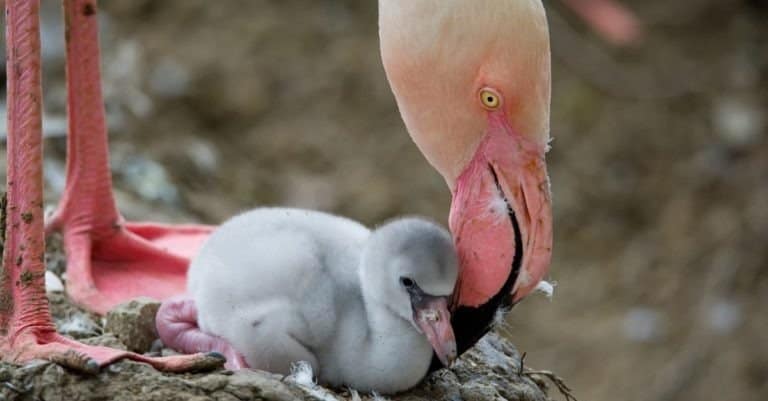
The baby or flamingo chick weighs around 3 ounces. Flamingo chicks are born with white downy feathers and a straight beak. A young flamingo’s feathers don’t come in fully pink until they reach the age of about 2 years old. Its beak begins to curve downward at about 11 weeks of age.

A chick stays with its parents for 5 days. The parents both feed the chick by releasing food from their stomachs into the chick’s mouth. Yuck! When the chick is 5 days old, it joins a small group of other chicks where it stays for three weeks. During this time, when the chick is hungry, the parents feed it. But how do the parents find their chick when it’s hanging around with other chicks? Answer: The parents find their chick by the sound of its peeps and honks.

After this three-week period, the parents move their chick to a larger group of other young flamingos where it learns to find food on its own. As you see, all birds in a flamingo colony play a part in raising young ones. Flamingos reach sexual maturity at 3 to 5 years old.

This bird can live from 20 to 30 years in the wild. Furthermore, they can live for 50 years or more in zoos. The oldest recorded flamingo lived to be 83!

Avian flu and tuberculosis (both respiratory issues) are common illnesses of the flamingo.
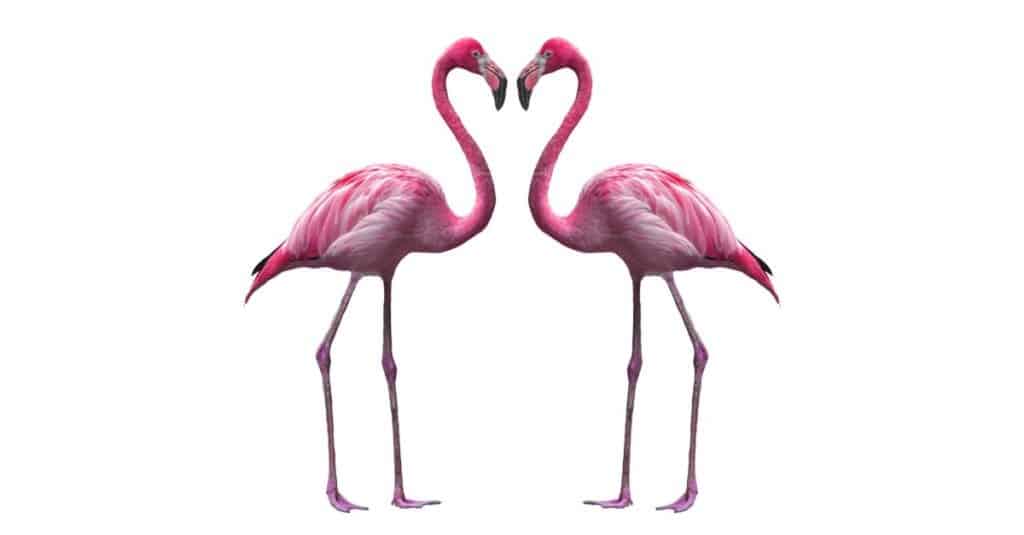
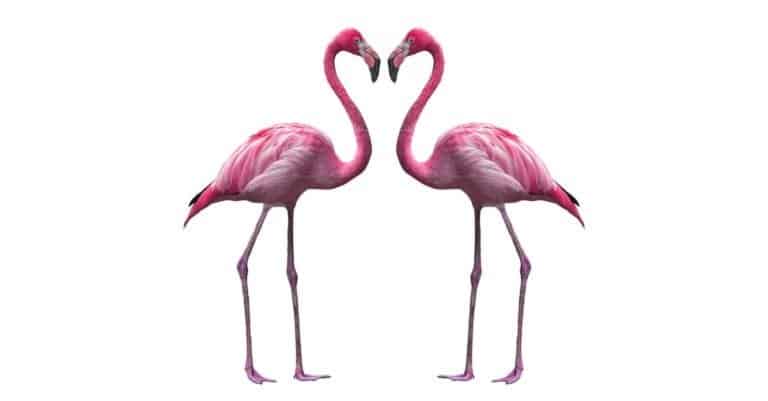
Flamingo isolated on white background

Though these birds are thought to be monogamous, there are some males that mate with multiple females.

Population

There are six species of flamingo and their populations vary. According to the IUCN Red List of Threatened Species:

  • There are 260,000 to 330,000 mature American flamingos in the Turks and Caicos Islands
  • The lesser flamingo has a population of 2,220,000 to 3,240,000 individuals. Some of these live in western and southern Africa while others are in southern Asia.
  • The Chilean flamingo has a population of 300,000 in South America
  • The greater flamingo has a population of 550,000 to 680,000 individuals in parts of Africa and Asia
  • The population of the Andean flamingo is unclear but there are thought to be 11,600 individuals in South America
  • The Puna flamingo population is estimated at 106,000 individuals in South America

Both the American and greater flamingos have a conservation status of Least Concern with an increasing population.

The lesser flamingo species along with the Chilean flamingo has a status of Near Threatened with a decreasing population.

The Andean flamingo has a status of Vulnerable with a decreasing population.

The Puna flamingo is Near Threatened with a population described as stable.
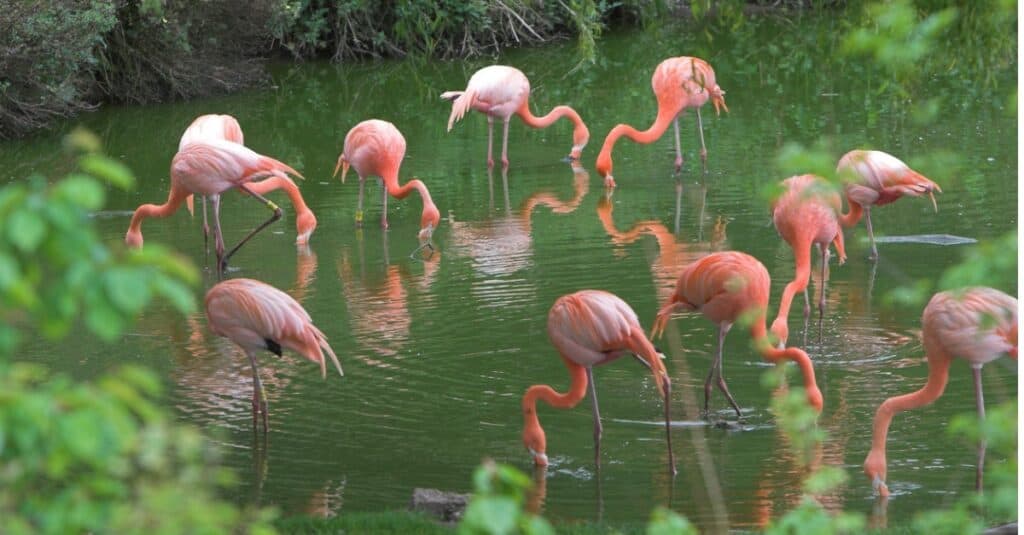
What do flamingos eat-flock

Both the American and greater flamingos have a conservation status of Least Concern with an increasing population.

In the Zoo

View all 170 animals that start with F

Sources

  1. Flamingos World / Accessed January 21, 2021
  2. Wikipedia / Accessed January 21, 2021
Heather Ross

About the Author

Heather Ross

Heather Ross is a secondary English teacher and mother of 2 humans, 2 tuxedo cats, and a golden doodle. In between taking the kids to soccer practice and grading papers, she enjoys reading and writing about all the animals!

Thank you for reading! Have some feedback for us?


Flamingo FAQs (Frequently Asked Questions)

Flamingos are Omnivores, meaning they eat both plants and other animals.