
F
Species Profile

Flying Squirrel

Sciuridae

Not flyers - forest gliders
FWS - Public Domain

Flying Squirrel Distribution

Click a location to explore more animals from that region

Loading map...

Size Comparison

Human 5'8"
Flying Squirrel 6 in

Flying Squirrel stands at 9% of average human height.

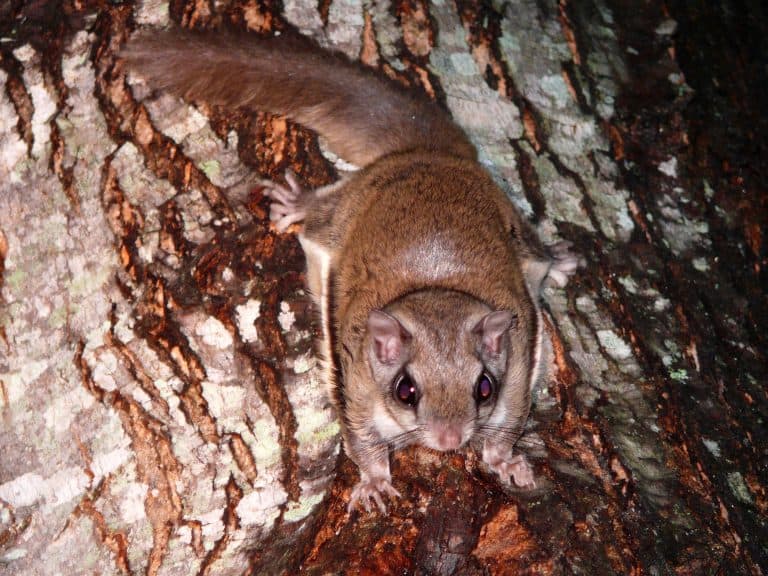
Flying Squirrel in a tree

At a Glance

Family Overview This page covers the Flying Squirrel family as a group. Stats below are general traits shared across the family.
Also Known As Gliding squirrel
Diet Omnivore
Activity Nocturnal+
Lifespan 4 years
Weight 2.5 lbs
Status Not Evaluated
Did You Know?

They don't truly fly: they glide and steer using a furred membrane (patagium) from wrist to ankle plus a flattened tail.

Scientific Classification

Family Overview "Flying Squirrel" is not a single species but represents an entire family containing multiple species.

Flying squirrels are a group of squirrels (tribe Pteromyini, family Sciuridae) specialized for gliding between trees using a furred membrane (patagium) stretching from wrist to ankle. They do not truly fly; they glide and steer using limb posture and their flattened tail.

Kingdom
Animalia
Phylum
Chordata
Class
Mammalia
Order
Rodentia
Family
Sciuridae

Distinguishing Features

  • Patagium (gliding membrane) between fore- and hindlimbs
  • Cartilaginous spur at the wrist to spread the patagium
  • Large eyes in many species (especially nocturnal species)
  • Flattened or plume-like tail used for stability and braking
  • Arboreal lifestyle; often cavity-nesting

Physical Measurements

Males and females differ in size

Height
♂ 6 in (2 in – 1 ft 2 in)
Length
♂ 1 ft 2 in (6 in – 3 ft 9 in)
♀ 1 ft 10 in (5 in – 3 ft 7 in)
Weight
♂ 1 lbs (0 lbs – 6 lbs)
♀ 1 lbs (0 lbs – 6 lbs)
Tail Length
♂ 6 in (2 in – 1 ft 10 in)
♀ 12 in (2 in – 1 ft 12 in)
Top Speed
19 mph
Ground ~10–30 km/h; glides faster

Appearance

Primary Colors
Secondary Colors
Skin Type Dense fur covers most of the body. The gliding membrane (patagium) is a furred skin fold on both sides. The tail is thick, bushy, and flattened, used for steering and braking.
Distinctive Features
  • Gliding specialization (not true flight): a furred patagium stretches from wrist to ankle on each side, forming an aerodynamic surface when limbs are splayed.
  • Wrist spur (styliform cartilage) supports and tensions the leading edge of the patagium, improving glide control and stability.
  • Large eyes relative to head size are common, reflecting predominantly nocturnal or crepuscular activity in many species (with some variation).
  • Tail typically flattened or broad and very bushy; used as a rudder/brake for steering and landing control during glides.
  • Arboreal forest ecology: most species are strongly tree-dependent, moving along trunks/branches and gliding between trees to reduce ground travel and predation risk.
  • Cavity nesting is widespread: many use tree hollows, old woodpecker holes, or nest boxes; some also build leaf nests. Communal nesting occurs in some temperate species, especially in cold seasons.
  • Size range across flying squirrels (tribe Pteromyini) is large: head-body length about ~7-60 cm; tail length about ~6-55 cm; mass roughly ~0.015-3.0 kg (from pygmy flying squirrels to giant flying squirrels).
  • Lifespan varies by species and conditions: commonly ~3-8 years in the wild, with some reaching ~10-15+ years in captivity.
  • Glide performance varies with body size, forest structure, and species: typical glides are often tens of meters (e.g., ~20-150 m), with exceptional long glides reported in some large species (occasionally ~200-300 m).
  • Diet breadth is broad and seasonally flexible: nuts/seeds, buds/shoots, fruits, fungi (including truffles/mycorrhizal fungi), lichens; some species take insects, eggs, or carrion opportunistically.
  • Behavior varies across the group: many are nocturnal, but some show crepuscular or occasional daytime activity; some temperate species exhibit torpor/energy-saving behaviors during harsh weather.

Did You Know?

They don't truly fly: they glide and steer using a furred membrane (patagium) from wrist to ankle plus a flattened tail.

Body size across the group spans roughly 7-60 cm (head-body), with masses from ~0.025 kg to >2 kg, depending on species.

Many species are strongly nocturnal, with large eyes for low-light vision - yet a few are more crepuscular or show regional flexibility.

Glide distances commonly range from a few hundredths of a kilometer to well over 0.1 km in some large species, with controlled turns and precise landings on trunks.

Diet is broad: nuts, seeds, buds, flowers, fruit, lichens, and fungi are common; insects and bird eggs occur opportunistically in some species.

Several species (notably some North American flying squirrels) are important dispersers of fungal spores, indirectly supporting forest tree health via mycorrhizae.

Lifespan varies widely: often only a few years in the wild, but some can reach ~10-15+ years in captivity under good care.

Unique Adaptations

  • Patagium (gliding membrane): a furred skin sail stretching from wrist to ankle that increases surface area for lift during a glide.
  • Wrist 'spur' (styliform cartilage): a rod-like support extending from the wrist that helps spread and tension the patagium like a wingtip.
  • Flattened, often broad tail: acts as a rudder and brake - assisting steering, stabilizing yaw, and helping control landing angle on vertical trunks.
  • Arboreal landing mechanics: many species land by pitching upward onto the trunk, then clinging with strong claws to absorb impact.
  • Sensory specializations for darkness: enlarged eyes and a reliance on tactile and auditory cues for navigating complex canopy routes at night.
  • Digestive flexibility: the group includes species that can make heavy use of fungi/lichen or buds/flowers, reflecting adaptation to different forest types and seasons.

Interesting Behaviors

  • Nightly 'commutes' by gliding: individuals often travel between feeding trees and nesting cavities without descending to the ground, reducing exposure to ground predators.
  • Cavity nesting is the norm: they use tree hollows, old woodpecker holes, and nest boxes; materials can include bark strips, leaves, moss, lichens, or shredded plant fibers.
  • Social nesting is common in several species (especially in colder climates): groups may share a cavity to conserve heat, though sociality varies by species, season, and food supply.
  • Food choices shift with season and region: hard mast (nuts/seeds) can dominate at one time, while buds, catkins, fungi, or lichens may become crucial in others.
  • Predator avoidance often includes freezing against bark, silent glides, and choosing launch points that maximize cover; some species use repeated, short glides through dense canopy.
  • Home-range size and movement vary greatly: some species are relatively localized around dependable cavities, while others range more widely in fragmented or resource-poor forests.

Cultural Significance

Flying squirrels (Sciuridae) have been trapped for fur but not widely hunted. Species like the northern flying squirrel live in mature, cavity-rich forests and show forests are intact. They eat truffles, spread fungal spores, and glide at night.

Myths & Legends

Scientific name origin (name-story): The genus name Pteromys is built from Greek roots meaning "wing" (pteron) and "mouse" (mys), referring to the gliding membrane that lets these squirrels travel through the air without powered flight.

The woolly flying squirrel (Eupetaurus cinereus) was known from very few specimens and was not recorded for decades before being found again in northern Pakistan in the 1990s, often told as a 'lost' animal returning.

Japan has two native flying squirrels: the Japanese dwarf flying squirrel (Pteromys momonga) and the Japanese giant flying squirrel (Petaurista leucogenys). Both are gliders active at night, seen as quiet tree dwellers.

Conservation Status

NE Varies by species (no single IUCN Red List category applies to all flying squirrels)

Has not yet been evaluated against the criteria.

Population Unknown

Protected Under

  • Varies widely by country and species: many flying squirrels occur within protected areas (national parks, forest reserves), while some threatened/range-restricted species receive additional protection under national wildlife laws and harvest restrictions.
  • Because no single legal framework applies to the entire group, effective protection is typically driven by site-based forest conservation, maintenance of canopy connectivity, and enforcement against illegal hunting/capture where relevant.

You might be looking for:

Southern flying squirrel

27%

Glaucomys volans

Common small North American flying squirrel of eastern forests.

Northern flying squirrel

22%

Glaucomys sabrinus

Larger North American flying squirrel, widespread in boreal and montane forests.

Siberian flying squirrel

16%

Pteromys volans

Eurasian species found from Finland across Russia to East Asia; notable conservation concern in parts of Europe.

Red giant flying squirrel

12%

Petaurista petaurista

Large Asian flying squirrel; representative of the giant flying squirrels.

Japanese dwarf flying squirrel

8%

Pteromys momonga

Small endemic Japanese flying squirrel (a separate species from P. volans).

Life Cycle

Birth 3 kits
Lifespan 4 years

Lifespan

In the Wild
2–12 years
In Captivity
6–17 years

Reproduction

Mating System Polygynandry
Social Structure Solitary
Breeding Pattern Transient
Fertilization Internal Fertilization
Birth Type Internal_fertilization

Behavior & Ecology

Social Colony Group: 4
Activity Nocturnal, Crepuscular, Cathemeral
Diet Omnivore Fungi (including truffles) and energy-rich mast (nuts/seeds); the dominant "favorite" varies strongly by species, region, and season.

Temperament

Across the group, generally wary, cryptic, and risk-averse in open areas; strong reliance on cover, rapid climbing, and controlled gliding to evade predators.
Often tolerant in shared nests (especially in colder regions) but may be territorial around key dens/food patches; aggression levels vary by species, population density, and cavity scarcity.
Most flying squirrels are tree-living gliders that use patagia to move between trees. They mostly eat mast (nuts and seeds), buds, fruits, fungi or lichen, and sometimes insects or eggs.
Flying squirrels (Sciuridae) vary a lot in size: tiny species weigh about 0.05–0.1 kg, while giant ones can exceed 1.5 kg (some over 2 kg). Body length about 12–45+ cm; tails add much length.
Lifespan varies by species and conditions: often about 3–6 years in the wild, some reach 10–15+ years in captivity; bigger species often live longer, but predators and winter stress shorten wild lifespan.

Communication

High-pitched squeaks/chirps used in close-range social contexts Nesting, reunions, aggression
Trills/whistles and chatter-like calls reported in multiple genera; call repertoires differ among species.
Ultrasonic components occur in some species (notably in North American flying squirrels), likely aiding short-range communication while reducing predator detection.
Scent communication is prominent: urine/fecal marking and glandular rubbing on branches, den entrances, and travel routes; intensity varies with season (breeding) and social density.
Tactile contact in communal nests (huddling, grooming) supports cohesion and thermoregulation; more frequent where winter aggregation is common.
Visual/body-posture cues at close range (tail positioning, piloerection, bounding/climbing displays); gliding approach/landing behaviors may also function as spacing or recognition cues around shared trees/cavities.

Habitat

Biomes:
Tropical Rainforest Tropical Dry Forest Temperate Forest Temperate Rainforest Boreal Forest (Taiga) Alpine Wetland +1
Terrain:
Mountainous Hilly Plateau Plains Valley Coastal Island Riverine Karst Rocky +4
Elevation: Up to 13123 ft 4 in

Ecological Role

Arboreal omnivores that link canopy resources (mast, buds, fungi) to forest food webs; important dispersers of plant and fungal propagules and key prey for nocturnal forest predators.

Fungal spore dispersal (especially hypogeous fungi/truffles), supporting mycorrhizal forest health Seed dispersal and secondary seed movement via caching (with some seeds escaping recovery) Influence on forest regeneration through selective feeding on buds/seeds and occasional bark/cambium use Support of predator populations (owls, martens, mustelids, etc.) as common prey in many forests Nutrient cycling via consumption and redistribution of fungi/plant material

Diet Details

Main Prey:
Insects Arthropods Occasional vertebrate material
Other Foods:
Hard mast Seeds Fruits and berries Buds, young shoots and flowers Leaves Bark, cambium and twigs Tree sap and plant exudates Lichens and mosses Fungi +3

Human Interaction

Domestication Status

Wild

Flying squirrels (Sciuridae) are not domesticated. People change them by changing forests and cities (some adapt, many lose nest trees), by occasional hunting or local use of meat or pelts in parts of Asia, by scientific study, and by a small, varied pet trade. No long-term breeding made a domesticated form.

Danger Level

Low
  • Bites/scratches when handled, trapped, or cornered (most incidents occur during capture/attempted pet handling).
  • Zoonotic disease risk from close contact, ectoparasites, urine/feces, or poorly managed captive conditions (overall uncommon but possible; risk increases with wild-caught animals).
  • Allergen exposure from dander/urine in enclosed spaces (e.g., infestations in attics).
  • Indirect hazards during removal (falls from ladders/roof work; improper pest-control methods).

As a Pet

Not Suitable as Pet

Legality: Rules for keeping flying squirrels (Sciuridae) vary by country and region. Permits, import/export limits, or protection laws may ban ownership. Vet care can be hard to find; check local wildlife and protected species lists.

Care Level: Expert Only

Purchase Cost: Up to $1,500
Lifetime Cost: $3,000 - $20,000

Economic Value

Uses:
Ecosystem services Forestry and conservation impacts Tourism/education Pet and wildlife trade (regulated/illegal components) Nuisance/wildlife conflict
Products:
  • Ecosystem service: dispersal of fungal spores (including mycorrhizal fungi) and seeds in many forest systems (varies by species/region).
  • Wildlife viewing and environmental education (nocturnal nature makes this niche; strongest where populations are accessible).
  • Limited/local historical use of pelts/meat in parts of their range (variable; not a dominant modern commodity across the group).
  • Pet market sales of certain species in some jurisdictions (often controversial; may incentivize illegal collection/import).
  • Economic costs from nuisance issues: nesting/denning in buildings, gnawing, insulation damage, or conflicts around attics/roof spaces (primarily where species tolerate human structures).

Relationships

Related Species 6

Tree squirrels Sciurini Shared Family
Ground squirrels Xerinae Shared Family
Marmots
Marmots Marmota Shared Family
Chipmunk
Chipmunk Tamias Shared Family
Prairie dogs
Prairie dogs Cynomys Shared Family
African tree squirrels Funisciurus Shared Genus

Ecological Equivalents 5

Animals that fill a similar ecological role in their ecosystem

Sugar glider
Sugar glider Petaurus breviceps Small, arboreal, nocturnal glider with a patagium; shows convergent evolution in locomotion and niche, including canopy foraging and cavity/leaf nesting.
Greater glider Petauroides volans Large canopy glider. Similar predator-avoidance strategies and energy-saving travel between trees, though it is a marsupial and often a more specialized folivore.
Colugos Galeopterus variegatus Has extensive gliding membranes and performs long-distance glides in Southeast Asian forests; occupies a similar canopy-glider role but is not a rodent.
Flying dragons Draco spp. Uses a membrane-supported glide to move between trees; shares canopy microhabitats and an anti-predator escape strategy, though its diet and physiology are very different.
Gliding gecko Ptychozoon spp. Membranous skin flaps enable controlled gliding in tropical forests, providing functional similarity in moving between trunks and avoiding ground travel.

Types of Flying Squirrel

29

Explore 29 recognized types of flying squirrel

Southern flying squirrel Glaucomys volans
Northern flying squirrel Glaucomys sabrinus
Humboldt's flying squirrel Glaucomys oregonensis
Siberian flying squirrel Pteromys volans
Japanese dwarf flying squirrel Pteromys momonga
Red giant flying squirrel Petaurista petaurista
Japanese giant flying squirrel Petaurista leucogenys
Indian giant flying squirrel Petaurista philippensis
Black giant flying squirrel Petaurista alborufus
Spotted giant flying squirrel Petaurista elegans
Horsfield's flying squirrel Iomys horsfieldii
Mentawai (Sipora) flying squirrel Iomys sipora
Hairy-footed flying squirrel Belomys pearsonii
Smoky flying squirrel Pteromyscus pulverulentus
Travancore flying squirrel Petinomys fuscocapillus
Red-cheeked flying squirrel Hylopetes spadiceus
Particolored flying squirrel Hylopetes alboniger
Temminck's flying squirrel Petinomys setosus
Hagen's flying squirrel Petinomys hageni
Thomson's (Thomas's) flying squirrel Aeromys thomasi
Black flying squirrel Aeromys tephromelas
Kashmir flying squirrel Eoglaucomys fimbriatus
Northern Pakistan flying squirrel Eoglaucomys baberi
Woolly flying squirrel Eupetaurus cinereus
Tibetan woolly flying squirrel Eupetaurus tibetensis
Yunnan woolly flying squirrel Eupetaurus nivamons
Complex-toothed flying squirrel Trogopterus xanthipes
Laotian giant flying squirrel Biswamoyopterus laoensis
Namdapha flying squirrel Biswamoyopterus biswasi

A flying squirrel has the power to glide 300 feet through the air.
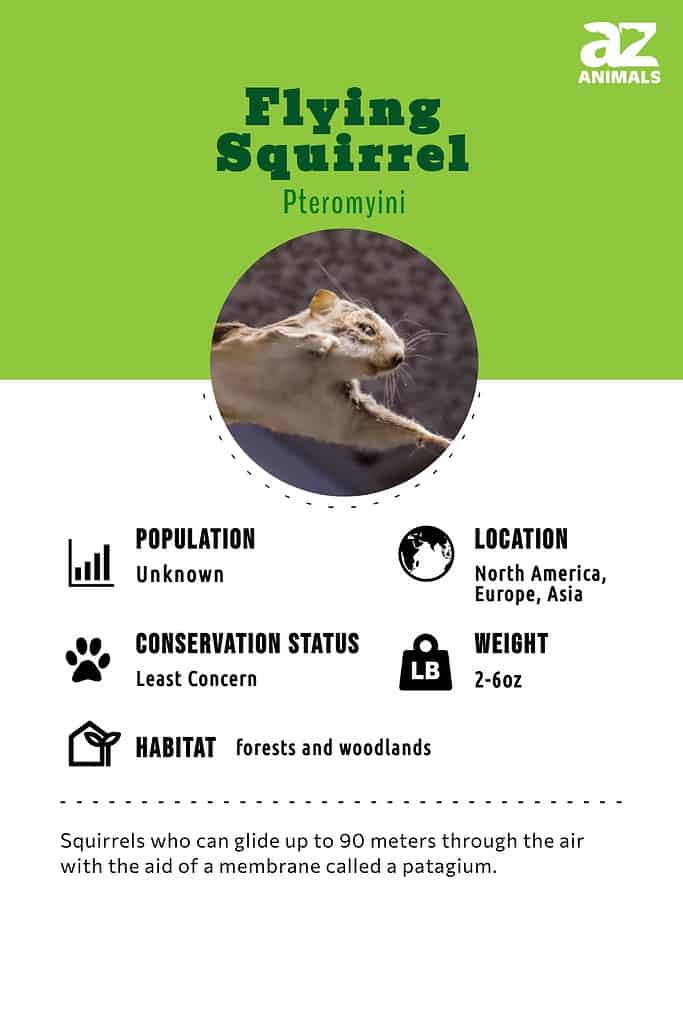
Despite its name, a flying squirrel doesn’t fly the same way a bird or a bat flies. Instead, flying squirrels are animals that glide or drift, through the air. These omnivores eat insects, mushrooms, flowers, and, of course, nuts. Flying squirrels are nocturnal animals and search for food at night. They can change direction by 180 degrees when gliding through the air.

5 Incredible Flying Squirrel Facts!

• These squirrels can gather and store up to 15,000 nuts in one season.

• The 50+ types of flying squirrels are in a group known to scientists as Pteromyini.

• The extremely large eyes of these small rodents allow light to pour in so they can see at night.

• These squirrels live in Europe, Asia, North America, Mexico, and Central America.

• The official conservation status of these squirrels is Least Concern.

Scientific Name
Largest squirrels - Flying squirrel

Flying squirrels share the suffix Ptero in their scientific name with the popular dinosaur Pterodactyl.

The scientific name for a flying squirrel is Pteromyini. ‘Ptero’ is a Greek word meaning wing and ‘myini’ means small. It belongs to the Sciuridae family and the Mammalia class.

The southern flying squirrel, the northern flying squirrel, Humboldt’s flying squirrel, and the Japanese dwarf flying squirrel are just four of the over 50 species of this animal in the pteromyini tribe.

Evolution
Are Bats Mammals

The oldest flying squirrel fossil ever found was 11.6 Million years old!

Biologists believe that flying squirrels first began to diverge from the family tree of regular squirrels and develop their signature aeronautics sometime 23-36 Million years ago. Their genes have remained vastly unchanged in the time since they first appeared on the evolutionary scene, as their special gliding membrane has proven to be an incredibly successful trait for escaping predators and securing prey with ease. Flying squirrels are also notable to biologists for being the most genetically diverse group of flying mammals alive today, with 50+ different species currently soaring through the forests of the Northern Hemisphere.

Appearance and Behavior
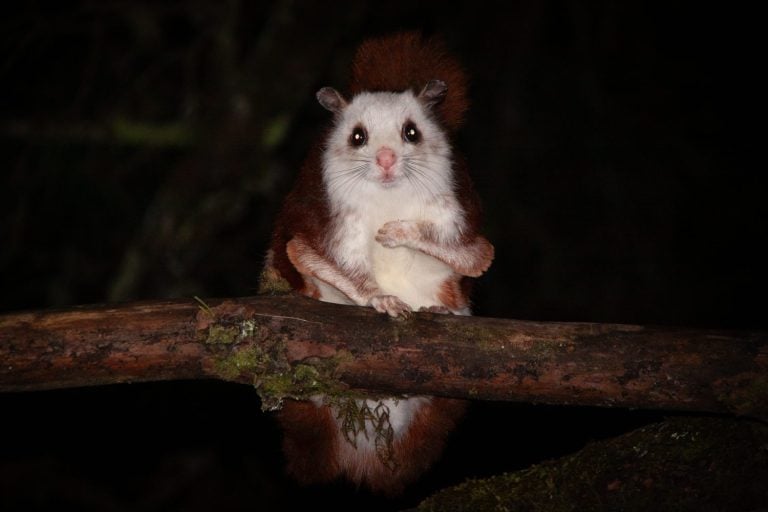
All flying squirrels have a membrane that acts like a parachute to help them glide.

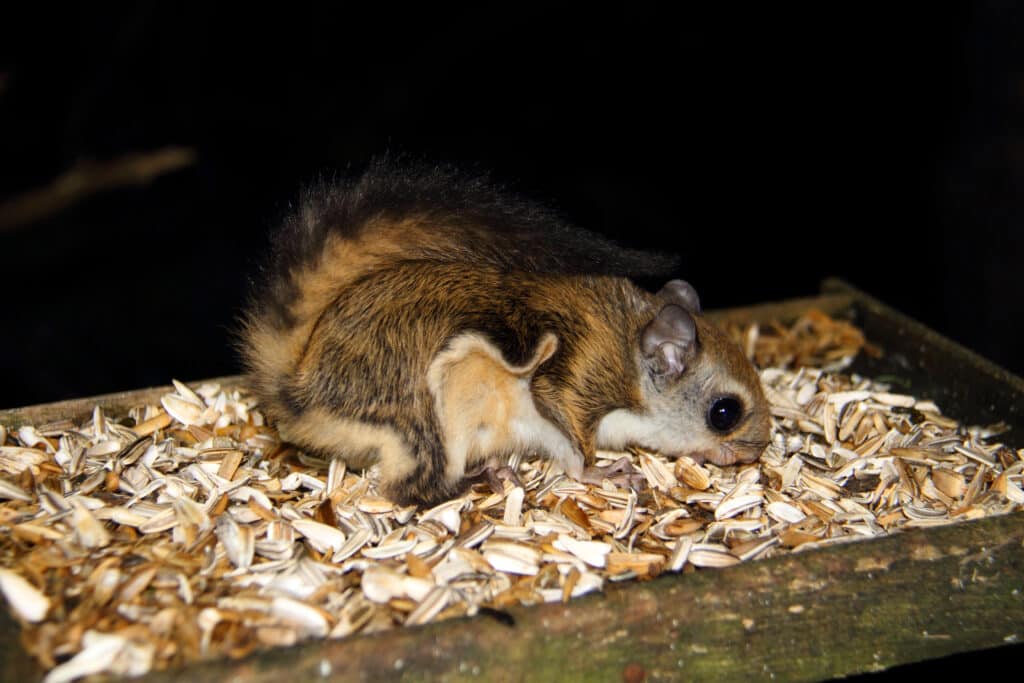
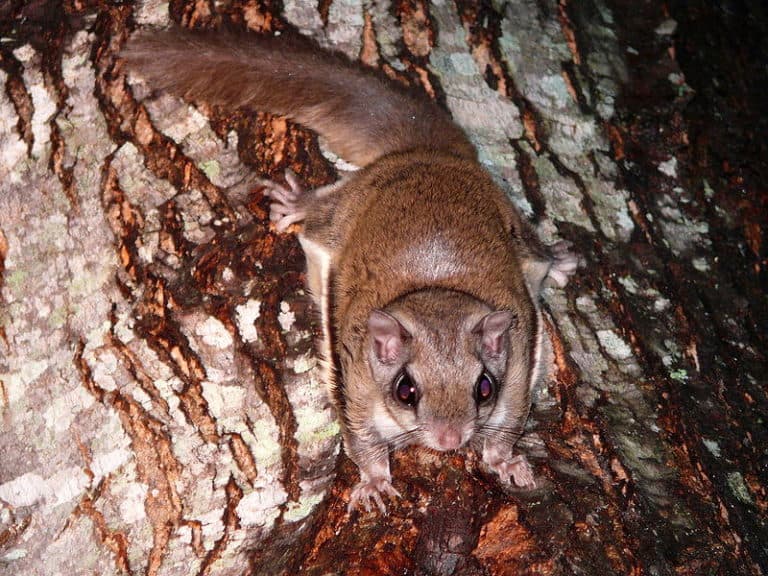
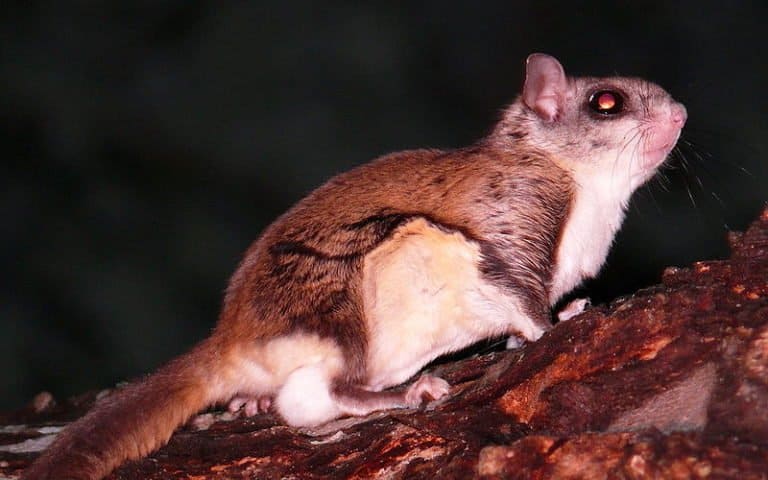
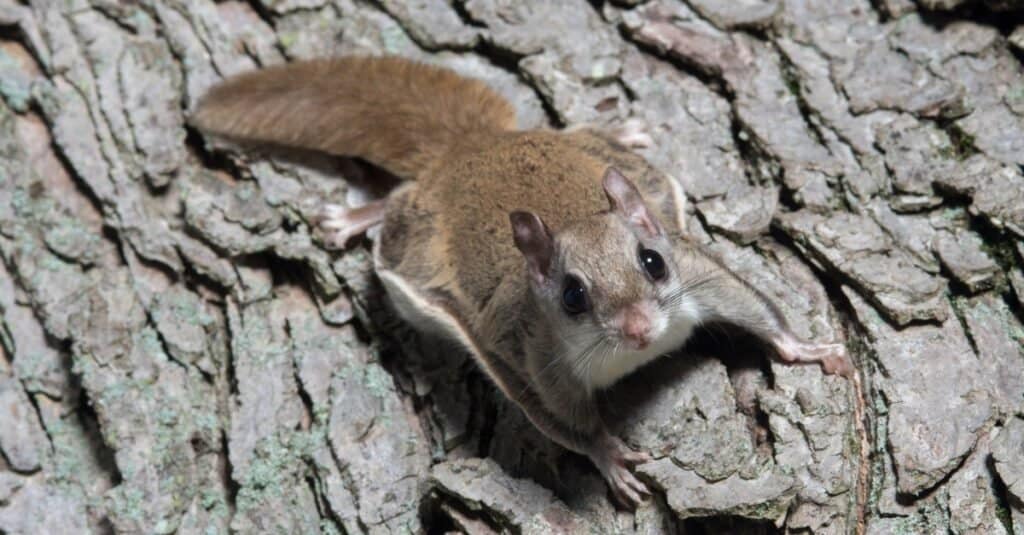
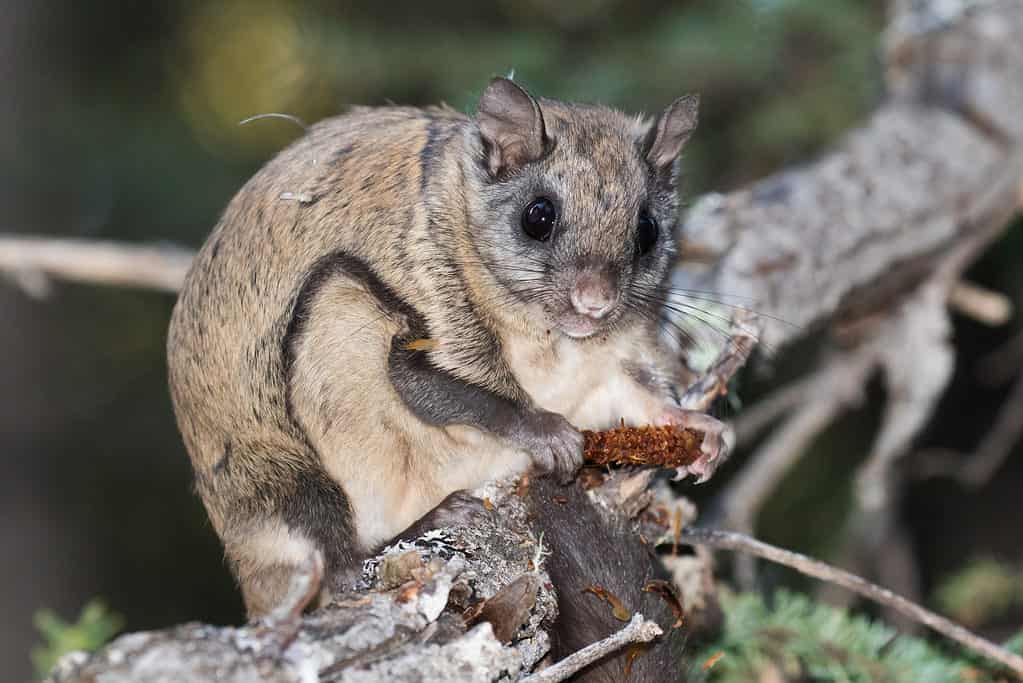
These squirrels have a light coat of brown fur on their back and white fur on their stomach. Some types of squirrels have small differences in fur color. For instance, the southern flying squirrel has all-white fur on its stomach while a northern flying squirrel has belly fur that’s white at the tip and darker near the skin. The most notable feature of all of these squirrels is a pair of large, dark eyes. Their eyes let a lot of light in which helps these animals to see their surroundings as they hunt at night.

These squirrels have a flat tail, four small feet, and long whiskers. Their whiskers help them to avoid running into objects while hunting at night. Like their cousin, the ground squirrel, they have sharp teeth they use to cut into black walnuts and other types of nuts.

Adult squirrels have a body measuring 9 to 14 inches long with a tail of about four inches. They weigh from two to eight ounces. For reference, a 14-inch-long squirrel is almost as long as a bowling pin. Furthermore, a squirrel that weighs eight ounces is as big as an adult hamster.

The largest species is the Red and White Giant flying squirrel. It has a 23-inch long body with a tail measuring about 24 inches. Also, this squirrel weighs around 10 pounds. Alternatively, the Japanese dwarf flying squirrel is one of the smallest types of these squirrels. It grows to be just seven inches long including its tail and weighs around five ounces.

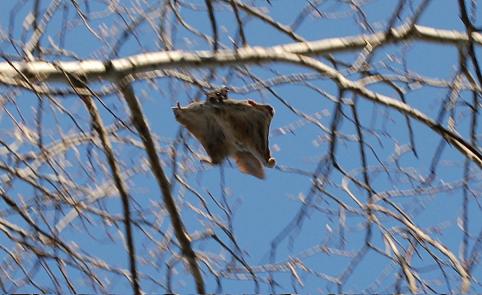
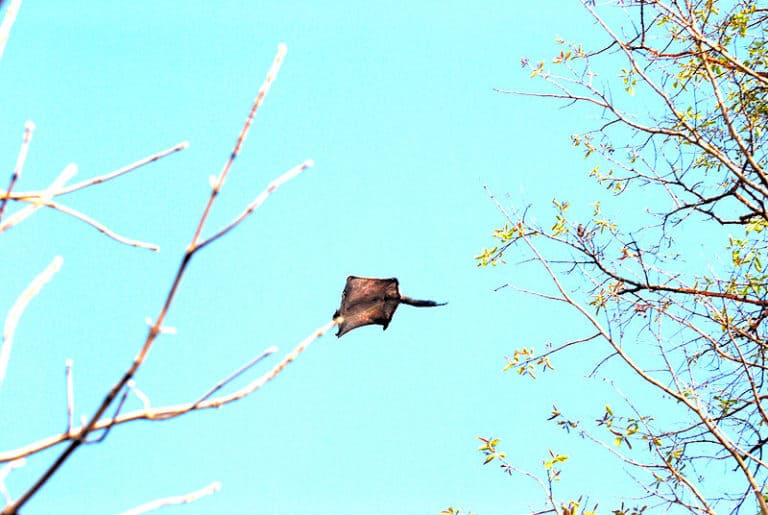
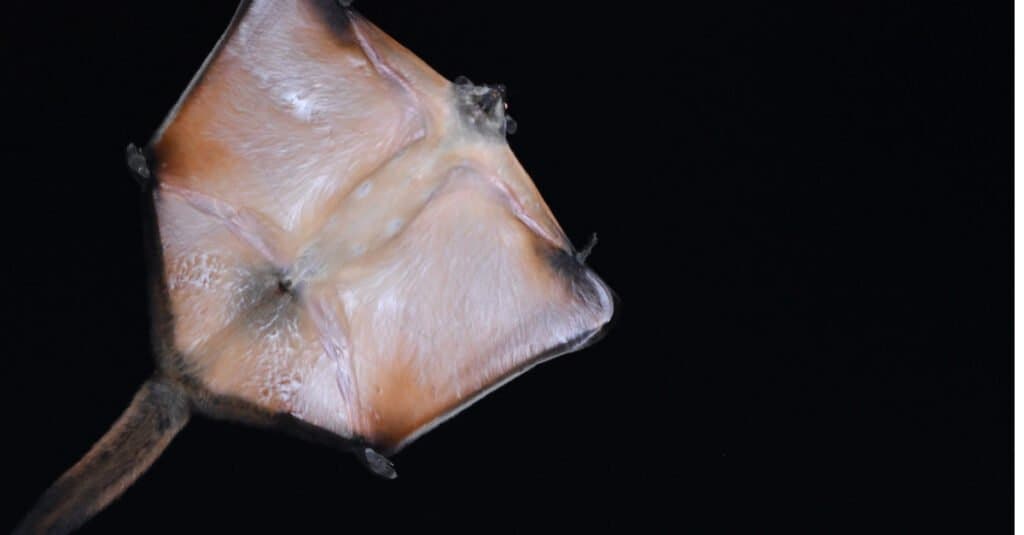
These squirrels have a membrane or fold of skin called a patagium. This membrane spreads out on both sides of the squirrel’s body allowing it to glide between tree branches. If you look up at a flying squirrel moving from tree to tree, the membrane takes the shape of a square.

Though these squirrels can glide a distance of 300 feet, the average gliding distance is 65 feet. To get a better mental picture, when a flying squirrel glides 300 feet, it is traveling about as far as the Statue of Liberty is tall (not including the base it is on)! A squirrel that glides 65 feet is traveling a distance equal to the length of three adult giraffes.

These squirrels spend most of their time in trees as a way to stay safe from predators. When they do walk on the ground level, they are clumsy and will hide from a predator as opposed to trying to run away.

Adult and young squirrels live in nests with about eight other squirrels. These small squirrels are not aggressive and are rarely seen mostly because they are active late at night.
flying squirrel (Pteromyini) flying squirrel gliding through the trees
Flying squirrels can travel incredibly far by gliding.

Habitat

Flying squirrels are found in North America, Asia, and Europe.

These squirrels live in Europe, Asia, North America, Mexico, and Central America. They live in deciduous and coniferous forests high up in the trees. A group of these squirrels may live in a nest that’s been left behind by a large bird or in a woodpecker’s hole in a tree. These squirrels stay in trees most of the time because they are more vulnerable to predators when they go to ground level.

These squirrels communicate with one another by letting out high-pitched chirping sounds as they glide through the trees. These chirps can be used to warn other flying squirrels of danger or to recognize members of a group. This is a quality they share with ground squirrels, which have a complicated system of chirps and barks they use to communicate with one another.

Northern, Southern, and all other species of flying squirrels like to stay warm! So, if the weather gets really cold in the wintertime, they survive by huddling with other squirrels inside a tree or in a nest to keep warm. Just imagine eight little Japanese dwarf flying squirrels huddled in a tree together!

Diet
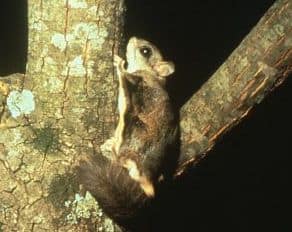
Flying Squirrel in a tree

Flying Squirrels are omnivorous.

What do these squirrels eat? These animals are omnivores and eat insects, flowers, bird eggs, nuts, fungi, and fruit. They have a varied diet and will eat whatever food source is most plentiful within their habitat.

A flying squirrel eats about 10 grams of food per day. This amount of food weighs a little less than a AAA battery you may put in an alarm clock.

For a full analysis of what flying squirrels eat, make sure to read our guide ‘What Do Flying Squirrels Eat? 13 Foods for this Cute Rodent.’

Predators and Threats
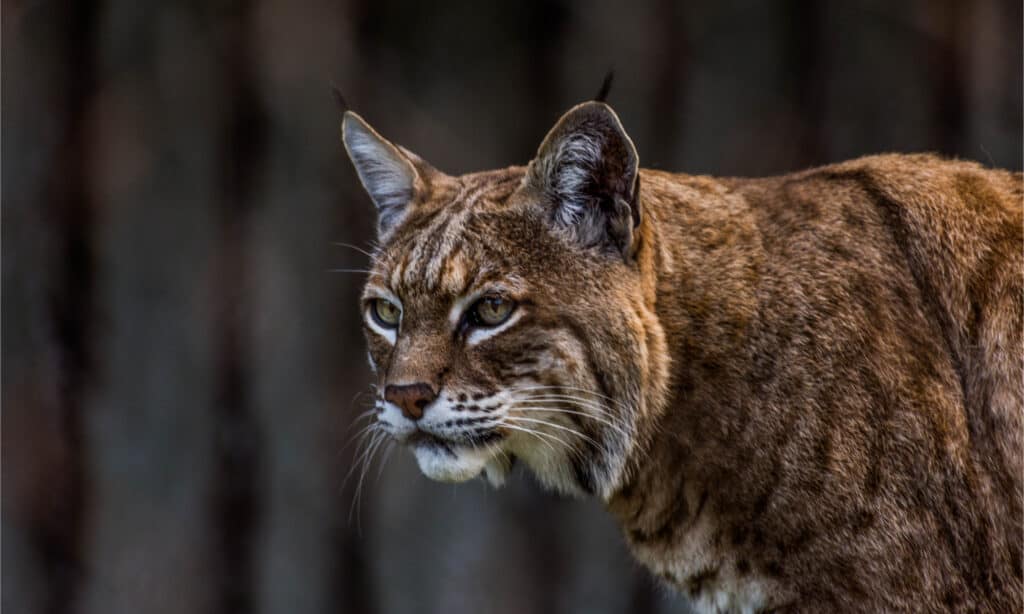
Head shot of a bobcat

Bobcats have been known to eat flying squirrels when they’re able to catch them.

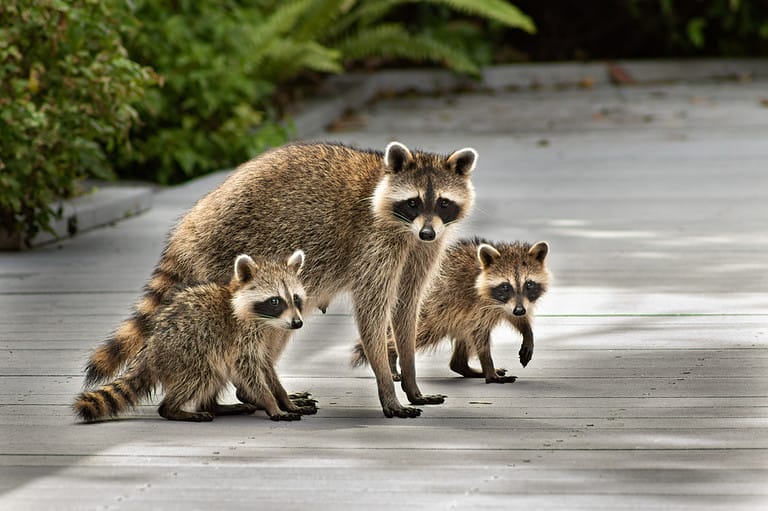
It probably won’t surprise you to know that these squirrels have many predators. Some of them include snakes, owls, hawks, weasels, raccoons, bobcats, and sometimes even domesticated cats.

Most of this animal’s predators live in or can climb into trees. This makes flying squirrels vulnerable to them. Plus, many of these animals are nocturnal so they are active at the same time. When looking for food, a raccoon may climb a tree to access a nest of these squirrels. Or, an owl may swoop down to capture a flying squirrel that has just taken off to glide toward another tree branch.

Humans are another threat to these squirrels because these animals are sometimes captured to sell as pets. Flying squirrels also face loss of their habitat whenever parts of a forest are cleared, and trees cut down.

These animals have a conservation status of the least concern. Though their habitat is threatened, there are some things people do to help flying squirrels. For example, when the Cherohala highway was built in North Carolina, it was discovered that the highway was too wide for the northern flying squirrels to glide over. So, pieces of PVC pipe were attached to the top of poles on both sides of this highway. A squirrel gliding over this highway is able to safely grab onto the PVC pipe when they reach the other side. They sometimes even disappear inside the PVC pipe for protection against predators in the area!

Reproduction, Babies, and Lifespan
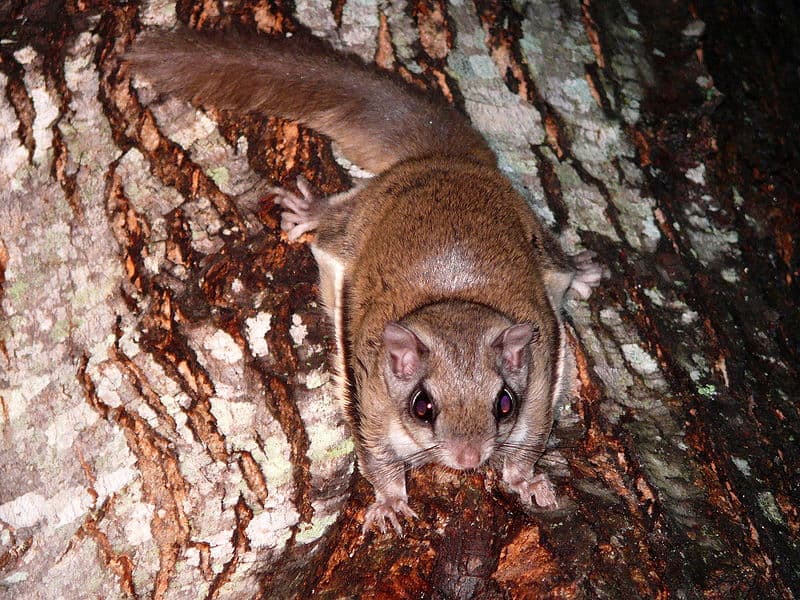
Flying Squirrel vs sugar glider

Flying squirrels are extremely vulnerable after they are first born and must be protected by their mother.

During mating season, male squirrels chase females through the trees in a playful way. These squirrels breed twice a year. Breeding season happens from January through April and again from June through August. A male and female stay together for that breeding season and may not meet again. The gestation period, or pregnancy, lasts for 40 days.

A female squirrel gives live birth and can have up to six babies in a litter. However, most females only have two to three babies in one litter. A baby squirrel is about 2 ½ inches long from its nose to the tip of its tail. This is about as long as an adult human’s thumb.

Baby squirrels are called kits and are nursed by their mother in the nest for the first 65 days of life. They are born without fur and their eyes and ears are closed. This makes them very vulnerable to larger animals who might find the nest. So, the mother stays with them except when she’s out hunting food for herself. When they’re about three or four days old, the kits’ ears open. At 25 days old, their eyes open. The kits stay with their mother in the nest until they are four months old. At that time, they are able to find their own food and can survive on their own.

In the wild, these squirrels live to be five or six years old. In a zoo or wildlife park, this squirrel can live to be 10 years old. These animals will live longer in a zoo or wildlife park because they are protected from other animals, fed nourishing foods on a regular basis, and kept healthy by caregivers.

In 2018, the oldest fossil of a flying squirrel was discovered in Catalonia Spain by paleontologists. The fossil is believed to be 11.63 million years old!

Population
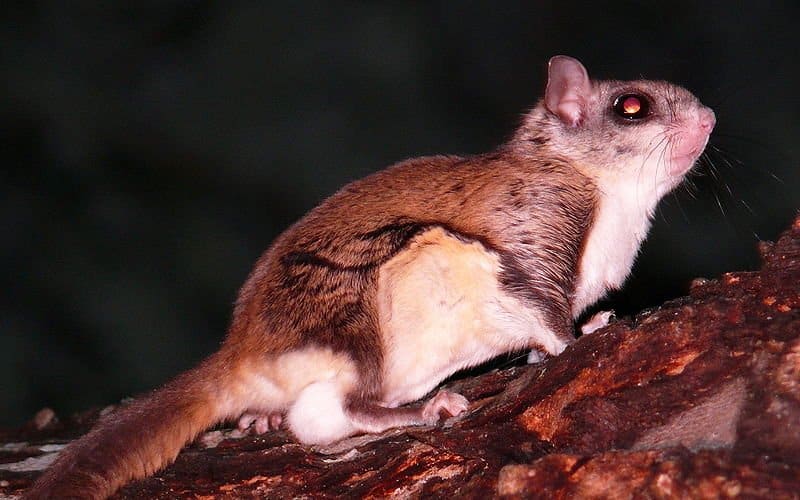
Flying Squirrel on the ground

Flying squirrel population sizes are largely unknown, though they are believed to be mostly stable.

When it comes to population, some types of flying squirrels are categorized as decreasing, stable or their population trends are unknown. For instance, the Sipora flying squirrel in Indonesia is decreasing while the population of the Indochinese flying squirrel in China is stable.

Sometimes scientists have challenges gathering the data they need to determine the population of a particular species of the flying squirrel because some types of flying squirrels live in forests and wooded areas that are hard for humans to get to. Also, a group of flying squirrels may remain hidden making it difficult for scientists to get an accurate count. One example is the Red-cheeked flying squirrel. There’s not enough data to determine its population.

Types of Flying Squirrels
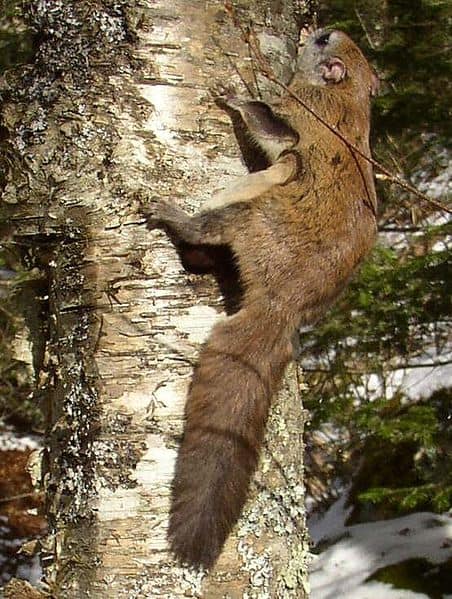
Flying Squirrel in a tree

There are more than 50 different species of flying squirrels.

Kashmir Flying SquirrelEoglaucomys fimbriatus
Afghan Flying SquirrelEoglaucomys fimbriatus baberi
Southern Flying SquirrelGlaucomys volans
Northern Flying SquirrelGlaucomys sabrinus
Humboldt’s Flying SquirrelGlaucomys oregonensis
Particolored Flying SquirrelHylopetes alboniger
Bartel’s Flying SquirrelHylopetes bartelsi
Arrow Flying SquirrelHylopetes sagitta
Palawan Flying SquirrelHylopetes nigripes
Indochinese Flying SquirrelHylopetes phayrei
Jentink’s Flying SquirrelHylopetes platyurus
Sipora Flying SquirrelHylopetes sipora
Red-cheeked Flying SquirrelHylopetes spadiceus
Sumatran Flying SquirrelHylopetes winstoni
Javanese Flying SquirrelIomys horsfieldii
Mentawi Flying SquirrelIomys sipora
Lesser Pygmy Flying SquirrelPetaurillus emiliae
Hose’s Pygmy Flying SquirrelPetaurillus hosei
Selangor Pygmy Flying SquirrelPetaurillus kinlochii
Basilan Flying SquirrelPetinomys crinitus
Travancore Flying SquirrelPetinomys fuscocapillus
Whiskered Flying SquirrelPetinomys genibarbis
Hagen’s Flying SquirrelPetinomys hageni
Siberut Flying SquirrelPetinomys lugens
Mindanao Flying SquirrelPetinomys mindanensis
Temminck’s Flying SquirrelPetinomys setosus
Vordermann’s Flying SquirrelPetinomys vordermanni
Himalayan Large-eared Flying SquirrelPriapomys leonardi
Groove-toothed Flying SquirrelAeretes melanopterus
Black Flying SquirrelAeromys tephromelas
Thomas’s Flying SquirrelAeromys thomasi
Hairy-footed Flying SquirrelBelomys pearsonii
Namdapha Flying SquirrelBiswamoyopterus biswasi
Laotian Giant Flying SquirrelBiswamoyopterus laoensis
Mount Gaoligong Flying SquirrelBiswamoyopterus gaoligongensis
Western Woolly Flying SquirrelEupetaurus cinereus
Yunnan Woolly Flying SquirrelEupetaurus nivamons
Tibetan Woolly Flying SquirrelEupetaurus tibetensis
Red and White Giant Flying Squirrel Petaurista alborufus
Spotted Giant Flying SquirrelPetaurista elegans
Hodgson’s Giant Flying SquirrelPetaurista magnificus
Bhutan Giant Flying SquirrelPetaurista nobilis
Indian Giant Flying SquirrelPetaurista philippensis
Chinese Giant Flying SquirrelPetaurista xanthotis
Japanese Giant Flying SquirrelPetaurista leucogenys
Red Giant Flying SquirrelPetaurista petaurista
Mechuka Giant Flying SquirrelPetaurista mechukaensis
Mishmi Giant Flying SquirrelPetaurista mishmiensis
Mebo Giant Flying SquirrelPetaurista siangensis
Siberian Flying SquirrelPteromys volans
Japanese Dwarf Flying SquirrelPteromys momonga
Smoky Flying SquirrelPteromyscus pulverulentus
Complex-toothed Flying SquirrelTrogopterus xanthipes
View all 170 animals that start with F
How to say Flying Squirrel in ...
Catalan
Esquirol volador
German
Gleithörnchen
English
Flying squirrel
Esperanto
Flugsciuro
Spanish
Pteromyini
French
Pteromyinae
Hungarian
Repülő mókusok
Japanese
モモンガ
Dutch
Vliegende eekhoorns
Polish
Polatuchy
Portuguese
Esquilo-voador
Swedish
Flygekorrar
Chinese
鼯鼠

Sources

  1. David Burnie, Dorling Kindersley (2011) Animal, The Definitive Visual Guide To The World's Wildlife / Accessed October 22, 2009
  2. Tom Jackson, Lorenz Books (2007) The World Encyclopedia Of Animals / Accessed October 22, 2009
  3. David Burnie, Kingfisher (2011) The Kingfisher Animal Encyclopedia / Accessed October 22, 2009
  4. Richard Mackay, University of California Press (2009) The Atlas Of Endangered Species / Accessed October 22, 2009
  5. David Burnie, Dorling Kindersley (2008) Illustrated Encyclopedia Of Animals / Accessed October 22, 2009
  6. Dorling Kindersley (2006) Dorling Kindersley Encyclopedia Of Animals / Accessed October 22, 2009
  7. David W. Macdonald, Oxford University Press (2010) The Encyclopedia Of Mammals / Accessed October 22, 2009
Corinna Cybele

About the Author

Corinna Cybele

My name is Corinna! In my profile photo you can see me with one of my two cats, Bisky! The other's name is Yma and she's a beautiful black Bombay kitty. I'm 24 years old and I live in Birmingham, AL with my partner Anastasia and like to spend my free time making music, collecting records and reading. Some other animals I've owned were a hamster, 2 chihuahuas and many different kinds of fish.

Thank you for reading! Have some feedback for us?


Flying Squirrel FAQs (Frequently Asked Questions)

Flying squirrels are omnivores with a varied diet of nuts, fruit, insects, and birds eggs.