
G
Species Profile

Gar

Lepisosteidae

Armored ambushers of the backwaters
Morrissey Design Studio/Shutterstock.com

Gar Distribution

Click a location to explore more animals from that region

This map shows coastal regions where Gar are found.

Loading map...
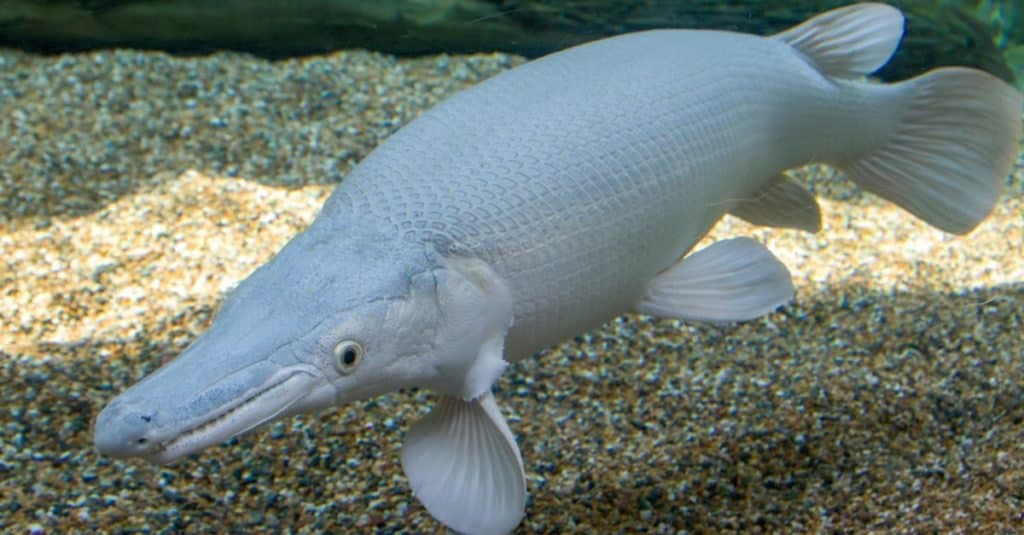
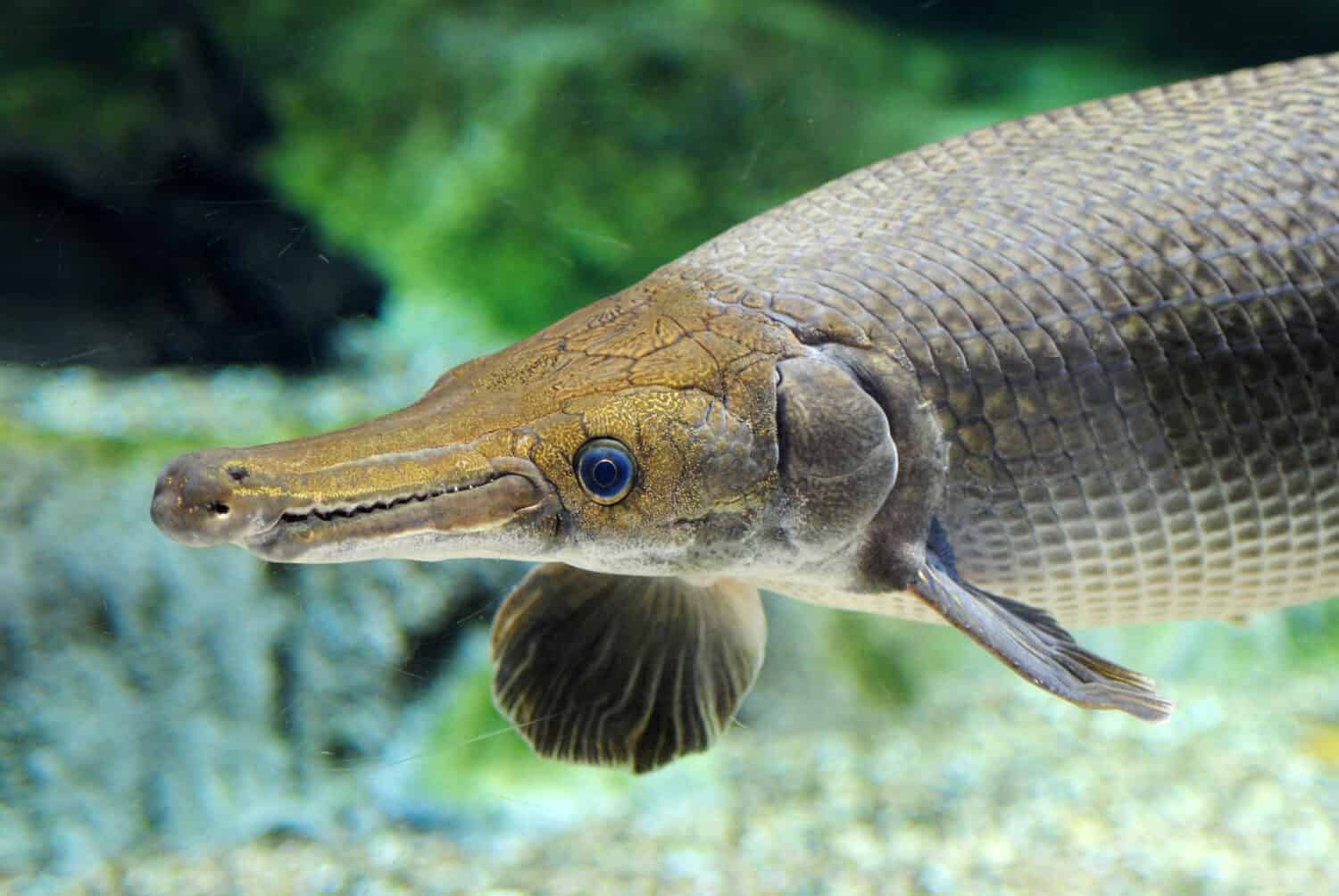
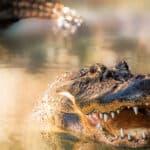
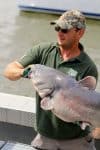
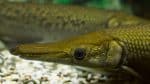
Huge Alligator Gar Close Up

At a Glance

Family Overview This page covers the Gar family as a group. Stats below are general traits shared across the family.
Also Known As Garfish, Garpike, Choupique, Chupique, Freshwater barracuda
Diet Piscivore
Activity Cathemeral+
Lifespan 30 years
Weight 137 lbs
Status Not Evaluated
Did You Know?

Gars wear "ganoid" armor: hard, enamel-like scales so tough they were historically used as tool material.

Scientific Classification

Family Overview "Gar" is not a single species but represents an entire family containing multiple species.

Gars are ancient-looking, predatory ray-finned fishes characterized by elongated bodies, ganoid (hard, enamel-like) scales, and long jaws with sharp teeth. They are primarily freshwater (some tolerate brackish water) and are ambush predators of fish and other aquatic animals.

Kingdom
Animalia
Phylum
Chordata
Class
Actinopterygii
Order
Lepisosteiformes
Family
Lepisosteidae

Distinguishing Features

  • Elongated, torpedo-shaped body with dorsal/anal fins set far back
  • Hard, rhomboid ganoid scales forming armor-like covering
  • Long snout (variable by species) with numerous sharp teeth
  • Ability to gulp air using a vascularized swim bladder (facultative air-breathing)
  • Typically ambush predators in vegetated or slow waters

Physical Measurements

Males and females differ in size

Length
♂ 3 ft 11 in (1 ft 12 in – 8 ft 6 in)
♀ 3 ft 11 in (1 ft 12 in – 9 ft 10 in)
Weight
♂ 13 lbs (1 lbs – 176 lbs)
♀ 26 lbs (1 lbs – 309 lbs)
Top Speed
9 mph
Short bursts 10–20 km/h
Poisonous

Appearance

Primary Colors
Secondary Colors
Skin Type Thick, armor-like ganoid scales (hard, enamel-like) forming rhomboid plates; skin feels rigid/abrasive compared to typical teleost fishes. Robust bony head with long rostrum and many sharp teeth.
Distinctive Features
  • Adult size range across the family is broad: roughly ~0.6-3.0 m total length (smallest Lepisosteus spp. to largest Atractosteus), with mass from under ~1 kg in small adults to 100+ kg in the largest individuals.
  • Body form: elongated, cylindrical to slightly flattened; dorsal and anal fins set far back near the tail for burst acceleration in ambush strikes.
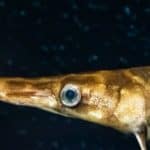
  • Head/jaws: long jaws with numerous sharp conical teeth; snout shape varies across the family from very elongate and narrow to shorter/broader, reflecting prey and ecology differences among genera/species.
  • Scales: interlocking ganoid scales provide heavy armor; coloration/pattern often appears as dark spots/blotches over olive-brown backgrounds.
  • Tail: typically heterocercal (upper lobe longer), contributing to sudden propulsion.
  • Air-breathing adaptation: a vascularized swim bladder functions like a lung; most gars regularly gulp air, allowing survival in warm, low-oxygen waters (frequency and reliance vary with conditions and species).
  • Habitat/ecology (family-level): primarily freshwater (rivers, bayous, floodplains, lakes, swamps), with some species/populations regularly using brackish estuaries; distribution centered in North and Central America (notably U.S., Mexico, parts of Central America, and Cuba).
  • Feeding/behavior: generally ambush predators of fish and other aquatic animals (e.g., crustaceans, amphibians); juveniles more often take invertebrates and small fish; activity and diet composition vary with size, season, and habitat.
  • Reproduction/life history generalizations: spring-summer spawning is common; eggs are often adhesive and can be toxic if ingested; early life stages may use vegetation for cover.
  • Gars live different lengths. Small and medium species usually live about 10–30 years. Large gars can live many decades, sometimes 50–90+ years, depending on species, sex, environment, and fishing pressure.

Sexual Dimorphism

Sexual dimorphism exists but is usually subtle and variable by species and age. Differences are most apparent during breeding season and in overall body size/shape.

♂
  • Often smaller and more slender-bodied than females in many populations/species.
  • In some species, males may show relatively longer or more pointed anal fin morphology and/or fin-ray modifications associated with reproduction (degree varies among species).
  • May mature at smaller sizes/younger ages than females in some taxa.
♀
  • Often larger-bodied and deeper/rounder in the abdomen, especially when gravid.
  • May reach greater maximum size and older ages in several species, contributing to broader size distributions among adults.
  • Gravid females can appear noticeably more robust during spawning season.

Did You Know?

Gars wear "ganoid" armor: hard, enamel-like scales so tough they were historically used as tool material.

They can gulp air-an adapted swim bladder works like a lung-letting them survive in warm, low-oxygen waters where many fish struggle.

The family includes both slender "needle-jawed" species (Lepisosteus) and heavier, broad-snouted giants (Atractosteus).

Gar eggs are notably toxic to many predators (including humans), a rare defense among fishes.

Some gars tolerate brackish estuaries and coastal marshes, moving between river mouths and freshwater backwaters.

Their lineage is ancient among ray-finned fishes, preserving many "primitive-looking" traits alongside modern ones.

Despite fearsome teeth, gars are usually not dangerous to people; they primarily hunt fish and aquatic animals.

Unique Adaptations

  • Ganoid scales (ganoin-coated): interlocking, armor-like plates that provide exceptional protection compared with typical fish scales.
  • Air-breathing via a vascularized swim bladder: allows persistence in low-oxygen waters and supports survival during heat and drought conditions.
  • Elongated rostrum with sharp, backward-pointing teeth: specialized for gripping slippery prey; snout shape varies notably among species.
  • Buccal pumping and surface respiration behaviors: help exploit habitats with fluctuating oxygen that exclude many competitors.
  • Long-lived, slow-to-mature life history in several species: supports survival in variable floodplain systems but can increase vulnerability to overharvest.
  • Camouflage and stealth: mottled patterns and stillness among reeds/roots/woody debris reduce detection by prey and predators.

Interesting Behaviors

  • Surface "air-gulping": individuals often rise to sip air, especially in hot, stagnant, or hypoxic water-frequency varies by habitat and oxygen levels.
  • Sit-and-wait hunting: many remain nearly motionless among vegetation or woody cover, then lunge with rapid sideways snaps of the jaws.
  • Basking and hovering near the surface: common in calm waters; can look like floating logs, especially in larger species.
  • Seasonal spawning runs: adults move into shallow, vegetated areas (often spring-early summer, varying by latitude) where eggs adhere to plants.
  • Opportunistic diet shifts: while fish are common prey across the family, some populations take crustaceans, insects, amphibians, and small reptiles when available.
  • Estuary use (variable): some species and populations regularly use brackish marshes and river deltas; others are mostly inland river/lake residents.

Cultural Significance

In parts of the U.S., Mexico, and Central America, gars (Lepisosteidae) were used as food (eggs can be toxic) and for sport. Hard scales made tools and art. New interest in protecting native fish and fishing shows they are top predators.

Myths & Legends

River-and-bayou "monster gar" tales: along the lower Mississippi and Gulf Coast, folk stories describe huge gars lurking like logs and seizing ducks or dragging lines-often told as cautionary waterside yarns.

Name lore of the "alligator gar": early settlers and anglers popularized comparisons to alligators for the fish's broad snout and armored look, feeding local legends that it was part-alligator or unusually savage.

In parts of the southeastern U.S., Indigenous and local craft traditions tell stories that gar (Lepisosteidae) scales are nearly unbreakable and were kept or worked into strong, protective pieces.

Across the Americas, local names for gars (Lepisosteidae) — like "needlefish," "armored fish," or "spotted gar" — come with village stories about specific rivers and seasonal floods, making gars familiar wetland characters.

Conservation Status

NE Not Evaluated

Has not yet been evaluated against the criteria.

Population Unknown

Protected Under

  • No single family-wide international legal protection applies; conservation is primarily species- and jurisdiction-specific.
  • Many populations occur within protected wetlands, river refuges, or managed water bodies; effectiveness varies with hydrologic management and enforcement.
  • Several jurisdictions regulate harvest via size/bag limits, seasonal closures, or protective status for large-bodied gars (especially where past declines occurred).
  • At-risk endemics (e.g., Cuban gar) may receive additional national protections and benefit from habitat-focused management where implemented.

You might be looking for:

Alligator gar

22%

Atractosteus spatula

Largest living gar; broad snout; found in large rivers, bayous, and estuaries of the southern/central U.S. and into Mexico.

View Profile

Longnose gar

18%

Lepisosteus osseus

Very long narrow snout; widespread in eastern North America in lakes and rivers.

View Profile

Spotted gar

14%

Lepisosteus oculatus

Distinct dark spots on head/body/fins; common in vegetated slow waters of central/eastern North America.

View Profile

Shortnose gar

12%

Lepisosteus platostomus

Shorter, broader snout than longnose; Mississippi River basin and Gulf coastal drainages.

Florida gar

10%

Lepisosteus platyrhincus

Primarily Florida and parts of Georgia; narrow snout but shorter than longnose; freshwater habitats.

View Profile

Tropical gar

8%

Atractosteus tropicus

Central America; large gar of rivers and lakes; important in regional fisheries.

Cuban gar

6%

Atractosteus tristoechus

Endemic to Cuba; large-bodied gar of wetlands and rivers; conservation concern.

Life Cycle

Birth 20000 frys
Lifespan 30 years

Lifespan

In the Wild
10–100 years
In Captivity
10–80 years

Reproduction

Mating System Polygynandry
Social Structure Aggregation Group
Breeding Pattern Seasonal
Fertilization Substrate Spawning
Birth Type Substrate_spawning

Behavior & Ecology

Social Shoal Group: 4
Activity Cathemeral, Crepuscular, Diurnal, Nocturnal
Diet Piscivore small, abundant forage fish (e.g., shad, minnows/shiners) taken in ambush strikes
Seasonal Migratory 31 mi

Temperament

Predatory, primarily ambush-oriented; typically relies on stealth and short bursts rather than prolonged pursuit (strength of ambush behavior varies with habitat clarity, vegetation, and prey type).
Generally wary and not socially aggressive toward conspecifics outside of spawning or competition at concentrated resources; interactions are usually avoidant rather than confrontational.
Tolerance for low-oxygen/warm, stagnant conditions is relatively high compared with many other fishes due to air-breathing capability; this can influence spacing and aggregation in stressful seasons.
Behavioral/ecological variation across the family: some species/populations are more riverine/open-water oriented while others are strongly associated with vegetated lakes, backwaters, and floodplains; brackish-water use occurs in some members.
Adult gars usually range from about 0.6 to 3.0 meters long. Body weight can be under 1 kilogram in small species and over 100 kilograms in the largest.
Lifespan (range across family, general): approximately ~10-60+ years depending on species, growth rate, latitude, and fishing pressure; larger-bodied species tend to be longer-lived.

Communication

No specialized vocal communication is well documented for gars; any sounds are typically incidental (surface gulping, splashing, or movement through vegetation), especially around spawning aggregations.
Chemical cues: likely important for reproductive timing and mate localization during seasonal spawning movements Common in many fishes; strength and specificity likely vary among species and systems
Tactile contact: close-body contact and bumping can occur during courtship/spawning when multiple males accompany females in shallow vegetation.
Visual signaling: posture/orientation, approach/avoidance, and following behavior at close range; effectiveness varies with water clarity and vegetation density.
Hydrodynamic/mechanical cues: detection of water movement and vibrations (lateral line) supports prey detection and close-range interactions in turbid or low-light conditions.

Habitat

Biomes:
Freshwater Wetland Marine Temperate Forest Temperate Grassland Tropical Rainforest Tropical Dry Forest Savanna +2
Terrain:
Riverine Coastal Plains Valley Island Muddy Sandy +1
Elevation: Up to 2296 ft 7 in

Ecological Role

Mesopredators to top predators in freshwater (and occasionally brackish) food webs; important regulators of small-fish communities and floodplain productivity pathways.

population control of abundant forage fish and some invasive/overabundant small fishes maintenance of prey community structure in vegetated littoral and backwater habitats energy transfer from productive shallow/floodplain areas to deeper channels via predation scavenging is not a primary strategy, but opportunistic consumption of injured/dying prey can contribute to nutrient cycling

Diet Details

Main Prey:
Small to medium-sized fish Juvenile and small-bodied fish Crustaceans Aquatic insects and other invertebrates Amphibians Small reptiles

Human Interaction

Domestication Status

Wild

Gars (family Lepisosteidae) are wild fishes with no true domestication history. People have used them for food, sport fishing, and sometimes killed them as pests; more recently some populations get protection and management. Gars vary widely in size and lifespan, live mostly in slow freshwater, and have toxic, adhesive eggs.

Danger Level

Low
  • Bites/lacerations if handled or provoked (sharp teeth; large individuals can cause serious puncture wounds)
  • Injury from thrashing during capture/landing (hooks, gill covers, teeth, and heavy body mass in larger members)
  • Egg toxicity if ingested (a poisoning risk; especially relevant where fish are harvested for food)
  • Indirect ecological risk: illegal release can contribute to invasive populations and management conflicts (not a direct injury risk but a significant human-wildlife issue)

As a Pet

Not Suitable as Pet

Legality: Laws for keeping gars (Lepisosteidae) vary by country and state. Many places allow them with permits—especially big species. Some ban owning, moving, or releasing them. Public aquariums often get permits; private owners often do not.

Care Level: Expert Only

Purchase Cost: $20 - $500
Lifetime Cost: $3,000 - $50,000

Economic Value

Uses:
Sport and recreational fishing Subsistence and regional commercial food use (limited/variable) Public aquaria and private aquarium trade (mostly juveniles; limited suitability) Cultural/heritage uses (scales, crafts, historical tools/ornamentation) Ecosystem management and conservation programs
Products:
  • rod-and-reel sport catch (trophy fisheries in some regions)
  • meat from some species/populations (prepared carefully; eggs are toxic and not eaten)
  • live fish sales (juveniles) for aquaria/ponds where legal
  • craft items from ganoid scales (jewelry, decorative inlays; historically used as durable points/implements)

Relationships

Related Species 7

Alligator gar
Alligator gar Atractosteus spatula Shared Family
Tropical gar Atractosteus tropicus Shared Family
Cuban gar Atractosteus tristoechus Shared Family
Longnose gar
Longnose gar Lepisosteus osseus Shared Family
Spotted gar
Spotted gar Lepisosteus oculatus Shared Family
Shortnose gar Lepisosteus platostomus Shared Family
Florida gar
Florida gar Lepisosteus platyrhincus Shared Family

Types of Gar

7

Explore 7 recognized types of gar

Alligator gar
Alligator gar Atractosteus spatula
Tropical gar Atractosteus tropicus
Cuban gar Atractosteus tristoechus
Longnose gar
Longnose gar Lepisosteus osseus
Spotted gar
Spotted gar Lepisosteus oculatus
Shortnose gar Lepisosteus platostomus
Florida gar
Florida gar Lepisosteus platyrhincus

Quick Take

  • Surviving as the sole Ginglymodi representatives for 240 million years requires a specific vertebral configuration.
  • Consumption of Cuban gar eggs creates severe toxicity risks for uninformed humans.
  • Paradoxically, aquatic predators require atmospheric oxygen to thrive in low-oxygen habitats.
  • Newborn larvae depend on an adhesive organ to initiate their post-hatching development stage.

Resembling a cross between a reptile and a fish, the gar is a family of long-nosed carnivorous animals that inhabit the freshwaters of North America. They make slow, languid movements through the water, but this merely hides how quickly they can strike at their prey.

Although numbers are dwindling in some areas, several gar species — such as the alligator gar — are considered threatened or endangered in certain states due to human activity, including overfishing and habitat loss. In Europe and Australia, gar refers to a different, unrelated family of needlefish, which sometimes causes confusion.

Educational infographic about gar fish, featuring illustrations of seven species, their geographic distribution across North America, and diagrams of their diamond-shaped scales and sharp teeth.
They survived the dinosaurs by breathing air and armoring themselves in bone-hard scales. But whatever you do, never eat the eggs. © A-Z Animals

3 Incredible Gar Facts

Most Expensive Fish: Platinum Alligator Gar

Throughout history, people have utilized the tough scales of the gar to create various items, including jewelry, lampshades, plows, arrows, and armor.

  • The gar arose some 157 million years ago in the late Jurassic Period. Based on fossil evidence, it originally evolved in Mexico and then radiated out to Europe and the rest of America when the two continents were still closely aligned. This ancient lineage is evident in the gar’s cartilage-based skeletal system and reptile-like vertebrae.
  • The hard scales of the gar have been used to make jewelry, lampshades, plows, arrows, and armor throughout history.
  • Because of its unusual body structure, the gar is a popular fish at several aquariums, including the Georgia Aquarium, the Tennessee Aquarium, and the National Aquarium in Baltimore.

Classification and Scientific Name
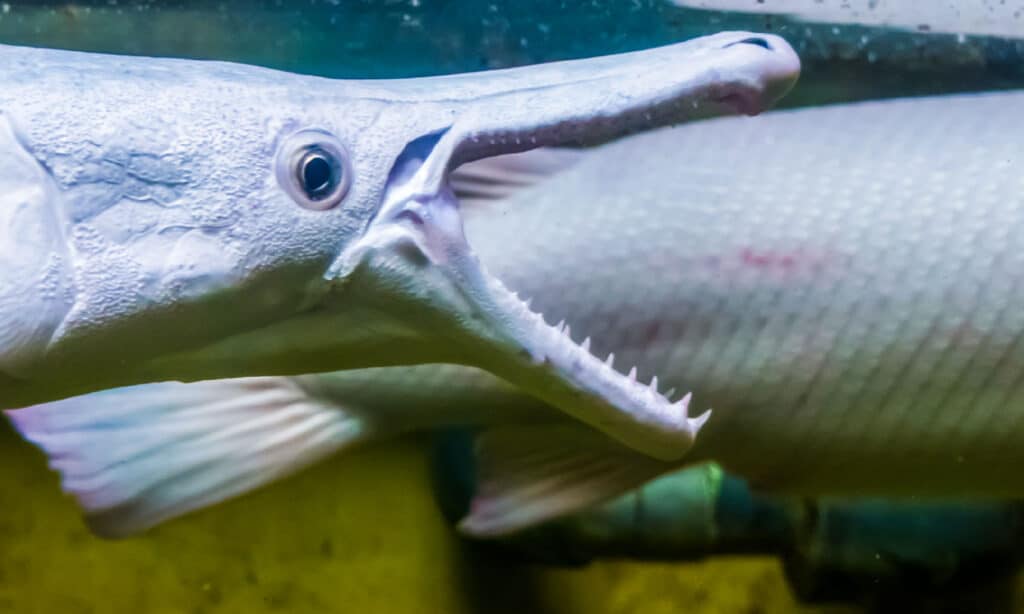
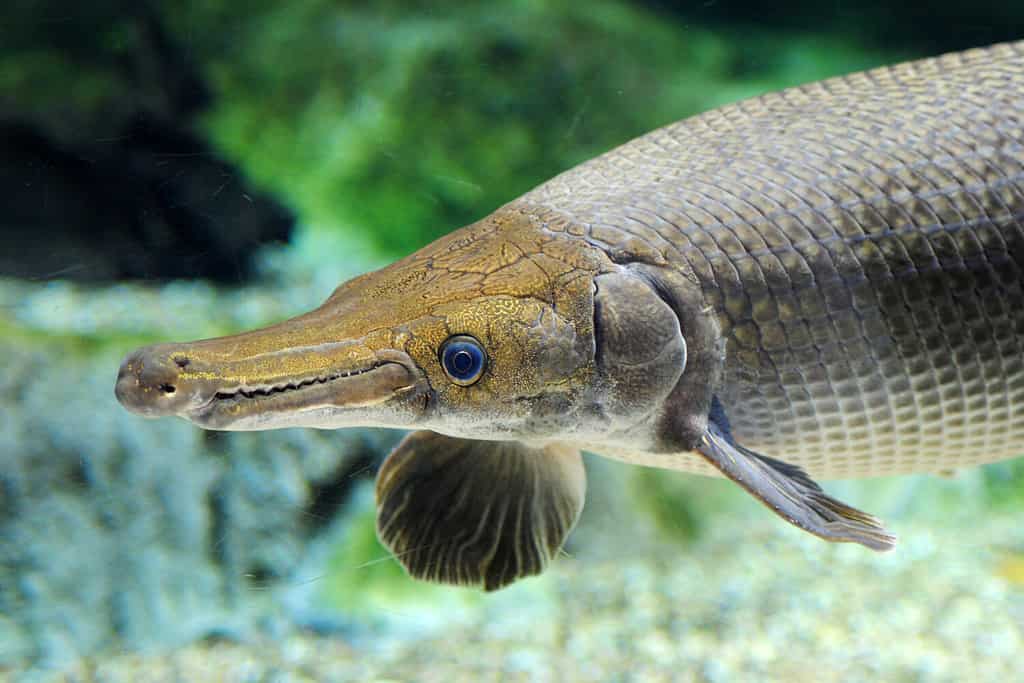
alligator gar

The term “gar” can refer to either the order of Lepisosteiformes or the family of Lepisosteidae within this order.

Gar, as a taxonomical term, can describe either the order of Lepisosteiformes or the specific family of Lepisosteidae within this order. Both terms derive from the Greek word lepis for scales. All types of gar belong to the class of ray-finned fish known as the Actinopterygii.

Evolution and Origins

Gars are recognized as the sole surviving representatives of the Ginglymodi, a category of bony fish that thrived during the Mesozoic period. The earliest known ginglymodians emerged in the Middle Triassic, which is more than 240 million years ago.

Fossils show that fish species such as the Alligator gar have been in existence for over 100 million years, dating back to the Early Cretaceous period.

Belonging to the Lepisosteidae family, gars are freshwater fish that are generally sizable. There are seven known species of gar, which include the alligator, Cuban, Florida, longnose, shortnose, spotted, and tropical varieties.

Gars are exclusively found in North America, Central America, and Cuba, ranging from southeastern Canada to Panama, but are not present in regions west of the Rocky Mountains.

The longnose gar (Lepisosteus osseus) has the most extensive distribution among the species. While primarily inhabiting freshwater environments, gars may occasionally explore saltwater or brackish water regions.

The 7 Different Species
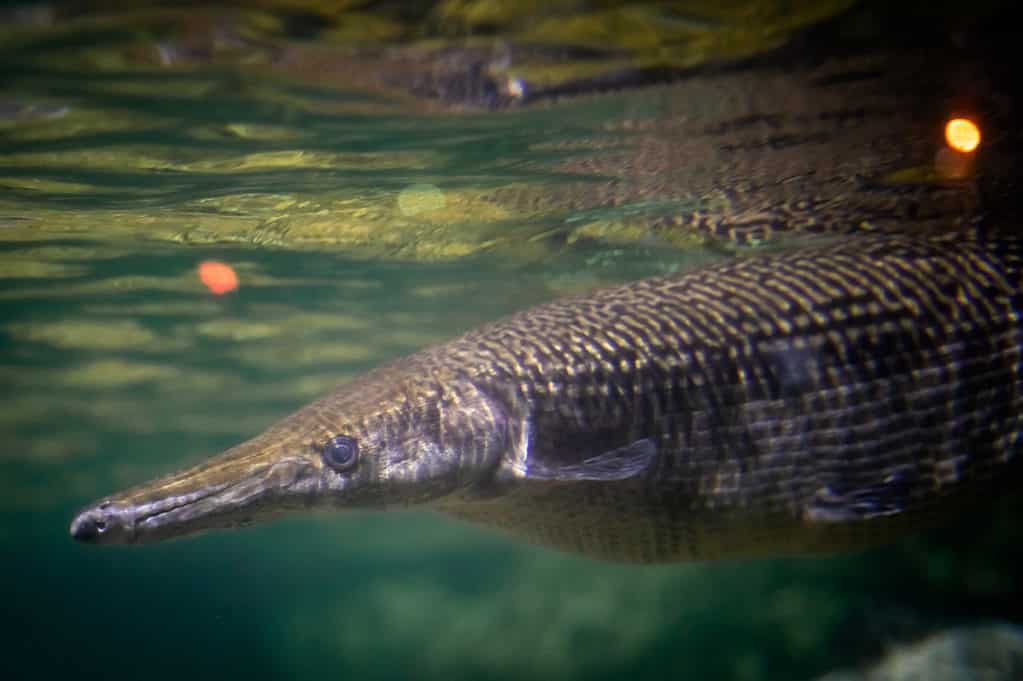
The Cuban gar (Atractosteus tristoechus) or manjuari

The Cuban gar or manjuari is found in the rivers and lakes of western Cuba. Cuban gar eggs are poisonous to humans.

There are seven living species of gar (five of them in Florida alone) and several more extinct species known from the fossil record. The first three species belong to the genus Atractosteus, whereas the final four belong to the genus Lepisosteus.

  • Alligator Gar (Atractosteus spatula): As the largest species of gar, this species is sometimes mistaken for the alligator. It inhabits the Southeast United States and Mexico.
  • Cuban Gar (Atractosteus tristoechus): This freshwater fish inhabits the rivers and lakes of western Cuba.
  • Tropical Gar (Atractosteus tropicus): As one of the few exclusively tropical gar, this species inhabits a range of territory between southern Mexico and Costa Rica, where it feeds primarily on cichlids and other tropical fish.
  • Florida Gar (Lepisosteus platyrhincus): Found exclusively in Florida and Georgia, this species prefers the muddy bottoms of rivers and lakes.
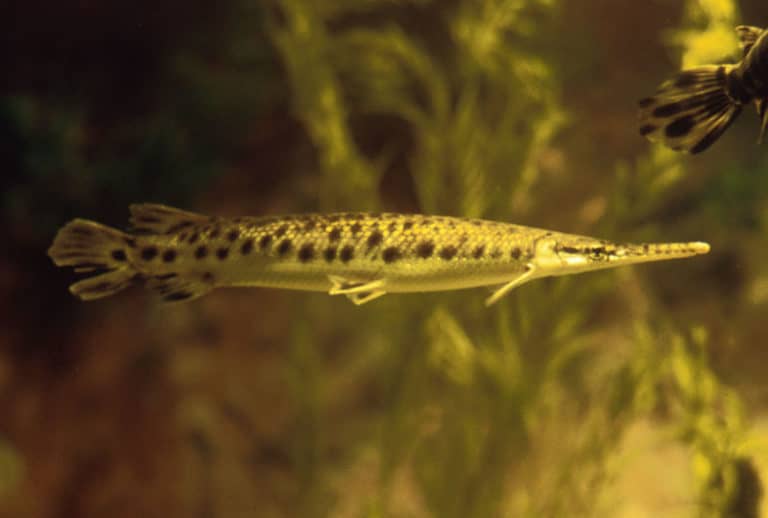
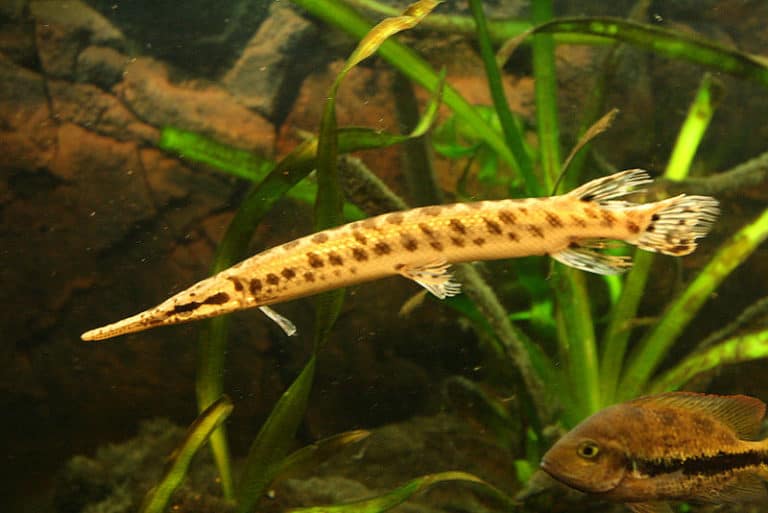
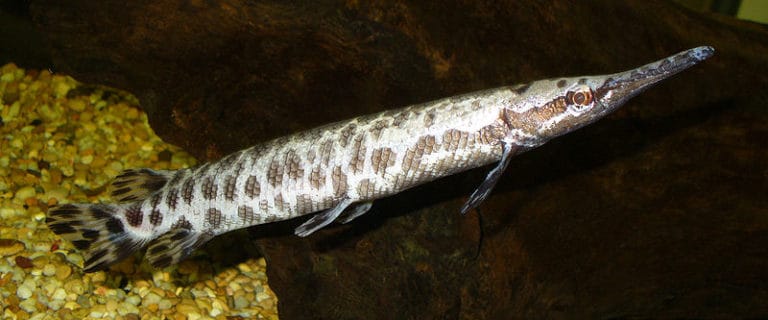
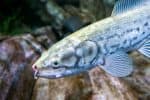
  • Spotted Gar (Lepisosteus oculatus): With its small, black spotted body, this fish inhabits the waters of Lake Michigan, Lake Erie, and the Mississippi River System down to the Gulf of Mexico.
  • Shortnose Gar (Lepisosteus platostomus): This aptly named species is endemic to the Mississippi River and surrounding bodies of water.
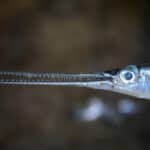
  • Longnose Gar (Lepisosteus osseus): With its long, narrow snout, the longnose gar inhabits a large range of territory across most of the Eastern United States.

Appearance

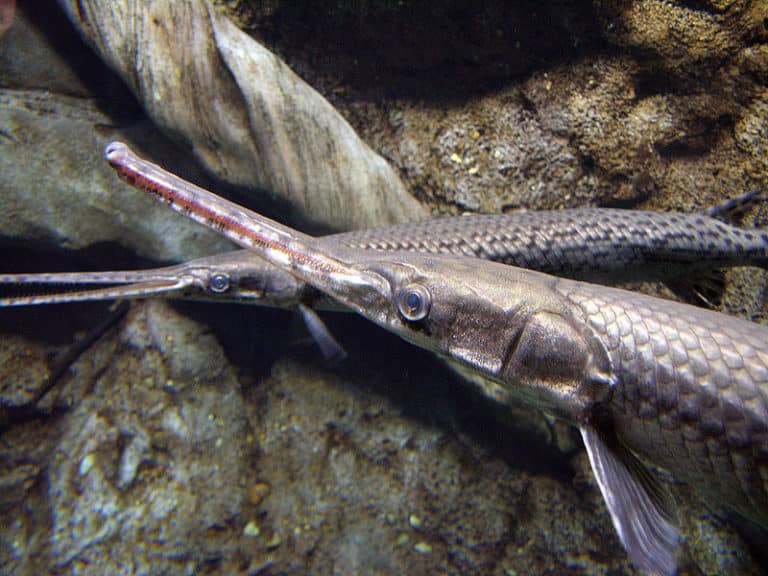
The most interesting physical characteristic of this fish is perhaps the most obvious. With its narrow body, protruding snout, and feather-like tail, it looks a bit like a dart. This is actually an important adaptation. The massive snout contains rows and rows of sharp, needle-like teeth that help with crushing shells and consuming prey.

Another important adaptation is the way that the swim bladder is connected directly to the esophagus. This allows the gar to breathe in the air amid stagnant, low-oxygen water.

The largest species in the family is the alligator gar, which can grow over 8 feet in length and weigh more than 300 pounds, with the largest confirmed individuals reaching up to 8 feet 4 inches and 283 pounds. This species also ranks among the largest of all freshwater fish in the world. The smallest species is the shortnose gar at around 2 feet in length.

The female tends to be larger than the male in the spotted gar and a few other species. Most of them have interlocking and protective bony plates known as ganoid scales, sometimes arranged in a diamond shape all over their bodies.

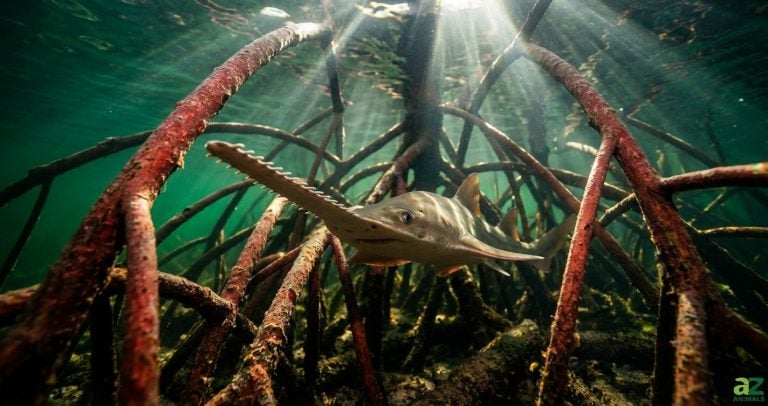
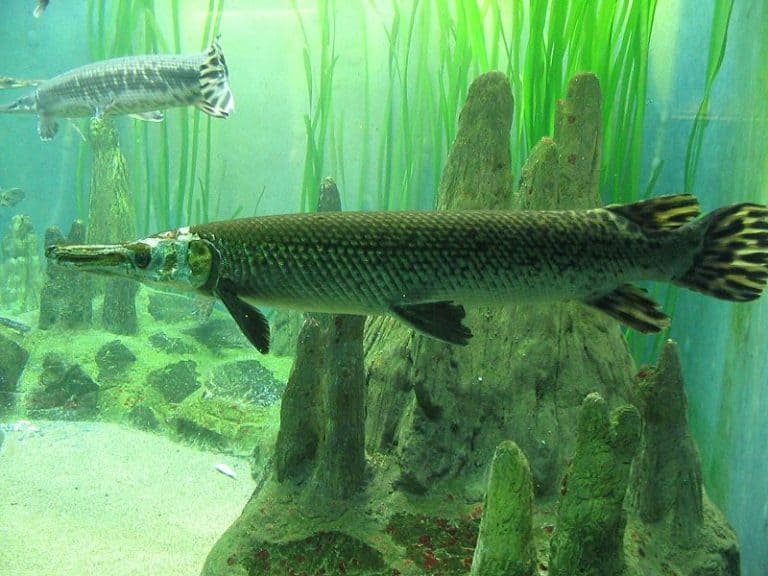
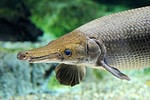
Gar swimming among grass

The majority of these fish inhabit freshwater rivers, bayous, and other brackish water environments that have low levels of oxygen, although a few species can also be found in saltwater bodies.

Distribution, Population, and Habitat

These fish are largely confined to freshwater rivers, bayous, and other brackish water with low oxygen content, but a few species venture out into saltwater bodies as well. The fish floats slowly like logs in the water, sometimes plunging into the depths in search of food, but it must return to the surface occasionally to take in air.

Although exact population numbers are unknown, the gar as a whole is in good health. According to conservation estimates, almost every species is listed as least concern, which is the best possible prognosis, but some local populations appear to be decreasing in number. For instance, the alligator gar is becoming rarer in states like Missouri and Tennessee.

Predators and Prey

The fish’s diet consists mainly of crustaceans, insects, frogs, and other fish. These slow-moving animals are opportunistic predators that scoop up nearby prey in their mouths with a simple strike of the head. It is not particularly picky about whether the prey is dead or alive.

Because of their status as apex predators throughout their natural habitat, they have few natural predators besides humans. The biggest threat to this animal is not necessarily fishing, as they are not often eaten as food, but hunting and pollution, which have caused some population numbers to decline.

Reproduction and Lifespan

No matter where they live, most species (except for the longnose gar) prefer to spawn in the spring. The females move to the shallow water and then deposit thousands of large sticky eggs with yolk contained within on vegetation. These eggs are actually toxic to many predators, including humans, which affords a degree of protection (though some fish appear to be immune to the toxin).

After a few days, the young larvae emerge from the eggs and then attach to the vegetation with an adhesive organ at the tip of the snout. The young juveniles survive the early stages of life by absorbing what remains of the egg yolk and later by feeding on minnows and other fish larvae.

Life expectancy varies by species, but the fish reaches sexual maturity after a few years and lives about 10 to 20 years in the wild (though the alligator gar appears to live 50 years or more). In many species, the female tends to live longer than the male.

Fishing and Cooking

This is not a very common type of dish, especially outside of its native region, but it is sometimes caught by both commercial and recreational fishers with simple nets or fishing rods. People describe it as having a firm, mild taste, different from any other species of fish.

Their flesh is not harmful on its own, but it does sometimes accumulate toxins and pollution from the environment, and so consumption is limited or banned in some areas. By contrast, the eggs are most certainly toxic and may cause a bout of sickness.

View all 261 animals that start with G

Sources

  1. David Burnie, Dorling Kindersley Animal, The Definitive Visual Guide To The World's Wildlife / Accessed June 14, 2010
  2. Tom Jackson, Lorenz Books (2007) The World Encyclopedia Of Animals / Accessed June 14, 2010
  3. David Burnie, Kingfisher The Kingfisher Animal Encyclopedia / Accessed June 14, 2010
  4. Richard Mackay, University of California Press (2009) The Atlas Of Endangered Species / Accessed June 14, 2010
  5. David Burnie, Dorling Kindersley (2008) Illustrated Encyclopedia Of Animals / Accessed June 14, 2010
  6. Dorling Kindersley (2006) Dorling Kindersley Encyclopedia Of Animals / Accessed June 14, 2010
  7. Britannica / Accessed November 26, 2020
  8. Seaworld Parks & Entertainment / Accessed November 26, 2020
  9. Florida Fish and Wildlife Conservation Commission / Accessed November 26, 2020
  10. Texas Parks & Wildlife / Accessed November 26, 2020
Rebecca Bales

About the Author

Rebecca Bales

Rebecca is an experienced Professional Freelancer with nearly a decade of expertise in writing SEO Content, Digital Illustrations, and Graphic Design. When not engrossed in her creative endeavors, Rebecca dedicates her time to cycling and filming her nature adventures. When not focused on her passion for creating and crafting optimized materials, she harbors a deep fascination and love for cats, jumping spiders, and pet rats.
Connect:

Thank you for reading! Have some feedback for us?


Gar FAQs (Frequently Asked Questions)

The gar’s diet consists of crustaceans, insects, frogs, and other fish.