G
Species Profile

Geoffroys Tamarin

Saguinus geoffroyi

Panama's cooperative twin-raiser
Brian Gratwicke / Creative Commons

Geoffroys Tamarin Distribution

Click a location to explore more animals from that region

Loading map...
Geoffroy's tamarin

At a Glance

Wild Species
Also Known As Panamanian tamarin, Panama tamarin, Panamanian titi, Panama titi, tamarino panameño
Diet Omnivore
Activity Diurnal+
Lifespan 10 years
Weight 0.5 lbs
Status Least Concern
Did You Know?

Adult size: head-body length ~20.8-25.9 cm; tail length ~31-40 cm (species accounts compiled in primate field guides; e.g., Rowe & Myers, 2016).

Scientific Classification

Geoffroy’s tamarin (Saguinus geoffroyi) is a small callitrichid New World monkey native to Central America, especially Panama and parts of northwestern Colombia. It is diurnal, highly social, and known for cooperative breeding and group living typical of tamarins.

Kingdom
Animalia
Phylum
Chordata
Class
Mammalia
Order
Primates
Family
Callitrichidae
Genus
Saguinus
Species
Saguinus geoffroyi

Distinguishing Features

  • Small, slender-bodied tamarin with long tail
  • Contrasting facial pattern typical of Saguinus; often noted for a dark face with lighter/whitish markings around the muzzle/cheeks
  • Claw-like nails (tegulae) on most digits, typical of callitrichids
  • Social groups with cooperative infant care and frequent vocal/visual communication

Physical Measurements

Length
1 ft 10 in (1 ft 8 in – 2 ft 1 in)
Weight
1 lbs (1 lbs – 1 lbs)
Tail Length
1 ft 2 in (1 ft – 1 ft 4 in)

Appearance

Primary Colors
Secondary Colors
Skin Type Dense mammalian fur over most of the body; sparsely furred to bare, darkly pigmented facial skin (and small bare areas around the muzzle/ears) typical of callitrichid tamarins.
Distinctive Features
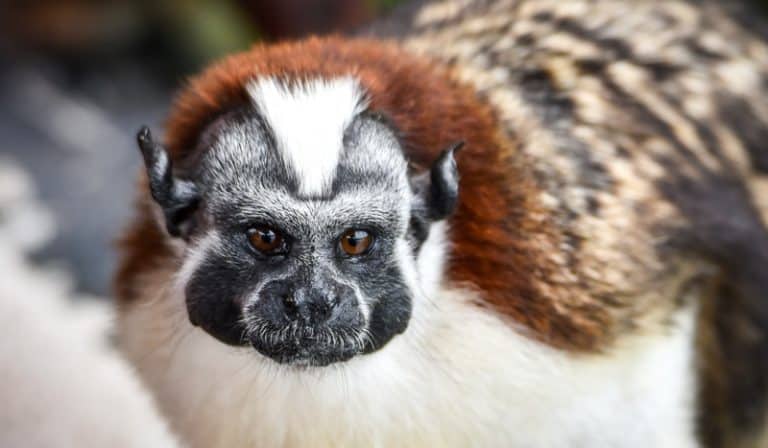
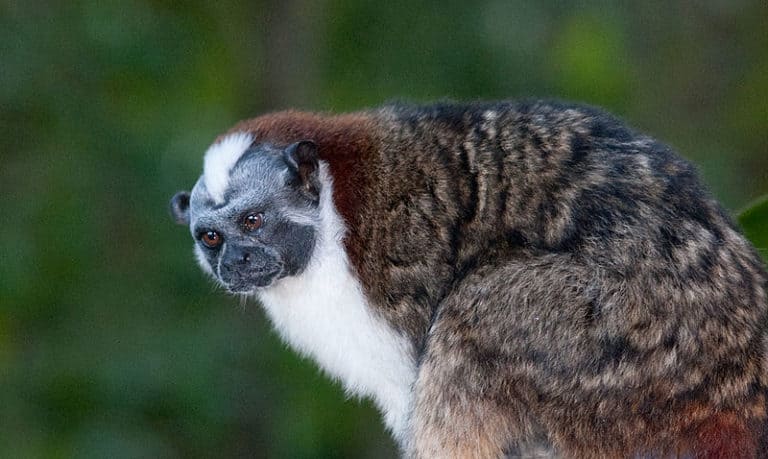
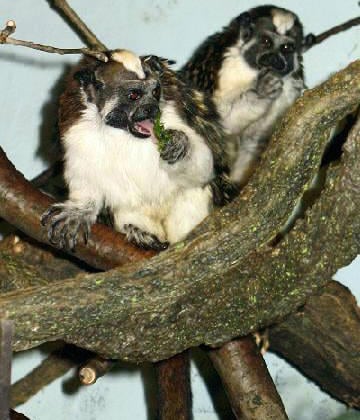
  • Small callitrichid tamarin with a conspicuous pale (white/cream) facial mask/ruff contrasting with a dark face; dark tail and limbs give a strongly contrasted head-and-shoulders appearance in the canopy/forest edge.
  • Adult size (reported ranges): head-body length 20.8-24.0 cm; tail length 33.0-41.0 cm; adult mass commonly reported about 0.432-0.535 kg (values compiled in major mammal references and callitrichid species accounts).
  • Nails are claw-like tegulae on most digits (a callitrichid hallmark) aiding vertical clinging and insect gleaning; flattened nails are typically restricted to the big toe.
  • Diurnal, arboreal, and highly social; typically lives in small family groups with cooperative breeding (helpers carry and provision infants).
  • Reproduction commonly involves twinning (a widespread callitrichid trait), with extensive male and helper infant-carrying-important for interpreting observed wear/soiling on the back and shoulders of frequent carriers.
  • Diet is visually associated with active foraging: rapid quadrupedal movement and frequent probing/gleaning for insects plus fruit; opportunistic use of nectar/exudates (gum) can involve face/muzzle contact with bark/flowers, sometimes staining pale facial hair.
  • Often found in secondary forest, forest edges, and disturbed areas in Panama and northwest Colombia. Living there can fade brown fur in sun and add dust to pale facial hair.
  • Geoffroy's tamarin can live about 15–16 years in captivity and zoo records. In the wild it usually lives less, often around 10 years because of predators and disease.

Did You Know?

Adult size: head-body length ~20.8-25.9 cm; tail length ~31-40 cm (species accounts compiled in primate field guides; e.g., Rowe & Myers, 2016).

Typical adult mass ~0.45-0.65 kg (reported ranges across wild populations; Smith & Jungers, 1997 datasets include Saguinus body masses).

Like most tamarins, births are usually twins; gestation is ~140-145 days (callitrichid reproductive biology summaries; e.g., Kleiman, 1977; later reviews).

Groups are cooperative breeders: non-breeding helpers (often older siblings) carry infants and share food-key to raising heavy twin litters.

Diet is strongly insect-and-fruit based, but they also take nectar and plant exudates opportunistically-especially in disturbed/edge habitats where gums and pioneer fruits are common.

Range is centered on Panama with extension into NW Colombia; it is one of the few tamarins naturally occurring in Central America (IUCN Red List species account).

Unique Adaptations

  • Callitrichid claw-like nails on most digits provide strong grip for vertical clinging and rapid movement on small branches-ideal for understory and edge habitats.
  • Twinning and cooperative breeding are tightly linked adaptations: because twin infants can total a large fraction of the mother's body mass, shared carrying by helpers increases offspring survival.
  • Chimerism is common in callitrichids: twin embryos can exchange cells in the womb, so many individuals carry some cells genetically derived from their twin-an unusual mammalian condition documented across tamarins and marmosets.
  • Small-body, high-agility design: lightweight build and long tail (used for balance, not grasping) enable fast, acrobatic foraging on thin supports where larger monkeys are less efficient.
  • Opportunistic gum/nectar use: while not as specialized as true "gum-gouging" marmosets, Geoffroy's tamarin can exploit exudates and nectar, buffering seasonal fruit shortages.

Interesting Behaviors

  • Cooperative infant care: infants are carried by multiple group members; carriers frequently transfer infants, allowing the breeding female to forage and recover energy after birth.
  • Food sharing and "provisioning": adults and helpers often pass large insects or fruit pieces to juveniles and to the breeding female, reinforcing social bonds and aiding infant growth.
  • Scent-marking and territorial routines: individuals rub scent glands on branches and frequently over-mark group mates' scent, helping maintain territory boundaries and group cohesion.
  • Edge-savvy foraging: regularly uses secondary forest and forest edges; exploits vine tangles and dense understory where insects are abundant and small fruits are plentiful.
  • Mixed-species tolerance: may forage near other small primates when resources align, while still defending core areas from neighboring tamarin groups.
  • Anti-predator responses: rapid alarm calling, group clustering, and mobbing-like harassment of threats (especially raptors and snakes) are commonly reported for tamarins.

Cultural Significance

In Panama and nearby Colombia, Geoffroy's tamarin (Saguinus geoffroyi) is often called "titi," a name for small callitrichid monkeys (marmosets and tamarins). Scientists use tamarins as examples of cooperative breeding; they often have twins and many group members help care for babies.

Myths & Legends

Name-origin story (scientific tradition): the specific name honors French zoologist Etienne Geoffroy Saint-Hilaire-part of a long 18th-19th century natural-history practice of commemorating prominent scholars in species names.

Historical anecdote (discovery-era): Geoffroy's tamarin was formally described in the 19th century (authority: Pucheran, 1845), during a period when Central American biodiversity was being cataloged rapidly through museum collections and expedition specimens.

In Panama and Colombia, Geoffroy's tamarin (Saguinus geoffroyi) is called "titi" and used in everyday speech and stories to mean small monkeys who are quick, curious, and live in close family groups.

Conservation Status

LC Least Concern

Widespread and abundant in the wild.

Population Decreasing

Protected Under

  • CITES Appendix I (international trade controls for wild specimens)
  • Occurs in multiple protected areas within its range (e.g., Darién National Park, Panama; Los Katíos National Natural Park, Colombia)

Life Cycle

Birth 2 infants
Lifespan 10 years

Lifespan

In the Wild
7–13 years
In Captivity
12–20 years

Reproduction

Mating System Polyandry
Social Structure Cooperative Breeder
Breeding Pattern Long Term
Fertilization Internal Fertilization
Birth Type Internal_fertilization

Geoffroy's tamarin (Saguinus geoffroyi) live in groups with one main breeding female, several males, and helpers. They show cooperative polyandry: multiple males mate and help raise often twin babies. Males often carry infants. Pregnancy lasts about 140–145 days.

Behavior & Ecology

Social Troop Group: 6
Activity Diurnal, Matutinal, Vespertine
Diet Omnivore Ripe fruits (field studies consistently report fruit as the dominant plant item; figs are commonly used when available)

Temperament

Highly social and gregarious within the group (frequent close proximity, grooming, and play, especially among juveniles)
Cooperative/alloparental (helpers participate heavily in infant care; infant carrying is commonly male-biased in callitrichids)
Alert and vigilant (frequent scanning and rapid alarm responses; small-bodied prey profile promotes risk-sensitive foraging)
Territorial and reactive to neighbors (vocal exchanges/approaches at boundaries; intensity varies by local conditions)
Curious/inquisitive foragers (rapid, active movement through the understory and mid-canopy; frequent investigation of substrates and epiphytes while searching for insects and fruit)

Communication

long calls/whistles used for intergroup spacing and long-distance contact Common callitrichid pattern; reported for Saguinus geoffroyi in field ethograms
close-range contact calls (soft trills/chirps) coordinating group movement and cohesion
alarm calls that differ with disturbance context (predator-oriented vs. generalized alarms), often eliciting freezing, mobbing, or rapid withdrawal depending on threat
infant distress calls that trigger retrieval/carrying and group attention
scent marking with specialized skin glands (including anogenital/suprapubic regions typical of callitrichids) and urine-washing to mark routes, resources, and territorial boundaries
visual signals (facial expressions, piloerection, body postures) during social tension and intergroup encounters
tactile communication: social grooming, huddling, play wrestling, and direct infant handling/transfer among helpers

Habitat

Biomes:
Tropical Rainforest Tropical Dry Forest
Terrain:
Coastal Hilly Plains Riverine
Elevation: Up to 4921 ft 3 in

Ecological Role

Omnivorous mesoconsumer in lowland and premontane forests; important seed disperser and arthropod predator.

Seed dispersal of small-seeded fruits (defecation-based dispersal after pulp consumption) Regulation of arthropod populations via intensive insect predation Pollination facilitation/flower visitation (nectar feeding can transfer pollen incidentally) Trophic support for higher predators (prey base for raptors, snakes, and small felids)

Diet Details

Main Prey:
Insects Spiders and other arachnids Small vertebrates Bird eggs and nestlings
Other Foods:
Fleshy fruits Nectar and flowers Plant exudates Soft seeds

Human Interaction

Domestication Status

Wild

Geoffroy's tamarin (Saguinus geoffroyi) is wild and not domesticated; there is no selective breeding. People contact them mostly through habitat loss, capture for the pet trade, research, and zoos, plus wildlife tourism and education in Panama and NW Colombia. They are diurnal, social, live in small groups (about 3–9), often have twins, and show cooperative breeding.

Danger Level

Low
  • Bites/scratches: small but sharp canines; injuries are usually minor yet can become infected.
  • Zoonotic disease exposure from close contact, especially in pet settings (reported/possible risks for New World monkeys include enteric pathogens such as Salmonella/Shigella/Campylobacter, parasites such as Giardia/Cryptosporidium, and respiratory pathogens; risk increases with poor hygiene and illegal trade conditions).
  • Allergy/asthma risk from dander/urine in indoor keeping.
  • Reverse zoonosis is also important: humans can transmit respiratory viruses to callitrichids, making close contact risky for the animals and complicating handling/rehabilitation.

As a Pet

Not Suitable as Pet

Legality: Geoffroy's tamarin (Saguinus geoffroyi) is generally unsuitable as a pet and often illegal or restricted. Trade is CITES-regulated; many countries, the US, and home countries (e.g., Panama, Colombia) require permits or ban ownership.

Care Level: Expert Only

Purchase Cost: $4,000 - $12,000
Lifetime Cost: $50,000 - $180,000

Economic Value

Uses:
Ecotourism / wildlife viewing (notably in parts of Panama; supports local guiding and protected-area value) Zoo/education value (captive display and conservation messaging) Scientific research value (behavioral ecology, cooperative breeding/callitrichid social systems; also captive husbandry research) Negative economic interactions: crop/garden raiding can occur locally (generally minor due to small size and diet), and conflict may arise near settlements Illegal/regulated live-animal trade (pet market demand-economic driver but a conservation and welfare harm) HUBS (range of human interactions across the broader tamarin/callitrichid group): habitat conversion/fragmentation; hunting/persecution (usually low compared with larger primates); live capture for pets; zoo trade and managed breeding; field research and ecotourism; disease interfaces with humans/domestic animals; roadkill and urban-edge use in fragmented landscapes.
Products:
  • Live animals for zoos/research (legal only with permits/ethical oversight)
  • Live animals for the pet trade (often illegal/unregulated; major welfare and disease-risk concern)
  • Non-consumptive services: tourism/education value (no physical product)

Relationships

Predators 7

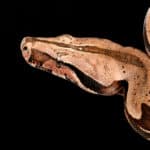
Boa constrictor
Boa constrictor Boa constrictor
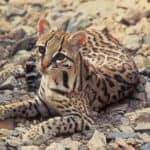
Ocelot
Ocelot Leopardus pardalis
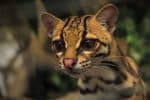
Margay
Margay Leopardus wiedii
Tayra Eira barbara
Ornate hawk-eagle Spizaetus ornatus
Crested eagle Morphnus guianensis
Black-and-white owl Strix nigrolineata

Related Species 9

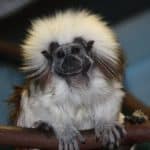
Cotton-top tamarin
Cotton-top tamarin Saguinus oedipus Shared Genus
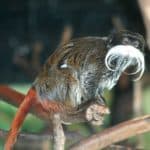
Emperor tamarin
Emperor tamarin Saguinus imperator Shared Genus
Golden-handed tamarin Leontocebus midas Shared Genus
White-footed tamarin Saguinus leucopus Shared Genus
White-lipped tamarin Saguinus labiatus Shared Genus
Golden-mantled tamarin Saguinus tripartitus Shared Genus
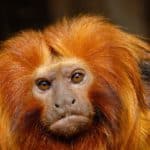
Golden lion tamarin
Golden lion tamarin Leontopithecus rosalia Shared Family
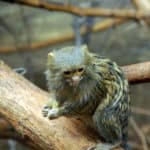
Pygmy marmoset
Pygmy marmoset Cebuella pygmaea Shared Family
Common marmoset Callithrix jacchus Shared Family

Ecological Equivalents 4

Animals that fill a similar ecological role in their ecosystem

Cotton-top tamarin
Cotton-top tamarin Saguinus oedipus Very similar niche and life history to other small-bodied callitrichids: diurnal, group-living, cooperative breeding with frequent twinning; comparable frugivore–insectivore diet and use of lower- to mid-canopy and forest-edge habitats. (General callitrichid ecology summarized in Garber et al., 1997; IUCN Callitrichidae accounts.)
Common marmoset Callithrix jacchus A close relative: small (0.35–0.45 kg), diurnal, lives in social groups, and depends on arthropods (insects, spiders) and plant foods. It differs by gouging more for sap and gums but also searches for insects and small fruits, and helps care for young.
Geoffroy's spider monkey Ateles geoffroyi Partly share fruit resources in forests of Panama and Colombia. Both are diurnal canopy frugivores, but Geoffroy's spider monkey is much larger and moves differently, leading to indirect competition for fruit when resources are scarce.
Golden lion tamarin
Golden lion tamarin Leontopithecus rosalia Similar functional niche within Callitrichidae: small-bodied, diurnal, cooperative breeder; insect foraging in bromeliads and crevices parallels insect gleaning by tamarins and use of secondary/edge habitats, though the golden lion tamarin occurs in the Atlantic Forest rather than Central America. (Diet/foraging syntheses: Rylands & Mittermeier, 2009).

“A Geoffroy’s tamarin can jump up to 16 feet from one treetop to another.”

Geoffroy’s tamarins are omnivores eating tree sap, insects, fruits, and various plants. They are active during the day and spend most of their time up in trees. These are social animals living in groups of 3 to 5 monkeys. They communicate with one another using whistles, high-pitched chattering, rasps, and even sneezes. These animals can live up to 13 years in the wild.

5 Geoffroy’s Tamarin Facts

  • This animal has a thick stripe of white hair on its head.
  • They live in South America and Central America.
  • They are the smallest monkey living in Panama.
  • Rufous-naped tamarin and red-crested tamarin are two other names for this animal.
  • This animal travels a little over a mile each day in search of food.

Geoffroy’s Tamarin Scientific Name

The scientific name for this monkey is Saguinus geoffroyi. The word Saguinus means, ‘of a marmoset.’ Sagu is Portuguese for marmoset, and inus is Latin meaning ‘of or pertaining to.’ The second part of its scientific name geoffroyi, comes from the name of French naturalist Etienne Geoffroy Saint-Hilaire. This tamarin was named after him.

Along with being called a Geoffroy’s tamarin, this animal is sometimes referred to as the rufous-naped tamarin or the red-crested tamarin.

This animal belongs to the Callitrichidae family. They are in the same family as the marmoset. This animal is also in the Mammalia class.

Geoffroy’s Tamarin Appearance

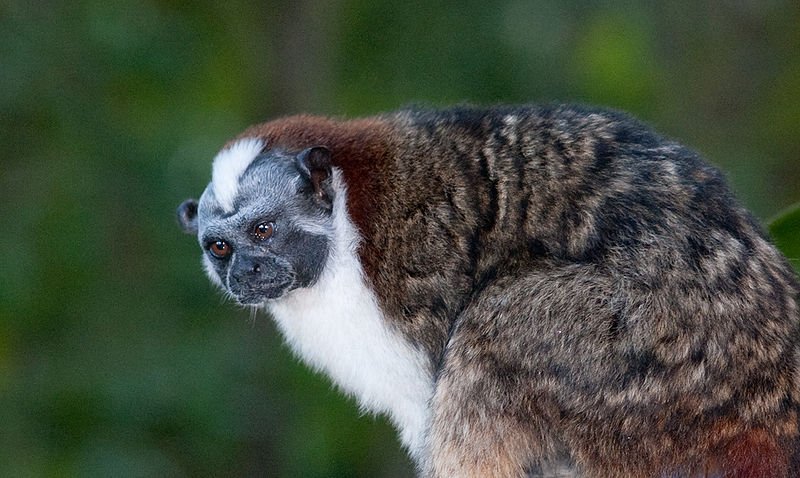
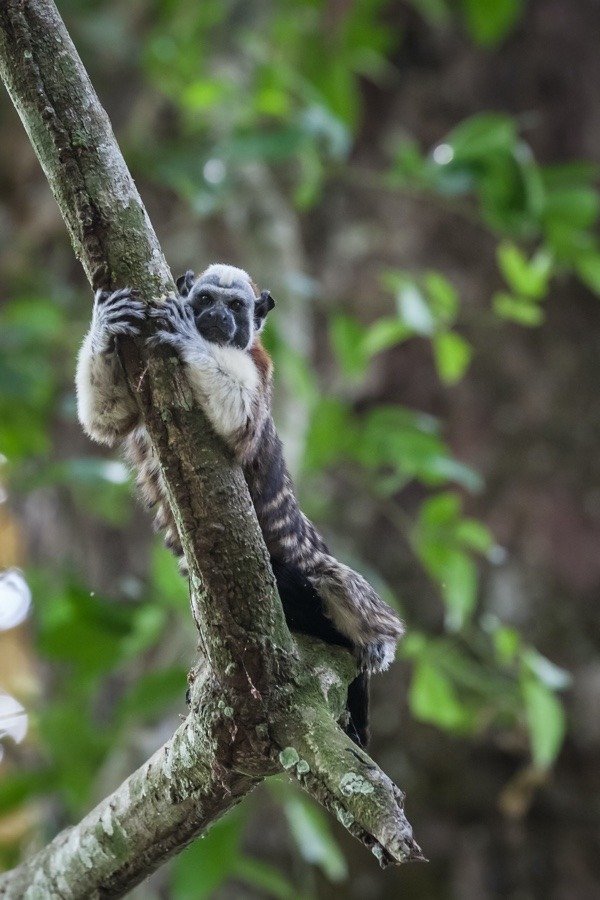
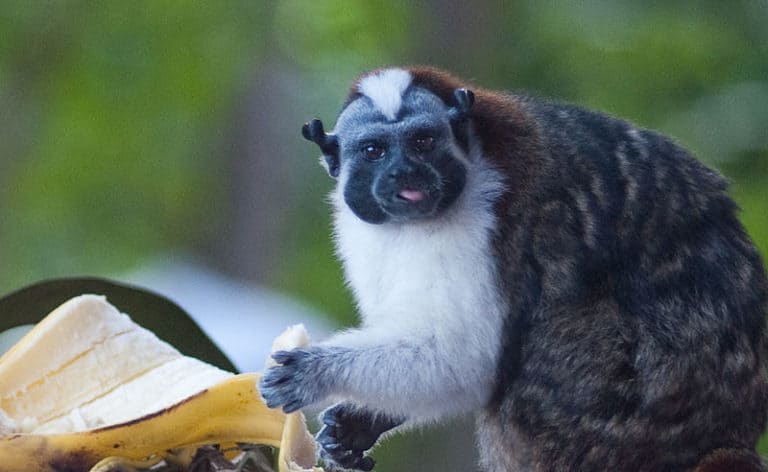
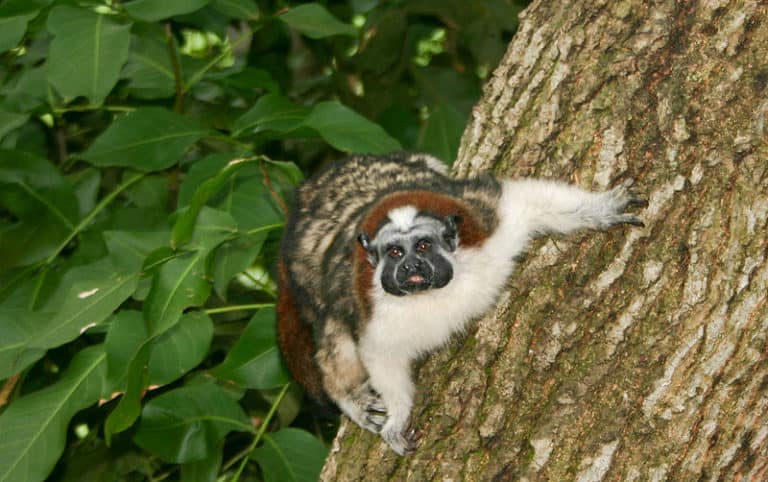
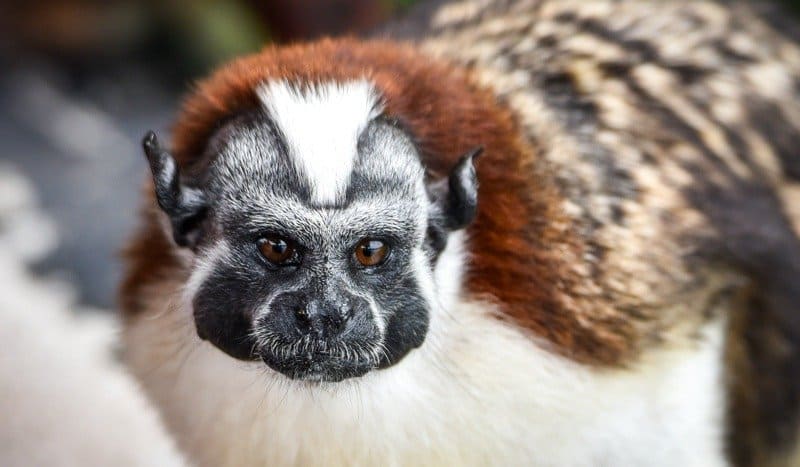
A Geoffroy’s tamarin has a coat of black and tan fur on its back along with a red section of fur at the back of its neck and shoulders. This section of fur is what earned it the names red-crested and rufous-naped tamarin. Its tail is black with light tan rings, and its chest and front legs are white. The Geoffroy’s tamarin has black fur on its face and a thick stripe of white hair that stands up on its head. Some people say it has a white mohawk haircut. This creature has small, black ears and dark, curious eyes.

The size of an adult Geoffroy’s tamarin ranges from 8.5 to 11 inches long. It can have a tail measuring from 12 to 16.5 inches long. Male Geoffroy’s tamarins weigh about 1 pound while females weigh 1.1 pounds. If you held two hamsters in your palm, they would be equal in weight to a 1-pound Geoffroy’s tamarin.
Geoffroy’s Tamarin Behavior

This animal is small, so it’s vulnerable to many predators. Fortunately, it has a few ways to protect itself. For one, this animal is fast! In fact, its fastest speed is 24 mph. Also, they stay up in the treetops most of the time to avoid predators on the ground. They alert other monkeys of predators by using chirps, whistles and clicking sounds. These animals also move their heads, tails and arms to alert others of a predator. Alerting other monkeys of a predator in the area gives everyone a chance to hide.

Geoffroy’s tamarins are social animals normally living in groups of 3 to 5 monkeys. The largest groups can number up to 20 animals. A group of Geoffroy’s tamarins is called a troop.

When it comes to people, these monkeys try to stay out of sight. But males can be aggressive with other males when competing for females during breeding season. Male Geoffroy’s tamarins can seriously hurt one another in a fight. Broken tails, deep scratches and injured claws are just a few examples of the injuries.

Geoffroy’s Tamarin Habitat

These creatures live in South America and Central America. Specifically, they live in Panama and Columbia. Their habitat includes dry deciduous forests as well as tropical rainforests. They stay in dense gatherings of trees, so they have plenty of places to hide. They live in a climate with moderate humidity.

Geoffroy’s Tamarin Population

As far as population goes, there are 4 to 6 Geoffroy’s tamarins for every square kilometer (about half a mile) in some areas of Barro Colorado Island in Panama. However, in other territories on the island, there are as many as 20 to 30 monkeys per square kilometer. The island itself is only about 9,600 acres in size. The number of these creatures in various areas depends on how these animals divide up their territories.

The conservation status of this animal is Least Concern. This animal’s population is believed to be decreasing with habitat loss due to deforestation.

These creatures live in South America and Central America. Specifically, they live in Panama and Columbia. Their habitat includes dry deciduous forests as well as tropical rainforests. They stay in dense gatherings of trees, so they have plenty of places to hide. They live in a climate with moderate humidity.

Geoffroy’s Tamarin Diet

What do Geoffroy’s tamarins eat? They are omnivores which means they have both meat and plants in their diet. Lizards, insects, eggs, fruit, and flowers are all on the menu. Also, Geoffroy’s tamarins eat tree sap or nectar. Their teeth aren’t designed to dig into a tree’s trunk to find sap. So, they look for areas where sap is already leaking out of a tree.

This animal shares its habitat in Panama with a bird called the tyrant flycatcher. Now, it would seem like a Geoffroy’s tamarin and a little bird have very little in common. But, when it comes to insects, these two animals have a similar diet. Geoffroy’s tamarins have been known to listen for the calls of the tyrant flycatcher, so they can feast on the insects found by these birds. This is why some scientists call Geoffroy’s tamarin an opportunistic forager. In other words, the tyrant flycatcher does the hard work of finding the insects and all the Geoffroy’s tamarin has to do is eat them.

Geoffroy’s Tamarin Predators and Threats

Not surprisingly, the smallest monkey in Panama has a lot of predators. Wild cats, snakes, raptors such as hawks, and coatimundis are on the list of its predators. Many of its predators can climb trees as well which allows them to prey on these tiny creatures.

Sometimes a family of Geoffroy’s tamarins can turn the tables on a predator. These animals have been known to crowd around, or mob, a predator in order to chase it out of their territory. A mob could be a dozen monkeys or more. For instance, if a coatimundi, a raccoon-like animal, entered the territory of a family of Geoffroy’s tamarins, the monkeys may gather together in a mob to chase it away. Oftentimes, the predator will become overwhelmed and move away. Teamwork!

Humans are also predators of the Geoffroy’s tamarin. They are captured by humans and sold as exotic pets. This is very harmful to the Geoffroy’s tamarin. Humans aren’t able to take proper care of them and the animals are likely to die as a result. They are meant to live in the wild.

These animals also suffer from loss of habitat due to deforestation and the expansion of farmland. Some of these tiny creatures have been known to wander into urban areas and are killed on the road by cars.

The official conservation status of Geoffroy’s tamarins is: Least Concern. Many of these monkeys live in national parks located in Colombia and Panama. This provides them with some protection from habitat loss and capture by humans.

Geoffroy’s Tamarin Reproduction, Babies and Lifespan

This animal breeds in the months of January and February. Female Geoffroy’s tamarins coil their tails to attract a male. Scientists have determined that some of these animals have one partner while others have several. In short, it varies from group to group. The gestation period for a female Geoffroy’s tamarin ranges from 140 to 145 days. Its gestation period is about the same as its close relative the cotton-top tamarin.

These creatures use a cavity, or hole, in a tree for shelter and as a nest to have babies. It’s a common occurrence for Geoffroy’s tamarins to give live birth to twins. A female marmoset has twins most of the time as well. Unfortunately, one twin may die within a couple months. The second baby may not be as healthy or strong as the first one. Newborn monkeys, also called infants, are born covered in mostly black hair with some white on their face. They weigh from 1.4 to 1.8 ounces at birth. A newborn that is 1.8 ounces weighs about as much as a tennis ball. They are nursed by their mother for the first couple months of life.

By 5 weeks old, the babies or infants are moving around and eating solid food by 7 weeks. The male Geoffrey’s tamarin shares in the care of the infants with the female. He carries the infants on his back and grooms their hair. It’s not unusual for older brothers and sisters in the family to help in the infant care as well. The infants are weaned by 18 weeks old and live independently at 25 weeks.

Geoffroy’s tamarins can live up to 13 years in the wild. The oldest Geoffroy’s tamarin lived in captivity for 20 years! These animals are vulnerable to intestinal parasites as they age.

Geoffroy’s Tamarin in the Zoo

Geoffroy’s tamarins are on display at Philadelphia Zoo.

View all 261 animals that start with G

Sources

  1. New England Primate Conservancy
  2. Animal Diversity
  3. National Geographic
A-Z Animals Staff

About the Author

A-Z Animals Staff

AZ Animals is a growing team of animals experts, researchers, farmers, conservationists, writers, editors, and -- of course -- pet owners who have come together to help you better understand the animal kingdom and how we interact.
Connect:

Thank you for reading! Have some feedback for us?


Geoffroys Tamarin FAQs (Frequently Asked Questions)

The scientific name for a Geoffroy’s tamarin is Saguinus geoffroyi. The name means ‘of or pertaining to a marmoset.’ Though marmosets and tamarins are in the same family, there is a difference between them. A marmoset has teeth designed to dig into the trunk of a tree to release sap whereas a Geoffroy’s tamarin doesn’t have teeth designed for digging. They have to find sap that’s already coming out of the tree trunk.