


G
Species Profile

Glass Lizard

Anguidae

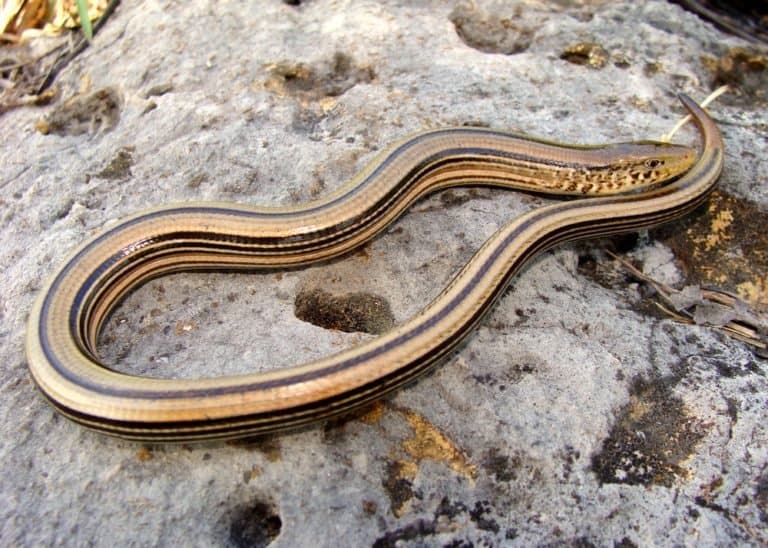
All the lizard-none of the legs.
Fl295, Public domain, via Wikimedia Commons

Glass Lizard Distribution

Click a location to explore more animals from that region

Loading map...
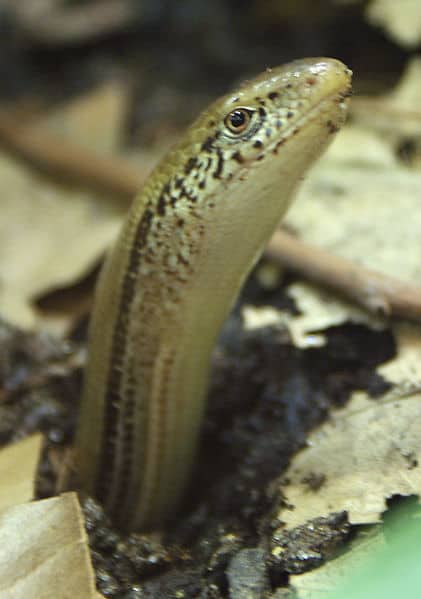
Glass Lizard under leaves

At a Glance

Family Overview This page covers the Glass Lizard family as a group. Stats below are general traits shared across the family.
Also Known As Glass snake, Legless lizard, Slowworm, Blindworm, Sheltopusik
Diet Carnivore
Activity Diurnal+
Lifespan 12 years
Weight 2 lbs
Status Not Evaluated
Did You Know?

They're lizards, not snakes: many have movable eyelids and visible external ear openings.

Scientific Classification

Family Overview "Glass Lizard" is not a single species but represents an entire family containing multiple species.

Glass lizards are legless (or nearly legless) lizards—distinct from snakes—best known for extreme tail autotomy (the tail can break into pieces), which inspired the “glass” name. Many have movable eyelids and visible external ear openings, and retain lizard-like skull and jaw features.

Kingdom
Animalia
Phylum
Chordata
Class
Reptilia
Order
Squamata
Family
Anguidae

Distinguishing Features

  • Legless lizard (not a snake): usually has movable eyelids
  • Often has external ear openings
  • Very long, fragile tail with pronounced autotomy (can break readily)
  • Lateral body fold in many species, giving a segmented look
  • Generally less flexible than snakes; lizard-like head/jaw anatomy

Physical Measurements

Males and females differ in size

Length
2 ft 4 in (8 in – 4 ft 5 in)
1 ft 10 in (5 in – 3 ft 11 in)
Weight
1 lbs (0 lbs – 2 lbs)
0 lbs (0 lbs – 1 lbs)
Tail Length
1 ft 6 in (4 in – 3 ft 3 in)
12 in (2 in – 2 ft 2 in)
Top Speed
6 mph
Top speed 2–10 km/h

Appearance

Primary Colors
Secondary Colors
Skin Type Anguidae have hard keratin scales over osteoderms, giving a firmer, armored feel than many lizards. Glass-lizard forms are smoother and glossy with a side fold; alligator-lizards have keeled scales. As squamates, they shed outer skin.
Distinctive Features
  • Family-level size range (smallest to largest members): roughly ~10-140+ cm total length depending on species; glass-lizard forms tend to be at the larger/longer end due to extreme tail length (tail often exceeds body length).
  • Body plan diversity within Anguidae: includes both limbed 'alligator lizards' and multiple legless or near-legless lineages commonly called glass lizards; do not assume all anguids are legless.
  • Glass-lizard vs snake traits (common in legless anguids): movable eyelids and visible external ear openings; skull/jaw proportions remain lizard-like (not a snake).
  • Extreme tail autotomy is widespread and especially notable in glass lizards: the tail can detach readily and may fragment into multiple pieces, inspiring the 'glass' name (they are not literally made of glass).
  • Elongate body with many vertebrae; in legless forms, forelimbs are absent and hindlimbs are absent or reduced to tiny vestiges in some taxa.
  • A lateral skin fold (a groove along each side) is commonly evident in many glass lizards and can aid flexibility/expansion after feeding.
  • Head often distinct from neck; eyes typically well-developed with eyelids; ear opening visible in many species even when the body is very elongate.
  • Shy, ground-living or partly underground; use grass, leaf litter, sand, or loose soil. Some are day-active, others dawn/dusk. Mostly eat invertebrates; larger kinds take small vertebrates. Live in temperate forests, shrublands, grasslands, and semi-arid regions.
  • Old World glass lizards include Anguis and Pseudopus in temperate Europe and West Asia, while New World glass lizards are mostly Ophisaurus in North America. Body thickness and striping or mottling vary.

Sexual Dimorphism

Sex differences in glass lizards (Anguidae) are often subtle and vary by species. Males may have wider heads and thicker bodies; females can be a bit longer or heavier when carrying eggs. Some populations show small pattern or seasonal color changes, but strong color splits are rare.

  • Proportionally larger/broader head and jaw musculature in many species (more evident in some glass-lizard lineages and some alligator lizards).
  • May appear more robust through the neck/shoulder region (where present) and anterior trunk; differences can be most noticeable during breeding season.
  • Often slightly longer trunk or greater body volume when gravid; overall pattern/color usually similar to males in many species.
  • In some taxa, may retain or show slightly different striping contrast compared to males, but this varies by species/population and is not universal.

Did You Know?

They're lizards, not snakes: many have movable eyelids and visible external ear openings.

Their "glass" name comes from extreme tail autotomy-tails can snap off and may fragment into multiple pieces.

Most are long-bodied with the tail making up well over half the total length (often ~60-70%).

Anguid skin is reinforced with bony scales (osteoderms), giving many species a notably armored, stiff feel.

Leglessness evolved alongside a burrowing/grass-swimming lifestyle; some anguids still retain tiny hind-limb remnants.

Across the group, reproduction varies: some species lay eggs, while others give live birth-sometimes within closely related lineages.

They're common garden allies in many regions, feeding heavily on insects, slugs, and other invertebrates.

Unique Adaptations

  • Extreme caudal fracture planes: specialized tail anatomy enables rapid shedding; regeneration occurs but the new tail typically differs in structure and may be shorter or differently colored.
  • Snake-like locomotion without snake anatomy: movement relies on lateral undulation plus body rigidity from osteoderms-effective for "swimming" through grasses and loose debris.
  • Key 'not-a-snake' traits in many species: movable eyelids and external ear openings; skull/jaw structure remains distinctly lizard-like.
  • Osteoderm armor: bony deposits in the skin add protection and help reduce water loss, but also make many species less flexible than snakes.
  • Limb reduction continuum: within Anguidae, forms range from fully limbed alligator lizards to nearly limbless glass lizards, illustrating repeated evolutionary steps toward elongation and burrowing.
  • Tail-to-body proportion specialization: very long tails shift the detachable 'sacrificial' portion away from vital organs-useful when predators strike from behind.

Interesting Behaviors

  • Tail autotomy as a decoy: when seized, the tail can detach and writhe vigorously; in "glass lizards" it may break into multiple sections, distracting predators while the lizard escapes.
  • Secretive, cover-seeking lifestyle: many spend much of the day under logs, leaf litter, rocks, boards, or in loose soil; activity often peaks in mild temperatures (morning/evening or after rain).
  • Thermoregulation by "edge basking": individuals may bask partly concealed (only a portion of the body exposed) to reduce predation risk.
  • Diet flexibility with regional variation: many specialize on invertebrates (insects, larvae, spiders, snails/slugs), while larger species may also take small vertebrates or eggs.
  • Seasonal cycles: in temperate regions, many undergo winter dormancy/brumation; timing and length vary widely by latitude and elevation.
  • Reproductive behaviors differ: some species guard eggs (reported in several legless lizards), while live-bearing species invest in prolonged gestation; mating seasons and clutch/litter sizes vary by climate.
  • Defensive displays beyond tail loss: hissing, rapid lateral body movements, and musky secretions are common; some flatten the body to seem larger.

Cultural Significance

Glass lizards (Anguidae), called slow worms or blindworms in Europe and western Asia, are seen with fear and respect. People value them for eating pests, but in stories they often mean hidden danger or strange change because they look like snakes and drop tails.

Myths & Legends

In Britain and Ireland, people often called the slow worm a harmless 'worm' or a kind of adder, some thinking it was venomous or could give a painful bite, showing confusion between legless lizards and snakes.

In Europe, old stories explain the English name "glass lizard": these legless lizards can drop their long tails, which may break into pieces, so people said they "shattered like glass."

Scottish/English witchcraft lore (early modern literature): in Shakespeare's *Macbeth*, "eye of newt and toe of frog... and blind-worm's sting" draws on contemporary associations of small reptiles/legless lizards with magical ingredients and hidden harm.

Medieval/early modern bestiary tradition (Europe): legless, shiny-bodied reptiles were sometimes grouped with 'serpents' in moralized natural histories, used as symbols of deceit or subterranean secrecy-reflecting cultural unease about creatures that resemble snakes but behave differently.

Balkan and steppe stories give many names to the large Eurasian glass lizard (Anguidae). Folk tales call it an odd 'in-between' creature because of eyelids, ear openings, and tail-breaking.

Conservation Status

NE Not Evaluated as a single group; IUCN Red List categories are assigned at the species level. Glass lizard species (within Anguidae, primarily Anguinae) span multiple IUCN categories depending on the species and region.

Has not yet been evaluated against the criteria.

Population Unknown

Protected Under

  • No glass lizard species are currently listed on the CITES Appendices (for example, the glass lizard genera Ophisaurus, Pseudopus, and Hyalosaurus do not appear in the CITES Appendices listings), so CITES-based trade controls do not generally apply to glass lizards as a group.
  • Legal protection for glass lizards is mainly implemented through national or subnational wildlife legislation, and coverage varies substantially by species and country (some species are legally protected in parts of their ranges, while others are not).
  • In parts of Europe and the Mediterranean, glass lizard protections (where they exist) are typically delivered via national nature protection laws and related regulations rather than through a single glass-lizard-specific international listing; applicability depends on the country and the species' local status.

You might be looking for:

European glass lizard

32%

Pseudopus apodus

Large Old World legless lizard often called “the” glass lizard in Europe/West Asia; eyelids and external ear openings present (unlike snakes).

Eastern glass lizard

26%

Ophisaurus ventralis

North American glass lizard (southeastern USA), long tail and brittle autotomy; common in sandy habitats.

View Profile

Slender glass lizard

20%

Ophisaurus attenuatus

North American species (central/southern USA) frequently referred to as a glass lizard.

Slow worm

12%

Anguis fragilis

European legless lizard sometimes loosely called a glass lizard; smaller and more uniformly colored than Pseudopus.

View Profile

California legless lizard

10%

Anniella pulchra

A different legless-lizard lineage (family Anniellidae) sometimes confused with “glass lizards,” but not an anguidae glass lizard.

Life Cycle

Birth 7 hatchlings
Lifespan 12 years

Lifespan

In the Wild
3–30 years
In Captivity
5–54 years

Reproduction

Mating System Promiscuity
Social Structure Solitary
Breeding Pattern Seasonal
Fertilization Internal Fertilization
Birth Type Internal_fertilization

Anguidae (glass and alligator lizards) mostly mate with multiple partners; no long-term pairs. They use internal fertilization (hemipenes), are mainly solitary and seasonal, sometimes show male competition, do not have helpers to raise young. Female sperm storage may occur.

Behavior & Ecology

Social No consistent collective noun; usually solitary (temporary breeding pairs; occasional refuge aggregations) Group: 1
Activity Diurnal, Crepuscular, Nocturnal
Diet Carnivore Large, easily subdued invertebrates-especially insects and other soft-bodied prey (e.g., crickets/grasshoppers, beetles, caterpillars, earthworms, slugs)
Seasonal Hibernates 1 mi

Temperament

Generally secretive and cover-dependent; many are wary and avoid confrontation, relying on crypsis and rapid retreat into vegetation, litter, rocks, or burrows (degree varies widely among terrestrial, semifossorial, and more surface-active lineages).
Defensive when handled or cornered: may bite, thrash, musk, or use tail autotomy; 'glass lizard' forms are especially prone to extreme tail breakage (sometimes into multiple segments), while other anguids may autotomize less readily.
Territoriality is usually expressed as spacing and occasional aggressive encounters (chasing, biting, wrestling) rather than stable dominance hierarchies; intensity varies by sex, season, and population density.
Anguidae vary a lot: body shape from fully limbed to nearly or fully legless; they live in leaf litter, grasslands, rocky outcrops, and forest edges, and mostly eat insects and other small animals.
Adults range about 10–120 cm long across Anguidae. Lifespan is usually 4–20 years, though some large species can live 20–30 years in captivity; wild lives are often shorter.

Communication

Hissing or forced-air exhalations during threat displays Generally limited vocal output across the family
Chemical communication via scent/pheromones Tongue-flicking to sample substrates; use of skin/cloacal secretions; important in mate finding, sex recognition, and tracking
Tactile communication during courtship and combat Body contact, biting/holding, pushing/wrestling; intensity varies across species
Visual signaling at close range Posture changes, body inflation, head/neck elevation, lateral presentation; in some, mouth gaping as a threat
Substrate-borne cues generated by movement/rapid thrashing during defensive displays; may function to deter predators at close range.
Autotomy as a last-resort antipredator tactic Particularly pronounced in legless 'glass lizard' lineages): vigorous tail writhing can distract predators while the animal escapes; this is a survival behavior rather than true social communication but strongly shapes interactions with predators and handling by conspecifics

Habitat

Biomes:
Tropical Rainforest Tropical Dry Forest Savanna Mediterranean Temperate Grassland Temperate Forest Temperate Rainforest Boreal Forest (Taiga) Tundra Alpine Wetland +5
Terrain:
Mountainous Hilly Plateau Plains Valley Coastal Island Riverine Karst Rocky Sandy Muddy +6
Elevation: Up to 13123 ft 4 in

Ecological Role

Terrestrial mesopredators and invertebrate specialists that link leaf-litter/soil food webs to higher trophic levels; they both regulate invertebrate communities and serve as prey for larger predators.

Natural pest control (reducing herbivorous and nuisance insects) Regulation of soil/leaf-litter invertebrate communities (including slugs/snails and worms) Food-web support as prey for birds, mammals, and larger reptiles Contribution to nutrient cycling via predation and movement within litter/soil microhabitats

Diet Details

Main Prey:
Insects Arachnids Other arthropods Annelids Gastropods Small reptiles and amphibians Small mammals Bird eggs and nestlings +2

Human Interaction

Domestication Status

Wild

Anguids (Family Anguidae) are wild reptiles with no true domestication history. People usually meet them by chance in yards or gardens, study them, or rarely keep them as pets. The family includes legless or nearly legless types (glass lizards/slow-worms) and fully limbed species. Captive breeding is small-scale and mostly hobbyist.

Danger Level

Low
  • defensive bites (can be painful in larger species; generally not medically significant)
  • scratches/abrasions during handling
  • salmonella or other zoonotic pathogen risk typical of reptiles (risk increases with poor hygiene)
  • misidentification as snakes leading to persecution or unsafe handling attempts

As a Pet

Not Suitable as Pet

Legality: Laws differ by country, state, and species. Many anguids (Anguidae, native glass lizards) are protected and may need permits; some places allow only captive‑bred pets. Import/export and wild‑caught trade are often restricted.

Care Level: Experienced

Purchase Cost: $50 - $800
Lifetime Cost: $2,000 - $12,000

Economic Value

Uses:
Pest control/ecosystem services Pet trade (limited, species-dependent) Education and research Ecotourism/nature appreciation (localized)
Products:
  • no major commercial products; value is mostly indirect (insect/rodent control) or service-based (exhibits, educational programs, limited captive breeding)

Relationships

Related Species 7

Alligator lizards Gerrhonotinae Shared Family
Arboreal alligator lizards Abroniinae Shared Family
Slow worms Anguis Shared Family
Monitor lizards
Monitor lizards Varanidae Shared Order
Gila monsters and beaded lizards Helodermatidae Shared Order
Knob-scaled lizards Xenosauridae Shared Order
Crocodile lizard Shinisaurus crocodilurus Shared Order

Ecological Equivalents 5

Animals that fill a similar ecological role in their ecosystem

Amphisbaenians Amphisbaenia Often share a secretive, burrowing or ground-litter lifestyle and feed heavily on invertebrates. Similar 'legless reptile' body plan, but very different skull and skin structure and overall biology.
Legless lizards Pygopodidae Convergent evolution toward limblessness and serpentine locomotion. Many occupy similar open, terrestrial habitats and prey on invertebrates and small vertebrates.
Burrowing skinks Scincidae Occupy a similar niche in loose soils and leaf litter, rely heavily on concealment and invertebrate prey, and have independently evolved limb reduction.
Blind lizards Dibamidae Fossorial, limb-reduced squamates that can overlap in microhabitats and prey types (soft-bodied invertebrates), although they are much more specialized burrowers.
Colubrid snakes Colubridae Share predator-prey roles in grasslands and woodland edges, and can overlap in diet (small vertebrates and amphibians) and in use of cover objects. Glass lizards differ by having eyelids and external ear openings.

Types of Glass Lizard

5

Explore 5 recognized types of glass lizard

European glass lizard Pseudopus apodus
Eastern glass lizard
Eastern glass lizard Ophisaurus ventralis
Slender glass lizard Ophisaurus attenuatus
Island glass lizard Ophisaurus compressus
Mimic glass lizard Ophisaurus mimicus

“The glass lizard has no legs but is not a snake, making it a unique and interesting member of the reptile kingdom.”

The glass lizard is a legless reptile that’s native to North America. This intelligent lizard dwells everywhere between the rocky beaches of Florida to the grassy expanses of the Midwest. Hidden in these places, the Ophisaurus waits patiently for its prey: insects, spiders, and other small creatures that crawl in the damp spaces underground.

These lizards are known for having long tails that comprise most of their bodies. Although it’s possible for one of these tails to regrow if it gets broken off, the truth is that the new tail will have neither the same markings nor reach the same length as the original. Because of this, responsible handlers take great care to avoid harming any glass lizards they meet. These lizards are not known to bite humans if approached with a friendly attitude.
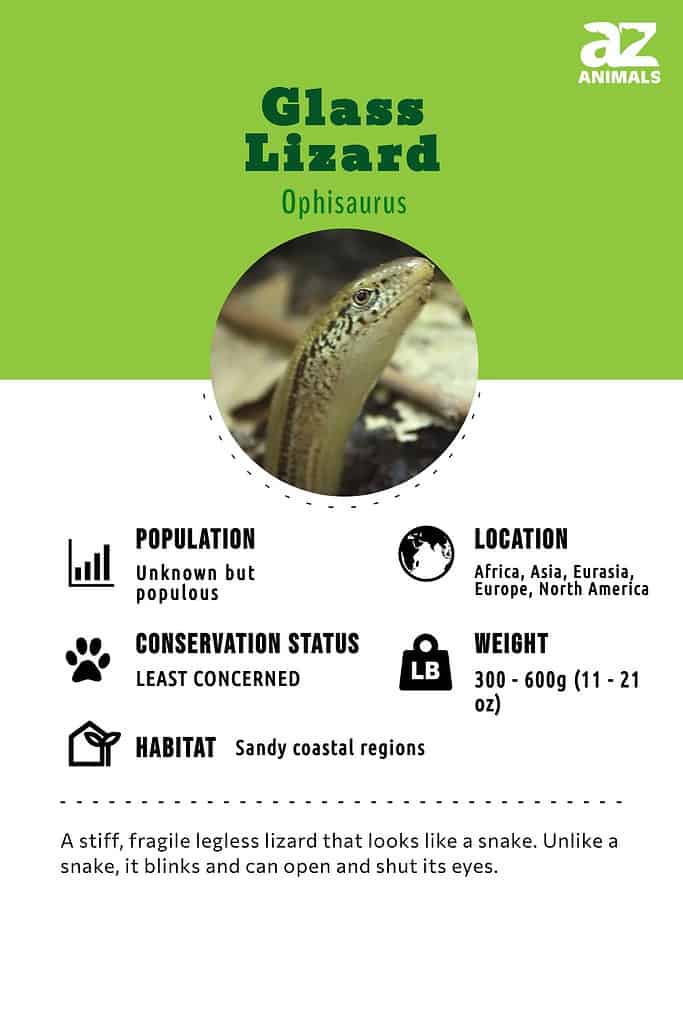
Luckily, Ophisaurus is a resourceful species that has managed to successfully spread across America’s warm and moderate climates. You can tell that you’re looking at a glass lizard if its eyes can open and close; this is something that a snake simply cannot do.

Incredible Glass Lizard Facts!

  • Glass lizards have eyes that can open and close; that’s how you know they’re lizards and not snakes.
  • Glass lizards are shy and squirmy, but they don’t usually bite humans, even when they’re picked up.
  • Although glass lizards are legless, some of them have a small pair of legs located near their rear vents.
  • Glass lizards’ tails break off as a survival mechanism when they are caught by a predator. The tail keeps squirming while the lizard gets away; later, the lizard’s tail will regrow.
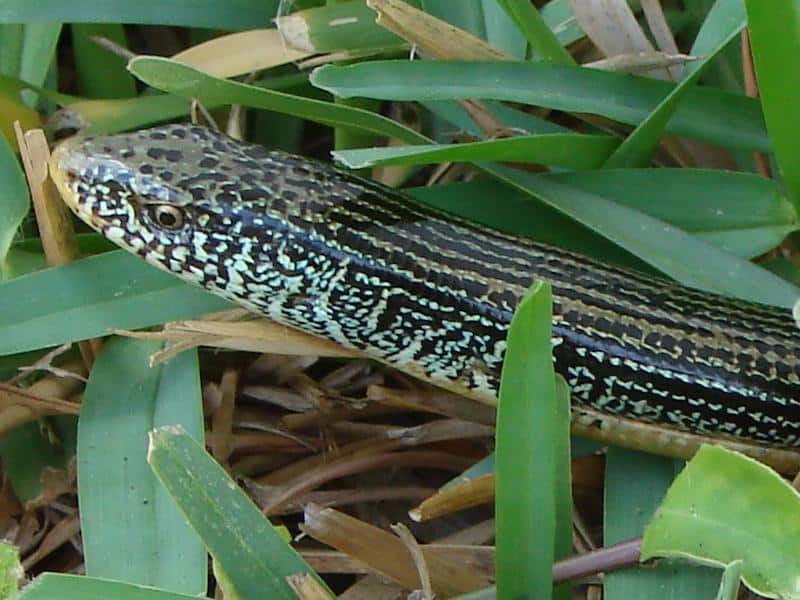
Glass Lizard under leaves

Glass lizards look like snakes – but they blink and can close their eyes.

Scientific Name

The scientific name of these lizards is Ophisaurus. This name is a combination of two Greek words: ophio, which means snake, and sauros, which means lizard. There are several different varieties of glass lizard scattered across the world, including:

  • Ophisaurus ventralis: the eastern glass lizard
  • Ophisaurus compressus: the island glass lizard
  • Ophisaurus mimicus: the mimic glass lizard
  • Ophisaurus attenuatus: the slender glass lizard

Ophisaurus attenuatus also contains the subspecies Ophisaurus attenuatus longicaudus, which are the longest and most slender glass lizards of all.

It’s worth noting that the term “glass lizard” can also be used to refer to members of the genera Dopasia, Hyalosaurus, and Pseudopus, which can be found in Asia, Africa, and Europe. Although these creatures are technically legless lizards, they are not actually related to members of the Ophisaurus genus.

Evolution
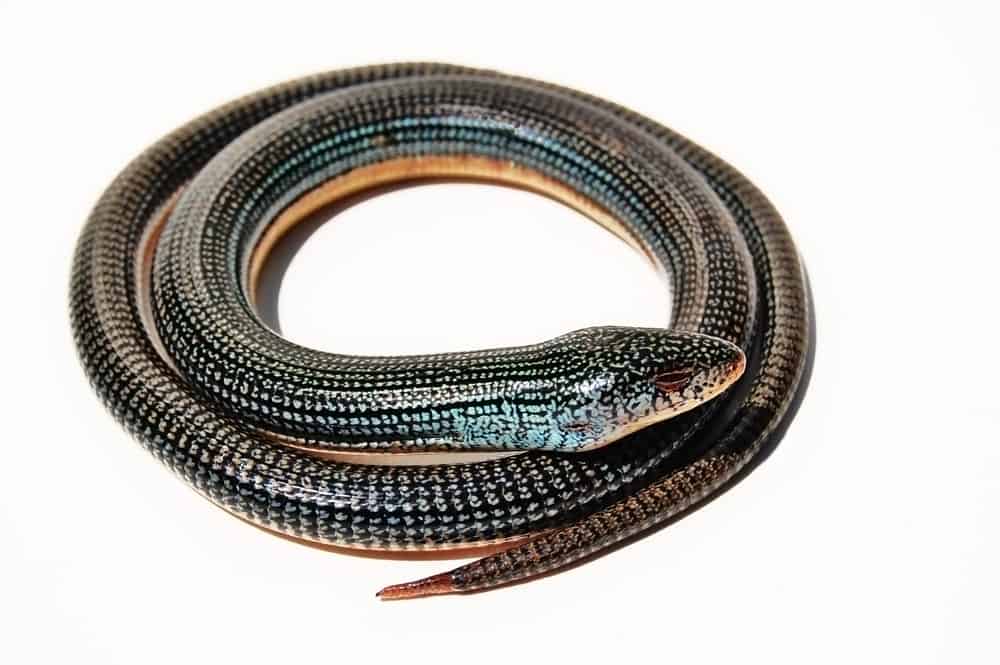
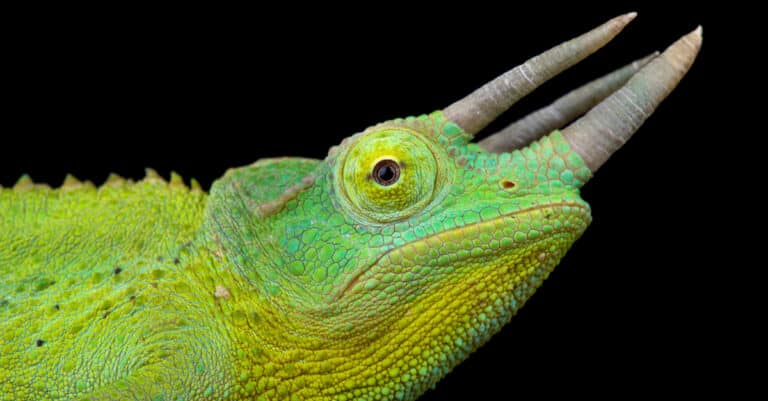
Glass Lizard (Ophisaurus) - green glass lizard on white background

Glass lizards all over the world evolved leglessness independently of each other – this is called convergent evolution.

Glass lizards can not trace their lineage back to one ancestor from which they evolved. Instead, there are species of glass lizard all over the world that evolved leglessness independently of each other – convergent evolution. Over millions of years, these creatures developed smaller and smaller limbs until they just vanished. Some glass lizards still have vestigial back limbs next to their vents. Snakes actually evolved from burrowing or aquatic lizards during the Jurassic period, so glass lizards may be animals that never evolved into snakes but remained in a stage of development that suited their environments. The oldest fossil of a true snake has dated 167 – 143 million years ago.

Appearance
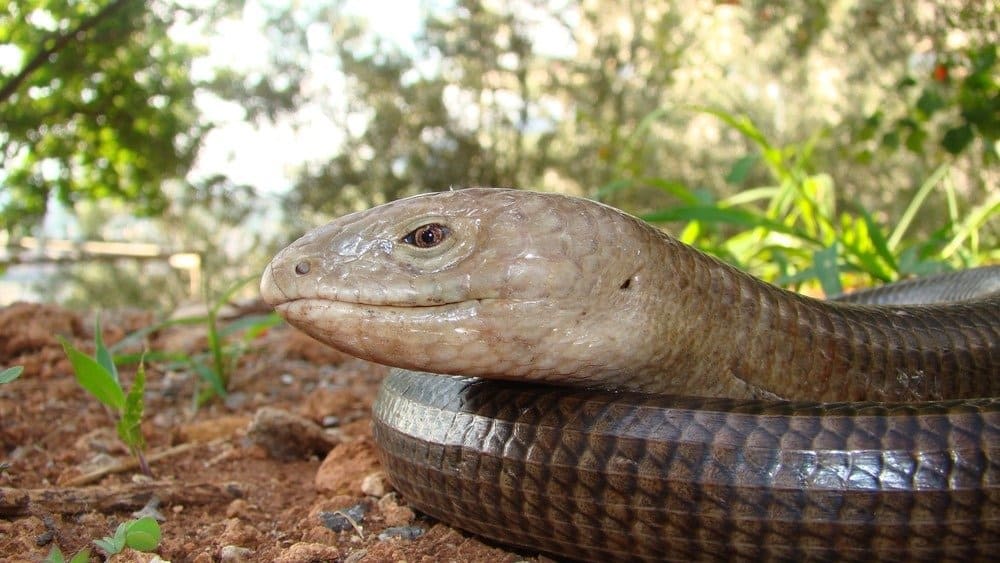
European legless lizard, Pallas's glass lizard

Almost two-thirds of a glass lizard’s length consists of its tail.

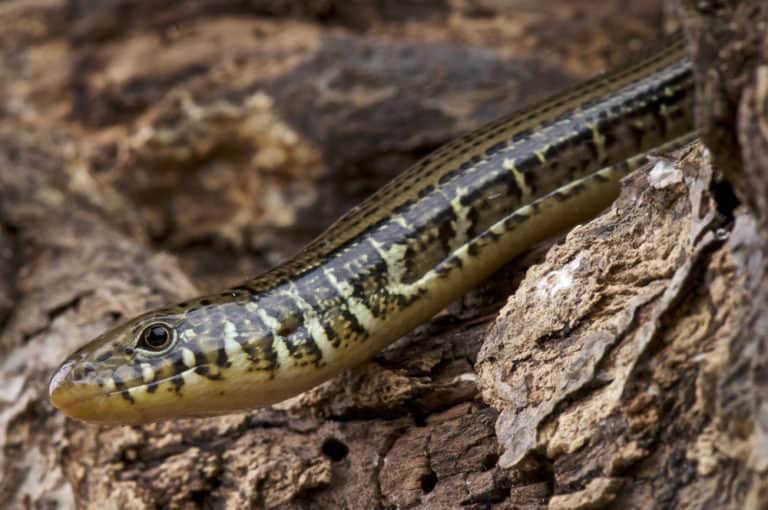
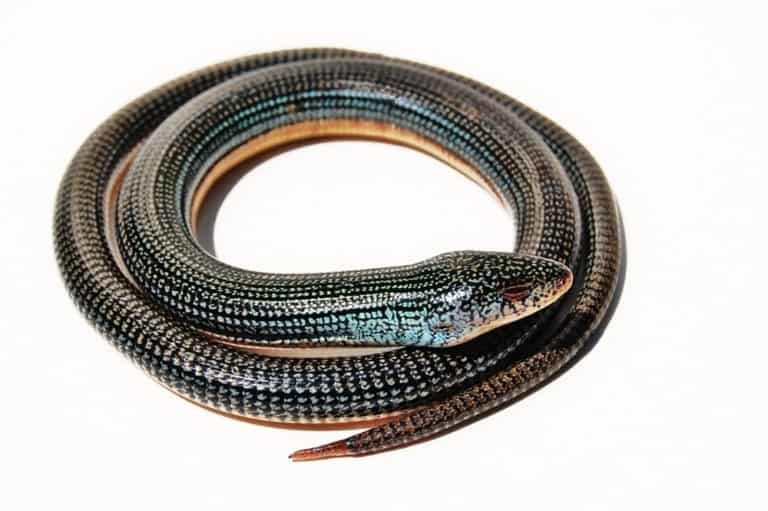
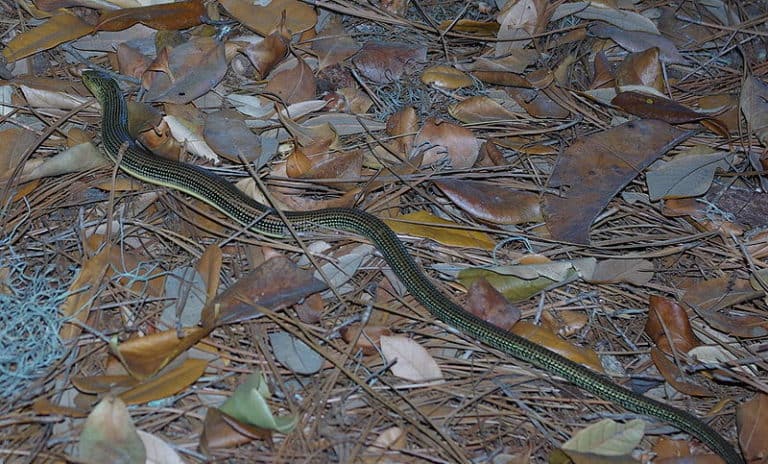
Glass lizards are long, thin reptiles that come in a variety of colors and patterns. Most glass lizards have brown or gray scales with light speckles and a yellow or cream-colored belly. Many of these lizards also have long, dark stripes on their sides that reach from head to tail. Ophisaurus patterns are regional and often help the lizard maintain camouflage in the local environment.

These lizards can grow anywhere between 2 to 4 feet (60 to 121 cm) long. Almost two-thirds of this length consists of the tail, which grows longer as the glass lizard gets older. In addition to the head, body, and tail, some glass lizards may have a nearly unnoticeable pair of legs near their rear vents.

Other key identifying features of these lizards include the two longitudinal grooves that run down either side of their body. These grooves allow the lizard’s internal organs to expand, permitting easy breathing and digestion. Aside from these grooves, glass lizards are rather stiff and fragile. The name “glass lizard” comes from the fact that these creatures can be easily broken if they are improperly handled.

When this lizard’s tail is caught, it may snap off completely. Ophisaurus tails can continue to wriggle and move for several moments after they are detached. This typically confuses the predator, allowing the lizard to make a quick escape. In the months and years that follow, the tail will regrow, although it is usually much shorter and typically lacks the decorative markings of the original.
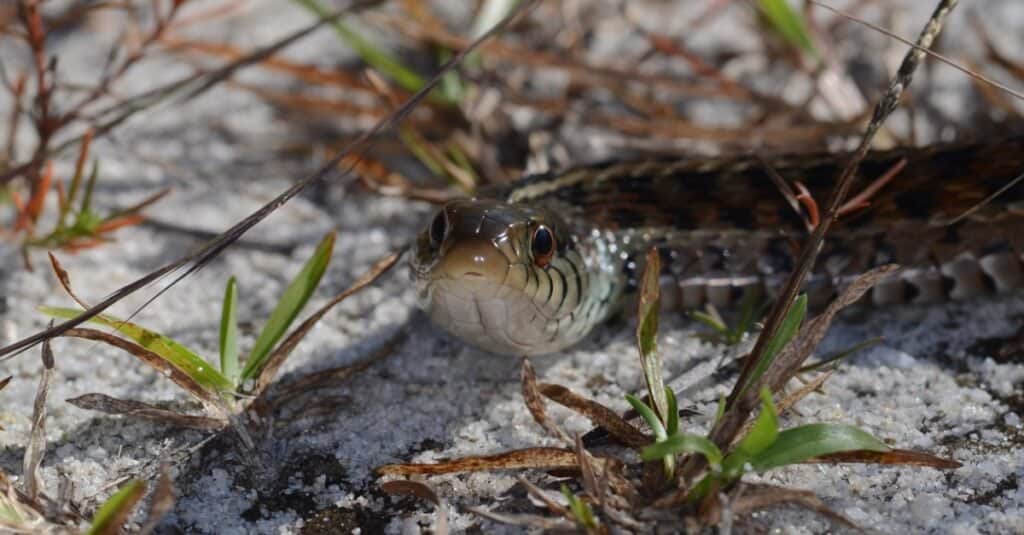
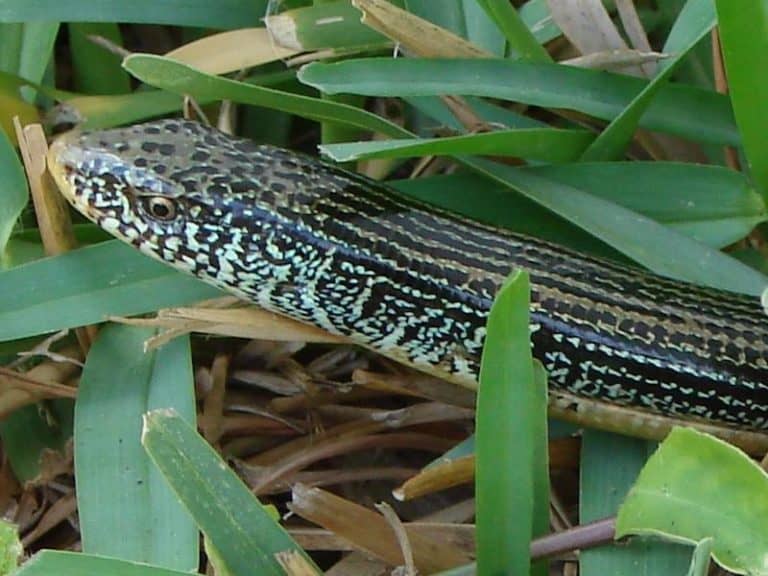
front face view of an eastern glass lizard

The blinking eyelids and round pupils of a glass lizard’s eyes are easily distinguishable from a snake.

Glass Lizard vs. Snake

If you catch a glimpse of this lizard in the wild, you’ll probably assume that you just saw a snake slither by. Glass lizards are long, thin, legless creatures covered with scales – but this is where their similarity to snakes ends.

Unlike snakes, these lizards have moveable eyelids and round pupils that can dilate in the sun. Snake eyes are covered in a thin layer of skin; if the reptile you’re looking at can close its eyes, it’s probably a lizard instead. Similarly, glass lizards have external ear openings on either side of their head, meaning they can rely on sound instead of the ground and wind vibrations that help snakes get around.

Finally, the body of a snake is typically far more flexible than the body of a lizard. This is because snakes have compressed organs, stretchy skin, and other features that allow their unique movement. Glass lizards can’t move like snakes, and attempting to flex them in such a way will invariably cause an injury.

Behavior
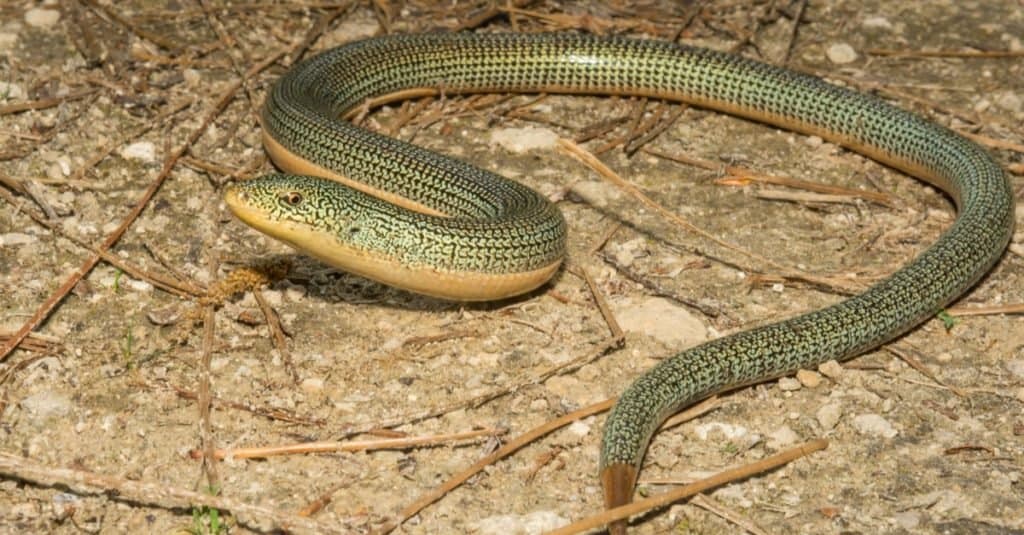
Longest Tail: Eastern Glass Lizard

Glass lizards hibernate in the abandoned burrows of other animals.

These lizards are diurnal creatures that are typically active during moderate temperatures. In the spring and fall, they may be around at all times of the day. In the summer, they tend to be active during the morning and evening. The lizards hibernate during the winter months; don’t expect to see one between October and May.

Although they hibernate, glass lizards don’t actually dig their own burrows. Instead, they find abandoned burrows left behind by other animals. It’s unclear whether these lizards prefer to live alone or in groups, as these creatures are very good at fleeing when under observation.

Glass lizards are shy creatures but are not violent and may allow a human to approach them. The lizards do not bite when they feel threatened; instead, they try to escape. Like other lizards, members of the Ophisaurus family enjoy basking in the sun and may be found on large rocks or even sidewalks during the warmest part of the day.

Habitat
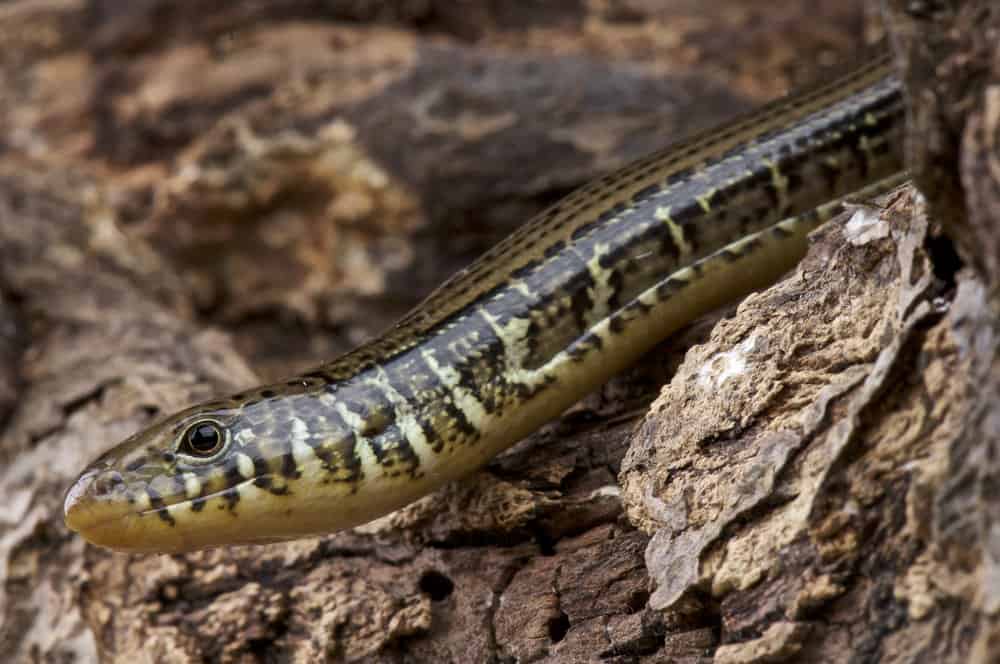
Glass Lizard (Ophisaurus) - face of glass lizard

Glass lizards prefer a warm to moderate climate.

These lizards are endemic to North America and are primarily found in warm to moderate regions, including the midwestern and southeastern parts of the country. Eastern glass lizards are widespread in Florida, Georgia, and the surrounding regions. They tend to prefer wetlands, sandy areas, and similar habitats. Meanwhile, the slender glass lizard prefers to live in the midwest and can be found in woodlands, grassy plains, and other areas with moderate temperatures and good cover.

Diet
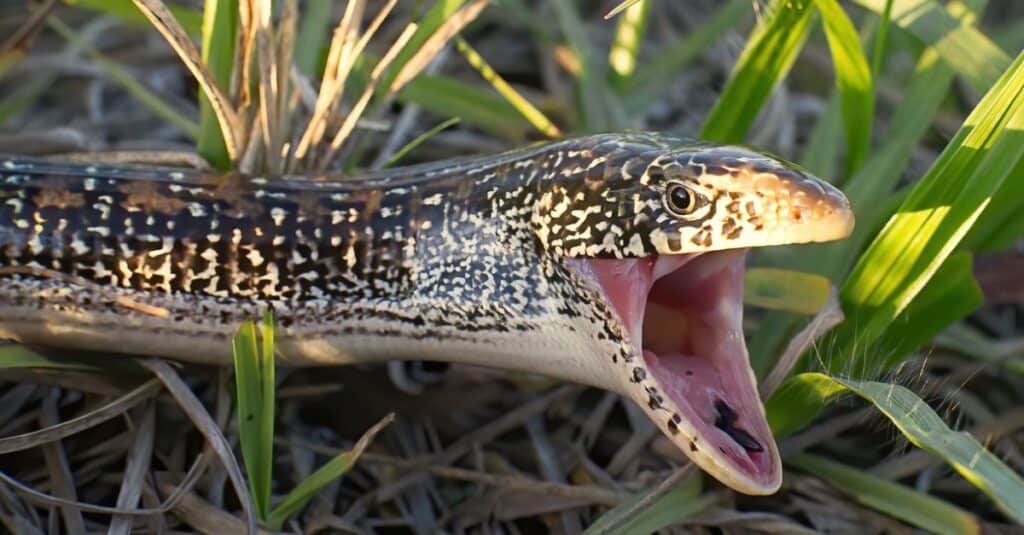
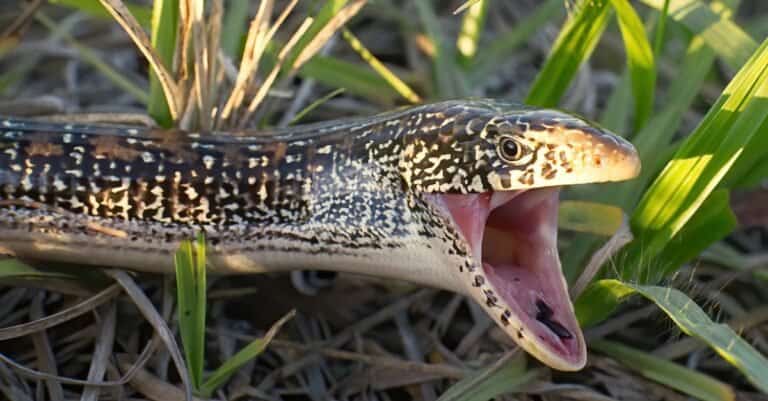
eastern glass lizard with mouth open

The glass lizard, unlike a snake with unhinged jaws, can’t eat anything bigger than its open mouth.

These lizards are carnivores that primarily eat insects like crickets and beetles. However, they also hunt other small creatures, including spiders, rodents, snakes, and even other lizards. They primarily hunt underground but may also look for food in dark, damp areas on the surface.

One of the main differences between these lizards and snakes is that glass lizards cannot unhinge their jaws. This means that the lizard cannot eat anything larger than the size of its head. Even the biggest lizards never weigh more than 21 ounces, which makes mice some of their largest possible prey.

Predators and Threats
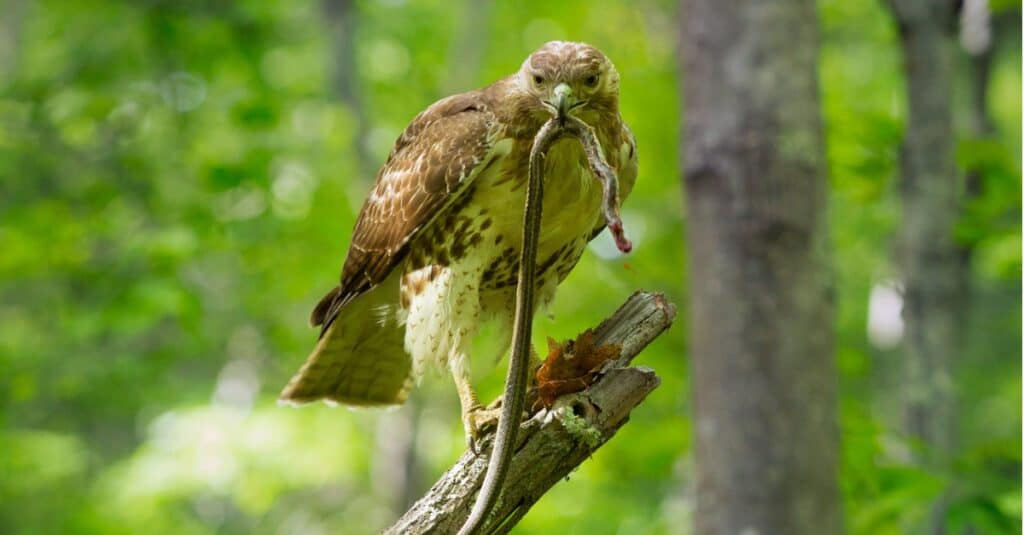
red-tail-hawk-with-garter-snake-in-its-beak

Hawks prey on glass lizards.

The lizard’s natural predators vary based on the region. In general, they avoid raccoons, opossums, hawks, and other carnivorous mammals and birds of prey. Some types of snakes have also been known to feed on these lizards, including copperheads and king snakes.

One of the greatest threats to their survival is habitat disruption caused by humans. Deforestation and paving are the biggest concerns; however, insecticides also pose a substantial threat. If these lizards consume a bug that has ingested pesticides, the lizard may also fall victim to the poison.

Reproduction, Babies, and Lifespan
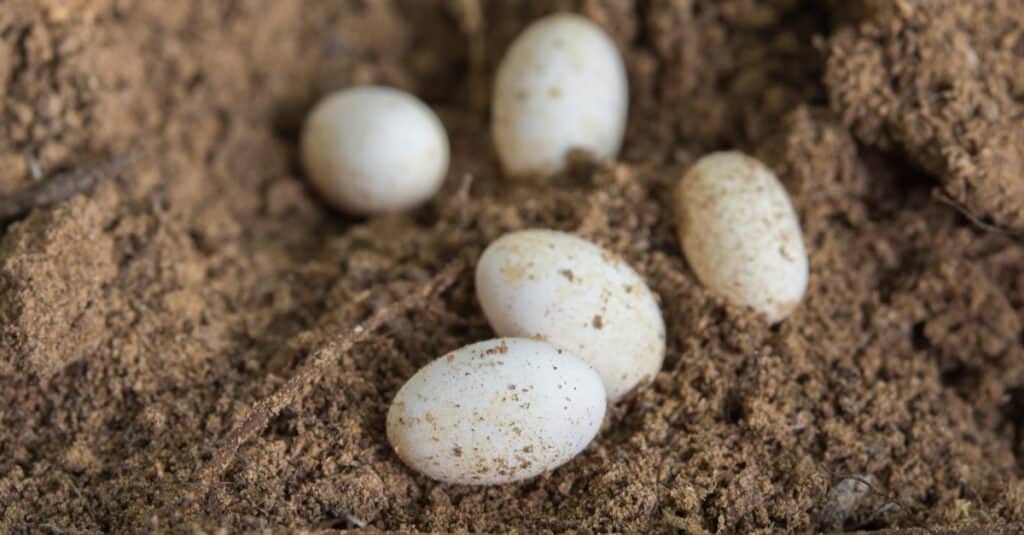
baby lizard eggs

Female glass lizards stay with their eggs until they are hatched – unlike most lizards.

These lizards are egg-laying creatures that mate on a yearly or bi-yearly basis. The Ophisaurus mating season typically occurs in May, although this may vary based on the speed at which warm weather arrives.

After mating, female lizards carry their eggs for one to two months; the clutch of eggs is usually laid in late June or early July. An Ophisaurus clutch typically contains anywhere from 5 to 15 eggs. The mother lizard usually chooses a safe location underneath a covered object like a log or a rock.

Ophisaurus eggs will hatch after roughly 50 days. Female lizards stay with their eggs for this entire time period, a feature that is uncommon among most species of lizard. Freshly hatched lizards are only a few inches long and may need help feeding themselves until they are larger.

These lizards are sexually mature at 3 to 4 years of age. The average lifespan of a glass lizard is 10 years, but some have been known to survive for as long as 30 years. It is rare for this lizard to go its entire life without needing to regrow its tail, which is why there are no recorded instances of the lizard getting more than 4 feet long.

Population
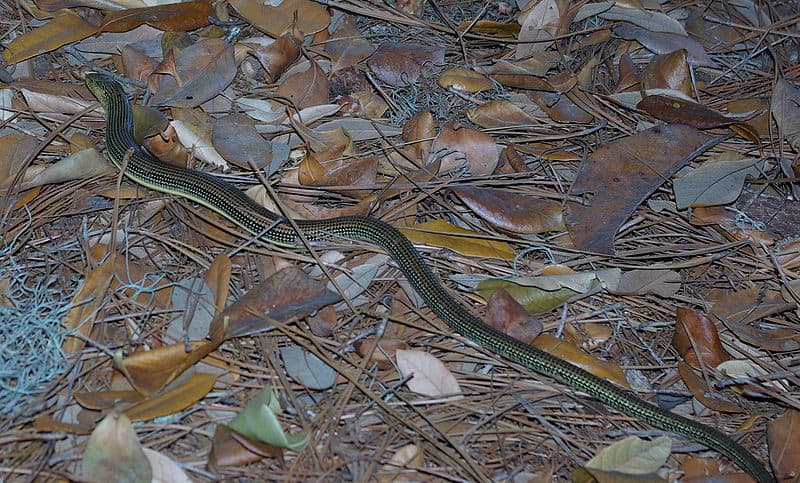
Glass Lizard on the ground

Glass lizards have a conservation status of least concern.

These lizards are not an endangered species. In fact, the International Union for Conservation of Nature has classified Ophisaurus as a least concern species because they have no immediate threats.

With that said, these lizards are still threatened by the encroachment of human populations on their existing habitats. The lizard populations have been dropping across the Midwest, and they are even considered endangered in the state of Wyoming

In the Zoo

These lizards are common enough to be featured in zoos around the world. From small zoos like the one at Chehaw Park to more prominent locations like Florida’s Jacksonville Zoo and Gardens, Ophisaurus can be found in nearly any well-established reptile house.

View all 261 animals that start with G

Sources

  1. David Burnie, Dorling Kindersley (2011) Animal, The Definitive Visual Guide To The World's Wildlife / Accessed July 5, 2010
  2. Tom Jackson, Lorenz Books (2007) The World Encyclopedia Of Animals / Accessed July 5, 2010
  3. David Burnie, Kingfisher (2011) The Kingfisher Animal Encyclopedia / Accessed July 5, 2010
  4. Richard Mackay, University of California Press (2009) The Atlas Of Endangered Species / Accessed July 5, 2010
  5. David Burnie, Dorling Kindersley (2008) Illustrated Encyclopedia Of Animals / Accessed July 5, 2010
  6. Dorling Kindersley (2006) Dorling Kindersley Encyclopedia Of Animals / Accessed July 5, 2010
  7. Snakes Are Long / Accessed November 13, 2020
  8. Virginia Herpetological Society / Accessed November 13, 2020
  9. Britannica / Accessed November 13, 2020
Lisha Pace

About the Author

Lisha Pace

After a career of working to provide opportunities for local communities to experience and create art, I am enjoying having time to write about two of my favorite things - nature and animals. Half of my life is spent outdoors, usually with my husband and sweet little fourteen year old dog. We love to take walks by the lake and take photos of the animals we meet including: otters, ospreys, Canadian geese, ducks and nesting bald eagles. I also enjoy reading, discovering books to add to my library, collecting and playing vinyl, and listening to my son's music.

Thank you for reading! Have some feedback for us?


Glass Lizard FAQs (Frequently Asked Questions)

Glass lizards primarily eat insects, spiders, and other small creatures. A glass lizard can’t eat anything larger than its head, which is why you won’t see one eating birds or larger rodents. However, you might see a glass lizard eating a snake or even another kind of lizard.