
G
Species Profile

Golden Lion Tamarin

Leontopithecus rosalia

Golden mane, forest guardian
Eric Gevaert/Shutterstock.com

Golden Lion Tamarin Distribution

Click a location to explore more animals from that region

Endemic Species
Loading map...

Found in 1 country

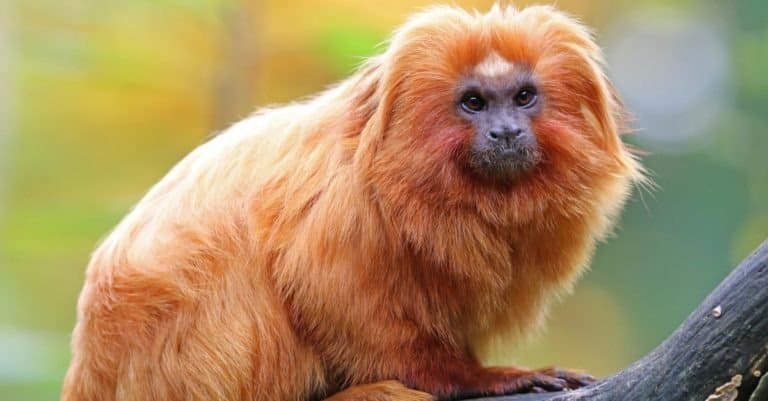
Golden Lion Tamarin close-up

At a Glance

Wild Species
Also Known As Golden lion monkey, Golden tamarin, Lion tamarin, Golden marmoset, Golden lion marmoset, Mico-leão-dourado, Mico león dorado
Diet Omnivore
Activity Diurnal+
Lifespan 10 years
Weight 0.75 lbs
Status Endangered
Did You Know?

Adult size: head-body length about 20.5-33.0 cm; tail about 31-40 cm; mass commonly reported about 0.49-0.71 kg (Callitrichidae-sized primate).

Scientific Classification

A small New World monkey (callitrichid) endemic to Brazil’s Atlantic Forest, notable for its bright orange-gold coat and mane-like facial ruff. It is a cooperative breeder living in family groups and primarily feeds on fruits, insects, and small vertebrates.

Kingdom
Animalia
Phylum
Chordata
Class
Mammalia
Order
Primates
Family
Callitrichidae
Genus
Leontopithecus
Species
Leontopithecus rosalia

Distinguishing Features

  • Brilliant golden-orange pelage with a lion-like mane framing the face
  • Small-bodied callitrichid with claw-like nails (tegulae) on most digits, aiding vertical clinging
  • Long tail used for balance (not prehensile)
  • Typically lives in cooperative family groups with helpers caring for twins

Physical Measurements

Length
1 ft 11 in (1 ft 8 in – 2 ft 2 in)
Weight
1 lbs (1 lbs – 2 lbs)
Tail Length
1 ft 2 in (1 ft – 1 ft 4 in)

Appearance

Primary Colors
Secondary Colors
Skin Type Golden lion tamarin has dense, soft fur with long hairs forming a mane; facial skin is bare and dark. Most fingers have claw-like nails for clinging and foraging; big toe nail is flat.
Distinctive Features
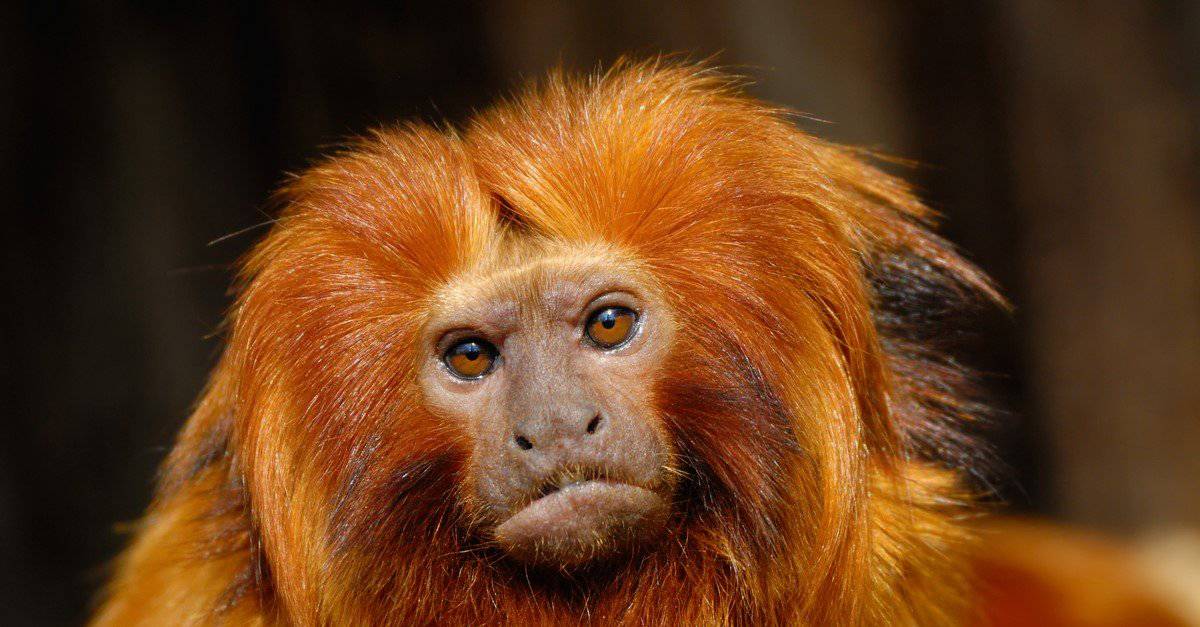
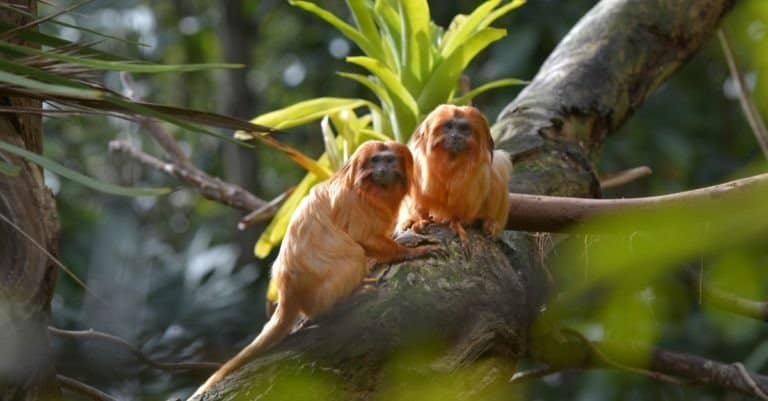
  • Bright orange-gold pelage with a conspicuous mane-like facial ruff framing a dark, mostly hairless face-key field mark for the golden lion tamarin (Atlantic Forest, Brazil).
  • Small callitrichid monkey: adult body (head-to-body) length about 20–33 cm, tail 31–40 cm long, and adult weight typically about 0.5–0.7 kg.
  • Long, non-prehensile tail used primarily for balance during mid- to upper-canopy travel and vertical clinging/leaping; not adapted for grasping branches like atelines.
  • Like other Callitrichidae, golden lion tamarins have claw-like tegulae on most toes to cling while foraging. They eat fruit and insects and often use the mid and upper Atlantic Forest canopy.
  • Golden lion tamarins live and breed in family groups with one main breeding female. Twins are common, and males and helpers carry babies a lot, shown by long-term studies in Brazil.
  • Flagship conservation context tied to appearance: the conspicuous golden coat is central to its role as a symbol of Atlantic Forest conservation, including habitat restoration and reintroduction/translocation programs in Rio de Janeiro state.
  • Longevity commonly cited as ~8 years in the wild and up to ~15-20 years in captivity in compiled species accounts (e.g., ADW and zoo/managed-care summaries; exact maxima vary by record-keeping source).

Did You Know?

Adult size: head-body length about 20.5-33.0 cm; tail about 31-40 cm; mass commonly reported about 0.49-0.71 kg (Callitrichidae-sized primate).

Reproduction is "twin-biased": litters are most often twins, a hallmark of callitrichids; helpers (older siblings/relatives) routinely assist with infant care.

Gestation is about 4 months (commonly reported ~125-132 days in Leontopithecus), followed by intense alloparental care-especially infant carrying by males and helpers.

They sleep in tree holes and other cavities, which can reduce predation risk and buffer temperature swings in the forest canopy.

Foraging is a mixed strategy: fruit is a major energy source, while insects and small vertebrates add protein; they frequently probe bromeliads, crevices, and curled leaves for hidden prey.

A flagship conservation success: once reduced to a tiny, fragmented wild population in Rio de Janeiro state, it became the focus of habitat restoration, corridor creation, and reintroductions from coordinated captive breeding.

Unique Adaptations

  • Claw-like nails (tegulae) on most digits (typical of callitrichids), improving grip on trunks and aiding insect-foraging in bark and crevices; the big toe retains a flatter nail for grasping.
  • "Lion-like" facial ruff: elongated mane hair frames the face and is used in social display; its vivid orange-gold coat is among the most distinctive of New World primates.
  • Small-bodied, agile locomotion suited to the Atlantic Forest canopy: low mass and grasping hands/feet support rapid climbing and branch running in complex vegetation.
  • Dietary flexibility: the ability to switch among seasonal fruits, arthropods, and small vertebrate prey helps them persist in a forest where resources fluctuate strongly across seasons.
  • High-investment family care: frequent twinning is balanced by cooperative breeding, distributing the energetic cost of raising infants across the group-an adaptation central to callitrichid life history.

Interesting Behaviors

  • Cooperative breeding and "helper" system: typically one breeding female with a small family group; nonbreeding adults/juveniles provision and carry infants, increasing infant survival.
  • Infant carrying is intensive: newborn twins are often transported by the male or helpers for long periods, with infants returning to the mother mainly to nurse.
  • Mid-upper canopy foraging: they travel and search in arboreal pathways, often using vertical supports to scan and pick prey from bark, epiphytes, and leaf axils.
  • Cavity use: daily routines commonly include selecting safe sleeping cavities; groups may reuse favored holes and defend access.
  • Scent-marking and vocal coordination: like other callitrichids, they use scent marks and calls to maintain cohesion, advertise presence, and coordinate movement in dense forest.
  • Opportunistic predation: alongside insects, they may take small lizards, frogs, or bird eggs/chicks when encountered-useful protein in a fruit-heavy diet.

Cultural Significance

The golden lion tamarin (Leontopithecus rosalia) is a symbol of Brazil's Atlantic Forest and is used to help protect habitat, restore forest corridors, and guide careful reintroductions after captive breeding and forest restoration.

Myths & Legends

Its common name refers to its bright golden coat and the lion-like mane of hair around its face; in Brazil it is widely used as a flagship symbol in Atlantic Forest conservation and environmental education.

Leontopithecus rosalia was named in the 18th century (Linnaeus called it Simia rosalia). Europeans thought its face ruff looked like a tiny lion's mane, so 'lion' stuck in the name.

A famous conservation story: golden lion tamarins (Leontopithecus rosalia) bred in captivity were released at Poco das Antas Biological Reserve, with Atlantic Forest restoration and corridors reconnecting forest fragments to help wildlife rebound.

Conservation Status

EN Endangered

Facing a very high risk of extinction in the wild.

Population Decreasing

Protected Under

  • CITES Appendix I (international commercial trade prohibited, with limited exceptions).
  • Brazil: Law No. 5,197/1967 (Fauna Protection Law) - prohibits hunting/capture of native wildlife except as authorized.
  • Brazil: Atlantic Forest Law No. 11,428/2006 - legal framework for protection/use of Atlantic Forest native vegetation.
  • Occurs in and is managed through multiple protected areas in its range (e.g., Poco das Antas Biological Reserve and Uniao Biological Reserve, Rio de Janeiro), plus surrounding conservation mosaics and restoration corridors supported by national/NGO programs.

Life Cycle

Birth 2 infants
Lifespan 10 years

Lifespan

In the Wild
8–15 years
In Captivity
10–23 years

Reproduction

Mating System Monogamy
Social Structure Cooperative Breeder
Breeding Pattern Long Term
Fertilization Internal Fertilization
Birth Type Internal_fertilization

Behavior & Ecology

Social Troop Group: 6
Activity Diurnal, Matutinal, Vespertine
Diet Omnivore Ripe fleshy fruits (primary staple), supplemented by large, energy-rich insect prey (field diet studies in Brazil's Atlantic Forest report fruit as the dominant dietary component, with animal prey-mainly insects-making a substantial secondary contribution; e.g., Dietz et al. 1997; Rylands 1996; Kleiman & Rylands 2002).

Temperament

Highly social and affiliative within the troop (frequent grooming, close proximity, play in juveniles), with strong cooperative infant care and food sharing; alloparental care is a defining behavioral hub across callitrichids (Savage et al., 1996).
Golden lion tamarin (Leontopithecus rosalia) groups are territorial, defend overlapping home ranges, use calls and chasing in encounters, with ranges often tens of hectares (about 40-100 ha), varying by habitat and group size.
Vigilant and cautious (high predator sensitivity); scans and rapid retreat to dense cover are typical; alarm calling can mobilize the whole group.
They forage together, move in sync, quickly use patchy foods like fruit and insects, sometimes catch small animals, follow group members (callitrichid hub behavior), and boldness varies by age, sex, and local predators.

Communication

Long-distance 'long calls' used in spacing/territorial advertisement and intergroup context Commonly described as loud, multi-syllabic calls in Leontopithecus
Contact calls (soft trills/peeps/twitters) to maintain group cohesion during foraging and travel.
Alarm calls that differ with threat context (aerial vs terrestrial predators reported in callitrichids), often triggering group-wide vigilance/retreat.
Infant distress calls that elicit rapid approach/carrying by multiple group members Consistent with cooperative care
Scent marking via specialized glands Notably anogenital/suprapubic) and urine marking; used for territorial boundaries, travel routes, and reproductive/social signaling (common callitrichid hub
Visual displays during intergroup encounters (piloerection of the mane/ruff, body postures, chasing) and facial expressions at close range.
Tactile communication: social grooming, huddling, and infant handling/carrying as key affiliative signals; food transfer to juveniles and mates functions as both nutrition and social bonding.

Habitat

Biomes:
Tropical Rainforest Wetland
Terrain:
Coastal Riverine Plains
Elevation: Up to 984 ft 3 in

Ecological Role

Omnivorous frugivore-insectivore that functions both as an important seed disperser and a mesopredator of arthropods/small vertebrates in Brazil's Atlantic Forest.

Seed dispersal (moving and defecating viable seeds away from parent trees, supporting forest regeneration and plant gene flow) Regulation of arthropod populations via predation (potentially influencing herbivory pressure on plants) Linking epiphyte microhabitats (e.g., bromeliads) to broader food webs by extracting and transferring energy from concealed invertebrate prey to higher trophic levels

Diet Details

Main Prey:
Arthropods Small vertebrates Bird eggs and nestlings
Other Foods:
Fleshy fruits Nectar and flowers Plant exudates

Human Interaction

Domestication Status

Wild

The golden lion tamarin (Leontopithecus rosalia) is a wild, non-domesticated primate from Brazil's Atlantic Forest. Captive groups are kept for conservation, breeding, research, and zoos, not pet breeding. Humans caused habitat loss and pet trade threats; reintroduction programs, managed breeding, and habitat work support recovery. Their social needs and small size make pet keeping harmful.

Danger Level

Low
  • Bites/scratches: Small primate but can inflict painful bites; risk increases with handling, captivity, or cornering.
  • Zoonotic and reverse-zoonotic disease risk: Potential transmission of enteric pathogens (e.g., Salmonella/Shigella), parasites (e.g., Giardia), and respiratory viruses in close contact settings; callitrichids are also notably vulnerable to human pathogens, making human-to-tamarin transmission a major welfare and conservation risk (reintroductions and captive settings).
  • Behavioral stress/aggression in captivity: Cooperative-breeding, highly social animals may exhibit stress-related behaviors when isolated or improperly housed, increasing handling injuries.

As a Pet

Not Suitable as Pet

Legality: Golden lion tamarin (Leontopithecus rosalia) are not legal pets. Listed on CITES Appendix I, they need special permits. Brazil, the U.S., EU/UK and most places ban or tightly control private ownership.

Care Level: Expert Only

Purchase Cost:
Lifetime Cost: $30,000 - $120,000

Economic Value

Uses:
Conservation flagship value Zoo and educational exhibition Ecotourism (localized) Scientific research and monitoring Ecosystem services (seed dispersal/insect predation-indirect value)
Products:
  • No legitimate commodity products; value is primarily non-consumptive (education, conservation fundraising, ecotourism) rather than extractive use.

Relationships

Predators 8

Margay
Margay Leopardus wiedii
Ocelot
Ocelot Leopardus pardalis
Tayra Eira barbara
Ornate hawk-eagle Spizaetus ornatus
Black-and-white hawk-eagle Spizaetus melanoleucus
Crested eagle Morphnus guianensis
Jararaca pit viper Bothrops jararaca
Boa constrictor
Boa constrictor Boa constrictor

Related Species 9

Golden-headed lion tamarin Leontopithecus chrysomelas Shared Genus
Black lion tamarin Leontopithecus chrysopygus Shared Genus
Superagui lion tamarin Leontopithecus caissara Shared Genus
Cotton-top tamarin
Cotton-top tamarin Saguinus oedipus Shared Family
Red-handed tamarin
Red-handed tamarin Saguinus midas Shared Family
Pied tamarin
Pied tamarin Saguinus bicolor Shared Family
Common marmoset Callithrix jacchus Shared Family
Geoffroy's marmoset Callithrix geoffroyi Shared Family
Pygmy marmoset
Pygmy marmoset Cebuella pygmaea Shared Family

Ecological Equivalents 4

Animals that fill a similar ecological role in their ecosystem

Cotton-top tamarin
Cotton-top tamarin Saguinus oedipus Small-bodied callitrichid that lives in cohesive social groups, practices cooperative care of young, and forages primarily on fruits and arthropods in the forest canopy and understory; very similar niche structure and foraging mode (fruit, insects, and small vertebrates).
Geoffroy's marmoset Callithrix geoffroyi Sympatric or nearby Atlantic Forest callitrichid with comparable body size and arboreal movement; overlaps strongly in insectivory and fruit feeding, and uses tree holes and exudate resources, creating similar constraints and predator exposure in mid-canopy habitats.
Pied tamarin
Pied tamarin Saguinus bicolor Arboreal frugivore–insectivore that frequently exploits edge and secondary forest, relying on rapid quadrupedal foraging and vigilance. Ecologically analogous despite occurring in a different Brazilian forest region.
Black capuchin Sapajus nigritus An Atlantic Forest primate that eats fruit, insects, and small vertebrates and forages in the canopy; although it is larger and does not breed in groups, it has a similar arboreal diet and may share feeding sites and predator-avoidance strategies.

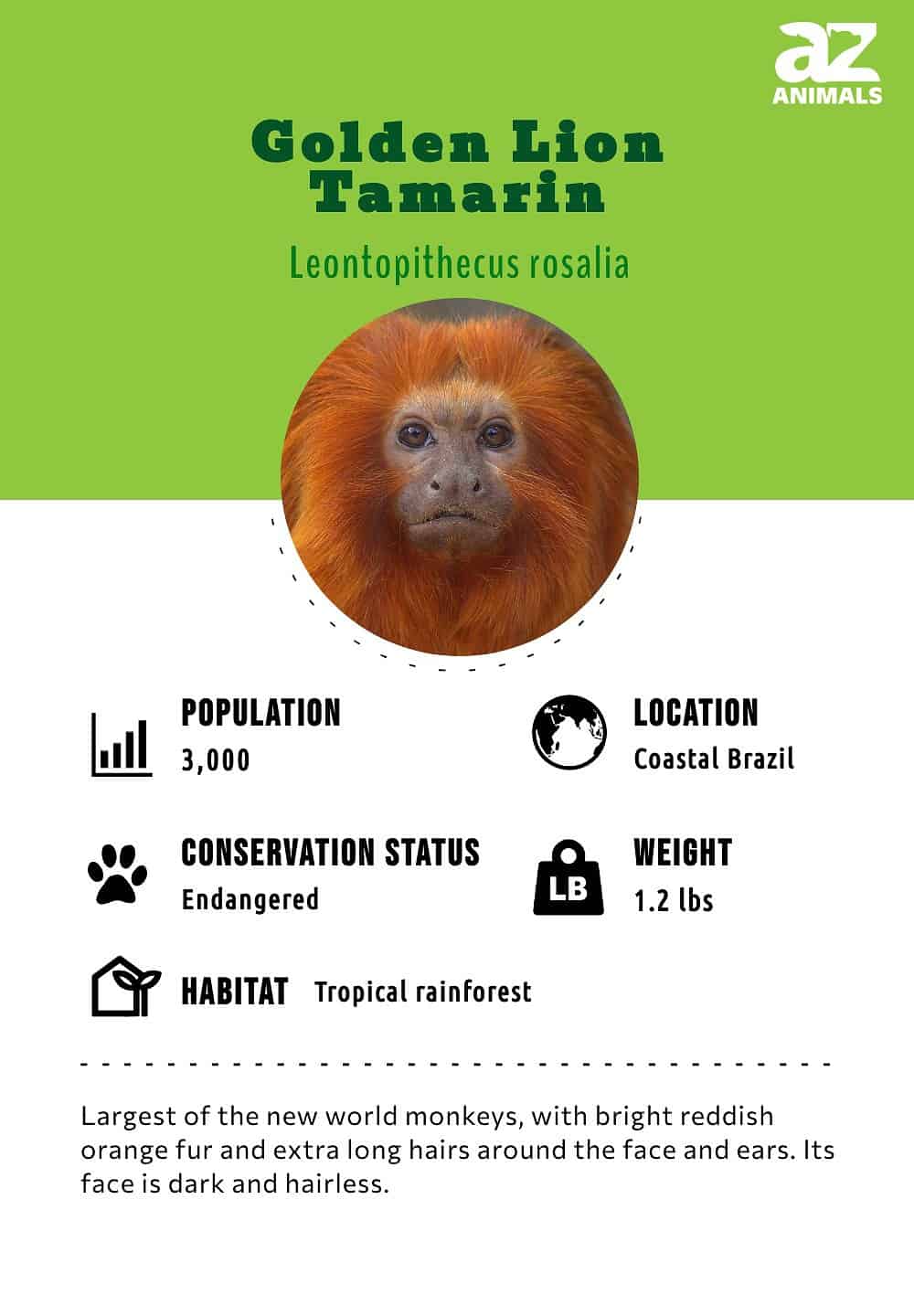
The golden lion tamarin is a small monkey native to coastal Brazil.

Sometimes called a golden marmoset, it has a long tail, reddish-gold fur, and a dramatic mane that frames its face. Due in part to shrinking habitat, the golden lion tamarin population has dwindled dangerously near extinction, but intensive conservation efforts over the past few years have pulled it back to endangered status. Currently, less than 3,000 individuals occupy the rainforests of Brazil’s southern Atlantic coast.

5 Facts About The Golden Lion Tamarin

  • Females typically give birth to twins.
  • The golden lion tamarin has a high risk of mortality – close to 50 percent – in its first year of life.
  • This type of monkey has an average lifespan of 10 years in the wild.
  • It mainly eats fruit, nuts, and small animals.
  • It has claw-like nails rather than flat nails like other primates.
Scientific Name
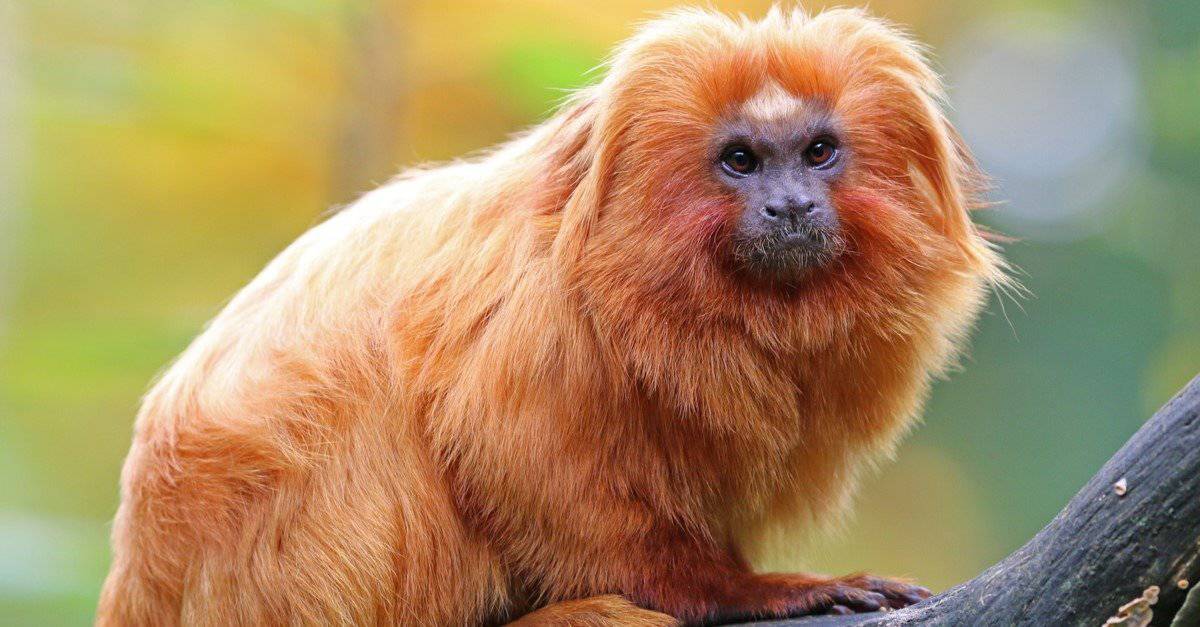
The golden lion tamarin is a small, New World monkey that belongs to the Callitrichidae family of arboreal mammals. Its scientific name is Leontopithecus rosalia, which refers both to its lion-like mane and its red coloring. All four tamarin species live in Brazilian rainforests.

Evolution And Origin

As a new world monkey, the golden lion tamarin is a descendant of an ancient African primate that is said to have migrated to South America on a raft constructed of vegetation. Due to a lack of fossil evidence, the exact origin of the early primates is not entirely known. It is believed that new-world monkeys began to appear in the middle of the Cenozoic epoch, during the Paleogene era, around 66 million to 23 million years ago, and they most likely split from the old-world monkeys sometime around 40 million years ago.

Types Of

Also known as the golden marmoset, the golden lion tamarin shares the Leontopithecus genus with three other species:

  • Golden-headed lion tamarin or Leontopithecus chrysamelus
  • Black lion tamarin or Leontopithecus chrysopygus
  • Superagui lion tamarin or Leontopithecus caissara

Appearance
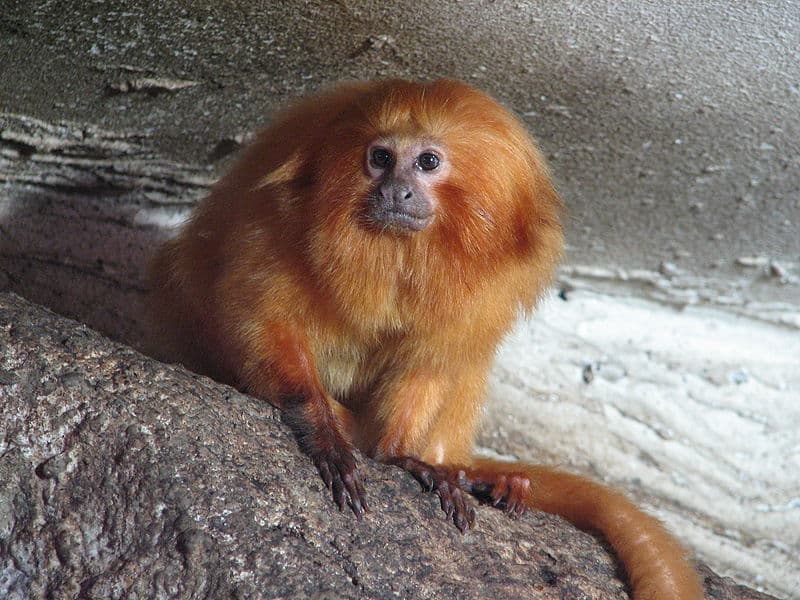
Golden Lion Tamarin has a luxurious reddish-gold coat that covers its entire body with the exception of its face and paws.

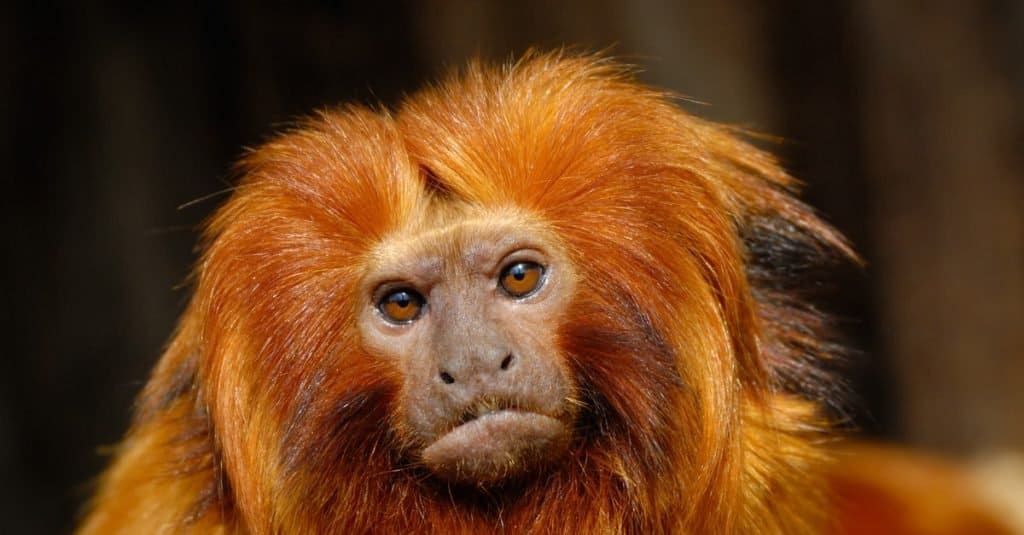
A pint-sized monkey that lives in the trees, the golden marmoset has a luxurious, long reddish-gold coat that covers its entire body except for its face and paws. A ruff of fur frames its furless face and sweeps back over the ears like the mane of a lion, lending this New World monkey an exotic appearance. It also has a hank of red-gold whiskers on each cheek.

The tamarin’s paws resemble hands, but rather than flat fingernails, or ungulae, like those of humans and other primates, the tamarin has claws, which are also called tegulae. These help it dig into tree bark to get the insects it eats and to cling to branches as it travels through the treetops.

The weight range for golden lion tamarins, the largest Leontopithecus species, is between 482 and 680 grams (17 and 24 ounces), so they are about the size of a gray squirrel. Tamarins measure 15 to 25 centimeters in length (6 to 10 inches). Their tails add about 32-40 centimeters (12 to 15 inches) to their length. Males and females are usually similar in size and weight.

Behavior
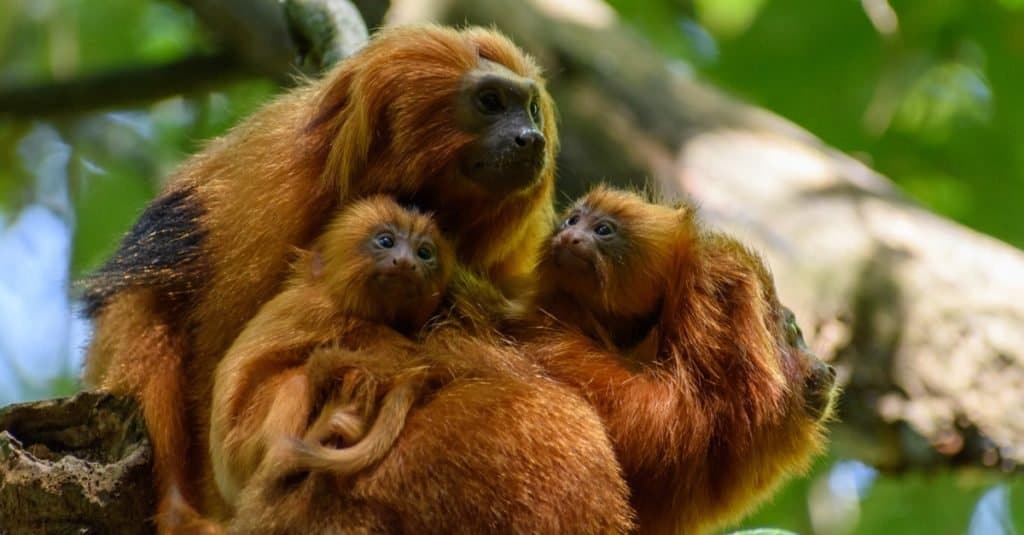
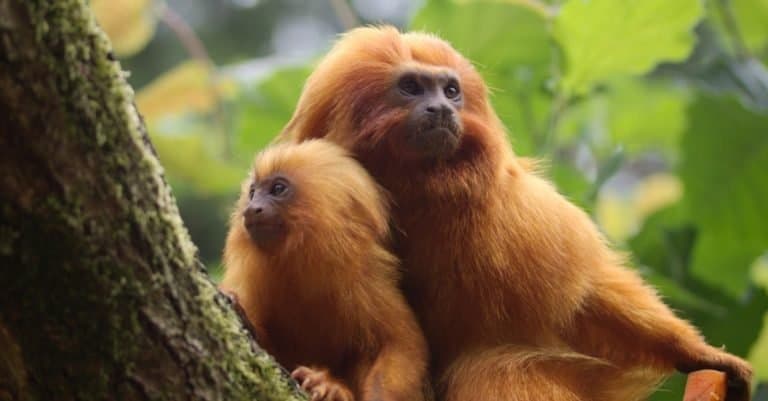
Golden Lion Tamarin family sitting in a tree

The tamarin is a social creature and has a core group of up to 8 relatives.

Like squirrels, the tamarin travels on all fours, scurrying between tree branches 10 to 30 meters (29 to 100 feet) above the forest floor. It digs into cracks in the tree bark for insects. It pries into small holes with its deft, hairless fingers. It then shares whatever food is available with its family group.

These arboreal creatures are social within a core group of up to eight relatives. Like other monkeys, they groom each other, and the young ones play together. The mating pair in each family group is typically monogamous for life.

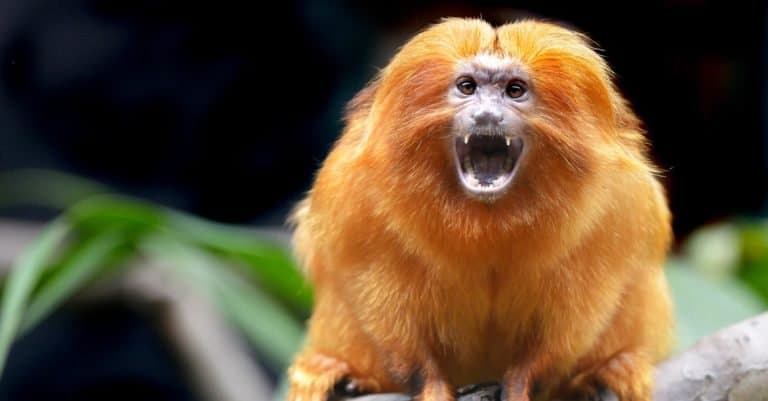
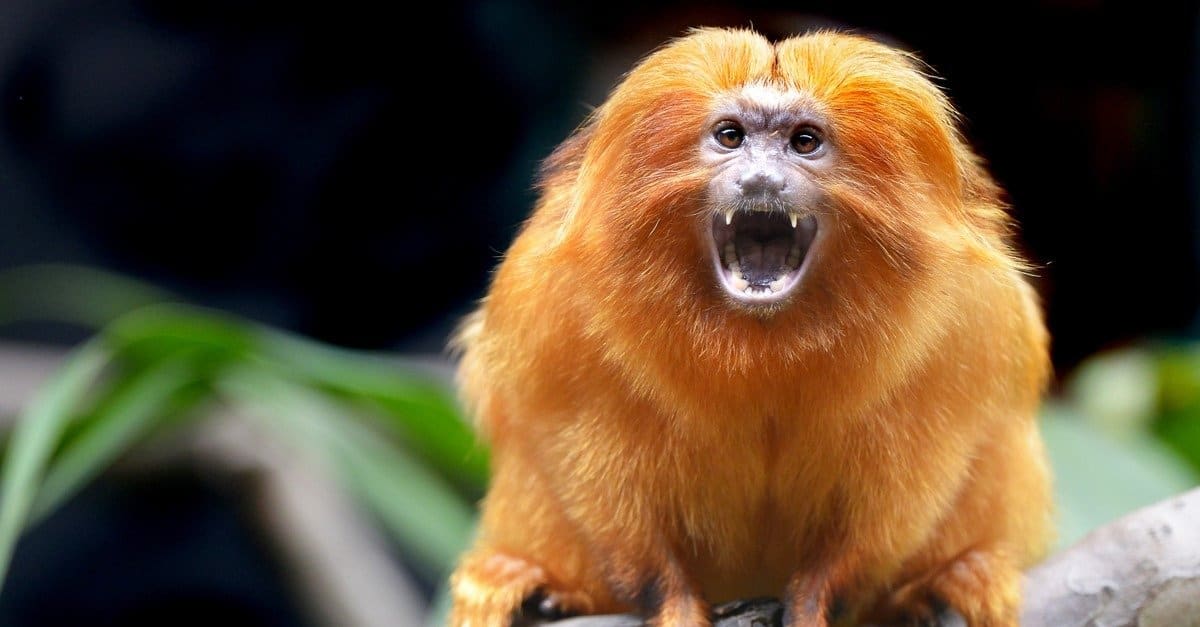
Golden lion tamarin families are part of larger troops that mark their territory with scent to ward off outsiders. They also vocalize whining calls to warn of danger. When they are in an aggressive mode, they arch their backs, open their mouths and stare. They make peeping calls when feeling friendly.

These golden marmosets also have a trilling call in their vocabulary, which they use to let others in their troop know their location. They may cluck when searching for food, and screech in delight when playing.

Groups of tamarins re-nest often as another measure to evade predators. They will nestle in the hollows of trees, bed down on a nest of vines, or another sheltered spot high in the treetops. Their typical daytime routine consists of foraging for fruit and nectar in the morning and then catching insects in the afternoon. In the late afternoon to evening, they choose a new sleeping spot.

Habitat
Golden lion tamarins live in three small regions of southeastern Brazil. Their rainforest habitat has shrunk to less than three percent of its former size due to human activities and encroachment. All three locations are wildlife preserves: Poco das Antas Biological Reserve, Unaio Biological Reserve, and a privately owned reserve that works with the Reintroduction Program, all in the state of Rio de Janeiro.

Different troops have made adaptations to survive in various types of terrain. Due to a fractured habitat, some live in lowland coastal rainforests while others prefer forested hilltops or wetlands along Brazil’s southeastern coast.

Diet
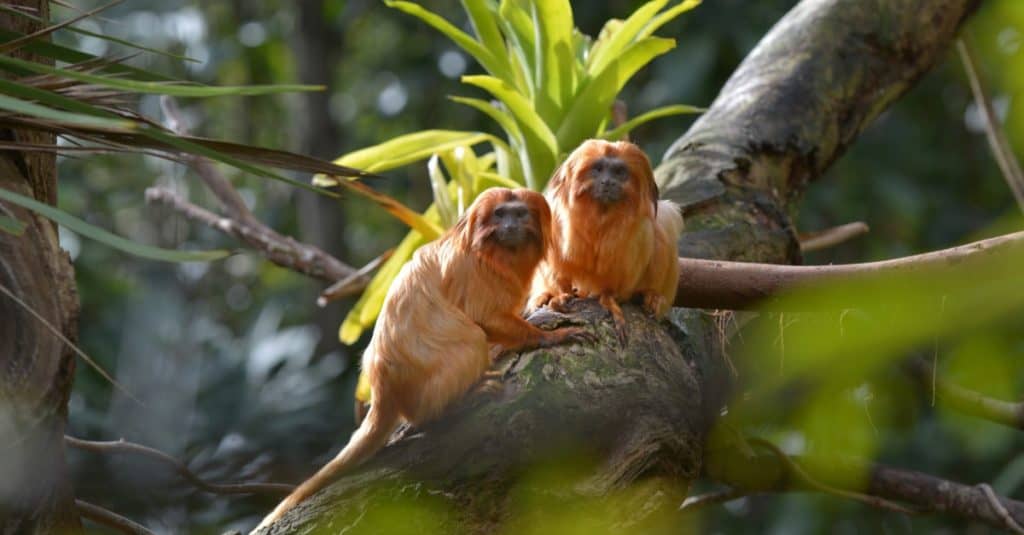
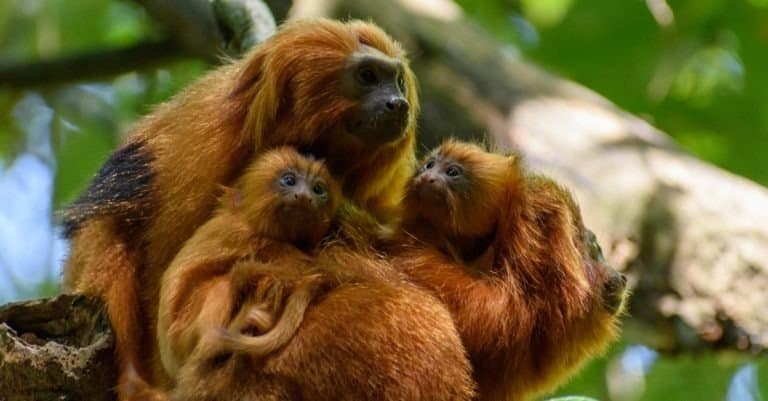
Two Golden Lion Tamarins sitting in a tree

These primates have a diet that is comprised of both animal and vegetable matter.

These tree-dwelling primates eat a diet of foods available in their rainforest canopy habitat. Because they are omnivores, they eat both animal and vegetable matter. For example, everything from spiders to small lizards finds its way into their diet, depending on local availability and season.

They also feast on flower nectar, tree fruits, and flower petals. Their main criterion in choosing their food is whether it is small enough for them to handle. As they eat and digest fruits and flowers, they naturally disperse the seeds throughout their habitat in their feces, helping to maintain the abundance of the environment.

They enjoy unique adaptations that help them dig into tree bark for the insects they eat. Their slender fingers have claw-like nails rather than the flattened ones specific to other types of monkeys and to humans. These adaptations have another purpose as well. They make it safer for golden lion tamarins to travel through the treetops because their claws help them get a safer grip on the branches, reducing the risk of dangerous falls.

Predators And Threats
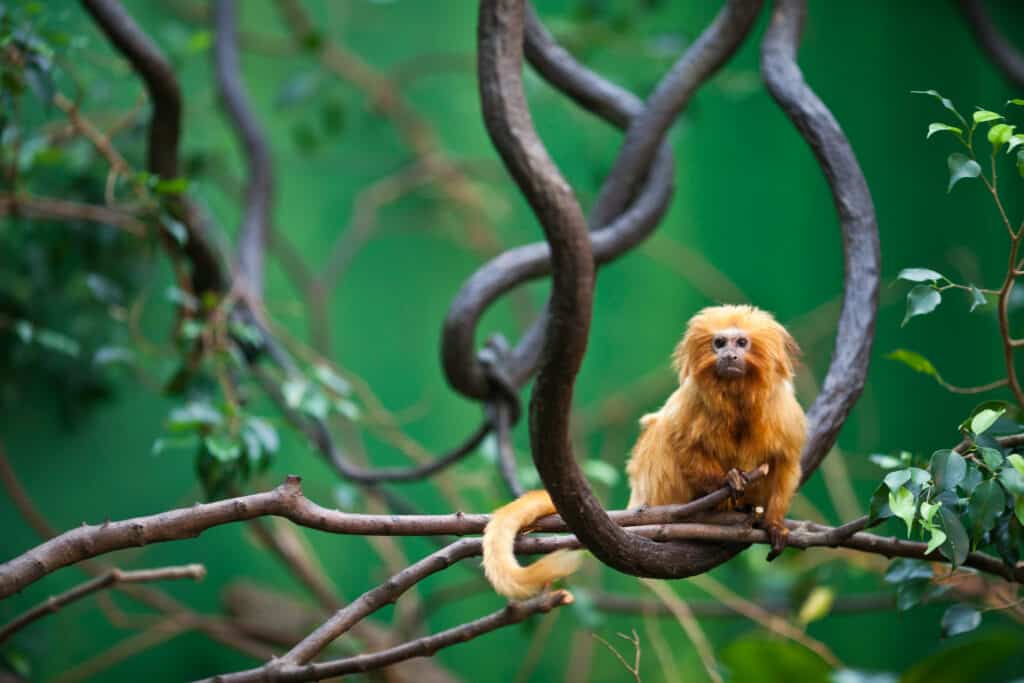
Golden Lion Tamarin on tree branch.

The Golden Lion Tamarin is an endangered species of New World Monkey that lives in Brazil.

A few of the animals that share the rainforest with the tamarin, or golden marmoset, prey on it too. Large birds of prey, raccoon-like coatis, snakes and margays, and small Brazilian wildcats all pose a threat of predation to the golden lion tamarin.

Human activities nearly drove tamarins to extinction in the 1960s, and they remain a significant, ongoing threat to the population. Clearcutting tamarin habitat for valuable wood products and charcoal-making has diminished tamarin habitat by 98 percent.

Additional destruction of habitat due to urban sprawl further decimates the tamarins’ homes. Ranchers who cut down forestland to create grazing fields for cattle are another threat to a number of native species, as are big agricultural conglomerates expanding their farming operations.

In the past, the illegal trade in golden lion tamarins further challenged conservation efforts for this small, attractive species. Poachers captured them to sell as pets and zoo exhibits. The strength of the current conservation movement has minimized this once-pervasive threat, however.

Reproduction, Babies, And Lifespan
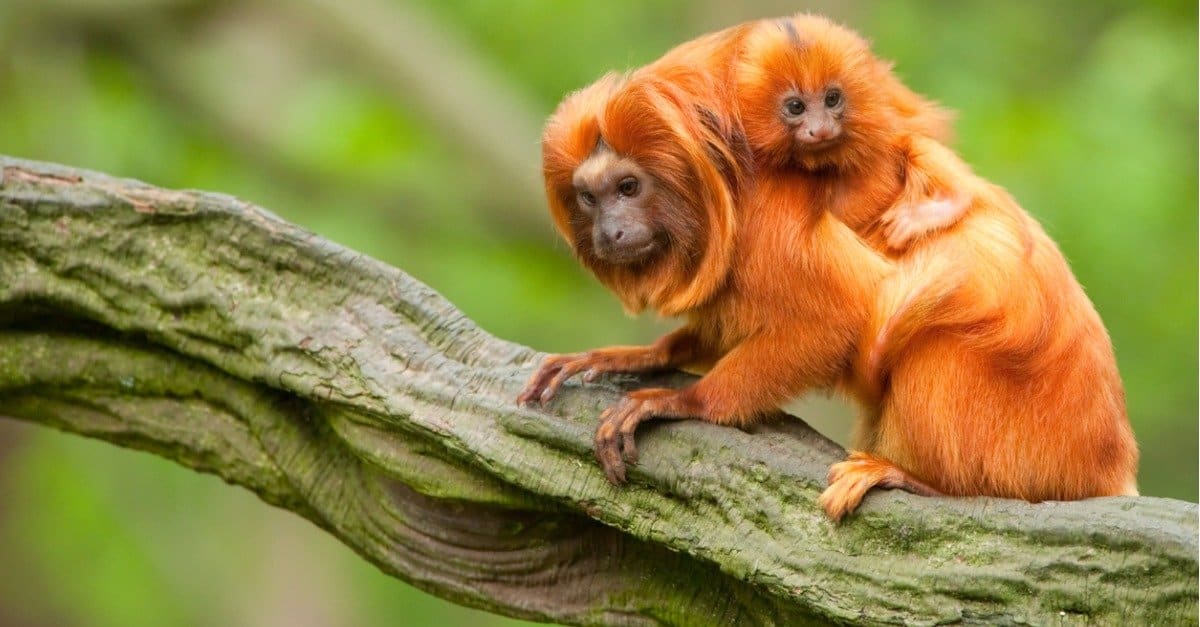
Golden marmosets are typically monogamous, with a single mating pair within a family group reproducing. Mating season begins as the rainy season draws to a close between April and June. The gestation time for a golden lion tamarin baby is four months, so the baby will be born sometime between September and February.

Tamarins usually give birth to twins, although occasionally, triplets or quadruplets make an appearance. During the first month after birth, a set of baby tamarin twins depends completely on its mother. She nurses them and carries them on her back.

After those initial weeks, the entire family group helps with childcare and feeding, including the father. A baby typically begins socializing at about 17 weeks.

The dominant female and male of the group can begin reproducing when each is approximately two-and-a-half years old. Other mature males and females do not reproduce until they have formed their own family groups.

Their first year is the riskiest for these infants. The mortality rate for babies under a year of age is nearly 50 percent. After they have survived the critical first year of life, they are young adults.

On average, a golden lion tamarin lives about 10 to 15 years in the wild. The longest-lived are those in captivity. One captive male lived for nearly 25 years.

Population

Although population estimates vary, there are likely about 3,000 golden lion tamarins left in the wilds of Brazil, and nearly 500 living in zoos throughout the world. At its lowest point, the population totaled a scant 200 in the mid-20th century, but since then, numbers have gradually multiplied, thanks to the efforts of conservation groups.

In the Zoo

These small, active primates live in zoos throughout the world. Approximately 38 states in the U.S. host golden lion tamarins too. These include Zoo Atlanta in Georgia, Woodland Park Zoo in Seattle, the Smithsonian National Zoo in Washington D.C., and Audubon Zoo in New Orleans.

View all 261 animals that start with G

Sources

  1. Wikipedia / Accessed December 26, 2020
  2. Smithsonian's National Zoo & Conservation Biology Institute / Accessed December 26, 2020
  3. New England Primate Conservancy / Accessed December 26, 2020
  4. Animal Diversity Web / Accessed December 26, 2020
  5. Save The Golden Lion Tamarin / Accessed December 26, 2020
Melissa Bauernfeind

About the Author

Melissa Bauernfeind

Melissa Bauernfeind was born in NYC and got her degree in Journalism from Boston University. She lived in San Diego for 10 years and is now back in NYC. She loves adventure and traveling the world with her husband but always misses her favorite little man, "P", half Chihuahua/half Jack Russell, all trouble. She got dive-certified so she could dive with the Great White Sharks someday and is hoping to swim with the Orcas as well.
Connect:

Thank you for reading! Have some feedback for us?


Golden Lion Tamarin FAQs (Frequently Asked Questions)

Golden Lion Tamarins are Omnivores, meaning they eat both plants and other animals.