


G
Species Profile

Golden Oriole

Oriolus oriolus

Golden voice in the green canopy
Jesus Giraldo Gutierrez/Shutterstock.com

Golden Oriole Distribution

Click a location to explore more animals from that region

Loading map...
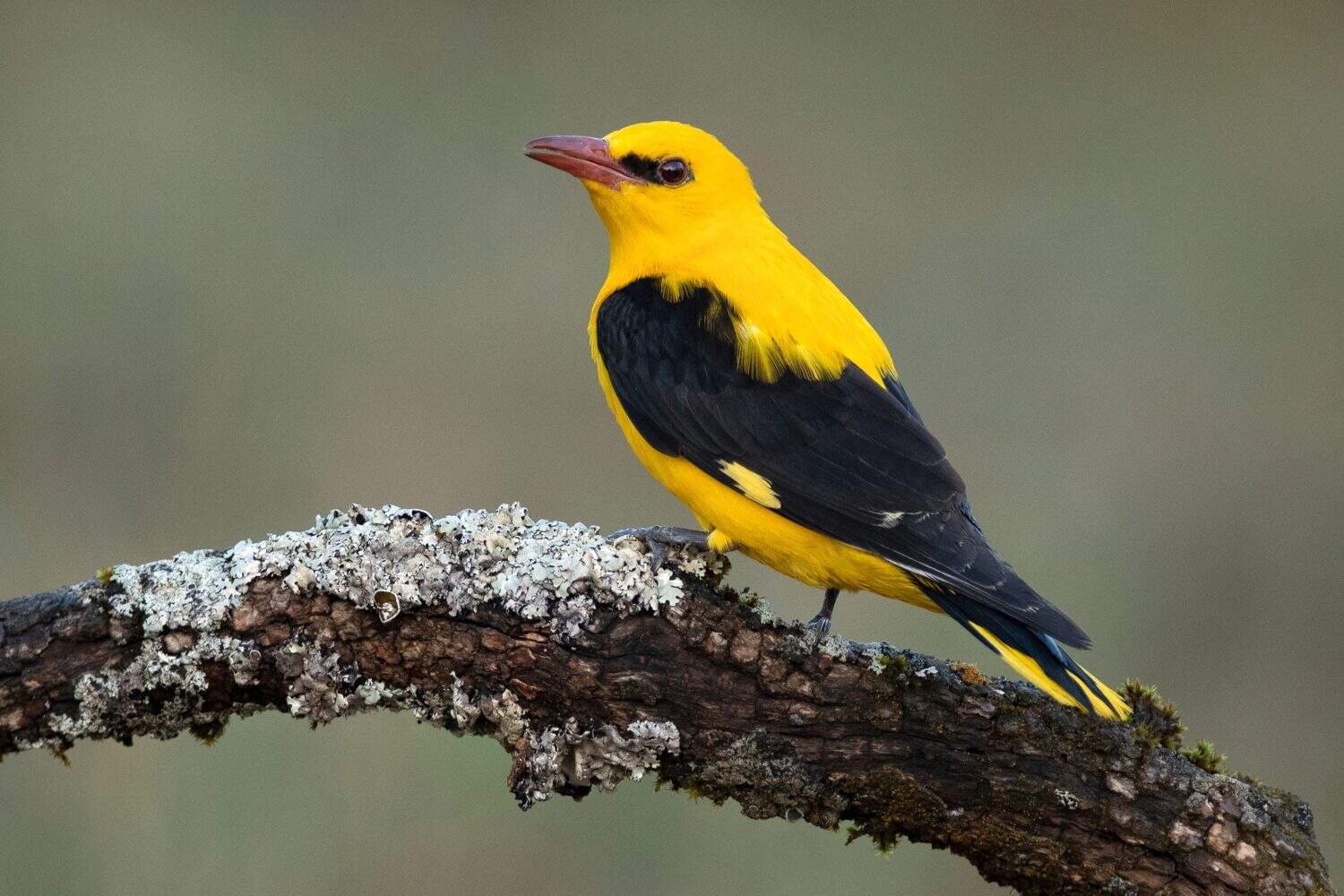
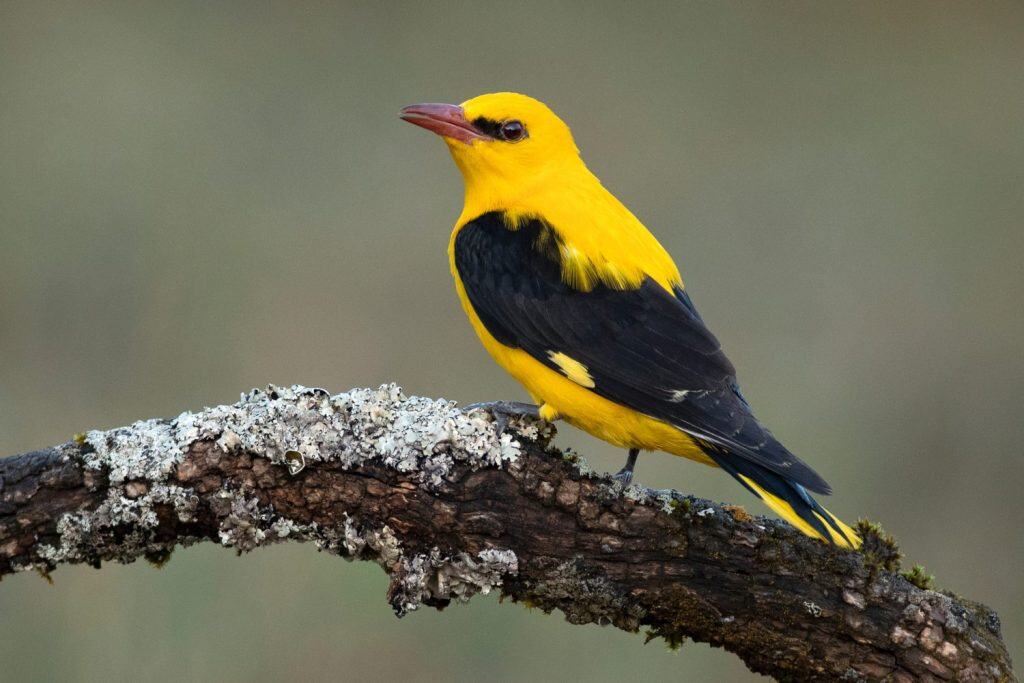
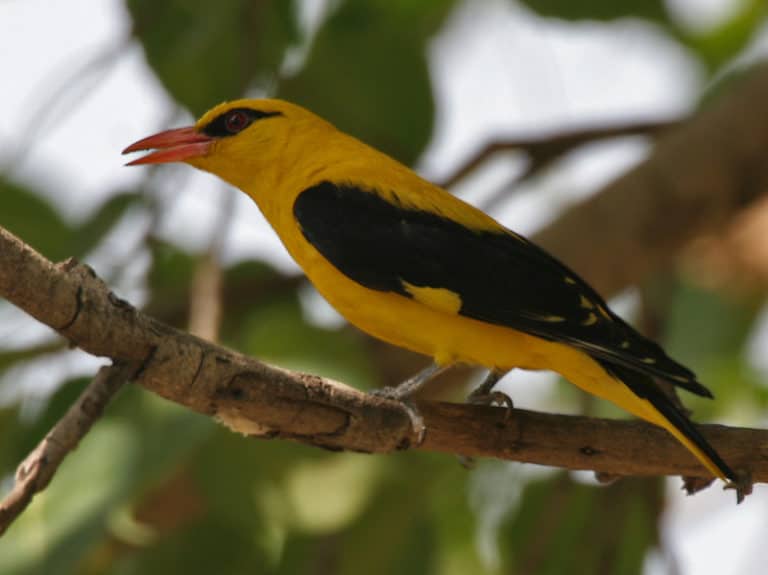
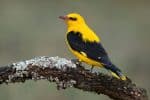
Golden oriole male in one of his favorite perches in his breeding territory with the last light of a day with clear spring clouds

At a Glance

Wild Species
Also Known As Golden Oriole, European Golden Oriole, Common Golden Oriole, Eurasian Oriole
Activity Diurnal+
Lifespan 7 years
Weight 0.067 lbs
Status Least Concern
Did You Know?

Size: 22-25 cm long; wingspan 44-47 cm; mass ~65-75 g (Handbook of the Birds of the World; Cramp & Perrins).

Scientific Classification

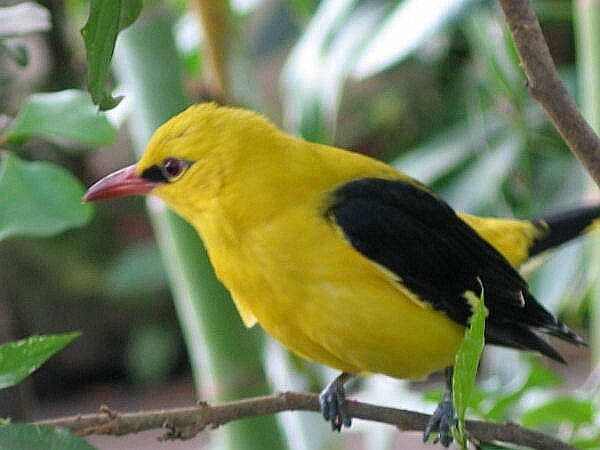
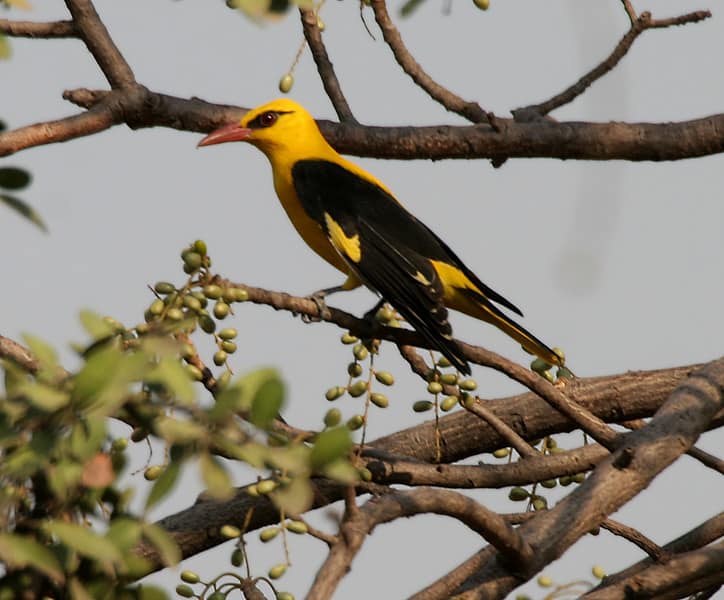
A medium-sized passerine songbird of the oriole family. Adult males are vivid yellow with contrasting black wings and tail; females/immatures are greener-yellow with streaking. Known for a rich, fluting song and a preference for leafy tree canopies.

Kingdom
Animalia
Phylum
Chordata
Class
Aves
Order
Passeriformes
Family
Oriolidae
Genus
Oriolus
Species
Oriolus oriolus

Distinguishing Features

  • Adult male: bright golden-yellow body with black wings and tail
  • Female/immature: greener-yellow with dark streaking on underparts
  • Fluting, whistle-like song; often heard more than seen
  • Typically forages high in the canopy for insects and fruit

Physical Measurements

Length
9 in (9 in – 10 in)
Weight
0 lbs (0 lbs – 0 lbs)
Top Speed
31 mph
Estimated top speed 50 km/h

Appearance

Primary Colors
Secondary Colors
Skin Type Feathered body; bare keratin bill (often pinkish/red), bare scaly legs/feet (grayish).
Distinctive Features
  • Size (standard field measurements): total length 22-25 cm; wingspan 34-37 cm; body mass commonly reported ~0.067-0.080 kg (sources: BTO BirdFacts; major European field handbooks).
  • Adult male diagnostic appearance: saturated yellow body with black wings and tail; often a narrow dark line through the eye (lores/eye-stripe).
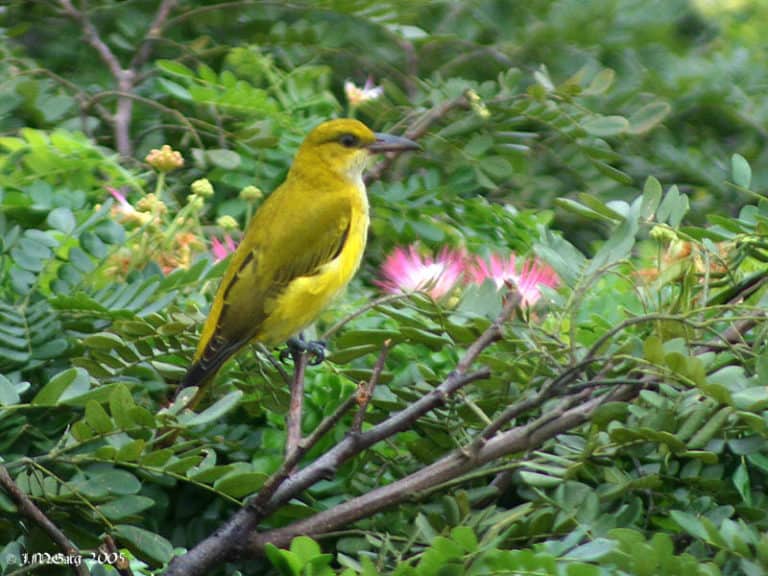
  • Adult female/immature diagnostic appearance: greener/yellower upperparts with paler (cream/whitish) underparts showing conspicuous dark streaking; overall much less contrasting than male (useful for avoiding confusion with bright male).
  • Canopy-dwelling and secretive: typically forages high in leafy deciduous canopies and can be difficult to see despite loud, far-carrying voice; often detected by song/calls rather than prolonged views.
  • Vocalization (behavioral ID): rich, fluting, melodious song (classic oriole 'whistle' phrase), plus distinctive harsher calls; strongly associated with breeding territories in tall trees.
  • Long-distance migrant: breeds across much of Europe and western/central Asia and winters in sub-Saharan Africa (supported by ring-recovery and BirdLife International range accounts).
  • Diet-linked appearance/behavior context: primarily insects (notably caterpillars) in breeding season plus fruit (e.g., cherries/berries) when available; often seen gleaning and making short sallies in the canopy.
  • Longevity (ringing data): maximum recorded lifespan in European ringing datasets is ~11+ years (EURING-style longevity summaries; exact maxima vary by dataset and update).

Sexual Dimorphism

Strong sexual dimorphism in plumage: adult males are vivid yellow-and-black; females and immatures are greener, less contrasting, and typically streaked below. Some overlap occurs in non-adult plumages, but adult males are highly distinctive within the species' range.

  • Plumage: bright yellow head/body/underparts; wings predominantly black; tail largely black with yellow at edges/tail base depending on feather; overall very high contrast.
  • Facial mark: usually a dark eye-stripe/lores line accentuating the face.
  • Bill: often appears pinkish to reddish, contrasting with yellow face and black wings.
  • Plumage: upperparts greener-yellow/olive; underparts paler (cream/whitish) with dark longitudinal streaking; reduced black compared with male.
  • Wings/tail: more grayish/olive-toned with less crisp black; generally more cryptic in foliage.
  • Overall impression: subdued, camouflaged canopy bird; streaking is a key feature versus the male's largely unmarked yellow.

Did You Know?

Size: 22-25 cm long; wingspan 44-47 cm; mass ~65-75 g (Handbook of the Birds of the World; Cramp & Perrins).

Adult male is golden-yellow with black wings/tail; females and first-year males are greener and streaked-classic "hidden in leaves" camouflage.

Builds a distinctive hanging "hammock" nest, slung between a forked branch using plant fibres, grass, wool, and sometimes string.

Typical clutch is 3-5 eggs; incubation ~14-15 days; fledging ~14-17 days after hatching (summarized in major European breeding accounts, incl. Cramp & Perrins).

Long-distance migrant: breeds across much of Europe into western/central Asia and winters in sub-Saharan Africa-often travelling several thousand kilometres each way.

Oldest recorded by ringing is 10 years 11 months (BTO BirdFacts longevity record).

Despite its bright colors, it's often hard to see because it forages high in leafy canopies and stays remarkably secretive.

Unique Adaptations

  • Suspended "pendulum" nest architecture reduces access for some ground/branch-walking predators and keeps the nest stable in the outer canopy.
  • Sexual dichromatism: high-contrast male plumage aids mate signaling, while female/immature streaking improves concealment in foliage.
  • Diet flexibility: switches from insect-heavy feeding during breeding (protein for chicks) to more fruit as it becomes seasonally abundant.
  • First-year male plumage resembles female (delayed maturation), which may reduce aggression from territory-holding adult males while young birds learn routes and breeding areas.
  • Broad, strong bill suited to both seizing large insects (e.g., caterpillars) and handling soft fruit efficiently.

Interesting Behaviors

  • Canopy-dwelling foraging: gleans caterpillars and other insects from leaves and twigs; also takes fruit (notably soft fruits and berries) when available.
  • Song and contact calls: males give a rich, fluting, far-carrying song used for territory advertisement; pairs also use sharper calls for contact and alarm within dense foliage.
  • Nest-weaving behavior: both sexes may contribute materials; the nest is carefully stitched to a horizontal fork, forming a deep cup that sways with the branch.
  • Secretive display: males may sing prominently yet remain concealed, shifting position within the canopy to avoid exposure while still projecting sound.
  • Seasonal movement timing (typical across much of the range): spring arrival in Europe often late April-May; post-breeding departure commonly August-September, with juveniles often leaving later.

Cultural Significance

The Eurasian Golden Oriole (Oriolus oriolus) is a migratory bird that returns to Europe in spring to breed. Often heard more than seen, its rich, flute-like song shows up in European nature writing and folk stories as a sound of warm, leafy woods.

Myths & Legends

European weather-lore: in several regions (notably central and eastern Europe), folk sayings link the oriole's first songs or persistent calling with imminent rain or changing weather-treating it as a natural 'forecast' from the treetops.

Seasonal-harbinger tradition: country folklore in parts of Europe holds that hearing the golden oriole's flute-like call signals that 'true summer' has arrived, because the bird appears late in spring and sings from fully leafed-out canopies.

Name lore: the English word "oriole" ultimately comes from a Latin root meaning "golden", reflecting a long-standing cultural habit of treating the male's plumage as a living emblem of gold in European vernacular naming.

The Eurasian Golden Oriole (Oriolus oriolus) is often shown as a shy 'forest musician'—its song fills the woods while its bright body stays hidden in leaves, a common theme in European folk tales.

Conservation Status

LC Least Concern

Widespread and abundant in the wild.

Population Stable

Protected Under

  • EU Birds Directive (Directive 2009/147/EC): protected as a wild bird species in the EU; hunting controls apply where permitted by national derogations/annex listings.
  • Bern Convention on the Conservation of European Wildlife and Natural Habitats: listed for protection in many European jurisdictions (implemented through national legislation).
  • IUCN Red List (BirdLife International as Red List Authority for birds): Oriolus oriolus assessed as Least Concern; overall population considered large with a broadly stable global trend, despite regional declines in parts of Europe.
  • Species biology (context from standard ornithological references such as HBW/BirdLife): adult total length typically ~24-25 cm; wingspan ~44-47 cm; adult mass commonly ~0.065-0.11 kg; clutch usually 3-5 eggs; nests are deep, suspended cup nests placed high in leafy canopies; primarily insectivorous (notably caterpillars and other large insects) with seasonal fruit consumption; long-distance migrant wintering mainly in sub-Saharan Africa.

Life Cycle

Birth 4 chicks
Lifespan 7 years

Lifespan

In the Wild
1–11 years
In Captivity
2–15 years

Reproduction

Mating System Monogamy
Social Structure Socially Monogamous
Breeding Pattern Seasonal
Fertilization Internal Fertilization
Birth Type Internal_fertilization

Behavior & Ecology

Social Flock Group: 2
Activity Diurnal, Matutinal
Diet Insectivore Caterpillars, especially larger canopy-dwelling larvae
Seasonal Migratory 3,107 mi

Temperament

Secretive canopy-dweller; often heard more than seen even in occupied territories (Cramp & Perrins, 1993).
Strongly territorial in the breeding season (especially males), with aggressive chases and vocal escalation toward intruders near nesting areas (Cramp & Perrins, 1993; HBW).
Generally non-gregarious; tolerance of conspecifics increases outside breeding, when loose associations may form at food sources or roosts (HBW).
Seasonal behavioral shift (HUB pattern for the species): breeding = pair-based territoriality; non-breeding/migration = reduced territoriality and more transient grouping/roosting variability (Cramp & Perrins, 1993; HBW).

Communication

Primary territorial/song vocalization: rich, fluting whistles often rendered as 'weela-wee-oo' Species-typical advertising song; Cramp & Perrins, 1993; HBW
Harsh, grating/scolding calls used as alarms and during agitation E.g., near nest or in response to predators/observers) (Cramp & Perrins, 1993
Short contact calls between pair members and between adults and fledglings in dense foliage HBW
Begging calls by dependent young, eliciting provisioning by adults Cramp & Perrins, 1993
Visual signaling and posture in close-range interactions: wing/tail spreading, body orientation, and chase flights used in territorial disputes and mate-associated interactions Generalized in BWP/HBW behavioral descriptions
Spatial communication via song perches and repeated use of particular canopy strata/trees to advertise occupancy and maintain territory boundaries Cramp & Perrins, 1993
Courtship/provisioning behavior Food offering) functioning as a pair-bond signal during breeding (reported in standard species accounts; Cramp & Perrins, 1993; HBW

Habitat

Biomes:
Temperate Forest Mediterranean Savanna Tropical Dry Forest
Terrain:
Plains Hilly Valley Riverine Plateau Coastal Mountainous +1
Elevation: Up to 6561 ft 8 in

Ecological Role

Canopy insect predator and seasonal frugivore in Eurasian broadleaf forests and agro-woodland mosaics

Suppresses herbivorous insect populations (notably caterpillars) in tree canopies Contributes to seed dispersal of fleshy-fruited plants via fruit consumption (secondary, seasonal) Links canopy arthropod production to higher trophic levels as prey for raptors and other predators

Diet Details

Other Foods:
Fleshy fruits and berries Cherries Fig Mulberries Grapes Elderberry Blackberries and raspberries +1

Human Interaction

Domestication Status

Wild

Eurasian Golden Oriole (Oriolus oriolus) is a fully wild bird with no domestication history. It was once trapped or kept locally as a cagebird for its song in parts of Europe and the Mediterranean but was not bred. Today most possession is illegal. It visits orchards and wood edges, affecting fruit crops and drawing birdwatchers.

Danger Level

Low
  • Minimal direct risk; may peck/scratch if handled (e.g., during rescue/rehabilitation).
  • Standard wild-bird zoonotic/hygiene considerations if handled (e.g., Salmonella spp.; avian influenza risk is generally low but possible in wild birds).
  • Allergic reactions in sensitive individuals from feathers/dander are possible but uncommon.

As a Pet

Not Suitable as Pet

Legality: The Eurasian Golden Oriole is illegal to keep as a pet because it is a native bird protected by laws like the EU Birds Directive. Permits are needed for rehab, research, or licensed facilities; capture and trade are often banned.

Care Level: Expert Only

Purchase Cost:
Lifetime Cost: $3,000 - $15,000

Economic Value

Uses:
Ecotourism/birdwatching value Cultural/aesthetic value (song, symbolism) Ecosystem services (insect predation) Localized/occasional orchard interaction (fruit feeding)
Products:
  • Non-consumptive value via birdwatching/ecotourism (no standard commercial product).
  • Indirect agricultural benefit through predation on insect pests (e.g., caterpillars/beetles) in wooded farmland/orchards.
  • Historically: limited cagebird value (now typically illegal/restricted).

Relationships

Related Species 10

African Golden Oriole Oriolus auratus Shared Genus
Indian Golden Oriole Oriolus kundoo Shared Genus
Black-naped Oriole Oriolus chinensis Shared Genus
Maroon Oriole Oriolus traillii Shared Genus
Dark-throated Oriole Oriolus xanthonotus Shared Genus
Silver Oriole Oriolus mellianus Shared Genus
Green Oriole Oriolus flavocinctus Shared Genus
Black-headed Oriole Oriolus larvatus Shared Genus
Figbird Sphecotheres viridis Shared Family
Australasian Figbird Sphecotheres vieilloti Shared Family

Ecological Equivalents 5

Animals that fill a similar ecological role in their ecosystem

Baltimore Oriole Icterus galbula North American ecological analogue: a canopy-foraging, arboreal insectivore-frugivore that builds a hanging, woven nest; similar to the Eurasian Golden Oriole in bright yellow/orange-and-black male plumage and in using a rich, whistled song during breeding.
Eurasian Blackcap Sylvia atricapilla Overlaps strongly in broadleaf woodland edges and parks, feeds heavily on insects in the canopy during the breeding season, and switches to fruit later in the season. Both are migratory passerines that rely on leafy canopies for foraging and concealment.
Eurasian Golden Oriole
Eurasian Golden Oriole Oriolus oriolus Medium-sized canopy bird that picks and catches large insects, especially caterpillars and beetles, and eats soft fruit. Breeds in tall deciduous trees high in the canopy, using a deep cup nest hung on a forked branch.
Eurasian Jay
Eurasian Jay Garrulus glandarius Shares use of the woodland canopy and seasonal fruits (berries, cherries). Although behavior differs — the jay is also a nest predator — both depend on mature trees and woodland-edge mosaics for foraging.
Common Cuckoo Cuculus canorus Uses similar breeding landscapes (woodland edges, riparian trees, orchards) and overlaps in large insect prey (especially caterpillars). Interacts indirectly via shared predator communities and similar timing of spring arrival in temperate Eurasia.

Quick Take

  • Northern populations achieve spring prediction accuracy by monitoring specific arrivals from Namibia and South Africa.
  • A 9.4-inch height constraint creates visual confusion with thrushes and green woodpeckers during flight.
  • Contrary to 18th-century records, Romans likely identified this species as early as the 12th century.

The people living in the northern parts of Europe are known to be able to predict the start of spring with the coming of the Golden Oriole. The Golden Orioles inhabiting more western European regions are known to migrate as far south as Namibia and South Africa when the winter begins to set in. Although the Golden Oriole was thought to have been properly named in the 18th century, it is thought that the Romans could have been calling them Orioles as early as the 12th century.

Infographic of the Golden Oriole displaying its yellow and black plumage, a migration map, and facts about its behavior and habitat.
A master of disguise that bridges two continents and defies centuries of scientific classification. © A-Z Animals

Classification and Evolution

The Golden Oriole (also known as the Eurasian Oriole) is a small species of bird found throughout Europe and western Asia. The Golden Oriole’s name is thought to have arisen during the 18th century after the classical Latin word meaning gold. Although almost indistinguishable in appearance, some believe that the Golden Orioles found in Europe are actually a separate subspecies from those found in Asia. They are also known to be the only member of the Oriole family that breeds in the more temperate regions of the northern hemisphere.

Anatomy and Appearance

The male Golden Oriole is an incredibly colorful bird, with striking yellow and jet black plumage, and fully black wings. As with many other birds, the female of the species is more dull-looking, being slightly greener in color. Both, however, are hard to spot in the canopy as they are perfectly camouflaged among the leaves. Golden Orioles are birds that tend to be between 7.9 and 9.4 inches in height and are often mistaken for thrushes and even green woodpeckers when in flight. They have dark red eyes and a fairly thick, pink beak that is curved slightly downwards at the end.

Distribution and Habitat

The Golden Oriole is a bird that is predominantly found throughout Europe and western Asia, but also in parts of Africa. The Golden Oriole is a summer migrant, meaning that it migrates north for the cooler summer climates, and flies back south to the tropics when the winter begins to emerge. The Golden Oriole is nearly always found in well-timbered forests and woodland, along with parks, orchards, and gardens. They spend the majority of their time high in the tree canopy, where their distinctive plumage helps them to remain hidden from lurking predators.

Behaviour and Lifestyle

Due to its excellent camouflage amongst the leaves and its shy nature, the Golden Oriole is an almost impossible bird to spot. However, it is its unmistakable song that alerts all around to its presence, which is said to sound very fluty and can be heard over considerable distances. Their basic calls, however, are often compared to the screech of a Jay, but both are used to communicate with other Golden Orioles inhabiting the surrounding forest. The Golden Oriole is a migratory and generally quite solitary bird, but can be seen migrating, often under the cover of night, in large flocks.

Reproduction and Life Cycles

The Golden Oriole breeds in the more temperate northern regions during the summer months, where courtship displays involve them chasing one another from tree to tree and through the canopy. The female Golden Oriole builds her nest, generally in the fork of a tree, out of plant fibers and stems, in the shape of a shallow cup. She lays between 3 and 6 eggs, which hatch after an incubation period of between 15 and 18 days, which is predominantly conducted by the female. Once hatched, both Golden Oriole parents help to feed and look after their young, which will have left their nest (fledged) within 20 days. Golden Orioles usually live to be around 9 or 10 years old.

Diet and Prey

The Golden Oriole is an omnivorous animal that primarily feeds on insects, fruits, and seeds high up in the tree canopy. The relatively thick, slightly curved beak of the Golden Oriole is the perfect shape for picking insects out of holes and plucking fruits off the branches. The Golden Oriole also has wide, clawed feet, which assist the bird in holding onto the more tricky branches when it is trying to gather food. They also play a vital role in redistributing the seeds from the fruits throughout their native ecosystems.

Predators and Threats

Despite their shy disposition, the Golden Oriole can become incredibly aggressive towards any animal that tries to go near its nest, swooping and diving at the invader to try and intimidate it. Due to its tree-top lifestyle, the Golden Oriole is safe from numerous predators lower down the trees, but it is still vulnerable to larger birds such as crows and birds of prey, including eagles, hawks, and raptors. They are also threatened by deforestation and, therefore, habitat destruction in their native environments.

Relationship with Humans

The Golden Oriole is an incredibly shy bird and very hard to spot high up in the canopy. Without the use of binoculars, the greener females, particularly, are commonly mistaken for Green Woodpeckers, although their flight after a time is noticeably different. Humans have, however, always been awe-struck by their beautifully distinctive, floaty song. The biggest impact that humans have on the Golden Oriole is the deforestation of their native forests, which poses a threat to their habitat. However, the species’ overall range and population are currently considered stable.

Conservation Status and Life Today

The Golden Oriole has been listed as being an animal that is of Least Concern on the IUCN Red List, as its populations are generally stable and it has a wide distribution. The Golden Orioles found across Asia are known to be decreasing slightly in number, but it is thought that those found in Europe are actually on the rise.

View all 261 animals that start with G
How to say Golden Oriole in ...
Bulgarian
Авлига
Catalan
Oriol
Czech
Žluva hajní
German
Pirol (Art)
English
Eurasian Golden-Oriole
Spanish
Oropéndola
French
Loriot d'Europe
Galician
Vichelocrego
Dutch
Wielewaal
Polish
Wilga
Portuguese
Papa-figos
Finnish
Kuhankeittäjä
Turkish
Bayağı sarıasma

Sources

  1. David Burnie, Dorling Kindersley (2011) Animal, The Definitive Visual Guide To The World's Wildlife / Accessed January 19, 2011
  2. Tom Jackson, Lorenz Books (2007) The World Encyclopedia Of Animals / Accessed January 19, 2011
  3. David Burnie, Kingfisher (2011) The Kingfisher Animal Encyclopedia / Accessed January 19, 2011
  4. Richard Mackay, University of California Press (2009) The Atlas Of Endangered Species / Accessed January 19, 2011
  5. David Burnie, Dorling Kindersley (2008) Illustrated Encyclopedia Of Animals / Accessed January 19, 2011
  6. Dorling Kindersley (2006) Dorling Kindersley Encyclopedia Of Animals / Accessed January 19, 2011
  7. Christopher Perrins, Oxford University Press (2009) The Encyclopedia Of Birds / Accessed January 19, 2011
  8. Euraisan Oriole / Accessed January 19, 2011
  9. Golden Oriole Information / Accessed January 19, 2011
  10. Golden Oriole Behaviour / Accessed January 19, 2011
  11. About Orioles / Accessed January 19, 2011
A-Z Animals Staff

About the Author

A-Z Animals Staff

AZ Animals is a growing team of animals experts, researchers, farmers, conservationists, writers, editors, and -- of course -- pet owners who have come together to help you better understand the animal kingdom and how we interact.
Connect:

Thank you for reading! Have some feedback for us?


Golden Oriole FAQs (Frequently Asked Questions)

Golden Orioles live in woodlands and open forests.