G
Species Profile

Grey Mouse Lemur

Microcebus murinus

Madagascar's pocket primate of the night
Gabriella Skollar / Creative Commons

Grey Mouse Lemur Distribution

Click a location to explore more animals from that region

Endemic Species
Loading map...

Found in 1 country

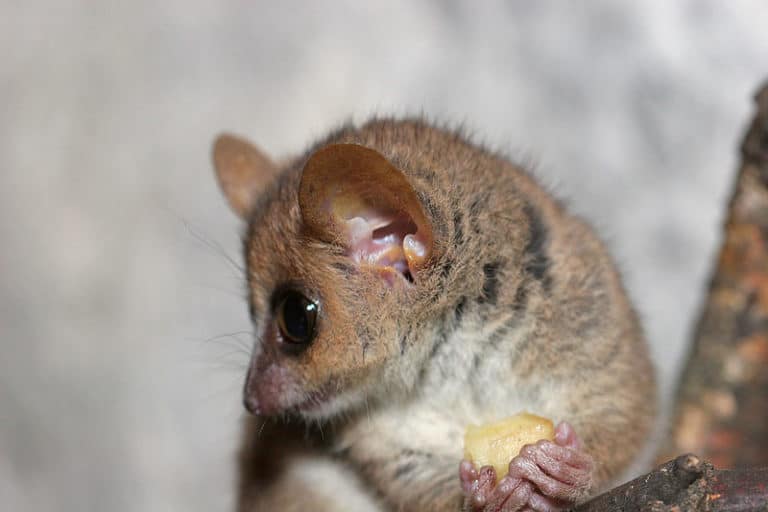
Grey Mouse Lemur among some ferns

At a Glance

Wild Species
Also Known As Mouse lemur, Madagascar mouse lemur, Tsidy
Diet Omnivore
Activity Nocturnal+
Lifespan 5 years
Weight 0.12 lbs
Status Least Concern
Did You Know?

Size: head-body length ~12-14 cm; tail ~11-16 cm (tail often as long as body).

Scientific Classification

The Grey (Gray) Mouse Lemur (Microcebus murinus) is a small nocturnal primate endemic to Madagascar, among the best-known mouse lemur species. It is an arboreal, omnivorous-foraging strepsirrhine (lemur) with large eyes and prominent ears, using scent marking and vocalizations for communication.

Kingdom
Animalia
Phylum
Chordata
Class
Mammalia
Order
Primates
Family
Cheirogaleidae
Genus
Microcebus
Species
Microcebus murinus

Distinguishing Features

  • Very small body size (mouse-lemur sized), nocturnal primate
  • Large reflective eyes (tapetum lucidum) and large ears
  • Grey-brown dorsal coloration with paler underside (overall ‘grey’ appearance)
  • Long tail; agile arboreal movement
  • Endemic to Madagascar (not found naturally elsewhere)

Physical Measurements

Length
10 in (9 in – 11 in)
Weight
0 lbs (0 lbs – 0 lbs)
Tail Length
5 in (5 in – 6 in)

Appearance

Primary Colors
Secondary Colors
Skin Type Dense, soft fur over typical primate skin; fur provides insulation for nocturnality and is compatible with seasonal torpor use reported for this species (cheirogaleid trait).
Distinctive Features
  • Very small cheirogaleid lemur with disproportionately large forward-facing eyes (nocturnal adaptation) and prominent, rounded ears; strong eyeshine at night (species descriptions in IUCN/field guides).
  • Adult Grey (Gray) Mouse Lemurs (Microcebus murinus) have body 11–14 cm, tail 14–17 cm, and weigh about 0.049–0.080 kg, often becoming much heavier in certain seasons.
  • Tail longer than head-body length; commonly used in balance during arboreal locomotion; seasonal fat storage can increase overall body condition in the dry season (reported in ecological/physiology studies of M. murinus).
  • Lives in trees and is active at night in western/southern Madagascar dry forests (dry deciduous and spiny habitats). By day it rests in tree holes or leaf nests, often in groups with more females.
  • Communication strongly involves scent marking (urine washing and glandular marking) and vocalizations; nocturnal foraging is omnivorous (fruit, insects/other arthropods, gums/nectar), consistent with published diet studies on M. murinus.
  • Grey (Gray) Mouse Lemur (Microcebus murinus) can live very long in captivity—up to about 18 years in research colonies—far longer than in the wild, where average survival is much lower.

Sexual Dimorphism

Grey Mouse Lemur (Microcebus murinus) shows little outward color difference between males and females; males mainly have larger testes in the breeding season, while females often build up more seasonal fat for torpor and energy storage.

  • Slight tendency toward higher body mass in some populations/periods, but overlap is large; dimorphism is modest compared with many primates (reported in ecological studies of M. murinus).
  • Seasonal enlargement of testes during the breeding season; otherwise similar facial/pelage appearance to females.
  • Often exhibit pronounced seasonal fattening and are more likely to use prolonged torpor/energy-saving strategies in dry-season conditions reported for this species (sex-biased torpor patterns documented in cheirogaleid literature).
  • No consistent pelage color differences from males; overall appearance remains grey/grey-brown dorsally with pale ventrum.

Did You Know?

Size: head-body length ~12-14 cm; tail ~11-16 cm (tail often as long as body).

Adult mass is typically ~60-90 g, but individuals can fatten substantially before the dry season (seasonal mass gain linked to torpor).

Reproduction: gestation about ~59-62 days; litters usually 1-3 young (often 2) in tree-hole/leaf nests.

Longevity: in captivity can reach ~15 years; wild lifespans are shorter and strongly shaped by predation and seasonality.

Diet is omnivorous and highly flexible-fruit, insects, nectar, and tree gums (a common cheirogaleid trait).

Grey mouse lemurs use daily torpor and can enter prolonged seasonal torpor/hibernation in the cool dry season-an unusual strategy among primates.

Sexes differ in space use: males typically range more widely and overlap multiple females; females often show stronger site fidelity and may share sleeping nests.

Unique Adaptations

  • Torpor/hibernation physiology: can markedly lower metabolic rate and body temperature to conserve energy during the cool, resource-poor dry season.
  • Large forward-facing eyes with a reflective tapetum lucidum (strepsirrhine trait) enhance low-light vision for nocturnal movement and prey detection.
  • Grasping hands/feet with nails (not claws) and strong hindlimbs enable agile climbing and leaping in dense understory.
  • Specialized dentition for mixed diets: sharp cusps for insects plus the ability to exploit gums/nectar and soft fruits.
  • Acute olfaction: enlarged reliance on smell (a strepsirrhine hallmark) supports night navigation, social signaling, and mate choice.
  • Flexible digestive and foraging ecology: thrives across a range of seasonal habitats (notably western/southern dry forests), adjusting diet and ranging to resource pulses.

Interesting Behaviors

  • Strictly nocturnal and arboreal: forages in shrubs and trees, with activity peaks soon after dusk and before dawn.
  • Nest use and switching: sleeps in tree holes or woven leaf nests; individuals may rotate among several sleeping sites.
  • Communal sleeping (especially females): groups may share nests, which can improve thermoregulation during cool periods.
  • Scent-marking communication: uses urine washing and glandular marking on branches to advertise identity, reproductive state, and territory/paths.
  • High-frequency vocal communication: produces a range of calls for contact, alarm, and mating; some calls extend into ultrasonic frequencies typical of mouse lemurs.
  • Seasonal torpor strategy: reduces activity and can remain inactive for long bouts in the dry season, relying on stored fat; arousal bouts punctuate extended torpor.
  • Opportunistic foraging: switches between insect hunting and fruit/nectar/gum feeding as resources fluctuate in Madagascar's seasonal forests.

Cultural Significance

In Madagascar, taboos and respect for ancestors often stop people from harming lemurs. Lemurs stand for Madagascar's uniqueness and play a big role in conservation education and ecotourism. Microcebus murinus (Cheirogaleidae) is often studied.

Myths & Legends

Across Madagascar, lemurs are sometimes treated in oral tradition as kin to humans-linked to ancestors or to stories of people transformed into forest beings-supporting traditional taboos that can protect lemurs from hunting in some communities.

In parts of Madagascar, people believe sounds and movements in forests at night have meaning; small night primates, including the grey (gray) mouse lemur (Microcebus murinus), are treated with cautious respect.

The species name murinus means "mouse-like." Early scientists named it that because this tiny, fast primate that is active at night looked like a mouse when first described (Lemur murinus, now Microcebus).

Conservation Status

LC Least Concern

Widespread and abundant in the wild.

Population Decreasing

Protected Under

  • CITES Appendix I (lemurs; international commercial trade generally prohibited except under strict permit conditions).
  • Occurs in multiple Malagasy protected areas within its range (IUCN Red List range/protected-area mapping notes presence in protected areas).
  • Madagascar national wildlife regulations protect lemurs from unauthorized capture/hunting; enforcement and on-the-ground compliance vary by region.

Life Cycle

Birth 2 infants
Lifespan 5 years

Lifespan

In the Wild
2–8 years
In Captivity
6–18.8 years

Reproduction

Mating System Polygynandry
Social Structure Transient
Breeding Pattern Seasonal
Fertilization Internal Fertilization
Birth Type Internal_fertilization

Behavior & Ecology

Social Sleeping group Group: 4
Activity Nocturnal, Crepuscular
Diet Omnivore Seasonally variable; tends to target energy-rich arthropods (insects) when abundant and switches to fruits/nectar/gums during periods of low insect availability (reported in field diet studies of Microcebus murinus).
Seasonal Hibernates

Temperament

Cryptic and cautious; typically avoids open areas and reduces movement under high predation risk
Tolerant within familiar sleeping partners (especially female kin) with affiliative huddling during daytime rest
Seasonally competitive: males show increased roaming and agonistic interactions during the brief mating period (strongly seasonal reproduction documented in Kirindy populations; Eberle & Kappeler 2006)
Female philopatry with male-biased dispersal (common pattern reported for this species in field studies; e.g., Radespiel et al. 2001; Eberle & Kappeler 2006)

Communication

short-range contact calls used during nocturnal movements and when locating partners at sleeping sites Described for Microcebus murinus in field and captive studies; Zimmermann 1990s; Scheumann et al. 2007
alarm calls in response to aerial/terrestrial predators; call usage is context-dependent and can recruit attention of nearby conspecifics Reported in mouse lemur behavioral studies
infant distress calls that elicit maternal retrieval/attention
ultrasonic vocalizations Components >20 kHz) reported for this species and used in close-range social contexts (e.g., Scheumann et al. 2007, studies of vocal repertoires in grey mouse lemurs
scent marking with urine and glandular secretions Including urine-washing/urine marking and genital/anogenital rubbing) to mark routes, sleeping sites, and reproductive condition; overmarking occurs (documented broadly in Microcebus murinus behavioral ecology literature
olfactory assessment during social encounters (sniffing of anogenital region) important for individual and reproductive-status recognition
tactile communication during communal sleeping (huddling, grooming at low rates compared with diurnal primates) associated with thermoregulation and social tolerance in sleeping groups

Habitat

Biomes:
Tropical Dry Forest
Terrain:
Plains Hilly Valley Riverine Coastal
Elevation: Up to 2624 ft 8 in

Ecological Role

Nocturnal omnivorous mesopredator and plant-resource exploiter in Malagasy dry forests.

Arthropod population regulation (predation on insects and other arthropods) Seed dispersal via frugivory (defecation of small seeds after fruit feeding) Potential pollination/flower visitation services when feeding on nectar/flowers Nutrient cycling through consumption of diverse forest resources and deposition of feces/urine in the canopy and understory

Diet Details

Other Foods:
Fleshy fruits Nectar and flower parts Plant exudates Honeydew from hemipterans

Human Interaction

Domestication Status

Wild

The grey (gray) mouse lemur (Microcebus murinus) is a wild primate from Madagascar. It has not been domesticated. Human contact is mainly field research and long-term study, captive breeding for medical and behavior research, zoo and education programs, and illegal capture for the wildlife trade.

Danger Level

Low
  • Minor bite/scratch risk if handled; can cause localized injury or infection
  • Potential zoonotic/parasitic exposure typical of handling wild small mammals/primates (e.g., enteric bacteria, ectoparasites); risk increases with illegal trade and poor husbandry
  • Welfare and public-health risks are primarily associated with illegal capture/transport and inappropriate private keeping rather than deliberate aggression

As a Pet

Not Suitable as Pet

Legality: Generally not legal as a pet: Grey (Gray) Mouse Lemur (Microcebus murinus) is on CITES Appendix I. Madagascar export is banned except for strict scientific reasons. Many countries (US, EU/UK) limit or ban having them; pet trade is often illegal.

Care Level: Expert Only

Purchase Cost:
Lifetime Cost: $15,000 - $60,000

Economic Value

Uses:
Biodiversity conservation value (endemic Malagasy primate; flagship role in dry-forest conservation) Ecotourism/education value (nocturnal wildlife viewing where permitted and well-managed) Scientific and biomedical research value (model for aging, circadian rhythms, cognition, seasonal physiology/torpor, reproduction)
Products:
  • Scientific data/publications and validated animal models (aging and circadian biology)
  • Accredited zoo/education exhibits and conservation programming
  • Ecotourism experiences (regulated nocturnal guided tours at some sites)

Relationships

Predators 6

Fossa Cryptoprocta ferox
Malagasy civet Fossa fossana
Ring-tailed mongoose Galidia elegans
Madagascar harrier-hawk Polyboroides radiatus
Madagascar long-eared owl Asio madagascariensis
Madagascar ground boa
Madagascar ground boa Acrantophis madagascariensis

Related Species 9

Madame Berthe's mouse lemur Microcebus berthae Shared Genus
Brown mouse lemur Microcebus rufus Shared Genus
Gray-brown mouse lemur Microcebus griseorufus Shared Genus
Goodman's mouse lemur Microcebus lehilahytsara Shared Genus
Rufous mouse lemur Microcebus ravelobensis Shared Genus
Fat-tailed dwarf lemur Cheirogaleus medius Shared Family
Coquerel's giant mouse lemur Mirza coquereli Shared Family
Fork-marked lemur Phaner furcifer Shared Family
Hairy-eared dwarf lemur Allocebus trichotis Shared Family

Ecological Equivalents 5

Animals that fill a similar ecological role in their ecosystem

Fat-tailed dwarf lemur Cheirogaleus medius They co-occur in western Madagascar dry forests. Both are nocturnal and arboreal, eat fruit and insects, use tree holes for sleeping, and employ energy-saving strategies; C. medius undergoes prolonged hibernation, whereas Microcebus murinus uses daily or short torpor.
Brown mouse lemur Microcebus rufus Small, nocturnal, arboreal omnivore that eats insects, uses scent marks and vocalizations, and breeds quickly with multiple young; however, it primarily occurs in wetter eastern forests, whereas Microcebus murinus occupies western/coastal areas.
Fork-marked lemur Phaner furcifer Nocturnal, arboreal strepsirrhine that overlaps in activity period and predator guild with Microcebus murinus; both use vocalizations and olfaction. Phaner furcifer is more specialized on tree exudates (gum), whereas Microcebus murinus is more broadly omnivorous (fruit, nectar, gums, and animal prey).
Lesser bushbaby Galago senegalensis Small nocturnal primate that lives in trees, eats insects and plant sap, leaps rapidly, and relies on sound and smell. Faces similar pressures—being active at night, meeting small-body energy needs, and avoiding predators—despite distant evolutionary relationships on different continents.
Philippine tarsier Carlito syrichta Like tarsiers, the grey mouse lemur (Microcebus murinus) is a small, nocturnal, arboreal primate with large eyes and high nocturnal predation risk, but it is omnivorous, shifts its diet seasonally, and uses torpor.

“The Grey Mouse Lemur is a mouse-like primate with a powerful nose and big jump.”

Grey mouse lemurs, also called lesser mouse lemurs, are among the smallest primate species in the entire world. Even though their size, color and body shape is reminiscent of a common mouse, they are very different than rodents in physiology and genetics. As primates, they actually have promising applications for non-invasive research into conditions that also impact humans.

While they are not considered endangered, this species is only found in select habitats around the western side of the African island of Madagascar. They are industrious nocturnal foragers who exhibit plenty of interesting dynamics and characteristics, including a prolonged state of torpor hibernation and female-dominant group structure.

3 Incredible Grey Mouse Lemur Facts!

  • Grooming Claw: While almost all of their digits are equipped with a flat nail, these lemurs have one long claw on their hind-foot to aid in grooming.
  • Long Jumpers: Even though they are small enough to fit into the palm of a human hand, these little primates can leap up to 3 meters in a single bound.
  • Community Sleeping: Adult females routinely congregate for their day-time sleeping with related females and their offspring.

Grey Mouse Lemur Scientific Name

Grey mouse lemur, alternatively spelled gray, are also known as lesser mouse lemurs due to their small stature. Their scientific name is Microcebus murinus. The genus name comes from the Greek words “micro” and “cebus,” which mean “small” and “long-tailed monkey” respectively. The species name murinus is a derivative of the Latin word for mouse. This species is part of the Cheirogaleidae family in the Mammalia class of animals.

Grey Mouse Lemur Appearance

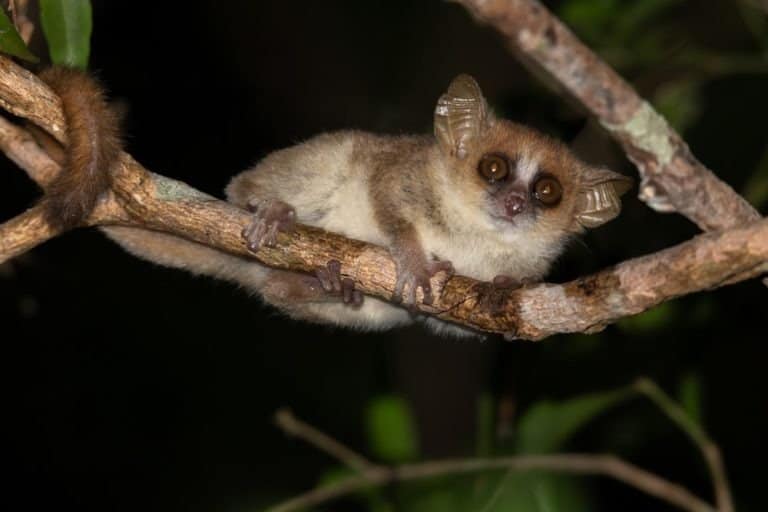
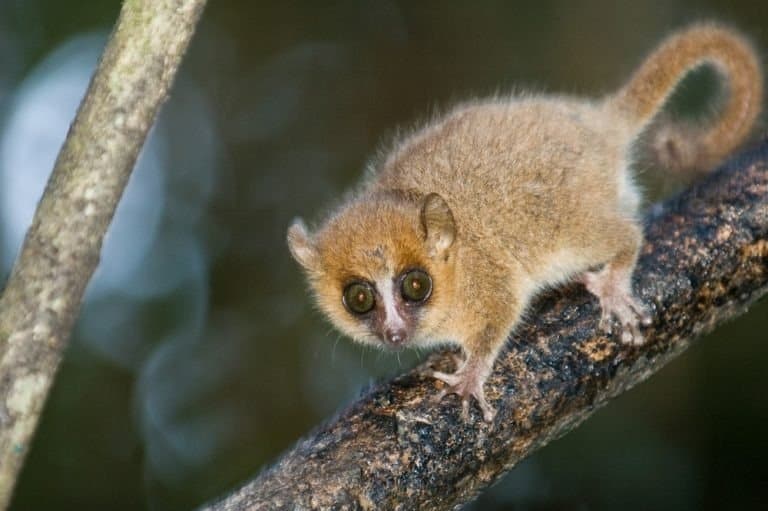
These animals have an extremely small stature and are one of the smallest primate species in the world. They are generally mouse-like in appearance and size with tails that are often longer than the rest of their body. Adult body length ranges from 4.7 to 5.5 inches and tail length is 5.1 to 5.9 inches. Total weight is usually only around 1.5 to 2.5 ounces or 40 to 70 grams. There is little difference in size or body type between males and females.

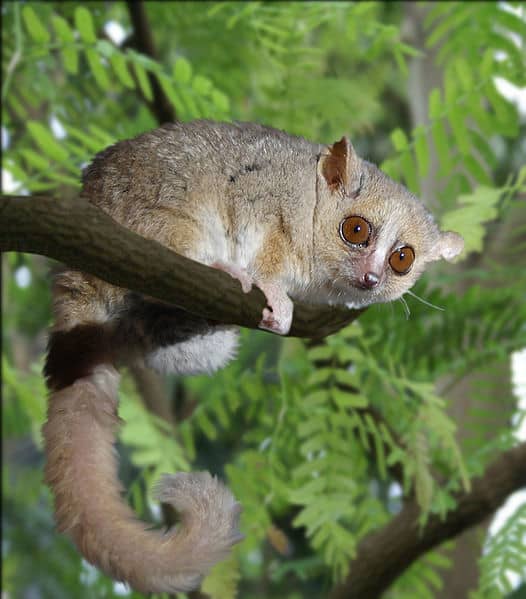
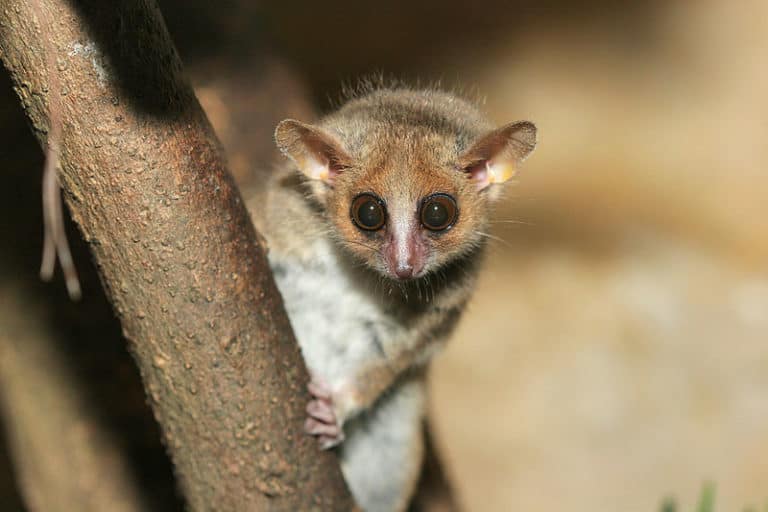
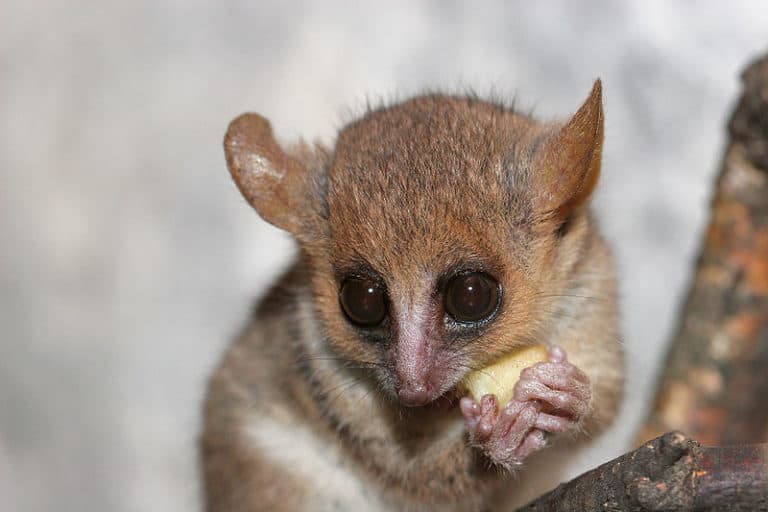
Grey mouse lemurs have gray to brown fur that can have red overtones. They have short limbs and pronounced, rounded ears protruding from the top of their head. They have flexible hands and feet that are capable of grasping firmly onto branches and limbs of trees. Their facial features are similar to other lemurs, including a long snout-like nose that also gives them a keen sense of smell.

These lemurs also have large, round eyes that provide strong night vision to aid them in their nocturnal foraging habits. They have a specialized layer of tissue, called the tapetum, behind the retinas of their eyes as do many other animals. This helps them capture as much light as possible to improve night vision and also makes their eyes very reflective when exposed to a bright light source, like a flashlight.
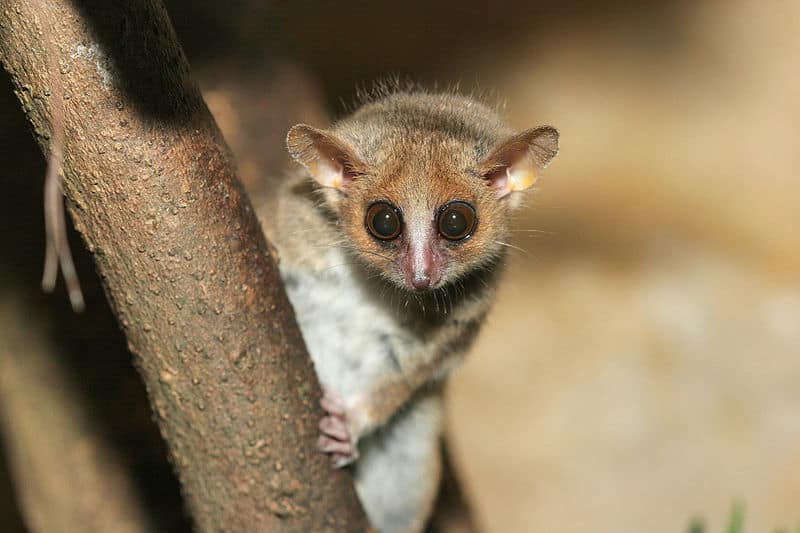
Grey Mouse Lemur sitting in a tree

Grey Mouse Lemur sitting in a tree

Grey Mouse Lemur Behavior

Even though they are generally solitary foragers, grey mouse lemurs do have strong community dynamics and frequently communicate with one another. Adults can emit a sharp whistling sound to alert nearby lemurs of a threat, but the duration is quite short to prevent predators from pinpointing their location. They also use several other types of whistling sounds to ensure there is an acceptable distance between individuals or in displays of aggression between two adults.

Like many of its close taxonomic relatives, this lemur can enter a state of torpor where their metabolism slows considerably. This state is comparable to hibernation in other animal species and allows them to conserve energy. Grey mouse lemurs typically engage in long-term torpor during the colder months of May through August. They can also reduce the metabolic rate on a short-term basis when they sleep during the daylight hours.

Grey Mouse Lemur Habitat

Like other lemurs, this species is only found on the African island of Madagascar. It is considered the most prolific and numerous lemur, even though it’s only found in dry, deciduous forest habitats along the western side of the island. They are found in all kinds of dry wooded areas throughout their range, including scrublands, gallery forests, moister lowland forests, and degraded forests around plantations. They can thrive at elevations of up to 2600 feet above sea level.

The grey mouse lemur spends most of its time foraging, sleeping, and traversing the branches and limbs of trees. It tends to move around on all fours and are adept climbers and jumpers. Despite their extremely small stature, they can leap distances of almost 10 feet in order to capture insects or cross the gap to another tree. While they do prefer to stay up on the trees, they can occasionally be seen on or near the ground in their search for food.

Grey Mouse Lemur Diet

These lemurs are omnivores that target various insect species and all kinds of plant material. They are nocturnal foragers that wander around a designated home range that usually ranges from 2.5 to 5 acres in size. They are known to increase their consumption in the weeks leading up to their long-term dormant state and accumulate significant fat reserves along with their hindquarters in preparation for torpor.

What do grey mouse lemurs eat?

Insects are often the main course of a grey mouse lemur’s diet. Local beetle species are a favored target. They are also known to consume frogs, chameleons, and other small reptiles. These tiny primates also get plenty of plant matter in their diets, including fruit, leaves, and flowers from local trees or shrubs. They may also consume nectar, which makes them a potential pollinator as well.

Grey Mouse Lemur Predators and Threats

The grey mouse lemur is currently considered a species of least concern in terms of conservation, although this is based on limited data regarding population numbers and trends. Predatory birds are among the chief predators of this species, particularly the Madagascan owl, barn owl, and Henst’s goshawk. These small mammals may also fall prey to snakes, fossa, and several local mongoose species. Lemurs frequently release alarm calls to warn others about impending threats and occasionally mob potential predators to chase them away.

Aside from the many natural dangers found in the forests of Madagascar, they also face threats from human activity. Poaching and trapping as a commodity on the pet market is an ongoing concern. Logging and expansion of human development around the island have also degraded or destroyed parts of their native range. Harsh agricultural techniques and the expansion of cattle farming are among the chief threats to habitat quality.

Grey Mouse Lemur Reproduction, Babies, and Lifespan

Grey mouse lemurs have a complex and unusual social structure for primates. Females tend to congregate in central locations with their young and exert influence over males in terms of breeding selection and food availability. This indicates a female-dominant hierarchy. Individual adults have home ranges and males tend to be more spread out with larger turfs than individual females. Females and their offspring typically sleep alongside related adult females during the day, but may also spend the day alone if they don’t have any relatives nearby.

Reproduction occurs from September to March and there is no strict male-female pairing during this period. An adult female is usually able to breed for a period of 1 to 2 months during this season. Gestation can last anywhere from 54 to 68 days before the female gives birth to 2 or 3 pups. Babies remain in the nest for about 3 weeks, then the mother starts bringing them with her during foraging expeditions.

Lemurs are generally able to forage independently by the time they are 2 months old and are sexually mature in 1 to 2 years. Females generally have a limited reproductive span of about 5 years but can live for a long time after that. Individuals in captivity have been reported to reach over 15 years of age.

Grey Mouse Lemur Population

Despite their small geographical range and declining population, the gray mouse lemur is not considered at imminent risk of extinction. They do have some flexibility and durability when it comes to ecological change. This gives it an edge over other small lemur species when it comes to immediate threat from habitat loss. Numerous individuals live in Madagascar’s numerous reserves and protected areas, which gives them some stability and reprieve.

Grey Mouse Lemur In the Zoo

These lemurs aren’t generally considered a zoo animal, but they are used in non-invasive and non-lethal research due to genetic similarities with humans. The Duke Lemur Center is home to one of the only breeding populations of gray mouse lemurs in the world. As of 2020, their colony included dozens of mature individuals with a balanced population of males and females.

View all 261 animals that start with G

Sources

  1. Duke Lemur Center / Accessed December 8, 2020
  2. New England Primate Conservancy / Accessed December 8, 2020
  3. AnAge: The Animal Ageing and Longevity Database / Accessed December 8, 2020
  4. Wikipedia / Accessed December 8, 2020

A-Z Animals Staff

About the Author

A-Z Animals Staff

AZ Animals is a growing team of animals experts, researchers, farmers, conservationists, writers, editors, and -- of course -- pet owners who have come together to help you better understand the animal kingdom and how we interact.
Connect:

Thank you for reading! Have some feedback for us?


Grey Mouse Lemur FAQs (Frequently Asked Questions)

These lemurs are technically omnivores and consume a mixture of animal and plant tissue. However, they could also be considered insectivores due to their strong preference for bugs.