
G
Species Profile

Grey Seal

Halichoerus grypus

Horse-head seal of the North Atlantic
Andreas Trepte / Creative Commons

Grey Seal Distribution

Click a location to explore more animals from that region

This map shows coastal regions where Grey Seal are found.

Loading map...

At a Glance

Wild Species
Also Known As Gray seal, Atlantic gray seal, phoque gris, Kegelrobbe, gråsäl, gråsel
Diet Piscivore
Activity Cathemeral
Lifespan 30 years
Weight 400 lbs
Status Least Concern
Did You Know?

Scientific name meaning: the genus name means "sea pig," and the species name means "hook-nosed," referring to the long, convex male snout.

Scientific Classification

The grey seal is a large true seal (earless seal) of the North Atlantic, notable for its long head profile, sexually dimorphic size, and colonies on rocky coasts and islands.

Kingdom
Animalia
Phylum
Chordata
Class
Mammalia
Order
Carnivora
Family
Phocidae
Genus
Halichoerus
Species
Halichoerus grypus

Distinguishing Features

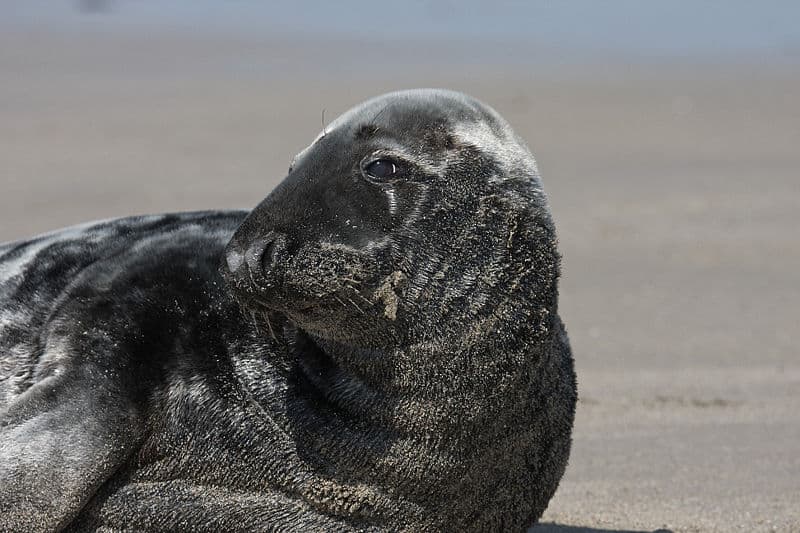
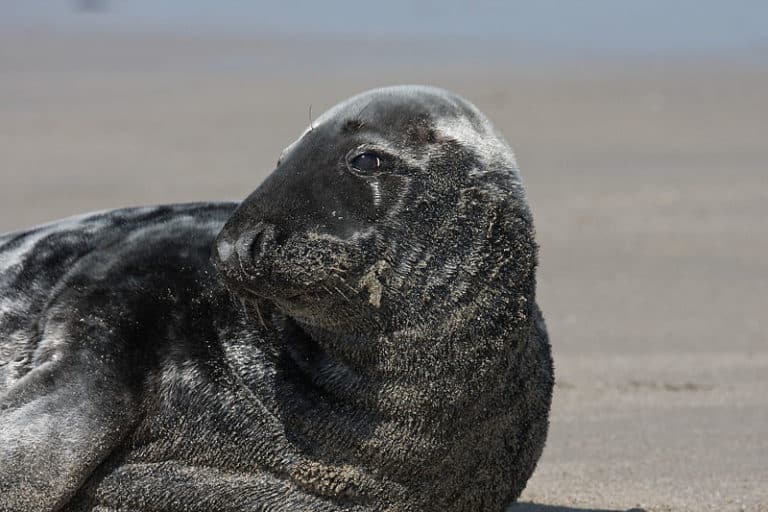
  • Long, horse-like head profile (especially males)
  • Nostrils form a distinct V-shape
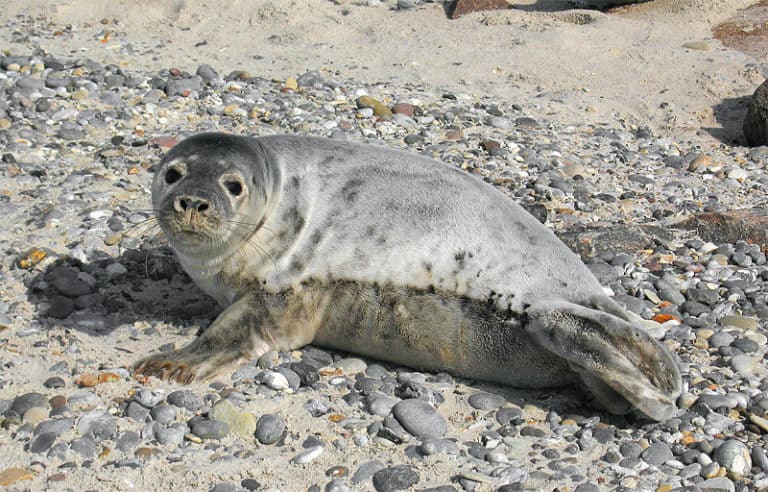
  • Males typically darker with heavier neck/shoulders; females lighter with dark spotting
  • A true seal (no external ear flaps); moves on land by wriggling rather than walking on flippers

Physical Measurements

Males and females differ in size

Length
♂ 1 in (1 in – 1 in)
♀ 5 ft 11 in (5 ft 3 in – 6 ft 7 in)
Weight
♂ 595 lbs (485 lbs – 683 lbs)
♀ 331 lbs (220 lbs – 419 lbs)
Tail Length
♂ 2 in (2 in – 3 in)
Top Speed
16 mph
Burst speed about 7 m/s

Appearance

Primary Colors
Secondary Colors
Skin Type Short dense fur over thick subcutaneous blubber; earless seal skin/fur with no external ear flaps. On land, movement is by abdominal undulation and foreflipper-assisted scooting rather than foreflipper-walking (an earless seal trait).
Distinctive Features
  • Large earless (true) seal with a long, horse-like head and a distinctive convex "Roman" nose; males are usually darker with blotchy markings while females are lighter with scattered spots.
  • No external ear flaps (earless seal); streamlined head and body adapted for aquatic propulsion primarily via hind flippers.
  • Long, 'horse-like' head profile (often described as a Roman-nosed profile), especially in adult males; this is a key field mark versus harbor seal.
  • Nostrils tend to appear more parallel/straight-edged rather than the more V-shaped nostrils typical of harbor seals, aiding differentiation at haul-outs.
  • Adult Grey Seals (Halichoerus grypus): males usually about 2.3–2.5 m long and 170–310 kg; females about 1.8–2.1 m long and 100–190 kg. Size varies by region.
  • Coat changes with molt: annual molt produces a 'fresher' higher-contrast look; worn coat can look smoother and more uniformly gray-brown.
  • Life span reported in monitoring/agency summaries: typically ~25-35 years maximum; females often reach older ages than males in wild populations.
  • Males grow thicker neck and shoulder muscles and often darker fur in the breeding season; females fast while nursing and look sleeker as nursing goes on, which lasts about 16–23 days in NE Atlantic colonies.

Sexual Dimorphism

Strong sexual dimorphism: adult males are substantially larger and heavier and typically darker, with a thicker neck and more pronounced long head profile; females are smaller and often lighter with clearer spotting. This dimorphism is evident at North Atlantic breeding colonies where males compete for access to females.

♂
  • Larger body size: commonly ~2.3-2.5 m total length; mass often ~170-310 kg (ranges summarized in widely used species accounts; varies by region/season).
  • Thicker neck/shoulders ('bull-necked' appearance) and more robust forequarters; pronounced long, convex head profile.
  • Pelage often darker gray-brown with less distinct contrast between background and spots; can appear nearly uniform dark at distance.
  • More conspicuous scarring on neck/shoulders is common in adults due to male-male competition at breeding sites.
♀
  • Smaller body size: commonly ~1.8-2.1 m total length; mass often ~100-190 kg (regional/seasonal variation).
  • Head profile less strongly convex/'roman-nosed' than males; overall more gracile body shape.
  • Pelage often lighter gray/silver-gray with distinct dark spots/blotches, giving higher-contrast patterning than typical adult males.
  • During nursing fasts (short lactation, often ~16-23 days), females may appear progressively leaner at colonies while pups transition from pale lanugo to darker juvenile coat.

Did You Know?

Scientific name meaning: the genus name means "sea pig," and the species name means "hook-nosed," referring to the long, convex male snout.

Strong sexual dimorphism: adult males commonly reach ~2.1-2.3 m and 170-310 kg; females ~1.6-2.0 m and 100-190 kg (NOAA Fisheries; UK SMRU field guides).

Pups are born in a white lanugo coat and are typically weaned after ~16-21 days, during which mothers fast and transfer extremely energy-rich milk (often ~50-60% fat in phocids; data reported for grey seals in pinniped lactation studies).

They are "earless seals" (Family Phocidae): no external ear flaps, and on land they move by wriggling/undulating rather than "walking" on all fours like sea lions.

Deep-diving capability: routine dives are often tens of meters, but recorded dives can exceed 300 m and last >20 minutes in telemetry studies of grey seals in the North Atlantic.

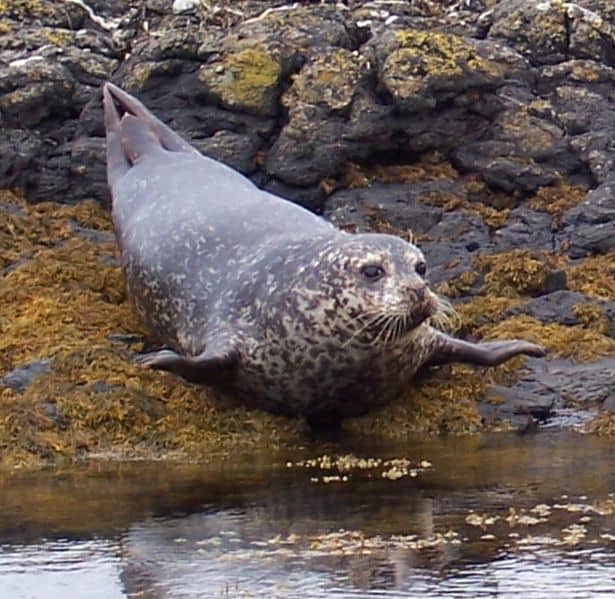
Easy ID vs harbor seal: grey seals have a longer, sloping head ("horse-head") and a W-shaped/concave nostril pattern; harbor seals typically have a rounder head and more V-shaped nostrils (NOAA ID guides).

Major stronghold: the UK holds a large share of the world population, with famous breeding colonies on rocky coasts and islands (e.g., Scotland, Farne Islands) (SCOS reports).

Unique Adaptations

  • Phocid locomotion: powerful hind flippers optimized for swimming; on land, movement is by abdominal undulation and foreflipper bracing-effective on rocks and sand but not built for long terrestrial travel.
  • Diving physiology: large blood volume, high oxygen stores (hemoglobin/myoglobin), and a strong dive response (bradycardia and peripheral vasoconstriction) support long, cold-water dives typical of North Atlantic foraging.
  • Thermal insulation: thick blubber layer and countercurrent heat exchange in flippers reduce heat loss in cold seas; blubber also fuels fasting during breeding and molt.
  • Sexually dimorphic head/neck: males develop a heavier forebody and thick neck (useful in combat and display), with the characteristic long "roman-nosed" profile.
  • Neonatal strategy: white lanugo provides camouflage/insulation on land; rapid nursing and fast growth prepare pups for an abrupt shift to independent life at sea shortly after weaning.
  • Sensory toolkit: large eyes for low light and extremely sensitive vibrissae help detect prey-generated flow fields-an advantage in turbid coastal waters and during deep or night foraging.

Interesting Behaviors

  • Colonial breeding on exposed coasts and islands: adults haul out on rocky shores, beaches, and dunes; pupping often occurs in dense, noisy aggregations where males compete for access to females.
  • Polygynous mating system: large males use body size, thickened neck/shoulders, and threat displays (posturing, vocalizing, biting) to control access to groups of females during the breeding season.
  • Capital breeding strategy: females typically fast during lactation and fuel milk production from stored blubber, then abruptly end nursing at weaning; pups remain ashore to molt their white coat and learn to swim/forage.
  • Site fidelity: many individuals return to the same haul-out and breeding sites year after year (documented in mark-recapture and photo-ID studies).
  • Foraging style: opportunistic predator of fish and cephalopods; individuals can specialize locally (e.g., sand eels in some UK regions, gadids/flatfish elsewhere), revealed by scat analysis and telemetry.
  • Seasonal haul-out patterns: breeding occurs in autumn-early winter in much of the eastern Atlantic (timing varies by region); annual molt typically follows later (often late winter-spring), when seals spend extended time hauled out.
  • Underwater sensing and hunting: uses highly sensitive whiskers (vibrissae) to detect water movements from prey and to follow hydrodynamic trails in low visibility (demonstrated broadly across phocid sensory research).

Cultural Significance

Grey seals (Halichoerus grypus) are part of North Atlantic coastal identity—especially in Scotland, Ireland, Orkney, and Shetland—where selkie myths live on. Today they help conservation, ecotourism, and local art, place identity, and education (e.g., Sable Island).

Myths & Legends

Selkies (Scotland, Orkney, Shetland, Ireland): old stories say seals are sea people who take off their seal skins to walk on land. If a human hides a skin, the selkie must stay ashore.

"The Great Silkie of Sule Skerry" (Orkney ballad): a seal-man, often a Grey Seal (Halichoerus grypus), has a human child, returns from the sea; the story mixes sea danger and the mystery of seal colonies.

Irish coastal folklore of the "seal folk": in some traditions, seals are regarded as kin or enchanted beings; harming them is treated as taboo in certain coastal storytelling traditions.

Faroe and Iceland North Atlantic seal beliefs: maritime folklore sometimes treats seals as liminal creatures tied to storms, luck at sea, or omens-reflecting the importance of seals in subsistence and seafaring life.

Naming lore (learned tradition): the "horse-head" look of male grey seals feeds into common sailor descriptions and local nicknames, reinforcing their reputation as powerful, watchful animals of rocky headlands.

Conservation Status

LC Least Concern

Widespread and abundant in the wild.

Population Increasing

Protected Under

  • EU Habitats Directive (92/43/EEC) - listed on Annex II and Annex V in relevant EU waters (requires designation of Special Areas of Conservation and management of exploitation where applicable).
  • United Kingdom: Conservation of Seals Act 1970 (and subsequent national measures regulating killing and protecting seals at/near key sites).
  • United States: Marine Mammal Protection Act (1972) - prohibits take/harassment of marine mammals (applies to grey seals in U.S. waters).
  • Canada: Fisheries Act - Marine Mammal Regulations (provisions governing disturbance and take).

Life Cycle

Birth 1 pup
Lifespan 30 years

Lifespan

In the Wild
20–46 years
In Captivity
25–46 years

Reproduction

Mating System Polygyny
Social Structure Harem Based
Breeding Pattern Seasonal
Fertilization Internal Fertilization
Birth Type Internal_fertilization

Grey Seal (Halichoerus grypus) breed in dense colonies on rocky coasts, islands, sometimes ice. Males are bigger, compete and guard females (polygynous). Females nurse pups ~16–21 days, mate after weaning; delayed implantation gives a yearly cycle and no lasting pair bonds.

Behavior & Ecology

Social Colony Group: 200
Activity Cathemeral
Diet Piscivore Sandeels (Ammodytes spp.)

Temperament

Generally wary of humans; flight response increases with disturbance intensity and proximity, especially at haul-outs
Socially tolerant at haul-outs when undisturbed, often resting in close proximity; tolerance decreases under crowding or during breeding
Breeding-season males can be highly aggressive: threat displays, lunges, biting, and fights associated with dominance and access to females (polygynous, competitive mating; Anderson & Fedak, 1987)
Mothers are protective and may threaten/strike intruders approaching pups; mother-pup interactions are strongly selective (recognition and reunion after separations within the colony)
Pups show exploratory social interactions post-weaning (e.g., approaching, vocal exchanges, low-level sparring), especially in high-density nursery areas

Communication

Pup 'wails/bleats' used to solicit maternal attention and facilitate reunion in crowded colonies Mother-pup recognition context
Female calls (bleats/growls) used in maternal care, rejection of non-filial pups, and short-range spacing
Male threat vocalizations (low-frequency growls/roars) during contests and mate-guarding contexts, often paired with visual postures
Underwater vocalizations (low-frequency calls reported in phocids) likely used at close range, though most socially salient signaling in grey seals is described at haul-outs during breeding
Visual threat and dominance displays: raised head/neck, open-mouth displays, lunges, and body orientation to maintain spacing and deter rivals Especially males in breeding season
Tactile interactions: nose-to-nose contact, nuzzling between mother and pup, and biting during aggressive encounters
Olfactory cues at close range Sniffing) used in individual assessment and mother-pup recognition within dense colonies (commonly reported for phocids in breeding aggregations
Spatial behavior as communication: maintaining individual 'personal space' on haul-outs; spacing shifts with temperature, tide, substrate, and breeding state

Habitat

Coastal Rocky Shore Beach Estuary Open Ocean Seabed/Benthic
Biomes:
Terrain:
Coastal Island Rocky Sandy
Elevation: Up to 98 ft 5 in

Ecological Role

Large marine mesopredator/top predator in North Atlantic coastal-shelf ecosystems; links mid-trophic forage fish and higher predators and can exert localized top-down pressure on commercially important fish assemblages.

Trophic regulation of fish and cephalopod populations (top-down control) Energy and nutrient transfer from offshore feeding areas to haul-out/breeding sites via excretion and carcasses Supports scavenger communities through prey remains and occasional carcasses Sentinel/indicator role for marine ecosystem health via diet shifts and contaminant burdens (widely used in monitoring programs such as SCOS/NOAA assessments)

Diet Details

Main Prey:
Sandeels Atlantic cod Whiting Saithe Haddock Atlantic herring European sprat Atlantic mackerel Flatfishes Lumpfish Squid Octopus Crustaceans +7

Human Interaction

Domestication Status

Wild

Grey seals (Halichoerus grypus) are not domesticated and have no history of breeding for tameness. People hunted them for oil and skins. Today they have legal protection. They interact with fisheries (stealing fish, bycatch), draw tourism, are studied (tagging, diet, disease), and are rescued when stranded. As Phocidae seals, they live at sea, dive deep, range widely; domestication is impractical.

Danger Level

Moderate
  • Bites and crushing injuries: adults are large, strong carnivorans; defensive bites can cause deep lacerations and infection risk, especially if approached on land during breeding season or near pups.
  • Zoonoses: potential exposure from close contact (especially with stranded/rehab animals) to pathogens reported in seals (e.g., sealpox/parapoxvirus; various bacterial infections). Risk is primarily occupational (rehabilitation staff, researchers).
  • Aggressive/territorial behavior at colonies: breeding males can be highly aggressive; disturbance increases risk to humans and seals.
  • Water safety: seals can startle swimmers/boaters; interactions around haul-outs can increase accident risk (falls on rocks, boat handling hazards).

As a Pet

Not Suitable as Pet

Legality: Grey Seal (Halichoerus grypus) is generally illegal to keep as a private pet. In the US it needs federal MMPA authorization; in the EU and UK permits only allow licensed rehab, research, or zoos.

Care Level: Expert Only

Purchase Cost:
Lifetime Cost: $200,000 - $1,500,000

Economic Value

Uses:
Wildlife tourism and recreation (seal-watching at colonies, coastal ecotourism) Fisheries interactions (gear damage, depredation, bycatch mitigation costs) Scientific research value (telemetry, ecology, climate and ecosystem monitoring) Public-sector conservation and management (monitoring, protected area enforcement) Stranding response and rehabilitation (charity/government funded veterinary care) Historical harvest (regional, now highly regulated/limited depending on jurisdiction)
Products:
  • Non-consumptive economic value: tourism services (boat tours, guides, lodging spillover)
  • Historical: oil/blubber and skins/pelts (legacy use; now largely restricted)
  • Data products: movement/dive datasets from tags used in oceanography/ecology

Relationships

Related Species 5

“A grey seal can dive 1,500 feet below the surface of the ocean and stay under for an hour.”

A grey seal is one of the rarest species of seal alive today. They can adapt to life on a coastline but go to the ocean when hunting for food. These seals can live from 25 to 35 years. The big, curved nose of grey seals has earned them the name the horseheads of the sea.

Grey Seal Top Facts

Staying warm in the sea: A grey seal has two heavy layers of fur and one layer of blubber that combine to keep it warm in the cold ocean water.

• A big animal: An adult male grey seal can weigh 880 pounds!

• Expert hunters: Grey seals can see and hear better underwater than they can on land. This helps them to find their prey in the ocean waters.

• Talking seal talk: These seals communicate with one another in hoots, cries, growls and hisses. They also flap their flippers. Seals have their own language!
 

Grey Seal Scientific Name

The common name for this marine mammal is grey seal. Looking further into grey seal classification, its scientific name is Halichoerus Grypus. Halichoerus Grypus is Latin meaning sea pig with a hooked nose. The grey seal classification for family is Phocidae and its class is mammalia.

There are subspecies of this seal found on the western Atlantic coast and the eastern Atlantic coast as well as the coast of the Baltic Sea.
 

Grey Seal Appearance & Behavior

A male grey seal has silver-colored spots scattered over its thick, dark grey fur. Females have silver colored fur with dark spots throughout. Both males and females have short flippers that are perfect for helping them swim through the ocean waters but make them look like caterpillars while moving on land.

Male seals are around 10 feet long and can weigh up to 880 pounds! So, if you stood an adult male seal up on its back flipper, it would be half the height of an adult giraffe. Plus, an adult seal at 880 pounds weighs a little less than an adult Arabian horse. Females are around 7 1/2 feet long and weigh in at 550 pounds. A female seal is about half the weight of a grand piano.

The body of a grey seal is designed to help it survive on land and in the sea. It has two webbed front flippers featuring five claws on each of them. Their rear flippers help them to move through the water and change direction. The strength in a seal’s shoulders allow it to push itself up out of the water onto slippery rocks even when the waves are crashing behind it.

The long nose of a grey seal has earned it its scientific name of hook-nosed pig of the sea. They are called horseheads also due to their long noses. A male seal’s nose is generally longer than a females. This seal has large eyes, whiskers like a cat and pointed teeth. This particular feature is one of the main differences between grey seals and harbor seals, a close relative.

Seals are able to close their ears and their nostrils. This allows them to spend long periods of time in the ocean water looking for prey or traveling to their next destination.

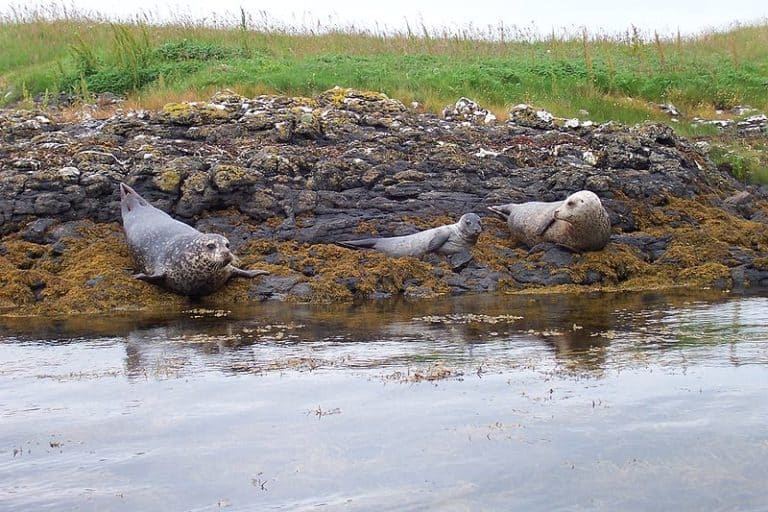
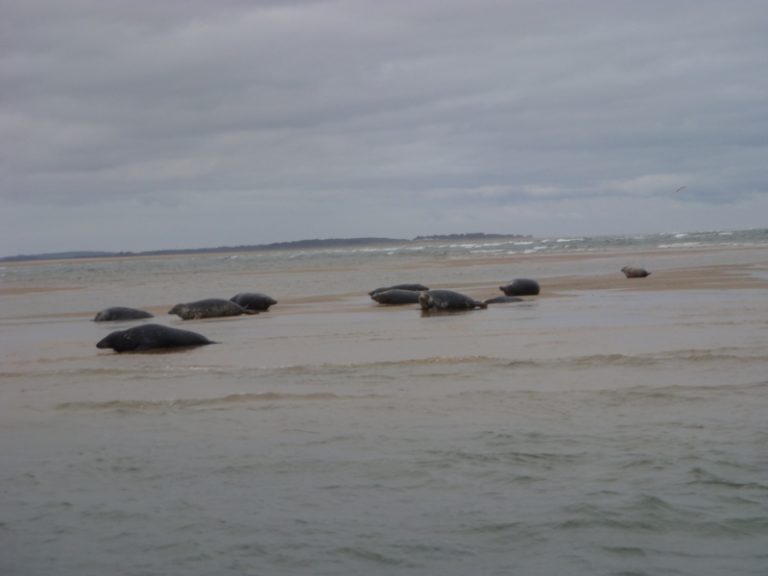
A group of seals is sometimes called a herd or colony. These seals live in large groups during the breeding season and travel in smaller groups during the rest of the year. The largest colony on record is located on Sable Island near Nova Scotia and contains 100,000 grey seals that travel there to breed.

Gray seals are curious and playful, but they can be aggressive if threatened. They will use their sharp teeth to bite at predators or strike them with their flippers. Though the babies of grey seals can look cute and cuddly like puppies, they can be aggressive in their own way if threatened.
Grey Seal (Halichoerus Grypus)

Grey Seal Habitat

These seals make their home on many coasts throughout the world. Some live on the coasts of eastern Canada down to New England shorelines. Other grey seals live on coasts of the United Kingdom, Ireland, the Faroe Islands, Norway, Iceland and in northwestern Russia. There is also a smaller group of grey seals living on the coast of the Baltic sea.

Grey seals live on coastlines, but the specific terrain can vary in different areas. These seals inhabit coastlines with a rocky terrain, icebergs, sandbars and islands. Its thick fur protects it from the cold sometimes arctic temperatures in which it lives.

Harbor seals have been seen living in the same area as grey seals. These two seals share many of the same characteristics and are certainly similar in appearance.
 

Gray Seal Diet

What do grey seals eat? Scientists have found that gray seals eat at least 29 species of fish including mackerel, squid, cod, capelin, sand eels and herring. They usually dive down about 200 to 230 feet to hunt for fish, but they can swim to lower depths if necessary. Seals need to eat about 30 to 50 pounds of food almost every day, but they fast (don’t eat) during the breeding season. A pile of fish adding up to 50 pounds weighs about half as much as the average toilet.
 

Grey Seal Predators & Threats

Though grey seals can swim at speeds up to 25 mph, they still have predators in the ocean. Orcas (also known as killer whales) and sharks have been known to prey on these seals. A group of Orcas may approach a grey seal resting on an ice floe and create a wave, quickly tipping the seal into the water.

Humans are a threat to these seals as well. Chemicals such as oil and gas dumped into the ocean gets into fish that serve as a food source for grey seals. When the seals eat the fish, they take in these chemicals and it can result in health problems. Also, they can get tangled up in fishing nets or trawls attached to boats. If this happens, they may not be able to escape to get up to the surface to get a breath.

Of course, a person is at risk when they approach a grey seal to feed it. Like any animal, a seal’s reaction can be unpredictable. In addition, feeding grey seals makes them more likely to look to humans for food. This puts them at risk for being mistreated or fed items that will make them sick. Plus, they may venture too close to boats in order to get food and suffer injury as a result.

A grey seal is one of many marine animals protected by the Marine Mammal Protection Act. There’s been a decrease in commercial hunting for grey seals giving them a conservation status of Least Concern which means they are not considered to be a threatened animal. Also, their population is said to be increasing.
 

Grey Seal Reproduction, Babies & Lifespan

Grey Seal Mating

A male grey seal called a bull, fights other males when looking for a female, or cow, during breeding season. Males are often injured and take on scars during this season of the year. Males and females mate with several different partners throughout their lives.

The gestation period of a grey seal is 11 months. A harbor seal has a gestation period of about the same length. A female grey seal living on the Baltic coast will usually give birth in March while a female living on the western Atlantic coast gives birth anywhere from December to February. Females on the eastern coast of the Atlantic give birth somewhere between September and November.

A grey seal gives live birth to one baby or pup. A newborn pup weighs around 35 pounds or about the size of two and a half bowling balls!
 

Grey Seal Babies

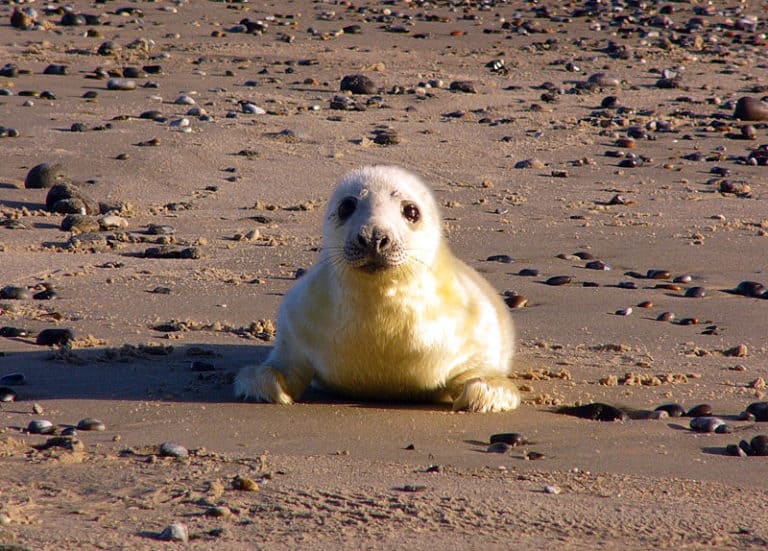
A seal pup nurses for about three weeks receiving high fat milk from its mother in order to develop a thick layer of blubber. A baby seal is born with a coat of white fur designed to absorb heat to keep it warm as it develops blubber. At the pup’s fourth week of life, it is weaned by its mother. The mother seal forages for small fish to give to the pup but doesn’t eat anything herself. A grey seal pup has a unique cry that lets its mom know where it is on a crowded beach. Some scientists say this cry sounds like a human baby’s cry.

As the seal pup turns six weeks old, she leaves it survive on its own. A healthy six-week-old pup will stay with the herd a couple more weeks, then begin to hunt on its own in the ocean.
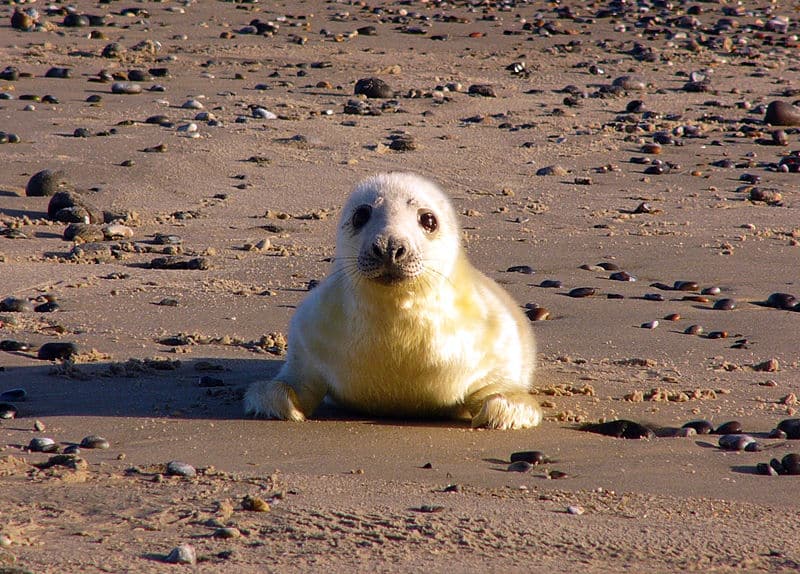
 

Grey Seal Baby (Halichoerus Grypus)

Grey Seal Lifespan

A male grey seal’s lifespan can be up to 25 years while a female can live to be 35 years old. Of course, the threat of fishing nets, water pollution and natural predators’ factor into the lifespan of a grey seal. The oldest grey seal lived to be 46 years old in the wild!
 

Grey Seal Population

The population of the grey seal is increasing. It’s conservation status is Least Concern, so it is not recognized as a threatened animal according to its population totals.

• There are approximately 150,000 grey seals on the western Atlantic coasts.

• 130,000-140,000 grey seals populate the eastern Atlantic coasts

• The Baltic coast has a population of about 7,500 seals
 

View all 261 animals that start with G

Sources

  1. David Burnie, Dorling Kindersley (2011) Animal, The Definitive Visual Guide To The World's Wildlife / Accessed December 12, 2008
  2. Tom Jackson, Lorenz Books (2007) The World Encyclopedia Of Animals / Accessed December 12, 2008
  3. David Burnie, Kingfisher (2011) The Kingfisher Animal Encyclopedia / Accessed December 12, 2008
  4. Richard Mackay, University of California Press (2009) The Atlas Of Endangered Species / Accessed December 12, 2008
  5. David Burnie, Dorling Kindersley (2008) Illustrated Encyclopedia Of Animals / Accessed December 12, 2008
  6. Dorling Kindersley (2006) Dorling Kindersley Encyclopedia Of Animals / Accessed December 12, 2008
  7. David W. Macdonald, Oxford University Press (2010) The Encyclopedia Of Mammals / Accessed December 12, 2008
A-Z Animals Staff

About the Author

A-Z Animals Staff

AZ Animals is a growing team of animals experts, researchers, farmers, conservationists, writers, editors, and -- of course -- pet owners who have come together to help you better understand the animal kingdom and how we interact.
Connect:

Thank you for reading! Have some feedback for us?


Grey Seal FAQs (Frequently Asked Questions)

A grey seal is a carnivore. In fact, it’s the biggest carnivore in the United Kingdom. This seal eats many types of fish including mackerel, herring, flatfish and cod. Also, they have been known to eat squid, lobsters, octopus and even a few types of seabirds. In addition to those animals, a grey seal may eat a harbor seal, or a porpoise using its powerful jaws to capture and eat this larger prey. These seals wouldn’t be able to sustain a necessary layer of blubber by eating plant life. They need to maintain this layer of blubber for warmth to survive in a cold environment.