Quick Take
- Mastering over 300 distinct strains is the ultimate achievement for fancy guppy specialists.
- The Gyrodactylus turnbulli parasite creates a critical technical constraint for aquarium health and longevity.
- Shifting to black irises provides a surprising defensive buffer during active predator strikes.
- An 1858 storage mistake necessitated a 100-year scouting effort to reconcile 11 conflicting species names.
The Guppy fish, with their colorful designs and feathery tailfins, are favorites with people who keep freshwater aquariums. Guppies are tiny tropical fish that live throughout the world. They are sometimes called rainbow fish or million fish. There are over 300 known fancy, colorful, and pattern-varied types or strains of guppies in the aquarium trade.

3 Incredible Guppy Facts
- The million fish: Guppies go by alternate names, including rainbow fish and million fish. They are called rainbow fish because of their colorful scales. The nickname million fish refers to the breeding habits of the fish. A female guppy can have up to 50 babies every month
- Fighting malaria: Guppies are small tropical fish that play a part in the fight against malaria. Mosquitoes are known carriers of this disease. To reduce the mosquito population, these fish have been released into bodies of water around Asia and other areas to eat mosquito larvae.
- Birth announcement: While most fish reproduce by laying eggs, guppies do things another way. The eggs are incubated while still inside the female guppy. The female is pregnant for about a month, then gives live birth to dozens of babies.
Classification and Scientific Name
Poecilia reticulata is the scientific name for these fish. Poecilia is a Greek word meaning speckled, and reticulata is Latin, meaning a net-like pattern. These wild fish are also called rainbow fish and million fish. They belong to the Poeciliidae family and are in the class Actinopterygii.
Origins and History
In 1866, geologist Robert John Lechmere Guppy sent a small fish from streams in Trinidad to London, where it was given the scientific name Girardinus guppyi in honor of Mr. Guppy.
Guppy is commonly recognized as the discoverer of the wild guppy, even though a Spaniard named De Filippi stumbled upon the species on the island of Barbados in 1862 and classified it as a new genus and species, giving it the name Lebistes poecilioides.
Before De Filippi, a German biologist named Julius Gollmer found guppies in the Rio Guayre near Caracas, Venezuela, in 1857 and 1858. He sent the preserved fish to the Imperial Prussian Academy of Science in Berlin. However, they were not very enthusiastic about them and gave Gollmer only a small reward and nominal recognition. The specimens were put in a storeroom due to a filing mistake.
In 1859, Wilhelm Karl Hartwig Peters wrote the first scientific description of what was in the jars. Sadly, the jars were not properly labeled or stored, so only the female specimens were recognized as a new species named Poecilia reticulata.
Following 1866, the male specimens that Julius Gollmer had sent to Berlin were located and officially called Girardinus guppyi. The females, which had previously been called Poecilia, were given the same name as the males, as was traditional during this period. Many collectors delivered guppies to museums, and they were assigned no fewer than 11 distinct scientific names. It was eventually revealed that these were merely different strains and not new species.
The scientific name of guppies has undergone a number of revisions in the past 100+ years, finally settling on the name of Poecilia reticulata. You may still, however, see the guppy described under the scientific name of Lebistes reticulata in some scientific publications.
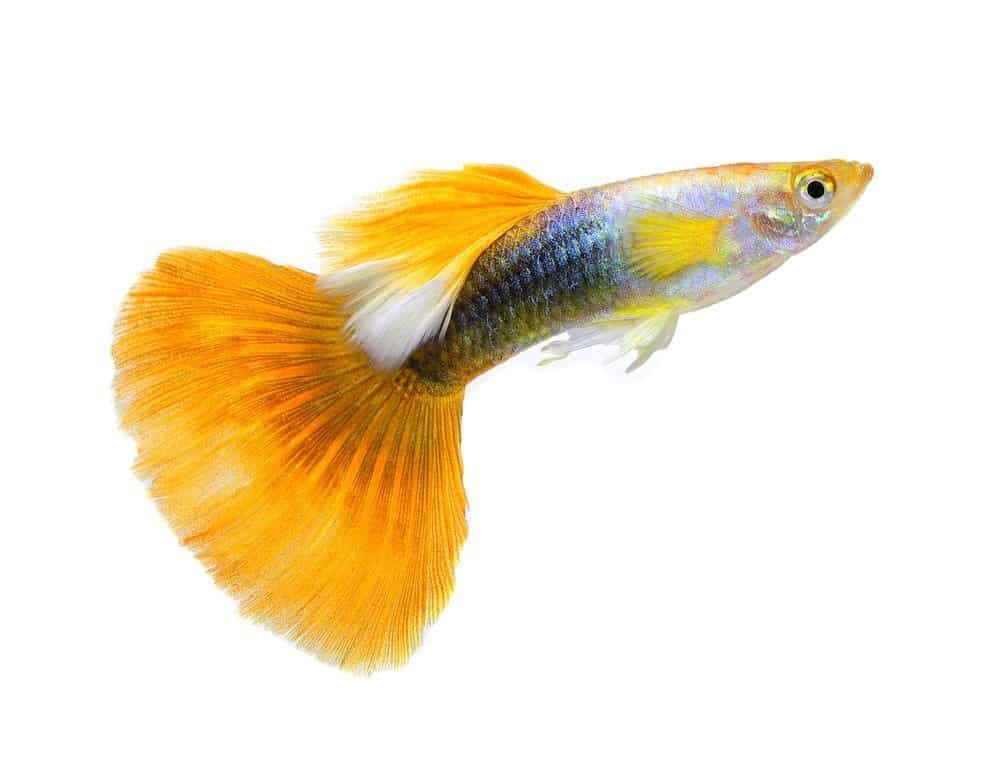
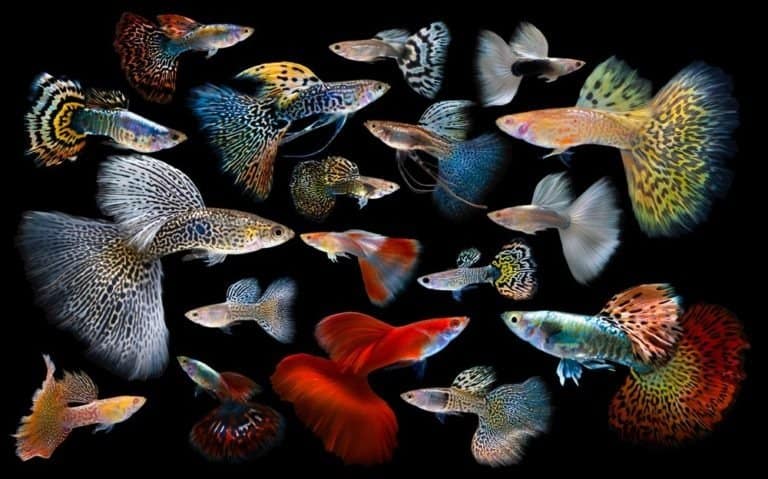
There are more than 300 types of guppies in the aquarium trade.
©SOMMAI/Shutterstock.com
Species
Guppy fish are categorized in many ways, including by their scale colors, scale patterns, and even the shape of their tail. Three of the most well-known types include:
- Fancy guppy: They are known for their especially bright colors and elaborate tailfins. They can have fan tailfins, triangle tailfins, and veil tailfins, to name a few.
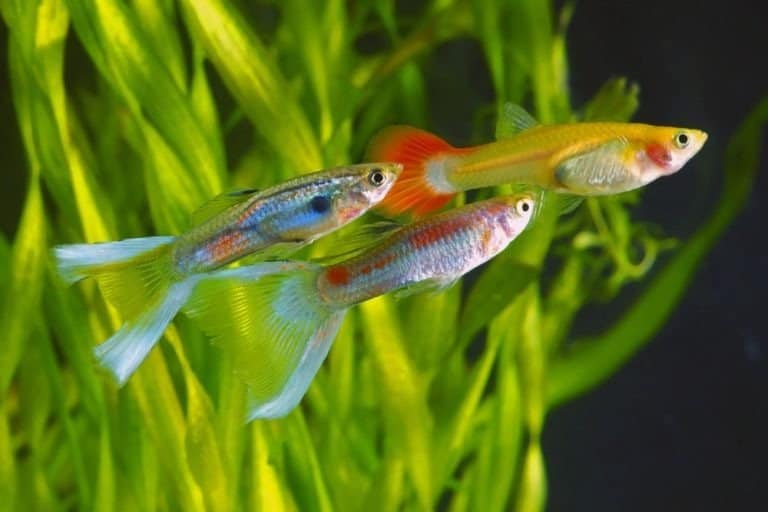
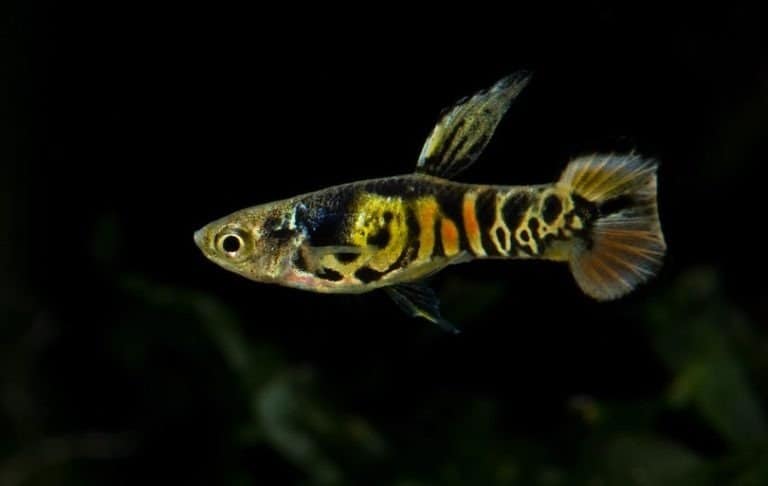
- Endler’s guppy: These fish are less colorful than fancy guppies and have a simple round or spade tailfin. Someone who wanted a colorful addition to their aquarium would likely choose a fancy over an Endler’s guppy.
- Swamp guppy: This type is rarer than those in the above two groups. They are found in streams around Trinidad and prefer a habitat with brackish water.
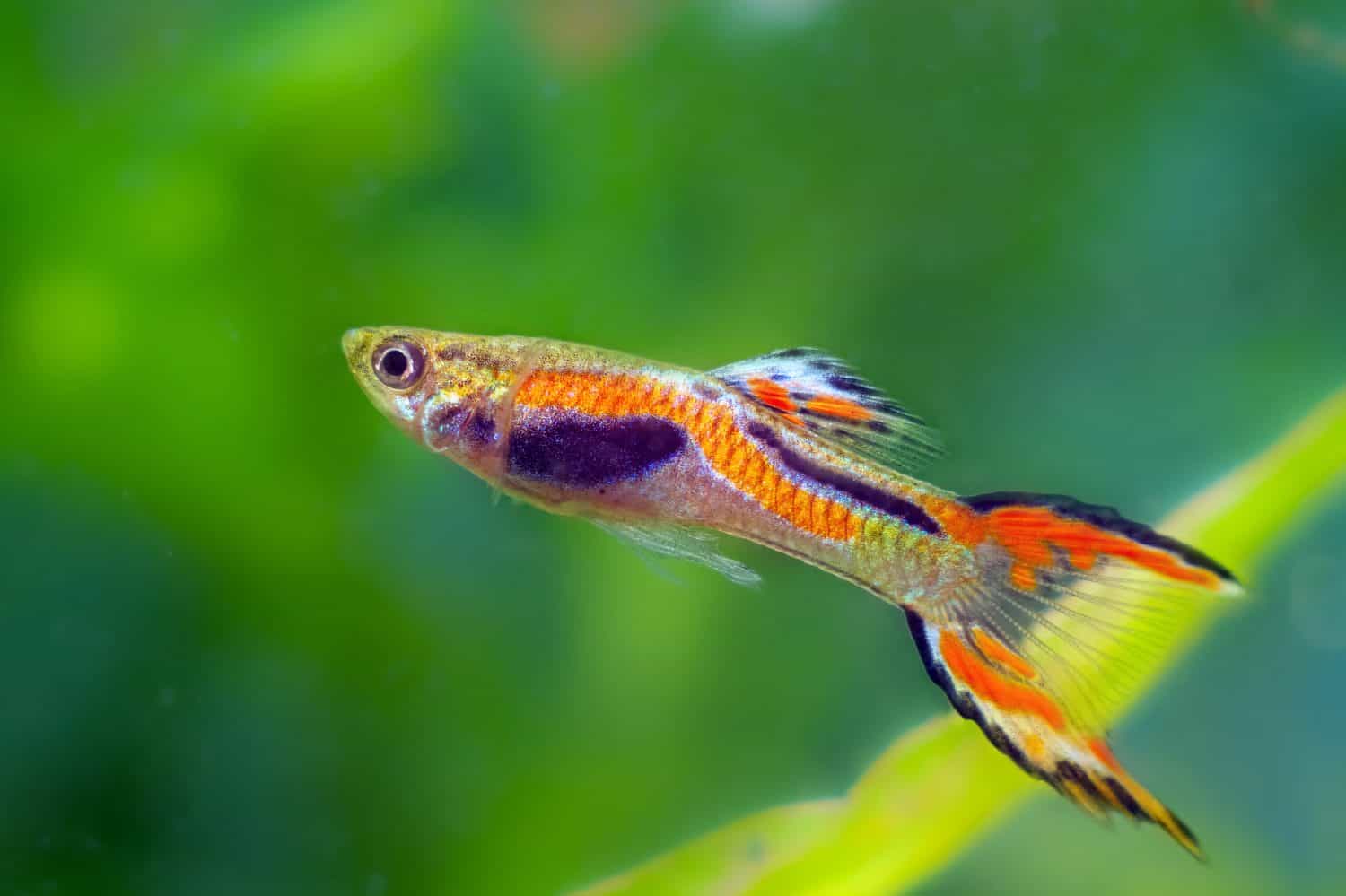
A healthy, handsome Endler’s guppy with vibrant neon glowing spawning coloration.
©Aleron Val/Shutterstock.com
Appearance
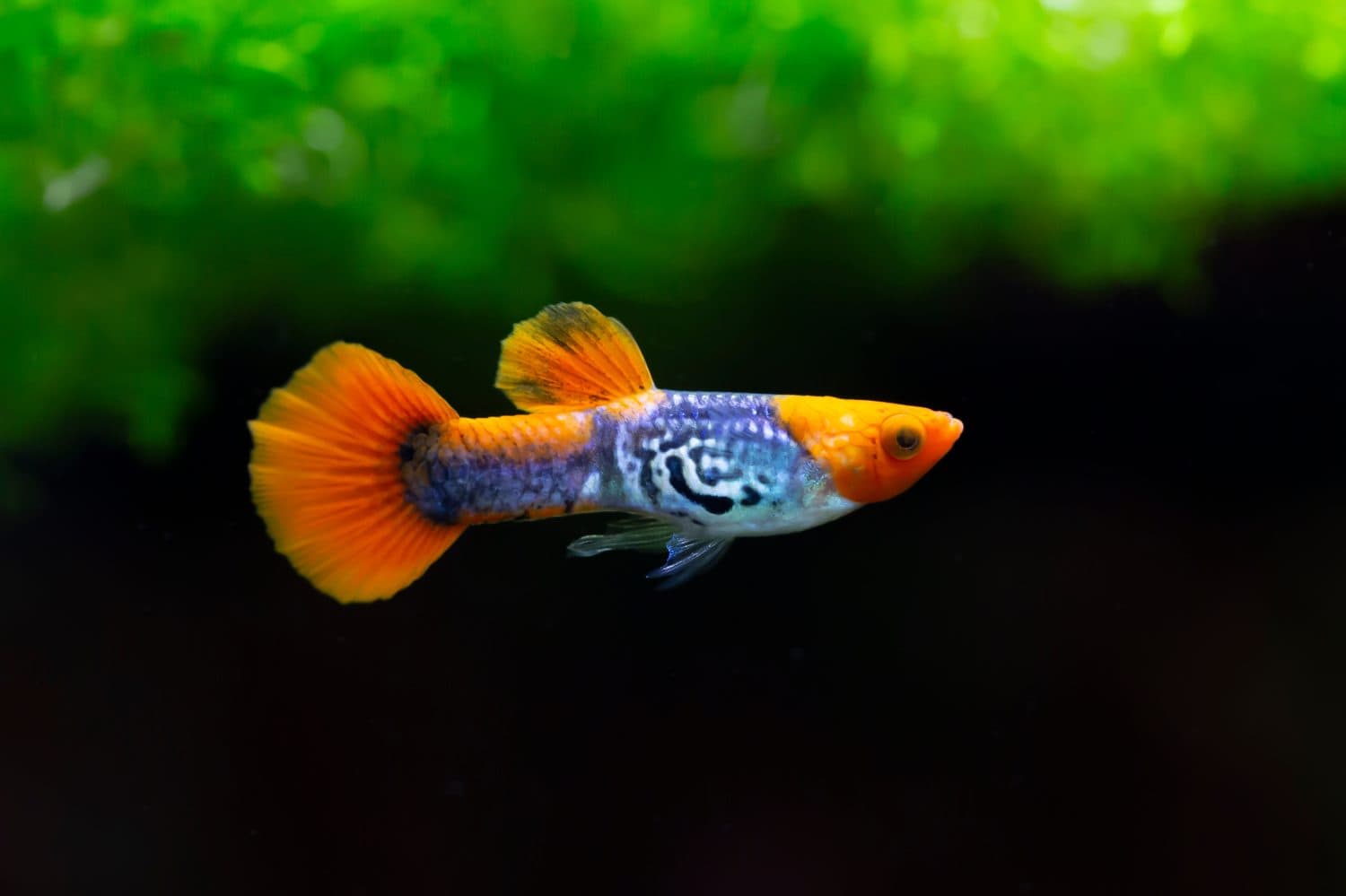
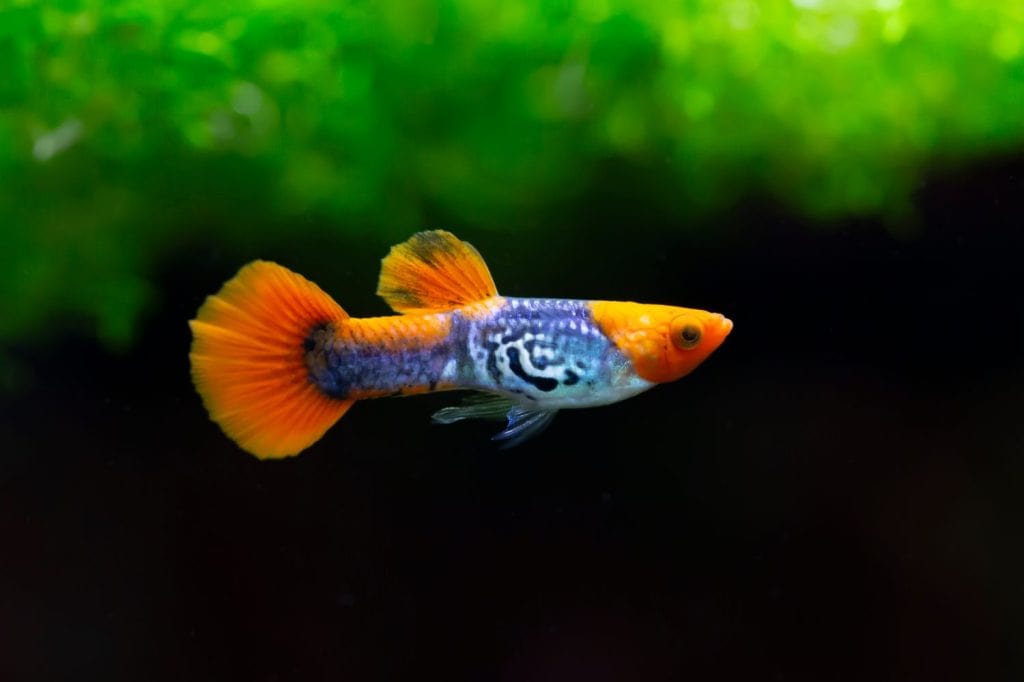
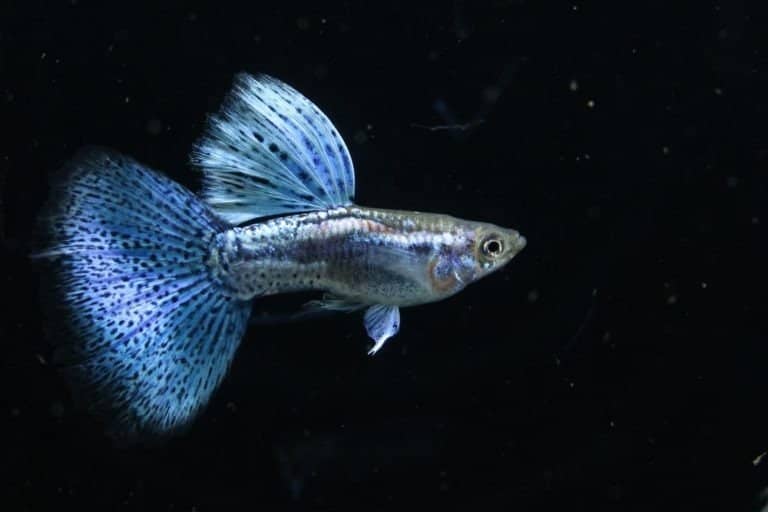
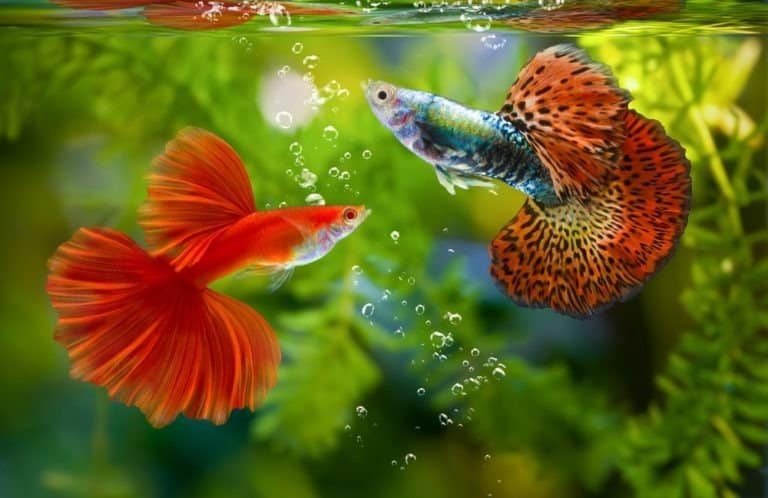
Guppy fish can be yellow, red, blue, green, black, white, or orange, depending on the type. For instance, a blue cobra guppy has a dark blue body with a vertical black striped pattern that looks like a cobra snake’s back. It has a triangle tailfin of bright blue with a yellow and black pattern mixed in. Alternatively, a red guppy has scales that feature a mixture of bright red and gold. Its fan tailfin is bright red with light gold at its tip. From leopard to cobra guppies to the Dumbo ear dragon guppy, there are unique colors and scale patterns throughout this group.
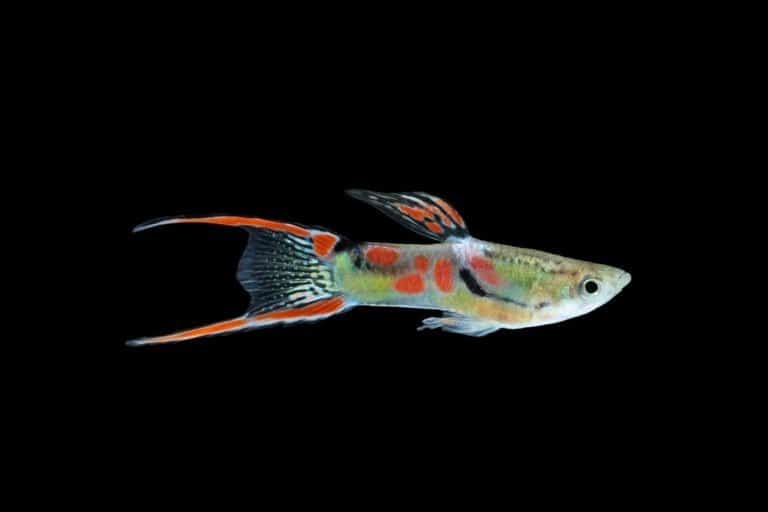
These fish have a number of different tailfin shapes as well. Fan tail, flag tail, lyre tail, sword tail, round tail, and veil tail are a few examples. The longest a guppy can get is 2.4 inches.
The bright coloration of guppy fish makes them a clear target for many predators. However, they do have a unique defensive feature. When a predator approaches, the fish’s irises turn from silver to black. This allows the fish to dart out of the path of danger while the predator focuses on what it thinks is the fish’s head.
In addition, wild guppies swim in large schools containing sometimes hundreds of fish. This means if a predator attacks, there’s a good chance that most of the fish in the school will be able to get away.
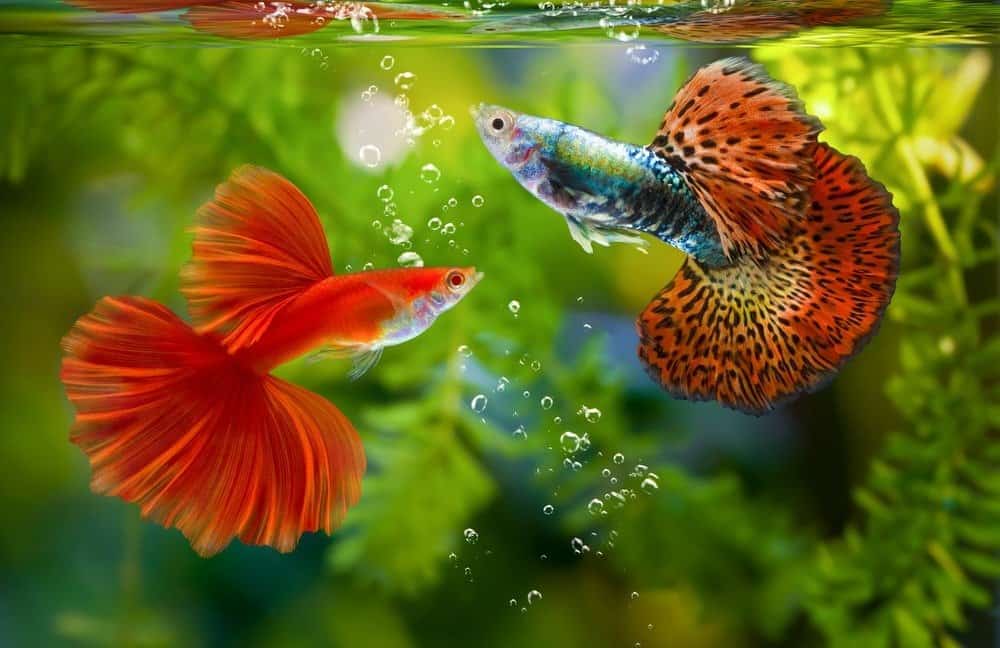
The bright coloration of guppy fish makes them a clear target for many predators.
©panpilai paipa/Shutterstock.com
Distribution, Population, and Habitat
Brazil, Jamaica, Antigua, Barbados, Venezuela, and the U.S. Virgin Islands are just a few of the places where wild guppy fish are found. In fact, they are now found everywhere in the world except Antarctica. They are able to live in freshwater or brackish water. Their habitat includes streams and shallow pools near larger bodies of water.
The exact population of this tropical fish is unknown. However, the conservation status of the fish is Least Concern. These wild fish reproduce in large numbers, which helps their population remain stable.
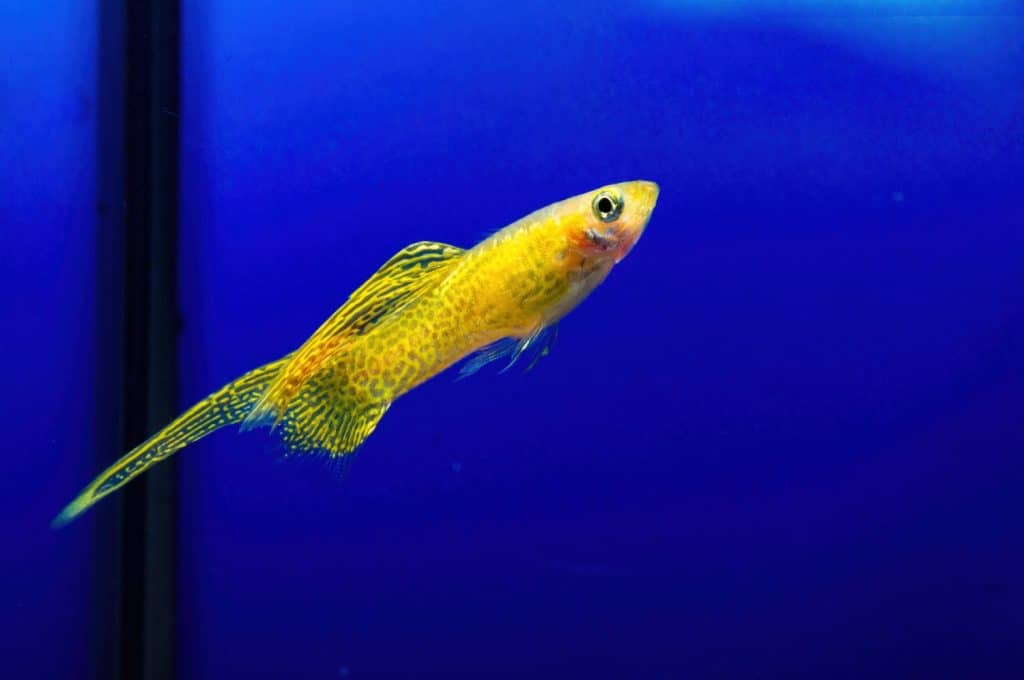
A yellow top swordtail guppy. Swordtails are one of the fin variants of guppies.
©neohch/Shutterstock.com
Predators and Prey
Most of these fish grow to be about one inch in length, so it’s no surprise they have many predators. Wild guppies swim in schools of hundreds of fish, so a predator can grab several at one time.
What eats guppies?
Larger fish, such as the blue acara and pike cichlid, are predators of guppy fish. Sea birds such as kingfishers are also predators of this tiny tropical fish.
What do guppies eat?
These fish are omnivores. They eat algae, plant particles, and mosquito larvae.
They live in large schools and participate in foraging behavior. This means they search for food while in these large groups. So, when a supply of algae is found, more of them can share the nourishment.
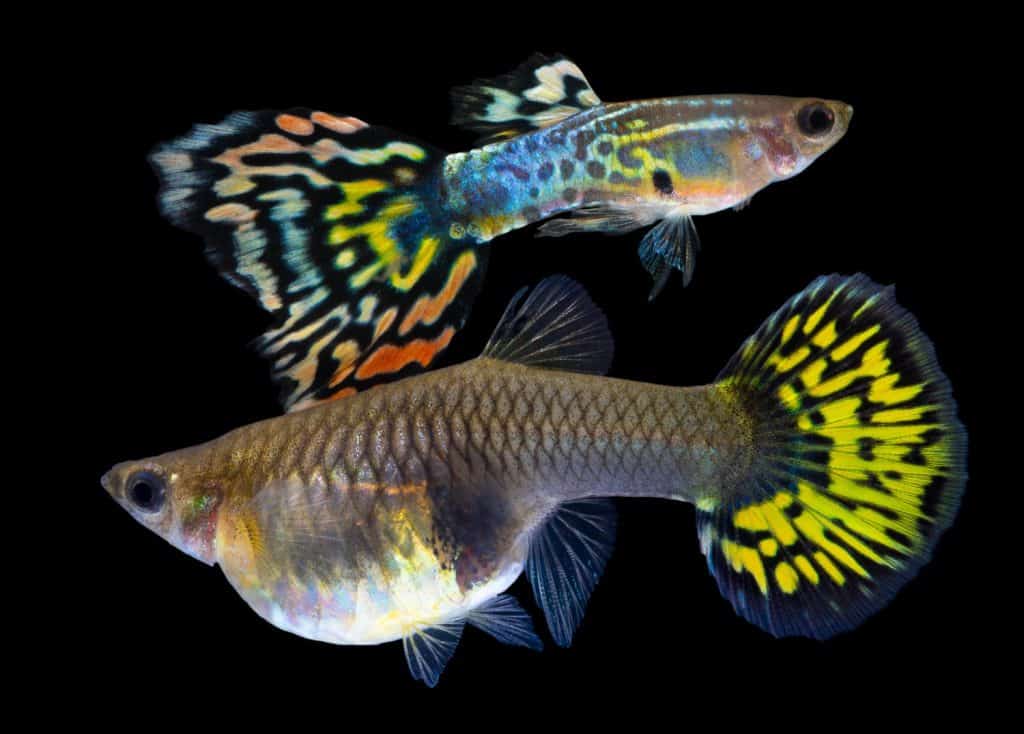
You can tell that a guppy female is pregnant by the dark gravid spot.
©panpilai paipa/Shutterstock.com
Reproduction and Lifespan
Breeding takes place year-round for these fish. A female mates with multiple males. She is pregnant with fertilized eggs for about one month. They are different from many other types of fish in that they give live birth to their young. A female can have from 50 to 100 babies, also called fry. Due to this breeding activity, a female can have from 2 to 3 generations of fry each year. Fry begin living independently right at birth.
Males are sexually mature at seven weeks old, while females reach sexual maturity at 10 to 20 weeks old. Normally, these fish live to be two years old.
These fish are carriers of many parasites, which is another factor affecting their lifespan. Gyrodactylus turnbulli is one of the most common parasites inhabiting the gills and fins of guppies. They spread these parasites to other guppies and even other species of fish.
Fishing and Cooking
These are very small fish measuring no more than 2.4 inches in length. So, they are not targets of commercial fisheries.
Some recreational fishermen may try to capture rare specimens in small nets to sell to guppy hobbyists or pet shops.
Guppy Pictures
View all of our Guppy pictures in the gallery.

panpilai paipa/Shutterstock.com
Sources
- Pet MD / Accessed December 16, 2020
- Wikipedia / Accessed December 16, 2020
- Guppy Expert / Accessed December 16, 2020