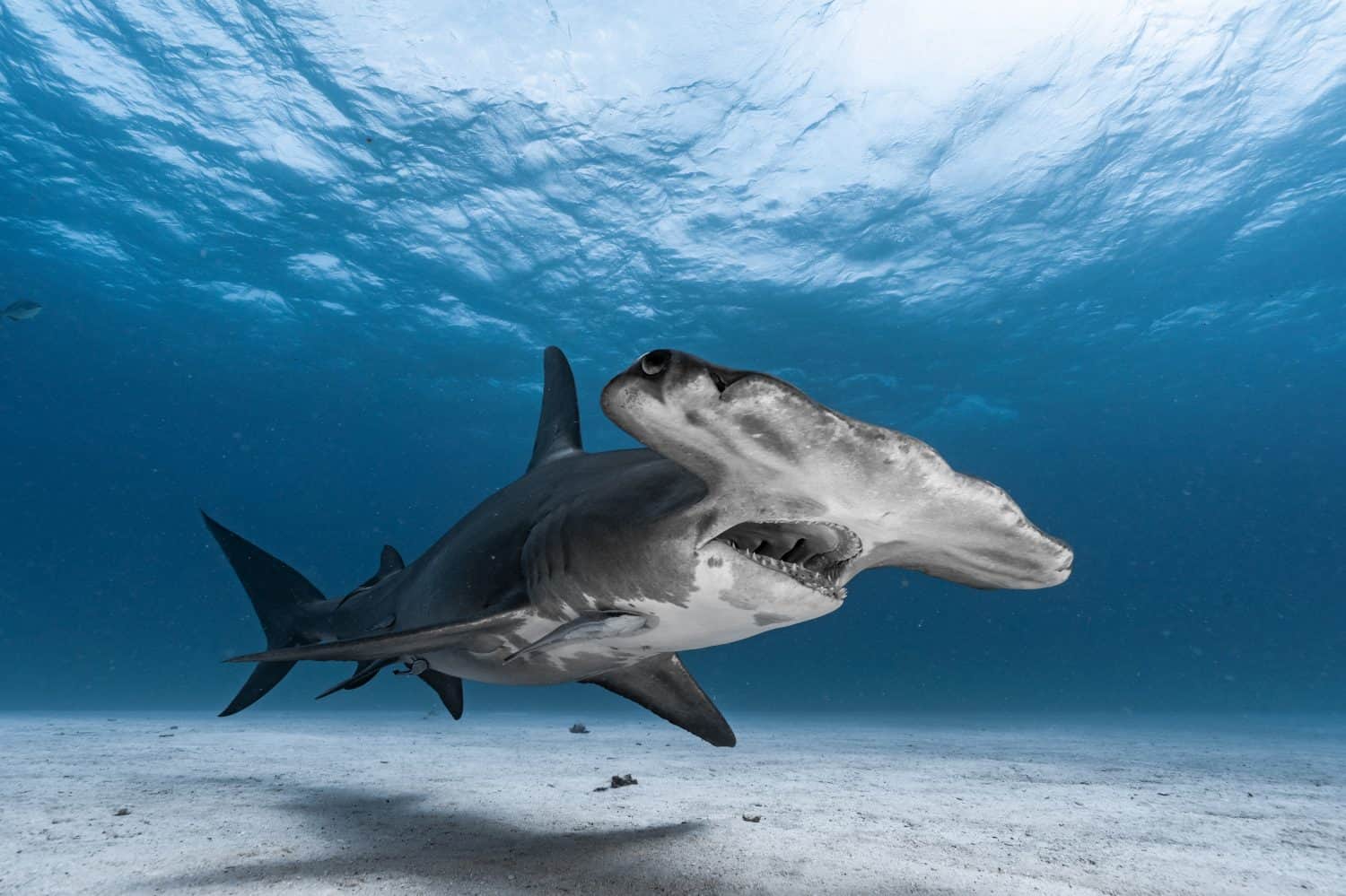
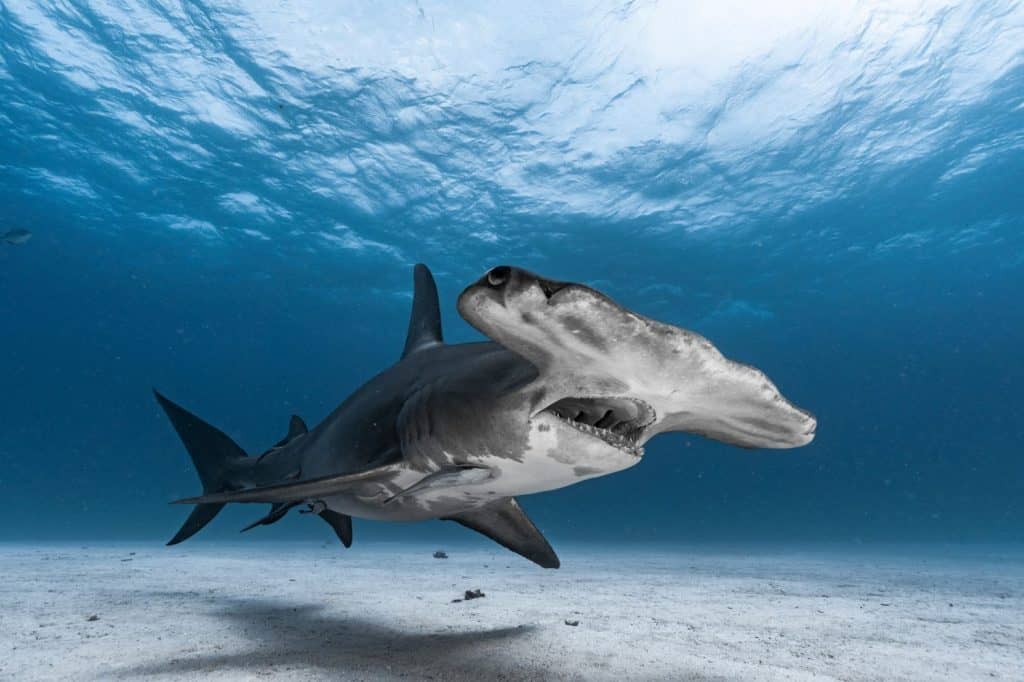
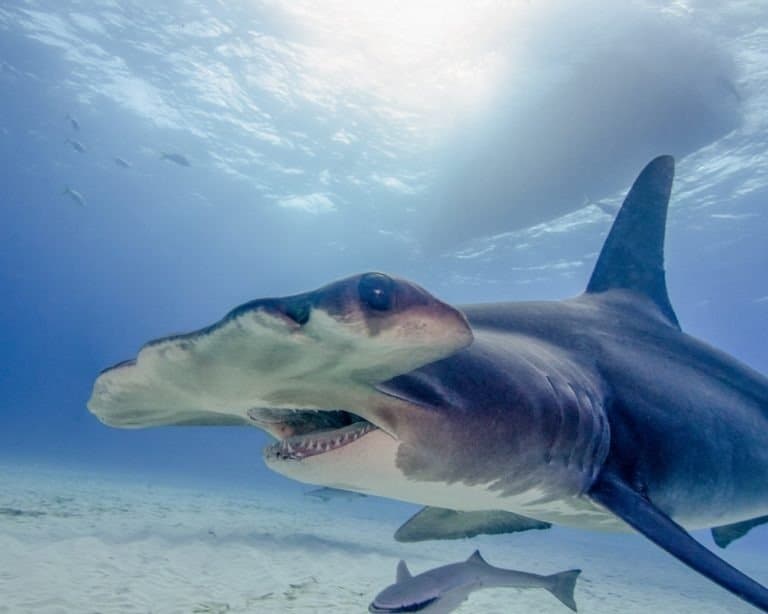

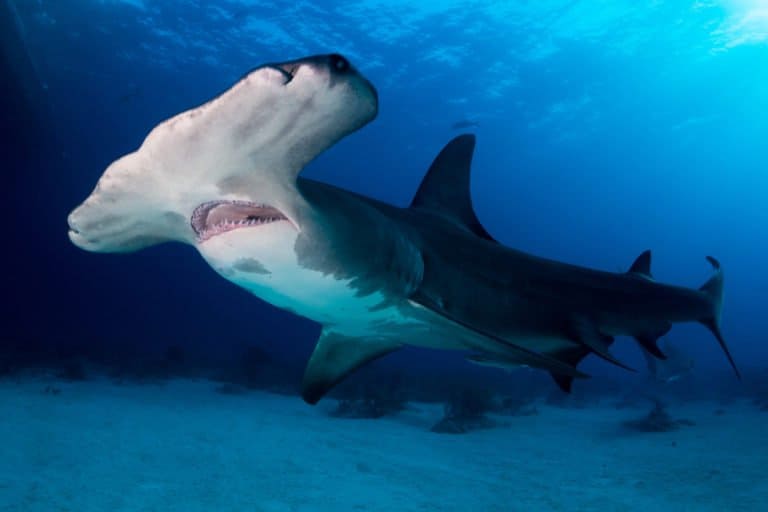
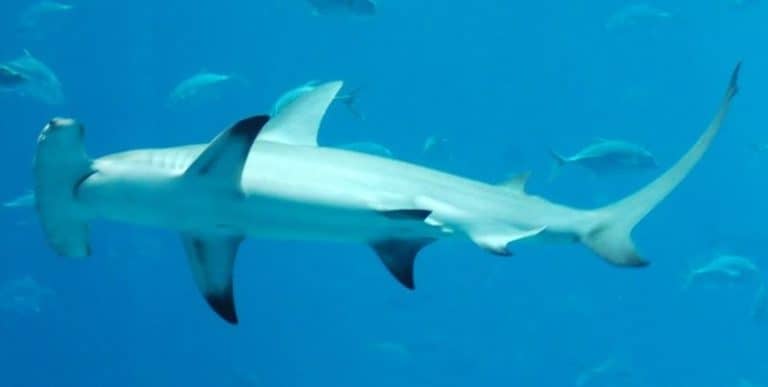






Hammerhead sharks are best known for their long, rectangular heads. These distinctive heads serve multiple purposes, including granting the sharks 360-degree vision as well as better hunting abilities. Hammerhead sharks populate coastal areas and the edges of continental plates.
4 Hammerhead Shark Facts
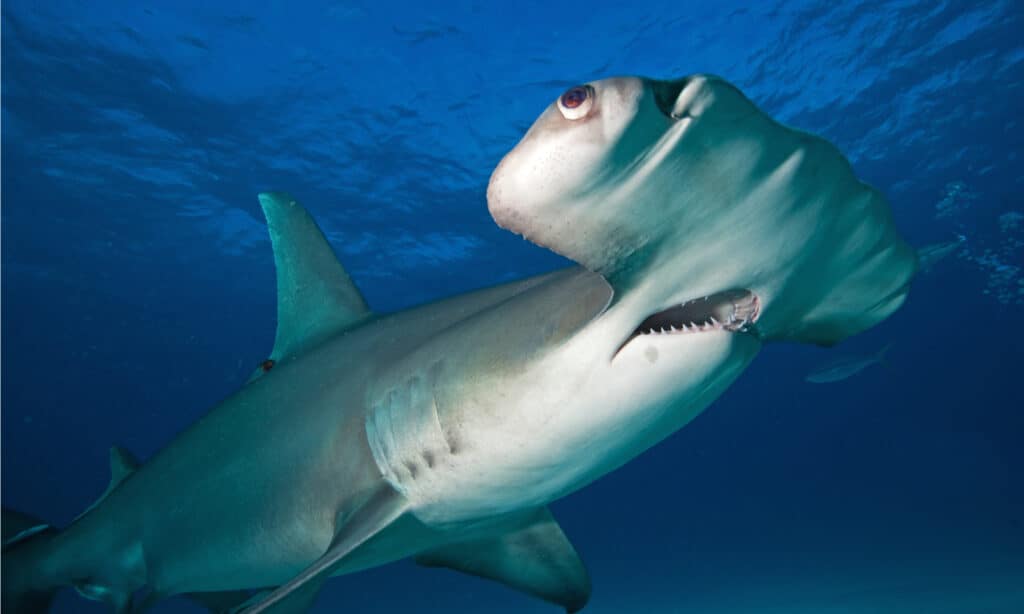
Hammerhead sharks are found in warm coastal waters.
©Martin Prochazkacz/Shutterstock.com
- Lovers of warmth: Hammerheads are fish that prefer warm coastal waters.
- Efficient swimmers: Hammerhead sharks tend to swim at an angle to decrease drag and increase their swimming efficiency.
- Going green: One species of hammerhead, the bonnethead shark, is actually omnivorous, as it eats seagrass.
- Better hunters: The long heads of the hammerhead shark allow the sharks to spread out their special sensory organs, giving them a hunting advantage over other sharks.
Classification and Scientific Name
These sharks are in the class Chondrichthyes, or cartilaginous fishes. Their order is Carcharhiniformes, which has two dorsal fins, five-gill slits, and is the largest order of sharks.
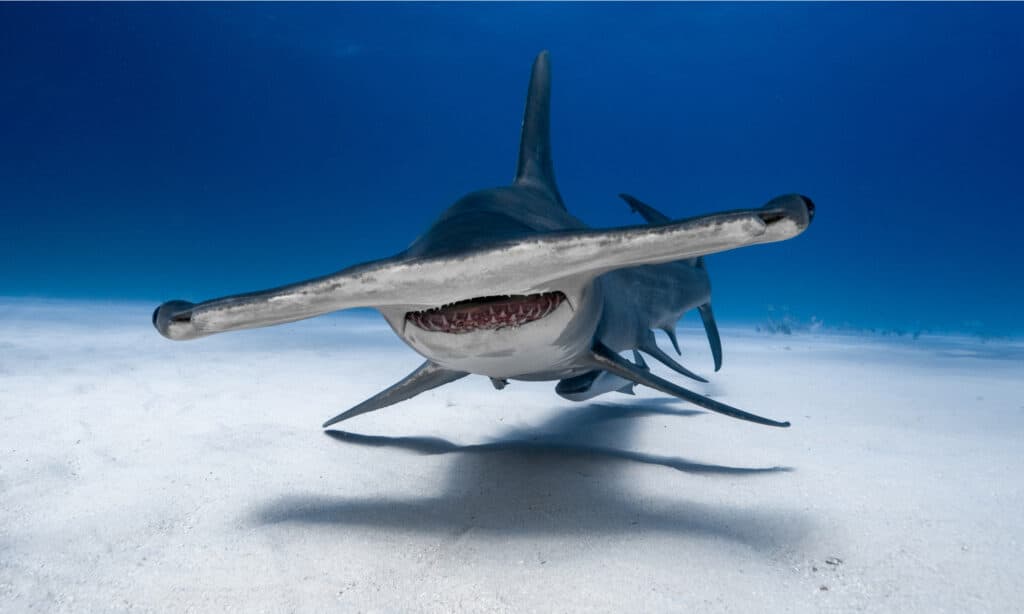
These sharks are in the class Chondrichthyes, or cartilaginous fishes. Their order is Carcharhiniformes. The family scientific name for hammerhead sharks, Sphyrna, is the Greek word for “hammer.”
©Sail Far Dive Deep/Shutterstock.com
The family Sphyrnidae is the hammerheads, which include the genus Sphyrna and the genus Eusphyrna. Sphyrna includes the nine species of true hammerheads, and Eusphyrna includes only one species, the winghead shark.
The scientific name for hammerhead sharks, Sphyrna, is the Greek word for “hammer.”
Evolution and Origins
Hammerhead sharks first appeared in oceans close to 20 million years ago. They were actually as big as some contemporary hammerhead sharks today. In modern times, there are about 530 species of sharks, and at least 9 species of hammerhead sharks alive as of 2025.
It is acceptable to believe that hammerheads evolved from a single carcharhinid ancestor with a normal-shaped head. It is believed that the shape of the hammer has evolved over millions of years.
Additionally, a recent study suggests that the hammerhead shark evolved its hammer-shaped snout to boost the animal’s vision and hunting process. Although argued in the past, most believe that having eyes so wide apart actually helps vision rather than hinders it.
Shark Species
There are nine species of true hammerhead sharks, with most of them being smaller sharks and a few, such as the great hammerhead shark, being large enough to pose a threat to humans.
These are the nine different species of hammerhead shark:
- Winghead Shark
- Scalloped Bonnethead
- Whitefin Hammerhead
- Scalloped Hammerhead
- Scoophead
- Great Hammerhead
- Bonnethead
- Smalleye Hammerhead
- Carolina hammerhead
Some are named after the shape of their heads, such as the bonnethead shark. Some, such as the scalloped hammerhead, are named after features on their heads. The scalloped hammerhead features a row of ridges along the front of its face.
The winghead shark is an ancient breed of hammerhead, as its head is significantly larger in proportion to the rest of its body.
Appearance
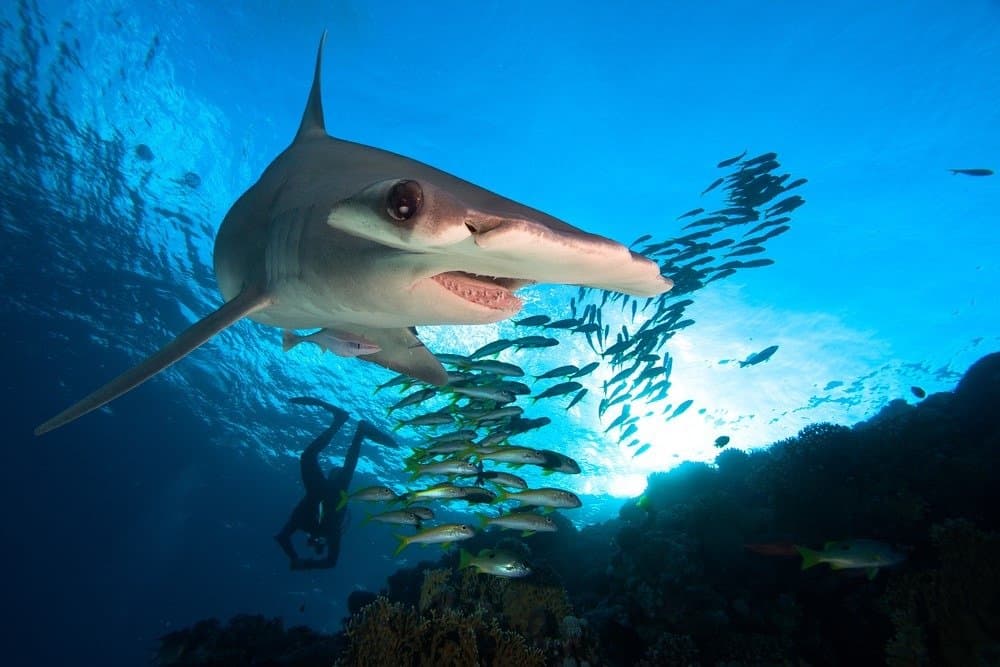
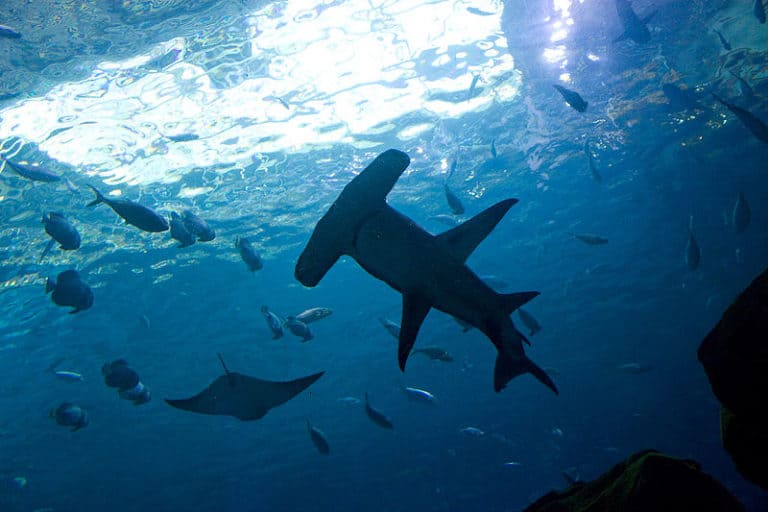
A hammerhead shark and a school of fish.
©frantisekhojdysz/Shutterstock.com
Hammerheads are fish that are grey-green to olive in coloration, and they have bright white bellies. These bellies allow them to disguise themselves against the brightness of the ocean surface while hunting prey. Hammerheads have small mouths in proportion to their heads. Their teeth are serrated and tiny. Their eyes sit at the edges of their face, granting them a wide field of view. They have 5 gill slits.
The unique head of these sharks serves purposes beyond great vision. Like most sharks, hammerheads use sensory organs in their face to detect the electrical impulses given off by other creatures. These organs aid in locating and catching prey.
The hammerhead shark family has increased detection abilities because their sensory organs are spread throughout their heads. This spread allows them to find food, such as stingrays, on the sandy ocean floor.
These sharks can be as small as 2.95 feet and as long as 20 feet. They have tall, pointed dorsal fins. Some species have a notch on the end of their tails.
Distribution, Population, and Habitat

These unique sharks live along the coastline and the continental plates. They prefer warm bodies of water and are only found in the ocean.
©Ruslan Harutyunov/Shutterstock.com
These unique sharks live along the coastline and the continental plates. They prefer warm bodies of water and are only found in the ocean. These sharks migrate when the seasons change; they move to the poles during the summer and to the equator during the winter. Populations of these sharks are dense around Hawaii, Costa Rica, and Eastern and Southern Africa.
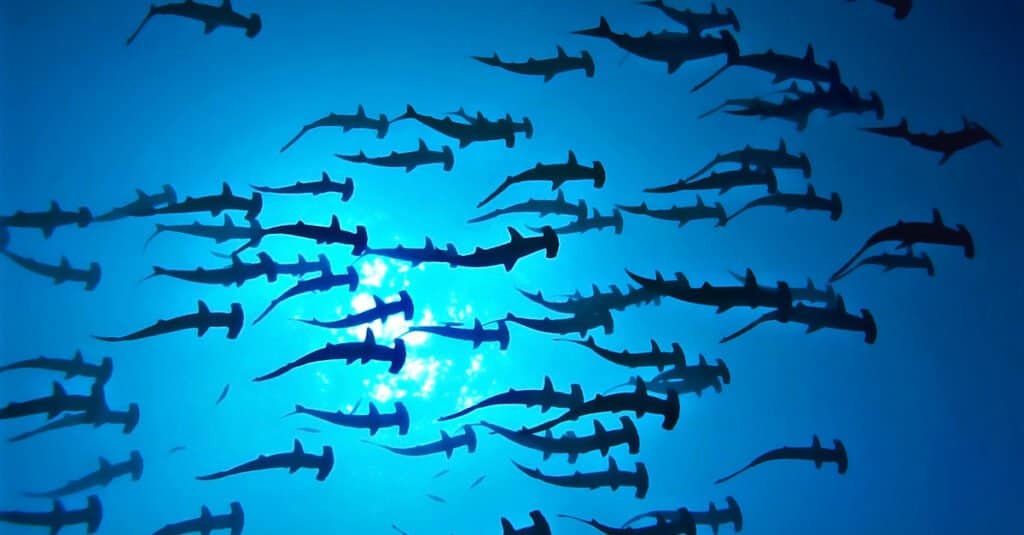
Some species form schools of hundreds of individuals by day. These schools are primarily female hammerheads. By night, most species are solitary hunters.
Populations of most species of hammerhead sharks have been in decline, with some species listed as threatened while others are critically endangered.
Predators and Prey
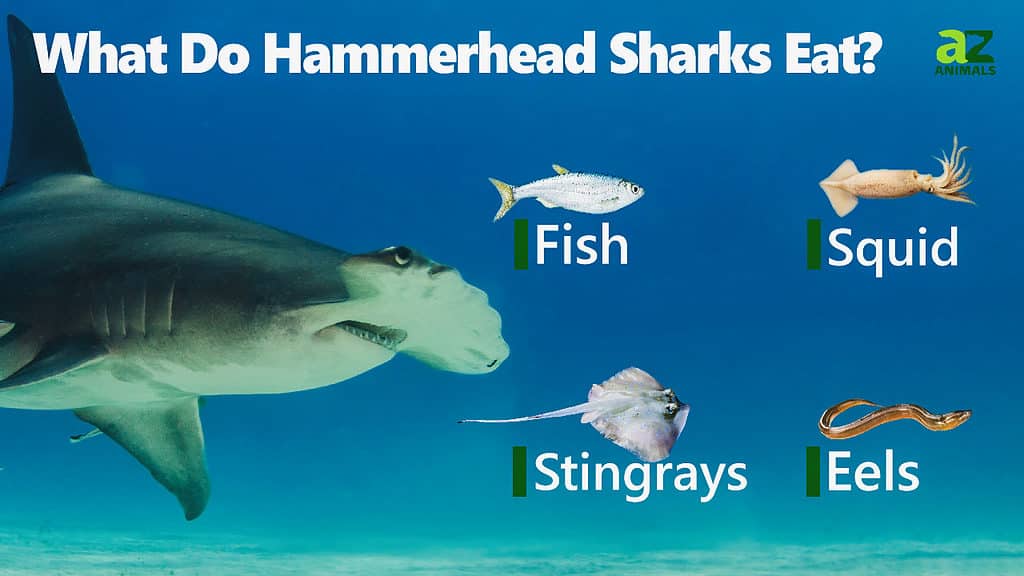
Hammerheads tend to be carnivorous creatures. They will feed on fish, crustaceans, and cephalopods. A particular favorite of hammerheads is stingrays. They will use their enhanced sensory abilities to find them buried in the sand and then pin them down using their heads.
Hammerheads prefer to hunt in shallow waters, and some species even venture into bays and brackish waters to find prey. A 2005 study examined the stomach contents of 556 hammerhead sharks and found their most common prey were small squids, fish, and their stomachs even included moray eel.
If the sharks are unable to find food, they have been known to eat their own young. They are considered to be better predators than other species of sharks.
Adult hammerhead sharks have few natural predators, but large sharks and orcas have been known to prey on them, and juveniles are more vulnerable to predation. Humans are the biggest threat to these species, as they are fished deliberately for their fins or occasionally accidentally caught in fishing nets.
Reproduction and Lifespan
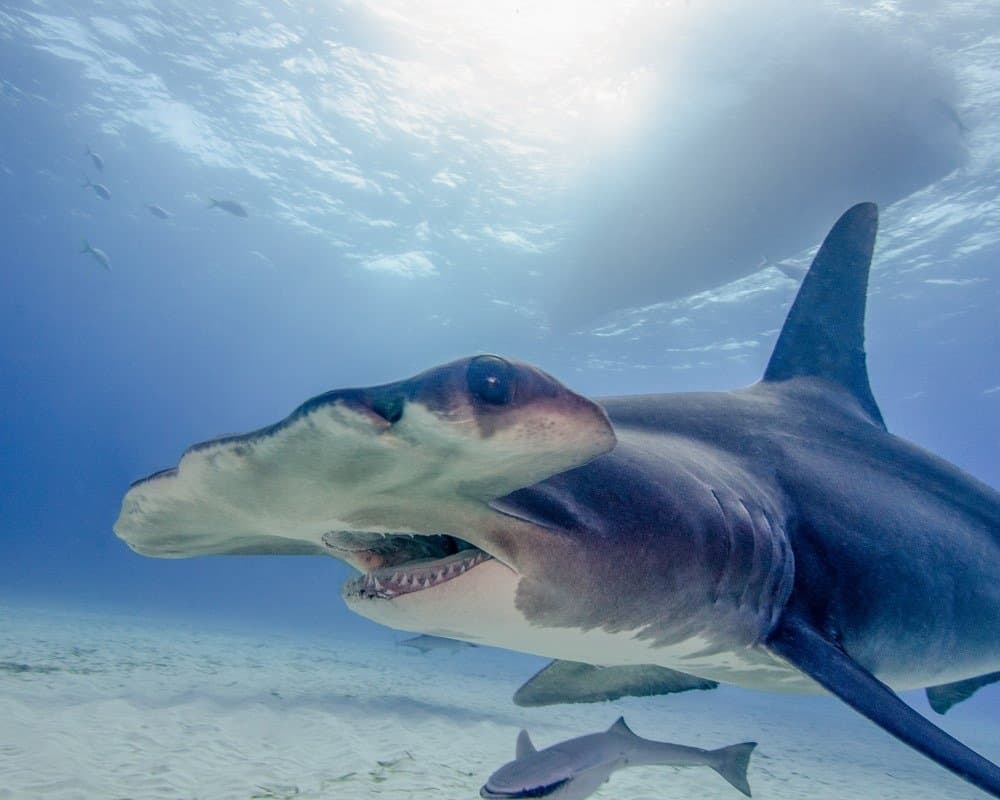
Great Hammerhead Shark in the Bahamas.
©Brent Barnes/Shutterstock.com
These sharks reproduce in the spring and summer months. Their breeding season is annual, unlike other species of shark. The male bites the female viciously until she allows him to mate with her. However, she can chase him away if she is not interested in him.
This process can take hours until the female decides to submit to a mate. These sharks have thick skin, which means the mating rituals aren’t painful, though older females often have scars from the bites.
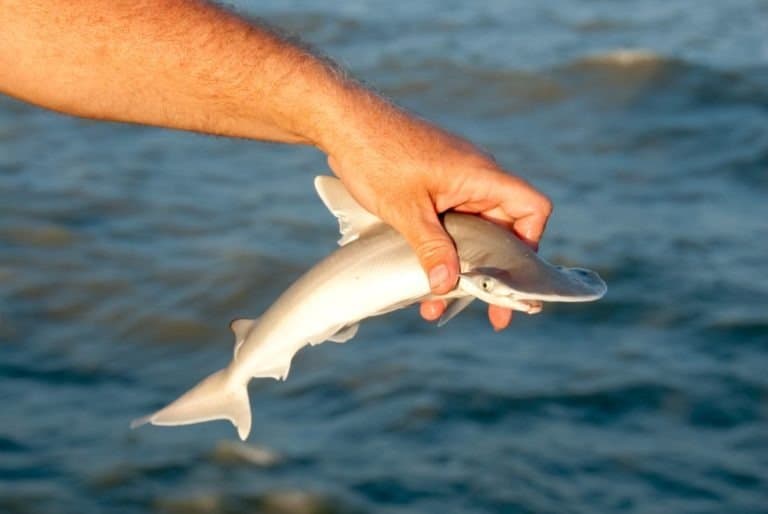
Hammerheads fertilize their eggs internally, making for a safe environment for the young to develop. Females give birth to live young after a 10 to 12-month gestation period. Pups are born in shallower waters and left to fend for themselves. They swim to deeper waters once they are older.
Fishing and Cooking
Hammerhead sharks are one of many species of sharks that suffer from the shark finning industry.
© EDGAR PHOTOSAPIENS/Shutterstock.com
These sharks are one of many species of sharks that suffer from the shark finning industry. Shark finning is when sharks are harvested for their fins and then tossed back to sea, often while still alive. Shark fins are illegally used in medicinal remedies, as well as in shark fin soup. These sharks are also prized as sport fish.
Millions of sharks are finned every year, and hammerhead populations suffer enormously from this. However, since they reproduce once a year, hammerheads can replenish their populations faster than other species of shark can. Most sharks are slow to breed and reproduce, so their numbers simply cannot keep up with the population decline caused by shark finning.
Hammerhead Shark Pictures
View all of our Hammerhead Shark pictures in the gallery.

Brent Barnes/Shutterstock.com
Sources
- Australian Marine Conservation Society / Accessed November 28, 2020
- Britannica / Accessed November 28, 2020
- Sharks World / Accessed November 28, 2020
- National Geographic / Accessed November 28, 2020
- Animal Corner / Accessed November 28, 2020
- Planet Shark Divers / Accessed November 28, 2020
- NOAA Fisheries / Accessed November 28, 2020
- Fish Base / Accessed November 28, 2020
- Reference / Accessed November 28, 2020