














H
Species Profile

Hamster

Cricetidae

Pouches, burrows, and big impacts
An13nA/Shutterstock.com

Hamster Distribution

Click a location to explore more animals from that region

Loading map...

Size Comparison

Human 5'8"
Hamster 3 in

Hamster stands at 4% of average human height.

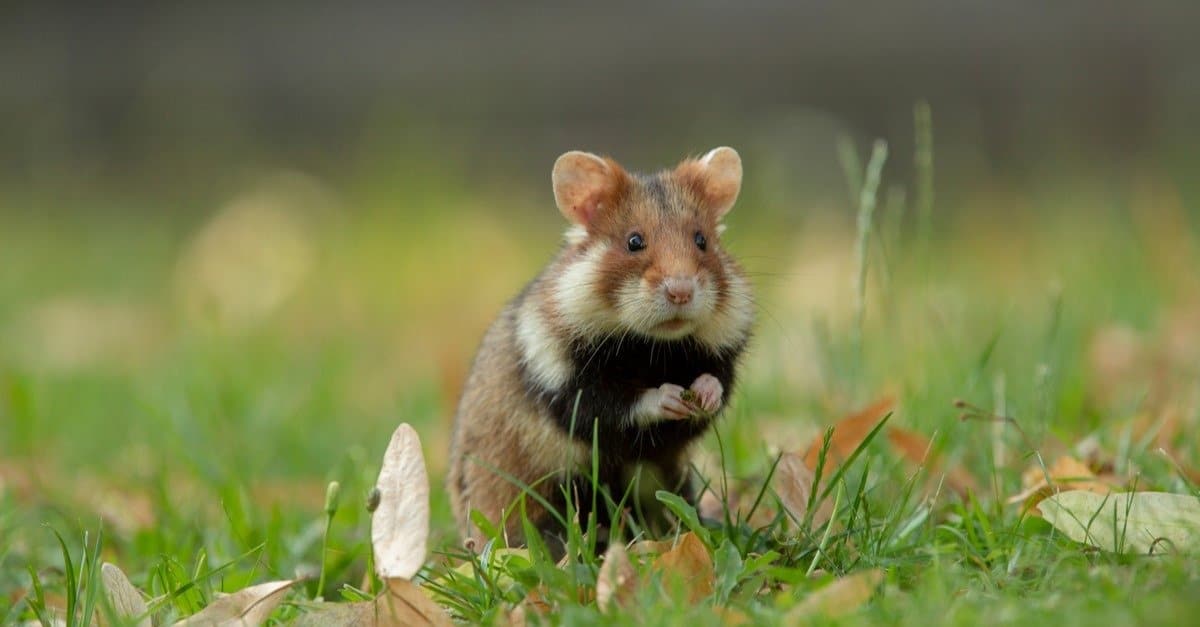
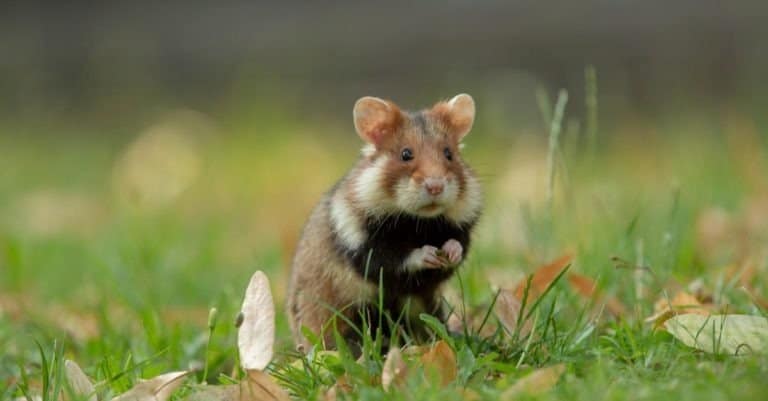
European hamster in a green meadow with lime blossoms

At a Glance

Family Overview This page covers the Hamster family as a group. Stats below are general traits shared across the family.
Also Known As Pocket pet, Fuzzball, Furry friend
Diet Omnivore
Activity Nocturnal+
Lifespan 1.5 years
Weight 0.67 lbs
Status Not Evaluated
Did You Know?

Size range across Cricetidae: roughly 5-35 cm head-body length and about 0.006-2 kg in mass (from tiny pygmy mice such as Baiomys spp. to the muskrat, Ondatra zibethicus).

Scientific Classification

Family Overview "Hamster" is not a single species but represents an entire family containing multiple species.

Hamsters are small rodents best known for cheek pouches used to carry food and nesting material, and for burrow-oriented lifestyles. The animals commonly called "hamsters" are primarily the subfamily Cricetinae within the rodent family Cricetidae.

Kingdom
Animalia
Phylum
Chordata
Class
Mammalia
Order
Rodentia
Family
Cricetidae

Distinguishing Features

  • Expandable cheek pouches for transporting food
  • Stocky body with short tail relative to many other rodents
  • Burrowing behavior with food-caching (hoarding) common
  • Nocturnal/crepuscular activity patterns are common (species-dependent)

Physical Measurements

Males and females differ in size

Height
3 in (1 in – 8 in)
Length
7 in (2 in – 1 ft 1 in)
8 in (2 in – 1 ft 1 in)
Weight
0 lbs (0 lbs – 1 lbs)
0 lbs (0 lbs – 2 lbs)
Tail Length
3 in (0 in – 4 in)
1 in (0 in – 4 in)
Top Speed
7 mph
Short bursts, about 5–13 km/h

Appearance

Primary Colors
Secondary Colors
Skin Type Hamsters (Cricetidae) have dense fur over rodent skin. Underfur varies: short fine coats in burrowing/steppe forms, thicker insulating coats in cold voles/lemmings. Semi-aquatic muskrats have water-shedding fur.
Distinctive Features
  • Measurements (hamsters, subfamily Cricetinae): head-body length about 5-34 cm; tail typically short, up to about 7.5 cm; adult mass roughly 0.02-0.46 kg depending on species.
  • Lifespan varies: many small cricetids live about 1–3 years in the wild; some species and captive animals can reach 4–10+ years. Pet hamsters (Syrian, dwarf) are usually shorter lived.
  • Rodent dentition and gnawing ecology: a single pair of ever-growing incisors in each jaw with a diastema; incisors are self-sharpening and used for gnawing seeds, stems, roots, and occasionally animal material depending on species.
  • Hamsters (mainly subfamily Cricetinae) have large fur-lined cheek pouches for carrying and storing food. Not all Cricetidae have these; many voles, lemmings, and New World mice do not.
  • Food-caching and hoarding: widespread in true hamsters (Cricetinae), often involving large stores in burrow chambers; across Cricetidae more broadly, caching varies from extensive (some taxa) to minimal, with many species relying more on immediate foraging.
  • Many cricetids use burrows for shelter and raising young. True hamsters build multi-chamber burrows (nest, food store, latrine) and suit steppe or semi-arid areas. Others nest on surface, use grass runways, or semi-aquatic like muskrat.
  • Cricetidae includes true hamsters (steppe burrowers), many voles (grassland runners), lemmings (tundra/alpine), many New World mice (forest/shrubland), and muskrats (semi-aquatic). Diets vary from seeds to plants to insects and other animal food.
  • Sensory and external traits: generally small eyes and rounded ears relative to many murids; vibrissae well-developed; feet vary from digging-adapted forefeet in burrowers to partially webbed/hairy hindfeet in semi-aquatic or snow-adapted species.
  • Pet examples like Syrian and dwarf hamsters have big cheek pouches, hoard food, and dig burrows. But the family Cricetidae also includes voles, lemmings, and many New World rats and mice.

Sexual Dimorphism

Generally mild to moderate and highly variable across Cricetidae. Many species show subtle male-biased size differences, but ecological factors can reverse or minimize dimorphism; external dimorphism is often most evident in scent-gland development and reproductive anatomy rather than striking coat differences.

  • Often slightly larger average body size in many species (not universal).
  • More conspicuous external genitalia in many taxa; in some species, testes can be seasonally prominent during breeding.
  • Scent glands may be more developed or more frequently used for marking in some lineages (including many true hamsters).
  • In some species, females may be similar in size or occasionally larger; lactation-related changes (enlarged nipples/mammary tissue) during breeding are the most obvious seasonal difference.
  • In several cricetids, females can be strongly territorial or dominant behaviorally despite limited visible morphological dimorphism.

Did You Know?

Size range across Cricetidae: roughly 5-35 cm head-body length and about 0.006-2 kg in mass (from tiny pygmy mice such as Baiomys spp. to the muskrat, Ondatra zibethicus).

Lifespan varies widely: many small cricetids live ~1-3 years, while larger species (e.g., muskrats) can reach ~4-8 years in favorable conditions.

Only some cricetids are "true hamsters" (subfamily Cricetinae); the family also includes voles and lemmings (Arvicolinae) and many New World rats and mice (e.g., Peromyscus, Neotoma, Sigmodontinae).

Cheek pouches are a hallmark of true hamsters: they can transport large loads of seeds and nesting material without using their mouths for chewing en route.

Voles and lemmings often have high-crowned (hypsodont) teeth suited for abrasive, fibrous diets-an adaptation linked to grazing on tough plants.

Many cricetids are champion engineers: burrow systems, runways through grass, under-snow tunnels, or (for muskrats) lodges and feeding platforms.

Several cricetids show dramatic population booms and busts (notably many voles/lemmings), which can reshape predator-prey dynamics across landscapes.

Unique Adaptations

  • Rodent dentition: ever-growing incisors with hard enamel fronts enable lifelong gnawing; jaw musculature supports powerful chewing for seeds, stems, and bark.
  • Cheek pouches (especially in Cricetinae/true hamsters): expandable internal pouches allow rapid collection and transport of dry food and nesting material to secure storage sites.
  • Burrow microclimates: underground nests buffer temperature extremes and drought, crucial for steppe/semi-arid hamsters and many grassland cricetids.
  • Diet-linked teeth in many voles/lemmings: high-crowned molars and complex chewing surfaces help process gritty, silica-rich plants.
  • Subnivean living (many voles/lemmings): movement and foraging beneath snow reduce heat loss and predation risk during winter.
  • Aquatic specialization in muskrats: dense water-shedding fur, partially webbed hind feet, and laterally flattened tail support swimming and wetland life.
  • High reproductive potential: short generation times and flexible breeding seasons allow rapid population growth when conditions are favorable (with strong variation among species).

Interesting Behaviors

  • Food caching is widespread, but expressed differently: true hamsters commonly hoard large stores in burrow chambers; many other cricetids cache locally or rely more on daily foraging.
  • Burrow-centered living is common: tunnels may include nesting rooms, food pantries, and separate latrine areas; depth/complexity varies with soil, climate, and predation risk.
  • Activity patterns vary: many are nocturnal or crepuscular, but some voles and lemmings can be active day and night in short bouts, especially in cold climates.
  • Runway-building: voles often maintain "highways" through vegetation and under snow (subnivean spaces), reducing exposure to predators.
  • Seasonal strategies differ: some hamsters use torpor/short hibernation-like states; many northern voles/lemmings rely on insulation and subnivean foraging rather than deep hibernation.
  • Social systems range widely-often solitary/territorial (many hamsters) to more tolerant or colonial tendencies in some vole species depending on season and resource distribution.
  • Gnawing and clipping vegetation shape habitats: cutting stems for food, opening seeds, and maintaining burrow entrances are routine behaviors across the family.

Cultural Significance

Cricetids—true hamsters (Syrian and dwarf species), muskrats, lemmings and voles—affect people: hamsters are popular pets and research animals; muskrats help wetland communities with fur trade and use; lemmings and voles shape northern ecosystems and language.

Myths & Legends

Earth-Diver creation stories, told by Indigenous peoples of North America (including Anishinaabe/Ojibwe and Cree), show the muskrat as a small, determined diver who brings up earth from ancient waters to make land.

In some tellings of the Earth-Diver cycle, muskrat succeeds where larger animals fail-an enduring lesson that humility and persistence can shape the world.

A medieval/early Renaissance European belief recorded by Olaus Magnus (16th century) held that lemmings "fell from the sky" during storms, reflecting attempts to explain sudden mass appearances during irruption years.

The word "hamster" entered English via German, and a German verb meaning "to hoard" became a cultural shorthand for stockpiling-mirroring the famous food-storing behavior of true hamsters.

Most pet Syrian hamsters come from a few wild animals taken near Aleppo in the 1930s and bred in captivity, which led to hamsters becoming common household pets worldwide.

Conservation Status

NE Not Evaluated at the group level (IUCN Red List categories are assigned to individual species rather than to the entire hamster group). Hamsters (subfamily Cricetinae) include species that range from Least Concern to threatened; the European hamster (Cricetus cricetus) is listed as Critically Endangered. General hamster ranges (across species; approximate): - Size: about 5-34 cm head-body length, depending on species. - Ecology: many species are burrowing and primarily nocturnal/crepuscular; diets are typically seeds/plant material with varying degrees of omnivory. Conservation landscape summary: status and trends vary by species and region; common risk factors include agricultural intensification and land conversion in steppe/grassland systems, habitat fragmentation, and climate-driven changes in seasonality and drought.

Has not yet been evaluated against the criteria.

Population Unknown

Protected Under

  • Protection varies widely by species and country/region; there is no single legal status that applies to all Cricetidae.
  • Example of strong protection for an at-risk member: the European hamster (Cricetus cricetus) is protected under European conservation frameworks (e.g., EU Habitats Directive) and international agreements (e.g., Bern Convention).
  • Many species occur in protected areas incidentally; targeted protections are most common for threatened, endemic, or rapidly declining populations where national/regional listings apply.

You might be looking for:

Syrian (Golden) Hamster

45%

Mesocricetus auratus

The most common pet hamster; relatively large, typically solitary as adults.

View Profile

Djungarian / Winter White Dwarf Hamster

20%

Phodopus sungorus

Small dwarf hamster; can develop a paler winter coat; popular in the pet trade.

Roborovski Dwarf Hamster

15%

Phodopus roborovskii

Very small, fast-moving dwarf hamster; often kept in pairs/groups with care.

Chinese Hamster

10%

Cricetulus griseus

Slender-bodied hamster; also notable in biomedical research (CHO cell lines derived from a related Chinese hamster).

Campbell’s Dwarf Hamster

10%

Phodopus campbelli

Dwarf hamster often confused with winter whites; common in captivity.

Life Cycle

Birth 5 pups
Lifespan 2 years

Lifespan

In the Wild
0.5–5 years
In Captivity
1–4 years

Reproduction

Mating System Polygynandry
Social Structure Solitary
Breeding Pattern Serial
Fertilization Internal Fertilization
Birth Type Internal_fertilization

In Cricetidae (hamsters, voles, New World mice), mating is mainly polygynandrous—solitary breeders with brief encounters and internal fertilization; some Microtus show social monogamy, others polygyny, and cooperative helpers are rare.

Behavior & Ecology

Social Colony Group: 3
Activity Nocturnal, Crepuscular
Diet Omnivore Seeds and other energy-rich plant parts (especially grains/grass seeds)
Seasonal Hibernates

Temperament

Diversity note (family-wide): Cricetidae includes hamsters, voles, lemmings, muskrats, and many New World rats/mice; sociality ranges from strongly solitary/territorial to locally colonial or pair-bonded depending on lineage, habitat, and season.
Typical baseline: vigilant, startle-prone, and quick to use cover; many species rely on burrows/runways and show strong risk-avoidance in open areas.
Territoriality is common (especially around nest/burrow cores and food stores), but tolerance can increase at high densities, in winter nests, or where resources are clumped; aggression levels vary markedly among species and between sexes.
Across Cricetidae, adults range from very small mice, lemmings, and hamsters to larger muskrats. Wild lifespan is often about 1–2 years; some live several years, longer in safe captivity.
Reproductive temperament: many show seasonal breeding and strong maternal defensiveness; infanticide risk and mate aggression are present in some taxa, while others show higher affiliative contact (e.g., certain vole systems).

Communication

audible squeaks/chirps during handling, aggression, or contact
distress calls by juveniles and adults
ultrasonic vocalizations Common in many small cricetids, especially in social/maternal and courtship contexts
tooth chattering/low-frequency sounds associated with threat or arousal in some species
scent marking with urine and feces; strong reliance on olfaction for territory, reproductive state, and individual recognition
use of glandular secretions (where present) and rubbing/dragging behaviors to mark substrates
tactile communication Nose-to-nose contact, grooming in more tolerant species, huddling for thermoregulation in communal nests
postural/behavioral displays (freezing, lunging, boxing, chase/avoidance) mediating spacing and dominance
substrate vibrations/foot drumming in some taxa as an alarm or arousal signal

Habitat

Biomes:
Tropical Rainforest Tropical Dry Forest Savanna Desert Hot Desert Cold Mediterranean Temperate Grassland Temperate Forest Temperate Rainforest Boreal Forest (Taiga) Tundra Alpine Freshwater Wetland +8
Terrain:
Mountainous Hilly Plateau Plains Valley Coastal Island Riverine Rocky Sandy Muddy +5
Elevation: Up to 22309 ft 9 in

Ecological Role

Abundant small-to-medium mammals functioning as primary consumers and opportunistic secondary consumers; key prey base for many predators and important ecosystem engineers in many habitats.

Seed predation and seed dispersal (via caching/hoarding and missed stores) Vegetation regulation through grazing/browsing and selective feeding Soil aeration and mixing via burrowing and runway formation Nutrient cycling through foraging, feces deposition, and decomposition of cached material Supporting food webs as major prey for raptors, carnivores, and snakes Dispersal of fungal spores in some systems (where fungi are eaten and moved)

Diet Details

Main Prey:
Insects Invertebrates Small vertebrates or eggs Carrion
Other Foods:
Seeds and grains Green plant material Roots, tubers, bulbs Fruits and berries Fungi Bark and twigs

Human Interaction

Domestication Status

Semi domesticated

Only a few cricetids are truly domesticated. The Syrian (golden) hamster came from a small wild group caught in the early 1900s and was bred for labs and pets. Some dwarf hamsters are kept as pets. Other cricetids are used in labs, but most species stay wild. Local feral populations are rare.

Danger Level

Moderate
  • bites and scratches (generally minor, but can become infected)
  • allergies/asthma triggers from dander/urine proteins (especially in occupational/lab settings)
  • zoonotic disease risk from wild cricetids (e.g., hantaviruses in some deer mice; leptospirosis; salmonellosis; ectoparasites); risk is typically much lower in well-sourced pet hamsters but not zero
  • property damage and contamination when cricetids occur as household or agricultural pests

As a Pet

Suitable as Pet

Legality: Laws vary. Common pet hamsters (Cricetidae, especially Cricetinae) are legal in much of the U.S., but places like Hawaii ban them. Wild cricetids may need permits or be illegal; health and ethical risks matter.

Care Level: Moderate

Purchase Cost: $10 - $150
Lifetime Cost: $200 - $2,000

Economic Value

Uses:
Companion animal/pet trade (limited subset of species) Biomedical and behavioral research models Agriculture/forestry impacts (crop and seed predation; girdling; burrow damage) Public health (reservoirs for some zoonotic pathogens; surveillance value) Wildlife management and pest control industries Fur and trapping (notably muskrat in some regions) Ecological services (soil turnover from burrowing; prey base for predators)
Products:
  • pet animals and captive-bred lines
  • laboratory animals and research services
  • fur/pelts from trapped species (regionally, e.g., muskrat)
  • pest-control services and exclusion/trapping equipment demand (indirect economic linkage)

Relationships

Ecological Equivalents 4

Animals that fill a similar ecological role in their ecosystem

Gerbils
Gerbils Gerbillinae Often overlap with hamsters in being small, ground-dwelling, burrow-nesting rodents that cache seeds and are active in arid to semi-arid habitats. Gerbils are typically more cursorial and many species are more social.
Kangaroo rats and pocket mice Heteromyidae Convergent "granivore + caching + burrow" lifestyle in dry habitats: both groups store seeds and use cheek pouches or other food-transport mechanisms. Heteromyids have external, fur-lined cheek pouches, whereas many cricetids have internal pouches.
Jerboas Dipodidae Small-bodied rodents of open, dry environments that use burrows and concentrate activity at night. Ecological similarity is strongest in desert communities, even though locomotion and foraging style differ.
Ground squirrels Marmotini Share burrow use and seasonal fattening and food-storage tendencies in some environments; ground squirrels are generally more diurnal and often larger-bodied than typical hamsters.

Types of Hamster

17

Explore 17 recognized types of hamster

Syrian hamster (golden hamster) Mesocricetus auratus
Turkish hamster Mesocricetus brandti
Romanian hamster Mesocricetus newtoni
Campbell's dwarf hamster Phodopus campbelli
Djungarian (winter white) dwarf hamster Phodopus sungorus
Roborovski dwarf hamster Phodopus roborovskii
Chinese hamster Cricetulus griseus
Striped dwarf hamster Cricetulus barabensis
European hamster Cricetus cricetus
Long-tailed dwarf hamster Cricetulus longicaudatus
White-footed mouse Peromyscus leucopus
Hispid cotton rat Sigmodon hispidus
Brown lemming Lemmus trimucronatus
Meadow vole Microtus pennsylvanicus
Bank vole Myodes glareolus
Muskrat
Muskrat Ondatra zibethicus
Southern bog lemming Synaptomys cooperi

Hamsters are small-sized rodents. They are very commonly kept as house pets. However, unlike other rodents, they have short tails.

Their legs are stubby with widely-spaced feet, and their ears are small. Hamsters are found in a variety of colors, using grey, yellow, black, white, brown, golden, and red. They exist in a mixture of several colors. They are usually 2 to 6 inches long and weigh about 6.2 oz on average.

There are several types of hamsters, including dwarf hamsters, golden dwarfs, and Syrian hamsters, which are also known as the teddy bear hamster. They go by the scientific name Cricetinae.
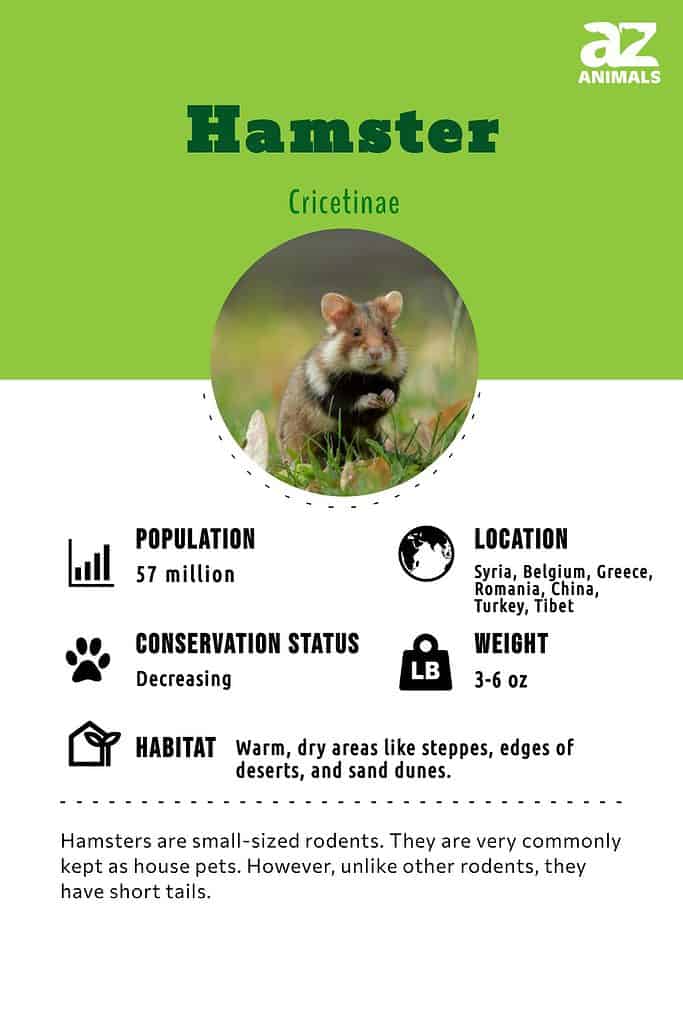
Hamster Infographic
Hamsters are tiny rodents. There are 19 species, and 5 of them are commonly kept as house pets.

Incredible Hamster Facts!

  • Hamsters make good house pets because they are very gentle and are said to take care of. Some common names of pet hamsters include Cheeks, Chomper, Chewy, Harry, and Fuzzy.
  • Hamsters bite when they are scared or are disturbed during their sleep time.
  • Hamsters have very poor eyesight, and their feet are wide apart.
  • Their teeth keep growing all the time and are short only because they keep chewing on things.
  • Hamster mothers are very protective and keep their babies in pouches inside their mouths if they sense danger.

Scientific Name

Hamsters go by the scientific name Cricetinae. They belong to the kingdom Animalia and Phylum Chordata, and the class is Mammalia. The hamsters belong to order Rodentia and suborder Myomorpha.

The family is Cricetidae, and the subfamily is Cricetinae. The lower classification of the hamsters includes the subphylum, which is Vertebrata. Meanwhile, the superfamily is Murodiea.

The name Cricetinae can be broken down into two words – cricetus and -inae (a suffix). Cricetus is rooted in New Latin, though it may come from the Czech word “křeček.”
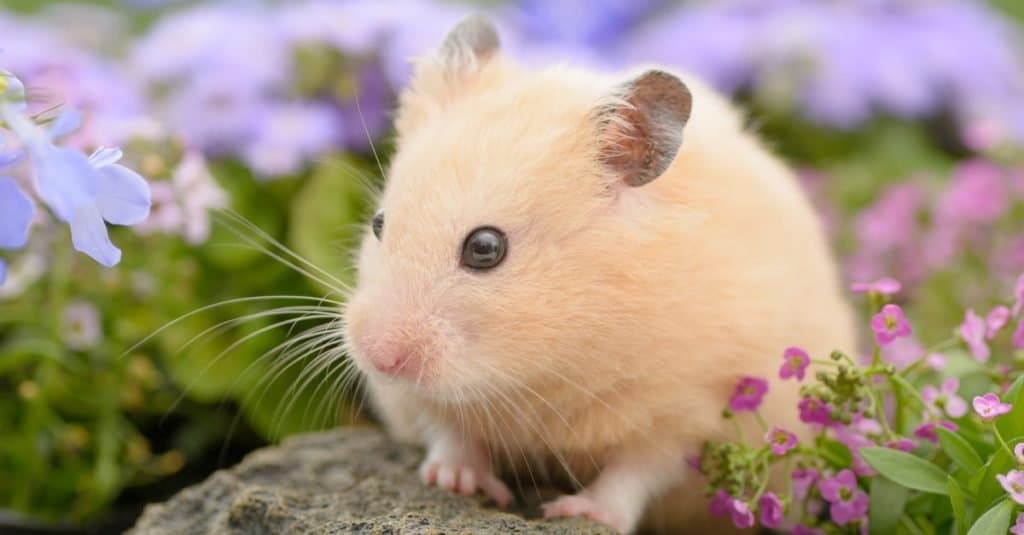
Syrian Hamster in a flower garden

Hamsters go by the scientific name Cricetinae.

Evolution and Origin

The Syrian hamster was first described in 1839, but it wasn’t until 1939 that researchers were able to successfully domesticate them. The entire population of Syrian hamsters is believed to be descendants of a single brother-sister pair captured from Aleppo, Syria, in 1930.

After being imported to Jerusalem, they bred very successfully. Later, some animals from this original breeding colony were exported to the United States, where they quickly became popular as pets and laboratory animals. Comparative studies between wild and domesticated Syrian hamsters have revealed reduced genetic variability within the domestic strain. However, any differences found remain relatively small when compared with other variations seen in other lab animals.

A Syrian hamster peeking out of its cage.

The entire population of Syrian hamsters is believed to be descendants of a single brother-sister pair captured from Aleppo, Syria, in 1930.

Appearance

Hamsters are small rodents that have stout bodies. Their legs are stubby and stocky legs, and their ears are small. Hamsters have short tails that are even shorter than the length of their bodies. Their ears are furry, and their feet are wide.

Though most species have fairly similar bodies, each one has identifying markings and sizes that determine which species they are. The dwarf hamster, much like their name, is a very tiny rodent. They are about 2 to 4 inches long.

On the other hand, the Syrian hamster is quite different. It is also referred to as a teddy bear hamster or golden hamster, growing to approximately 6 inches long as an adult. On average, a hamster weighs about 6.2 ounces, making it rather small with very little muscle.

In general, hamsters have thick and silky fur, and it could be long or short, depending on the hamster. This fur comes in a variety of colors, including black, grey, yellow, red, brown, and white. Some hamsters also have fur that is a blend of several different colors, but the combination will be determined by the breed.

These rodents have a scent gland that is located in the middle of their bodies. In the case of a dwarf hamster, the scent gland is located in the hamster’s stomach, allowing them to mark their territory. However, the Syrian hamster (aka the teddy bear hamster) has scent glands on their hips instead.

Interestingly, hamsters have a natural way to get out of trouble when they need to escape – their skeletons. The flexibility of their rib cage allows them to flatten their body under small crevices. Anyone that owns such a pet will need to have a secure cage to keep them from escaping.
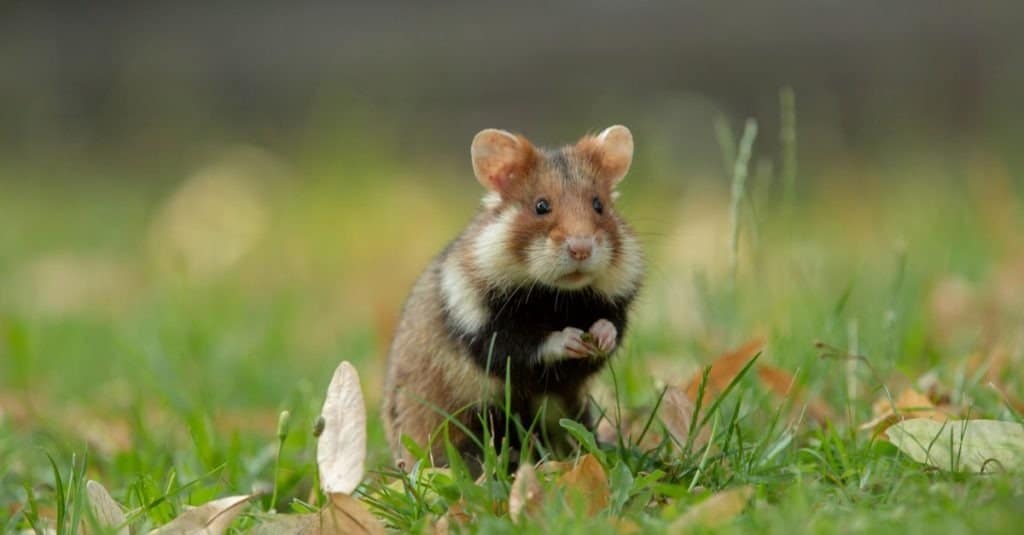
European hamster in a green meadow with lime blossoms

Hamsters are small rodents that have stout bodies. Their legs are stubby and stocky legs, and their ears are small.

Behavior

Most wild hamsters are active during dusk time and night and need plenty of space to play at night time. Some of them can easily run up to 5 miles during this time. When hamsters are kept as pets, they maintain this natural routine.

Their waking hours take up the nighttime, whether in the wild or in captivity, which means that they are awake during the night. They prefer to be undisturbed, so wild hamsters will avoid other wildlife and people during this time. Any unwarranted disturbance in their sleep could very well lead to a bite from these tiny rodents.

They survive best in rooms where the lights are not kept on till very late. In the wild, many hamsters dig burrows, and several others are solitary creatures, which is why they need plenty of areas to conceal themselves. Wild hamsters hibernate during the cold weather months. These rodents get up during their hibernation periods only to eat occasionally.

A loner hamster, it is said, should never be put in a cage with other hamsters as it can bite and harm it and, in some cases, even kill it. The only time that these animals are especially friendly towards other hamsters is when they are young (i.e., under three months old). They will even eat their young if they so desire.

The dwarf hamster is an exception. They are surprisingly social, and they enjoy having multiple friends around in their family.

In captivity, hamsters can sometimes flinch, grimace, and raises its hand toward their owners. This simple motion is an indication that the hamster may be ready to attack, showing exactly how they feel about the person infiltrating their safe space.

If a human earns the trust of a hamster as a pet, the animal will gently move towards their hand and even crawl into it. They are fairly expressive animals, and there is no doubt about how they feel about their owner or surrounding animals.

A hamster in an exercise wheel

In the wild, hamsters can run 5 miles per night. An exercise wheel is essential, whether your hamster gets time out of its cage or not.

Habitat

The first of these small rodents was found in Syria. However, they are also found in Belgium, northern China, Romania, and Greece. In the wild, hamsters prefer living in warm and dry areas. They like living in steppes, edges of deserts, and sand dunes.

Hamsters have also become an incredibly popular pet, and there are many toys and hideaways that can be added to their home to recreate their natural surroundings.
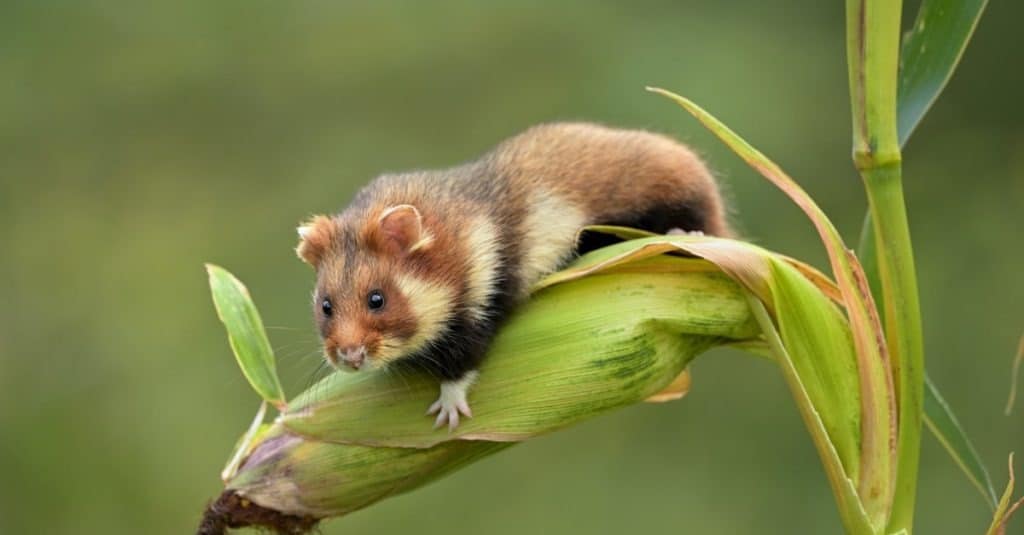
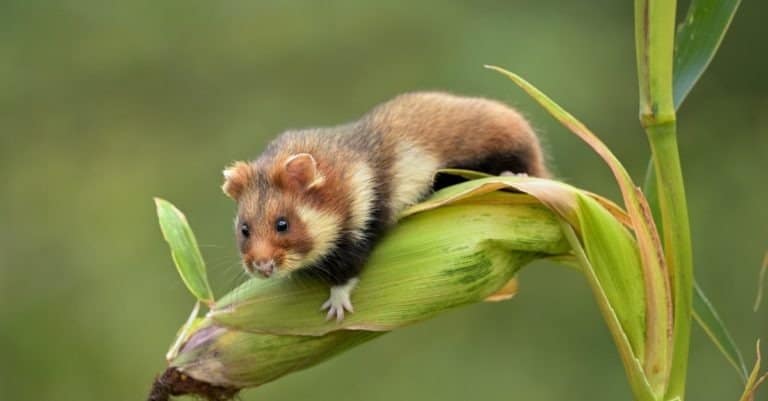
European hamster (Cricetus cricetus), Czech republic

In the wild, hamsters live in steppes, edges of deserts, and sand dunes

Diet

The primary diet of Hamsters includes seeds, nuts, grains, fruits, vegetables, and cracked corn. Apart from that, hamsters also eat small insects, lizards, as well as other small animals.

Interestingly, hamsters have pouches on the inside of their cheeks, and they carry food in these pouches to store and eat later.

Hamster Eat Infographic
The primary diet of Hamsters includes seeds, nuts, grains, fruits, vegetables, and cracked corn.

Predators and Threats

Hamsters are known to defend themselves against these predators by using their incisors which are large in size. The mother hamsters also carry their children to safety by putting them in the pouches in their mouths.

The predators of this small animal are numerous since they are small and easy to pick up. However, they are quite fast and spritely.

What Eats Hamsters?

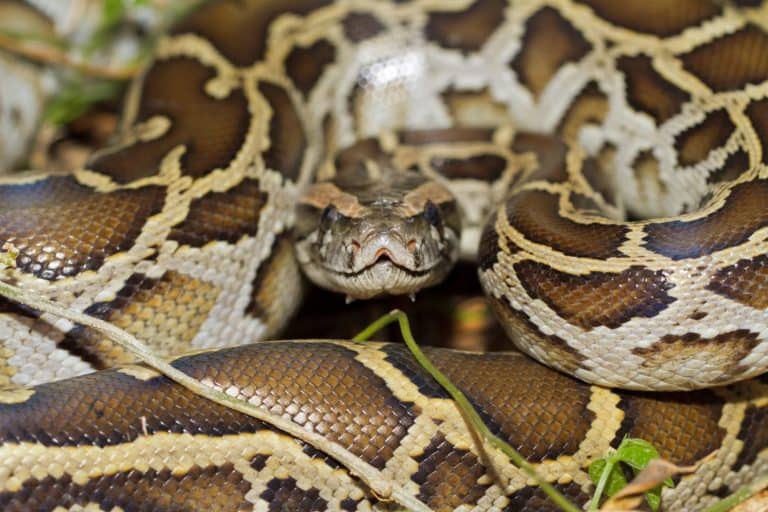
The common predators of hamsters include snakes, birds, and other predatory mammals. That doesn’t mean that a hamster won’t put up a good fight. Instead, they use their naturally long incisors to bite. If the hamster is a new mother, she will keep her young safe within her mouth’s pouches.

Interestingly, the most likely cause of death in hamsters isn’t being hunted – it is heart disease.

What Do Hamsters Eat?

Hamsters, in turn, feed on seeds, grains, fruits, nuts, cracked corn, small insects, lizards, and other animals. They are herbivores, so they do not seek out any other animal as prey.

These animals should never eat kidney beans, tomato leaves, or unwashed produce. All of these sources of nutrients are incredibly toxic.
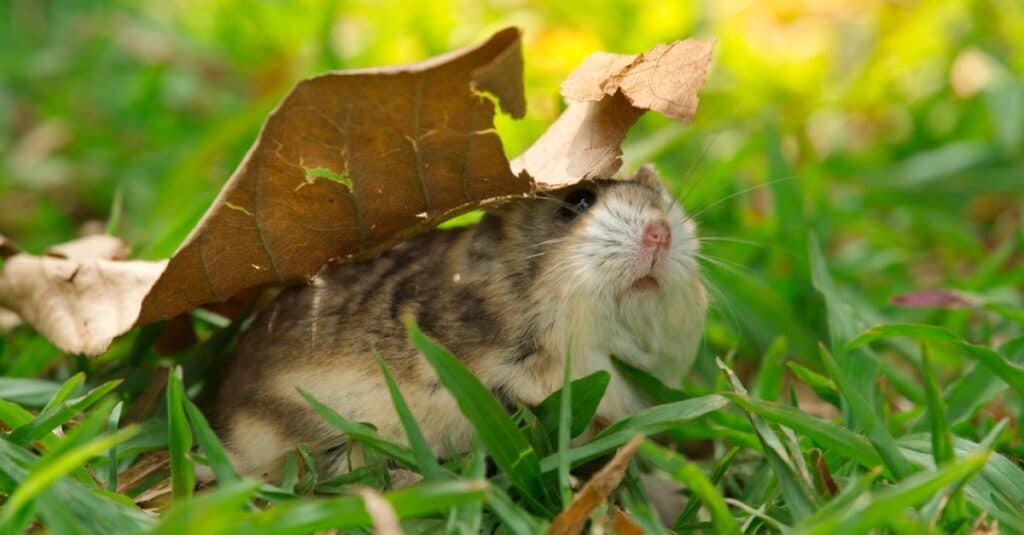
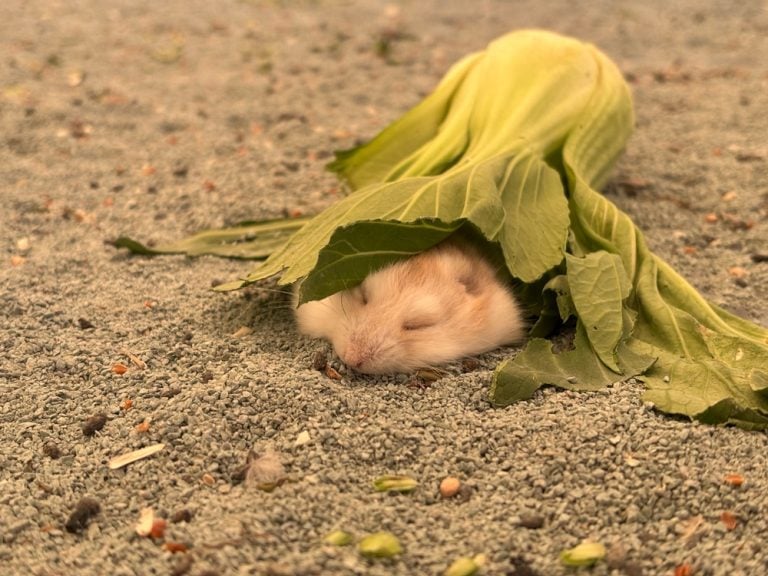
dwarf hamster under leaf, in grass

The most common predators of hamsters are snakes and birds.

Reproduction, Babies, and Lifespan

Both male and female hamsters are known to be fast maters. They are known to waste no time in the process of reproduction, and it is often said that if hamsters from two separate genders are locked in a cage, the female can very quickly conceive.

The gestation period in hamsters is about 15 to 20 days. A group of hamster babies, known as a litter, is born shortly after. The average litter size is six to eight pups. The hamster babies are blind till about two weeks after their birth. They have to be weaned when they are about three to four weeks old. However, these animals should be watched carefully, as they are one of many animals that may eat their young.

It is said that female hamsters give birth to two to three litters of hamster babies annually. The lifespan of these small rodents is about one to two years. In captivity, they can survive up to three years.
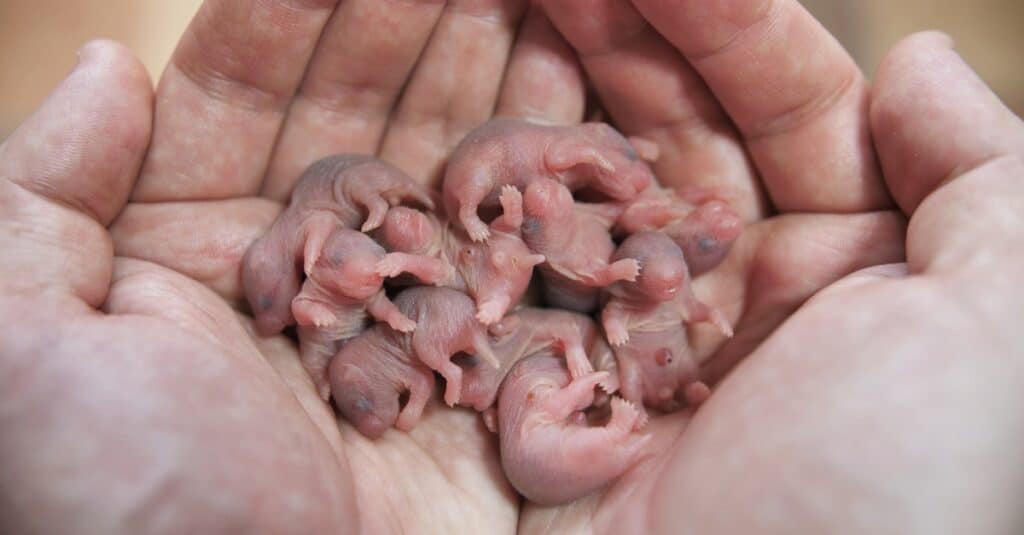
baby hamster litter

Hamsters have an average of six to eight pups per litter and can mate two or three times per year.

Hamsters vs. Mice

When comparing a hamster vs. a mouse, hamsters are generally larger than mice. In addition, hamsters generally are found in a wider variety of colors than mice. Mice are also more opportunistic eaters, while hamsters are known to hoard food and even store it in their mouths.

Hamsters vs. Guinea Pigs

Another popular pet rodent that hamsters are often compared with is guinea pigs. Guinea pigs are generally larger than hamsters and weigh several pounds, whereas hamsters weigh less than a pound. In addition, hamsters are omnivores, while guinea pigs are strict herbivores.

Population

While it is not known how many hamsters live in the wild all over the world, it has been said that the pet population of hamsters is around 57 million. About 11 million households have hamsters as pets.

Hamsters in the Zoo

Little is known about hamsters living in zoos. However, it is said that they multiply quickly and find their way into parks, universities, and zoos. For anyone that wants to learn more about hamsters in an up-close way, most pet stores will carry at least a few different species.

The population of pet hamsters is approximately 57 million. The wild population is unknown.

The 19 Types of Hamsters

The subfamily Cricetinae contains 19 different species of hamsters from different geographical regions. Of these hamsters, many are never kept as pets. The five most commonly-kept types of hamsters for pet owners are Syrian hamsters, Campell’s dwarf hamsters, Roborovski dwarf hamsters, winter white dwarf hamsters, and Chinese hamsters.

  • Syrian Hamster – Syrian hamsters are a common type of hamster kept as a pet. They can grow up to 6 inches long and are usually golden brown with darker markings around their cheeks. Syrian hamsters tend to be more solitary, so they should be kept to one in a cage. They can get along well with pet owners if proper interaction and entertainment are provided.
  • Campbell’s Dwarf Hamster – One of only two species of Russian dwarf hamsters, the Campbell’s Dwarf hamster is a very common pet store find. They were named after Charles William Campbell, who first caught one in Mongolia in 1904. They come in many colors and are friendly, boisterous, and active. Campbell’s Dwarf hamsters can become territorial if kept in groups. This means they should be kept in very large enclosures. Additionally, this species is genetically predisposed to developing diabetes.
  • Roborovski Dwarf Hamster – The Roborovski hamster is a small, energetic, and wild hamster species that originates from central Asia’s deserts. They have become popular pets recently due to their fun temperament and tiny size. These hamsters only reach an average length of 2 inches. Still, their fluffy fur comes in various colors, making them look extremely cute. Although they make great pets to observe, they require a large cage and many different toys.
  • Winter White Dwarf Hamster – The Winter White Dwarf hamster is similar to the Campbell’s Dwarf hamster but has a different body shape and comes in different colors. They also are more mild-mannered and reserved than Campbell’s hamsters. The name “Winter White Dwarf hamster” comes from the fact that these hamsters’ fur usually turns white in the winter to camouflage themselves from predators. Winter white dwarf hamsters can cross-breed with Campbell’s hamsters, so it can be difficult to find a purebred Winter white dwarf hamster.
  • Chinese Hamster – The Chinese hamster is a small, energetic hamster that can be difficult to handle. These hamsters require large enclosures with plenty of space to run around. Several states have labeled them pests, so special permits are required.
  • Chinese Striped Hamster – The Chinese Striped hamster is a species of hamster that is native to central and eastern Asia. These hamsters live in long burrows and emerge to forage for food at night. They have an average body length of 3.9 inches and are mostly light greyish-brown with a faint stripe on the spine.
  • Ciscaucasian Hamster – The Ciscaucasian hamster is a large hamster that is found in Georgia and Russia. It has a brown or slightly yellow coloration with a white throat and black underside. It also has very large, rounded ears. This hamster is considered a pest as it likes to steal crops.
  • European Hamster – The European hamster is a type of hamster native to a large area in Eurasia. It is considered an agricultural pest and is often hunted for its fur. While it is not considered endangered globally, it is critically endangered in many countries. European hamsters are crepuscular and eat mostly plant matter, like seeds, legumes, grasses, vegetables, and insects. They are often solitary.
  • Eversmann’s Hamster – Eversmann’s hamster is a species of hamster that is native to Kazakhstan. It is named after the Russian naturalist, zoologist, and explorer Eduard Friedrich Eversmann. Eversmann’s hamster is part of the family Cricetidae, which is the second-largest family of mammals.
  • Gansu Hamster – The Gansu hamster is an endangered species of rodent native to China, easily identified by its small size, round head, short legs, large ears, and long tail. It inhabits grasslands up to two miles above sea level and feeds on seeds and roots. As the only member of its genus (Cansumys), it is often referred to as “the lone hamster.”
  • Greater Long-Tailed Hamster – The Greater Long-Tailed hamster is a hamster species in Northern China. It has been considered a major pest in China since ancient times because it eats crops all year round. The hamster also often stands up on its hind legs and screams loudly as a way of communicating with others.
  • Grey Dwarf Hamster – The Grey Dwarf hamster is a common hamster species found in Eastern Europe, the Middle East, Russia, Central Asia, Mongolia, and western China. These hamsters have an average body length of 4 inches, with a furry tail about 1/3 of that length. Their fur is brownish-grey with white underparts, and they have large ears and a flattened skull. Grey Dwarf hamsters are known for their burrows, which can be as deep as 5 feet beneath the ground. These hamsters do not hibernate, so they are active year-round as they forage for roots, plants, seeds, and insects.
  • Kam Dwarf Hamster – The Kam Dwarf hamster is a hamster species found only in the mountains of western China. These hamsters have an average body length of 4 inches and a tail length of 2 inches. Their fur is greyish-brown in color, and their underside is greyish-white. These hamsters are active day and night and dig burrows to an average depth. They forage for grain and seeds, and they also hunt insects.
  • Long-Tailed Dwarf Hamster – The Long-Tailed Dwarf Hamster is a hamster species found in Mongolia, China, Kazakhstan, and Russia. It has an average body length of about 4 inches, with a tail at least 1/3 of that length. It is sandy brown in color on its back, with a greyish-white belly. This hamster lives in dry, arid areas with dry forests, rocky steppes, and shrubby slopes. It is especially common in piedmont semidesert. It is nocturnal and feeds on seeds and insects.
  • Mongolian Hamster – The Mongolian hamster is a type of hamster that is found in China and Mongolia. It is relatively muted, with a sandy brownish-grey top coloring and light grey underside coloring.
  • Romanian Hamster – The Romanian hamster is a species of hamster found in both Bulgaria and Romania. It is brown with a white underside and a black stripe that runs from its head to its neck. It is around 7 inches long and is nocturnal. It lives solitarily in burrows, where it stores and eats seeds, vegetables, grasses, legumes, and insects.
  • Sokolov’s Dwarf Hamster – This type of hamster is usually grey, with a light brown or yellow hue and a dark stripe running down its body. It has a body length of about 3.7 inches and a 1-inch tail. It is found in China and Mongolia, where it lives in underground burrows beneath desert shrubs.
  • Tibetan Dwarf Hamster – The Tibetan Dwarf hamster is a species of hamster that is found in Tibet, as well as India, Nepal, and China. It prefers to live in mountainous regions and can be found in altitudes of up to 17,100 feet. This hamster lives in desert steppes, scrublands, swampy grasslands, and Alpine meadows. It has a body about 4 inches long, with a tail of 1.5 inches.
  • Turkish Hamster – The Turkish hamster originates in Turkey, Armenia, and several other surrounding nations. It is closely related to the Syrian hamster but is not as well known and rarely kept as a pet. The Turkish hamster population is decreasing in the wild. However, they are often still used as lab test species. These extremely adaptable hamsters live in sand dunes, scrublands, and desert steppes. These areas are very dry with little plant matter, so the hamsters burrow 6 feet under the ground for shelter.
View all 287 animals that start with H

Sources

  1. Live Science / Accessed December 24, 2020
  2. Wikipedia / Accessed December 24, 2020
  3. RSPCA / Accessed December 24, 2020
  4. Sciencing / Accessed December 24, 2020
  5. PFMA / Accessed December 24, 2020

Heather Hall

About the Author

Heather Hall

Heather Hall is a writer at A-Z Animals, where her primary focus is on plants and animals. Heather has been writing and editing since 2012 and holds a Bachelor of Science in Horticulture. As a resident of the Pacific Northwest, Heather enjoys hiking, gardening, and trail running through the mountains with her dogs.

Thank you for reading! Have some feedback for us?


Hamster FAQs (Frequently Asked Questions)

Hamsters are omnivorous in nature. They eat seeds, grains, fruits, cracked corn, and vegetables. They also feed on Lizards, small insects, and small animals.