
The horn shark is a slow-moving and lethargic species that spends most of the day camouflaged among the rocks and only comes out at night to feed. But don’t mistake this lethargy for indolence. Once it spots a predator or prey, the horn shark is ready to move at fast speeds in an instant. This species is mostly ignored by humans because it has little value to recreational and commercial fishers. Only scientists take much interest in these sharks with horns because of their ability to survive in captivity.
4 Incredible Horn Shark Facts!
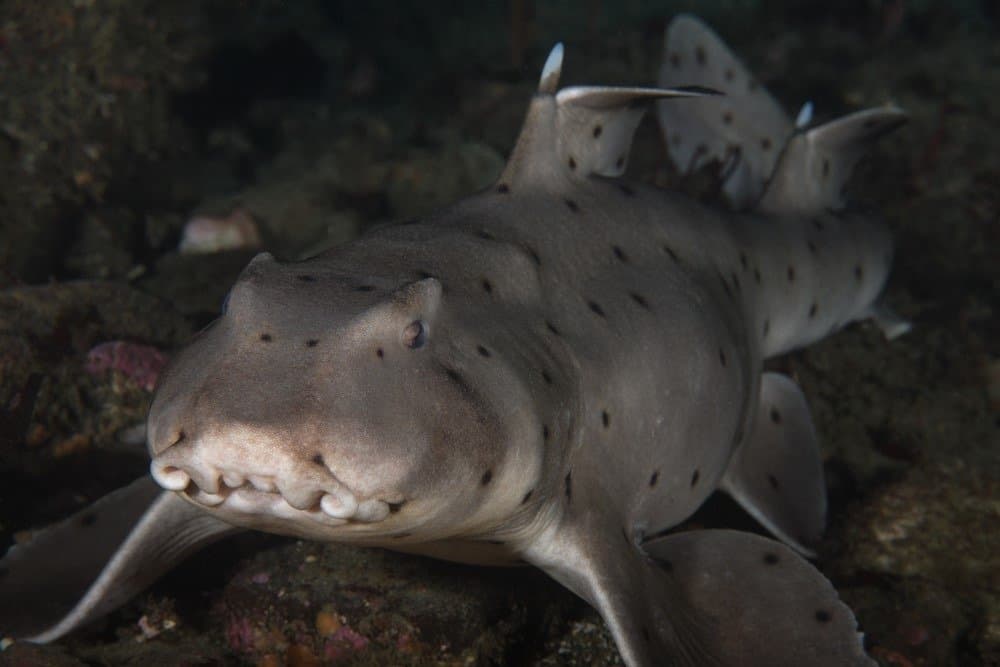
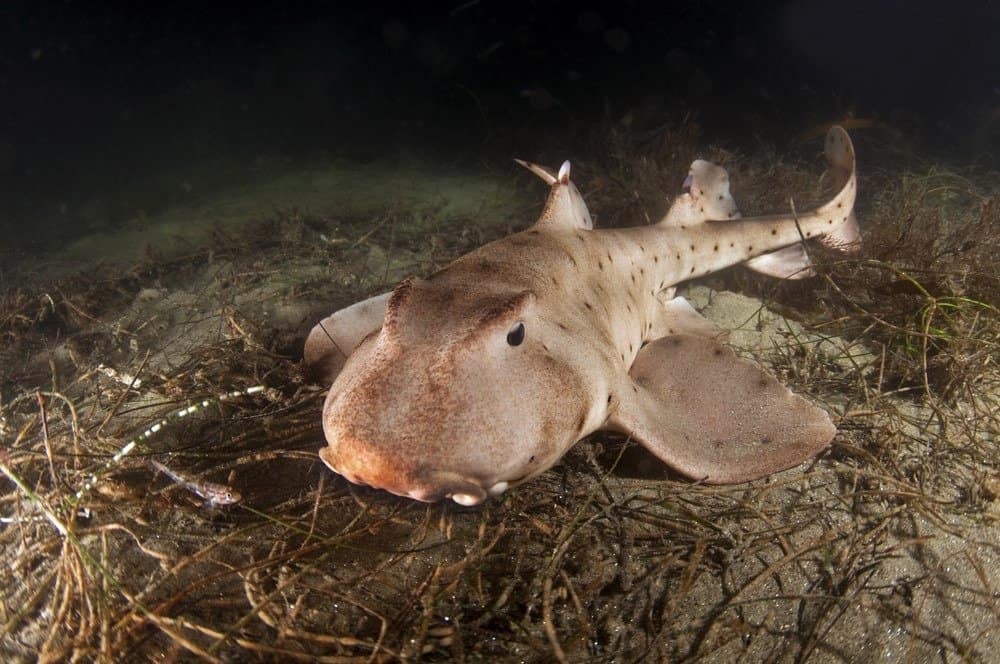
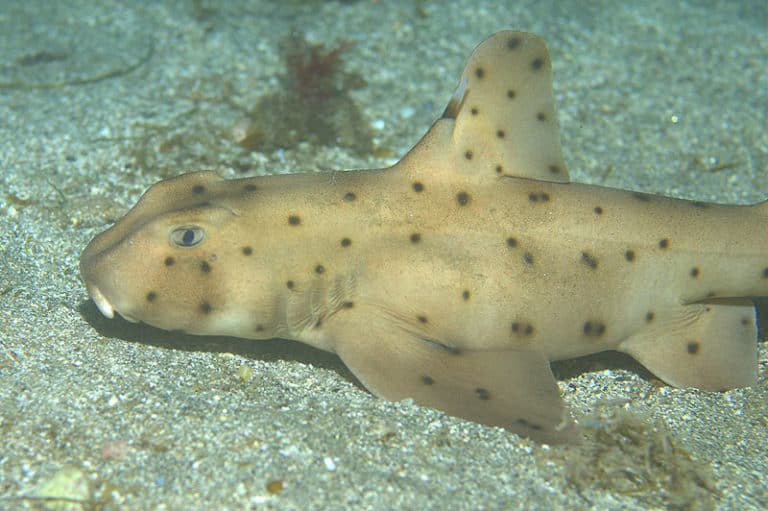
Using its robust fins, the horn shark propels itself along the ocean floor.
©Philip Garner/Shutterstock.com
- The shark with horns maintains a territory of approximately 10,000 square feet in which it roams and feeds. Some sharks barely leave their home range for their entire lives.
- The horn shark moves by pushing itself along the bottom with its strong fins.
- This shark is very sensitive to light. It spends almost all its life hidden in crevices, shadows, or dark waters.
- The horn shark has been kept at many aquariums across the United States, including the San Antonio Aquarium and the Oregon Coast Aquarium.
Classification and Scientific Name
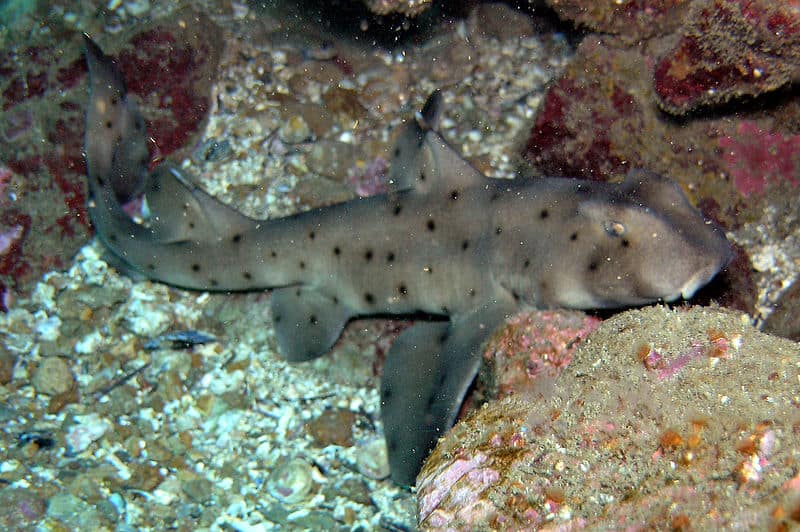
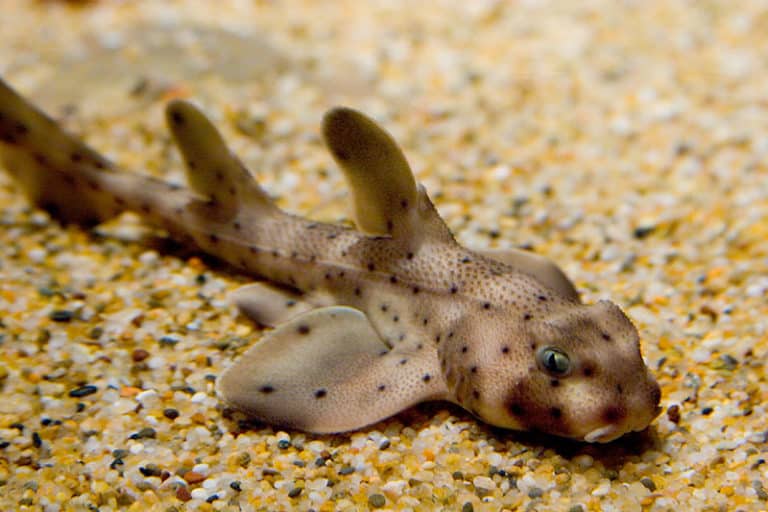
These sharks are scientifically referred to as Heterodontus francisci.
©Ed Bierman / Creative Commons – Original
The scientific name of these sharks is Heterodontus francisci. The genus name Heterodontus derives from a combination of two Greek words: heteros, meaning different or other, and odous, meaning teeth. This is perhaps a reference to their molar-like arrangement of teeth in the mouth. The species name francisci is a Latinized form of San Francisco.
The horn shark is closely related to the small bullhead sharks (not to be confused with the larger bull sharks). There are ten living species in this genus, including the crested bullhead shark and the Port Jackson shark. These bullhead sharks are the only members of the family Heterodontidae (and the entire order of Heterodontiformes).
Evolution and Origins
The horn shark, scientifically known as Heterodontus francisci, belongs to the Heterodontidae family and is a species of bullhead shark. It is native to the coastal waters along the western coast of North America, ranging from California to the Gulf of California.
The horn shark is classified within the Heterodontidae family, known as bullhead sharks. The genus was initially described by Blainville in 1816, while the species was later documented by Girard in 1855. There are no subspecies of horn sharks, and they evolved in a similar way to most sharks.
Appearance
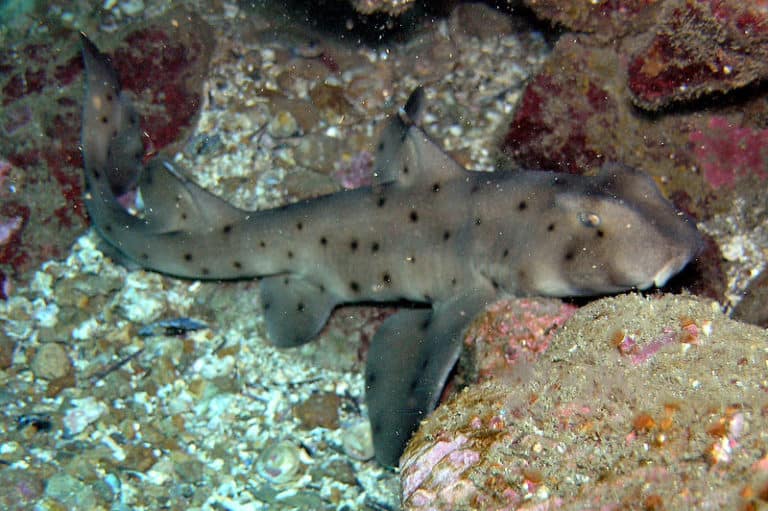
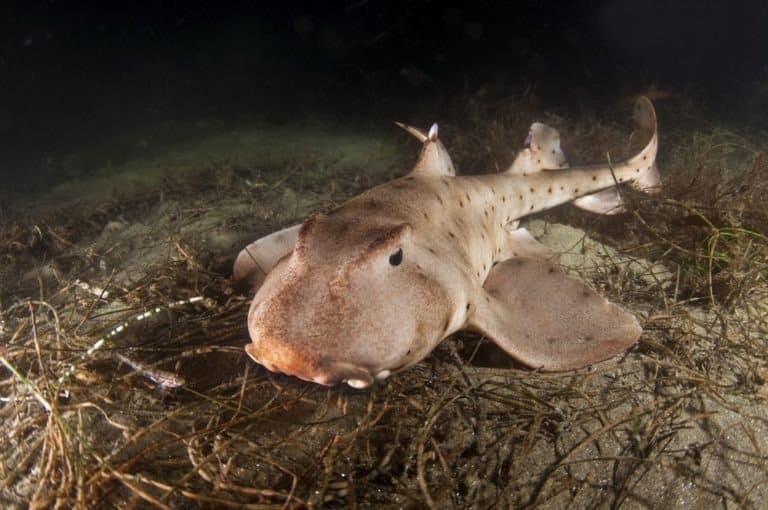
These sharks with horns are easy to identify by their blunt head, curved snouts, long mouths, and sharp spines. The most distinctive physical characteristic of the horn shark is the prominent ridges above both eyes that kind of resemble horns.
They also have a brown or gray back with white spots and a yellowish underside to provide camouflage amid the dirt and rocks. The horn shark measures up to 4 feet in length, but the typical size is 3 feet long and 10 pounds.
Both males and females tend to grow around the same size as each other and have a similar appearance.
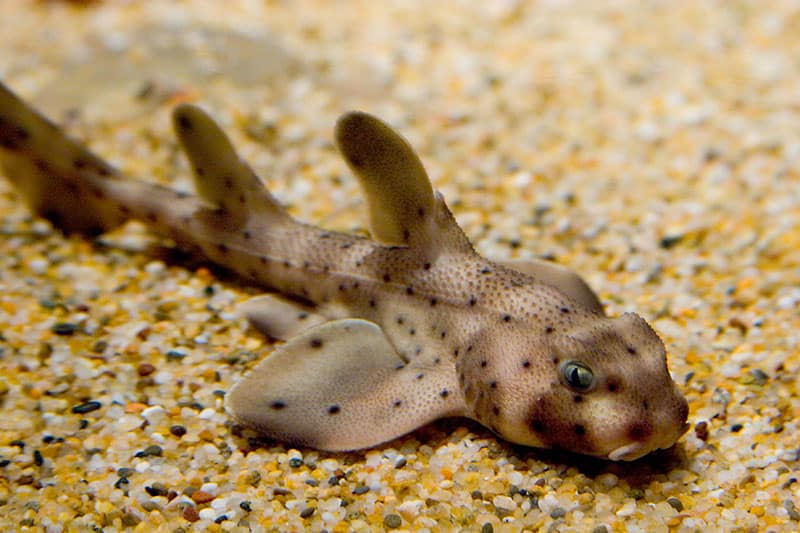
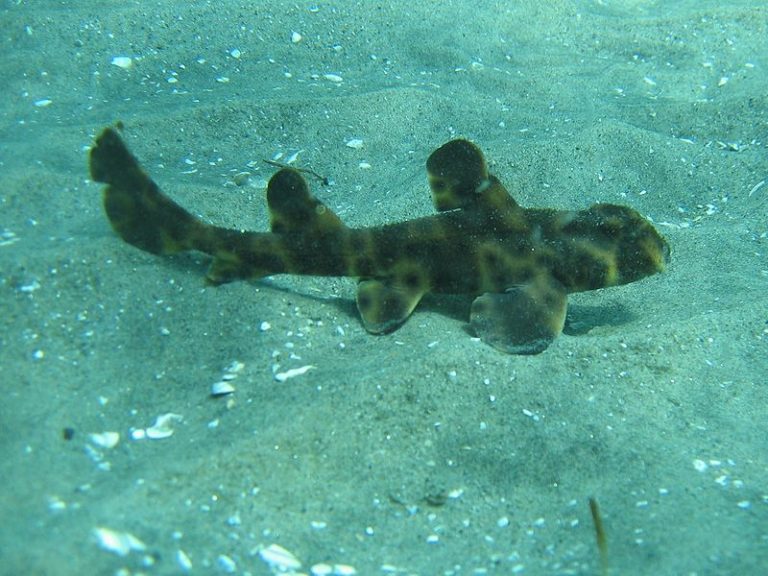
These horned sharks can be readily distinguished by their blunt heads, curved snouts, elongated mouths, and prominent, sharp spines.
©Erik Ogan / Creative Commons – Original
Distribution, Population, and Habitat
These sharks have a narrow range along the coasts of California and Mexico. Reports indicate that it may appear as far south as Ecuador and Peru, but it’s unclear if these specimens are actually a similar species identified as a horn shark by mistake. Horn sharks dwell among kelp beds or rocky outcrops in shallow waters around 26 to 40 feet deep. They sometimes move out to deeper waters depending on the climate.
Not much is known about the number of horn sharks left in the wild. The IUCN Red List considers it to be data deficient, but the species appears to be fairly common throughout its natural habitat. They do not appear to be seriously threatened in any way, and no particular conservation efforts are devoted to them.
Predators and Prey
Sharks with horns are one of the top predators in their ecosystem, but they are not apex predators. This species drifts along the continental shelf at night, feeding on prey and running from danger.
What does the horn shark eat?
The horn shark’s diet consists mostly of hard-shelled crustaceans like shrimp and crabs, but they enjoy other food items as well. One of their most common hunting tactics is to surprise small fish that sleep at night. They also eat so much purple urchin that the teeth and body are sometimes stained purple.
The horn shark moves along the bottom of the sea bed, sucking up prey into its mouth. The shark has small molar-like teeth, which it uses to crush the hard shells of its prey.
What eats the horn shark?
A full-grown adult horn shark only has a few natural predators, among them other sharks. But elephant seals and bald eagles may also prey upon juveniles and eggs.
Reproduction and Lifespan
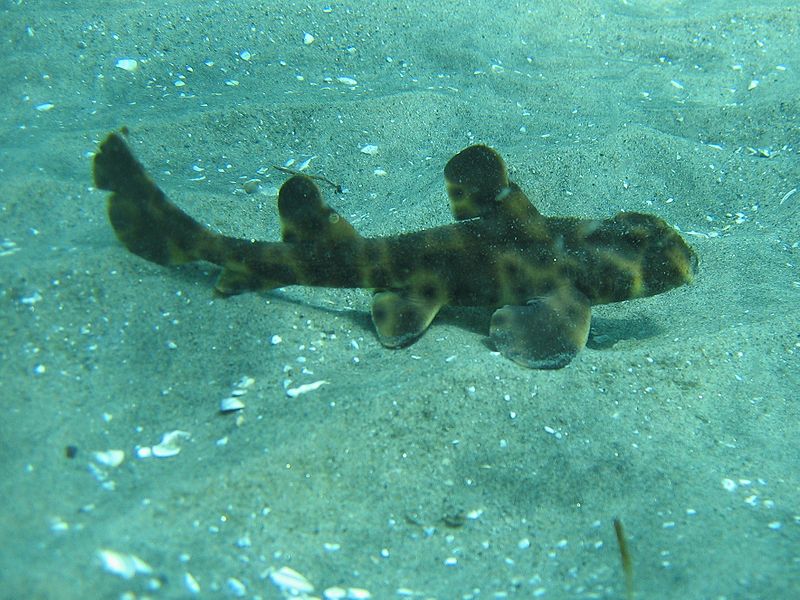
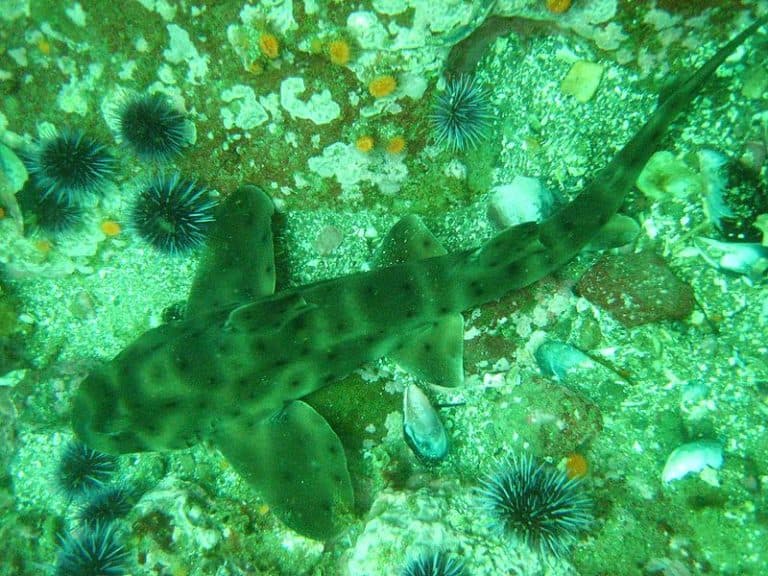
The horn shark lays up to 24 eggs.
©Magnus Kjaergaard / Creative Commons – Original
These sharks have an annual mating season in December or January. The male chases the female to indicate his interest. Once the female signals she is ready, the male grabs her pectoral fin with his teeth and mates with her. The mating session lasts 30 to 40 minutes before they depart permanently.
A few weeks later, the female will begin laying a litter of up to 24 eggs. She only lays two of her litter at a time, so it takes her a few months to fully produce them all. These eggs are encased in a spiral-shaped substance with the same color as the surrounding kelp so they can be safely deposited in crevices and kept hidden from predators. The horn shark is one of the few species of shark to actually invest a great deal of time into parental care. The mother will even sometimes position the eggs herself.
The young litter of pups emerges from the eggs after some six to nine months, usually measuring no more than 7 inches in size. The sharp spines serve as the main means of protection against hungry predators like angel sharks and sea bass. The juveniles begin to feed on the yolk sac for the first month until they are old enough to hunt on their own.
Then they graduate to soft-bodied prey such as worms and sea anemones. Only once their teeth and bodies are more developed do they finally begin to feed on hard-shelled creatures. Each individual shark grows at a highly different rate, which makes it difficult to say anything consistent about its life stages. These sharks are known to live some 12 years in captivity and possibly around 25 or even 50 years in the wild.
Fishing and Cooking
This shark has almost no value to fishers except as a sport for the most dedicated recreational fishers. The only real danger from humans is when it’s accidentally caught in shrimp trawls or gill nets. When the shark is caught deliberately, it is almost always for scientific purposes.
This shark can survive at least 12 years in captivity, while other sharks die from starvation because they stop eating. This makes it very valuable as a specimen for studying shark anatomy, ecology, and reproduction.
Horn Shark Pictures
View all of our Horn Shark pictures in the gallery.

Sources
- Animal Diversity Web / Accessed December 22, 2020
- Sea Dwellers / Accessed December 22, 2020