H
Species Profile

Horseshoe Crab

Xiphosurida

Beach Spawners, Blue-Blooded Guardians
Kesorn Weaver/iStock via Getty Images

Horseshoe Crab Distribution

Click a location to explore more animals from that region

This map shows coastal regions where Horseshoe Crab are found.

Loading map...
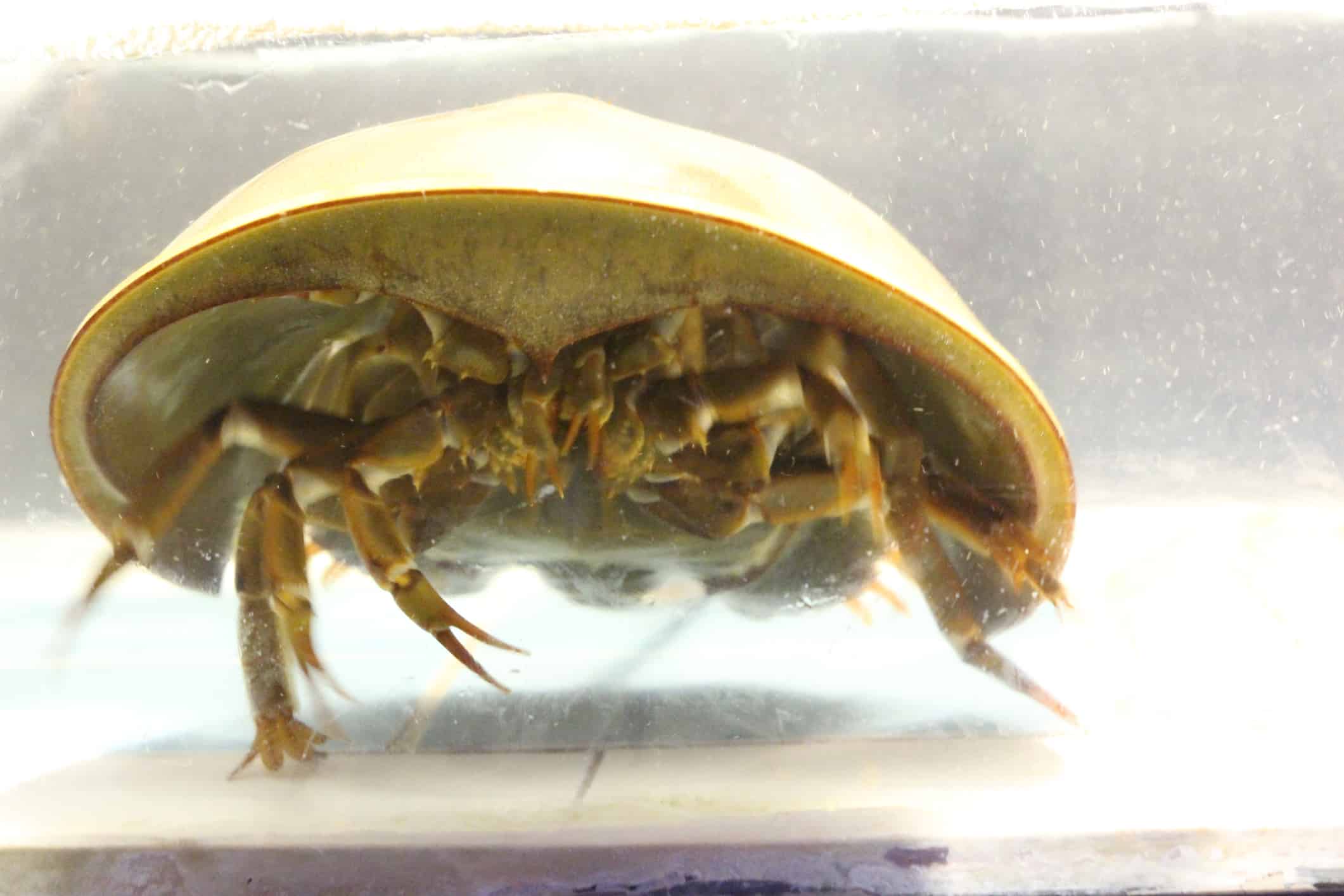
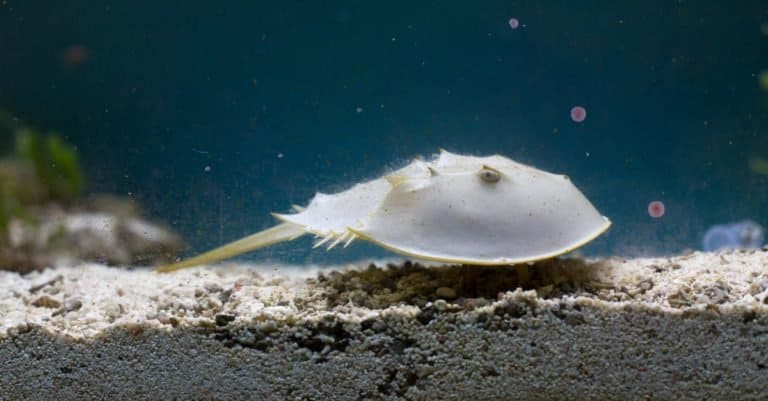
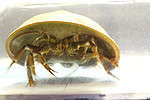
Yellow horseshoe crab walking

At a Glance

Order Overview This page covers the Horseshoe Crab order as a group. Stats below are general traits shared across the order.
Diet Omnivore
Activity Nocturnal+
Lifespan 20 years
Weight 5 lbs
Status Vulnerable
Did You Know?

They're closer to spiders and scorpions than to true crabs (they're chelicerates).

Scientific Classification

Order Overview "Horseshoe Crab" is not a single species but represents an entire order containing multiple species.

Horseshoe crabs are marine chelicerate arthropods (closer to spiders and scorpions than to true crabs) characterized by a hard domed carapace, book gills, and a long tail spine (telson). They are ancient lineages and important coastal ecosystem components, with significant biomedical relevance due to their blood’s clotting reaction to bacterial endotoxins.

Kingdom
Animalia
Phylum
Arthropoda
Class
Xiphosura
Order
Xiphosurida

Distinguishing Features

  • Not true crabs (not crustaceans); they are chelicerates
  • Horseshoe-shaped carapace with compound lateral eyes and smaller median eyes
  • Book gills on the underside used for respiration and swimming
  • Long telson (tail spine) used mainly for righting themselves

Physical Measurements

Males and females differ in size

Length
1 ft 4 in (12 in – 1 ft 10 in)
1 ft 10 in (12 in – 2 ft 9 in)
Weight
2 lbs (0 lbs – 6 lbs)
6 lbs (1 lbs – 13 lbs)
Tail Length
7 in (4 in – 10 in)
10 in (4 in – 1 ft 6 in)
Top Speed
2 mph
Slow 0.5-3 km/h

Appearance

Primary Colors
Secondary Colors
Skin Type Hard chitin shell forming a domed prosomal carapace and segmented opisthosoma; surface smooth to slightly bumpy, often with scrapes and covered by algae or barnacles, varying by species, age, environment.
Distinctive Features
  • Chelicerate arthropods (closer to spiders/scorpions than to true crabs): lack crustacean antennae; appendages are chelicerae + walking legs beneath the carapace.
  • Body plan consistent across the order: broad domed prosoma (carapace), posterior opisthosoma with marginal spines, ventral book gills, and a long telson (tail spine) used for righting and maneuvering (not a stinger).
  • Measurements (range across extant members of Xiphosurida): typical adult prosomal carapace width roughly ~15-35 cm; total length including telson commonly ~30-75 cm (sex, species, and population dependent).
  • Lifespan (range across species/populations): typically about ~8-20+ years; some estimates reach ~25 years depending on species, region, and methodology (growth/molt-based vs mark-recapture).
  • Ventral anatomy: paired book gills on the opisthosoma used for respiration and swimming; can fan rapidly, and are often pale compared with the dorsal shell.
  • Legs and feeding: multiple pairs of walking legs with spines for handling prey; hard gnathobases at the limb bases help grind food (benthic invertebrates and carrion).
  • Color and surface are strongly influenced by environment: sediment staining, algal films, and epibionts (e.g., barnacles) can significantly alter apparent coloration and texture; thus visual 'patterns' vary more by habitat than by species-level markings.
  • Horseshoe crabs often spawn on beaches. Adults move into shallow and intertidal waters to mate and lay eggs, usually with tides and sometimes seasons or moon phases; timing varies in temperate and tropical areas.
  • Horseshoe crab eggs and young are key food for coastal predators, especially migratory shorebirds. Adults help recycle seafloor nutrients and stir sediment; effects depend on coastal productivity and local crab numbers.
  • Biomedical relevance: amoebocyte lysate (e.g., Limulus/Tachypleus lysate) derived from horseshoe crab blood is used to detect bacterial endotoxins; this has conservation tradeoffs where harvest intersects with fisheries and shorebird-dependent ecosystems (management practices vary by region).

Sexual Dimorphism

Sexual dimorphism is common across the order: females are typically larger-bodied, while males are smaller and have specialized clasping appendages used during mating. Degree of size difference and mating aggregations varies among species and regions.

  • Generally smaller prosomal width and mass compared with females of the same species/population.
  • Modified anterior walking legs/pedipalps forming claspers for gripping the female during amplexus (a key chelicerate reproductive adaptation).
  • Often more frequent external scarring/wear consistent with prolonged attachment during spawning events (variable).
  • Generally larger body size (broader carapace) and greater mass, associated with egg production.
  • Typically lack male clasping modifications; walking legs remain primarily locomotive/feeding structures.
  • May show more pronounced abdominal/ventral distension when gravid (variable with season and locality).

Did You Know?

They're closer to spiders and scorpions than to true crabs (they're chelicerates).

All living horseshoe crabs belong to one order with just four modern species, split between the Atlantic and Indo-Pacific.

They breathe with "book gills" that can function in water-and briefly in air when kept moist.

Their blood (blue from copper-based hemocyanin) is used to detect bacterial endotoxins in medical products (LAL/TAL tests).

Mass beach spawning can feed migrating shorebirds via the crabs' nutrient-rich eggs, linking oceans to flyways.

The long tail spine (telson) is mainly a righting tool to flip themselves over, not a stinger.

They are often called "living fossils," reflecting an ancient lineage with body plans recognizable in very old fossils.

Unique Adaptations

  • Book gills: layered, page-like structures for efficient gas exchange; also help with swimming and digging movements.
  • Telson (tail spine): leveraged to right the body when overturned and to stabilize movement through soft sediment.
  • Hard domed carapace (prosoma) plus segmented opisthosoma: a robust "shield-and-hinge" design that protects vital organs while allowing flexion.
  • Chemosensory and mechanosensory sensing: specialized receptors help them locate mates and food in turbid, dynamic coastal waters.
  • Innate immune system with endotoxin-triggered clotting: amebocytes rapidly clot in response to bacterial lipopolysaccharides-key to LAL/TAL biomedical testing.
  • Broad tolerance to coastal variability: as a group they cope with shifting salinity, oxygen, and temperature in nearshore systems; tolerance is especially notable in species that frequent estuaries and mangroves.

Interesting Behaviors

  • Seasonal shoreward migrations: adults move from deeper coastal waters into bays/estuaries to spawn, often timed with tides and (in many regions) lunar cycles; timing varies by latitude and species.
  • Beach spawning aggregations: multiple males may cluster around a female during egg-laying; intensity ranges from huge events on some Atlantic beaches to more localized Indo-Pacific nesting.
  • Benthic foraging and burrowing: they plow through sand or mud to find worms, small bivalves, and other invertebrates; some species more strongly favor muddy/mangrove flats and brackish areas.
  • Nocturnal/low-light activity is common in many habitats, but activity patterns vary with temperature, tides, and disturbance.
  • Ontogenetic habitat shifts: juveniles often use shallow nursery flats, then expand to deeper coastal areas as they grow; the exact nursery habitats differ among regions and species.

Cultural Significance

Horseshoe crabs (Xiphosurida) are tied to coasts: used as bait, draw tourists to spawning events, and are used in medicine by Limulus/Tachypleus amebocyte lysate (LAL/TAL) to test drugs. Harvesting sparks conservation debates and they appear in East/Southeast Asian food and folk lore.

Myths & Legends

In parts of southern China and neighboring regions, horseshoe crabs have been used as a folk symbol of marital fidelity because they are often seen traveling in attached male-female pairs during the breeding season.

In Japan, the tri-spine horseshoe crab (often called the 'helmet crab') is a local symbol in places like Kasaoka, Okayama Prefecture, with efforts to protect its nearby spawning and nursery shores.

Across modern coastal North America, public folklore around the "living fossil" label has turned horseshoe crab spawn into a seasonal rite-of-spring narrative-an annual coastal event often retold alongside stories of shorebird migrations and beach stewardship.

Conservation Status

VU Not Evaluated

Facing a high risk of extinction in the wild.

Population Decreasing

Protected Under

  • United States: Atlantic States Marine Fisheries Commission (ASMFC) Interstate Fishery Management Plan and state-level harvest/handling restrictions for Limulus polyphemus (vary by state; includes quotas/closures/seasonal limits in some areas).
  • China: Tachypleus tridentatus listed as National Key Protected Wildlife (national protection framework; implementation varies by province).
  • India: Horseshoe crabs receive legal protection in several jurisdictions under wildlife and coastal regulations, with enforcement varying regionally (e.g., protections linked to the Wildlife (Protection) Act and coastal conservation measures).
  • Multiple countries/regions: local marine protected areas, seasonal beach protections, and fishery regulations that incidentally or explicitly reduce take/disturbance at spawning sites (coverage and effectiveness vary).

You might be looking for:

Atlantic horseshoe crab

50%

Limulus polyphemus

The best-known North American species; common on Atlantic and Gulf coasts and widely used in biomedical LAL testing.

Tri-spine horseshoe crab (Chinese/Japanese horseshoe crab)

20%

Tachypleus tridentatus

Large Indo-Pacific species; regionally threatened in parts of its range due to harvest and habitat loss.

Indo-Pacific horseshoe crab

18%

Tachypleus gigas

Indo-West Pacific species associated with sandy and muddy coastal habitats.

Mangrove horseshoe crab

12%

Carcinoscorpius rotundicauda

Smaller Asian species strongly associated with mangroves and estuaries.

Life Cycle

Birth 20000 hatchlings
Lifespan 20 years

Lifespan

In the Wild
10–40 years
In Captivity
5–30 years

Reproduction

Mating System Polygynandry
Social Structure Aggregation Group
Breeding Pattern Transient
Fertilization Substrate Spawning
Birth Type Substrate_spawning

Horseshoe crabs (Xiphosurida) are long-lived benthic animals that gather on beaches to spawn. Females lay eggs in sand; multiple males often fertilize them (polygynandry). Pairing is brief, and there is no parental care.

Behavior & Ecology

Social Spawning congregation Group: 20
Activity Nocturnal, Crepuscular, Cathemeral
Diet Omnivore Benthic worms and small bivalves (commonly reported as major food items across species, varying by local availability).
Seasonal Migratory, Hibernates 25 mi

Temperament

Generally non-aggressive toward conspecifics; interactions are mostly incidental contact during crowding or mating rather than territoriality.
Defensive rather than confrontational: relies on armor (domed carapace) and the telson primarily for righting/levering; may push or wedge when crowded.
Strongly rhythm-driven behavior: activity and shoreward movements are commonly synchronized to tides and lunar cycles; the degree of night-vs-day activity varies by locality, season, turbidity, and disturbance.
Order-level size range (smallest to largest extant members): roughly ~20-70 cm total length including telson, with broad variation in carapace width and mass across species, sex, and region (females typically larger).
Order-level lifespan range: commonly on the order of ~8-20+ years, with relatively late maturity (often many years) and multi-year reproductive participation; longevity and maturation rate vary with species and environmental conditions.

Communication

None documented; horseshoe crabs are effectively silent and do not rely on acoustic calls.
Chemical cues (pheromone-like signals) important for mate finding and spawning-site attraction; reliance and specificity may vary among species and populations.
Tactile/mechanical signaling during mating and crowding E.g., male attachment to females, physical contact in dense spawning groups
Hydrodynamic cues and substrate-borne vibrations may help detect nearby animals or movement in turbid/shallow water, especially during tidal migrations.
Visual cues likely play a limited-to-moderate role (simple eyes and light sensitivity), with importance varying by water clarity and time of activity.

Habitat

Coastal Beach Estuary Mangrove Rocky Shore Wetland Seabed/Benthic Open Ocean +2
Biomes:
Terrain:
Coastal Sandy Muddy Riverine Island
Elevation: -7874 in – 16 ft 5 in

Ecological Role

Coastal benthic predator-scavenger and sediment disturber (bioturbator) that links benthic invertebrate production to higher trophic levels.

Regulates benthic invertebrate communities through predation and scavenging Bioturbation: mixes and aerates sediments while foraging, influencing sediment chemistry and infaunal habitat Nutrient cycling via consumption and redistribution of organic matter Supports food webs: eggs and larvae are key seasonal resources for many shorebirds and fishes; juveniles/adults are prey for marine predators (e.g., turtles, sharks/rays, some birds) Contributes to coastal ecosystem stability through energy transfer between intertidal/subtidal zones

Diet Details

Main Prey:
Polychaete worms Small bivalves Gastropods Small crustaceans Benthic invertebrates
Other Foods:
Organic detritus Benthic microalgae, diatoms and algal films Seaweed

Human Interaction

Domestication Status

Wild

Horseshoe crabs (order Xiphosurida; family Limulidae) are not domesticated. Adults are about 30–75+ cm; many live 10–30 years. They live in shallow coastal waters and spawn on sandy beaches with the tides. They eat worms, mollusks, and carrion. Humans use them for bait, research, aquaria, and biomedical bleeding for LAL/TAL; coastal development and harvest threaten them.

Danger Level

Low
  • Mechanical injury from the telson (tail spine) if mishandled or stepped on; typically puncture/scratch risk rather than envenomation
  • Cuts/abrasions from carapace edges or barnacle encrustations on shells
  • Handling risks typical of marine animals (secondary infection if punctured; hygiene concerns)
  • Rare allergic/irritant reactions to contact with marine biofilms or associated organisms

As a Pet

Not Suitable as Pet

Legality: Rules differ by country, state, and species. Many places need permits to collect or keep horseshoe crabs. Some species have extra protections. Transport may need papers. Private keeping is usually allowed only for licensed aquaria or research.

Care Level: Expert Only

Purchase Cost: Up to $250
Lifetime Cost: $1,500 - $15,000

Economic Value

Uses:
Biomedical testing (endotoxin detection reagents; LAL/TAL supply chain) Bait fisheries and associated coastal economies Scientific research (physiology, vision, immunology, ecology) Public aquaria/education and ecotourism (spawning-beach viewing in some regions) Conservation management and habitat restoration activities
Products:
  • Limulus amebocyte lysate (LAL) and analogous endotoxin-detection reagents (including TAL from Asian horseshoe crabs)
  • Bait for eel/whelk and other fisheries (regional)
  • Live specimens for research/education (typically via permitted channels)
  • Educational exhibits and ecotourism experiences centered on spawning events

Relationships

Related Species 4

Horseshoe crabs
Horseshoe crabs Limulidae Shared Family
Atlantic horseshoe crab Limulus Shared Genus
Tri-spine horseshoe crabs Tachypleus Shared Genus
Mangrove horseshoe crab Carcinoscorpius Shared Genus

Ecological Equivalents 4

Animals that fill a similar ecological role in their ecosystem

True crabs Brachyura Share shallow-coastal benthic habitats and scavenging/predatory roles, but are crustaceans (not chelicerates) and differ markedly in anatomy and development.
Spider crabs Majoidea Occupy similar nearshore benthic zones and can overlap in prey (worms, mollusks) and predator guilds. Superficially similar 'armored' appearance despite distant relationships.
Trilobites Trilobita Often compared due to a superficially similar armored, segmented body plan and ancient marine lineage. Not a close living ecological equivalent today, but commonly invoked as an evolutionary/functional analogue.
Rays Batoidea Occupy similar coastal flats and estuaries and can interact strongly: rays overlap in benthic prey and are also important predators of horseshoe crabs in some regions.

Types of Horseshoe Crab

4

Explore 4 recognized types of horseshoe crab

Atlantic horseshoe crab Limulus polyphemus
Tri-spine horseshoe crab Tachypleus tridentatus
Coastal horseshoe crab Tachypleus gigas
Mangrove horseshoe crab Carcinoscorpius rotundicauda

One of the oldest animals on earth, horseshoe crabs have been roaming the ocean for hundreds of millions of years. They adapted to continents forming and reforming and survived the Ice Ages and cataclysmic events that made the dinosaurs and so many other species go extinct. When humans arrived, they discovered that horseshoe crabs could be used as food and bait to catch other kinds of food, and now they are used for medical research.

Quick Facts

Some fascinating facts about the horseshoe crab include:

  • Horseshoe crabs are arthropods, which means they are related to spiders.
  • They’re not crabs. They’re not even crustaceans.
  • They evolved about 450 million years ago, which makes some people call them living fossils.
  • The blood of these animals is sapphire blue when exposed to oxygen.
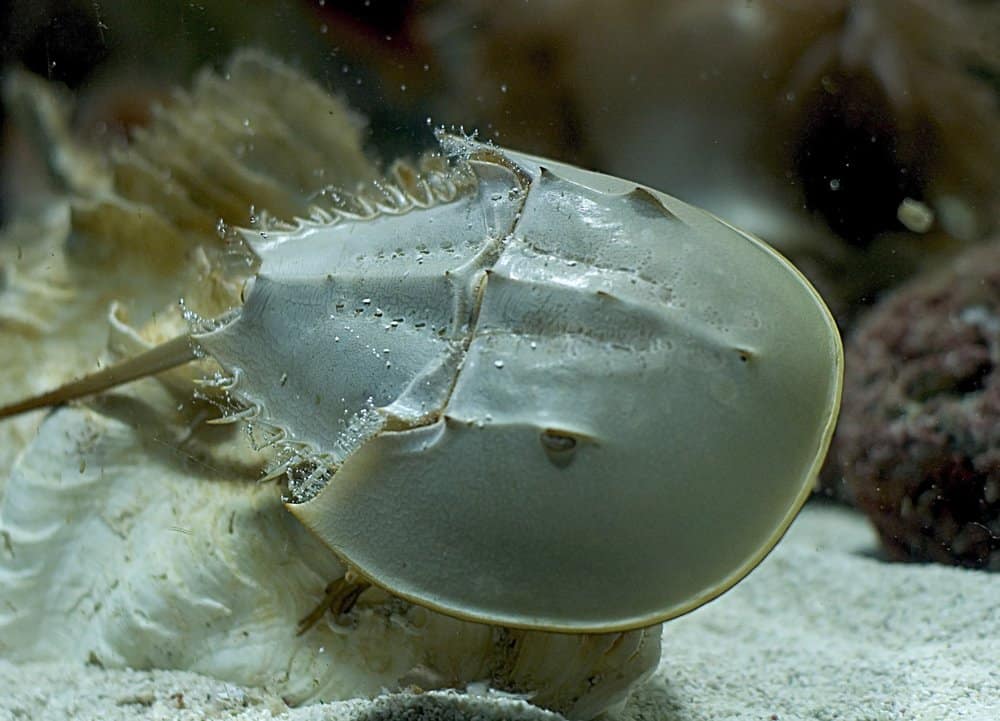
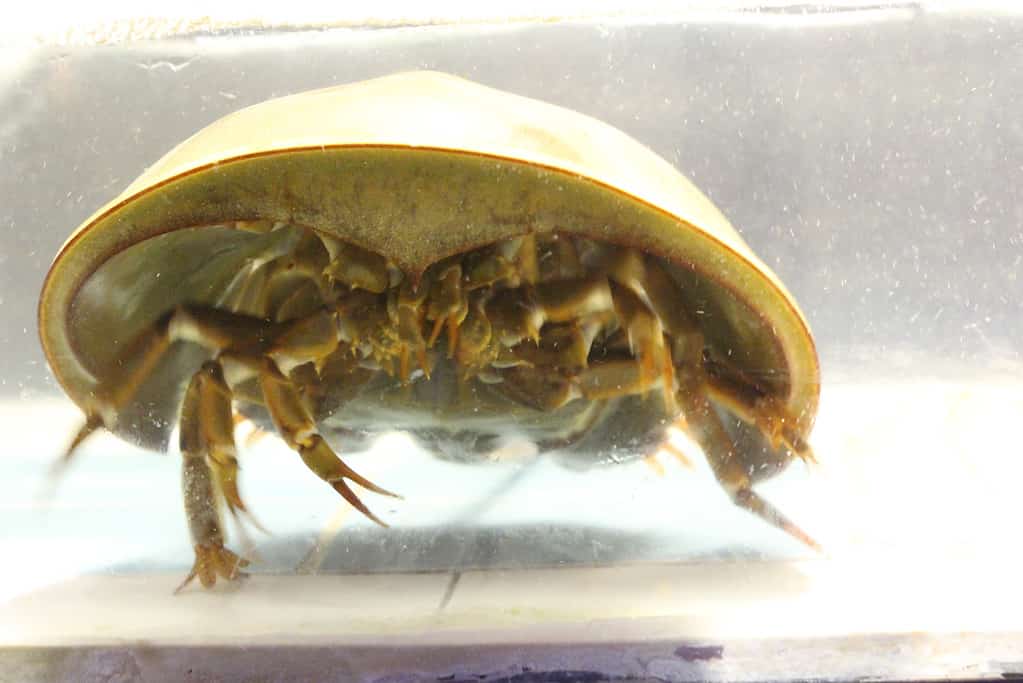
Horseshoe Crab in water

The horseshoe crab survived the Ice Ages and mass dinosaur extinction.

Classification and Scientific name

Horseshoe crabs belong to the family Limulidae, within the suborder Xiphosurida, and the order Xiphosura. This group includes four genera: Carcinoscorpius, Limulus, Mesolimulus (extinct), and Tachypleus

Species

The four living species of horseshoe crabs are:

  • Carcinoscorpius rotundicauda (Mangrove horseshoe crab)
  • Limulus polyphemus (Atlantic horseshoe crab)
  • Tachypleus gigas (Indo-Pacific horseshoe crab)
  • Tachypleus tridentatus (Tri-spine horseshoe crab)

Mangrove horseshoe crabs are found in southern Asia. Atlantic horseshoe crabs live along the east coast of the United States and Mexico. The Indo-Pacific horseshoe crab is also found in south and southeastern Asia. And the tri-spine horseshoe crab lives in Southeast and East Asia.

Appearance

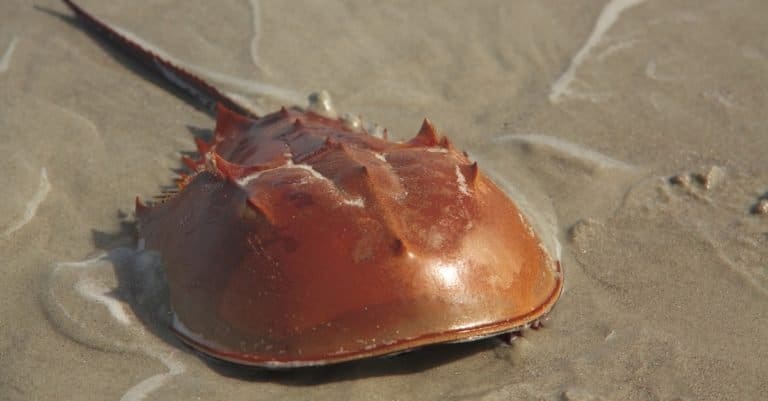
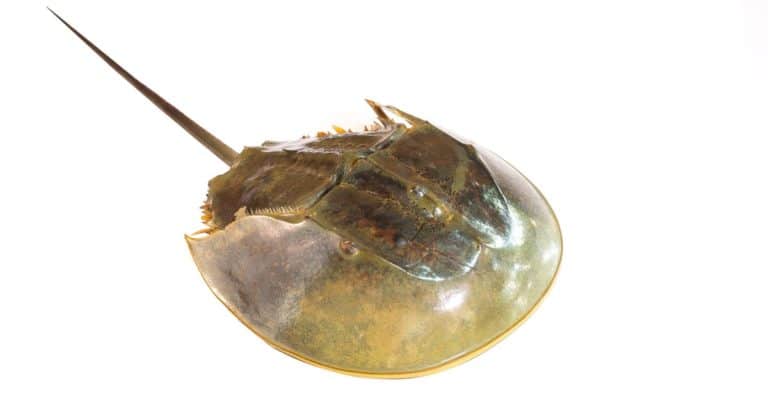
Horseshoe crabs have a distinct horseshoe-shaped carapace, or protective covering, which covers their body, dividing it into three parts: the prosoma (head), opisthosoma (middle body), and telson (tail). The telson, which is long and stiff, functions as a rudder during swimming and helps right the animal if it becomes overturned. Despite its menacing appearance, the tail is not used for defense. Horseshoe crabs are equipped with multiple eyes. Some are located on the prosoma. In contrast, others are situated on the telson, helping them navigate their environment and even detect changes in light.

Adult horseshoe crabs vary in size depending on the species. For instance, the male mangrove horseshoe crab typically grows to about 12 inches. The female tri-spine horseshoe crab can reach up to 31.25 inches and weigh as much as 9 pounds.
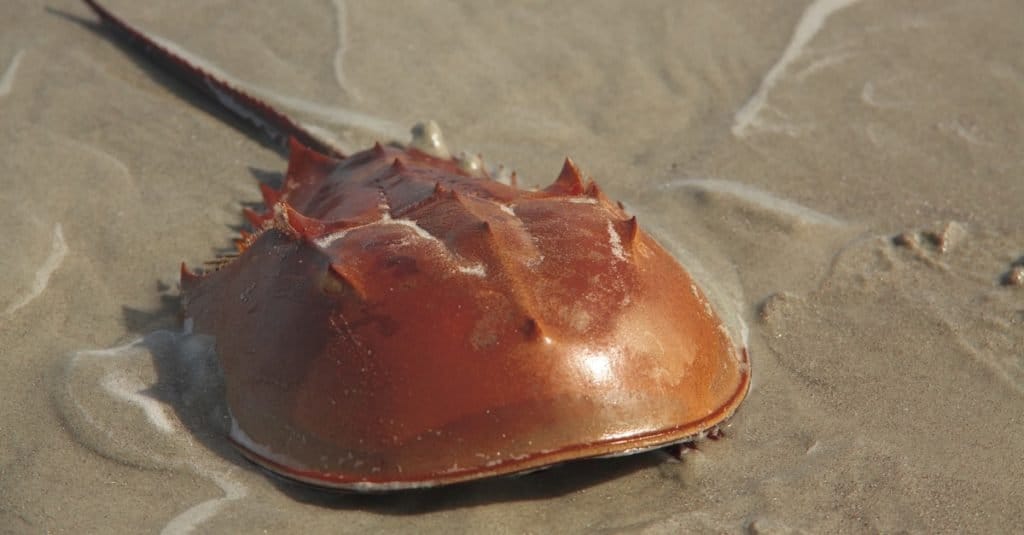
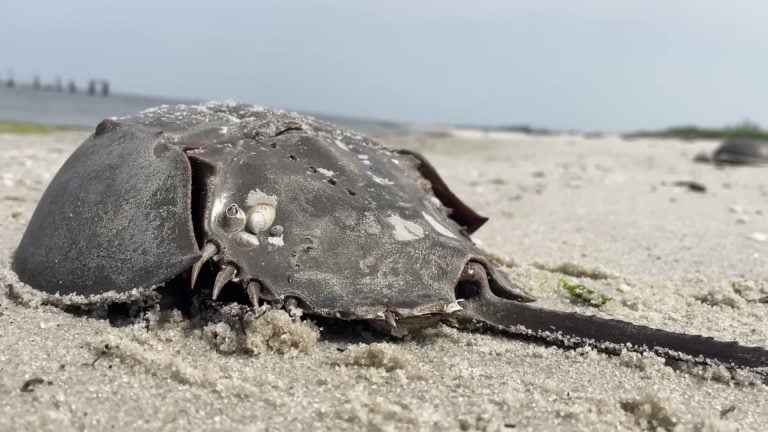
Close-up of Horseshoe Crab on the sand.

The tail of a horseshoe crab functions as a rudder during swimming.

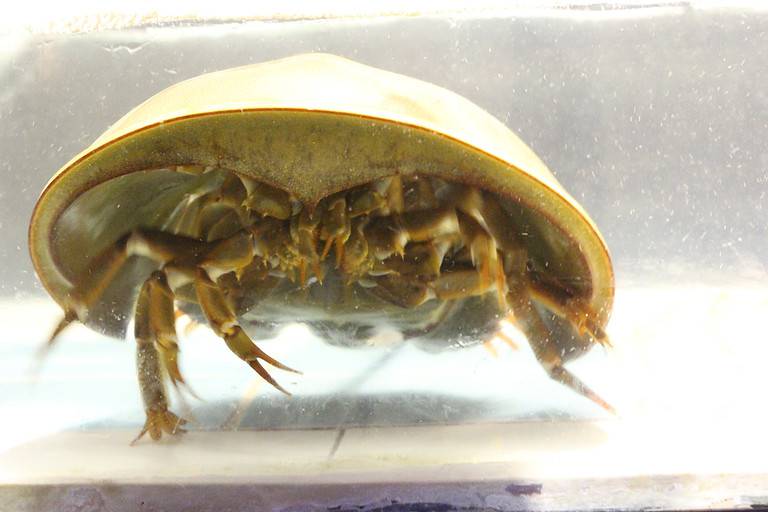
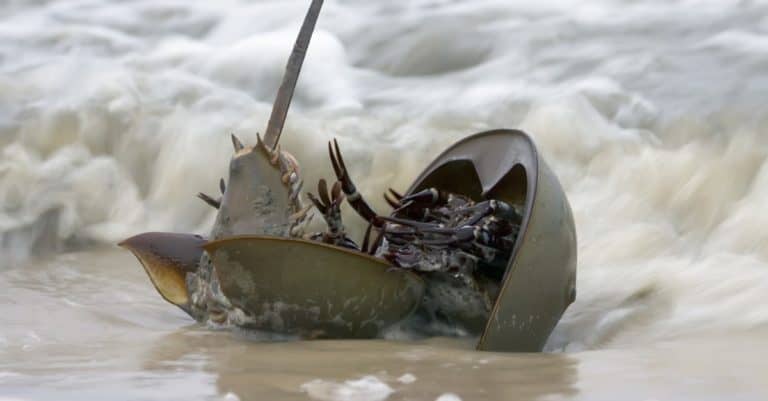
Horseshoe crabs have many eyes. Their eyes are on and under their heads, and there are even eyes under their tails. This may be why they are sometimes found swimming upside down. If the animal is flipped upside down, a person can see its book gills, which it uses to breathe underwater. These gills get their name because they look like the pages of a book.

Though they lack teeth, they can still eat shellfish whose shells aren’t too thick. This is because they have a mouth filled with bristles in the middle of their five pairs of legs. They use their legs to move their food to their mouth, then chew it by walking.
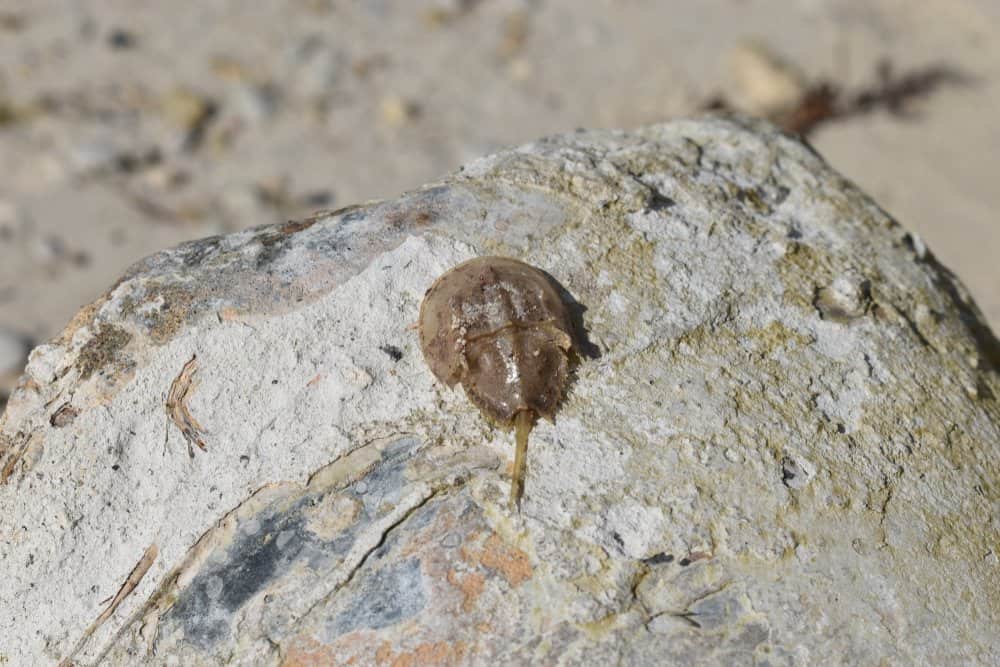
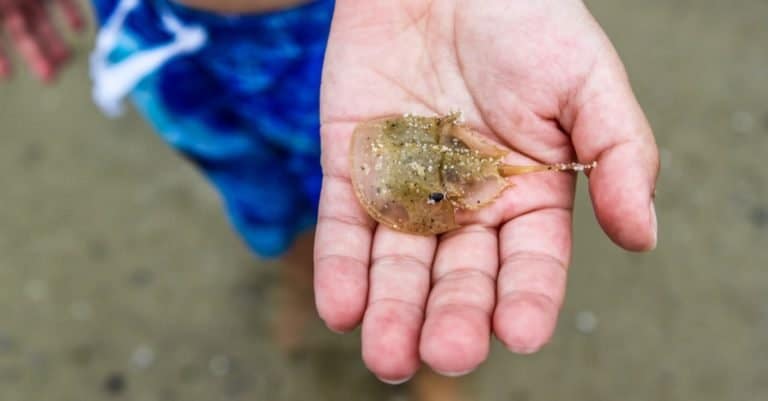
Horseshoe Crab (Limulidae) - baby on rock

Horseshoe crabs chew their food by walking.

Distribution, Population, and Habitat

All species of horseshoe crabs prefer shallow water with muddy or sandy bottoms. There are millions of these animals in the world’s oceans, though their numbers are declining in some places. The mangrove and tri-spine horseshoe crabs can be found in salt or brackish water around southeast Asia and north into China and Hong Kong. The Atlantic horseshoe crab is found along North America’s Atlantic coastline and in the Gulf of Mexico. The Indo-Pacific horseshoe crab is found on the coasts of the South China Sea down to the Bay of Bengal.

Predators and Prey

Horseshoe crabs are opportunistic feeders and consume a variety of organisms, including small fish, bivalves, invertebrates, and algae. Their predators include sea turtles, birds, and various fish, such as eels, flounders, and perches, which feed on the adult crabs and their eggs. Shorebirds, in particular, rely on the horseshoe crab eggs as a critical protein source during migration.

These animals also have their share of symbionts, since at one point they will no longer molt. Clams scuds, marine worms, algae, barnacles, oysters, starfish, and other creatures live on and in the horseshoe crab’s shell.

Reproduction and Lifespan

Horseshoe crabs can live for up to 20–30 years. They undergo frequent molts during their early years, sometimes as many as 18 times, before reaching reproductive maturity around age nine. The spawning season is one of the most impressive natural phenomena, occurring in spring during high tide at the new or full moon. Males arrive at the spawning site first and await females. Once a female arrives, she is typically surrounded by multiple males. A single female can carry between 60,000 to 120,000 eggs, which she lays in batches of about 4,000 eggs at each high tide.
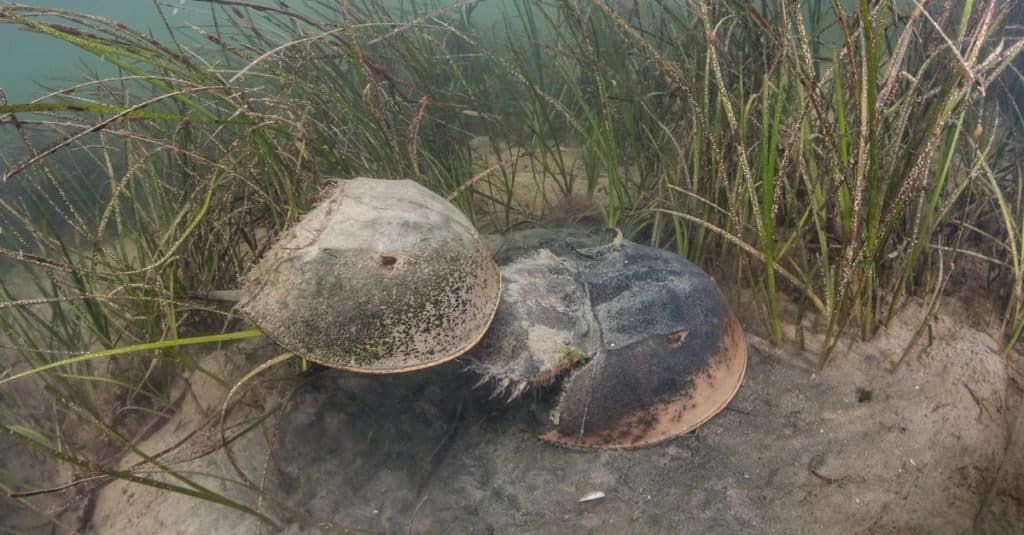
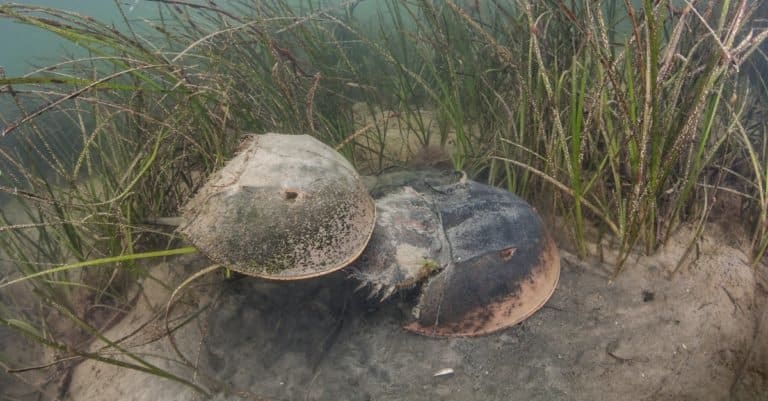
A pair of Atlantic horseshoe crabs (Limulus polyphemus) mate. These crabs are marine chelicerate arthropods commonly found from the Gulf of Mexico up to Canada. They are valuable in medical research.

Male horseshoe crabs are much smaller than females.

Horseshoe Crabs in Medical Research

The horseshoe crab’s blood coagulates in the presence of bacterial toxins. In human hands, this helps to ensure that vaccines and other medicines are free of dangerous chemicals. To harvest the blood, the animal is caught, drained a little, and released back into the water. This method has a mortality rate as high as 30% though.

Population

The Atlantic horseshoe crab is classified as Least Concern by the IUCN, indicating stable populations. However, overexploitation for medical research and bait use poses a local threat in certain areas. In contrast, species like Tachypleus gigas are classified as Vulnerable, with population declines attributed to habitat loss, overharvesting, and pollution.

View all 287 animals that start with H

Sources

  1. National Geographic / Accessed June 13, 2021
  2. Promega Connections / Accessed June 13, 2021
  3. Animal Diversity Web / Accessed June 13, 2021
  4. The Horseshoe Crab / Accessed June 13, 2021
  5. Wikipedia / Accessed June 13, 2021
  6. EPA / Accessed June 13, 2021
Abby Parks

About the Author

Abby Parks

Abby Parks has authored a fiction novel, theatrical plays, short stories, poems, and song lyrics. She's recorded two albums of her original songs, and is a multi-instrumentalist. She has managed a website for folk music and written articles on singer-songwriters, folk bands, and other things music-oriented. She's also a radio DJ for a folk music show. As well as having been a pet parent to rabbits, birds, dogs, and cats, Abby loves seeking sightings of animals in the wild and has witnessed some more exotic ones such as Puffins in the Farne Islands, Southern Pudu on the island of Chiloe (Chile), Penguins in the wild, and countless wild animals in the Rocky Mountains (Big Horn Sheep, Mountain Goats, Moose, Elk, Marmots, Beavers).
Connect:

Thank you for reading! Have some feedback for us?


Horseshoe Crab FAQs (Frequently Asked Questions)

The horseshoe crab is edible, but some people may consider it unappetizing or even toxic.