
H
Species Profile

Howler Monkey

Alouatta

Small monkeys, thunderous voices.
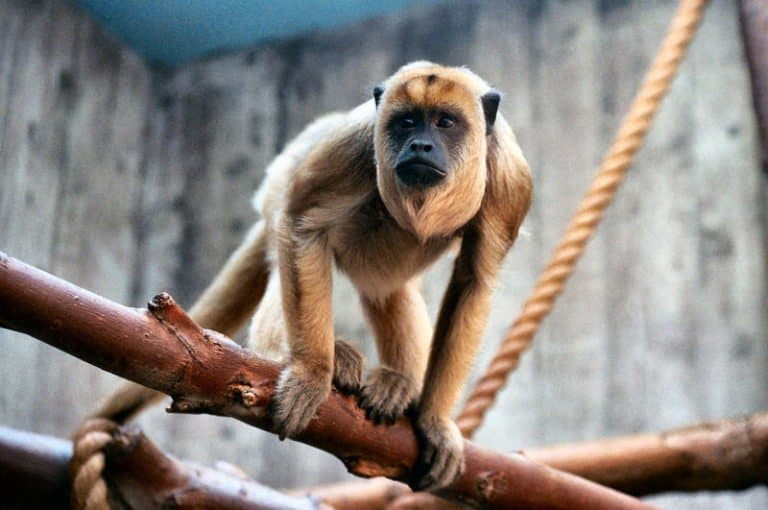
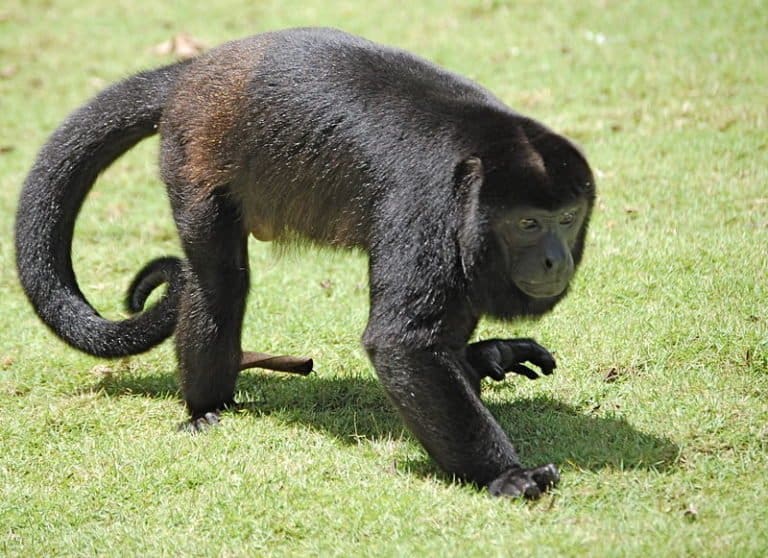
leofleck / Creative Commons

Howler Monkey Distribution

Click a location to explore more animals from that region

Loading map...

At a Glance

Genus Overview This page covers the Howler Monkey genus as a group. Stats below are general traits shared across the genus.
Also Known As mono aullador, macaco bugio, bugio, singe hurleur, guariba
Diet Folivore
Activity Diurnal+
Lifespan 15 years
Weight 11 lbs
Status Not Evaluated
Did You Know?

Size across Alouatta: ~38-72 cm head-body, ~45-90 cm tail; ~3-11 kg (varies by species, sex, and habitat).

Scientific Classification

Genus Overview "Howler Monkey" is not a single species but represents an entire genus containing multiple species.

Howler monkeys (genus Alouatta) are New World primates in the family Atelidae, famous for extremely loud vocalizations produced by an enlarged hyoid bone. They are primarily arboreal, diurnal, and largely folivorous-frugivorous, often living in social groups with home ranges in tropical forests.

Kingdom
Animalia
Phylum
Chordata
Class
Mammalia
Order
Primates
Family
Atelidae
Genus
Alouatta

Distinguishing Features

  • Very loud, far-carrying group calls (dawn/dusk choruses) enabled by an enlarged hyoid bone
  • Prehensile tail used for grasping branches (Atelidae trait)
  • Robust body with adaptations for leaf-heavy diets; comparatively slow, energy-conserving behavior
  • Social group living; territorial calling common

Physical Measurements

Males and females differ in size

Length
3 ft 9 in (2 ft 9 in – 4 ft 7 in)
Weight
17 lbs (9 lbs – 26 lbs)
12 lbs (7 lbs – 18 lbs)
Tail Length
2 ft 4 in (1 ft 8 in – 2 ft 11 in)
2 ft (1 ft 6 in – 2 ft 6 in)
Top Speed
12 mph
short bursts about 15–20 km/h

Appearance

Primary Colors
Secondary Colors
Skin Type Howler monkeys (Alouatta) have dense fur; faces often show bare or thin dark skin. Hands and feet are less furry. Tails furred above with a bare pad below near the tip for a prehensile grip.
Distinctive Features
  • Howler monkeys (Alouatta) vary in size: body length about 38–72 cm, tail about 50–75 cm (often as long or longer than body), and adult mass around 3–11 kg; males often larger.
  • An enlarged hyoid bone (especially in adult males) forms a sound chamber. It lets them make very loud, low howls for spacing, territory, and group communication, strongest at dawn and dusk.
  • A prehensile tail with a strong grasp and a hairless touch pad near the tip acts like a fifth limb for moving in trees, holding on, and steadying on branches.
  • Robust jaw/teeth and large gut typical of a folivory-leaning diet; many species spend long periods resting to accommodate leaf digestion (activity budgets commonly 'rest-heavy'), with variation by season, fruit availability, and habitat quality.
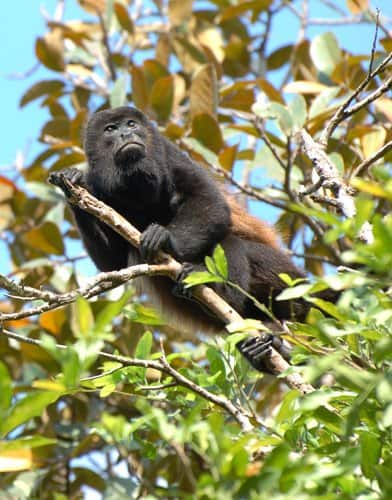
  • Tree-living (arboreal) and active by day (diurnal), howler monkeys live in the mid to upper canopy but use lower levels when forest is damaged or food shifts; they climb and bridge carefully, rarely leaping.
  • Dietary generalization: largely folivorous-frugivorous (leaves often dominant, fruit important when available), with opportunistic flowers; degree of folivory/frugivory varies widely among species, sites, and seasons.
  • Howlers (Alouatta) live in social groups of a few to over ten. Group makeup and mating differ by species and habitat. Home range size and territorial behavior vary with forest type, density, and food distribution.
  • Conservation status varies: threats include habitat loss, fragmentation, hunting, and diseases like yellow fever. Some populations cope in disturbed forests; others are very sensitive and may be locally endangered.

Sexual Dimorphism

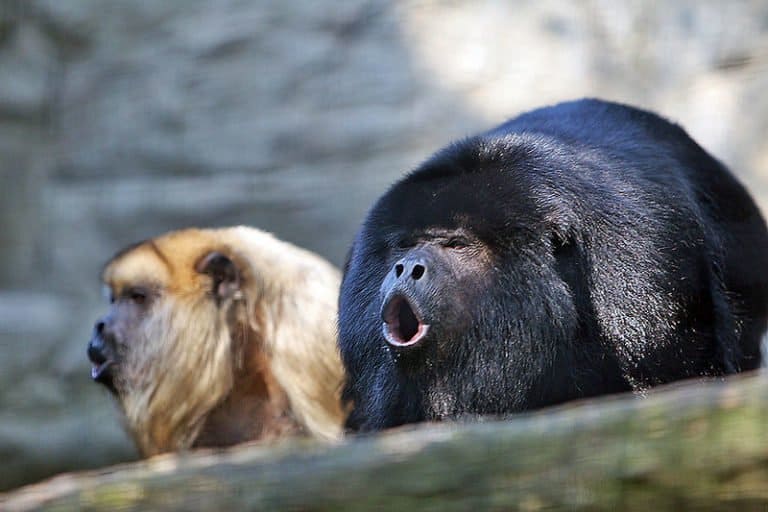
Sexual dimorphism is common but varies in Alouatta. Often males are larger and have a bigger hyoid bone for louder, longer calls. Some species show strong sexual dichromatism (males darker, females blond/tan); others have similar coat color.

  • Often larger-bodied and heavier on average (upper end of the genus mass range).
  • More enlarged hyoid (throat/neck resonance structure), supporting higher-amplitude howling; may present as a bulkier throat/mandibular region.
  • In sexually dichromatic species: males commonly the darker morph (often black or very dark brown).
  • Often smaller-bodied on average (lower end of adult mass range).
  • Hyoid typically less enlarged than in males (still capable of loud calls, but average resonance/volume differs).
  • In sexually dichromatic species: females commonly lighter morphs (cream/tan/golden-buff), though many species are not dichromatic.

Did You Know?

Size across Alouatta: ~38-72 cm head-body, ~45-90 cm tail; ~3-11 kg (varies by species, sex, and habitat).

Their low-frequency roars can typically be heard 1-3 km away, and sometimes farther under good conditions-useful for spacing groups apart.

Many species spend a large share of the day resting (often ~50-70%) because leaves are energy-poor compared with fruit.

They're among the most leaf-focused monkeys in the Americas, but the leaf vs. fruit balance shifts by species, season, and forest type.

The tail is fully prehensile with a tactile, "fingerprint-like" bare patch underneath-essential for slow, careful canopy travel.

Group living is common, but social structure varies widely: some species often have multiple adult males, others more often single-male groups, and group sizes can range from just a few individuals to a few dozen.

Conservation status differs by species and region: some populations are stable, while others are pressured by habitat loss/fragmentation, hunting, pet trade, and outbreaks of yellow fever.

Unique Adaptations

  • Enlarged hyoid bone (throat "resonating chamber") that amplifies calls-an anatomical specialization unusually developed across the genus.
  • Prehensile tail with a sensitive, hairless gripping pad that functions like an extra hand for stability and reach while feeding.
  • Digestive/behavioral toolkit for folivory: robust jaws/teeth for tough plant material plus time budgeting (more resting) to cope with lower-energy diets.
  • Low-frequency vocal communication suited to dense forests: sound travels well through vegetation, aiding long-distance signaling.
  • Strong, hook-like hands and feet adapted for sustained canopy climbing and feeding on terminal branches.

Interesting Behaviors

  • Dawn and dusk "choruses": bouts of roaring that advertise occupancy, reduce direct conflicts, and help coordinate spacing among neighboring groups-timing and intensity vary among species and sites.
  • Energy-saving lifestyle: slow, deliberate climbing and long rest periods are common, especially where diets are leaf-heavy; more fruit can mean more travel and feeding time.
  • Flexible diets: most eat young leaves, mature leaves, fruit, and flowers in varying proportions; some populations lean more frugivorous when fruit is abundant.
  • Group dynamics: grooming and proximity maintain bonds, but aggression levels and mating competition differ among species and with the number of adult males present.
  • Arboreal risk management: careful use of multiple supports and tail anchoring is typical; leaping is generally less common than in many other monkeys.
  • Home-range use: often relatively small compared with more fruit-dependent primates, but ranges expand or shift with forest productivity, fragmentation, and seasonality.
  • Predator awareness: alarm responses may be subtle (freezing, moving higher, clustering) and can differ by habitat and predator community.

Cultural Significance

Howler monkeys (Alouatta) are loud tropical animals whose dawn roars mark time and signal healthy forest. In Mesoamerican art they link to creativity and canopy life. Some local names mean howler or roar, and ecotourism often uses them as flagships for forest conservation.

Myths & Legends

In the Maya creation story, two half-brothers associated with music and the arts are transformed into monkeys; in wider Mesoamerican tradition, monkeys (including howlers) are enduring figures tied to artistry and performance.

Maya day-name tradition: monkeys appear as significant calendrical figures associated with creativity and skilled crafts (often represented in art as expressive, human-like forest beings).

In some rural Brazilian folklore, the deep roaring is traditionally treated as a powerful forest omen or signal-often linked in popular belief to coming weather changes or the presence of remote woodland.

Indigenous Amazonian storytelling traditions in multiple regions describe the howler's thunderous voice as a defining gift or consequence bestowed in primordial times-explaining why this monkey "speaks" for the forest at dawn.

Conservation Status

NE Not Evaluated (genus-level; IUCN assessments are primarily at the species level-Alouatta species span multiple threat categories from Least Concern to Critically Endangered)

Has not yet been evaluated against the criteria.

Population Decreasing

Protected Under

  • CITES Appendix II (Alouatta spp.)
  • National/provincial wildlife protection laws in multiple range countries (protections and enforcement vary widely)
  • Many populations occur within protected areas and Indigenous/community conserved lands across Mesoamerica and South America, though coverage and effectiveness are uneven

You might be looking for:

Mantled howler monkey

24%

Alouatta palliata

Widespread Central American howler; black body with a pale/golden mantle on the sides in many populations.

Black howler monkey

20%

Alouatta caraya

South American species; strong sexual dimorphism—adult males typically black, females brownish/olive.

Red howler monkey

18%

Alouatta seniculus

Northern South America; typically reddish coat; one of the best-known Amazonian howlers.

Guatemalan black howler (Yucatán black howler)

14%

Alouatta pigra

Mexico–Guatemala–Belize region; generally dark/black, robust build; often referenced in Mesoamerican contexts.

Brown howler monkey

10%

Alouatta guariba

Atlantic Forest howler from Brazil/Argentina; threatened in parts of its range.

Coiba Island howler monkey

7%

Alouatta coibensis

Panamanian island/nearby mainland species; sometimes discussed in island biogeography/conservation contexts.

Life Cycle

Birth 1 infant
Lifespan 15 years

Lifespan

In the Wild
10–25 years
In Captivity
15–33 years

Reproduction

Mating System Polygynandry
Social Structure Aggregation Group
Breeding Pattern Serial
Fertilization Internal Fertilization
Birth Type Internal_fertilization

Howler monkeys (Alouatta) live in groups with several adult females and one to several males. Mating is usually polygynandrous (sometimes polygynous or pair-like). Males compete; females may mate with many males. Infanticide can occur. Care is mainly maternal.

Behavior & Ecology

Social Troop Group: 12
Activity Diurnal, Cathemeral
Diet Folivore Young, protein-rich leaves (with many populations shifting strongly to ripe fruit when seasonally abundant)

Temperament

Generally calm and relatively sedentary compared with many other primates, with long resting bouts
Often tolerant of close group-mates, with social tensions expressed more through displays than frequent fighting
Can be strongly territorial or range-defensive via vocal displays; intensity varies by population density and habitat
Risk-averse and cryptic when threatened (freezing, moving higher, or retreating), but may escalate to loud alarm calling
Male competition and aggression increase during takeovers and at group boundaries; degree varies among species

Communication

long-distance howls/roars (the genus hallmark) used for spacing, intergroup competition, and mate/ownership advertisement; timing and bout structure vary among species and habitats
short barks, grunts, and contact calls during group coordination and close-range interactions
alarm calls and agitation calls in response to predators, humans, or intergroup encounters
infant distress calls that prompt maternal/kin responses
visual displays (postures, piloerection, yawns/open-mouth displays, body orientation) during tension and boundary encounters
branch shaking and rapid, noisy locomotion as threat displays; frequency varies with disturbance and social context
olfactory cues (urine/fecal marking and scent deposition) contributing to social signaling and possibly ranging/ownership cues, with variable prominence across species
tactile communication such as social grooming and mother-infant contact, generally less intensive than in some other primates but present across the genus

Habitat

Biomes:
Tropical Rainforest Tropical Dry Forest Savanna Wetland Temperate Forest
Terrain:
Mountainous Hilly Plains Valley Coastal Island Riverine +1
Elevation: Up to 10498 ft 8 in

Ecological Role

Arboreal primary consumer (leaf browser) and secondary frugivore; important seed disperser for some plant species despite heavy leaf use

Regulation of forest understory/canopy plant growth through selective folivory Seed dispersal (variable across species and sites; often for small-to-medium seeds swallowed with fruit) Seed predation in some contexts (when seeds are chewed) Nutrient cycling via deposition of dung that fertilizes forest soils and supports decomposer communities

Diet Details

Other Foods:
Young leaves Mature leaves Fruits Flowers and flower buds Leaf buds and petioles Seeds Bark and stems Epiphyte-associated plant material +2

Human Interaction

Domestication Status

Wild

Howler monkeys (genus Alouatta) are not domesticated. People have hunted them for food, captured them for illegal pets, and changed their homes by farming, logging, and roads. More recently humans interact through ecotourism, research, and conservation, including rehabilitation and moving individuals (translocation) in some regions.

Danger Level

Moderate
  • Bites and scratches if handled, cornered, or kept in captivity (risk increases with stress and sexual maturity)
  • Zoonotic disease exposure from close contact, feces/urine, or bites (general primate-to-human transmission risks; also human-to-primate disease risk is significant)
  • Aggression incidents in the pet context (unpredictable behavior, territoriality, and strong jaw/teeth for body size)
  • Falling hazards during conflict/flight in disturbed habitats (animals may drop branches or fall when chased/harassed)
  • Indirect conflict: crop-raiding complaints in some fragmented landscapes (varies by species/site and local food availability)

As a Pet

Not Suitable as Pet

Legality: Howler monkeys (Alouatta): Generally illegal or very limited to keep as pets across most countries. CITES often restricts trade. U.S./EU often ban or need rare permits. Sourcing is often illegal; confiscations common.

Care Level: Expert Only

Purchase Cost: Up to $20,000
Lifetime Cost: $50,000 - $250,000

Economic Value

Uses:
Ecotourism/wildlife viewing Ecosystem services (seed dispersal and forest dynamics) Scientific research and education Illegal wildlife trade (pet market) Subsistence hunting/bushmeat (localized)
Products:
  • tourism revenue from guided forest and primate-viewing activities
  • research value (behavior, vocal communication, ecology, disease surveillance)
  • cultural value (local knowledge/folklore around their calls)
  • illicit sales of live animals (pets) and occasional meat/hides in some areas

Relationships

Related Species 3

Ecological Equivalents 4

Animals that fill a similar ecological role in their ecosystem

Colobus monkey Colobus spp. Old World monkeys that, like many Alouatta species, rely heavily on leaves and use a large, fermentative gut to process fibrous diets in forest canopies.
Langurs Trachypithecus spp. / Semnopithecus spp. Ecological analogs in Africa and Asia: arboreal, diurnal, often group-living primates with substantial folivory and a strong reliance on canopy food patches.
Proboscis monkey
Proboscis monkey Nasalis larvatus Canopy-dwelling, riverine/forest-edge primate with notable folivory and specialized gut adaptations; shares a feeding strategy of consuming leaves and fruit when available, though it occurs in Southeast Asia.
Sloths Bradypus spp. and Choloepus spp. Not primates, but they share a slow, energy-conserving, arboreal lifestyle tied to leaf-heavy diets in Neotropical forests. They occupy a broadly similar canopy folivore niche.

Types of Howler Monkey

12

Explore 12 recognized types of howler monkey

Mantled howler monkey Alouatta palliata
Guatemalan black howler monkey Alouatta pigra
Black-and-gold howler monkey Alouatta caraya
Brown howler monkey Alouatta guariba
Red-handed howler monkey Alouatta belzebul
Venezuelan red howler monkey Alouatta seniculus
Guyanan red howler monkey Alouatta macconnelli
Bolivian red howler monkey Alouatta sara
Amazon black howler monkey Alouatta nigerrima
Spix's red-handed howler monkey Alouatta discolor
Coiba Island howler monkey Alouatta coibensis
Ululating (northern brown) howler monkey Alouatta ululata

The largest New World monkey

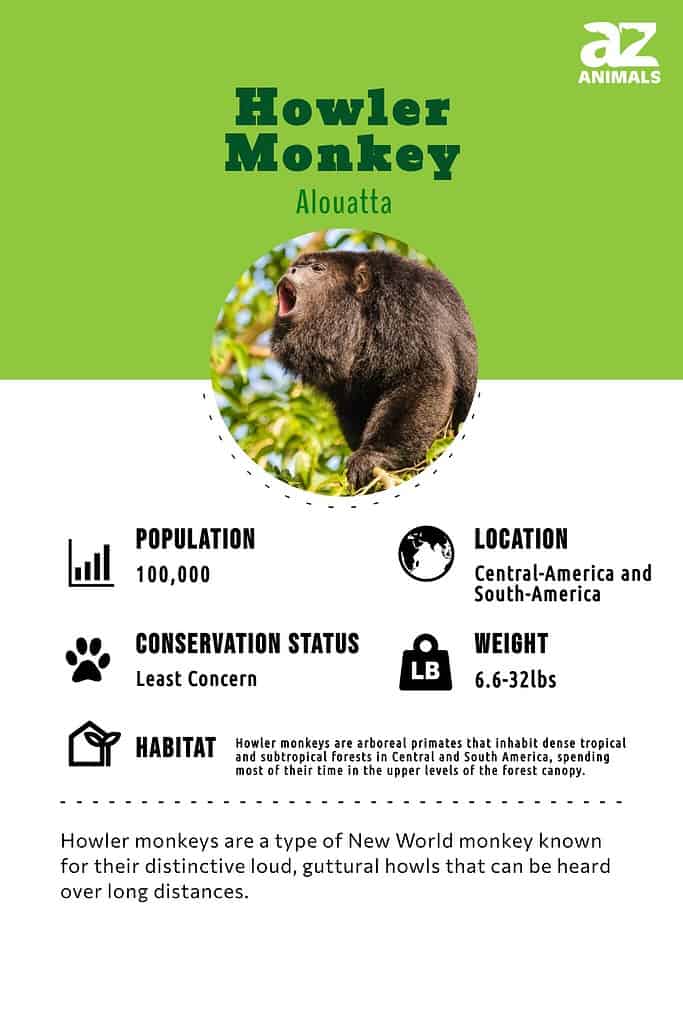
The howler monkey is an American monkey known for its roaring cry. This howl is heard for up to three miles. Living in Central and South America, these monkeys reach lengths of 16 to 28 inches. Their tails are another 20 or 30 inches. The species as a whole is not endangered at this time. But they live under constant threat of lost habitat and human poaching.

3 Incredible Howler Monkey Facts
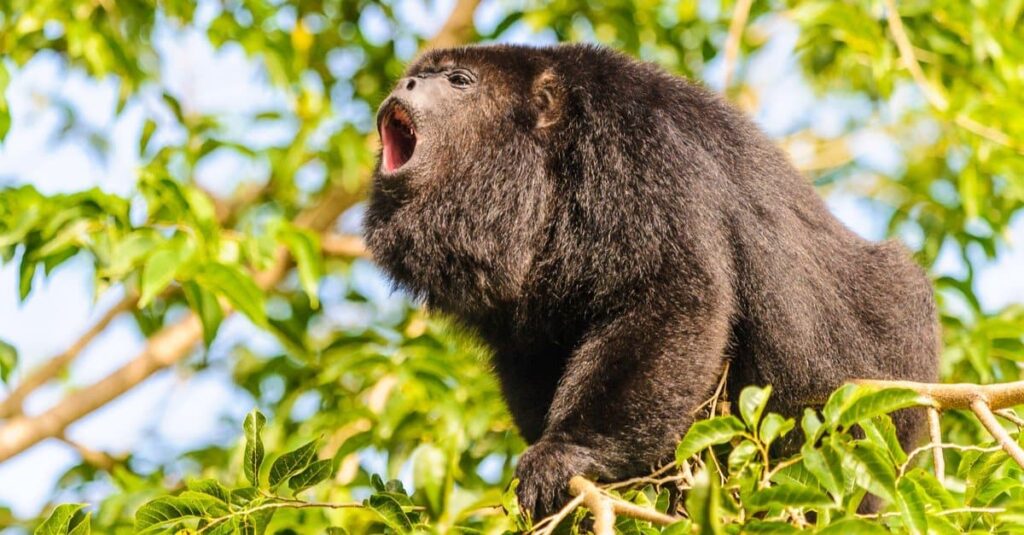
Loudest Animals: Howler Monkey

Howler Monkeys are the loudest animal in the New World and their sound can travel for up to three miles of thick forest.

  • Howler monkeys have a three-color vision, just like people!
  • Howler monkey tails are up to five times longer than their bodies!
  • A howler monkey’s bark sounds frightening, but they rarely fight.

Scientific Name
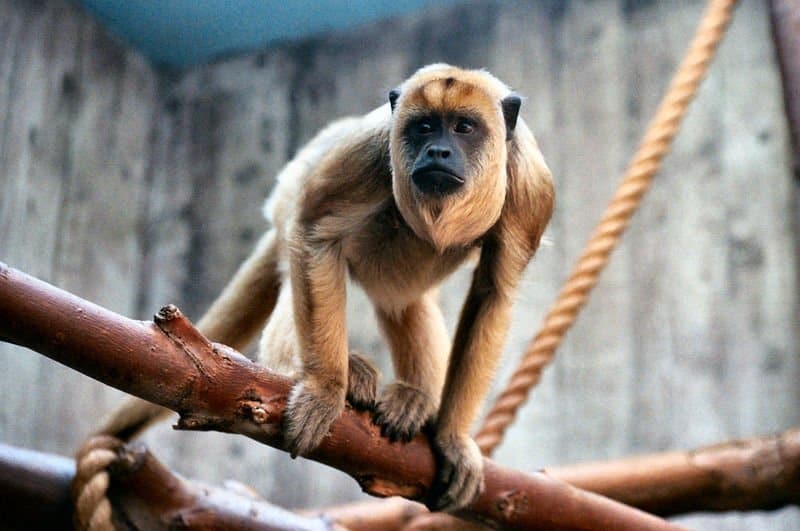
The howler monkey’s scientific name is Alouatta palliata.

The howler monkey’s scientific name is Alouatta palliata. This is a New Latin and French masculine noun. It means, “Tropical American howling monkey with a tail used for swinging through trees and eating fruit.”

There are 15 species of howler monkeys. Their species is part of the Atelidae family. Other Atelidae cousins are spider, woolly, and woolly spider monkeys. All of the monkeys in this family live in South and Central America.

Subspecies of howler monkeys include the Columbian red howler, the Amazon black howler, the Maranhao red-handed howler monkey of Brazil, and the Yucatan black howler monkey of Guatemala, Belize, and southern Mexico.

Evolution and Origins
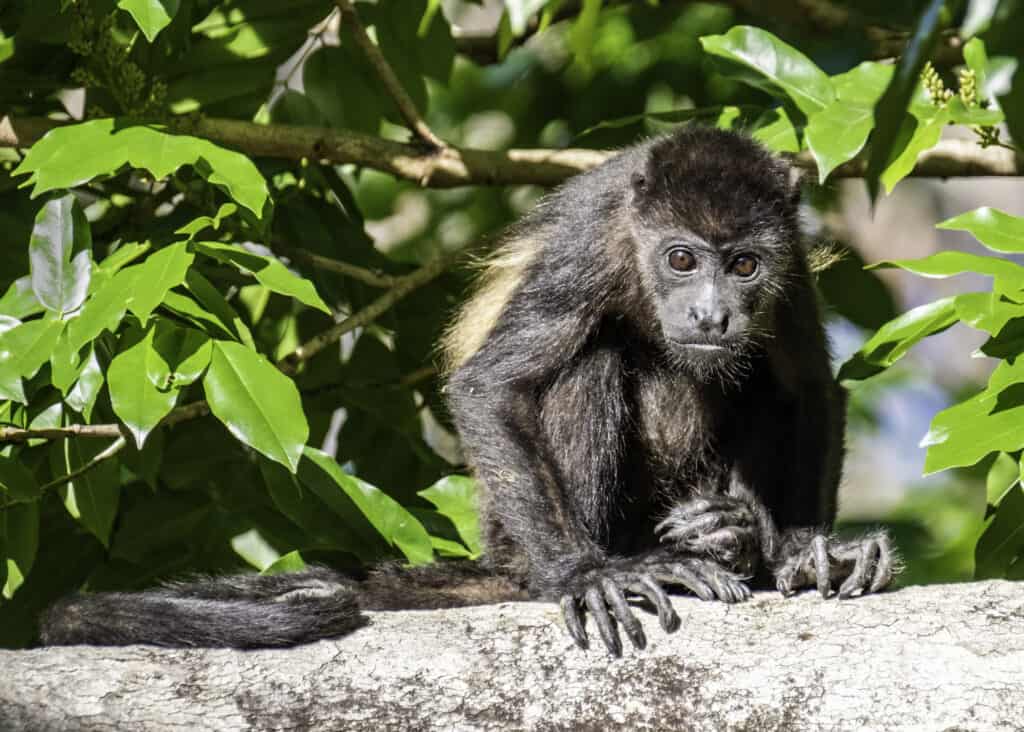
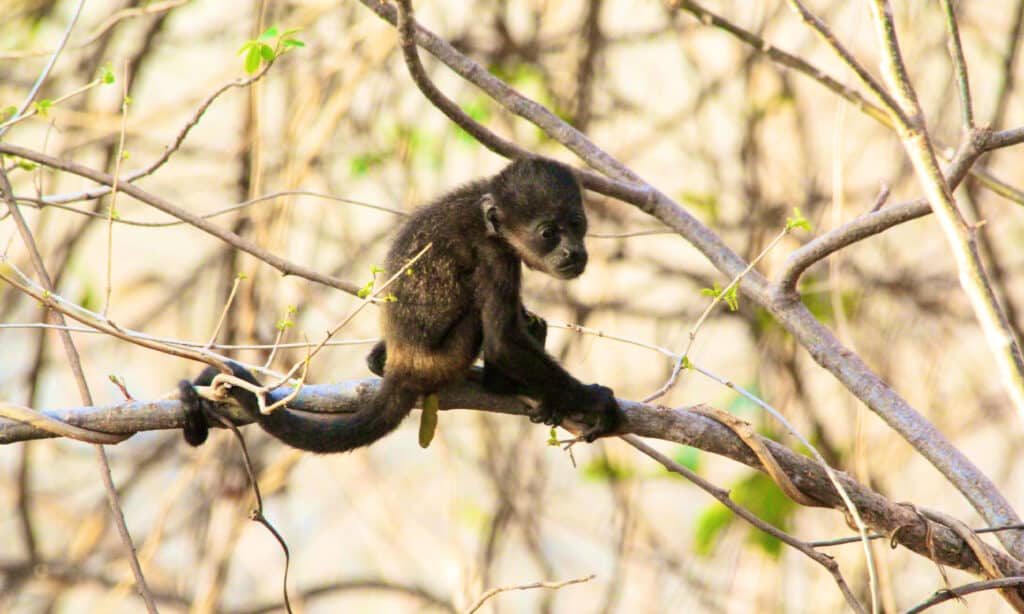
A young howler monkey in Guanacaste, Costa Rica, sits crouching pensively on a large branch with his long fingers and toes gripping the tree.

Mantled and black howler monkeys, the focus of the study, separated around 3 million years ago and lived apart until recently, possibly within the last 10,000 years, when they reconnected in a hybrid zone in southeast Mexico with a diameter of about 12 miles.

Southern Brazil, Paraguay, eastern Bolivia, and northern Argentina are all home to black howler monkeys. They reside in broadleaf and primarily arid deciduous woods. One of the loudest noises made by a land mammal is the low, guttural sound made by howler monkeys.

During the Oligocene Period, prosimians gave rise to monkeys. African catarrhines gave rise to apes during the Miocene epoch.

Different Types

Here are different types of howler monkeys:

  • Colombian red howler
  • Black howler
  • Yucatán black howler
  • Mantled howler monkey
  • Brown howler
  • Red-handed howler
  • Maranhão red-handed howler
  • Bolivian red howler
  • Guyanan red howler
  • Ursine howler
  • Coiba Island howler
  • Amazon black howler
  • Spix’s red-handed howler
  • Purus red howler
  • Juruá red howler

Appearance & Behavior
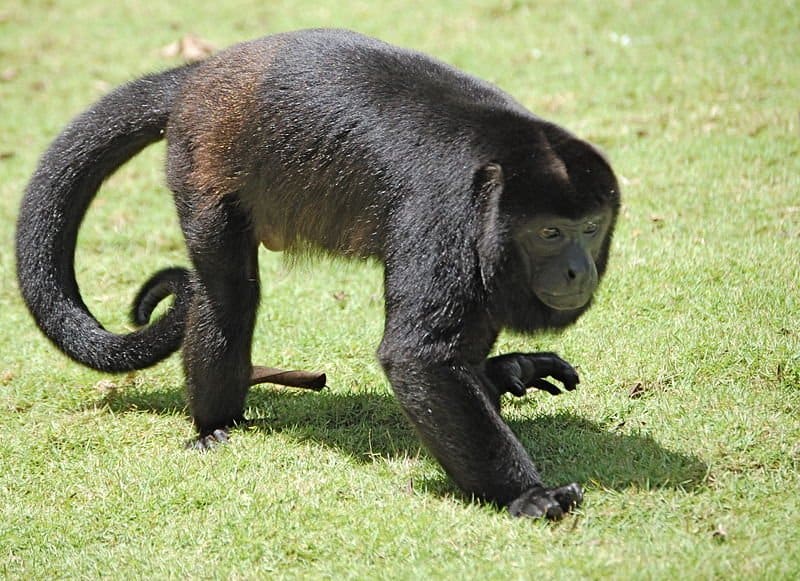
Howler Monkey
The howler monkey is the largest monkey in the New World. Howlers have large, side-opening nostrils. In contrast to other New World monkeys, they lack rumps pads.

Howler monkeys are bigger than all other monkeys of the New World. Howlers have wide nostrils that open on the sides. They do not have pads on their rumps, as other New World monkeys do.

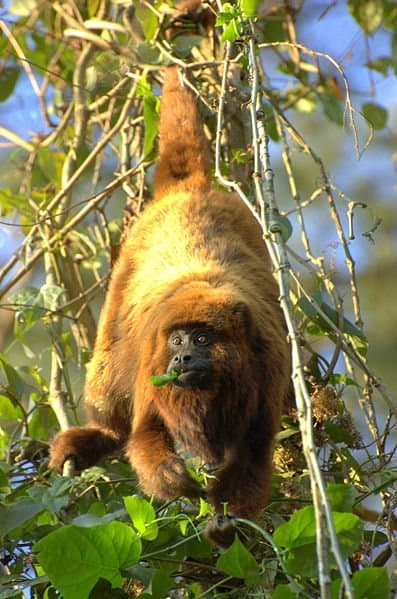
One of their most important features is their tail. They use this tail like a fifth arm. Their tail grips branches, help them swing through trees, and holds food. Howler monkeys also have long, thick hair with beards. The hair on their scalp and face is brown, black, or red. Red is their most common color, as part of the red howler species.

Howler monkeys spend most of their lives in trees. There, they swing from branch to branch and eat their preferred diet of leaves.

Howler monkey groups usually include up to 15 adult males and females. Scientists call their group a “troupe.” One alpha male takes control of the troupe. When young males and females reach maturity, the group forces them out on their own. The lone monkey then wanders the jungle or even among humans and spider monkeys, until they find another troupe willing to take them in.

Howler monkey howls are very scary, especially for people or animals hearing them for the first time. But these monkeys are actually harmless. They are peaceful leaf-eaters howling just to talk to each other. To keep predators away, such as humans getting too close to their troupe, they pee from overhead. Unless you want to get wet, you should never stand under howler monkeys in the trees!

As said before, howler monkey troupes have a dominant male. But they also have a dominant female. The male is the boss of the whole group. The female helps him keep everyone in order. Rarely do members of the troupe fight among themselves, even though most have grumpy dispositions. They stick close together and watch out for each other. Sometimes a short spat can cause injuries, such as when a male and female fight with each other. Troupes usually have one male for every four females.

Because howler monkeys spend 80 percent of their lives resting, they are said to be the laziest monkeys in the world. These mammals do not act aggressively around people, but they do not live well in captivity. Most captive howler monkeys stop eating because they miss their group. This makes it difficult to keep them alive. That is, except for the black howler monkey. Black howlers are a gentle subspecies that make good pets.

Howl
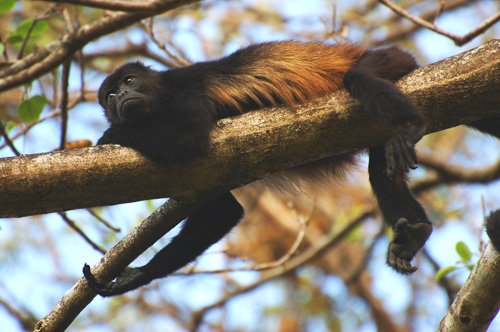
Nearly all other land creatures are not as noisy as howler monkeys, which produce a deep, low sound.

Howler monkeys make a deep, low sound louder than almost all other land animals. The sound travels three miles, with the male being louder than the female. They make their howling sound by drawing air into their throat through a cavity in their oversized hyoid bone.

Howling is a critical part of their social behavior. Troupe males call every morning and at nightfall. They also call during the day to “talk” to other members of the troupe. Calls can tell other troupe members to space out more in the trees. Other calls tell the group to come closer together. Still, others announce a nearby intruder or warn another group member to stay away from their mate.

Habitat

Howlers live mostly in tropical Mexico, the rest of Central America, and South America. They dwell in cloud forests, rainforests, and tropical dry forests.

Howler monkeys play a big and important role in the rainforest ecosystem. When more howlers live in a forest, more birds do, too. This happens because trees produce more leaves and fruit when howler monkeys feed on them. With more leaves and fruit for each tree, more insects follow. The bounty of insects can feed more birds.

Diet
monkey was caught pooping

Only howler monkeys have been identified as folivores in the New World.

Howler monkeys are the only New World animals known as folivores. This means they eat mostly leaves. They do not eat just any leaf, however. They pick only the best leaves from each tree. The best leaves are those with the most protein and other nutrients.

Howler monkeys love fruit. But spider monkeys eat these much faster. The spider monkeys steal most of the fruit away before howler monkeys can get to them. Besides fruit from time to time, Howler monkeys also like stealing eggs from chicken coops, when they live close to humans.

Sometimes howlers eat plants with toxins in them. This can make their whole troupe sick. Often, it kills away the whole group. 

Predators & Threats

The main threat to howler monkeys is humans. People destroy the forests where the monkeys live. They knock down trees to create farms or sell the wood from the howler monkeys’ habitat. Many people in Central and South America also love to eat the howlers’ meat. The howler monkeys do not put up a big fight around humans, so they make easy prey. People also steal many howlers away from their troupes for zoos or others who want them as household pets. Many howlers in captivity die.

One of the awful threats to howler monkeys is electric wiring. Across much of Costa Rica, howlers die on live wires along roads. The monkeys try to use the wires to reach other trees. They also die on transformers that do not have covers.

Reproduction, Babies, and Lifespan

Howler Monkey Reproduction

Female howlers have their first babies before age four. Pregnancy lasts six months. Most births are for one baby at a time. Like humans, howlers have babies at any time of year.

Babies

Since mothers only have one baby at a time, they take great care of their young. These babies grow very fast. Mothers take care of them for the first year, giving them all of the food, love, and learning they need to survive on their own.

At about one year old, young howlers must leave their troupe. They get kicked out of the group to find a new one. During this period, the young howlers explore the forest. They look for another troupe to take them in, looking sad and lonely the whole time. Many try to join humans as their new troupe. Others try to bond with spider monkeys. But soon, all young howler monkeys must find their own kind to accept them.

Lifespan

In their small groups and living high up in the trees, most howler monkeys live happy lives for 10 to 25 years. 

Population

Scientists consider howler monkeys not threatened, as a species. But humans keep destroying their habitat, so this can quickly change. Overall, about 100,000 howlers of all subspecies remain in the wild.

The Colombian red howler has the largest population among all 15 types of howlers. Maranhao red-handed howler monkeys of Brazil are very endangered, as they have been since 1996. They have been hunted and suffered the loss of habitat which takes a toll on their population.

Ecologists counted only about 2,500 Maranhao red-handed howlers in 2008. Since 2003, ecologists have listed Yucatan black howlers of Guatemala, Mexico, and Belize as endangered, too.

View all 287 animals that start with H

Sources

  1. David Burnie, Dorling Kindersley (2011) Animal, The Definitive Visual Guide To The World's Wildlife / Accessed December 13, 2008
  2. Tom Jackson, Lorenz Books (2007) The World Encyclopedia Of Animals / Accessed December 13, 2008
  3. David Burnie, Kingfisher (2011) The Kingfisher Animal Encyclopedia / Accessed December 13, 2008
  4. Richard Mackay, University of California Press (2009) The Atlas Of Endangered Species / Accessed December 13, 2008
  5. David Burnie, Dorling Kindersley (2008) Illustrated Encyclopedia Of Animals / Accessed December 13, 2008
  6. Dorling Kindersley (2006) Dorling Kindersley Encyclopedia Of Animals / Accessed December 13, 2008
  7. David W. Macdonald, Oxford University Press (2010) The Encyclopedia Of Mammals / Accessed December 13, 2008
Rebecca Bales

About the Author

Rebecca Bales

Rebecca is an experienced Professional Freelancer with nearly a decade of expertise in writing SEO Content, Digital Illustrations, and Graphic Design. When not engrossed in her creative endeavors, Rebecca dedicates her time to cycling and filming her nature adventures. When not focused on her passion for creating and crafting optimized materials, she harbors a deep fascination and love for cats, jumping spiders, and pet rats.
Connect:

Thank you for reading! Have some feedback for us?


Howler Monkey FAQs (Frequently Asked Questions)

Howler Monkeys are Omnivores, meaning they eat both plants and other animals.