H
Species Profile

Humboldt Penguin

Spheniscus humboldti

Built for the Humboldt Current
William Warby / Creative Commons

Humboldt Penguin Distribution

Click a location to explore more animals from that region

Endemic Species

This map shows coastal regions where Humboldt Penguin are found.

Loading map...
Humboldt Penguin in Peru

At a Glance

Wild Species
Also Known As Peruvian penguin, Chilean penguin, Pingüino de Humboldt, Pingüino peruano
Diet Piscivore
Activity Diurnal+
Lifespan 15 years
Weight 5.9 lbs
Status Vulnerable
Did You Know?

Size: 56-70 cm long; 3.6-5.9 kg (Williams, 1995, *The Penguins*; species accounts in ornithological handbooks).

Scientific Classification

A medium-sized, coastal penguin of the eastern South Pacific, strongly associated with the cold, nutrient-rich Humboldt Current. It is a banded penguin (genus Spheniscus) with a black breast band and a pale facial stripe.

Kingdom
Animalia
Phylum
Chordata
Class
Aves
Order
Sphenisciformes
Family
Spheniscidae
Genus
Spheniscus
Species
Spheniscus humboldti

Distinguishing Features

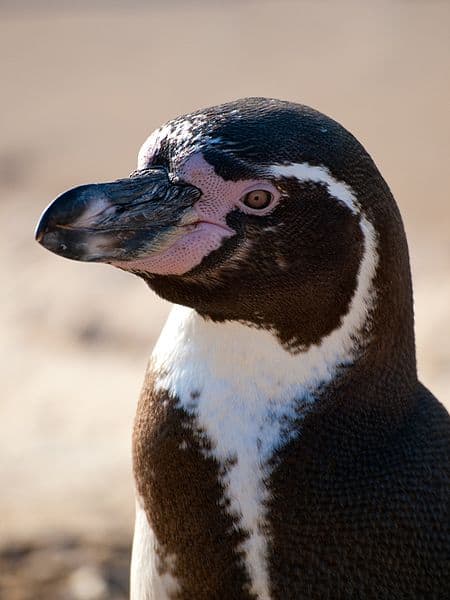
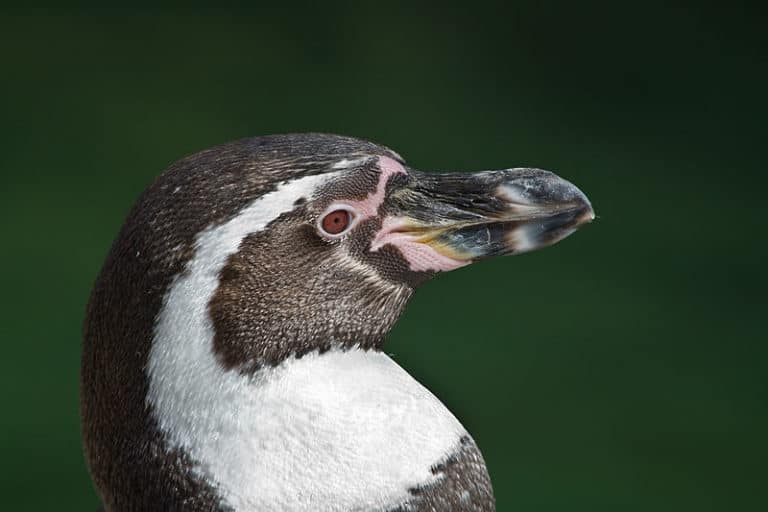
  • Black band across the upper chest with a dark stripe running down the side of the body
  • White face with a bold black border and a fleshy pink patch at the base of the bill/around the eye
  • Black upperparts, white underparts typical of penguins; overall ‘banded penguin’ pattern
  • Breeds in burrows/crevices more than some other penguin species; often linked to guano substrates

Physical Measurements

Males and females differ in size

Height
♂ 2 ft 2 in (1 ft 12 in – 2 ft 4 in)
Length
♂ 2 ft (1 ft 10 in – 2 ft 2 in)
Weight
♂ 11 lbs (9 lbs – 13 lbs)
♀ 9 lbs (7 lbs – 11 lbs)
Top Speed
6 mph
About 2.5 m/s (9 km/h)

Appearance

Primary Colors
Secondary Colors
Skin Type Thick, waterproof feathers cover most of the Humboldt Penguin's body. Pink bare skin patches are around the eyes and bill base. Feet have thick scaly skin. They do one complete molt after breeding.
Distinctive Features
  • Medium-sized coastal penguin from Peru and Chile (Spheniscus humboldti). Lives along the cold, nutrient-rich Humboldt Current and usually feeds in nearshore coastal waters, not on Antarctic pack ice.
  • Humboldt Penguin (Spheniscus humboldti) has one broad black band across the upper chest, unlike Magellanic Penguin (S. magellanicus), which usually shows two dark bands across the chest/abdomen.
  • Facial pattern: bold pale/white stripe sweeping from the eye region around the side of the head/ear-coverts toward the throat; dark head cap contrasts strongly with this stripe.
  • Bare skin: conspicuous pink patches around the eyes and at the base of the bill (thermoregulatory function noted broadly for Spheniscus penguins; Williams 1995).
  • Typical adult size: total length about 56-70 cm; mass commonly ~3.6-5.9 kg (range varies by sex, season, and locality; commonly reported in species accounts such as BirdLife International and Williams 1995).
  • Humboldt Penguins nest on dry coasts and islands, digging burrows in guano or sand or using rock crevices and caves to stay cool and safe near rich feeding grounds.
  • Key ecological reliance: schooling, upwelling-dependent prey (e.g., Peruvian anchovy and other small pelagic fish); strong sensitivity to warm-water El Niño events that reduce upwelling productivity and prey availability (IUCN Red List; long-term Humboldt system literature).
  • Humboldt Penguins (Spheniscus humboldti) face fisheries that take their food and cause bycatch, people disturbing colonies, and climate events like El Niño that harm body condition and breeding success.

Sexual Dimorphism

Humboldt Penguins (Spheniscus humboldti) have similar plumage for both sexes. Males are slightly larger and often have thicker, deeper bills. Size differences are small and usually checked by measurements or genetics, not by feather color.

♂
  • On average slightly heavier and marginally larger overall body size within reported adult mass/length ranges (commonly noted for the species in comparative penguin references such as Williams 1995).
  • Bill often appears thicker/longer in hand (a practical field/handling cue used in some monitoring programs, though overlap is substantial).
♀
  • On average slightly smaller/lighter; bill typically a bit slimmer than male on average, but visual separation is unreliable without measurements (overlap common).

Did You Know?

Size: 56-70 cm long; 3.6-5.9 kg (Williams, 1995, *The Penguins*; species accounts in ornithological handbooks).

A "banded penguin" (genus *Spheniscus*): it shares the bold chest band + facial stripe style with African, Magellanic, and Galápagos penguins-useful for species recognition in mixed seabird colonies.

Diving is usually shallow-to-moderate over the coastal shelf; maximum recorded dive depth ~54 m in field telemetry studies (Culik et al., 1994; *Spheniscus* diving ecology literature).

Often nests in burrows dug in guano/soil or in rock crevices-behavior that buffers heat, wind, and predators on exposed deserts and islands along Peru-Chile.

Like other penguins, it undergoes a catastrophic annual molt: it must stay on land and fast while replacing all feathers over ~2-3 weeks (general penguin molt physiology; documented in *Spheniscus* husbandry/field studies).

Climate shocks can crash breeding: strong El Niño events warm surface waters, weaken upwelling, and reduce prey like anchoveta-leading to breeding failures and adult mortality in parts of the range (widely reported in Humboldt Current seabird literature; IUCN threats narrative).

Conservation status: listed as Vulnerable on the IUCN Red List (IUCN Red List: *Spheniscus humboldti*), with key pressures from El Niño, fisheries interactions (e.g., gillnets), and human disturbance at colonies.

Unique Adaptations

  • Humboldt Current specialization: thrives where cold, nutrient-rich upwelling fuels dense prey schools close to shore-making it one of the penguins most tightly linked to an oceanographic feature (the Humboldt Current system).
  • Banded-and-striped head pattern: black breast band plus pale facial stripe is a hallmark of *Spheniscus* penguins, aiding visual identification of mates/conspecifics in colonies and at sea.
  • Burrow-nesting lifestyle: unlike many polar penguins that nest in open scrapes, Humboldt penguins commonly use burrows/crevices-an adaptation to heat, aridity, and terrestrial predators on Peruvian/Chilean coasts and islands.
  • Heat-dissipating bare skin: reduced feathering around the face (and vascularized areas near the bill/eyes) helps dump excess heat in warm, dry conditions-crucial for a penguin living far from polar climates.
  • Salt gland function: like other seabirds, they excrete excess salt via nasal salt glands, enabling a diet of marine prey without dehydration.
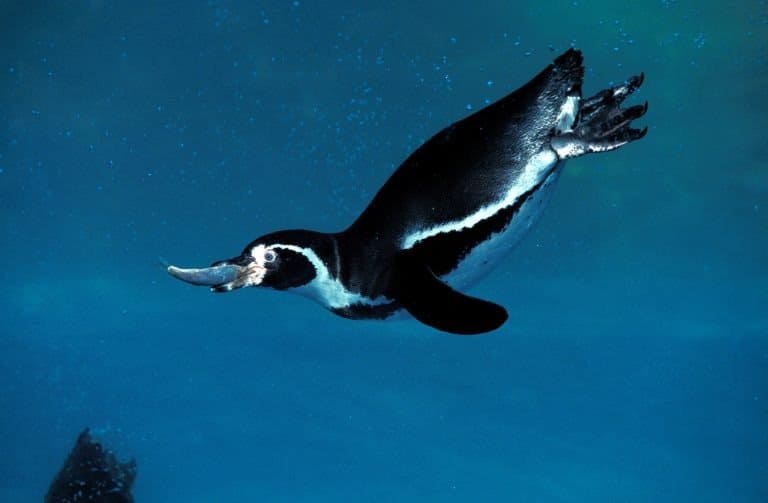
  • Streamlined pursuit diver: rigid flippers, dense feathering, and compact body shape reduce drag for underwater "flight," supporting repeated short dives in productive nearshore waters.

Interesting Behaviors

  • Burrow/crevice nesting: pairs excavate or reuse burrows and defend the entrance, often choosing shaded sites to avoid overheating and egg/chick heat stress in arid coastal habitats.
  • Biparental care: both sexes incubate and feed chicks; typical clutch size is 2 eggs, with incubation around ~40 days and fledging roughly ~10-12 weeks (species accounts in standard ornithological references).
  • Distinctive vocalizations: adults produce loud braying calls (common across *Spheniscus*) used for mate recognition and territory defense in dense colonies.
  • Flexible breeding timing: breeding can occur in much of the year, but peaks shift by colony and ocean conditions-tracking when upwelling concentrates prey close to shore.
  • Nearshore, schooling-fish hunting: foraging focuses on small pelagic fish (notably Peruvian anchoveta, *Engraulis ringens*, where available) and other small fish/squid, often in short trips from colonies when prey is abundant.
  • Thermoregulation displays: in hot conditions, birds stand with flippers held away from the body and pant, exposing bare facial skin to dump heat-important for a penguin living at low latitudes on sun-baked coasts.
  • Annual molt fast: adults haul out to molt, dramatically reducing time at sea; this creates a predictable seasonal pulse of penguins onshore at colonies.

Cultural Significance

The Humboldt penguin is an important species of the Peru–Chile Humboldt Current, linked to coastal protected sites, island ecotourism and fisheries. It is a well-known conservation symbol in coastal development debates and is named for Alexander von Humboldt.

Myths & Legends

The Humboldt Penguin (Spheniscus humboldti) got its name from Alexander von Humboldt and the cold Humboldt Current. Explorers and scientists linked that current to rich seabird life along coastal South America.

Along the Peruvian coast, guano islands with seabird colonies, including Humboldt penguins, were vital for centuries; stories say early Andean leaders strictly protected these 'guano bird' sanctuary islands.

In Chile and Peru, the Humboldt penguin is used as a symbol in conservation outreach and environmental education to help protect offshore breeding islands and the Humboldt Current upwelling ecosystem.

Conservation Status

VU Vulnerable

Facing a high risk of extinction in the wild.

Population Decreasing

Protected Under

  • CITES Appendix I (international trade generally prohibited except under strict conditions).
  • Peru: protected under national legislation; major colonies occur within the Guano Islands, Islets and Capes National Reserve System (RNSIIPG).
  • Chile: legally protected native wildlife; key breeding sites occur in protected areas including Humboldt Penguin National Reserve.
  • Convention on International Trade in Endangered Species of Wild Fauna and Flora (CITES) - Appendix I

Life Cycle

Birth 2 chicks
Lifespan 15 years

Lifespan

In the Wild
10–20 years
In Captivity
15–30 years

Reproduction

Mating System Monogamy
Social Structure Socially Monogamous
Breeding Pattern Long Term
Fertilization Internal Fertilization
Birth Type Internal_fertilization

Behavior & Ecology

Social Colony Group: 500
Activity Diurnal, Crepuscular
Diet Piscivore Peruvian anchoveta (Engraulis ringens)

Temperament

Highly social and colonial during breeding; tolerant at non-nest areas but aggressive at close range around nest entrances (pecking, chasing, bill jabs).
Strong pair-bonded behavior: frequent mutual displays and allopreening; coordinated parental roles.
Site-faithful and territorial on land at the nest (defends a small area immediately around burrow/crevice); territoriality intensity varies with nest-site scarcity and colony density.
Risk-sensitive and disturbance-responsive: heightened vigilance and flushing in colonies exposed to humans/predators; responses vary widely among colonies depending on protection history.
Foraging behavior is opportunistic within prey constraints: individuals often exploit the same coastal foraging zones, but trip timing and group cohesion vary with prey distribution and oceanographic conditions (Humboldt Current variability).

Communication

Ecstatic Advertisement) call: loud, braying display used in mate attraction, pair-bond maintenance, and individual identification within noisy colonies (described for Spheniscus; documented for Humboldt penguin captive and wild observations) (Williams 1995
Mutual display call Duetting-like exchanges) between mates at the nest, especially during reunions and nest relief shifts (Williams 1995
Contact calls between parents and chicks; chick begging calls increase with hunger and can guide feeding at nest entrances Culik 2001; Williams 1995
Alarm/threat calls given during aggressive interactions or predator/human disturbance Williams 1995
Visual displays: head-swinging, bowing, upright stance, flipper extension, and pointing/posturing at burrow entrances; used for territory defense and pair synchronization Williams 1995
Bill actions: bill clapping, pecking, and bill fencing during disputes; intensity varies with crowding and nest-site competition.
Tactile signaling: allopreening and mutual bill-touching between mates; brood contact (brooding posture) used to calm/thermoregulate chicks.
Spatial/locomotor cues: synchronized arrivals/departures and rafting cohesion offshore; individuals often follow conspecific movement when commuting between colony and foraging areas Social information use inferred in colonial seabirds, including penguins) (Williams 1995; Culik 2001

Habitat

Coastal Rocky Shore Beach Cliff/Rocky Outcrop Cave Open Ocean Seabed/Benthic Kelp Forest +2
Biomes:
Marine Desert Cold Mediterranean
Terrain:
Coastal Island Rocky Sandy
Elevation: Up to 656 ft 2 in

Ecological Role

Mid-trophic-level marine predator (forage-fish specialist) and nutrient vector linking marine productivity to terrestrial/coastal island ecosystems.

Top-down predation on small pelagic fish (helps structure nearshore forage-fish communities) Transfers marine-derived nutrients to land via guano deposition, fertilizing coastal/island plant and microbial communities Serves as an indicator of Humboldt Current ecosystem condition because breeding success and survival track forage-fish availability and oceanographic variability (e.g., ENSO impacts)

Diet Details

Main Prey:
Peruvian anchoveta Pacific sardine Silversides Chilean hake Squid and other cephalopods Small crustaceans

Human Interaction

Domestication Status

Wild

Humboldt Penguin (Spheniscus humboldti) is not domesticated and has no history of breeding for people. People once took eggs, hunted them, and mined guano from nests. In the 20th–21st centuries efforts shifted to protection: managed colonies, rescue and rehab after oiling, artificial nests, and care in zoos and aquaria.

Danger Level

Low
  • Bites and puncture wounds from the bill during handling (not venomous; injury risk is localized but can be painful)
  • Scratches/contusions from flippers during restraint
  • Zoonotic pathogen exposure in captive/rehab contexts (e.g., Salmonella or other enteric bacteria) primarily via fecal contamination-risk reduced with standard hygiene and PPE
  • Allergic reactions/asthma exacerbation in enclosed facilities due to dander/aerosols in poorly ventilated penguin enclosures

As a Pet

Not Suitable as Pet

Legality: Not a legal or suitable pet. International trade is tightly restricted under CITES Appendix I, allowed only for approved conservation, research, or education. Domestic possession is usually limited to licensed zoos/aquaria; private ownership is generally illegal without special permits.

Care Level: Expert Only

Purchase Cost: Up to $2,000
Lifetime Cost: $75,000 - $300,000

Economic Value

Uses:
Ecotourism and local tourism (wild colonies and coastal wildlife viewing) Zoo/aquarium exhibit value (education, conservation messaging, visitor revenue) Conservation and research value (indicator of forage-fish availability and ocean conditions) Ecosystem value (part of coastal food webs linked to Humboldt Current upwelling)
Products:
  • Tourism services (guided viewing, park fees) tied to colony presence
  • Conservation programming and fundraising anchored by charismatic-species display
  • Scientific data products (monitoring of breeding success, diet, and oceanographic change)
  • Historically: guano industry interactions (disturbance/colony displacement rather than a penguin-derived product)

Relationships

Ecological Equivalents 5

Animals that fill a similar ecological role in their ecosystem

Peruvian Booby Sula variegata In the Humboldt Current, Peruvian boobies and Humboldt penguins feed nearshore and offshore on schooling anchoveta and sardines in cold, nutrient-rich waters. Both are medium coastal diving birds (~56–70 cm, 3.6–5.9 kg) that mostly dive shallowly to around 50+ m.
Guanay Cormorant Leucocarbo bougainvillii Possible ecological analogue and competitor in the Humboldt upwelling. A colonial coastal seabird that depends heavily on anchoveta. Both track upwelling fronts and fish schools and are very sensitive to El Niño-related prey losses.
Peruvian Pelican Pelecanus thagus Occurs in productive coastal upwelling zones and feeds on small schooling fish, especially anchoveta. Pelicans feed at the surface while penguins dive. Both are nearshore predators whose breeding and condition track anchoveta abundance and Humboldt Current warm events.
Inca Tern Larosterna inca Nearshore Humboldt Current specialist that often forages on anchoveta schools near penguin colonies. Its similar dependence on cold upwelling and on schooling forage fish makes it a good ecological relative and indicator of the same food-web base.
South American Sea Lion Otaria flavescens Shares coastal upwelling habitat and feeds on the same small pelagic fish and squid; overlaps near colonies and shore. Acts as an ecological counterpart and, locally, is a known predator and scavenger of Humboldt penguins.

“Humboldt Penguins are piscivores!”

Capable of swimming up to 30 miles an hour, the Humboldt penguin is a very interesting bird. These penguins have a distinct black-and-white appearance with a black breast band. They live along the west coast of Chile and Peru near the Humboldt Current, for which they were named. Humboldt penguins are piscivores, a type of carnivore that eats fish.
Incredible Humboldt Penguin Facts!

  • Humboldt penguin chicks have brown feathers instead of the black feathers adults have.
  • Unlike other birds that only use their feet as paddles, these penguins also use their feet to help them steer.
  • Humboldt penguins have developed different calls to communicate. For example, they have a yell warning call if they feel threatened and a bray call to attract a mate.
  • These penguins nest in guano, which is layers of bird poop.
  • The oldest Humboldt penguin lived to be 36 years old.
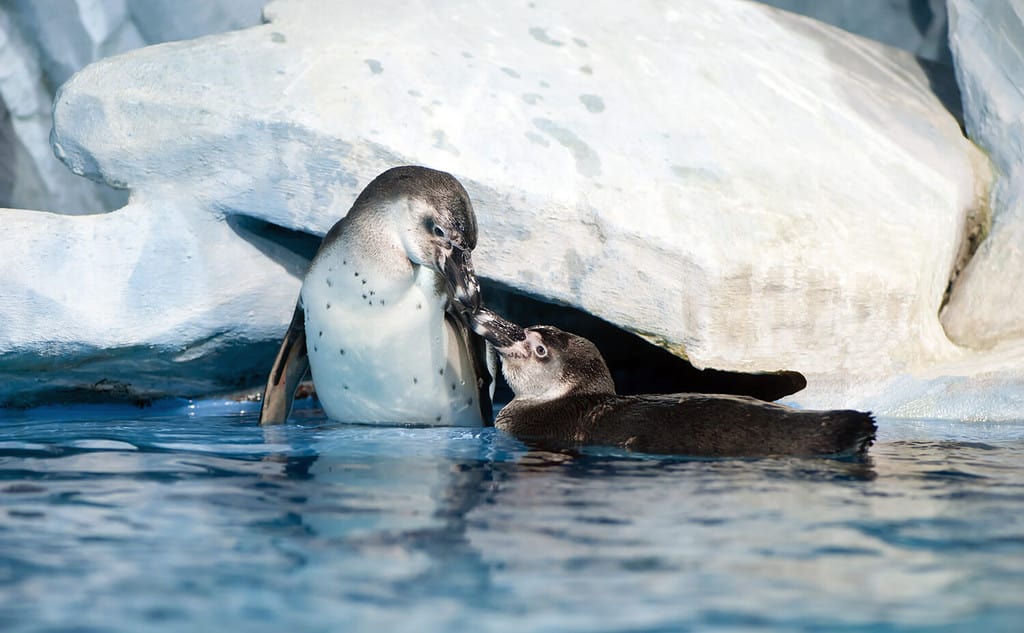
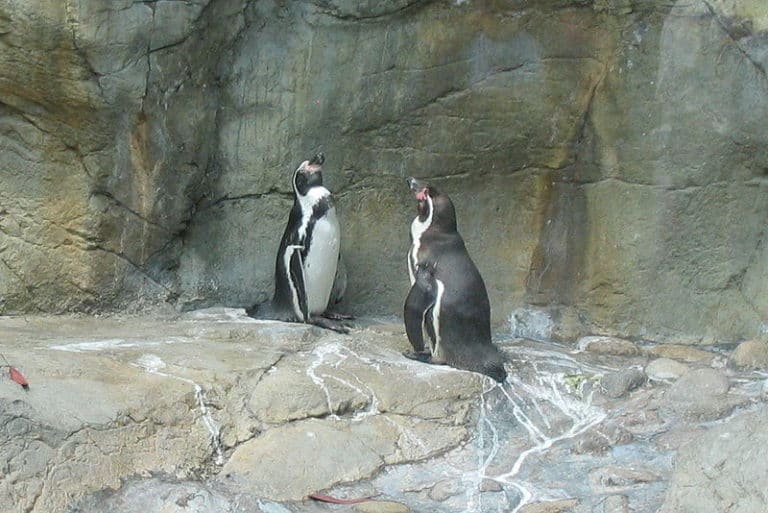
pair of playful penguins in Moscow oceanarium (Humboldt penguin, Peruvian penguin or Patranca)

Humboldt penguins are popular in zoos all over the world, including The Moskavrium, or Moscow Aquarium.

Scientific name

The scientific name for the bird is Spheniscus humboldti. Spheniscus is derived from the Greek word, sphēniskos, meaning small wedge. This word refers to the shape of a penguin’s body. Humboldti refers to Alexander Van Humboldt who was a German naturalist and explorer. The sea current where the penguins live on South America’s west coast was named after Alexander Von Humboldt.
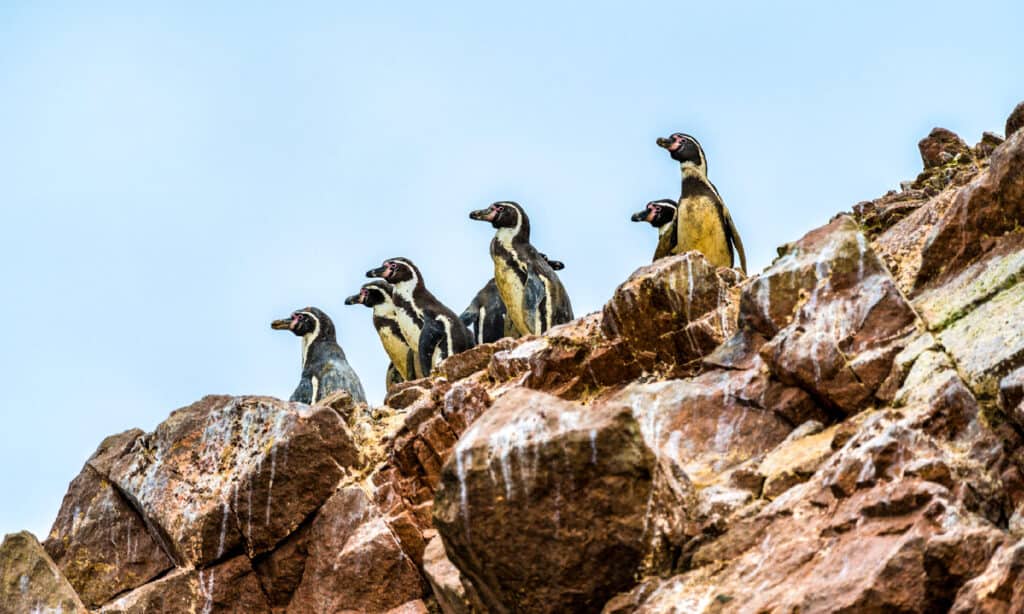
penguins

Humboldt penguins live on the west coast of South America.

Evolution

Fossil records indicate that Humboldt penguins’ common ancestors lived as long as 40 million years ago and were around five feet tall. They are believed to have originated in Antarctica, which was covered in forests at that time and connected to what would become New Zealand, Australia, South America, and surrounding islands. These ancient ancestors of penguins had diverged from the ancestors of petrels and albatrosses around 71 million years ago.

The arrival of the ice age 35 million years ago brought brutal changes to the ancient ancestors of the penguin. The continents of Australia and South America drifted away from Antarctica while ocean currents encircled it. This cooling climate likely killed the older penguins – leaving them to compete with whales for the same prey.

While most of the ancient penguins became extinct, others, like the Humboldt penguin, swam to warmer waters to found new lineages. Species like the emperor penguin stayed in Antarctica and evolved adaptations suited to live in the cold environment.

Appearance and Behavior
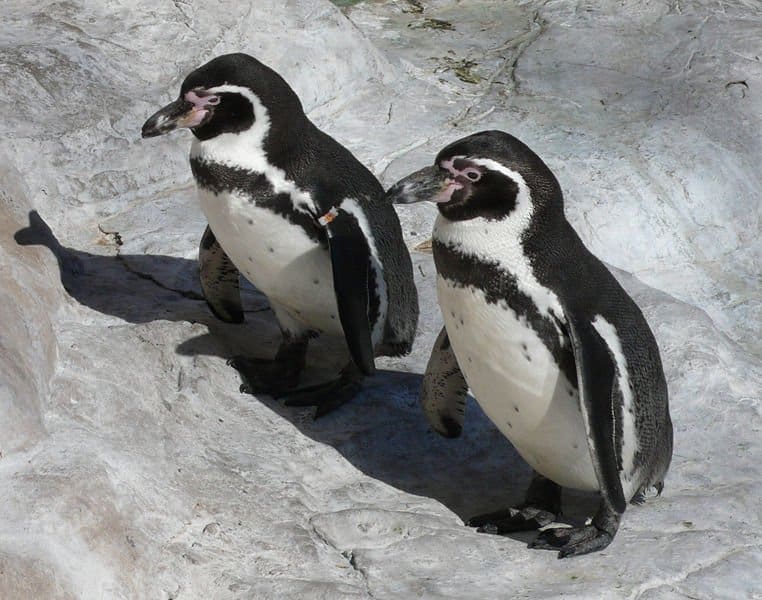
2 Humboldt Penguin2 on rock

Humbolt Penguins, like all penguins, have a thick layer of fat to keep them warm.

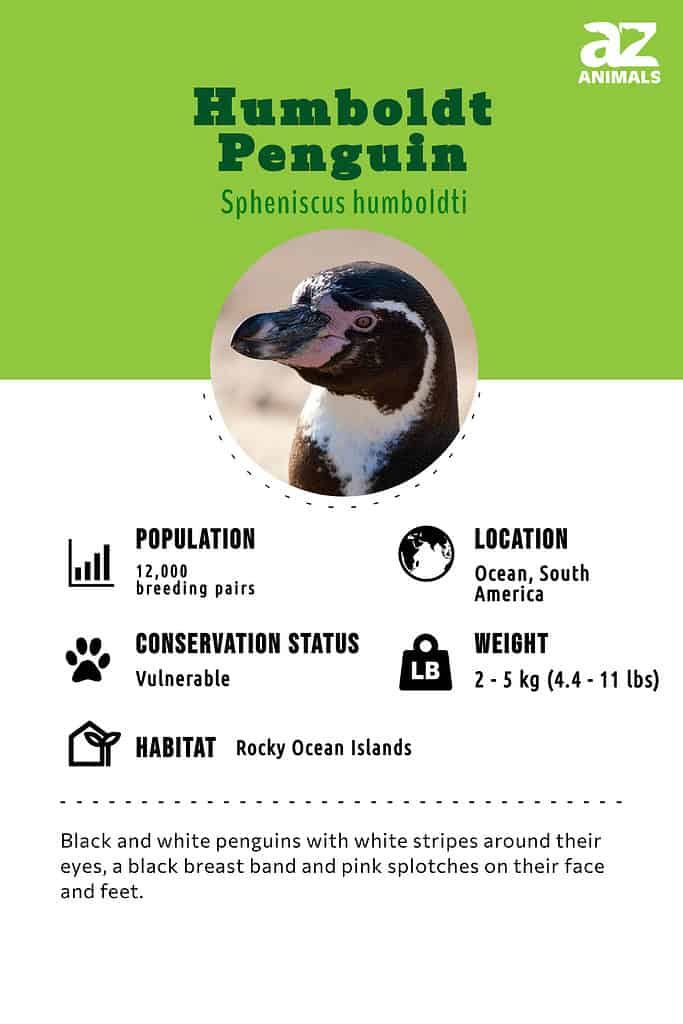
Like other penguins, they are black and white. This is one of the adaptations that help penguins camouflage and stay protected from their predators. Their heads have a white stripe that goes sideways from above their eye to around their ear. The stripes from both sides of their head meet at their throat. Adult birds have a black breast band with a white belly. They also have splotches of pink on their feet, face, and beneath their wings.

These penguins also have three layers of overlapping short feathers and a thick layer of fat that work together to keep them dry and warm. These are other adaptations that have helped the Humboldt penguins to survive in their habitat.

Young penguins differ in appearance from their adult counterparts in that they are brown instead of black and do not have a breast band. The Magellanic Penguin is very similar in appearance to these birds, but they have two black breast bands instead of just one.

The adult penguins are about 28 inches long and weigh about 9 pounds, just less than the average weight of a domestic cat. The female penguins are typically a little smaller than their male counterparts.

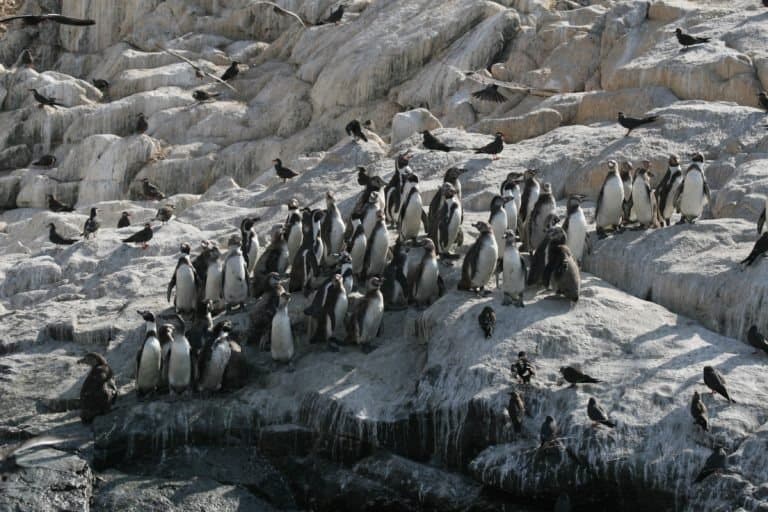
Humboldt penguins are very social and prefer to be with others. They live in small groups known as rookeries.
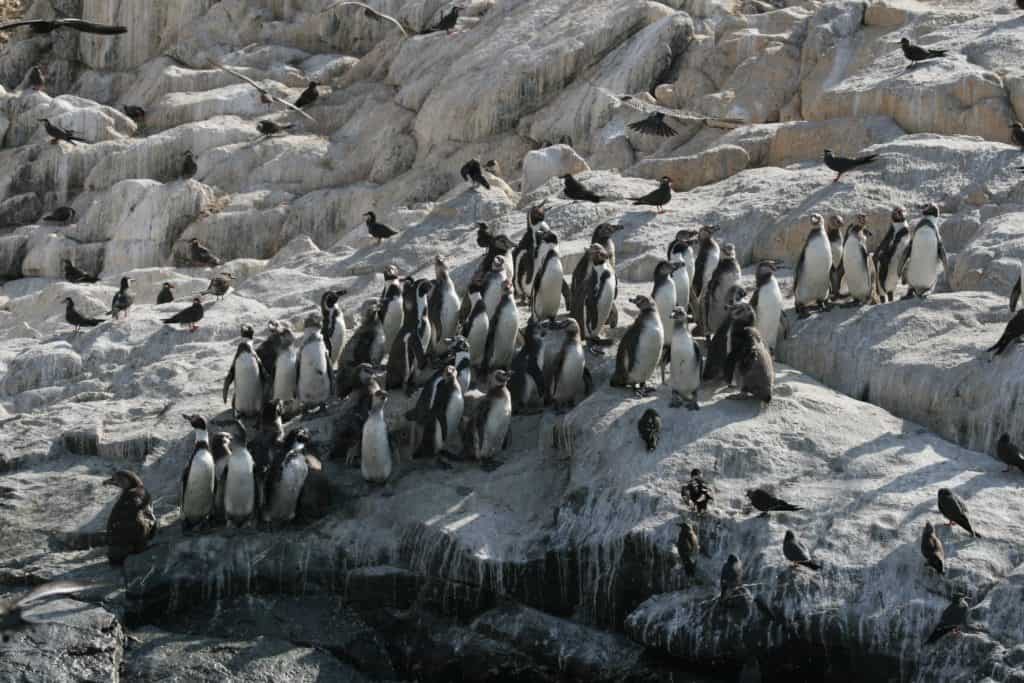
Humboldt penguins on guano island

Humboldt penguins live in groups called rookeries.

Habitat

Humboldt penguins live in the coastal areas of Peru and Chile. They can be found on rocky shores or on the islands in the area. Since they feed on fish in the Humboldt Current, they choose areas to live that are near this current.

Diet
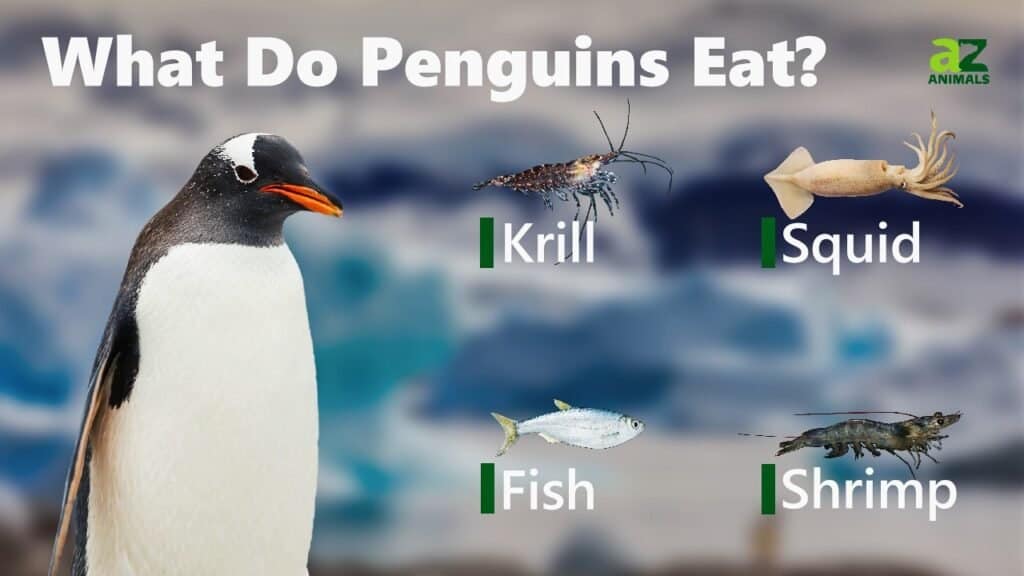
What Do Penguins Eat
Penguins primarily eat fish, with other seafood like crustaceans and krill added to the mix.

The food of choice for a Humboldt Penguin is anchoveta, a small fish. In addition to anchoveta, they also eat sardines, krill, and squid.

Predators and Threats
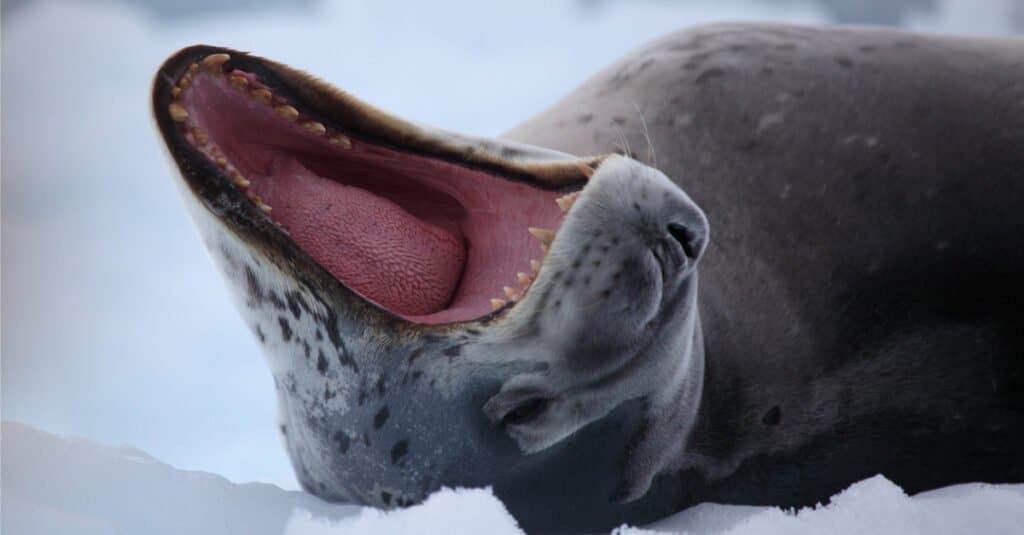
Leopard Seal Teeth - Leopard Seal

Leopard seals prey on Humboldt penguins.

Unfortunately, these penguins face many predators and threats. They are a favorite food of sea lions, leopard seals, fur seals, killer whales, and great white sharks. Humboldt penguin eggs are often eaten by snakes, foxes, and birds.

In addition to predators in nature, humans also pose a threat to these penguins. Commercial fisherman fish in the areas where the penguins live, which reduces the number of fish that are available for the penguins. Humboldt penguins also die when they get tangled up in the fishing nets the fishermen use. Humans also threaten their habitat when they harvest guano deposits to use for fertilizer. These penguins choose to nest in the guano deposits, so as the resources are depleted, fewer areas are available for them to nest.

Climate change also threatens these birds. Rising temperatures in the Arctic have started to decrease the amount of fish available in the Humboldt Current.

Because of all the threats that Humboldt penguins face, they face a risk of extinction. Their current conservation status is vulnerable.

Reproduction, Babies, and Lifespan

Humboldt penguins find a lifelong mate, like other penguins. These penguins bow their head and use alternating eyes to exchange glances with penguins of the opposite sex during courtship. They stretch their heads up, flap their wings, and let out a loud call to try to attract a partner.

The male and female penguins work together to dig their burrow in dried bird poop called guano. Each female lays two eggs at a time. The peak months for laying eggs are April through August. The eggs take about 40 days to incubate. During the incubation period, both the male and female penguins take turns sitting on the eggs.
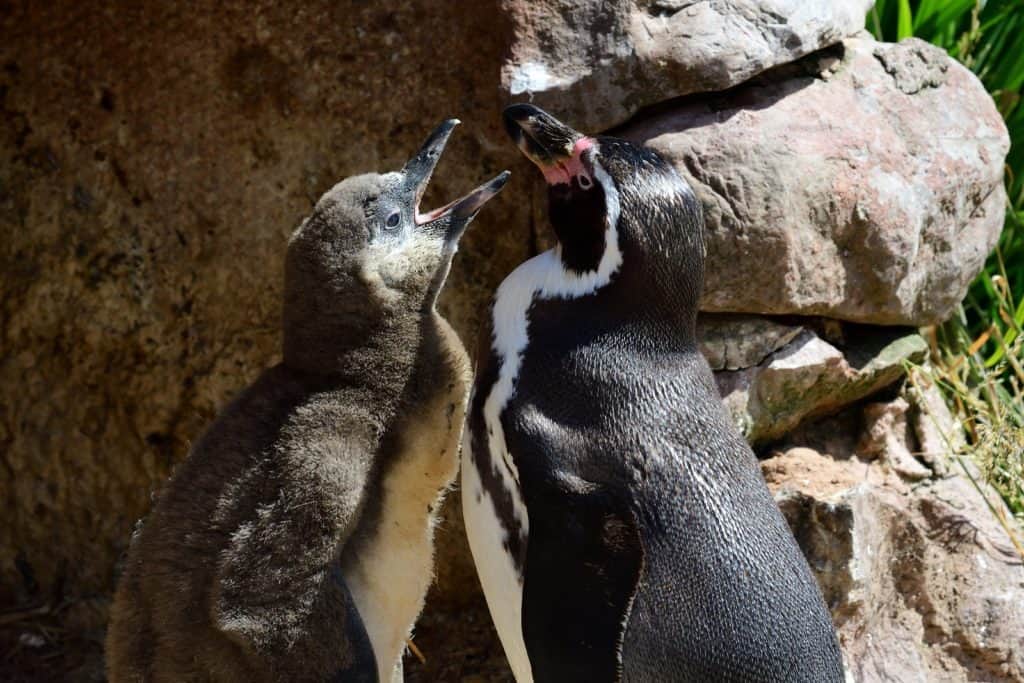
Humboldt penguin with a baby penguin

Humboldt penguins mate for life and raise their chicks together.

When baby penguins are born, they have grayish-brown feathers. At around the age of 70 to 90 days, the baby penguins will molt. At this time, their brown baby feathers are replaced with gray adult feathers. However, the young penguins still will not get their black breast band until they become an adult.

Until they have their adult feathers, the penguin chicks are unable to maintain their body temperature. They need to stay in their nest to keep warm, and their parents feed them by regurgitating food. One parent will stay with the chicks at the nest to keep them safe. After the chicks molt and get their adult feathers, they are able to leave the nest and begin looking for their own food.

Once Humboldt penguins are two years old, they are considered an adult. At this time, they return to the rookery to look for a mate.

The lifespan for most Humboldt penguins is about 20 years. Although, some of these penguins in captivity can live as long as 30 years. The oldest one lived to be 36. Her name was Emmanuelle, and she lived at the Akron Zoo in Ohio.
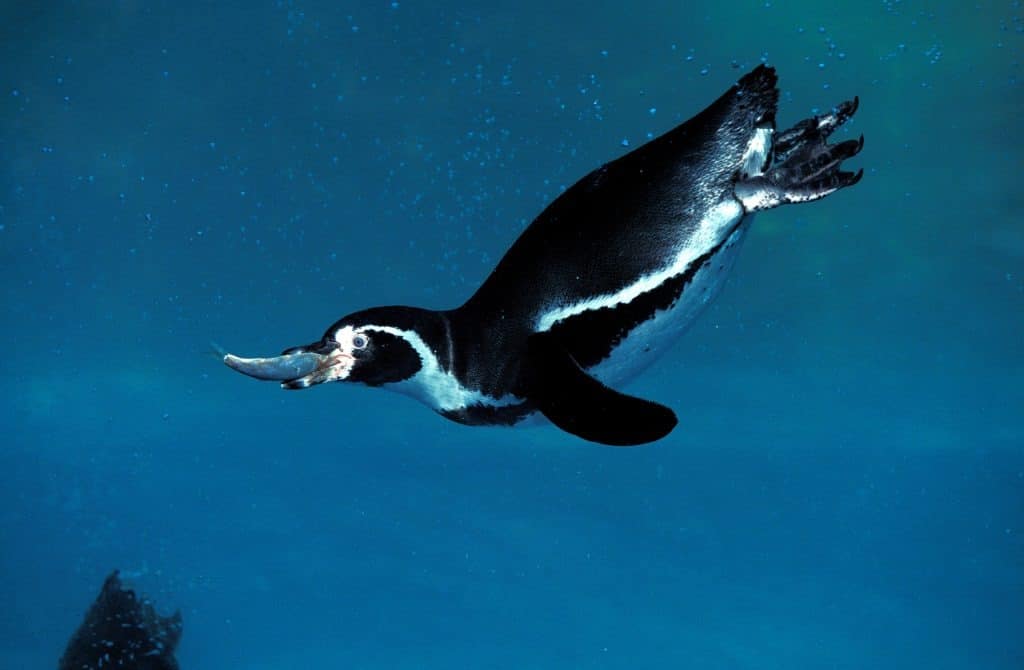
Adult Humboldt Penguin fishing, with Fish in its beak, against a background of blue water

Humboldt penguins have been given a vulnerable conservation status.

Population

Currently, there are only about 12,000 breeding pairs of Humboldt penguins left. About 4,000 pairs are located in Peru, and about 8,000 pairs are located in Chile. This penguin population is declining due to the threats they face from humans and predators in nature. These penguins have been given a vulnerable conservation status due to their declining population.

In the Zoo

Portland, Oregon: October 11, 2019: The Oregon Zoo in the city of Portland, Oregon. The Oregon Zoo has 1,800 animals.

The Oregon Zoo features Humboldt penguins.

If you want to see these penguins in person, there are many zoos in the United States where you can do so. Some of these include the Saint Louis Zoo, Denver Zoo, Oregon Zoo, Akron Zoo, and Philadelphia Zoo


View all 287 animals that start with H

Sources

  1. David Burnie, Dorling Kindersley (2011) Animal, The Definitive Visual Guide To The World's Wildlife / Accessed August 3, 2010
  2. Tom Jackson, Lorenz Books (2007) The World Encyclopedia Of Animals / Accessed August 3, 2010
  3. David Burnie, Kingfisher (2011) The Kingfisher Animal Encyclopedia / Accessed August 3, 2010
  4. Richard Mackay, University of California Press (2009) The Atlas Of Endangered Species / Accessed August 3, 2010
  5. David Burnie, Dorling Kindersley (2008) Illustrated Encyclopedia Of Animals / Accessed August 3, 2010
  6. Dorling Kindersley (2006) Dorling Kindersley Encyclopedia Of Animals / Accessed August 3, 2010
  7. Christopher Perrins, Oxford University Press (2009) The Encyclopedia Of Birds / Accessed August 3, 2010
  8. <a href="https://a-z-animals.com/animals/location/south-america/peru/">Peru</a> Aves / Accessed October 9, 2020
  9. Saint Louis Zoo / Accessed October 9, 2020
  10. Centre for Biological Diversity / Accessed October 9, 2020
  11. Wikipedia / Accessed October 9, 2020
  12. Organization for the Conservation of Penguins / Accessed October 9, 2020
  13. ANIMALIA / Accessed October 9, 2020
Lisha Pace

About the Author

Lisha Pace

After a career of working to provide opportunities for local communities to experience and create art, I am enjoying having time to write about two of my favorite things - nature and animals. Half of my life is spent outdoors, usually with my husband and sweet little fourteen year old dog. We love to take walks by the lake and take photos of the animals we meet including: otters, ospreys, Canadian geese, ducks and nesting bald eagles. I also enjoy reading, discovering books to add to my library, collecting and playing vinyl, and listening to my son's music.

Thank you for reading! Have some feedback for us?


Humboldt Penguin FAQs (Frequently Asked Questions)

These penguins are carnivores, or piscivores since they eat fish.