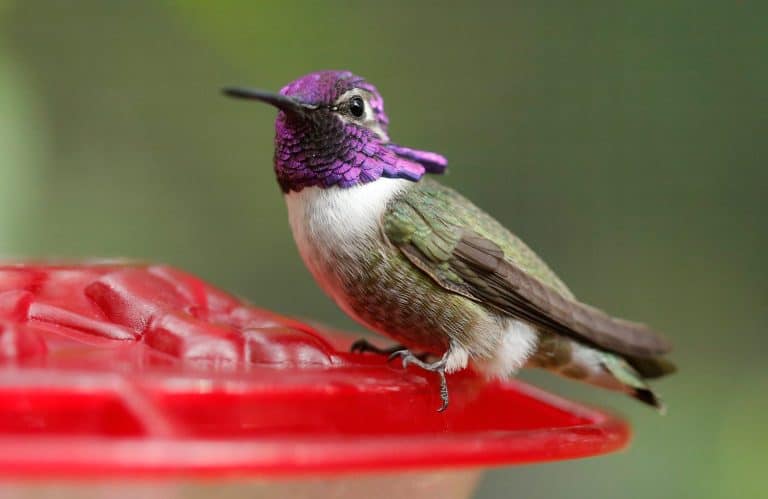
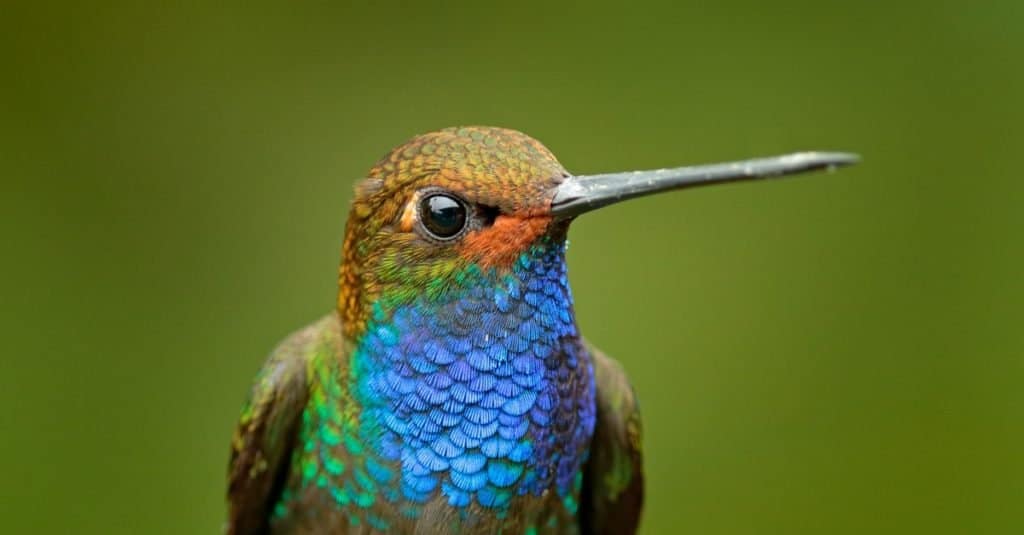

Native to the Americas, hummingbirds largely form the family called Trochilidae. There are currently between 362 and 375 recognized species of hummingbirds, with the International Ornithologists’ Union listing 366 species, including the bee hummingbird, Anna’s hummingbird, ruby-throated hummingbird, and topaz hummingbird. However, the list is updated each year as new variations are discovered.
The smallest of the hummingbird — which is the bee hummingbird — weighs just about 0.07 ounces (2 grams). Two species of these birds are now known to have gone extinct. They are also famous for their ability to fly backwards.
An Amazing Bird: 5 Hummingbird Facts
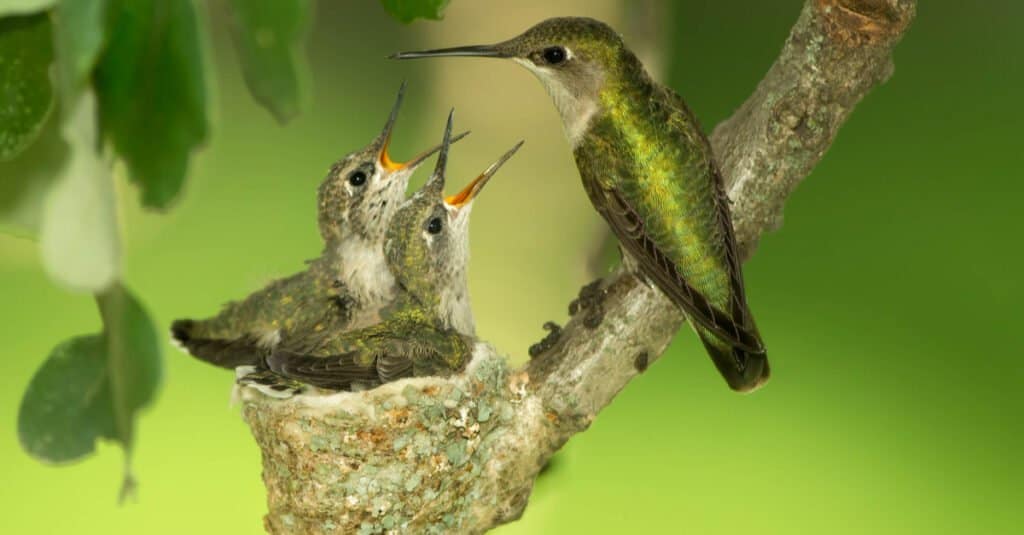
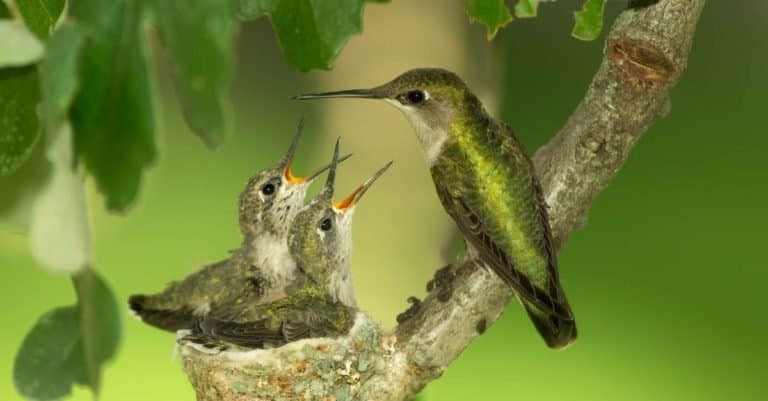
Two hungry baby hummingbird chicks eagerly welcome the arrival of their mother.
©Agnieszka Bacal/Shutterstock.com
- Their average clutch size is no more than three eggs, but a female will have one or two broods. The eggs are just half an inch big, and the mother needs to take care of the eggs for about two weeks before they hatch.
- Hummingbirds are the only birds that can fly backwards, thanks to a wingspan that can exceed their full length by at least one-fourth of an inch.
- They get their name from the humming sound that their wings make when they flap together quickly.
- On average, a hummingbird weighs even less than a nickel. The bee hummingbird, in fact, only weighs 0.07 ounces (2 grams) at its adult size.
- While hummingbirds aren’t especially heavy, they can be quite large. The largest hummingbird in the world measured more than 9 inches in length.
Where to Find Hummingbirds
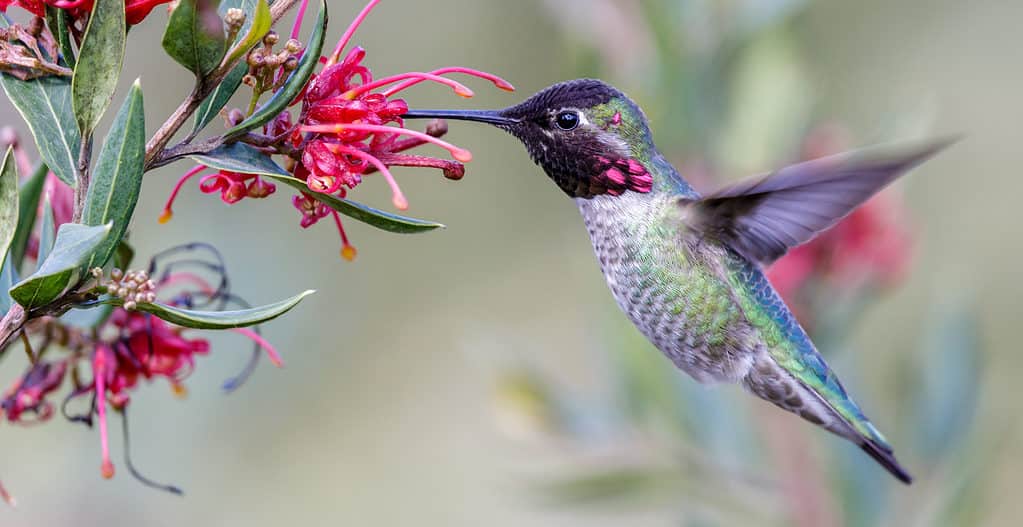
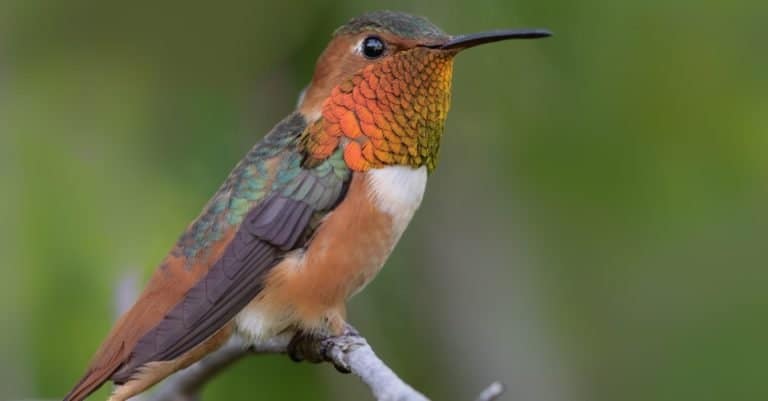
Calypte anna is just one of more than 360 species of hummingbird found across North America.
©yhelfman/Shutterstock.com
Bird watchers are in luck — hummingbirds can be sighted in a variety of places, spanning across the Americas. However, even among the more than 360 different species, these birds are not located beyond the New World, so you might need to travel if you are in the Eastern Hemisphere.
Different types of these birds, like bee, Anna, topaz, and ruby-throated hummingbirds, are found in different parts of the world. The easiest way to find one of these unique and special birds is to get closer to the equator, since these birds like the warmth. With over half of the known species that live right along the equator, you can still spot them above Mexico.
Some of the places where these small birds are found include the Southwestern states such as California, Arizona, Texas, and New Mexico. In these places, areas like the Davis Mountains State Park in Texas and/or the Ramsey Canyon Preserve in Arizona are popular hotspots for hummingbird sightings.
Classification and Scientific Name
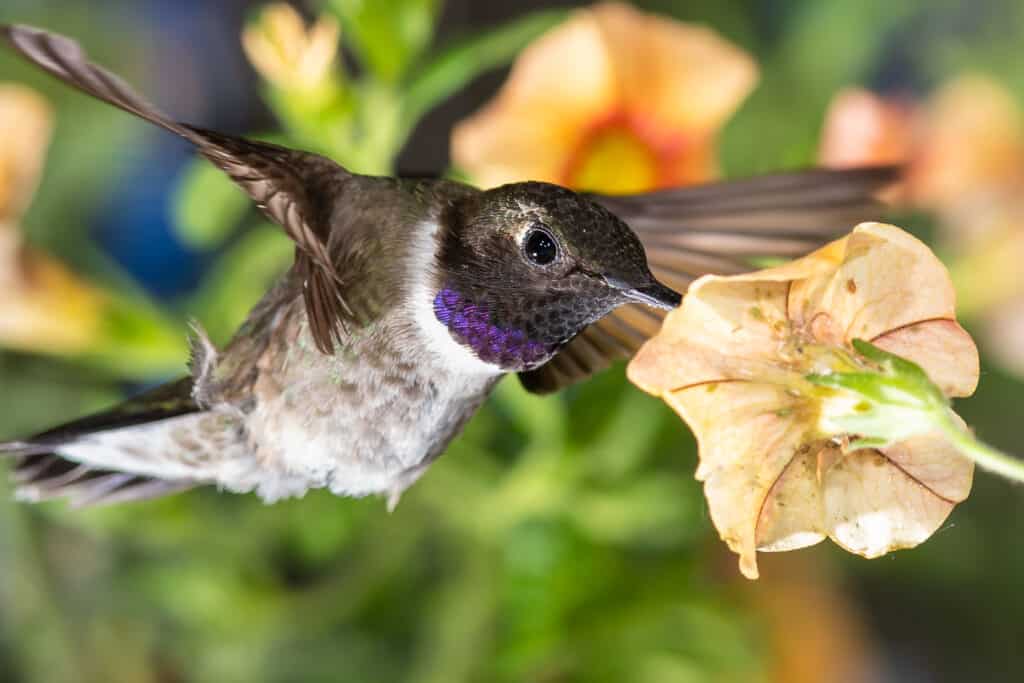
Hummingbirds belong to the family Trochilidae.
©rck_953/Shutterstock.com
Hummingbirds belong to the family Trochilidae. They belong to the kingdom Animalia and the Phylum Chordata. Their class is called Aves, and the order is called Apodiformes.
Trochilidae is rooted in a Greek word — trochilos — which is interpreted to mean “a small bird” by some sources. However, it can also be traced to the Ancient Greek word τροχίλος, which means “Egyptian plover.” A plover is a wading bird that is rather stout with a short bill, which is very different from a hummingbird.
Size, Appearance, and Behavior
These birds are small in size. Even the largest of these birds — the Patagona gigas in South America — is only about 8 inches long. Different hummingbirds, however, come in different sizes. The calliope hummingbird is three inches long, while the bee hummingbird is 2.25 inches long. Meanwhile, Topaz hummingbirds are 3.1 to 3.5 inches long.
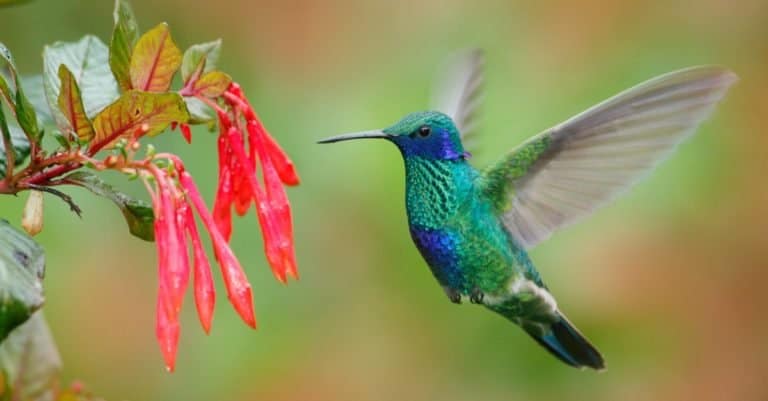
These birds look slightly different than normal birds, which is part of their beauty. Despite their streamlined, stubby bodies, they have gracefully long bills and wings. While their extremely tiny legs can make it difficult to walk around, they don’t need to — their wings move about 10-15 times per second, allowing them to hover in place.
This incredible speed is only one way that their flying is both unusual and captivating. The power of their wings makes them the only birds that can fly backward. In the blink of an eye, they can change directions, seeming to hover in the air. If they so choose, the bird is even capable of flying upside down.
These birds are known to be aggressive birds and often shoo the intruders away. They are among some of the fiercest birds, which often seems contradictory to their tiny size. They not only successfully drive away large birds but can also attack other animals and even human beings.
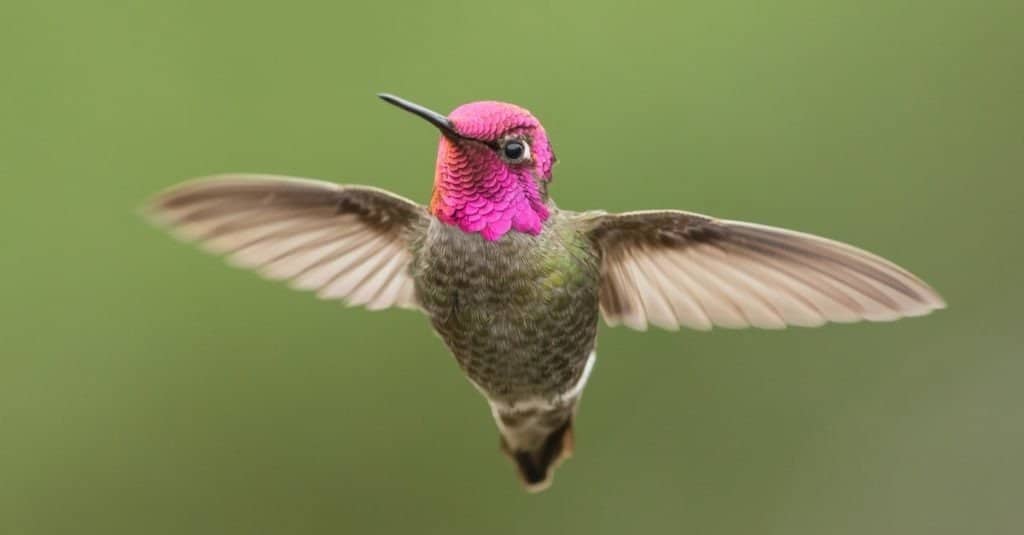
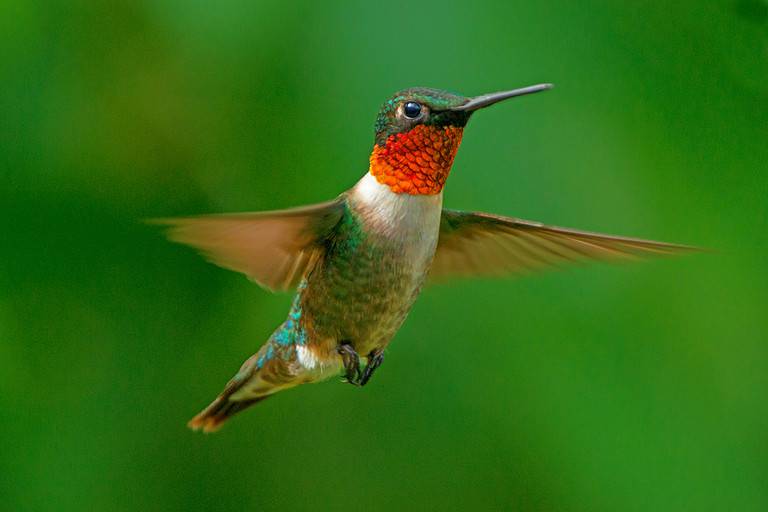
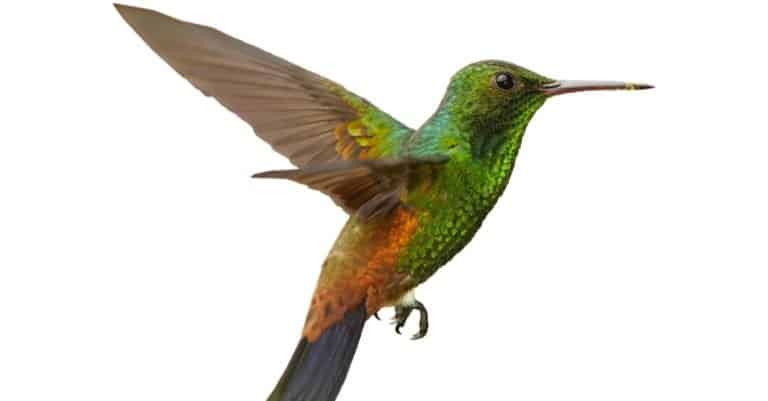
This hummingbird is displaying its incredible ability to hover in midair.
©Keneva Photography/Shutterstock.com
Diet
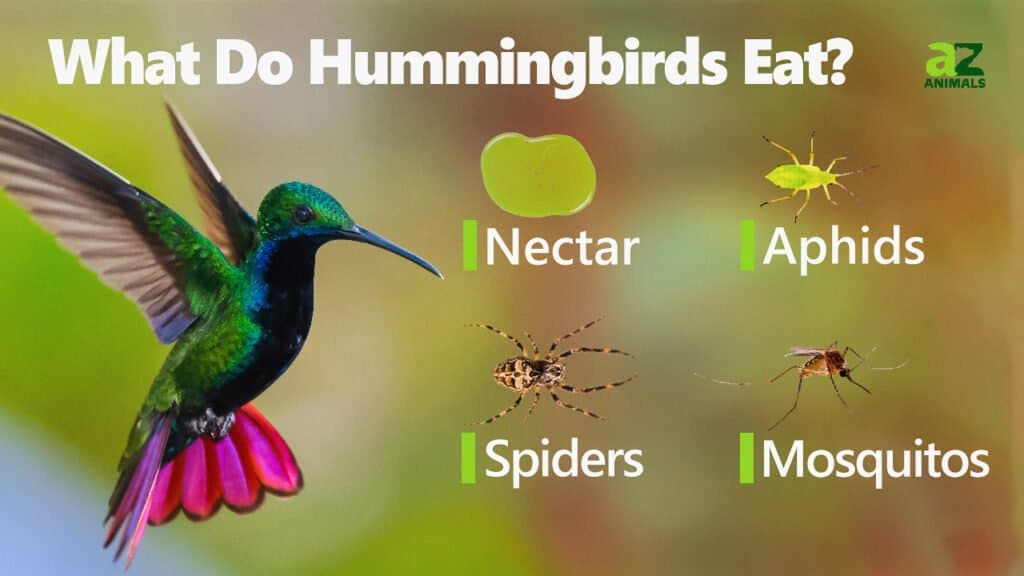
The bird’s diet includes consuming half of their own weight worth of sugar, which is why sugar water is the easiest way to attract them to a bird feeder. These birds feed themselves about five to eight times per day, also finding this sugar from nectar and fruit.
When they aren’t grazing on sugar, sugar water, or natural nectar, the hummingbird will also seek out insects and invertebrates as nourishment. Their preferred diet consists of ants, spiders, beetles, mosquitoes, gnats, weevils, fruit flies, and aphids, making them ideal guests around any home. In a pinch, they’ll also find whatever food is captured in spider webs.
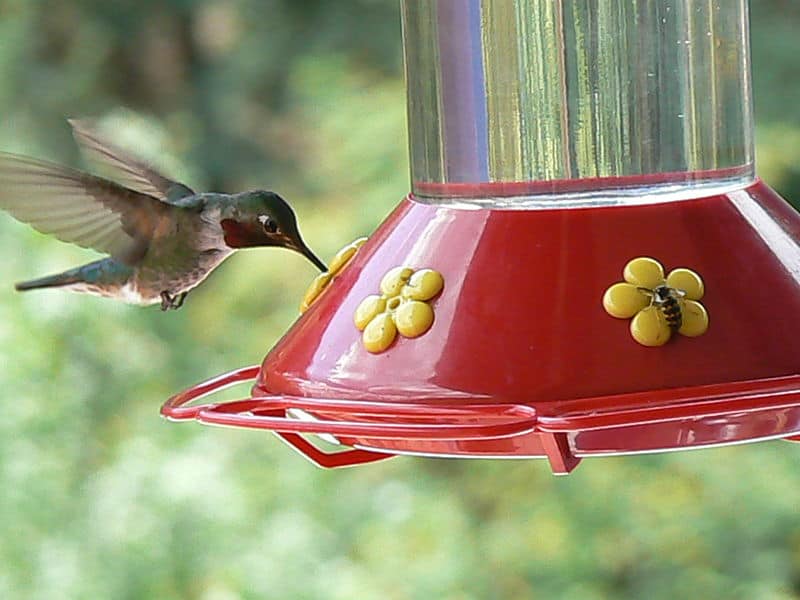
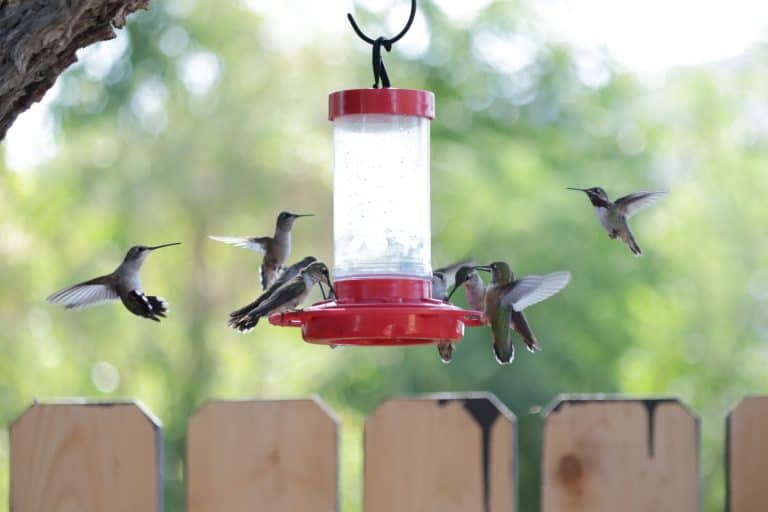
Hummingbird feeders are a great way to invite them into your own backyard!
©Garrett Davis – Public Domain
Predators and Threats
These birds, especially owing to their tiny size, have a lot of predators, which may be why they have to be so aggressive to defend themselves. Their eggs are at constant risk of falling victim to predators, though one of their biggest threats is that of humans.
As cities become more urbanized, the natural habitats of these animals dwindle. Deforestation is a major problem for hummingbirds, but the average bird enthusiast can contribute by adding a hummingbird feeder and ample foliage around their yard to attract the birds for a place to build a nest and eat.
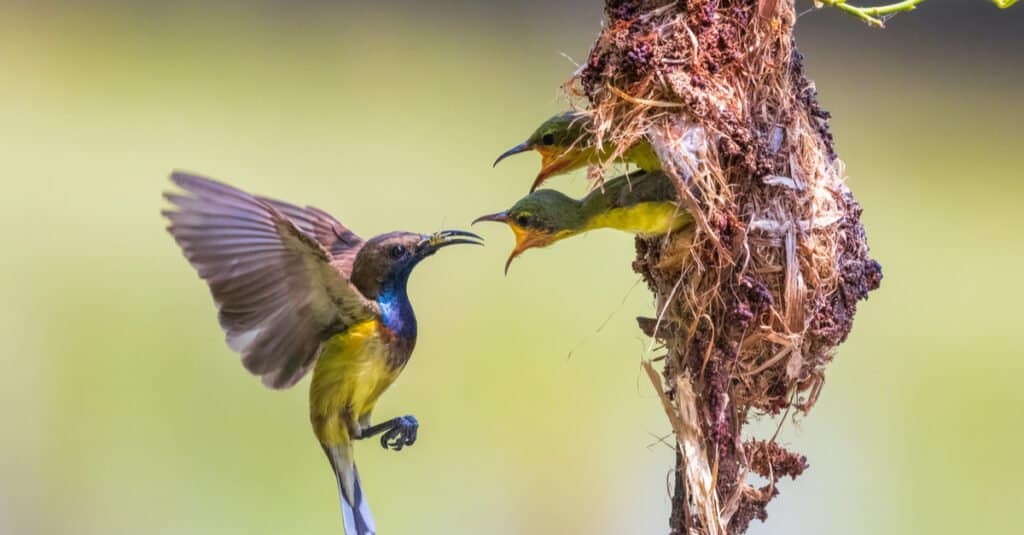
A typical hummingbird nest is built out of scavenged local foliage.
©ukrit.wa/Shutterstock.com
What eats hummingbirds?
These birds are in constant peril as they avoid the clutches of frogs, snakes, lizards, squirrels, chipmunks, blue jays, crows, and other aggressive birds.
Their eggs need special attention to avoid predators as well. Even once hatched, the eggs and young are sought out by blue jays, squirrels, chipmunks, and crows.
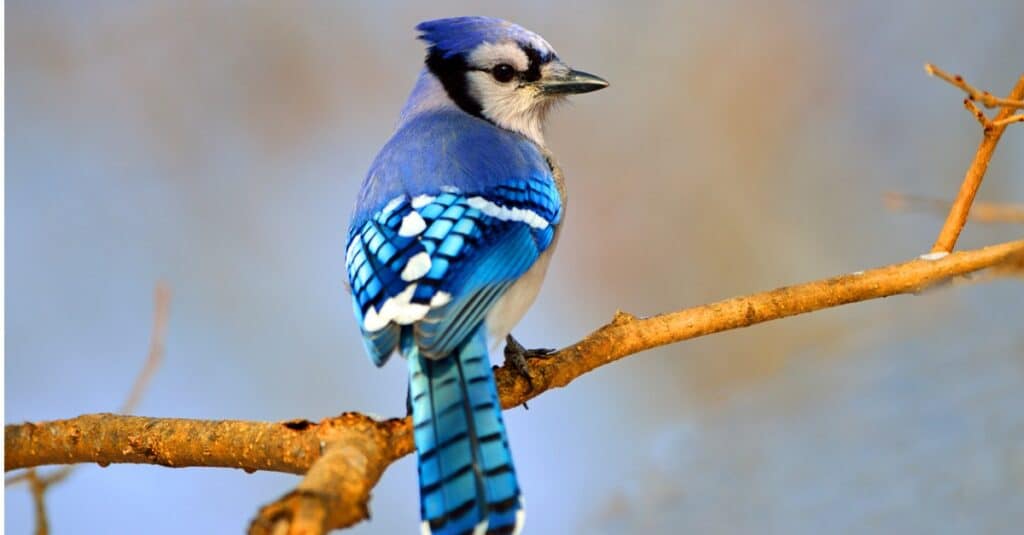
The blue jay is one of the hummingbird’s fiercest predators.
©iStock.com/BrianEKushner
What do hummingbirds eat?
Hummingbirds usually feed on the nectar from flowers, as well as broken fruit from which they can source natural sugar. While they will go after small insects, these birds aren’t much of a predator. The only time they will go after any game bigger than a spider or beetle is if they feel threatened, but only to defend themselves (not to eat).
Reproduction, Babies, and Lifespan
Hummingbirds start mating when they are one year old. Every year, female hummingbirds can raise up to three baby broods, which means six baby hummingbirds per year.
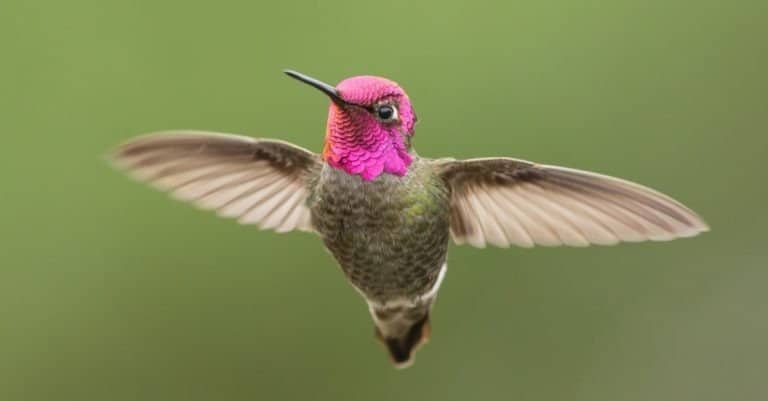
Before mating, a male hummingbird has to convince the female hummingbird that he would be a perfect match for her. For that reason, the males tend to be a little more colorful, which is a natural evolutionary trait of most bird species.
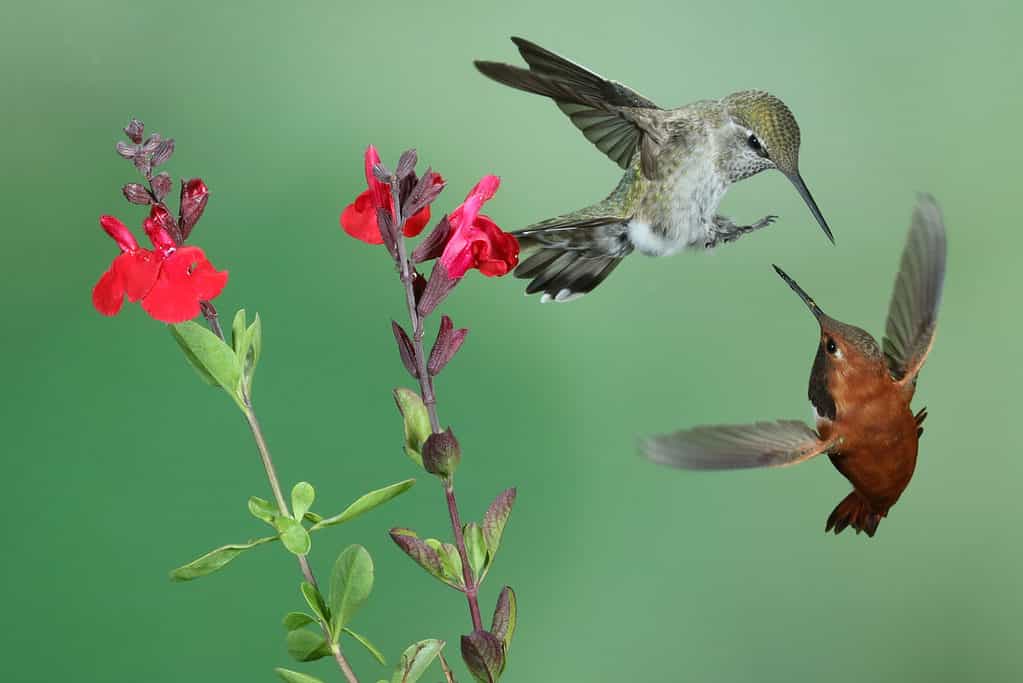
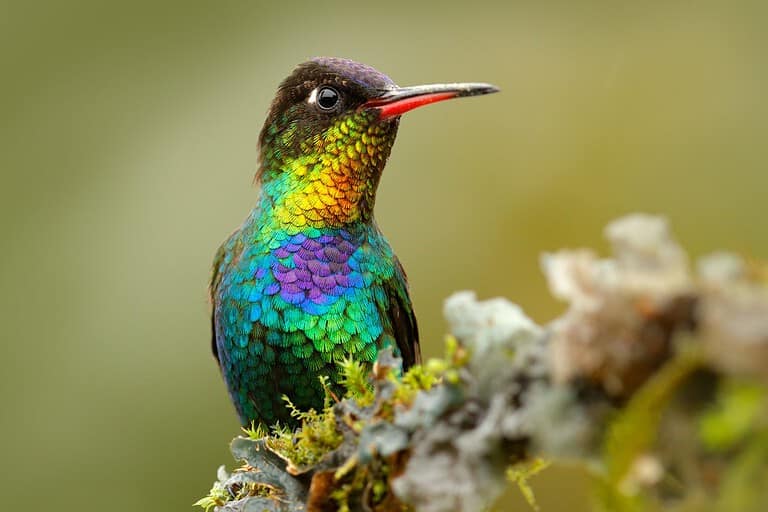
This Anna’s Hummingbird uses their vibrant colors to help attract a potential mate.
©iStock.com/Jedlovec
Female hummingbirds are known to be solitary mothers; after impregnating the female, males move on with their lives. She stays behind to lay her eggs, incubating them for about two weeks. The eggs are about the size of navy beans. Typically, during one breeding session, female hummingbirds usually lay only two eggs.
Their young, which are called chicks, will remain in the nest as their mother nurtures and feeds them for up to four weeks after birth. The lifespan of hummingbirds is about three to five years.
Evolution
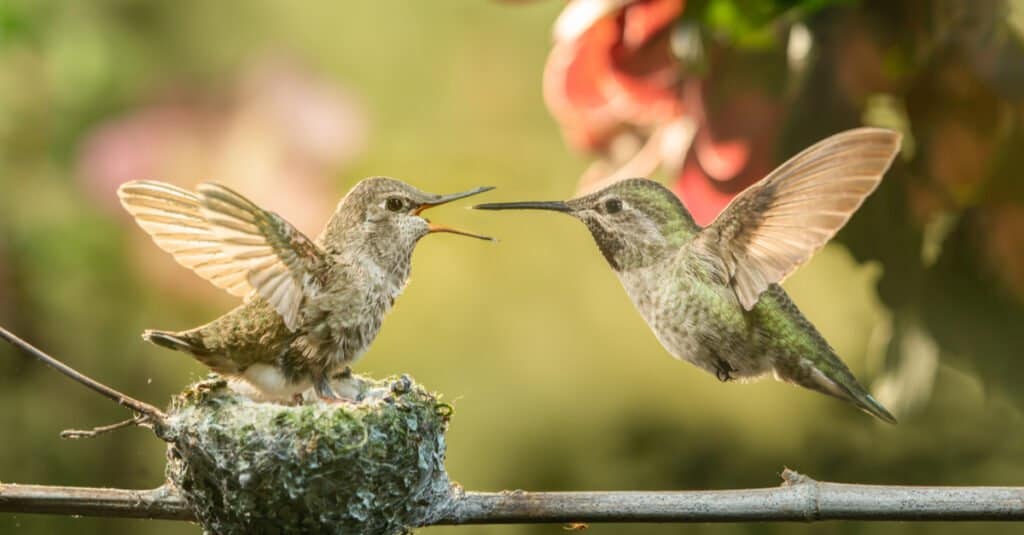
Hummingbirds have evolved to be some of the avian world’s most gifted flyers.
©Freebilly Photography/Shutterstock.com
Scientists were absolutely baffled when they discovered the oldest known hummingbird fossil, which dated back to 30 million years ago, not because of its age, but the location: Southern Germany! This proved to biologists that Hummingbirds had not always been native solely to the Americas.
It is believed that about 40 million years ago, hummers began to take on traits unique to their closest relative, the swift, and around 20 million years ago migrated to South America and began to co-evolve with local flowers. There is much speculation regarding the specifics of how hummingbirds became the endearing pollinators we know today, as there is a massive gap in the fossil record, with the oldest North American Hummingbird fossils being only less than 10,000 years old. Until more data can be collected, all we can do is hypothesize as to how these marvels of nature came to be.
Population
While the exact population of hummingbirds is not known, some species of hummingbirds, like the ruby-throated hummingbird, are estimated at 34 to 36 million individuals according to recent surveys. There are over 360 different species, though about half of the birds live along the equator.
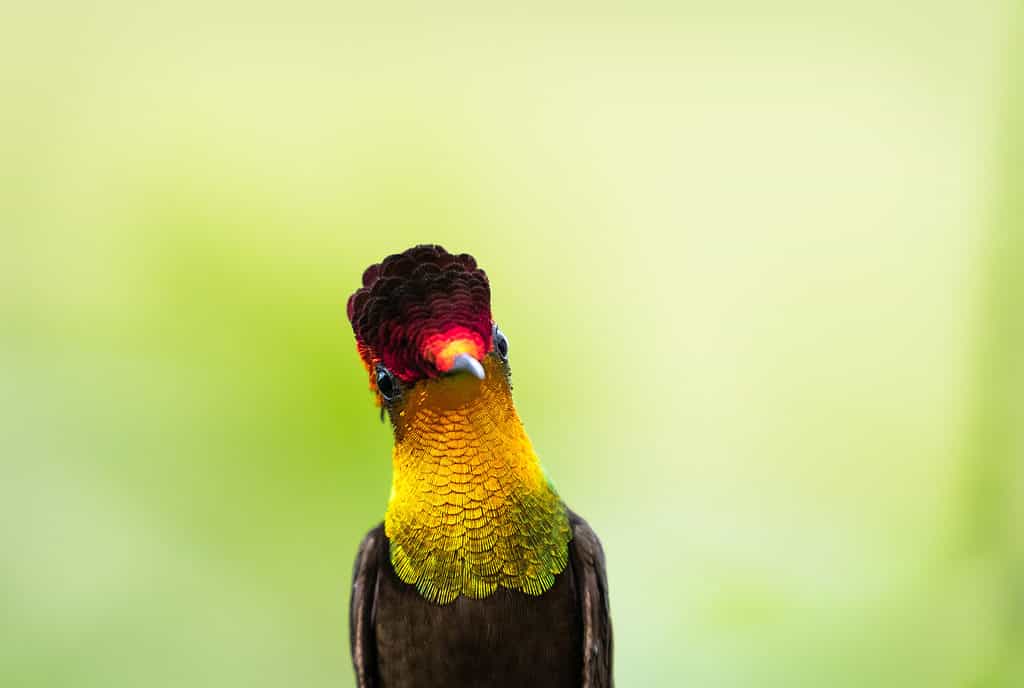
Close-up of the Ruby Topaz hummingbird, Chrysolampis mosquitus, with glittering gold and red feathers.
©iStock.com/Chelsea Sampson
Types of Hummingbirds
There are currently 366 different species of hummingbirds recognized by the ‘International Ornithologists’ Union (IOU). You can find a list of some of these hummingbirds and their scientific name below.
- Crimson Topaz: Known by the scientific name Topaza pella, this hummingbird is native to Venezuela, Suriname, Guyana, French Guiana, and Brazil.
- Fiery Topaz: Topaza pyra is the scientific name of this hummingbird. It lives in Northern South America.
- White-necked Jacobin: Florisuga mellivora is the scientific name for this brilliant blue and white hummingbird. It can be found in Mexico and other parts of Central America.
- Black Jacobin: The Florisuga fusca is a common sight among coffee and cacao plantations of Uruguay, Paraguay, Brazil, and Argentina.
- White-tipped Sicklebill: The Eutoxeres aquila is only about 12 cm long.
- Buff-tailed Sicklebill: Eutoxeres condamini is a close relative of the White-tipped Sicklebill.
- Saw-billed Hermit: Known by the scientific name Ramphodon naevius, this hummingbird lives in the rainforests of Brazil.
- Hook-billed Hermit: Glaucis dohrnii is a rare hummingbird only found in a small region of Brazil.
- Bronzy Hermit: Glaucis aeneus is native to Panama, Nicaragua, Honduras, Ecuador, Costa Rica, and Colombia.
- Rufous-breasted Hermit: The Glaucis hirsutus is also known as the “hairy hermit.”
- Band-tailed Barbthroat: Threnetes ruckeri can be found throughout much of South and Central America.
- Pale-tailed Barbthroat: Threnetes leucurus inhabits a wide area of the Amazon.
- Sooty Barbthroat: Threnetes niger was first described by Taxonomist Carl Linnaeus in 1758.
- Broad-tipped Hermit: Anopetia gounellei is one of many species of hummingbird found only in Brazil.
- Dusky-throated Hermit: Phaethornis squalidus is a hummingbird with a nuanced and complex song native to Brazil.
- Streak-throated Hermit: Phaethornis rupurumii is sometimes known as the Rupurumi Hermit.
- Little Hermit: Phaethornis longuemareus is one of the tiniest hummingbirds, weighing less than 0.12 oz.
- Tapajos Hermit: This hummingbird is known by the scientific name Phaethornis aethopygus.
- Minute Hermit: Phaethornis idaliae is the scientific name of this Brazilian hummingbird.
- Cinnamon-throated Hermit: Bolivia and Brazil are home to the Phaethornis nattereri.
- Black-throated Hermit: Phaethornis atrimentalis can be found in Colombia, Ecuador, and Peru.
- Stripe-throated Hermit: Phaethornis striigularis is a very common hummingbird throughout South and Central America.
- Grey-chinned Hermit: Phaethornis griseogularis lives in Venezuela, Peru, Ecuador, Colombia, and Brazil.
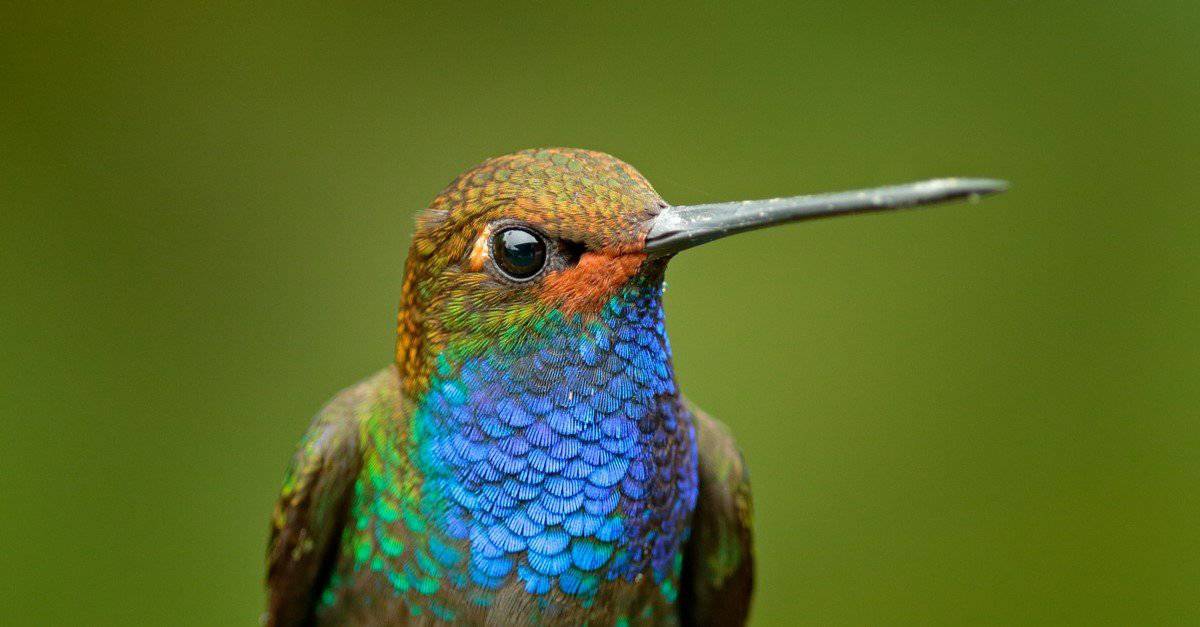
Hummingbird Pictures
View all of our Hummingbird pictures in the gallery.

Ondrej Prosicky/Shutterstock.com
Sources
- Discover Wildlife / Accessed December 28, 2020
- Wikipedia / Accessed December 28, 2020
- Kaytee / Accessed December 28, 2020
- Birds & Blooms / Accessed December 28, 2020
- Britannica / Accessed December 28, 2020
- The Spruce Pets / Accessed December 28, 2020
- Perky Pet / Accessed December 28, 2020
- Birds of the World / Accessed December 28, 2020