


H
Species Profile

Hyena

Hyaenidae

Bone-crushers, termite-lappers, ecosystem keepers
Marieke Kuijpers / Creative Commons

Hyena Distribution

Click a location to explore more animals from that region

Loading map...

Size Comparison

Human 5'8"
Hyena 2 ft 4 in

Hyena stands at 41% of average human height.

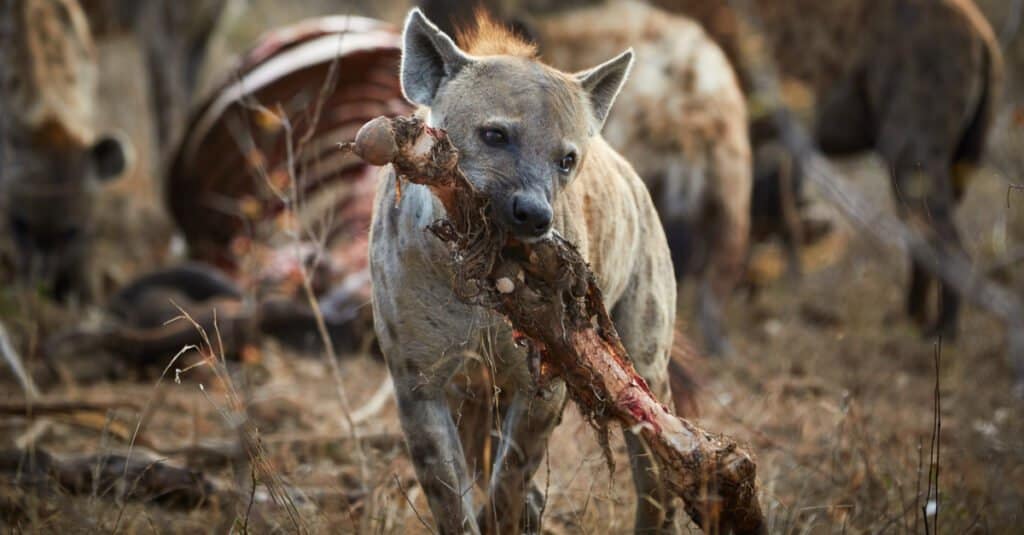
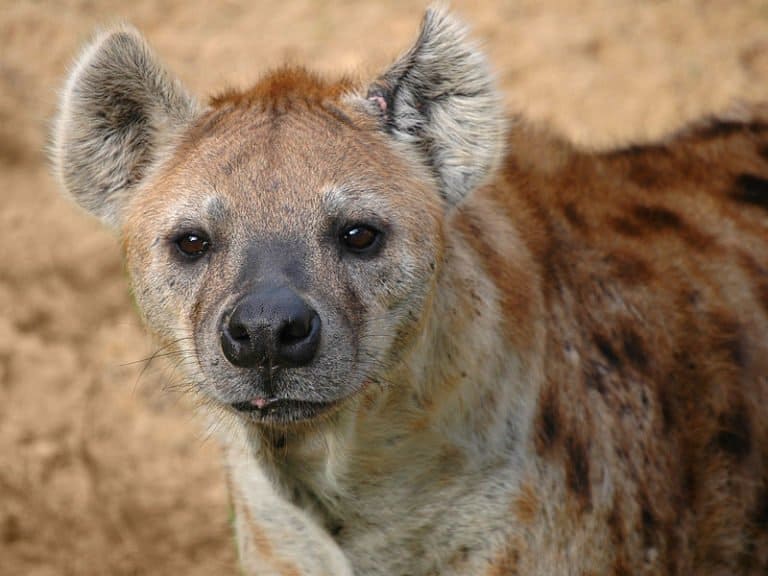
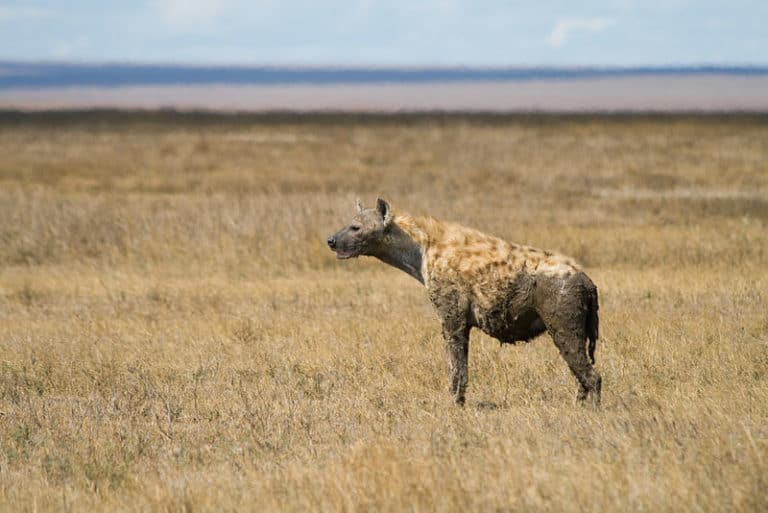
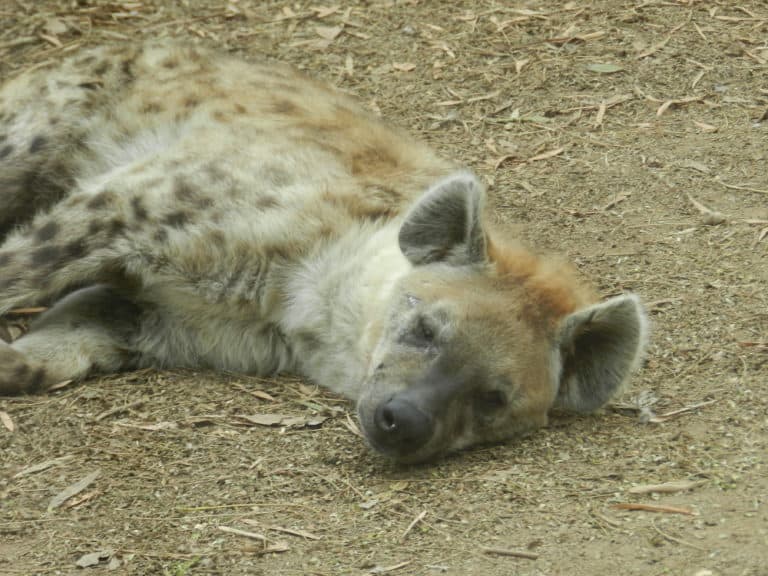
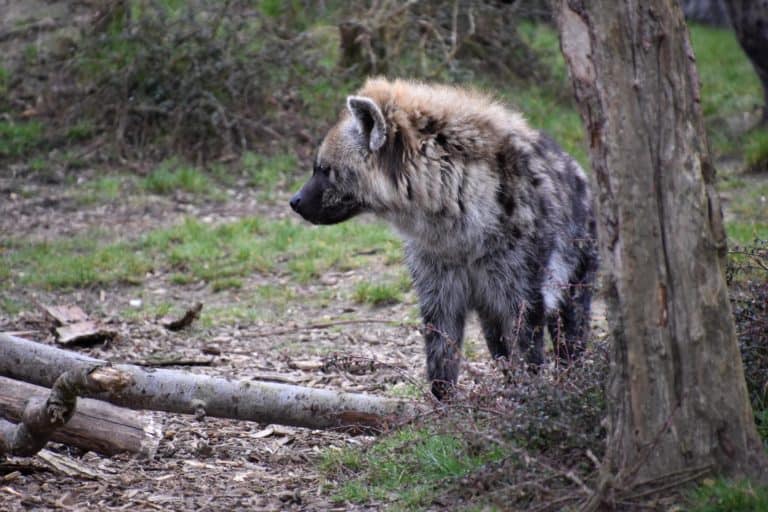
Hyena looking for prey

At a Glance

Family Overview This page covers the Hyena family as a group. Stats below are general traits shared across the family.
Diet Omnivore
Activity Nocturnal+
Lifespan 13 years
Weight 86 lbs
Status Not Evaluated
Did You Know?

Hyaenidae has only 4 living species: spotted, striped, brown hyenas, and the aardwolf.

Scientific Classification

Family Overview "Hyena" is not a single species but represents an entire family containing multiple species.

Hyenas (family Hyaenidae) are African–Eurasian carnivorans known for strong jaws, efficient digestion, and (in some species) complex social behavior. Despite a dog-like appearance, they are more closely related to feliform carnivorans (cats, mongooses) than to canids.

Kingdom
Animalia
Phylum
Chordata
Class
Mammalia
Order
Carnivora
Family
Hyaenidae

Distinguishing Features

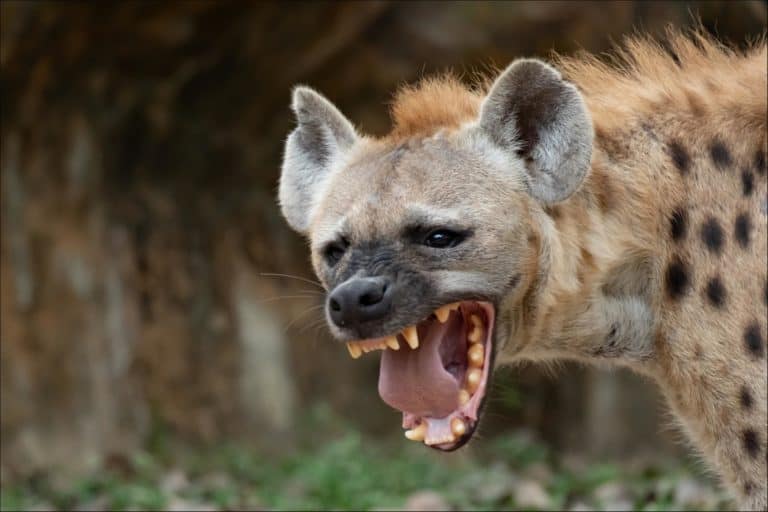
  • Robust skull and extremely powerful jaws adapted for cracking bones (especially in spotted and brown hyenas)
  • Digitigrade posture with forequarters often higher than hindquarters, giving a sloping back profile
  • Strong social systems in some species (notably spotted hyenas) including clans and communal dens
  • Aardwolf is an outlier: specialized insectivore feeding mainly on termites

Physical Measurements

Males and females differ in size

Height
2 ft 4 in (1 ft 4 in – 2 ft 11 in)
2 ft 2 in (1 ft 4 in – 2 ft 11 in)
Length
4 ft 5 in (2 ft 6 in – 5 ft 7 in)
4 ft 7 in (2 ft 6 in – 6 ft 1 in)
Weight
77 lbs (15 lbs – 132 lbs)
99 lbs (15 lbs – 198 lbs)
Tail Length
11 in (8 in – 1 ft 2 in)
1 ft 1 in (8 in – 1 ft 2 in)
Top Speed
37 mph
40–65 km/h, good endurance

Appearance

Primary Colors
Secondary Colors
Skin Type Dense fur and guard hairs, often a raised mane; coarse, shaggy coat (especially brown hyena). Skin tough with strong tissue for biting. Tail has darker tuft; paws suit ground running, not climbing.
Distinctive Features
  • Body length about 55–165 cm, shoulder height 35–91 cm, weight about 8–86+ kg (smallest: aardwolf; largest: spotted hyena). Front part is stronger than back, giving most a sloped back.
  • Lifespan (range across species): typically ~8-25 years in the wild depending on species and local pressures; up to ~30-40 years reported in captivity for the longest-lived individuals (not uniform across species).
  • Feliform carnivorans (closer to cats/mongooses than to canids): dog-like silhouette but distinct skull and dental specializations (notably robust premolars and strong jaw musculature in the bone-cracking species).
  • Skull/jaws: exceptionally robust crania and crushing premolars in spotted/striped/brown hyenas enable bone consumption; very strong bite forces relative to size, supporting efficient carcass use and nutrient cycling.
  • Digestive efficiency: capable of processing skin, tendons, and bones more thoroughly than many other carnivorans; contributes to carcass cleanup and mineral redistribution in ecosystems.
  • Overall build: deep chest, powerful neck/shoulders, long forelimbs; hindquarters often comparatively lower; ears generally large and upright, aiding hearing in open habitats.
  • Mane/crest: erectile dorsal mane present to varying degrees; can be raised in aggression or excitement, altering apparent size and contour.
  • Scent communication: prominent anal gland/paste-marking behaviors (varies by species), used for territorial and social signaling.
  • Hyenas vary: spotted hyena lives in female-led clans, hunt and scavenge together and call a lot; striped and brown are more solitary or in small families; aardwolf eats termites. Mostly active at night and dusk.
  • Spotted, striped, and brown hyenas hunt and scavenge as needed; they crush bones and quickly use carcasses, cutting waste and affecting disease spread and nutrient cycling. Aardwolves mainly eat termites, not carcasses.

Sexual Dimorphism

Sexual dimorphism varies across the family. In spotted hyenas it is strong: females often larger and more dominant and have an enlarged clitoris (pseudopenis) and fused labia. Striped and brown show mild dimorphism; aardwolves subtle. Individuals and populations vary.

  • Often slightly larger or heavier in striped, brown, and aardwolf (differences usually modest).
  • More typical external genital appearance compared with spotted-hyena females; scrotum visible in adults.
  • May show more prominent neck/shoulder musculature in some populations, though overlap is common.
  • In spotted hyena: commonly larger-bodied and socially dominant; masculinized external genitalia (pseudopenis) and fused labia are diagnostic at the family overview level because this condition is unique among extant hyenas.
  • In striped/brown/aardwolf: generally similar in size and appearance to males (dimorphism subtle); mammary development evident in lactating females.
  • In social systems with strong female dominance (notably spotted hyena), females often exhibit more assertive postures and social priority, though this is behavioral rather than a fixed morphological trait.

Did You Know?

Hyaenidae has only 4 living species: spotted, striped, brown hyenas, and the aardwolf.

Despite their dog-like look, hyenas are feliforms-closer to cats and mongooses than to wolves.

Across the family, diets span extremes: the aardwolf specializes on termites, while spotted hyenas can be dominant large-prey hunters.

Hyenas can digest and extract nutrients from bones efficiently, helping recycle calcium and phosphorus back into ecosystems.

Spotted hyena societies can be among the most complex of any carnivore, with large clans and strict social ranks-while other hyenas are often more solitary.

Hyena vocalizations are diverse: whoops, growls, and the famous "laugh" (notably in spotted hyenas) are used for communication over long distances.

Striped and brown hyenas are well-known long-range foragers, often traveling widely to find carrion and other foods.

Unique Adaptations

  • Powerful skulls, necks, and dentition (in the three bone-eating species) adapted for cracking large bones and accessing marrow and nutrients that many carnivores cannot use.
  • Highly acidic stomachs and robust digestion that allow efficient processing of carrion, skin, and bone, reducing waste and supporting nutrient cycling.
  • Scent communication toolkit: well-developed anal glands for durable scent marks used in social signaling and territoriality.
  • Locomotion built for endurance: strong forequarters and a sloping back profile (most pronounced in spotted hyenas) support long-distance travel and carrying/dragging food.
  • Aardwolf specialization: reduced bone-cracking dentition relative to other hyenas and a termite-focused feeding strategy supported by a long, sticky tongue.
  • Flexible feeding ecology: across the family, hyenas switch among hunting, scavenging, and small-prey/insect feeding depending on species, region, and seasonal availability.

Interesting Behaviors

  • Predation vs. scavenging (varies by species): spotted hyenas frequently hunt large ungulates; striped and brown hyenas often rely more on scavenging and opportunistic feeding.
  • Social diversity: spotted hyenas commonly live in large multi-female clans with cooperative territorial defense; striped hyenas are usually solitary or in small family groups; brown hyenas often center activity around dens; aardwolves are typically solitary or in pairs, especially around breeding.
  • Communal denning and cub rearing (strongest in spotted hyenas; present to varying degrees in others), with dens serving as social hubs and safe sites for young.
  • Long-distance commuting: especially in arid regions, striped and brown hyenas may travel far nightly between resting sites, dens, and feeding areas.
  • Territory marking: frequent scent marking using anal gland secretions ("pasting"), plus latrine use in some species-important for communication and spacing.
  • Night-focused activity: most hyenas are primarily nocturnal or crepuscular, though spotted hyenas can be active in daylight depending on conditions.
  • Aardwolf foraging specialization: systematic termite "grazing" in patches, often following termite activity patterns and seasons.

Cultural Significance

Hyenas (Hyaenidae) appear in African and Eurasian stories as night and cemetery animals linked to life-and-death, seen as feared, taboo, funny tricksters, or strong foes. They help by removing carcasses, reducing disease, and recycling nutrients, affecting local tolerance and conservation.

Myths & Legends

Ethiopian and Horn of Africa traditions include "werehyena" beliefs, in which certain people are said to transform into hyenas at night-stories tied to fears of witchcraft and nocturnal harm.

In parts of North and East Africa and the Middle East, folktales describe hyenas as possessing mesmerizing calls or eyes that can lure people, reflecting the animal's eerie nighttime vocalizations and fearless scavenging near settlements.

Ancient Greco-Roman writers like Pliny said hyenas could change sex and that hyena parts were used for protection or love magic. These ideas spread widely into medieval stories.

In some African trickster-style tales, hyenas appear as greedy or foolish figures who overreach at feasts or mishandle clever bargains, serving as cautionary characters about appetite and poor judgment.

Ancient Egyptian art and accounts include depictions of hyenas being kept and fattened for food-an unusual historical relationship that later fed broader Mediterranean fascination with the animal's perceived wildness and power.

South Asian and Middle Eastern storytelling sometimes places the hyena in graveyard or spirit-haunted settings as a liminal creature that moves between human spaces and the wild, emphasizing themes of impurity, danger, and the uncanny.

Conservation Status

NE Not Evaluated (family-level; IUCN assesses Hyaenidae primarily at the species level)

Has not yet been evaluated against the criteria.

Population Unknown

Protected Under

  • Species-level protections under various national/provincial wildlife laws across African and Asian range states (coverage and enforcement vary)
  • Occurrence in protected-area networks (national parks, game reserves, conservancies) that provide important refugia but do not fully prevent conflict and poisoning outside boundaries

You might be looking for:

Spotted hyena

55%

Crocuta crocuta

Largest and most social hyena; powerful bone-crushing jaws; common in sub-Saharan Africa.

Striped hyena

20%

Hyaena hyaena

More solitary; ranges from North/East Africa through the Middle East into India; prominent mane and stripes.

View Profile

Brown hyena

15%

Parahyaena brunnea

Shaggy brown coat; southern Africa; often scavenges along coasts and arid regions.

View Profile

Aardwolf

10%

Proteles cristatus

Termite-specialist hyenid; smaller with striped coat; eastern and southern Africa.

View Profile

Life Cycle

Birth 2 cubs
Lifespan 13 years

Lifespan

In the Wild
8–21 years
In Captivity
14–25 years

Reproduction

Mating System Polygynandry
Social Structure Aggregation Group
Breeding Pattern Serial
Fertilization Internal Fertilization
Birth Type Internal_fertilization

Hyaenidae are mainly polygynandrous: many males and females mate in clans, though some species (aardwolf, some striped hyenas) form monogamous pairs. Fertilization is internal; mates often change by season. Cooperative breeding is not typical. Spotted hyenas show female dominance.

Behavior & Ecology

Social Clan (in the most social species); otherwise solitary/pairs with den-centered family units Group: 15
Activity Nocturnal, Crepuscular, Cathemeral, Diurnal
Diet Omnivore Family-wide: ungulate carcasses and bone/marrow-rich remains; notable exception within the family: aardwolves primarily favor termites.

Temperament

Highly variable across the family: from secretive, avoidance-prone solitary foragers to bold, socially assertive group-living hunters/scavengers
Opportunistic and resource-flexible (hunting vs scavenging emphasis varies by species, habitat, and local prey availability)
Strongly territorial in many populations, with boundary defense intensity generally increasing with sociality and competition
Risk-tolerant at carcasses and around competitors in the more social/larger-bodied members; more cautious in smaller/solitary members
Persistent and conflict-prone at concentrated foods (e.g., kills, dumps, large carcasses), but capable of fine-scale appeasement/submission signaling within groups

Communication

whoops/long-distance calls Notably developed in the most social members for spacing, reunion, and status advertisement
giggles/laugh-like calls during high arousal and feeding competition Prominent in some species
growls, snarls, and threat vocalizations at carcasses and during social disputes
yips, barks, and chattering/whines used in close-range interactions, alarm, and contact Forms vary among species
soft grunts/purr-like contact sounds in affiliative contexts Reported in some taxa
scent marking with anal gland secretions ("pasting"), urine/feces, and use of communal latrines in some species; intensity and social function vary across the family
visual signals: tail carriage, ear position, facial expressions, and body posture Dominance/submission and intent
tactile greetings and social contact More elaborate in highly social members; reduced but present in den/mate contexts in less social members
spatial communication via repeated use of paths, boundary patrols, and den-site fidelity, supporting territoriality and group cohesion where applicable

Habitat

Biomes:
Savanna Tropical Dry Forest Tropical Rainforest Desert Hot Desert Cold Mediterranean Temperate Grassland Temperate Forest Alpine Wetland Marine +5
Terrain:
Plains Plateau Hilly Mountainous Valley Rocky Sandy Riverine Coastal +3
Elevation: Up to 13123 ft 4 in

Ecological Role

Multi-niche carnivoran family: includes mesopredators to near-apex predators and highly efficient scavengers; also includes a specialized termite consumer (aardwolf). Overall roles vary by species and ecosystem context (prey availability, competition with lions/leopards/wild dogs, human land use).

Rapid carcass removal and nutrient recycling (limits waste accumulation) Potential reduction of disease transmission by consuming carrion (context-dependent) Regulation of prey populations via predation (strength varies by species and sociality) Suppression of some pest insects through termite consumption (aardwolf) Occasional seed dispersal from fruit ingestion (minor, but can occur) Supports food webs by redistributing carrion resources (e.g., leaving scraps for smaller scavengers)

Diet Details

Main Prey:
Carrion Live prey Medium-large mammals Small mammals Birds and eggs Reptiles Insects +1
Other Foods:
Fallen fruit and berries Wild melons and other succulent plant foods

Human Interaction

Domestication Status

Wild

Hyenas (Hyaenidae) are a family with many sizes and habits. They are not domesticated; people sometimes tame or keep single hyenas for display, ritual, or guarding. Diets range from termite-eating (aardwolf) to hunting and scavenging (spotted, striped, brown). They live in dry lands, savannas, woodlands, and near people. Interactions include carcass cleanup and tourism but also livestock loss and killing.

Danger Level

Moderate
  • Risk varies strongly by species and context: aardwolves pose minimal physical danger; striped/brown hyenas are typically wary but can bite if cornered or habituated; spotted hyenas can be dangerous, especially near den sites, food sources, or when habituated/food-conditioned.
  • Bites/crushing injuries due to very strong jaws if an attack occurs (often defensive or conflict-related).
  • Higher risk situations include: feeding/attracting hyenas, unsecured waste/carcasses around settlements, nighttime encounters, injured/trapped animals, and close approach to dens.
  • Public-health risks are generally indirect (e.g., carcass-contact pathogens) rather than routine aggressive encounters; overall attack frequency is low relative to contact rates in many regions but can become significant in specific hotspots.

As a Pet

Not Suitable as Pet

Legality: Generally illegal, heavily restricted, or permit-only in many jurisdictions (often regulated as 'dangerous/exotic wildlife'). Where legal, requirements commonly include specialized permits, facility inspections, liability coverage, and bans on public contact/breeding; legality varies widely by country/state/province and species.

Care Level: Expert Only

Purchase Cost: Up to $15,000
Lifetime Cost: $30,000 - $250,000

Economic Value

Uses:
Ecotourism and wildlife viewing Ecosystem services (scavenging/carcass removal) Research and conservation funding Cultural significance (folklore, traditional beliefs) Human-wildlife conflict costs (livestock loss, property damage, mitigation)
Products:
  • Tourism revenue (park fees, guiding, lodging linked to predator viewing)
  • Conservation program funding and jobs (rangers, monitoring)
  • Educational/media content (documentaries, outreach)
  • Conflict-mitigation goods/services (predator-proof livestock enclosures, guard animals, compensation schemes)

Relationships

Related Species 4

Cats Felidae Shared Family
Mongooses
Mongooses Herpestidae Shared Order
Civets and genets Viverridae Shared Order
Malagasy carnivorans Eupleridae Shared Order

Types of Hyena

4

Explore 4 recognized types of hyena

Hyenas are animals that are biologically closer to cats than dogs.

Humans tend to make snap judgments about these animals. We think of them as savage gluttons with demonic laughs. But it’s an unfair characterization. In reality, they are sociable and smart.

Plus, they play a vital role in the African, Middle Eastern, and Asian ecosystems. Hyenas rival lions in terms of predatory prowess and the spotted hyena’s community structure will make you shout, “no way!” So, let’s abandon our assumptions and dive into the wild and wondrous world of these animals.

9 Fascinating Hyena Facts
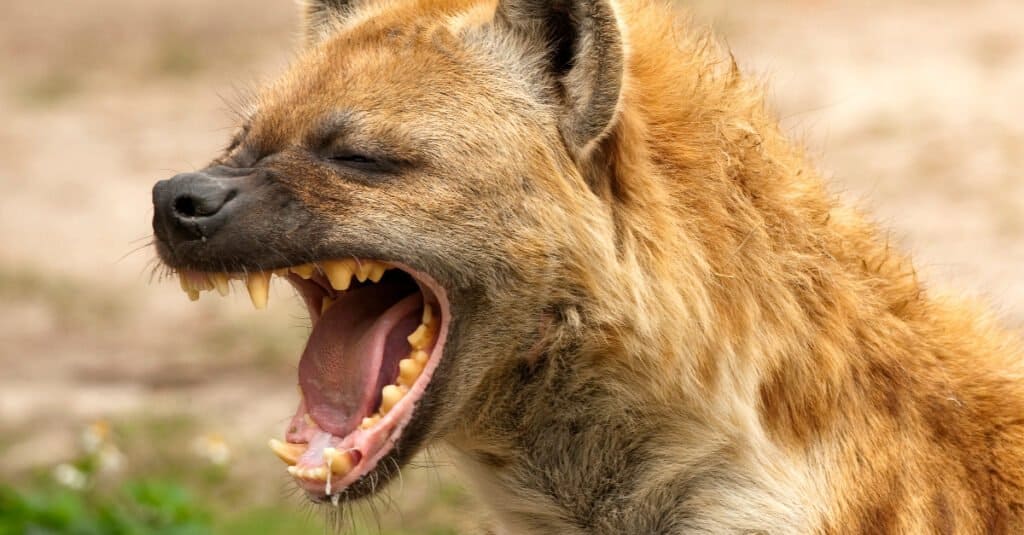
Hyena Teeth- Hyena

In some parts of Somalia, Hyenas are a delicacy.

  • Talking hyenas are a staple in Disney animated features, including Dumbo, Lady and the TrampNoah’s Ark, Bedknobs and Broomsticks, and, of course, The Lion King.
  • In 1999, the lions and hyenas of Ethiopia’s Gobele wilderness went to war. The situation grew so deadly that the military intervened. In the end, the lions killed 35 hyenas, and the hyenas managed to kill six lions.
  • In some parts of Somalia, these animals are a delicacy.
  • Some species have bright white feces due to the large number of calcified bones they eat.
  • Females dominate in spotted hyena clans.
  • Contrary to popular belief, hyenas have more in common with cats than dogs.
  • The 26th president of the United States, Teddy Roosevelt, maintained an animal menagerie that included a hyena.
  • Ancient Greeks and Romans believed hyena parts were effective shields against evil and ensured fertility.
  • Hyenas have one of the strongest bite forces in the animal kingdom. The spotted hyena has a bite force of 1,100 PSI, which is slightly below a polar bear‘s bite force of 1,200 PSI. Hyenas have a bite force that’s greater than lions.

You can check out more incredible facts about hyenas.

Scientific Name
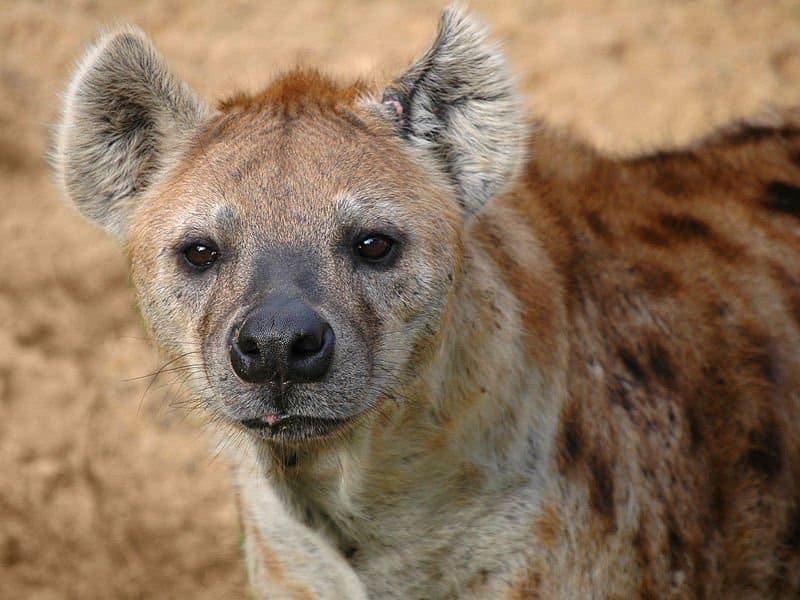
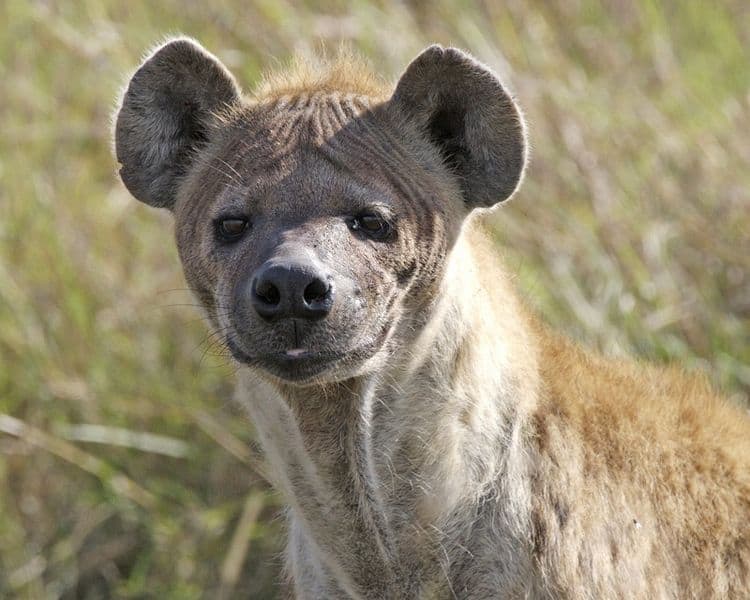
Hyena looking for prey

The scientific name for hyena is Hyaenidae.

The scientific name for hyena is Hyaenidae, which doubles as the animal’s taxonomic family that includes four extant species dispersed over three genera.

These include:

  • Spotted hyena (Crocuta crocuta)

Evolution and Origins

The earliest Hyena evolved from civet-like ancestors about 15 million years ago. Although Hyenas do have a bit of canine blood within their genetics, they are actually more closely related to felines. In fact, the order carnivore branched out into dogs and cats about 50 million years ago and hyenas evolved from that group.

Aardwolf Scientific Name
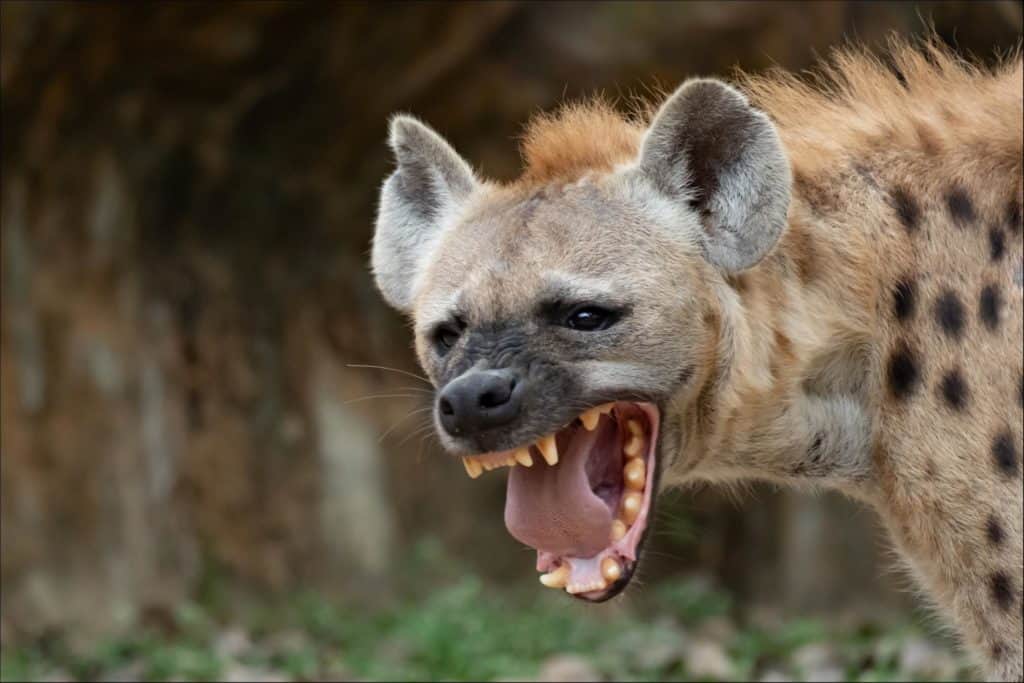
Hyena laughing

The scientific name for aardwolves — which means “earthwolves” in the Afrikaans and Dutch languages — is Proteles cristata.

The scientific name for aardwolves — which means “earthwolves” in the Afrikaans and Dutch languages — is Proteles cristata. Proteles is a portmanteau of two ancient Greek words, teleos and protos, which roughly translate to “complete” and “front or first,” respectively. Combined, they mean “complete in front,” a reference to the aardwolf’s five-toed front feet.

Cristata derives from the Latin word “cristatus,” which means “provided with a comb,” a reference to the animal’s mane.

Other names for aardwolf include “maanhaar-jackal,” “any hyena,” “termite-eating hyena,” and “civet hyena.” The Nama people use “|gīb” to label the animal.

Brown Hyena Scientific Name
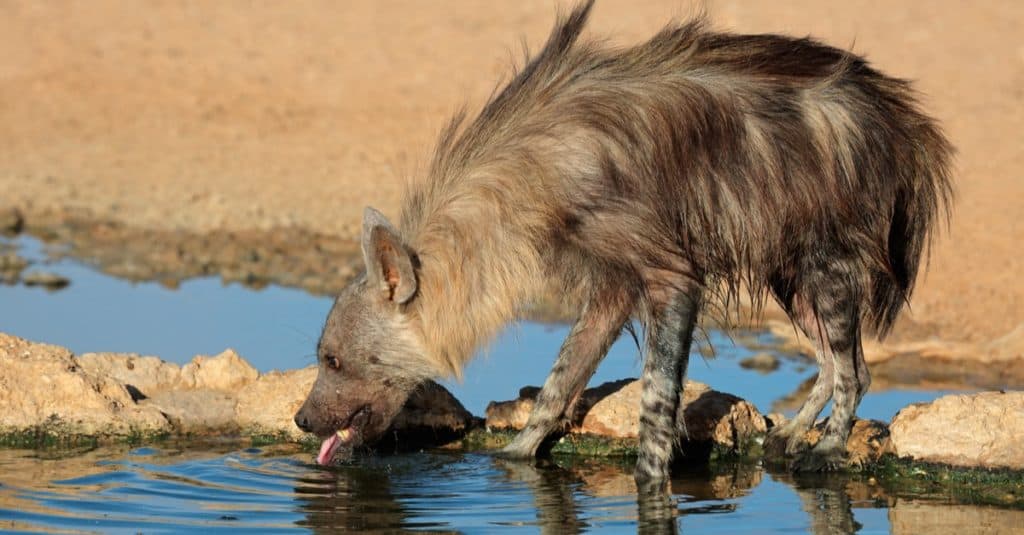
A brown hyena (Hyaena brunnea) drinking water, Kalahari desert, South Africa

A brown hyena (Hyaena brunnea) drinking water, Kalahari desert, South Africa

Hyaena brunnea is the scientific name for the brown hyena. Hyaena derives from the ancient Greek word “hyaina,” which evolved from “hys,” meaning hog or pig. Under the Roman pen, hyaina became hyaena, and when Middle English emerged as the prominent language, hyaena morphed into hyena.

Brunnea comes from the Latin word “brunneus,” which means “brown.”

Brown hyenas are also known as strandwolves.

Spotted Hyena Scientific Name
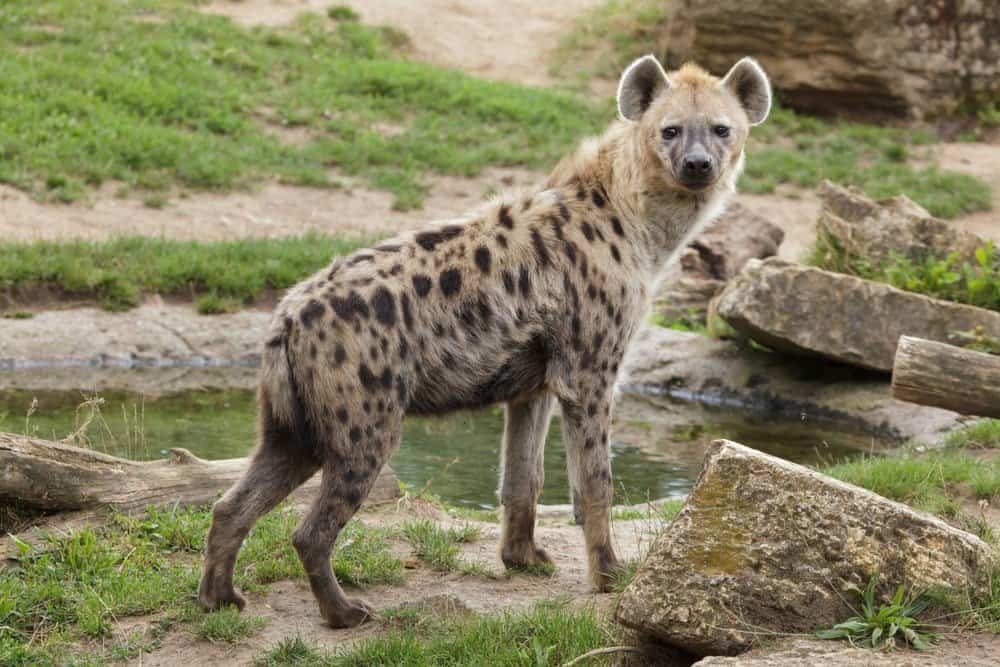
Ugliest Animal - Spotted hyena

The scientific name for the spotted hyena is Crocuta crocuta.

The scientific name for the spotted hyena is Crocuta crocuta. For decades, people thought “crocuta” came from the Latin word “crocutus,” which means “saffron-colored one,” but they were wrong. The taxonomic label for spotted hyenas comes from the ancient Greek word “Κροκόττας,” which translates to “golden jackal.”

Colloquially, spotted hyenas are also known as laughing hyenas.

Striped Hyena Scientific Name

Hyaena hyaena is the scientific name for striped hyenas. As we discussed under the brown hyena section, Hyaena derives from the ancient word “hyena,” which relates to wild pigs. The Greeks associated the two animals because they both had manes.

Appearance
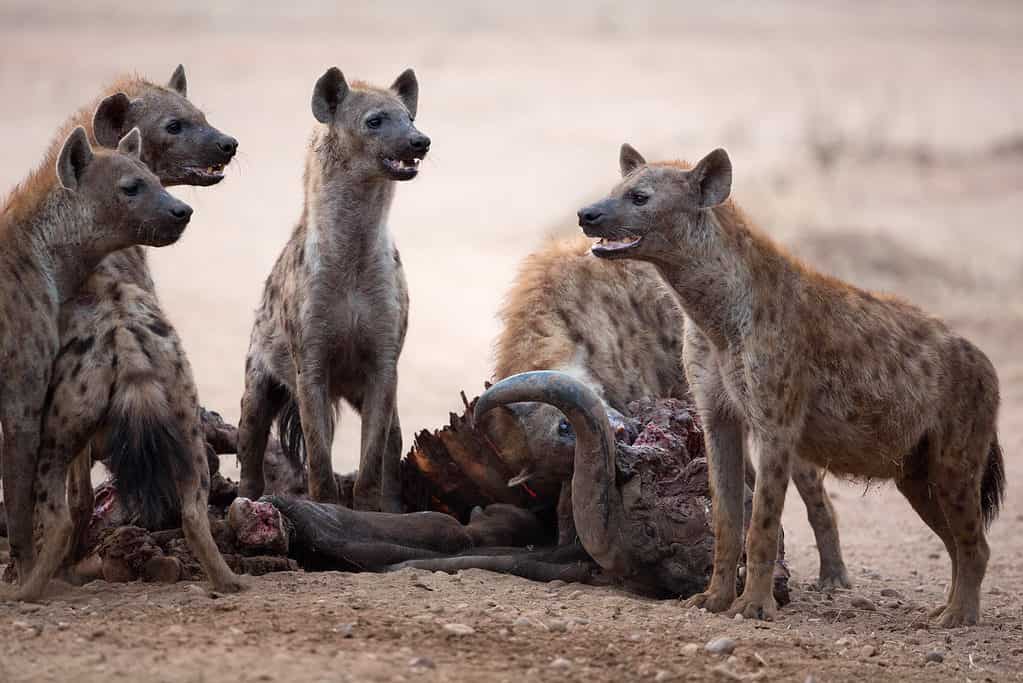
Group of feeding hyenas

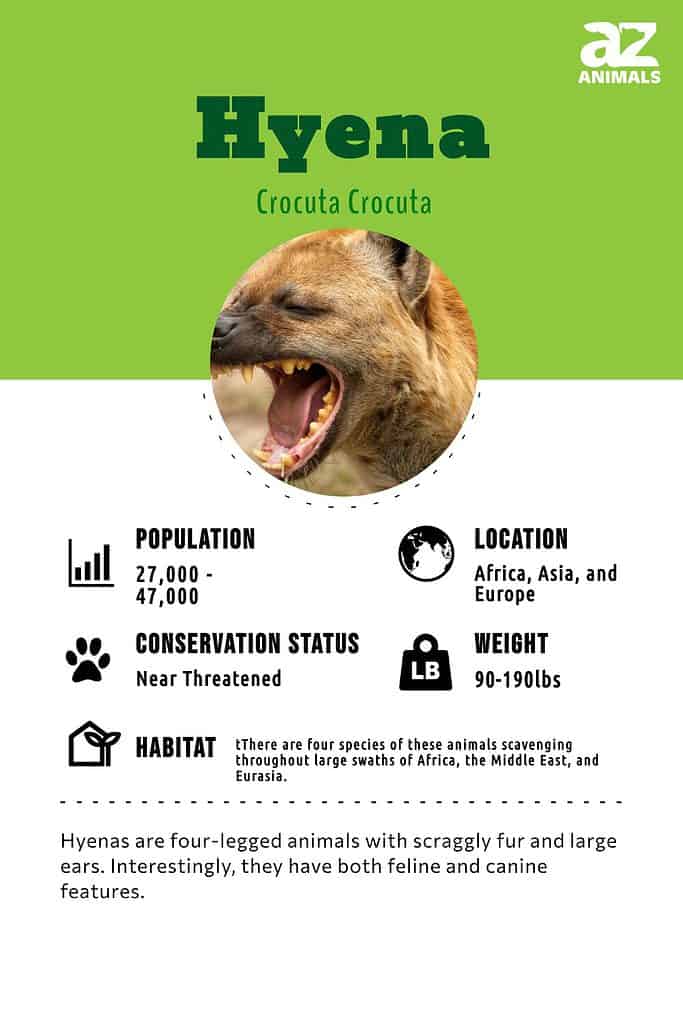
Hyenas are four-legged animals with scraggly fur and large ears. Interestingly, they have both feline and canine features.

These animals belong to the carnivorous suborder Feliformia — sometimes called Feloidea — which includes meat-eating mammals with “cat-like” physical and behavioral features. Currently, there are four species of these animals scavenging throughout large swaths of Africa, the Middle East, and Eurasia.

Generally speaking, hyenas are four-legged animals with scraggly fur and large ears. Interestingly, they have both feline and canine features, and all sport manes. They also have downward-sloping spines, long front legs, and short hind legs. Learn about the ugliest animals on earth here.

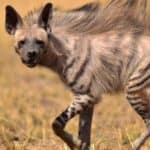
Aardwolves, and brown -, and striped hyenas have lined coats. The spotted hyena, as its name suggests, sports dotted pelage. Like dogs, their short claws are non-retractable, but they have more ribs than canids and rough tongues similar to felines.

Male individuals in the aardwolf, striped, and spotted hyena species are usually larger than their female counterparts. In the spotted variety community, however, the women are bigger. They dominate the males and even have external genitalia.

How Big Are Hyenas?
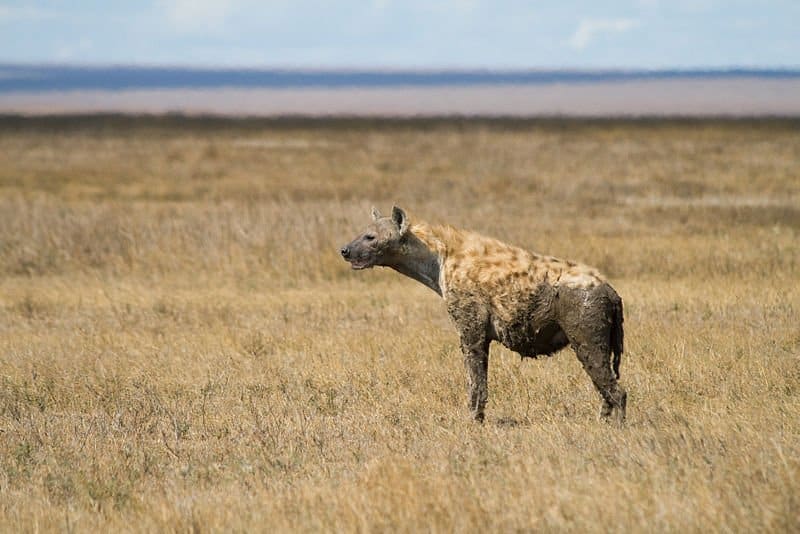
hyena (Hyaenidae) spotted hyena in savanna
Hyenas vary in size depending on the species and sex.

Hyenas vary in size depending on the species and sex.

SpeciesSexAverage HeightAverage LengthAverage Weight
AardwolfFemale16 to 20 inches22 to 31 inches15 to 22 pounds
AardwolfMale16 to 20 inches22 to 31 inches15 to 22 pounds
BrownFemale28 to 31 inches51 to 63 inches83 to 89 pounds
Brown Male28 to 31 inches51 to 63 inches89 to 96 pounds
Spotted Female28 to 36 inches37 to 65 inches98 to 153 pounds
Spotted Male28 to 36 inches37 to 65 inches89 to 149 pounds
Striped Female24 to 31 inches33 to 51 inches49 to 121 pounds
Striped Male24 to 31 inches33 to 51 inches49 to 121 pounds

Behavior

Strongest animal bite – spotted hyena

The spotted hyena is primarily a hunter, but it also scavenges for food.

Like house cats, these animals are avid groomers that also mark territory, but they use anal glands instead of urination. They’re primarily a nocturnal species, though spotted hyenas occasionally venture out during the day, especially if humans aren’t poking around.

The striped variety typically lives alone or in pairs, though some populations travel in packs of up to seven-deep. Spotted hyenas are the exception. Exceptionally sociable, they live in highly organized communities of up to 80 individuals. Matriarchal and monarchical by nature, females of the species dominate. Plus, when a pack leader dies, her oldest daughter automatically takes over!

Mostly they burrow in caves and under crevices. Striped hyenas also dig dens.

The animals vocalize loudly and frequently. However, not all species laugh, as is often assumed. In fact, spotted hyenas are the only extant species known for laughing. Notably, they use about a dozen distinct grunts, laughs, and barks to communicate with their clan members about food and migration efficiently.

Habitat

These animals live throughout Africa, the Middle East, and parts of Asia. Aardwolves roam in southern and eastern Africa, whereas brown hyenas stick to South Africa, Namibia, and Botswana, with some overflow into Angola, Zimbabwe, and Mozambique. The spotted variety’s range is central, western, and southern Africa, though very few live in South Africa. Striped hyenas cover northern Africa, the Middle East, and large swaths of India.

Aardwolves live in bushlands and heavily grazed arid plains where termites — an essential part of their diet — are plentiful. Typically, aardwolves stay in the same place for about six weeks and cluster their dens together.

Deserts and coastal lands are where you’ll find the brown variety, whereas spotted populations favor woodlands, savannahs, semi-deserts, and hilly forests below 4,000 meters. Striped hyenas prefer dry woodlands in mountainous regions, savannahs, and dense grasslands. Typically, they make dens in rocky outcrops, ravines, and crevices.

Diet
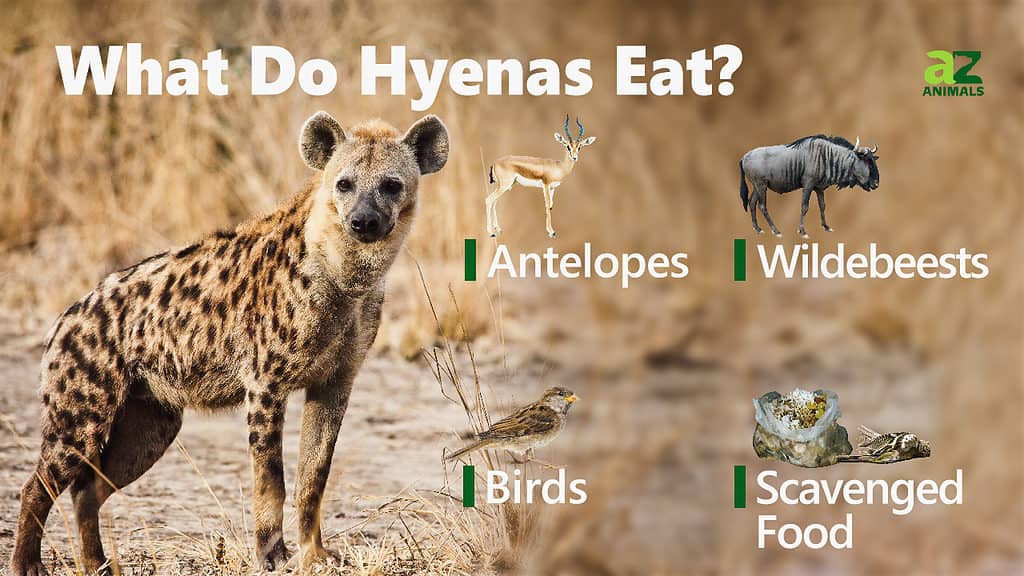
These animals are primarily scavengers, but they also kill prey. As carnivores, they mostly consume meat but have been known to supplement their diets with fruit in tough times. They are also members of the “clean plate club,” meaning they eat every last bit of a kill, including bones and hooves. Plus, they aren’t particularly picky about what type of meat they eat.

These animals have digestive systems made of steel! So much so that field scientists and anthropologists often report them feasting on inanimate objects, like tires and tent materials.

Aardwolf Diet

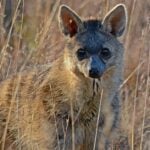
Aardwolves’ primary source of nourishment is termites from the genus Trinervitermes. Using sound and scent clues, aardwolves locate the crawlers and lick them off the ground using their sticky tongues.

In a single night, an individual aardwolf may consume upwards of 250,000 insects. Conscious of their constant need for sustenance, aardwolves never eat an entire pile of termites. Instead, they leave it partly intact, and the mound serves as a replenishing source.

The aardwolf diet differs from other hyena species because it doesn’t include any carrion, which is the meat of an already-killed animal. Instead, aardwolves stick to insects and larvae.

Brown Hyena Diet

These animals aren’t great hunters. As such, they rely on carcasses killed by other predators. They also supplement their meals with rodents, insects, eggs, fruit, and fungi.

Spotted Hyena Diet

Spotted hyenas, arguably the most aggressive Hyaenidae species, differ from their cousins because they primarily hunt prey instead of sticking to carrion. Except for spotted populations in west Africa, who largely scavenge for meat, the species preys on large, hooved, plant-eating animals, including, but not limited to, wildebeests, giraffes, gazelles, impalas, gemsboks, sheep, goats, and cattle. They’ve also been known to catch fish, and, on rare occasions, humans!

These animals have huge appetites. A single individual can pack away up to 32 pounds of meat in a single feeding!

Striped Hyena Diet

These animals are scavengers who eat almost any meat, though they turn their noses up at vulture flesh. They also feast liberally on bones and bone marrow.

Predators and Threats
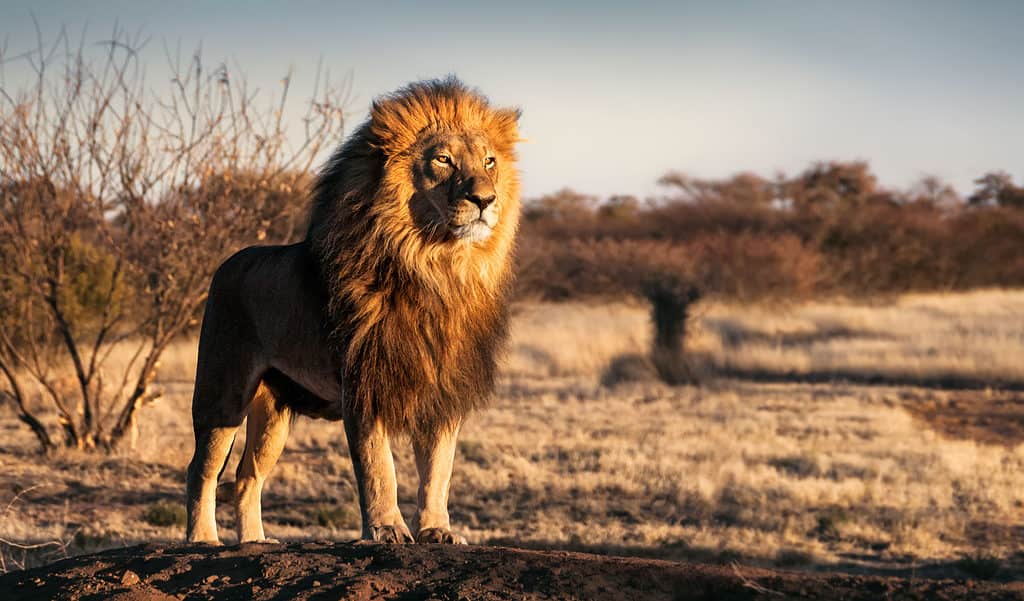
Male lion standing proudly

Lions will kill hyenas to reduce food source competition.

Lions are These animals’ primary foes even though the former usually don’t eat the latter. But lions see them as fellow apex predators and will kill them to reduce competition. Similarly, in the Middle East, striped hyenas compete with wolves for food. But at times, the two animals cooperate and travel in joint-species hunting packs.

Leopards also prey on these animals in certain regions.

According to conservationists, aardwolf and spotted hyenas currently enjoy stable wild populations and don’t face imminent extinction. Striped and brown varieties aren’t as fortunate because humans are increasingly encroaching on their natural habitats and killing them at alarming rates using traps, poison, and wire snares.

Farmers often eliminate brown hyenas in retaliation for livestock deaths. In reality, though, they don’t kill prey; they only scavenge for dead animals, which sometimes include already deceased livestock.

Reproduction, Babies, and Lifespan
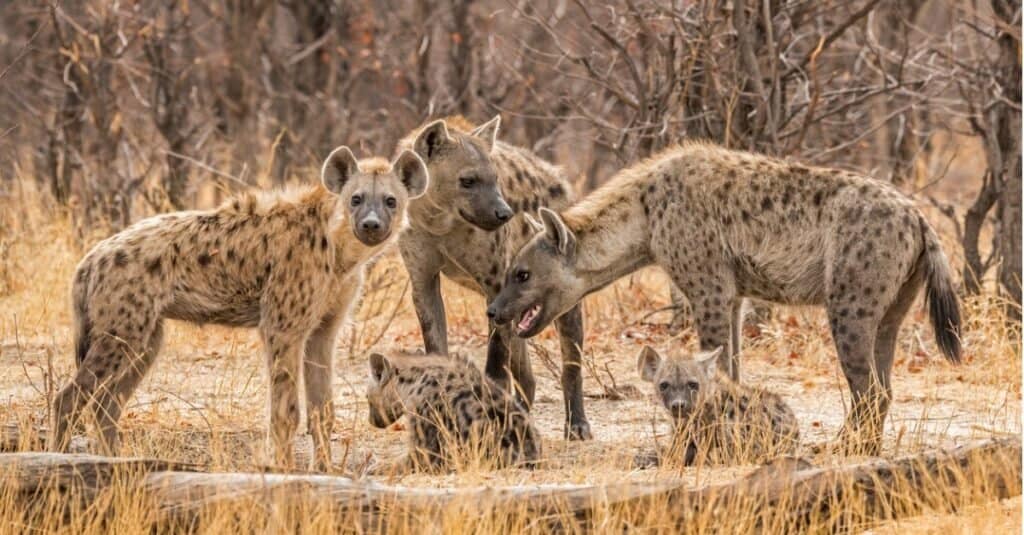
Hyena Birth - hyena pack

Hyenas (Crocuta crocuta) on the Khwai River in Botswana, Africa. One of the problems of a hyena birth is that the female does not have a typical vaginal opening.

Reproduction

Spotted, brown, and aardwolf hyenas copulate with several partners in a lifetime. Striped hyenas, on the other hand, are monogamous, meaning they mate with the same partner for most of their lives.

For the spotted variety, mating is an awkward and tricky process since both males and females have genitalia on the outside of their bodies. The male has to position himself just right in order to successfully mate with the female. This process often is described as a dance because of all the jumping around he has to do.

SpeciesGestation PeriodMating SeasonLitter SizeParental Responsibility
Aardwolf89 to 92 daysSpring or Autumn depending on location; July in South Africa2 to 5 cubsBoth parents raise cubs
Brown 90 daysMay to August, but occasionally mate out of season1 to 5 CubsMales help provide food for cubs
Spotted 110 daysAll year, but prefer the wet season2 CubsNo male help
Striped 90 to 91 daysEither January and February or October and November depending on the location1 to 6 CubsBoth parents raise cubs

Babies

The babies are called cubs. At birth, aardwolves, and brown, and striped hyenas are born with closed eyes and require adult help. Spotted hyenas, however, are born fully developed, with open eyes and teeth!

Lifespan

These animals usually live for about 12 years, but they can live up to 25 years. Brown hyenas, however, typically have shorter lives.

The oldest specimen ever was a male spotted hyena named Mars who lived in the Honolulu Zoo with his brother, Whoops. Both arrived in 1992, and both had unusually long lives. Mars broke the record with 28.5 years, and Whoops made it to 26!

Population

According to the International Union for the Conservation of Nature, aardwolves and spotted hyenas are populations of least concern, meaning they’re currently not in danger of extinction. However, brown and striped hyenas are classified as near threatened, and scientists are employing conservation efforts to combat declining population numbers.

View all 287 animals that start with H

Sources

  1. David Burnie, Dorling Kindersley (2011) Animal, The Definitive Visual Guide To The World's Wildlife / Accessed November 10, 2008
  2. Tom Jackson, Lorenz Books (2007) The World Encyclopedia Of Animals / Accessed November 10, 2008
  3. David Burnie, Kingfisher (2011) The Kingfisher Animal Encyclopedia / Accessed November 10, 2008
  4. Richard Mackay, University of California Press (2009) The Atlas Of Endangered Species / Accessed November 10, 2008
  5. David Burnie, Dorling Kindersley (2008) Illustrated Encyclopedia Of Animals / Accessed November 10, 2008
  6. Dorling Kindersley (2006) Dorling Kindersley Encyclopedia Of Animals / Accessed November 10, 2008
  7. David W. Macdonald, Oxford University Press (2010) The Encyclopedia Of Mammals / Accessed November 10, 2008
Rebecca Bales

About the Author

Rebecca Bales

Rebecca is an experienced Professional Freelancer with nearly a decade of expertise in writing SEO Content, Digital Illustrations, and Graphic Design. When not engrossed in her creative endeavors, Rebecca dedicates her time to cycling and filming her nature adventures. When not focused on her passion for creating and crafting optimized materials, she harbors a deep fascination and love for cats, jumping spiders, and pet rats.
Connect:

Thank you for reading! Have some feedback for us?


Hyena FAQs (Frequently Asked Questions)

Hyenas are primarily carnivores that subsist on meat and bones. However, aardwolves stick to termites and larva, and several hyena species will supplement their diets with fruit to get through lean times.