


I
Species Profile

Ibis

Threskiornithidae

Probe, sweep, and thrive in wetlands
Plcon555 - Public Domain

Ibis Distribution

Click a location to explore more animals from that region

Invasive Species
Loading map...

Size Comparison

Human 5'8"
Ibis 2 ft 4 in

Ibis stands at 41% of average human height.

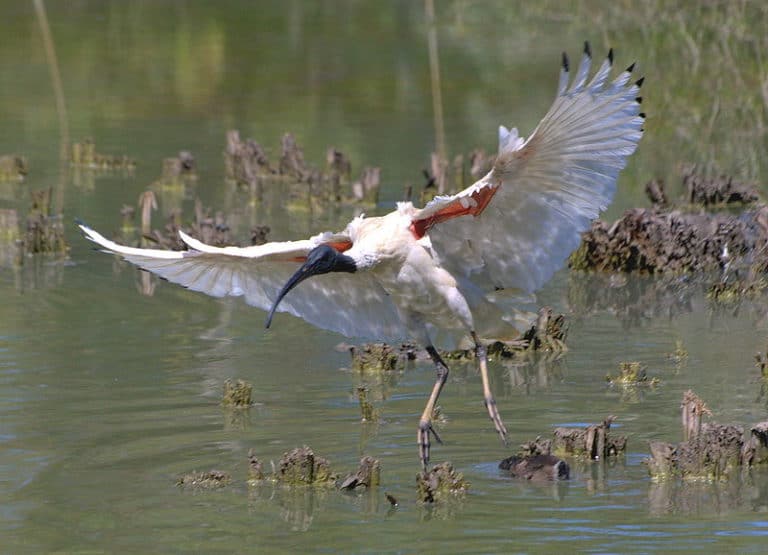
Australian Ibis looking for prey

At a Glance

Family Overview This page covers the Ibis family as a group. Stats below are general traits shared across the family.
Also Known As ibis, spoonbill, wader, wading bird, bin chicken, tip turkey
Diet Omnivore
Activity Diurnal+
Lifespan 15 years
Weight 4.2 lbs
Status Not Evaluated
Did You Know?

Threskiornithidae includes both "classic" decurved-billed ibises and flat-billed spoonbills-close relatives in one family.

Scientific Classification

Family Overview "Ibis" is not a single species but represents an entire family containing multiple species.

Ibises are long-legged, long-necked wading birds with characteristically long, decurved bills used to probe mud or shallow water for prey. In modern classification they are placed in the family Threskiornithidae, which includes both ibises and spoonbills.

Kingdom
Animalia
Phylum
Chordata
Class
Aves
Order
Pelecaniformes
Family
Threskiornithidae

Distinguishing Features

  • Long legs and neck suited to wading
  • Long, usually down-curved bill (ibises); spoonbills in the same family have broadened spoon-shaped bills
  • Foraging by probing or sweeping bill through shallow water/mud
  • Often gregarious, nesting and roosting in colonies

Physical Measurements

Males and females differ in size

Height
2 ft 7 in (1 ft 4 in – 3 ft 11 in)
1 ft 12 in (1 ft 2 in – 2 ft 11 in)
Length
2 ft 6 in (1 ft 6 in – 3 ft 7 in)
2 ft 6 in (1 ft 6 in – 3 ft 5 in)
Weight
3 lbs (1 lbs – 10 lbs)
3 lbs (1 lbs – 9 lbs)
Tail Length
6 in (4 in – 10 in)
6 in (4 in – 10 in)
Top Speed
43 mph
Short fast bursts; 40–60 km/h

Appearance

Primary Colors
Skin Type Feathered body with much bare skin on the face around the bill base and eyes and long unfeathered legs. Bills are hard: ibises curved, spoonbills spoon-shaped. Bare-skin color changes with age and breeding.
Distinctive Features
  • Overall build: long-legged, long-necked wading birds adapted to wetlands; body size varies across the family from small-to-medium ibises to large spoonbills.
  • Within Threskiornithidae, most ibises have long, thin bills curved downward for probing mud, while spoonbills have long bills with a wide, spoon shaped tip for sweeping in shallow water.
  • Typical measurement ranges across Threskiornithidae (smallest to largest members, generalized): total length ~45-105 cm; wingspan ~75-150 cm; mass ~0.3-2.0+ kg (variation by species, sex, season, and condition).
  • Lifespan range (generalized across the family): commonly ~10-25 years in the wild for many species; some individuals (especially in managed care) can reach ~30+ years depending on species and circumstances.
  • Legs and feet: long tarsi for wading; feet generally not strongly adapted for swimming (unlike some other waterbirds), supporting slow walking in shallow water and on mudflats.
  • Head/neck bare skin: many species show facial bare patches, throat skin, or textured facial areas; coloration may become brighter in breeding season and can be a key field mark.
  • Most ibises and spoonbills feed in wetlands (marshes, estuaries, mangroves), probing (ibises) or sweeping (spoonbills), eating worms, insects, crustaceans, small fish, and amphibians; some forage more on land or forest edges.
  • Many ibises and spoonbills are social, feeding and roosting in groups and often nesting in colonies, sometimes with other bird species. Forest ibises may be solitary or form small groups.
  • Movement patterns: includes resident, nomadic, and migratory species; some undertake long-distance seasonal movements tied to rainfall and flooding cycles, while others are relatively sedentary in stable tropical wetlands.
  • Global distribution: family-wide, the group is widespread across warm-temperate to tropical regions on multiple continents; species occupy diverse wetland types from coastal mudflats (many spoonbills) to inland swamps and even forested wetlands (some Bostrychia).
  • Ibises and spoonbills (Threskiornithidae) are wetland wading birds. They share body plans but differ in bill shape and feeding—ibises probe mud, spoonbills sweep shallow water—though some genera overlap (Threskiornis, Eudocimus, Plegadis, Bostrychia).

Sexual Dimorphism

Sexual dimorphism in Threskiornithidae (ibises and spoonbills) is usually small, mostly size or bill shape (males slightly larger, longer/heavier bills). Some species show breeding changes (skin color, seasonal feathers), but many sexes have similar feather color.

  • Often slightly larger overall body size (mass and wing/chest dimensions) in many species; bill may be longer or more robust on average.
  • In some species, breeding-season bare-part coloration (face/legs/bill) can be more intense or more extensive; timing and expression vary widely.
  • May show more prominent or longer breeding plumes/ornamental feathers in species where such ornaments occur (variable; not universal).
  • Often slightly smaller with a marginally shorter or finer bill on average in many species; overlap with males is substantial.
  • In many species, plumage is essentially identical to males outside of subtle size metrics; bare-part color changes occur but may be less intense in some taxa (variable).
  • In colonial nesters, external appearance may provide limited sex cues; behavior or measurements are often needed for reliable sexing (varies by species).

Did You Know?

Threskiornithidae includes both "classic" decurved-billed ibises and flat-billed spoonbills-close relatives in one family.

They occur on every continent except Antarctica, from tropical mangroves to temperate marshes and inland floodplains.

Spoonbills often feed by sweeping their partly open bills side-to-side; many ibises feed by touch-probing in mud.

Several species nest in huge mixed colonies with herons, egrets, and storks-wetlands can host thousands of pairs.

Ibis plumage can be white, glossy dark, chestnut, or even iridescent; some show dramatic seasonal color changes.

Some ibises thrive in human-altered habitats (rice fields, city parks, rubbish dumps), while others are forest or specialist wetland birds and more sensitive to disturbance.

Their long bills are packed with sensory endings in many species, helping them detect hidden prey without seeing it.

Unique Adaptations

  • Bill specializations within one family: decurved probing bills (ibises) versus flattened spatulate bills (spoonbills) reflect different wetland-feeding mechanics.
  • Highly innervated bill tips (common in many ibises): dense sensory receptors help detect concealed prey in turbid water or mud.
  • Long legs and toes for wading: allow access to shallow water and soft substrates; stance and leg length vary across species tied to preferred water depth.
  • Salt and water balance for coastal living: many members use estuaries and tidal flats, relying on physiological mechanisms typical of seabird-adjacent wetland waders to cope with variable salinity.
  • Flexible neck and head kinematics: rapid bill closure and precise probing/sweeping movements support touch-based prey capture.
  • Colony breeding and synchronized timing: social nesting can dilute predation risk and improve mate finding; timing often tracks rainy seasons, flood pulses, or coastal productivity.
  • Plumage and bare-skin signaling: in several species, contrasting facial skin or breeding plumage aids display and recognition, though coloration varies widely across genera.

Interesting Behaviors

  • Tactile foraging: many ibises probe soft mud or shallow water, locating prey by touch; others also pick from vegetation or dry ground, showing wide dietary flexibility across the family.
  • Spoonbill sweep-feeding: spoonbills commonly swing the bill laterally through water; when prey contacts the sensitive bill edges, it snaps shut reflexively.
  • Colonial nesting: many species breed in dense colonies (often mixed-species), using trees, reedbeds, mangroves, or islands; colony size and site choice vary greatly by species and region.
  • Seasonal movements: some members are strongly migratory (especially in temperate zones), while many tropical species are resident or move locally with rains and flooding.
  • Habitat breadth: across the family, species occupy marshes, estuaries, tidal flats, floodplains, lakeshores, rice paddies, and some forest streams (notably among certain African ibises).
  • Group foraging and spacing: feeding can occur in lines, loose flocks, or dispersed individuals; spacing patterns often track water depth, prey density, and disturbance.
  • Opportunistic feeding: some species readily exploit human food sources or newly flooded fields; others remain more specialized (e.g., forest-associated or island endemics).

Cultural Significance

Ibises have been symbols of wetlands and seasonal plenty. The sacred ibis was sacred in Ancient Egypt and linked to Thoth, shown in art and mummies. In Japan the crested ibis is a symbol of saving wetlands. Ibises and spoonbills nest in colonies and mark healthy marshes, estuaries, and floodplains.

Myths & Legends

Ancient Egypt: the sacred ibis was associated with Thoth, the god of wisdom and writing; ibises were depicted in temple art and mummified as offerings in devotion to him.

Medieval and early modern European bestiaries: the "ibis" was sometimes portrayed as a marsh bird linked to purification themes and the cleansing of foul places-an emblematic, moralized role in bestiary tradition.

Japan: the crested ibis appears in regional folklore and place-based traditions as a bird of rice landscapes; in modern cultural memory it became a symbol of loss and return tied to countryside renewal.

Classical-era natural history lore: Greco-Roman writers treated the ibis as an Egyptian bird with special powers against pests, a tradition repeated for centuries in later texts and anecdotes.

Heraldry and symbolism (various regions): ibis-like birds and spoonbills have been used as wetland emblems in local insignia and storytelling about marshlands, abundance, and seasonal waters.

Conservation Status

NE Not Evaluated (family-level entity; individual Threskiornithidae species range from Least Concern to Critically Endangered on the IUCN Red List)

Has not yet been evaluated against the criteria.

Population Unknown

Protected Under

  • Mixed/partial protection at the family level: many species and their nests are protected under national wildlife laws across range countries
  • CITES listings apply to some threatened species (varies by species and country implementation)
  • Wetland habitat protection via site-based mechanisms such as Ramsar Convention designations (where applied)
  • Protected areas, colony protection measures, and hunting regulations are key tools but coverage/enforcement varies widely

You might be looking for:

Sacred Ibis

22%

Threskiornis aethiopicus

White-bodied African ibis with black head/neck; famous in ancient Egyptian iconography; often found in wetlands and open country.

White Ibis

20%

Eudocimus albus

Common North American coastal/wetland ibis; white plumage with red bill and legs.

Glossy Ibis

18%

Plegadis falcinellus

Widespread, dark chestnut/iridescent ibis; frequents marshes and flooded fields across multiple continents.

Hadada Ibis

14%

Bostrychia hagedash

Large African ibis known for its loud 'haa-daa-daa' call; often seen in parks and savanna woodlands.

Black-headed Ibis

12%

Threskiornis melanocephalus

South and Southeast Asian ibis; white body with bare black head; associated with wetlands and rice fields.

American White Ibis (genus Eudocimus)

8%

Eudocimus spp.

Sometimes "ibis" informally refers to the white/scarlet ibis group (genus Eudocimus) in the Americas.

Life Cycle

Birth 3 chicks
Lifespan 15 years

Lifespan

In the Wild
5–30 years
In Captivity
10–40 years

Reproduction

Mating System Monogamy
Social Structure Socially Monogamous
Breeding Pattern Seasonal
Fertilization Internal Fertilization
Birth Type Internal_fertilization

Behavior & Ecology

Social Flock Group: 30
Activity Diurnal, Crepuscular, Nocturnal
Diet Omnivore Small aquatic invertebrates-especially crustaceans and insect larvae-taken from shallow wetlands
Seasonal Migratory 1,864 mi

Temperament

Generally gregarious and tolerant of conspecifics while foraging and especially at communal roosts and colonies, but spacing and aggression increase at nest sites and during chick-rearing.
Often cautious/wary in open habitats; habituation to humans varies widely (from very tolerant in urban/agricultural settings to highly wary in hunted/disturbed areas).
Intraspecific aggression is usually low away from nesting areas; at colonies, threat postures, pecking, and displacement are common, particularly around nest materials and immediate nest vicinity.
Foraging temperament is typically persistent and methodical (probing/sweeping), with opportunistic shifts when prey is abundant; some species are more solitary/territorial, others strongly flock-oriented.

Communication

Low grunts, croaks, and rasping calls Often most frequent at breeding colonies
Begging calls from chicks and contact calls between mates/parents and young.
Occasional alarm calls; many species are relatively quiet while feeding away from colonies.
Visual displays at courtship and nesting: bowing, bill-up/bill-down postures, head shaking, wing drooping, and mutual preening; intensity and repertoire vary among species.
Bill interactions (e.g., bill clattering/tapping or ritualized bill gestures) and nest-material presentation during pair bonding.
Aerial displays and group circling near colonies/roosts; synchronized departures/arrivals at communal roosts.
Spatial signaling via stance and short lunges to defend small nest areas; chicks often aggregate into nursery groups where recognition relies on proximity, calls, and repeated parent-young interactions.

Habitat

Biomes:
Wetland Freshwater Marine Savanna Tropical Rainforest Tropical Dry Forest Temperate Grassland Temperate Forest Mediterranean Desert Hot Desert Cold Alpine +6
Terrain:
Coastal Riverine Plains Valley Island Muddy Sandy +1
Elevation: Up to 16404 ft 3 in

Ecological Role

Wading wetland predators and opportunistic foragers whose diets span benthic/aquatic invertebrates to small vertebrates, with some species also taking plant material; collectively they link aquatic and terrestrial food webs and respond strongly to wetland water-level dynamics (with notable interspecific and regional variation).

Regulation of aquatic and soil invertebrate populations (including pest insects in some landscapes) Trophic transfer between wetlands and adjacent habitats (movement of nutrients/energy via foraging and roosting) Nutrient cycling and localized enrichment of wetlands/roost sites through guano deposition Bioindicators of wetland health and hydrological change (sensitive to water quality and prey availability) Occasional seed dispersal via incidental fruit/seed consumption (minor and variable across species)

Diet Details

Main Prey:
Aquatic insects and insect larvae Crustaceans Mollusks Worms Small fish Amphibians Small reptiles Small mammals and nestling birds +2
Other Foods:
Seeds and grains Aquatic plant material Fruits/berries Human-associated foods/refuse

Human Interaction

Domestication Status

Wild

Danger Level

Low
  • defensive pecking or wing-strikes when handled or approached at nests/roosts (injury risk increases in breeding colonies)
  • zoonotic and hygiene risks typical of wild birds and congregations (e.g., Salmonella/Campylobacter exposure via feces; broader avian disease concerns where outbreaks occur)
  • slip/fall or habitat-associated hazards for people entering wetlands to approach birds
  • rare aircraft bird-strike risk near large roosts/flight paths (more a public safety/aviation hazard than direct aggression)

As a Pet

Not Suitable as Pet

Legality: Ibises and spoonbills are usually illegal or impractical as personal pets. Many are protected by national laws (e.g., U.S. Migratory Bird Treaty Act) and CITES. Only licensed zoos, breeders, rehab centers, or permitted aviaries may keep them.

Care Level: Expert Only

Purchase Cost: Up to $2,000
Lifetime Cost: $20,000 - $150,000

Economic Value

Uses:
Ecotourism and birdwatching (wetland reserves, coastal flats) Cultural and educational value (symbolism, zoo/aviary exhibits) Ecosystem services (predation on aquatic/terrestrial invertebrates; wetland food-web roles) Wetland indicator species value (conservation planning and monitoring) Nuisance/management costs in localized cases (crop interactions, urban roosting, invasive/feral populations)
Products:
  • limited/mostly historical: feathers and occasional subsistence meat/eggs (often now illegal or regulated)
  • modern: non-consumptive value primarily (tourism, education, conservation program funding rather than direct products)

Relationships

Ecological Equivalents 5

Animals that fill a similar ecological role in their ecosystem

Herons and egrets Ardeidae Overlap strongly in wetland foraging (wading in shallow water) and in nesting ecology (often colonial in rookeries), but herons typically spear or grab prey while many ibises probe and spoonbills sweep‑filter.
Storks
Storks Ciconiidae Share a long-legged wading lifestyle and broad wetland diets. Often use similar marshes and floodplains and exploit seasonal water-level changes.
Shorebirds Scolopacidae Niche overlap in probing mudflats for invertebrates; functional similarity in long bills and tactile feeding, though these shorebirds are generally smaller and more strictly coastal and migratory.
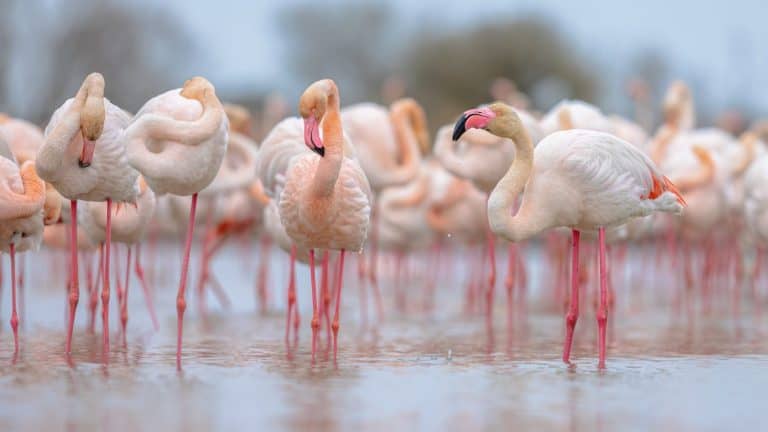
Flamingo
Flamingo Phoenicopteridae Most similar to spoonbills in shallow-water filter/sweep feeding and use of saline/alkaline wetlands; however, flamingos filter with specialized lamellae rather than a spatulate bill.
Avocets and stilts Recurvirostridae They wade in shallow water and sweep their bills side-to-side to capture small aquatic prey, exhibiting feeding mechanics comparable to spoonbills but at a smaller body size.

Types of Ibis

35

Explore 35 recognized types of ibis

African Sacred Ibis Threskiornis aethiopicus
Black-headed Ibis Threskiornis melanocephalus
Australian White Ibis Threskiornis moluccus
Madagascar Ibis Threskiornis bernieri
Reunion Ibis (extinct) Threskiornis solitarius
American White Ibis Eudocimus albus
Scarlet Ibis Eudocimus ruber
Glossy Ibis Plegadis falcinellus
White-faced Ibis Plegadis chihi
Puna Ibis Plegadis ridgwayi
Hadada Ibis Bostrychia hagedash
Wattled Ibis Bostrychia carunculata
Olive Ibis Bostrychia olivacea
Spot-breasted Ibis Bostrychia rara
São Tomé Ibis Bostrychia bocagei
Madagascar Crested Ibis Lophotibis cristata
Giant Ibis Thaumatibis gigantea
Red-naped Ibis Pseudibis papillosa
White-shouldered Ibis Pseudibis davisoni
Northern Bald Ibis Geronticus eremita
Southern Bald Ibis Geronticus calvus
Crested Ibis Nipponia nippon
Green Ibis Mesembrinibis cayennensis
Bare-faced Ibis Phimosus infuscatus
Sharp-tailed Ibis Cercibis oxycerca
Buff-necked Ibis Theristicus caudatus
Black-faced Ibis Theristicus melanopis
Plumbeous Ibis Theristicus caerulescens
Andean Ibis Theristicus branickii
African Spoonbill Platalea alba
Eurasian Spoonbill Platalea leucorodia
Royal Spoonbill Platalea regia
Yellow-billed Spoonbill Platalea flavipes
Black-faced Spoonbill Platalea minor
Roseate Spoonbill
Roseate Spoonbill Platalea ajaja

The Ibis was venerated by Ancient Egyptians as sacred, but no species of the bird currently inhabits modern Egypt.
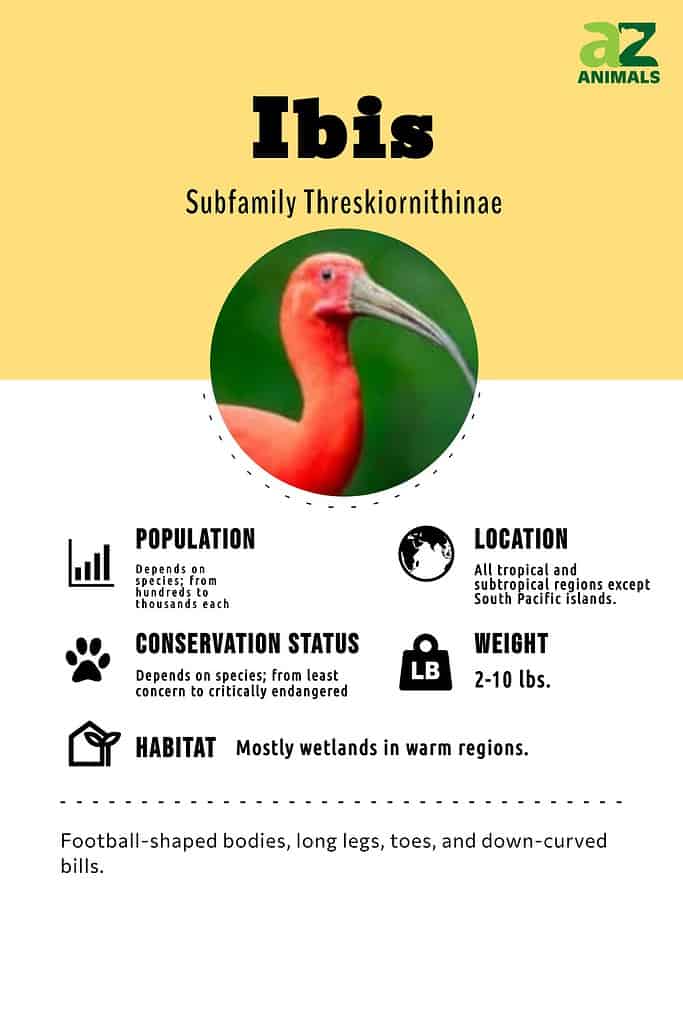
With species found across all continents minus Antarctica, the Ibis, a type of bird, is one of the best-known wading birds in the world. Nearly 30 different species are currently extant, but they vary considerably in terms of size, coloring, and other variables. A few species of Ibis are now extinct, and several species are classified as endangered.

5 Incredible Facts!

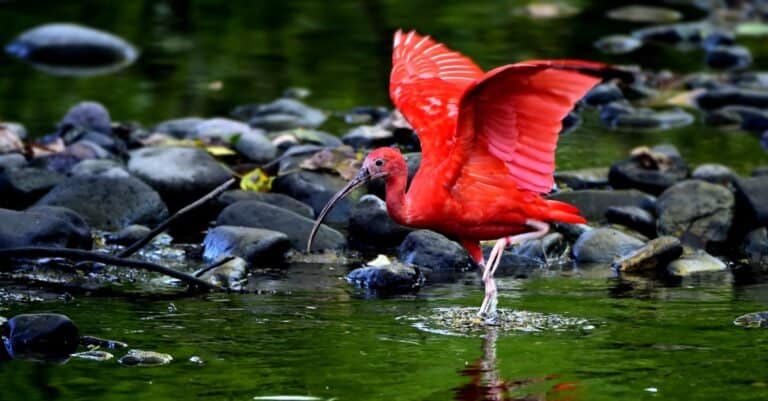
  • An Ibis bird’s coloring is primarily based on its feeding behavior and habitat. Like the flamingo, the scarlet Ibis gets its bright pink hue from its shrimp-heavy diet.
  • Ibis birds can identify food that it finds while probing with its beak without seeing it first, thanks to sensitive feelers inside its bill.
  • Most species of Ibis have bare areas, including the head, face, and chest. During breeding season, these areas turn bright red.
  • Male and female Ibises take turns incubating eggs, and they take turns feeding baby chicks.
  • Ibis birds are related to storks, and they belong to the same order, Ciconiiformes, as spoonbills.

Scientific Name
The Ibis bird belongs to the class Aves, the order Ciconiiformes, family Threskiornithidae, and subfamily Threskiornithinae. They are further subclassified into 12 different genera, with 28 extant species of the bird found across them. The term “ibis” was the traditional word that was used for this group of birds in both Latin and Ancient Greek. The word “ibis” is also related to the Egyptian term “hab,” which means “sacred bird.”

Appearance and Behavior

Ibises vary by appearance from one species to the next. However, these wading birds tend to average between 22 and 30 inches in length. The largest species, the Giant Ibis, averages more than three feet in length and weighs an average of 10 pounds. Female Ibises tend to be smaller than males, typically weighing about 10 ounces less and possessing smaller bills and shorter wings.

Despite variations in appearance across species, all Ibis birds have football-shaped bodies and long legs and toes. Their long, down-curved bills are used to probe mud and water for food. Interestingly, baby Ibises’ bills are straight at birth and start curving downward around 14 days after birth.
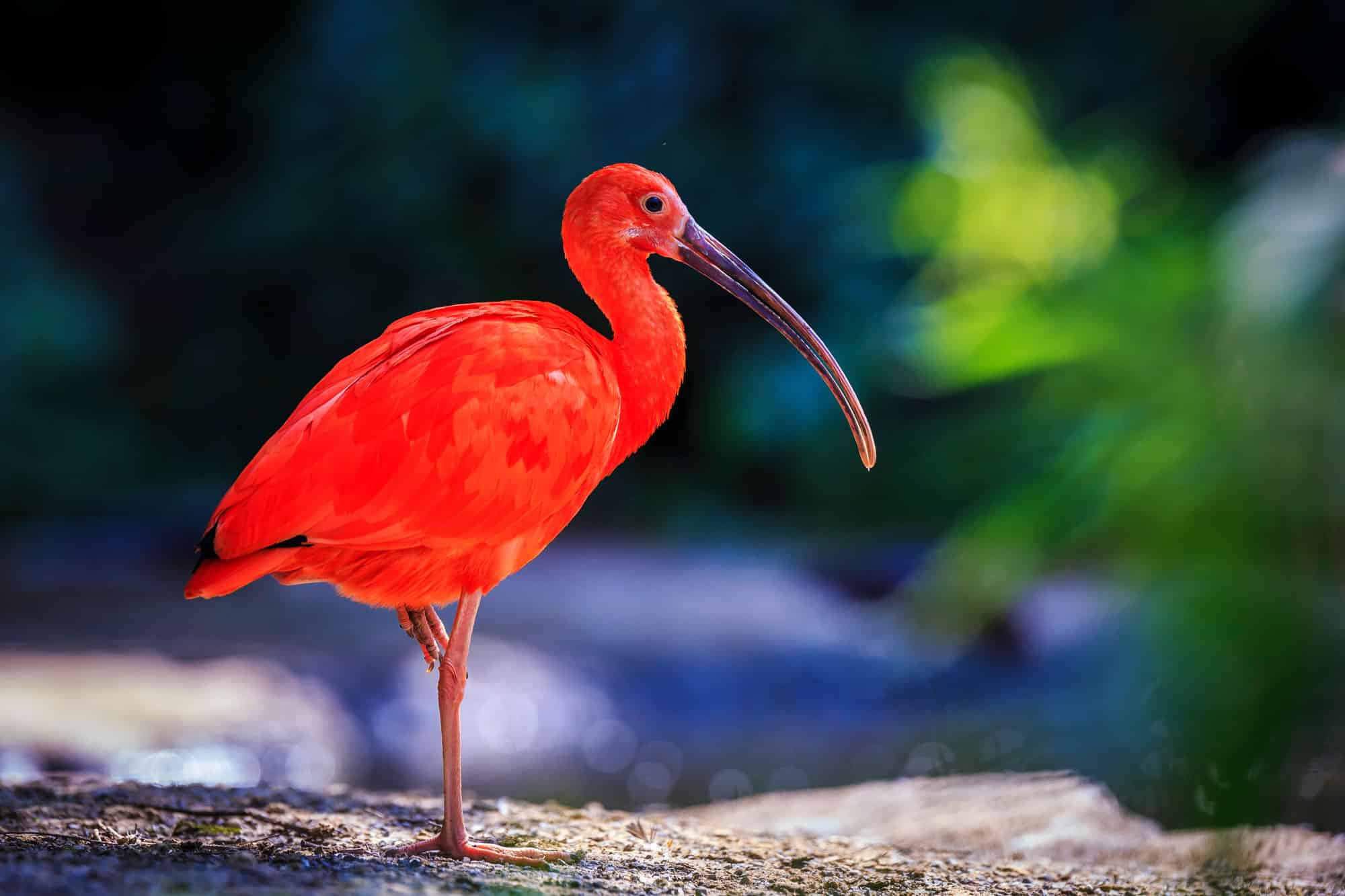
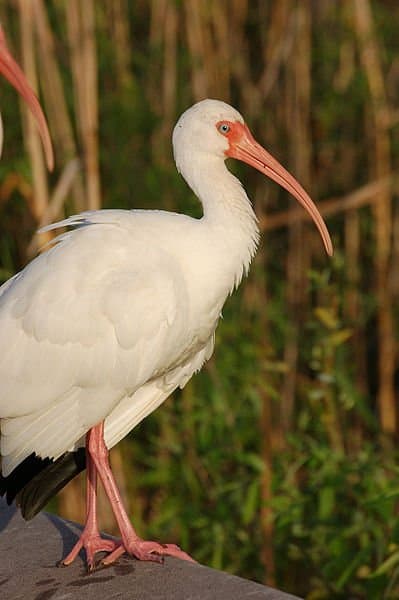
Ibises vary in color from species to species, and their coloring is also determined by their dietary habits and habitat. For example, the Scarlet Ibis’s bright pink coloring comes from the fact that it consumes large volumes of shrimp. Most Ibises have bald heads or faces, and the underlying skin turns bright red during breeding season.

These wading birds’ bills are specially designed to help them to probe the ground for food. Their nostrils are located at the base of the bill instead of the tip, which allows them to keep breathing while probing. They also use sensitive feelers within their bills to identify food that they find, eliminating the need to drop the food and look at it first.

Most species of Ibis are typically silent. However, during breeding season, they may wheeze, squeak, or breathe loudly to make their presence known. Female Ibises also sometimes use a special sound to summon their young.

Social birds, Ibises typically live together in large flocks. Primarily active during the day, flocks of Ibises spend the daylight hours feeding, resting, and preening. All extant species of the bird are capable of flight, and they fly together in flocks from roosting sites to feeding sites and back again. They sometimes fly in straight-line formations and sometimes in V-shaped formations. Incredibly, Ibises in flight beat their wings in unison and even transition between flapping and gliding at the same time. While in flight, Ibises keep their necks and legs extended, alternating between flapping and sailing.
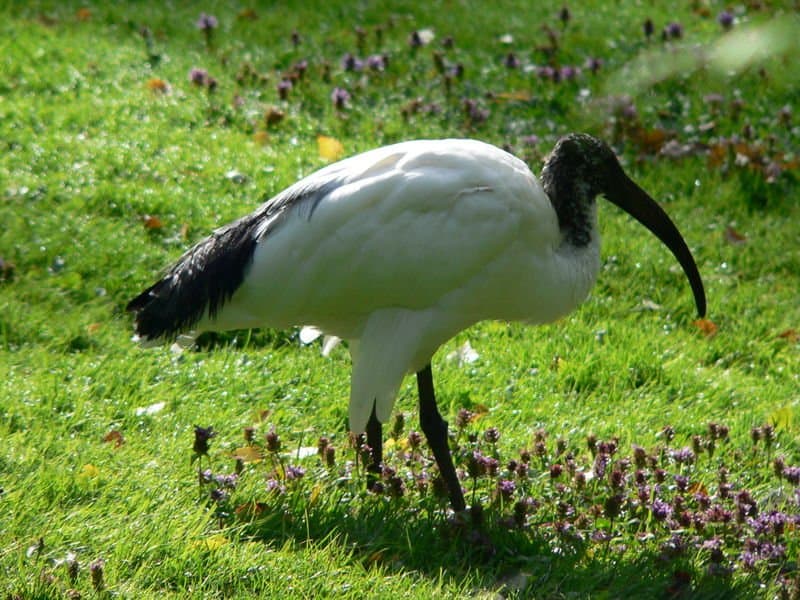
black-headed ibis (Threskiornis melanocephalus) black and white ibis in marsh
Ibises nest together in large groups that can consist of hundreds to thousands of breeding pairs.

Ibises build compact nests, usually out of sticks, in low areas of bushes and trees. Some species even build them up on cliffs. They nest together in large groups that can consist of hundreds to thousands of breeding pairs.

During the breeding season, which varies by species and habitat, individual flocks of Ibises converge to form massive colonies. Some species of Ibis mate with the same partner from year to year while others mate with new partners every year. Both parents prepare the nest for eggs. Females typically lay three to five eggs per season and the incubation period averages between three to four weeks. During this time, both parents take turns incubating the eggs.

After hatching, the chicks usually have brown, gray, or black down. Both parents take turns feeding the chicks by letting each chick reach its head inside the parent’s mouth and retrieve regurgitated food. Ibis chicks fledge at anywhere from 28 to 56 days on average, and they become fully independent anywhere from one to four weeks after that. However, some species of Ibis stay with their parents for much longer to learn the finer points of things like migration patterns and feeding strategies.

Habitat
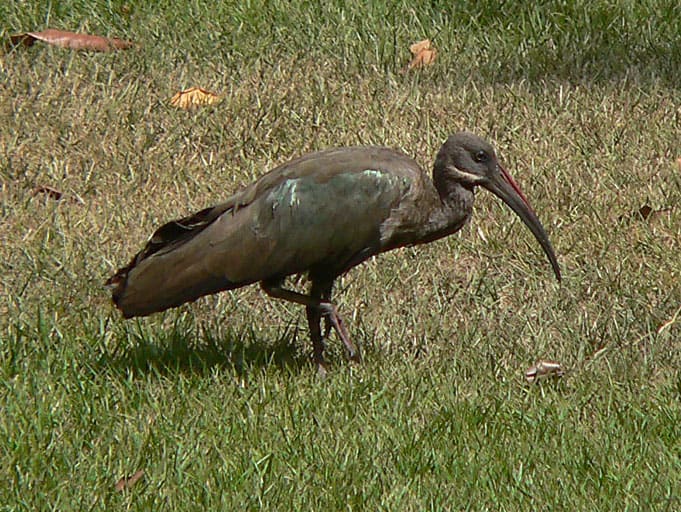
These birds are found in all warm (typically tropical to subtropical) regions of the world except for the islands of the South Pacific. They are most commonly found in wetlands, but they are also found in farmlands, open meadows, grasslands, and forested areas. Although most Ibis habitats are found at sea level, some Ibis are located in mountainous regions.

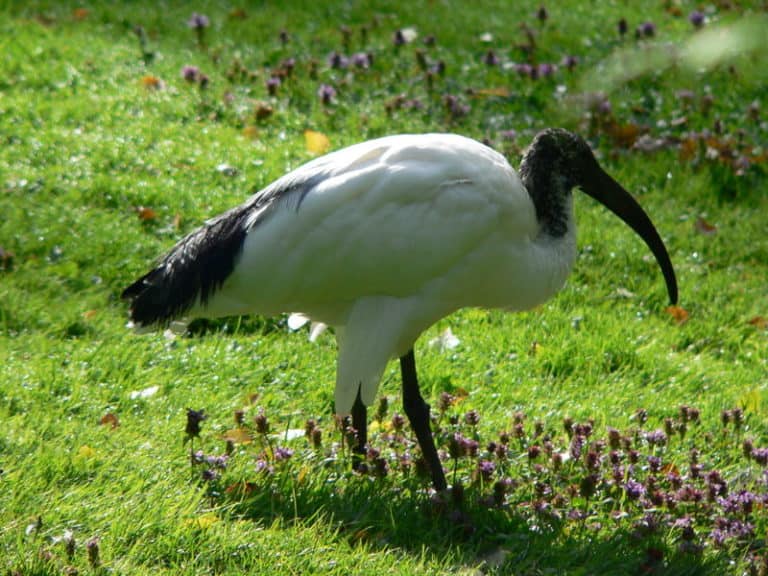
Three species of Ibis are commonly found in North America: the Glossy Ibis, Plegadis falcinellus Plegadis chihi Eudocimus albus. Some, like the Hadada Ibis, are found in Africa. Others, like the Hermit Ibis, Geronticus eremita, are found in North Africa and the Middle East. One species called the Straw-necked Ibis, Threskiornis spinicollis, is found only in Australia. The sacred Ibis, Threskiornis aethiopica, was revered in Ancient Egypt. Today, the species is no longer found in Egypt, but is located primarily in Southern Arabia and in Sub-Saharan Africa.

Diet

These birds are opportunistic feeders, which means that they will eat just about anything that they come across as long as it is edible. For the most part, however, they tend to be more carnivorous and subsist primarily off insect larvae, worms, shrimp, beetles, grasshoppers, small fish, and soft crustaceans. Occasionally, these birds may consume algae and aquatic plants too, but those organisms rarely make up much of their diet.

Predators and Threats
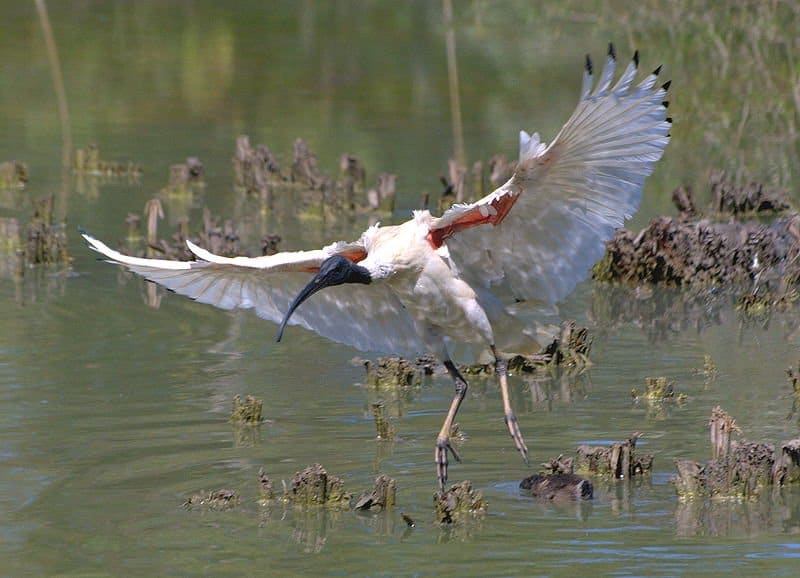
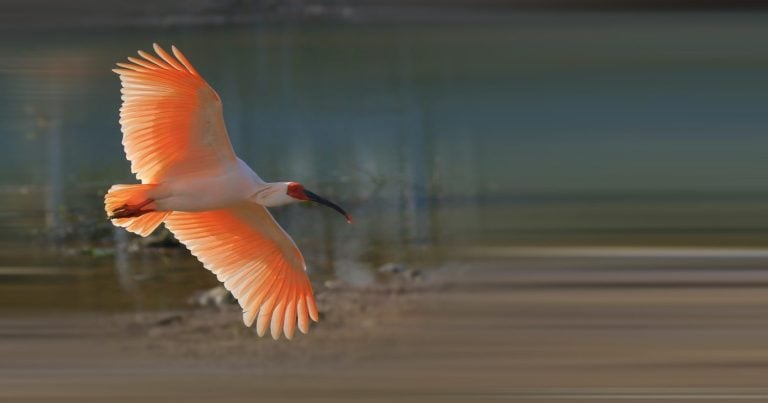
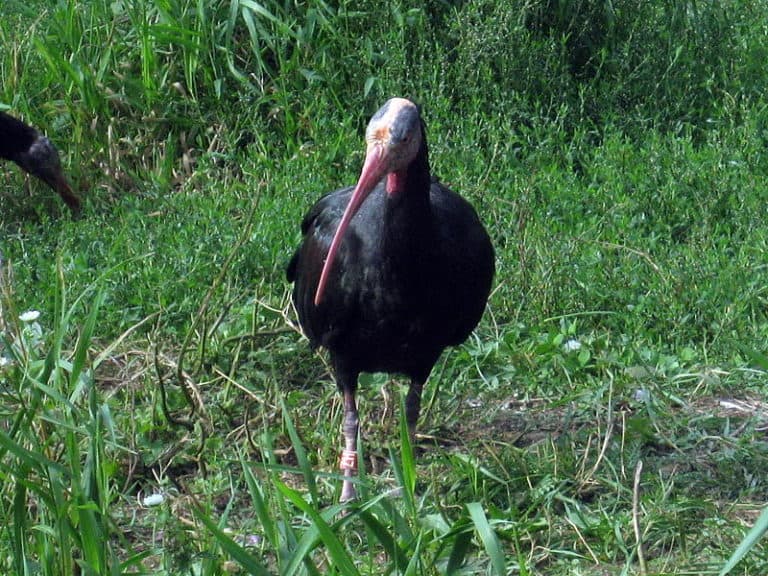
Most Ibis species are widespread and abundant in many parts of the world. However, some are considered to be endangered. The Hermit Ibis of Northern Africa and the Middle East, for example, is classified as endangered by the International Union for the Conservation of Nature (IUCN). Once found across central and southern Europe, Algeria, and Turkey, this species is now only found in Turkey and Morocco. Another endangered species of Ibis called the Japanese or Crested Ibis, Nipponia nippon, was at the verge of extinction near the end of the 20th century. Several species are also listed as facing critical risk, including the Giant Ibis, the Dwarf Olive Ibis, the Waldrapp or Northern Bald Ibis, and the White-Shouldered Ibis.
There are 28 extant, or currently existing, species of Ibis across the world. Six species have gone extinct, including two that were flightless birds – apteribis of the Hawaiian islands and xenicibis of Jamaica, which had club-like wings.

Ibises face various predators depending on their habitat. Common predators of the Ibis include birds of prey, monkeys, crows, snakes, and iguanas. Factors that may negatively impact population levels include intense hunting; drainage of wetland habitats; use of pesticides; and commercial logging of nesting sites. Ibis eggs and Ibis chicks also often fall out of nests.

Reproduction, Babies, and Lifespan
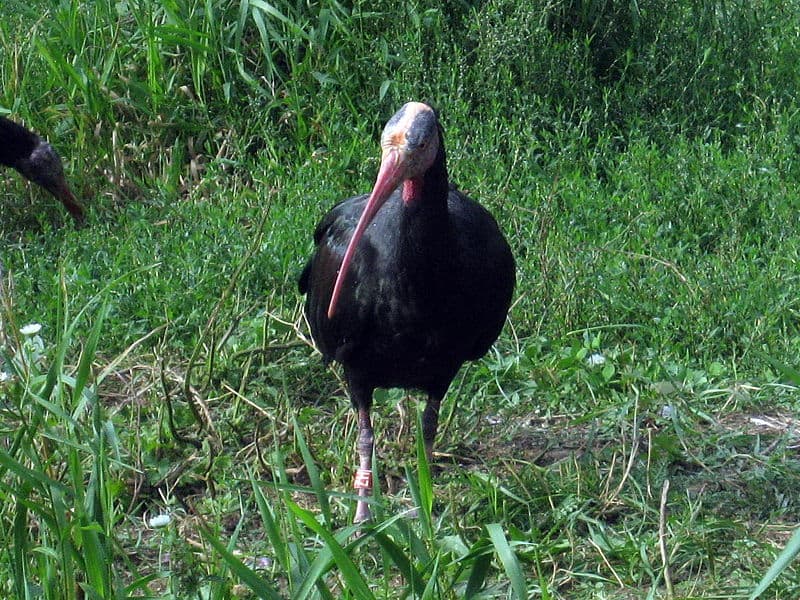
On average, Ibises live for anywhere from 16 to 27 years. The oldest recorded White Ibis to be found in the wild was at least 16 years and four months old. Located in Florida in 1972, the bird had been banded in Alabama in 1956.

The breeding season varies by species, geographic location, and other factors. When it is time to breed, individual Ibis flocks come together to form huge breeding colonies. During breeding season, these normally silent birds become a lot noisier. They emit sounds like wheezes and squeaks to attract attention from potential mates. Some ibis species mate with the same partner from year to year while others mate with different partners every year.

The male and female ibis work together to prepare the nest for eggs using reeds, twigs, and grass. When the eggs arrive – usually anywhere from three to five are laid per season – both parents take turns incubating them. The incubation period lasts for anywhere from three to four weeks. Chicks are then cared for by both parents. The male or female ibis consumes food and then regurgitates it into its mouth. The chick then reaches its head into the parent’s mouth to retrieve the food.

Ibis chicks begin fledging (developed enough for flight) anywhere from 28 to 56 days after being born. It then typically takes another one to four weeks for the birds to become completely independent of their parents. However, some species of ibis remain with their parents for even longer periods of time.

Population

Population levels for most species of Ibis have held steady. However, some species have become endangered, and the primary culprit is the loss of habitat. Commercial logging activities eliminate nesting sites, causing population levels to drop. Wetland habitats are often drained for human habitation, eliminating safe areas for Ibises to flourish. The birds are also intensely hunted in some areas, and their eggs may also be negatively impacted by the widespread use of pesticides.

Efforts have been made to improve Ibis population levels for threatened species. For example, the Waldrapp Ibis, or Bald Ibis, was once classified as critically endangered by the IUCN. Thanks mostly to successful captive breeding programs, this species is now listed as endangered.

View all 59 animals that start with I

Sources

  1. David Burnie, Dorling Kindersley (2011) Animal, The Definitive Visual Guide To The World's Wildlife / Accessed November 4, 2009
  2. Tom Jackson, Lorenz Books (2007) The World Encyclopedia Of Animals / Accessed November 4, 2009
  3. David Burnie, Kingfisher (2011) The Kingfisher Animal Encyclopedia / Accessed November 4, 2009
  4. Richard Mackay, University of California Press (2009) The Atlas Of Endangered Species / Accessed November 4, 2009
  5. David Burnie, Dorling Kindersley (2008) Illustrated Encyclopedia Of Animals / Accessed November 4, 2009
  6. Dorling Kindersley (2006) Dorling Kindersley Encyclopedia Of Animals / Accessed November 4, 2009
  7. Christopher Perrins, Oxford University Press (2009) The Encyclopedia Of Birds / Accessed November 4, 2009
Thank you for reading! Have some feedback for us?


Ibis FAQs (Frequently Asked Questions)

The ibis animal is a type of wading bird that can be found in warm climates across the globe. It belongs to the same family as the spoonbill and is closely related to the stork. Although a few extinct species of the ibis were flightless, all extant species of the bird are capable of flying.